A National Debt

The idea of a national theatre, one that celebrates its country’s cultural and performance heritage is a known around the world. A quick look at this list confirms that fact. The Comédie-Française in Paris, which was founded in 1680, is thought to be the world’s first national theatre, but it is clear that a theatre supported by the state is considered by most countries to be an integral part of its cultural fabric.

This month, the National Theatre in the UK celebrates its 50th year and there are a whole host of events connected with the anniversary. om757468_429long I will be sharing many of them here as they will have a relevance and a resonance for any theatre student, no matter where you find yourself reading this. The National, as it is known, plays a huge role in defining the production of quality theatre in the UK, and although not alone in this by any means, it’s very prominent London base, on the river Thames, means it is known around the world. For me personally The National is at the very heart of my involvement with theatre. I remember my first visit at the age of 16 and being in awe of the brutalist building and what it represented. I may not have lived in the UK for many years, but whenever I visit London, I go. I can’t recall ever seeing a poor production and without a doubt some of the best theatre I have ever seen has been at The National. For 30 of its 50 years I have been a patron and I always will be.

MotherWhat fascinates me, however, is that the land that gave the world William Shakespeare didn’t have its own national theatre until 1963 and even then, it didn’t have a permanent home until 1976. You can read a short history here, from the BBC, The bumpy road to the National Theatre.

Alternatively you can listen to a radio programme from BBC Radio 4, The Road to the National Theatre, (this is the first of two parts) that explores the same journey. In it the journalist James Naughtie sets out to discover why founding it took so long and what was learned along the way. Click to play, below. Fascinating!

In the last decade, The National has forged an international reputation with shows such as The History Boys and even more successfully, War Horse, both of which have toured internationally.

You might think that a national theatre restricts itself to producing plays from its own country or written in the native language. However, a glance at the following list tells a different story, and one that places The National in a league of its own

Playwright’s plays have had the most productions at the National Theatre in the last 50 years

1. William Shakespeare,70 productions
2. Bertolt Brecht, 19 productions
3. Bernard Shaw, 16 productions
4. Anton Chekhov, 16 productions
5. David Hare, 15 new plays
6. Tom Stoppard, 13 productions
7. Harold Pinter, 12 productions
8. Arthur Miller, 10 productions
9. Eugene O’Neill 10 productions
10. Alan Bennett 7 new plays

For a theatre student, the next month or so promises lots of great resources that can be shared, and I will start that with my next post. However, to round this one off, two things that I found interesting were, firstly, the US does not have a state funded national theatre. Secondly, War Horse is about to open in Berlin, in translation – the first time for a play originating from The National. This is particularly noteworthy because it is the first time the first World War  has been discussed on a German stage. This article from The Telegraph, written by Dominic Cavendish, discusses the implications of this staging – War Horse in Berlin: behind the scenes – both for The National and German audiences.

wh_title

Who Does What & Where

Before I begin today, I would like to say that I have added 5 new sources to the Key Resources page of Reading Room – very diverse, both in terms of content and origin, and chock full of really useful information on virtually all aspects of performance.

Now to the meat of the post.  The Royal Shakespeare Company in the UK are in the process of staging Richard II and are keeping a video production diary. I am sharing them as a great insight into the professional production process. Obviously the context is the staging of a particular play, but the processes are universal in any large theatre.

In the first video, the director Gregory Doran explains how he’s approaching the play, ideas for the design and introduces his cast.

.

In this the second, Emma Hamilton who plays the Queen, describes the first day of rehearsals, including the welcome games they play to help break the ice and build rapport between the actors. She explains how the show’s Director Gregory Doran is beginning to help them explore their characters and also explains some of the historical truth behind Richard’s Queen.

.

In the third of the series, Historian Helen Castor visits Westminster Hall, one of the last surviving parts of the Palace of Westminster, with the cast and creatives of Richard II. She explains how Richard II transformed Westminster Hall, and talks about we can understand Richard the man, and Shakespeare’s vision of him.

.

In number four, the RSC head of Voice, Lyn Darnley, shows how she helps the actors in Richard II develop their posture, breathing and articulation, as well as bringing together the physical voice with the language and text of the play.

.

The fifth in the series we meet Professor Jim Shapiro who sits in on week five of rehearsals for Richard II. He talks about treason, censorship and seditious material in ‘a radioactive play’, which was both shocking and highly topical for audiences when it was written, and six years later sparked an uprising.

.

In video 6, the latest one released, Alistair McArthur, Head of Costume, shows the process of making costumes for Richard II. He leads a tour of the costume department, through painting and dyeing, on to footwear and armoury and finally into the hats and jewellery team.

.

There are 6 more of these videos to come. If you are interested in looking in more detail at the production you can by clicking the image below.

Untitled_Fotor

That Is The Question

An article in the New York Times caught my attention a couple of days ago, Maximum Shakespeare, To Renovate or Not to Renovate. Written by Charles Isherwood, a very well-known american theatre critic, it deals with the hoary old question about whether modern productions of Shakespearian plays should be contemporized. With a slew of The Bard’s plays to open on and off Broadway in the near future, Isherwood and other NYT writers will be

regularly posting commentaries on aspects of them, engaging larger questions about how today’s theater artists approach these canonical works, and inviting you to add your opinions about how vitally Shakespeare continues to speak to modern audiences. (Opera, ballet and movies will come up as well.)

If you read the article below and then follow the link above, you can see the discussion has already begun. I shall be following with interest.

Orlando Bloom in Romeo and Juliet on Broadway

Orlando Bloom in Romeo and Juliet on Broadway

Wherefore art thou riding a motorcycle, Romeo?

So might audiences muse at the start of the new Broadway staging of “Romeo and Juliet,” the first in the season’s plentiful Shakespeare productions, both on Broadway and off.

As the shows open in the coming months, fellow New York Times writers and I will be regularly posting commentaries on aspects of them, engaging larger questions about how today’s theater artists approach these canonical works, and inviting you to add your opinions about how vitally Shakespeare continues to speak to modern audiences. (Opera, ballet and movies will come up as well.)

David Leveaux’s “Romeo and Juliet,” which opened on Sept. 19 at the Richard Rodgers Theater, announces its point of view in the show’s opening moments, as Romeo removes his helmet (odd, that, for a swooning romantic; Mercutio, one suspects, wouldn’t bother) and reveals himself in the comely person of Orlando Bloom, clad in ripped jeans, T-shirt and hoodie, plus the kind of assorted man-jewelry you can scoop up by the handful at Urban Outfitters.

DISCUSS: Is Shakespeare better with contemporary imagery, or clad in classical garb?

The question I opened with — why make Romeo a facsimile of an urban hipster? — points directly toward an issue that I suspect will percolate throughout the season, namely whether in producing Shakespeare today the most effective approach revolves around cloaking the text in contemporary imagery, or hewing to a more “classical” line, dressing the actors in what passes for traditional Elizabethan costume.

With its set dominated by a giant Renaissance-style fresco scrawled with graffiti, the new Broadway production didn’t strike me as an ideal test case for the here-and-now approach. The costuming and visual effects meant to reorient this tragic love story as an urgent bulletin from today’s world felt pretty generic, as did his somewhat half-hearted gesture toward infusing the play with an element of racial tension. (The Capulets are all played by black actors, while the Montagues are white.)

But it is easy to understand the impulse, particularly with this play. “Romeo and Juliet” is the ur-drama of young love, and it is often the first Shakespeare play kids read in high school. Young audiences alienated, or at least challenged, by the arcane language of the play may be encouraged to stop texting and give it a more attentive hearing when the drama comes packaged in imagery to which they can relate.

Baz Luhrmann proved the efficacy of this approach in his fiercely imaginative movie version from 1996, with a pre-megastardom Leonardo DiCaprio and a pre-“Homeland” Claire Danes playing the doomed lovers in a Southern California riven by gun violence.

It was a palpable hit, so to speak, and deservedly so. And of course one of the most popular iterations of the story is the beloved musical “West Side Story,” which dispensed with Shakespeare’s language but kept the fundamental architecture of the plot.

Denzel Washington, far right, in the 2005 Broadway production of Julius Caesar.

Denzel Washington, far right, in the 2005 Broadway production of Julius Caesar.

But there are many grumblers out there, I suspect, who have had their fill of Shakespeare productions that try to shoehorn contemporary relevance into the plays by dressing the conspirators in “Julius Caesar,” say, in business suits, or “Macbeth” in 20th-century military attire.

In fact these days I’d argue that the default Shakespeare style — at least for the major tragedies, and many of the comedies and romances, too — is contemporary. (With the history plays that concentrate in detail on specific periods in the progression of the British royal line, there isn’t always as much innovation.)

What may get lost in the debate is the fact that dressing Shakespeare in off-the-rack duds is nothing new; in fact what’s comparatively newer is the tradition of presenting the plays in Elizabethan or Jacobean attire. As no less an acting authority than Alec Guinness once pointed out, in a 1953 program for the Stratford Shakespeare Festival, the plays were traditionally performed in attire drawn from the era in which they were produced until in the 19th century manager-actors such as Charles Kean and William Macready introduced a vogue for historical accuracy in Shakespeare.

Some scholars cite the innovative productions of Barry Jackson in the 1920s at the Birmingham Repertory Theater as marking a true inflection point in bringing modern dress into Shakespeare production. His 1923 production of “Cymbeline” was a game-changing landmark for British Shakespeare staging. Coincidentally — or perhaps not — the company was home to some of the greatest British actors of the 20th century, from Laurence Olivier and Ralph Richardson to Edith Evans and Peggy Ashcroft.

The great director Peter Brook was hired to stage three productions there at the age of 20. In America, meanwhile, Orson Welles is often lauded as the radical innovator who yanked Shakespeare out of the realm of fusty classicism, with his famous “voodoo” “Macbeth” and his Fascist-styled “Julius Caesar.”

Rory Kinnear and Adrian Lester in the National Theatre's production of Othello in London

Rory Kinnear and Adrian Lester in the National Theatre’s production of Othello in London

Many years of Shakespeare-watching have left me agnostic on the issue of “to update or not to update.” Nicholas Hytner’s riveting “Othello,” which I saw at the National Theater last summer (and which will be broadcast in movie theaters beginning Sept. 26), was a superb case in point. Without altering the text, in setting the play in a 21st-century war zone the production made cogent and disturbing points about the way, in a largely male-dominated military environment, women can become the object of repressed or warped violent impulses. (Emilia, here, was a soldier too.)

A scene from the 2006 production of King Lear at the Goodman Theater in Chicago.

A scene from the 2006 production of King Lear at the Goodman Theater in Chicago.

And perhaps the best overall production of “King Lear” I’ve seen was Robert Falls’s aggressively violent production for the Goodman Theater several years ago, in which Lear’s kingdom was represented as a failing, vaguely Balkan state, illuminating the way in which a power void automatically unleashes violence, which only begets more violence.

But I could just as easily cite any number of bland, unrewarding attempts to dress Shakespeare up in modern garb and gimmicky attempts at relevance, which I suspect some directors impose upon their productions because they (and their actors) are less at ease with the language than they ought to be. The hope is that novelty (although it rarely qualifies as novelty anymore) will prove a distraction from mediocrity.

Fundamentally, a great Shakespeare production will rise or fall not on what the actors are wearing, and whether they are barking into cell phones or slinging swords at each other, but on whether they can infuse these magnificent, challenging texts with the life blood of honest feeling and formal beauty

Are the most memorable Shakespeare productions you’ve seen modern or “classical”? Do you find it jarring when Hamlet picks up an iPad? What did you make of Mr. Leveaux’s “Romeo and Juliet”?

Secret Theatre

I really enjoyed an article I read earlier in the week about a British theatre,  The Lyric Hammersmith, that is attempting to do something new, to shake things up a bit. Written by Matt Trueman, for The Guardian I thought I’d share it with you.

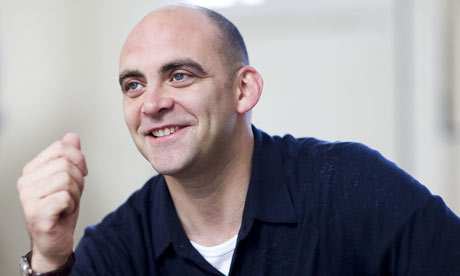
Sean Holmes on Secret Theatre: ‘There are no assumptions; it’s about honesty’

Frustrated by British theatre’s conservatism, the Lyric Hammersmith boss has decided to shake things up with a season of secret shows

“A lot of theatre is quite boring,” says Sean Holmes, fully aware this is not the sort of statement made by artistic directors of major…..theatres. These days, however – part moroseness, part mischief – Holmes is happy to lob a few home-truth hand grenades.

With funding squeezed, we’ve come to expect cultural cheerleading. Arts leaders fight their corner, championing their chosen discipline wherever possible. Theatre, we’re told, feeds television and film. It pays its way in VAT and cultural tourism and generally does this country proud.

Sean Holmes

Sean Holmes

In June, the 44-year-old stood in front of an invited audience of peers and told them as much. “Maybe the existing structures of theatre in this country, whilst not corrupt, are corrupting,” he said. Maybe the theatre we trumpet as the best in the world, isn’t. Maybe it could be better, broader, bolder.” It was a barnstorming speech that pulled no punches. Even Holmes – burly, shaven-headed and one of British theatre’s great straight-talkers – admits he was afraid. “I was absolutely shitting myself; so nervous. I’m sure it pissed a lot of people off.”

Holmes runs through the basic argument again: “Most British theatre is well made, and maybe that’s what most audiences want. But there’s another audience – a young audience – that’s hungry for something else, for something that might just change them. Most theatre simply isn’t interested in doing that.”

Instead, he believes British theatre is rooted in commercial structures and standard practices. It runs on unquestioned assumptions – that rehearsals last six weeks, that the writer is central, that acting means pretending to be someone else – all of which add up to cultural hegemony and artistic compromise. Lest this sound like runaway hubris, Holmes includes himself: “Any criticism comes from self-criticism; me going, ‘I’m too cautious’.”

This frustration has prompted Holmes to challenge the norms with an atypical season born of unique circumstances. In April, a 20-strong ensemble – 10 actors and 10 writers, directors and designers – started working together under the label Secret Theatre. This month, they’ll open the first two shows of an eight-month, seven-show repertory season. The aim is to question the way theatre is made in this country and the type of theatre that results. “We believe that theatre matters,” runs the company’s manifesto. “We are hungry for change.”

.

There are two fronts to this: structural and artistic. The ensemble will be together for a year…..Six weeks of workshops preceded rehearsals proper; theoretically, the extra time spent together allows them to build a shared vocabulary and aesthetic understanding without reverting to habitual methods. Change the structures and you shift the possibilities.

“The starting point is that there are no assumptions,” Holmes explains. “With everything we do, we ask, ‘What the f**k are we going to do with this?'”

The philosophy extends beyond design and direction to play selection, casting decisions and marketing techniques. Audiences will book shows by number, not title. They might find themselves watching a classic text, a new play or something else entirely. Who knows what?

Casting isn’t merely gender- and colour-blind – the ensemble necessitates non-literalism – it is also willfully topsy-turvy at times. Scripts aren’t sacred. Scenes are played out of order. Lines get chopped and changed. Stage directions are obliterated. If a moment needs a dance routine, it gets one. If a pop song does the job better than dialogue, it’s tagged in. Every decision is up for grabs.

All this stems from last year’s (production of) Three Kingdoms. Simon Stephens’ play – and Sebastian Nübling’s distorted staging, in particular – has clearly had quite an impact on Holmes. Though it opened to underwhelmed reviews and half-full houses, the production found vocal champions online and, by the end of its three-week run, was selling out entirely, mostly to eager young audiences. Holmes talks about a generation waiting for their 1956-Look-Back-In-Anger moment: “On a good day, Three Kingdoms was the John the Baptist to that.”

Three Kingdoms

Three Kingdoms

Stephens, now Secret Theatre’s resident dramaturg, recalls “a response I’d never seen in my career”. He believes Three Kingdoms left three major marks: “Audiences remember the inventiveness of actors, their unapologetic presence in the room and their sheer physicality.” The performers didn’t just act out a scene, they warped it into something else. They didn’t kowtow to the script’s demands. They made it anew, in their own personal and inimitable style.

Secret Theatre has maintained not only the same “spirit of attack” but also the same honesty, says Stephens. “No pretending” has become the company’s mantra. The cast play themselves, even in some of the most iconic roles in drama.

“Our aesthetic is, ‘Look at us. We’re just humans on a stage’,” says Holmes. “It’s about honesty. We can’t get a fight director. We can’t do accents.”

Everything needs an alternative approach, one that the actors can own entirely. The refusal to pretend means they have to rely on analogy and metaphor, so that frying an egg might stand in for a scientific experiment. It adds an extra layer to the play, representing and commentating at the same time. “It’s about going against the text – not to be perverse, but to reveal the writing.”

Even as early as mid-July, rehearsal performances feel dangerous. Classic scenes are unrecognisable and fiercely charged. The company, most of whom are significantly younger than Holmes and Stephens, clearly relish the agency and provocation it’s provided. Actor Leo Bill, 33, feels like it allows him to consider himself an artist – something frowned upon in the wider industry that deems acting a craft. “You couldn’t stand up at drama school and say, ‘I’m an artist.’ You’d be told to sit down and shut up.

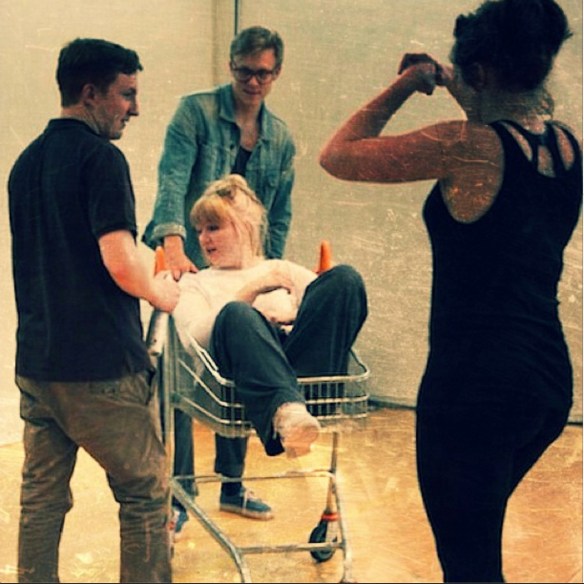
Secret Theatre in rehearsal

Secret Theatre in rehearsal

I’ve met older actors who are adamant they’re not artists. They just do what the director tells them as best they can.”

Not so here. Actors pull scenes in radical directions without warning their colleagues. They arrive onstage with props they’ve just picked up. They’re happy to actually fight each other; to spit and snog and sing. There’s no sign of the “middle-class politeness” that so frustrates Bill in other rehearsal rooms. At one point, a group discussion of a short confessional monologue dissects the paradox of sin and forgiveness – a cycle that makes both terms redundant – within a minute. “Usually there isn’t time for talking,” says Bill, “because you’ve got four weeks to put a show together.”

But Secret Theatre is underpinned by a luxury: freedom from normal commercial pressures. “Whatever we did this year, we would struggle financially,” Holmes admits. “There was always going to be some kind of deficit.”

Reduced design costs will compensate for increased wages, but the theatre will have to dip into reserves nonetheless. “It’s an opportunity to examine every aspect of how we run a theatre building,” says Holmes.

In that, Stephens draws comparisons with the Royal Court’s Open Court. “Three things over one summer could really force people to interrogate the conditions in which work is made.” Yet, where those projects have quietly downplayed their radicalism, Secret Theatre has defined itself with a combative, critical rhetoric that could easily trigger a backlash. “We’re just putting some plays on,” Stephens adds. “That’s all we’re doing. We’re not bringing down the government or starting a political party.”

But Holmes and his young company are already looking to the future. “Far worse than it failing is the possibility that it succeeds,” says Holmes. “Then we have to make it sustainable.”

When I read something like this I always have to question (albeit in this case, in a very small way) whether the intention will be fulfilled. The response on Twitter to the opening Secret Theatre #1 put my mind at rest:

@LyricHammer what you’re doing with Secret Theatre is possibly the single most important experiment in british theatre in decades. go on!

Just seen Show 1 @LyricHammer. OMG! Really OMG! Came out feeling shellshocked. Battered. GO. You need to see this for yourself.

The #SecretTheatre ensemble are brilliant. 2nd time this week. 1st two shows are pure theatre and inventive to the nth degree.@LyricHammer

#showone@LyricHammer#secrettheatre is a cluster bomb into the violent subconscious of England. And quite, quite beautiful for it. I think

@StephensSimon@LyricHammer Tremendous quality of dislocation and presence simultaneously in the performers.

Post Update:

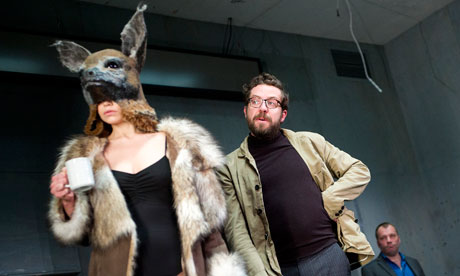
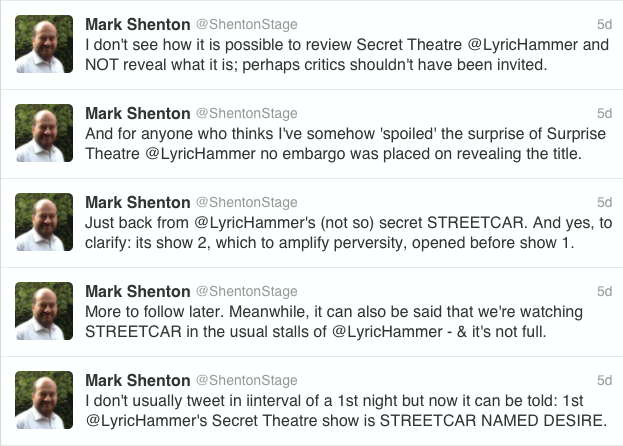
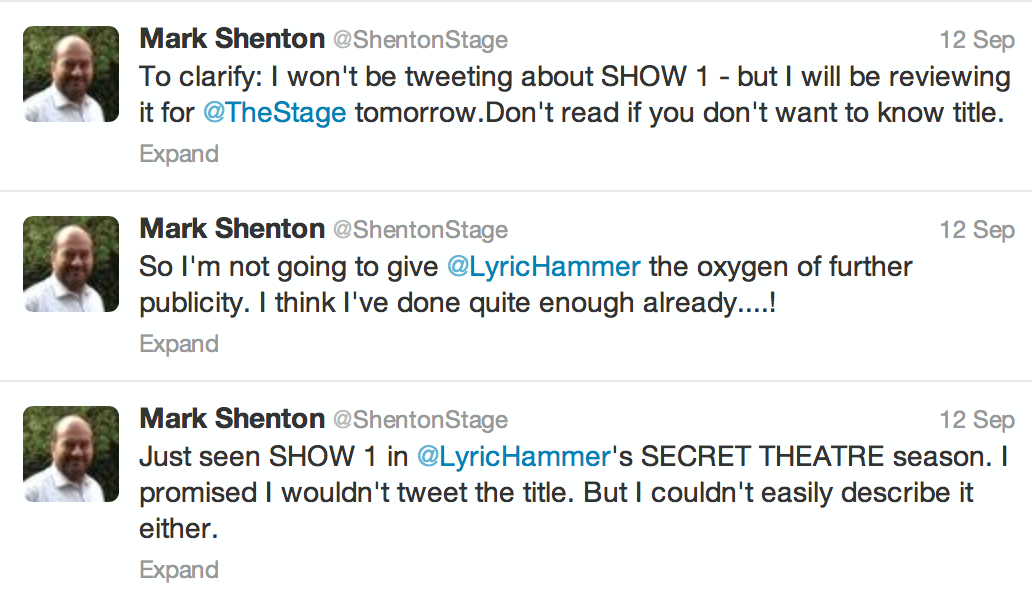
Evernote Camera Roll 20130915 145639_FotorHaving made this post, I then noticed that the opening week of Secret Theatre had created a bit of a (Twitter) storm. Two Secret Theatre shows opened, a little confusingly, Show 2, followed by Show 1. One theatre critic, Mark Shenton, went to see Show 2 and then tweeted the real title, A Streetcar Named Desire. And this is where it all got a bit bizarre. Some people were outraged that Shenton had undermined the idea underpinning Secret Theatre as this Storify trail shows. Jake Orr, a well-known theatre maker weighed in with an attack on him on his blog, Where Theatre is Thought, calling Shenton Scrooge for spoiling the fun. And so it went on, with Lyn Gardner having her (sensible and grounded) say in her blog post, Not so Secret Theatre.

Untitled_FotorThen came an apology from Shenton in The Stage, To Tweet or not to Tweet a secret.

All in all, quite funny really, I think. Great free publicity for Secret Theatre and a theatre critic who will be a bit more careful with his tweets.

In Search Of Meaning

marian-van-kerkhovenIt seems to me that there is such a thing as a major and a minor dramaturgy, and although my preference is mainly for the minor, which means those things that can be grasped on a human scale, I would here like to talk about the major dramaturgy. Because it is necessary. Because I think that today it is awfully necessary. We could define the minor dramaturgy as that zone, that structural circle, which lies in and around a production. But a production comes alive through its interaction, through its audience, and through what is going on outside its own orbit. And around the production lies the theatre and around the theatre lies the city and around the city, as far as we can see, lies the whole world and even the sky and all its stars. The walls that link all these circles together are made of skin, they have pores, they breathe.

These words were spoken by Marianne Van Kerkhoven, a Belgian dramaturge who died last week. Kerkhoven was a leading light in political and ‘new wave’ theatre throughout her career. It is perhaps not surprising that I hadn’t heard about her work until after her death, but it is clear that she was extremely influential and highly regarded. Again it got me pondering the role of the dramaturge in theatre making, particularly after my recent post, You Do What?. I came across a piece, written by Kerkhoven, and posted on Sarma, a site that, amongst other things, has a focus on dramaturgy. It is titled On dramaturgy – Looking without pencil in hand  and makes interesting reading.

“(…) distance is often linked with the most intense state of feeling, in which the coolness or impersonality with which something is treated measures the insatiable interest that thing has for us.” (Susan Sontag)

1. The request to talk or write about it leads time and again to the same awkwardness: the feeling of being asked to reveal someone else’s culinary secrets or recipes.

2. In artistic practice there are no fixed laws of behaviour, or task that can wholly defined in advance, not even for the dramaturge. Every production forms its own method of work. It is precisely through the quality of the method used that the work of important artists gains its clarity, by their intuitively knowing – at every stage in the process – what the next step is. One of the abilities a dramaturge must develop is the flexibility to handle the methods used by artists while at the same time shaping his/her own way of working.

3. Whatever additional tasks – sometimes very practical and certainly highly varied – the dramaturge takes on in the course of an artistic process, there always remain several constants present in his work; dramaturgy is always concerned with the conversion of feeling into knowledge, and vice versa. Dramaturgy is the twilight zone between art and science.

4. Dramaturgy is also the passion of looking. The active process of the eye; the dramaturge as first spectator. He should be that slightly bashful friend who cautiously, weighing his words, expresses what he has seen and what traces it has left; he is the ‘outsider’s eye’ that wants to look ‘purely’ but at the same time has enough knowledge of what goes on on the inside to be both moved by and involved in what happens there. dramaturgy feeds on diffidence.

dramaturgy_woods

5. Dramaturgy is also being able both to affirm and to repudiate at the right moment: knowing what, when and how to say something. Based on a realization of the vulnerability of the building blocks, but also conscious that the construction sometimes needs a good pounding.

6. It also invites the building up of a special type of personal relationship, in order to carry on conversations that are on the one hand highly specific – they are, after all, concerned with that progress of practical work – and on the other very serene and ‘wasteful’ in the ay a very personal contact is.

7. By means of his/her writing about a production, the dramaturge smooths the way towards its public airing. Whatever he/she writes must be ‘correct’; it must describe the work in an evident and organic way and lend a guiding hand on its way to its life in society, a life which often has a destructive effect on its meaning.

8. Dramaturgy is also sometimes – one is working after all with ‘groups’ – a psychological mediation. The basis for this lies not, however, in the technical approach of the professional ‘social worker’, but rather in the disinterested motives of ‘a friendship in the workplace’.

9. Dramaturgy is a limited profession. The dramaturge must be able to handle solitude; he/she has no fixed abode, he/she does not belong anywhere. The work he does dissolves into the production, becomes invisible. He/she always shares the frustrations and yet does not have to appear on the photo. The dramaturge is not (perhaps not quite or not yet) an artist. Anyone that cannot, or can no longer, handle this serving – and yet creative – aspect, is better off out of it.

10. Dramaturgy means, among other things: filling in in a creative process, with whatever material necessary; the assimilation and ‘guarding’ of a project’s ‘first ideas’ in order, occasionally, to restore them to memory; to suggest without forcing to a decision; being a touchstone, a sounding board; helping provide for inner needs. For this reason one of the essential axes on which the practice of dramaturgy turns is the accumulation of a reservoir of material – amassing knowledge in all fields: reading, listening to music, viewing exhibitions, watching performances, travelling, encountering people and ideas, living and experiencing and reflecting on all this. Being continuously occupied with the building up of a stock which may be drawn from at any time. Remembering at the right time what you have in your stockroom.

11. There is no essential difference between theatre and dance dramaturgy, although the nature and history of the material used differs. Its main concerns are: the mastering of structures; the achievement of a global view; the gaining of insight into how to deal with the material, whatever its origin may be – visual, musical, textual, filmic, philosophical etc.

12. At present, purely literary or linear dramaturgy is seldom to be found, in either dance or theatre. Dramaturgy today is often a case of solving puzzles, learning to deal with complexity. This management of complexity demands an investment from all the senses, and, more especially, a firm trust in the path of intuition.

“There is an immense difference between looking at something without pencil in the hand and looking at something while drawing it.” (Paul Valéry)

bt dramaturgy logo

Still a definition of the role remains hard to grasp.  This led me back to dramaturg’s network, which I have mentioned here before, and found the following; an attempt to tie a definition down written by John Keefe, who is a lecturer in theatre, a director and a dramaturge:

Dramaturg : Dramaturgy – Towards a Definition

Provocations for a discussion

To begin: an indication of the multiplicity of responses to the two terms ranging from the abstract to the technical….

Dramaturgy: from ‘text’ – a weaving together; from ‘drama-ergon’ – the work of the actions; thus, that which concerns the weave of the performance, (see Eugenio Barba & Nicola Savarese, A Dictionary of Theatre Anthropology, 1991).

Dramaturgy is the dialogic relationship between subject matter and its theatrical framing; content and form, (see Norman Frisch, Theatrerschrift 5-6, 1994).

Dramaturgy is the concern with composition, structure, staging and audience from literary analysis and historiography, (see Gotthold Lessing, Hamburg Dramaturgy, 1767-69).

Dramaturgy: not only the subject but also the object is constantly moving; dramaturgy is movement itself, a process, (see Marianne van Kerkhoven, Performance Research 14:3, 2009).

Dramaturgy: the wooden walls of small drawers with brass handles in the hardware stores of my childhood; the dramaturg opens each drawer to reveal new objects of indeterminate but indispensable use, (see John Keefe, State of Mime, Summer 1995).
dramaturg-meme.440.300

Dramaturg: a literary reader-editor concerned with playscripts, (see A Dictionary of Theatre, Penguin).

Dramaturg: one who assists the traffic between stage and auditorium through the conceptual preparation of a production in its political, historical, aesthetic and formal aspects, (see Bertolt Brecht, The Messingkauf Dialogues, 1939-55; The Journals, 1934-55).

Dramaturg(e): one who is responsible for research and the development of plays, (see Wikipedia).

Dramaturg(e): a researcher and intellectual ‘go-fer’ who acts as the artistic conscience for the theatre, (see Bert Cardullo, What is dramaturgy, 1995).

So trying to bring these and other suggestions and definitions together:

Dramaturgy – as theatre science, a rigorous, analytical and sensitive approach to theatre practice and discourse (the play-text and stage-text), bridging the tension and ‘agon’ between the conceptual and the practical as the two (Janus) faces of theatre.

Dramaturg – as theatre scientist, one who looks and listens with knowledge, insight, rigor, sensitivity and open-mindedness helping to create the play-text with writer and director and/or the stage text with the production ensemble for presenting to a theatre ensemble (performance and audience). The function may be performed to a lesser or greater degree by members of the production ensemble, by other theatre or curatorial professionals, by education professionals whereby their contributory role is acknowledged as such.
The spectator is, of course, his/her own dramaturg by nature of their presence and engagement.


I’m not sure whether these are definitive definitions, but they are the latest and things seem to be merging toward a wide-ranging, encompassing understanding of the nature of the role….probably.
dramaturg

Perhaps it would help if we had a definitive way of spelling it –  ‘e’ or no ‘e’, that is the question.


The Wright Way

bruntwood_head_mid_res.jpg300x424.028268551Over the last year I have watched three plays emerge from the creative minds of two (now ex) students, on to the page and then on to the stage (or a toilet in one case). I was humbled by and astonished at their skill.  I’m a deviser of theatre by nature, a practical playwright if you wish. So to see them hone their skills through trial and error, draft and redraft was as much as a learning experience for me as it was for them.

There is lots of advice out there of course – a simple Google search tells you that – but I wonder where the line is drawn between a taught/learned skill and an innate talent. So I was delighted when I stumbled across this recording on The Open University by playwright Mark Ravenhill, talking about his craft and his approach to writing:

You can read the transcript of the recording by clicking here and then clicking the text tab.

You Do What?

Can you describe what a dramaturge does? What is their role in the theatrical process? Well, it has been defined in a number of (sometimes conflicting) ways but it perhaps easiest to think about it as someone who deals with the research and development of plays, working alongside the director. But, there is no officially defined description and a the role of a dramaturge in one theatre company might differ quite significantly to one in another company.  One (Wikipeadia) definition says:

Dramaturgy is a comprehensive exploration of the context in which the play resides. The dramaturg is the resident expert on the physical, social, political, and economic milieus in which the action takes place, the psychological underpinnings of the characters, the various metaphorical expressions in the play of thematic concerns; as well as on the technical consideration of the play as a piece of writing: structure, rhythm, flow, even individual word choices

All clear now? No? Well have a read of this article written by Zoë Svendsen for T.H.E. Svendsen is a dramaturge and director, based in the UK, and here she explains how she understands the role by explaining work on a production of Christopher Marlowe’s Edward II, a play that is notoriously difficult to stage.

Zoë Svendsen on the dramaturge’s role at the heart of the action

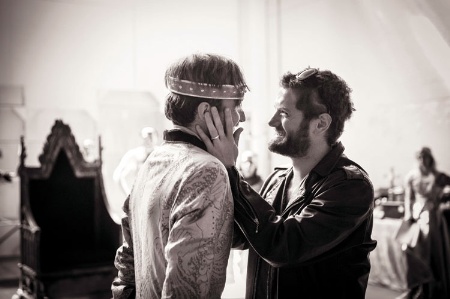
The ‘creative consultant’ at work in the National Theatre’s new production of Christopher Marlowe’s Edward II

Zoë Svendsen

Zoë Svendsen

There is a huge crossover between academia and the theatre now,” says Zoë Svendsen. “When I left university, they felt like much more separate worlds…There is a very close relationship between my practice, my research and my teaching.”

His grace and favourite: the National Theatre’s new Edward II presents a world in which the unthinkable becomes thinkable, says dramaturge Zoë Svendsen

His grace and favourite: the National Theatre’s new Edward II presents a world in which the unthinkable becomes thinkable, says dramaturge Zoë Svendsen

For some years a practice-based research fellow in drama and performance at the University of Cambridge, Svendsen next month takes on a new position at Cambridge as a lecturer in drama. She is director of a company called Metis Arts, which specialises in immersive and sometimes interactive performance projects addressing political themes. And she has worked as dramaturge on Joe Hill-Gibbins’ acclaimed 2012 Young Vic production of Thomas Middleton and William Rowley’s Jacobean tragedy,The Changeling, and now on his National Theatre production of Christopher Marlowe’s Edward II, which previews from this week. (A similar gig, in which Svendsen will work with the Royal Shakespeare Company on another Elizabethan drama, Arden of Faversham, follows next year.)

The role of dramaturge is far more established in continental Europe than in the UK, but Svendsen explains that it is essentially about “how the play functions in time and space – the production as a whole from a structural perspective, how the audience’s attention is held”.

While it remains the director’s job to steer the actors, she sits in on rehearsals and sees herself as a “sounding board, a creative consultant. We push ideas back and forth, trying to find out what the heart of the play is. I don’t like the term ‘outside eye’ – I’m absolutely embedded – but I can keep an eye on how one scene fits with other scenes, what the overall ambitions are.”

When it comes to her own projects and research, Svendsen has “long been interested in works which don’t conform to a kind of British empiricism in the staging, with a single time and a single location”. Her PhD looked at the Gate Theatre in Notting Hill and the production of plays from other cultures in London. And living and working in Berlin gave her a further “sense of the plethora of forms in which plays can be written”.

As a striking example of Svendsen’s own work, we might cite Metis Arts’ interactive multimedia production 3rd Ring Out, which Svendsen sees as having been “absolutely research-driven” and arising out of “a set of questions”. An earlier project about disused air-raid shelters and a decommissioned nuclear bunker in Cambridge led her and her collaborators to reflect on “Cold War exercises and the scenarios for many people across the country to play”.

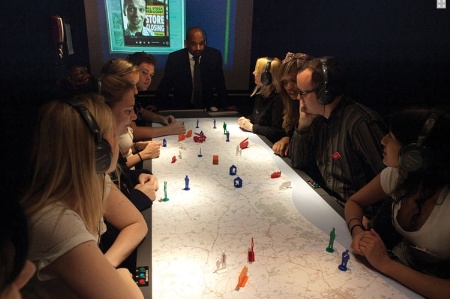
Doomsday scenarios: participants in Metis Arts’ interactive production 3rd Ring Out consider their options

Doomsday scenarios: participants in Metis Arts’ interactive production 3rd Ring Out consider their options

This led to the more general question of “What does it mean to practise for disaster?” and, since they “didn’t want to do re-enactment”, the search for a contemporary theme. When a visit to the Camp for Climate Action at Kingsnorth in Kent brought new urgency to Svendsen’s own concerns about the issue, it became the focus.

But this presented a dilemma, she recalls: “How do you make an effective performance about climate change? When you have theatre, which is about individual relationships, the short term and dramatic events, how do you avoid the trap of a kind of disaster porn, taking pleasure in the horror?”

To solve this problem, Svendsen and her co-director Simon Daw took two shipping containers around the country in 2010 and 2011. Inside, they constructed “an emergency planning cell” in which audiences of 12 sat at a table with headphones and a voting console. Amid an audiovisual simulation of a disaster scenario unfolding in their locality in 2033, they were invited to vote on the practical and ethical issues raised by heatwaves, food shortages and civil unrest. The question of whether to accept climate change refugees into the area proved particularly contentious.

But what had the creation of this powerful piece to do with productions of classic Elizabethan and Jacobean plays?

Svendsen believes that both draw on her central concern with how you hold audiences’ attention, and that her “sensibility for different kinds of formal structures” helped to forge “a distinctive way of looking at Renaissance dramas”. The key is “a deep commitment to the original text – which means expressing it as fully as possible in theatrical terms”.

When she and Hill-Gibbins began working on The Changeling, they were struck by its differences from most recent theatre: “A character says ‘We need to talk to so and so’ and there they are on stage – and there are no questions about how they got there. In Middleton, it’s all about what happens next, there’s very little back story. How characters interact with each other is absolutely about what they want at that immediate moment. There’s no continuous psychological through line. And that’s very different from what you find in ‘the grandfathers of modern drama’ such as Ibsen and Chekhov.”

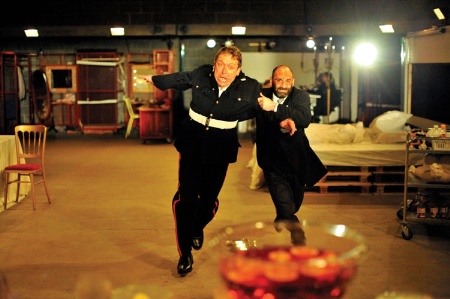
In tackling this challenge, they started off by cutting lines, reordering and amalgamating scenes – only to find themselves slowly working their way back to something close to the original text, albeit with greatly deepened understanding. The production, which featured a wedding scene staged with throbbing music by Beyoncé and a banquet where the actors get covered in food, was acclaimed by critics for its “lewdness and lunacy” and for “mak[ing] pervs of us all”.

Breaking with tradition: Joe Hill-Gibbins’ ‘iconoclastic’ production of The Changeling

Breaking with tradition: Joe Hill-Gibbins’ ‘iconoclastic’ production of The Changeling

“Reviewers talked about it as contemporary, Tarantino-esque and iconoclastic,” reflects Svendsen. “Actually all of that is in the play, but not necessarily brought out in today’s productions”, in which the British tradition of staging classics often puts the central stress on the text rather than the underlying structure.

Edward II may be best known for two key challenges it presents to directors: how openly erotic to make the relationship between the king and his “favourite”, Piers Gaveston; and how to stage Edward’s horrifying demise, impaled with a red-hot poker. (It also includes a great speech where the medieval equivalent of an academic is given trenchant advice on how he should “cast the scholar off”, give up his “velvet-caped cloak” and “learn to court it like a gentleman”: “You must be proud, bold, pleasant, resolute,/And now and then, stab, as occasion serves.”)

Without giving away any major secrets about a production still in rehearsal, Svendsen again flags up how different Edward II is from a contemporary play in its “accumulations and repetitions and things that seem to be a bit short-circuited” – and how exploring its structure had revealed its hidden depths.

“You need to allow the repetitions to become cumulative,” she suggests, “because repetition is what tells the story and allows Marlowe to comment on history. The characters don’t really change, but the situation changes, because what they conceive of as possible changes.

“Once the barons start threatening civil war and Gaveston’s exile, the rhetoric of threat becomes a capacity to act and those things become possible. The idea of deposing the king is unthinkable at the start of the play, but it’s interesting how quickly it becomes thinkable.”

In this, the play echoes Svendsen’s experience of working on 3rd Ring Out, where she and Daw considered the possible scenario of “putting the military on the streets” and then decided “no one would believe it was within the bounds of plausibility”.

“That was in 2010, but the next year the riots had erupted and the media were full of questions about whether the military should go on to the streets,” says Svendsen. “It had become thinkable as part of the national conversation. Pretty much everything we had imagined for 2033 did happen during the times we were performing.”

If you would like to hear more from Svendsen talking about dramaturgy, you can by clicking the link below, which will take you to an audio recording on Theatre Voicesof her talking about work on another classic play, The Changeling by Thomas Middleton and William Rowley.

Zoe Svendsen discusses The Changeling.

.

A Selfie?

This post is really for my Performing Arts students and my colleague Ciaran who are working on a unit about the business side of the business, but it makes interesting reading for any theatre student. The article comes from the Culture Professional Network and is a curated version of an on-line forum.

15 TIPS ON SETTING UP YOUR OWN THEATRE COMPANY

From funding to fringe festivals, a panel of theatre pros who have been there and done it share their expert insights

Alexander Kelly, co-artistic director, Third Angel

The work you make is the most important thing: Never forget that. It may well sound obvious, but when you’re getting stuck into the complexity of whether to be a partnership or company limited by guarantee, it’s useful to be reminded. Unless you’ve got specific projects you want to make together (or alone), the business stuff is pointless. A company isn’t just the legal entity – it’s the people making the work together.

Make the best work you can. Make the work you want to make.

Untitled_Fotor

When it comes to finances, plan ahead: In Third Angel we set ourselves a timetable; we put money into our first show, and then decided that:

  • For the next year we would only make work for the money we raised, but wouldn’t pay ourselves
  • The next year we would pay ourselves for performance days, as they were days where we clearly couldn’t do any other work, whereas rehearsals were more flexible
  • In year three we would pay ourselves for making time as well

We stuck to this. That meant for the first few years we also taught part-time in a secondary school, ran workshops, did get-ins for other companies, signed on and went on start-your-own-business courses (less of an option now I expect). We even did bits of performance for other companies, including motion capture for computer games.

After four years we finally started getting a weekly wage at equity minimum. It hasn’t always been full time since then, but we’ve stuck to at least equity minimum.

Dan Bridgewater, founder and managing director, Fourth Wall Theatre Network

Think about becoming a social enterprise: Because my company is a social enterprise, a lot of the funding has been to support this as opposed to supporting the theatre we create. Organisations such as Live UnLtdUnLtd and the Community Development Foundation all provide funding to organisations that help create social change, or raise awareness of social issues. There’s a lot of trusts all over the UK that do something similar.

Create strong partnerships: Partnerships need to be about solving a problem instead of making one. Make it easy for a potential partner – what do you want and what are they going to get? They need to see a clear personal benefit.

seis_crowd_funding_2507592b

Don’t necessarily give up the day job: Financially, I think you need to do what you can and what’s best for you. I’ve realised that my company isn’t going to be my full-time source of income at this moment in time, so I do a number of other projects on the side. However, in the long-term, I really feel that it can be. Organisations like Arts Council England allow funding to cover project management fees – if you have something that is good enough then you can be funded to run that project.

Don’t just focus on the theatre: What else do you offer? A place for people to socialise; a vehicle for change; a voice for young people? Communicate these objectives within your marketing, and take advantage of them when looking for funding.

Understand your market: Ask yourself the following questions: how much are your competitors charging; what kind of thing are they doing; what are their customers responding to? We originally charged £3 for two hours, whereas our closest competitors were charging at least £5 for one hour!

Have fun doing it: It goes without saying really. Don’t let things get to you too much – build a good support team around you and give them responsibilities, and don’t take on all the stress and the strain. When it stops being fun, you need to evaluate where you’re at.

Find space on the cheap (or for free): If you need rehearsal space, but funds are low, offer to hold a performance in that rehearsal space or venue and let them get a share of the takings. You can also find venues that need an image boost – say you’ll get people into their venue, as well as some press coverage or some promotion through your marketing campaigns, in exchange for lower cost or free venue hire. Finally, rehearse in random places: the park, your front room, a coffee shop.

P1020241

Phil Willmott, artistic director, the Steam Industry

Understand that it’s going to be extremely tough: If you start a theatre company in the hope of making a living or showcasing your work with a view to being spotted, you’ll almost certainly end up bitter and disappointed. Sorry about that. But don’t be cross – it’s not your fault, nor mine, nor the Arts Council’s, nor the culture of fringe theatre, nor the state of the nation. It’s simply that you’re choosing to enter a farcically overcrowded profession – it’s just the way it is.

If you can take that on board at the beginning, it will save you a lot of disappointment when you discover that no one will initially give you money or come and see your stuff.

Stand out, and then stand out some more: As with trying to break into any saturated market you HAVE to have a USP (unique selling point) – ideally a VUSP (very unique selling point) – to make any impact. What’s so different about you that audiences, critics, funders, sponsors and programmers will take notice of you rather then the millions of other people who want to direct Woyzek or get some agents in to see them in Miss Julie? Work out what’s so special about you and flog it. FLOG IT TO DEATH! Spinning it right is your best ticket to breaking through.

Jackie Elliman, legal and industrial relations manager
Independent Theatre Council

Your brand is crucial: I think we’re all been in agreement here that artistic vision is the single most important thing you need if you want to have a performing arts company. Your brand – logos, name and so on – are how you convey that vision, and that matters. It should enable not just audiences but venues, funders, potential partners and others to understand what you’re about.

Don’t ignore the paperwork: Don’t hope that the admin will go away if you ignore – it won’t. Take care of the management and your art will have strong foundations.

officepaperwork600

Leo Burtin, project manager, Lancaster Emerging Arts Platform

Think before you leap: Setting up a company when you are too insecure or unsure as to what you really want to be doing is often likely to lead to difficulties (not the productive kind). Knowing where your skills are is quite important and setting up a company takes a lot of administration and management – if that’s not your forte, learn how to do it before setting up.

leap-into-the-unknown-at-tikal-guatemala-courtesy-the-mat-at-flickr-cc

Mistakes to avoid: Lack of leadership or definition of roles; lack of regularity; not considering who your audience might be; putting projects to bed after a single showing at a platform; being scared to apply for funding.

If you want to have a look at the full online conversation can here.

Building the House

In another life I think I would have loved to have been a theatre designer. They are artists, architects, engineers and magicians all rolled into one. We sometimes forget they are there, that the set is another actor in the space. In the next few days the World Stage Design conference opens in Cardiff, Wales.

WSD_Fotor

WSD is described as a celebration of international performance design from the world of theatre, opera and dance as well as public performances and installations in non theatre spaces that takes place every 4 years. WSD started life in 2005 in Toronto, Canada. In 2009 it was held in Seoul, South Korea. While reading about it, I also learned about OISTAT, the International Organisation of Scenographers, Theatre Architects and Technicians a global network of theatre makers celebrating design and technology in live performance. The websites for both these organisations make interesting perusing.

I would really like to be at WSD, I think it would be a fascinating and exciting few days. However, I did raise a rye smile when I saw they were building a temporary, sustainable theatre for the conference, known as The Willow Theatre, lauding it as something new:

.

Now I know that I have seen them being built for many years and in an even more sustainable way:

.

The location for WSD2017 is yet to be decided, but perhaps they should start thinking about calling in the traditional bamboo theatre builders in instead? Mind you, one of the designers behind the The Willow is Chinese-american architect Tim Lai so perhaps it is just a modern take on a centuries old craft.

Digital Dreaming

I am always fascinated about how we can use technology to create and enhance performance and it is something that is clearly being embraced by theatres, directors and performers around the world. For example, live, streaming performance is starting to become the norm, rather than the exception. The National Theatre, through their NTLive programme, now regularly broadcasts it’s work to cinemas around the world.

However, it’s where technology allows a performance to become something that otherwise wouldn’t be possible is what really excites me. Therefore I was happy to come across this article in Wired by Liz Stinson about a performance called Mr and Mrs Dream. The creators, Le Théâtre du Corps, worked with a software company, Dassault Systèmes, to make something rather special indeed.

A Virtual Stage That Bends Reality and Pushes Theater’s Boundaries

There’s a scene in the contemporary ballet Mr. & Mrs. Dream where the walls of the set appear to burst apart, transporting one of the principal dancers from an apartment living room to a sea of meteorites in outer space. The dancer, Julien Derouault from Paris’ Théâtre du Corps, begins to hop from meteorite to meteorite, and with each step, the space rocks appear to dip from the heft of the human body. Of course, Derouault isn’t actually bouncing on meteorites; in reality, he’s simply leaping on the floor of an almost empty stage. The scene is mesmerizing, and from the vantage point of the audience, it really does look like the dancer is jumping through outer space. But it’s all an illusion, created by an elaborately engineered virtual reality system that could begin to replace traditional sets with projectors, screens and computers.

Though the show was conceived and choreographed by Derouault and his partner Marie-Claude Pietragalla, the brains behind Mr. and Mrs. Dream’s high-tech set is Dassault Systèmes. The French software engineering company typically uses its virtual reality technology to test, model and simulate products for companies like Boeing, so it’s natural to think that this collaboration is a bit of an odd pairing. But, says Mehdi Tayoubi, vice president in charge of experiential strategy at Dassault, interdisciplinary collaboration is becoming more common and more imperative for high-tech companies.

.

“It’s very important when you claim to be an innovative company, to be able to go outside the laboratory and your comfort zone,” says Tayoubi, who heads up Dassault’s Passion for Innovation program, an initiative whose goal is to apply the company’s industrial research and technology skills to the worlds of culture and education. Since 2005, Dassault has worked with architect Jean-Pierre Houdin to simulate the construction of Cheops pyramid, partnered with director Luc Besson to bring 3-D interactivity to movie theaters, and helped cartoon artists turn their cartoons into virtual reality (and these are just a few of their projects). Mr. and Mrs. Dream is Dassault’s first crack at live dance, and not surprisingly, there were some challenges and miscommunications along the way. “At the beginning it was a little bit difficult,” says Tayoubi. ”But we learned to share the same language.”

One of Dassault’s main challenges was creating a virtual reality system that was technical enough to accomplish the complex visual effects that the dance company envisioned while still being simple to use. “We needed to design a system that we can give to people who are not engineers and they could set up everything in a few hours,” explains Benoît Marini, Dassault’s virtual reality expert. The system also had to be mobile since the company would eventually be touring with it around the world.

.

Marini’s solution was a mobile “magic box,” which is basically a disassemble-able series of four gray screens and six projectors that would be the canvas for the immersive world of Mr. & Mrs. Dream. The box is similar to the virtual reality rooms traditionally used by industrial companies, only instead of testing emergency scenarios and modeling new airplane features, this box is used to motion-track dancers and project computer-generated images. For scenes like the one mentioned above, Marini positioned three Kinect sensors above the stage to track the dancers’ movements. So when the dancers jump, the meteorites bounce, or when the dancers kick, a flurry of leaves float through the air. Most of the other projected dance numbers were motion-captured in the studio and are played back in sync with the music. The audience doesn’t have to wear 3-D glasses; instead the team uses perception tricks like digitally created trompe l’oeil to convey depth and dimension.

dance888888

Fittingly, Mr. & Mrs. Dream is based on the work of Eugène Ionesco, the famed playwright whose work was a hallmark of the Theatre of the Absurd. “We always say to our customers like Boeing: ‘There is no limit, dream big, we can do everything,’” says Tayoubi. “So we saw a lot of similarity between Eugène Ionesco and what we are doing everyday.” Tayoubi believes that working on inter-disciplinary projects like this is the key to innovation, citing the magic box as a technology that Dassault will use again at automobile shows to give 3-D representations of new cars. Working with artists forces the scientifically minded to push boundaries and create solutions to problems that they’ve never encountered before. “Artists have a lot of imagination,” says Marini. ”Sometimes they want effects that aren’t possible.” So what happens when the dancers ask for something they can’t create, like holograms that can interact with the audience? “You say, ‘wow,’” Tayoubi laughs, “Then you begin to find a solution.”

You can read a review of the show here.

.