A New Design

Having written last week about immersive theatre, I am going to continue today with a connected theme. Immersive theatre, as well as the experience, is largely what it is because the visual elements it contains, be they the building or place itself or what is placed there. In other words, it’s design. Now it strikes me that the term theatre design is a little redundant when describing the immersive space and indeed this seems to be bringing about a change in how we perceive either the role of a theatre designer or theatre design itself.

9783899861365Increasingly, theatre design is becoming scenography; the theatre designer,  the scenographer. I had been aware of term, although never entirely sure of its exact meaning, but as is often the case, it seems to have been popping up with more frequency in things I have been reading and conversations I have had. A colleague used it this week to describe one of his areas of specialism. So with my interest piqued, I got digging and have been quite fascinated by what I have found.

To begin with, scenography is defined thus:

Scenography is the art of creating performance environments; it can be composed of sound, light, clothing, performance, structure and space

Nothing particularly new there, one might think on first reading. However, it is the bringing together of all of these elements together that is different. Traditionally in theatre we separate out the design roles – stage, costume, light, sound and so on. Throw into this mix the varying role a director can play in the design process and maybe even the dramaturg, and we get quite a complicated web of people and roles making contributions to what we eventually end up looking at and experiencing on stage.

Scenography is becoming quite common in Europe and indeed, theatre designers are designating themselves as scenographers. However, it would seem that in the US the term has not been adopted with the same passion. On her website Stephanie A. Schoelzel, herself a scenographer, describes heated debates over the use of the term and the unique differences between US and European theatre in this regard. It is an interesting read on a number of fronts. Another description of Sceneography and its origins is from Imagined Spaces, the Canadian National Arts Centre in Ottawa is also informative.

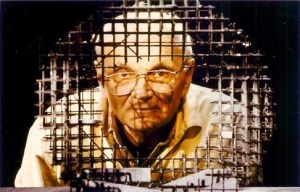
Josef Svoboda

Josef Svoboda

Imagined Spaces is a superb resource site for anyone interested in scenic design, with hundreds of beautifully rendered stage designs. In his article on Imagined Spaces, What Is Scenography, Michael Eagan states that scenography emerged from the Prague Quadrennial and talks about Josef Svoboda, himself Czech, as the godfather of modern scenography.

It was at this point in my research that I began to feel a little ignorant. Svoboda is clearly a giant amongst designers and scenographers, but I had never heard of him. When he died  2002, it was estimated that he had designed and/or directed over 700 theatrical and operatic performances.

When I sit alone in a theatre and gaze into the dark space of its empty stage, I’m frequently seized by fear that this time I won’t manage to penetrate it, and I always hope that this fear will never desert me. Without an unending search for the key to the secret of creativity, there is no creation. It’s necessary always to begin again. And that is beautiful.

Josef Svoboda.

You can get an idea of the scale of Svoboda’s work in the following two videos. If you speak Czech or French there are more in-depth videos on Youtube about the  man and his work.

It then struck me to whom I had heard the term scenographer ascribed before. Robert Lepage is one of the greatest living magicians of the performance space and I have had the delight, pleasure and awe of seeing a number of his works. An utter genius and worthy of a post all of his own, so I shall save further discussion of him until then. However equating Lepage and his work with the role of scenographer, I understood the difference between design and scenography.  It also allayed my feelings of ignorance somewhat. For many years scenography has been the preserve of the academics – a theory of, roughly speaking, the meeting of art, design, architecture and space, and how they interact with the spectator and the spectator with them.  Starting to feeI immersive here? I can now also see how two of the most influential theatre designers of the 20th Century, Adolphe Appia and Edward Gordon Craig, influenced the development of scenography. 

9789299006313_FotorThere are lots of resources out there for understanding scenography and putting it into practice, but one of the best I have come across is TAJ, Theatre Arts Journal. TAJ is an online journal devoted to the study of  scenography in performing arts. Also, the Prague Quadrennial site is a veritable treasure trove of scenographic wonders. There is even a board on Pinterest devoted to scenography, curated by architect Marios Angelopoulos.

To close, I should point out that scenography is not simply an act of theatre making. It is much wider than that, stretching to cover exhibition design, museum planning and interactive public spaces amongst other things – all things that need to engage an audience.

Immerse Yourself

As théâtre du jour, the popularity of immersive performance keeps on growing. I have written here many times about its attractions and why it possibly draws the audiences that it does. Today I want to share a mixture of things that have come my way in the last week or so, all of which making interesting reading and listening.

Firstly an audio slide show published in the UK’s Guardian this week. Made by  and Felix Barrett, the director of Punchdrunk, explains how they dreamed up The Drowned ManClick the image below to have a look and listen:

The Drowned Man_DC.indd


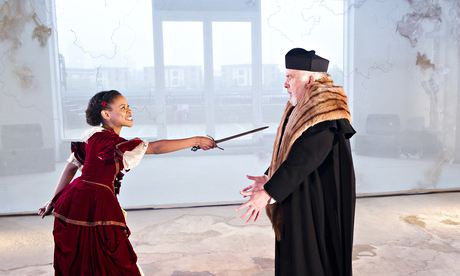
The second share today is also from The Guardian and written by Veronica Horwell, Casting Call For Buildings explores how site-specific theatre companies go about picking the right venues for their shows? Horwell looks at two current performances – again Punchdrunk’s Drowned Man and The Spectators Guild’s new show, Venice Preserve’d.

Casting call for buildings: on location with Punchdrunk and Spectators’ Guild

It’s easy to see why Paynes Wharf, near Deptford Creek in south London, is playing the lead in the Spectators’ Guild company’s production of Venice Preserv’d. It has an old Thameside maritime facade – a former boilermaking works – arcaded like the Doge’s Palace, next to a new flatblock in the manner of a campanile, and its developers put serious money into the production. And they offered guaranteed availability with a scheduled window in the site’s post-construction schedule.

VenicePlay_RG029-528x790

For, as the guild’s producer Harry Ross and production designer Helen Scarlett O’Neill know from their work with Secret Cinema, the company that stages elaborate movie events, any big, workable, public space in London is hard to find. Should they dream of a place with character, let alone the right looks, they’re into the near-impossible. There is noSpotlight for immersive venues, no showreels for talented but unknown ex-warehouses. The agents do not ring.

Mostly, Ross and friends keep their eyes open and ceaselessly ask around. Ross, who as a cyclist has travelled at just the right speed to observe the built landscape, collects London buildings, holding in his head half the current suitable specimens, tunnels included. He can charm any watchman into letting him past the gates within five minutes, and will wander around the metropolis yelling queries up to blokes on scaffolding, if that’s what it takes.

Once spotted, though, a space can be even harder to secure. It can be done, especially if it’s a pro tart of a place for hire anyway, as with the former Farmiloe stained-glass manufactory in Smithfield, much used as a movie location before being taken over for the duration of Secret Cinema’s The Grand Budapest Hotel-related live extravaganza in March. But the turnover of acquisition, renovation, demolition, repurposing and new construction in London has accelerated so fast since property became the international investment after the 2008 crash, that places the site-specific event companies have stashed away as promising hopes suddenly sprout into multi-storey plutoflats.

HAR250214_VenicePreservd_Web_Logo_640_27_3_14-627x500

That’s what makes Venice Preserv’d as an on-site production a novel venture for everybody – and is maybe the way that immersive theatre will have to go. The developers wanted the company and its production to show off the artistic potential of this great space behind the restored river facade. They’re looking to theatre to put some character into the wharf so that it won’t lapse into just another stretch of the executive luxury-flat cliffs now walling the Thames.

Director Charlotte Westenra has wanted to put on Thomas Otway’s Restoration tragedy for a long time – it being an entirely modern story about selling out, in every sense, in a privileged imperial city awash with money and betrayal, yet sinking fast. Then came this loan of what she feels is “a beautiful, significant space” that, both visually and contextually, correlated with her concept of the play.

I’d describe the production as location-referential more than site-specific. While Westenra exploits onsite advantages with glee – she will flood the central courtyard to simulate a bridged Venetian canalscape – she also looks out to a wider geographic “where” as a context for the old narrative. The audience can choose to come down to Greenwich pier by boat, as if on their way to a Venetian carnival, and, as they promenade the wharf’s tideside terrace or look through the space’s mighty windows, they cannot fail to see the uncaring, rising water and moneyed Canary Wharf on its far side.

Venice Preserv'd

The site’s most overwhelming area is a lofty nave the length of the gutted old building, which O’Neill will dress with decaying lace. Although Westenra’s approach to Otway’s bitter power play will remain a semi-formal staging, in which everybody will view and hear the same scene at the same time, it won’t be a Punchdrunk company gig with each audience member stomping his or her own route with a request to “wear appropriate shoes” on the ticket. If the walls could speak at Payne’s Wharf they’d be talking about investment, dividends, futures. Most of them – other than that 1860s frontage – have no past to speak of.

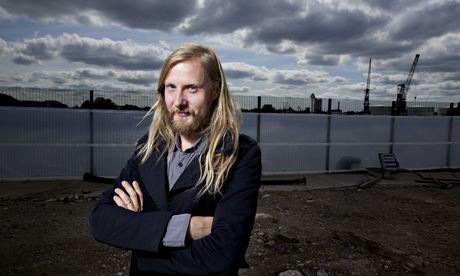
Get Felix Barrett, head of Punchdrunk, immersive veterans, on the subject of listening to walls, and it’s a whole different story – mostly about the past. He has known since his first student production in 2000, in a Territorial Army HQ in Exeter, all the highs and woes of the quest for unlikely performing spaces. He knows Deptford, too – he put on two shows in the old Seagar distillery, now a mighty block of “lifestyle living” just a drinker’s spit from Payne’s Wharf.

Felix Barrett of Punchdrunk

He’s full of admiration for the guild – “They’re going outside? First thing we do in a place is overpaint all the windows black”. But he doesn’t envy them the site, no matter how painlessly secured, because for Punchdrunk, building a narrative means narrating the building. For that, it needs not a beautifully embalmed corpse of a place, let alone a place that’s mostly newborn, but “a good dirty body of a building”. Or anyway, a building on its last breath, as many of his have been over the past 14 years. The first time he gains entry into a secured desired venue, he has to be alone, because “you have to listen, ask the buildings: what do you want? Tell me what you want.”

Westenra wanted to do her cherished show and was grateful for a supportive, expansive space as setting: Barrett doesn’t cherish anything so finished as a script, just a dozen two-word ideas, as many again in one sentence, and a well-developed few that run as far as a single paragraph. None go further until he can hunt and hold his site. It’s getting more difficult in London. Rare are the developers, he says, “who realise that dormant space could be a positive creative force”. Or that Punchdrunk could give a death-sentenced building a last hurrah (Faust in a former archive in Wapping Lane, The Duchess of Malfi in a doomed pharma HQ in Docklands), rather than a squalid slide into graffiti before the cranes move in. Now there is also competition from proliferating event companies and movie shoots. The economics have changed. The old Paddington mail sorting office, elaborated internally into “Temple Studios” as home to Punchdrunk’s most recent production, The Drowned Man: A Hollywood Fable, took three years to run to ground and secure, and was the first site where the company has had to pay properly for use.

How did Punchdrunk find it? Like its predecessors, by a combination of time, luck and legwork. Barrett used to draw a circle on a map, calibrated to the distance an audience might travel, then divide it into blocks. A-Z in hand, his team walked every alleyway, always looking up (“the hidden gems are above your eyeline”). The building should ideally be reticent, reclusive and exude a sense of danger: “The day we found the building for Faust, after nine brutal and bruising months, we could feel the electricity run through the fence. There was a big sign, DANGER: DO NOT ENTER … We went in.” (Punchdrunk never took the sign down, despite the misgivings of its National Theatre backers.) When Punchdrunk was invited into the safe, alive space of the Battersea Arts Centre, a former town hall, the first task was “to kill it off, a stake through the heart” before the right show, which turned out to be The Mask of the Red Death, could crawl out of its demunicipalised woodwork.

Untitled_Fotor

After Punchdrunk field trips, the team usually worked the phones for weeks, and got nowhere. For every hundred spaces that might fit the bill, only one was available for work – until, so often, it was out of the game. Three times Barrett came close to securing a hospital. (He would have liked to put on Faust in hospital wards, grief and loss flowing along every corridor – corridors are all plot.) Every time, in the end, pffft. Eventually, he learned that, “You can’t dream about the perfect space for the ideal show because a show may be almost go after three years” – then comes the NO – “and when you secure another building, it has to be a very different show”. Right now he has seven possibles waiting for a green light, and 50 that could happen, but their stories will have to be scored to what he hears on that first interior walk, “the beats and rhythms of the space, crescendos, diminuendos, staccato”. Punchdrunk is about being site-sympathetic, rather than site-specific, though. In New York, its backers wanted Faust, but Faust was outside the available venue’s range: it performed Sleep No More – Macbeth – brilliantly.

conor-doyle-ed-warner-omar-gordon-tomislav-english-vinicius-salles-punchdrunk-the-drowned-man-a-hollywood-fable-photo-birgit-ralf-0578

Barrettt’s own role is always Prospero. He says he is in the sandcastle business. Almost everywhere Punchdrunk has ever commandeered, all those not-so-gorgeous palaces, has since been replaced with cloud-capped tower blocks. So for the first time, the company now keeps proper records of its plays, including the buildings’ own stories, against the inevitable time they, too, vanish into thin air, shortly after the play closes.

My third and final share comes from one of my students, Mia, who as just written a comparison of the working practices of a number of immersive companies including, Punchdrunk, You Me Bum Bum Train and dreamthinkspeak. As part of her research she contacted the companies and got this great little Interview with Tristan Sharps, Artistic Director of dreamthinkspeak.

Birthday Bardolatry

Wednesday marks the 450th anniversary of the birth of William Shakespeare. Now regular readers of Theatre Room will know that I have a certain ambivalence to the works of the bard and occasionally find myself in arguments with others who refuse to believe anything other that he was the greatest playwright to have ever lived.

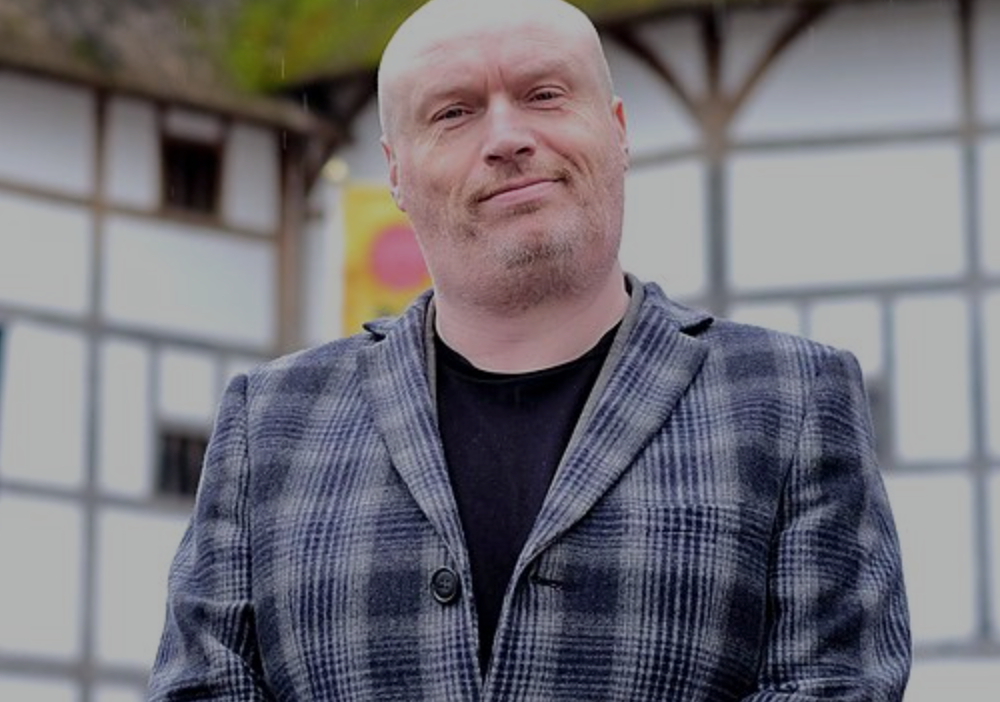
MR at The GlobeIt was therefore with some great interest I listened to a programme presented by British playwright Mark Ravenhill (left), who has just finished a two-year stint as playwright in residence at the Royal Shakespeare Company. In Shakespeare: For and Against for the BBC, and to quote the promotional material for the programme

…..Ravenhill challenges our adulation of the Bard and asks: Is Shakespeare’s genius beyond question? Casting a sceptical eye over centuries of bardolatry, Ravenhill calls for a new approach to the plays.

Exploring the intellectual tradition that has seen important figures from Voltaire to Tolstoy to Wittgenstein challenge Shakespeare’s supremacy, Ravenhill searches for today’s dissenting voices.

Tracing the transformation of a working playwright into a national poet, global brand and secular god, Ravenhill asks if it’s still possible to enjoy Shakespeare without being overwhelmed by the cultural and commercial baggage of ‘brand Shakespeare’.

It is really fascinating and amongst other people he speaks to scholar Ania Loomba who describes India’s changing relationship with Shakespeare, and Professor Gary Taylor talks about the ambivalence of large parts of America toward the Bard. Have a listen below:

In the interest of balance I would also like to share a piece written for The Telegraph by the highly respected actor Simon Russell Beale (interviewed by Ravenhill in the above) whose latest Shakespearian outing has been playing King Lear at the National Theatre.

Why Shakespeare always says something new

As the 450th anniversary of Shakespeare’s birth approaches, the great Shakespearean actor Simon Russell Beale explains his secrets

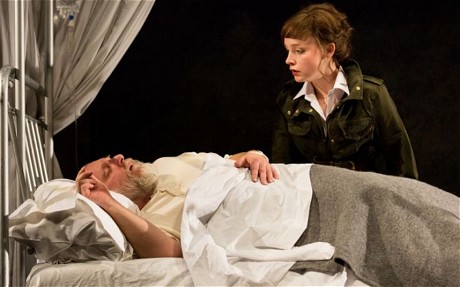
At the very end of King Lear, a frail, old man appears carrying the corpse of his youngest and much-loved daughter. It’s an image, like that of Hamlet holding a skull or Juliet on her balcony, that has imprinted itself on the minds of readers and spectators over the last four hundred years. For some, it is unbearable, even morally irresponsible; for Lear’s lonely, individual grief seems to reinforce the possibility, iterated again and again in the play, that all human life is essentially meaningless.

Whether one accepts that bleak vision or not, here once again is that familiar magic – Shakespeare’s astonishing ability to open out his work, to manipulate a single storyline, so that it includes, implicates and challenges everyone.

PX694779_King-Lear_2872690b

The old king and his daughter do not enter alone, however. They are accompanied by at least one soldier, possibly more. This soldier, about whom we know almost nothing, has a single line later in the scene, but his entrance is not marked in either of the authoritative texts that have been handed down to us – the quarto and the Folio – and, consequently, presents the director of King Lear with a problem. When, precisely, should the soldier, or soldiers, enter? Every line spoken by Lear in this short, final scene is a wonder and I suspect that most directors instinctively feel that his words and the image should be left, as it were, to stand alone.

But, as so often, Shakespeare gives us a context for Lear’s pain, a counterpoint. The soldier is there to remind us, amongst other things, that the old king is not simply a grieving father but also a prisoner- of -war (a war for which he is ultimately responsible) and to confirm, with his single line, that Lear is still powerful and angry enough to have killed the man who was murdering his child.

This is a tiny example of another Shakespearean manoeuvre, one to set against his skill at articulating the big things like love and hate. It’s the type of thing that makes mounting Shakespeare’s work endlessly fascinating, demanding and frustrating. For whatever reason – the way the texts have been transmitted, carelessness on the part of the writer, a change of intention – the plays, in their lack of precision, often raise questions for which the playwright has provided no clear answer. Any actor or director in search of clarity could be forgiven for interpreting this as an opportunity or a challenge.

If this challenge seems, at times, difficult to meet then it’s comforting to know that we are not alone. Ben Jonson, Shakespeare’s younger contemporary and a writer whose narrative was always meticulously charted, found his older colleague’s work, for all its beauty, sloppy and often absurd. He probably found the paucity of information about Lady Macbeth’s child, for instance, infuriating. Unfair though it might be, however, Shakespeare’s capacity for absorbing endless reinterpretation, in contrast to the demands that Jonson makes, is maybe one reason why the latter’s work has never been as popular as his colleague’s. Perhaps we should be braver with Jonson, but the truth is that, over nearly thirty years of working on Shakespeare’s plays, there have been countless occasions when, in the rehearsal room, I have witnessed (and expended) a great deal of enjoyable effort in the attempt to sort out apparent inconsistencies and ambiguities. We could leave the plays alone, I suppose, but that seems the lazy and irresponsible option. Shakespeare demands a more considered response, I think.

This is a tricky business, however. One never wants to “tidy up” Shakespeare’s writing without considering as many options as possible and ambiguity is often a good thing. There are sometimes unexpected discoveries to be made by investing fully in something that is apparently confusing. The soldier in the final moments of King Lear is there precisely to complicate matters. In this case, the king may very well be embodying a profound and far-reaching pain that has universal relevance, but the playwright cannot resist providing a more mundane and savage context. Lear is not floating free of the real world; and this may remind us that it is in the oddities of Shakespeare’s writing, his exploration of the confusion and ugliness of any situation, his absolute refusal to sentimentalise, that a great deal of his power lies.
srb-as-lear_2878816c

The fact, too, that the plays are, from an interpretative point of view, open-ended leads satisfyingly to our questioning, not only the playwright, but also each other. We may not agree with a particular analysis or interpretation, but if it is neither wilful nor illogical, then it may well be, despite our preconceptions, valid. Shakespeare’s plays are very hospitable. As a fellow actor said to me recently, interpreting Shakespeare is “a game we can all play”.

The feeling that one is standing on shifting ground is there right at the start of any close reading of the text. The astonishing work of literary scholars over the last century has radically changed our view of the plays as comprising an unchanging and rigid canon. Not one of Shakespeare’s plays exists in a single, unchallenged version. There are, as I mentioned earlier, two authoritative texts for King Lear – with significant differences – and three for Hamlet. Plays like Measure for Measure are frankly a bit of a mess and Timon of Athens is clearly unfinished.

It seems that Shakespeare’s plays are, in some sense, there to be adapted. We have to tread carefully, of course, because we are dealing with a man who was unquestionably a genius;, but he was also a working man of the theatre and, it seems, was willing to adapt his work, responding to his own changing ideas and, presumably, to the demands of those he worked with. What this all boils down to is that you can’t perform a play by Shakespeare without first editing it. There is no set text.

The reason why this is a worry for some is that editing is necessarily an interpretative activity and our judgment of a play can therefore be manipulated. Choosing between options that the playwright himself offers is not, of course, objectionable, although many are surprised at how different these options sometimes are. For instance, one of Hamlet’s famous soliloquies, his last, “How all occasions do inform against me” is not in the Folio version of the play.

Difficulties arise when theatre practitioners change things that Shakespeare did not clearly authorise. In the production of King Lear that I am currently involved with, there is a glaring, perhaps even controversial, example of this. The Fool, one of Lear’s few friends, disappears halfway through the play and this is considered by commentators as either gratifyingly mysterious or simply unsatisfactory. We decided that the King, now mad and predictably violent for much of the time, should club the Fool to death.

Whatever arguments we can produce for such a decision – and I, of course, think they are watertight, despite the fact that much later in the story Lear mentions that the Fool has been hanged – there is no doubt that some find such a departure from the text distressing. Years ago, in a production of The Tempest (also directed, as it happens, by Sam Mendes), I played a rather haughty Ariel who, at the moment of being given his freedom by Prospero, spat in his master’s face. This seemed to me to be an absolutely understandable protest given Ariel’s long years of servitude, but many spectators, for understandable reasons, disliked it intensely.
THE-WINTER_S-TAL_2878808c

My defence is that the texts themselves are not stable and that, anyway, we are following Shakespeare’s footsteps. For instance, editing a play for performance often means cutting lines and we know that some of the plays exist in shorter versions, presumably intended for particular occasions and I’m sure he changed things for other reasons than that of length. Even if the principal aim of a group of practitioners is simply to reduce the playing time, rather than something more devious, distortion of some (largely mythical) ur-text is inevitable.

This process of editing may challenge our preconceptions about a play and those preconceptions, especially if they manifest themselves in a desire for something that we can easily define, are often very difficult to shift. I’m aware, when watching a production of a Shakespeare play I know well, that I have to work hard not to impose my rigid requirements on the performers in front of me. There is always a danger that, while working on a Shakespeare play over months or even years, one can persuade oneself that a certain interpretation is the only one possible. After all, it is part of an actor’s job to convince an audience that, within the context of the production, this is momentarily the case. But Macbeth need not be, as I saw him, a man whose poetic imagination is liberated by a murder that is a gift to his wife. Iago may not have a second-rate mind, as I would argue, but perhaps is really is some sort of Machiavellian superstar.

I know I have to fight against my own prejudices (and acknowledge that, in any case, my ideas can change). Equally well, I have been guilty in performance of smoothing over, rather than embracing, difficulties, in the vain hope that no one will notice. For instance I have always found it hard that Hamlet, a character that I love and admire, is guilty of a puerile misogyny and, perhaps, more worryingly, of the unnecessary deaths of his old friends from university, Rosencrantz and Guildenstern. When I played him, I could find reasons for the misogyny but half- ignored the murders. The conflict and, most importantly the play on our sympathies are there, however, and should not be ignored.

The question of sympathy is one that has been exercising me over the months that I’ve been working on King Lear in Sam Mendes’s production for the National Theatre. If the soldier in the final scene is a reminder that Lear is not just a poor old thing but an angry, indeed homicidal, man, operating, however feebly, in a harsh world, then the first scene of the play is a direct challenge to our natural desire to like the central character. Unlike Othello or even Macbeth, we never get a chance to see Lear at his best, to see the man that Cordelia loves and that Kent and Gloucester, his devoted allies, respect. There are ways of softening the scene up, of playing it in a more vulnerable way, although I feel that this dodges the issue. What the king does in dividing his kingdom and banishing his daughter is, in Kent’s word, “evil”. Consequently, it’s a long haul back to forgiveness both from the other characters and from the audience; to be honest, I’m not sure we ever really get there.

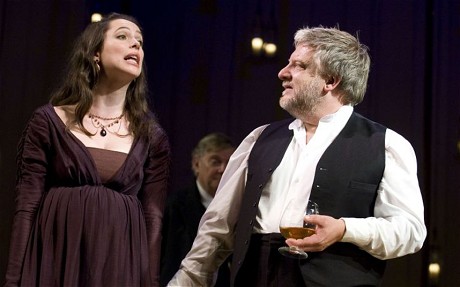
Forgiveness, and the difficulties of defining it, is something that Shakespeare seems always to have been interested in and this interest becomes especially intense in his later plays. In The Tempest we see Prospero offering forgiveness to his errant brother in a manner that looks suspiciously like another arbitrary display of power. The brother, perhaps significantly, does not answer. Leontes in The Winter’s Tale, wracked with a guilt that seems for a long time too deep-rooted to shift, faces a wronged wife who talks, not to him, but to their daughter. Not a word is spoken that promises unequivocally a settled and happy resolution.

Shakespeare recognised that the wish to be forgiven and the desire to forgive is the start of a process, that reconciliation or redemption take time, and time, of course, is the one thing that Lear and Cordelia do not have. That is what ultimately is so heartbreaking about King Lear. Not all mistakes can be fully rectified, all damage repaired and all love restored – at least, not here and now. The best we can do is accept the muddle of it all.

What Shakespeare always demands, though, is our sympathy, because, to put it simply, he writes about people like us. Offhand, I can think of only one character he wrote – Iago in Othello – that slips through the safety-net of his concern. Shakespeare might not agree with Lear’s sweeping and anarchic assertion that “none does offend”, but he sensed, I think, the danger of easy judgement. He recognises that self-worth and dignity are hard-won and that our lives cannot but be inconsistent, unpredictable, and confused. The only sane response for all of us, perhaps, is to emulate him – to look carefully, to withhold quick judgment and to try to understand.

It would suggest you read the comment’s that follow Beale’s piece – they make interesting reading. This one says it all for me:

Untitled_Fotor


A Stronghold In The Desert

Fifteen years ago I spent some time travelling through Syria and Jordan. It was my first trip to the Middle East and it was a defining moment for me. Both countries have had a lasting impact, not least because of the richness of their culture and history. In addition to Petra, two places remain very firmly planted in my memory. Firstly the Souk al-marina in Aleppo was a sensory delight,  an incredible bazaar built over 500 years ago under the Ottoman Empire and sat firmly on one of the World’s oldest trade routes. Secondly, Krak des Chevaliers, a crusader castle dating from 11th century, dripping in history.
SYR_1024_298371k

Souk al-marina before it was destroyed

krak_des_chevaliers_syria_photo

Krak des Chevaliiers before the civil war

Both have suffered badly during the Syrian civil war that has now been raging for 3 years. The Souk in Aleppo was destroyed by fire, and much of the city itself razed. Krak des Chevaliiers has been damaged by shelling and fire too.  It happens to be near Homs, another war-torn, ravaged Syrian city and has suffered accordingly. Both are (or in the former’s case, were) UNESCO World Heritage sites.

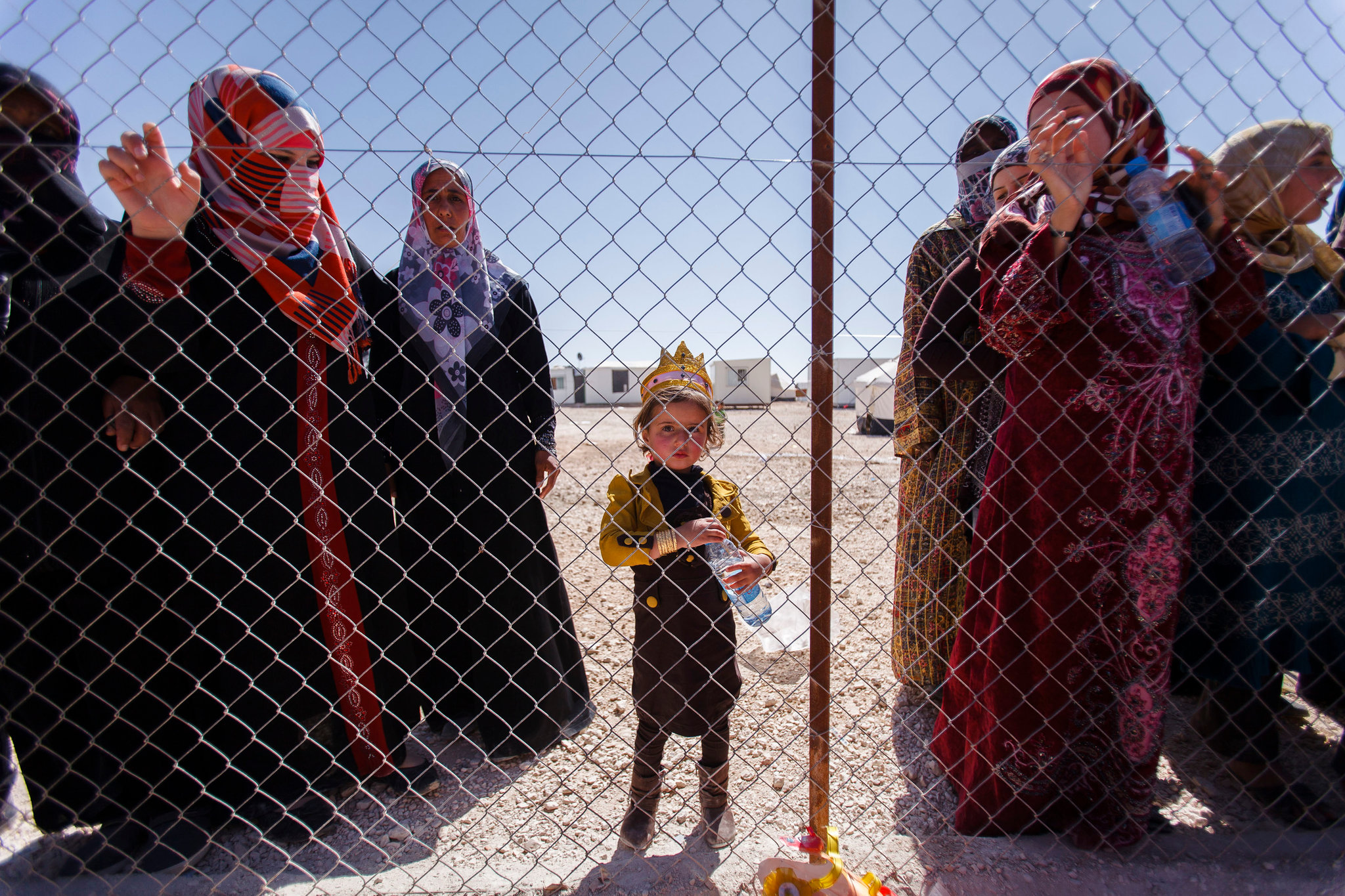
Where am I going with this? Well I was reminded of this visit again recently.  I have written twice here already (No Longer A Refugee and No Longer A Refugee #2about a group of women who have fled the fighting in Syria and have become performers in a production of The Trojan Women, a greek tragedy that reflects their own experiences. However, I have recently also become aware of another theatre project with Syrian refugees, but this time with children. Not surprisingly, many of the people fleeing the fighting in Syria have fled to neighbouring Lebanon and Jordan. One of the biggest refugee camps is the Zaatari Camp in Jordan which is currently housing about 150,000 people, an estimated 60,000 of whom are children with only a quarter of these receiving schooling.

1617466_875694579113737_164206393_o

In an attempt to help some of these children, Nawar Bulbul, a Syrian actor, has been working to stage a production of Shakespeare’s King Lear, with Lear recast as the Syrian president, Bashar al-Assad and Lear’s daughters as the different factions fighting in the civil war. I will let Ben Hubbard take up the story from here, in his excellent piece for The New York TimesBehind Barbed Wire. 

Behind Barbed Wire, Shakespeare Inspires a Cast of Young Syrians

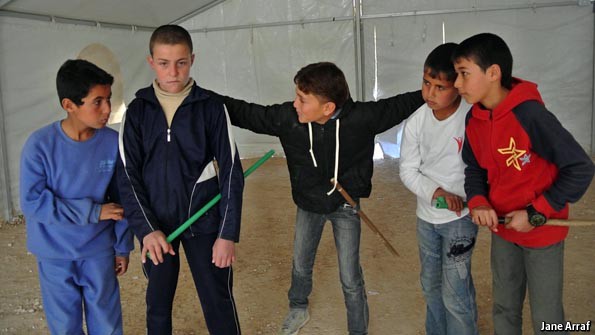
ZAATARI REFUGEE CAMP, Jordan — On a rocky patch of earth in this sprawling city of tents and prefab trailers, the king, dressed in dirty jeans and a homemade cape, raised his wooden scepter and announced his intention to divide his kingdom. His elder daughters, wearing paper crowns and plastic jewelry, showered him with false praise, while the youngest spoke truthfully and lost her inheritance.

So began a recent adaptation here of “King Lear.” For the 100 children in the cast, it was their first brush with Shakespeare, although they were already deeply acquainted with tragedy.

All were refugees who had fled the civil war in Syria. Some had seen their homes destroyed. Others had lost relatives to violence. Many still had trouble sleeping or jumped at loud noises. And now home was here, in this isolated, treeless camp, a place of poverty, uncertainty and boredom.

Reflecting the demographics of Syria’s wider refugee crisis, more than half of the 587,000 refugees registered in Jordan are younger than 18, according to the United Nations. Parents and aid workers fear that Syria’s war threatens to create a lost generation of children who are scarred by violence and miss vital years of education, and that those experiences and disadvantages will follow them into adulthood.

20140401_ZAATARI-slide-XUG9-superJumbo

The “King Lear” performance, the conclusion of a project than spanned months, was one attempt to fight that threat.

“The show is to bring back laughter, joy and humanity,” said its director, Nawar Bulbul, a 40-year-old Syrian actor known at home for his role in “Bab al-Hara,” an enormously popular historical drama that was broadcast throughout the Arab world.

The play owed its production largely to Mr. Bulbul. Smoking hand-rolled cigarettes and speaking with the animated face of a stage actor who never stops performing, Mr. Bulbul described his journey from television star to children’s director.

When the Syrian uprising broke out in 2011, he joined with gusto, appearing at antigovernment protests, leading chants and drawing the ire of the security services. A play he produced was banned, and a fellow actor who supported the government informed him that he could either appear on television to rectify his stance or expect to be arrested.

“I told him I would think about it, and a week later I was out of the country,” Mr. Bulbul said.

Bulbul watching rehearsals

Last year, he and his French wife moved to Jordan, where friends invited him to help distribute aid in Zaatari. The visit exposed him to what he called “the big lie” of international politics that had failed to stop the war.

“There are people who want to go home, and they are the victims while the great powers fight above them,” he said.

Children he met in the camp made him promise to return, and he did — with a plan to show the world that the least fortunate Syrian refugees could produce the loftiest theater.

The sun blazed on the day of the performance, staged on a rocky rectangle of land surrounded by a chain-link fence topped with barbed wire. The 12 main actors stood in the middle, while the rest of the cast stood behind them, a chorus that provided commentary and dramatic sound effects. The audience sat on the ground.

20140401_ZAATARI-slide-7SEC-superJumbo

When each of Lear’s first two daughters tricked him with false flattery in elegant, formal Arabic, the chorus members yelled “Liar! Hypocrite!” until the sisters told them to shut up.

And when the third sister refused to follow suit, the chorus members yelled “Truthful! Just!” until the king told them to shut up.

In later scenes, the king was heckled by the Fool, who wore a rainbow-colored wig, and eight boys performed a choreographed sword fight with lengths of plastic tubing. A few scenes from “Hamlet” were spliced in, making the story hard to follow. And at one point, a tanker truck carrying water roared by, drowning out the actors and coating the audience in a cloud of dust.

20140401_ZAATARI-slide-O1FD-superJumbo

But the mere fact that the play was performed was enough for the few hundred spectators. Families living in nearby tents brought their children, hoisting them on their shoulders so they could see.

After Lear’s descent into madness and death, the cast surrounded the audience, triumphantly chanting “To be or not to be!” in English and Arabic. The crowd burst into applause, and a number of the leading girls broke into tears. Mr. Bulbul said they were overwhelmed because it was the first time anyone had clapped for them.

After the show, as journalists interviewed the cast, the parents boasted of their children’s talent.

“I am the mother of King Lear,” declared Intisar al-Baradan when asked if she had seen the play. She had brought about 20 relatives to the performance, she said, adding that her son was also a great singer.

20140401_ZAATARI-slide-UA3C-superJumbo

Other parents described the project as a rare point of light in a bleak camp existence. Hatem Azzam, whose daughter Rowan, 12, played one of Lear’s daughters, said the family fled Damascus after government forces set his carpentry shop on fire. “We were a rebellious neighborhood, so they burned every shop on the street,” Mr. Azzam said. He arrived in Zaatari a year ago with five other family members, but one of his brothers got sick and died soon afterward, and his elderly mother never adjusted to the desert climate and died, too, he said. He hesitated to send his children to school, fearing that they would get sick in the crowded classrooms, and he kept them from roaming the camp because he did not want them to start smoking or pick up other bad habits. But the theater project was close to home, and his daughter was so excited about it that he let her go.

20140401_ZAATARI-slide-TSXA-superJumbo

“People get opportunities in life, and you have to take advantage of them,” Mr. Azzam said. “She got a chance to act when she was young, so that could make it easier for her in the future.”

The mother of Bushra al-Homeyid, 13, who played another of Lear’s daughters, said the family had fled Syria after government shelling killed her niece and nephew. “The camp is an incomplete life, a temporary life,” she said. “We hope that our time here will be limited.” But after a year here, she worried that her eldest daughter, who was in high school, would not be ready to go to college. Bushra, grinning widely and still wearing her yellow paper crown, said she had never acted before but wanted to continue.“I like that I can change my personality and be someone else,” she said.

(Illustrating photos by Warrick Page for The New York Times)

In his piece, City of The Lost for The New Yorker, David Remnick paints a desolate and harrowing picture of life in Zaatari – lengthy but worth a read.

Everything about this is a tragedy on a grand scale – a culture, lives and futures destroyed, but you cannot help but applaud Nawar Bulbul for what he is trying to do. He has set up a Facebook page and a YouTube channel, Shakespeare in Zaatari, which gives an even greater sense of what is being achieved out there in the desert. Having been forced to leave Syria himself, he continues to fight the Assad regime, even down to refusing to let what are considered to be pro-Assad media organisations film the project.

20140222_map503

Nouar Bolbol

Bulbul (left) is clearly a man of conviction and I for one celebrate what he is trying to achieve. Yes, it is only a small gesture when you consider that there are in excess of 60,000 children living in Zaatari. However he has chosen to harness the power of the thing he knows best – theatre – in an attempt to heal the brutal wounds of war, violence and dislocation. He doesn’t see theatre as a balm, a salve to make the horrors disappear. Some might say he is encouraging a very partisan view of the experience the children have been through. I would argue that it is simply a way of allowing an understanding of what brought about the situation they find themselves in and the truth about how one man and his regime can inflict incalculable suffering on others.

A Quiet Mind

This week I have watched 9 new pieces of theatre, as part of the exam season in my school. It never ceases to amaze me how powerful and prescient young peoples’ theatre can be and this week was no exception. A friend of mine (and ex student who did the same examination almost 20 years ago) commented that the real strength of a devised performance exam is that it

isn’t a recollection of prescribed ideas but in many ways a reflection of a group of young people’s interpretations of their surroundings expressed through [drama] techniques, skills and knowledge…

This is so true and why a drama education has so much value beyond the performance skills taught. My Grade 11 students tackled a range of issues from the Palestine/Israeli conflict to autism and it is the latter that led me to the focus of my post today.

The piece was inspired initially by this interview with Robin Blamires on the BBC World Service Outlook strand:

and the podcast, Inside The Mind Of A Hypomanic created by him.

.

Blamires is autistic and has suffered with hypomania and bi-polar disorder. His podcast explores what it feels like to go through a manic episode.

WAAD2014_FotorThe piece my students created was called A Quiet Mind and drew on verbatim interviews with those on the autistic spectrum, poetry, soundscape, physical theatre and Butoh.  It simply created the world of someone with Aspergers and allowed the audience to experience that viscerally.  It moved many to tears. It is now being re-staged next week as part of an awareness campaign for World Autism Awareness Day. It was an amazing piece of theatre and really got me thinking about how in theatre we represent mental illnesses and disorders. In some societies, mental illness remains an unspoken subject, almost taboo. Representing what such illnesses are really like for the sufferer is difficult and we often end up with stereotypes or simply exploring the worlds of the people around the person, not the person them self.

There are a good many plays that have characters who are clearly suffering a mental illness, amongst the best are Find Meby Olwen Wymark and 4:48 Psychosis by Sarah Kane. But even in the former the narrative tends to be led and experienced by those around Verity, the central character, rather than by her own direct experience.

In a fascinating article for Everything Theatre, Dr Rachel Proctor argues that:

theatre has an opportunity and a responsibility to educate us about the realities of mental illness, not simply increase our misunderstanding and paranoia.

Proctor’s stance is clear – the portrayal of mental illness on stage is not done well, often touching on stereotypes and lacking true insight. She concludes, asking:

Am I criticising the portrayals? How can I – writers, directors and actors have a right to put on stage anything they want……. but what I would argue is that there is a responsibility for some accuracy in a topic so grossly misunderstood. Mental illness scares us – whether through lack of understanding or fear of it in ourselves. Theatre is a powerful educative tool, and I believe it has a place – and indeed a responsibility – to educate us on this topic.

A recent very successful adaptation and staging of Mark Haddon’s The Curious Incident Of The Dog In The Night Time could be viewed as pushing mental disorder in to the theatre mainstream. In this case the narrative is driven from the perspective of the lead character, school boy Christopher. You are led to assume that he is autistic, although this is never stated in either the novel or its adaptation.

The Curious Incident of the Dog in the Night-Time

The Curious Incident of the Dog in the Night-Time

Yet the reality is, and back to Dr Proctor’s point here, there are precious few examples of plays that deal with mental illness honestly, realistically and allow the audience to truly understand what it means to be a sufferer. However, and is often the case when I decide to write something specific for Theatre Room, two examples of what I was really looking for popped up in my Twitter feed.

Firstly, a play called The Eradication of Schizophrenia in Western Lapland by London-based company Ridiculusmus. The play is inspired by a treatment method for psychosis that has virtually led to, as the title suggests, the eradication of schizophrenia in Western Lapland. It is described here as a startling piece of work by Maddy Costa for The Guardian and here as dense and audacious by Stewart Pringle for Exeuent. Not unlike my students’ work, it immerses that the audience in the world of the suffer. Interestingly, the play was commissioned for the SICK! Festival in the UK, which is a new festival exploring the medical, mental and social challenges of life and death and how we survive them (or don’t).

The Eradication of Schizophrenia in Western Lapland by Ridiculusmus. Photograph: Tristram Kenton for the Guardian

The Eradication of Schizophrenia in Western Lapland by Ridiculusmus. Photograph: Tristram Kenton for the Guardian

The second play, Head Hand Head by Laura Jane Dean is a solo show written and performed by her, drawing on her experiences of living with Obsessive Compulsive Disorder. In her review for Exeuent here, Alice Savill says that being trapped in Laura’s perspective feels almost dangerous; her explanations of her fears seems so rational, their results so irrational. Whilst in A Younger Theatre here, Devawn Wilkinson says that it is quietly devastating and that it blazes with honesty. 

Head Hand Head

Head Hand Head

Interestingly, and by way of wrapping up, as I was doing the research for this post, I was reminded of a theatre company, Stepping Out,  who have been creating theatre about mental health issues for almost 20 years. Their work is multifaceted. Not only do they make theatre about metal health issues, they also use it as therapy for sufferers. I also came across an organisation in Australia called Mindframe Stage & Screen whose purpose, amongst other things, is to provide research and sources to writers dealing in such illnesses as well as ensuring that

Depictions of mental illness are based on accurate information, challenge stereotypes and myths about mental illness and encourage people with mental health problems to seek help.

This final quote helps me make my final assertion too. As I said at the beginning, mental health issues are often hidden away, seen as taboo. Theatre has a duty to explore the human condition and by doing so help people understand themselves and each other – and in this context help themselves and each other.

Post Script.

I should say I have made a purposeful point of not mentioning plays where it could be  assumed that a character is suffering from a mental illness of one kind or another – think Hamlet, Lear, Medea, Blanch DuBois and so on – as they are merely projections by a director or actor in search of meaning and truth that probably never existed in the playwrights mind to begin with. Also, there are terrific works like Blue Orange by Joe Penhall which treat mental illness sensitively and in context, but use them really as a way to drive a broader narrative.

Blue Orange

Blue Orange

Left Foot Forward

bec7cf1f76a3df6efdf60f12fcd545f2_FotorMy post last week about theatre and (geo)politics, A Rocky Road, has caused some interesting discussion in my department.  Today I would like to add another dimension to that debate by sharing an article by Holly Williams, for The independent. 2014 sees the commemoration of the beginning of the First World War, especially in Europe and Australasia. Over the course of the last year, there has been much polemic surrounding the nature of the commemorations, with many fearing, in the UK at least, that these commemorations could descend into jingoistic, flag waving events, rather than reflective experiences that explore the atrocity and human tragedy that was the First World War. Inevitably, the debate has largely split along the political divide, with even a government minister joining in, accusing British theatre of being left-wing in its portrayal of the events of the war – and this is where Holly Williams begins:

The First World War on stage: Lest we forget… the politics of war drama

At the beginning of Theatre Royal Stratford East’s revival of Joan Littlewood’s 1963 musical Oh! What a Lovely War, a Pierrot clown describes a series of pre-war Bank holiday scenes, while a slide-show projects images of the seaside, bathers and a donkey. Except the “donkey” is the Education Secretary Michael Gove.

It’s apt that this landmark show about the First World War, which took swipes at the ruling classes who made a mess of it, should now laugh at today’s politicians too. And Gove is an easy, and justifiable, target: he made headlines recently by attacking Oh! What a Lovely War [as] perpetuating myths of the Great War as “a misbegotten shambles – a series of catastrophic mistakes perpetrated by an out-of-touch elite” and denigrating “patriotism, honour and courage”.

Birdsong

Birdsong

While it’s easy to smirk at the mental image of Gove stamping his foot, his reference to Oh! What a Lovely War reignited the debate about whether British theatre is inherently left wing: it’s hardly the first time it’s been accused of being the preserve of bleeding-heart, right-on liberals. But Gove had better stiffen that upper lip – 2014 sees First World War centenary events across all art forms, with theatre addressing the topic with particular vim.

The charge has already begun: Northern Broadsides are touring An August Bank Holiday Lark, about boys from a Lancashire village going to fight in the Gallipoli campaign, while the aforementioned  Oh! What a Lovely War is a huge sell-out at its original east London home. There are adaptations of books: a version of Sebastian Faulks’s Birdsong is on tour now, Pat Barker’s Regeneration arrives on stage at the Royal & Derngate in September, while a one-man play of Dalton Trumbo’s 1938 anti-war novel Johnny Got His Gun opens at the Southwark Playhouse in May. The National Theatre revives the rarely performed anti-war 1928 play The Silver Tassie in April, and there’s new writing too: Peter Gill’s Versailles is about to open at the Donmar, while in the autumn Shakespeare’s Globe stages Howard Brenton’s Doctor Scroggy’s War and the RSC has The Christmas Truce, a family play by Phil Porter.

These offer a vast array of different angles, from the impact of war on a rural community (An August Bank Holiday Lark) to the inner life of a man who had his limbs and face blown off (Johnny Got His Gun). Meanwhile, their protagonists range from officers in the trenches to civil servants in the corridors of power and the women who stayed behind. To assume that playwrights are wielding their pens like righteous political axes is simplistic, to say the least.

Rebecca Howell, Caroline Quentin, Alice Bailey Johnson and Zoe Rainey in Oh What A Lovely War

Oh What A Lovely War

And few within the industry have anything positive to say about Gove’s comments. “I thought it was unfortunate, unpatriotic, appealing to the worst side the country,” says the venerable Gill, who is also directing Versailles. “But mainly silly, and a bit embarrassing, frankly. Does he think we’re a fan of the Kaiser? It’s just childish!”

His play is set in the aftermath of war and centres on a young man sent among the British delegation to draw up the Treaty of Versailles; both in Paris, and at his family home in Kent, debate rages about the future of Europe.

And while Gill witheringly refutes the notion that British theatre is inherently left wing – “the National is hardly Trotskyite, is it?” – he does suggest that the stage is the ideal forum for ideological debate. “The Greeks showed us it is the perfect democratic instrument. It’s live and, unlike film, it’s not quite so able to manipulate. It’s the perfect dialectical [form] – I’m sounding like a communist now! – but it’s a perfect instrument for all kinds of things, and one of them is certainly airing [political debate].”

Versailles

Versailles

David Mercatali, directing the UK premiere of Johnny Got His Gun, suggests politics are a natural by-product of drama’s primary concern: the story. “There is nothing to say that politics needs to drive any medium, but I think that many people in theatre are looking to go beneath the presentation of history. If, in looking at those human stories, people feel a left-wing bias starts to come out, I don’t think there’s a lot we can do about that.”

He did, however, choose to stage Smith’s self-evidently anti-war monologue this year as a riposte to the misty-eyed patriotism that will also be sloshing about. “We have to be really careful about glorifying it. I actually think people try to protect the presentation of the First World War – it’s important that we expose the shortcomings behind it as well.”

An August Bank Holiday Lark

An August Bank Holiday Lark

Deborah McAndrew’s An August Bank Holiday Lark is winning rave reviews. But the playwright doesn’t see her role as political adjudicator. “Real historical analysis is probably not the job of a play, she says, “I’m a storyteller, I was looking for a story.”

However when she discusses Gallipoli, she can’t help but become angry. “If I was making any little political point it was that I felt young men’s lives were disregarded. And there was gross incompetence – Gallipoli was a disaster. There’s no way of spinning it. They were trying to invade Turkey, a whole country – the sheer numbers would tell you that was doomed to fail.” Which, really, is no “little” point.

Rachel Wagstaff, who adapted Birdsong for the West End in 2010 and rewrote it further for its current tour, echoes McAndrew: “I don’t think the job of a playwright is to teach history; it’s to tell stories.” But, she adds, writing is also an imaginative attempt to understand history and humanity. “How can we have allowed the situation to develop where, for example, in the first day of the Battle of the Somme, 20,000 [British troops] were killed? How can that ever be justified? As a playwright you’re trying to illuminate and question what it is to be human.”

Her show stages such battles – a logistical challenge that the production rises to with evocative use of lights, smoke and sound. And Wagstaff points out that theatre can be uniquely powerful in conveying the physical horror of war: “When it’s a real human being in front of you in that moment, I find that so much more affecting than on film or TV.”

Jonny Got His Gun

Johnny Got His Gun

Not that Birdsong isn’t also patriotic: Wagstaff says it also captures “the British spirit, that dark sense of humour” through its portrayal of the bravely upbeat Tommies in the trenches. “You have to show the events and honour them, and allow people to feel the horror,” says Wagstaff, “but on the other hand, you can’t have people sitting there for two hours just feeling sick, revolted, distressed and disturbed!”

Many of the plays being staged in 2014 do, then, question the decisions made before, during and after the war. Such harrowing source material naturally often lends itself to troubled – and sometimes explicitly anti-war – interpretations. But, despite what our Education Secretary might fear, they are also complex and humane in their interrogation, rather than limitedly “left wing”. “Isn’t it brilliant that people are having this debate?” says Wagstaff, injecting a note of positivity into the whole Govian furore, before concluding: “We must never allow such suffering to happen again, so it’s really important that we commemorate, and remember, and we tell our children. It’s more important than ever.”

I make no apologies for posting an article that is very UK-centric. I know similar debates are had right around the world about how politics and theatre collide, and that theatre makers are viewed as inherently left wing in their views. I think Williams’ word will have resonances everywhere. The politician Michael Gove is held in huge contempt for his ideology by the left leaning middle-class in the UK,  and for transparency’s sake I have to say I am in total agreement with them. I’d be interested to hear if a similar debate about theatre and the commemoration of the War is taking place elsewhere with such political overtones.

I want to finish with two other pieces of writing by theatre critic Michael Billington, both for The Guardian. Firstly, Oh What a Lovely War: the show that shook Britain which explores the impact of the original production in 1963 both on British understanding of the war and on theatre making more widely. Then, secondly, his review of the latest production of Oh What A Lovely War that has just been staged at the original venue of the ’63 production, Theatre Royal Stratford East. This latest staging formed part of the 50th anniversary of the play’s original staging as well as part of the centenary of the First World War.

Bit Between The Teeth

Last week I went to the theatre with a group of students. Nothing unusual in that of course. However, it was one of those occasions where my expectations were wildly off the mark. As I have said previously, it is International Arts Festival time in Hong Kong and when I book tickets for my students, I always try to book a range of performances – something to challenge, something from a world theatre perspective, some dance theatre and something to entertain. I think its important that my students understand that theatre is a ‘broad church’ and my want to book a piece that is a little ‘lighter’, shall we say, is part of encouraging life long learning.

Rob-Drummond-Volunteer-opening-520x327My ‘lighter’ choice this year was a piece called Bullet Catch, a solo performance by Rob Drummond, was described thus:

A stunt so dangerous Houdini refused to attempt it, the Bullet Catch has claimed the lives of at least 12 illusionists, assistants and spectators since its conception in 1613. Drawing help from his daring live audience, modern-day marvel (William Wonder) presents a unique theatrical magic show featuring storytelling, mind reading, levitation, games of chance and, if you are brave enough to stay for it, the most notorious finale in show business.

You can see why I might book it. However, this description barely touches on what the piece is really about or the depth of the intellectual and visceral responses it provokes. What I actually ended up seeing was one of the most engaging pieces of theatre I have seen in a long time and one that has caused endless discussion between teaching colleagues and students from all grades. The piece plays with theatrical form in such a way that it leaves you with endless questions about what you have just witnessed. It is about illusion and reality. It is about free will, trust and connections. To use a modern idiom, it messes with your head. One critic said

it is…..painfully honest about the choices we make and the way we stare despair in the face while pretending we are OK.

It is beautifully and cleverly manipulative of the audience and dramatic tension – you are never sure what is truth, as it plays with content and form. All in all it is deeply unsettling and the better for it as a piece of contemporary theatre – not surprisingly it won a Total Theatre Award when first performed.

.

Bullet Catch has played in the UK, America, Brazil, New Zealand, Australia and now, Hong Kong. The critics have been almost universal in their praise and I think largely so because of the fierce intelligence that is clearly behind the theatre making. It is as much an exploration of dramatic form and how theatre ‘works’  as it is the telling of a story. It plays with your suspension of disbelief in an almost cruel way – although in hindsight and after considerable thought I am astounded at the deftness with which Drummond (as writer, performer and co-director) has done this.

A review of one of its original performances by Lyn Garnder for The Guardian gave the piece a highly praised 4 star rating:

“This isn’t magic; it’s a conversation,” says Rob Drummond in this remarkable, multilayered and utterly gripping show inspired by the infamous bullet-catch trick. It’s remarkable for several reasons, not least for the levels of tension it invokes as it heads towards a climax in which Drummond persuades a member of the audience to shoot him.

I’m giving nothing away by telling you this is a piece that plays, with swaggering confidence, with the nature of truth and illusion, invoking Harry Houdini and claiming to be inspired by the real-life case of William Henderson – apparently killed while undertaking the trick in 1912 in front of 2,000 people. Was it an accident or did something more sinister take place when a labourer with no history of violence was grabbed from the audience and invited to pull the trigger?

BulletCatch4web

It is also remarkable because while it revels in sleight of hand and celebrates the magic of theatre, it is also painfully honest about the choices we make and the way we stare despair in the face while pretending we are OK.

Drummond is both measured and infinitely vulnerable and, in a way that reminds me of theatremaker Tim Crouch, he introduces an element of dangerous uncertainty into the show by inviting a member of the audience to play a major role. “It couldn’t have happened any other way,” are almost his final words, but Drummond marries form and content to prove that it’s a lie.

One of my graduating students was appalled that we were actually being asked to wait to watch another human being shot at, which was a view expressed by Sarah Hemming in her review of the show for The Financial Times. Hemming describes the magic trick itself  as:

……a launch-pad for a gripping, terrifying inquiry into free will

At the very end, Drummond and his co-opted member of the audience re-enact the Bullet Catch and this is where Drummond works yet more of his real magic – that of absolute psychological (and theatrical) manipulation. We know that it is just a trick, an illusion about to be acted out in front of us – it couldn’t possibly be anything else in a risk-averse 21st Century. Yet when the audience are offered the opportunity to leave before it takes place, some do. Of course there are a number of reasons why this might be the case. Like my student, the prospect of one man holding a gun and aiming at another is just wrong on many levels. Equally, despite the fact we know that it is fiction, we cannot quite manage to suspend our disbelief and the anxiety is just too much.

.

9478c756-cd60-4928-90fd-b4971df84a1b-460x276I am still not clear if I have been able to give a full enough description about why I feel this piece is a unique theatrical event, but  if it tours near you I wouldn’t hesitate in recommending you going to see it – even if you have to leave before the end.

No Longer A Refugee #2

In January I wrote a post, No Longer A Refugee, about a group of women refugees who had fled the vicious civil war in their homeland Syria and were involved in the staging of a production of the Greek Tragedy, The Trojan Women. As I was driving to work today I listened to another thought-provoking programme about the project, which was broadcast by the BBC World Service, as part of their Outlook strand. If the January post struck a chord with you, I certainly recommend a listen to the Outlook podcast below:

604

The High Priestess

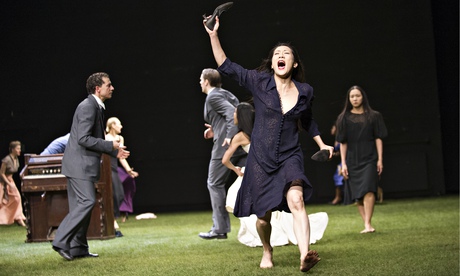
February and March is International Arts Festival time in Hong Kong which draws its repertoire from across the globe. One regular visitor every few of years is Pina Bausch’s Tanztheater Wuppertal, who are celebrating their 40th anniversary and this year they will be performing Iphigenia in Tauris which is one Bausch’s earliest works from 1973.

SPECTACLE: VOLLMONDCHORÉGRAPHE: PINA BAUSCHLIEU: WUPPERTAL - 2006

Vollmund

I love this company’s work and alway take myself and my students when they are in town. Prior to their run here they have been performing in London with another piece, 1980. Their appearance in the UK has generated a number of articles that I thought would be worth sharing here. I’ll start with a comment piece by Lyn Gardner for The Guardian which says everything about the genre and why it works for me and my students, who are invariably enraptured by this style of work.

What’s it all about? In theatre, it’s sometimes best if you don’t know

As Tanztheater Wuppertal’s 1980 proves, theatre is at its most potent when it doesn’t offer answers

Somebody once asked the dancer Anna Pavlova what she meant when she was dancing. “If I could tell you that,” she replied, “I wouldn’t dance it.” Theatre’s most thrilling evenings often come cloaked in ambiguity. Too much certainty is embalming in the theatre. It leaves nobody – writer, choreographer, performers, audience – with anything left to discover. I like leaving the theatre feeling as uncertain as when I went in. After all, the world and humanity are too complex and messy to explain easily and tie up in ribbons in a couple of hours.

The performances I most distrust are the ones that tell me emphatically what to think, where the playwright inserts a speech (usually somewhere towards the conclusion so we don’t forget it) that instructs as to what exactly the previous two hours have been about. Sometimes the director does it in an essay in the programme instead. I also distrust those performances that seem simply designed to confirm everything we already know about the world and ourselves. Plays that are “about things” are often really journalism in another guise.

The stage is like the mind itself ... Tanztheater Wuppertal's 1980

The stage is like the mind itself … Tanztheater Wuppertal’s 1980

The great Robert Holman once told me that one of the glorious things about writing plays was uncovering in the very act of writing the things that you didn’t know that you knew. With a very good play or an astonishing performance, that can be just as true for the audience too. In the act of listening and watching we suddenly hear a distant chime that reminds us of something we had forgotten or buried; glimpse a ghost version of ourselves; or unexpectedly discover something we didn’t know we knew or felt.

Pina Bausch’s extraordinary and unmissable 1980 – surreal, truthful, mysterious, witty, heart-breaking and painful – is like that. In some ways it is as secretive as an oyster, but it is so emotionally textured and dramaturgically open that the vast stage becomes like a massive mirror of memory, endlessly reflecting our own childhoods, our own griefs and terrifying sense of fragility, and our own ludicrous and absurd way of preening and presenting ourselves to the world in the face of our own mortality. The stage is like the mind itself, sometimes focused and at others surfing wildly. There are interesting things going on all around the edges, as in life. You never quite know where to direct your attention, or where you should look.

The choreographed space between the bodies is as eloquent as the bodies themselves, and the space between stage and audience so fully alive that it invites us to lean forward to hear those chimes and watch those ghosts walk. At the end of three-and-a-half hours, I had no idea at all what it was supposed to mean, but like a frightened child in the dark began to sense and grope towards the light and all the things it meant to me. The show, and the performers, exposed and opened themselves up and invited us to share their uncertainty. In theatre, that’s a rare, brave gift. We should take it when it’s offered.

Also in The Guardian were two other pieces.The first, by Chris Weigand, Performing Pina Bausch’s 1980 – in her dancers’ words, is an interview with three of the performers and the second, ‘She made you feel thrilled to be human’ is by actress Fiona Shaw who saw Bausch’s first London performance.

Pina-Bausch-in-August-200-001

Pina Bausch

If you are not familiar with her work (or even if you are) Sanjoy Roy wrote Pina Bausch: clip by clip dance guide for The Guardian, back in 2009, which is definitely worth a read and watch. Some of the original clips referenced in the article have been removed from YouTube, but a little search will find them posted elsewhere on the site.

facepic3-duotone_large

Sanjoy Roy

Sanjoy Roy is a prolific writer an all things dance/dance theatre and his own blog Sanjoy Roy Writing On Dance etc is worth a visit on any number of practitioners. I particularly like his Step By Step Guides to famous and iconic choreographers and companies, and his one on Pina Bausch is a great digest of her work.

Tanztheater Wuppertal tour widely across the globe and I thoroughly recommend you go if they come to a theatre near you.

How far that little candle throws his beams!

How far that little candle throws his beams! So shines a good deed in a weary world.

Portia, The Merchant of Venice.

Sydney Opera House at Night Australia Digital Art By mrmGoogle  ‘worlds famous theatres’ and the subsequent list is a mixture of iconic historic opera houses spanning a number of continents, the Chinese Theatre in Los Angeles and, not surprisingly, The Sydney Opera House. Now I could take issue on many fronts with what is considered to make a theatre famous, not least of all that none of them appear to take into account what actually goes on in inside. Yes, lots of them are works of art in themselves as this list from Huffington Post shows, but I would posit that were you to show these to most people they wouldn’t be able to tell what they are called or where they are. However, I would think a far great number would be able to tell you what and where this theatre is:

Pawel-Libera-Globe-Exterior

Shakespeare’s Globe was opened in 1997 and if you don’t know the history behind the reconstruction you can read that here. The point I am trying to make that since it opened, and for many reasons, it has become iconic throughout the world both for being the building it is AND for what goes on inside it. I’ve seen a play there and it is a truly unique way of watching theatre.  There is something democratic about the relationship between actor, audience and space – especially if it rains mid-performance. What’s more, as reported in The Stage, last year the theatre had a turnover of more that £21million, made a profit of £3.7 million, played to houses of 96% capacity and had a reach of 1 million people through it’s various ventures. Now that is some going for a theatre that started as one man’s, Sam Wanamaker, vision. It was built by raising money through donation and is less that 20 years old. The quote from The Merchant of Venice could well be said of Wanamaker and his vision, but I really intended it as an opening for the real purpose of today’s post.

the-sam-wanamaker-playhouse-85149

In January this year The Globe unveiled another theatre on its site, called the Sam Wanamaker Playhouse. Again built through fundraising, this ‘new’ theatre is another faithful reconstruction, but this time of an indoor, Jacobean theatre, entirely lit by candles. The exterior of the playhouse seems quite innocuous, but the images of the inside are a revelation and the reviews of the the two plays staged in it so far talk with some passion about the theatre-going experience in this new space. There is a great gallery of pictures here, from The Telegraph.

9386823

Much has been written about the Playhouse, not least of all the experience of lighting, acting in and watching a play by candlelight. The Jacobeans used candles made from animal fat, but the Globe have gone for pure beeswax, costing up to £500 per show, all of which are lit by hand before each performance. In a great article for The Guardian, Andrew Dixon give a real flavour of the place, New Globe playhouse draws us inside Shakespeare’s inner space

There is a very evocative and informative report from The Voice of Russia radio here which is fascinating, and talks about the experience as going back to storytelling in its most primitive form:

The Globe has produced a good series of videos about the Playhouse and I am going to put them all here, for ease of reference:

I think they tell a marvellous story. The following video is a collection of interviews with audience members on the opening night of The Duchess Malfi, and you get a real sense of what the experience is like:

There is also a really interesting podcast, courtesy of Theatre Voice, with Farah Karim-Cooper who is Head of Research at The Globe in which she explores indoor performance during the Renaissance and at The Sam Wanamaker Playhouse:

There is also a lovely piece called Ten Reasons to get excited about the Sam Wanamaker Playhouse at The Globe, also by Farah Karim-Cooper, published on Blogging Shakespeare.

If you are a regular reader of Theatre Room you will know my relationship with Shakespeare has it’s tensions, but I can only applaud the people behind this project and how it extends our understanding of the history of performance. I will certainly be booking tickets to see whatever is playing next time I find myself in the UK.