Setting Free

Valley_326First post of the day is an article published on Friday in The Financial Times.  Sarah Hemming interviews Peter Brook, now 89 and still going strong, about his latest work The Valley of Astonishmentwhich deals with the condition synaesthesia. It’s alway struck me that a theatrical exploration of the experience of a sufferer had potential and the great man himself has delivered the goods. As always he is working with an international cast, including American theatrical legend Kathryn Hunter (a big favourite amongst my colleagues) and avant-garde Japanese percussionist and long-time Brook collaborator Toshi Tsuchitori.

761fcdbc-cede-4460-9c5e-146e8022df94Interview: veteran theatre director Peter Brook

The once-maverick theatre director, now 89, still divides opinion. He talks about his latest creation and his desire to ‘savour life more fully’

Peter Brook picks up a tumbler of freshly squeezed orange juice from the table in front of him and revolves it in his hand. “I look at the glass of orange juice,” he says. “I listen very, very attentively . . . no sound emerges.”

Well, of course not, you might think. But while for most of us colours, sounds and sensations remain obstinately separate, for others the lines between them are porous. The great pioneering theatre director and I are discussing synaesthesia, the extraordinary neurological condition where the senses overlap: a sound, for example, might evoke a colour or taste. We agree that if you don’t have the condition, it is very hard to imagine. Which is precisely why Brook has made a theatre piece about it.

The Valley of Astonishment (which opens at London’s Young Vic next week) draws on the experiences of synaesthesia and attempts to communicate them using first-person testimony and stagecraft. Lighting, for instance, paints the stage in rapidly shifting colours to convey what one man hears when he listens to music. “We’re using the theatre to give life to a research that otherwise has no form or body,” Brook explains.

10390259_10152396206313346_31084398118402188_n

Not easy. But then all his life Brook has had an appetite for difficult theatrical terrain. Now 89, frail, but still cordial and spry in a black leather jacket and brightly coloured shirt, he meets me in an opulent Paris hotel. The place is full of handsomely furnished spaces but he chooses, characteristically, a quiet corridor where no one else is likely to settle.

Brook has always gone his own way. He blazed a trail through British theatre in the 1960s and 70s, experimenting with form and revolutionising theatre practice with his minimalist staging of Midsummer Night’s Dream (1970). His distillation of theatre to its basics in his 1968 book The Empty Space remains a guiding principle for many contemporary theatre makers. Its simple opening image of a person in an empty space has been the foundation of all Brook’s work in recent decades.

But he still felt constrained by the British theatre conventions of the time. In 1970 he left to travel the world, exploring theatre practices, and has never lived in Britain since. Settling in Paris, he created the International Centre for Theatre Research. He spent months, even years, developing pieces.

His eclectic methods and sage-like aura have produced intense reverence in some quarters and scepticism in others. They have also resulted in some outstanding pieces, one highlight being The Mahabharata (1985), an unforgettable nine-hour staging of the great Indian epic that sent fire licking across the sand and arrows raining over the stage to summon elemental battles. Typically, he responded to its success by changing tack and journeying inwards.

10320394_10152396206018346_2259612351189738091_n

“When The Mahabharata was over, I was swamped with invitations,” he says. “To do Beowulf, to do the Icelandic myths, to do the German myths – all that. Because I was now the Specialist on Old Myth,” he chuckles.

“I said, ‘But I’m not in the myth business.’ People always do that: if I’ve done a play by Chekhov somebody says, ‘Ah your next Chekhov . . .’ And I say, ‘But I’m not doing another Chekhov. This is something for now.’

“So my question to myself and my close collaborators was: what could be a similar research into what human life is about, but from a different perspective and from present-day conditions? . . . We started this research into what the brain is.”

The Valley of Astonishment is the third in a sequence of plays about the mind, initially inspired by the work of neurologist Oliver Sacks. The first was 1993’s The Man Who . . ., based on Sacks’ book The Man Who Mistook His Wife for a Hat. The new show is also typical of Brook’s recent work in being spare, delicate and distilled.

Before our meeting, I watch the show in Les Bouffes du Nord, the beautiful, dilapidated theatre behind Paris’s Gare du Nord that the director made his home for more than 30 years. The piece is simple in structure, delivered (in English) by three actors and two musicians on a near-empty stage. It’s humane, intensely focused, but also surprisingly light, playing little games with the audience.

A packed crowd listens intently and several linger in the bar afterwards to discuss the show with the cast. Brook says this is common: the piece has touched a nerve with many. One woman recalled that her mother had always had a different coloured toothbrush for each day of the week – a routine that suddenly made sense.

10404218_10152396206273346_7503657522193754296_n

“The people with this condition actually receive moments of their life more richly than we do,” Brook observes. “It’s a reminder to us all that whatever our experience at any moment, there is, in Shakespeare’s terms, ‘a world elsewhere’.”

He talks about one man who lost his proprioception – the inner sense of body position that enables us to co-ordinate movement – and yet learned, painstakingly, to control his limbs again by using his eyes.

“He came to see us when we were doing The Man Who . . . To everyone’s amazement, the door of the theatre opened and he strode in, sat down and crossed his legs. We thought someone would have to carry him in from the taxi. But he says he cannot for one second let go of this acute attentiveness with the eyes. Even today. If, for a moment, the lights go out, he has learnt how to let himself lean backwards against a wall because otherwise he would fall on the floor.

“And the thing that is so moving is that for him the great joy of Christmas day is that he is alone in his house and he sits on his chair and just lets himself go.” Brook demonstrates, letting himself go limp. “Because every moment for him is a marathon. Every moment.”

Brook stops, clearly moved. And this surely is the nub of the show: it is not designed to make audiences gawp at case histories, but to alert them to the out-of-the-ordinary capabilities of the mind. The piece encourages us to empathise with the characters but also to think about the perceptive tools we use to understand theatre. It’s about awareness in several senses: about what it means to be human.

There’s a click of heels on marble and we are joined by Marie-Hélène Estienne, Brook’s long-time French collaborator: a brisk though not unfriendly woman. She’s come to discuss her part in the play but also to keep Brook to his timetable (he is not a man for a short answer).

The two engage in a lively debate about the meaning of the word “compassion”. “I think you have to kill your judgment,” says Estienne. “Open yourself. When we worked on the play, the first thing that struck us was: ‘Who am I?’ Really.”

10270500_10152396205983346_8278687727159850143_n

That undimmed curiosity about what makes us tick seems to be what keeps Brook making theatre after 70 years in the business. The simplicity of his style, once revolutionary, is less surprising now – some have found recent works repetitive or underpowered – but the urge to comprehend remains fresh. His latest bookThe Quality of Mercy, a collection of essays about Shakespeare, finishes by examining Prospero’s final speech from The Tempest, with its plea to be forgiven and “set free”. Tolerance, clemency, mindfulness – late in life these qualities preoccupy Brook.

“What we need more and more is to savour more fully any moment of life,” he says. “And I think the theatre can do this. My only aim in the theatre is that people, after the experience of one or two hours together, in some way leave more confident with life than when they came in.”

An update. A week or so after I wrote this post, this interview was released by Theatre Voice in which Judi Herman talks to Kathryn Hunter and Marcello Magni about Brook and their work on Valley of Astonishment

Because there is not a set the audience have to contribute with their imagination, construct the landscape, and in that sense Peter is almost declaring from the first moment that we are telling a story inside another story inside another story, and I think for him theatre is telling stories.

.

Kings and Their Fools

A bit of a post script today to last week’s A Shakespearian Smorgasbord. The National have posted a video this week that was made to accompany the cinema broadcast of Sam Mendes’ King Lear – short but really informative.

.

In the video Simon Russell Beale mentions having to shave off his hair in preparation for the role and he spoke about this in an interview in The Telegraph with Jasper Rees, which makes for a good read.

Why I shaved my head for Lear

When a classical actor plays Hamlet, a clock starts counting down to his Lear. There should, however, be a decent hiatus. Among those who have bagged both of Shakespeare’s twin peaks, there was a 36-year wait for Ian McKellen, 32 for Jonathan Pryce and 31 for Derek Jacobi.

For Simon Russell Beale, the gap between his “O what a rogue and peasant slave” and his “O reason not the need” amounts to a slender 14 years. And if director Sam Mendes had had his way, the interim would have been even smaller.

“Sam came to see Galileo,” says Beale. “We went and had a beer afterwards. Galileo ends with Galileo being quite old and Sam said, ‘I think we should do Lear before it’s too late.’ I said, ‘What the f— are you talking about? I’m 45!’ ”

Mendes persisted and the play was vaguely scheduled at the National Theatre, but the director’s commitment to Skyfall and Charlie and the Chocolate Factory has allowed Beale to edge up to 52.

This will be Beale’s seventh Shakespearean role with Mendes in a collaboration that began with Thersites in the RSC’s Troilus and Cressida in 1990. We meet in the National Theatre’s interview room, where the actor looks across at a picture of himself as Hamlet in 2000. Nowadays, with a full white beard and cropped silver hair, he looks comfortably grizzled enough to be handing over his kingdom to his progeny.

The crop was Mendes’s request. “The two nasty characters I’ve done with Sam – Richard III and Iago – for both of them I shaved my head. The first thing he said to me as Lear was, ‘Can you shave your head because it makes you feel more of a brute?’”

Lear_2774252b_Fotor

You can see why. After Cambridge Beale wavered between acting and singing. As he would have been a tenor, it seems pertinent to ask whether Shakespeare’s canon supplies roles which, if written for a singer, would be considered more of a stretch. After all, English theatre’s most recent Lear, whom I interviewed as he took on the role at Chichester, is the tall booming übermensch Frank Langella.

“Is there a Fach? I love that word. A Faaaaccchhh.” He stretches the vowel and dwells on the percussive consonant of the German word referring to a classical singer’s performing range. “Um, I don’t know. Of course my really weak suit is Frank Langella’s strongest, isn’t it? That sense of power in the first scene is quite difficult to find for me and that’s the bass baritone. But the last beats of the play, that’s tenor, isn’t it? I dunno. It’s a negotiation between a part and an actor. You have to play to your strengths or you slightly adapt them.”

Even Beale’s polite army of obsessive fans may not know that he first played Lear as a 17-year-old schoolboy at Clifton College. “I remember the smell because we had proper greasepaint and spirit gum. I can’t really remember anything about the performance beyond the fact that it was very exciting. And then when I picked it up to learn it for this, when I read the very first speech – ‘Mean time we shall express our darker purpose’ – it was all still there somewhere in the back of my brain. Whereas if you’d asked me to quote any of Timon, it’s gone.” (Timon in 2012 was his most recent Shakespearean role.)

216355_2_preview

As Beale returns to the role, it feels like the fulfilment of a prophecy embedded in the epithet “the greatest classical actor of his generation” which has followed him around for a couple of decades.

“It’s happening less now, though.” He unleashes a huge cannonade of laughter. “Obviously my ego is massaged when people say it. It’s flattering but embarrassing. And if you believed it, then you’d be in trouble. And I don’t. I seriously don’t. I think actually I’m a bit second-rate a lot of the time, and that’s not coy.”

He mentions actors of the same age for whom he thinks the tag is at least as apt – Mark Rylance, Stephen Dillane, Roger Allam. But none has privileged the stage over the screen with anything like the same devotion.

Does he ever wish he’d had a parallel life in Hollywood like other great titans of British theatre? “You’re talking about Sir Ian and Sir Michael and people like that. And yeah of course I’d love a career like that. Love it.” What’s to stop him taking some meetings in Los Angeles? “I suppose I could. I’ve got an American manager.”

You sense that it’ll never happen. Beale may have a vast army of nieces and nephews – he took all eight of them, aged 22 to two, Christmas shopping along the King’s Road the day before we meet, but his other family is here in this building to whose well-being, it is no exaggeration to say, he is as integral as any actor since Olivier. A tally of around 1,600 performances suggests as much. When the National was looking for a new artistic director, the chairman asked him to name his two preferred candidates (Nicholas Hytner’s nominated successor Rufus Norris was one of them). This, in short, is his home.

“I don’t think anything has ever made me as happy as working on a Shakespeare play in a rehearsal room here. It’s to do with a type of intellectual excitement. I’m sure you do get it in film and television, but it’s something absolutely viscerally pleasurable about coming here.”

So how does he feel about leaving the rehearsal room and doing it in what Katie Mitchell refers to as “the other room”? Would he be happy just rehearsing for its own sake? “No, of course not. You’re responsible for telling a story. It’s a bit like being a monk, praying for the world – sometimes you get into a state where you’re thinking that what I’m doing is valuable even if nobody else sees it. Which is, of course, bollocks.”

Perhaps there is no such thing with the capacious leading roles in Shakespeare, but once he does leave the rehearsal room does he feel he has ever strayed close to giving a definitive interpretation? “The simple answer is no,” he says. “But there were moments where you think, I can’t do it any better than that. Just sometimes it goes like a Rolls-Royce and then most of the time it doesn’t quite.”

He came closest to Bardic nirvana, he reckons, in Much Ado, delivering Benedick’s speech about falling in love with Beatrice from an ornamental pond in which he had plunged to hide during the gulling scene. “I always used to joke that the best performances are done in the bath and there I was literally floating in this warm water and talking to audience.”

That memory may be relegated in the coming months as he performs what rehearsals have reinforced for him is “quite simply the greatest play ever written”. Aside from researching dementia with the help of his mainly medical family, Beale has done his usual rummaging in the First Folio and Quarto and alighted on Lear’s obsession with tears.

1788030903

“When he comes on wearing his flowers in his hair and mad, his first line is ‘They cannot touch me for coining, I am the king himself.’ Which is a moderately interesting line if you’re interested in the Mint. But the other option is ‘They cannot touch me for crying… The next line is ‘Nature is above art in that respect,’ which seems to be about instinct being more powerful than contrivance. It doesn’t seem to apply to coining at all, but it does apply to crying. So I decided to do that version.” He is eager to make a documentary about Shakespeare textual scholarship. Well if anyone can…

The downside of doing Lear at 52 is that there aren’t many peaks beyond. He was once given a lift to Stratford by John Wood, who was playing Lear and Prospero in the same season. “I remember him saying, ‘I really don’t know where to go now.’ It’s weird but you do feel it’s the end of the road.”

He doesn’t feel “a particular lust to do Prospero”. How about Antony? “Oh nooo, he’s a foot taller. I’d like to do Falstaff on stage. [Beale played the fat knight in the BBC’s Hollow Crown season]. “And Jacques, yes. Actually I’d love to do Angelo. Shylock I’m wary of because I don’t know what I think of the play.”

How about running the show? “I think not any more. There was a time ten years ago that I wanted to be an artistic director but not now that I’ve seen it at close hand.”

There is one other role which remains on his to-do list, having by his own admission got it wrong the first time round. Where Hamlet’s fleet-footed intelligence was a bullseye for Beale, Macbeth was thought by many critics to be a stretch when he played the role for the same director, John Caird, at the Almeida.

“I think the critics were right. That was a lesson about not imposing something from outside. I had a very clear idea of what I wanted to do and it was a result of an essay I did at university. The play seemed to be about a suspension of time which meant that it was very static. And that’s very anti-theatrical. This sounds craven but it’s true: years after the event, most of the horrible things that were said were probably accurate. But I’m determined that Macbeth is in my Fach.”

Beale also talks in the video about research he did into something called Lewy Body dementia in order to create a convincing Lear and he goes into more detail about that in another article for The Telegraph, this time by Hannah Furness, which you can read here.

kinglear20jan2014nine_FotorDespite my dichotomous relationship with Shakespeare, King Lear is one of my favourites. One of the many things I find interesting is the fact The Fool disappears half way through the play without any explanation.  This is often seen as a flaw in the writing, and both directors and actors have to deal with this whenever the play is staged.  In Mendes’ version The Fool is bludgeoned to death in a bathtub by a deranged Lear. Academics have spent much time discussing this sudden departure but the explanation I like best is very prosaic. The Fool and Cordelia never appear on the stage together and it has been surmised that in its original production the roles were double cast, with the same actor playing both parts – so Shakespeare simply begin expedient, then. A question of economics rather that poor narrative construction.

In Mendes’ production The Fool is played by Adrian Scarborough and you can watch him discussing the role here or listen here:

.

The role of the fool, jester or clown is a familiar figure in most cultures, reaching back many centuries. In its The Why Factor strand, BBC World Service broadcast a fascinating pUntitled_Fotorrogramme this week, by Mike Williams, about the history of the fool (the podcast is embedded below). In China they had a whole range of jesters, one with the fabulous name of Moving Bucket In India, perhaps their most famous jester is Birbal from the 15th Century. Even today the clown is a familiar figure in Bollywood movies, one of the best known films being Mere Namm Joker about a clown called Raju, starring Raj Kapoor.

.

There is a nice, condensed history of the clown, written by Jonathan Baker on the website Silent Clown.

A Shakespearian Smorgasbord

Today’s post is a bit of a pick and mix of all things Shakespeare that have come my way recently. Firstly, a very recent interview with Sam Mendes, acclaimed director of both stage and screen.  His latest theatrical outing was directing Simon Russell Beale as King Lear at the National Theatre in London. Here he is in conversation with Mark Leipacher about that very production.

.

Along with Mendes, there are a series of video and audio recordings from the National that talk with the actors about their approach to creating all the major roles in Lear. You can listen to Talking Lear here or watch them here.  Another from the same series, which is really interesting, is a discussion hosted by theatre critic Michael Billington between psychoanalyst, Mike Brearley, and academic, Laurie Maguire, where they discuss Shakespeare’s understanding of the complexities of the human mind and how these would appear to be evident in King Lear.

F

Finally in connection with King Lear Simon Russell Beale wrote a piece for The Telegraph in April, Whys Shakespeare always says something newin which talks at length about playing the Bard, the dangers of editing the text and why he considers that Shakespeare still has something to say today.

King_Lear_Fotor

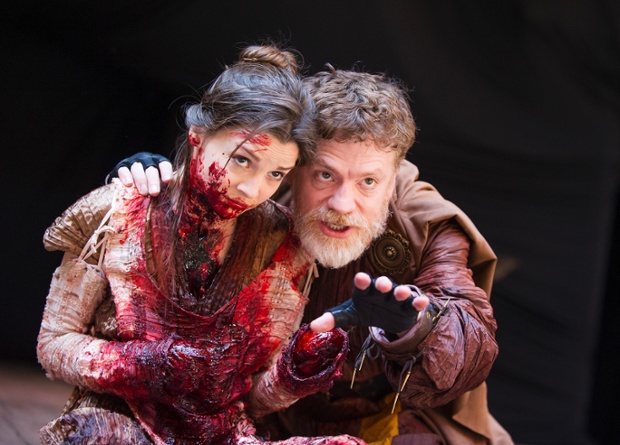
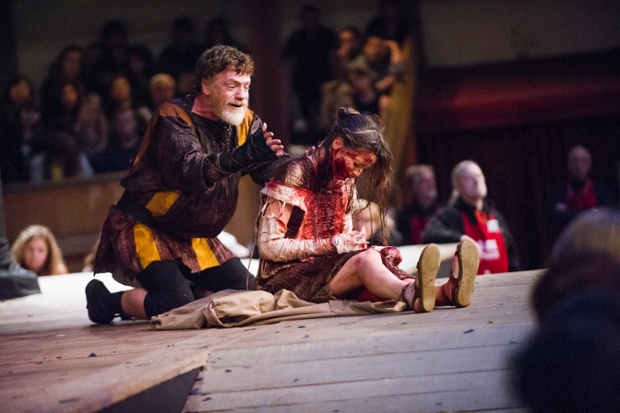
Another production that has been making headlines beyond its rave reviews is Titus Andronicus currently at The Globe Theatre, London. Titus is renowned for its violence – 14 deaths, a brutal rape and scenes of mutilation and cannibalism. Inevitably, stage blood is often used by the litre in productions of the play, and occasionally to great and gruesome effect.  This particular production has clearly pushed the boundaries, being described as full of violence and sick humour in Hannah Furness’ article for The Telegraph, Globe audience faints at ‘grotesquely violent’ Titus Andronicus. The fainting count at the time the article went to press was growing rapidly. If rumours are to be believed, the largest number to faint so far in one performance is 43.

06d90db4-6632-4b84-88ae-ced1441822bf-620x445

It is clear from the publicity photographs why the squeamish are not faring well at The Globe. Indeed those who faint have been dubbed ‘droppers’ by fellow theatre goers and Globe staff. Furness writes:

One theatre-goer, who watched the show’s opening night, said there had been “quite a few droppers” in the audience, who fainted upon seeing so much blood. Another reported he had “almost puked” by the interval, while a third warned: “You will definitely need a strong stomach”. Others praised the “Brilliantly staged and flawlessly acted” production, but warned of “blood and violence galore”

What is amazing that amongst all the gore, the director, Lucy Bailey has also been highly praised for bringing out the darkly comic elements of Titus and making sense of what is often seen as faltering marriage of knock-about humour and extreme suffering on Shakespeare’s part.

f7742971-e0c5-4a65-b0ea-475312981a98-620x413

I16iht-lon16-superJumbo_Fotorn her article for The Guardian, There’s method in theatre’s blood and goreMarina Warner talks about violence on stage through history, why tragedies such as Titus bring us face to face with intense violence and how they also carry a vital contemporary message. A great read.

There is some really good related reading on The Globe’s website. One is a great piece wittily entitled Food for Thought by Cedric Watts about the cannibal or anthropophagous banquet scene in the play.  Another is The Sound of Cracking Bone by Robert Shore which looks at the rehabilitation of Titus as a play of substance and how staging it in a theatre resembling its original setting allows it to breath again. It also reminded me of my favourite of Shakespeare’s stage directions, which comes from Titus, 

Enter a messenger with two heads and a hand

The maxim, there’s no such thing as bad publicity seems to have held true for The Globe and they have quietly taken advantage of the ‘droppers’ to garner extra publicity for the show. No one has actually said how much stage blood they are getting through, but it didn’t stop one intrepid journalist heading off to find where it was all made. There will be blood! written by Nick Clark for The Independent visits the suppliers of the fake blood for Titus who make up to 450 litres of the stuff every week and have doubled their production in the last year, largely due to bloody productions of Shakespeare’s plays.

Finally for today, a shout out for The Internet Archive which has recently posted the Orson Welles Shakespeare Collection, a selection of Shakespeare’s plays adapted for the radio by him in the 1930s and which were groundbreaking at the time. Welles is perhaps best known for the movie Citizen Kane, as well as one of the most famous broadcasts in the history of radio, his adaptation War of the Worlds which caused widespread panic when American listeners thought it was real and that an invasion by extraterrestrial beings was taking place

Orson Welles as Brutus in However, he was also a celebrated Shakespearian actor and during the late 1930s, Welles was the toast of Broadway, thanks to a string of audacious revivals of the Shakespeare’s work. The most famous of these was his 1937 adaptation of Julius Caesar. Welles costumed the piece in modern dress with soldiers wearing what looked like Nazi black shirts. The show was lit in such a way as to recall a Nuremberg rally. Obviously this was playing at a time when Hitler’s power was growing, and the production is said to have jolted American audiences and made Welles famous, with Time Magazine even putting him on its cover.

The recordings made available by The Internet Archive are obviously dated and sound quality is not always great, but they have a surprising intensity about them. You can access them here and I have embedded Julius Caesar to give a flavour of what the rest are like.

(.

Beyond The Icon

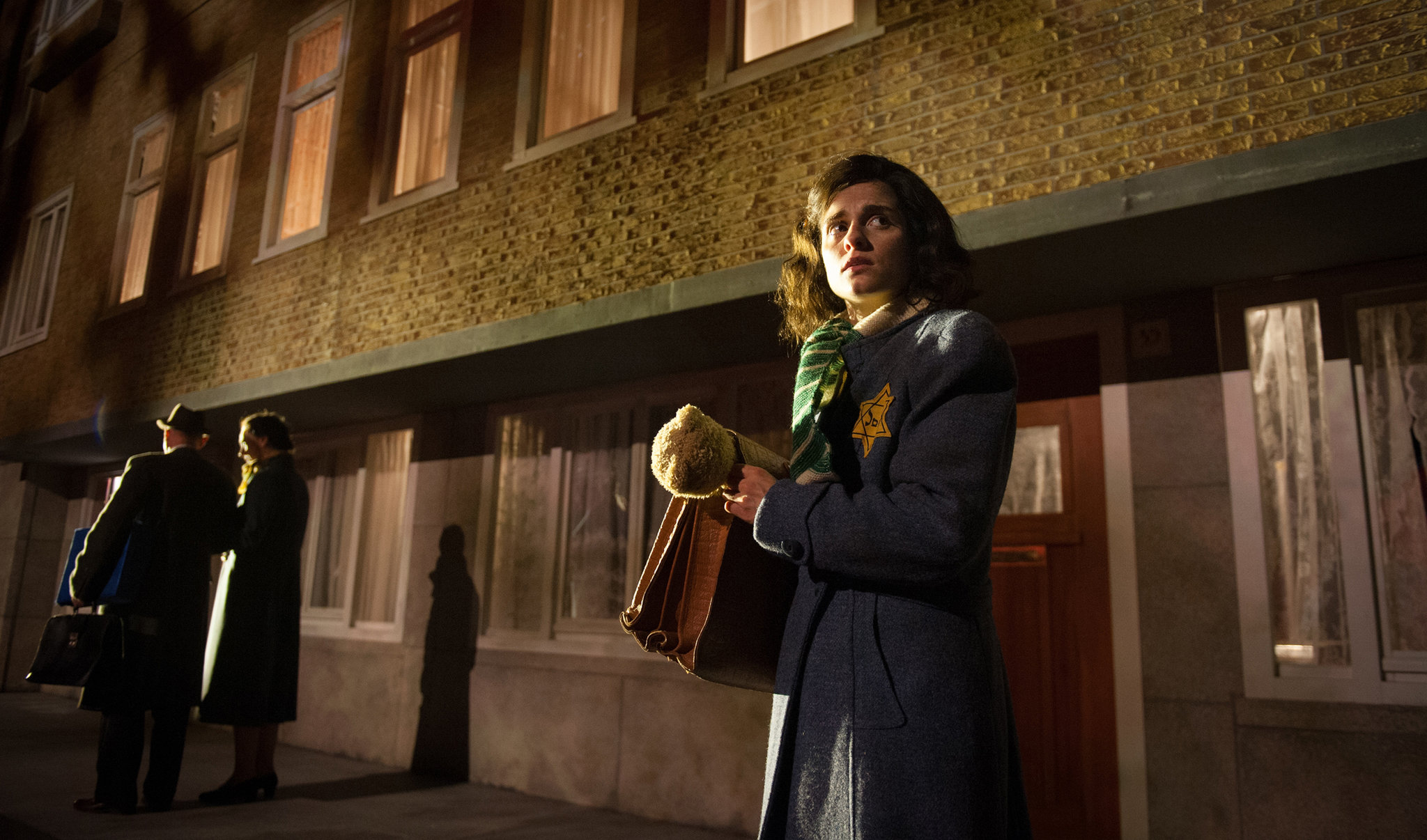
ANNE_hi_res_EnglishA new play has recently opened in Amsterdam eponymously called AnneI doubt there is a school child anywhere who has not heard the story of Anne Frank. She is perhaps one of the most well know victims of the Holocaust and the diaries of her wartime experiences in hiding have be translated and read around the world.

This new production has received much media coverage and is played out in a new theatre, built purposely to house the show, which is epic in its multi-media staging. However, the production has come with some controversy. It is the idea of Anne Frank Fonds (The Anne Frank Foundation) which was created in 1963 by Otto Frank, her father, to administer the funds raised by the publication of the diaries and use them for charitable projects around the world, usually related to young people.  However, the copyright on the diaries runs out in most countries in 2016 so the Anne Frank Fonds is looking at new ways of raising money, so it can continue its good works in Anne’s name. First published in 1947 the diaries have inspired numerous stage versions, although not one that has been particularly successful in great acclamation.  This new production looks like it might be the lasting legacy that the Fonds has been seeking, so where is the controversy? Well have a listen to this report by Anna Holligan for the BBC:

.

You can watch the report here too.

anne theu boermans


Jpfrank-superJumbo


annefrank-superJumbo

You can read more about the controversy in a report for The New York Times by Doreen Carvajal, Amid Tensions, a New Portrayal of Anne Frank. One of the first reviews in English by David Aaronovitch for The Times is here.

.

Redemption Sung!

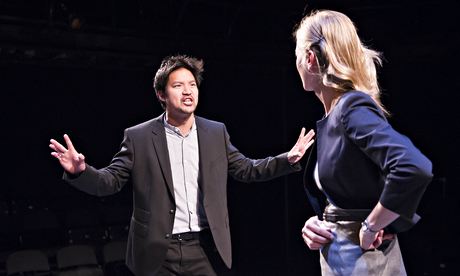
By way of post script to my last post about the restaging of Miss Saigon in London, I want to share some of the reviews.  Before that, however, a great piece by Mark Lawson in The Guardian that caught my eye. In Miss Saigon, Yellow Face and the colourful evolution of answer plays Lawson talks about the David Henry Hwang’s new play, Yellow Face which opens with a character talking about his role in a campaign against the casting of Jonathan Pryce as the Asian character of The Engineer in Miss Saigon’s original Broadway production. Hwang is probably the most famous Chinese (American) english language playwright of our time and much of his work reflects his heritage. 

There’s a phenomenon in pop music of the “answer song”, written in direct response to another track: Carole King, for instance, recorded a number called Oh, Neil! after hearing Neil Sedaka’s Oh, Carol! There’s a similar – though sparser – theatrical genre of answer plays and a recent example is currently running at the National Theatre: Yellow Face by the Chinese-American dramatist David Henry Hwang.

Yellow-Face-squareHwang’s play begins with a dramatist called DHH describing the events that followed his involvement in a campaign against the casting of Jonathan Pryce as the Asian character of The Engineer in the 1991 Broadway premiere of Miss Saigon. Timed, presumably not coincidentally, to run at the National just before this week’s opening of the first London revival of Boublil and Schönberg’s musical – with an Asian-American actor, Jon Jon Briones, in the Pryce role – Yellow Face is a response to that show. It is also, in a particularly rare example of a playwright answering himself back, a response to the failure of Hwang’s own 1993 show Face Value, a comedy about racial identity, even though, in Yellow Face, the dramatist exaggerates the content and controversy of that work.

Face Value and Yellow Face, though, were not Hwang’s first involvements with the retorting form. His first hit, M Butterfly (1986), was a tetchy conversation with Puccini’s opera Madame Butterfly, with Hwang using the enduring musical story of an American sailor’s marriage of convenience to a Japanese woman as a parallel to the fact-based scandal of a French diplomat and his Chinese “girlfriend”, who doubly fooled him by concealing the facts of being both a spy and a man.

Curiously, Miss Saigon, which later drove Hwang to his typewriter, was itself inspired by Puccini’s Madame Butterfly, although, for me, the musical belongs to the category of adaptations, rather than answer works. Boublil and Schönberg maintain the basic racial situation of the opera – both the American and Asian central characters are seduced by the dream of the US – while Hwang’s M Butterfly questions cultural stereotypes: challenged on his failure to have spotted the gender of his lover, the French diplomat revealed that he had never really seen “her” body because of typically Asian female modesty. Even so, it is possible, as if in a game of theatrical consequences, to create a chain of five works: Madame Butterfly-M Butterfly-Miss Saigon-Face Value-Yellow Face.

Perhaps, as Miss Saigon came some years after M Butterfly, the writers were influenced, even subliminally, by that other reply to Puccini. But, in any case, the above line of descent suggests that race is often a motivation in response projects. Hwang, from his perspective, queried the European view of the east, while Boublil and Schönberg approached the Vietnam war through their nation’s own history in what the French called Indochine.

Yellow-Face-National-Theatre

Racial redress was specifically the motivation of Arnold Wesker’s The Merchant (1983), in which Shakespeare’s Shylock – and the anti-semitism inspired by him – were given a counter-balancing characterisation by a Jewish writer.

A similar impulse underlies another chain of plays: Lorraine Hansberry’s A Raisin in the Sun (1959), Bruce Norris’s Clyborne Park (2010) and Kwame Kwei-Armah’s Beneatha’s Place (2013). Although the connection was more apparent to American than British theatregoers, Norris’s play has a first act (set in 1959) that picks up Hansberry’s characters and narrative of a black family in Chicago and then a second, set 50 years later, that depicts the change in demographics and American race relations. Kwei-Armah was so inflamed by his fellow writer’s treatment of the subject that he wrote his own play, which also has two halves set a half-century apart, but takes a more optimistic view of social progress.

Another string of dramatic inspiration links a British flop and a hit of the late 1950s. As the programme for the recent National Theatre revival of Shelagh Delaney’s 1958 play A Taste of Honey pointed out, the author, at the age of 18, had written her script in angrily rapid response to seeing Variation on a Theme by Terence Rattigan when it was performed in her native Salford. Delaney was irritated by Rattigan’s depiction of gay characters. As it happens, he was gay, while she wasn’t, but he had grown up with cautious attitudes enforced by the legal taboo on male relationships.

Rattigan’s play script was, as the title hints, itself an answer play, inspired by the Dumas drama La Dame aux Camélias. As a result, A Taste of Honey is a variation on a variation on a theme. It would be wrong to say that the three plays hold hands – the second and third are scarcely on speaking terms – but the two English language texts both owe their existence to a precursor.

Less specifically, two of the other most influential plays of the 50s – Samuel Beckett’s Waiting for Godot (1953) and John Osborne’s Look Back in Anger (1956) – can be regarded as answer plays written in response to the prevailing mood of drama at the time, with Beckett questioning the preference for social realism and Osborne objecting to the narrow class range.

In drama – as in pop music – the responses given by these answering works tend to be irritated or argumentative, with Hwang’s M Butterfly, Face Value and now Yellow Face as good examples. The Chinese-American writer was correcting or questioning social attitudes; as, in various ways, were Delaney, Wesker, Norris and Kwei-Armah.

Yellow Face at the National Theatre's Shed

There’s also, though, another type of answer play that gives a friendly or generous response to the predecessor text. David Hare’s South Downs (2011) was commissioned by the Terence Rattigan estate as a sympathetic companion piece for Rattigan’s one-act The Browning Version. And, watching Moses Raine’s amusing and moving drama Donkey Heart at the Old Red Lion theatre, it struck me that his depiction of an English Russian-language student billeted with a family in modern Moscow seemed to include several deliberate echoes of or variations on themes or scenes in Chekhov’s The Cherry Orchard: the final scenes of both plays, though different in intent and outcome, feature old Russian men left alone in a family house.

Such critical fancies can often be a result of having seen more plays than most playwrights do and the apparent homages in Donkey Heart might equally be explained by the fact that Russians (Raine’s play was inspired by a visit to the country) behave in a Chekhovian way. Raine was present at the performance I saw and when I asked him afterwards, he confirmed that a production of The Cherry Orchard had been one of his key theatre-going experiences and that the allusion in his conclusion was deliberate.

David Henry Hwang, left, Ben Starr and Gemma Chan in Yellow Face.

Human nature being what it is, though, the most appealing answer plays are those that disagree. As artistic director of the Center Stage theatre in Baltimore, Kwame Kwei-Armah staged A Raisin in the Sun, Clybourne Park and Beneatha’s Place last year as a season of dispute. There are no formal joint ticket deals for Yellow Face and Miss Saigon, but anyone who arranges their own double deal will experience an infrequent but powerful form of theatre.

In an accompanying article, David Henry Hwang shares is thoughts on the issue of racial casting – now and then – as well as the role he played in the protests against Pryce’s casting. Racial casting has evolved – and so have my opinions.

David Henry Hwang

David Henry Hwang

Described as a probingly political play by one critic, you can read a review of Yellow Face here. Equally as interesting, from the archive of The New York Times, the 1990 article about the furore surrounding Pryce’s role as The Engineer, which includes Hwang’s original Complaint, Actors’ Equity Attacks Casting of ‘Miss Saigon’.

So now back to the reviews of Miss Saigon, out this week. In extracts from his review for The Guardian, Michael Billington noted:

Seeing the show for the first time in a quarter of a century, I was more struck by its satirical edge than its emotional power. It’s not just that Chris condemns the Vietnam war as “a senseless fight”. Connor’s production implies that, although the story is about a cultural collision, the opposing forces of communism and capitalism carry strange visual echoes.

Ho Chi Minh City, as Saigon became, is embodied by a towering golden statue before which Viet Cong troops parade with well-drilled fervour. America, meanwhile, is symbolised by a Statue of Liberty replica before which chorines dance with military precision. The show is not morally equating the two systems; it is simply suggesting that they feed off each other.

The show’s political point about the casualties of a disastrous war comes across clearly.

Ever the gentleman critic, Billington refuses to get drawn back into the original’s casting debate, preferring to note:

The show’s satirical quality is best embodied by the character of the Engineer: a pimping Pandarus, bred of a Vietnamese woman and a French soldier, he is caught between two worlds and dreams of escape to America.

He was excellently played by Jonathan Pryce in the original, but here Jon Jon Briones makes him an even grubbier, sleazier figure who is the victim of both his background and pathetic fantasies that see him in the penultimate number, The American Dream, pleasuring himself on the bonnet of a Cadillac.

It comes as no surprise really that the other critics have so fair failed to make comment on the context of the narrative, simply bemoaning, like an aged aunt, that the original production was better – Mark Shenton in The Stage and Charles Spenser in The Telegraph to name but two.

Redemption Song?

miss-saigon3_2900882kA revival of the musical Miss Saigon is shortly to come out of preview in London and there are already rumours of it then heading to North America (and no doubt then further afield). Once called one of the four great stage musicals of the 20th Century (one of the others being Les Miserables) it is estimated that 34 million people have been to see it across 29 countries, for which it has been translated into 15 different languages. Originally opening in 1989, I saw it here in Hong Kong in 2001 and I have to say I thought it was great, as far as a musical can be for me. I had been living in Asia for 5 years at that point and was beginning to understand the history and the culture of a region in a way you only can if you live there.

miss-saigon1_2900877k

I was a child as the Vietnam war came to a close in 1975 so hadn’t really engaged with atrocities of that particular conflict. History, in my education, was very much a British one, stretching as far as Europe to cover the likes of the Thirty Years War and The Reformation – nothing as even contemporary as World War II. Of course I knew the basic facts about what happened in Vietnam and the terrible consequences that were inflicted on a people in the name political ideology. By the time I saw the production in Hong Kong I had visited Vietnam, and as you do, had devoured as much information as you can to try to understand a new country – it’s history, society, culture and so on. I’d also seen and been affected by the iconic films about the war – The Deer Hunter and Apocalypse Now. Consequently, watching Miss Saigon I remember struggling somewhat with my conscience . The music did it’s job and you were sucked kicking and screaming into the simple narrative and the over-played emotional lives of the characters. Yet with well in excess of 1,000,000 Vietnamese having lost their lives quite so horrifically, was it right to sentimentalise the war and it’s legacy in such a way?

Indeed one critic at the time accused the show of hitching its portentous showbiz wagon to the solemn star of the Vietnamese tragedy A Filipino critic, Isagani R Cruz, observed in 1989 that

All the Vietnamese and Thai characters in the story, whether played by Filipino, Malaysian, Italian, French, Dutch, Japanese, American, or British performers, were the scum of the earth – pimps, prostitutes, bar habitues, sadistic and mindless soldiers, anti-nationalist visa-hunters at embassies. None of the Asian characters had any redeeming human qualities. Even The Engineer (played ingeniously by Pryce) helps Kim (played by Lea Salonga) only because her child is his “passport to America.”

No matter what we think of communism, we cannot deny that the Vietnamese fought a war to get rid of foreigners in their own land. Miss Saigon makes it appear that the Vietnamese fought the Americans simply because of Ho Chi Minh’s ego, symbolized by a gigantic statue hoisted up by mindless communist soldiers. We might as well say that the Americans fought the British because Thomas Jefferson and George Washington wanted memorials built in their honor, or that Filipinos fought both the Spaniards and the Americans because we wanted to have a Rizal Park.

Cruz wasn’t alone in these views. Other criticisms included the casting of a caucasian actor, Jonathan Pryce, as The Engineer, a Vietnamese brothel owner and central character in the musical – although to be fair this was subsequently righted in future castings. It is interesting that in the ‘trailer’ for the new production, Cameron Mackintosh goes to great lengths to point out the international casting of the new production.

.

When the tickets went on sale in September last year for this new production,  the box office took £4.4 million in the first 24 hours and advanced sales have so far taken £10.2 million. This is a show people want to see, so are the criticisms levelled at the original miss-saigon-1_2902467kproduction about distorting the truth of the war and stereotyping of its Asian characters fair? Or perhaps the real question is are they any longer fair? Are liberal sensibilities around
these questions just that, sensibilities. Generally musical theatre , contemporary or otherwise, is never going to be able to have the subtleties of a straight play, particularly in-depth of character and narrative. If they take as context something as difficult and potentially divisive as the Vietnam War there are bound to be critical voices of descent.  I suppose what I am asking myself is that as the events become part of history, is it permissible to ignore the superficial nature of their treatment and just enjoy the musical for what it is – a great entertaining night out at the theatre.  

My original prompt for writing this post was the opening of a new multi-media theatre piece in Amsterdam about the life of Anne Frank and the criticism directed at it for not treating the holocaust with the dignity and sensitivity deemed appropriate.  I will save that discussion for another post, but you can see the similarities

I am completely aware that you could name quite a few musicals where the context is a historical event in which many people lost their lives, Les Miserables being a great example. Perhaps musical theatre represents a facet of human nature – the want to look at something from the past, of which as a race we should be rightly shameful, and find the good, the happy, morally acceptable ending.  A way of absolving ourselves, maybe? Redemption? I don’t know. It will be interesting to see if the reviews of the new production of Miss Saigon raise the same objections, or whether the events it portrays are now far enough in the past to allow it to be a story well told, a night at the theatre and just that.

miss-saigon5_2900874kTo close, the excellent, in-depth and thoughtful article by Serena Davies, written for The Telegraph, about the new production, which I Tweeted last week.

Pucking Wrong

One of the theatre companies for which I have immense admiration is Belarus Free Theatre and I have often written about them, their situation and their founders on Theatre Room – search above right for previous posts. It’s not just about their craft, which is outstanding, but equally about what they stand for.

UnknownYesterday, on the BBC World Service strand HARDtalk Natalia Kaliada, co-founder of Belarus Free Theatre gave a powerful interview about the political situation in Belarus. She talks about why directors, actors and even audiences are arrested and imprisoned in the face of a dictatorship in a country where political dissent gets you beaten up, begging the question is drama an effective tool of resistance? The podcast is below.

.

BFT

A week ago, respected theatre director Michael Attenborough gave an interview to Dalya Alberge, published in The Guardian, talking about the Belarusian regime and how it threatens free expression, himself having spent a week in the country, working with BFT on a production of King Lear.

David Cameron can’t ignore Belarus Free Theatre abuse

One of Britain’s leading theatre directors has called for David Cameron, the UK’s prime minister, to confront human-rights abuses in Belarus,Europe’s last dictatorship.

Michael Attenborough says Cameron can no longer ignore a brutal regime that arrests people for attending a play, has imprisoned a theatre director for 15 hours with no toilet, and has threatened to bulldoze a man’s home for allowing blacklisted actors to perform.

“Pressure should be put on the [Belarus] government about civil rights,” Attenborough says. “It’s a neglected cause.”

Attenborough, who headed the Almeida theatre in London until last year, entered the former Soviet republic as a tourist to spend a week working with the Belarus Free Theatre (BFT), a company banned in its own country.

BFT’s underground performances are regularly raided, with actors and audiences intimidated or arrested. Its founder-members – includingNatalia Kaliada, Nicolai Khalezin and Vladimir Shcherban – were forced into exile, coming to Britain as political refugees. With a base at the Young Vic theatre, London, they perform worldwide, liaising via the internet with colleagues still in the Belarusian capital, Minsk, who continue performing in secret locations.

Michael Attenborough

Michael Attenborough

BFT, founded in 2005, stages fiercely political productions, often directly critical of a regime that, under President Alexander Lukashenko, is accused of torturing and murdering political opponents. A US critic described it as “one of the most powerful and vividly resourceful underground companies on the planet”. Its stagings include Being Harold Pinter, a biting satire using real-life testimony from Belarusian citizens.

Now it must find a new location. The owner of the garage – a “slum” where the actors have been rehearsing and performing – has been warned to cease collaboration with BFT, or his house will be demolished.

“I almost don’t understand it,” Attenborough says. “They put themselves in so much danger willingly … They’re astonishing.”

“Natalia [Kaliada] was made to stand for 15 hours, not allowed a toilet … I visited [her] parents on my last night there. [Her father] is a very bright man from the university. He’s lost his job because he’s her father. They’re all different forms of harassment.”

When in Minsk, Attenborough asked the actors why they faced such danger. “They all said the same thing,” he says. “‘Self-expression. Otherwise, we’re just dancing to somebody else’s tune.'”

Attenborough worked with the group on King Lear. “They came to it with such hunger,” he says. On the day of the performance, he sensed their nervousness. The company publicises each show only 24 hours in advance, through social networking. “So there’s a great deal of subterfuge before,” he explains. The police raided just as it was about to start, but then left them alone.

On another evening, the company performed in a forest near Minsk. An audience of 50 turned up. Attenborough says: “The sense of freedom of people miles away from microphones, spies and depression was really moving.”

Michael is the son of the actor-director Richard Attenborough, whose own parents responded in 1939 to the plight of those facing persecution. They took in two German-Jewish children, adopting them after it was discovered that their parents had been murdered. Attenborough speaks of his shock on hearing that a close friend of BFT’s founders was found hanged in his flat in 2010 “with a fake suicide-note”. Some believe that, as an opposition activist, he was killed.

Attenborough could not wait to return home from Minsk. “It’s a really unnerving, uncanny experience – almost as if the whole place has been drained of emotion,” he says. “I thought maybe people were being unfriendly because I was English. I went to restaurants and supermarkets – and they do it to each other. [It’s] a completely joyless place.

“There are only two things alive – if you can call it alive – at night in Minsk. Casinos – which I think are illegal in Russia, so Russians come to bet – and mass prostitution. You’ve never seen so many street hookers. A group were standing outside my hotel. I found one who could speak English. Once I’d convinced her I wasn’t after business, I learned about their existence. This woman was about 50 with a family to support. How grim can life be?”

Kaliada recalls the terror of prison, deprived of water and sleep, ordered to face a wall and remain still or be beaten up. “You have to start to meditate. Otherwise, you go completely mad,” she says. “I can’t even talk of my experience. I was threatened to be raped by a guard. Political prisoners go through hell.”

Her husband, Khalezin, was placed in a cell with no windows, its floor less than a metre square.

David Lan, the artistic director of the Young Vic, says: “If you resist the state, you get very badly beaten up. Kolya [Khalezin] has been beaten up. One eye was damaged. Natalia’s been beaten up. I was brought up in South Africa. The technique is similar.”

BFT’s bravery is matched by the quality of its productions, Lan says. “Their work is completely original, powerful and first-rate – political theatre of the kind we used to take for granted but which has somehow died.” At the Young Vic this summer, BFT will be performing a new piece, Red Forest, featuring real-life stories from people living in war zones, in dictatorships and in unjust and unequal societies across the globe.

Stagings in Belarus are not toned down for fear of repercussions, Kaliada says: “It can’t be said that all of our work is overtly political. One of the latest shows to be raided and stopped the other day in Belarus was a non-verbal dance interpretation of Chekhov’s The Seagull. This couldn’t be called political. We are shut down because the work has not been approved by censors.”

belarus free theatre flyer

In her interview on HARDtalk Kaliada makes reference to the World Ice Hockey Championships that have just opened in Belarus – the first major international sporting event to take place in the country – and how this would appear to condone the 20 year-long regime of President Alexander Lukashenko and his systematic attack on human rights. In an open letter to the athletes taking part, a group of actors, writers, directors and artists have appealed to them to boycott the event.

Open Letter to all Ice Hockey Players who are taking part in the World Cup of Ice Hockey in Belarus:

We are artists writing to athletes, asking you to take a moment to consider the political situation of the country where the Ice Hockey World Championships is taking place.

Alexander Lukashenko is known as “Europe’s Last Dictator”. Belarusians have lived for 20 years under Lukashenko’s regime, and have faced torture, kidnapping and murder, intimidation and harassment for speaking out against his inhumane laws and regulations.

Lukashenko has created a publicity campaign with the slogan: “Big ice hockey supports Alexander Lukashenko”. We do not believe that. We believe ice hockey players support freedom and human rights. Please do not let yourselves be used by a despot. Join us by showing you do not support the Last Dictator of Europe and that you stand with the people of Belarus by wearing a red and white scarf after the match. These are colors of our national flag that is recognized in Belarus as symbol of resistance.

On 21st of December, of 2010 after a bloody crackdown of a peaceful rally when citizens of Belarus went to protest against falsification of elections, seven of us started the campaign with a slogan “Don’t Play with Dictators”. Those people included a unique person the late Vaclav Havel, a playwright and dissident born under a communist dictatorship who went on to be President of a free Czechoslovakia.

We ask you to show the Belarusian people that the courage and strength you show in your sport is not blind, and to join them by demonstrating your opposition a regime that violates human rights. This simple act of support would give millions strength in a time of political turmoil, just as the brave actions of athletes at Mexico in 1968 and Sochi in 2014, touched countless of people around the world.

We are not in a position of executive power, but we believe by uniting as artists and athletes we can make a difference simply by showing the Belarusian people that we value human rights and freedom and that we stand with them. We have a moral authority and it should not be misused by dictators for their own aims.

Belarus has been frozen in time. Its people have no opportunity under its Soviet style dictatorship. The recent invasions of the Ukraine by Russia means that the entire region is in danger of returning to the austere times of the Soviet Union.

Artists and athletes have a responsibility to make voices heard on behalf of those who are silenced, not as athletes or as artists, but as fellow human beings.

You are people of strong will and action. Usually it’s the fans who show their support for you, now it’s your turn to support them.

Put a white-red-white scarf on when you get on the ice. The red represents courage and white represents compassion. The scarf will demonstrate to the fans that you recognize the dictator for who he really is, and show that you stand behind the fans. Wearing the scarf will give them courage and let them know that their voices are heard.

Sport should be kept out of politics but when its not, athletes must demonstrate that they know what is going on, that they care, and they stand behind their fans in their quest for human rights and freedom.

Don’t play with Dictators, support your fans!

Signed by Laurie Anderson, Michael Attenborough, James Bierman, Kim Cattrall, Stephen Fry, Ralph Gibson, Hugh Grant, Paul Haggis, David Lan, Natalia Kaliada, Nicolai Khalezin, Jude Law, Joanna Lumley, Alan Rickman, Mark Rylance, Vladimir Shcherban, Tom Stoppard, Andy Summers, Janet Suzman and Emma Thompson

The letter was published in The Guardian.

Their Voices Are Far Too Few

Voting comes to a close tomorrow in the world largest democracy. The Indian general election has lasted 6 weeks, beginning on 7th April, with over 814.5 million people eligible to vote. Much has been published about the state of the nation and one article that particularly caught my attention was by Anupama Chandrasekhar and Akash Mohimen for The Guardian. Chandrasekhar and Mohimen are playwrights and in their piece The threats to political theatre in India: fundamentalism and escapism, they explore the integral role theatre has played in India’s freedom struggle in the past and question its purpose today, reflecting on censorship, audience expectations and the new voices seeking to be heard.

Anupama Chandrasekhar

Elections in India have always been high-decibel, high-emotion events, a period in which art and artists are most vulnerable to attack by fundamentalists. Twenty-five years ago, the street-theatre playwright and director Safdar Hashmi was killed in the middle of a performance during local municipal elections near Delhi. Last month, when the country was in the throes of electioneering, Evam, a Chennai theatre group, was pressurised by the police departments of three cities to cancel their shows of Ali J, a monologue on what it means to be a Muslim today.

Anupama Chandrasekhar

Anupama Chandrasekhar

The increasing number of fundamentalist groups targeting theatre companies across the country has become a cause for concern. A website of a fundamentalist group lists six plays they’ve had censored within the last three years, among other films, TV shows, commercials and books.. India was once far more tolerant of political theatre. While there was the odd case of a play being banned (the ban on Vijay Tendulkar’s Sakharam Binder was later revoked), explicitly political plays were allowed free reign in the 1970s (barring the Emergency years) and early 80s, particularly in my hometown, Chennai. As a child I watched in Tamil insightful political explorations in many guises: satires, spectacular mythologies, powerful social realism and laugh-a-minute drawing-room farces. Social realist Komal Swaminathan, satirist Cho Ramaswamy and mythologist Manohar were household names then.

The rise of fundamentalism has been an obvious deterrent to serious political theatre. But a bigger and more insidious threat has been what Brett Bailey would call the “sanitized demands of the market”. There’s a growing tendency to provide safe, escapist entertainment rather than dialogue with the world around us. While the older generation of theatre practitioners like Mahesh Dattani, Sunil Shanbag, Maya Rao, Na Muthuswamy, Gnani Sankaran and Mangai Arasu continue to ask urgent questions about who we are as a nation, many of my generation appear to have fallen prey to the exigencies of the market. Neil Simon and Yasmina Reza are Chennai’s two most popular and frequently staged playwrights of the English language. The pattern is eerily similar in other cities too.

Disconnect by Anupama Chandrasekhar at the Royal Court theatre

Disconnect by Anupama Chandrasekhar at the Royal Court theatre

In this din of safe comedies and news channel-induced hysteria, there are new voices seeking to be heard: Irawati Karnik, Abhishek Majumdar, Neel Chaudhuri, to name a few. The young Chennai director Aruna Ganesh Ram recently embarked on a pan-Indian verbatim project this election year to explore the concept of freedom. Director Quasar Padamsee’s project So Many Socks, based on Tenzin Tsundue’s collection of poems and stories, explores Tibet, nationhood and the individual. Swar Thounaojam, a Manipuri playwright and activist, wields the English language as a weapon and a tool to explore her subaltern identity.

But in a country with a population of over a billion, their voices are far too few.

Akash Mohimen

Traditionally, theatre has been an integral thread in the social fabric of India. It was used to spread news, socio-political awareness, propaganda and entertainment. Theatre played a vital role in India’s freedom struggle, bringing messages preached by the leaders to communities hundreds of miles away. It was one of the many sparks that gave rise to one of the world’s largest freedom movements.

In the 21st century, Indian theatre seems to have lost some of this spark. Political plays are few and far between.

Akash Mohimen

Akash Mohimen

Barring the continuous adaptations of Vijay Tendulkar and Badal Sircar’s texts from the 70s, there are only a handful of political plays doing the rounds.

There are plenty of contemporary writers trying to strike a balance between storytelling and shedding light upon important topics that have long been untouched. But audiences always prefer to keep such productions at arm’s length. They jump to conclusions that they are depressing and preachy; the message going around these days is “make them use their brains”.

I believe the reason for such a mind-set is lack of awareness. Audiences have little or no idea of what’s happening beyond their own city limits. When they hear about a play on the Kashmir issue, they immediately shun it, rather than become intrigued by the theme and witness a tale of friendship, lost innocence and survivor’s guilt.

The influence of the motion picture industry has affected theatre ticket sales. People would rather spend 400 rupees for a multiplex ticket on a Sunday, than 300 rupees for a play at Prithvi theatre. And their reason is mostly the same: escapism.

With such a thought process, it is fast becoming difficult to stay afloat by practising theatre alone. No matter how passionate one feels about this medium, one needs to branch out to films, commercials, event management and education to have some sort of financial support. There are few who can truly say that they earn their livelihood out of theatre.

Mahua by Akash Mohimen

Mahua by Akash Mohimen

Despite corporate funding over the last few years, most productions barely break even. In fact, some lose money each time the actors step on stage. But they keep coming back year after year, because of the sheer love for the stage.

Theatre in rural India remains the truest form of Indian theatre. There are parts of the country where, every festive season, a performance will be organised free of charge. A performance could be put together by a teacher, farmer, policeman and postman, where the whole village will participate. Irrespective of subject matter or story, they will lend their ears. The laughter and tears of the audience are a major adrenaline rush for the actors and musicians on stage. Everyone involved is as moved as the audience watching.

Anupama Chandrasekhar and Akash Mohimen are part of the Royal Court’s writing programme in India

A New Design

Having written last week about immersive theatre, I am going to continue today with a connected theme. Immersive theatre, as well as the experience, is largely what it is because the visual elements it contains, be they the building or place itself or what is placed there. In other words, it’s design. Now it strikes me that the term theatre design is a little redundant when describing the immersive space and indeed this seems to be bringing about a change in how we perceive either the role of a theatre designer or theatre design itself.

9783899861365Increasingly, theatre design is becoming scenography; the theatre designer,  the scenographer. I had been aware of term, although never entirely sure of its exact meaning, but as is often the case, it seems to have been popping up with more frequency in things I have been reading and conversations I have had. A colleague used it this week to describe one of his areas of specialism. So with my interest piqued, I got digging and have been quite fascinated by what I have found.

To begin with, scenography is defined thus:

Scenography is the art of creating performance environments; it can be composed of sound, light, clothing, performance, structure and space

Nothing particularly new there, one might think on first reading. However, it is the bringing together of all of these elements together that is different. Traditionally in theatre we separate out the design roles – stage, costume, light, sound and so on. Throw into this mix the varying role a director can play in the design process and maybe even the dramaturg, and we get quite a complicated web of people and roles making contributions to what we eventually end up looking at and experiencing on stage.

Scenography is becoming quite common in Europe and indeed, theatre designers are designating themselves as scenographers. However, it would seem that in the US the term has not been adopted with the same passion. On her website Stephanie A. Schoelzel, herself a scenographer, describes heated debates over the use of the term and the unique differences between US and European theatre in this regard. It is an interesting read on a number of fronts. Another description of Sceneography and its origins is from Imagined Spaces, the Canadian National Arts Centre in Ottawa is also informative.

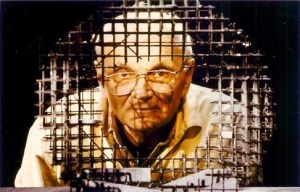
Josef Svoboda

Josef Svoboda

Imagined Spaces is a superb resource site for anyone interested in scenic design, with hundreds of beautifully rendered stage designs. In his article on Imagined Spaces, What Is Scenography, Michael Eagan states that scenography emerged from the Prague Quadrennial and talks about Josef Svoboda, himself Czech, as the godfather of modern scenography.

It was at this point in my research that I began to feel a little ignorant. Svoboda is clearly a giant amongst designers and scenographers, but I had never heard of him. When he died  2002, it was estimated that he had designed and/or directed over 700 theatrical and operatic performances.

When I sit alone in a theatre and gaze into the dark space of its empty stage, I’m frequently seized by fear that this time I won’t manage to penetrate it, and I always hope that this fear will never desert me. Without an unending search for the key to the secret of creativity, there is no creation. It’s necessary always to begin again. And that is beautiful.

Josef Svoboda.

You can get an idea of the scale of Svoboda’s work in the following two videos. If you speak Czech or French there are more in-depth videos on Youtube about the  man and his work.

It then struck me to whom I had heard the term scenographer ascribed before. Robert Lepage is one of the greatest living magicians of the performance space and I have had the delight, pleasure and awe of seeing a number of his works. An utter genius and worthy of a post all of his own, so I shall save further discussion of him until then. However equating Lepage and his work with the role of scenographer, I understood the difference between design and scenography.  It also allayed my feelings of ignorance somewhat. For many years scenography has been the preserve of the academics – a theory of, roughly speaking, the meeting of art, design, architecture and space, and how they interact with the spectator and the spectator with them.  Starting to feeI immersive here? I can now also see how two of the most influential theatre designers of the 20th Century, Adolphe Appia and Edward Gordon Craig, influenced the development of scenography. 

9789299006313_FotorThere are lots of resources out there for understanding scenography and putting it into practice, but one of the best I have come across is TAJ, Theatre Arts Journal. TAJ is an online journal devoted to the study of  scenography in performing arts. Also, the Prague Quadrennial site is a veritable treasure trove of scenographic wonders. There is even a board on Pinterest devoted to scenography, curated by architect Marios Angelopoulos.

To close, I should point out that scenography is not simply an act of theatre making. It is much wider than that, stretching to cover exhibition design, museum planning and interactive public spaces amongst other things – all things that need to engage an audience.

Immerse Yourself

As théâtre du jour, the popularity of immersive performance keeps on growing. I have written here many times about its attractions and why it possibly draws the audiences that it does. Today I want to share a mixture of things that have come my way in the last week or so, all of which making interesting reading and listening.

Firstly an audio slide show published in the UK’s Guardian this week. Made by  and Felix Barrett, the director of Punchdrunk, explains how they dreamed up The Drowned ManClick the image below to have a look and listen:

The Drowned Man_DC.indd


The second share today is also from The Guardian and written by Veronica Horwell, Casting Call For Buildings explores how site-specific theatre companies go about picking the right venues for their shows? Horwell looks at two current performances – again Punchdrunk’s Drowned Man and The Spectators Guild’s new show, Venice Preserve’d.

Casting call for buildings: on location with Punchdrunk and Spectators’ Guild

It’s easy to see why Paynes Wharf, near Deptford Creek in south London, is playing the lead in the Spectators’ Guild company’s production of Venice Preserv’d. It has an old Thameside maritime facade – a former boilermaking works – arcaded like the Doge’s Palace, next to a new flatblock in the manner of a campanile, and its developers put serious money into the production. And they offered guaranteed availability with a scheduled window in the site’s post-construction schedule.

VenicePlay_RG029-528x790

For, as the guild’s producer Harry Ross and production designer Helen Scarlett O’Neill know from their work with Secret Cinema, the company that stages elaborate movie events, any big, workable, public space in London is hard to find. Should they dream of a place with character, let alone the right looks, they’re into the near-impossible. There is noSpotlight for immersive venues, no showreels for talented but unknown ex-warehouses. The agents do not ring.

Mostly, Ross and friends keep their eyes open and ceaselessly ask around. Ross, who as a cyclist has travelled at just the right speed to observe the built landscape, collects London buildings, holding in his head half the current suitable specimens, tunnels included. He can charm any watchman into letting him past the gates within five minutes, and will wander around the metropolis yelling queries up to blokes on scaffolding, if that’s what it takes.

Once spotted, though, a space can be even harder to secure. It can be done, especially if it’s a pro tart of a place for hire anyway, as with the former Farmiloe stained-glass manufactory in Smithfield, much used as a movie location before being taken over for the duration of Secret Cinema’s The Grand Budapest Hotel-related live extravaganza in March. But the turnover of acquisition, renovation, demolition, repurposing and new construction in London has accelerated so fast since property became the international investment after the 2008 crash, that places the site-specific event companies have stashed away as promising hopes suddenly sprout into multi-storey plutoflats.

HAR250214_VenicePreservd_Web_Logo_640_27_3_14-627x500

That’s what makes Venice Preserv’d as an on-site production a novel venture for everybody – and is maybe the way that immersive theatre will have to go. The developers wanted the company and its production to show off the artistic potential of this great space behind the restored river facade. They’re looking to theatre to put some character into the wharf so that it won’t lapse into just another stretch of the executive luxury-flat cliffs now walling the Thames.

Director Charlotte Westenra has wanted to put on Thomas Otway’s Restoration tragedy for a long time – it being an entirely modern story about selling out, in every sense, in a privileged imperial city awash with money and betrayal, yet sinking fast. Then came this loan of what she feels is “a beautiful, significant space” that, both visually and contextually, correlated with her concept of the play.

I’d describe the production as location-referential more than site-specific. While Westenra exploits onsite advantages with glee – she will flood the central courtyard to simulate a bridged Venetian canalscape – she also looks out to a wider geographic “where” as a context for the old narrative. The audience can choose to come down to Greenwich pier by boat, as if on their way to a Venetian carnival, and, as they promenade the wharf’s tideside terrace or look through the space’s mighty windows, they cannot fail to see the uncaring, rising water and moneyed Canary Wharf on its far side.

Venice Preserv'd

The site’s most overwhelming area is a lofty nave the length of the gutted old building, which O’Neill will dress with decaying lace. Although Westenra’s approach to Otway’s bitter power play will remain a semi-formal staging, in which everybody will view and hear the same scene at the same time, it won’t be a Punchdrunk company gig with each audience member stomping his or her own route with a request to “wear appropriate shoes” on the ticket. If the walls could speak at Payne’s Wharf they’d be talking about investment, dividends, futures. Most of them – other than that 1860s frontage – have no past to speak of.

Get Felix Barrett, head of Punchdrunk, immersive veterans, on the subject of listening to walls, and it’s a whole different story – mostly about the past. He has known since his first student production in 2000, in a Territorial Army HQ in Exeter, all the highs and woes of the quest for unlikely performing spaces. He knows Deptford, too – he put on two shows in the old Seagar distillery, now a mighty block of “lifestyle living” just a drinker’s spit from Payne’s Wharf.

Felix Barrett of Punchdrunk

He’s full of admiration for the guild – “They’re going outside? First thing we do in a place is overpaint all the windows black”. But he doesn’t envy them the site, no matter how painlessly secured, because for Punchdrunk, building a narrative means narrating the building. For that, it needs not a beautifully embalmed corpse of a place, let alone a place that’s mostly newborn, but “a good dirty body of a building”. Or anyway, a building on its last breath, as many of his have been over the past 14 years. The first time he gains entry into a secured desired venue, he has to be alone, because “you have to listen, ask the buildings: what do you want? Tell me what you want.”

Westenra wanted to do her cherished show and was grateful for a supportive, expansive space as setting: Barrett doesn’t cherish anything so finished as a script, just a dozen two-word ideas, as many again in one sentence, and a well-developed few that run as far as a single paragraph. None go further until he can hunt and hold his site. It’s getting more difficult in London. Rare are the developers, he says, “who realise that dormant space could be a positive creative force”. Or that Punchdrunk could give a death-sentenced building a last hurrah (Faust in a former archive in Wapping Lane, The Duchess of Malfi in a doomed pharma HQ in Docklands), rather than a squalid slide into graffiti before the cranes move in. Now there is also competition from proliferating event companies and movie shoots. The economics have changed. The old Paddington mail sorting office, elaborated internally into “Temple Studios” as home to Punchdrunk’s most recent production, The Drowned Man: A Hollywood Fable, took three years to run to ground and secure, and was the first site where the company has had to pay properly for use.

How did Punchdrunk find it? Like its predecessors, by a combination of time, luck and legwork. Barrett used to draw a circle on a map, calibrated to the distance an audience might travel, then divide it into blocks. A-Z in hand, his team walked every alleyway, always looking up (“the hidden gems are above your eyeline”). The building should ideally be reticent, reclusive and exude a sense of danger: “The day we found the building for Faust, after nine brutal and bruising months, we could feel the electricity run through the fence. There was a big sign, DANGER: DO NOT ENTER … We went in.” (Punchdrunk never took the sign down, despite the misgivings of its National Theatre backers.) When Punchdrunk was invited into the safe, alive space of the Battersea Arts Centre, a former town hall, the first task was “to kill it off, a stake through the heart” before the right show, which turned out to be The Mask of the Red Death, could crawl out of its demunicipalised woodwork.

Untitled_Fotor

After Punchdrunk field trips, the team usually worked the phones for weeks, and got nowhere. For every hundred spaces that might fit the bill, only one was available for work – until, so often, it was out of the game. Three times Barrett came close to securing a hospital. (He would have liked to put on Faust in hospital wards, grief and loss flowing along every corridor – corridors are all plot.) Every time, in the end, pffft. Eventually, he learned that, “You can’t dream about the perfect space for the ideal show because a show may be almost go after three years” – then comes the NO – “and when you secure another building, it has to be a very different show”. Right now he has seven possibles waiting for a green light, and 50 that could happen, but their stories will have to be scored to what he hears on that first interior walk, “the beats and rhythms of the space, crescendos, diminuendos, staccato”. Punchdrunk is about being site-sympathetic, rather than site-specific, though. In New York, its backers wanted Faust, but Faust was outside the available venue’s range: it performed Sleep No More – Macbeth – brilliantly.

conor-doyle-ed-warner-omar-gordon-tomislav-english-vinicius-salles-punchdrunk-the-drowned-man-a-hollywood-fable-photo-birgit-ralf-0578

Barrettt’s own role is always Prospero. He says he is in the sandcastle business. Almost everywhere Punchdrunk has ever commandeered, all those not-so-gorgeous palaces, has since been replaced with cloud-capped tower blocks. So for the first time, the company now keeps proper records of its plays, including the buildings’ own stories, against the inevitable time they, too, vanish into thin air, shortly after the play closes.

My third and final share comes from one of my students, Mia, who as just written a comparison of the working practices of a number of immersive companies including, Punchdrunk, You Me Bum Bum Train and dreamthinkspeak. As part of her research she contacted the companies and got this great little Interview with Tristan Sharps, Artistic Director of dreamthinkspeak.