Immerse Yourself

As théâtre du jour, the popularity of immersive performance keeps on growing. I have written here many times about its attractions and why it possibly draws the audiences that it does. Today I want to share a mixture of things that have come my way in the last week or so, all of which making interesting reading and listening.

Firstly an audio slide show published in the UK’s Guardian this week. Made by  and Felix Barrett, the director of Punchdrunk, explains how they dreamed up The Drowned ManClick the image below to have a look and listen:

The Drowned Man_DC.indd


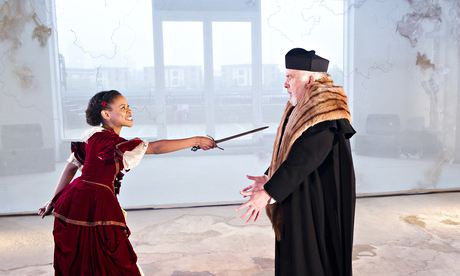
The second share today is also from The Guardian and written by Veronica Horwell, Casting Call For Buildings explores how site-specific theatre companies go about picking the right venues for their shows? Horwell looks at two current performances – again Punchdrunk’s Drowned Man and The Spectators Guild’s new show, Venice Preserve’d.

Casting call for buildings: on location with Punchdrunk and Spectators’ Guild

It’s easy to see why Paynes Wharf, near Deptford Creek in south London, is playing the lead in the Spectators’ Guild company’s production of Venice Preserv’d. It has an old Thameside maritime facade – a former boilermaking works – arcaded like the Doge’s Palace, next to a new flatblock in the manner of a campanile, and its developers put serious money into the production. And they offered guaranteed availability with a scheduled window in the site’s post-construction schedule.

VenicePlay_RG029-528x790

For, as the guild’s producer Harry Ross and production designer Helen Scarlett O’Neill know from their work with Secret Cinema, the company that stages elaborate movie events, any big, workable, public space in London is hard to find. Should they dream of a place with character, let alone the right looks, they’re into the near-impossible. There is noSpotlight for immersive venues, no showreels for talented but unknown ex-warehouses. The agents do not ring.

Mostly, Ross and friends keep their eyes open and ceaselessly ask around. Ross, who as a cyclist has travelled at just the right speed to observe the built landscape, collects London buildings, holding in his head half the current suitable specimens, tunnels included. He can charm any watchman into letting him past the gates within five minutes, and will wander around the metropolis yelling queries up to blokes on scaffolding, if that’s what it takes.

Once spotted, though, a space can be even harder to secure. It can be done, especially if it’s a pro tart of a place for hire anyway, as with the former Farmiloe stained-glass manufactory in Smithfield, much used as a movie location before being taken over for the duration of Secret Cinema’s The Grand Budapest Hotel-related live extravaganza in March. But the turnover of acquisition, renovation, demolition, repurposing and new construction in London has accelerated so fast since property became the international investment after the 2008 crash, that places the site-specific event companies have stashed away as promising hopes suddenly sprout into multi-storey plutoflats.

HAR250214_VenicePreservd_Web_Logo_640_27_3_14-627x500

That’s what makes Venice Preserv’d as an on-site production a novel venture for everybody – and is maybe the way that immersive theatre will have to go. The developers wanted the company and its production to show off the artistic potential of this great space behind the restored river facade. They’re looking to theatre to put some character into the wharf so that it won’t lapse into just another stretch of the executive luxury-flat cliffs now walling the Thames.

Director Charlotte Westenra has wanted to put on Thomas Otway’s Restoration tragedy for a long time – it being an entirely modern story about selling out, in every sense, in a privileged imperial city awash with money and betrayal, yet sinking fast. Then came this loan of what she feels is “a beautiful, significant space” that, both visually and contextually, correlated with her concept of the play.

I’d describe the production as location-referential more than site-specific. While Westenra exploits onsite advantages with glee – she will flood the central courtyard to simulate a bridged Venetian canalscape – she also looks out to a wider geographic “where” as a context for the old narrative. The audience can choose to come down to Greenwich pier by boat, as if on their way to a Venetian carnival, and, as they promenade the wharf’s tideside terrace or look through the space’s mighty windows, they cannot fail to see the uncaring, rising water and moneyed Canary Wharf on its far side.

Venice Preserv'd

The site’s most overwhelming area is a lofty nave the length of the gutted old building, which O’Neill will dress with decaying lace. Although Westenra’s approach to Otway’s bitter power play will remain a semi-formal staging, in which everybody will view and hear the same scene at the same time, it won’t be a Punchdrunk company gig with each audience member stomping his or her own route with a request to “wear appropriate shoes” on the ticket. If the walls could speak at Payne’s Wharf they’d be talking about investment, dividends, futures. Most of them – other than that 1860s frontage – have no past to speak of.

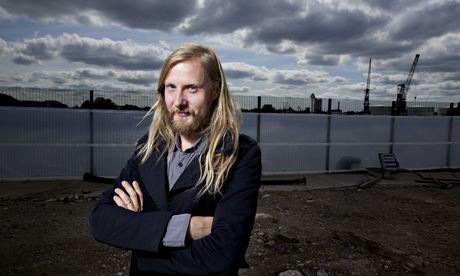
Get Felix Barrett, head of Punchdrunk, immersive veterans, on the subject of listening to walls, and it’s a whole different story – mostly about the past. He has known since his first student production in 2000, in a Territorial Army HQ in Exeter, all the highs and woes of the quest for unlikely performing spaces. He knows Deptford, too – he put on two shows in the old Seagar distillery, now a mighty block of “lifestyle living” just a drinker’s spit from Payne’s Wharf.

Felix Barrett of Punchdrunk

He’s full of admiration for the guild – “They’re going outside? First thing we do in a place is overpaint all the windows black”. But he doesn’t envy them the site, no matter how painlessly secured, because for Punchdrunk, building a narrative means narrating the building. For that, it needs not a beautifully embalmed corpse of a place, let alone a place that’s mostly newborn, but “a good dirty body of a building”. Or anyway, a building on its last breath, as many of his have been over the past 14 years. The first time he gains entry into a secured desired venue, he has to be alone, because “you have to listen, ask the buildings: what do you want? Tell me what you want.”

Westenra wanted to do her cherished show and was grateful for a supportive, expansive space as setting: Barrett doesn’t cherish anything so finished as a script, just a dozen two-word ideas, as many again in one sentence, and a well-developed few that run as far as a single paragraph. None go further until he can hunt and hold his site. It’s getting more difficult in London. Rare are the developers, he says, “who realise that dormant space could be a positive creative force”. Or that Punchdrunk could give a death-sentenced building a last hurrah (Faust in a former archive in Wapping Lane, The Duchess of Malfi in a doomed pharma HQ in Docklands), rather than a squalid slide into graffiti before the cranes move in. Now there is also competition from proliferating event companies and movie shoots. The economics have changed. The old Paddington mail sorting office, elaborated internally into “Temple Studios” as home to Punchdrunk’s most recent production, The Drowned Man: A Hollywood Fable, took three years to run to ground and secure, and was the first site where the company has had to pay properly for use.

How did Punchdrunk find it? Like its predecessors, by a combination of time, luck and legwork. Barrett used to draw a circle on a map, calibrated to the distance an audience might travel, then divide it into blocks. A-Z in hand, his team walked every alleyway, always looking up (“the hidden gems are above your eyeline”). The building should ideally be reticent, reclusive and exude a sense of danger: “The day we found the building for Faust, after nine brutal and bruising months, we could feel the electricity run through the fence. There was a big sign, DANGER: DO NOT ENTER … We went in.” (Punchdrunk never took the sign down, despite the misgivings of its National Theatre backers.) When Punchdrunk was invited into the safe, alive space of the Battersea Arts Centre, a former town hall, the first task was “to kill it off, a stake through the heart” before the right show, which turned out to be The Mask of the Red Death, could crawl out of its demunicipalised woodwork.

Untitled_Fotor

After Punchdrunk field trips, the team usually worked the phones for weeks, and got nowhere. For every hundred spaces that might fit the bill, only one was available for work – until, so often, it was out of the game. Three times Barrett came close to securing a hospital. (He would have liked to put on Faust in hospital wards, grief and loss flowing along every corridor – corridors are all plot.) Every time, in the end, pffft. Eventually, he learned that, “You can’t dream about the perfect space for the ideal show because a show may be almost go after three years” – then comes the NO – “and when you secure another building, it has to be a very different show”. Right now he has seven possibles waiting for a green light, and 50 that could happen, but their stories will have to be scored to what he hears on that first interior walk, “the beats and rhythms of the space, crescendos, diminuendos, staccato”. Punchdrunk is about being site-sympathetic, rather than site-specific, though. In New York, its backers wanted Faust, but Faust was outside the available venue’s range: it performed Sleep No More – Macbeth – brilliantly.

conor-doyle-ed-warner-omar-gordon-tomislav-english-vinicius-salles-punchdrunk-the-drowned-man-a-hollywood-fable-photo-birgit-ralf-0578

Barrettt’s own role is always Prospero. He says he is in the sandcastle business. Almost everywhere Punchdrunk has ever commandeered, all those not-so-gorgeous palaces, has since been replaced with cloud-capped tower blocks. So for the first time, the company now keeps proper records of its plays, including the buildings’ own stories, against the inevitable time they, too, vanish into thin air, shortly after the play closes.

My third and final share comes from one of my students, Mia, who as just written a comparison of the working practices of a number of immersive companies including, Punchdrunk, You Me Bum Bum Train and dreamthinkspeak. As part of her research she contacted the companies and got this great little Interview with Tristan Sharps, Artistic Director of dreamthinkspeak.
Birthday Bardolatry

Wednesday marks the 450th anniversary of the birth of William Shakespeare. Now regular readers of Theatre Room will know that I have a certain ambivalence to the works of the bard and occasionally find myself in arguments with others who refuse to believe anything other that he was the greatest playwright to have ever lived.

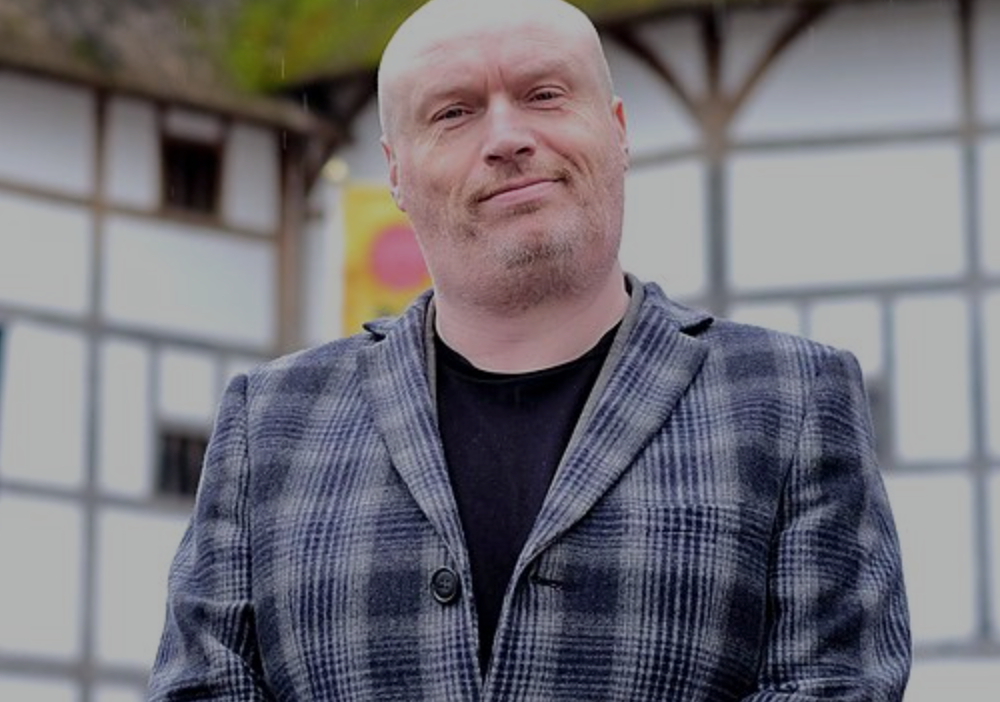
MR at The GlobeIt was therefore with some great interest I listened to a programme presented by British playwright Mark Ravenhill (left), who has just finished a two-year stint as playwright in residence at the Royal Shakespeare Company. In Shakespeare: For and Against for the BBC, and to quote the promotional material for the programme

…..Ravenhill challenges our adulation of the Bard and asks: Is Shakespeare’s genius beyond question? Casting a sceptical eye over centuries of bardolatry, Ravenhill calls for a new approach to the plays.

Exploring the intellectual tradition that has seen important figures from Voltaire to Tolstoy to Wittgenstein challenge Shakespeare’s supremacy, Ravenhill searches for today’s dissenting voices.

Tracing the transformation of a working playwright into a national poet, global brand and secular god, Ravenhill asks if it’s still possible to enjoy Shakespeare without being overwhelmed by the cultural and commercial baggage of ‘brand Shakespeare’.

It is really fascinating and amongst other people he speaks to scholar Ania Loomba who describes India’s changing relationship with Shakespeare, and Professor Gary Taylor talks about the ambivalence of large parts of America toward the Bard. Have a listen below:

In the interest of balance I would also like to share a piece written for The Telegraph by the highly respected actor Simon Russell Beale (interviewed by Ravenhill in the above) whose latest Shakespearian outing has been playing King Lear at the National Theatre.

Why Shakespeare always says something new

As the 450th anniversary of Shakespeare’s birth approaches, the great Shakespearean actor Simon Russell Beale explains his secrets

At the very end of King Lear, a frail, old man appears carrying the corpse of his youngest and much-loved daughter. It’s an image, like that of Hamlet holding a skull or Juliet on her balcony, that has imprinted itself on the minds of readers and spectators over the last four hundred years. For some, it is unbearable, even morally irresponsible; for Lear’s lonely, individual grief seems to reinforce the possibility, iterated again and again in the play, that all human life is essentially meaningless.

Whether one accepts that bleak vision or not, here once again is that familiar magic – Shakespeare’s astonishing ability to open out his work, to manipulate a single storyline, so that it includes, implicates and challenges everyone.

PX694779_King-Lear_2872690b

The old king and his daughter do not enter alone, however. They are accompanied by at least one soldier, possibly more. This soldier, about whom we know almost nothing, has a single line later in the scene, but his entrance is not marked in either of the authoritative texts that have been handed down to us – the quarto and the Folio – and, consequently, presents the director of King Lear with a problem. When, precisely, should the soldier, or soldiers, enter? Every line spoken by Lear in this short, final scene is a wonder and I suspect that most directors instinctively feel that his words and the image should be left, as it were, to stand alone.

But, as so often, Shakespeare gives us a context for Lear’s pain, a counterpoint. The soldier is there to remind us, amongst other things, that the old king is not simply a grieving father but also a prisoner- of -war (a war for which he is ultimately responsible) and to confirm, with his single line, that Lear is still powerful and angry enough to have killed the man who was murdering his child.

This is a tiny example of another Shakespearean manoeuvre, one to set against his skill at articulating the big things like love and hate. It’s the type of thing that makes mounting Shakespeare’s work endlessly fascinating, demanding and frustrating. For whatever reason – the way the texts have been transmitted, carelessness on the part of the writer, a change of intention – the plays, in their lack of precision, often raise questions for which the playwright has provided no clear answer. Any actor or director in search of clarity could be forgiven for interpreting this as an opportunity or a challenge.

If this challenge seems, at times, difficult to meet then it’s comforting to know that we are not alone. Ben Jonson, Shakespeare’s younger contemporary and a writer whose narrative was always meticulously charted, found his older colleague’s work, for all its beauty, sloppy and often absurd. He probably found the paucity of information about Lady Macbeth’s child, for instance, infuriating. Unfair though it might be, however, Shakespeare’s capacity for absorbing endless reinterpretation, in contrast to the demands that Jonson makes, is maybe one reason why the latter’s work has never been as popular as his colleague’s. Perhaps we should be braver with Jonson, but the truth is that, over nearly thirty years of working on Shakespeare’s plays, there have been countless occasions when, in the rehearsal room, I have witnessed (and expended) a great deal of enjoyable effort in the attempt to sort out apparent inconsistencies and ambiguities. We could leave the plays alone, I suppose, but that seems the lazy and irresponsible option. Shakespeare demands a more considered response, I think.

This is a tricky business, however. One never wants to “tidy up” Shakespeare’s writing without considering as many options as possible and ambiguity is often a good thing. There are sometimes unexpected discoveries to be made by investing fully in something that is apparently confusing. The soldier in the final moments of King Lear is there precisely to complicate matters. In this case, the king may very well be embodying a profound and far-reaching pain that has universal relevance, but the playwright cannot resist providing a more mundane and savage context. Lear is not floating free of the real world; and this may remind us that it is in the oddities of Shakespeare’s writing, his exploration of the confusion and ugliness of any situation, his absolute refusal to sentimentalise, that a great deal of his power lies.

srb-as-lear_2878816c

The fact, too, that the plays are, from an interpretative point of view, open-ended leads satisfyingly to our questioning, not only the playwright, but also each other. We may not agree with a particular analysis or interpretation, but if it is neither wilful nor illogical, then it may well be, despite our preconceptions, valid. Shakespeare’s plays are very hospitable. As a fellow actor said to me recently, interpreting Shakespeare is “a game we can all play”.

The feeling that one is standing on shifting ground is there right at the start of any close reading of the text. The astonishing work of literary scholars over the last century has radically changed our view of the plays as comprising an unchanging and rigid canon. Not one of Shakespeare’s plays exists in a single, unchallenged version. There are, as I mentioned earlier, two authoritative texts for King Lear – with significant differences – and three for Hamlet. Plays like Measure for Measure are frankly a bit of a mess and Timon of Athens is clearly unfinished.

It seems that Shakespeare’s plays are, in some sense, there to be adapted. We have to tread carefully, of course, because we are dealing with a man who was unquestionably a genius;, but he was also a working man of the theatre and, it seems, was willing to adapt his work, responding to his own changing ideas and, presumably, to the demands of those he worked with. What this all boils down to is that you can’t perform a play by Shakespeare without first editing it. There is no set text.

The reason why this is a worry for some is that editing is necessarily an interpretative activity and our judgment of a play can therefore be manipulated. Choosing between options that the playwright himself offers is not, of course, objectionable, although many are surprised at how different these options sometimes are. For instance, one of Hamlet’s famous soliloquies, his last, “How all occasions do inform against me” is not in the Folio version of the play.

Difficulties arise when theatre practitioners change things that Shakespeare did not clearly authorise. In the production of King Lear that I am currently involved with, there is a glaring, perhaps even controversial, example of this. The Fool, one of Lear’s few friends, disappears halfway through the play and this is considered by commentators as either gratifyingly mysterious or simply unsatisfactory. We decided that the King, now mad and predictably violent for much of the time, should club the Fool to death.

Whatever arguments we can produce for such a decision – and I, of course, think they are watertight, despite the fact that much later in the story Lear mentions that the Fool has been hanged – there is no doubt that some find such a departure from the text distressing. Years ago, in a production of The Tempest (also directed, as it happens, by Sam Mendes), I played a rather haughty Ariel who, at the moment of being given his freedom by Prospero, spat in his master’s face. This seemed to me to be an absolutely understandable protest given Ariel’s long years of servitude, but many spectators, for understandable reasons, disliked it intensely.

THE-WINTER_S-TAL_2878808c

My defence is that the texts themselves are not stable and that, anyway, we are following Shakespeare’s footsteps. For instance, editing a play for performance often means cutting lines and we know that some of the plays exist in shorter versions, presumably intended for particular occasions and I’m sure he changed things for other reasons than that of length. Even if the principal aim of a group of practitioners is simply to reduce the playing time, rather than something more devious, distortion of some (largely mythical) ur-text is inevitable.

This process of editing may challenge our preconceptions about a play and those preconceptions, especially if they manifest themselves in a desire for something that we can easily define, are often very difficult to shift. I’m aware, when watching a production of a Shakespeare play I know well, that I have to work hard not to impose my rigid requirements on the performers in front of me. There is always a danger that, while working on a Shakespeare play over months or even years, one can persuade oneself that a certain interpretation is the only one possible. After all, it is part of an actor’s job to convince an audience that, within the context of the production, this is momentarily the case. But Macbeth need not be, as I saw him, a man whose poetic imagination is liberated by a murder that is a gift to his wife. Iago may not have a second-rate mind, as I would argue, but perhaps is really is some sort of Machiavellian superstar.

I know I have to fight against my own prejudices (and acknowledge that, in any case, my ideas can change). Equally well, I have been guilty in performance of smoothing over, rather than embracing, difficulties, in the vain hope that no one will notice. For instance I have always found it hard that Hamlet, a character that I love and admire, is guilty of a puerile misogyny and, perhaps, more worryingly, of the unnecessary deaths of his old friends from university, Rosencrantz and Guildenstern. When I played him, I could find reasons for the misogyny but half- ignored the murders. The conflict and, most importantly the play on our sympathies are there, however, and should not be ignored.

The question of sympathy is one that has been exercising me over the months that I’ve been working on King Lear in Sam Mendes’s production for the National Theatre. If the soldier in the final scene is a reminder that Lear is not just a poor old thing but an angry, indeed homicidal, man, operating, however feebly, in a harsh world, then the first scene of the play is a direct challenge to our natural desire to like the central character. Unlike Othello or even Macbeth, we never get a chance to see Lear at his best, to see the man that Cordelia loves and that Kent and Gloucester, his devoted allies, respect. There are ways of softening the scene up, of playing it in a more vulnerable way, although I feel that this dodges the issue. What the king does in dividing his kingdom and banishing his daughter is, in Kent’s word, “evil”. Consequently, it’s a long haul back to forgiveness both from the other characters and from the audience; to be honest, I’m not sure we ever really get there.

Forgiveness, and the difficulties of defining it, is something that Shakespeare seems always to have been interested in and this interest becomes especially intense in his later plays. In The Tempest we see Prospero offering forgiveness to his errant brother in a manner that looks suspiciously like another arbitrary display of power. The brother, perhaps significantly, does not answer. Leontes in The Winter’s Tale, wracked with a guilt that seems for a long time too deep-rooted to shift, faces a wronged wife who talks, not to him, but to their daughter. Not a word is spoken that promises unequivocally a settled and happy resolution.

Shakespeare recognised that the wish to be forgiven and the desire to forgive is the start of a process, that reconciliation or redemption take time, and time, of course, is the one thing that Lear and Cordelia do not have. That is what ultimately is so heartbreaking about King Lear. Not all mistakes can be fully rectified, all damage repaired and all love restored – at least, not here and now. The best we can do is accept the muddle of it all.

What Shakespeare always demands, though, is our sympathy, because, to put it simply, he writes about people like us. Offhand, I can think of only one character he wrote – Iago in Othello – that slips through the safety-net of his concern. Shakespeare might not agree with Lear’s sweeping and anarchic assertion that “none does offend”, but he sensed, I think, the danger of easy judgement. He recognises that self-worth and dignity are hard-won and that our lives cannot but be inconsistent, unpredictable, and confused. The only sane response for all of us, perhaps, is to emulate him – to look carefully, to withhold quick judgment and to try to understand.

It would suggest you read the comment’s that follow Beale’s piece – they make interesting reading. This one says it all for me:

Untitled_Fotor


Invisible Light

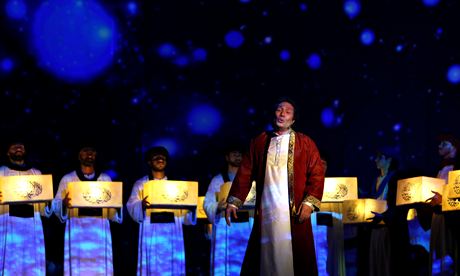
EP-140329286.jpg&MaxW=558&imageVersion=defaultA few days ago a show opened in Sharjah, a tiny emirate that forms part of the United Arab Emirates. Called Clusters of Light,  it tells the life story of the Prophet Mohammed and for anyone who knows about Islam, there is an obvious difficulty here – Islamic convention forbids the portrayal of the Prophet in human form. None the less what has been produced is a truly spectacular piece of theatre, drawing on the latest technology, expertise from around the world, a cast over over two hundred and performed in a brand new outdoor amphitheatre, the construction of which took only 3 months.

1715289621The whole event has been on an enormous scale. According to The Gulf News, The Al Majaz Amphitheatre, based on a traditional Roman design, cost US$32 million to build, can seat 4,500 people, has 400 animated lights, 120 sound speakers, and 21 projectors as well as a  hydraulic stage.

ali_03122014

The opening performance is no less impressive in its conception and the time scale in which it was created. Clusters of Light has been put together in less than 6 months, a time frame that would, I am sure, have any mainstream theatrical producer dancing with delight. The creative team behind the project are some of the most experienced in their field, with a history of staging, literally, some of the biggest shows on Earth. I will let writer Peter Walker and photojournalist Susan Schulman take up the story from here, in a piece published in The GuardianIslam the Opera.

It was quite a challenge, even for the crack team of theatrical experts summoned from around the world: less than six months to produce a hi-tech musical extravaganza about one of the most renowned figures in human history. Oh yes, and the title character can’t appear on stage.

But somehow it happened and on Sunday night a lavish production about the life and teachings of Muhammad, Islam’s main prophet, intended as a rejoinder to more militant interpretations of the faith, premiered at a specially built £20m mock-Roman amphitheatre in Sharjah, the small emirate adjoining Dubai.

The show had to be assembled in months by an international team that includes Piers Shepperd, technical director of the 2012 Olympic opening and closing ceremonies, and the man who made Danny Boyle’s creative ideas happen on stage. Now he has done the same for a show whose scope is roughly equivalent to Islam: the Opera. The 90-minute production, Clusters of Light, has the ambitious stated intent of rebranding the religion internationally.

The story is told with a cast of about 200, including some of the Arab world’s most celebrated singers, such as Mohammed Assaf, the Palestinian winner of Arab Idol, and the Tunisian tenor Lotfi Bouchnak, with spectacular animated scenes projected around them.

Clusters of Light

An inaugural run in Sharjah will be followed by mooted tours to Malaysia, Turkey and even Paris. There are tentative plans to translate the libretto, by a Saudi poet, into other languages with a view to attracting non-Muslim audiences.

From the beginning, the production faced one particular challenge: under Islamic convention Muhammad cannot be portrayed in human form.

The first step for the team, according to Richard Lindsay, the creative director, was to watch The Message, a 1977 film about Muhammad’s life that showed the story from his direct perspective, conveniently keeping him off-screen.

“As we weren’t making a film, we didn’t have that luxury,” said Lindsay. “There’s only once in the show we refer to the prophet, and then we represent him as a source of light, which is accepted. For the rest of the time we didn’t need him in the story, as it revolves around him. The show is about what he’s doing, but it doesn’t actually need to show him.”

EP-140339883.jpg&MaxW=460&imageVersion=default

The production is lavish to an almost Bollywood extent, with images projected to a huge screen behind the cast, forming the background scenes, sometimes animating to interact with the on-stage action or provide images such as a falcon seemingly soaring above the audience.

Gavin Robins, the director, with a background in the somewhat different world of the Eurovision song contest and stage productions such as How to Tame Your Dragon, describes it as the most technically advanced show he has worked on, and one of the most dramatic. “You could describe it as a romantic thriller,” he said. “When we first rehearsed the scene about the prophet’s death, the entire company was genuinely weeping. It’s a gift to be able to take that energy from a cast.”

Shepperd said his involvement changed his view about the religion’s take on several subjects, for example the position of women.

He said: “If you look at the popular misconceptions about Islam, that isn’t the case at all. It’s great to be working on a show that explores those kinds of things.”

AR-140329286.jpg&MaxW=558&imageVersion=default

Whatever the intended message, the broader cultural context is arguably slightly more complex. Sharjah is sufficiently traditional to possess a set of “public decency rules” that prohibit, among other things, men and women being alone together in public unless they are married or related. The author of the libretto, Abdulrahman al-Ashmawy, has reportedly written a poem criticising attempts by women in his native Saudi Arabia to be permitted to drive. However, the man ultimately overseeing Clusters of Light, Philippe Skaff, said he welcomed Sharjah’s ambitious scheme from the very personal perspective of a Lebanese Christian: “As a Christian Arab, if anyone feels threatened by extremism, it’s us. It’s very comforting to see a work like this commissioned.

“At the start of all this the sheikh told me, ‘If we don’t do this, if we don’t spread the real message of Islam, we’re letting the extremists take over. This is our way of responding to them.'”

In an article for The National, the Bahraini composer of Clusters of Light, Khalid Al Sheikh says it is a story for all nations and times. Interestingly, Al Sheikh worked with German composer Christian Steinhauser and the music was recorded by the German Film Orchestra Babelsberg. Another piece in The National, also by Afshan Ahmed, gives an idea of the complexity of, and technology behind, the staging.

During the rehearsal, a 12-tonne cube slowly appears from behind white scrim. A computer-generated grid pops up and in seconds is replaced by animated images of a marketplace.

“This is not a cinema screen where you have one big projector,” says Hai Tran, the head of technology at Multiple & Spinifex Group, a Sydney-based creative projects company that produced the show. “This involves projecting from all over the arena to get the whole environment looking right.

“The cube is very dynamic. We use it as a stage and it also turns into the Kaaba during the show.”

The commercial for the show (below) gives a very clear picture of the epic nature of what has been produced.

.

Now it has to be said something on this scale, and created in this timeframe, can only be achieved by a nation with a lot of money and the ability to hire the best the industry has to offer, but you can’t but applaud the vision. Also, as Peter Walker comments, the broader cultural context of the project might raise a few eyebrows elsewhere in the world, and perhaps this can’t be ignored. Having said this, I think if found myself in Sharjah tomorrow I would probably – no, almost certainly – find myself in the audience.

No Longer A Refugee #2

In January I wrote a post, No Longer A Refugee, about a group of women refugees who had fled the vicious civil war in their homeland Syria and were involved in the staging of a production of the Greek Tragedy, The Trojan Women. As I was driving to work today I listened to another thought-provoking programme about the project, which was broadcast by the BBC World Service, as part of their Outlook strand. If the January post struck a chord with you, I certainly recommend a listen to the Outlook podcast below:

604

Moods and Doodles

As a practitioner of theatre I have always created work in pictures first – both with the actors and with the set. A couple of years ago a visual art colleague watching some site-specific work I had created commented, with some surprise, that we clearly both worked in the same way, driven by a visual aesthetic. Obviously this is only one part of the creative process involved in making theatre, but is one I love –  in another life I think I would have liked to be a set designer.

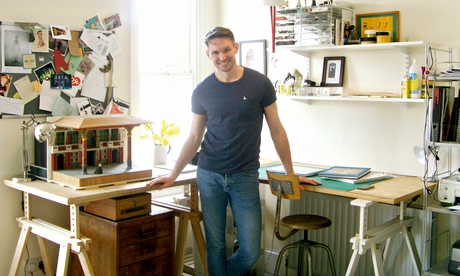
I was intrigued to read, therefore, in an occasional series in The Guardian, an interview by Georgie Bradley with Colin Richmond, a UK-based theatre designer entitled How do I become … a set designer

How do I become … a set designer

Good communication skills, an ability to network and willingness to start out making the tea have got Colin Richmond a long way

Colin Richmond conjured up fantastical uses for pegs when he was a child. His carpenter father would make miniature theatre sets out of leftover wood while Richmond covered pegs in “Borrower”-sized clothes.

'You have to keep emailing and creating worlds,' says Colin Richmond, 'get ideas on paper even if you don't have work.'

‘You have to keep emailing and creating worlds,’ says Colin Richmond, ‘get ideas on paper even if you don’t have work.’

“I loved going to the theatre for a bit of escapism. After I had seen Starlight Express I came home and made a model version of the set from memory,” says Richmond. He also recreated Gotham City at the age of eight.

Richmond, 32, from Ballymoney in Northern Ireland, wanted to be an actor. He had a string of school production credits to his name when he was cast as a member of the Jets in West Side Story, performing with the Ulster Theatre Company. “The set was this massive scaffold structure and I thought it was interesting how an environment changes you as an actor. And it made me realise this was the part of the process that was so appealing to me,” he says.

Richmond then attended the Royal Welsh College of Music and Drama,  where he took a three-year theatre design course. It culminated in a final-year show with all the pressures of a professional production. “It’s a hardcore three years of hardly any days off. It begins with sculpture work and developing the imagination and building up good skills,” he says. “We had a puppetry project to do, which we also performed in to understand the other side of the process. The second and third years are when you specialise in costume or set design.”

After his course, Richmond moved to London to become as an assistant to Bob Crowley, the designer of Mary Poppins and The History Boys, whose main assistant at the time was a friend of Richmond’s head of design at college.

Getting a break through someone you know is common in this line of work, although getting one job does not automatically lead to another. “You have to keep emailing and creating worlds, get ideas and designs on paper even if you’ve not got work. You have to be relentless in knowing who is doing what and where.”

Fresh from college, a designer can expect to be an assistant with tasks including the necessary evils of tea making and photocopying, but perseverance and a bulky portfolio will help you climb the ranks.

Richmond has recently worked on the RSC’s Wendy and Peter Pan, where he designed both the costumes and set. “You’re only contracted up until press night and then you’re free to go.” Walking around the warehouse of a set at the RSC in Stratford-upon-Avon, Tinkerbell’s fairy dust is everywhere, Captain Hook’s ship is being recharged in the wings and the plurality of the show’s scenes are inconspicuously layered.

Richmond believes in challenging the audiences: “Letting the audience use their heads to add to the story is a way to give them that escapism or realism. I’ve seen the most overdesigned sets that left nothing to the imagination. However it does depend on the show.”

Frantic sketches and doodles are part of the designer’s work, but a lack of drawing skills won’t set you back. “References, mood boards and montages are equally as effective,” says Richmond. Up until the set is constructed, the concept goes through different model stages, working at a scale 25 times smaller.

Wendy+&+Peter+Pan

Good communication skills are vital for a good set designer. They are always feeding back to the director and therefore need to be able to articulate ideas and have strong people skills. “At the end when it all comes into fruition it makes every part of the process worthwhile. The schedules are exhausting but you’ve got to keep doing more because it doesn’t pay well,” says Richmond. “You’re either a prince or a pauper in this industry.”

One of the great things about how large producing theatres now market themselves is that they are ready to promote all aspects of their production process. As a result the design of a play is often shared, along with other key aspects of the production, as the video above of Richmond’s work on the RSC’s Wendy and Pater Pan shows. Here is another, this time of the work of Bunny Christe, the designer of the UK’s National Theatre production of Emil and The Detectives, adapted from the 1929 novel by Erich Kästner.

.

How far that little candle throws his beams!

How far that little candle throws his beams! So shines a good deed in a weary world.

Portia, The Merchant of Venice.

Sydney Opera House at Night Australia Digital Art By mrmGoogle  ‘worlds famous theatres’ and the subsequent list is a mixture of iconic historic opera houses spanning a number of continents, the Chinese Theatre in Los Angeles and, not surprisingly, The Sydney Opera House. Now I could take issue on many fronts with what is considered to make a theatre famous, not least of all that none of them appear to take into account what actually goes on in inside. Yes, lots of them are works of art in themselves as this list from Huffington Post shows, but I would posit that were you to show these to most people they wouldn’t be able to tell what they are called or where they are. However, I would think a far great number would be able to tell you what and where this theatre is:

Pawel-Libera-Globe-Exterior

Shakespeare’s Globe was opened in 1997 and if you don’t know the history behind the reconstruction you can read that here. The point I am trying to make that since it opened, and for many reasons, it has become iconic throughout the world both for being the building it is AND for what goes on inside it. I’ve seen a play there and it is a truly unique way of watching theatre.  There is something democratic about the relationship between actor, audience and space – especially if it rains mid-performance. What’s more, as reported in The Stage, last year the theatre had a turnover of more that £21million, made a profit of £3.7 million, played to houses of 96% capacity and had a reach of 1 million people through it’s various ventures. Now that is some going for a theatre that started as one man’s, Sam Wanamaker, vision. It was built by raising money through donation and is less that 20 years old. The quote from The Merchant of Venice could well be said of Wanamaker and his vision, but I really intended it as an opening for the real purpose of today’s post.

the-sam-wanamaker-playhouse-85149

In January this year The Globe unveiled another theatre on its site, called the Sam Wanamaker Playhouse. Again built through fundraising, this ‘new’ theatre is another faithful reconstruction, but this time of an indoor, Jacobean theatre, entirely lit by candles. The exterior of the playhouse seems quite innocuous, but the images of the inside are a revelation and the reviews of the the two plays staged in it so far talk with some passion about the theatre-going experience in this new space. There is a great gallery of pictures here, from The Telegraph.

9386823

Much has been written about the Playhouse, not least of all the experience of lighting, acting in and watching a play by candlelight. The Jacobeans used candles made from animal fat, but the Globe have gone for pure beeswax, costing up to £500 per show, all of which are lit by hand before each performance. In a great article for The Guardian, Andrew Dixon give a real flavour of the place, New Globe playhouse draws us inside Shakespeare’s inner space

There is a very evocative and informative report from The Voice of Russia radio here which is fascinating, and talks about the experience as going back to storytelling in its most primitive form:

The Globe has produced a good series of videos about the Playhouse and I am going to put them all here, for ease of reference:

I think they tell a marvellous story. The following video is a collection of interviews with audience members on the opening night of The Duchess Malfi, and you get a real sense of what the experience is like:

There is also a really interesting podcast, courtesy of Theatre Voice, with Farah Karim-Cooper who is Head of Research at The Globe in which she explores indoor performance during the Renaissance and at The Sam Wanamaker Playhouse:

There is also a lovely piece called Ten Reasons to get excited about the Sam Wanamaker Playhouse at The Globe, also by Farah Karim-Cooper, published on Blogging Shakespeare.

If you are a regular reader of Theatre Room you will know my relationship with Shakespeare has it’s tensions, but I can only applaud the people behind this project and how it extends our understanding of the history of performance. I will certainly be booking tickets to see whatever is playing next time I find myself in the UK.

Being Taken For A Ride

As trends in theatre go, the immersive genre just keeps expanding and redefining itself. This week, some of my own students staged a piece called The Ward which entailed masked audiences, elevators, stairs, four different spaces, touch, taste, smell, specially created video and a cast of 24. It was risky, edgy and played with the form very successfully. We were all delighted with piece and no more so than its creators, deservedly so.

Rift's Macbeth posterIt is seems hardly a week goes by now where I don’t read about a piece of immersive theatre playing somewhere in the world, and this week was no exception. The first I’d like to share is news of a UK company, Rift, who are planning to stage a version of Macbeth. The company have a reputation for staging immersive reinterpretations of classic pieces of theatre. Theatre Critic, Matt Trueman, wrote about this new work in progress in The Guardian.  What caught my eye, however, was that their version comes with a twist – it will take place overnight and the audience will be invited, encouraged even, to go to sleep during the performance. You don’t just by a ticket, you buy a bed and meal and there are 3 levels of ‘package‘ available, depending on the amount of comfort you want to enjoy during the ‘show’. The company says of its plans:

Face-to-face with witches in an underground car park. Feasting with the Macbeths. Bedding down for the night on the 27th floor as a siege rages around you. Characters sleepwalking through the walls: confiding plots, summoning apparitions and conspiring murder. In the morning waking to find the battle lost or won.

This is William Shakespeare’s Macbeth seen from the inside out. This production like a fever-dream leaves you questioning ideas of space and status; dystopia and utopia; waking and sleeping.

This production scatters the story of Macbeth over one night. From Dusk till Dawn

Felix Mortimer, artistic director of Rift talks in this documentary about how they work – in this case on a production of Kafka’s The Trial.

Meanwhile in Australia, the Perth Festival International Arts Festival is in full swing and immersive is clearly the order of the day with Punchdrunk, Look Left Look Right and Rimini Protokoll are all presenting wildly different immersive work. Punchdrunk’s The House Where Winter Lives is for 3 to 6 year olds,  Look Right Look Left are performing a reworking of their city-specific work, You Once Said Yes originally made for Edinburgh and Rimini Protokoll are staging Situation Rooms which requires its audience of 20 to wear headphones and carry iPads.

Australian writer and critic, Jane Howard, wrote about all three shows in her article for the Australia Culture Blog, The Guardian. In it she talks to the creatives behind the pieces.

Perth festival’s immersive theatre: ‘being confused is perfect’

While the headline shows of the Perth festival may be playing to hundreds at a time, in pockets all around the city this week performances are happening on a much smaller scale. These immersive theatre pieces are reliant on the actions of audience members to stage the work: from the solo audience of You Once Said Yes to the tightly choreographed interaction of audience members in Situation Rooms to the rambunctious collaboration of children in The House Where Winter Lives.

Kathryn McGarr, one of the performers with Punchdrunk’s The House Where Winter Lives, tells me that immersive theatre “inspires people a bit more”. And then there’s the practical consideration: even with the best will in the world, faced with a comfy chair in a warm, dark room it’s sometimes hard to stay awake. “People do fall asleep. Whereas there is no way you could fall asleep in a show like this.”

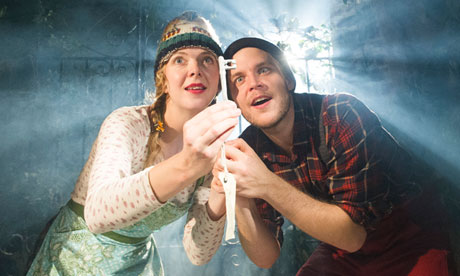
The House Where Winter Lives

The House Where Winter Lives

That much is certainly true. The adventure sees Mr and Mrs Winter take the audience of three to six-year-olds on a journey to discover the lost key to the larder. While Punchdrunk have created many immersive works for adults and even older children, this is the first time the company has pitched at such a young age group – and when you see their reactions it’s easy to think that this audience is perhaps the perfect age to be experiencing this work. Entirely without ideas of what “theatre” should be or how you should behave when watching it, they fully invest in the world.

Punchdrunk give the children a high degree of autonomy in their reactions. “We’ve got the script and we’ve got the structure and we’ve got certain things that we can do, and then we know when we can riff a bit and let them fill in the answers,” says performer and co-creator Matthew Blake.

Co-creator and performer Frances Moulds agrees. “There is a journey we need to go on,” she says, “but we can go with whatever they give us … That we’re open is actually a key thing: we’re open to anything they say and we want to hear what they’re saying.”

Allowing for audience response and choice is also central to You Once Said Yes, a show performed on the streets of Northbridge for an audience of one. That person has to be directed to a certain extent, concedes production manager Rosalyn Newbery, but “that has to be done sensitively and without dictating, because their responses and their reactions are very important, and they will change certain things”.

You Once Said Yes

You Once Said Yes

The title, she says, strongly suggests to the audience how to respond. Yet they can still say no, they can take an alternative route from that which is expected of them and the performers and production team must know how to be responsive to that.

James Rowland, one of the performers who travelled with the piece from the UK to join a local cast, says “no one show with one character will ever be the same, just because of the way people talk to them. The number of shows we’ve done is the number of shows there’s been.”

Many immersive theatre pieces rely on these interactions between the audience and performers and the self-direction and personality the audience invests into the work and the world. Rimini Protokoll’s Situation Rooms is the exception to this rule.

The documentary theatre piece invites the audience to step into the shoes of 10 people each as they talk about their relationship with the weapons industry. Following instructions on an iPad mini, with the world on the screen mirroring the environment built by the company, the audience move and silently interact in the exact place of the person whose story they’re hearing.

One of the creators, Helgard Haug, says the precision of the work is integral. “I think everybody understands that it’s perfect if it works, if you’re following it precisely. If you are in a space and you’re sitting at a table and you’re in the story of a person, and in the film you see a door opening and a person entering the space, and if that repeats in the real environment, in the real space where you are that’s the fun of it.”

While they walk through the space Haug wants the audience to question how these people fit into our society and why we each exist in the reality we exist in. After seeing the show, she says “to be confused is very productive. After half an hour leaving this building and being confused is perfect. Being exhausted is perfect. Needing a cup of coffee and a deep breath to then find your own skin again is just a very good thing to do with that content.”

Situation Rooms

Situation Rooms

While Situation Rooms aims to highlight the realities of a wider world, You Once Said Yes is about highlighting the realities and personality of the participant. Being involved in the presentation of such immersive work holds “massive privilege” for an actor, says Rowland.

“It’s pretty much the only arena in one-on-one performance where you really get that opportunity [to really meet the audience]: without lights, without a stage, in a situation where you just say, ‘No, go do whatever you want to do. Do your thing within the parameters of the show,’ which is lovely.”

That is one of reasons that people have responded so well to the show, he argues.

“By the end they feel they are, and they have been, valued, and it is about them as much as it is about the stories they’re unwrapping.”

A Cultural Democracy

For those of you who read Theatre Room regularly you will have noticed my preoccupation of late with the developments, and debate,  surrounding live streaming. Now of course this deals with how we consume theatre, not how we make it and this got me thinking about how this technology becomes part of the creative act itself. I know that there have been experiments in the field, and this piece by Jessica Holland, published in The National, an english language newspaper from Abu Dhabi, lays out some of the exciting possibilities:

Internet theatre – immersive, real-time shows with actors from all over the world

The answer is a brand-new art form that is being pioneered by performers in cities such as Tunis, Beirut and Dubai.

“It’s the future,” says the Lebanese writer, actor and director Lucien Bourjeily, who lives and works in Beirut. “At the moment it’s avant-garde, but it will become the norm.”

Lucien Bourjeily

Lucien Bourjeily

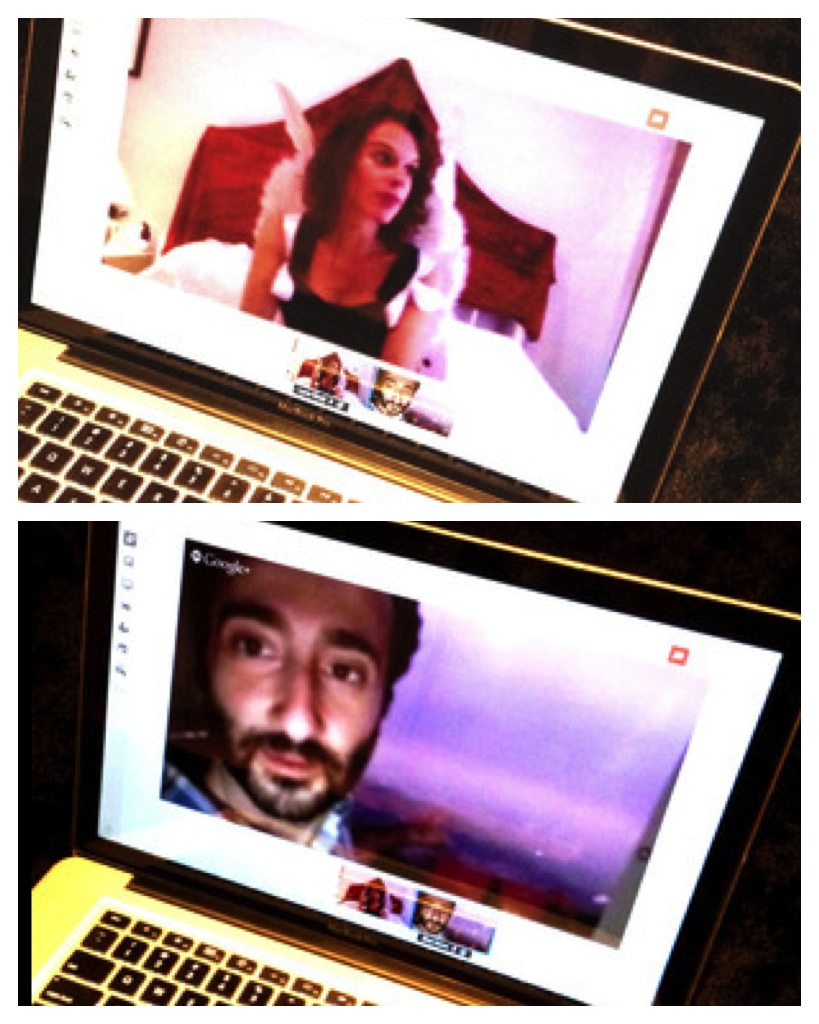
Last July, Bourjeily collaborated with Elastic Future, an experimental theatre company that started in San Francisco but is now based in London, on a play called Peek A Boo for the London International Festival of Theatre (LIFT). Five actors, playing spies, programmers and online peep-show entertainers, were divided between New York, London and Beirut, improvising dialogue as they interacted via streaming video. Audience members around the world watched in real-time by signing into Google Hangouts or watching the feed on Elastic Future’s web page. They also interacted with characters on Twitter and took part in a post-show Q&A.

Untitled“It was a breakthrough,” says Bourjeily of the performance, which followed just a week of online workshops and involved some quick thinking from the actors when there were glitches in the internet connection from New York. “It opened my eyes to so many possibilities for how to create a new type of immersive theatre.”

Erin Gilley, Elastic Future’s artistic director, says she learnt a lot from the experience and is eager to keep stretching the limits of the medium. She’s planning another work for this year’s Lift to be streamed online in July, with actors performing live via webcam from Ghana, Portugal and the United Kingdom.

“Theatre can’t exist without an audience and we’re trying to creatively explore what that means,” says Gilley of the work-in-progress. “The goal is for it to feel like you’re sitting in a theatre with other people, even though watching it will be a private experience.”

Gilley is avoiding screening the feed in an auditorium, in case the process prevents her from “discovering ways to create that feeling online”.

Much like Bourjeily, Gilley is evangelical about the benefits of this new, hybrid art form. For starters, it can bypass censors in countries such as Lebanon, where playwrights are required to submit their work to a bureau for approval. Performing online is cheaper than renting a space and flying in actors and it grants access to audiences from all over the world. It creates novel ways for artists scattered all over the globe to cooperate and to interact with viewers.

It can also turn practical constraints into aesthetic virtues….

As technology develops, the artistic possibilities multiply. “We have new ways of getting emotionally connected to our audience,” is how Bourjeily puts it. “The sky is the limit.”

Lucien Bourjeily is a fascinating man, as his website attests. So much so that Index On Censorship – a global NGO that fights for freedom of expression – has made him one of their four nominees for the Freedom of Expression awards for his play Would It Pass Or Not?, which is about censorship in Lebanon.The play was banned – by the censors, thus forcing them to justify their actions in public.

You can watch Peek-A -Boo here. It makes interesting viewing.

Elastic Future have been commissioned by LIFT to create a piece for this year’s festival, called Longitude, which will be streamed online on 9, 16, and 23 June. Indeed LIFT and it’s artistic director Mark Ball clearly see this kind of work as vital, linking the digital (stage) space with a wider cultural democracy – which is another blog post entirely.

David Cecil

David Cecil

As a post script, one of the other nominees for the Index Freedom Of Expression awards, which are in their 14th year and honour people around the world fighting for free expression, is David Cecil. Cecil is the British theatre producer who was jailed in Uganda for staging a play about homosexuality and whom I wrote about in the posts Stonewalled and A ruling for common sense over a year ago. Appallingly, a month ago the Ugandan parliament passed an anti-homosexuality law which, amongst other things, included punishments of up to life imprisonment. David Cecil is not gay. In fact when he was deported he was forced to leave behind his partner and their two young children. As I write, he has not been allowed to return.  The man deserves to be honoured.

A Shared Experience

Continuing on from my last post about the experience of watching a piece of live theatre, with Twitter as my fellow audience members, I was delighted to read this, written by Catherine Love for WhatsOnStage.com

Sharing the live experience

As debate about the live streaming of theatre productions continues, Catherine Love asks whether recorded performances can still unite an audience

As I logged into Twitter on Saturday evening, the tweets cluttering my timeline were, unusually, united in startling agreement. Nearly everyone I follow seemed to be watching the same thing……an online live stream of Forced Entertainment’s six-hour durational show 12AM: Awake & Looking Down.

twitter-iconEveryone who tweeted was watching it in a different place, from their bed or sofa or desk, but these scattered individuals were also watching the show together, as part of a separate but collective audience meeting in an online space.

This observation feels significant in light of renewed debate around the increasing practice of streaming theatre productions, be it huge operations like NT Live screening in cinemas across the country or modest webcasts of experimental performance. A number of theatre makers have expressed concern about these recordings replacing live performance, while Lyn Gardner  recently mounted a persuasive defence for the expansion of audience reach that these screenings allow.

Both sides of the argument make valid enough points. Those who take issue with the recording of performances protest that it somehow pollutes or detracts from the uniqueness of the live event, releasing viewers from the attention that is required of them in the theatre and encouraging audiences to retreat further and further into their screens, while live performance withers away. Icon for Streaming(2)The digital advocates, on the other hand, argue that screening theatre events can take them to a bigger audience in just one night than they might otherwise reach during a whole run, not to mention offering an opportunity for those without easy access to a theatre to engage with an art form that might otherwise be unavailable to them.

As Gardner points out, it doesn’t have to be a case of either/or; enjoying a performance online or in the cinema does not preclude the possibility of also taking a trip to the theatre. The two experiences offer different benefits. What I’d rather focus on, however, is the accusation – often levelled at streamed theatre – that it removes the collective, live experience of being part of an audience. It is implied that this is one of the key reasons for attending theatre rather than watching TV or sitting in front of a computer screen. In the modern world, the theatre is one of the few places where we can still have a live, unmediated experience, surrounded by other human beings. And this is, to an extent, true.

Forced Entertainment's 12AM: Awake & Looking Down. © Hugo Glendinning

Forced Entertainment’s 12AM: Awake & Looking Down.
© Hugo Glendinning

But what I witnessed on Saturday night looked an awful lot like an audience all having an experience together, even if that experience wasn’t in the same room. The same thing happened to an even greater extent throughout the 24 hours of Forced Entertainment’s Quizoola!, live streamed from the Barbican last year, and a similar online buzz has attended other webcasts by theatres such as the National Theatre of Wales and Hampstead Theatre.

On these various occasions, I have experienced a rare feeling of real community online, as a wide range of people all gather round one enthusiasm and exchange thoughts and responses. Sure, it’s not quite the same as having those reactions while sitting in the same space and breathing the same air, but the feelings and thoughts that the online experience provokes belong to the same family as those encountered in a theatre. And once audiences are hooked on the shared experience, who’s to say that they won’t seek it out again and again, both on and offline?

I couldn’t agree more. On the other hand, I was also interested to read this this by Ryan Gilby, for The Guardian, where he reflects on a different kind of live broadcast theatre event.

Coriolanus at National Theatre Live: cut the chat and get on with the show

The Donmar’s production starring Tom Hiddleston was a thriller in the cinema but it didn’t need all the DVD extras with it

Stage productions broadcast live in cinemas have been a fixture in the UK since 2009, when the National Theatre’s Phèdre was seen by more than 50,000 people. Numbers now tend to be far higher (the audience for The Audience was around 180,000) and reach beyond the UK. Last night was the first time I had attended a play in a cinema. The difference from theatre was apparent immediately: I was wearing a shabby jumper rather than a shirt. (I always try to wear a shirt to the theatre. I can’t help it. It’s an occasion.)

The next shock was finding that I had come to see Coriolanus starring Emma Freud. Cinema audiences have long suffered all manner of irritating pre-film ads, but the appearance of Ms Freud on screen, whipping us into a frenzy about what we were about to see, was at best superfluous (we didn’t need persuading: we’d already bought our tickets) and at worst obstructive. None of us were under the illusion that we were actually at the Donmar Warehouse where the play was staged, or that the actors would be with us in the flesh. Nor did we want to be made to feel we were watching an early-evening relay from the Big Brother house.

Tom Hiddleston as Coriolanus at the Donmar. Photograph: Johan Persson

Tom Hiddleston as Coriolanus at the Donmar. Photograph: Johan Persson

Next came a short film in which the lead actors, Tom Hiddleston (Coriolanus) and Mark Gatiss (Menenius), contextualised the play. The director, Josie Rourke, popped up to comment on the Donmar’s history, while the designer, Lucy Osborne, showed some examples of Roman graffiti on her iPad. I rarely bother with the featurettes that are routinely found among DVD extras and here was a reminder why. Such items can get in the way of our interpretation rather than enhancing it. The effect here evoked neither theatre nor cinema but bad arts television.

It was even worse at the end of the interval when the two-minute bell urged us back to our seats and we were shown an interview with Rourke during which Freud reminded her that Hiddleston had been named “the sexiest actor on the planet” by MTV. Hardly the words you want ringing in your ears as Act Two begins. My advice for the NT is to cut the chat and get on with the show. Suspension of disbelief in a play is not hard to achieve but it deserves to be given a fighting chance.

Thankfully the dynamism of the production was irresistible. Rourke’s staging made judicious use of minimal props – chairs, mainly – and a set that was effectively one brick wall, half of it painted a richly stewed burgundy. My concern going in was that performances pitched at theatre level might seem overblown on a cinema screen; these are, after all, two entirely different forms of acting. I had reckoned without the cast’s combined experience of calibrating performance for contrasting art forms. That Hiddleston chap, he’s done bits and bobs on film as well as on stage, hasn’t he? And Gatiss – he’s been before a camera once or twice. Birgitte Hjort Sørensen, who plays Coriolanus’s wife Virgilia, has a fair bit of Borgen under her belt. They’re getting the hang of it by now.

It helps that these broadcasts are geared toward the cinema experience; the theatre audience for Coriolanus last night paid reduced ticket prices on the understanding that cameras would be getting in their way now and then. For one night only, the popcorn-munchers took priority.

Not that any of us were actually eating. The mood of the audience was just as it would have been in a theatre: hushed, respectful, even tense at times. There were gasps during Coriolanus’s death scene, elegantly staged in a beam of light and a spray of red – an image foreshadowed earlier in the show when the gruesomely scarred warrior showers in a trickle of water before shaking himself like a sheepdog, sending bloody droplets flying about the stage (and screen).

Though lighting can alter the emphasis of a scene, theatre has no equivalent to the close-up, and the camera positions respected that fact: we never felt artificially intimate with the actors, but nor was there a sense that we were too far from the action. With one exception: the curtain call. Here a chasm opened up between the theatre and cinema audiences. There was some confusion over how best to respond. Most people in the packed cinema applauded.

Did they think the actors could hear them?

For clarity’s sake, Emma Freud is what is perhaps best described as a cultural commentator well-known in the UK, and fronts arts and cultural shows on both television and radio. I can but only sympathise with Gilbey – perhaps the solution is to simply give the  broadcast audiences the same programme/play bill that the ‘live’ audience get, then if they want to know more, they can read quietly, to themselves.

Something Else To Stream About

Yesterday morning, at 5.00am, I found myself watching live theatre. It had started at 1.00am and I was just tuning in. It was a live stream of a durational work,  12AM: Awake & Looking Down, by Forced Entertainment. And what a joy it was – my insomniac self isn’t normally this productive. To put it in context,

12am is a physical and visual performance that explores the relation between object and label, image and text…..The piece lasts anywhere between 6 and 11 hours and…..the audience are free to arrive, depart and return at any point.

BfarJDnCAAAhT3V_Fotor

Although this will be the basis of another post, just for the sake of understanding this one, durational theatre is defined as:

a form through which TIME is manifested in its original (natural) purity and brought to the forefront as pivotal to the experience. The performance is designed so that time, as the primary theme of the piece, physically affects and mentally transforms the performer, the audience, and the space

BfaeJ2tIAAAu2LV_Fotor

The particular production lasted 6 hours and although I only watched for just over an hour (the stream to Hong Kong was a little too stuttering to sustain more than that) it was an event that I enjoyed being part of. Both Forced Entertainment and Tim Etchells were live tweeting alongside it, as were people around the globe who were watching too, which added to the experience. It felt very ‘live’, but it was the fact that it was a new ‘experience’, a new type of theatre, that I think I enjoyed it more.

Untitled 4_FotorThese tweets give you a flavour of ‘how’ people were watching and interacting, and they themselves, for me at least, became part of the narrative as it unfolded.

Untitled 3_FotorOther people, as the tweet above shows, were clearly having the same experience. But it was the one below that really made me sit up and realise what I was actually witnessing.

Untitled_Fotor1

I got more excited by the fact that Tim Etchells, artistic director of Forced Entertainment then tweeted the following in conversation with Matt Trueman, a theatre critic:

Untitled 2_Fotor Untitled_FotorIt is Etchells’ words about context that really struck home. Having written recently, and at length, in my post Something to Stream About about the emergence of live streaming and broadcasting of theatre, this was adding another layer. The day before I had read a piece, Filmed theatre: a new art form in itself?by Racheal Castell who is Head of Screenings at Digital Theatre.  In it she covers some of the ground I had in my post, but she also observed that

The stage is indeed a precious space, and what happens between actor and audience member therein is both magic and real. But we mustn’t forget that plays are both ephemeral and eternal. A play is written to be performed, but performed again and again on new sets by different actors in reimagined contexts. The tension between the live and the repeated is inherent to most theatre.

Although the point isn’t entirely relevant to this post, the last sentence does connect. However, this second point by Castell is very relevant:

It was more gratifying to witness the responses to our watch-alongs, where people around the globe tune in and press play on a production at the same time and are suddenly able to visit the West End, albeit virtually. It’s as though the breath formed to articulate a Shakespearean monologue, the energy emitted between an ensemble, the tear that falls from a performer’s eye, is the butterfly’s wing and we – with all our technology, our media, our distance, our global experience – are the hurricane.

She is referring to an experience, not unlike watching 12am for me. Digital Theatre’s watch-alongs are dependent on social media, both to generate an audience all watching remotely at the same time as well allowing for a communal commentary along the way. Twitter replaces the real life audience, so rather than turning to your fellow theatre-goer for affirmation of a shared experience, you tweet it instead.

It’s also just struck me – a little off the point – that watching theatre in this way gets rid of the errant rings and glaring screens of mobile devices, hacking coughs, sweet wrappers being opened and latecomers that pervade the ‘live’ experience.

Castell (and many others I have read recently) are struggling to define this new live theatre experience, let alone give it a name. Whatever we eventually end up labelling this vanguard movement, I know I will be in the front row.

I want finish this post with another comment about 12AM, this time from Instagram. It says it all:

Untitled_Fotor2