That Is The Question

An article in the New York Times caught my attention a couple of days ago, Maximum Shakespeare, To Renovate or Not to Renovate. Written by Charles Isherwood, a very well-known american theatre critic, it deals with the hoary old question about whether modern productions of Shakespearian plays should be contemporized. With a slew of The Bard’s plays to open on and off Broadway in the near future, Isherwood and other NYT writers will be

regularly posting commentaries on aspects of them, engaging larger questions about how today’s theater artists approach these canonical works, and inviting you to add your opinions about how vitally Shakespeare continues to speak to modern audiences. (Opera, ballet and movies will come up as well.)

If you read the article below and then follow the link above, you can see the discussion has already begun. I shall be following with interest.

Orlando Bloom in Romeo and Juliet on Broadway

Orlando Bloom in Romeo and Juliet on Broadway

Wherefore art thou riding a motorcycle, Romeo?

So might audiences muse at the start of the new Broadway staging of “Romeo and Juliet,” the first in the season’s plentiful Shakespeare productions, both on Broadway and off.

As the shows open in the coming months, fellow New York Times writers and I will be regularly posting commentaries on aspects of them, engaging larger questions about how today’s theater artists approach these canonical works, and inviting you to add your opinions about how vitally Shakespeare continues to speak to modern audiences. (Opera, ballet and movies will come up as well.)

David Leveaux’s “Romeo and Juliet,” which opened on Sept. 19 at the Richard Rodgers Theater, announces its point of view in the show’s opening moments, as Romeo removes his helmet (odd, that, for a swooning romantic; Mercutio, one suspects, wouldn’t bother) and reveals himself in the comely person of Orlando Bloom, clad in ripped jeans, T-shirt and hoodie, plus the kind of assorted man-jewelry you can scoop up by the handful at Urban Outfitters.

DISCUSS: Is Shakespeare better with contemporary imagery, or clad in classical garb?

The question I opened with — why make Romeo a facsimile of an urban hipster? — points directly toward an issue that I suspect will percolate throughout the season, namely whether in producing Shakespeare today the most effective approach revolves around cloaking the text in contemporary imagery, or hewing to a more “classical” line, dressing the actors in what passes for traditional Elizabethan costume.

With its set dominated by a giant Renaissance-style fresco scrawled with graffiti, the new Broadway production didn’t strike me as an ideal test case for the here-and-now approach. The costuming and visual effects meant to reorient this tragic love story as an urgent bulletin from today’s world felt pretty generic, as did his somewhat half-hearted gesture toward infusing the play with an element of racial tension. (The Capulets are all played by black actors, while the Montagues are white.)

But it is easy to understand the impulse, particularly with this play. “Romeo and Juliet” is the ur-drama of young love, and it is often the first Shakespeare play kids read in high school. Young audiences alienated, or at least challenged, by the arcane language of the play may be encouraged to stop texting and give it a more attentive hearing when the drama comes packaged in imagery to which they can relate.

Baz Luhrmann proved the efficacy of this approach in his fiercely imaginative movie version from 1996, with a pre-megastardom Leonardo DiCaprio and a pre-“Homeland” Claire Danes playing the doomed lovers in a Southern California riven by gun violence.

It was a palpable hit, so to speak, and deservedly so. And of course one of the most popular iterations of the story is the beloved musical “West Side Story,” which dispensed with Shakespeare’s language but kept the fundamental architecture of the plot.

Denzel Washington, far right, in the 2005 Broadway production of Julius Caesar.

Denzel Washington, far right, in the 2005 Broadway production of Julius Caesar.

But there are many grumblers out there, I suspect, who have had their fill of Shakespeare productions that try to shoehorn contemporary relevance into the plays by dressing the conspirators in “Julius Caesar,” say, in business suits, or “Macbeth” in 20th-century military attire.

In fact these days I’d argue that the default Shakespeare style — at least for the major tragedies, and many of the comedies and romances, too — is contemporary. (With the history plays that concentrate in detail on specific periods in the progression of the British royal line, there isn’t always as much innovation.)

What may get lost in the debate is the fact that dressing Shakespeare in off-the-rack duds is nothing new; in fact what’s comparatively newer is the tradition of presenting the plays in Elizabethan or Jacobean attire. As no less an acting authority than Alec Guinness once pointed out, in a 1953 program for the Stratford Shakespeare Festival, the plays were traditionally performed in attire drawn from the era in which they were produced until in the 19th century manager-actors such as Charles Kean and William Macready introduced a vogue for historical accuracy in Shakespeare.

Some scholars cite the innovative productions of Barry Jackson in the 1920s at the Birmingham Repertory Theater as marking a true inflection point in bringing modern dress into Shakespeare production. His 1923 production of “Cymbeline” was a game-changing landmark for British Shakespeare staging. Coincidentally — or perhaps not — the company was home to some of the greatest British actors of the 20th century, from Laurence Olivier and Ralph Richardson to Edith Evans and Peggy Ashcroft.

The great director Peter Brook was hired to stage three productions there at the age of 20. In America, meanwhile, Orson Welles is often lauded as the radical innovator who yanked Shakespeare out of the realm of fusty classicism, with his famous “voodoo” “Macbeth” and his Fascist-styled “Julius Caesar.”

Rory Kinnear and Adrian Lester in the National Theatre's production of Othello in London

Rory Kinnear and Adrian Lester in the National Theatre’s production of Othello in London

Many years of Shakespeare-watching have left me agnostic on the issue of “to update or not to update.” Nicholas Hytner’s riveting “Othello,” which I saw at the National Theater last summer (and which will be broadcast in movie theaters beginning Sept. 26), was a superb case in point. Without altering the text, in setting the play in a 21st-century war zone the production made cogent and disturbing points about the way, in a largely male-dominated military environment, women can become the object of repressed or warped violent impulses. (Emilia, here, was a soldier too.)

A scene from the 2006 production of King Lear at the Goodman Theater in Chicago.

A scene from the 2006 production of King Lear at the Goodman Theater in Chicago.

And perhaps the best overall production of “King Lear” I’ve seen was Robert Falls’s aggressively violent production for the Goodman Theater several years ago, in which Lear’s kingdom was represented as a failing, vaguely Balkan state, illuminating the way in which a power void automatically unleashes violence, which only begets more violence.

But I could just as easily cite any number of bland, unrewarding attempts to dress Shakespeare up in modern garb and gimmicky attempts at relevance, which I suspect some directors impose upon their productions because they (and their actors) are less at ease with the language than they ought to be. The hope is that novelty (although it rarely qualifies as novelty anymore) will prove a distraction from mediocrity.

Fundamentally, a great Shakespeare production will rise or fall not on what the actors are wearing, and whether they are barking into cell phones or slinging swords at each other, but on whether they can infuse these magnificent, challenging texts with the life blood of honest feeling and formal beauty

Are the most memorable Shakespeare productions you’ve seen modern or “classical”? Do you find it jarring when Hamlet picks up an iPad? What did you make of Mr. Leveaux’s “Romeo and Juliet”?

Don’t Take Yourself Seriously

I have stumbled across three articles giving tips to budding playwrights and I thought it would be good to share them.

playwright

Firstly, in a piece called Writing for the theatre? Be practical, by Miriam Gillinson, playwrights are told to use their instinct and heart but also to be pragmatic and stay grounded.

Writing for the theatre? Be practical

Write what you know, write what you feel and remember you are writing for the theatre. These are the fundamental tips I would pass on to a first-time playwright. But playwriting isn’t just about instinct, integrity and heart – it is also about pragmatism.

I read for a number of theatres and playwriting competitions and I’m surprised how often writers neglect the practical side of playwriting: the presentation of the play, the lay-out, stage directions and even the cast list – all these aspects matter greatly.

Some writers are so brilliant they can ignore such concerns, or at least give the impression of doing so. Beckett could have described his characters as vegetables and written his plays in comic strip form and their cool power would have still blasted off the page. But if you’re just starting out, it’s worth paying attention to the small details – they’re a bigger deal than you might think.

Synopsis

Unless this has been directly requested, I would strongly advise against including a synopsis. They are rarely useful and often a hindrance. Most distracting is when a playwright explains or justifies his or her play in the synopsis – no good can come of this.

Such suggestions are always limiting and, strangely enough, often out of sync with the play itself. Playwrights often don’t have the foggiest what they’re writing about or why. This really doesn’t matter – as long as the playwright stays schtum.

Title page quotations are often much more useful. For example, Philip Ridley precedes his brutally moving play Vincent River with Margaret Atwood’s words: “Grief is to want more.” Jez Butterworth uses TS Eliot to introduce his eerie play The River: “Except for the point, the still point/There would be no dance, and there is only the dance.” And Simon Stephens begins The Morning with this: “What it was … still mostly in my mind … is unconnected flashes of horror.” These quotes are brilliant; they give us a whiff of the play without ramming it down our throats.

Character list

I’ve read a huge number of plays that are preceded by pages and pages of character descriptions. Such extensive character lists won’t ruin a good play, but they certainly won’t help a mediocre one.

Look in almost any published play and the character list will be just that, a list of the characters’ names and nothing else. Sometimes, if a playwright is feeling particularly verbose, the character’s age might be included or even a sparse physical description. But that’s about as extensive as it gets.

Just as a lengthy synopsis risks undermining a play, so too does a comprehensive character description. They tend to reduce rather than enrich the overall reading experience; to shut down the imagination rather than provoke it. The best thing about reading a new play is those rare moments of surprise. This is not going to happen if we’re told all the characters’ secrets in advance.

Stage directions

These are often overlooked or underwritten, but they are a crucial component of any play. Stage directions don’t just help visualise a play, they also reveal a lot about the playwright. Good stage directions distinguish a great dramatist from merely a good writer.

The style of stage directions says a great deal about the writer and the time in which he or she is writing. Lyrical stage directions used to be in vogue – see the beginning of Arthur Miller’s Death of a Salesman: “An air of dream clings to the place, a dream rising out of reality.”

Since then, stage directions have become increasingly sparse. Beckett’s Waiting for Godot is a prime example: “A country road. A tree. Evening,” or Sarah Kane’s infamous stage direction in Blasted: “He eats the baby.” More recently, Payne’s directions in Constellations are as restrained as they are extravagant: “An indented rule indicates a change in universe.”

In some ways, the stage directions need to be more honest and lucid than the play itself. They are the reader’s direct line to the playwright and the director’s link to the visual world of the stage.

Presentation

I’ve read plays illustrated with pictures, photos and masses of symbols – some scripts have even included links to clips on the internet. Apart from a few inspired examples, these additions don’t help. Instead, they come across as amateurish: a rushed afterthought rather than a crucial component of the play proper.

These visual touches – which are often poorly executed – suggest a lack of faith in the writing. Obviously, there are no set rules and a series of brilliant sketches could, theoretically, beautifully complement a play. But such additions shouldn’t be shoe-horned into the work; they need to be as carefully considered as the rest of the play, or they will only take away from the writing.

Write your own play

Most playwriting competitions and (fringe) theatres are not looking for adaptations; they are looking for original work. Despite this stipulation, I have lost count of the number of imitation plays I have read, faintly disguised as new work. Even if the play is set at a bus-stop and the central characters are called Victoria and Esteban, it is still Waiting for Godot.

There’s nothing worse than a playwright trying to pass off another writer’s idea – or even their diction, rhythm and use of pauses – as their own. Such iterative writing feels brittle, ugly and thin. But an honest writer, who is true to themselves, their material and their medium? Magic.

playwright

Secondly in a piece published on his blog, Nick Gill offers his own rather satirical take, although with some wise words too.

Some advice for newish playwrights

1. Get a job.

Statistically, the number of people who define themselves as ‘A Playwright’ and who make a living from writing plays is so small that it might as well be zero. It follows that you’re very unlikely to be one of those people. Find something you can cope with, and that allows you enough time and space to write.

2. Take the work seriously.
Work at it.  Don’t say ‘Oh, that’ll do’. If what you’re writing ever gets anywhere, it’ll be judged on the same scale as the most successful shows there are – if you don’t take it seriously, who will?

3. Don’t take yourself seriously.
You want to spend the only life you’ll ever have making up stories.  Have some perspective.

4. Avoid oxides of metals.
By and large, metal oxides are pretty toxic; it’s a good idea to avoid them if at all possible. If it isn’t, be sure to wear relevant protective safety gear when handling them.

5. Don’t have a process.
If you have A Way Of Doing Things, it’ll be very easy to make minor variations on The Same Thing every time you sit down to write something new. The assumption here, of course, is that you want to write something new each time…

6. Suit your medium.
Be sure that the thing you want to write about should be a piece of theatre. Maybe it’s just a story that would work better as a novella, or a short story, or a secret little dance you do in front of your girlfriend.

The thing about defining yourself as A Playwright is that you’re confronted with a classic problem: if all you have is a hammer, pretty soon everything starts to look like a nail. I suspect there’s a strong impulse to say to yourself ‘I find this particular Thing I Saw On The News interesting; I will write An Important Play about it’, while not considering what it is about live performance that particularly suits what you’re trying to do.

I would also add that it’s a good idea to have some perspective about what theatre can do.  Andrew Haydon put it very nicely in his Postcards from the Gods blog:

…there was a repeated strain of question which seemed to be formulated thus: “How can Theatre block the flow of a river in a steep valley, thereby storing all the water in a reservoir, which can then be used for hydro-electricity or irrigation?”
To which the sensible answer is: You want a dam for that, not theatre.

7. Go to see some plays.  But not too many.
Let’s be honest, most plays are rubbish. Not just plays, of course:  plays, films, paintings, albums, novels, dances, drawings- most of them are rubbish. If you go to see too many plays, you may well see too many terrible things, and become disillusioned with the whole medium, which would be sad. Moderate your theatre intake.

8. Network. A bit.
This is a horrible thing for me to write as I hate it, both in principle and practice.  Nevertheless, meeting people is A Good Way to get people interested in what you do.  I find that very few directors and producers pop round to my house to see what I’m up to, so leaving the house seems the only option. I recommend you do the same; but, once again, moderate it.  You need to leave some time for video games and general procrastination, after all.

9. Know your tools.
I have been called a snob for wanting writers to construct a decent sentence, with properly spelt words and even some punctuation in the right place.

If I see a carpenter trying to use a slotted screwdriver on a posidrive screw, I’m going to be a little sceptical about his ability to put up a sturdy shelf; if I see a script with ‘you’re’ and ‘your’ used interchangeably, or paragraphs of text without a comma or a semicolon to break it up, I’m going to be sceptical about the writer’s ability in other areas.

Likewise clumsy metaphors, ham-fisted emotionally-manipulative dialogue, characters so clichéd they could have been culled from 90210, lazy pop references, all that jazz. If you care about writing, you should care about imagery, sonority, grammar, allegory, form, structure, spelling, all the good stuff they teach you in English literature.

10. And finally.
When the first day of rehearsals comes round, and you meet the actors, and the director, and the sound designer, and the wardrobe mistress, remember this:

You have not written A Play.
You’ve written A Script.

And if you really need the difference explained, you should probably reconsider how you’re spending your time.

pw1

And finally Top 10 Tips for Playwrights: Advice from the Other Side of the Line. This is written by Van Badham who is both a writer and literary manager*.

* In a theatre company, literary managers are responsible for reading and selecting plays for production.

Everyone’s A Critic

A few weeks ago I wrote a post, Critiquing the Critics, in which I touched upon the notion that professional theatre critics are being threatened by the rise of the internet blogger/critic. Since then one of the major UK news papers sacked all its arts critics and another got rid of its chief theatre critic. The picture is the same right across the globe.  Arts criticism is clearly and sadly becoming a minority interest in the eyes of newspaper owners. All of this has not surprisingly stirred up quite a debate about the role of critics in relation to theatre and the purpose they really serve.  It has fascinated me and has raised a few questions about the synergy between theatre critic and theatre making.

In her article for Fourthwall magazine, The Future of Theatre CriticismEmily Hardy lays out the debate.

THE ESSAY: The Future of Theatre Criticism

In an information, saturated world, who do you trust? What is the future of traditional theatre criticism? Emily Hardy investigates.

theatre_seats_main

Tim Berners-Lee, creator of the internet, brought about a revolution that overwhelmed, consumed, and eventually defined contemporary society, facilitating freedom of speech in its rawest form.

A universally accessible resource of information, music, film and literature, the internet has reduced the value of the tangible book or CD for example, resulting in the inevitable and devastating decline of particular industries.

Theatre remains relatively safe, largely unperturbed by the culture of the ‘free download.’ A curated theatrical experience can be purchased in the form of aPhantom of the Opera concert DVD, but nothing available online yet threatens live, visceral, organic, fleshy theatre. However, traditional theatre criticism has fallen victim: In one respect, the immediate, wide-spread accessibility of a review has facilitated increased readership, but rapid turn-around and ‘free-for-all’ authorship means that the quality of criticism, at one time an art form in itself, is suffering. After all, “If everyone’s a critic, then no one’s a critic.” (L.Winer, Newsday)

Where once, books were ritually burnt because of the political threat posed by the persuasive written word, the internet, by putting power into the hands of the people, has actively encouraged the spread of opinion. Writer John Moore explains that, “When it comes to arts criticism, the internet was supposed to be the great equaliser,” but, what truth or meaning is there in anything online? The internet is everything and nothing because it has no centralised governance. What is fact without validation? Opportunistic bloggers, tweeters, and rapid-response reviewers, have filled the information vacuum created by the impartial internet, and whilst these unpaid, unqualified, unknowledgable writers slather the web with their opinions, informative, measured and witty criticism slips into the archives of yet another lost art form. Web reviewers, writing to varying degrees of purpose or proliferation have spawned a culture of speed rather than that of considered opinion, and this has resulted in wide-spread unemployment; John Moore, for example, was the last full-time, professional critic in Denver.

As experienced writers become surplus to requirement we need to ask, can theatre exist without criticism? The answer is dependent upon what you believe the purpose of criticism to be. What do you read and who do you trust? What do you hope to achieve by flicking to the arts pages of a paper? In any case, with the standard of criticism (online and in the papers) continuing to slip, the critic’s reputation worsens. What future is there?

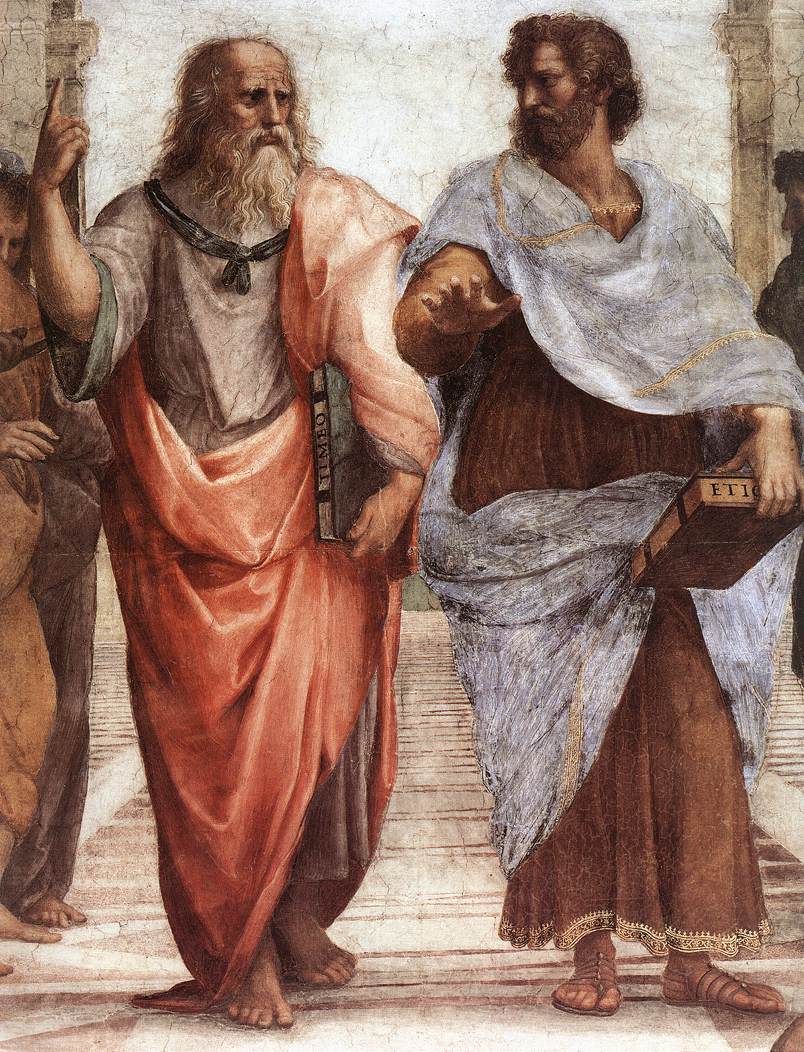
Plato

Plato

Before we confront the future, let us look firstly to the past. The earliest known reference to criticism dates back to C.380 B.C.E and Plato’s Republic. Laying a foundation for critical discourse in the classical world, Plato explains how it was fitting for a rhapsode, (poet) to respond verbally to theatrical entertainments: “For the poet is a light and winged and holy thing, and there is no invention in him until he has been inspired and is out of his senses, and the mind is no longer in him.” In the beginning then, there were high expectations. In the 1800’s, critics played an increasingly important role within the American press, and despite being accused of reducing feelings to a state of miserable refinement, they were valued, employed and at least possessed such skills. Meanwhile, as Irving Wardle outlines in his book Theatre Criticism, the Grub Street slums of Georgian London rapidly became a bohemian hive of artistic activity and were the probable origin of theatrical criticism in Britain. By the 1850’s, advancements in printing and the press fuelled an explosion in journalism, and in 1935, cementing that progress, establishment of The Drama Critic’s circle ensured that the critic’s influence continued to abound.

Conversely, 2007 saw the beginning of wide- spread layoffs at newspapers and magazines leaving dozens of veteran arts journalists professionally homeless, expunged by internet reviewers or cheaper freelancers. And the situation continues to worsen, evidence now suggesting that criticism has reached such a point of decline that it is no longer significant; it no longer has a part to play.

What could today’s critic offer in order to reinstate their own necessity and worth? What do we want? Reviewing, simply put, is the act of writing or speaking about the performing arts, so no one person can dictate what it should or shouldn’t be, and if critics disagree amongst themselves, that is nothing compared to the public disagreement over what their role should be. We all require something different, but one might hope to locate at least one, two or a combination of the qualities listed below:

A review should be…

Informative. The piece should contain basic, accurate information about the show/production in order to keep the reader in touch with the continuously evolving theatrical landscape – a landscape which, for some, sits at the epicentre of social functioning. The reviewer therefore, is required to attend, watch and inform.

Entertaining. Theatre is occasionally entertaining. Shouldn’t we be entertained when reading about it too? Be it witty or not, criticism should capture the style and essence of the show – reflecting, not just referencing it. It is good for the industry if people flick to the review pages; interesting articles will promote that intrigue.

Historical. Criticism is a way of documenting, remembering and celebrating past theatre, as well as present. Therefore a critic should have theatrical knowledge in order to root the production in question within theatrical history.

Constructive. Good, impartial criticism can provide the fresh eyes a creative team require. Reviewing is a fundamental and integral part of the development process – a way of improving theatre. “Only critical faculty enables any artistic creation at all.” (Wilde) What good does a sycophantic wash of praise do?

Opinionated: A review should assist the reader in making the all-important decision: to buy tickets or not to buy tickets? That’s a big responsibility, and if “everyone is a critic,” then who should we trust? Marketing might initially catch the attention of the consumer but a good review can cement the £60 per ticket spend. The public need an arbiter of taste.

The critics bible

The critics bible

And is this what we are getting? According to writer, John Russell Brown, criticism is an “unmapped quagmire,” – an art form that has remained, until recently, unexamined. But, in light of increased instability, it feels appropriate to turn the tables and examine what remains. Reviews that meet our expectations are increasingly difficult to find, but they do exist: Ben Brantley, for example, reviewed Menken and Fierstein’s Broadway musical, Newsies, for the New York Times. His piece, ‘Urchins with Punctuation,’ is lengthy and entertaining, reflecting the show’s energy and offering a measured and reasoned opinion from which the individual reader can decipher the production’s suitability. A literary achievement, he gives credit without verging into the bland territory of hyperbole: “Mr. Feldmen’s lyrics are spot on, while the melody reminds us just how charming a composer Mr.Menken […] can be.” Overblown praise only provokes cynicism, disappointment and a wilfulness to protest. He is refreshingly witty: “That doesn’t stop them from burning energy like toddlers on a sugar high at a birthday party,” and immediately captivates the reader, much in the same vein as a play might wish to do. Brantley also resists the trappings of writing a gratuitous plot synopsis, instead summarising the narrative in one Plato line: “The show’s title characters, feisty lads of the urban jungle […] make their living pushing the papes.”

In terms of language, Brantley uses the “read all about it,” exclamatory, punctuated energy of the show to drive his piece and employs the colloquial so as to serve the readership and the show’s potential audience. In addition, the grounded review acknowledges current social trends: “These days urchins have mostly been replaced in popular entertainment by troubled teenage vampires (‘Twilight’) and fresh-fleshed human killing machines (‘The Hunger Games’).” Perhaps you could criticise Brantley for failing to address the historical concerns of said urchins, but the all singing all dancing, lavish musical does not lend itself to a serious discussion of these themes. If the show fails to address it, then why should the reviewer? Instead, Brantley reviews Newsies for what it is. Finally and perhaps most importantly, is Brantley’s impressive honesty. He bravely asserts his opinion in the confident 1st person, and in a way that is simultaneously constructive and comical: “I commend the cast members for always appearing to be excited by what they are doing. Unfortunately, that is not the same as being exciting.”

Of course, Brantley is not the only capable writer in print, but with the situation as it is, and talented writers (young and old) being forced to write to unrealistic deadlines, often for no pay, is it any wonder that standards and expectations are not being met? Infuriatingly, criticism also continuously undermines itself in the following ways: Firstly, reviews have become monetized.

It is increasingly common for large production companies to pay papers (inevitably tantalised by the fee) for headline quotes. We are now bombarded with emphatic posters making incredible claims: “It’s the greatest show on Earth!” for example. But, if companies pay for quotes, how are we, the reader, able to distinguish between a review and a sales pitch? The differentiation no longer exists. Secondly, writers for particular sites receive a rate of pay dependant on the number of ‘hits’ a review receives. Obviously, a 5* piece, fizzing with praise, is shared and circulated by the company and consequently, only the sycophant can afford to eat. This severely limits the opinion of the honest reviewer, terrified of displeasing. That’s not theatre, nor is it criticism. That’s bribery and actually, all the reader gets is more marketing.

It is no coincidence that as we see more of the above, (not to mention dry, ignorant, distasteful writing) people lose faith in criticism, no longer functioning in the traditional capacity on which they relied. Simply put, the remaining work is not good enough to sustain the form’s validity. Let us remember for a moment Oscar Wilde’s expectation: “It is criticism rather than emotional sympathies, abstract ethics or commercial advantages that would make us cosmopolitan and serve as the basis of peace.” (Wilde) Gone, I fear, are the days of this long lost ideology.

oscar-wilde-1

Oscar Wilde

So what can be done? Due to the human need to impose form on chaos, art will always be accompanied by some sort of criticism; it cannot exist without it. However, in order to prevent being displaced entirely by the unmediated voice of the internet, critics need to act. Public reviews, such as those found on Amazon or Trip-Advisor, for example, tend to be either glowing or scathing. The internet rarely offers informed, impartial, measured opinion. For as long as this remains to be the case, the critic, as an arbiter of taste, stands a chance. Continuing to encourage a wealth of discussion and increasing public awareness will assist to stimulate change; only an amalgamation of minds can forge progress at this stage and suggestions are already being made.

No one can prescribe a format for ‘good’ criticism; pieces are as individual as plays or paintings, but perhaps, as was conceded at ‘The Art of Criticism’ conference in London, 2013, the future of criticism might hinge upon a willingness to adapt. For example, Brantley argues that reviews cannot be written well AND quickly. “I don’t think you should go with your very first instinct. I don’t think theatre is sports.” However, in order to adapt to 21st century demands, critics may no longer be allowed the luxury of “a chance to process what [they’ve] seen.” Mark Shenton, in his blog for The Stage, identifies how critics, such as Billington, Taylor and Letts, have been attending performances ahead of press night, in order to allow

for writing time. This is not an ideal solution – a preview should be a preview, but early viewing could potentially improve the standard of published work. Also in question is the star-rating system, which some papers have dismissed in order to encourage a thorough reading of the piece. It is too tempting to place great emphasis on the over-simplistic, reductionist, blurry distinction between 3 or 4 stars.

There are problems to be addressed and solutions to be trialled, but with persistence, adaptation and adjustment critics may well prevail. (Alternatively, we can hope that readers themselves might start to demand better!) However, if the horizon continues to darken, traditional theatre critics, artists as they are, may continue to suffer, reminiscent of where it all began – Grub Street and the impoverished, bohemian neighbourhood of hack writers.

It is clearly a debate that is going on in many places. For example, in his piece for the Australian newspaper The Age, theatre critic Cameron Woodhead talks about the rise (and dangers) of the internet blogger – Slagging off theatre, a case of foul play. You can read the blog Woodhead talks about, Shit on your play, here.

Meanwhile in London this week, The Critics Circle held its centenary conference and the link below is to a recording of a discussion, hosted by theatre critic Lyn Gardner, about the future of theatre criticism in a, twittering, blogging world.

The Critics’ Circle Centenary Conference: The Future of Criticism.

In the recording, I was particularly struck by the audience and panel talking about Harold Hobson and his championing of new writers that went on to become some of the most successful writers of the 20th century:

.

Irving Wardle also had a fascinating relationship with Harold Pinter, which he wrote about in Intelligent Life Magazine, The Unconditional Harold.

The Chair of the Drama section of the Critics’ Circle is Mark Shenton, theatre critic and avid tweeter. He also blogs for The Stage and two of his recent postings, Critics in intensive care – but can Twitter fill the space? and The critical and Shakespearean conundrum add to the debate.

It seems to me that there is a strong case in all of this for the professional theatre critic and we allow them to be drowned out by the likes of Shit on your play at our peril.

Sacred Texts, Mr Bond

I have a very eclectic mix to share over the next few days, but I will start the weekend with a short note from the Alice Jones’ Arts Diary in The Independent newspaper:

Daniel Craig on Pinter’s pauses: ‘If it doesn’t feel right, don’t do it’

The Broadway production of Betrayal starring real-life couple Daniel Craig and Rachel Weisz and Rafe Spall finally opens on Tuesday night.

Daniel-Craig-Rachel-Weisz

The play, about an affair which runs in reverse from break-up to first kiss, is one of Harold Pinter’s finest.

But Craig isn’t overly reverent towards the late playwright’s script. “I think if the pause doesn’t feel right, don’t do it,” he told New York Magazine. “He’s not around anymore, so it’s tough s**t.”

My response to this? Two things specifically (as well as “how dare he!”). Firstly, I recently read some advice for budding playwrights (which I will share at a later stage). The final point  made was

You have not written A Play. You’ve written A Script.

And generally I would agree, the art of theatre making being about interpretation. However, Pinter’s pauses are not to be messed with. You do so at your peril and if you do, you totally ruin the whole rhythm of the writing.

Secondly, Betrayal is one of my favourite Pinter plays, which unusually works on the page as well as the stage. This sounds a little odd, but I know when I read play texts,  I am reading something that will only come to life when put on the stage. Betrayal works in both worlds.

.
I would suggest Mr Craig has forgotten his roots and should stick to the film set.

Complicité Genius

Published yesterday, today’s share is a joy. Perhaps one of the most famous theatre companies with a global reputation of the last 30 years is Complicité.

The Company’s inimitable style of visual and devised theatre [has] an emphasis on strong, corporeal, poetic and surrealist image supporting text

Stephen Knapper, Contemporary European Theatre Directors.

[The main principles of our work is ] seeing what is most alive, integrating text, music, image and action to create surprising, disruptive theatre

Complicité

Complicité at 30: Simon McBurney (founder and artistic director) and Judith Dimant (producer) in conversation

.

If you have never seen any of their work, here is a great taster

And a few more words of theatrical wisdom from McBurney

.

Ghost In The Machine

I tend not to write about dead white european men (DWEM) here very often. Much of contemporary theatre practice can still be dominated by them. It’s not that I don’t think DWEMs are important – they are, and form a basis for much of what we do – but there is just so much else to write about. It therefore comes as a little bit of a surprise to me that I am writing about one for the second time in three days.

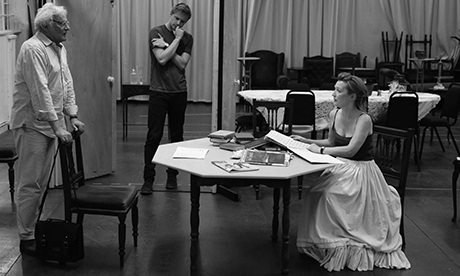
I really want to share an article about one of my favourite plays and playwrights, Ghosts by Henrik Ibsen. Ibsen’s plays have always drawn me to them, there is something about the way he creates characters capable of communicating so much about themselves to an audience, while failing to communicate with one another. Respected veteran director Richard Eyre is currently rehearsing a production of Ghosts and has written in The Guardian about adapting the play for a 21st century audience.

In the spirit of Ibsen

The premiere of Ibsen’s Ghosts caused an explosion of outrage and critical venom. Richard Eyre discusses his new production of the play, and how all acts of adaptation leave a trace of authorial presence

Richard Eyre (left) at a rehearsal of Ghosts

Richard Eyre (left) at a rehearsal of Ghosts

Ibsen said of Ghosts that “in none of my plays is the author so completely absent as in this last one”. Nine years later, when he was 61, Ibsen met an 18-year-old Viennese girl and fell in love. She asked him to live with her; he at first agreed but, crippled by guilt and fear of scandal (and perhaps impotence as well), he put an end to the relationship. Emilie became the “May sun of a September life” and the inspiration for the character of Hedda Gabler, even if Ibsen himself contributed many of her characteristics with his fear of scandal and ridicule, his apparent repulsion with the reality of sex, and his yearning for an emotional freedom.

Perhaps his disavowal of authorial presence in Ghosts was a little disingenuous. When he was working on the play he wrote to a friend: “Everything that I have written is most minutely connected with what I have lived through, if not personally experienced … for every man shares the responsibility and the guilt of the society to which he belongs. To live is to war with trolls in heart and soul. To write is to sit in judgment on oneself.”

The audience for a play has to be left with the impression that the characters exist independently of the writer and have come to life spontaneously. “Sitting in judgment on oneself” means mediating one’s ideas, emotions and anxieties through one’s characters, who in their turn have to absorb the subject matter into their bloodstream – in the case of Ghosts: patriarchy, class, free love, prostitution, hypocrisy, heredity, incest and euthanasia. In that sense Helene Alving, the protagonist ofGhosts, is as much an autobiographical portrait as Hedda: yearning for emotional and sexual freedom but too timid to achieve it, a rebel who fears rebellion, a scourge who longs for approbation and love.

Ghosts

Ibsen’s great women characters – Nora Helmer, Hedda Gabler, Helene Alving, Rebecca West, Hilde Wangel, Petra Stockmann – batter against convention and repression. He empathises, actually identifies, with women both as social victims and as people. “If I may say so of an eminently virile man, there is a curious admixture of the woman in his nature,” said the 18-year-old James Joyce. “His marvellous accuracy, his faint traces of femininity, his delicacy of swift touch, are perhaps attributable to this admixture. But that he knows women is an incontrovertible fact. He appears to have sounded them to almost unfathomable depths.”

Yet in spite of – or because of – his sympathy for women and morbid view of the state of society, you emerge from Ghosts with a sense of exhilaration, albeit underscored by the conclusion that it’s impossible to achieve joy in life. In the face of the bones of true experience, you feel that the great enemy, apart from social repression and superstition, is to be bored with life and indifferent to its suffering. The great political activist Emma Goldman wrote: “The voice of Henrik Ibsen in Ghosts sounds like the trumpets before the walls of Jericho. Into the remotest nooks and corners reaches his voice, with its thundering indictment of our moral cancers, our social poisons, our hideous crimes against unborn and born victims.” As with Chekhov, Ibsen sees boredom and indifference as the insidious viruses that infect all society.

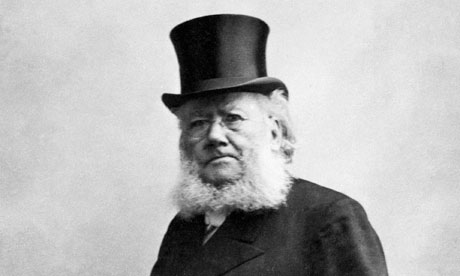
Henrik Ibsen

Henrik Ibsen

Ghosts was written when Ibsen was living in Rome in the summer of 1881 and was published in December in Denmark. He anticipated its reception: “It is reasonable to suppose that Ghosts will cause alarm in some circles; but so it must be. If it did not do so, it would not have been necessary to write it.” He wasn’t to be disappointed. There was an outcry of indignation against the attack on religion, the defence of free love, the mention of incest and syphilis. Large piles of unsold copies were returned to the publisher, the booksellers embarrassed by their presence on the shelves.

Ghosts was sent to a number of theatres in Scandinavia, who all rejected it – it was first performed by Danish and Norwegian amateurs in a hall in Chicago in May 1882, for an audience of Scandinavian immigrants. The play was staged in Sweden the following year and this production then appeared in Denmark and, in late 1883, in Norway, where the reviews were good. Even the King of Sweden saw it, and told Ibsen that it was not a good play, to which, in some exasperation, Ibsen responded: “Your Majesty, I had to write Ghosts!”

In England the lord chamberlain, the official censor, banned the play from public performance but there was a single, unlicensed, “club” performance in 1891 on a Sunday afternoon at the Royalty theatre. It detonated an explosion of critical venom: “The experience of last night demonstrated that the official ban placed upon Ghosts as regards public performance was both wise and warranted”; “The Royalty was last night filled by an orderly audience, including many ladies, who listened attentively to the dramatic exposition of a subject which is not usually discussed outside the walls of an hospital”; “It is a wretched, deplorable, loathsome history, as all must admit. It might have been a tragedy had it been treated by a man of genius. Handled by an egotist and a bungler, it is only a deplorably dull play”; “revoltingly suggestive and blasphemous”; “a dirty deed done in public”.

Ghosts15_595

In case we bask in the glow of progress and the delight of feeling ourselves superior to our predecessors, it’s worth remembering that the response to Edward Bond’s Saved in 1965 and Sarah Kane’s Blasted 30 years later was remarkably similar.

Shortly after Ibsen’s death in 1906, the director Max Reinhardt asked Edward Munch to design the set for the production of Ghosts that was to open his new intimate theatre in Berlin. Munch had no experience of stage design but helped the actors by doing sketches of the characters in different scenes, expressing what was going on in their minds. He designed a set that surrounded realistic Biedermeier furniture with an expressionistic setting, walls of sickly egg-yolk yellow fading to ochre. “I wanted to stress the responsibility of the parents,” he said, “but it was my life too – my ‘why’? I came into the world sick, in sick surroundings, to whom youth was a sickroom and life a shiny, sunlit window – with glorious colours and glorious joys – and out there I wanted so much to take part in the dance, the Dance of Life.”

Munch, profligate and alcoholic, feared syphilis as much as he feared madness. It’s often said that Ibsen misunderstood the pathology of syphilis, that he thought – as Oswald is told by his doctor in Ghosts – that it was a hereditary disease passed by father to son. It’s much more probable, given that he had friends in Rome who were scientists (including the botanist JP Jacobsen, who translated Darwin into Norwegian), that he knew that the disease is passed on through sexual contact, and that pregnant women can pass it to the babies they are carrying. He knew too that it’s possible for a woman to be a carrier without being aware of it, and perhaps he wants us to believe that Helene knows she is a carrier. It’s a matter of interpretation.

Which is, of course, what lies in the process of directing a play and translating it: it’s a matter of making choices. The first choice – and the first indication of the difficulty of rendering any play into another language – is what title to give the play. When Ghosts was first translated into English by William Archer, Ibsen disliked the title. The Norwegian title, Gjengangere, means “a thing that walks again”, rather than the appearance of a soul of a dead person. But “Againwalkers” is an ungainly title and the alternative “Revenants” is both awkward and French. Ghosts has a poetic resonance to the English ear.

berkely_repertory_theatre_ghosts

I wrote a version of Ghosts six years ago when I was waiting for a film to be financed and was all too aware of the insidious virus of boredom. For some reason I couldn’t stop thinking of Oswald’s “Give me the sun…”, and I read the play, not having seen it for at least 20 years, with a sense of discovery: The producer, Sonia Friedman, commissioned it with a view to presenting it in the West End. It didn’t get produced because another production popped up and waved it away.

I worked from a literal version by Charlotte Barslund, and tried to animate the language in a way that felt as true as possible to what I understood to be the author’s intentions – even to the point of trying to capture cadences that I could at least infer from the Norwegian original. But even literal translations make choices, and the choices we make are made according to taste, to the times we live in and how we view the world. All choices are choices of meaning, of intention. What I have written is a “version” or “adaptation” or “interpretation” of Ibsen’s play, but I hope that it comes close to what Ibsen intended while seeming spontaneous to an audience of today.

If you haven’t seen the play, there is a full length version below with some excellent performances from the ‘A’ list of British actors.

.

Now! Not Then

There are not many people who have had a greater global impact on theatre-making in the last 100 years, than Bertolt Brecht. I don’t imagine there is a theatre student anywhere who has at least not heard of him, studied him briefly. I am a great believer in his theatre practice. However, his plays tend to leave me, well, a tad bored. There are a couple I really like, The Resistible Rise of Arturo Ui and Fear and Misery of the Third Reich, for example, but the rest often feel a little dry.  Now of course this is often due to the way they are staged but I can never help feeling that his longer works would benefit from significant trimming   And this is the dichotomy with Brecht – Brecht, the theatre practitioner and Brecht, the playwright – in contemporary theatre. His practice continues to be fundamental to a whole host of theatre making, but his plays in performance, are far less common than they used to be.

.

This really comes as no surprise, when theatres are trying to find ways of competing with a fast-moving, attention-shrinking, digital world. So it was with some joy that I read Michael Billington’s article in The Guardian:

Bertolt Brecht: irresistible force or forgotten chapter in theatrical history?

Brecht’s belief that drama should present moral ideas through action is unfashionable, but as theatre becomes ever more narcissistic, audiences are seeking him out again

In the Jungle of Cities

In the Jungle of Cities

It’s that man again: Bertolt Brecht. His early play, In the Jungle of Cities,is being revived at London’s Arcola, and later this month he’s back in the West End, as Jonathan Church’s Chichester production of The Resistible Rise of Arturo Ui moves to the Duchess. It’s a production that won lots of praise when first seen last year, not least for the comic demonism of Henry Goodman’s performance as the eponymous Chicago racketeer who provides a metaphor for Adolf Hitler. But, for all its dazzling energy, I suspect the production will raise all the old arguments about Brecht’s standing today. Is he still an irresistible force or simply a chapter in theatrical history whose reputation has declined with the collapse of eastern European communism?

In weighing up the pros and cons, one has to start with a basic fact: as both a practising dramatist and visionary theorist, Brecht changed the face of modern theatre. Just to take Britain alone, I’d argue that the historic visit by Brecht’s Berliner Ensemble to London in 1956 [The link is to a review from the time] did more than any other single event – even than the premiere of Waiting for Godot a year earlier – to shake us out of our rooted complacency. The spare Brechtian aesthetic had a profound influence on the newly founded English Stage Company at the Royal Court, and the realisation of what a permanent company could achieve shaped the creation of the Royal Shakespeare Company in 1960 and the National theatre in 1963.

Directors, designers and dramatists were all influenced by Brecht’s idea of an epic theatre in which narrative replaces plot, the spectator is turned into an observer rather than someone implicated in the stage action, and each scene exists for itself alone. Above all, Brecht’s belief that drama should present moral and political ideas through action left its stamp on a huge range of plays, from Serjeant Musgrave’s Dance by John Arden, Luther by John Osborne and Saved by Edward Bond in the 1950s and 60s, through to Fanshen by David Hare and Destiny by David Edgar in the 1970s. As David Edgar once said: “Brecht is part of the air we breathe.”

Lest you think I exaggerate Brecht’s influence, I turned up a catalogue to an exhibition, Bertolt Brecht in Britain, mounted at the National Theatre in 1977. Among other things, it includes a checklist of annual productions. In 1972 you find 15 professional Brecht productions in the UK ranging from Arturo Ui in Belfast and Bradford to Mother Courage and Her Children in Watford and Canterbury, and a West End revival of The Threepenny Opera with a cast that included Vanessa Redgrave andBarbara Windsor. There were 77 amateur productions including a staggering 36 – many staged by students – of The Caucasian Chalk Circle. For good measure, BBC Television also presented Arturo Ui starring the formidable Nicol Williamson.

.

All this is unimaginable today. Few regional theatres have the financial resources, even if they had the will, to mount a Brecht play. The right-wing thought police would, I suspect, quickly be on the case if any school put on a Brecht show. And there is about as much likelihood of BBC doing a prestigious Brecht television production as there is of it presenting a play by Sophocles, Shaw, Ibsen, Chekhov or any of the great classic dramatists. Even in academia Brecht is much less central than he used to be: a friend told me that a supposedly comprehensive undergraduate theatre course devotes roughly two hours a year to him.

Yet, even if Brecht is out of fashion, his legacy is all around us. Stephen Unwin, in his excellent A Guide to the Plays of Bertolt Brecht, points to one key example in the growth of documentary drama. The kind of work staged at London’s Tricycle theatre under Nicolas Kent, starting with Half the Picture in 1993 and taking us up to Gillian Slovo’s examination of theLondon riots in 2011, fulfilled many of Brecht’s theatrical criteria. This was work that, in Brecht’s definition of epic theatre, offered the spectator a picture of the world, forced him or her to take decisions. It appealed to reason rather than feeling. Even the performance style made it clear that actors were representing, rather than identifying with, particular characters.

I also sense the Brechtian influence at work in some of the big plays on public themes that have emerged in recent years. They may eschew the Brechtian visual approach, but they engage with the issues of our times in ways he would have understood. In Enron (2009), Lucy Prebble traced the fall of the Texan energy giant to show how capitalism depends on con-tricks and illusions. In 13 (2011), which many critics myopically repudiated, Mike Bartlett argued that popular protest was now a bigger force for change than entrenched political parties. And in the 2013 play Chimerica, Lucy Kirkwood boldly invites us to compare and contrast China and America: it is a work that genuinely activates thought in that its apparent conclusion that America tolerates dissent while China punishes it is brought into question by the cases of Bradley Manning and Edward Snowden.

Brecht may be out of fashion in the self-regarding world of immersive and site-specific theatre, where everything depends on the minor shocks and sensations felt by the individual spectator: however good such shows may be, you generally come out of one by Punchdrunk or Shunt wanting to change your clothes instead of the world. But Brecth’s legacy is still too pervasive and potent for him ever to be entirely invisible.

We are also learning how to do him without the pedagogic reverence that for years put people off. Jonathan Church’s excellent Arturo Ui ushers us into a Chicago speakeasy where we listen to the seductive sounds of a jazz trio. And Roxana Silbert’s modern-dress Royal Shakespeare Company production of A Life of Galileo earlier this year used a text sensibly trimmed by Mark Ravenhill and seemed vitally connected to a world in which a liberally intentioned pope found himself trapped by institutional conservatism.

.

Brecht is too big a force to ignore…..But I’d like see our theatre go beyond revivals of Galileo, Mother Courage, The Caucasian Chalk Circle and The Good Person of Szechwan. I’d be fascinated to see St Joan of the Stockyards, with its Salvation Army heroine, Paul Dessau choruses and parodies of Goethe and Schiller. Brecht may not be as fashionable as he once was. But, in a theatre that tends towards narcissistic introspection, his ability to engage with the world and instruct delightfully seems to me more urgently important than ever.

Secret Theatre

I really enjoyed an article I read earlier in the week about a British theatre,  The Lyric Hammersmith, that is attempting to do something new, to shake things up a bit. Written by Matt Trueman, for The Guardian I thought I’d share it with you.

Sean Holmes on Secret Theatre: ‘There are no assumptions; it’s about honesty’

Frustrated by British theatre’s conservatism, the Lyric Hammersmith boss has decided to shake things up with a season of secret shows

“A lot of theatre is quite boring,” says Sean Holmes, fully aware this is not the sort of statement made by artistic directors of major…..theatres. These days, however – part moroseness, part mischief – Holmes is happy to lob a few home-truth hand grenades.

With funding squeezed, we’ve come to expect cultural cheerleading. Arts leaders fight their corner, championing their chosen discipline wherever possible. Theatre, we’re told, feeds television and film. It pays its way in VAT and cultural tourism and generally does this country proud.

Sean Holmes

Sean Holmes

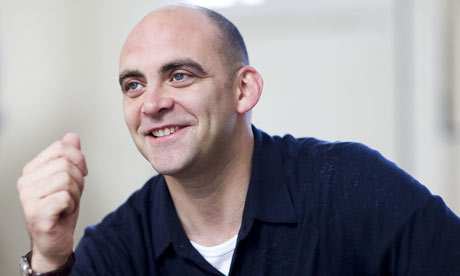
In June, the 44-year-old stood in front of an invited audience of peers and told them as much. “Maybe the existing structures of theatre in this country, whilst not corrupt, are corrupting,” he said. Maybe the theatre we trumpet as the best in the world, isn’t. Maybe it could be better, broader, bolder.” It was a barnstorming speech that pulled no punches. Even Holmes – burly, shaven-headed and one of British theatre’s great straight-talkers – admits he was afraid. “I was absolutely shitting myself; so nervous. I’m sure it pissed a lot of people off.”

Holmes runs through the basic argument again: “Most British theatre is well made, and maybe that’s what most audiences want. But there’s another audience – a young audience – that’s hungry for something else, for something that might just change them. Most theatre simply isn’t interested in doing that.”

Instead, he believes British theatre is rooted in commercial structures and standard practices. It runs on unquestioned assumptions – that rehearsals last six weeks, that the writer is central, that acting means pretending to be someone else – all of which add up to cultural hegemony and artistic compromise. Lest this sound like runaway hubris, Holmes includes himself: “Any criticism comes from self-criticism; me going, ‘I’m too cautious’.”

This frustration has prompted Holmes to challenge the norms with an atypical season born of unique circumstances. In April, a 20-strong ensemble – 10 actors and 10 writers, directors and designers – started working together under the label Secret Theatre. This month, they’ll open the first two shows of an eight-month, seven-show repertory season. The aim is to question the way theatre is made in this country and the type of theatre that results. “We believe that theatre matters,” runs the company’s manifesto. “We are hungry for change.”

.

There are two fronts to this: structural and artistic. The ensemble will be together for a year…..Six weeks of workshops preceded rehearsals proper; theoretically, the extra time spent together allows them to build a shared vocabulary and aesthetic understanding without reverting to habitual methods. Change the structures and you shift the possibilities.

“The starting point is that there are no assumptions,” Holmes explains. “With everything we do, we ask, ‘What the f**k are we going to do with this?'”

The philosophy extends beyond design and direction to play selection, casting decisions and marketing techniques. Audiences will book shows by number, not title. They might find themselves watching a classic text, a new play or something else entirely. Who knows what?

Casting isn’t merely gender- and colour-blind – the ensemble necessitates non-literalism – it is also willfully topsy-turvy at times. Scripts aren’t sacred. Scenes are played out of order. Lines get chopped and changed. Stage directions are obliterated. If a moment needs a dance routine, it gets one. If a pop song does the job better than dialogue, it’s tagged in. Every decision is up for grabs.

All this stems from last year’s (production of) Three Kingdoms. Simon Stephens’ play – and Sebastian Nübling’s distorted staging, in particular – has clearly had quite an impact on Holmes. Though it opened to underwhelmed reviews and half-full houses, the production found vocal champions online and, by the end of its three-week run, was selling out entirely, mostly to eager young audiences. Holmes talks about a generation waiting for their 1956-Look-Back-In-Anger moment: “On a good day, Three Kingdoms was the John the Baptist to that.”

Three Kingdoms

Three Kingdoms

Stephens, now Secret Theatre’s resident dramaturg, recalls “a response I’d never seen in my career”. He believes Three Kingdoms left three major marks: “Audiences remember the inventiveness of actors, their unapologetic presence in the room and their sheer physicality.” The performers didn’t just act out a scene, they warped it into something else. They didn’t kowtow to the script’s demands. They made it anew, in their own personal and inimitable style.

Secret Theatre has maintained not only the same “spirit of attack” but also the same honesty, says Stephens. “No pretending” has become the company’s mantra. The cast play themselves, even in some of the most iconic roles in drama.

“Our aesthetic is, ‘Look at us. We’re just humans on a stage’,” says Holmes. “It’s about honesty. We can’t get a fight director. We can’t do accents.”

Everything needs an alternative approach, one that the actors can own entirely. The refusal to pretend means they have to rely on analogy and metaphor, so that frying an egg might stand in for a scientific experiment. It adds an extra layer to the play, representing and commentating at the same time. “It’s about going against the text – not to be perverse, but to reveal the writing.”

Even as early as mid-July, rehearsal performances feel dangerous. Classic scenes are unrecognisable and fiercely charged. The company, most of whom are significantly younger than Holmes and Stephens, clearly relish the agency and provocation it’s provided. Actor Leo Bill, 33, feels like it allows him to consider himself an artist – something frowned upon in the wider industry that deems acting a craft. “You couldn’t stand up at drama school and say, ‘I’m an artist.’ You’d be told to sit down and shut up.

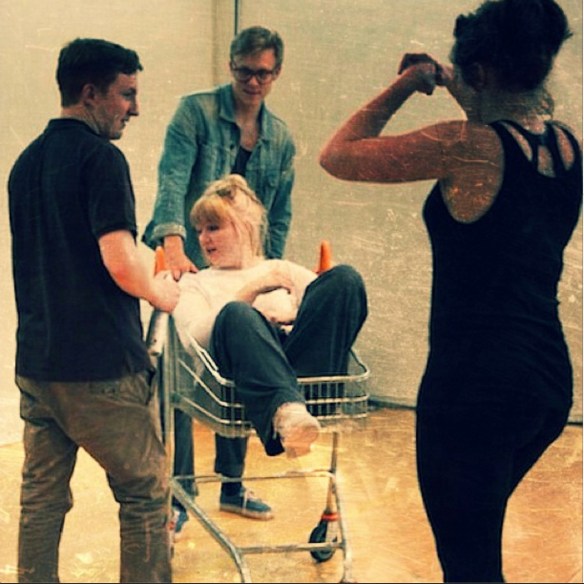
Secret Theatre in rehearsal

Secret Theatre in rehearsal

I’ve met older actors who are adamant they’re not artists. They just do what the director tells them as best they can.”

Not so here. Actors pull scenes in radical directions without warning their colleagues. They arrive onstage with props they’ve just picked up. They’re happy to actually fight each other; to spit and snog and sing. There’s no sign of the “middle-class politeness” that so frustrates Bill in other rehearsal rooms. At one point, a group discussion of a short confessional monologue dissects the paradox of sin and forgiveness – a cycle that makes both terms redundant – within a minute. “Usually there isn’t time for talking,” says Bill, “because you’ve got four weeks to put a show together.”

But Secret Theatre is underpinned by a luxury: freedom from normal commercial pressures. “Whatever we did this year, we would struggle financially,” Holmes admits. “There was always going to be some kind of deficit.”

Reduced design costs will compensate for increased wages, but the theatre will have to dip into reserves nonetheless. “It’s an opportunity to examine every aspect of how we run a theatre building,” says Holmes.

In that, Stephens draws comparisons with the Royal Court’s Open Court. “Three things over one summer could really force people to interrogate the conditions in which work is made.” Yet, where those projects have quietly downplayed their radicalism, Secret Theatre has defined itself with a combative, critical rhetoric that could easily trigger a backlash. “We’re just putting some plays on,” Stephens adds. “That’s all we’re doing. We’re not bringing down the government or starting a political party.”

But Holmes and his young company are already looking to the future. “Far worse than it failing is the possibility that it succeeds,” says Holmes. “Then we have to make it sustainable.”

When I read something like this I always have to question (albeit in this case, in a very small way) whether the intention will be fulfilled. The response on Twitter to the opening Secret Theatre #1 put my mind at rest:

@LyricHammer what you’re doing with Secret Theatre is possibly the single most important experiment in british theatre in decades. go on!

Just seen Show 1 @LyricHammer. OMG! Really OMG! Came out feeling shellshocked. Battered. GO. You need to see this for yourself.

The #SecretTheatre ensemble are brilliant. 2nd time this week. 1st two shows are pure theatre and inventive to the nth degree.@LyricHammer

#showone@LyricHammer#secrettheatre is a cluster bomb into the violent subconscious of England. And quite, quite beautiful for it. I think

@StephensSimon@LyricHammer Tremendous quality of dislocation and presence simultaneously in the performers.

Post Update:

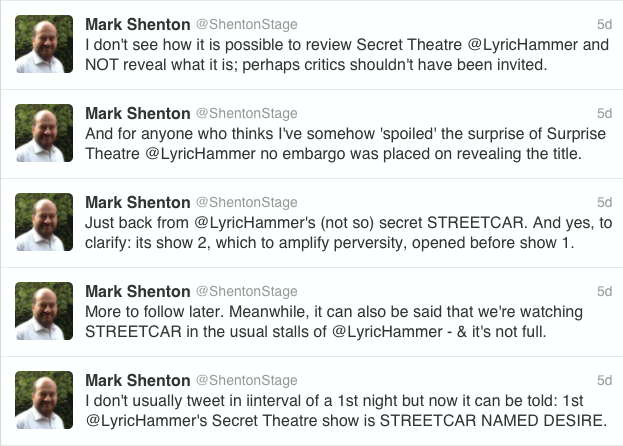
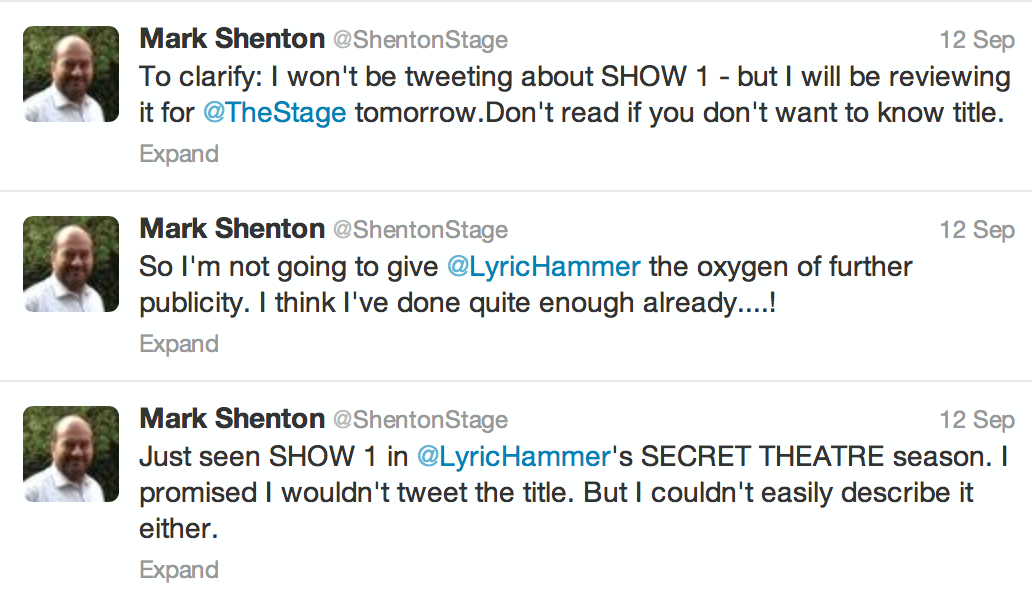
Evernote Camera Roll 20130915 145639_FotorHaving made this post, I then noticed that the opening week of Secret Theatre had created a bit of a (Twitter) storm. Two Secret Theatre shows opened, a little confusingly, Show 2, followed by Show 1. One theatre critic, Mark Shenton, went to see Show 2 and then tweeted the real title, A Streetcar Named Desire. And this is where it all got a bit bizarre. Some people were outraged that Shenton had undermined the idea underpinning Secret Theatre as this Storify trail shows. Jake Orr, a well-known theatre maker weighed in with an attack on him on his blog, Where Theatre is Thought, calling Shenton Scrooge for spoiling the fun. And so it went on, with Lyn Gardner having her (sensible and grounded) say in her blog post, Not so Secret Theatre.

Untitled_FotorThen came an apology from Shenton in The Stage, To Tweet or not to Tweet a secret.

All in all, quite funny really, I think. Great free publicity for Secret Theatre and a theatre critic who will be a bit more careful with his tweets.

The Theatre of War

I was interested to read yesterday that the world-renowned Sydney Theatre Company  is to collaborate with the Australian Defence Force in a new verbatim play that will bring the stories of servicemen and women to the stage in the centenary year of the start of the first world war. What is even more interesting is that it was the military itself that approached the company with the idea. The new work will be based on the real experiences of Australian defence personnel who were wounded in Iraq, Afghanistan and East Timor. The process is underway and 20 soldiers are currently telling their stories through workshops. Daniel Keene will write the play, which will be preformed by both professional actors and ex-soldiers.

The Long Way Home - STC

Interestingly, Keene says that the project is not verbatim theatre (see the Q and A below), but all the news reports and the company’s own artistic director says it is.

Q & A: Daniel Keene (from the SCT Website)

What interested you about The Long Way Home as a project?

Firstly, it seemed a unique way to make theatre. Making theatre is what I’ve done for a very long time, and it’s something that I enjoy enormously. The Long Way Home presented a very particular set of circumstances, the most intriguing of which was the fact that I would be starting with no idea of what the final outcome would be. danielkeene200pxEverything depends on what the soldiers are willing to offer me. They are the ones who will determine what the play/show will be about. My job is to shape the material they offer into something that is theatrically effective.

Another reason I was interested in the project is that I think it’s important for the public to hear the stories that these soldiers have to tell. The ADF have been on multiple deployments over the last 20 years. They represent Australia, they act in our name. But does the public actually know what they’ve been doing or what they have achieved? More importantly, I think it’s critical that service men and women tell their own stories, the good and the bad, stories about their successes and their failures, and that the public’s understanding of the ADF isn’t limited to Government pronouncements and PR.

And I guess finally, deciding to participate in the project was a moral decision. The men and women involved have sacrificed an enormous amount in the service of their country. Whether or not you agree with the Australian government’s decision to become involved in a conflict such as the one in Iraq, the people involved in this project have given the best of themselves. And some of them have paid a very high price. It felt right to be able to offer something in return.

The production is based on first-hand accounts from soldiers. How do you fit into that as the playwright?

From the outset, both Stephen Rayne and myself have been clear that we did not want to make a piece of reportage, nor anything like a documentary. This will not be a piece of Verbatim Theatre. It isn’t question of the men and women involved in this project simply repeating their stories, but of creating a piece of theatre out of those stories; we want to escape the merely anecdotal. In doing that, perhaps by working together we can assign a larger meaning to those stories, illuminate their context, explore their cultural and emotional significance. This notion of creationis part of the healing process for the men and women involved in the project. As I’ve said, we want to get beyond the anecdotal and head someway towards the creation of meaning. I’m right now discovering how I fit in to that process. My job right now is to listen carefully, to pay attention to detail, and to resolve to be as truthful to what I hear as possible.

Is this process of writing familiar or is it new ground?

I’ve done a two projects a somewhat similar to this, both in France. They both took place in Marseilles, and they both concerned people living (to put it bluntly) at the very bottom of the food-chain. Some were living on the street. Many of them were immigrants and refugees from North Africa. I wrote two plays based on these people’s experiences, which they then performed, with the help of a small group of professional actors. I know that it was a liberating experience for the people involved. What I remember most of all is how exhausting it was for me! But it was an amazing experience.

Being in the midst of a creative development with the soldiers right now, has there been anything particularly striking or surprising about their stories so far?

We are only just beginning, and stories are only just now emerging, but what is already striking is the openness and the willingness of the soldiers to take part in this process. There is a lot of vulnerability in the room, but there is also a lot of courage.

In Search Of Meaning

marian-van-kerkhovenIt seems to me that there is such a thing as a major and a minor dramaturgy, and although my preference is mainly for the minor, which means those things that can be grasped on a human scale, I would here like to talk about the major dramaturgy. Because it is necessary. Because I think that today it is awfully necessary. We could define the minor dramaturgy as that zone, that structural circle, which lies in and around a production. But a production comes alive through its interaction, through its audience, and through what is going on outside its own orbit. And around the production lies the theatre and around the theatre lies the city and around the city, as far as we can see, lies the whole world and even the sky and all its stars. The walls that link all these circles together are made of skin, they have pores, they breathe.

These words were spoken by Marianne Van Kerkhoven, a Belgian dramaturge who died last week. Kerkhoven was a leading light in political and ‘new wave’ theatre throughout her career. It is perhaps not surprising that I hadn’t heard about her work until after her death, but it is clear that she was extremely influential and highly regarded. Again it got me pondering the role of the dramaturge in theatre making, particularly after my recent post, You Do What?. I came across a piece, written by Kerkhoven, and posted on Sarma, a site that, amongst other things, has a focus on dramaturgy. It is titled On dramaturgy – Looking without pencil in hand  and makes interesting reading.

“(…) distance is often linked with the most intense state of feeling, in which the coolness or impersonality with which something is treated measures the insatiable interest that thing has for us.” (Susan Sontag)

1. The request to talk or write about it leads time and again to the same awkwardness: the feeling of being asked to reveal someone else’s culinary secrets or recipes.

2. In artistic practice there are no fixed laws of behaviour, or task that can wholly defined in advance, not even for the dramaturge. Every production forms its own method of work. It is precisely through the quality of the method used that the work of important artists gains its clarity, by their intuitively knowing – at every stage in the process – what the next step is. One of the abilities a dramaturge must develop is the flexibility to handle the methods used by artists while at the same time shaping his/her own way of working.

3. Whatever additional tasks – sometimes very practical and certainly highly varied – the dramaturge takes on in the course of an artistic process, there always remain several constants present in his work; dramaturgy is always concerned with the conversion of feeling into knowledge, and vice versa. Dramaturgy is the twilight zone between art and science.

4. Dramaturgy is also the passion of looking. The active process of the eye; the dramaturge as first spectator. He should be that slightly bashful friend who cautiously, weighing his words, expresses what he has seen and what traces it has left; he is the ‘outsider’s eye’ that wants to look ‘purely’ but at the same time has enough knowledge of what goes on on the inside to be both moved by and involved in what happens there. dramaturgy feeds on diffidence.

dramaturgy_woods

5. Dramaturgy is also being able both to affirm and to repudiate at the right moment: knowing what, when and how to say something. Based on a realization of the vulnerability of the building blocks, but also conscious that the construction sometimes needs a good pounding.

6. It also invites the building up of a special type of personal relationship, in order to carry on conversations that are on the one hand highly specific – they are, after all, concerned with that progress of practical work – and on the other very serene and ‘wasteful’ in the ay a very personal contact is.

7. By means of his/her writing about a production, the dramaturge smooths the way towards its public airing. Whatever he/she writes must be ‘correct’; it must describe the work in an evident and organic way and lend a guiding hand on its way to its life in society, a life which often has a destructive effect on its meaning.

8. Dramaturgy is also sometimes – one is working after all with ‘groups’ – a psychological mediation. The basis for this lies not, however, in the technical approach of the professional ‘social worker’, but rather in the disinterested motives of ‘a friendship in the workplace’.

9. Dramaturgy is a limited profession. The dramaturge must be able to handle solitude; he/she has no fixed abode, he/she does not belong anywhere. The work he does dissolves into the production, becomes invisible. He/she always shares the frustrations and yet does not have to appear on the photo. The dramaturge is not (perhaps not quite or not yet) an artist. Anyone that cannot, or can no longer, handle this serving – and yet creative – aspect, is better off out of it.

10. Dramaturgy means, among other things: filling in in a creative process, with whatever material necessary; the assimilation and ‘guarding’ of a project’s ‘first ideas’ in order, occasionally, to restore them to memory; to suggest without forcing to a decision; being a touchstone, a sounding board; helping provide for inner needs. For this reason one of the essential axes on which the practice of dramaturgy turns is the accumulation of a reservoir of material – amassing knowledge in all fields: reading, listening to music, viewing exhibitions, watching performances, travelling, encountering people and ideas, living and experiencing and reflecting on all this. Being continuously occupied with the building up of a stock which may be drawn from at any time. Remembering at the right time what you have in your stockroom.

11. There is no essential difference between theatre and dance dramaturgy, although the nature and history of the material used differs. Its main concerns are: the mastering of structures; the achievement of a global view; the gaining of insight into how to deal with the material, whatever its origin may be – visual, musical, textual, filmic, philosophical etc.

12. At present, purely literary or linear dramaturgy is seldom to be found, in either dance or theatre. Dramaturgy today is often a case of solving puzzles, learning to deal with complexity. This management of complexity demands an investment from all the senses, and, more especially, a firm trust in the path of intuition.

“There is an immense difference between looking at something without pencil in the hand and looking at something while drawing it.” (Paul Valéry)

bt dramaturgy logo

Still a definition of the role remains hard to grasp.  This led me back to dramaturg’s network, which I have mentioned here before, and found the following; an attempt to tie a definition down written by John Keefe, who is a lecturer in theatre, a director and a dramaturge:

Dramaturg : Dramaturgy – Towards a Definition

Provocations for a discussion

To begin: an indication of the multiplicity of responses to the two terms ranging from the abstract to the technical….

Dramaturgy: from ‘text’ – a weaving together; from ‘drama-ergon’ – the work of the actions; thus, that which concerns the weave of the performance, (see Eugenio Barba & Nicola Savarese, A Dictionary of Theatre Anthropology, 1991).

Dramaturgy is the dialogic relationship between subject matter and its theatrical framing; content and form, (see Norman Frisch, Theatrerschrift 5-6, 1994).

Dramaturgy is the concern with composition, structure, staging and audience from literary analysis and historiography, (see Gotthold Lessing, Hamburg Dramaturgy, 1767-69).

Dramaturgy: not only the subject but also the object is constantly moving; dramaturgy is movement itself, a process, (see Marianne van Kerkhoven, Performance Research 14:3, 2009).

Dramaturgy: the wooden walls of small drawers with brass handles in the hardware stores of my childhood; the dramaturg opens each drawer to reveal new objects of indeterminate but indispensable use, (see John Keefe, State of Mime, Summer 1995).

dramaturg-meme.440.300

Dramaturg: a literary reader-editor concerned with playscripts, (see A Dictionary of Theatre, Penguin).

Dramaturg: one who assists the traffic between stage and auditorium through the conceptual preparation of a production in its political, historical, aesthetic and formal aspects, (see Bertolt Brecht, The Messingkauf Dialogues, 1939-55; The Journals, 1934-55).

Dramaturg(e): one who is responsible for research and the development of plays, (see Wikipedia).

Dramaturg(e): a researcher and intellectual ‘go-fer’ who acts as the artistic conscience for the theatre, (see Bert Cardullo, What is dramaturgy, 1995).

So trying to bring these and other suggestions and definitions together:

Dramaturgy – as theatre science, a rigorous, analytical and sensitive approach to theatre practice and discourse (the play-text and stage-text), bridging the tension and ‘agon’ between the conceptual and the practical as the two (Janus) faces of theatre.

Dramaturg – as theatre scientist, one who looks and listens with knowledge, insight, rigor, sensitivity and open-mindedness helping to create the play-text with writer and director and/or the stage text with the production ensemble for presenting to a theatre ensemble (performance and audience). The function may be performed to a lesser or greater degree by members of the production ensemble, by other theatre or curatorial professionals, by education professionals whereby their contributory role is acknowledged as such.
The spectator is, of course, his/her own dramaturg by nature of their presence and engagement.


I’m not sure whether these are definitive definitions, but they are the latest and things seem to be merging toward a wide-ranging, encompassing understanding of the nature of the role….probably.

dramaturg

Perhaps it would help if we had a definitive way of spelling it –  ‘e’ or no ‘e’, that is the question.