Ghost In The Machine

I tend not to write about dead white european men (DWEM) here very often. Much of contemporary theatre practice can still be dominated by them. It’s not that I don’t think DWEMs are important – they are, and form a basis for much of what we do – but there is just so much else to write about. It therefore comes as a little bit of a surprise to me that I am writing about one for the second time in three days.

I really want to share an article about one of my favourite plays and playwrights, Ghosts by Henrik Ibsen. Ibsen’s plays have always drawn me to them, there is something about the way he creates characters capable of communicating so much about themselves to an audience, while failing to communicate with one another. Respected veteran director Richard Eyre is currently rehearsing a production of Ghosts and has written in The Guardian about adapting the play for a 21st century audience.

In the spirit of Ibsen

The premiere of Ibsen’s Ghosts caused an explosion of outrage and critical venom. Richard Eyre discusses his new production of the play, and how all acts of adaptation leave a trace of authorial presence

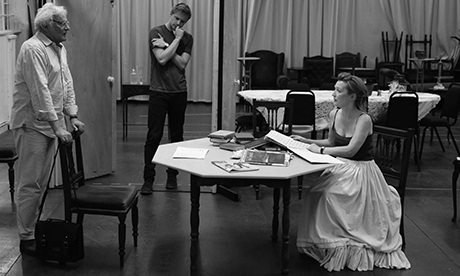
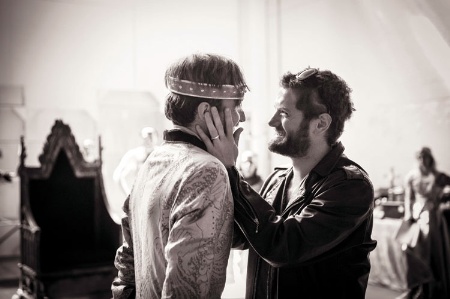
Richard Eyre (left) at a rehearsal of Ghosts

Richard Eyre (left) at a rehearsal of Ghosts

Ibsen said of Ghosts that “in none of my plays is the author so completely absent as in this last one”. Nine years later, when he was 61, Ibsen met an 18-year-old Viennese girl and fell in love. She asked him to live with her; he at first agreed but, crippled by guilt and fear of scandal (and perhaps impotence as well), he put an end to the relationship. Emilie became the “May sun of a September life” and the inspiration for the character of Hedda Gabler, even if Ibsen himself contributed many of her characteristics with his fear of scandal and ridicule, his apparent repulsion with the reality of sex, and his yearning for an emotional freedom.

Perhaps his disavowal of authorial presence in Ghosts was a little disingenuous. When he was working on the play he wrote to a friend: “Everything that I have written is most minutely connected with what I have lived through, if not personally experienced … for every man shares the responsibility and the guilt of the society to which he belongs. To live is to war with trolls in heart and soul. To write is to sit in judgment on oneself.”

The audience for a play has to be left with the impression that the characters exist independently of the writer and have come to life spontaneously. “Sitting in judgment on oneself” means mediating one’s ideas, emotions and anxieties through one’s characters, who in their turn have to absorb the subject matter into their bloodstream – in the case of Ghosts: patriarchy, class, free love, prostitution, hypocrisy, heredity, incest and euthanasia. In that sense Helene Alving, the protagonist ofGhosts, is as much an autobiographical portrait as Hedda: yearning for emotional and sexual freedom but too timid to achieve it, a rebel who fears rebellion, a scourge who longs for approbation and love.

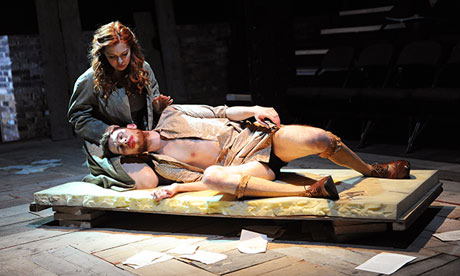
Ghosts

Ibsen’s great women characters – Nora Helmer, Hedda Gabler, Helene Alving, Rebecca West, Hilde Wangel, Petra Stockmann – batter against convention and repression. He empathises, actually identifies, with women both as social victims and as people. “If I may say so of an eminently virile man, there is a curious admixture of the woman in his nature,” said the 18-year-old James Joyce. “His marvellous accuracy, his faint traces of femininity, his delicacy of swift touch, are perhaps attributable to this admixture. But that he knows women is an incontrovertible fact. He appears to have sounded them to almost unfathomable depths.”

Yet in spite of – or because of – his sympathy for women and morbid view of the state of society, you emerge from Ghosts with a sense of exhilaration, albeit underscored by the conclusion that it’s impossible to achieve joy in life. In the face of the bones of true experience, you feel that the great enemy, apart from social repression and superstition, is to be bored with life and indifferent to its suffering. The great political activist Emma Goldman wrote: “The voice of Henrik Ibsen in Ghosts sounds like the trumpets before the walls of Jericho. Into the remotest nooks and corners reaches his voice, with its thundering indictment of our moral cancers, our social poisons, our hideous crimes against unborn and born victims.” As with Chekhov, Ibsen sees boredom and indifference as the insidious viruses that infect all society.

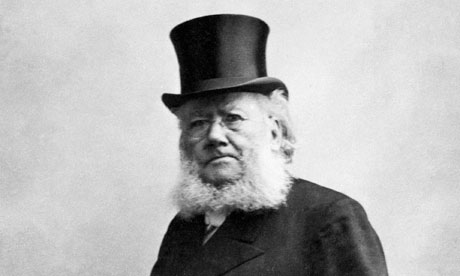
Henrik Ibsen

Henrik Ibsen

Ghosts was written when Ibsen was living in Rome in the summer of 1881 and was published in December in Denmark. He anticipated its reception: “It is reasonable to suppose that Ghosts will cause alarm in some circles; but so it must be. If it did not do so, it would not have been necessary to write it.” He wasn’t to be disappointed. There was an outcry of indignation against the attack on religion, the defence of free love, the mention of incest and syphilis. Large piles of unsold copies were returned to the publisher, the booksellers embarrassed by their presence on the shelves.

Ghosts was sent to a number of theatres in Scandinavia, who all rejected it – it was first performed by Danish and Norwegian amateurs in a hall in Chicago in May 1882, for an audience of Scandinavian immigrants. The play was staged in Sweden the following year and this production then appeared in Denmark and, in late 1883, in Norway, where the reviews were good. Even the King of Sweden saw it, and told Ibsen that it was not a good play, to which, in some exasperation, Ibsen responded: “Your Majesty, I had to write Ghosts!”

In England the lord chamberlain, the official censor, banned the play from public performance but there was a single, unlicensed, “club” performance in 1891 on a Sunday afternoon at the Royalty theatre. It detonated an explosion of critical venom: “The experience of last night demonstrated that the official ban placed upon Ghosts as regards public performance was both wise and warranted”; “The Royalty was last night filled by an orderly audience, including many ladies, who listened attentively to the dramatic exposition of a subject which is not usually discussed outside the walls of an hospital”; “It is a wretched, deplorable, loathsome history, as all must admit. It might have been a tragedy had it been treated by a man of genius. Handled by an egotist and a bungler, it is only a deplorably dull play”; “revoltingly suggestive and blasphemous”; “a dirty deed done in public”.

Ghosts15_595

In case we bask in the glow of progress and the delight of feeling ourselves superior to our predecessors, it’s worth remembering that the response to Edward Bond’s Saved in 1965 and Sarah Kane’s Blasted 30 years later was remarkably similar.

Shortly after Ibsen’s death in 1906, the director Max Reinhardt asked Edward Munch to design the set for the production of Ghosts that was to open his new intimate theatre in Berlin. Munch had no experience of stage design but helped the actors by doing sketches of the characters in different scenes, expressing what was going on in their minds. He designed a set that surrounded realistic Biedermeier furniture with an expressionistic setting, walls of sickly egg-yolk yellow fading to ochre. “I wanted to stress the responsibility of the parents,” he said, “but it was my life too – my ‘why’? I came into the world sick, in sick surroundings, to whom youth was a sickroom and life a shiny, sunlit window – with glorious colours and glorious joys – and out there I wanted so much to take part in the dance, the Dance of Life.”

Munch, profligate and alcoholic, feared syphilis as much as he feared madness. It’s often said that Ibsen misunderstood the pathology of syphilis, that he thought – as Oswald is told by his doctor in Ghosts – that it was a hereditary disease passed by father to son. It’s much more probable, given that he had friends in Rome who were scientists (including the botanist JP Jacobsen, who translated Darwin into Norwegian), that he knew that the disease is passed on through sexual contact, and that pregnant women can pass it to the babies they are carrying. He knew too that it’s possible for a woman to be a carrier without being aware of it, and perhaps he wants us to believe that Helene knows she is a carrier. It’s a matter of interpretation.

Which is, of course, what lies in the process of directing a play and translating it: it’s a matter of making choices. The first choice – and the first indication of the difficulty of rendering any play into another language – is what title to give the play. When Ghosts was first translated into English by William Archer, Ibsen disliked the title. The Norwegian title, Gjengangere, means “a thing that walks again”, rather than the appearance of a soul of a dead person. But “Againwalkers” is an ungainly title and the alternative “Revenants” is both awkward and French. Ghosts has a poetic resonance to the English ear.

berkely_repertory_theatre_ghosts

I wrote a version of Ghosts six years ago when I was waiting for a film to be financed and was all too aware of the insidious virus of boredom. For some reason I couldn’t stop thinking of Oswald’s “Give me the sun…”, and I read the play, not having seen it for at least 20 years, with a sense of discovery: The producer, Sonia Friedman, commissioned it with a view to presenting it in the West End. It didn’t get produced because another production popped up and waved it away.

I worked from a literal version by Charlotte Barslund, and tried to animate the language in a way that felt as true as possible to what I understood to be the author’s intentions – even to the point of trying to capture cadences that I could at least infer from the Norwegian original. But even literal translations make choices, and the choices we make are made according to taste, to the times we live in and how we view the world. All choices are choices of meaning, of intention. What I have written is a “version” or “adaptation” or “interpretation” of Ibsen’s play, but I hope that it comes close to what Ibsen intended while seeming spontaneous to an audience of today.

If you haven’t seen the play, there is a full length version below with some excellent performances from the ‘A’ list of British actors.

.

Now! Not Then

There are not many people who have had a greater global impact on theatre-making in the last 100 years, than Bertolt Brecht. I don’t imagine there is a theatre student anywhere who has at least not heard of him, studied him briefly. I am a great believer in his theatre practice. However, his plays tend to leave me, well, a tad bored. There are a couple I really like, The Resistible Rise of Arturo Ui and Fear and Misery of the Third Reich, for example, but the rest often feel a little dry.  Now of course this is often due to the way they are staged but I can never help feeling that his longer works would benefit from significant trimming   And this is the dichotomy with Brecht – Brecht, the theatre practitioner and Brecht, the playwright – in contemporary theatre. His practice continues to be fundamental to a whole host of theatre making, but his plays in performance, are far less common than they used to be.

.

This really comes as no surprise, when theatres are trying to find ways of competing with a fast-moving, attention-shrinking, digital world. So it was with some joy that I read Michael Billington’s article in The Guardian:

Bertolt Brecht: irresistible force or forgotten chapter in theatrical history?

Brecht’s belief that drama should present moral ideas through action is unfashionable, but as theatre becomes ever more narcissistic, audiences are seeking him out again

In the Jungle of Cities

In the Jungle of Cities

It’s that man again: Bertolt Brecht. His early play, In the Jungle of Cities,is being revived at London’s Arcola, and later this month he’s back in the West End, as Jonathan Church’s Chichester production of The Resistible Rise of Arturo Ui moves to the Duchess. It’s a production that won lots of praise when first seen last year, not least for the comic demonism of Henry Goodman’s performance as the eponymous Chicago racketeer who provides a metaphor for Adolf Hitler. But, for all its dazzling energy, I suspect the production will raise all the old arguments about Brecht’s standing today. Is he still an irresistible force or simply a chapter in theatrical history whose reputation has declined with the collapse of eastern European communism?

In weighing up the pros and cons, one has to start with a basic fact: as both a practising dramatist and visionary theorist, Brecht changed the face of modern theatre. Just to take Britain alone, I’d argue that the historic visit by Brecht’s Berliner Ensemble to London in 1956 [The link is to a review from the time] did more than any other single event – even than the premiere of Waiting for Godot a year earlier – to shake us out of our rooted complacency. The spare Brechtian aesthetic had a profound influence on the newly founded English Stage Company at the Royal Court, and the realisation of what a permanent company could achieve shaped the creation of the Royal Shakespeare Company in 1960 and the National theatre in 1963.

Directors, designers and dramatists were all influenced by Brecht’s idea of an epic theatre in which narrative replaces plot, the spectator is turned into an observer rather than someone implicated in the stage action, and each scene exists for itself alone. Above all, Brecht’s belief that drama should present moral and political ideas through action left its stamp on a huge range of plays, from Serjeant Musgrave’s Dance by John Arden, Luther by John Osborne and Saved by Edward Bond in the 1950s and 60s, through to Fanshen by David Hare and Destiny by David Edgar in the 1970s. As David Edgar once said: “Brecht is part of the air we breathe.”

Lest you think I exaggerate Brecht’s influence, I turned up a catalogue to an exhibition, Bertolt Brecht in Britain, mounted at the National Theatre in 1977. Among other things, it includes a checklist of annual productions. In 1972 you find 15 professional Brecht productions in the UK ranging from Arturo Ui in Belfast and Bradford to Mother Courage and Her Children in Watford and Canterbury, and a West End revival of The Threepenny Opera with a cast that included Vanessa Redgrave andBarbara Windsor. There were 77 amateur productions including a staggering 36 – many staged by students – of The Caucasian Chalk Circle. For good measure, BBC Television also presented Arturo Ui starring the formidable Nicol Williamson.

.

All this is unimaginable today. Few regional theatres have the financial resources, even if they had the will, to mount a Brecht play. The right-wing thought police would, I suspect, quickly be on the case if any school put on a Brecht show. And there is about as much likelihood of BBC doing a prestigious Brecht television production as there is of it presenting a play by Sophocles, Shaw, Ibsen, Chekhov or any of the great classic dramatists. Even in academia Brecht is much less central than he used to be: a friend told me that a supposedly comprehensive undergraduate theatre course devotes roughly two hours a year to him.

Yet, even if Brecht is out of fashion, his legacy is all around us. Stephen Unwin, in his excellent A Guide to the Plays of Bertolt Brecht, points to one key example in the growth of documentary drama. The kind of work staged at London’s Tricycle theatre under Nicolas Kent, starting with Half the Picture in 1993 and taking us up to Gillian Slovo’s examination of theLondon riots in 2011, fulfilled many of Brecht’s theatrical criteria. This was work that, in Brecht’s definition of epic theatre, offered the spectator a picture of the world, forced him or her to take decisions. It appealed to reason rather than feeling. Even the performance style made it clear that actors were representing, rather than identifying with, particular characters.

I also sense the Brechtian influence at work in some of the big plays on public themes that have emerged in recent years. They may eschew the Brechtian visual approach, but they engage with the issues of our times in ways he would have understood. In Enron (2009), Lucy Prebble traced the fall of the Texan energy giant to show how capitalism depends on con-tricks and illusions. In 13 (2011), which many critics myopically repudiated, Mike Bartlett argued that popular protest was now a bigger force for change than entrenched political parties. And in the 2013 play Chimerica, Lucy Kirkwood boldly invites us to compare and contrast China and America: it is a work that genuinely activates thought in that its apparent conclusion that America tolerates dissent while China punishes it is brought into question by the cases of Bradley Manning and Edward Snowden.

Brecht may be out of fashion in the self-regarding world of immersive and site-specific theatre, where everything depends on the minor shocks and sensations felt by the individual spectator: however good such shows may be, you generally come out of one by Punchdrunk or Shunt wanting to change your clothes instead of the world. But Brecth’s legacy is still too pervasive and potent for him ever to be entirely invisible.

We are also learning how to do him without the pedagogic reverence that for years put people off. Jonathan Church’s excellent Arturo Ui ushers us into a Chicago speakeasy where we listen to the seductive sounds of a jazz trio. And Roxana Silbert’s modern-dress Royal Shakespeare Company production of A Life of Galileo earlier this year used a text sensibly trimmed by Mark Ravenhill and seemed vitally connected to a world in which a liberally intentioned pope found himself trapped by institutional conservatism.

.

Brecht is too big a force to ignore…..But I’d like see our theatre go beyond revivals of Galileo, Mother Courage, The Caucasian Chalk Circle and The Good Person of Szechwan. I’d be fascinated to see St Joan of the Stockyards, with its Salvation Army heroine, Paul Dessau choruses and parodies of Goethe and Schiller. Brecht may not be as fashionable as he once was. But, in a theatre that tends towards narcissistic introspection, his ability to engage with the world and instruct delightfully seems to me more urgently important than ever.

Drama Online

And finally for this week a potentially groundbreaking new resource for theatre students and teachers called Drama Online. It says about itself:

Capture

Drama Online introduces new writers alongside the most iconic names in playwriting history, providing contextual and critical background through scholarly works and practical guides.

Currently it is in BETA development but there is already so much on there. To get to the plays, you will have to have a subscription, but a lot of the areas, such as the Playwrights & Practitioners and Genres pages are accessible to all users. If this continues to grow it will become a key resource for theatre students everywhere.

It’s Not All Custard Pies

A bit of an unusual post from me today, courtesy of Smithsonian.com, written by Linda Rodriguez McRobbie. It deals with the history of the clown figure, from a range of cultures, which haunts many people’s nightmares and the psychology behind why – really good reading (if you aren’t scared by clowns!)

The History and Psychology of Clowns Being Scary

A terrifying clown walks in a Halloween parade in New York

A terrifying clown walks in a Halloween parade in New York

There’s a word— albeit one not recognized by the Oxford English Dictionary or any psychology manual— for the excessive fear of clowns: Coulrophobia.

Not a lot of people actually suffer from a debilitating phobia of clowns; a lot more people, however, just don’t like them. Do a Google search for “I hate clowns” and the first hit is ihateclowns.com, a forum for clown-haters that also offers vanity @ihateclowns.com emails. One “I Hate Clowns” Facebook page has just under 480,000 likes. Some circuses have held workshops to help visitors get over their fear of clowns by letting them watch performers transform into their clown persona. In Sarasota, Florida, in 2006, communal loathing for clowns took a criminal turn when dozens of fiberglass clown statues—part of a public art exhibition called “Clowning Around Town” and a nod to the city’s history as a winter haven for traveling circuses—were defaced, their limbs broken, heads lopped off, spray-painted; two were abducted and we can only guess at their sad fates.

Even the people who are supposed to like clowns—children—supposedly don’t. In 2008, a widely reported University of Sheffield, England, survey of 250 children between the ages of four and 16 found that most of the children disliked and even feared images of clowns. The BBC’s report on the study featured a child psychologist who broadly declared, “Very few children like clowns. They are unfamiliar and come from a different era. They don’t look funny, they just look odd.”

But most clowns aren’t trying to be odd. They’re trying to be silly and sweet, fun personified. So the question is, when did the clown, supposedly a jolly figure of innocuous, kid-friendly entertainment, become so weighed down by fear and sadness? When did clowns become so dark?

Maybe they always have been.

Clowns, as pranksters, jesters, jokers, harlequins, and mythologized tricksters have been around for ages. They appear in most cultures—Pygmy clowns made Egyptian pharaohs laugh in 2500 BCE; in ancient imperial China, a court clown called YuSze was, according to the lore, the only guy who could poke holes in Emperor Qin Shih Huang’s plan to paint the Great Wall of China; Hopi Native Americans had a tradition of clown-like characters who interrupted serious dance rituals with ludicrous antics. Ancient Rome’s clown was a stock fool called the stupidus; the court jesters of medieval Europe were a sanctioned way for people under the feudal thumb to laugh at the guys in charge; and well into the 18th and 19th century, the prevailing clown figure of Western Europe and Britain was the pantomime clown, who was a sort of bumbling buffoon.

But clowns have always had a dark side, says David Kiser, director of talent for Ringling Bros. and Barnum & Bailey Circus. After all, these were characters who reflected a funhouse mirror back on society; academics note that their comedy was often derived from their voracious appetites for food, sex, and drink, and their manic behavior. “So in one way, the clown has always been an impish spirit… as he’s kind of grown up, he’s always been about fun, but part of that fun has been a bit of mischief,” says Kiser.

“Mischief” is one thing; homicidal urges is certainly another. What’s changed about clowns is how that darkness is manifest, argued Andrew McConnell Stott, Dean of Undergraduate Education and an English professor at the University of Buffalo, SUNY.

Stott is the author of several articles on scary clowns and comedy, as well as The Pantomime Life of Joseph Grimaldi, a much-lauded 2009 biography of the famous comic pantomime player on the Regency London stage.

Grimaldi was the first recognizable ancestor of the modern clown, sort of the Homo erectus of clown evolution. He’s the reason why clowns are still sometimes called “Joeys”; though his clowning was of a theatrical and not circus tradition, Grimaldi is so identified with modern clowns that a church in east London has conducted a Sunday service in his honor every year since 1959, with congregants all dressed in full clown regalia.

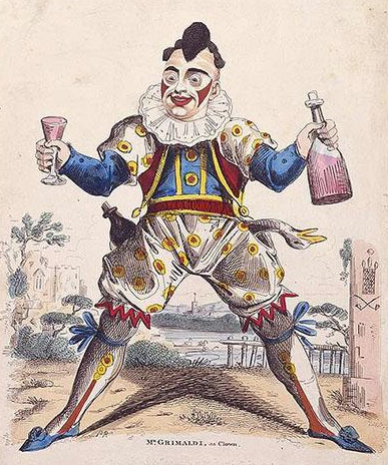
In his day, he was hugely visible: It was claimed that a full eighth of London’s population had seen Grimaldi on stage. Grimaldi made the clown the leading character of the pantomime, changing the way he looked and acted. Before him, a clown may have worn make-up, but it was usually just a bit of rouge on the cheeks to heighten the sense of them being florid, funny drunks or rustic yokels. Grimaldi, however, suited up in bizarre, colorful costumes, stark white face paint punctuated by spots of bright red on his cheeks and topped with a blue mohawk. He was a master of physical comedy—he leapt in the air, stood on his head, fought himself in hilarious fisticuffs that had audiences rolling in the aisles—as well as of satire lampooning the absurd fashions of the day, comic impressions, and ribald songs.

A drawing of Joseph Grimaldi as his famous persona Clown Joey.

A drawing of Joseph Grimaldi as his famous persona Clown Joey.

But because Grimaldi was such a star, the character he’d invented became closely associated with him. And Grimaldi’s real life was anything but comedy—he’d grown up with a tyrant of a stage father; he was prone to bouts of depression; his first wife died during childbirth; his son was an alcoholic clown who’d drank himself to death by age 31; and Grimaldi’s physical gyrations, the leaps and tumbles and violent slapstick that had made him famous, left him in constant pain and prematurely disabled. As Grimaldi himself joked, “I am GRIM ALL DAY, but I make you laugh at night.” That Grimaldi could make a joke about it highlights how well known his tragic real life was to his audiences.

Enter the young Charles Dickens. After Grimaldi died penniless and an alcoholic in 1837 (the coroner’s verdict: “Died by the visitation of God”), Dickens was charged with editing Grimaldi’s memoirs. Dickens had already hit upon the dissipated, drunken clown theme in his 1836 The Pickwick Papers. In the serialized novel, he describes an off-duty clown—reportedly inspired by Grimaldi’s son—whose inebriation and ghastly, wasted body contrasted with his white face paint and clown costume. Unsurprisingly, Dickens’ version of Grimadli’s life was, well, Dickensian, and, Stott says, imposed a “strict economy”: For every laugh he wrought from his audiences, Grimaldi suffered commensurate pain.

Stott credits Dickens with watering the seeds in popular imagination of the scary clown—he’d even go so far as to say Dickens invented the scary clown—by creating a figure who is literally destroying himself to make his audiences laugh. What Dickens did was to make it difficult to look at a clown without wondering what was going on underneath the make-up: Says Stott, “It becomes impossible to disassociate the character from the actor.” That Dickens’s version of Grimaldi’s memoirs was massively popular meant that this perception, of something dark and troubled masked by humor, would stick.

Meanwhile, on the heels of Grimaldi’s fame in Britain, the major clown figure on the Continent was Jean-Gaspard Deburau’s Pierrot, a clown with white face paint punctuated by red lips and black eyebrows whose silent gesticulations delighted French audiences.

French artist Auguste Bouquet's rendition of Jean-Gaspard Deburau as Pierrot

French artist Auguste Bouquet’s rendition of Jean-Gaspard Deburau as Pierrot

Deburau was as well known on the streets of Paris as Grimaldi was in London, recognized even without his make-up. But where Grimaldi was tragic, Deburau was sinister: In 1836, Deburau killed a boy with a blow from his walking stick after the youth shouted insults at him on the street (he was ultimately acquitted of the murder). So the two biggest clowns of the early modern clowning era were troubled men underneath that face-paint.

After Grimaldi and Deburau’s heyday, pantomime and theatrical traditions changed; clowning largely left the theater for the relatively new arena of the circus. The circus got its start in the mid-1760s with British entrepreneur Philip Astley’s equestrian shows, exhibitions of “feats of horsemanship” in a circular arena. These trick riding shows soon began attracting other performers; along with the jugglers, trapeze artists, and acrobats, came clowns. By the mid-19th century, clowns had become a sort of “hybrid Grimaldian personality [that] fit in much more with the sort of general, overall less-nuanced style of clowning in the big top,” explains Stott.

Clowns were comic relief from the thrills and chills of the daring circus acts, an anarchic presence that complimented the precision of the acrobats or horse riders. At the same time, their humor necessarily became broader—the clowns had more space to fill, so their movements and actions needed to be more obvious. But clowning was still very much tinged with dark hilarity: French literary critic Edmond de Goncourt, writing in 1876, says, “[T]he clown’s art is now rather terrifying and full of anxiety and apprehension, their suicidal feats, their monstrous gesticulations and frenzied mimicry reminding one of the courtyard of a lunatic asylum.” Then there’s the 1892 Italian opera, Pagliacci (Clowns), in which the cuckolded main character, an actor of the Grimaldian clown mold, murders his cheating wife on stage during a performance. Clowns were unsettling—and a great source for drama.

England exported the circus and its clowns to America, where the genre blossomed; in late 19th century America, the circus went from a one-ring horse act to a three-ring extravaganza that travelled the country on the railways. Venues and humor changed, but images of troubled, sad, tragic clowns remained—Emmett Kelly, for example, was the most famous of the American “hobo” clowns, the sad-faced men with five o’clock shadows and tattered clothes who never smiled, but who were nonetheless hilarious.
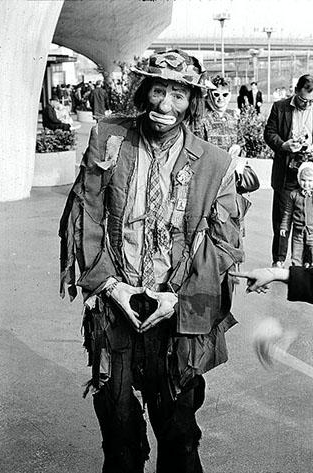
Emmett Kelly as "Weary Willy," the most famous example of the hobo-clown persona

Emmett Kelly as “Weary Willy,” the most famous example of the hobo-clown persona

Kelly’s “Weary Willie” was born of actual tragedy: The break-up of his marriage and America’s sinking financial situation in the 1930s.

Clowns had a sort of heyday in America with the television age and children’s entertainers like Clarabell the Clown, Howdy Doody’s silent partner, and Bozo the Clown. Bozo, by the mid-1960s, was the beloved host of a hugely popular, internationally syndicated children’s show – there was a 10-year wait for tickets to his show. In 1963, McDonald’s brought out Ronald McDonald, the Hamburger-Happy Clown, who’s been a brand ambassador ever since (although heavy is the head that wears the red wig – in 2011, health activists claimed that he, like Joe Camel did for smoking, was promoting an unhealthy lifestyle for children; McDonald’s didn’t ditch Ronald, but he has been seen playing a lot more soccer).

But this heyday also heralded a real change in what a clown was. Before the early 20th century, there was little expectation that clowns had to be an entirely unadulterated symbol of fun, frivolity, and happiness; pantomime clowns, for example, were characters who had more adult-oriented story lines. But clowns were now almost solely children’s entertainment. Once their made-up persona became more associated with children, and therefore an expectation of innocence, it made whatever the make-up might conceal all the more frightening—creating a tremendous mine for artists, filmmakers, writers and creators of popular culture to gleefully exploit to terrifying effect. Says Stott, “Where there is mystery, it’s supposed there must be evil, so we think, ‘What are you hiding?’”

Most clowns aren’t hiding anything, except maybe a bunch of fake flowers or a balloon animal. But again, just as in Grimaldi and Deburau’s day, it was what a real-life clown was concealing that tipped the public perception of clowns. Because this time, rather than a tragic or even troubled figure under the slap and motley, there was something much darker lurking.

Even as Bozo was cavorting on sets across America, a more sinister clown was plying his craft across the Midwest. John Wayne Gacy’s public face was a friendly, hard-working guy; he was also a registered clown who entertained at community events under the name Pogo. But between 1972 and 1978, he sexually assaulted and killed more than 35 young men in the Chicago area. “You know… clowns can get away with murder,” he told investigating officers, before his arrest.

Gacy didn’t get away with it—he was found guilty of 33 counts of murder and was executed in 1994. But he’d become identified as the “Killer Clown,” a handy sobriquet for newspaper reports that hinged on the unexpectedness of his killing. And bizarrely, Gacy seemed to revel in his clown persona: While in prison, he began painting; many of his paintings were of clowns, some self-portraits of him as Pogo. What was particularly terrifying was that Gacy, a man who’d already been convicted of a sexual assault on a teenage boy in 1968, was given access to children in his guise as an innocuous clown. This fueled America’s already growing fears of “stranger danger” and sexual predation on children, and made clowns a real object of suspicion.

After a real life killer clown shocked America, representations of clowns took a decidedly terrifying turn. Before, films like Cecil B. DeMille’s 1952 Oscar-winning The Greatest Show on Earth could toy with the notion of the clown with a tragic past—Jimmy Stewart played Buttons, a circus clown who never removed his make-up and who is later revealed to be a doctor on the lam after “mercy killing” his wife—but now, clowns were really scary.
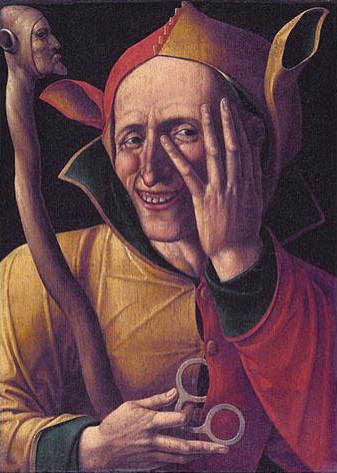
A predecessor of the modern clown, the medieval court jester exemplified the delicate blend of funny and horrifying

A predecessor of the modern clown, the medieval court jester exemplified the delicate blend of funny and horrifying

In 1982, Poltergeist relied on transforming familiar banality—the Californian suburb, a piece of fried chicken, the television—into real terror; but the big moment was when the little boy’s clown doll comes to life and tries to drag him under the bed. In 1986, Stephen King wrote It, in which a terrifying demon attacks children in the guise of Pennywise the Clown; in 1990, the book was made into a TV mini-series. In 1988, B-movie hit Killer Klowns from Outer Space featured alien clowns harboring sharp-toothed grins and murderous intentions. The next year saw Clownhouse, a cult horror film about escaped mental patients masquerading as circus clowns who terrorize a rural town. Between the late 1980s and now – when the Saw franchise’s mascot is a creepy clown-faced puppet — dozens of films featuring vicious clowns appeared in movie theatres (or, more often, went straight to video), making the clown as reliable a boogeyman as Freddy Kreuger.

Kiser, Ringling’s talent spotter and a former clown himself, acknowledged the damage that scary clown images have done to clowning, though he was inclined to downplay the effect. “It’s like, ‘Oh man, we’re going to have to work hard to overcome that one,’” he says.

But anecdotally at least, negative images of clowns are harming clowning as a profession. Though the Bureau of Labor Statistics doesn’t keep track of professional clowns specifically (they’re lumped in with comedians, magicians, and other miscellaneous performers), in the mid-2000s, articles began popping up in newspapers across the country lamenting the decline of attendees at clown conventions or at clowning workshop courses. Stott believes that the clown has been “evacuated as a figure of fun” (notably, Stott is personally uncomfortable with clowns and says he finds them “strange”); psychologists suggest that negative clown images are replacing positive clown images.

“You don’t really see clowns in those kinds of safe, fun contexts anymore. You see them in movies and they’re scary,” says Dr. Martin Antony, a professor of psychology at Ryerson University in Toronto and author of the Anti-Anxiety Work Book. “Kids are not exposed in that kind of safe fun context as much as they used to be and the images in the media, the negative images, are still there.”

That’s creating a vicious circle of clown fear: More scary images means diminished opportunities to create good associations with clowns, which creates more fear. More fear gives more credence to scary clown images, and more scary clown images end up in circulation. Of course, it’s difficult to say whether there has been a real rise in the number of people who have clown phobias since Gacy and It. A phobia is a fear or anxiety that inhibits a person’s life and clown fears rarely rate as phobias, psychologists say, because one simply isn’t confronted by clowns all that often. But clown fear is, Antony says, exacerbated by clowns’ representation in the media. “We also develop fears from what we read and see in the media… There’s certainly lots of examples of nasty clowns in movies that potentially puts feet on that kind of fear,” he says.

From a psychologist’s perspective, a fear of clowns often starts in childhood; there’s even an entry in the psychologists’ bible, the Diagnostic and Statistical Manual of Mental Disorders or DSM, for a fear of clowns, although it’s under the umbrella category of a pediatric phobia of costumed characters (sports mascots, Mickey Mouse). “It starts normally in children about the age of two, when they get anxiety about being around strangers, too. At that age, children’s minds are still developing, there’s a little bit of a blend and they’re not always able to separate fantasy from reality,” explains Dr. Brenda Wiederhold, a veteran psychologist who runs a phobia and anxiety treatment center in San Diego that uses virtual reality to treat clients.

Most people, she says, grow out of the fear, but not everyone—perhaps as much as 2 percent of the adult population will have a fear of clowns. Adult clown phobics are unsettled by the clown’s face-paint and the inability to read genuine emotion on a clown’s face, as well as the perception that clowns are able to engage in manic behavior, often without consequences.

But really, what a clown fear comes down to, what it’s always come down to, is the person under the make-up. Ringling’s Kiser agreed.

“I think we have all experienced wonderful clowns, but we’ve also all experienced clowns who in their youth or lack of training, they don’t realize it, but they go on the attack,” Kiser says, explaining that they can become too aggressive in trying to make someone laugh. “One of the things that we stress is that you have to know how to judge and respect people’s space.” Clowning, he says, is about communicating, not concealing; good clown make-up is reflective of the individual’s emotions, not a mask to hide behind—making them actually innocent and not scary.

Krusty_the_Clown_by_TheTitan99

But have bad, sad, troubled clowns done too much damage? There are two different, conflicting visions of the clown’s future.

Stott, for one, sees clowning continuing on its dark path. “I think we’ll find that the kind of dark carnival, scary clown will be the dominant mode, that that figure will continue to persist in many different ways,” he says, pointing to characters like Krusty the Clown on The Simpsons, who’s jaded but funny, or Heath Ledger’s version of The Joker in the Batman reboot, who is a terrifying force of unpredictable anarchy. “In many respects, it’s not an inversion of what we’re used to seeing, it’s just teasing out and amplifying those traits we’ve been seeing for a very long time.” Other writers have suggested that the scary clown as a dependable monster under the bed is almost “nostalgically fearful,” already bankrupted by overuse.

But there’s evidence that, despite the claims of the University of Sheffield study, kids actually do like clowns: Some studies have shown that real clowns have a beneficial affect on the health outcomes of sick children. The January 2013 issue of the Journal of Health Psychology published an Italian study that found that, in a randomized controlled trial, the presence of a therapy clown reduced pre-operative anxiety in children booked for minor surgery. Another Italian study, carried out in 2008 and published in the December 2011 issue of the Natural Medicine Journal found that children hospitalized for respiratory illnesses got better faster after playing with therapeutic clowns.

And Kiser, of course, doesn’t see clowning diminishing in the slightest. But good clowns are always in shortage, and it’s good clowns who keep the art alive. “If the clown is truly a warm and sympathetic and funny heart, inside of a person who is working hard to let that clown out… I think those battles [with clown fears] are so winnable,” he says. “It’s not about attacking, it’s about loving. It’s about approaching from a place of loving and joy and that when you really look at it, you see, that’s it really genuine, it’s not fake.”

.

You Do What?

Can you describe what a dramaturge does? What is their role in the theatrical process? Well, it has been defined in a number of (sometimes conflicting) ways but it perhaps easiest to think about it as someone who deals with the research and development of plays, working alongside the director. But, there is no officially defined description and a the role of a dramaturge in one theatre company might differ quite significantly to one in another company.  One (Wikipeadia) definition says:

Dramaturgy is a comprehensive exploration of the context in which the play resides. The dramaturg is the resident expert on the physical, social, political, and economic milieus in which the action takes place, the psychological underpinnings of the characters, the various metaphorical expressions in the play of thematic concerns; as well as on the technical consideration of the play as a piece of writing: structure, rhythm, flow, even individual word choices

All clear now? No? Well have a read of this article written by Zoë Svendsen for T.H.E. Svendsen is a dramaturge and director, based in the UK, and here she explains how she understands the role by explaining work on a production of Christopher Marlowe’s Edward II, a play that is notoriously difficult to stage.

Zoë Svendsen on the dramaturge’s role at the heart of the action

The ‘creative consultant’ at work in the National Theatre’s new production of Christopher Marlowe’s Edward II

Zoë Svendsen

Zoë Svendsen

There is a huge crossover between academia and the theatre now,” says Zoë Svendsen. “When I left university, they felt like much more separate worlds…There is a very close relationship between my practice, my research and my teaching.”

His grace and favourite: the National Theatre’s new Edward II presents a world in which the unthinkable becomes thinkable, says dramaturge Zoë Svendsen

His grace and favourite: the National Theatre’s new Edward II presents a world in which the unthinkable becomes thinkable, says dramaturge Zoë Svendsen

For some years a practice-based research fellow in drama and performance at the University of Cambridge, Svendsen next month takes on a new position at Cambridge as a lecturer in drama. She is director of a company called Metis Arts, which specialises in immersive and sometimes interactive performance projects addressing political themes. And she has worked as dramaturge on Joe Hill-Gibbins’ acclaimed 2012 Young Vic production of Thomas Middleton and William Rowley’s Jacobean tragedy,The Changeling, and now on his National Theatre production of Christopher Marlowe’s Edward II, which previews from this week. (A similar gig, in which Svendsen will work with the Royal Shakespeare Company on another Elizabethan drama, Arden of Faversham, follows next year.)

The role of dramaturge is far more established in continental Europe than in the UK, but Svendsen explains that it is essentially about “how the play functions in time and space – the production as a whole from a structural perspective, how the audience’s attention is held”.

While it remains the director’s job to steer the actors, she sits in on rehearsals and sees herself as a “sounding board, a creative consultant. We push ideas back and forth, trying to find out what the heart of the play is. I don’t like the term ‘outside eye’ – I’m absolutely embedded – but I can keep an eye on how one scene fits with other scenes, what the overall ambitions are.”

When it comes to her own projects and research, Svendsen has “long been interested in works which don’t conform to a kind of British empiricism in the staging, with a single time and a single location”. Her PhD looked at the Gate Theatre in Notting Hill and the production of plays from other cultures in London. And living and working in Berlin gave her a further “sense of the plethora of forms in which plays can be written”.

As a striking example of Svendsen’s own work, we might cite Metis Arts’ interactive multimedia production 3rd Ring Out, which Svendsen sees as having been “absolutely research-driven” and arising out of “a set of questions”. An earlier project about disused air-raid shelters and a decommissioned nuclear bunker in Cambridge led her and her collaborators to reflect on “Cold War exercises and the scenarios for many people across the country to play”.

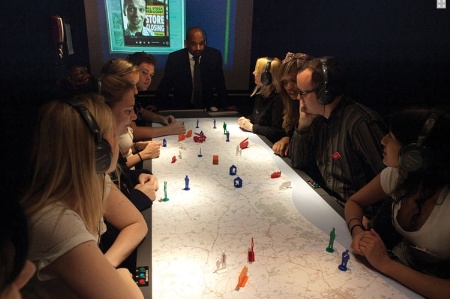
Doomsday scenarios: participants in Metis Arts’ interactive production 3rd Ring Out consider their options

Doomsday scenarios: participants in Metis Arts’ interactive production 3rd Ring Out consider their options

This led to the more general question of “What does it mean to practise for disaster?” and, since they “didn’t want to do re-enactment”, the search for a contemporary theme. When a visit to the Camp for Climate Action at Kingsnorth in Kent brought new urgency to Svendsen’s own concerns about the issue, it became the focus.

But this presented a dilemma, she recalls: “How do you make an effective performance about climate change? When you have theatre, which is about individual relationships, the short term and dramatic events, how do you avoid the trap of a kind of disaster porn, taking pleasure in the horror?”

To solve this problem, Svendsen and her co-director Simon Daw took two shipping containers around the country in 2010 and 2011. Inside, they constructed “an emergency planning cell” in which audiences of 12 sat at a table with headphones and a voting console. Amid an audiovisual simulation of a disaster scenario unfolding in their locality in 2033, they were invited to vote on the practical and ethical issues raised by heatwaves, food shortages and civil unrest. The question of whether to accept climate change refugees into the area proved particularly contentious.

But what had the creation of this powerful piece to do with productions of classic Elizabethan and Jacobean plays?

Svendsen believes that both draw on her central concern with how you hold audiences’ attention, and that her “sensibility for different kinds of formal structures” helped to forge “a distinctive way of looking at Renaissance dramas”. The key is “a deep commitment to the original text – which means expressing it as fully as possible in theatrical terms”.

When she and Hill-Gibbins began working on The Changeling, they were struck by its differences from most recent theatre: “A character says ‘We need to talk to so and so’ and there they are on stage – and there are no questions about how they got there. In Middleton, it’s all about what happens next, there’s very little back story. How characters interact with each other is absolutely about what they want at that immediate moment. There’s no continuous psychological through line. And that’s very different from what you find in ‘the grandfathers of modern drama’ such as Ibsen and Chekhov.”

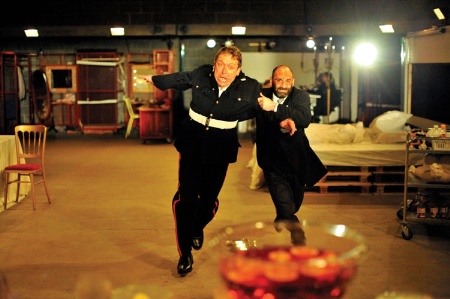
In tackling this challenge, they started off by cutting lines, reordering and amalgamating scenes – only to find themselves slowly working their way back to something close to the original text, albeit with greatly deepened understanding. The production, which featured a wedding scene staged with throbbing music by Beyoncé and a banquet where the actors get covered in food, was acclaimed by critics for its “lewdness and lunacy” and for “mak[ing] pervs of us all”.

Breaking with tradition: Joe Hill-Gibbins’ ‘iconoclastic’ production of The Changeling

Breaking with tradition: Joe Hill-Gibbins’ ‘iconoclastic’ production of The Changeling

“Reviewers talked about it as contemporary, Tarantino-esque and iconoclastic,” reflects Svendsen. “Actually all of that is in the play, but not necessarily brought out in today’s productions”, in which the British tradition of staging classics often puts the central stress on the text rather than the underlying structure.

Edward II may be best known for two key challenges it presents to directors: how openly erotic to make the relationship between the king and his “favourite”, Piers Gaveston; and how to stage Edward’s horrifying demise, impaled with a red-hot poker. (It also includes a great speech where the medieval equivalent of an academic is given trenchant advice on how he should “cast the scholar off”, give up his “velvet-caped cloak” and “learn to court it like a gentleman”: “You must be proud, bold, pleasant, resolute,/And now and then, stab, as occasion serves.”)

Without giving away any major secrets about a production still in rehearsal, Svendsen again flags up how different Edward II is from a contemporary play in its “accumulations and repetitions and things that seem to be a bit short-circuited” – and how exploring its structure had revealed its hidden depths.

“You need to allow the repetitions to become cumulative,” she suggests, “because repetition is what tells the story and allows Marlowe to comment on history. The characters don’t really change, but the situation changes, because what they conceive of as possible changes.

“Once the barons start threatening civil war and Gaveston’s exile, the rhetoric of threat becomes a capacity to act and those things become possible. The idea of deposing the king is unthinkable at the start of the play, but it’s interesting how quickly it becomes thinkable.”

In this, the play echoes Svendsen’s experience of working on 3rd Ring Out, where she and Daw considered the possible scenario of “putting the military on the streets” and then decided “no one would believe it was within the bounds of plausibility”.

“That was in 2010, but the next year the riots had erupted and the media were full of questions about whether the military should go on to the streets,” says Svendsen. “It had become thinkable as part of the national conversation. Pretty much everything we had imagined for 2033 did happen during the times we were performing.”

If you would like to hear more from Svendsen talking about dramaturgy, you can by clicking the link below, which will take you to an audio recording on Theatre Voicesof her talking about work on another classic play, The Changeling by Thomas Middleton and William Rowley.

Zoe Svendsen discusses The Changeling.

.

Words Are Louder Than Actions

All aspects of culture have their trends – art, music, architecture and so on – and theatre is no different. Current trends in theatre seem to be that of the immersive performance but also that of verbatim theatre (VT), which appears to be very popular at the moment across the globe. Essentially VT is a form of documentary theatre in which plays are created/written from the precise words spoken by people interviewed about a particular event or topic.

Perhaps one of the most famous pieces of VT is The Laramie Project which is a play by the Tectonic Theater Project about the reaction to the 1998 murder of a gay student in Laramie, Wyoming, in the US. The murder was denounced as a hate crime and brought attention to the lack of hate crimes laws in various US states. The play draws on hundreds of interviews conducted by the theatre company with inhabitants of the town, company members’ own journal entries, and published news reports. Arguably it is one of the most performed plays in The States. The company have just followed up the original with a new work called The Laramie Project: Ten Years Later which returns to Laramie to see how attitudes have changed in the intervening years.

.

There is a sense that VT is something new, but this is in fact mistaken. This kind of theatre has been around since the early 20th Century, one of the pioneers being Erwin Piscator and his living newspapers. In Drama Online Dr Tom Cantrell, Lecturer in Drama, University of York, gives a great outline and history of VT

Verbatim theatre is a form of documentary theatre which is based on the spoken words of real people. In its strictest form, verbatim theatre-makers use real people’s words exclusively, and take this testimony from recorded interviews. However, the form is more malleable than this, and writers have frequently combined interview material with invented scenes, or used reported and remembered speech rather than recorded testimony. There is an overlap between verbatim theatre and documentary theatre, and other kinds of fact-based drama, such as testimonial theatre (in which an individual works with a writer to tell their own story) and tribunal theatre (edited from court transcripts). In the United Kingdom, the term ‘verbatim’ specifically relates to the use of spoken testimony, whereas ‘documentary’ encompasses other found sources, such as newspaper articles, diaries and letters. However, in America ‘verbatim’ is not used, with ‘documentary’ being the preferred term. When looking for verbatim playtexts, the reader will often find them conflated with other documentary forms.

words

Documentary theatre has a rich heritage in comparison to the relative infancy of verbatim theatre. Erwin Piscator’s Trotz alledem! (In Spite of Everything! Berlin, 1925) is widely acknowledged as the first stage documentary. The play was a revue about the Communist Party and Piscator utilised new technologies which included creating montages using projected newsreel footage. Trotz alledem!also featured recorded speeches, news-extracts, photographs and film sequences from the First World War. Piscator went on to direct some of the most respected German documentary plays such as Rolf Hochhuth’s Der Stellvertreter (The Representative, known in America as The Deputy), which premiered in West Berlin in 1963, Heinar Kipphardt’s In the Matter of J. Robert Oppenheimer (1964), and Peter Weiss’s The Investigation (1965). These German documentary productions had a great influence on British documentary theatre, particularly the work of Joan Littlewood. Her production, Oh What a Lovely War! chronicled the First World War through songs and documents of the period. Its importance was immediately recognised, with the production hailed by the Observer as ‘The most important theatrical event of the decade’.

The development of verbatim theatre, rather like Piscator’s use of new film projection technologies, is closely linked to a simple technological development – the invention of the portable cassette recorder. This enabled the voices of individuals to be recorded in their own environment. Mobile interviews could take place which extended the dramatic possibilities of verbatim theatre. The first verbatim productions were directed by Peter Cheeseman who was artistic director of the Victoria Theatre, Stoke-on-Trent from 1962 – 1984. Cheeseman’s verbatim work at Stoke was not only influenced by the left-wing documentary theatre of Joan Littlewood, but also by the radio documentary tradition, particularly the radio ballads of Charles Parker. Central to Parker’s work was the prominence of working class voices in the broadcasts. One of Cheeseman’s most notable productions, which can be regarded the first verbatim play, was Fight for Shelton Bar (1974), which was part of a campaign fighting against the closure of a major steelworks in the heart of Stoke, and was performed in the city to an audience of many of the ex-workers.

Over the past two decades verbatim theatre has come to occupy a central place on the British stage, and is seen as one of the most incisive forms of political theatre. It has moved from the fringes to the mainstream, with some of the highest profile theatres staging verbatim plays. Particularly noteworthy exponents of the form include David Hare, whose verbatim (or at least part-verbatim) plays The Permanent Way (2003), Stuff Happens (2004) andThe Power of Yes (2009) were all performed at the National Theatre; director Max Stafford-Clark and writer Robin Soans, who have collaborated on A State Affair (2000), Talking to Terrorists (2005) andMixed Up North (2009); and in particular the campaigning work of director Nicholas Kent and theGuardian journalist Richard Norton Taylor at the Tricycle Theatre in Kilburn, North London. Kent and Norton-Taylor’s work has included a series of tribunal plays, including Nuremberg (1996), Bloody Sunday (2005), and perhaps their most successful production: The Colour of Justice: The Stephen Lawrence Enquiry (1999). All these were edited scenes from court cases. Kent has also collaborated with Gillian Slovo on Guantanamo: ‘Honour Bound to Defend Freedom’ (with Victoria Brittain, 2004) and most recently on The Riots (2011), which was the first theatrical response to the riots in the summer of 2011.

Verbatim theatre has arisen as the medium chosen to depict major societal issues. For example, army deaths in Philip Ralph’s Deep Cut (2008) and Fiona Evans’s Geoff Dead: Disco for Sale (2008); prostitution in Esther Wilson’s Unprotected (2006), Alecky Blythe’s The Girlfriend Experience (2008); murder in Tanika Gupta’s Gladiator Games (2005) and London Road (2012) and perhaps most predominantly, a surge of work on the continuing issue of the war in Iraq: Norton-Taylor’s Justifying War (2003), Called to Account (2007) and Tactical Questioning (2011), Gregory Burke’s Black Watch(2007) and Steve Gilroy’s The Motherland (2008).

Verbatim theatre has also proliferated internationally. Interested readers should explore American plays such as Moises Kaufman’s Gross Indecency: The Three Trials of Oscar Wilde (1997) and in particularThe Laramie Project (2000) and The Laramie Project Ten Years Later (2009). Anna Deavere Smith is also one of the most high profile documentary makers. Her work includes Building Bridges, Not Walls(1985) and Fires in the Mirror (1992). Similarly important is Jessica Blank and Erik Jensen’s celebrated play The Exonerated (2002), composed of interviews with individuals who have been released from death row. Australia has also experienced a boom in verbatim productions. The first verbatim production was Paul Brown’sAftershocks (1993), featuring interviews in the aftermath of the devastating Newcastle earthquake. Works by Alana Valentine including Run Rabbit Run(2004) and Parramatta Girls (2007) have also raised the profile of Australian verbatim theatre.

VT should be powerful and is obviously all about theatre that provokes, informs and seeks social and cultural change. Michael Billington wrote an article for The Guardian that also talks about its current popularity and you can read that here.

In an article for ideastap, playwright Alecky Blythe outlines her process:

I start with either an interesting event, or interesting character. That might be a story that I read in the paper or it might be an ongoing story, like women bishops. Then I’ll take myself off to interview people in a very journalistic way.

You have to be quite upfront from the beginning. Even if you don’t know where your project will end up – if it’ll even get used – you need to let people know that you’re going to record them and that an actor might portray them on stage. And you have to get their permission to do that.

Some people have said ‘no’. You have to judge if that really is a ‘no’ or if you just haven’t explained yourself properly. If it’s a matter of them being identifiable, I will go into how I can make them anonymous….

anonymous icon

Some people have both [of the] things you’re looking for: interesting characters and the potential to be developed narratively. Some people are brilliant, likeable and accessible straight away, but they might not have much forward story; all their best stories have already happened to them. The best verbatim theatre is as much present tense as possible – it’s about capturing things as they happen.

Of course you’re looking for emotional effect, but at other points in the story you’ll be looking for plot and facts, which means asking slightly dry questions – where they are, what they’re doing, who they’re waiting for etc. Those things are key to the highs and lows of the story.

Legally I don’t know whether it’s different to journalism. If someone says something that is highly contentious, as I am finalising the edit I’ll also go over exactly what they said with them. I want to check they remember, in case it could lead to any kind of back lash for them, and that they are ok with that. Some people say things in the heat of the moment that they might forget; sometimes the show is produced at least a year after they said it.

I don’t transcribe anything. I make a first edit, and of that edit I’ll log the timecode and who said what. That means that further down the line I can pick up specific moments – someone talking about sunglasses, for instance – by reading back through my notes rather than listening to 15 hours of recording.

I don’t write any lines; I give the actors the audio recordings. Although on the first day of rehearsal they get a running order; the names of the characters, titles of the tracks and who’s playing what part…..

…One of the strengths of verbatim is the sort of rich text you just couldn’t make up. So if you’re doing a verbatim play, put some of those quotes on the flyer or poster. It can just be a tiny soundbite.

I’ve always gone out and followed stories before anybody’s put any money on the table. That’s still the case. Even if a company says they want to work with you, by the time the paperwork’s gone through and the contract is signed, you might have missed a month’s worth of collecting material. Sometimes you are living on a breadline and taking gambles. But luckily my process isn’t too expensive – apart from the initial cost of a dictaphone, it’s just batteries and travel.

The popularity of VT is wide and I share two examples here that give you an idea about its power – Home, about life in a hostel for young homeless people in London and My Name is Rachel Corrie a play based on the diaries and emails of Rachel Corrie, an American student who was killed while protesting against the destruction of a house by the Israeli Defence Force in the Gaza Strip in 2003.

.

I should say (and proudly) that Shannon Murphy is an ex student of mine.

And finally a great article from Australian Writers Guild Magazine, by playwright Alana Valentine titled The tune of the spoken voice.

That’s the way to do it

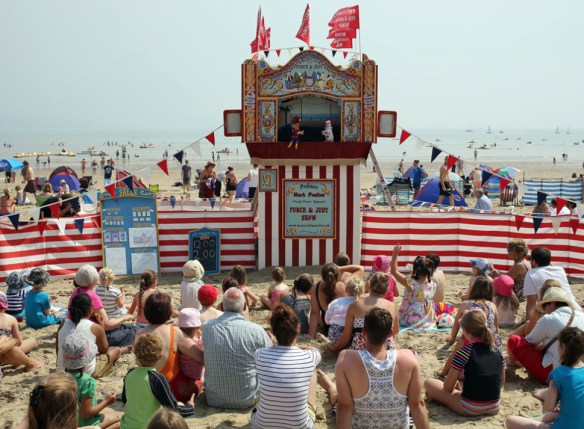
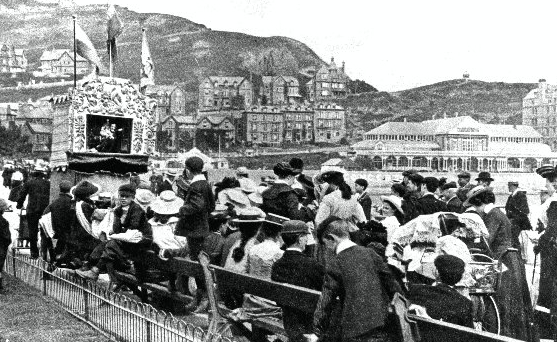
As a child I remember watching a puppet show with my grandfather. Nothing unusual in that, except it was on a beach. I can’t recall it very clearly except that I didn’t like the major character, who frightened me. As I have been exploring puppet theatre across the world I have steadfastly ignored this experience until a colleague pointed out that Punch and Judy was as much a legitimate world theatre form as Wayang Kulit. So I was prompted to dig deeper, and even more so when the image below, taken two weeks ago, appeared in the british press.
photo_Fotor

And the one below is from late nineteenth century.

llancod1_Fotor

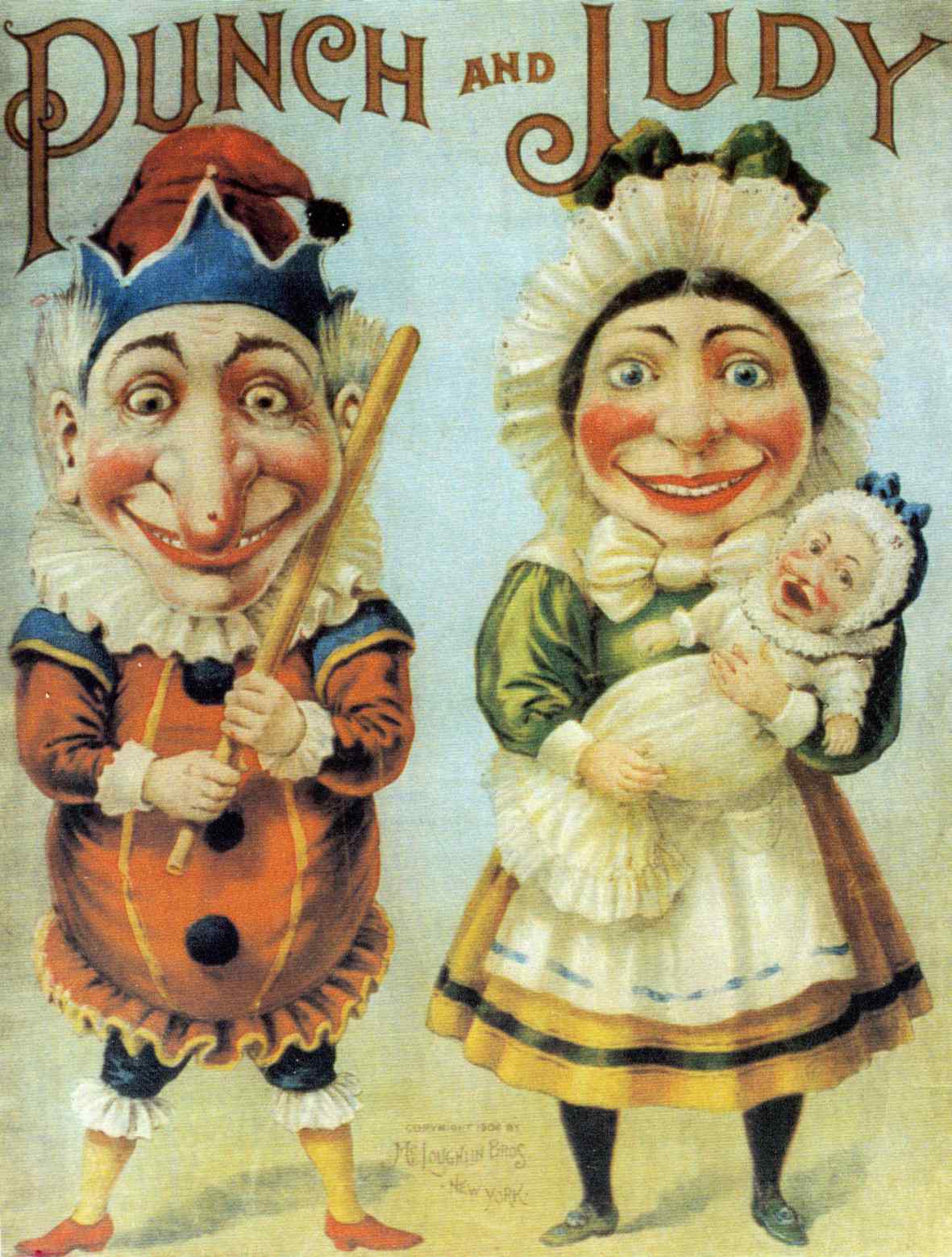
I hadn’t realised quite how old the form was, or that it had its roots in Commedia dell’arte – although now that seems really obvious. Punch and Judy is one of the world’s most famous and long running puppet shows. It is essentially linked with England but Punch and Judy can be found just about wherever the colonial English decided to ‘set up home’ and english is spoken as a first language, America, Canada, Australia. Here is a great history of the form, written by Keith Preston, an Australian Punch and Judy man.

Punch and Judy has its origins in the commedia street theatre of medieval Italy and Punch arrived in England in 1663 from Italy as the marionette Pulchinello (noted by the famous London diarist Samuel Pepys). The character evolved into Punch over the next century and Punch appeared extensively both as a marionette and as a comic actor and slowly acquired a more English character that was a cross between the English Jester, Fool and the Shakespearean comic characters. In the late 1700’s the London puppet theatres closed and Punch and Judy as we know it appeared as a busking act on the streets of London as a portable hand-puppet show.

To entertain its new audience of street-wise townsfolk this new form of puppet theatre needed to be fast, loud, action-packed, comic and portable. Punch and Judy was all of these and more. The show started with the bottler (assistant who carried the bottle for the money donations) banging a drum and playing the pan pipes. The Punch-Man (later to be called a “Professor of Punch”) stayed inside the booth and operated all of the puppets and most notably the character of Punch whose shrill shrieking voice was created with a special reed inserted in the throat (known as the swazzle).

punch

The early puppeteers led a gypsy style existence moving through the streets of London and also taking the puppet show to fairs and events. When Londoners began to travel to the seaside towns by train in the 1840’s the Punch Professors followed and soon the Punch and Judy Show became a seaside institution. Some beaches and cities have had a Punch and Judy show every year for well over a hundred and thirty years. The Punch Professors guarded their shows fiercely and only passed on the secrets of puppetry to a son or nephew and kept the business ‘in the family’.

The show itself has changed enormously over the last two hundred years. The first written scripts appear around 1830 but illustrations of shows actually appear in the 1770’s. By the time the first scripts are found the Punch and Judy show has already been around for fifty years and has had a chance to develop into a fully fledged puppet show. While the story is new and reflects the life of the then modern Londoner, the script is also full of references to the early years of Punch, to the Medieval mystery plays and to the symbolic dramas, themes and characteristics of England.

The early shows feature Mr Punch , a hook-nosed comic figure with a stick who is a cowardly braggart but strangely likeable. He hides, lies, cheats, steals, beats, boasts eats, drinks and loves his way through a difficult life. He is a rascal but is also an “Everyman” figure in that he represents the average person. In the old storyline he has an argument with other characters, fights them, sometimes he kills them, is chased by the law, taken to jail, but beats the hangman and the devil and ends as triumphant anti-hero. In between, the whole drama is treated as a total farcical comedy with lots of action, routines, jokes and slapstick moments. Other characters include Judy his wife and their Baby, Scaramouch the neighbour and his dog Toby (often played by a real dog) Joey the Clown, The Beadle or Policeman, The Quack Doctor, The Crocodile, Sweet Polly the Mistress, The Hangman, The Devil. In particular the characters of Hangman and Devil owe their origins to the medieval English dramas and early theatre of the Elizabethan period.

Punch-and-Judy

Obviously much of this is black-humour but with the comic drama, Punch and Judy acquired a symbolic status as a drama about life itself. Punch and Judy was a hugely popular entertainment for ordinary people on the street but also was often invited into private homes and mansions of the aristocrats.

It is interesting to note that a similar evolution of the commedia/marionettes also happened in other parts of Europe around the same time or slightly later and in Germany we have a similar hand-puppet show-Kaspar, in France – Guignol, Petrushka in Russia, Punchinello in Italy as well as links to the Greek shadow puppet theatre.

Punch and Judy emigrated with the English to America, Australia and other parts of the world in the Nineteenth Century but by the 1940’s was in decline with the advent of films and other aspects of popular entertainment. As with many other forms of traditional performance such as Vaudeville, Circus, Fairs and so on Punch and Judy was able to reinvent itself and had a revival in the 1960’s with the new emphasis on community arts, national pride, tourism and so on.

.

However over the years the Punch and Judy Show has also adapted and changed. In some cases it has become more of a children’s entertainment, far removed from its origins as a street-play. The rough and tumble violence has been changed and Punch is very much less of a sinister figure than he was in his early days. Some performers however do present shows that portray old-style performances still to this day.

To me it all seems terribly dated, but it clearly lives on. In an article in the Smithsonian Magazine by Linda Rodriguez McRobbie earlier this year the question is asked, Are Punch and Judy Shows Finally Outdated? It would seem not, although Rodriguez McRobbie does  talk about the violence (and murder!) in the shows:

The violence, of course, has remained—and for that reason, Mr. Punch’s influence on children has understandably long been a source of worry. A New York Times article from February 11, 1896, describes children enjoying a Punch show on West 135th Street in Manhattan—and one “grave gentleman,” who resembled Punch “as if they were brothers,” grumbling at the policeman-beating scene and declaring, “It is a shame to show such things to children! How can you expect them to have any respect for the law?”

In 1947, the Middlesex County Council in England banned Punch and Judy from schools, prompting wide outcry from Punch fans and his eventual reinstatement. More than 50 years later, in 1999 and 2000, other councils in Britain considered banning Punch and Judy shows on the claim that they were too violent for children; they didn’t, but it was close……Punch defenders claim that’s just modern oversensitivity. “Although adults get very upset about the violence, the bashing the baby, it’s no more real to a child than watching a cartoon, like ‘Tom and Jerry,’” says Cathy Haill, curator of popular entertainment for the Victoria & Albert Museum in London. “Ninety-nine percent of children will roar with laughter [at ‘Tom and Jerry’] and not think ‘Oh, I’ve got to write to the society for prevention of cruelty to cats’…Nowadays, people are far more— and I hate this term—politically correct and get ridiculously worried about things like this, in my view.”

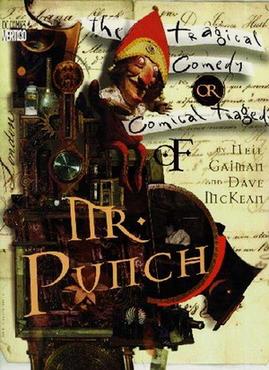
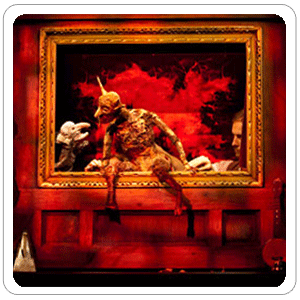
Mr_Punch_coverInterestingly though, Punch has been reinvented in a number of ways. In 1994 The Tragical Comedy or Comical Tragedy of Mr. Punch appeared as graphic novel by Neil Gaiman and Dave McKean. Last year Improbable Theatre created one of its most famous pieces, The Devil and Mr Punch:

DevilPunch.

..

.

.

.

.

There are two excellent pieces from Exuent that look at this particular show, The Immortal Mr Punch by Gareth Martin, and an interview with Julian Crouch (Designer and Director) by Tom Wicker.

.

And to finish, a delightful interview from 3 days ago, entitled Keeping Punch and Judy in the family, by Giulia Rhodes for the Guardian, where she talks to three generations of a Punch and Judy family.

.

Riding High

Today’s post is born out of one those moments of revelation when you think ‘how did I miss that? How can I not have heard of that’.  I am writing about the Bamana giant body puppets of Mali. If you have never heard of this tradition it is well worth looking at, because when I say big, I mean BIG!

screen-shot-2013-03-13-at-12-47-05-pm

I need to point out at this stage that in the Bambara language the same word is used for both ‘mask’ and ‘puppet’, since both serve the same function: to enable mythical and supernatural beings to be brought to life by hidden performers. I got a little confused at first, but I like the idea that there is no distinction between the two .

.

Below is a brief background, courtesy of Museum of African Art in New York, but first I suggest you watch this.  The narration is in French (Mali was a French colony until 1960) and very accessible even with my poor school-boy ear.

.

At Arm’s Length: The Art of African Puppetry

The art of Malian puppet theatre, the Sogo bo (the animals come forth), practiced by the Bamana of Mali and originated by the fishing community of Bozo, dates back to pre-colonial Mali. Sogo bo, a performance of puppet and mask dances, tells stories of Malian tradition, imparting valuable lessons in morality while entertaining the audience.

Within the Sogo bo performance animals of the bush are paramount.The Bamana describe themselves as cultivators and hunting people, and it is therefore animals from the bush that predominate. The animal characters represent far more than their counterparts in the bush. They are the symbols, the tangible manifestation of the essential force of the animal. They are the imperial majesty of the buffalo or the conniving duplicity of the hare. The qualities are implied through the costume and the dance of the masker. The buffalo masker regally marches about, and the youthful spark of the hare can be seen in its quick, vigorous movements. The antelope can be seen striding grace-fully, and the baboon jumps about with vigor.

warel508370_540h450w

The Sogo bo masquerades are organized by the village youth associations, the kamalen- ton, and the subject matter most commonly dealt with is hunting and heroic behavior. The youth associations, in essence, own the masquerades. They organize the activities of the night, and it is their stories that the masquerades tell. Weeks prior to the fete, the youth organizations meet frequently, planning and choreographing the events of the masquer- ades. The youths of the kamalen-ton choose the cast of characters, the costumes, the stories, and the masks that will be used. They may choose to bring out and refurbish used masks or create new ones. Their mothers, wives, and sisters provide the textiles neces- sary for the costumes. Once the major planning is completed, the youth organizations split into smaller groups and work on the particular renovation or construction projects assigned to them. Throughout this process, the older men act as consultants, offering advice on the construction of the more intricate puppets.

The puppet masks of the Sogo bo are generally worn over the bodies of the performers (usually two men). The performer(s), surrounded by the wooden frame of their puppet masks, are hidden from view by straw and cloth which cover the frame.The head of the puppet is manipulatable , and from within, the performers move the puppet about in dance.

3947215898_e7764f17d6_o

The Sogo bo performance takes place at night, and can carry on well into the early morning hours, consisting of more than twenty sets of dances. Called to the dance by the beat of the drums, the maskers, either individually or in small groups, dance in character. The large and powerful beasts lumber about slowly, majestically (the more powerful ones come out towards the end of the night), while the energy and spark of youth can be seen in the dance of the smaller animals. Each dance set lasts only five to ten minutes, and in between, the women’s chorus provide song (praise songs for the animals). The chorus, however, does not perform during the dance sets, the sets are without voice. It is the masks, the movement of the maskers, and the beat of the drums that tell the story.Untitled_Fotor

Malian puppetry features maaniw, “little people” or puppets in human form. They range in size, from small hand-held rod puppets to almost 6-foot tall figures. Maaniw play an important role in initiation ceremonies and often appear at nighttime on the backs of kalaka (small stages in the form of a body). They often speak of the individual’s place in society and teach morals.

Though there are certain tenets that are retained in the storytelling, it is by no means a static tradition. Puppet plays that were once held only on specified days are now held on weekends, to accommodate the schedule of those who have left the village to make a living in bigger cities. Modern issues are dealt with, and the plays continue to reflect the lives and times of the Bamana.

.

1244916533630_FotorThen I read about Yaya Coulibaly, 7th generation descendant of Mamari Biton Coulibaly (King of Segou region of Mali) who is the director of the Sogolon Puppet Troupe. After training at the National Institute of Arts in Bamako, Mali,  and l’Institute International de la Marionette in France he mastered the traditional Malian arts of puppetry.  It would seem he doesn’t rest with tradition either. Malian puppet performances are traditionally voiceless, but Yaya has chosen to integrate voice and performance. I realised I had heard of him before and then I remembered he had worked with Handspring Puppet Company, the people who created the horse puppets for War HorseThey collaborated on a piece call Tall Horse which blended two puppetry traditions: the Handspring work which is based in lifelike realism and the stylised, ritual rtallhorsebased puppetry of West Africa. The play’s narrative is of  a giraffe and its handler, Atir, sent as a gift from the Egyptian Pasha to the French King Charles X in 1827. Its journey took it via Alexandria and Marseilles, creating a sensation en route. Tall Horse premiered in Cape Town and then went on to tour the world. This blending of styles really appeals to me. I would have loved to have seen the play.

Many of you reading this will know of ISTA – the International Schools Theatre Association and they published a great article a few years ago by Laurie-Carroll Bérubé about her staging of Tall Horse which you can read here, Malian puppetry traditions.

Changing tack slight, as part of my research I came across this fascinating recording of Basil Jones and Adrian Kohler (Handspring’s founders) and others, talking about puppetry as a contemporary medium of communication and influence. Puppets and politics – fantastic! You will need a couple of hours, but it is really, really interesting and worthwhile.

.

I’ll finish with a few useful facts about Malian puppetry, taken from Bérubé’s article:

Boliw is the raw spiritual energy/ power contained within performance objects such as masks and puppets. It is believed that women possess boliw – because of their ability to give birth.

Castalet: the large body-puppet, which represents a gentle mythical beast. The body of the animal is a cloth and raffia-covered frame which conceals the puppeteer inside who dances, making the raffia skirt sway.

Merens habitables are the long- necked female characters of traditional Malian performance. Merens habitables are manipulated only by men and post-menopausal women because only they are able to control the boliw contained within the puppet.

Sogo Baw or Sogow (Big Beasts): these are large body-puppets (roughly 2 m long, 1.5 m high), generally representing bush, savannah or domesticated animals. Sogo baw can resemble mobile puppet theatres with small puppets on the larger animal’s back, manipulated from within.

Sogo Bo: the annual masquerade (the Animals come forth) held in June, just before the rains come to Mali’s Segou region

Body Talk

{722863BA-C984-4A5A-80E4-10D5297F14AE}Img100

I thought a while before posting today.  I read an article in the New York Times yesterday about a play touring in China. It is inspired by Eve Ensler’s play The Vagina Monologues which has become a cornerstone for a global movement to end violence against women and girls, V DAY. I only hesitated because the article is very frank, then decided that the power of theatre wins out against possible embarrassment. It is written by Didi Kirsten Tatlow:

Play Tests China’s Sexual Limits

BEIJING — There is a moment in the play “Our Vaginas, Ourselves” — a frank and funny exploration of feminism with Chinese characteristics — when the audience freezes in embarrassment. It is right after the actress Xiao Meili asks, “Do you masturbate?”

“It’s so hard getting people to answer that question!” Ms. Xiao, a 20-something with a razor-sharp black bob, exclaimed in an interview. “A lot of the time I had to answer myself,” she said of her scene, in which she plays a teacher.

During a recent performance in Beijing, Ms. Xiao paced in front of a white board demanding answers of her “students” — in reality a standing-room-only crowd of college-age women, some older women and several men. “A former professor of mine who attended told me she was terrified I’d ask her,” she said. Yet at one performance, “a woman yelled ‘Yes, it’s relaxing!”’ Ms. Xiao said, relishing the moment. “Totally spontaneous!”

Inspired by Eve Ensler’s “The Vagina Monologues,” with an English title that makes reference to the feminist classic “Our Bodies, Ourselves” — its Chinese title translates as “The Way of the Vagina” — the taboo-busting “Our Vaginas, Ourselves” was first staged in January at an L.G.B.T. center in Beijing before an audience of 50, said its producer, Ji Hang.

Written by four women, it is based on the life experiences of about a dozen contributors who gathered last autumn at Yiyuan Gongshe, a nongovernmental organization in Beijing, where they sat on cushions in a circle and talked.

“Writing this play was really just getting it down,” said Ai Ke, 29, one of the writers, who by day works for the publishing house of a major social science research institute.

It has been a hit. Since January, the amateur actresses and playwrights have performed it about 10 times in Beijing, Tianjin and Xiamen, to enthusiastic audiences numbering up to 150, who squeeze into small venues, sharing chairs and fanning themselves, as on a recent evening in the MOMA arts district of Beijing. But their performances have been limited in scale. The play has only been staged in unofficial venues because it was unlikely to get the necessary script approval from the authorities to show in official theaters, said Ms. Ji, the producer.

“We really want to enter the mainstream theater scene, but it’s impossible because the scripts would have to be censored,” she said. The subject matter is far too edgy to pass, she said.

While the play clearly owes a debt to Western feminism, what is striking — and exciting for the actresses and their audiences — is how thoroughly localized it is, with uniquely Chinese stories and a fast-paced style that at times recalls the xiangsheng, or crosstalk, of traditional Beijing humor, and rich, pun-laden language. Localization was crucial to the artists. “It’s so important to us I can’t even find the words to say it,” Ms. Ai said. “From the beginning we knew that was what we wanted.” The goal? Nothing less than to bring live, theatrical feminism — with its truths and relevance for hundreds of millions of people — to China. And to create an opportunity for personal transformation.

“It was important to us as a consciousness-raising exercise,” Ms. Ai said. “The personal transformation was No. 1.”

The localization is spelled out in the very first scene. “I’ll say it: vagina!” two actresses, called A and B, say in Mandarin, on a stage with minimal props. “I’ll say it in the Shanxi dialect: vagina,” B says. “In the Wenzhou dialect: vagina,” A says. Then it’s the Hubei dialect, and so on until they have uttered the word in 10 dialects, the audience reacting with delight to the shock of the familiar, yet rarely heard word, spoken in their hometown tongues.

Of the play’s 11 scenes, eight consist of original material, while two are Chinese translations of excerpts from Ms. Ensler’s “The Vagina Monologues,” and one is from an earlier Chinese play inspired by the American play, Ms. Ji said. Humor figures highly, as in Ms. Xiao’s scene and another called “The First Night.” Six women identified by the letters A to F chat about how they lost their virginity. “After we got a room,” sighs E, using a Chinese euphemism for having sex, “he got a receipt,” indicating that the man planned to make the encounter tax-deductible. The audience erupted in laughter.

But there is also real tension, notably in scenes that focus on rape, health and abortion. In the final scene, “I Am an Intern in an OB-GYN Ward,” a medical student recounts her experiences at a hospital: An elderly woman embodying the Chinese cultural ideal of the selfless grandmother — who will not seek medical treatment for a gynecological problem — says, “Son, don’t spend the money on me. Spend it on my grandson to go to university.”

The student also describes helping at births; the horror of aborting fetuses because they are female; and young women coming for routine abortions, sometimes several a year. China has a high abortion rate, and as I gazed around the audience, all their laughter gone, I reflected that quite a few women there probably knew precisely what she was talking about.

In 2005 The Vagina Monologues was banned in Shanghai. In the same year it was also banned in Uganda.

The Vagina Monologues challenges India's taboos

The Vagina Monologues challenges India’s taboos

.

.

.

.

.

.

.

.

I have seen the play a couple of times and it is indeed a powerful piece. If you are interested you can read the original text here. A little bit of researching later, it became apparent to me just how widely the play has been performed – it has been translated into 22 languages (and counting). It has been running in India for 11 years. Following the awful Delhi rape case that made headlines across the world earlier in the year, it is not surprising that the play took on a greater importance, as this report, Vagina Monologues challenges India’s taboosfrom the BBC highlights. Indeed following it, Eve Ensler went to India to support the movement there:

.

A report from zeenews.com, When art impacts life, makes interesting and thought provoking reading as does a review of the play from the Times of India. Mind you, it has been banned in certain parts of India, as it has, believe it or not, in certain American states.

I was surprised to read that it has been staged in a number of more liberal muslim countries – Turkey, Egypt, Pakistan and Indonesia, but is banned in Malaysia.

And the purpose of my post? Simply to highlight the power of theatre to challenge orthodoxy and repression across the world.

The Show Must Go On

We’ve all been there – props not in place, mics failing, even scenery falling over. I remember being a lighting operator on a show set in a women’s toilet, where half the cubicles collapsed mid-performance! Things do go wrong in theatre all the time.

_51633161_51633147

In this episode from the BBC’s Essay series, artistic director Josie Rourke talks about why working in theatre isn’t always plain sailing; what happens when disaster strikes and things go wrong. She explores mistakes of many kinds, not just the obvious ones that make an audience laugh, but the deeper rooted ones that start in the rehearsal room. Real food for thought!

Essay: On Directing – Josie Rourke

On a more frivolous note, recently in a newly opened production of Charlie and the Chocolate Factory the glass elevator got stuck just before the finale, leaving actors stuck in mid-air. The show was halted for 6 minutes while the problem was solved and apparently the apologetic stage manager received a round of applause from the audience. This prompted Lyn Gardner to write in her Guardian blog a piece entitled

Prop flops: why I love it when things go wrong on stage

Charlie and the Chocolate Factory’s great glass elevator may be unreliable – but misfiring props and mistimed cues can enhance rather than wreck a performance

The great glass elevator in Charlie and the Chocolate Factory at the Theatre Royal Drury Lane malfunctioned last week, leaving Douglas Hodge’s Willy Wonka and the child actor playing Charlie stranded – and the performance halted – while they were rescued. They were lucky: when a flying carpet misbehaved during a Californian production of Aladdin, it tipped off the actors and left them hanging by their safety harnesses.

6a00d8341c630a53ef015435b5f972970c-600wi

Provided nobody gets hurt or is humiliated (I once saw a poor Juliet lose her knickers when the elastic snapped), I must confess to having a sneaking enjoyment for moments that go wrong in the theatre. Doors that refuse to open, sets that wobble and revolves that malfunction may be a producer’s nightmare, but they demand spontaneity of a kind too much theatre spends its time trying, and failing, to emulate.

When things don’t go according to plan, it reminds us that what we are seeing is live and the actors are human. I once saw a rather dull revival of Oscar Wilde’s The Importance of being Earnest during which the teapot handle came off as one of the actors was trying to pour the tea. The moment was galvanising for both actors and audience, and we all laughed a great deal more for the rest of the show. It made everyone relax.

Sound effects are particularly prone to mistiming: I’ve heard telephones ring long after they have been answered and heard gunshots after the actor has fallen to the ground in apparent agony.

images1None, though, has been as spectacular as the misfiring special effects during a performance of Shakespeare’s Henry VIII at the Globe in 1613, when a cannon was fired and a spark lodged in the thatch, causing the theatre to burn down.
The reality is that something often goes wrong during theatre shows, but it’s rare that the audience notices. It’s only when something goes badly awry with a big illusion such as the glass elevator in Charlie that we notice, or when the show doesn’t go on at all or has to be abandoned because of computer malfunction. Cancellation of a performance because of technical hitches can be really annoying for audiences (who can’t always return on another evening), but I reckon audiences are hugely sympathetic when a production has to be halted for a few minutes. Rather than detracting from their theatre experience, it often enhances it. Those who were at Charlie last Friday will be talking about it for years.

Gardner’s post in turn prompted the RSC (Royal Shakespeare Company) to confess a few of its own mishaps:

We do our best to make sure all our performances run smoothly, but live theatre does go wrong from time to time. Here are some examples…

RSC-logoOne night our current production of Titus Andronicus came to a temporary halt when Saturnius (John Hopkins) remained naked in the bath which became stuck half way through the trap.

The Merry Wives of Windsor has a chequered history. Both our recent production and Merry Wives the Musical(2006), were each stopped three times, through difficulties with the set or audience illness. Stage Manager Robbie Cullen said: ‘On two preview performances, I had to pause Dame Judi Dench mid scene. The second time she said to me (and the audience) “Oh not you again!”’

The hydraulic leaning book cases on David Farr’s The Winter’s Tale (2009) decided to lean (and start tipping the odd book) a scene early on a New Year’s Day matinee at the Roundhouse.

During one performance of Twelfth Night last year the on-stage lift cut out as it was coming down, leaving Andrew Aguecheek, played by Bruce Mackinnon stuck in the open cage lift. He and fellow actors improvised (not in iambic pentameter) before stage managers had to temporarily stop the show, to much audience laughter, until the lift was fixed. Later in the same performance Aguecheeck seemed to forget where the front of the stage was and fell off it – he was startled but unhurt.

job_0344Unfortunately when shows are stopped, it is not always for mundane reasons. I remember going to see a production at the RSC of a play called Singer, by Peter Flannery, starring Antony Sher which was stopped after about 20 minutes because of a bomb scare and we were evacuated from the theatre. The similar thing happened to me when I happened to be in London two days after the 7/7 bombings in 2005 and two performances I was about to see were cancelled because members of the respective casts were stuck on the Underground following subsequent terrorist alerts.

It has to be said though that sometimes mistakes are tragic. In 1673, Molière, the French actor and playwright, died after being seized by a violent coughing fit while playing the title role in his own play, The Hypochondriac. In 2008 a german actor slit his throat on stage in Vienna when the prop knife for his suicide scene turned out to be a real one. Thankfully he survived. However, sadly only a few weeks ago a performer with Cirque Du Soleil in Las Vegas was killed during a performance of Ka.

..