Break A Leg

il_570xN.354411704_5aerA bit of a silly post today. Theatre is full is superstitions and actors are said to be equally full of superstition.  I have been doing a little bit of a trawl through these, prompted by a new series being published in the UK Guardian, My dressing roomwhere actors are interviewed – not surprisingly – in their dressing rooms. What struck me as I read them, is that they all have their rituals, totems or preparations (read superstitions) that go with them wherever they are performing.

(They are worth a read regardless of the superstition bits as they give a lovely insight to the world of the professional actor).

legs

One of my favourite superstitions is the tradition of telling someone to ‘break a leg’ before they go on stage, rather than wishing them ‘good luck’. There are many purported reasons for this rather violent idiom, but my favourite is this one. In the early days of Music Hall (Europe)/Vaudeville (US) the producers would book more performers than could possibly perform in the given time of the show, since “bad” acts could be pulled before their completion. In order to ensure that the producers didn’t start paying people who hadn’t actually performed, there was a general policy that a performer did NOT get paid unless they actually appeared onstage. So the phrase “break a leg” referred to breaking the visual plane of the “legs,” or curtains that lined the side of the stage. In other words, “Hope you break a leg and get onstage, so that you get paid.”

img_1557_FotorOf course one of the other most famous theatrical superstitions is not saying the word ‘Macbeth’ inside a theatre, but referring to it as The Scottish Play. Theatrical folklore has it that, as revenge for Shakespeare’s inclusion of a number of accurate spells within the play, a coven of witches cursed it for all eternity. Whether or not you believe this explanation is irrelevant, though, because the ill-fortune associated with the play is backed up by many examples over its four hundred year history. Initially, King James banned the play for five years because he had such a dislike for it, but there are also more bloody examples: there was an unpleasant and lethal riot after one showing in 19th century New York and one Lady Macbeth fell off the front of the stage while sleepwalking, dropping nearly twenty feet. Even Lawrence Olivier wasn’t free from the curse, as one of his performances was enlivened by a falling stage weight which landed only inches from him mid-performance. Having said this, I quite like the more prosaic options –  that there is more swordplay in it than most other Shakespeare plays and, therefore, more chances for someone to get injured – or, and the one I believe most likely is that, due to the plays popularity, it was often run by theatres that were in debt and as a last attempt to increase audience numbers; the theatres normally went bankrupt soon after.

There a good number of other superstitions, involving not whistling on stage, not wearing the colour blue and a number involving ghosts.  You can read about some of them here and here, the latter coming from the Steppenwolf Theatre in Chicago, one of America’s most respected theatre companies and now associated with one of the worlds greatest english speaking actors, John Malkovich.

There is also an eminently readable blog post by The London Bluebird which covers superstitions and traditions in London’s West End, including theatre cats and hauntings.

Just Epic

A quick post today, just to share a few collected video resources about Bertolt Brecht and his theatre.

The first set is from a BBC documentary made 25 years ago, but still a useful source of all things Brechtian. Sadly the whole documentary is no longer available. The final fourth clip is from the same documentary, but from a different source and shows Helene Weigel (Brecht’s second wife and acclaimed actresses of the period) explaining Epic theatre.

.

.

.

.

The second set come from the National Theatre in the UK and were filmed when they were mounting a production of Brecht’s Mother Courage:

.

.

.

The next is an interesting and eclectic small film called The Brecht Document which details Brecht’s and is composed of what its writer/director Warren Leming calls “fragments” from a two-year stay in Berlin,Germany which he made in 1986/87. The final couple of minutes are from The Jewish Wife (Fear and Misery of the Third Reich), one of Brecht’s most haunting texts.

.

This one is Eric Bentley, the eminent critic, playwright and translator on the life of – and his work with – the legendary Brecht.

.

And finally, and perhaps most extraordinarily, a recording of Brecht’s testimony to, and questioning by, the House Com­mit­tee on Un-​Ame­ri­can Ac­tivi­tes (The McCarthy witch hunts), hours before he returned to Germany.

.

Mandela, Apartheid And The Theatre Of The Fight

Nelson-Mandela-dead

The death of Nelson Mandela two days ago has, quite rightly, brought about a slew of obituaries, articles and opinion pieces from around the world. One particularly caught my attention, written by Emily Mann for the LA Times. It talks about the great man’s unwitting, yet powerful effect on theatre. I’m posting it today simply as a tribute, but is worthy of a read and I whole heartedly suggest that the plays Mann talks about are worth a read too.

I especially recommend Athol Fugard’s The Island and Sizwe Bansi Is Dead (which was also written by Fugard in collaboration with Winston Ntshona and John Kani). The former is set in an unnamed prison, clearly based on South Africa’s notorious Robben Island, where Nelson Mandela was held for twenty-seven years. It focuses on two cellmates, one whose successful appeal means that his release draws near and one who must remain in prison for many years to come. The latter is a beautiful elegy about the loss of identity and how oppression can make desperate people do desperate things. The play’s protagonist, Sizwe Banzi, is forced to steal the identity papers, and thus the identity, of a dead man in order to get work in apartheid era South Africa.

Nelson Mandela dies: His legacy to the arts

Many people know that Nelson Mandela’s life inspired novels, poems, plays and films, but few people know how powerful his effect on the theater was and how powerful the theater’s effect was on him.

The theater served as a mirror to Mandela, each side influencing and reflecting the other, placing them both in time.

At the height of the apartheid era, the Market Theater in Johannesburg and the Space Theatre in Cape Town, both defiantly nonracial venues in a racially divided country, produced shattering plays about black life under the apartheid regime.

nelson_mandela

These plays premiered in South Africa in the 1970s and ’80s and then flooded onto the world stages. The plays triggered global outrage at the South African government and support for the struggle for freedom Mandela represented.

Athol Fugard’s “The Island” and “Sizwe Bansi Is Dead” (co-created with actors Winston Ntshona and John Kani) and “Master Harold and the Boys”; Percy Mtwa, Barney Simon and Mbongeni Ngema’s “Woza Albert”; and Ngema’s “Sarafina” along with many other plays of staggering power sparked a conflagration of local and international protest and helped Mandela bring down the apartheid government.

As Fugard once said to me and others, “I sometimes have to subscribe to the old cliché that the pen is mightier than the sword. It certainly was true in this case.”

Mandela’s arts legacy reaches beyond the apartheid era. He continued to inspire theater makers around the world to write those plays that would expose social injustice.

One of my plays, “Greensboro, a Requiem,” is about the Ku Klux Klan massacre of a multiracial group of anti-Klan demonstrators in Greensboro, N.C., in 1978. It brought national attention to the event and to the shocking acquittals of the Klan by an all-white jury.

In its wake, the play inspired the mayor and the city of Greensboro to convene America’s first Truth and Reconciliation Commission, modeled on Mandela and the Rev. Desmond Tutu’s commission in South Africa.

The citizens of Greensboro, as in South Africa, chose to face painful truths about their past so they could enter a future together with a mutually agreed-upon history and a new understanding of each other’s lives. This, too, is Mandela’s legacy. A play can inspire social change.

During Mandela’s long life on the world stage, his influence has been multifaceted and his reach long. His profound contribution to the arts, both the work influenced by him and for him, made not only world but theater history, and his legacy continues to inspire those who work in the theater for social justice.

1990. Nelson Mandela as he is freed from prison after 27 years

1990. Nelson Mandela as he is freed from prison after 27 years


He’s Behind You

Something quite strange happens to British theatre at this time of the year. Up and down the country they get taken over by men dressed as women, women dressed as boys, people in animal costumes (quite often a horse or a cow), custard pies and all playing to packed houses. From the land that gave Shakespeare to the world and is still exporting the finest theatre around the globe, what is all this about?

40-panto-fl

royal-panto-princess-margaret-and-princess-elizabeth-1-1386158362-view-1

Princess Elizabeth as the ‘Principal Boy’ in pantomime

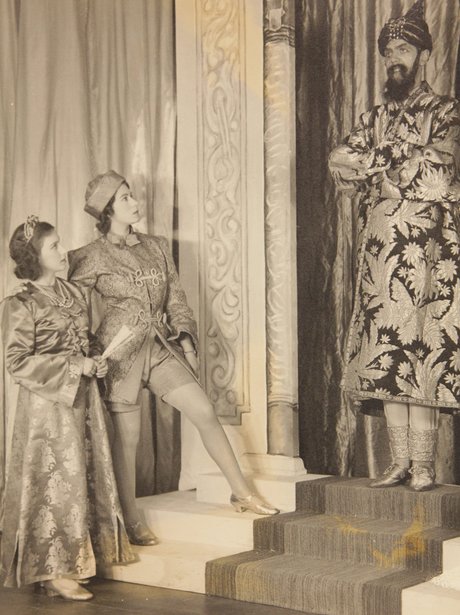
Well, its Pantomime, a peculiarly British theatre form that is a good few centuries old and is very much part of the cultural landscape – theatre for everyone.  Only this week, photographs emerged of the current queen appearing as the ‘principal boy’ in pantomimes, taken between 1942 and 1944. As a child I fondly remember been taken to the theatre every Christmas, on a family outing, siblings, parents, aunts and uncles, grand-parents and cousins, to see the local pantomime. With an older, more jaundiced eye, I have tended to frown at the tradition, as not being ‘real’ theatre, but it remains unarguably popular. Last year, the largest producer of the seasonal offering had in excess of 30 shows going on across the country, with a take of £25 million. So what exactly is it, in terms of form and what is its history? According to Professor Jane Moody, from the University of York, in her article It’s Behind You – A look into the history of pantomime

The story of pantomime is a tale of dragons and serpents. It features men dressed as women, and women masquerading as young men. Pantomime presents a tale of good and evil, where hope triumphs over adversity after danger and virtual despair. It has its roots in ancient Greece, and via Italy and France, insinuates itself into Britain. Pantomime’s unique fusion of eccentricity, ambiguity and absurdity has much to tell us about [British] national identity.

christmas-pantomime-1890-wiki

According to writer and caricaturist Max Beerbohm, pantomime is the only art form ever invented in England. It’s a splendid witticism, albeit untrue. Pantomime has become quintessentially British: as British as Earl Grey tea or a good Indian curry.

Pantomime’s history is a story of border crossings, as plots and performers slip across national, linguistic and cultural boundaries.

Panto season

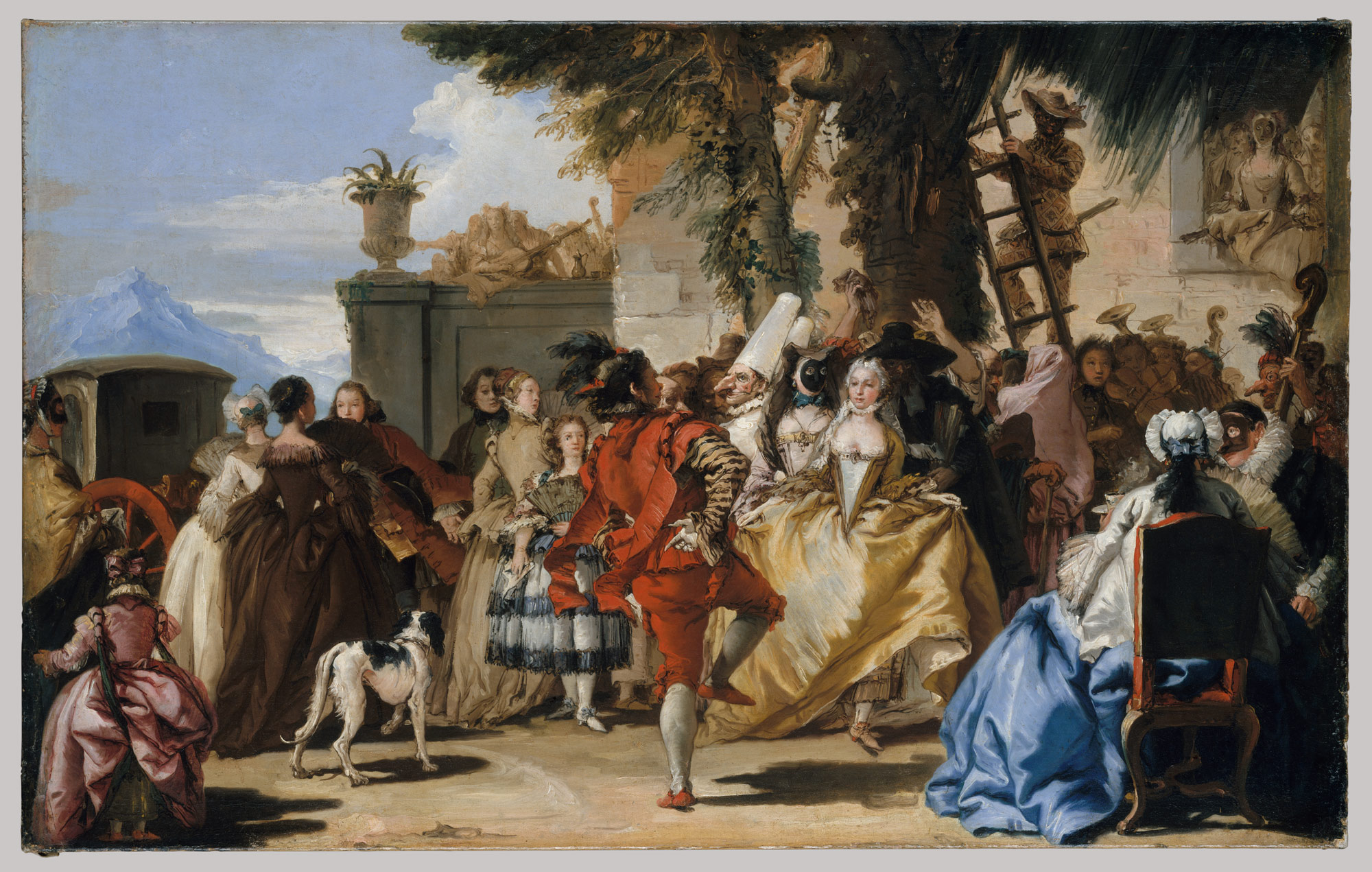
By complete coincidence, given my post last week, pantomime has its roots in Commedia dell’arte, which spread across Europe in the 16th Century, from Italy to France, and by the middle of the 17th century began to be popular in England. Soon after, the Commedia characters started to appear in english plays and on english stages. The history of Pantomime is well documented, and one of the best and accessible is from the Victoria and Albert Museum which covers the tradition in good detail:

  1. Early Pantomime – The transformation from Commedia to Pantomime
  2. Pantomime Acts – Which explains all about the Pantomime Dame, The Principal Boy and the animal impersonations.
  3. The Origin of Popular Pantomime Stories
  4. Victorian Pantomime – The development of the form and the introduction of ‘stars’ into the lead roles.

Accompanying the lecture below by Professor Jane Moody, which looks at the history of pantomime – part lecture and part performance – there is also the article mentioned above, It’s Behind You, which deals in another historical aspects.

.

If you want a sound-bite (slightly patronising) outline, watch this one:

.

But it will come as no surprise, that despite its continuing popularity, the tradition is changing and some claim, beyond recognition. Has the Christmas pantomime had its day? written by Gillian Orr in The Independent and Curtain falls on traditional panto – oh yes it does! written Jasper Copping in The Telegraph both discuss what has changed and why. But despite this, the audiences still roll in. My own nephews, who have to be torn away from their computers, tablets, phones usually kicking and screaming, still love to go to the ‘Panto’ and are duly taken by my sister, with grandparents in tow.

panto_2751309b


The current copy of Timeout London lists a total of 24, yes 24, Pantomimes happening across the city alone this year – and these are just the professional ones. Thousands of amateur groups get in on the act too – a nationwide outbreak of cross-dressing, if you will.

Having said that Pantomime is peculiarly british, they do take place elsewhere in the english speaking world, usually where the British used to rule – Canada and Australia being good examples. Even in Hong Kong, we have a traditional Pantomime performed every year by the The Hong Kong Players. I have to say though, I do find this a colonial hangover, an anachronism, and for me, somewhat embarrassing.

Playing The Fool

I realised this week that I sometimes miss the blatantly obvious when I am writing this blog. Once a week I set aside time to explore the things from Twitter that I have mined during the previous 7 days as well as trawl through the tried and trusted sites, blogs and people who feed Theatre Room. Also, I am often prompted by questions from my students and debates and discussions that happen in the classroom and studio as well as discussions with theatre teaching colleagues.

At the moment, all of my senior students are involved with research projects of one kind or another and I have quietly being doing some background research of my own to support them. And so it was that I came to the realisation above. One of my students, Grace, is exploring Commedia dell’Arte for her Independent  Project and although I know have referred in passing to the tradition, I don’t think I have devoted a post to it. So here it is.

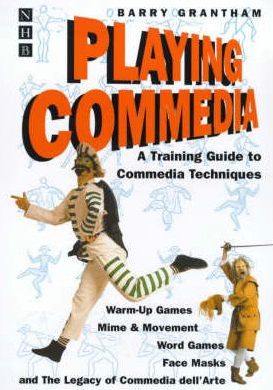
hb_1980.67There are lots of bits and bobs on the internet about Commedia, some more useful than others, but a general Google search will throw all these up. One of the best on-line histories comes from theatredatabase.com and can be found here. However, the best sources of information still remain (much to my surprise and occasionally to my students’ chagrin) printed texts. The best list of these can be found here, complied by Jonathon Becker on his website theatre-masks.com. Of all of these, there are two that stand out. 254682Firstly there is Commedia Dell’Arte: An Actor’s Handbook by John Rudlin which is a bit of a bible, in my opinion. One review on Amazon says It is not an esoteric bible of secret facts which will allow anyone to become a commedia performer.It is an actor’s manual and, if you cannot find adequate live teaching of the form, it is one of the best books you can find to start with. I couldn’t agree more!  The other one I always recommend to students is Playing Commedia by Barry Grantham. It has a section on different types of warm-ups and games specific to 9781854594662_Fotorskills and/or characters and there is another section with a history of each character which is invaluable. There are lots others available, some more practical, some more academic, but these two are my favourites. In fact the number of books still in print says much about the tradition itself – it is alive and flourishing. One company that specialises is Faction of Foolsbased at Gallaudet University in Washington DC.

Commedia is classed by UNESCO as a piece of Intangible World Cultural Heritage and as such there is even a World Commedia dell’Arte Day, 25th February every year. A look at the report produced for the 2013 day shows just how wide-spread (5 continents) Commedia practitioners are.

I want to share a series of videos produced by the National Theatre in the UK, which are a great little resource.

.

.

.

.

.

The workshops in the video are led by Didi Hopkins from Commediaworks, a UK based organisation that aims to keep the [Commedia] flame alive and burning bright. To this extent, they worked with Richard Bean, the writer of the internationally successful modern reworking of Carlo Goldoni’s classic The Servant of Two Masters, in the form of One Man, Two Governors.  You can read Goldoni’s original text here, courtesy of Project Gutenberg. Goldoni is often accused of ‘killing’ Commedia, by writing it down – committing an oral, improvised art, to the page. Hopkins and her partner in Commediaworks, Ninian Kinnier-Wilson, wrote the programme/play bill notes for One Man, Two Governors where they challenged the notion of Goldoni as ‘murderer’.

Did Goldoni Murder Commedia?

When Goldoni wrote The Servant of Two Masters, some say he killed Commedia dell’Arte. Was it alive? What was it? And why was a playwright accused of its murder?

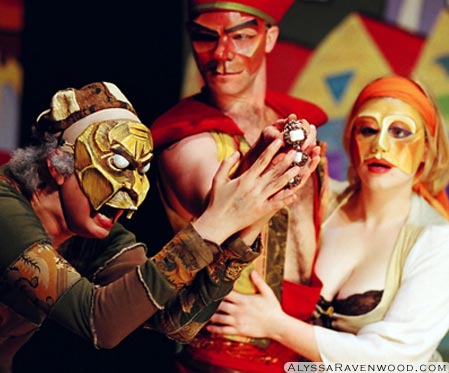
Commedia dell’Arte, or Comedy of the Guild, was the first professional theatre in Europe, appearing in the 1550s in Northern Europe. Actors were paid a fair wage. A round of applause on your exit line meant you often got extra money… and on stage, for the first time, there were women. Before Commedia, Literary Societies, populated with academics, often performed amateur theatre, and there were professional entertainers – jongleurs – but there was no professional theatre. Commedia dell’Arte seems to have been a marriage between the academics and the jongleurs, between ideas and skills, between mind and body, and between high and low class. It was originally known as ‘Commedia all’Improviso’, the players taking the roles of different types found in society, from lowly servants to middle class professionals and lofty aristocrats. These types were clearly defined and contrasted to help the actors with their improvisation: high masters with low servants, lost lovers with knowing maids, cunning servants with stupid masters. As there was no written play, the actors worked from a scenario or running-order pinned up behind the stage, detailing entrances and exits of the players and the main points to be conveyed in the scene.

101203ArlecchinoTraditional themes involved riches and poverty, power and servitude, barrenness and fertility, wisdom and folly, and, of course, life and death – powerful reasons to drive characters through their stories.
There was no central hero in the Commedia dell’Arte, rather each character had a storyline with a beginning, middle and end to their plight, and all these stories were woven together to end, usually with a marriage, in the final scene. As well as socially, the characters were also divided by whether or not they were masked. The masked characters are cyclical and end the story back in their rightful places; the unmasked are linear and go on a journey from one state to finish in another. Both sets of characters have lessons to learn on the way about life, love, justice and society – all topics that would concern their audience.

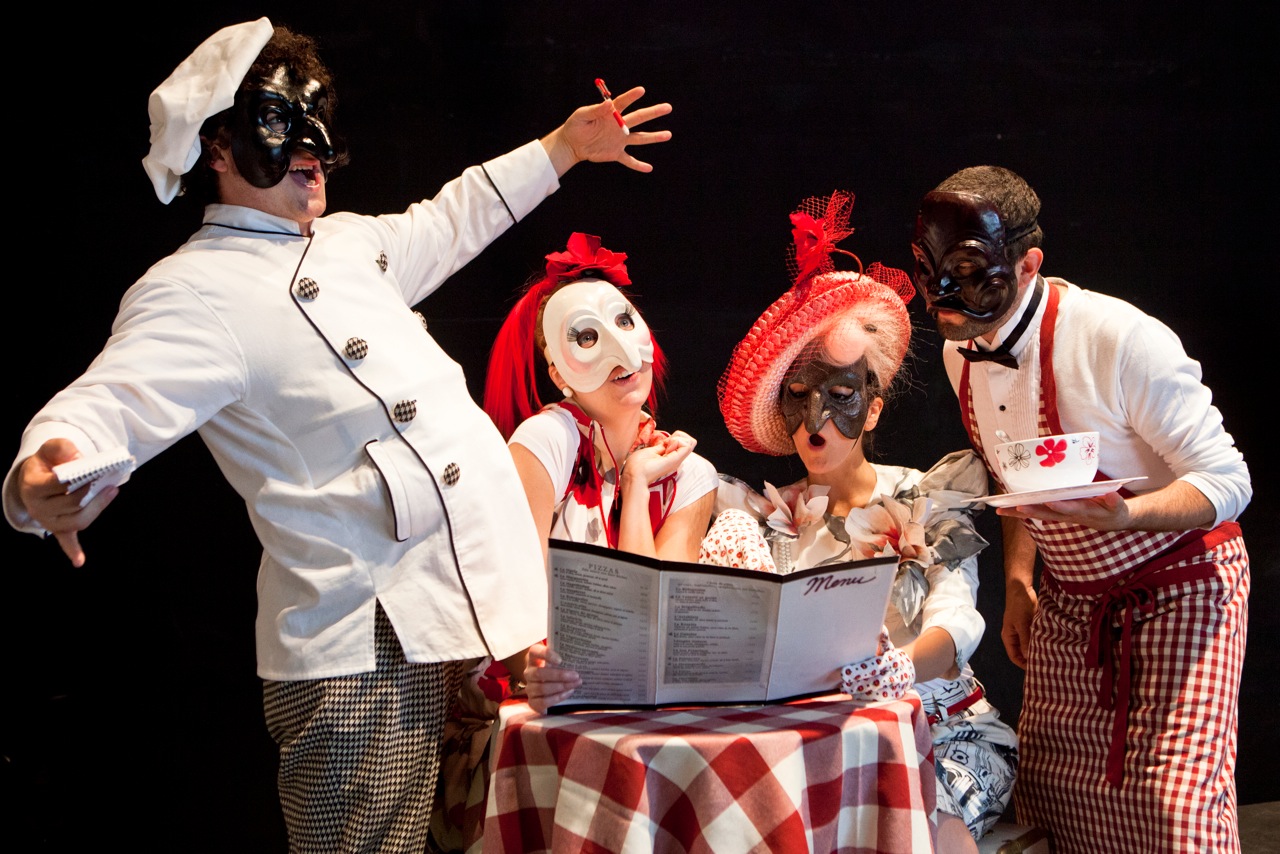
tablemasks

Commedia actors studied hard for their parts, and learned quantities of text. The unmasked lovers learned love poems and duets; the professionals were familiar with business ideas of the day, the latest interests of the academic societies, and could speak Latin, Greek and Hebrew like their equivalents in the audience. The braggart Captain had speeches of valour and ridiculous long Spanish names. The players of the servants had to practise tumbling and set piece gags, or ‘lazzi’. All this had to be retained and inserted into scenes when appropriate and at the drop of a hat.

Commedia all’Improviso was a literate and visual theatre, speaking the ideas of the Renaissance literary society and using the vulgar visuals of the illiterate lower classes, combining the two to speak to the whole audience. Sound commercial sense! It also meant that the players of the Commedia all’Improviso were truly skilled. Trained to a very high level in their chosen roles, they were more than just actors, they were artisans of the theatre: the Commedia dell’Arte.

commedia-dell-arte-Y-2-3A

So why was Goldoni accused of killing Commedia dell’Arte?

Others, including Molière and Marivaux, had made text plays in the style of Commedia dell’Arte. But by the 1740s the Commedia was old. At its birth two hundred years before, it had sprung to life fully formed and travelled the courts and countryside of Europe, speaking secrets and introducing theatre to many of the countries it visited. It had a purpose. By Goldoni’s time it had forgotten that purpose and was wrapped not in the sharp ideas of the Renaissance but in the fluffy gauze of the Rococo of Watteau and the fairytales of Gozzi. It was not a murder, it was a mercy killing. Commedia was resurrected and brought back to life two centuries later by the Piccolo Teatro of Milan when, in 1947, Giorgio Strehler, Jacques Lecoq and mask-maker Amleto Sartori picked up Goldoni’s script and pieced together, through information and research, a new template for understanding the form, the characters and the rhythms of Commedia dell’Arte. It is a tradition that has influenced theatre, actors and playwrights and its strong imprint can be seen in Restoration comedy, melodrama, music hall, vaudeville, circus, pantomime and in the Zanni of Chaplin, the Marx Brothers, Laurel and Hardy, Mr Bean, and beyond. The work goes on.

8113413776_4e7bab0440_o

Goldoni the playwright is innocent of the murder of Commedia dell’Arte. By writing down what he witnessed in his rich and theatrical Venetian landscape, he helped to preserve it and keep the flame alive. He tried to bring together two traditions of European theatre – the playwrights’ theatre, and Commedia – the actors’ theatre. Viva la Commedia!

If you would like to know more about One Man, Two Govenors, you can download the education pack that accompanies the show here.

What The Butler Saw

JHaynesPortrait2A quick video post from me today.  The first is a documentary from the BBC about the playwright Joe Orton that TheatreVoice has added to its growing video archive, TheatreVoiceTV. 

Orton lived a short but vibrant life and I was reminded of him recently when one of my performing arts students decided to write an investigation of the history of farce in theatre.

If you would like to know more, there is a fantastic website that has masses about Orton, his life and his plays – Joe Orton Online.

.

.

OH GOD-oh

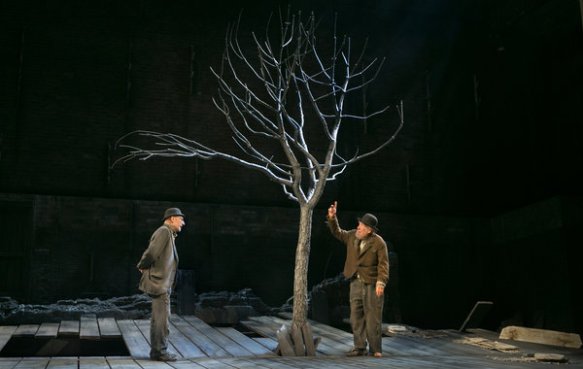
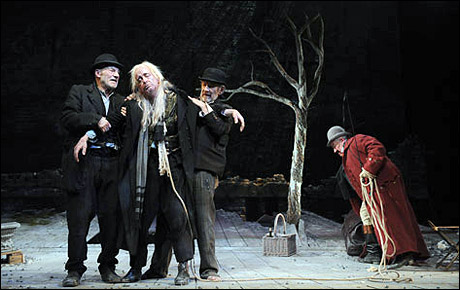
It’s production time at my school, so the posting has slowed down a little bit in the last week or so.  Normal service will be resumed next week.  However, one little item that made me smile was an article two days ago in The New York Times by Dave Itzkoff, entitled The Only Certainty Is That He Won’t Show Up  which is about the right way to say ‘Godot’. The reason why this resonated was that a touring production of Waiting for Godot came through Hong Kong earlier in the year, during a holiday when I was away, and some of my students went along to see it. When school was back in session, and they were eager to share their experiences and thoughts, many of them were pronouncing it god-OH, stressing the final syllable, rather than the first. I chose not to put them right (so I thought) as I was delighted they had gone to see one of the theatre classics under their own steam.

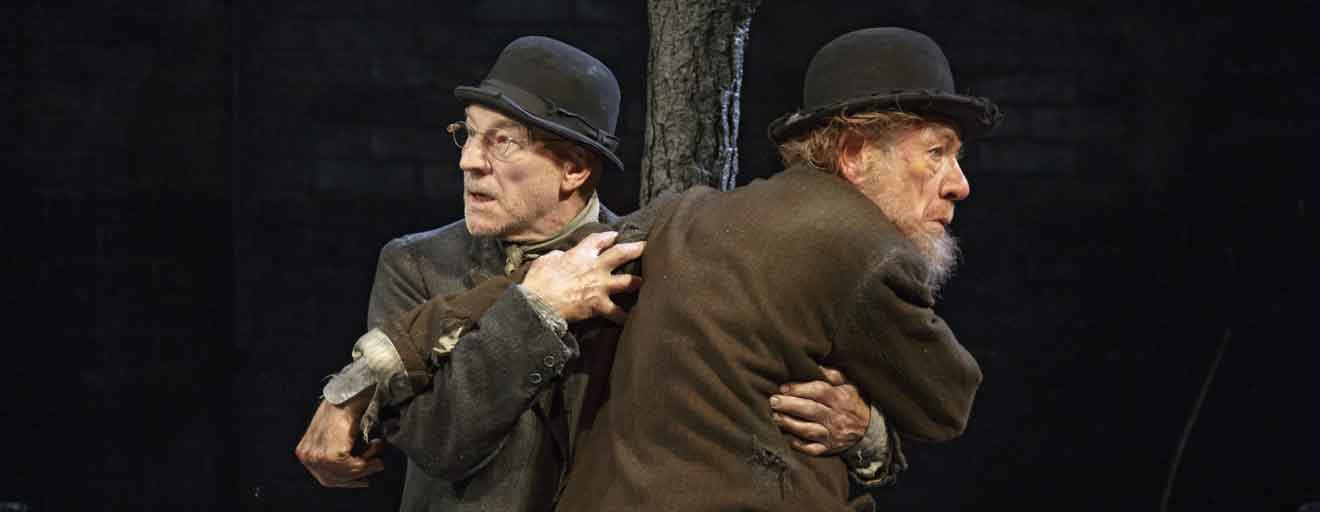
ban-01Now the reason Samuel Beckett’s most famous play is in the news at the moment,  is that two of the most famous stage (and screen) actors in the english-speaking world are about to open in it on Broadway – Sirs Ian McKellan and patrick Stewart – a great reason to spend Christmas in New York, as far as I’m concerned. I can guarantee that they will pronounce GOD-oh!

Here’s the article I mentioned above.

The Only Certainty Is That He Won’t Show Up

The Right Way to Say ‘Godot’

Maybe Godot never appears because everyone is mispronouncing his name.

More than 60 years after the debut of“Waiting for Godot,” Beckett’s absurdist drama about two vagabonds anticipating a mysterious savior, there is much disagreement among directors, actors, critics and scholars on how the name of that elusive title figure should be spoken.

“GOD-oh,” with the accent on the first syllable, is how “it should be pronounced,” said Sean Mathias, the British director of the latest a Broadway revival of “Waiting for Godot,” opening later this month at the Cort Theater.

“It has to be, really,” he said. “There’s no other way to do it.”

But the theater critic John Lahr said that rendering “is too obvious” for the playwright Samuel Beckett, with its suggestion of the Almighty.

“Beckett is more elusive and poetic, and he wouldn’t hit it on the head like that,” said Mr. Lahr, a longtime contributor to The New Yorker, who instead advocates for “god-OH,” with the accent on the second syllable.

Georges Borchardt, a literary agent who represented Beckett and continues to represent his literary estate, suggested even a third pronunciation was possible.

“I myself have always pronounced it the French way, with equal emphasis on both syllables,” Mr. Borchardt said in an email.
12GODOTjp-articleLarge

Mr. Borchardt said he had consulted with Edward Beckett, a nephew of the author, who told him that his uncle pronounced it the same way, and that Edward Beckett could not see “why there should be a correct or incorrect way of pronouncing Godot.”

“As the agents for the estate,” Mr. Borchardt continued, “we do not insist on any particular pronunciation.”

There seems to be nothing to be done to reconcile these competing camps, and productions of “Godot” do what they will. In a video recording, Peter Hall, who directed the first British production, in 1955, pronounces it GOD-oh. An American television production from 1961 starring Burgess Meredith and Zero Mostel uses “god-OH.” Discussing his role in the 2009 Broadway production, Nathan Lane says “GOD-oh.”

“I don’t think there is a mathematical solution to this problem,” said Mark Nixon, the director of the Beckett International Foundation at the University of Reading in England. Dr. Nixon said he believed the name was correctly pronounced with a stressed first syllable. But, he said, “I don’t feel strongly in the sense that I would correct somebody who said it differently.” Still, he did not dismiss the Godot question as a trivial issue. “Nothing’s trivial when it comes to Beckett,” he said.

The debate would surely please Beckett, an Irish author who originally wrote “Waiting for Godot” in French before translating it into English, and whose work embraced ambiguity and resisted easy interpretation. As this Nobel laureate wrote, “no symbols where none intended,” but he kept his intentions mysterious and seemed to leave symbols everywhere. The pronunciation of Godot, like the name itself, seems pregnant with meaning, yet ambiguous.

One might think that Beckett’s own writing would plainly reveal his wishes, but, gosh, no.

According to “The Theatrical Notebooks of Samuel Beckett” (Grove Press), when “Waiting for Godot” was performed in the 1980s by the San Quentin Drama Workshop, Beckett sought “to counter the natural American tendency to stress the second syllable” and asked his actors “consciously to pronounce it with the stress on the first syllable instead.”

Dr. Nixon said that recordings of the author’s voice are extremely rare — “only about four, or four and a half, are in existence.”

“I’ve heard all of them,” Dr. Nixon said, “and on none of those recordings does he use the word Godot. So, unfortunately, that’s not a route we can take.”

The French-looking name Godot may seem to call for a French pronunciation. But in an English-language production, speaking Godot without stressing either syllable “would be similar to saying ‘Paree’ for Paris,” explained the actor Adrian Dunbar, an experienced Beckett performer.

“Although not incorrect,” he said, “it does sound a little, shall we say, faux.”

There is no definitive origin story for the name Godot, either. It may be Beckett’s reference to the French bicyclist Roger Godeau or to French slang words for boots, a pair of which feature prominently in the play.

Mr. Lahr rejected the interpretation that Godot was simply a stand-in for God, an idea he said was too easily conjured up by the pronunciation GOD-oh.

When his father, the actor Bert Lahr, played Estragon in the original American productions of “Waiting for Godot,” Mr. Lahr said “god-OH” was used.

“It keeps it open-ended and more painful, almost, as if there’s nothing out there,” Mr. Lahr said. “Which there isn’t, in Beckett’s vision.”

And for American ears, the GOD-oh pronunciation can sound affected, and can take some getting used to.

Mr. Mathias, whose production of “Waiting for Godot” was originally staged in the West End of London, said that when it transferred to New York, “we had to train everybody” to embrace this pronunciation.
waitingforgodotLDN460f

“Could you imagine the poor crew?” Mr. Mathias asked cheekily. “Anybody who says ‘god-OH,’ I say, ‘Excuse me? What’s that? We’re not doing that play.’ Poor things.”

Shane Baker, who translated “Waiting for Godot” into Yiddish, said that actors in this version of the play said “god-OH” because “that’s how it’s known in America.”

“I was the translator,” said Mr. Baker, who also played Vladimir in the New Yiddish Rep production at the Castillo Theater in Manhattan. “But the producer and director wanted god-OH, so there you have it.”

“We did it wrong,” he said. “Look, I had other battles I had to fight.”

Mr. Baker added that, over the years, “Waiting for Godot” had become part of “the people’s imagination.” It has been paid tribute in films like “Waiting for Guffman,” and the subject of a “Sesame Street” parody, “Waiting for Elmo.”

Saying “god-OH,” he said, has become part of the vernacular, and it is too late to talk audiences out of it.

“The rest of the play is jarring enough,” Mr. Baker said. “Why upset them?”

Palaces of Fun

I have been collecting material for today’s post for quite a while and following the development of one aspect for most of this year. 2014 marks the centenary of the birth of Joan Littlewood, the celebrated founder of the radical Theatre Workshopand director of the internationally renowned Oh What A Lovely Wara piece that was widely recognised as changing attitudes towards World War I, as this recording from the BBC Witness programme describes.

Another, longer, programme broadcast yesterday, also by the BBC, talks about the creation of the show and is really fascinating.

Theatre-Royal-Stratford-East-1963-630x310

joanlittlewood460Outside theatre circles, Littlewood is largely remembered for Lovely War but she in fact had an impact on the development of theatre and theatre practice to such an extent that she is credited with being a radical theatrical visionary and one of original figures responsible for the regeneration of the British theatre. Her obituaries in the New York Times and The Guardian paint great pictures of her life and career. However, having had an incredible impact on the development of British theatre, there was one aspect of her work that was never realised – The Fun Palace. An article by writer and theatre-maker Stella Duffy in The Guardian explains:

Celebrating Joan Littlewood: it’s time to build her fun palaces

The trailblazing director wanted to create cultural spaces across the UK. In 2014, her centenary year, you can make it happen

In January, at Improbable’s annual Devoted and Disgruntled event, I called one session:“Who wants to do something for Joan Littlewood’s centenary in October 2014, that isn’t another revival of Oh! What a Lovely War?”.

Oh! What a Lovely War, which Joan developed, is brilliant, but with the first world war anniversary next year, there will be many revivals and Joan was more than a director. She was one of the few British directors (before or since) to work fully with an ensemble, from training to performance. She made “immersive” theatre long before immersive was cool. She kick-started improvisation in the UK. She was political, formidable, inspiring, and far ahead of her time.

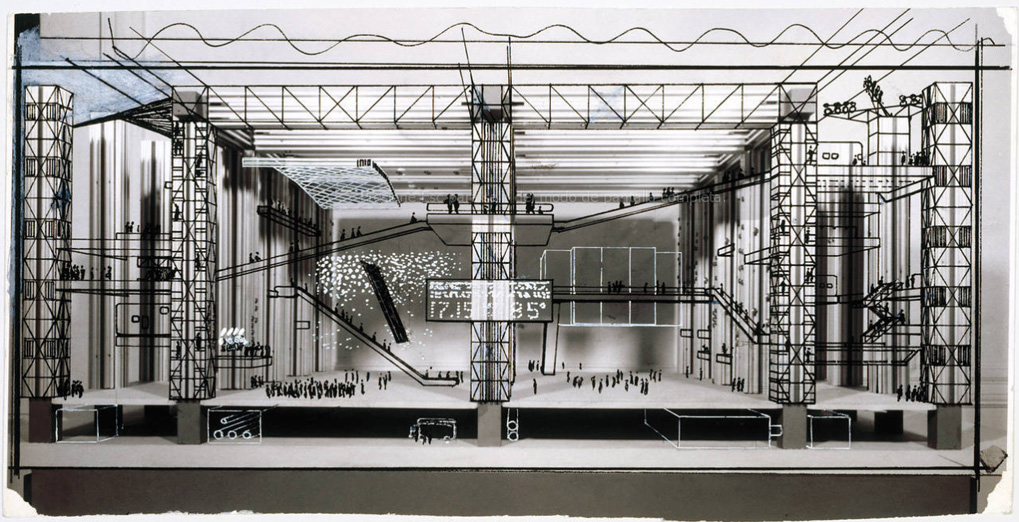
In 1961, Joan and the architect Cedric Price came up with the idea of thefun palace. Their blueprint says:

“Choose what you want to do – or watch someone else doing it. Learn how to handle tools, paint, babies, machinery, or just listen to your favourite tune. Dance, talk or be lifted up to where you can see how other people make things work. Sit out over space with a drink and tune in to what’s happening elsewhere in the city. Try starting a riot or beginning a painting – or just lie back and stare at the sky.”

An idea descended from pleasure gardens, the fun palace was designed to link arts and sciences, entertainment and education, in a space welcoming to all – especially children and young people. Joan knew she had not yet discovered a way to welcome those who found buildings and institutions daunting – the fun palace would be about public engagement at its most open and inclusive. Perhaps because they wanted to make links between places such as the zoo and Wembley, via screens and technology that did not yet exist; perhaps it was just too soon. But the councils wouldn’t give the land, the permissions and money did not eventuate.

1251412840-1

In the D&D discussion we talked about fun palaces maybe happening anywhere. I tweeted that maybe, and there were dozens of immediate responses. It helped that some were from big buildings like the RSC……. I thought we might make three or four fun palaces for Joan’s centenary.

Today we have 134 venues, companies, schools, universities, museums, arts centres and digital companies engaged, as well as hundreds of independent artists. There are scientists, film-makers, fine artists, walkers, storytellers, a cub scout pack, massive venues and tiny two-person companies, wanting to make their “laboratory of the streets” on 4-5 October 2014.

Sarah-Jane Rawlings and I……. aim to bring it all together with a brilliant, yet-to-be-created website, digital and physical links. We don’t know what your locality wants – but you do. Together we’ll make fun palaces 2014, across the UK and beyond, a step towards the kind of engagement many of us believe in and most of us have yet to achieve. Doing it together, jointly and uniquely, will be a huge shout about the value of cultural engagement, just as 2012 was for sport.

And if we don’t change the world next year, we’ll do it again in 2015 and 2016.

Since then, individuals, groups, theatres, companies, professionals and amateurs from across the world have signed up to take part. Theatre Royal Stratford East, Littlewood’s own theatre,  has become the organising hub and their website is hosting The Fun Palace site. Stella Duffy is an avid tweeter and there is clear excitement from people on there. You can read the Fun Palace 2014 Manifesto here which also gives you the statistics for who is taking part as of this month – 264 and rising.

Untitled_FotorI think this is a great idea and I am looking forward to see how and where it develops over the next year.

A Poke In The Eye

I have just come across the work of a theatre company called Spymonkey. Founded in 1997, it is a pan-european outfit with performers from Spain, Germany and England and, according to the Boston Herald, they produce a

dark, edgy physical comedy rooted ‘somewhere between Monty Python, the Marx Brothers and Samuel Beckett.

Untitled_FotorThey are clearly an international success as their tour schedule shows.  Their current piece is called Oedipussy, an irreverent take on the Sophocles classic, Oedipus Rex. Now this just happens to be one of my favourite Greek plays – I am, in fact, a great fan of ancient Greek theatre – and it normally features in my teaching of exam years at some point. I love telling the narrative to my students and waiting for the wails of disbelief/disgust to start, once things begin to unravel for Oedipus and they, my students, realise what is going to happen next.  Playing with Greek Chorus is a great way into teaching/learning about ensemble technique. If you don’t know the play, or much about Greek theatre in general, there is an exhaustive work-pack here, from the National Theatre of Great Britain.

Ralph Fiennes as Oedipus 2008

Ralph Fiennes as Oedipus 2008

For me, the great thing about Greek Tragedy is the epic nature of the tales and sheer breadth of humanity’s (and the Gods’) frailties laid bare. But I have always thought they were just a stone’s throw away from being riotously funny too, and it would seem that this is what Spymonkey has done with their version. Indeed, one critic commented that there is a brilliant moment at the end of Spymonkey’s spoof, an evening which proves that in every tragedy there is a comedy trying to get out. Another commented that some people will never “get” Spymonkey: their loss. This is not just inventive comedy but an affirmation of all human weakness…

.

Take a look at this taster for the piece. I should warn you though that sight of grown men wearing nappies/diapers is a tad disturbing.

.

Finally I have been looking for a reason to post this photograph, trawled from Twitter. It amused me immensely:

Photo 146_Fotor

National Express

Today is a mixed bag of the gems that are coming out of The National Theatre in the UK as party of its 50th anniversary celebrations.

Firstly another in the Scene Changes discussions, this one about lighting design and the role of the lighting designer. Again really interesting and gives you a great idea about the profession and how technology has advanced theatre lighting. Featured on this panel are lighting designers Paule Constable (War Horse, The Light Princess), Richard Pibrow (Three Sisters), Natasha Chivers (Sunday in the Park with George) and Paul Pyant (The Wind in the Willows). Something I didn’t know was that the job of the lighting designer came from the US and until then, the director had been in charge of lighting a show.

.

Secondly, the second part of the radio documentary, The Road to the National Theatre – Whose National Theatre, from BBC Radio 4. The first part is in my post National Debt

.

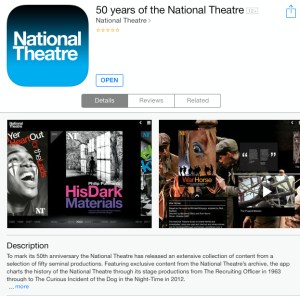
National AppAnd finally from the Apple App Store which charts the history of the theatre through its productions from 1963 to today. It includes interactive timelines, production materials, costume designs, technical images, annotated scripts, video interviews and so on. Really informative and you could spend a good afternoon working your way through it. A useful resource. Click the image on the left for more information.

.