A Stronghold In The Desert

Fifteen years ago I spent some time travelling through Syria and Jordan. It was my first trip to the Middle East and it was a defining moment for me. Both countries have had a lasting impact, not least because of the richness of their culture and history. In addition to Petra, two places remain very firmly planted in my memory. Firstly the Souk al-marina in Aleppo was a sensory delight,  an incredible bazaar built over 500 years ago under the Ottoman Empire and sat firmly on one of the World’s oldest trade routes. Secondly, Krak des Chevaliers, a crusader castle dating from 11th century, dripping in history.

SYR_1024_298371k

Souk al-marina before it was destroyed

krak_des_chevaliers_syria_photo

Krak des Chevaliiers before the civil war

Both have suffered badly during the Syrian civil war that has now been raging for 3 years. The Souk in Aleppo was destroyed by fire, and much of the city itself razed. Krak des Chevaliiers has been damaged by shelling and fire too.  It happens to be near Homs, another war-torn, ravaged Syrian city and has suffered accordingly. Both are (or in the former’s case, were) UNESCO World Heritage sites.

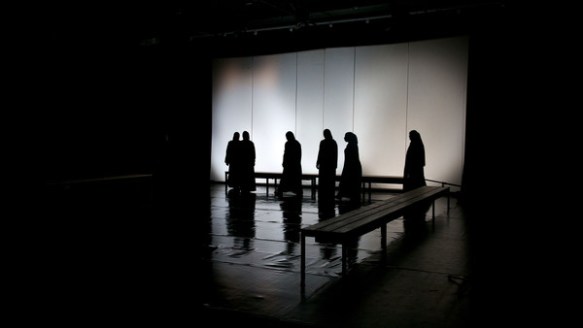
Where am I going with this? Well I was reminded of this visit again recently.  I have written twice here already (No Longer A Refugee and No Longer A Refugee #2about a group of women who have fled the fighting in Syria and have become performers in a production of The Trojan Women, a greek tragedy that reflects their own experiences. However, I have recently also become aware of another theatre project with Syrian refugees, but this time with children. Not surprisingly, many of the people fleeing the fighting in Syria have fled to neighbouring Lebanon and Jordan. One of the biggest refugee camps is the Zaatari Camp in Jordan which is currently housing about 150,000 people, an estimated 60,000 of whom are children with only a quarter of these receiving schooling.

1617466_875694579113737_164206393_o

In an attempt to help some of these children, Nawar Bulbul, a Syrian actor, has been working to stage a production of Shakespeare’s King Lear, with Lear recast as the Syrian president, Bashar al-Assad and Lear’s daughters as the different factions fighting in the civil war. I will let Ben Hubbard take up the story from here, in his excellent piece for The New York TimesBehind Barbed Wire. 

Behind Barbed Wire, Shakespeare Inspires a Cast of Young Syrians

ZAATARI REFUGEE CAMP, Jordan — On a rocky patch of earth in this sprawling city of tents and prefab trailers, the king, dressed in dirty jeans and a homemade cape, raised his wooden scepter and announced his intention to divide his kingdom. His elder daughters, wearing paper crowns and plastic jewelry, showered him with false praise, while the youngest spoke truthfully and lost her inheritance.

So began a recent adaptation here of “King Lear.” For the 100 children in the cast, it was their first brush with Shakespeare, although they were already deeply acquainted with tragedy.

All were refugees who had fled the civil war in Syria. Some had seen their homes destroyed. Others had lost relatives to violence. Many still had trouble sleeping or jumped at loud noises. And now home was here, in this isolated, treeless camp, a place of poverty, uncertainty and boredom.

Reflecting the demographics of Syria’s wider refugee crisis, more than half of the 587,000 refugees registered in Jordan are younger than 18, according to the United Nations. Parents and aid workers fear that Syria’s war threatens to create a lost generation of children who are scarred by violence and miss vital years of education, and that those experiences and disadvantages will follow them into adulthood.

20140401_ZAATARI-slide-XUG9-superJumbo

The “King Lear” performance, the conclusion of a project than spanned months, was one attempt to fight that threat.

“The show is to bring back laughter, joy and humanity,” said its director, Nawar Bulbul, a 40-year-old Syrian actor known at home for his role in “Bab al-Hara,” an enormously popular historical drama that was broadcast throughout the Arab world.

The play owed its production largely to Mr. Bulbul. Smoking hand-rolled cigarettes and speaking with the animated face of a stage actor who never stops performing, Mr. Bulbul described his journey from television star to children’s director.

When the Syrian uprising broke out in 2011, he joined with gusto, appearing at antigovernment protests, leading chants and drawing the ire of the security services. A play he produced was banned, and a fellow actor who supported the government informed him that he could either appear on television to rectify his stance or expect to be arrested.

“I told him I would think about it, and a week later I was out of the country,” Mr. Bulbul said.

Bulbul watching rehearsals

Last year, he and his French wife moved to Jordan, where friends invited him to help distribute aid in Zaatari. The visit exposed him to what he called “the big lie” of international politics that had failed to stop the war.

“There are people who want to go home, and they are the victims while the great powers fight above them,” he said.

Children he met in the camp made him promise to return, and he did — with a plan to show the world that the least fortunate Syrian refugees could produce the loftiest theater.

The sun blazed on the day of the performance, staged on a rocky rectangle of land surrounded by a chain-link fence topped with barbed wire. The 12 main actors stood in the middle, while the rest of the cast stood behind them, a chorus that provided commentary and dramatic sound effects. The audience sat on the ground.

20140401_ZAATARI-slide-7SEC-superJumbo

When each of Lear’s first two daughters tricked him with false flattery in elegant, formal Arabic, the chorus members yelled “Liar! Hypocrite!” until the sisters told them to shut up.

And when the third sister refused to follow suit, the chorus members yelled “Truthful! Just!” until the king told them to shut up.

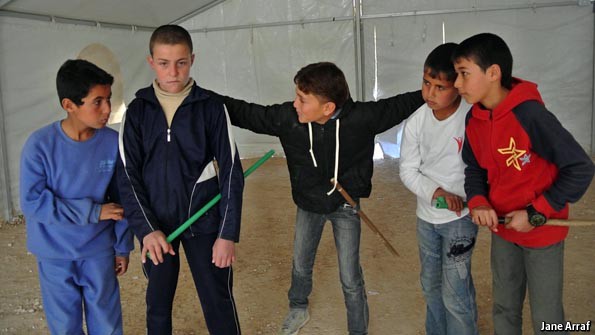
In later scenes, the king was heckled by the Fool, who wore a rainbow-colored wig, and eight boys performed a choreographed sword fight with lengths of plastic tubing. A few scenes from “Hamlet” were spliced in, making the story hard to follow. And at one point, a tanker truck carrying water roared by, drowning out the actors and coating the audience in a cloud of dust.

20140401_ZAATARI-slide-O1FD-superJumbo

But the mere fact that the play was performed was enough for the few hundred spectators. Families living in nearby tents brought their children, hoisting them on their shoulders so they could see.

After Lear’s descent into madness and death, the cast surrounded the audience, triumphantly chanting “To be or not to be!” in English and Arabic. The crowd burst into applause, and a number of the leading girls broke into tears. Mr. Bulbul said they were overwhelmed because it was the first time anyone had clapped for them.

After the show, as journalists interviewed the cast, the parents boasted of their children’s talent.

“I am the mother of King Lear,” declared Intisar al-Baradan when asked if she had seen the play. She had brought about 20 relatives to the performance, she said, adding that her son was also a great singer.

20140401_ZAATARI-slide-UA3C-superJumbo

Other parents described the project as a rare point of light in a bleak camp existence. Hatem Azzam, whose daughter Rowan, 12, played one of Lear’s daughters, said the family fled Damascus after government forces set his carpentry shop on fire. “We were a rebellious neighborhood, so they burned every shop on the street,” Mr. Azzam said. He arrived in Zaatari a year ago with five other family members, but one of his brothers got sick and died soon afterward, and his elderly mother never adjusted to the desert climate and died, too, he said. He hesitated to send his children to school, fearing that they would get sick in the crowded classrooms, and he kept them from roaming the camp because he did not want them to start smoking or pick up other bad habits. But the theater project was close to home, and his daughter was so excited about it that he let her go.

20140401_ZAATARI-slide-TSXA-superJumbo

“People get opportunities in life, and you have to take advantage of them,” Mr. Azzam said. “She got a chance to act when she was young, so that could make it easier for her in the future.”

The mother of Bushra al-Homeyid, 13, who played another of Lear’s daughters, said the family had fled Syria after government shelling killed her niece and nephew. “The camp is an incomplete life, a temporary life,” she said. “We hope that our time here will be limited.” But after a year here, she worried that her eldest daughter, who was in high school, would not be ready to go to college. Bushra, grinning widely and still wearing her yellow paper crown, said she had never acted before but wanted to continue.“I like that I can change my personality and be someone else,” she said.

(Illustrating photos by Warrick Page for The New York Times)
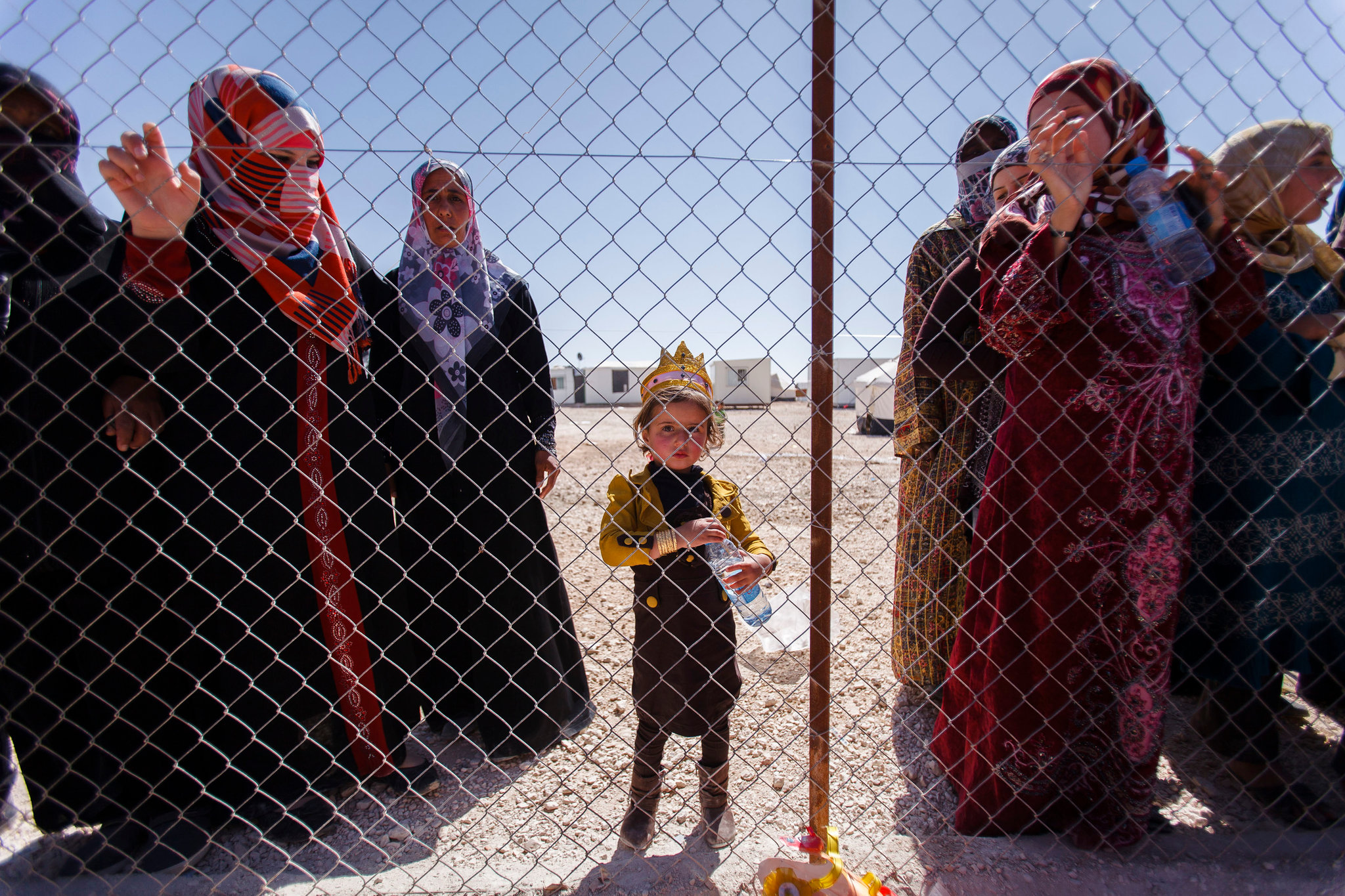
In his piece, City of The Lost for The New Yorker, David Remnick paints a desolate and harrowing picture of life in Zaatari – lengthy but worth a read.

Everything about this is a tragedy on a grand scale – a culture, lives and futures destroyed, but you cannot help but applaud Nawar Bulbul for what he is trying to do. He has set up a Facebook page and a YouTube channel, Shakespeare in Zaatari, which gives an even greater sense of what is being achieved out there in the desert. Having been forced to leave Syria himself, he continues to fight the Assad regime, even down to refusing to let what are considered to be pro-Assad media organisations film the project.
20140222_map503

Nouar Bolbol

Bulbul (left) is clearly a man of conviction and I for one celebrate what he is trying to achieve. Yes, it is only a small gesture when you consider that there are in excess of 60,000 children living in Zaatari. However he has chosen to harness the power of the thing he knows best – theatre – in an attempt to heal the brutal wounds of war, violence and dislocation. He doesn’t see theatre as a balm, a salve to make the horrors disappear. Some might say he is encouraging a very partisan view of the experience the children have been through. I would argue that it is simply a way of allowing an understanding of what brought about the situation they find themselves in and the truth about how one man and his regime can inflict incalculable suffering on others.

The Stage, Fighting

My first post today is a fascinating and troubling programme broadcast by the BBC last week. In it, the UK-based, Turkish theatre director, Mehmet Ergen travels back to Istanbul to explore the current state of the theatre in the country after the Arab Spring and Gezi Park protests.

Mehmet ErgenA background to Ergen and the programme, call A Tale of Two Theatres, is given here in the publicity from the BBC:

Acclaimed director Mehmet Ergen leads a double life, directing on stages 3000km apart. This programme follows him from London to Istanbul, to learn how much is now at stake for Turkish theatre.

Mehmet is best known to UK theatre audiences as Artistic Director of London’s Arcola Theatre. But his pioneering work in Hackney is only half the story as the programme discovers on a journey to his Turkish homeland, post Gezi Park and post Arab Spring, caught between the Syrian conflict and EU aspirations.

An Istanbul-born former DJ, Mehmet became the toast of London’s theatre scene by creating venues and careers from scratch. In 2000 he transformed a derelict clothing factory in Dalston into a destination venue, twice recognised by the Peter Brook Empty Space Award. Not content to run ‘a powerhouse of new work’ (in the words of theatre critic Susannah Clapp) in his adopted city, he later opened its opposite number back in his hometown.

istanbultheatre-protest

Tensions have been rising in Turkey between artists and politicians ever since the Prime Minister’s daughter was mocked on stage, allegedly for wearing a headscarf to the Ankara State Theatre in 2011. In 2012, a performance of Chilean play Secret Obscenities was censored by Istanbul’s Mayor Kadir Topbas.

Turkey Artistic FreedomsPrime Minister Erdogan then threatened to withdraw subsidies of up to 140 million
Turkish Lira from approximately 50 venues, employing roughly 1,500 actors, directors and technicians. Although wholesale privatisation has yet to be enacted, theatre companies openly opposed to government tactics during 2013’s Gezi Park protests promptly had their funding withdrawn.

Entrepreneurial ex-pat Mehmet acts as the listener’s guide to this politically charged arts scene, as he negotiates national and cultural borders to stage work that is as unpretentious as it is provocative.

A Tale of Two Theatres:

Somehow the situation in Turkey, which began in 2012, had passed me by and a little further digging only underscores what Ergen has to say. LABKULTUR ran a piece, Ethics of Art or Ethical Art, that is the question! that details the situation nicely, as did the Huffington Post.  You don’t need to speak Turkish to understand the following protest video. Entitled Şehir Tiyatroları Yok Edilemez, which roughly translates as our city theatres won’t be destroyed, is a powerful 24 seconds.

.

Let’s not forget that this is the same Prime Minister, Tayyip Erdoğan, who a couple of weeks ago attempted to block Twitter and Youtube to the whole country as both were hosting evidence of wide-ranging corruption in his government.

In 2012, Erdoğan accused theatre artists of being arrogant, saying They have started to humiliate and look down on us and all conservatives. Clearly theatre in Turkey is doing a great job if it manages to rattle the politicians in this way.

While researching this post I came across artsfreedom, an organisation which gathers international news and knowledge about artistic freedom of expression – or the lack of it. Click the image below to see what they do:

af_Fotorartsfreedom is an extension of Freemuse, a Danish-based organisation that advocates freedom of expression for musicians. Freemuse have started to gather annual statistics that cover artistic freedom of expression violations globally and the ones for 2013 make grim reading. A total number of 199 cases of attacks on artists and violations of their rights have been registered. The cases include 19 artists being killed, 27 newly imprisoned, 9 imprisoned in previous years but still serving time, 8 abducted, 3 attacked, 13 threatened or persecuted, 28 prosecuted, 19 detained, as well as 73 cases of censorship.

Visually it looks like this:

freemuse_FotorThe breakdown by country is here. The artsfreedom newsletter that reflects on these statistics is worth a (depressing) read here.

While artsfreedom works right across all arts, the pieces on their site that relate specifically to theatre are here.

Left Foot Forward

bec7cf1f76a3df6efdf60f12fcd545f2_FotorMy post last week about theatre and (geo)politics, A Rocky Road, has caused some interesting discussion in my department.  Today I would like to add another dimension to that debate by sharing an article by Holly Williams, for The independent. 2014 sees the commemoration of the beginning of the First World War, especially in Europe and Australasia. Over the course of the last year, there has been much polemic surrounding the nature of the commemorations, with many fearing, in the UK at least, that these commemorations could descend into jingoistic, flag waving events, rather than reflective experiences that explore the atrocity and human tragedy that was the First World War. Inevitably, the debate has largely split along the political divide, with even a government minister joining in, accusing British theatre of being left-wing in its portrayal of the events of the war – and this is where Holly Williams begins:

The First World War on stage: Lest we forget… the politics of war drama

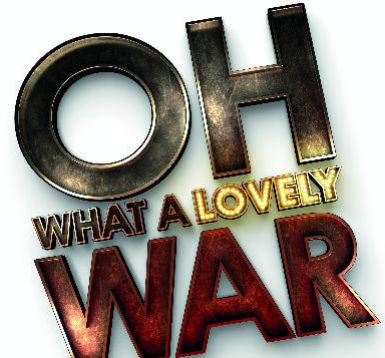
At the beginning of Theatre Royal Stratford East’s revival of Joan Littlewood’s 1963 musical Oh! What a Lovely War, a Pierrot clown describes a series of pre-war Bank holiday scenes, while a slide-show projects images of the seaside, bathers and a donkey. Except the “donkey” is the Education Secretary Michael Gove.

It’s apt that this landmark show about the First World War, which took swipes at the ruling classes who made a mess of it, should now laugh at today’s politicians too. And Gove is an easy, and justifiable, target: he made headlines recently by attacking Oh! What a Lovely War [as] perpetuating myths of the Great War as “a misbegotten shambles – a series of catastrophic mistakes perpetrated by an out-of-touch elite” and denigrating “patriotism, honour and courage”.

Birdsong

Birdsong

While it’s easy to smirk at the mental image of Gove stamping his foot, his reference to Oh! What a Lovely War reignited the debate about whether British theatre is inherently left wing: it’s hardly the first time it’s been accused of being the preserve of bleeding-heart, right-on liberals. But Gove had better stiffen that upper lip – 2014 sees First World War centenary events across all art forms, with theatre addressing the topic with particular vim.

The charge has already begun: Northern Broadsides are touring An August Bank Holiday Lark, about boys from a Lancashire village going to fight in the Gallipoli campaign, while the aforementioned  Oh! What a Lovely War is a huge sell-out at its original east London home. There are adaptations of books: a version of Sebastian Faulks’s Birdsong is on tour now, Pat Barker’s Regeneration arrives on stage at the Royal & Derngate in September, while a one-man play of Dalton Trumbo’s 1938 anti-war novel Johnny Got His Gun opens at the Southwark Playhouse in May. The National Theatre revives the rarely performed anti-war 1928 play The Silver Tassie in April, and there’s new writing too: Peter Gill’s Versailles is about to open at the Donmar, while in the autumn Shakespeare’s Globe stages Howard Brenton’s Doctor Scroggy’s War and the RSC has The Christmas Truce, a family play by Phil Porter.

These offer a vast array of different angles, from the impact of war on a rural community (An August Bank Holiday Lark) to the inner life of a man who had his limbs and face blown off (Johnny Got His Gun). Meanwhile, their protagonists range from officers in the trenches to civil servants in the corridors of power and the women who stayed behind. To assume that playwrights are wielding their pens like righteous political axes is simplistic, to say the least.

Rebecca Howell, Caroline Quentin, Alice Bailey Johnson and Zoe Rainey in Oh What A Lovely War

Oh What A Lovely War

And few within the industry have anything positive to say about Gove’s comments. “I thought it was unfortunate, unpatriotic, appealing to the worst side the country,” says the venerable Gill, who is also directing Versailles. “But mainly silly, and a bit embarrassing, frankly. Does he think we’re a fan of the Kaiser? It’s just childish!”

His play is set in the aftermath of war and centres on a young man sent among the British delegation to draw up the Treaty of Versailles; both in Paris, and at his family home in Kent, debate rages about the future of Europe.

And while Gill witheringly refutes the notion that British theatre is inherently left wing – “the National is hardly Trotskyite, is it?” – he does suggest that the stage is the ideal forum for ideological debate. “The Greeks showed us it is the perfect democratic instrument. It’s live and, unlike film, it’s not quite so able to manipulate. It’s the perfect dialectical [form] – I’m sounding like a communist now! – but it’s a perfect instrument for all kinds of things, and one of them is certainly airing [political debate].”

Versailles

Versailles

David Mercatali, directing the UK premiere of Johnny Got His Gun, suggests politics are a natural by-product of drama’s primary concern: the story. “There is nothing to say that politics needs to drive any medium, but I think that many people in theatre are looking to go beneath the presentation of history. If, in looking at those human stories, people feel a left-wing bias starts to come out, I don’t think there’s a lot we can do about that.”

He did, however, choose to stage Smith’s self-evidently anti-war monologue this year as a riposte to the misty-eyed patriotism that will also be sloshing about. “We have to be really careful about glorifying it. I actually think people try to protect the presentation of the First World War – it’s important that we expose the shortcomings behind it as well.”

An August Bank Holiday Lark

An August Bank Holiday Lark

Deborah McAndrew’s An August Bank Holiday Lark is winning rave reviews. But the playwright doesn’t see her role as political adjudicator. “Real historical analysis is probably not the job of a play, she says, “I’m a storyteller, I was looking for a story.”

However when she discusses Gallipoli, she can’t help but become angry. “If I was making any little political point it was that I felt young men’s lives were disregarded. And there was gross incompetence – Gallipoli was a disaster. There’s no way of spinning it. They were trying to invade Turkey, a whole country – the sheer numbers would tell you that was doomed to fail.” Which, really, is no “little” point.

Rachel Wagstaff, who adapted Birdsong for the West End in 2010 and rewrote it further for its current tour, echoes McAndrew: “I don’t think the job of a playwright is to teach history; it’s to tell stories.” But, she adds, writing is also an imaginative attempt to understand history and humanity. “How can we have allowed the situation to develop where, for example, in the first day of the Battle of the Somme, 20,000 [British troops] were killed? How can that ever be justified? As a playwright you’re trying to illuminate and question what it is to be human.”

Her show stages such battles – a logistical challenge that the production rises to with evocative use of lights, smoke and sound. And Wagstaff points out that theatre can be uniquely powerful in conveying the physical horror of war: “When it’s a real human being in front of you in that moment, I find that so much more affecting than on film or TV.”

Jonny Got His Gun

Johnny Got His Gun

Not that Birdsong isn’t also patriotic: Wagstaff says it also captures “the British spirit, that dark sense of humour” through its portrayal of the bravely upbeat Tommies in the trenches. “You have to show the events and honour them, and allow people to feel the horror,” says Wagstaff, “but on the other hand, you can’t have people sitting there for two hours just feeling sick, revolted, distressed and disturbed!”

Many of the plays being staged in 2014 do, then, question the decisions made before, during and after the war. Such harrowing source material naturally often lends itself to troubled – and sometimes explicitly anti-war – interpretations. But, despite what our Education Secretary might fear, they are also complex and humane in their interrogation, rather than limitedly “left wing”. “Isn’t it brilliant that people are having this debate?” says Wagstaff, injecting a note of positivity into the whole Govian furore, before concluding: “We must never allow such suffering to happen again, so it’s really important that we commemorate, and remember, and we tell our children. It’s more important than ever.”

I make no apologies for posting an article that is very UK-centric. I know similar debates are had right around the world about how politics and theatre collide, and that theatre makers are viewed as inherently left wing in their views. I think Williams’ word will have resonances everywhere. The politician Michael Gove is held in huge contempt for his ideology by the left leaning middle-class in the UK,  and for transparency’s sake I have to say I am in total agreement with them. I’d be interested to hear if a similar debate about theatre and the commemoration of the War is taking place elsewhere with such political overtones.

I want to finish with two other pieces of writing by theatre critic Michael Billington, both for The Guardian. Firstly, Oh What a Lovely War: the show that shook Britain which explores the impact of the original production in 1963 both on British understanding of the war and on theatre making more widely. Then, secondly, his review of the latest production of Oh What A Lovely War that has just been staged at the original venue of the ’63 production, Theatre Royal Stratford East. This latest staging formed part of the 50th anniversary of the play’s original staging as well as part of the centenary of the First World War.

Exits, Pursued By A Bear

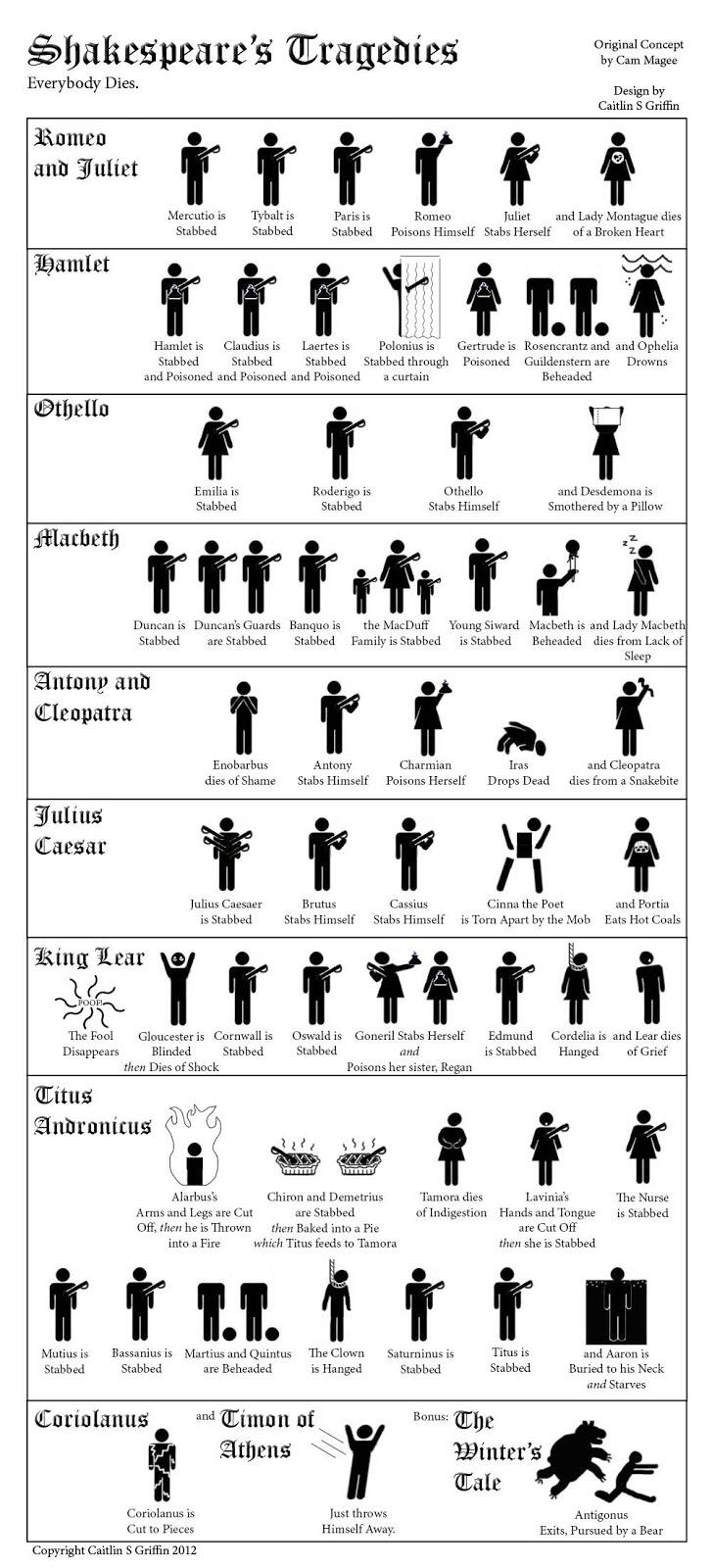
When I was a child, we had something called ‘wall charts’ that normally came free with weekend newspapers, and that covered every topic imaginable.  Today’s version of these are ‘info graphics’ and very often still created by the now online print media. Today I have two infographics to share, the first of which has been doing the rounds on social media for a while, but worth a look if you haven’t seen it. A great little aide memoir to all things death in Shakespearian tragedy. Following on from my last post, I’m guessing Kin Jong-Un hasn’t seen it.

BhLC9dlCcAA6eTlCourtesy of Cam Magee and Caitlin S Griffin

The second is one I stumbled across from goodreads.com which is rather amusing in it’s own way:

1366703200-1366703200_goodreads_misc

No Longer A Refugee #2

In January I wrote a post, No Longer A Refugee, about a group of women refugees who had fled the vicious civil war in their homeland Syria and were involved in the staging of a production of the Greek Tragedy, The Trojan Women. As I was driving to work today I listened to another thought-provoking programme about the project, which was broadcast by the BBC World Service, as part of their Outlook strand. If the January post struck a chord with you, I certainly recommend a listen to the Outlook podcast below:

604

How far that little candle throws his beams!

How far that little candle throws his beams! So shines a good deed in a weary world.

Portia, The Merchant of Venice.

Sydney Opera House at Night Australia Digital Art By mrmGoogle  ‘worlds famous theatres’ and the subsequent list is a mixture of iconic historic opera houses spanning a number of continents, the Chinese Theatre in Los Angeles and, not surprisingly, The Sydney Opera House. Now I could take issue on many fronts with what is considered to make a theatre famous, not least of all that none of them appear to take into account what actually goes on in inside. Yes, lots of them are works of art in themselves as this list from Huffington Post shows, but I would posit that were you to show these to most people they wouldn’t be able to tell what they are called or where they are. However, I would think a far great number would be able to tell you what and where this theatre is:

Pawel-Libera-Globe-Exterior

Shakespeare’s Globe was opened in 1997 and if you don’t know the history behind the reconstruction you can read that here. The point I am trying to make that since it opened, and for many reasons, it has become iconic throughout the world both for being the building it is AND for what goes on inside it. I’ve seen a play there and it is a truly unique way of watching theatre.  There is something democratic about the relationship between actor, audience and space – especially if it rains mid-performance. What’s more, as reported in The Stage, last year the theatre had a turnover of more that £21million, made a profit of £3.7 million, played to houses of 96% capacity and had a reach of 1 million people through it’s various ventures. Now that is some going for a theatre that started as one man’s, Sam Wanamaker, vision. It was built by raising money through donation and is less that 20 years old. The quote from The Merchant of Venice could well be said of Wanamaker and his vision, but I really intended it as an opening for the real purpose of today’s post.

the-sam-wanamaker-playhouse-85149

In January this year The Globe unveiled another theatre on its site, called the Sam Wanamaker Playhouse. Again built through fundraising, this ‘new’ theatre is another faithful reconstruction, but this time of an indoor, Jacobean theatre, entirely lit by candles. The exterior of the playhouse seems quite innocuous, but the images of the inside are a revelation and the reviews of the the two plays staged in it so far talk with some passion about the theatre-going experience in this new space. There is a great gallery of pictures here, from The Telegraph.

9386823

Much has been written about the Playhouse, not least of all the experience of lighting, acting in and watching a play by candlelight. The Jacobeans used candles made from animal fat, but the Globe have gone for pure beeswax, costing up to £500 per show, all of which are lit by hand before each performance. In a great article for The Guardian, Andrew Dixon give a real flavour of the place, New Globe playhouse draws us inside Shakespeare’s inner space

There is a very evocative and informative report from The Voice of Russia radio here which is fascinating, and talks about the experience as going back to storytelling in its most primitive form:

The Globe has produced a good series of videos about the Playhouse and I am going to put them all here, for ease of reference:

I think they tell a marvellous story. The following video is a collection of interviews with audience members on the opening night of The Duchess Malfi, and you get a real sense of what the experience is like:

There is also a really interesting podcast, courtesy of Theatre Voice, with Farah Karim-Cooper who is Head of Research at The Globe in which she explores indoor performance during the Renaissance and at The Sam Wanamaker Playhouse:

There is also a lovely piece called Ten Reasons to get excited about the Sam Wanamaker Playhouse at The Globe, also by Farah Karim-Cooper, published on Blogging Shakespeare.

If you are a regular reader of Theatre Room you will know my relationship with Shakespeare has it’s tensions, but I can only applaud the people behind this project and how it extends our understanding of the history of performance. I will certainly be booking tickets to see whatever is playing next time I find myself in the UK.

Voices Within

A quick little post from me today. An episode from a BBC World Service programme called  The Why Factor.

Untitled_FotorFrom sub Saharan Africa to the west coast tribes of Canada to the Mardi Gras of Rio, New Orleans and Venice, masks define realities – of religious belief, of healing power, of theatre and entertainment, of concealment and of memorialisation in death. They have been around as long as humanity and they evoke both fascination and fear. Mike Williams traces the power and culture of masks and asks why we have them and what they mean for us.

Click the icon below to listen to the podcast. Not entirely related to theatre but fascinating none-the-less.

p01plr4j_640_360

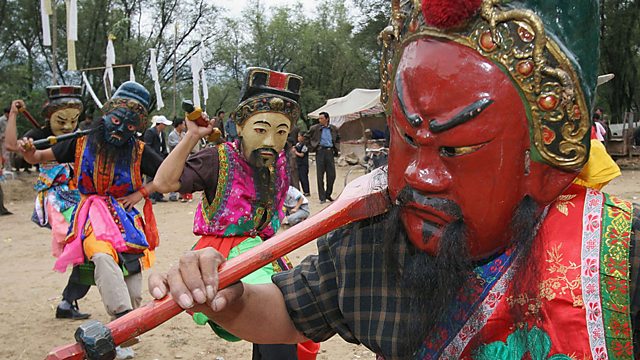
A group wearing masks of legendary heroes as they perform a dance in Minhe County of Qinghai Province, north-west China

Dying On Stage

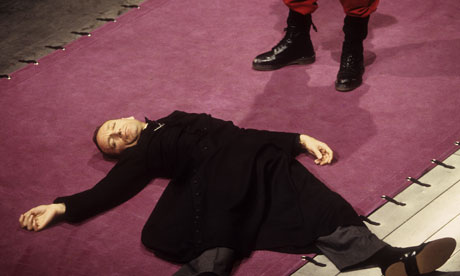
There a few things I have always had to begrudgingly admit that cinema does better than theatre, and one of them is death. A death – be it by murder, accident or natural causes – on stage is alway difficult. We suspend our disbelief, but when I see someone chopped down in the prime of life in front of me – I’m thinking Hamlet, Romeo and Juliet – it always leaves me (rather than the supposed corpse) a little cold.

the-barricade1

So it was with some interest that I read Jane Howard’s article in The Guardian that mused on this most difficult of theatrical acts:

Can theatre ever pull off a convincing stage death?

Playwrights love a dramatic death scene – but stage trickery is rarely good enough for the audience to suspend disbelief

If you’ve been to the theatre even a handful of times, it’s likely you’ve seen a stage death. Our fascination with death seems endless, and proves fruitful picking for playwrights. For the writer, there’s power in making an audience empathise with a character and then ripping that character away, and there’s also power in the vindictive killing of the disliked.

Oedipus Schmoedipus, playing in the Sydney festival, is a documentation and reenactment of the deaths in the western theatrical canon by performance company Post. The billing lists the work as “after Aeschylus, Anon, Barrie, Behn, Boucicault, Büchner, Chekhov, Euripides, Gogol, Goldsmith, Gorky, Hugo, Ibsen, Jonson, Marlowe, Mayakovsky, Molière, Pirandello, Plautus, Racine, Seneca, Shakespeare, Sophocles, Strindberg, Voltaire, Wedekind, Wilde et al”. And these men didn’t stop at one death apiece.

Post’s Mish Grigor describes the work as exploring the “tension between the fact that death is an actual universal, and the western theatrical canon is often spoken about as having universal themes or, these plays speak to all of us. We’re interpreting an actual universal through something that we don’t think is really universal, but pretends to be.”

Is death, then, perhaps an easy way of trying to create a connection with the audience? It is something that everyone watching will have a relationship with, even when other themes a play explores may be foreign?

oedipus-schmoedipus-belvoir-2014-production-shot-4-by-ellis-parrinder

And yet, we are readily judgemental of watching someone pretend to die. When we’re watching theatre we suspend disbelief in so many ways, buying into the construct of the world and using our imagination to fill in the gaps. But there is something about death that is particularly sticking when it comes to witnessing it on stage.

“I find it quite absurd when an actor dies on stage,” says Grigor, “because we know that it’s a game of pretend: they’re still breathing. You can still see them breathing a lot of the time, and the stage trickery that is employed is usually not that good.”

When you start talking about the practice of death and dying on stage, the same concerns repeatedly come up. Tim Roseman, artistic director of Playwriting Australia, says: “The trouble is, it’s an inherently over-the-top theatrical thing that theatre does, because at the very least you’re left with: what do you do with the body? And so the artifice is always problematic.

“Because I know you’ve got to do it 34 more times before you finish the season and, literally, do you just get up and walk off? Do we get someone in black to come and steal the body in the end? It’s a really problematic thing. And, you know, fake blood. So I think it’s the thing we buy the least.”

It seems that while we’re prepared to ignore the wires helping someone fly, there is something about death that makes us watch for the rise and fall of an actor’s chest or shadowed movements in the blackout.

Maybe that’s why, when I look back at the deaths on stage that have truly impacted and stayed with me, I keep returning to puppetry. The death of the title character of the Adventures of Alvin Sputnik: Deep Sea Explorer, a puppet made from little more than a white-gloved hand and a foam ball, left me holding my breath to not audibly sob. The deaths of hundreds of silent puppets at the hands of Nazi soldiers in Hotel Modern’s Kamp left my heart in my throat and my brain overwhelmed.

I mentioned these deaths to Nescha Jelk, artistic associate at the State Theatre Company of South Australia. “It’s because the puppeteer animates it, gives it that life and gives it that real presence,” she says. “We really invest [emotionally] with the puppets, but it’s so easy to de-animate them and to take that away.”

Grigor agrees: “There’s always life in the person, isn’t there? You always know. For me, I find it very hard to escape that knowledge: that a person is just a person.”

Michael-Feast-plays-Thoma-007

Not surprisingly this led me to see what other people had to say on the topic. A blog post Alexis Soloski, also in The Guardian, from a year or so ago – What makes a good stage death? Forget all that tediously realistic convulsing and juddering – a really convincing theatrical death is better left unseen – is great and her list at the end, about what should be remembered when ‘acting’ death, just made me smile:

1. Don’t. Keep the death off-stage.

2. Perform the death on stage but avoid showing it directly, as in the famed stoning scene in Edward Bond’s Saved.

3. Keep convulsions to a minimum.

4. Better blood. (The Royal Shakespeare Company keeps correctly coloured fluid in three different viscosities.)

5. Try to die on your stomach or with your back to the audience so they don’t see you continuing to breathe.

6. Actually die. There are – a very small number of – actors who have perished while treading the boards. (This method is not recommended. Not only is it tremendously sad and frightening, but it’s terribly inconvenient for the next day’s matinee.)

There is also a great article from TimeOut Sydney, Death Scenes,  which talks to six performers about how they ‘do’ death on stage. One of the actors interviewed, when asked if their mind wonders once they have been killed, said:

Sometimes you lie there thinking about what you’re going to have for dinner if it’s a matinee

A rather more serious article from theatrebayarea.org, I’m dying out here has in interview with actor James Carpenter who has ‘died’ many, many times on stage and is an interesting read on the subject.

I’ll finish with an extract from a post by Alfred Hickiling, Death by overacting, The Greeks did it tactfully, Bottom did it endlessly

There is a lot of death in the theatre: sometimes good, but frequently so bad as to make you wonder why anyone ever decided to mess with the formula established by the Greeks. You can’t help but feel that the fathers of western drama had it right when they opted to keep all the gory business off stage – why spoil the performance with a series of unnecessary convulsions when you can send a messenger to report that you expired heroically, with all your tragic dignity intact? Ibsen, Chekhov and Miller got the message: a solemn exit followed by a solitary gunshot, a profound silence and no mess.

Saved, Edward Bond

Saved, Edward Bond

It is the Jacobeans we have to thank for plays that conclude knee-deep in guts, thanks to their macabre fascination for golden daggers, poisoned Bibles, severed limbs and so forth – which all the followers of Sarah Kane and the Blasted school have enthusiastically revived today. But if one were to identify the absolute nadir of unconvincing expirations, it is as well to start at the Bottom:

Thus die I: thus, thus, thus.

Now I am dead,
Now I am fled,
My soul is in the sky.
Tongue lose thy light,
Moon take thy flight,
Now die, die, die, die, die.

I have seen actors spin Bottom’s soliloquy out for several minutes, at which point the joke no longer seems to be on Shakespeare’s weaver, so much as on themselves. But if the death of Pyramus is daft, Shakespeare also crafted some of the most exquisitely moving death scenes of all time, such as Cleopatra with the asp (“Dost thou not see the baby at my breast that sucks the nurse asleep?”), as well as one of the most defiantly underplayed (Mercutio’s “’tis but a scratch”).

No Longer A Refugee

The article I want to share in today’s post really touched a nerve when I read it last week. It was published in the Financial Times, written by Charlotte Eagar, and is about her project to stage the antiwar Greek tragedy, The Trojan Women with a cast of Syrian women who have fled their homeland’s vicious civil war for neighbouring Jordan.

a8ebe18e-7410-11e3-beeb-00144feabdc0

If you don’t know the play, The Trojan Women is about refugees, set at the fall of Troy. All the men are dead and the former Queen Hecuba of Troy, her daughter Cassandra and the rest of the women are waiting in a refugee camp to hear their fate. Euripides wrote the play in 415BC as an anti-war protest against the Athenians’ brutal capture of the neutral island of Melos; they slaughtered all the men and sold the women and children into slavery. You can download the text of the play as an e-book here, or read it online here.

4c06569e-5e6e-4213-b3a3-59af6ceffd39

Eagar’s piece is definitely worth reading. It charts the whole project from beginning to end. It is both immensely inspirational and gut-wrechingly sad. Click the link below for the full article.

Syrian refugees stage Euripides’ ‘The Trojan Women’

You get a real sense of the power of the performance in the interview, below, with one of the actor refugees, known simply as Fatima.

.

5857925

.
.

A Fellow Named Meng

The other day I posted about the superstitions that exist in western theatre, so in the interests of balance and world theatre traditions, today I have an extract from The Illuminated Lantern: A Short History of Chinese Opera which, not surprisingly, covers the same but in Chinese theatre.

In western theater, a number of superstitions have grown up among performers. Many words and phrases are avoided backstage, as they are said to cause bad luck. For example, actors never say “Good Luck” to each other, they say, “break a leg.” Whistling backstage is also said to bring bad luck. As is, most curiously, saying “Macbeth.” When one wishes to discuss Macbeth in the theater, one should always refer to it as “the Scottish play.” In Chinese Opera, similar superstitions exist.

The words Meng and Keng are particularly important. One should never say Meng at the back of the stage, nor Keng at the front of the stage. These prohibitions stem from the story of Yu Meng, a legendary jester who is said to have impersonated a famous scholar at the court as long ago as 403 B.C. The king was so impressed by the impersonation that lavish favors were bestowed (though respectfully declined).

Yu Meng

Yu Meng

Another superstition involves the doll that Chinese Opera troupes use to represent babies on stage. These dolls possess the soul of the child they represent. Before and after each performance with these dolls, the actors would pay their respects to it. During the performance, it was always left facing the sky, and afterwards, it was always packed facing the earth. The film Attack of the Joyful Goddess explores this superstition in violent, bloody detail.

Since the Opera often concerns itself with the supernatural world, it’s players must be ever more respectful of the laws of that world, and ritual and ceremony must be performed properly and with respect. Tales like the one which begins Hocus Pocus are often told of Chinese Opera troupes who visit a remote town and give a performance, only to find in the morning that the town did not exist and that they were entertaining ghosts. It is traditional that during some Taoist ceremonies, and especially during the Ghost Festival in the seventh month, an Opera Troupe would perform in front of the shrine, to entertain the spirits of that place. Ultimate Vampire begins with a performance of this type. These days, a TV may often be seen facing a shrine to provide similar entertainment to the gods. Though if I were an angry spirit, I can only imagine the suffering I would inflict on anyone who decided to set up a TV in front of MY shrine.

T'ang Ming Huang

T’ang Ming Huang

The Patron Saint of Chinese Opera is T’ang Ming Huang. A figure or tablet of T’ang Ming Huang is set up in every theater, and incense was burnt to him before every performance. He was believed to have the power to make each actor perform well or badly. Military actors typically honor another tablet, representing the spirit Wu Ch’ang. This spirit was believed to possess special abilities, including the cruelty needed to wage a successful campaign. Four famous generals from the Warring States period were said to have this spirit’s ability bestowed upon them.

Opening a new theater is a special occasion for ceremony, to ‘purify’ the stage, and drive away devils and harmful spirits. The stage must be doused in dog’s blood or chicken’s blood, while actors appear on the stage dressed as spirits, carrying whips, tablets, and masks. This ceremony thus drives away the devils, placates them, and ensures that they do not appear on stage again.