Having Some Self-Respect!

In July I wrote a post, Body Talk, which dealt with how theatre has been used around the world by the global movement to end violence against women and girls. It’s focus was Eve Ensler’s play, The Vagina Monologues, and  a play touring in China, Our Vaginas, Ourselves. A week or so ago, The Atlantic published an article by Gabrielle Jaffee which takes the debate back to China:

Performing The Vagina Monologues in China

The ongoing controversy of the iconic play reflects feminism’s struggle to establish a toehold in a still conservative society.

“When I first heard about The Vagina Monologues, I was shocked. I thought, how could someone give a play a name like that?” says Xiao Hang. That was five years ago, when Xiao Hang was, by her own admission, “mainstream and quite conservative.” But after volunteering for an NGO in her sophomore year at college, she began to see society through a different lens. She no longer thinks, as she once did, that “it isn’t elegant to talk about your vagina in public.” In fact, she thinks it’s vital to.

Today Xiao Hang is one of the organizers behind Bcome, the Beijing-based feminist group which has put on around a dozen performances of The Monologues this year to mark the ten-year anniversary of its first showing in China. Performed in over 150 countries worldwide in some 50 different languages, Eve Ensler’s play was first shown in the Mainland at Guangzhou’s Sun Yatsen University in 2003.

In their offices just outside Beijing’s third ring road, Xiao Hang and Bcome’s other volunteers are preparing leaflets to send out for the International Day for the Elimination of Violence against Women. The leaflets have titles such as “20 Misconceptions about Sexual Violence,” “The ABCs of Feminism,” and “Resist Verbal Abuse.”

“We’ve already done lots of online and print promotions as well as panel discussions. The Vagina Monologues is new, fresh and attention-grabbing,” says Ai Ke, another organizer. “It’s not just a play, it’s a tool for spreading feminism, a method for public education.”

To prepare the script, the organizers translated from the English version, took parts from past Mandarin versions, and created original scenes through a series of workshops they ran last year. At the beginning of each workshop, they voted on which topic they wanted to discuss (“We’re very democratic,” laughs Xiao Hang), noted down their own experiences, and gave key words to the scriptwriters. “We wanted to localize the play as much as possible, so we added issues such as the obsession and anxiety over virginity,” explains Ai Ke.

With their script complete, Bcome’s committee organized shows at Beijing’s LGBT center, at culture cafes, and at an art space where they performed to an audience of 400. They also put on the play for a community of migrant sex workers (“This helped us better understand them and write a scene about their lives”) and organized college campus productions—including a now notorious rendition by female students at Beijing Foreign Studies University (BFSU).

The BFSU students caused an internet storm earlier this month when, in an effort to promote their version of the Monologues, they posted pictures of themselves holding up messages from their vaginas to the popular social network RenRen. Written in English, Chinese and Korean, the messages ranged from “My vagina says: I want freedom” and “My vagina says: I want respect” to “My vagina says: You need to be invited to get in.” The images were soon reposted on Sina Weibo and picked up by local media outlets, who focused on the girl’s “confessions.”  A video of the images received over 2 million views on Sina.

dfe14f23b

The wave of online misogyny that followed was nasty. Commenters focused on the women’s looks (“Seeing their faces, I’ve lost all interests in their vaginas” said one @Taoist_Mua), others expressed shock that students at one of the country’s top universities could have written such things (“How could BFSU admit such vulgar girls?” @冬天的亭子) or simply resorted to pure name-calling (“These ignorant grandstanding tarts” @保护地球绿色家园). One user, @shendeon, even exclaimed, “If my daughter did this, I’d slap her across the face.”

***

These reactions only seemed to validate the need for performances of The Vagina Monologues in China. The critics “have this image that female university students must be pure,” says Xiao Hang. “They were terrified because women in China never talk about sex in public.”

Bcome received mostly positive feedback for their other performances of The Vagina Monologues, which included a traditional xiangsheng (comic dialogue) about different kinds of moaning when reaching a climax and an interactive section where audience members were invited to share their stories. “Some people laughed, some people were so moved that they cried,” says Ai Ke. Several people came up to her afterwards and thanked her for the “growing experience” they had, or for convincing them that they were not “odd” for thinking about such things.

However, Ai Ke admits that the people who came to watch the play were probably already open-minded. In China, this isn’t surprising: There’s a difference between intellectual elites performing in the safe environment of the student union or culture cafes and the opinions of the public at large, which the BFSU students were exposed to online.

Chinese government repression plays a key role, too. While the last decade has seen The Vagina Monologues performed many times at universities across the country, a professional production in Shanghai was banned in 2004 after hundreds of tickets had been sold and a 2009 production was forced to call the show “The V Monologues” instead of the full name. Bcome found that “as soon as the word vagina was mentioned,” official theaters and even some small independent outfits such as Beijing’s Peng Hao and Mu Ma theaters refused them.

The Monologues’s checkered history in China reflects the inconsistent approach towards sex and sexuality in the country. While the government continues to crack down on pornography and vulgarity, reform and opening of the last few decades has coincided with more liberal attitudes towards sex. Indeed, in China, sexuality is on view everywhere: Even state-run news outlets like Xinhua and the People’s Daily use soft porn slide-shows to bump up click rates.

But just because there’s more flesh on view than during the puritan past, that doesn’t necessarily women’s sexual rights have improved. Using the “v-word” is still a taboo in China. “China is still a male dominated world,” says Ai Ke. “The sexual freedom gained in the last few years has been for men. The pleasure that women can get from sex is so seldom talked about.”

And it’s not just the female right to enjoy sex that has become an important feminist issue in China: There’s also the right to protect their bodies. Around a quarter of China’s female population suffers from domestic abuse, according to the All-China Women’s Federation, but there is no law specifically targeting the crime.

Women are beginning to speak out. Last year, after the official Sina Weibo account of the Shanghai Subway Line 2 posted a photo of a passenger in a revealing dress with the caption “dressed like that, it’s no wonder you get harassed. There are many perverts on the subway, can’t catch them all. Girl, have some self-respect!” many net users were outraged. For their part, Bcome organized flash mob readings of the Monologues scene “My Short Skirt” on the Beijing subway. [click the image below for video the performance].

Untitled_Fotor

“Most people just looked awkward, tried to not to look us in the eyes and instead fiddled with their phones,” admits Xiao Hang. Perhaps asking people to face sexual issues directly remains too much to ask for in China.

More reassuring, though, is what happened after each of their performances. When the women approached passengers with a petition to support legislating against domestic violence, they collected over 10,000 signatures in 15 hours. That, at least, is something to celebrate.

Just Epic

A quick post today, just to share a few collected video resources about Bertolt Brecht and his theatre.

The first set is from a BBC documentary made 25 years ago, but still a useful source of all things Brechtian. Sadly the whole documentary is no longer available. The final fourth clip is from the same documentary, but from a different source and shows Helene Weigel (Brecht’s second wife and acclaimed actresses of the period) explaining Epic theatre.

.

.

.

.

The second set come from the National Theatre in the UK and were filmed when they were mounting a production of Brecht’s Mother Courage:

.

.

.

The next is an interesting and eclectic small film called The Brecht Document which details Brecht’s and is composed of what its writer/director Warren Leming calls “fragments” from a two-year stay in Berlin,Germany which he made in 1986/87. The final couple of minutes are from The Jewish Wife (Fear and Misery of the Third Reich), one of Brecht’s most haunting texts.

.

This one is Eric Bentley, the eminent critic, playwright and translator on the life of – and his work with – the legendary Brecht.

.

And finally, and perhaps most extraordinarily, a recording of Brecht’s testimony to, and questioning by, the House Com­mit­tee on Un-​Ame­ri­can Ac­tivi­tes (The McCarthy witch hunts), hours before he returned to Germany.

.

Mandela, Apartheid And The Theatre Of The Fight

Nelson-Mandela-dead

The death of Nelson Mandela two days ago has, quite rightly, brought about a slew of obituaries, articles and opinion pieces from around the world. One particularly caught my attention, written by Emily Mann for the LA Times. It talks about the great man’s unwitting, yet powerful effect on theatre. I’m posting it today simply as a tribute, but is worthy of a read and I whole heartedly suggest that the plays Mann talks about are worth a read too.

I especially recommend Athol Fugard’s The Island and Sizwe Bansi Is Dead (which was also written by Fugard in collaboration with Winston Ntshona and John Kani). The former is set in an unnamed prison, clearly based on South Africa’s notorious Robben Island, where Nelson Mandela was held for twenty-seven years. It focuses on two cellmates, one whose successful appeal means that his release draws near and one who must remain in prison for many years to come. The latter is a beautiful elegy about the loss of identity and how oppression can make desperate people do desperate things. The play’s protagonist, Sizwe Banzi, is forced to steal the identity papers, and thus the identity, of a dead man in order to get work in apartheid era South Africa.

Nelson Mandela dies: His legacy to the arts

Many people know that Nelson Mandela’s life inspired novels, poems, plays and films, but few people know how powerful his effect on the theater was and how powerful the theater’s effect was on him.

The theater served as a mirror to Mandela, each side influencing and reflecting the other, placing them both in time.

At the height of the apartheid era, the Market Theater in Johannesburg and the Space Theatre in Cape Town, both defiantly nonracial venues in a racially divided country, produced shattering plays about black life under the apartheid regime.

nelson_mandela

These plays premiered in South Africa in the 1970s and ’80s and then flooded onto the world stages. The plays triggered global outrage at the South African government and support for the struggle for freedom Mandela represented.

Athol Fugard’s “The Island” and “Sizwe Bansi Is Dead” (co-created with actors Winston Ntshona and John Kani) and “Master Harold and the Boys”; Percy Mtwa, Barney Simon and Mbongeni Ngema’s “Woza Albert”; and Ngema’s “Sarafina” along with many other plays of staggering power sparked a conflagration of local and international protest and helped Mandela bring down the apartheid government.

As Fugard once said to me and others, “I sometimes have to subscribe to the old cliché that the pen is mightier than the sword. It certainly was true in this case.”

Mandela’s arts legacy reaches beyond the apartheid era. He continued to inspire theater makers around the world to write those plays that would expose social injustice.

One of my plays, “Greensboro, a Requiem,” is about the Ku Klux Klan massacre of a multiracial group of anti-Klan demonstrators in Greensboro, N.C., in 1978. It brought national attention to the event and to the shocking acquittals of the Klan by an all-white jury.

In its wake, the play inspired the mayor and the city of Greensboro to convene America’s first Truth and Reconciliation Commission, modeled on Mandela and the Rev. Desmond Tutu’s commission in South Africa.

The citizens of Greensboro, as in South Africa, chose to face painful truths about their past so they could enter a future together with a mutually agreed-upon history and a new understanding of each other’s lives. This, too, is Mandela’s legacy. A play can inspire social change.

During Mandela’s long life on the world stage, his influence has been multifaceted and his reach long. His profound contribution to the arts, both the work influenced by him and for him, made not only world but theater history, and his legacy continues to inspire those who work in the theater for social justice.

1990. Nelson Mandela as he is freed from prison after 27 years

1990. Nelson Mandela as he is freed from prison after 27 years


Uncut Debate

The Scotsman newspaper published an interesting article this week, Debating Political Theatre, written by Tiffany Jenkins, a cultural commentator. In it she suggests that even in an age of austerity and economic woe across much of the world, theatre has yet to respond in a robust and meaningful way. I don’t necessarily agree with her take, but it certainly gives pause for thought. 

Modern social drama has plenty of targets but is awash with complacency at a time when we badly need riotous debate, writes Tiffany Jenkins

POLITICAL theatre has a long and honourable tradition, reaching back to Ancient Greece when playwrights satirised the existing system to powerful effect. More recently, in the 1970s and 80s, political theatre was alive with attacks on……capitalism. At its best, it was vibrant and uncompromising. Most importantly, it had bite.

Today, over three years into the age of austerity, and political theatre appears to be in rude health. Its boom is suggested by the success of Theatre Uncut, formed in 2010 in response to public spending cuts and with the intention of encouraging debate and action. Leading playwrights have responded to this contemporary vehicle for short work made available for free for anyone to perform for a limited period. And they have done so in their thousands – so far, more than 3,000 people have staged these plays in more than 17 countries across four continents. This Saturday, there is a Mass Action Day where people will simultaneously stage seven new works written in response to the provocation: “Do we all get more right wing in hard times?”

There is a lot on show. Appearances, however, can be deceptive, because despite all this activity – the multiple productions, prizes, plaudits and the applause – there are limitations to political theatre today. These are in part due to certain inherent difficulties with it – it can easily veer into didactic agitprop, which is boring – but there are also more profound problems with the politics at the heart of the works, and the state of affairs that they inadvertently reveal. Taking a closer look at political theatre today – what is on offer, who it is for and what it says – and you find a complacent body of writing that flatters the audience and is devoid of critical thinking.

DSC_0388_web

Theatre Uncut aims to create a conversation about important everyday issues, a laudable purpose, but the work staged is very much a singular view of the world, and notably black and white. The objects of criticism and those who are to blame are cynical politicians, greedy capitalists and racists. One such play is Church Forced To Put Up Gates After Font Is Used As Wash Basin By Migrants, written by the comedian Mark Thomas. It’s about a right-wing newspaper owner who used to publish porn, who is obsessed with depicting immigrants as “shit”, the EU as “shit”, and the BBC as “shit”, and who thinks everyone who works for him is “f****** useless”. He is taken hostage by women in balaclavas who threaten to kill him unless he prints a pro-migration editorial.

If this work contributes anything to political debate, it’s cliché. Because we have heard this before – there is nothing surprising, complex, or nuanced in this play or the others it accompanies. Most of them are cartoon depictions of nasty right wing people and lovely lefties who think the right kind of thoughts. Frankly, most of the plays are just long rants. It is clearly assumed that audiences know better, and are thus reassured about their views and can go home contented having been congratulated. It’s all very safe.

The problem with the pantomime visions of what is effectively the opposition is that they just don’t ring true. I say this not as a right-wing newspaper owner or as a capitalist, but as someone who is interested in working out what is wrong today, and it’s really not as simple as how things are depicted in works such as Church Forced To Put Up Gates After Font Is Used As Wash Basin By Migrants – in which there is a lot of profanity but little insight.

Take another of the plays being performed this week, The Wing by Clara Brennan. One of Brennan’s main characters is Mick, a white working class bloke who reads The Sun (there is a repetitive theme in the plays which depicts tabloids as disgusting and their readers as scum), wraps himself in a “light blood-spattered St George’s flag” and who dislikes immigrants. His daughter, Kerry, is a right-on thinking woman who had had her picture taken for Page 3 in order to later reveal that at the very same time as she was getting her bits out, she was by then already pregnant by a “brown person”.

In The Wing, there is no attempt to persuade those that may not think or feel the same, and no attempt to understand people who do not agree. It also feels out of date, just repeating the politics of the 1980s and 1990s, refusing to address the present. And this is why is has no bite, no power: it doesn’t aim to win hearts or minds, and it doesn’t address the present with any urgency.

The political theatre of the past tried to influence, the political theatre of the present assumes things will never change. What The Wing also and unintentionally shows is the contempt some of these playwrights have for the white working class, the social group habitually blamed for everything, but who were once an important social force in politics.

Theatre-Uncut-007

There is nothing wrong with going to see a dramatisation of opinions with which you agree, but for the work to be effective, to have an impact, it needs to challenge those who come from shared outlooks and try to understand those that don’t. Indeed, some of the best work has done just this – John McGrath, founder of the Scottish popular 7:84 theatre company, is a case in point. McGrath always said that political theatre should avoid agitprop and confront the audience, make them feel uncomfortable and question their own positions.

Political theatre today should be a place of riotous debate. Even if the playwrights and producers are singing from the same hymn sheet – and they usually are – there is plenty to discuss and argue about. I am not advocating that people tear each other apart, but suggest that constructive questioning is needed in the cause of clarification.

If we do not take ourselves and audiences out of our comfort zones, and try and persuade others, political theatre will continue as a dampener to debate, a sedative rather than a spur to action. It is time to stop applauding and cheering. This sort of political theatre doesn’t deserve an encore.

TUheader

Now it is clear that Jenkins is taking particular aim at a movement called Theatre Uncut which was created in 2010

to encourage debate and galvanise action around political issues that affect all of our lives.

According to Lyn GardnerTheatre Uncut isn’t just a performance, it’s an idea: that theatre can be immediately responsive to world events, engender discussion and effect change. Founded in response to public service cuts (in the UK), it suggests that theatre has a part to play in the protest movements that are gathering pace across the world in response to economic downturn and events in Syria. The lead time between a play being written and actually being staged is often more than a year; Theatre Uncut, by contrast, is theatre’s rapid response unit. The plays are written speedily and given just one day of rehearsal: actors often have scripts in hand.

.

So far Theatre Uncut plays have been performed by over 3,000 people in 17 countries across 4 continents. Performances have happened everywhere from theatres in New York, community centres in Scotland, schools across England, universites in South Africa, on the streets in Spain, on public buses in Mexico, to village church halls in Wales.

Untitled 2_FotorPlaywrights have come from many countries – Syria, Spain, Argentina, Iceland, Greece, UK, USA, Egypt and so on. You can even obtain the plays free of charge for performance, as long as any profits are donated to charity. You can read a review of the latest Theatre Uncut performance, by Susannah Clapp here.

.

To me, this is how theatre of protest should be happening, and I think Jenkins’ is misguided in her notion that theatre is not causing riotous debate. Maybe it’s because it is just not happening in the way she would like. Mind you, the final paragraph of Clapp’s review above does say the following:

This is an evening of intermittent sizzle. It intrigues rather than ignites. The idea of the project itself is more political than any particular argument. There is no real answer to the question about getting more rightwing: how could there be without statistical evidence? There is no real anti-left persuasion. Neither are there any rallying cries: Gillian Slovo suggested in one post-show discussion that people no longer feel there is a political alternative. Yet the actors bring the flying-by-the-seat-of-their-pants concentration that the visionary enterprise needs.

.

I’d suggest you watch the three plays embedded here and make your own mind up.

.

What The Butler Saw

JHaynesPortrait2A quick video post from me today.  The first is a documentary from the BBC about the playwright Joe Orton that TheatreVoice has added to its growing video archive, TheatreVoiceTV. 

Orton lived a short but vibrant life and I was reminded of him recently when one of my performing arts students decided to write an investigation of the history of farce in theatre.

If you would like to know more, there is a fantastic website that has masses about Orton, his life and his plays – Joe Orton Online.

.

.

It Does Matter

This post is a milestone for Theatre Room – the 200th since I started it, 18 months ago. So it seems only fitting that the post has come about after an intelligent, heartening, occasionally saddening conversation yesterday, with my final year Theatre Arts students. I can’t quite remember how we got started, but in essence we were discussing the value of a theatre arts eduction and more generally the need for arts in society.  Now this particular group of young people are inspirational at the best of times, but when they started to list what they felt they had learned from the course – the skills (non-theatre related), the cultural understanding, the ability for arts to impact the world, and so on – I was humbled. They hadn’t been indoctrinated by my (well, not much) and had discovered and understood all this themselves. I am a proud man.

Howard Shalwitz

Howard Shalwitz

During the course of the discussion articles and videos were shared and this was one that touched a nerve for all of us – encapsulating what we talking about. It is from a post on theatrewashington entitled 7 Reasons Why Theatre Makes Our Lives Better. It is an extract from a speech, actually more of a treatise,  given by Howard Shalwitz, the Artistic Director at Woolly Mammoth Theatre Company, from Washington D.C., a fund-raiding event in 2011..

.

As someone who came from a family of doctors, started out pre-med in college, detoured to philosophy, then teaching, and finally to theatre — not only did my career choices slide steadily downhill from my mother’s perspective, but I was left with a moral conundrum: does my chosen profession, theatre, make a valuable contribution to the world when compared with the other professions I left behind? I guess this conundrum has stuck with me, because as recently as this past winter I made a list of seven reasons why theatre matters and I’d like to share them with you briefly tonight.

First, theatre does no harm. Theatre is one of those human activities that doesn’t really hurt anyone or anything (except for its carbon footprint — but let’s ignore that for now). While we’re engaged in making or attending theatre, or any of the arts for that matter, we are not engaged in war, persecution, crime, wife-beating, drinking, pornography, or any of the social or personal vices we could be engaged in instead. For this reason alone, the more time and energy we as a society devote to theatre and the arts, the better off we will be.

Second, theatre is a sophisticated expression of a basic human need — one might call it an instinct — to mimic, to project stories onto ourselves and others, and to create meaning through narrative and metaphor.. We see this instinct expressed in children when they act out real or imagined characters and events. We have evidence of theatre-like rituals in some of the oldest human societies, long before the foundations of Western theatre in Ancient Greece. So theatre matters, in essence, because we can’t help it. It’s part of what makes us human.

kecak1

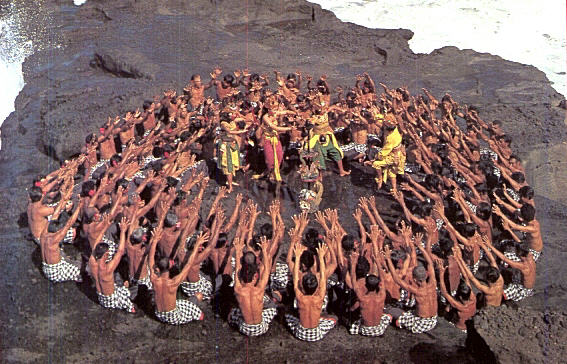
Third, theatre brings people together. For a performance to happen, anywhere from a hundred to a thousand or more people need to gather in one place for a couple of hours, and share together in witnessing and contemplating an event that may be beautiful, funny, moving, thought-provoking, or hopefully at least diverting. And in an age when most of our communication happens in front of a screen, I think that this gathering function of theatre is, in and of itself, something that matters.

Fourth, theatre models for us a kind of public discourse that lies at the heart of democratic life, and builds our skills for listening to different sides of a conversation or argument, and empathizing with the struggles of our fellow human beings whatever their views may be. When we watch a play, we learn what happens when conflicts don’t get resolved, and what happens when they do. We develop our faculty for imagining the outcomes of various choices we might make in our personal lives and our political lives. It’s not surprising that, in repressive societies, theatre has often been aligned with the movement toward openness and freedom. In South Africa theatre played a role in the struggle against apartheid; in Czechoslovakia, a playwright became the leader of a new democracy. If our own representatives and senators in Washington went to the theatre more often, I suspect we’d all be better off.

Fifth, both the making of theatre and attending of theatre contribute to education and literacy. Watching the characters talk back and forth in the theatre is tricky; it requires sharp attention, quick mental shifts, and nimble language skills. It teaches us about human motivation and psychology. In historical plays we get lessons in leadership and government. In contemporary plays, we learn about people and cultures in different parts or our own country or in other countries. Studies have shown that students who participate in theatre do better in school. Making plays together also draws kids out of their shells and helps them learn to socialize in a productive and healthy way.

Sixth, theatre as an industry contributes to our economy and plays a special role in the revitalization of neglected neighborhoods. We’ve seen this quite clearly in our own city. You can look at the role that the Studio Theatre played along the 14th Street corridor, or Shakespeare Theatre along Seventh Street, or Woolly in both these neighborhoods, or Gala Hispanic Theatre in Columbia Heights, the Atlas along H Street, or the new Arena Stage along the waterfront. As each of these theatres opened, new audiences started flooding in, new restaurants opened, jobs were created, the city improved the sidewalks, and neighborhoods that were once grim and forbidding became vibrant hubs of activity. And this pattern has been repeated in cities across the United States and around the world.

Finally, the seventh way that theatre matters — and this one applies to some kinds of theatre more than others — is that it influences the way we think and feel about our own lives and encourages us to take a hard look at ourselves, our values, and our behavior. The most vivid example of this I’ve ever experienced was during a post-show discussion at Woolly Mammoth when a woman said that one of our plays made her and her husband decide that they had a serious problem in their marriage and needed to go for counseling; and she was pleased to report that they were still together and much happier as a result. Now, I’ll admit, I don’t hear things like this every day. But speaking more generally isn’t this one of the things we go to the theatre for, to measure our own lives against the lives we see depicted on the stage, to imagine what it would be like if we had those lives instead? And isn’t it a very short step from there to saying, gee, maybe there’s something I should change about my own life? And it may have nothing to do with the message that the playwright wanted to deliver! Maybe the play is about a fierce battle over a family dinner that breaks the family apart over irreconcilable political divisions — but maybe you watch the play and say, gosh, wouldn’t it be nice to at least have a family dinner once in a while, and so you decide to plan one for next month.

So, those are my seven ways that theatre matters: it does no harm, expresses a basic human instinct, brings people together, models democratic discourse, contributes to education and literary, sparks economic revitalization, and influences how we think and feel about our own lives.

With one exception, the comments posted about the article are worth a read too. One of the commenters even goes as far as adding an 8th reason, which particularly resonates with me:

Theatre helps us to understand the lives of others on a visceral, rather than intellectual, level……. theatre expands our connection to the larger world, and our empathy for lives lived differently from our own.

I couldn’t agree more.

To finish I share a video interview with Pulitzer Prize-winning playwright Tony Kushner (Angels in America) making a strong case for theatre’s role in modern society.

.

We Are Strong

I have written here, on a number of occasions, about Belarus Free Theatre, a company whose founders were forced to seek political asylum in the UK in 2011. This was after being targeted by the government in their home country, Belarus, for standing up against its repressive and dictatorial regime.

The audience inside the 'house-theatre' listening a reading from a student of Belarus Free Theatre, taken in 2009 by photographer Alessandro Vincenzi. The audience was contacted by the company in a private and secret way the day before or the same day of the performance in Minsk, Belarus.

The audience inside the ‘house-theatre’ listening to a reading from a student of BTF, taken in 2009 by photographer Alessandro Vincenzi. The audience was contacted by the company in a private and secret way the day before, or the same day of, the performances in Minsk, Belarus.

In fact, the very first two posts on Reading Room Asia were about the company (Belarus Free Theatre Part 1 and Part 2). To quote their own website, BFT is now a two-headed beast with a new part of the company in London, and a permanent ensemble left behind in Minsk who perform and tour around the world as Belarus Free Theatre.

Natalia Kaliada

Natalia Kaliada

Natalia Kaliada, one of the company’s co-founders, has become a significant voice, not only about the human rights violations that are taking place in her own country and around the globe, but about the power of theatre to challenge such atrocities.

Jude Law

Jude Law

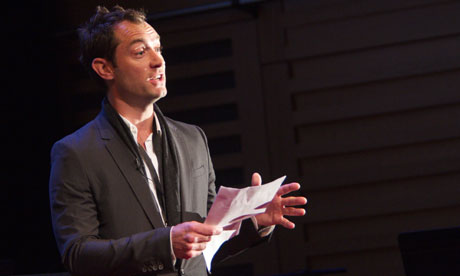
Since fleeing to London, she has used the new-found freedoms to rally support and has been joined by a whole host of influential people from both the theatre world and beyond. One of BFTs most high-profile supporters is the actor Jude Law, who has said when you talk about artistic freedom you are talking about freedom of speech and all our fundamental freedoms….it could not be more central to how we live. And these freedoms that we often take for granted are celebrated……by the struggle of the Free Theatre……These are freedoms which define us.

BFT now has a home in London with, and as an associate of, the Young Vic Theatre.  The company, together with the Young Vic have just released a short film, called Connection, with Law in the cast, which you can watch here.  It is a metaphor for BFTs own search to find a new home. Kaliada has written about this journey in an article for The Guardian:

Losing a home is always sudden, always a shock and always a tragedy.

An aircraft that can’t find an airport for landing, a doe searching in vain for a watering place in the desert or a man who has lost his memory in the middle of the metropolis – an endless stream of literary cliches could not reflect one hundredth of the horror and confusion that you feel after being left far from home without friends and family, without comfort and security.

We lost our home in Belarus involuntarily, without imagining that it could happen to us. The presidential elections in Belarus in 2010 resulted in thousands of arrests, long-term jail sentences, and hundreds of socially-active people fleeing persecution just for demanding one thing: respect for their rights. That is how the creators of Belarus Free Theatre ended up in exile.

Regaining a home doesn’t start with a space to live in, it begins with people. It begins with someone suddenly appearing next to you and asking one very simple but very important question: “How can I help?”

bft-logo

The film Connection……is a metaphor for our story. It is about how we as members of the troupe bridged the psychological gap between two societies; how we attempted to accept the fact that we were persecuted in one and celebrated in another. Jude Law, who co-stars in the film, supported us even before we escaped from Belarus. He performed in a Belarus Free Theatre production at the Young Vic a month before the ill-fated presidential elections of 2010. The theatre welcomed us with open arms, and Belarus Free Theatre soon began to show its performances there. It is no accident that the Young Vic became our London home: it’s an open, freedom-loving theatre, that listens keenly to others, with an acute sensitivity to theatrical innovation and freedom of creative expression. Belarus Free Theatre continues to show its performances underground in Minsk, but London is our second home, the place where our performances can be shown on some of the very best stages.

Jude was one of the first people to ask “How can I help?” and soon his voice was joined by Tom Stoppard, Irina Bogdanova, David Lan, Michael Attenborough, Kevin Spacey, Albina Kovaleva, Alison Stanley, Sigrid Rousing, James Bierman, Sam West, Laura Wade, Alexandra Wood, Joe Corré, Olga Proctor, Dominic Dromgoole, Joanna Lumley – first dozens then hundreds of people, famous and not so famous, influential and not so influential, wealthy and not so wealthy. Every single one of these people asked that crucial question and helped to create the foundation from which we began to build a new home.

Be assured, we are not complaining about our fate, nor are we looking for sympathy. We are strong. We want to work, to tell stories, to build and develop creative projects. Connection is not only a metaphor for regaining a new home, but a sign of communication between people coming together with the desire to create and collaborate; strengthening each other’s voice.

Incredible strength! If you want to get an idea of what it was like for BFT before being forced to flee, take a look at this work here by Alessandro Vincenzi, an italian photographer who charted their work and lives.

Now! Not Then

There are not many people who have had a greater global impact on theatre-making in the last 100 years, than Bertolt Brecht. I don’t imagine there is a theatre student anywhere who has at least not heard of him, studied him briefly. I am a great believer in his theatre practice. However, his plays tend to leave me, well, a tad bored. There are a couple I really like, The Resistible Rise of Arturo Ui and Fear and Misery of the Third Reich, for example, but the rest often feel a little dry.  Now of course this is often due to the way they are staged but I can never help feeling that his longer works would benefit from significant trimming   And this is the dichotomy with Brecht – Brecht, the theatre practitioner and Brecht, the playwright – in contemporary theatre. His practice continues to be fundamental to a whole host of theatre making, but his plays in performance, are far less common than they used to be.

.

This really comes as no surprise, when theatres are trying to find ways of competing with a fast-moving, attention-shrinking, digital world. So it was with some joy that I read Michael Billington’s article in The Guardian:

Bertolt Brecht: irresistible force or forgotten chapter in theatrical history?

Brecht’s belief that drama should present moral ideas through action is unfashionable, but as theatre becomes ever more narcissistic, audiences are seeking him out again

In the Jungle of Cities

In the Jungle of Cities

It’s that man again: Bertolt Brecht. His early play, In the Jungle of Cities,is being revived at London’s Arcola, and later this month he’s back in the West End, as Jonathan Church’s Chichester production of The Resistible Rise of Arturo Ui moves to the Duchess. It’s a production that won lots of praise when first seen last year, not least for the comic demonism of Henry Goodman’s performance as the eponymous Chicago racketeer who provides a metaphor for Adolf Hitler. But, for all its dazzling energy, I suspect the production will raise all the old arguments about Brecht’s standing today. Is he still an irresistible force or simply a chapter in theatrical history whose reputation has declined with the collapse of eastern European communism?

In weighing up the pros and cons, one has to start with a basic fact: as both a practising dramatist and visionary theorist, Brecht changed the face of modern theatre. Just to take Britain alone, I’d argue that the historic visit by Brecht’s Berliner Ensemble to London in 1956 [The link is to a review from the time] did more than any other single event – even than the premiere of Waiting for Godot a year earlier – to shake us out of our rooted complacency. The spare Brechtian aesthetic had a profound influence on the newly founded English Stage Company at the Royal Court, and the realisation of what a permanent company could achieve shaped the creation of the Royal Shakespeare Company in 1960 and the National theatre in 1963.

Directors, designers and dramatists were all influenced by Brecht’s idea of an epic theatre in which narrative replaces plot, the spectator is turned into an observer rather than someone implicated in the stage action, and each scene exists for itself alone. Above all, Brecht’s belief that drama should present moral and political ideas through action left its stamp on a huge range of plays, from Serjeant Musgrave’s Dance by John Arden, Luther by John Osborne and Saved by Edward Bond in the 1950s and 60s, through to Fanshen by David Hare and Destiny by David Edgar in the 1970s. As David Edgar once said: “Brecht is part of the air we breathe.”

Lest you think I exaggerate Brecht’s influence, I turned up a catalogue to an exhibition, Bertolt Brecht in Britain, mounted at the National Theatre in 1977. Among other things, it includes a checklist of annual productions. In 1972 you find 15 professional Brecht productions in the UK ranging from Arturo Ui in Belfast and Bradford to Mother Courage and Her Children in Watford and Canterbury, and a West End revival of The Threepenny Opera with a cast that included Vanessa Redgrave andBarbara Windsor. There were 77 amateur productions including a staggering 36 – many staged by students – of The Caucasian Chalk Circle. For good measure, BBC Television also presented Arturo Ui starring the formidable Nicol Williamson.

.

All this is unimaginable today. Few regional theatres have the financial resources, even if they had the will, to mount a Brecht play. The right-wing thought police would, I suspect, quickly be on the case if any school put on a Brecht show. And there is about as much likelihood of BBC doing a prestigious Brecht television production as there is of it presenting a play by Sophocles, Shaw, Ibsen, Chekhov or any of the great classic dramatists. Even in academia Brecht is much less central than he used to be: a friend told me that a supposedly comprehensive undergraduate theatre course devotes roughly two hours a year to him.

Yet, even if Brecht is out of fashion, his legacy is all around us. Stephen Unwin, in his excellent A Guide to the Plays of Bertolt Brecht, points to one key example in the growth of documentary drama. The kind of work staged at London’s Tricycle theatre under Nicolas Kent, starting with Half the Picture in 1993 and taking us up to Gillian Slovo’s examination of theLondon riots in 2011, fulfilled many of Brecht’s theatrical criteria. This was work that, in Brecht’s definition of epic theatre, offered the spectator a picture of the world, forced him or her to take decisions. It appealed to reason rather than feeling. Even the performance style made it clear that actors were representing, rather than identifying with, particular characters.

I also sense the Brechtian influence at work in some of the big plays on public themes that have emerged in recent years. They may eschew the Brechtian visual approach, but they engage with the issues of our times in ways he would have understood. In Enron (2009), Lucy Prebble traced the fall of the Texan energy giant to show how capitalism depends on con-tricks and illusions. In 13 (2011), which many critics myopically repudiated, Mike Bartlett argued that popular protest was now a bigger force for change than entrenched political parties. And in the 2013 play Chimerica, Lucy Kirkwood boldly invites us to compare and contrast China and America: it is a work that genuinely activates thought in that its apparent conclusion that America tolerates dissent while China punishes it is brought into question by the cases of Bradley Manning and Edward Snowden.

Brecht may be out of fashion in the self-regarding world of immersive and site-specific theatre, where everything depends on the minor shocks and sensations felt by the individual spectator: however good such shows may be, you generally come out of one by Punchdrunk or Shunt wanting to change your clothes instead of the world. But Brecth’s legacy is still too pervasive and potent for him ever to be entirely invisible.

We are also learning how to do him without the pedagogic reverence that for years put people off. Jonathan Church’s excellent Arturo Ui ushers us into a Chicago speakeasy where we listen to the seductive sounds of a jazz trio. And Roxana Silbert’s modern-dress Royal Shakespeare Company production of A Life of Galileo earlier this year used a text sensibly trimmed by Mark Ravenhill and seemed vitally connected to a world in which a liberally intentioned pope found himself trapped by institutional conservatism.

.

Brecht is too big a force to ignore…..But I’d like see our theatre go beyond revivals of Galileo, Mother Courage, The Caucasian Chalk Circle and The Good Person of Szechwan. I’d be fascinated to see St Joan of the Stockyards, with its Salvation Army heroine, Paul Dessau choruses and parodies of Goethe and Schiller. Brecht may not be as fashionable as he once was. But, in a theatre that tends towards narcissistic introspection, his ability to engage with the world and instruct delightfully seems to me more urgently important than ever.

Secret Theatre

I really enjoyed an article I read earlier in the week about a British theatre,  The Lyric Hammersmith, that is attempting to do something new, to shake things up a bit. Written by Matt Trueman, for The Guardian I thought I’d share it with you.

Sean Holmes on Secret Theatre: ‘There are no assumptions; it’s about honesty’

Frustrated by British theatre’s conservatism, the Lyric Hammersmith boss has decided to shake things up with a season of secret shows

“A lot of theatre is quite boring,” says Sean Holmes, fully aware this is not the sort of statement made by artistic directors of major…..theatres. These days, however – part moroseness, part mischief – Holmes is happy to lob a few home-truth hand grenades.

With funding squeezed, we’ve come to expect cultural cheerleading. Arts leaders fight their corner, championing their chosen discipline wherever possible. Theatre, we’re told, feeds television and film. It pays its way in VAT and cultural tourism and generally does this country proud.

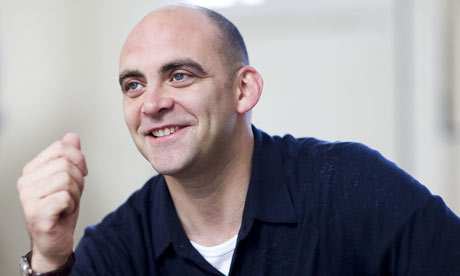
Sean Holmes

Sean Holmes

In June, the 44-year-old stood in front of an invited audience of peers and told them as much. “Maybe the existing structures of theatre in this country, whilst not corrupt, are corrupting,” he said. Maybe the theatre we trumpet as the best in the world, isn’t. Maybe it could be better, broader, bolder.” It was a barnstorming speech that pulled no punches. Even Holmes – burly, shaven-headed and one of British theatre’s great straight-talkers – admits he was afraid. “I was absolutely shitting myself; so nervous. I’m sure it pissed a lot of people off.”

Holmes runs through the basic argument again: “Most British theatre is well made, and maybe that’s what most audiences want. But there’s another audience – a young audience – that’s hungry for something else, for something that might just change them. Most theatre simply isn’t interested in doing that.”

Instead, he believes British theatre is rooted in commercial structures and standard practices. It runs on unquestioned assumptions – that rehearsals last six weeks, that the writer is central, that acting means pretending to be someone else – all of which add up to cultural hegemony and artistic compromise. Lest this sound like runaway hubris, Holmes includes himself: “Any criticism comes from self-criticism; me going, ‘I’m too cautious’.”

This frustration has prompted Holmes to challenge the norms with an atypical season born of unique circumstances. In April, a 20-strong ensemble – 10 actors and 10 writers, directors and designers – started working together under the label Secret Theatre. This month, they’ll open the first two shows of an eight-month, seven-show repertory season. The aim is to question the way theatre is made in this country and the type of theatre that results. “We believe that theatre matters,” runs the company’s manifesto. “We are hungry for change.”

.

There are two fronts to this: structural and artistic. The ensemble will be together for a year…..Six weeks of workshops preceded rehearsals proper; theoretically, the extra time spent together allows them to build a shared vocabulary and aesthetic understanding without reverting to habitual methods. Change the structures and you shift the possibilities.

“The starting point is that there are no assumptions,” Holmes explains. “With everything we do, we ask, ‘What the f**k are we going to do with this?'”

The philosophy extends beyond design and direction to play selection, casting decisions and marketing techniques. Audiences will book shows by number, not title. They might find themselves watching a classic text, a new play or something else entirely. Who knows what?

Casting isn’t merely gender- and colour-blind – the ensemble necessitates non-literalism – it is also willfully topsy-turvy at times. Scripts aren’t sacred. Scenes are played out of order. Lines get chopped and changed. Stage directions are obliterated. If a moment needs a dance routine, it gets one. If a pop song does the job better than dialogue, it’s tagged in. Every decision is up for grabs.

All this stems from last year’s (production of) Three Kingdoms. Simon Stephens’ play – and Sebastian Nübling’s distorted staging, in particular – has clearly had quite an impact on Holmes. Though it opened to underwhelmed reviews and half-full houses, the production found vocal champions online and, by the end of its three-week run, was selling out entirely, mostly to eager young audiences. Holmes talks about a generation waiting for their 1956-Look-Back-In-Anger moment: “On a good day, Three Kingdoms was the John the Baptist to that.”

Three Kingdoms

Three Kingdoms

Stephens, now Secret Theatre’s resident dramaturg, recalls “a response I’d never seen in my career”. He believes Three Kingdoms left three major marks: “Audiences remember the inventiveness of actors, their unapologetic presence in the room and their sheer physicality.” The performers didn’t just act out a scene, they warped it into something else. They didn’t kowtow to the script’s demands. They made it anew, in their own personal and inimitable style.

Secret Theatre has maintained not only the same “spirit of attack” but also the same honesty, says Stephens. “No pretending” has become the company’s mantra. The cast play themselves, even in some of the most iconic roles in drama.

“Our aesthetic is, ‘Look at us. We’re just humans on a stage’,” says Holmes. “It’s about honesty. We can’t get a fight director. We can’t do accents.”

Everything needs an alternative approach, one that the actors can own entirely. The refusal to pretend means they have to rely on analogy and metaphor, so that frying an egg might stand in for a scientific experiment. It adds an extra layer to the play, representing and commentating at the same time. “It’s about going against the text – not to be perverse, but to reveal the writing.”

Even as early as mid-July, rehearsal performances feel dangerous. Classic scenes are unrecognisable and fiercely charged. The company, most of whom are significantly younger than Holmes and Stephens, clearly relish the agency and provocation it’s provided. Actor Leo Bill, 33, feels like it allows him to consider himself an artist – something frowned upon in the wider industry that deems acting a craft. “You couldn’t stand up at drama school and say, ‘I’m an artist.’ You’d be told to sit down and shut up.

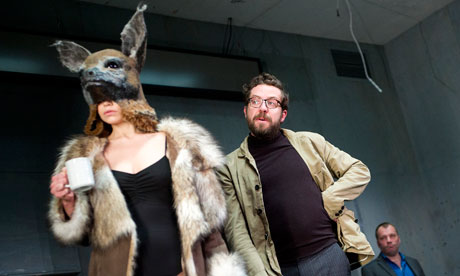
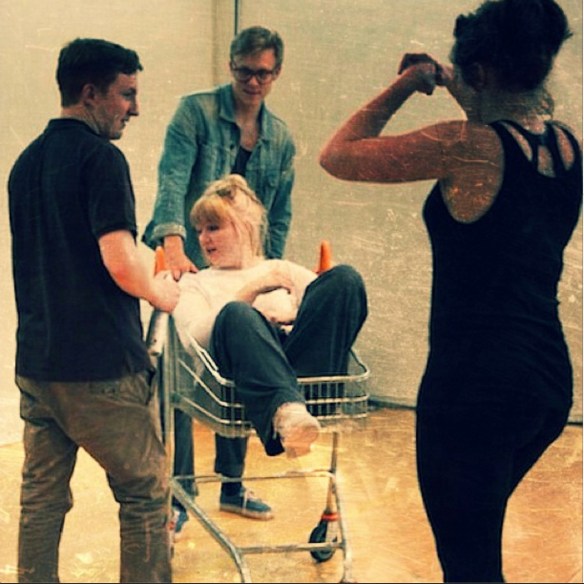
Secret Theatre in rehearsal

Secret Theatre in rehearsal

I’ve met older actors who are adamant they’re not artists. They just do what the director tells them as best they can.”

Not so here. Actors pull scenes in radical directions without warning their colleagues. They arrive onstage with props they’ve just picked up. They’re happy to actually fight each other; to spit and snog and sing. There’s no sign of the “middle-class politeness” that so frustrates Bill in other rehearsal rooms. At one point, a group discussion of a short confessional monologue dissects the paradox of sin and forgiveness – a cycle that makes both terms redundant – within a minute. “Usually there isn’t time for talking,” says Bill, “because you’ve got four weeks to put a show together.”

But Secret Theatre is underpinned by a luxury: freedom from normal commercial pressures. “Whatever we did this year, we would struggle financially,” Holmes admits. “There was always going to be some kind of deficit.”

Reduced design costs will compensate for increased wages, but the theatre will have to dip into reserves nonetheless. “It’s an opportunity to examine every aspect of how we run a theatre building,” says Holmes.

In that, Stephens draws comparisons with the Royal Court’s Open Court. “Three things over one summer could really force people to interrogate the conditions in which work is made.” Yet, where those projects have quietly downplayed their radicalism, Secret Theatre has defined itself with a combative, critical rhetoric that could easily trigger a backlash. “We’re just putting some plays on,” Stephens adds. “That’s all we’re doing. We’re not bringing down the government or starting a political party.”

But Holmes and his young company are already looking to the future. “Far worse than it failing is the possibility that it succeeds,” says Holmes. “Then we have to make it sustainable.”

When I read something like this I always have to question (albeit in this case, in a very small way) whether the intention will be fulfilled. The response on Twitter to the opening Secret Theatre #1 put my mind at rest:

@LyricHammer what you’re doing with Secret Theatre is possibly the single most important experiment in british theatre in decades. go on!

Just seen Show 1 @LyricHammer. OMG! Really OMG! Came out feeling shellshocked. Battered. GO. You need to see this for yourself.

The #SecretTheatre ensemble are brilliant. 2nd time this week. 1st two shows are pure theatre and inventive to the nth degree.@LyricHammer

#showone@LyricHammer#secrettheatre is a cluster bomb into the violent subconscious of England. And quite, quite beautiful for it. I think

@StephensSimon@LyricHammer Tremendous quality of dislocation and presence simultaneously in the performers.

Post Update:

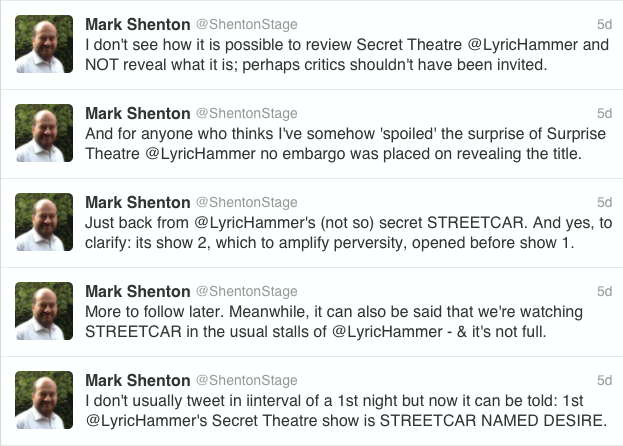
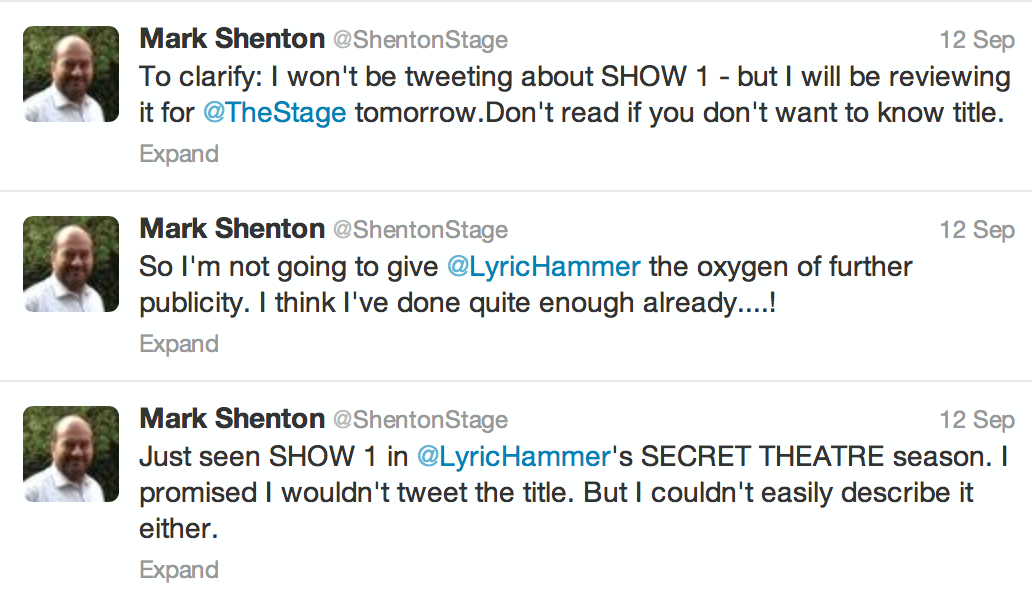
Evernote Camera Roll 20130915 145639_FotorHaving made this post, I then noticed that the opening week of Secret Theatre had created a bit of a (Twitter) storm. Two Secret Theatre shows opened, a little confusingly, Show 2, followed by Show 1. One theatre critic, Mark Shenton, went to see Show 2 and then tweeted the real title, A Streetcar Named Desire. And this is where it all got a bit bizarre. Some people were outraged that Shenton had undermined the idea underpinning Secret Theatre as this Storify trail shows. Jake Orr, a well-known theatre maker weighed in with an attack on him on his blog, Where Theatre is Thought, calling Shenton Scrooge for spoiling the fun. And so it went on, with Lyn Gardner having her (sensible and grounded) say in her blog post, Not so Secret Theatre.

Untitled_FotorThen came an apology from Shenton in The Stage, To Tweet or not to Tweet a secret.

All in all, quite funny really, I think. Great free publicity for Secret Theatre and a theatre critic who will be a bit more careful with his tweets.

The Theatre of War

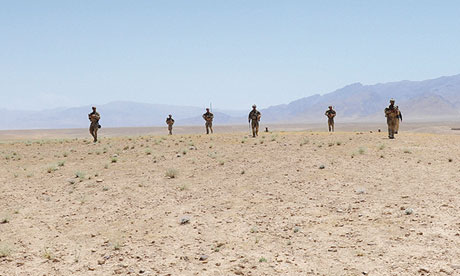
I was interested to read yesterday that the world-renowned Sydney Theatre Company  is to collaborate with the Australian Defence Force in a new verbatim play that will bring the stories of servicemen and women to the stage in the centenary year of the start of the first world war. What is even more interesting is that it was the military itself that approached the company with the idea. The new work will be based on the real experiences of Australian defence personnel who were wounded in Iraq, Afghanistan and East Timor. The process is underway and 20 soldiers are currently telling their stories through workshops. Daniel Keene will write the play, which will be preformed by both professional actors and ex-soldiers.

The Long Way Home - STC

Interestingly, Keene says that the project is not verbatim theatre (see the Q and A below), but all the news reports and the company’s own artistic director says it is.

Q & A: Daniel Keene (from the SCT Website)

What interested you about The Long Way Home as a project?

Firstly, it seemed a unique way to make theatre. Making theatre is what I’ve done for a very long time, and it’s something that I enjoy enormously. The Long Way Home presented a very particular set of circumstances, the most intriguing of which was the fact that I would be starting with no idea of what the final outcome would be. danielkeene200pxEverything depends on what the soldiers are willing to offer me. They are the ones who will determine what the play/show will be about. My job is to shape the material they offer into something that is theatrically effective.

Another reason I was interested in the project is that I think it’s important for the public to hear the stories that these soldiers have to tell. The ADF have been on multiple deployments over the last 20 years. They represent Australia, they act in our name. But does the public actually know what they’ve been doing or what they have achieved? More importantly, I think it’s critical that service men and women tell their own stories, the good and the bad, stories about their successes and their failures, and that the public’s understanding of the ADF isn’t limited to Government pronouncements and PR.

And I guess finally, deciding to participate in the project was a moral decision. The men and women involved have sacrificed an enormous amount in the service of their country. Whether or not you agree with the Australian government’s decision to become involved in a conflict such as the one in Iraq, the people involved in this project have given the best of themselves. And some of them have paid a very high price. It felt right to be able to offer something in return.

The production is based on first-hand accounts from soldiers. How do you fit into that as the playwright?

From the outset, both Stephen Rayne and myself have been clear that we did not want to make a piece of reportage, nor anything like a documentary. This will not be a piece of Verbatim Theatre. It isn’t question of the men and women involved in this project simply repeating their stories, but of creating a piece of theatre out of those stories; we want to escape the merely anecdotal. In doing that, perhaps by working together we can assign a larger meaning to those stories, illuminate their context, explore their cultural and emotional significance. This notion of creationis part of the healing process for the men and women involved in the project. As I’ve said, we want to get beyond the anecdotal and head someway towards the creation of meaning. I’m right now discovering how I fit in to that process. My job right now is to listen carefully, to pay attention to detail, and to resolve to be as truthful to what I hear as possible.

Is this process of writing familiar or is it new ground?

I’ve done a two projects a somewhat similar to this, both in France. They both took place in Marseilles, and they both concerned people living (to put it bluntly) at the very bottom of the food-chain. Some were living on the street. Many of them were immigrants and refugees from North Africa. I wrote two plays based on these people’s experiences, which they then performed, with the help of a small group of professional actors. I know that it was a liberating experience for the people involved. What I remember most of all is how exhausting it was for me! But it was an amazing experience.

Being in the midst of a creative development with the soldiers right now, has there been anything particularly striking or surprising about their stories so far?

We are only just beginning, and stories are only just now emerging, but what is already striking is the openness and the willingness of the soldiers to take part in this process. There is a lot of vulnerability in the room, but there is also a lot of courage.