A Theatrical Thriller

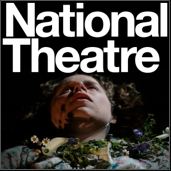
My plan today was to blog a great article from Mark Lawson about stage directions, and how some playwrights ask the impossible. However, the article led me to read again about one of the biggest stories in the history of the British theatre. In 1980, a play by Howard Brenton, Romans in Britain, was staged at the National Theatre in London. The play comments upon imperialism, colonialism and the abuse of power and whilst it is set at the time of the Roman invasion of Great Britain 2000 years ago, it  was really a metaphor for British rule in Northern Ireland, which was at its deadliest in the 1970s and ’80s.

So what, you may ask? Well the issue was that the play included simulated male rape as well as some nudity and quite graphic violence and soon there was a moral crusade, led by a figure called Mary Whitehouse. The culmination of this was the director of the play, Michael Bogdanov, being tried in court for having “procured an act of gross indecency………on the stage of the [National] Theatre contrary to the Sexual Offences Act of 1956”.

The outcome of the case changed legal and theatrical history and was indeed a drama in itself. This first link .Passion Play is the full story and it is fascinating.

This article, Dangerous Minds, explores the whole case further.

And finally this is an interview with the playwright, Howard Brenton, 25 years later.

To top it all off nicely is a BBC video interview with Michael Bogdanov from earlier this year, the 30th anniversary of his court appearance.

Still Talking

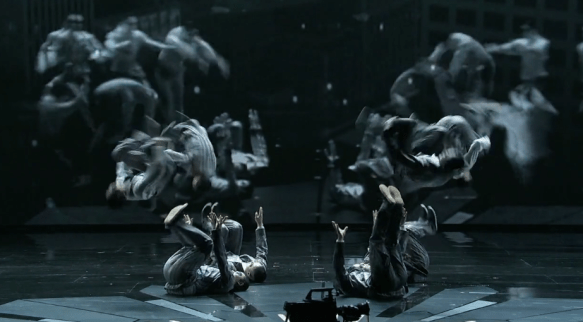
Earlier in June I blogged about Can We Talk About This?, DV8’s latest work looking at Multiculturalism, Islam and freedom of speech. What I hadn’t picked up on at the time were the debates that were going on surrounding the piece and that, in some quarters, it was being vilified as naive and lacking balance.

.

.

.

.

.

.

.

I suppose the question for me is does it need balance? Merely by provoking the furore it has, doesn’t that mean it has done what Lloyd Newson, it’s creator, set out to do – start a debate? Can a piece of polemic be classed as political theatre? Brecht would, of course, have said no – it should have balance and represent both sides of the argument. On the other hand, perhaps saying publically, albeit through dance theatre, what others are scared to talk about is the correct thing to do.

Linked here are a series of three articles from Exeunt Magazine.  Have a read, I’d like to know what you think:

Talking About This

We Didn’t Talk About This

Talking More About This

.

.

.

.

.

.

.

And finally an interview with Newson entitled Dancing Around Islam

.

Turning Japanese

It’s Research Investigation time for my TA students and two of them are getting excited about Japanese theatre. So, Tim and Clarissa, three fantastic documentaries to get you going.

And a little added extra.  This is the Ningyo Johruri Bunraku Puppet Theatre in Osaka which I visited 6 years ago.  I went on the opening day of the season, thanks to a very helpful concierge at my hotel. I was fortunate enough to see the greatest living japanese master jōruri – a very wizened old man who was just astonishing.

Dennis Kelly: “The Quest for Truth” 3

The political theatre debate continues. In an article in The Economist, Natalia Koliada is reported as saying

I am always against separating, saying there should be political theatre or social theatre or female theatre, or aboriginal theatre—it is about theatre. It is about going deep into one life, like a total immersion in personality, in a different circumstance.

Click the image above for the full article. What do you think?

Also in The Economist recently is Mohammed Al Attar,  an acclaimed young Syrian playwright who, given the appalling situation in his country, is talking about play-writing as a tool of protest:

I think theatre is political by default. But I do not directly write statements or propaganda

Again click the image above for a very different take on what is ‘political’ in theatre.

Five Truths

What are the differences between five of the most influential European theatre practitioners of the 20th century – Constantin Stanislavski, Antonin Artaud, Bertolt Brecht, Jerzy Grotowski and Peter Brook? How would these five directors work with the actors playing Ophelia in the famous mad scene in Shakespeare’s Hamlet? What would they ask the actors to do and how would they ask them  to behave?

A video installation called Five Truths commissioned by a theatre and a museum was created by a group of contemporary theatre makers lead by stage director,Katie Mitchell, looking at these questions. The Multi-screen installation brings together five interpretations of Ophelia’s madness in Hamlet. and consists of ten short films (2 for each of the practitioners) suggesting possible variations in what you might see. Ten screens of varying sizes simultaneously play films of Ophelia interpreted dramatically through the lens of the Big Five..

I love this project and it is a viewing MUST for any performance student.  You can get to the  five podcasts on iTunes by clicking the image above, or watch them on Youtube, the first being Stan the Man:

.

Shannon Murphy takes the cake

As a drama and theatre teacher, you are always proud of what you ex-students go on to achieve, be it a doctor, a lawyer, working in PR or in business…..the list is long and gratifying. However, you always have a soft spot for those that have the will, determination and talent to keep going and make it in the cut-throat world of professional theatre. Yesterday, on Facebook, there was a post on my timeline from my old student and friend Shannon Murphy. It was an interview with her in TimeOut Sydney. So with great pride and a wry smile on my face it is my post for today.

Meet a Sydney director with an unquenchable artistic appetite. Darryn King tucks in with a true theatrical omnivore

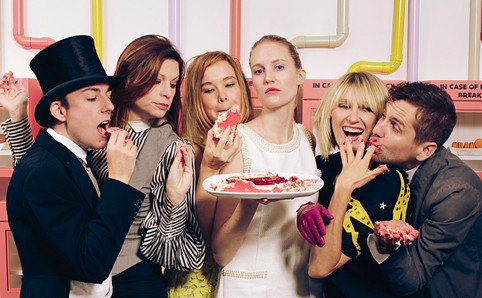
Shannon Murphy arrives at the Time Out photo shoot with her entourage in tow: a couple of tittering blonde starlets, a man in a coat and tails and top hat, a grinning performance artist duo…

Murphy is used to keeping diverse and colourful company. For Sydney stages in 2011 she directed the warm-hearted romantic comedy This Year’s Ashes right after directing Trapture, a psycho-surgical freak-out of a show that featured live urination and a pig’s heart barbecue. Before that she directed two young teens and a seven-year-old (in Tusk Tusk) and before that she directed three women in a trio of grisly poem-monologues (Crestfall).

Even in primary school Murphy was a theatre-maker of bold vision. “I wanted to direct the nativity play but was told my ideas were too radical,” she says. “All I wanted was the angel Gabriel on roller blades.”
It’s possibly her international upbringing – Murphy was born in Africa, raised in Hong Kong, primary schooled in Melbourne, college educated in America – that makes her so comfortable navigating disparate theatrical worlds. “Sometimes people find it tricky when they can’t define an artist,” she says. “But I just love continuously expanding. I always try to find something new every time that keeps stimulating me – in the form or the style of the work or the writing of the work or whatever it is. It’s got to be really different from anything I’ve done before because otherwise I get bored.”

Given that, it’s not surprising that Murphy is now considering joining her partner, actor Dan Wyllie, in pursuing a career off-stage. “I would really like to look at film and TV, a completely different form,” she says.

In the meantime, though, Murphy is working on two back-to-back theatre productions. She’s currently in rehearsals for the angsty sex comedy Porn.Cake for Griffin. “It’s about this idea of Saturn’s return, reaching 40, seeing things anew – and wondering whether you will ever find the pure and simple happiness you felt pashing someone for the first time or finding a click beetle in your party bag…”

And, after Porn.Cake, Murphy bounds straight into rehearsals at the Ensemble Theatre for Circle Mirror Transformation: a play set in a community centre drama class. It’s a glimpse, Murphy says, of what it feels like in every rehearsal room. “What starts off with drama games ends in people’s lives being changed, in a way.”

When our photo shoot gets underway, we get a glimpse of what it must feel like in Murphy’s rehearsal room in particular: Murphy’s actor buddies bunch up close for the camera, laugh, clown and take turns pawing at her face.

Our photographer asks one of them, “Can I get you to lick her face again?”

She obliges. Murphy doesn’t even blink.

Specific Reflections

I have been keeping this blog for a month and over the weekend, I looked back at what I’ve posted about……and it made me realise a couple of very significant things.

Firstly, just how much I have learned about world theatre, and more particularly Asian theatre, since I started teaching IB Theatre Arts 6 years ago. What an amazing journey! Mostly, my performance education was largely in the western canon and generally about dead, white male theatre practitioners, so now to have knowledge and understanding about so much more is empowering.

Secondly, there are some trends emerging which reflect my own personal interests in a very obvious way – political (sorry Dennis!), site specific and dance theatre, as well as technology in multimedia performance. I knew it, but it is interesting to see it laid bare in front of me.

Site specific theatre is my current passion, fuelled by work with Dr Sally Mackey, from the Central School of Speech and Drama, and Lynne Bradley from Brisbane-based physical theatre company, Zen Zen Zo. This brings me to the this:

Everyday Moments 12: audio drama for private performance

This is a series of podcasts that have been created by different artists to be listened to in specific places, at specific times. Glorious sound scapes and, in my book, very site specific.

Enjoy, when you have 10 minutes

Dennis Kelly: “The Quest for Truth” 2

One thing that Dennis Kelly doesn’t appear to consider is that sometimes the very act of making theatre is judged to be political. In May I wrote about Belarus Free Theatre and it’s co-founder, Natalia Kaliada. Yesterday my friend Paula, blogged the latest from them:

Imprisioned, tortured, threatened, exiled for making theatre

When I interviewed you last year, you’d been forced to leave Belarus and were living with your husband [the playwright Nikolai Khalezin] and your daughter in exile in Britain. Your friends were in prison, some had been tortured, your family had been threatened. Has anything improved?

An extract from an interview with Natalia Kaliad

‘In Belarus it’s very simple – everything’s repressed’

Natalia Kaliada talks more here about the company’s new play and the escalating brutality in her homeland

A very different kind of political theatre to that of DV8. One that exists because of political oppression and is oppressed as a result.  Brave artists who keep creating theatre in the hope that it will bring about change or at the very least, let a wider world understand what needs to be changed – another quest for truth – but this time a more bloody and deadly one.