The Business

Untitled_FotorI have just stumbled across the content for today’s post courtesy of a tweet from Lyn Gardner. It would seem there is an annual careers conference held in the UK, specifically for students who want a career in theatre, theatrecraft. It looks fantastic and really does cover all aspects of theatre making. Whilst it obviously focuses on working in the UK, the video page has a huge list of categories and links to videos that would be useful to anyone, anywhere, thinking of making their career a theatrical one. Take a look below, and click the title links for the relevant videos:

DIRECTING

Explore the role of a Director and what it takes to survive in the industry. Hear from professional Director Adam Spreadbury-Maher

MAKE-UP

See the character emerge — a demonstration of Stage Make up from experienced theatre make up artist Melanie Winning.

PRODUCING

Take a look at what is involved in producing a show and find out how to pursue a career as a producer from industry experts.

.

THEATRE DESIGN

With professional stage desinger Matt Edwards.

PROPS

An introduction to working in a props department for a major company

DESIGN AND MODEL BOXES

A chance to see how shows are developed from a design concept to a full size on stage production, with advice to those interested in pursuing a career in theatre design.

.

WRITING

Be introduced to the craft of playwriting and find out how to survive as a working playwright.

DIRECTING

What exactly do directors do? An introduction with professional Director Emma Rivlin.

MAKING MONEY…

A unique opportunity to hear how your technical skills can be utilised in the commercial sector.

DIRECTING COMEDY

A look at verbal and visual comedy, focusing on how understanding timing and where to direct the audience’s attention can benefit your ability to direct in every other genre.

BACKSTAGE TOURS

Take a peek behind the scenes at two major London theatres.

DIRECTING AND PRODUCING

We talk to some some top directors and producers about why they love their jobs and how they got there.

SPOTLIGHT ON TECHNICAL THEATRE

Exactly what goes on behind the scenes to make your favourite shows happen…

PLAYWRIGHTS

Leading writers talk about how they got to where they are and what it takes to write a play.

.

THEATRE MANAGEMENT

How to keep a major London theatre running smoothly and not go mad in the process.

MARKETING

The ins and outs of making sure people know about shows and want to see them.

TOP TIPS

A great collection of hints and tips from those in the know (or so they say…).

VIDEO DESIGN

An insight into the work of video designers and how their work contributes to live performance.

SOUND AND SET DESIGN

A fascinating look at the sound designer and set designer and how the two work together to create incredible atmospheres.

SET CONSTRUCTION

See some of the work that goes into building a major set – before it even gets to the theatre.

.

PRODUCTION MANAGEMENT

Amazing buhend the scenes access as we follow the production manager during a get-in at the London Coliseum.

STAGE DESIGN

An informative one-to-one explaining the role of the Stage Designer.

RUNNING A VENUE

Get the low down on running one of the biggest and busiest venues at the Edinburgh Fringe Festival.

COSTUME

A profile of Faye Fullerton – a leading costume designer.

ALTERNATIVES TO TRAINING

Theatre professionals talk about how they took different routes into the undustry.

ROUTES INTO THE INDUSTRY

Insights right from the top of the Theatre World – Nicholas Hytner spills the beans.

DON’T GO TO UNI!

The artistic director of the National Theatre puts forward a controversial point of view.

WORKING IN TECHNICAL THEATRE

Learn about how to “upskill” for this exciting but demanding profession.

.

SKILL UP!

What skills do you need for your chosen profession and where do you get them from?

UNIVERSITY

Do you need to go to University to get ahead in the theatre?

HOW DID I GET HERE?

Various theatre professionals explain the decisions, training and lucky coincidences that led them to their jobs.

APPRENTICESHIPS

A popular way to take your first steps in the industry

SPOTLIGHT ON WIGS AND PROPS

A brief introduction to the goings on in the wigs and props department of major theatres.

..

What The Butler Saw

JHaynesPortrait2A quick video post from me today.  The first is a documentary from the BBC about the playwright Joe Orton that TheatreVoice has added to its growing video archive, TheatreVoiceTV. 

Orton lived a short but vibrant life and I was reminded of him recently when one of my performing arts students decided to write an investigation of the history of farce in theatre.

If you would like to know more, there is a fantastic website that has masses about Orton, his life and his plays – Joe Orton Online.

.

.

OH GOD-oh

It’s production time at my school, so the posting has slowed down a little bit in the last week or so.  Normal service will be resumed next week.  However, one little item that made me smile was an article two days ago in The New York Times by Dave Itzkoff, entitled The Only Certainty Is That He Won’t Show Up  which is about the right way to say ‘Godot’. The reason why this resonated was that a touring production of Waiting for Godot came through Hong Kong earlier in the year, during a holiday when I was away, and some of my students went along to see it. When school was back in session, and they were eager to share their experiences and thoughts, many of them were pronouncing it god-OH, stressing the final syllable, rather than the first. I chose not to put them right (so I thought) as I was delighted they had gone to see one of the theatre classics under their own steam.

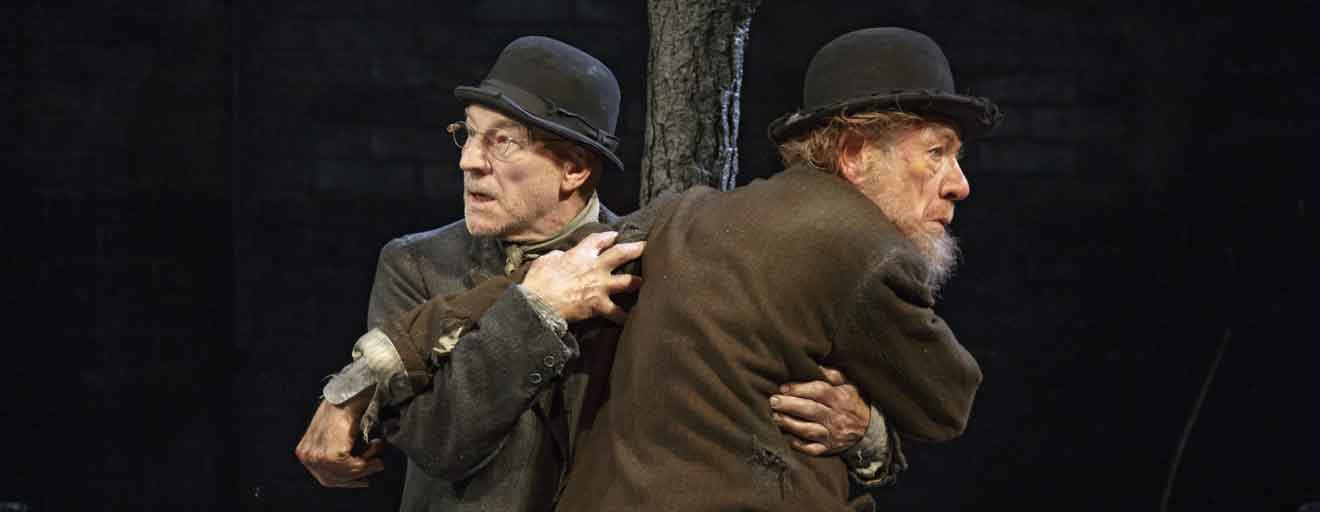
ban-01Now the reason Samuel Beckett’s most famous play is in the news at the moment,  is that two of the most famous stage (and screen) actors in the english-speaking world are about to open in it on Broadway – Sirs Ian McKellan and patrick Stewart – a great reason to spend Christmas in New York, as far as I’m concerned. I can guarantee that they will pronounce GOD-oh!

Here’s the article I mentioned above.

The Only Certainty Is That He Won’t Show Up

The Right Way to Say ‘Godot’

Maybe Godot never appears because everyone is mispronouncing his name.

More than 60 years after the debut of“Waiting for Godot,” Beckett’s absurdist drama about two vagabonds anticipating a mysterious savior, there is much disagreement among directors, actors, critics and scholars on how the name of that elusive title figure should be spoken.

“GOD-oh,” with the accent on the first syllable, is how “it should be pronounced,” said Sean Mathias, the British director of the latest a Broadway revival of “Waiting for Godot,” opening later this month at the Cort Theater.

“It has to be, really,” he said. “There’s no other way to do it.”

But the theater critic John Lahr said that rendering “is too obvious” for the playwright Samuel Beckett, with its suggestion of the Almighty.

“Beckett is more elusive and poetic, and he wouldn’t hit it on the head like that,” said Mr. Lahr, a longtime contributor to The New Yorker, who instead advocates for “god-OH,” with the accent on the second syllable.

Georges Borchardt, a literary agent who represented Beckett and continues to represent his literary estate, suggested even a third pronunciation was possible.

“I myself have always pronounced it the French way, with equal emphasis on both syllables,” Mr. Borchardt said in an email.

12GODOTjp-articleLarge

Mr. Borchardt said he had consulted with Edward Beckett, a nephew of the author, who told him that his uncle pronounced it the same way, and that Edward Beckett could not see “why there should be a correct or incorrect way of pronouncing Godot.”

“As the agents for the estate,” Mr. Borchardt continued, “we do not insist on any particular pronunciation.”

There seems to be nothing to be done to reconcile these competing camps, and productions of “Godot” do what they will. In a video recording, Peter Hall, who directed the first British production, in 1955, pronounces it GOD-oh. An American television production from 1961 starring Burgess Meredith and Zero Mostel uses “god-OH.” Discussing his role in the 2009 Broadway production, Nathan Lane says “GOD-oh.”

“I don’t think there is a mathematical solution to this problem,” said Mark Nixon, the director of the Beckett International Foundation at the University of Reading in England. Dr. Nixon said he believed the name was correctly pronounced with a stressed first syllable. But, he said, “I don’t feel strongly in the sense that I would correct somebody who said it differently.” Still, he did not dismiss the Godot question as a trivial issue. “Nothing’s trivial when it comes to Beckett,” he said.

The debate would surely please Beckett, an Irish author who originally wrote “Waiting for Godot” in French before translating it into English, and whose work embraced ambiguity and resisted easy interpretation. As this Nobel laureate wrote, “no symbols where none intended,” but he kept his intentions mysterious and seemed to leave symbols everywhere. The pronunciation of Godot, like the name itself, seems pregnant with meaning, yet ambiguous.

One might think that Beckett’s own writing would plainly reveal his wishes, but, gosh, no.

According to “The Theatrical Notebooks of Samuel Beckett” (Grove Press), when “Waiting for Godot” was performed in the 1980s by the San Quentin Drama Workshop, Beckett sought “to counter the natural American tendency to stress the second syllable” and asked his actors “consciously to pronounce it with the stress on the first syllable instead.”

Dr. Nixon said that recordings of the author’s voice are extremely rare — “only about four, or four and a half, are in existence.”

“I’ve heard all of them,” Dr. Nixon said, “and on none of those recordings does he use the word Godot. So, unfortunately, that’s not a route we can take.”

The French-looking name Godot may seem to call for a French pronunciation. But in an English-language production, speaking Godot without stressing either syllable “would be similar to saying ‘Paree’ for Paris,” explained the actor Adrian Dunbar, an experienced Beckett performer.

“Although not incorrect,” he said, “it does sound a little, shall we say, faux.”

There is no definitive origin story for the name Godot, either. It may be Beckett’s reference to the French bicyclist Roger Godeau or to French slang words for boots, a pair of which feature prominently in the play.

Mr. Lahr rejected the interpretation that Godot was simply a stand-in for God, an idea he said was too easily conjured up by the pronunciation GOD-oh.

When his father, the actor Bert Lahr, played Estragon in the original American productions of “Waiting for Godot,” Mr. Lahr said “god-OH” was used.

“It keeps it open-ended and more painful, almost, as if there’s nothing out there,” Mr. Lahr said. “Which there isn’t, in Beckett’s vision.”

And for American ears, the GOD-oh pronunciation can sound affected, and can take some getting used to.

Mr. Mathias, whose production of “Waiting for Godot” was originally staged in the West End of London, said that when it transferred to New York, “we had to train everybody” to embrace this pronunciation.

waitingforgodotLDN460f

“Could you imagine the poor crew?” Mr. Mathias asked cheekily. “Anybody who says ‘god-OH,’ I say, ‘Excuse me? What’s that? We’re not doing that play.’ Poor things.”

Shane Baker, who translated “Waiting for Godot” into Yiddish, said that actors in this version of the play said “god-OH” because “that’s how it’s known in America.”

“I was the translator,” said Mr. Baker, who also played Vladimir in the New Yiddish Rep production at the Castillo Theater in Manhattan. “But the producer and director wanted god-OH, so there you have it.”

“We did it wrong,” he said. “Look, I had other battles I had to fight.”

Mr. Baker added that, over the years, “Waiting for Godot” had become part of “the people’s imagination.” It has been paid tribute in films like “Waiting for Guffman,” and the subject of a “Sesame Street” parody, “Waiting for Elmo.”

Saying “god-OH,” he said, has become part of the vernacular, and it is too late to talk audiences out of it.

“The rest of the play is jarring enough,” Mr. Baker said. “Why upset them?”

Playing With Words

This week I have been to see (with lots of students) A Clockwork Orange, an adaptation of the Anthony Burgess novella, staged by UK-based company, Action To The Word. Nothing unusual in that, of course, but it did raise a number of questions for me and my students. But before I go any further have a look as these two videos to put the post in context:

.

.

Firstly I should say that I did enjoy it. It was a great attempt to put something on stage that would otherwise be difficult to do, simply because the sheer level of ultra-violence and sexual violence in the narrative. Secondly, I have to say this as it has a bearing on what I am about to write, I was sitting in the gods (gallery) and had forgotten my glasses, so may have missed a few subtleties.

Clockwork Orange - Action to the Word

This production is an all male one. Single gender companies and casts are very much in vogue at the moment, allowing directors to explore narrative themes that are perhaps not foremost in an original work. In essence I have no problem with this – this is theatre at its most dynamic – theatre as a vehicle to reflect what is interesting to the director and company, and even as a mirror to contemporary societal shifts and passions. However, I was left wondering whether, when you stray away too far from a writer’s original intent, are you indeed putting on, in this case, A Clockwork Orange or a different play altogether.

In her programme/play bill notes, Alexandra Spencer-Jones, the plays director says

My company was rehearsing Romeo and Juliet [when] I decided to bring A Clockwork Orange to the stage……People think of R & J as a beautiful and tragic love story….for me it is much more than that….my main interest came into the role of Romeo ‘as a man’ upholding male responsibility when his friend Mercutio is killed and becoming (sadly) what he hates – a Montague fighter. With this in mind I spent much time concentrating on the fights and the role of testosterone in Shakespeare. Romeo – an angel with rage just under the skin. In the same actor who was in the role at the time, I found this storage balance – can the audience love someone they are scared of, sympathise with a villain – cry for him when he suffers. I was desperate to find out and A Clockwork Orange provided such a character and such a story to experiment.

Clockwork Orange - Action to the Word

It was from this concept, and the fact that I primarily direct men in the Shakespeare company, that I decided to workshop the piece as all male. Suddenly it was to a piece about women being objectified and raped, it was a piece about power and manipulation of all people, dictatorship and youth.

And I suppose this is what I saw this week. The narrative is indeed transformed, but into one that has blunt homoerotic overtones that don’t exist in Burgess’ original and therefore I have to question whether what we watched should still be ‘sold’ as A Clockwork Orange.

Clockwork Orange - Action to the WordAs I said earlier, I appreciated the piece and there were some excellent moments. But should a director be able to take way a central theme, such as the objectification of women, and claim they are staging the same play? I have subsequently had this conversation with some friends and students and we came to no real conclusion….seemingly just left with a nagging doubt that we had seen something other than that which we were expecting.

This also led to some self-examination on my part. As a theatre maker I like taking an original work and exploring certain themes in more depth while relegating others in terms of importance. A few years ago I staged a version of Lord of the Flies which did just this. I have never really thought about the proprietary nature of doing this as part of the creative process, but having experienced what I have this week, it has made question myself a little.

Another question that this particular production raised for me was whether, when one sees a physical theatre re-interpretation or re-imagining of a novel, is there a need to have read the original to make sense of the new work? Do you need to hold on to the depths and nuances of the novel in order to give depth and nuance to the new work? In this case, the reaction of my students would seem to indicate yes. Of course any adaptation from one form to another takes on this conundrum, whether it is from book to stage or screen, but it is a question worth considering I feel.

"A Clockwork Orange"

The other major question that was raised for me was one of venue choice. Here in Hong Kong, the piece was staged in the Lyric Theatre, a 1200 seater, traditional space. Thankfully we have a handful of new production companies in the city who are increasingly bringing in significant and worthy pieces. However, I was left feeling that the decision to put this particular production onto one of the two main stages we have in the city was a mistake. This was confirmed when I started to read the reviews of the original stagings in the UK. The venues there were small and intimate – 150 seaters or so.  This made sense of the reviews for me – you can read a couple here and here – where the critic had clearly had a very experience to my own. The intent behind the direction was clearly to create a piece of theatre that was visceral and arresting, but when you are sat a long way from the stage, this is lost – as it was for us. A shame, as I think, especially given that the audience in the stalls was sparse and the four international schools in attendance seemed to be crammed in to the gallery and balcony. This fact could of course lead to a whole new post about theatre pricing and the real value given by production companies to fostering the next generation of theatre goers…..but that one is for another day.

It Does Matter

This post is a milestone for Theatre Room – the 200th since I started it, 18 months ago. So it seems only fitting that the post has come about after an intelligent, heartening, occasionally saddening conversation yesterday, with my final year Theatre Arts students. I can’t quite remember how we got started, but in essence we were discussing the value of a theatre arts eduction and more generally the need for arts in society.  Now this particular group of young people are inspirational at the best of times, but when they started to list what they felt they had learned from the course – the skills (non-theatre related), the cultural understanding, the ability for arts to impact the world, and so on – I was humbled. They hadn’t been indoctrinated by my (well, not much) and had discovered and understood all this themselves. I am a proud man.

Howard Shalwitz

Howard Shalwitz

During the course of the discussion articles and videos were shared and this was one that touched a nerve for all of us – encapsulating what we talking about. It is from a post on theatrewashington entitled 7 Reasons Why Theatre Makes Our Lives Better. It is an extract from a speech, actually more of a treatise,  given by Howard Shalwitz, the Artistic Director at Woolly Mammoth Theatre Company, from Washington D.C., a fund-raiding event in 2011..

.

As someone who came from a family of doctors, started out pre-med in college, detoured to philosophy, then teaching, and finally to theatre — not only did my career choices slide steadily downhill from my mother’s perspective, but I was left with a moral conundrum: does my chosen profession, theatre, make a valuable contribution to the world when compared with the other professions I left behind? I guess this conundrum has stuck with me, because as recently as this past winter I made a list of seven reasons why theatre matters and I’d like to share them with you briefly tonight.

First, theatre does no harm. Theatre is one of those human activities that doesn’t really hurt anyone or anything (except for its carbon footprint — but let’s ignore that for now). While we’re engaged in making or attending theatre, or any of the arts for that matter, we are not engaged in war, persecution, crime, wife-beating, drinking, pornography, or any of the social or personal vices we could be engaged in instead. For this reason alone, the more time and energy we as a society devote to theatre and the arts, the better off we will be.

Second, theatre is a sophisticated expression of a basic human need — one might call it an instinct — to mimic, to project stories onto ourselves and others, and to create meaning through narrative and metaphor.. We see this instinct expressed in children when they act out real or imagined characters and events. We have evidence of theatre-like rituals in some of the oldest human societies, long before the foundations of Western theatre in Ancient Greece. So theatre matters, in essence, because we can’t help it. It’s part of what makes us human.

kecak1

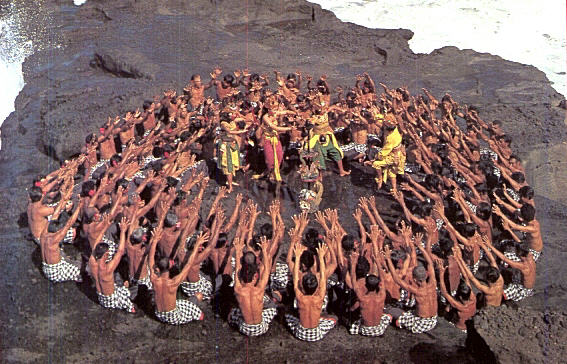
Third, theatre brings people together. For a performance to happen, anywhere from a hundred to a thousand or more people need to gather in one place for a couple of hours, and share together in witnessing and contemplating an event that may be beautiful, funny, moving, thought-provoking, or hopefully at least diverting. And in an age when most of our communication happens in front of a screen, I think that this gathering function of theatre is, in and of itself, something that matters.

Fourth, theatre models for us a kind of public discourse that lies at the heart of democratic life, and builds our skills for listening to different sides of a conversation or argument, and empathizing with the struggles of our fellow human beings whatever their views may be. When we watch a play, we learn what happens when conflicts don’t get resolved, and what happens when they do. We develop our faculty for imagining the outcomes of various choices we might make in our personal lives and our political lives. It’s not surprising that, in repressive societies, theatre has often been aligned with the movement toward openness and freedom. In South Africa theatre played a role in the struggle against apartheid; in Czechoslovakia, a playwright became the leader of a new democracy. If our own representatives and senators in Washington went to the theatre more often, I suspect we’d all be better off.

Fifth, both the making of theatre and attending of theatre contribute to education and literacy. Watching the characters talk back and forth in the theatre is tricky; it requires sharp attention, quick mental shifts, and nimble language skills. It teaches us about human motivation and psychology. In historical plays we get lessons in leadership and government. In contemporary plays, we learn about people and cultures in different parts or our own country or in other countries. Studies have shown that students who participate in theatre do better in school. Making plays together also draws kids out of their shells and helps them learn to socialize in a productive and healthy way.

Sixth, theatre as an industry contributes to our economy and plays a special role in the revitalization of neglected neighborhoods. We’ve seen this quite clearly in our own city. You can look at the role that the Studio Theatre played along the 14th Street corridor, or Shakespeare Theatre along Seventh Street, or Woolly in both these neighborhoods, or Gala Hispanic Theatre in Columbia Heights, the Atlas along H Street, or the new Arena Stage along the waterfront. As each of these theatres opened, new audiences started flooding in, new restaurants opened, jobs were created, the city improved the sidewalks, and neighborhoods that were once grim and forbidding became vibrant hubs of activity. And this pattern has been repeated in cities across the United States and around the world.

Finally, the seventh way that theatre matters — and this one applies to some kinds of theatre more than others — is that it influences the way we think and feel about our own lives and encourages us to take a hard look at ourselves, our values, and our behavior. The most vivid example of this I’ve ever experienced was during a post-show discussion at Woolly Mammoth when a woman said that one of our plays made her and her husband decide that they had a serious problem in their marriage and needed to go for counseling; and she was pleased to report that they were still together and much happier as a result. Now, I’ll admit, I don’t hear things like this every day. But speaking more generally isn’t this one of the things we go to the theatre for, to measure our own lives against the lives we see depicted on the stage, to imagine what it would be like if we had those lives instead? And isn’t it a very short step from there to saying, gee, maybe there’s something I should change about my own life? And it may have nothing to do with the message that the playwright wanted to deliver! Maybe the play is about a fierce battle over a family dinner that breaks the family apart over irreconcilable political divisions — but maybe you watch the play and say, gosh, wouldn’t it be nice to at least have a family dinner once in a while, and so you decide to plan one for next month.

So, those are my seven ways that theatre matters: it does no harm, expresses a basic human instinct, brings people together, models democratic discourse, contributes to education and literary, sparks economic revitalization, and influences how we think and feel about our own lives.

With one exception, the comments posted about the article are worth a read too. One of the commenters even goes as far as adding an 8th reason, which particularly resonates with me:

Theatre helps us to understand the lives of others on a visceral, rather than intellectual, level……. theatre expands our connection to the larger world, and our empathy for lives lived differently from our own.

I couldn’t agree more.

To finish I share a video interview with Pulitzer Prize-winning playwright Tony Kushner (Angels in America) making a strong case for theatre’s role in modern society.

.

You Spin Me Right, Right Round

Before you read what I’m writing about today, take a minute to watch this video:

.

I often write about theatre and technology, but this is something else.  This amazing piece of mechanics creates illusion in a very different way. The following article, written by Nina Caplin in The Telegraph explains it all.

Inside the Olivier’s drum revolve

It’s the mechanical beast that allows the Olivier’s actors to be spun round invisibly – and to rise miraculously from the depths. But what’s it like being in the drum revolve’s jaws?

After World War II, when a National Theatre finally became more than an excellent idea that nobody wanted to pay for, the architect Denys Lasdun was appointed to design the new theatre on the South Bank. The company, under Laurence Olivier, was up and running by 1963 but their purpose-built home took rather longer, and the most revolutionary (in every sense) part of it took longer still. The Olivier Theatre’s drum revolve is an extraordinary, five-storey, computer-operated double lift contraption that enables the stage to be lowered through the floor and spun around.

The drum revolve in action, rising up with a cork screw action

The drum revolve in action, rising up with a cork screw action

And, because it’s split into two, operators can swap one half for the other without, in theory, the audience suspecting a thing. It is complicated, expensive and mechanically flawed, but it speaks of the kind of dramatic ambition a national theatre should have – and when it is cleverly used, the results can be amazing. The clever usage took a while, though. The entire building is wrapped around the drum’s contraption, or as Di Willmott, production manager on 2011’s Emperor & Galilean, puts it, “the whole mechanism is inside a big baked bean tin”. The two semicircular elevators, known as Red and Blue, weigh 25 tonnes each, plus 25 tonnes of counterweight. It must have been a brave actor prepared to rise up from the basement to the Olivier stage on a 100-foot lift operated by a 1970s computer.

The control panel and operator of the National Theatre's drum revolve

The control panel and operator of the National Theatre’s drum revolve

And in fact, even though the National Theatre building opened in 1976, it was 1988, and Dion Boucicault’s The Shaughraun, directed by Howard Davies with a set by William Dudley, that – in the words of then-Director of the NT Richard Eyre – made sense of the Olivier revolve for the first time. Shortly after it opened, Eyre met with Lasdun and told him that despite admiring the NT building and getting a thrill out its public spaces, he found the Olivier a difficult theatre to present plays in, “Which,” said Eyre, “I suppose is a bit like saying that you have a watering can that doesn’t hold water.” Lasdun called him a barbarian. Willmott took me backstage, during Emperor & Galilean, to see the beast in its lair. We descended seemingly endless steps, in the dark (well, Willmott had a torch), to find a lone man – show operator Simon Nott – shifting a series of levers in front of a screen. The raising and lowering and rotating is his job; everything must be in just the right place, so that doors line up for actors to enter and leave and scenery to be wheeled in or out. Everything should happen quietly, although until recently that wasn’t the case: ‘When it starts going around,’ said Nott, ‘you can’t hear yourself think.’ The metal tracks of the revolve weren’t quite perfectly round, and loud music was required to drown out the noise of its motion. But that, Sacha Milroy tells me now, has been fixed. Milroy was Production Manager on His Dark Materials, the vastly ambitious adaptation of Philip Pullman’s vastly ambitious trilogy; she is now, perhaps not coincidentally, PM of the entire theatre.

The National Theatre's drum revolve stage in action

The National Theatre’s drum revolve stage in action

Backstage, I stood at the base of the incredible golden gates from the Emperor and Galilean set and craned up. It’s all right this way, Willmott said, but the other way round is harder: ‘The first time you look down and see the floor 100ft away it’s very frightening. But now I’ve done it hundreds of times.’ Ben Wright, an actor in His Dark Materials, described feeling daunted by its size, but added: ‘It’s a great feeling when it’s moving, you’re going up 20ft into air then back down again.’ His co-star, Inika Leigh-Wright, was less robust: ‘You can hear everything going on above you and it sounds 20 times louder than it actually is and it’s quite scary.’

The view from inside the National Theatre's drum revolve

The view from inside the National Theatre’s drum revolve

As the actors floated up and down during that show, more prosaic work went on below: Milroy describes the 6-metre space that they lowered, re-dressed, exchanging furniture and snapping panels on and off, then raised as an entirely different room; critics talked of witches and bears on the stage’s upper regions and Oxford colleges rising from its lower depths. Even those who didn’t love the show marvelled at the design. As well they might: with the exception of Vienna’s Burgtheater, there is nothing like the drum revolve in Europe. So, why isn’t it used – and talked about – more? Partly, because it’s so expensive: ‘It eats money,’ says Milroy, ‘and it’s hard to get your head around – it’s quite cumbersome, so you need to understand the nuances and use it in a subtle way.’ Not easy with a contraption that weighs 100 tonnes. ‘An awful lot of designers are quite terrified of the logistics and the complications,’ says Milroy – and in fact Giles Cadle, who designed His Dark Materials, worked on the show for two years.

The drum revolve in action during 'War Horse'

The drum revolve in action during ‘War Horse’

Something About Judy

This week I have been watching my Theatre Arts students give a variety of presentations on theatre traditions originating from their own cultures. Teaching in an international school means that these are always wonderfully varied. What struck me this time however, were the number of students who had identified puppet theatre forms. This got me thinking again about the resurgence of puppetry. I then read this article, by Beccy Smith, in Exeunt. In it she ponders the attraction to a modern audience. Smith, as well as being a dramaturg and writer, runs a company called Touched Theatre who are performing a piece called Blue at the Suspense Festival in London.

What is it about puppets that so captures the contemporary imagination? In recent years life-size horses have stormed the West End, a decidedly larger-than-life elephant has paraded down the Mall and beautifully crafted figures of myriad shapes and sizes have entertained audiences in touring theatres up and down the country. Of course, as an art-form puppetry is not new: forms like Greek Karagoz and Indonesian Wayang Kulik can be traced back to ancient times and even our ‘own’ Mr Punch boasts a fairly impressive lineage from as far back as the writing of Pepys diaries and probably beyond. But a growing interest in puppetry has made itself felt of late and there’s a distinct sense that this oldest of theatrical languages is returning en vogue…..What puppetry draws together in these disparate strands is an emphasis on visual storytelling, on expressing meaning through action and image that I think speaks particularly vividly to contemporary audiences versed in media imagery and embodied theatrical languages.

BlueMarionette-600x527

I started to get especially interested in the connections between puppetry and other performance languages when making a show called Headcase, in 2011 which was collaboration between a dancer and a puppeteer. The show set out to portray the emotional experiences of teenagers experiencing mental heath difficulties which were themselves difficult to articulate by their sufferers but which we found, by working with the young people over a period of time, could be effectively expressed through movement and gesture. We discovered that dancers have an intuitive understanding of puppetry because of the formal qualities they share in portraying feeling and idea through movement and rhythm (we also learned a lot about the age-old connections of puppetry and therapy, but that’s another article).

Puppetry has the exceptional ability to combine within itself the abstract with the specific. Puppet figures, embodied as bug-eyed capering monsters or delicately floating wraiths, present character with engaging immediacy. Puppets can talk – sometimes you can’t shut them up – they can do text from Shakespeare to Beckett though they are decidedly not literate because so much of the meaning they convey is expressed through their material form – how they look, how they move, what they are made of. For puppets subtext is in the body. The pretensions of a hero are punctured by his being made out of sponge; a romantic heroine’s mortality is embedded in the fragile paper of which she’s formed. Puppetry is able to borrow the most powerful elements of a range of art forms – the rich metaphors of of the visual arts, the dynamic expressiveness of dance, the detailed articulacy of poetry. They’re a wonderful theatre mongrel for a post post modern audience versed in Brecht and Lecoq.

And what is most powerful of course is puppetry’s status as shared fantasy. The wiling suspension of disbelief is in-built to this form and central to its magic, its emotional resonance. In making Blue, the new interactive mystery we ail be opening at SUSPENSE, we wanted to test out how close to the audience we could bring our puppets and still invite them to take an imaginative leap. Blue explores working with audiences moving though different spaces on the hunt to discover what has happened to a missing young woman …… and this amplifies the storytelling power of the placement and disclosure of puppets and objects. Whilst our array of suspects characters speak much but reveal little, the memory, metaphor and magic that power the story’s real action express themselves through the puppetry and video that haunt their spaces.

You might argue that the appeal of puppetry to today’s audiences is as a way to step out of some of the grimmer realities of our current realities, to reach for the fantasy and playfulness of childhood, but my feeling is that the artistic riches of the art form empower it as a vehicle through which to plumb the depths and articulate the heights of human experience – a range that’s much in evidence in the lovingly crafted programme at this year’s SUSPENSE.

This Is Your Final Call

This is the most simple, yet greatly informative post for performance students, in so many ways. To quote The Guardian who have published it on their site:

As part of the celebrations to mark the 50th anniversary of the National Theatre, last year film-maker Pinny Grylls was granted exclusive access backstage with some of the National’s company. In the documentary she created, The Hour, we watch the all-important 60 minutes before curtain-up as actors including Simon Russell Beale, Ruby Bentall, Ciarán Hinds, Jenny Jules, Rory Keenan and Sophie Thompson warm up, get into costume and character, and embark on the nerve-racking nightly ritual of preparing to go on stage at one of Britain’s busiest and most high-profile theatres.

What makes me smile most is the unspoken hierarchy. It is really worth making the time to watch it. Click the image below for the link:

Untitled_Fotor

Specific, Responsive or Sympathetic?

PAI have just listened to this and it is very inspiring in a number of ways. Amongst the panel are Punchdrunk Artistic Director, Felix Barrett and Jenny Sealey who was co-director of the London Paralympic Opening Ceremony and who is Artistic Director of Graeae Theatre Company (pronounced grey-eye). Creatively, to listen to these 4 people all of whom are responsible for making theatre in non-theatre buildings and in open spaces, it is just so impelling. Even more so, however, is Sealey’s passion for what she does and what she believes in. A real force of nature! Give it a listen, I implore you! And if you aren’t sure of the difference between site-specific, site-responsive and site-sympathetic theatre, you will be by the end.

.

.

Breathing Life

Peter Glanville

Peter Glanville

My first post today is a follow-up to an earlier one, On A Wing And A Prayer, about a puppet production of Macbeth and puppetry for adults. Theatre Voice has just interviewed Macbeth’s director Peter Glanville who talks about the show, puppetry in general and its popularity and you can listen to the interview here:

Director Peter Glanville talks puppets and puppetry

It is a worth while listen, as he talks about Bunraku as a puppetry form and why there is a trend for creating puppet theatre for adults. You are left in no doubt that puppetry is a thriving world theatre form that is increasingly being embraced by theatre critics and audiences alike. Long may this continue.


In the interview, reference is made to the Suspense Festival, which Glanville started a few years ago, which focuses on puppetry that is specifically made for adult audiences. This year’s festival is about to open, featuring work from companies from a number of countries, much of which has toured internationally. Check who is performing here and just what a diverse range of puppetry style are being showcased.