A Rocky Road

normal-2Perhaps more that any other art form, theatre is a political beast. It has to be, it is about the human condition.  Whether it is the content that is political, or the mere act of staging something in a certain place, politics is never very far away. In democracies that have a left leaning government, theatre usually thrives and is supported by the state as a forum for discussion and debate. In those that lean to the right, theatre making shrinks as state funding is usually withdrawn or cut, being viewed as subversive and unnecessary. What the right have yet to work out is that their attempts at suppression only forces theatre makers to shout louder. More extreme governments hijack theatre as propaganda and/or ban work that doesn’t support ‘the cause’. Now of course these are generalisations, but without doubt there is some truth in them.

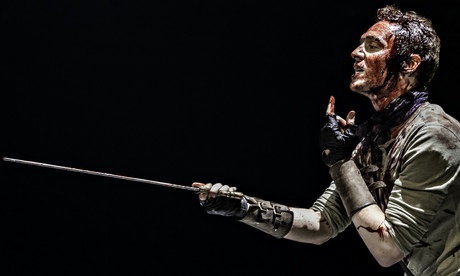
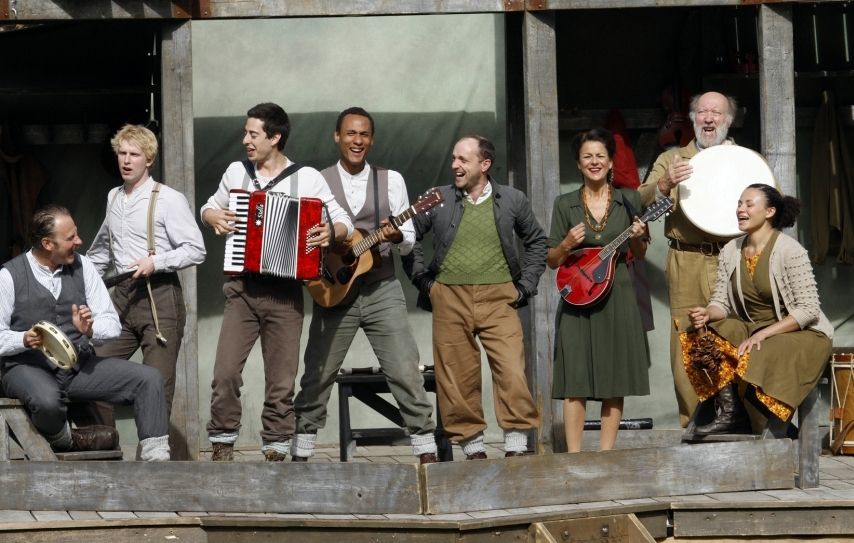
This week there have a few rumblings of discontent about the forth-coming world tour of Hamlet by the Globe Theatre, which I wrote about in July last year, Going Global. The theatre announced that in their attempt to visit every country in the world, North Korea was on the itinerary for September this year. This immediately drew criticism from Amnesty  and Human Rights Watch. Niall Couper from Amnesty said:

North Korea is a country where the horrors inflicted on people who fall out of favour are worse than any fiction….No tragic play can come close to the misery that 100,000 people trapped in the country’s prison camps endure, where torture, rape, starvation and execution are everyday occurrences.

normalTo be fair, Amnesty didn’t suggest that the theatre should boycott North Korea, but urged the company to read up on its human rights abuses first. Meanwhile Phil Robertson from Human Rights Watch (Asia) commented that exclusion would be the order of the day if the performance went ahead:

It’s going to be an extremely limited, elite audience that would see a production in any case. It would have to be in Pyongyang, which is a showcase city whose residents are selected to live there because they have shown their loyalty, so there’s a strict pre-selection process involved right from the off.

Many commentators have of course noted the sinister connection between Prince Hamlet’s murderous revenge on his uncle Claudius in the Shakespearean tragedy and recent events in North Korea. As a report from CNN said

The parallels of staging a drama about an epic family power struggle in Pyongyang, where the country’s young leader Kim Jong Un had his uncle, Jang Song Thaek executed has raised a few eyebrows…..Jang was considered instrumental in Kim’s rise to power, but Kim turned his back on his uncle in spectacular fashion late last year as Jang was branded “a traitor for all ages” and executed on charges that he had attempted to overthrow the government.

Phil Robertson drily noted that

When the North Korean leadership gets around to reading the plot of Hamlet, one imagines they might well insist on something else from the canon
hamlet_hedingham_Fotor

The story has made international news, from Bangkok and South Korea, to Germany and the US.  I suppose this says a lot about how well regarded the Globe is around the world. However, it is politicking that is driving the story. Not surprisingly, the Globe hit back issuing a statement that, amongst other things, said:

We have decided that every country means every country, since we believe that every country is better off for the presence of Hamlet. Shakespeare can entertain and speak to anyone, no matter where in the world they are. We have always believed that cultural communication, and different peoples talking to each other through art, is a force for good in the world. In every country, we are going for one single and simple purpose: to play Hamlet there.

We are very proud of our record of working with a selection of NGOs over the years – Amnesty themselves, PEN, Reprieve and Human Rights Watch. We have raised money for their operations, provided space for them, and felt their influence in many of our productions and the new plays we have performed. In that light, we were disappointed that Amnesty put out a quote about our touring without realizing that it was a world tour, but under the impression that it was going solely to one country.

I take their point, but I do wonder whether this is a wise move, as it could be seen as a potential endorsement of the brutal North Korean regime. There is something to be said for cultural diplomacy, but as the USA News points out, it can go too far. On the other hand, Mark Lawson writing in the Guardian, Is there something rotten in taking Hamlet to North Korea? argues that theatre does not always legitimise its hosts and can be a weapon against oppression. If the Globe were to avoid all repressive regimes, their World Tour simply wouldn’t be.

I’ll leave the final word to Couper and Amnesty who noted that

There’s a dark irony in the fact that Hamlet focuses on a prince wrestling with his conscience. Kim Jong-Un is no Hamlet. Sadly he shows no sign of wrestling with his conscience.

 

Provisional routing of the tour

Provisional routing of the tour

Bit Between The Teeth

Last week I went to the theatre with a group of students. Nothing unusual in that of course. However, it was one of those occasions where my expectations were wildly off the mark. As I have said previously, it is International Arts Festival time in Hong Kong and when I book tickets for my students, I always try to book a range of performances – something to challenge, something from a world theatre perspective, some dance theatre and something to entertain. I think its important that my students understand that theatre is a ‘broad church’ and my want to book a piece that is a little ‘lighter’, shall we say, is part of encouraging life long learning.

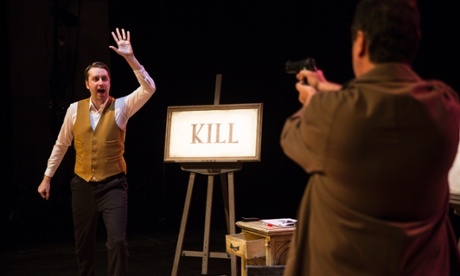
Rob-Drummond-Volunteer-opening-520x327My ‘lighter’ choice this year was a piece called Bullet Catch, a solo performance by Rob Drummond, was described thus:

A stunt so dangerous Houdini refused to attempt it, the Bullet Catch has claimed the lives of at least 12 illusionists, assistants and spectators since its conception in 1613. Drawing help from his daring live audience, modern-day marvel (William Wonder) presents a unique theatrical magic show featuring storytelling, mind reading, levitation, games of chance and, if you are brave enough to stay for it, the most notorious finale in show business.

You can see why I might book it. However, this description barely touches on what the piece is really about or the depth of the intellectual and visceral responses it provokes. What I actually ended up seeing was one of the most engaging pieces of theatre I have seen in a long time and one that has caused endless discussion between teaching colleagues and students from all grades. The piece plays with theatrical form in such a way that it leaves you with endless questions about what you have just witnessed. It is about illusion and reality. It is about free will, trust and connections. To use a modern idiom, it messes with your head. One critic said

it is…..painfully honest about the choices we make and the way we stare despair in the face while pretending we are OK.

It is beautifully and cleverly manipulative of the audience and dramatic tension – you are never sure what is truth, as it plays with content and form. All in all it is deeply unsettling and the better for it as a piece of contemporary theatre – not surprisingly it won a Total Theatre Award when first performed.

.

Bullet Catch has played in the UK, America, Brazil, New Zealand, Australia and now, Hong Kong. The critics have been almost universal in their praise and I think largely so because of the fierce intelligence that is clearly behind the theatre making. It is as much an exploration of dramatic form and how theatre ‘works’  as it is the telling of a story. It plays with your suspension of disbelief in an almost cruel way – although in hindsight and after considerable thought I am astounded at the deftness with which Drummond (as writer, performer and co-director) has done this.

A review of one of its original performances by Lyn Garnder for The Guardian gave the piece a highly praised 4 star rating:

“This isn’t magic; it’s a conversation,” says Rob Drummond in this remarkable, multilayered and utterly gripping show inspired by the infamous bullet-catch trick. It’s remarkable for several reasons, not least for the levels of tension it invokes as it heads towards a climax in which Drummond persuades a member of the audience to shoot him.

I’m giving nothing away by telling you this is a piece that plays, with swaggering confidence, with the nature of truth and illusion, invoking Harry Houdini and claiming to be inspired by the real-life case of William Henderson – apparently killed while undertaking the trick in 1912 in front of 2,000 people. Was it an accident or did something more sinister take place when a labourer with no history of violence was grabbed from the audience and invited to pull the trigger?

BulletCatch4web

It is also remarkable because while it revels in sleight of hand and celebrates the magic of theatre, it is also painfully honest about the choices we make and the way we stare despair in the face while pretending we are OK.

Drummond is both measured and infinitely vulnerable and, in a way that reminds me of theatremaker Tim Crouch, he introduces an element of dangerous uncertainty into the show by inviting a member of the audience to play a major role. “It couldn’t have happened any other way,” are almost his final words, but Drummond marries form and content to prove that it’s a lie.

One of my graduating students was appalled that we were actually being asked to wait to watch another human being shot at, which was a view expressed by Sarah Hemming in her review of the show for The Financial Times. Hemming describes the magic trick itself  as:

……a launch-pad for a gripping, terrifying inquiry into free will

At the very end, Drummond and his co-opted member of the audience re-enact the Bullet Catch and this is where Drummond works yet more of his real magic – that of absolute psychological (and theatrical) manipulation. We know that it is just a trick, an illusion about to be acted out in front of us – it couldn’t possibly be anything else in a risk-averse 21st Century. Yet when the audience are offered the opportunity to leave before it takes place, some do. Of course there are a number of reasons why this might be the case. Like my student, the prospect of one man holding a gun and aiming at another is just wrong on many levels. Equally, despite the fact we know that it is fiction, we cannot quite manage to suspend our disbelief and the anxiety is just too much.

.

9478c756-cd60-4928-90fd-b4971df84a1b-460x276I am still not clear if I have been able to give a full enough description about why I feel this piece is a unique theatrical event, but  if it tours near you I wouldn’t hesitate in recommending you going to see it – even if you have to leave before the end.

No Longer A Refugee #2

In January I wrote a post, No Longer A Refugee, about a group of women refugees who had fled the vicious civil war in their homeland Syria and were involved in the staging of a production of the Greek Tragedy, The Trojan Women. As I was driving to work today I listened to another thought-provoking programme about the project, which was broadcast by the BBC World Service, as part of their Outlook strand. If the January post struck a chord with you, I certainly recommend a listen to the Outlook podcast below:

604

Moods and Doodles

As a practitioner of theatre I have always created work in pictures first – both with the actors and with the set. A couple of years ago a visual art colleague watching some site-specific work I had created commented, with some surprise, that we clearly both worked in the same way, driven by a visual aesthetic. Obviously this is only one part of the creative process involved in making theatre, but is one I love –  in another life I think I would have liked to be a set designer.

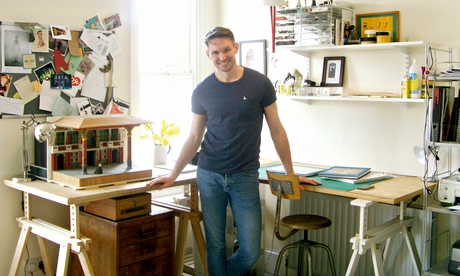
I was intrigued to read, therefore, in an occasional series in The Guardian, an interview by Georgie Bradley with Colin Richmond, a UK-based theatre designer entitled How do I become … a set designer

How do I become … a set designer

Good communication skills, an ability to network and willingness to start out making the tea have got Colin Richmond a long way

Colin Richmond conjured up fantastical uses for pegs when he was a child. His carpenter father would make miniature theatre sets out of leftover wood while Richmond covered pegs in “Borrower”-sized clothes.

'You have to keep emailing and creating worlds,' says Colin Richmond, 'get ideas on paper even if you don't have work.'

‘You have to keep emailing and creating worlds,’ says Colin Richmond, ‘get ideas on paper even if you don’t have work.’

“I loved going to the theatre for a bit of escapism. After I had seen Starlight Express I came home and made a model version of the set from memory,” says Richmond. He also recreated Gotham City at the age of eight.

Richmond, 32, from Ballymoney in Northern Ireland, wanted to be an actor. He had a string of school production credits to his name when he was cast as a member of the Jets in West Side Story, performing with the Ulster Theatre Company. “The set was this massive scaffold structure and I thought it was interesting how an environment changes you as an actor. And it made me realise this was the part of the process that was so appealing to me,” he says.

Richmond then attended the Royal Welsh College of Music and Drama,  where he took a three-year theatre design course. It culminated in a final-year show with all the pressures of a professional production. “It’s a hardcore three years of hardly any days off. It begins with sculpture work and developing the imagination and building up good skills,” he says. “We had a puppetry project to do, which we also performed in to understand the other side of the process. The second and third years are when you specialise in costume or set design.”

After his course, Richmond moved to London to become as an assistant to Bob Crowley, the designer of Mary Poppins and The History Boys, whose main assistant at the time was a friend of Richmond’s head of design at college.

Getting a break through someone you know is common in this line of work, although getting one job does not automatically lead to another. “You have to keep emailing and creating worlds, get ideas and designs on paper even if you’ve not got work. You have to be relentless in knowing who is doing what and where.”

Fresh from college, a designer can expect to be an assistant with tasks including the necessary evils of tea making and photocopying, but perseverance and a bulky portfolio will help you climb the ranks.

Richmond has recently worked on the RSC’s Wendy and Peter Pan, where he designed both the costumes and set. “You’re only contracted up until press night and then you’re free to go.” Walking around the warehouse of a set at the RSC in Stratford-upon-Avon, Tinkerbell’s fairy dust is everywhere, Captain Hook’s ship is being recharged in the wings and the plurality of the show’s scenes are inconspicuously layered.

Richmond believes in challenging the audiences: “Letting the audience use their heads to add to the story is a way to give them that escapism or realism. I’ve seen the most overdesigned sets that left nothing to the imagination. However it does depend on the show.”

Frantic sketches and doodles are part of the designer’s work, but a lack of drawing skills won’t set you back. “References, mood boards and montages are equally as effective,” says Richmond. Up until the set is constructed, the concept goes through different model stages, working at a scale 25 times smaller.

Wendy+&+Peter+Pan

Good communication skills are vital for a good set designer. They are always feeding back to the director and therefore need to be able to articulate ideas and have strong people skills. “At the end when it all comes into fruition it makes every part of the process worthwhile. The schedules are exhausting but you’ve got to keep doing more because it doesn’t pay well,” says Richmond. “You’re either a prince or a pauper in this industry.”

One of the great things about how large producing theatres now market themselves is that they are ready to promote all aspects of their production process. As a result the design of a play is often shared, along with other key aspects of the production, as the video above of Richmond’s work on the RSC’s Wendy and Pater Pan shows. Here is another, this time of the work of Bunny Christe, the designer of the UK’s National Theatre production of Emil and The Detectives, adapted from the 1929 novel by Erich Kästner.

.

The High Priestess

February and March is International Arts Festival time in Hong Kong which draws its repertoire from across the globe. One regular visitor every few of years is Pina Bausch’s Tanztheater Wuppertal, who are celebrating their 40th anniversary and this year they will be performing Iphigenia in Tauris which is one Bausch’s earliest works from 1973.

SPECTACLE: VOLLMONDCHORÉGRAPHE: PINA BAUSCHLIEU: WUPPERTAL - 2006

Vollmund

I love this company’s work and alway take myself and my students when they are in town. Prior to their run here they have been performing in London with another piece, 1980. Their appearance in the UK has generated a number of articles that I thought would be worth sharing here. I’ll start with a comment piece by Lyn Gardner for The Guardian which says everything about the genre and why it works for me and my students, who are invariably enraptured by this style of work.

What’s it all about? In theatre, it’s sometimes best if you don’t know

As Tanztheater Wuppertal’s 1980 proves, theatre is at its most potent when it doesn’t offer answers

Somebody once asked the dancer Anna Pavlova what she meant when she was dancing. “If I could tell you that,” she replied, “I wouldn’t dance it.” Theatre’s most thrilling evenings often come cloaked in ambiguity. Too much certainty is embalming in the theatre. It leaves nobody – writer, choreographer, performers, audience – with anything left to discover. I like leaving the theatre feeling as uncertain as when I went in. After all, the world and humanity are too complex and messy to explain easily and tie up in ribbons in a couple of hours.

The performances I most distrust are the ones that tell me emphatically what to think, where the playwright inserts a speech (usually somewhere towards the conclusion so we don’t forget it) that instructs as to what exactly the previous two hours have been about. Sometimes the director does it in an essay in the programme instead. I also distrust those performances that seem simply designed to confirm everything we already know about the world and ourselves. Plays that are “about things” are often really journalism in another guise.

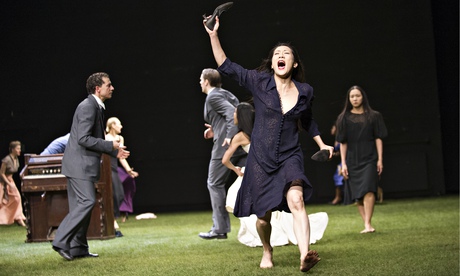
The stage is like the mind itself ... Tanztheater Wuppertal's 1980

The stage is like the mind itself … Tanztheater Wuppertal’s 1980

The great Robert Holman once told me that one of the glorious things about writing plays was uncovering in the very act of writing the things that you didn’t know that you knew. With a very good play or an astonishing performance, that can be just as true for the audience too. In the act of listening and watching we suddenly hear a distant chime that reminds us of something we had forgotten or buried; glimpse a ghost version of ourselves; or unexpectedly discover something we didn’t know we knew or felt.

Pina Bausch’s extraordinary and unmissable 1980 – surreal, truthful, mysterious, witty, heart-breaking and painful – is like that. In some ways it is as secretive as an oyster, but it is so emotionally textured and dramaturgically open that the vast stage becomes like a massive mirror of memory, endlessly reflecting our own childhoods, our own griefs and terrifying sense of fragility, and our own ludicrous and absurd way of preening and presenting ourselves to the world in the face of our own mortality. The stage is like the mind itself, sometimes focused and at others surfing wildly. There are interesting things going on all around the edges, as in life. You never quite know where to direct your attention, or where you should look.

The choreographed space between the bodies is as eloquent as the bodies themselves, and the space between stage and audience so fully alive that it invites us to lean forward to hear those chimes and watch those ghosts walk. At the end of three-and-a-half hours, I had no idea at all what it was supposed to mean, but like a frightened child in the dark began to sense and grope towards the light and all the things it meant to me. The show, and the performers, exposed and opened themselves up and invited us to share their uncertainty. In theatre, that’s a rare, brave gift. We should take it when it’s offered.

Also in The Guardian were two other pieces.The first, by Chris Weigand, Performing Pina Bausch’s 1980 – in her dancers’ words, is an interview with three of the performers and the second, ‘She made you feel thrilled to be human’ is by actress Fiona Shaw who saw Bausch’s first London performance.

Pina-Bausch-in-August-200-001

Pina Bausch

If you are not familiar with her work (or even if you are) Sanjoy Roy wrote Pina Bausch: clip by clip dance guide for The Guardian, back in 2009, which is definitely worth a read and watch. Some of the original clips referenced in the article have been removed from YouTube, but a little search will find them posted elsewhere on the site.

facepic3-duotone_large

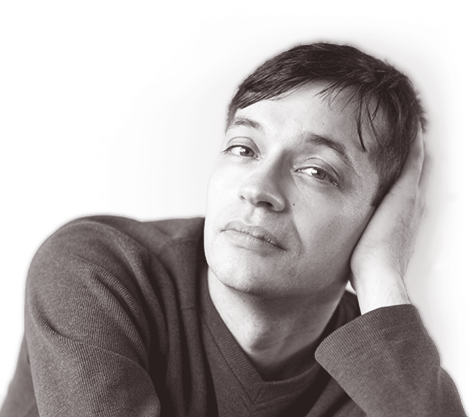
Sanjoy Roy

Sanjoy Roy is a prolific writer an all things dance/dance theatre and his own blog Sanjoy Roy Writing On Dance etc is worth a visit on any number of practitioners. I particularly like his Step By Step Guides to famous and iconic choreographers and companies, and his one on Pina Bausch is a great digest of her work.

Tanztheater Wuppertal tour widely across the globe and I thoroughly recommend you go if they come to a theatre near you.

How far that little candle throws his beams!

How far that little candle throws his beams! So shines a good deed in a weary world.

Portia, The Merchant of Venice.

Sydney Opera House at Night Australia Digital Art By mrmGoogle  ‘worlds famous theatres’ and the subsequent list is a mixture of iconic historic opera houses spanning a number of continents, the Chinese Theatre in Los Angeles and, not surprisingly, The Sydney Opera House. Now I could take issue on many fronts with what is considered to make a theatre famous, not least of all that none of them appear to take into account what actually goes on in inside. Yes, lots of them are works of art in themselves as this list from Huffington Post shows, but I would posit that were you to show these to most people they wouldn’t be able to tell what they are called or where they are. However, I would think a far great number would be able to tell you what and where this theatre is:

Pawel-Libera-Globe-Exterior

Shakespeare’s Globe was opened in 1997 and if you don’t know the history behind the reconstruction you can read that here. The point I am trying to make that since it opened, and for many reasons, it has become iconic throughout the world both for being the building it is AND for what goes on inside it. I’ve seen a play there and it is a truly unique way of watching theatre.  There is something democratic about the relationship between actor, audience and space – especially if it rains mid-performance. What’s more, as reported in The Stage, last year the theatre had a turnover of more that £21million, made a profit of £3.7 million, played to houses of 96% capacity and had a reach of 1 million people through it’s various ventures. Now that is some going for a theatre that started as one man’s, Sam Wanamaker, vision. It was built by raising money through donation and is less that 20 years old. The quote from The Merchant of Venice could well be said of Wanamaker and his vision, but I really intended it as an opening for the real purpose of today’s post.

the-sam-wanamaker-playhouse-85149

In January this year The Globe unveiled another theatre on its site, called the Sam Wanamaker Playhouse. Again built through fundraising, this ‘new’ theatre is another faithful reconstruction, but this time of an indoor, Jacobean theatre, entirely lit by candles. The exterior of the playhouse seems quite innocuous, but the images of the inside are a revelation and the reviews of the the two plays staged in it so far talk with some passion about the theatre-going experience in this new space. There is a great gallery of pictures here, from The Telegraph.

9386823

Much has been written about the Playhouse, not least of all the experience of lighting, acting in and watching a play by candlelight. The Jacobeans used candles made from animal fat, but the Globe have gone for pure beeswax, costing up to £500 per show, all of which are lit by hand before each performance. In a great article for The Guardian, Andrew Dixon give a real flavour of the place, New Globe playhouse draws us inside Shakespeare’s inner space

There is a very evocative and informative report from The Voice of Russia radio here which is fascinating, and talks about the experience as going back to storytelling in its most primitive form:

The Globe has produced a good series of videos about the Playhouse and I am going to put them all here, for ease of reference:

I think they tell a marvellous story. The following video is a collection of interviews with audience members on the opening night of The Duchess Malfi, and you get a real sense of what the experience is like:

There is also a really interesting podcast, courtesy of Theatre Voice, with Farah Karim-Cooper who is Head of Research at The Globe in which she explores indoor performance during the Renaissance and at The Sam Wanamaker Playhouse:

There is also a lovely piece called Ten Reasons to get excited about the Sam Wanamaker Playhouse at The Globe, also by Farah Karim-Cooper, published on Blogging Shakespeare.

If you are a regular reader of Theatre Room you will know my relationship with Shakespeare has it’s tensions, but I can only applaud the people behind this project and how it extends our understanding of the history of performance. I will certainly be booking tickets to see whatever is playing next time I find myself in the UK.

Being Taken For A Ride

As trends in theatre go, the immersive genre just keeps expanding and redefining itself. This week, some of my own students staged a piece called The Ward which entailed masked audiences, elevators, stairs, four different spaces, touch, taste, smell, specially created video and a cast of 24. It was risky, edgy and played with the form very successfully. We were all delighted with piece and no more so than its creators, deservedly so.

Rift's Macbeth posterIt is seems hardly a week goes by now where I don’t read about a piece of immersive theatre playing somewhere in the world, and this week was no exception. The first I’d like to share is news of a UK company, Rift, who are planning to stage a version of Macbeth. The company have a reputation for staging immersive reinterpretations of classic pieces of theatre. Theatre Critic, Matt Trueman, wrote about this new work in progress in The Guardian.  What caught my eye, however, was that their version comes with a twist – it will take place overnight and the audience will be invited, encouraged even, to go to sleep during the performance. You don’t just by a ticket, you buy a bed and meal and there are 3 levels of ‘package‘ available, depending on the amount of comfort you want to enjoy during the ‘show’. The company says of its plans:

Face-to-face with witches in an underground car park. Feasting with the Macbeths. Bedding down for the night on the 27th floor as a siege rages around you. Characters sleepwalking through the walls: confiding plots, summoning apparitions and conspiring murder. In the morning waking to find the battle lost or won.

This is William Shakespeare’s Macbeth seen from the inside out. This production like a fever-dream leaves you questioning ideas of space and status; dystopia and utopia; waking and sleeping.

This production scatters the story of Macbeth over one night. From Dusk till Dawn

Felix Mortimer, artistic director of Rift talks in this documentary about how they work – in this case on a production of Kafka’s The Trial.

Meanwhile in Australia, the Perth Festival International Arts Festival is in full swing and immersive is clearly the order of the day with Punchdrunk, Look Left Look Right and Rimini Protokoll are all presenting wildly different immersive work. Punchdrunk’s The House Where Winter Lives is for 3 to 6 year olds,  Look Right Look Left are performing a reworking of their city-specific work, You Once Said Yes originally made for Edinburgh and Rimini Protokoll are staging Situation Rooms which requires its audience of 20 to wear headphones and carry iPads.

Australian writer and critic, Jane Howard, wrote about all three shows in her article for the Australia Culture Blog, The Guardian. In it she talks to the creatives behind the pieces.

Perth festival’s immersive theatre: ‘being confused is perfect’

While the headline shows of the Perth festival may be playing to hundreds at a time, in pockets all around the city this week performances are happening on a much smaller scale. These immersive theatre pieces are reliant on the actions of audience members to stage the work: from the solo audience of You Once Said Yes to the tightly choreographed interaction of audience members in Situation Rooms to the rambunctious collaboration of children in The House Where Winter Lives.

Kathryn McGarr, one of the performers with Punchdrunk’s The House Where Winter Lives, tells me that immersive theatre “inspires people a bit more”. And then there’s the practical consideration: even with the best will in the world, faced with a comfy chair in a warm, dark room it’s sometimes hard to stay awake. “People do fall asleep. Whereas there is no way you could fall asleep in a show like this.”

The House Where Winter Lives

The House Where Winter Lives

That much is certainly true. The adventure sees Mr and Mrs Winter take the audience of three to six-year-olds on a journey to discover the lost key to the larder. While Punchdrunk have created many immersive works for adults and even older children, this is the first time the company has pitched at such a young age group – and when you see their reactions it’s easy to think that this audience is perhaps the perfect age to be experiencing this work. Entirely without ideas of what “theatre” should be or how you should behave when watching it, they fully invest in the world.

Punchdrunk give the children a high degree of autonomy in their reactions. “We’ve got the script and we’ve got the structure and we’ve got certain things that we can do, and then we know when we can riff a bit and let them fill in the answers,” says performer and co-creator Matthew Blake.

Co-creator and performer Frances Moulds agrees. “There is a journey we need to go on,” she says, “but we can go with whatever they give us … That we’re open is actually a key thing: we’re open to anything they say and we want to hear what they’re saying.”

Allowing for audience response and choice is also central to You Once Said Yes, a show performed on the streets of Northbridge for an audience of one. That person has to be directed to a certain extent, concedes production manager Rosalyn Newbery, but “that has to be done sensitively and without dictating, because their responses and their reactions are very important, and they will change certain things”.

You Once Said Yes

You Once Said Yes

The title, she says, strongly suggests to the audience how to respond. Yet they can still say no, they can take an alternative route from that which is expected of them and the performers and production team must know how to be responsive to that.

James Rowland, one of the performers who travelled with the piece from the UK to join a local cast, says “no one show with one character will ever be the same, just because of the way people talk to them. The number of shows we’ve done is the number of shows there’s been.”

Many immersive theatre pieces rely on these interactions between the audience and performers and the self-direction and personality the audience invests into the work and the world. Rimini Protokoll’s Situation Rooms is the exception to this rule.

The documentary theatre piece invites the audience to step into the shoes of 10 people each as they talk about their relationship with the weapons industry. Following instructions on an iPad mini, with the world on the screen mirroring the environment built by the company, the audience move and silently interact in the exact place of the person whose story they’re hearing.

One of the creators, Helgard Haug, says the precision of the work is integral. “I think everybody understands that it’s perfect if it works, if you’re following it precisely. If you are in a space and you’re sitting at a table and you’re in the story of a person, and in the film you see a door opening and a person entering the space, and if that repeats in the real environment, in the real space where you are that’s the fun of it.”

While they walk through the space Haug wants the audience to question how these people fit into our society and why we each exist in the reality we exist in. After seeing the show, she says “to be confused is very productive. After half an hour leaving this building and being confused is perfect. Being exhausted is perfect. Needing a cup of coffee and a deep breath to then find your own skin again is just a very good thing to do with that content.”

Situation Rooms

Situation Rooms

While Situation Rooms aims to highlight the realities of a wider world, You Once Said Yes is about highlighting the realities and personality of the participant. Being involved in the presentation of such immersive work holds “massive privilege” for an actor, says Rowland.

“It’s pretty much the only arena in one-on-one performance where you really get that opportunity [to really meet the audience]: without lights, without a stage, in a situation where you just say, ‘No, go do whatever you want to do. Do your thing within the parameters of the show,’ which is lovely.”

That is one of reasons that people have responded so well to the show, he argues.

“By the end they feel they are, and they have been, valued, and it is about them as much as it is about the stories they’re unwrapping.”

Voices Within

A quick little post from me today. An episode from a BBC World Service programme called  The Why Factor.

Untitled_FotorFrom sub Saharan Africa to the west coast tribes of Canada to the Mardi Gras of Rio, New Orleans and Venice, masks define realities – of religious belief, of healing power, of theatre and entertainment, of concealment and of memorialisation in death. They have been around as long as humanity and they evoke both fascination and fear. Mike Williams traces the power and culture of masks and asks why we have them and what they mean for us.

Click the icon below to listen to the podcast. Not entirely related to theatre but fascinating none-the-less.

p01plr4j_640_360

A group wearing masks of legendary heroes as they perform a dance in Minhe County of Qinghai Province, north-west China

A Cultural Democracy

For those of you who read Theatre Room regularly you will have noticed my preoccupation of late with the developments, and debate,  surrounding live streaming. Now of course this deals with how we consume theatre, not how we make it and this got me thinking about how this technology becomes part of the creative act itself. I know that there have been experiments in the field, and this piece by Jessica Holland, published in The National, an english language newspaper from Abu Dhabi, lays out some of the exciting possibilities:

Internet theatre – immersive, real-time shows with actors from all over the world

The answer is a brand-new art form that is being pioneered by performers in cities such as Tunis, Beirut and Dubai.

“It’s the future,” says the Lebanese writer, actor and director Lucien Bourjeily, who lives and works in Beirut. “At the moment it’s avant-garde, but it will become the norm.”

Lucien Bourjeily

Lucien Bourjeily

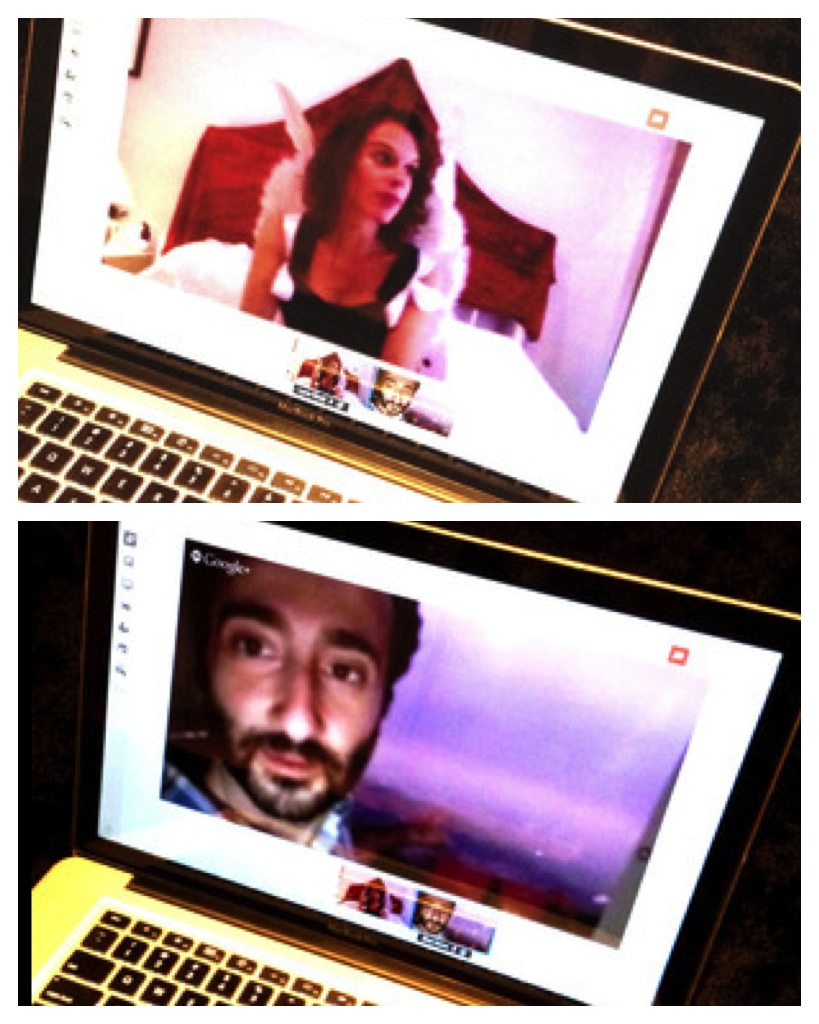
Last July, Bourjeily collaborated with Elastic Future, an experimental theatre company that started in San Francisco but is now based in London, on a play called Peek A Boo for the London International Festival of Theatre (LIFT). Five actors, playing spies, programmers and online peep-show entertainers, were divided between New York, London and Beirut, improvising dialogue as they interacted via streaming video. Audience members around the world watched in real-time by signing into Google Hangouts or watching the feed on Elastic Future’s web page. They also interacted with characters on Twitter and took part in a post-show Q&A.

Untitled“It was a breakthrough,” says Bourjeily of the performance, which followed just a week of online workshops and involved some quick thinking from the actors when there were glitches in the internet connection from New York. “It opened my eyes to so many possibilities for how to create a new type of immersive theatre.”

Erin Gilley, Elastic Future’s artistic director, says she learnt a lot from the experience and is eager to keep stretching the limits of the medium. She’s planning another work for this year’s Lift to be streamed online in July, with actors performing live via webcam from Ghana, Portugal and the United Kingdom.

“Theatre can’t exist without an audience and we’re trying to creatively explore what that means,” says Gilley of the work-in-progress. “The goal is for it to feel like you’re sitting in a theatre with other people, even though watching it will be a private experience.”

Gilley is avoiding screening the feed in an auditorium, in case the process prevents her from “discovering ways to create that feeling online”.

Much like Bourjeily, Gilley is evangelical about the benefits of this new, hybrid art form. For starters, it can bypass censors in countries such as Lebanon, where playwrights are required to submit their work to a bureau for approval. Performing online is cheaper than renting a space and flying in actors and it grants access to audiences from all over the world. It creates novel ways for artists scattered all over the globe to cooperate and to interact with viewers.

It can also turn practical constraints into aesthetic virtues….

As technology develops, the artistic possibilities multiply. “We have new ways of getting emotionally connected to our audience,” is how Bourjeily puts it. “The sky is the limit.”

Lucien Bourjeily is a fascinating man, as his website attests. So much so that Index On Censorship – a global NGO that fights for freedom of expression – has made him one of their four nominees for the Freedom of Expression awards for his play Would It Pass Or Not?, which is about censorship in Lebanon.The play was banned – by the censors, thus forcing them to justify their actions in public.

You can watch Peek-A -Boo here. It makes interesting viewing.

Elastic Future have been commissioned by LIFT to create a piece for this year’s festival, called Longitude, which will be streamed online on 9, 16, and 23 June. Indeed LIFT and it’s artistic director Mark Ball clearly see this kind of work as vital, linking the digital (stage) space with a wider cultural democracy – which is another blog post entirely.

David Cecil

David Cecil

As a post script, one of the other nominees for the Index Freedom Of Expression awards, which are in their 14th year and honour people around the world fighting for free expression, is David Cecil. Cecil is the British theatre producer who was jailed in Uganda for staging a play about homosexuality and whom I wrote about in the posts Stonewalled and A ruling for common sense over a year ago. Appallingly, a month ago the Ugandan parliament passed an anti-homosexuality law which, amongst other things, included punishments of up to life imprisonment. David Cecil is not gay. In fact when he was deported he was forced to leave behind his partner and their two young children. As I write, he has not been allowed to return.  The man deserves to be honoured.

A Shared Experience

Continuing on from my last post about the experience of watching a piece of live theatre, with Twitter as my fellow audience members, I was delighted to read this, written by Catherine Love for WhatsOnStage.com

Sharing the live experience

As debate about the live streaming of theatre productions continues, Catherine Love asks whether recorded performances can still unite an audience

As I logged into Twitter on Saturday evening, the tweets cluttering my timeline were, unusually, united in startling agreement. Nearly everyone I follow seemed to be watching the same thing……an online live stream of Forced Entertainment’s six-hour durational show 12AM: Awake & Looking Down.

twitter-iconEveryone who tweeted was watching it in a different place, from their bed or sofa or desk, but these scattered individuals were also watching the show together, as part of a separate but collective audience meeting in an online space.

This observation feels significant in light of renewed debate around the increasing practice of streaming theatre productions, be it huge operations like NT Live screening in cinemas across the country or modest webcasts of experimental performance. A number of theatre makers have expressed concern about these recordings replacing live performance, while Lyn Gardner  recently mounted a persuasive defence for the expansion of audience reach that these screenings allow.

Both sides of the argument make valid enough points. Those who take issue with the recording of performances protest that it somehow pollutes or detracts from the uniqueness of the live event, releasing viewers from the attention that is required of them in the theatre and encouraging audiences to retreat further and further into their screens, while live performance withers away. Icon for Streaming(2)The digital advocates, on the other hand, argue that screening theatre events can take them to a bigger audience in just one night than they might otherwise reach during a whole run, not to mention offering an opportunity for those without easy access to a theatre to engage with an art form that might otherwise be unavailable to them.

As Gardner points out, it doesn’t have to be a case of either/or; enjoying a performance online or in the cinema does not preclude the possibility of also taking a trip to the theatre. The two experiences offer different benefits. What I’d rather focus on, however, is the accusation – often levelled at streamed theatre – that it removes the collective, live experience of being part of an audience. It is implied that this is one of the key reasons for attending theatre rather than watching TV or sitting in front of a computer screen. In the modern world, the theatre is one of the few places where we can still have a live, unmediated experience, surrounded by other human beings. And this is, to an extent, true.

Forced Entertainment's 12AM: Awake & Looking Down. © Hugo Glendinning

Forced Entertainment’s 12AM: Awake & Looking Down.
© Hugo Glendinning

But what I witnessed on Saturday night looked an awful lot like an audience all having an experience together, even if that experience wasn’t in the same room. The same thing happened to an even greater extent throughout the 24 hours of Forced Entertainment’s Quizoola!, live streamed from the Barbican last year, and a similar online buzz has attended other webcasts by theatres such as the National Theatre of Wales and Hampstead Theatre.

On these various occasions, I have experienced a rare feeling of real community online, as a wide range of people all gather round one enthusiasm and exchange thoughts and responses. Sure, it’s not quite the same as having those reactions while sitting in the same space and breathing the same air, but the feelings and thoughts that the online experience provokes belong to the same family as those encountered in a theatre. And once audiences are hooked on the shared experience, who’s to say that they won’t seek it out again and again, both on and offline?

I couldn’t agree more. On the other hand, I was also interested to read this this by Ryan Gilby, for The Guardian, where he reflects on a different kind of live broadcast theatre event.

Coriolanus at National Theatre Live: cut the chat and get on with the show

The Donmar’s production starring Tom Hiddleston was a thriller in the cinema but it didn’t need all the DVD extras with it

Stage productions broadcast live in cinemas have been a fixture in the UK since 2009, when the National Theatre’s Phèdre was seen by more than 50,000 people. Numbers now tend to be far higher (the audience for The Audience was around 180,000) and reach beyond the UK. Last night was the first time I had attended a play in a cinema. The difference from theatre was apparent immediately: I was wearing a shabby jumper rather than a shirt. (I always try to wear a shirt to the theatre. I can’t help it. It’s an occasion.)

The next shock was finding that I had come to see Coriolanus starring Emma Freud. Cinema audiences have long suffered all manner of irritating pre-film ads, but the appearance of Ms Freud on screen, whipping us into a frenzy about what we were about to see, was at best superfluous (we didn’t need persuading: we’d already bought our tickets) and at worst obstructive. None of us were under the illusion that we were actually at the Donmar Warehouse where the play was staged, or that the actors would be with us in the flesh. Nor did we want to be made to feel we were watching an early-evening relay from the Big Brother house.

Tom Hiddleston as Coriolanus at the Donmar. Photograph: Johan Persson

Tom Hiddleston as Coriolanus at the Donmar. Photograph: Johan Persson

Next came a short film in which the lead actors, Tom Hiddleston (Coriolanus) and Mark Gatiss (Menenius), contextualised the play. The director, Josie Rourke, popped up to comment on the Donmar’s history, while the designer, Lucy Osborne, showed some examples of Roman graffiti on her iPad. I rarely bother with the featurettes that are routinely found among DVD extras and here was a reminder why. Such items can get in the way of our interpretation rather than enhancing it. The effect here evoked neither theatre nor cinema but bad arts television.

It was even worse at the end of the interval when the two-minute bell urged us back to our seats and we were shown an interview with Rourke during which Freud reminded her that Hiddleston had been named “the sexiest actor on the planet” by MTV. Hardly the words you want ringing in your ears as Act Two begins. My advice for the NT is to cut the chat and get on with the show. Suspension of disbelief in a play is not hard to achieve but it deserves to be given a fighting chance.

Thankfully the dynamism of the production was irresistible. Rourke’s staging made judicious use of minimal props – chairs, mainly – and a set that was effectively one brick wall, half of it painted a richly stewed burgundy. My concern going in was that performances pitched at theatre level might seem overblown on a cinema screen; these are, after all, two entirely different forms of acting. I had reckoned without the cast’s combined experience of calibrating performance for contrasting art forms. That Hiddleston chap, he’s done bits and bobs on film as well as on stage, hasn’t he? And Gatiss – he’s been before a camera once or twice. Birgitte Hjort Sørensen, who plays Coriolanus’s wife Virgilia, has a fair bit of Borgen under her belt. They’re getting the hang of it by now.

It helps that these broadcasts are geared toward the cinema experience; the theatre audience for Coriolanus last night paid reduced ticket prices on the understanding that cameras would be getting in their way now and then. For one night only, the popcorn-munchers took priority.

Not that any of us were actually eating. The mood of the audience was just as it would have been in a theatre: hushed, respectful, even tense at times. There were gasps during Coriolanus’s death scene, elegantly staged in a beam of light and a spray of red – an image foreshadowed earlier in the show when the gruesomely scarred warrior showers in a trickle of water before shaking himself like a sheepdog, sending bloody droplets flying about the stage (and screen).

Though lighting can alter the emphasis of a scene, theatre has no equivalent to the close-up, and the camera positions respected that fact: we never felt artificially intimate with the actors, but nor was there a sense that we were too far from the action. With one exception: the curtain call. Here a chasm opened up between the theatre and cinema audiences. There was some confusion over how best to respond. Most people in the packed cinema applauded.

Did they think the actors could hear them?

For clarity’s sake, Emma Freud is what is perhaps best described as a cultural commentator well-known in the UK, and fronts arts and cultural shows on both television and radio. I can but only sympathise with Gilbey – perhaps the solution is to simply give the  broadcast audiences the same programme/play bill that the ‘live’ audience get, then if they want to know more, they can read quietly, to themselves.