Noises Off

This week, theatre critic and blogger, Lyn Gardner has written two short pieces that got me thinking. The first, Should there be more heckling in the theatre?, essentially deals with interruptions, be they by mobile telephones, snoring, or people expressing their disquiet at the play they are watching, while noting that the revered silence audiences in the ‘west’ are expected to adopt has not always been the case.

The second, Fail safe: how good can come of bad theatre, discusses the notion that when actors and directors are actually involved in a show, it’s rare for them to acknowledge that it might be anything less than brilliant.

Both of these are connected for me and basically deal with how audiences are expected to behave. If you live in Asia, as I do, you start to develop a different (and I have to say, more refreshing attitude) to what it means to be an audience member. If I go to a professional venue in Hong Kong to watch Beijing Opera, I expect the audience to talk through the production, perhaps walk in and out or even eat their lunch – its just what happens. Similarly, if I go to see Cantonese Opera at one of the temporary stages that spring up around town (and country) at various times of year, it is much more of a community event, with villagers popping in and out as they fancy. In neither of these contexts do the actors or fellow audience members feel annoyed or slighted by such actions.

In the West however, very different responses ensue and I would like to share two examples with you. A number of years ago my school ran overseas theatre trips to London and on two separate occasions I remember being party to an incident. On the first occasion, having arrived in the UK only hours early, we went to see a wonderful, lyrical and powerful play called The Island by Athol Fugard, John Kani, and Winston Ntshona.
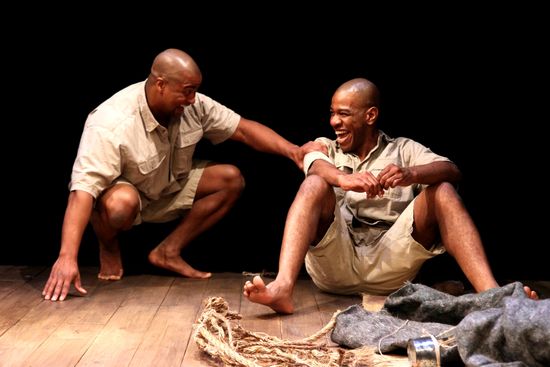
The play is an apartheid-era drama, inspired by a true story, is set in South Africa’s notorious Robben Island prison. It focuses on two cellmates, one whose release draws near and one under a life sentence, who spend their days at mind-numbing physical labor and at night rehearse for a performance of Sophocles’ Antigone. There were 25 in our party and we had front row seats. It was superbly performed and directed, yet, all but one of us (a student) fell to sleep – jet lag – and were woken by very loud applause at the end. I felt acutely embarrassed for the actors who had to witness their front row snoring away while they acted their hearts out. However, it isn’t this that sticks in my memory. It is being shouted at by a rather elderly member of the audience and being told how rude we were and that we shouldn’t be taking children to the theatre if all they were going to do was sleep through the play. I tried to point out that in fact we had made a huge effort to see the production, having flown 8000 miles to do so, but the irony was lost on the shouting individual.

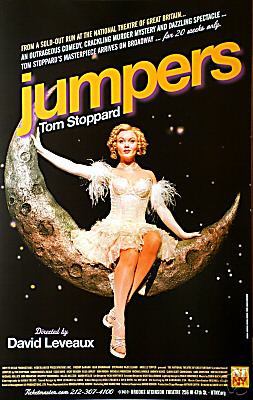
The second occasion, a year later, back in London with another group of students, we went to see Jumpers by Tom Stoppard.

.

.

.

.

.

.

.

.

.

.

Now, Jumpers explores and satirizes the field of academic philosophy, likening it to a less-than skilful competitive gymnastics display. It raises questions such as What do we know? and Where do values come from? As you might imagine, it is a very challenging play to watch even if you are a philosophy major. So my students who were philosophy students were whispering quietly to their friends in an attempt to help them understand what they were watching. Again, but this time at the interval, some embittered old harridan started to shout at my students, telling them how disrespectful they were being and when I went to defend them, she started to shout at me too. This time my reply was anything but polite and I told my students to carry on as before.

Now all of these are small tales, but they do highlight the relationship, the pact, that exists between the audience and the stage in the ‘west’. I often have conversations with my students about whether it is acceptable to leave a performance before it finishes. We usually disagree. Generally my students think it is rude and disrespectful to the actors whereas I tend to believe that given I have paid to see the performance, I have the right to leave if it doesn’t reach my expectations. Admittedly this is something I have developed as I have got older, but with reference to Gardner’s second article above, if the actors/director refuse to admit that what they have produced is less than satisfactory, its up to me to be my own judge of what constitutes quality theatre.

There is another side to this which is highlighted in the article Showstopping: why Broadway audiences applaud too often by Mark Lawson which deals with the American phenomenon of the “entry round” – the enthusiastic and often over lengthy applause at the moment when theatre-goers recognise a famous actor. Interestingly Lawson comments that

Such reactions remain very rare in the UK. Indeed, in London productions featuring Judi Dench or Ian McKellen, it’s possible to calculate precisely how many American tourists are in the house by counting the number who put their hands together for the celebrity entrance, and are then silenced by disapproving shushing from Brits.

He also outlines another source of disruption that he witnessed in a production of Glengarry Glen Ross.

A group of people sitting near me had clearly come only to see (Al) Pacino, and then become grumpy at his absence from the second and third scenes of the first act. Their response to this was to chat loudly and use their mobile phones silently but flashingly until he came back on.

I could go on. But I suppose basically I’m just blogging about something that has always intrigued and fascinated me. Brecht’s notion of the ‘spectactor’, the breaking of the fourth wall, the actor/audience relationship and the role that it plays in the creation of dynamic, meaningful theatre.

A Black Day

I was going to keep this post until tomorrow, but I can’t wait.

Pulitzer prize winning American playwright Bruce Norris has been forced to remove the performance rights for his play, Clybourne Park from Berlin’s Deutsches Theater after he learned that they planned to ‘black-up’ a white actor to play the role of an African-american – in a piece that that explores race as one of it’s central theme.

Clybourne Park takes place in Chicago, in 1956 and 2006 and deals with the aspirations of black Americans in both of those times.  It has toured the world and has been widely celebrated. I can’t quite believe that in the 21st Century it still might be considered appropriate for a white actor to be cast in a role, whose skin colour is central to the experiences of the character and context of the play as a whole, and then be expected to ‘black-up’.

You might think that such a trick should be unthinkable in a nation with the historical racial sensitivities of Germany – and, indeed, it would be unthinkable in most countries. However, ‘blacking up’ remains a relatively common practice in German theatre and is often justified on the basis of directorial prerogative. Indeed German director Thomas Schendel, commented that “blackface is a part of the theatre tradition”.

Norris has said:

Normally I don’t meddle in the cultural politics of other countries, but when my work and the work of my colleagues – other playwrights – is misrepresented, I do.

However Norris has now called on others to boycott productions of their work by German theatres that continue this asinine tradition. A zero-tolerance position is the only position to take.

.

.

.

.

.

.

Y.You cabn

You can read more here. A quick search of the blogosphere will throw up even more comment. This is not the only case that has been highlighted this year in Germany, The Schlosspark theatre did the same with a production of I’m Not Rappaport by Herb Gardner. This production featured a white actor in black-face in the role of Midge Carter.

You can read Norris’ open letter to the Dramatists Guild of America here .You might even sign the petition.

Finally, I offer you the New York Times review of Clybourne Park which says more than I can here. Slashing the Tires on the Welcome Wagon ‘Clybourne Park,’ by Bruce Norris

Post Colonialism?

My post yesterday about the casting controversy in the UK has elicited some interesting responses and became a focus for discussion for one of my TA classes this morning.

I have been digging deeper and have come across a comment piece by Anna Chen, a writer and performer who lives in the UK, entitled Memo to the RSC: east Asians can be more than just dogs and maids: The Royal Shakespeare Company’s casting for The Orphan of Zhao seems to hark back to an age of British imperialism.

I have reproduced an edited version here:

It’s no fun being bred out of the cultural gene pool. Watching TV, theatre or film, I’m on constant alert for a glimpse of someone who looks Chinese, for the slightest resemblance to an estimated 499,999 others like me living in the UK.

So it was with a sense of “here we go again” that we learned that the esteemed Royal Shakespeare Company (RSC) is mounting the classic play The Orphan of Zhao in the way prize trophies usually get mounted: gutted and stuffed. This 13th-century Yuan-dynasty masterpiece may be the first Chinese play, to make it to the hallowed RSC, but the only parts given to actors of east Asian heritage are two dogs. And a maid-servant. Who dies. Tragically.

Yes, out of 17 roles in the classic known to Eurocentrics as “the Chinese Hamlet”, a grand total of three have gone to Asians. Another dog is played by a black actor, making you wonder exactly what the RSC is trying to say.

All director Gregory Doran came up with is that the blizzard of complaints is a case of “sour grapes”, and that the critics should “get real”; not the most eloquent response you might expect from the intellectual heavyweight described as “one of the finest Shakespeareans of his generation”. Any finer, and he might appreciate why casting Asians as dogs and a maid – the latter dying in the most tiresome Madame Butterfly tradition – might elicit consternation. Quite rightly, “blackface” was long ago laughed out of court on the grounds that it not only challenges credulity but is also both ludicrous and demeaning to all parties concerned. Yellowface, however, apparently remains acceptable and credible. Why?

Had Doran remembered the lessons learned by director Peter Brook when he cast a range of ethnicities in his well-intentioned 1980s film and stage adaptations of the Indian epic Mahabharata and was forced to face his own ideological assumptions in the ensuing row, he might have trodden more sensitively instead of crashing in like a 19th-century colonialist after our tea and silks.

Only last year in the US, La Jolla Playhouse felt compelled to hold a public debate after it was caught having cast a mere two of the roles in the Chinese story, The Nightingale, as Asian, and one of them was a bird.

Cheekily, the RSC targets Chinese audiences (and their growing disposable wealth) in their marketing – with adverts in Chinese and a poster featuring a Chinese kid who looks nothing like the actors playing the main roles in the show – so we know it can make the effort when it wants to. Playwright David Henry Hwang of the Asian American Performers Action Coalition which fought in the Nightingale battle, says: “By producing The Orphan of Zhao, the RSC seeks to exploit the public’s growing interest in China; through its casting choices, the company reveals that its commitment to Asia is self-serving, and only skin-deep.”

Once again: why? The RSC casting is something of a litmus test, indicating how a failing superpower asserts its cultural dominance when its economic base is disintegrating. It may no longer operate under cold war rules to consciously exclude representations of the upstart Chinese, or feel pressured to depict us as Fu Manchu monstrosities . But, as George Orwell pointed out, you don’t need a whipped dog when a well-trained one will do.

Such minds are hard-wired to eliminate an entire group’s cultural representation, and they don’t even realise it. Amanda Rogers of Swansea University, says: “As a national company they have a responsibility to represent all sectors of British society. There is a real paucity of east Asian representation in this country, and when we do see it, it is usually confined to minor or stereotypical roles.”

One danger is that, the more a minority is presented as a blank canvas, the easier it is to project all sorts of rubbish on to it.

It’s a shame that James Fenton, with his progressive track record, allows his adaptation of The Orphan of Zhao to be cast along colonialist lines. As a component of the establishment’s entertainment wing shaping our perceptions and feelings, the RSC continues to airbrush us out of the picture, ready to be re-inserted into the frame only when villains are required. Whipped dog, well-trained one or puppet: you have to ask the old question: cui bonio?

The La Jolla Playhouse Chen refers too (and referred to in some of the links yesterday) is based in Los Angles and suffered the same fate earlier this year when it mounted a musical called ‘The Nightingale’ set in ancient China with a cast of 12, only 2 of whom were of east Asian decent. You can read more here in the LA Times. However, La Jolla’s reaction was more immediate than the RSC and they held an open, public discussion which was generally well received for opening up the debate about cultural casting. You can watch the opening 10 minutes of the debate (and then the rest of it) here:

Fascinating. Theatre and cultural politics – never too far apart!

The Orphan of Zhao

For the last few weeks I’ve been following a really interesting debate that has been getting the theatre world chatting right across the globe. The Royal Shakespeare Company in the UK are about to stage a production of the the Chinese play The Orphan of Zhao.  The play, from the 13th century, is often referred to as the ‘Chinese Hamlet’, and the RSC production is a new translation by James Fenton.

Fenton writes here giving a wonderful background to the play.

However, controversy has arisen because out of 17 actors cast in the piece, only 3 are  of  South East Asian origin and they play two puppeteers and and a maid. The debate and back lash has been harsh and forced the RSC on the offensive about their casting policies.

The media across the world has got involved, from The Huffington Post to the LA Times to the UK Guardian.

What I find even more interesting is that the ‘blogoshere’ has joined the debate in a very vociferous and intelligent way and I wanted to share some of that too: Madam Miaow, Dangerology and Theatrical Geographies all write passionately about the debate.  The latter blog is particularly interesting and worth a read. Even Twitter and  Facebook are not immune to the uproar.

I’ll let you read through and make your own mind up, but I have to say it is the first time I have come across the term yellowing-up and it is disturbing.

Finally, I want to include an interview with the director of the show that was made before the storm hit.


Việt nhà hát

As my mind turns to flying to Vietnam tomorrow, with 50 students, on a CAS trip,  I started to think about performance in that beautiful country. Many months ago I wrote about the traditional Water Puppet theatre for which Vietnam is very famous.  I don’t imagine there is a visitor who has ever been to Hanoi who has not been to the Thang Long Water Puppet Theate to see a performance – I will be there again tomorrow night.

However, there is another theatre form that is very popular in Vietnam and that is Cai Luong, which roughly translated means renovated or reformed theatre. The Water Puppet theatre has its roots firmly in Vietnamese rice farming culture, but Cai Luong is an interesting mixture of East and West theatrical traditions, having being heavily influenced by the French during their rule in Vietnam. Essentially, Cai Luong is the convergence of southern Vietnamese folk songs, classical music, tuong (a Chinese-based classical theatre form) and modern spoken drama, all coming together to create folk opera.

There is a great little website, called, not suprisingly, Vietnam Opera, that has much more background and you can access that by clicking the image below:

Also on this site are pages about two other, more traditional, Vietnamese Opera forms, Tuong and Cheo that are more ‘Classical’ in their nature (and more serious in their themes and content). Cai Luong has a reputation for being lighter and more comic. Perhaps what is most astonishing of all is that unlike many traditional theatre forms across Asia, Cai Luong is thriving, growing in popularity and although some of this growth is driven by tourism, it has huge appeal to the Vietnamese too. There are even some instances of the traditional dress and costume being swapped for more contemporary clothing.

I leave you with a video of a full length performance of Cai Luong titled The Life of Buddah


Crowd Sourcing Theatre

A national newspaper in the UK has just launched a project that really interests me – the idea of a crowd-sourced theatre project.  The Guardian is working with a regional theatre, The West Yorkshire Playhouse, on a production of Tennessee Williams’ Cat on a Hot Tin Roof. During the production they are running a series of articles that take you through the production process as well as exploring in more depth other aspects of staging the play. But more than this they asking their readers to review the show and share their reviews, as well as offering advice from professional theatre critics about how to write a good review.

The link that will take you to the ‘series’ page is here.

.

.

.

.

.

.

.

.

.

.

.

.

..

.

I have already posted the article written by Michael Billington about the history of the play itself, but if you click on the image below you can re-read it:

.

.

.

.

.

.

.

There is a collection of images from various productions of the play from 1958 onwards which you can view by clicking here and advice from Lynne Garnder, professional critic, about review writing here

You can even watch trumpet player Simon Beddoe and pianist Matthew Bourne talk about the challenge of providing ‘reactive and emotive’ improvised accompaniment to the play, working with the cast and the director to create a soundscape that reflects and comments on the world of the play by clicking here.

However, my favorite so far is an article by Alfred Hickling, which follow the fit-up week when the set is built and technical rehearsals take place. It’s that interesting I’m not going to link to it, but reproduce it in full.

Behind the scenes: Cat on a Hot Tin Roof at West Yorkshire Playhouse

A society drowning in bourbon-coloured water, an opulent mansion and improvised jazz are not the easiest of illusions to create on stage, as Alfred Hickling discovers as part of our unique crowd-sourced theatre project

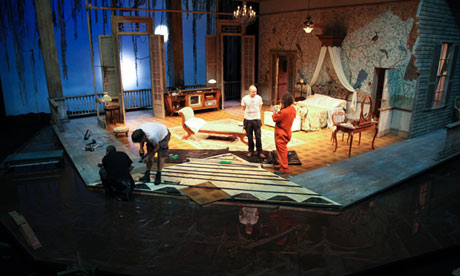
It’s the first day of the fit-up at the West Yorkshire Playhouse – the week in which the set is installed and technical rehearsals begin – and already production manager Eddie de Pledge has a sinking feeling. Not that there’s anything wrong (the build is progressing on schedule), but the design for Cat on a Hot Tin Roof requires approximately a third of the stage to be submerged in brown, bourbon-coloured water.

Before anything else can happen, several layers of industrial-grade pond-liner have to be deployed. “If a designer wants water as a scenic element, you have to add at least an extra day to the schedule,” De Pledge says. “Even 10 centimetres of liquid creates over three tonnes of additional weight. Then there’s issues of humidity in the atmosphere, especially where electrics are involved. And the water has to be changed regularly to prevent it becoming stagnant.”

De Pledge will be doing his utmost to avoid any aquatic disasters on the scale of the National theatre’s production of Alan Ayckbourn’s boating comedy Way Upstream, which notoriously flooded the Lyttelton auditorium in 1982. But there are valid artistic reasons for turning the Playhouse into a temporary swimming pool. Designer Francis O’Connor explains: “The Quarry theatre is one of the largest stages in the country – it demands that you make an epic, visual statement. At the same time, Tennessee Williams’ play is remarkably intimate – there are lots of sequences which are basically two people talking in a bedroom.” O’Connor’s solution has been to increase the rake of the stage, so that the the room itself plunges into a tide of muddy, brown water. “The play deals with death, alcoholism and a family in crisis,” O’Connor says. “The idea was to suggest a society sliding into the drink.”

Recreating the opulence of an antebellum mansion is an expensive business. There’s a budget of more than £1000 for balustrades alone (all the show’s carpentry is done in-house) and a parquet floor to be laid – albeit from painted MDF rather than solid wood. Even the chinoiserie of the decorative scheme is the outcome of a careful search to find period-correct silk wallpaper: “Though not in Mississippi,” O’Connor says. “Sadly, the research budget doesn’t stretch that far. But we found something very close at Nostell Priory, near Wakefield.”

.

.

.

.

.

.

.

The director, Sarah Esdaile, did visit the Mississippi Delta, however, while on honeymoon four years ago. The trip fired her ambition to direct what many consider to be Williams’s finest work. “What this play gives you is that otherworldly sense of southern Mississippi,” she says. “It’s like no place on Earth; the flatness, the humidity, the weird alien moss hanging in the swamps. And then there’s the music of course.”

Williams’s fictitious plantation is in the region of Clarksville, often referred to as the birthplace of the blues (Elia Kazan’s original Broadway production featured an appearance by the great country-blues duo Sonny Terry and Brownie McGhee. Esdaile’s production shifts the action slightly further south, to the swampland surrounding New Orleans, and takes inspiration from the sounds of that region. “We originally discussed commissioning a jazz-based score,” she says, “but then we realised that a jazz composition may be a contradiction in terms.”

Instead, the music in the production is the result of an unusual experiment in which a group of musicians from Leeds Improvised Music Association (LIMA) were invited to interact directly with the cast. As the actors rehearsed, the musicians improvised, and the results of these sessions have been edited into a montage by sound designer Mic Pool. “In an ideal world, we’d have live musicians improvising every night,” Esdaile explains. “Unfortunately we couldn’t afford that. But what we do have is a bespoke score that developed as the result of an improvised dialogue between actors and musicians.”

.

.

.

.

.

.

.

Esdaile has just one further day in the rehearsal room before a gruelling week of 13-hour days begins. “It’s the most exciting and the most nerve-racking part of the process,” she says. “You have four weeks to create a theatrical illusion in the rehearsal room; and then four days to recreate it all again with lights, sound and costumes. It’s the point where you most often find yourself switching into problem-solving mode, and it can sometimes seem as if the poor play is being ignored.”

The main contribution to a successful tech is anticipating problems in advance – nowhere more so than in the wardrobe department, for which a classic costume drama such as Cat on a Hot Tin Roof is a major operation. Deputy head of wardrobe, Victoria Marzetti, explains: “You read the script and note that it is set in 1950s Mississippi. That means lots of white linen. And lots of linen means lots of laundry.”

Her job is made more challenging by the fact that some of the actors will be required to wade ankle-deep through filthy brown water. This won’t present such a problem for cotton and light fabrics, but some of the more elaborate women’s costumes are dry-clean only. It’s not practical for theatres to work with cleaning chemicals, but Marzetti reveals that there is a secret, temporary fix for emergencies: “Vodka. A quick squirt with neat alcohol works wonders because it kills the bacteria.”

Marzetti pulls out the wardrobe department’s proudest creation for this show – the outfit worn by the matriarch Big Mama, whom Williams describes as being like “a Japanese wrestler wearing at least half a million in flashy gems”. Big Mama’s bling was made possible by the fortunate find of several metres of emerald, beaded fabric at a knock-down price. But an even greater bargain is the padded underwear – a Debenhams leotard stuffed with birdseed – to plump the actor, Amanda Boxer, to an appropriate size. “It will be very hot and very heavy” Marzetti says, “but Amanda wanted to feel the incapacitating effects of genuine weight.”

Movement director Etta Murfitt has been teaching Boxer how a much larger person gets in and out of a chair; and has spent time developing a suitably feline stance for Zoe Boyle, who plays Maggie the Cat. But there is little point in the actors looking right if they don’t sound right; and perhaps the most indispensable role has been that of voice specialist, Kara Tsiaperas, who has coached the cast in the nuances of deep south dialect.

“Williams was very specific about melodic speech patterns he wanted to hear,” Tsiaperas says. “There’s a stage direction which states that Maggie’s voice must have ‘range and music’.” Tsiaperas, a New Yorker herself, says there is nothing worse than actors falling into “generalised, American drawl. It’s a myth that everyone in the south talks slowly – it’s just that the stress falls on different vowels. But the hardest thing of all is not to sound condescending. Whenever I’m required to coach southern American accents I’m reminded of a line from the film Sweet Home Alabama: “Just because I talk slow doesn’t mean I’m stupid.”

The Churchillian Way

Today I am reproducing an article that appeared this week in the UK Guardian. In it, Mark Lawson speaks to people who have worked with playwright Caryl Churchill over the course of her prolific career.  At the beginning of September I wrote about Churchill in a post called On Cloud Nine which is essentially about her incredible  theatrical legacy. One of the things that makes Churchill even more fascinating is that she never speaks publically about her work, hence this article talking to those who have worked with her over the years.

Caryl Churchill, by the people who know her best

Her plays arrive fully formed – and she refuses to talk about what they mean. Mark Lawson talks to actors, directors and her publisher about what really makes Churchill tick

Since the death of JD Salinger, one of my biggest regrets as an interviewer is that Caryl Churchill declines to speak publicly about her work. It’s a resolution she has stuck to through the quarter century in which she has established herself as one of theatre’s most innovative and provocative dramatists. Tantalisingly, there have now been two new plays within a month that journalists can’t ask her about: today, the Royal Court in London premieres Ding Dong the Wicked, a half-hour drama that will run alongside Love and Information, the enthusiastically reviewed full-length play that opened there three weeks ago.

In the light of Churchill’s silence, I talked to a number of people who have worked with her instead. Flexibility, it rapidly emerges, is a key quality for her collaborators. The plays about which the writer won’t speak tend to emerge out of silence themselves. Nick Hern, who has published Churchill’s plays for 40 years, first at Methuen and now at his own company, NHB, says: “The plays just turn up, without warning. I think she’s one of those shamanistic writers, in the way Harold Pinter was. A play isn’t planned or premeditated; it’s scratching an itch. They come to me – originally in the post, now by email – and I sit down to read them, having absolutely no idea what the length or subject matter or form will be.”

John Tydeman, the former head of BBC radio drama, has directed half a dozen Churchill radio plays, starting with Lovesick in 1966; he also staged her play Objections to Sex and Violence, at the Royal Court in 1975. Even as a young writer, he remembers, Churchill was unusual in not seeking payment or contracts in advance. “We never commissioned her. Even with a work that had taken a great deal of historical research, such as one called Schreber’s Nervous Illness, the play would just turn up in the post.”

This is still the case, says Dominic Cooke, artistic director of the Royal Court. “The plays aren’t usually formally commissioned. So, in that sense, they just turn up on my desk. I have no idea what I’m getting.” The late addition to this autumn’s repertoire of Ding Dong the Wicked marks the second time the author has turned up at rehearsal with a second new play. The actor Allan Corduner was rehearsing Ice-Cream at the Royal Court in 1989 when, he says, “Caryl came in and said: ‘I’ve just written another new play. Are you up for it?” Called Hot Fudge, an allusion to the other play, Corduner recalls that this unexpected extra was “rehearsed and staged in record time”.

As well as challenging theatre schedules, Churchill’s plays have a long record of testing production possibilities. “The exciting thing about Caryl,” says Cooke, “is that she always tends to break new ground. The degree of innovation is extraordinary. Every play almost reinvents the form of theatre.” And not just theatre: among her radio plays with Tydeman was Identical Twins (1968), in which the title characters were men who, the writer specified, should be played by one actor, Kenneth Haigh, whose speeches would overlap. Decades before digital editing made such effects effortless, Tydeman needed to work with broadcasting’s best technicians. “Kenneth had to record the second speech while we played the first one back, and it turned out that it was almost impossible to do that (keeping pace with your own voice) for more than 30 or 40 seconds at a time. So we had to put the play together in very small takes.”

Churchill’s interest in vocal counterpoint has continued, and tested Hern at Methuen. “We were sitting one day and Caryl said: ‘I want to have overlapping dialogue.’ And I said: ‘Oh, my God, how are we going to do that?’ And we worked it out, using a forward slash, and even put a little example of how it would work at the front of the script. And now it’s an absolutely standard way of laying out a play.”

Even before that, the writer had asked for a specific and unusual layout of her scripts (character names set to the left, with a uniform gap before the dialogue began). Hern’s experience of her polite but precise insistence is echoed in stories from the rehearsal room. Cooke, who directs Ding Dong the Wicked, says: “She is a very strong presence in rehearsals. And there is a combination of being very open to suggestion – she enjoys the process of collaboration – but also of being very specific about what she wants in some cases.”

Tydeman agrees, finding the writer “diffident and quiet, willing to listen to advice but with firmly held views on certain aspects of the text or production”. It’s an experience shared by Michelene Wandor, a dramatist who worked with Churchill on the multi-author cabaret Floorshow (1977); she says that, “while friendly, Caryl kept herself very much to herself”. Perhaps because of her public invisibility, Churchill is often described as shy, but Corduner, who also appeared in the economic comedy Serious Money (1987), has a different reading: “She is so confident about her work that she can discuss it without defensiveness. She’s completely non-dogmatic. During rehearsal, she is absolutely clear-headed about what does and doesn’t work, which is quite rare in writers. She is entirely without ego.”

Tydeman hints at a private stability that underlies this quiet certainty. “One of the things that always strikes me about her is that I think she’s the only person in my address book who is still living at the same house she was living in in the early 1960s.” He has never met Churchill’s husband, David Harter, a campaigning solicitor, but she would often refer, during their working years, to her three sons and “writing the plays at the kitchen table”.

Churchill prefers to discuss form or effects in rehearsal, rather than meaning. “She talks more in general terms,” says Corduner. “She trusts actors and doesn’t want to tread on your territory.” When he was having trouble finding a character in Serious Money, she gently replied that she couldn’t help. But when the actor’s solution involved mimicking Churchill’s own speech – “She has a slight soft-r sound” – she agreed at once. Tydeman says: “We never talked about feminism, for example. It was just there. Caryl’s view was always that the plays would speak for themselves. Which, as you know, is also the attitude that she takes to interviews.”

Ah, the interviews. As I can’t put the question to Churchill herself, I asked her collaborators if they knew why she refused to talk about her work. “I’ve never discussed her refusal to do publicity,” insists Cooke. “We just accept that that will be the situation with each play.” Possibly because, as a publisher, he feels this refusal most keenly, Hern has had the conversation. “Oh, yes. Back at Methuen, I would come out of editorial meetings, having been asked if I could get Caryl to do this or that to promote the books. And I discussed it with her and she said: ‘I really don’t like talking about my work. It makes me self-conscious when I come to write the next thing.’ She said that, if she became analytical about the plays, she was worried that whatever it is that produces them will go away. It was always about creative self-consciousness. It wasn’t: ‘I vant to be alone.'”

Another thing Churchill’s people agree on is that critics focus too much on her structural jumps. “I’m most impressed by dialogue, rather than the form,” says Wandor, “which has, I think, always had uncertainties about it. The elliptical, quasi-poetic quality of the dialogue is the most interesting element.” Cooke concurs: “I don’t think she’s been given enough credit for the quality of her dialogue – the way she captures a situation or a character in just a few lines.”

In the unlikely event that Churchill ever agreed to an interview, one question that might come up would be the fact that – from Tydeman to Cooke, Stephen Daldry and James Macdonald at the Court – she has worked almost exclusively with male directors. “Mmm. Isn’t that interesting?” says Tydeman. “I think at the start it was happenstance rather than choice, because the men were rather in the majority. But it is interesting that it continued.” Wandor says: “I’ve never discussed it with her. But I think it is true that to have had major theatrical success, male directors still seem pretty pivotal, and the management/directing by Max Stafford-Clark [her longterm collaborator at the Royal Court] was crucial to the successes of the earlier work.”

Corduner admits the question has occurred to him. “I have been very conscious of that during rehearsals. But I’ve never discussed it with her. I think, although she’s clearly a feminist and stands for many things feminism admires, she doesn’t judge people by gender. I’ve never detected a yearning to have her work directed by women. Again, it’s that confidence.”

Has her diffidence when it comes to interviews had an effect on her reputation? The final word goes to Tydeman, who says, “I’m talking about working with [Caryl], but I was always struck by how little work was needed. Her plays – like those of Tom Stoppard, with whom I also worked – always arrived fully made. I’d put her up there with Stoppard, although her reputation may be lower than it should be – because she has chosen to stay in the background.”

Getting Heckled

A short post from me today, and one for Hong Kongers really.

.

.

.

.

.

If you click on the image above it will take you to a new website, HKLED that lists (and reviews) all the English language drama in Hong Kong. You can sign up to receive a weekly newsletter about what’s on. Check it out and see what’s about.


Stonewalled

.

.

.

.

.

.

.

This is an image taken on 16th September of British theatre producer, David Cecil. He was appearing in court in Kampala, Uganda, after having been arrested.  What had Cecil done? Well, he dared to stage a play about homosexuality in a country that is currently debating a law that could possibly make being openly gay, punishable by death.  Currently you can be imprisoned for life in Uganda for being gay.  Cecil was, in fact, released on bail, pending another court appearance in mid-October that could see him put behind bars for 2 years.

His actual crime was to stage the play, The River and The Mountain, by playwright Beau Hopkins, without gaining authorisation from the Ugandan’s Media Council. The National Theatre of Uganda refused to stage play because some government officials objected to it. The play tells the story of a corporate businessman coming to terms with his sexual identity in a climate of oppressive homophobia.  The protagonist, Samson, is a good man and a gay one. When his mother learns of his homosexuality, she tries to cure it by hiring a pastor, a private dancer and finally a witch doctor. The play ends with his murder at the hands of his co-workers.

.

.

.

.

.

.

.

.

If click the image above, which is taken from the play, you can read an interview with Okuyo Joel Atiku Prynce who played the lead role of Samson in The River and the Mountain.

Theatre has played a significant role in the last 50 years in bringing about the legalisation of homosexuality right across the world. Only yesterday in The Observer, British theatre critic Michael Billington wrote a lengthy piece about Tennessee Williams’ Cat on a Hot Tin Roof entitled Tennessee Williams’s southern discomfort. For those of you who don’t know the play, it deals in part with the suppressed homosexuality of one of the lead characters, Brick.

I have nothing but the utmost respect for people like David Cecil and the cast of The River and The Mountain who dare to challenge what they belive to be morally unacceptable. Only last year a gay rights activist in Uganda, David Kato, was brutally murdered after a tabloid news paper printed details about his private life.

Theatre has a long history of inciting fear in governments and other powerful people, that results in banning – look back as far as Molière and even farther. Molière, a French actor and playwright, wrote Tartuffe in 1664 and that was banned after being performed at Versailles for attacking and exposing the hypocrisy and deceit of the upper classes. People were afraid it would affect change, and wham, it was gone. And as you look through the history of theatre, you begin to realize that a playwright wasn’t tackling enough daring subject matter if they hadn’t been banned in some theatre somewhere. Theatre-goers have historically been a riotous bunch, so you can see where the fear would come from.

A modern audience member really recognizes the power of work on the stage to change the course of politics and daily life off the stage. Playwrights like Bertolt Brecht based their entire body of work off that power. Plays like The Laramie Project (about the murder of Matthew Shephard, a show that brought the discussion of hate crimes and trials to a nation)  were written to directly engage with politics and to change the mindset of the culture around them, to explore territory that had not yet been explored.

The story of David Cecil and The River and The Mountain is not over yet.

Hunger Games

Today I want to go back to a post I made in May about Juliano Mer-Khamis, a founder of the Freedom Theatre in the West Bank, Palestine, who was assassinated outside his own theatre. To put the post in context, both in terms of the Freedom and the regional politics the film below is excellent (and I warn you, at times, difficult to watch).

.

Now, the co-founder of the Freedom Theatre, Zakaria Zubeidi, and the artisitic director, Nabil al-Raee, are both in Israeli prisons and on hunger strike.  No charge has been brought against Zubeidi and al-Raee has been charged with some very spurious offences.

This isn’t a political post, although you can probably guess what I think from the mere fact I’m blogging about the situation. It is about the power of theatre and the belief in this power to bring about social, cultural and political change.

In the course of the last year, at least six members of the Freedom’s board and staff have been arrested by the Palestinian Authority.  What is it that a tiny little theatre like this can do that causes one of the most heavily armed nations in the world to persecute it in this way? No one has yet been charged for the killing of Mer-Khamis.

Below are a series of articles, the most recent coming first, that explore the last 18 months in the incredible story of the Freedom Theatre.  I urge you read them all and make your own mind up.

Detained Palestinian theatre director resumes hunger strike

West Bank Freedom theatre director on hunger strike

West Bank theatre founder wanted by Israel after amnesty deal revoked

Palestinian theatre stages first play without director Juliano Mer Khamis

Juliano Mer-Khamis – a killing inspired by drama, not politics

Israeli peace activist Juliano Mer Khamis shot dead in Jenin

By clicking the image on the left you can watch to Juliano Mer-Khamis talking about the importance of drama as a means of coping with Israeli occupation.

You can also listen to Mer Khamis talking in another interview from 2005  about a film he made, called Arna’s Children, which you can watch below.

Finally, I repost the video from May about the Freedom Theatre and the immensely important role it plays in helping the people of the West Bank live under Israeli occupation.

.