Drama Online

And finally for this week a potentially groundbreaking new resource for theatre students and teachers called Drama Online. It says about itself:

Capture

Drama Online introduces new writers alongside the most iconic names in playwriting history, providing contextual and critical background through scholarly works and practical guides.

Currently it is in BETA development but there is already so much on there. To get to the plays, you will have to have a subscription, but a lot of the areas, such as the Playwrights & Practitioners and Genres pages are accessible to all users. If this continues to grow it will become a key resource for theatre students everywhere.

It’s Not All Custard Pies

A bit of an unusual post from me today, courtesy of Smithsonian.com, written by Linda Rodriguez McRobbie. It deals with the history of the clown figure, from a range of cultures, which haunts many people’s nightmares and the psychology behind why – really good reading (if you aren’t scared by clowns!)

The History and Psychology of Clowns Being Scary

A terrifying clown walks in a Halloween parade in New York

A terrifying clown walks in a Halloween parade in New York

There’s a word— albeit one not recognized by the Oxford English Dictionary or any psychology manual— for the excessive fear of clowns: Coulrophobia.

Not a lot of people actually suffer from a debilitating phobia of clowns; a lot more people, however, just don’t like them. Do a Google search for “I hate clowns” and the first hit is ihateclowns.com, a forum for clown-haters that also offers vanity @ihateclowns.com emails. One “I Hate Clowns” Facebook page has just under 480,000 likes. Some circuses have held workshops to help visitors get over their fear of clowns by letting them watch performers transform into their clown persona. In Sarasota, Florida, in 2006, communal loathing for clowns took a criminal turn when dozens of fiberglass clown statues—part of a public art exhibition called “Clowning Around Town” and a nod to the city’s history as a winter haven for traveling circuses—were defaced, their limbs broken, heads lopped off, spray-painted; two were abducted and we can only guess at their sad fates.

Even the people who are supposed to like clowns—children—supposedly don’t. In 2008, a widely reported University of Sheffield, England, survey of 250 children between the ages of four and 16 found that most of the children disliked and even feared images of clowns. The BBC’s report on the study featured a child psychologist who broadly declared, “Very few children like clowns. They are unfamiliar and come from a different era. They don’t look funny, they just look odd.”

But most clowns aren’t trying to be odd. They’re trying to be silly and sweet, fun personified. So the question is, when did the clown, supposedly a jolly figure of innocuous, kid-friendly entertainment, become so weighed down by fear and sadness? When did clowns become so dark?

Maybe they always have been.

Clowns, as pranksters, jesters, jokers, harlequins, and mythologized tricksters have been around for ages. They appear in most cultures—Pygmy clowns made Egyptian pharaohs laugh in 2500 BCE; in ancient imperial China, a court clown called YuSze was, according to the lore, the only guy who could poke holes in Emperor Qin Shih Huang’s plan to paint the Great Wall of China; Hopi Native Americans had a tradition of clown-like characters who interrupted serious dance rituals with ludicrous antics. Ancient Rome’s clown was a stock fool called the stupidus; the court jesters of medieval Europe were a sanctioned way for people under the feudal thumb to laugh at the guys in charge; and well into the 18th and 19th century, the prevailing clown figure of Western Europe and Britain was the pantomime clown, who was a sort of bumbling buffoon.

But clowns have always had a dark side, says David Kiser, director of talent for Ringling Bros. and Barnum & Bailey Circus. After all, these were characters who reflected a funhouse mirror back on society; academics note that their comedy was often derived from their voracious appetites for food, sex, and drink, and their manic behavior. “So in one way, the clown has always been an impish spirit… as he’s kind of grown up, he’s always been about fun, but part of that fun has been a bit of mischief,” says Kiser.

“Mischief” is one thing; homicidal urges is certainly another. What’s changed about clowns is how that darkness is manifest, argued Andrew McConnell Stott, Dean of Undergraduate Education and an English professor at the University of Buffalo, SUNY.

Stott is the author of several articles on scary clowns and comedy, as well as The Pantomime Life of Joseph Grimaldi, a much-lauded 2009 biography of the famous comic pantomime player on the Regency London stage.

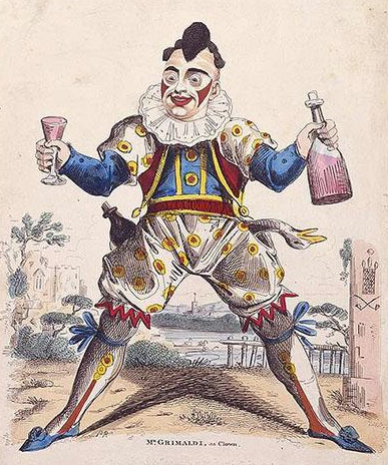
Grimaldi was the first recognizable ancestor of the modern clown, sort of the Homo erectus of clown evolution. He’s the reason why clowns are still sometimes called “Joeys”; though his clowning was of a theatrical and not circus tradition, Grimaldi is so identified with modern clowns that a church in east London has conducted a Sunday service in his honor every year since 1959, with congregants all dressed in full clown regalia.

In his day, he was hugely visible: It was claimed that a full eighth of London’s population had seen Grimaldi on stage. Grimaldi made the clown the leading character of the pantomime, changing the way he looked and acted. Before him, a clown may have worn make-up, but it was usually just a bit of rouge on the cheeks to heighten the sense of them being florid, funny drunks or rustic yokels. Grimaldi, however, suited up in bizarre, colorful costumes, stark white face paint punctuated by spots of bright red on his cheeks and topped with a blue mohawk. He was a master of physical comedy—he leapt in the air, stood on his head, fought himself in hilarious fisticuffs that had audiences rolling in the aisles—as well as of satire lampooning the absurd fashions of the day, comic impressions, and ribald songs.

A drawing of Joseph Grimaldi as his famous persona Clown Joey.

A drawing of Joseph Grimaldi as his famous persona Clown Joey.

But because Grimaldi was such a star, the character he’d invented became closely associated with him. And Grimaldi’s real life was anything but comedy—he’d grown up with a tyrant of a stage father; he was prone to bouts of depression; his first wife died during childbirth; his son was an alcoholic clown who’d drank himself to death by age 31; and Grimaldi’s physical gyrations, the leaps and tumbles and violent slapstick that had made him famous, left him in constant pain and prematurely disabled. As Grimaldi himself joked, “I am GRIM ALL DAY, but I make you laugh at night.” That Grimaldi could make a joke about it highlights how well known his tragic real life was to his audiences.

Enter the young Charles Dickens. After Grimaldi died penniless and an alcoholic in 1837 (the coroner’s verdict: “Died by the visitation of God”), Dickens was charged with editing Grimaldi’s memoirs. Dickens had already hit upon the dissipated, drunken clown theme in his 1836 The Pickwick Papers. In the serialized novel, he describes an off-duty clown—reportedly inspired by Grimaldi’s son—whose inebriation and ghastly, wasted body contrasted with his white face paint and clown costume. Unsurprisingly, Dickens’ version of Grimadli’s life was, well, Dickensian, and, Stott says, imposed a “strict economy”: For every laugh he wrought from his audiences, Grimaldi suffered commensurate pain.

Stott credits Dickens with watering the seeds in popular imagination of the scary clown—he’d even go so far as to say Dickens invented the scary clown—by creating a figure who is literally destroying himself to make his audiences laugh. What Dickens did was to make it difficult to look at a clown without wondering what was going on underneath the make-up: Says Stott, “It becomes impossible to disassociate the character from the actor.” That Dickens’s version of Grimaldi’s memoirs was massively popular meant that this perception, of something dark and troubled masked by humor, would stick.

Meanwhile, on the heels of Grimaldi’s fame in Britain, the major clown figure on the Continent was Jean-Gaspard Deburau’s Pierrot, a clown with white face paint punctuated by red lips and black eyebrows whose silent gesticulations delighted French audiences.

French artist Auguste Bouquet's rendition of Jean-Gaspard Deburau as Pierrot

French artist Auguste Bouquet’s rendition of Jean-Gaspard Deburau as Pierrot

Deburau was as well known on the streets of Paris as Grimaldi was in London, recognized even without his make-up. But where Grimaldi was tragic, Deburau was sinister: In 1836, Deburau killed a boy with a blow from his walking stick after the youth shouted insults at him on the street (he was ultimately acquitted of the murder). So the two biggest clowns of the early modern clowning era were troubled men underneath that face-paint.

After Grimaldi and Deburau’s heyday, pantomime and theatrical traditions changed; clowning largely left the theater for the relatively new arena of the circus. The circus got its start in the mid-1760s with British entrepreneur Philip Astley’s equestrian shows, exhibitions of “feats of horsemanship” in a circular arena. These trick riding shows soon began attracting other performers; along with the jugglers, trapeze artists, and acrobats, came clowns. By the mid-19th century, clowns had become a sort of “hybrid Grimaldian personality [that] fit in much more with the sort of general, overall less-nuanced style of clowning in the big top,” explains Stott.

Clowns were comic relief from the thrills and chills of the daring circus acts, an anarchic presence that complimented the precision of the acrobats or horse riders. At the same time, their humor necessarily became broader—the clowns had more space to fill, so their movements and actions needed to be more obvious. But clowning was still very much tinged with dark hilarity: French literary critic Edmond de Goncourt, writing in 1876, says, “[T]he clown’s art is now rather terrifying and full of anxiety and apprehension, their suicidal feats, their monstrous gesticulations and frenzied mimicry reminding one of the courtyard of a lunatic asylum.” Then there’s the 1892 Italian opera, Pagliacci (Clowns), in which the cuckolded main character, an actor of the Grimaldian clown mold, murders his cheating wife on stage during a performance. Clowns were unsettling—and a great source for drama.

England exported the circus and its clowns to America, where the genre blossomed; in late 19th century America, the circus went from a one-ring horse act to a three-ring extravaganza that travelled the country on the railways. Venues and humor changed, but images of troubled, sad, tragic clowns remained—Emmett Kelly, for example, was the most famous of the American “hobo” clowns, the sad-faced men with five o’clock shadows and tattered clothes who never smiled, but who were nonetheless hilarious.
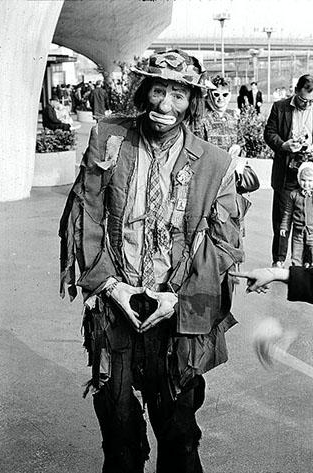
Emmett Kelly as "Weary Willy," the most famous example of the hobo-clown persona

Emmett Kelly as “Weary Willy,” the most famous example of the hobo-clown persona

Kelly’s “Weary Willie” was born of actual tragedy: The break-up of his marriage and America’s sinking financial situation in the 1930s.

Clowns had a sort of heyday in America with the television age and children’s entertainers like Clarabell the Clown, Howdy Doody’s silent partner, and Bozo the Clown. Bozo, by the mid-1960s, was the beloved host of a hugely popular, internationally syndicated children’s show – there was a 10-year wait for tickets to his show. In 1963, McDonald’s brought out Ronald McDonald, the Hamburger-Happy Clown, who’s been a brand ambassador ever since (although heavy is the head that wears the red wig – in 2011, health activists claimed that he, like Joe Camel did for smoking, was promoting an unhealthy lifestyle for children; McDonald’s didn’t ditch Ronald, but he has been seen playing a lot more soccer).

But this heyday also heralded a real change in what a clown was. Before the early 20th century, there was little expectation that clowns had to be an entirely unadulterated symbol of fun, frivolity, and happiness; pantomime clowns, for example, were characters who had more adult-oriented story lines. But clowns were now almost solely children’s entertainment. Once their made-up persona became more associated with children, and therefore an expectation of innocence, it made whatever the make-up might conceal all the more frightening—creating a tremendous mine for artists, filmmakers, writers and creators of popular culture to gleefully exploit to terrifying effect. Says Stott, “Where there is mystery, it’s supposed there must be evil, so we think, ‘What are you hiding?’”

Most clowns aren’t hiding anything, except maybe a bunch of fake flowers or a balloon animal. But again, just as in Grimaldi and Deburau’s day, it was what a real-life clown was concealing that tipped the public perception of clowns. Because this time, rather than a tragic or even troubled figure under the slap and motley, there was something much darker lurking.

Even as Bozo was cavorting on sets across America, a more sinister clown was plying his craft across the Midwest. John Wayne Gacy’s public face was a friendly, hard-working guy; he was also a registered clown who entertained at community events under the name Pogo. But between 1972 and 1978, he sexually assaulted and killed more than 35 young men in the Chicago area. “You know… clowns can get away with murder,” he told investigating officers, before his arrest.

Gacy didn’t get away with it—he was found guilty of 33 counts of murder and was executed in 1994. But he’d become identified as the “Killer Clown,” a handy sobriquet for newspaper reports that hinged on the unexpectedness of his killing. And bizarrely, Gacy seemed to revel in his clown persona: While in prison, he began painting; many of his paintings were of clowns, some self-portraits of him as Pogo. What was particularly terrifying was that Gacy, a man who’d already been convicted of a sexual assault on a teenage boy in 1968, was given access to children in his guise as an innocuous clown. This fueled America’s already growing fears of “stranger danger” and sexual predation on children, and made clowns a real object of suspicion.

After a real life killer clown shocked America, representations of clowns took a decidedly terrifying turn. Before, films like Cecil B. DeMille’s 1952 Oscar-winning The Greatest Show on Earth could toy with the notion of the clown with a tragic past—Jimmy Stewart played Buttons, a circus clown who never removed his make-up and who is later revealed to be a doctor on the lam after “mercy killing” his wife—but now, clowns were really scary.
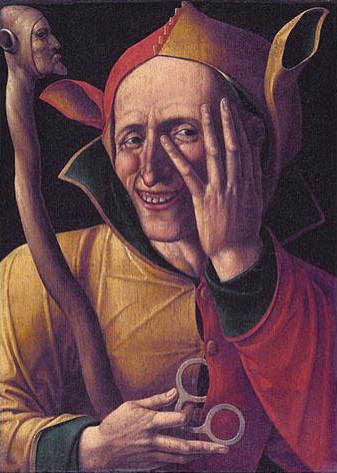
A predecessor of the modern clown, the medieval court jester exemplified the delicate blend of funny and horrifying

A predecessor of the modern clown, the medieval court jester exemplified the delicate blend of funny and horrifying

In 1982, Poltergeist relied on transforming familiar banality—the Californian suburb, a piece of fried chicken, the television—into real terror; but the big moment was when the little boy’s clown doll comes to life and tries to drag him under the bed. In 1986, Stephen King wrote It, in which a terrifying demon attacks children in the guise of Pennywise the Clown; in 1990, the book was made into a TV mini-series. In 1988, B-movie hit Killer Klowns from Outer Space featured alien clowns harboring sharp-toothed grins and murderous intentions. The next year saw Clownhouse, a cult horror film about escaped mental patients masquerading as circus clowns who terrorize a rural town. Between the late 1980s and now – when the Saw franchise’s mascot is a creepy clown-faced puppet — dozens of films featuring vicious clowns appeared in movie theatres (or, more often, went straight to video), making the clown as reliable a boogeyman as Freddy Kreuger.

Kiser, Ringling’s talent spotter and a former clown himself, acknowledged the damage that scary clown images have done to clowning, though he was inclined to downplay the effect. “It’s like, ‘Oh man, we’re going to have to work hard to overcome that one,’” he says.

But anecdotally at least, negative images of clowns are harming clowning as a profession. Though the Bureau of Labor Statistics doesn’t keep track of professional clowns specifically (they’re lumped in with comedians, magicians, and other miscellaneous performers), in the mid-2000s, articles began popping up in newspapers across the country lamenting the decline of attendees at clown conventions or at clowning workshop courses. Stott believes that the clown has been “evacuated as a figure of fun” (notably, Stott is personally uncomfortable with clowns and says he finds them “strange”); psychologists suggest that negative clown images are replacing positive clown images.

“You don’t really see clowns in those kinds of safe, fun contexts anymore. You see them in movies and they’re scary,” says Dr. Martin Antony, a professor of psychology at Ryerson University in Toronto and author of the Anti-Anxiety Work Book. “Kids are not exposed in that kind of safe fun context as much as they used to be and the images in the media, the negative images, are still there.”

That’s creating a vicious circle of clown fear: More scary images means diminished opportunities to create good associations with clowns, which creates more fear. More fear gives more credence to scary clown images, and more scary clown images end up in circulation. Of course, it’s difficult to say whether there has been a real rise in the number of people who have clown phobias since Gacy and It. A phobia is a fear or anxiety that inhibits a person’s life and clown fears rarely rate as phobias, psychologists say, because one simply isn’t confronted by clowns all that often. But clown fear is, Antony says, exacerbated by clowns’ representation in the media. “We also develop fears from what we read and see in the media… There’s certainly lots of examples of nasty clowns in movies that potentially puts feet on that kind of fear,” he says.

From a psychologist’s perspective, a fear of clowns often starts in childhood; there’s even an entry in the psychologists’ bible, the Diagnostic and Statistical Manual of Mental Disorders or DSM, for a fear of clowns, although it’s under the umbrella category of a pediatric phobia of costumed characters (sports mascots, Mickey Mouse). “It starts normally in children about the age of two, when they get anxiety about being around strangers, too. At that age, children’s minds are still developing, there’s a little bit of a blend and they’re not always able to separate fantasy from reality,” explains Dr. Brenda Wiederhold, a veteran psychologist who runs a phobia and anxiety treatment center in San Diego that uses virtual reality to treat clients.

Most people, she says, grow out of the fear, but not everyone—perhaps as much as 2 percent of the adult population will have a fear of clowns. Adult clown phobics are unsettled by the clown’s face-paint and the inability to read genuine emotion on a clown’s face, as well as the perception that clowns are able to engage in manic behavior, often without consequences.

But really, what a clown fear comes down to, what it’s always come down to, is the person under the make-up. Ringling’s Kiser agreed.

“I think we have all experienced wonderful clowns, but we’ve also all experienced clowns who in their youth or lack of training, they don’t realize it, but they go on the attack,” Kiser says, explaining that they can become too aggressive in trying to make someone laugh. “One of the things that we stress is that you have to know how to judge and respect people’s space.” Clowning, he says, is about communicating, not concealing; good clown make-up is reflective of the individual’s emotions, not a mask to hide behind—making them actually innocent and not scary.

Krusty_the_Clown_by_TheTitan99

But have bad, sad, troubled clowns done too much damage? There are two different, conflicting visions of the clown’s future.

Stott, for one, sees clowning continuing on its dark path. “I think we’ll find that the kind of dark carnival, scary clown will be the dominant mode, that that figure will continue to persist in many different ways,” he says, pointing to characters like Krusty the Clown on The Simpsons, who’s jaded but funny, or Heath Ledger’s version of The Joker in the Batman reboot, who is a terrifying force of unpredictable anarchy. “In many respects, it’s not an inversion of what we’re used to seeing, it’s just teasing out and amplifying those traits we’ve been seeing for a very long time.” Other writers have suggested that the scary clown as a dependable monster under the bed is almost “nostalgically fearful,” already bankrupted by overuse.

But there’s evidence that, despite the claims of the University of Sheffield study, kids actually do like clowns: Some studies have shown that real clowns have a beneficial affect on the health outcomes of sick children. The January 2013 issue of the Journal of Health Psychology published an Italian study that found that, in a randomized controlled trial, the presence of a therapy clown reduced pre-operative anxiety in children booked for minor surgery. Another Italian study, carried out in 2008 and published in the December 2011 issue of the Natural Medicine Journal found that children hospitalized for respiratory illnesses got better faster after playing with therapeutic clowns.

And Kiser, of course, doesn’t see clowning diminishing in the slightest. But good clowns are always in shortage, and it’s good clowns who keep the art alive. “If the clown is truly a warm and sympathetic and funny heart, inside of a person who is working hard to let that clown out… I think those battles [with clown fears] are so winnable,” he says. “It’s not about attacking, it’s about loving. It’s about approaching from a place of loving and joy and that when you really look at it, you see, that’s it really genuine, it’s not fake.”

.

You Do What?

Can you describe what a dramaturge does? What is their role in the theatrical process? Well, it has been defined in a number of (sometimes conflicting) ways but it perhaps easiest to think about it as someone who deals with the research and development of plays, working alongside the director. But, there is no officially defined description and a the role of a dramaturge in one theatre company might differ quite significantly to one in another company.  One (Wikipeadia) definition says:

Dramaturgy is a comprehensive exploration of the context in which the play resides. The dramaturg is the resident expert on the physical, social, political, and economic milieus in which the action takes place, the psychological underpinnings of the characters, the various metaphorical expressions in the play of thematic concerns; as well as on the technical consideration of the play as a piece of writing: structure, rhythm, flow, even individual word choices

All clear now? No? Well have a read of this article written by Zoë Svendsen for T.H.E. Svendsen is a dramaturge and director, based in the UK, and here she explains how she understands the role by explaining work on a production of Christopher Marlowe’s Edward II, a play that is notoriously difficult to stage.

Zoë Svendsen on the dramaturge’s role at the heart of the action

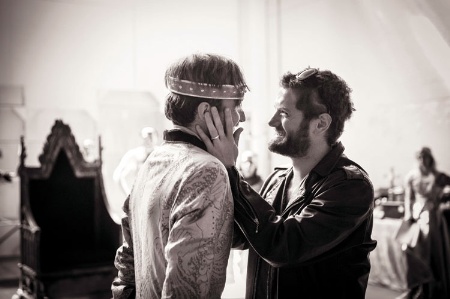
The ‘creative consultant’ at work in the National Theatre’s new production of Christopher Marlowe’s Edward II

Zoë Svendsen

Zoë Svendsen

There is a huge crossover between academia and the theatre now,” says Zoë Svendsen. “When I left university, they felt like much more separate worlds…There is a very close relationship between my practice, my research and my teaching.”

His grace and favourite: the National Theatre’s new Edward II presents a world in which the unthinkable becomes thinkable, says dramaturge Zoë Svendsen

His grace and favourite: the National Theatre’s new Edward II presents a world in which the unthinkable becomes thinkable, says dramaturge Zoë Svendsen

For some years a practice-based research fellow in drama and performance at the University of Cambridge, Svendsen next month takes on a new position at Cambridge as a lecturer in drama. She is director of a company called Metis Arts, which specialises in immersive and sometimes interactive performance projects addressing political themes. And she has worked as dramaturge on Joe Hill-Gibbins’ acclaimed 2012 Young Vic production of Thomas Middleton and William Rowley’s Jacobean tragedy,The Changeling, and now on his National Theatre production of Christopher Marlowe’s Edward II, which previews from this week. (A similar gig, in which Svendsen will work with the Royal Shakespeare Company on another Elizabethan drama, Arden of Faversham, follows next year.)

The role of dramaturge is far more established in continental Europe than in the UK, but Svendsen explains that it is essentially about “how the play functions in time and space – the production as a whole from a structural perspective, how the audience’s attention is held”.

While it remains the director’s job to steer the actors, she sits in on rehearsals and sees herself as a “sounding board, a creative consultant. We push ideas back and forth, trying to find out what the heart of the play is. I don’t like the term ‘outside eye’ – I’m absolutely embedded – but I can keep an eye on how one scene fits with other scenes, what the overall ambitions are.”

When it comes to her own projects and research, Svendsen has “long been interested in works which don’t conform to a kind of British empiricism in the staging, with a single time and a single location”. Her PhD looked at the Gate Theatre in Notting Hill and the production of plays from other cultures in London. And living and working in Berlin gave her a further “sense of the plethora of forms in which plays can be written”.

As a striking example of Svendsen’s own work, we might cite Metis Arts’ interactive multimedia production 3rd Ring Out, which Svendsen sees as having been “absolutely research-driven” and arising out of “a set of questions”. An earlier project about disused air-raid shelters and a decommissioned nuclear bunker in Cambridge led her and her collaborators to reflect on “Cold War exercises and the scenarios for many people across the country to play”.

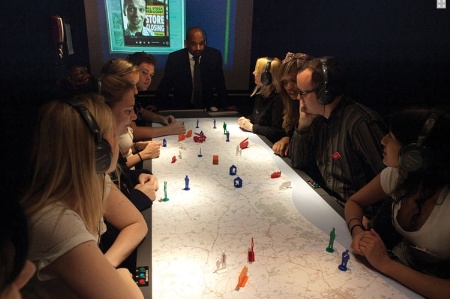
Doomsday scenarios: participants in Metis Arts’ interactive production 3rd Ring Out consider their options

Doomsday scenarios: participants in Metis Arts’ interactive production 3rd Ring Out consider their options

This led to the more general question of “What does it mean to practise for disaster?” and, since they “didn’t want to do re-enactment”, the search for a contemporary theme. When a visit to the Camp for Climate Action at Kingsnorth in Kent brought new urgency to Svendsen’s own concerns about the issue, it became the focus.

But this presented a dilemma, she recalls: “How do you make an effective performance about climate change? When you have theatre, which is about individual relationships, the short term and dramatic events, how do you avoid the trap of a kind of disaster porn, taking pleasure in the horror?”

To solve this problem, Svendsen and her co-director Simon Daw took two shipping containers around the country in 2010 and 2011. Inside, they constructed “an emergency planning cell” in which audiences of 12 sat at a table with headphones and a voting console. Amid an audiovisual simulation of a disaster scenario unfolding in their locality in 2033, they were invited to vote on the practical and ethical issues raised by heatwaves, food shortages and civil unrest. The question of whether to accept climate change refugees into the area proved particularly contentious.

But what had the creation of this powerful piece to do with productions of classic Elizabethan and Jacobean plays?

Svendsen believes that both draw on her central concern with how you hold audiences’ attention, and that her “sensibility for different kinds of formal structures” helped to forge “a distinctive way of looking at Renaissance dramas”. The key is “a deep commitment to the original text – which means expressing it as fully as possible in theatrical terms”.

When she and Hill-Gibbins began working on The Changeling, they were struck by its differences from most recent theatre: “A character says ‘We need to talk to so and so’ and there they are on stage – and there are no questions about how they got there. In Middleton, it’s all about what happens next, there’s very little back story. How characters interact with each other is absolutely about what they want at that immediate moment. There’s no continuous psychological through line. And that’s very different from what you find in ‘the grandfathers of modern drama’ such as Ibsen and Chekhov.”

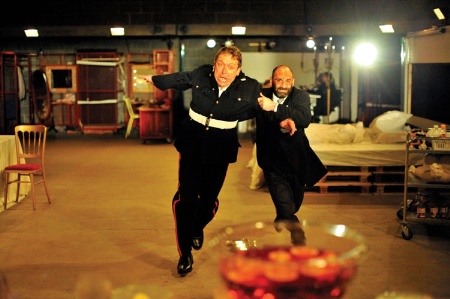
In tackling this challenge, they started off by cutting lines, reordering and amalgamating scenes – only to find themselves slowly working their way back to something close to the original text, albeit with greatly deepened understanding. The production, which featured a wedding scene staged with throbbing music by Beyoncé and a banquet where the actors get covered in food, was acclaimed by critics for its “lewdness and lunacy” and for “mak[ing] pervs of us all”.

Breaking with tradition: Joe Hill-Gibbins’ ‘iconoclastic’ production of The Changeling

Breaking with tradition: Joe Hill-Gibbins’ ‘iconoclastic’ production of The Changeling

“Reviewers talked about it as contemporary, Tarantino-esque and iconoclastic,” reflects Svendsen. “Actually all of that is in the play, but not necessarily brought out in today’s productions”, in which the British tradition of staging classics often puts the central stress on the text rather than the underlying structure.

Edward II may be best known for two key challenges it presents to directors: how openly erotic to make the relationship between the king and his “favourite”, Piers Gaveston; and how to stage Edward’s horrifying demise, impaled with a red-hot poker. (It also includes a great speech where the medieval equivalent of an academic is given trenchant advice on how he should “cast the scholar off”, give up his “velvet-caped cloak” and “learn to court it like a gentleman”: “You must be proud, bold, pleasant, resolute,/And now and then, stab, as occasion serves.”)

Without giving away any major secrets about a production still in rehearsal, Svendsen again flags up how different Edward II is from a contemporary play in its “accumulations and repetitions and things that seem to be a bit short-circuited” – and how exploring its structure had revealed its hidden depths.

“You need to allow the repetitions to become cumulative,” she suggests, “because repetition is what tells the story and allows Marlowe to comment on history. The characters don’t really change, but the situation changes, because what they conceive of as possible changes.

“Once the barons start threatening civil war and Gaveston’s exile, the rhetoric of threat becomes a capacity to act and those things become possible. The idea of deposing the king is unthinkable at the start of the play, but it’s interesting how quickly it becomes thinkable.”

In this, the play echoes Svendsen’s experience of working on 3rd Ring Out, where she and Daw considered the possible scenario of “putting the military on the streets” and then decided “no one would believe it was within the bounds of plausibility”.

“That was in 2010, but the next year the riots had erupted and the media were full of questions about whether the military should go on to the streets,” says Svendsen. “It had become thinkable as part of the national conversation. Pretty much everything we had imagined for 2033 did happen during the times we were performing.”

If you would like to hear more from Svendsen talking about dramaturgy, you can by clicking the link below, which will take you to an audio recording on Theatre Voicesof her talking about work on another classic play, The Changeling by Thomas Middleton and William Rowley.

Zoe Svendsen discusses The Changeling.

.

A Selfie?

This post is really for my Performing Arts students and my colleague Ciaran who are working on a unit about the business side of the business, but it makes interesting reading for any theatre student. The article comes from the Culture Professional Network and is a curated version of an on-line forum.

15 TIPS ON SETTING UP YOUR OWN THEATRE COMPANY

From funding to fringe festivals, a panel of theatre pros who have been there and done it share their expert insights

Alexander Kelly, co-artistic director, Third Angel

The work you make is the most important thing: Never forget that. It may well sound obvious, but when you’re getting stuck into the complexity of whether to be a partnership or company limited by guarantee, it’s useful to be reminded. Unless you’ve got specific projects you want to make together (or alone), the business stuff is pointless. A company isn’t just the legal entity – it’s the people making the work together.

Make the best work you can. Make the work you want to make.

Untitled_Fotor

When it comes to finances, plan ahead: In Third Angel we set ourselves a timetable; we put money into our first show, and then decided that:

  • For the next year we would only make work for the money we raised, but wouldn’t pay ourselves
  • The next year we would pay ourselves for performance days, as they were days where we clearly couldn’t do any other work, whereas rehearsals were more flexible
  • In year three we would pay ourselves for making time as well

We stuck to this. That meant for the first few years we also taught part-time in a secondary school, ran workshops, did get-ins for other companies, signed on and went on start-your-own-business courses (less of an option now I expect). We even did bits of performance for other companies, including motion capture for computer games.

After four years we finally started getting a weekly wage at equity minimum. It hasn’t always been full time since then, but we’ve stuck to at least equity minimum.

Dan Bridgewater, founder and managing director, Fourth Wall Theatre Network

Think about becoming a social enterprise: Because my company is a social enterprise, a lot of the funding has been to support this as opposed to supporting the theatre we create. Organisations such as Live UnLtdUnLtd and the Community Development Foundation all provide funding to organisations that help create social change, or raise awareness of social issues. There’s a lot of trusts all over the UK that do something similar.

Create strong partnerships: Partnerships need to be about solving a problem instead of making one. Make it easy for a potential partner – what do you want and what are they going to get? They need to see a clear personal benefit.

seis_crowd_funding_2507592b

Don’t necessarily give up the day job: Financially, I think you need to do what you can and what’s best for you. I’ve realised that my company isn’t going to be my full-time source of income at this moment in time, so I do a number of other projects on the side. However, in the long-term, I really feel that it can be. Organisations like Arts Council England allow funding to cover project management fees – if you have something that is good enough then you can be funded to run that project.

Don’t just focus on the theatre: What else do you offer? A place for people to socialise; a vehicle for change; a voice for young people? Communicate these objectives within your marketing, and take advantage of them when looking for funding.

Understand your market: Ask yourself the following questions: how much are your competitors charging; what kind of thing are they doing; what are their customers responding to? We originally charged £3 for two hours, whereas our closest competitors were charging at least £5 for one hour!

Have fun doing it: It goes without saying really. Don’t let things get to you too much – build a good support team around you and give them responsibilities, and don’t take on all the stress and the strain. When it stops being fun, you need to evaluate where you’re at.

Find space on the cheap (or for free): If you need rehearsal space, but funds are low, offer to hold a performance in that rehearsal space or venue and let them get a share of the takings. You can also find venues that need an image boost – say you’ll get people into their venue, as well as some press coverage or some promotion through your marketing campaigns, in exchange for lower cost or free venue hire. Finally, rehearse in random places: the park, your front room, a coffee shop.

P1020241

Phil Willmott, artistic director, the Steam Industry

Understand that it’s going to be extremely tough: If you start a theatre company in the hope of making a living or showcasing your work with a view to being spotted, you’ll almost certainly end up bitter and disappointed. Sorry about that. But don’t be cross – it’s not your fault, nor mine, nor the Arts Council’s, nor the culture of fringe theatre, nor the state of the nation. It’s simply that you’re choosing to enter a farcically overcrowded profession – it’s just the way it is.

If you can take that on board at the beginning, it will save you a lot of disappointment when you discover that no one will initially give you money or come and see your stuff.

Stand out, and then stand out some more: As with trying to break into any saturated market you HAVE to have a USP (unique selling point) – ideally a VUSP (very unique selling point) – to make any impact. What’s so different about you that audiences, critics, funders, sponsors and programmers will take notice of you rather then the millions of other people who want to direct Woyzek or get some agents in to see them in Miss Julie? Work out what’s so special about you and flog it. FLOG IT TO DEATH! Spinning it right is your best ticket to breaking through.

Jackie Elliman, legal and industrial relations manager
Independent Theatre Council

Your brand is crucial: I think we’re all been in agreement here that artistic vision is the single most important thing you need if you want to have a performing arts company. Your brand – logos, name and so on – are how you convey that vision, and that matters. It should enable not just audiences but venues, funders, potential partners and others to understand what you’re about.

Don’t ignore the paperwork: Don’t hope that the admin will go away if you ignore – it won’t. Take care of the management and your art will have strong foundations.

officepaperwork600

Leo Burtin, project manager, Lancaster Emerging Arts Platform

Think before you leap: Setting up a company when you are too insecure or unsure as to what you really want to be doing is often likely to lead to difficulties (not the productive kind). Knowing where your skills are is quite important and setting up a company takes a lot of administration and management – if that’s not your forte, learn how to do it before setting up.

leap-into-the-unknown-at-tikal-guatemala-courtesy-the-mat-at-flickr-cc

Mistakes to avoid: Lack of leadership or definition of roles; lack of regularity; not considering who your audience might be; putting projects to bed after a single showing at a platform; being scared to apply for funding.

If you want to have a look at the full online conversation can here.

Building the House

In another life I think I would have loved to have been a theatre designer. They are artists, architects, engineers and magicians all rolled into one. We sometimes forget they are there, that the set is another actor in the space. In the next few days the World Stage Design conference opens in Cardiff, Wales.

WSD_Fotor

WSD is described as a celebration of international performance design from the world of theatre, opera and dance as well as public performances and installations in non theatre spaces that takes place every 4 years. WSD started life in 2005 in Toronto, Canada. In 2009 it was held in Seoul, South Korea. While reading about it, I also learned about OISTAT, the International Organisation of Scenographers, Theatre Architects and Technicians a global network of theatre makers celebrating design and technology in live performance. The websites for both these organisations make interesting perusing.

I would really like to be at WSD, I think it would be a fascinating and exciting few days. However, I did raise a rye smile when I saw they were building a temporary, sustainable theatre for the conference, known as The Willow Theatre, lauding it as something new:

.

Now I know that I have seen them being built for many years and in an even more sustainable way:

.

The location for WSD2017 is yet to be decided, but perhaps they should start thinking about calling in the traditional bamboo theatre builders in instead? Mind you, one of the designers behind the The Willow is Chinese-american architect Tim Lai so perhaps it is just a modern take on a centuries old craft.

Words Are Louder Than Actions

All aspects of culture have their trends – art, music, architecture and so on – and theatre is no different. Current trends in theatre seem to be that of the immersive performance but also that of verbatim theatre (VT), which appears to be very popular at the moment across the globe. Essentially VT is a form of documentary theatre in which plays are created/written from the precise words spoken by people interviewed about a particular event or topic.

Perhaps one of the most famous pieces of VT is The Laramie Project which is a play by the Tectonic Theater Project about the reaction to the 1998 murder of a gay student in Laramie, Wyoming, in the US. The murder was denounced as a hate crime and brought attention to the lack of hate crimes laws in various US states. The play draws on hundreds of interviews conducted by the theatre company with inhabitants of the town, company members’ own journal entries, and published news reports. Arguably it is one of the most performed plays in The States. The company have just followed up the original with a new work called The Laramie Project: Ten Years Later which returns to Laramie to see how attitudes have changed in the intervening years.

.

There is a sense that VT is something new, but this is in fact mistaken. This kind of theatre has been around since the early 20th Century, one of the pioneers being Erwin Piscator and his living newspapers. In Drama Online Dr Tom Cantrell, Lecturer in Drama, University of York, gives a great outline and history of VT

Verbatim theatre is a form of documentary theatre which is based on the spoken words of real people. In its strictest form, verbatim theatre-makers use real people’s words exclusively, and take this testimony from recorded interviews. However, the form is more malleable than this, and writers have frequently combined interview material with invented scenes, or used reported and remembered speech rather than recorded testimony. There is an overlap between verbatim theatre and documentary theatre, and other kinds of fact-based drama, such as testimonial theatre (in which an individual works with a writer to tell their own story) and tribunal theatre (edited from court transcripts). In the United Kingdom, the term ‘verbatim’ specifically relates to the use of spoken testimony, whereas ‘documentary’ encompasses other found sources, such as newspaper articles, diaries and letters. However, in America ‘verbatim’ is not used, with ‘documentary’ being the preferred term. When looking for verbatim playtexts, the reader will often find them conflated with other documentary forms.

words

Documentary theatre has a rich heritage in comparison to the relative infancy of verbatim theatre. Erwin Piscator’s Trotz alledem! (In Spite of Everything! Berlin, 1925) is widely acknowledged as the first stage documentary. The play was a revue about the Communist Party and Piscator utilised new technologies which included creating montages using projected newsreel footage. Trotz alledem!also featured recorded speeches, news-extracts, photographs and film sequences from the First World War. Piscator went on to direct some of the most respected German documentary plays such as Rolf Hochhuth’s Der Stellvertreter (The Representative, known in America as The Deputy), which premiered in West Berlin in 1963, Heinar Kipphardt’s In the Matter of J. Robert Oppenheimer (1964), and Peter Weiss’s The Investigation (1965). These German documentary productions had a great influence on British documentary theatre, particularly the work of Joan Littlewood. Her production, Oh What a Lovely War! chronicled the First World War through songs and documents of the period. Its importance was immediately recognised, with the production hailed by the Observer as ‘The most important theatrical event of the decade’.

The development of verbatim theatre, rather like Piscator’s use of new film projection technologies, is closely linked to a simple technological development – the invention of the portable cassette recorder. This enabled the voices of individuals to be recorded in their own environment. Mobile interviews could take place which extended the dramatic possibilities of verbatim theatre. The first verbatim productions were directed by Peter Cheeseman who was artistic director of the Victoria Theatre, Stoke-on-Trent from 1962 – 1984. Cheeseman’s verbatim work at Stoke was not only influenced by the left-wing documentary theatre of Joan Littlewood, but also by the radio documentary tradition, particularly the radio ballads of Charles Parker. Central to Parker’s work was the prominence of working class voices in the broadcasts. One of Cheeseman’s most notable productions, which can be regarded the first verbatim play, was Fight for Shelton Bar (1974), which was part of a campaign fighting against the closure of a major steelworks in the heart of Stoke, and was performed in the city to an audience of many of the ex-workers.

Over the past two decades verbatim theatre has come to occupy a central place on the British stage, and is seen as one of the most incisive forms of political theatre. It has moved from the fringes to the mainstream, with some of the highest profile theatres staging verbatim plays. Particularly noteworthy exponents of the form include David Hare, whose verbatim (or at least part-verbatim) plays The Permanent Way (2003), Stuff Happens (2004) andThe Power of Yes (2009) were all performed at the National Theatre; director Max Stafford-Clark and writer Robin Soans, who have collaborated on A State Affair (2000), Talking to Terrorists (2005) andMixed Up North (2009); and in particular the campaigning work of director Nicholas Kent and theGuardian journalist Richard Norton Taylor at the Tricycle Theatre in Kilburn, North London. Kent and Norton-Taylor’s work has included a series of tribunal plays, including Nuremberg (1996), Bloody Sunday (2005), and perhaps their most successful production: The Colour of Justice: The Stephen Lawrence Enquiry (1999). All these were edited scenes from court cases. Kent has also collaborated with Gillian Slovo on Guantanamo: ‘Honour Bound to Defend Freedom’ (with Victoria Brittain, 2004) and most recently on The Riots (2011), which was the first theatrical response to the riots in the summer of 2011.

Verbatim theatre has arisen as the medium chosen to depict major societal issues. For example, army deaths in Philip Ralph’s Deep Cut (2008) and Fiona Evans’s Geoff Dead: Disco for Sale (2008); prostitution in Esther Wilson’s Unprotected (2006), Alecky Blythe’s The Girlfriend Experience (2008); murder in Tanika Gupta’s Gladiator Games (2005) and London Road (2012) and perhaps most predominantly, a surge of work on the continuing issue of the war in Iraq: Norton-Taylor’s Justifying War (2003), Called to Account (2007) and Tactical Questioning (2011), Gregory Burke’s Black Watch(2007) and Steve Gilroy’s The Motherland (2008).

Verbatim theatre has also proliferated internationally. Interested readers should explore American plays such as Moises Kaufman’s Gross Indecency: The Three Trials of Oscar Wilde (1997) and in particularThe Laramie Project (2000) and The Laramie Project Ten Years Later (2009). Anna Deavere Smith is also one of the most high profile documentary makers. Her work includes Building Bridges, Not Walls(1985) and Fires in the Mirror (1992). Similarly important is Jessica Blank and Erik Jensen’s celebrated play The Exonerated (2002), composed of interviews with individuals who have been released from death row. Australia has also experienced a boom in verbatim productions. The first verbatim production was Paul Brown’sAftershocks (1993), featuring interviews in the aftermath of the devastating Newcastle earthquake. Works by Alana Valentine including Run Rabbit Run(2004) and Parramatta Girls (2007) have also raised the profile of Australian verbatim theatre.

VT should be powerful and is obviously all about theatre that provokes, informs and seeks social and cultural change. Michael Billington wrote an article for The Guardian that also talks about its current popularity and you can read that here.

In an article for ideastap, playwright Alecky Blythe outlines her process:

I start with either an interesting event, or interesting character. That might be a story that I read in the paper or it might be an ongoing story, like women bishops. Then I’ll take myself off to interview people in a very journalistic way.

You have to be quite upfront from the beginning. Even if you don’t know where your project will end up – if it’ll even get used – you need to let people know that you’re going to record them and that an actor might portray them on stage. And you have to get their permission to do that.

Some people have said ‘no’. You have to judge if that really is a ‘no’ or if you just haven’t explained yourself properly. If it’s a matter of them being identifiable, I will go into how I can make them anonymous….

anonymous icon

Some people have both [of the] things you’re looking for: interesting characters and the potential to be developed narratively. Some people are brilliant, likeable and accessible straight away, but they might not have much forward story; all their best stories have already happened to them. The best verbatim theatre is as much present tense as possible – it’s about capturing things as they happen.

Of course you’re looking for emotional effect, but at other points in the story you’ll be looking for plot and facts, which means asking slightly dry questions – where they are, what they’re doing, who they’re waiting for etc. Those things are key to the highs and lows of the story.

Legally I don’t know whether it’s different to journalism. If someone says something that is highly contentious, as I am finalising the edit I’ll also go over exactly what they said with them. I want to check they remember, in case it could lead to any kind of back lash for them, and that they are ok with that. Some people say things in the heat of the moment that they might forget; sometimes the show is produced at least a year after they said it.

I don’t transcribe anything. I make a first edit, and of that edit I’ll log the timecode and who said what. That means that further down the line I can pick up specific moments – someone talking about sunglasses, for instance – by reading back through my notes rather than listening to 15 hours of recording.

I don’t write any lines; I give the actors the audio recordings. Although on the first day of rehearsal they get a running order; the names of the characters, titles of the tracks and who’s playing what part…..

…One of the strengths of verbatim is the sort of rich text you just couldn’t make up. So if you’re doing a verbatim play, put some of those quotes on the flyer or poster. It can just be a tiny soundbite.

I’ve always gone out and followed stories before anybody’s put any money on the table. That’s still the case. Even if a company says they want to work with you, by the time the paperwork’s gone through and the contract is signed, you might have missed a month’s worth of collecting material. Sometimes you are living on a breadline and taking gambles. But luckily my process isn’t too expensive – apart from the initial cost of a dictaphone, it’s just batteries and travel.

The popularity of VT is wide and I share two examples here that give you an idea about its power – Home, about life in a hostel for young homeless people in London and My Name is Rachel Corrie a play based on the diaries and emails of Rachel Corrie, an American student who was killed while protesting against the destruction of a house by the Israeli Defence Force in the Gaza Strip in 2003.

.

I should say (and proudly) that Shannon Murphy is an ex student of mine.

And finally a great article from Australian Writers Guild Magazine, by playwright Alana Valentine titled The tune of the spoken voice.

Power To The People?

6a00d83451688869e20120a72085e1970b-800wiA quick post from me today, a longer one coming tomorrow. You need to read my previous post, Worlds Apart, to make sense of this one. It is fascinating to read Lyn Gardner’s take on The Tragedy of Coriolanus by Beijing People’s Art theatre given what Lin Zhaohua has to say about his direction and why he does Shakespeare in China. A real East versus West cultural conundrum, I think. The review was published in The Guardian this week.

Beijing People’s Art Theatre go for bombast, but slack pacing and an underused chorus leave it more mediocre than menacing

It sure is big, and – with no less than two Chinese rock bands on stage – it’s full of sound and fury, but while Beijing People’s Art Theatre pump up the volume on Shakespeare’s tragedy of power and violence, the result is oddly muted. With its themes of arrogance, leadership, a discontented mob and democracy, this should be a fascinating choice of play for a company hailing from a country where there is no political opposition, human rights are regularly abused and protest is frequently stamped out.

But this production remains mysteriously opaque, offering empty spectacle in the place of nuanced political comment and metaphor. Unlike the Shakespeare that came out of Romania and Poland during their communist eras, it seems determined to offer no comment upon the society that spawned it. Maybe it says something about the contempt in which the mass of the people are held by the country’s political leadership that the mob here have a desultory feel, wandering around looking vaguely hippyish, waving their arms unconvincingly and muttering the Chinese equivalent of “rhubarb, rhubarb”. They are so under-energised that they are never a real threat to anyone, except perhaps to their own health and safety in getting on and off the stage without tripping over each other.

The slackness of the crowd scenes is reflected in a production which was first performed in 2007 – and which often looks in need of a jolly good dust-down. Even the aesthetic is inconsistent, at times pared down and stripped back, and at others including cumbersome sofas and carts. Like a great deal in this production, the ladders at the back of the stage are there for effect only, and serve no purpose.

It’s not all mediocre flashiness. Pu Cunxin’s arrogant Coriolanus enters with a rock-star assurance and has a rumbling power, like a capped volcano. The scenes between him and his mother (Li Zhen) have genuine power and tension, particularly in their final encounter, which seals Coriolanus’s fate. But overall an evening which is epic, but not in a good way.


Other critics took different views and raised interesting questions.  You can read them here, here and here.


Critiquing The Critics

One of the things that confounds many theatre teachers is how to teach written theatre criticism. You can give your students all the tools to deconstruct what they see, but to then write it down in a way that communicates the truth of what has been seen without ladening it down with subjectivity is difficult.

theatre-criticsOf course theatre criticism is ultimately subjective – it is an individual’s viewpoint. But there is an art to it and in some instances the professional critic can make or break a show (New York theatre critics are particularly renowned for this as this  article shows). However, in the internet age, things have changed. Very often a blogger critic can get their reviews out to the world before traditional print critics can.

CriticThis is particularly so when shows are in preview and the bloggers get there first. This means that theatres are having to change the way they promote their work and social media is playing a greater and greater role in creating audiences for a show.  But I digress…..what I wanted to write about today was that notion of subjectivity. Sometimes plays are universally panned because they are simply bad. A show that opened in London this summer was utterly trashed by everyone that saw it, one critic going as far as saying:

It’s the kind of dreary experience……that makes you want to gnaw your fingers to the bone and ring the Samaritans.

Not good then, but the reverse can happen of course. However what intrigues me is what one critic praises another decries. Two of the plays I have written about recently, Hamlet, by The Wooster Group and Leaving Planet Earth by Grid Iron have both been reviewed The-Shepherds-Chamaleon1and were bound to divide the critics given their unconventional staging. Having had the luxury of time that my summer vacation affords me, I have been able to read all the mainstream reviews for both plays (as well as some of the more ‘unofficial’ ones) and it struck me just how subjective they are. There are of course similarities, both in terms of praise and criticism, but the overall ‘feel’ of the reviews is markedly different. So today I am going to offer you four reviews for each play, from the same sources, and see what you make of them.

Firstly, The Wooster Group and Hamlet:

The Guardian by Andrew Dickson, The ghosts of great Danes past haunt the Wooster Group’s intellectually satisfying but distant and forensic Hamlet 

The Telegraph by Dominic Cavendish , The Wooster Group’s production of Hamlet… in part a tribute to Richard Burton – doesn’t impress Dominic Cavendish 

The Independent by Anna Burnside, Hamlet – The Wooster Group’s efforts are like an elaborate parlour game 

The Stage by Natasha Tripney, The production can feel clinical in places, but there’s something mesmerising about it as a piece. It has a strange magic. (The Stage does not have a star rating system)

Secondly, Leaving Planet Earth, Grid Iron

The Guardian by Lyn Gardner. The show needs rather more of these small, intense and knotty human encounters, and rather less shuffling the audience around different spaces 

The Telegraph by Mark Brown, This thought-provoking science-fiction vision of a future Earth is all too believable 

The Independent by Anna Burnside, It looked good but added up to nothing much at all 

The Stage by Lauren Paxman, Have the site-specific experts….stretched themselves too far? (The Stage does not have a star rating system)

There’s much debate to be had here I think!

knifeback460

I will leave you with one further article, written by Lyn Gardner, theatre critic herself, discussing the role of the theatre critic. Sadly the article she is responding to is behind a pay-wall, but it doesn’t diminish what she has to say.

.

.

Worlds Apart

Over the course of the summer I have written about Shakespeare a couple of times. Today I am going to share two articles about two plays currently in production from opposite sides of the world. Firstly, Coriolanus directed by Lin Zhaohua for the People’s Art Theatre in Beijing in Mandarin and Hamlet, by The Wooster Group in New York. Both are currently on at The Edinburgh Festival.

The first is by Andrew Dixon for the Guardian, entitled

Guitar hero: Coriolanus goes rock

China’s most controversial director is bringing Shakespeare’s Coriolanus to Edinburgh – with two heavy-metal bands in tow

It’s 45 minutes to showtime at the People’s Art Theatre in Beijing. Backstage, actors in civvies are padding around, studiously avoiding the clock. Behind a dressing-room door, someone is making heavy weather of their warmup. Suddenly, the strangulated squeal of an electric guitar shakes the building, like a crack of thunder. No one bats an eyelid.

21253_653587371334804_1261359802_n

The closest most British stagings of Shakespeare get to guitars is the occasional lute. But in China, it seems, they prefer their Bard a little gnarlier. This is The Tragedy of Coriolanus by Lin Zhaohua, routinely described as China’s most controversial theatre director. First performed in 2007, it is big in every sense: there’s a cast of more than 100, and the action takes place on a near-empty stage against a vast, blood-red brick wall.

But the real surprise is the soundtrack: two live heavy-metal bands, going under the colourful names of Miserable Faith and Suffocated, who slide in periodically from the wings and punctuate the action with frenzied surges of nu-metal. This might be the only version of Shakespeare’s tragedy – the story of a hot-headed general who goes to war against his own people – that turns it into a battle of the bands.

182698_653587424668132_155504144_n

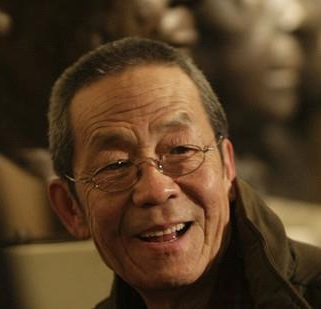
The director is hiding in a cloud of cigarette smoke in the theatre cafe. Were it not for the translator hovering at his elbow, you’d mistake Lin for an elderly caretaker: a slight, somewhat caved-in figure, his jacket hanging absent-mindedly off one shoulder. But, behind neat spectacles, his dark eyes are pin-sharp. He claps me on the shoulder as I sit down; I sense I’m being sized up.

First things first: why the heavy metal? “I wanted to use rock music to display the fierceness of the war, and the rioting of the citizens,” he says. “At first I wanted bands from Germany … I listened to a lot of them, but I didn’t like their electronic sounds. So Yi Liming, my designer, showed me around different parts of Beijing. I chose two of the bands I saw.”

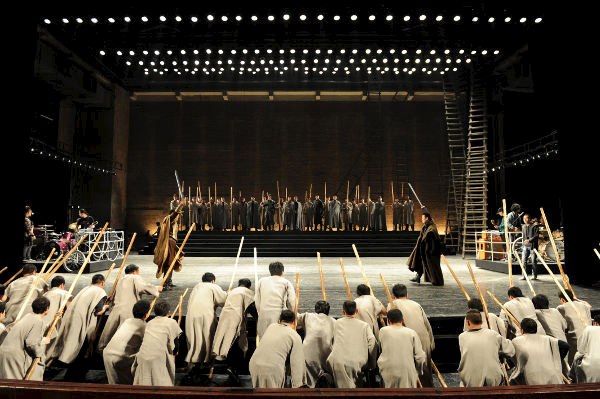
The music certainly adds a volcanic energy. The text has been translated into contemporary Mandarin, and here in Beijing (unlike at the Edinburgh international festival, where the show will open later this month) there are no surtitles. The scalding force of Shakespeare’s verse, though, is echoed in the roaring guitars and pulsing bass. It’s a high-voltage experience, particularly when the Roman mob, dressed in semi-druidic robes, rush onstage brandishing wooden staffs – like a cross between a scene from Star Wars and Reading festival. In the interval, the musicians entertain the crowd, a flock of teenagers pressing close, clicking away with their cameraphones.

Lin smiles. “Some dramatists and critics don’t like the idea of using rock music, and they criticise my way of doing productions.” How does he feel about that? A shrug. “I don’t care.”

Combing the city’s nightspots for musical accompaniment sounds energetic for a director now in his late 70s. But Lin has never done things by the book. After graduating from the Beijing Central Academy of Drama in 1961, he joined the People’s Art Theatre (BPAT) – China’s equivalent of the RSC – as an actor, only to find his career stymied by the Cultural Revolution. Afterwards, he joined forces with the dissident writer Gao Xingjian, who would later win the Nobel prize. A trio of plays, beginning with 1982’s Absolute Signal, all but launched experimental theatre in China, with a confrontational, often absurdist style that unnerved the communist authorities.

316185_653587391334802_432981805_n

In the decades since, Lin has been prolific, flitting between new drama, stylised Peking Opera and ambitious reworkings of western classics. According to Li Ruru, an academic who has written extensively on Chinese theatre, Lin is “a major voice. He’s been doing experimental theatre for more than 30 years, at the absolute vanguard of Chinese spoken drama.” But his approach hasn’t always done him favours: one critic described him and Gao as “harbingers of strangeness” for their efforts to release drama from the straitjacket of Soviet-era social realism. The director refuses even this pigeonholing: “I have no style,” he has repeatedly told interviewers.

Anyone expecting peony-strewn chinoiserie – like that offered by the National Ballet of China two festivals ago – will be in for a shock. This is a Coriolanus of muscular clashes and brutal comedowns; of a leader always itching to administer the hair-dryer treatment, and who does nothing to disguise his detestation of the masses.

In the lead role is one of China’s most famous stage actors, Pu Cunxin: a disconcertingly polite figure who apologies for his sore throat – the consequence of competing with two metal groups. “It is an unusual way of performing,” he admits. “We don’t normally have this kind of collaboration in China. The noise is just so powerful on stage, but we need the rock music to express these emotions. It parallels Shakespeare’s ideas.”

941130_653587461334795_535090116_n

I’m struck by one moment in particular, where Coriolanus’s arch-rival Aufidius grabs a microphone during a battle scene, looking half like a wannabe rock god, half like a politician channelling the energy of the crowd. Politics are everywhere in Coriolanus: the play has been claimed both by leftwing critics as a primer on the dangers of demagoguery, and by the right as a lesson in the fickleness of the masses (the Roman citizens at first swoon over their apparently invincible general, then later turn on him). Given these paradoxes, it feels an oddly appropriate play for present-day China, a country nominally communist, but with an economy many capitalists would trade their copies of Milton Friedman for. On the short walk from my hotel to the theatre, two blocks from the Forbidden City, I drift through a shopping district crammed with western luxury brands; one window of a photography shop is jewelled with glittering Japanese cameras, the other with portraits of Mao and Deng Xiaoping. It would be harder to find a clearer image of Deng’s infamous”socialism with Chinese characteristics”.

What does Lin see in Shakespeare’s text? “The relations between the hero and the common citizens,” he replies. “In ancient Rome, people admired heroes. From my point of view, Coriolanus is a hero.” Is there a resonance with contemporary China? “It’s a good phenomenon if the play refers to current events. Those in power like to control citizens, and some common citizens are foolish.”

I want to find out about a previous Shakespeare production, Lin’s Beckettian staging of Hamlet, first seen in 1989. Performed in a rehearsal room at BPAT, the only prop a barber’s chair, it had three actors (one of them Pu) sharing the roles of Hamlet, Claudius and Polonius. Depending on your perspective, it captured either capitalist alienation, or the disillusion that followed the collapse of the student protests at Tiananmen Square. The parallels were cloudy – theatrical censorship is vigorously alive in the People’s Republic – but there to be seen.

Lin freely admits the show was unusual: in contrast to the traditional Chinese way of presenting Shakespeare, with wigs and western-style makeup (sometimes even prosthetic noses), his actors wore their own clothes, in a conscious decision to show the student prince as just another guy. But he is reluctant to open up on the wider issues. “I hate politics,” he says stoutly. “Hamlet has nothing to do with politics. It’s just about a person’s situation.” I can’t tell whether he’s genuinely uninterested, or unwilling to be frank with a British journalist. “I never discuss politics. I don’t think you can direct a production just from politics.” He isn’t even convinced, he says, he’s avant-garde. “I don’t have that concept. I just direct the production from my interests and from the needs of the play.”

941279_653587384668136_1016224444_n

Our time is nearly up; his lighter is snapping impatiently. Last question: does he like being called a rebel? “I don’t have preconceptions about what I’m going to create,” he stonewalls. “I just follow my instincts.”

I realise as I’m rushed out that I’ve forgotten to ask one thing – why direct Shakespeare in the first place? Why stage reach for a playwright four centuries old? When I email, the answer comes back quicker than I expect. It reads: “It gives me the freedom to say what I want.”

537273_582437285116480_15271441_nInterestingly, the Lin Zhaohua Theatre Studio has it’s own Facebook page which is where all the above images came from.

There is a fantastic outline of him and his work here where he is described as a very controversial drama director in China…one of the most significant figures in Chinese drama history you can’t ignore – whether you love him or not.

.

The second article today is also from the Guardian, by Hermione Hoby, exploring with the Wooster Group why, after all these years of experimental theatre, they decided to ‘do’ Shakespeare.

Wooster Group take on Shakespeare with Hamlet remix

Before Punchdrunk, or Complicite, or Forced Entertainment, or any other experimental theatre company you can name, there was New York’s Wooster Group, an avant-garde ensemble legendary not just for the work it has made since the 1970s, but also for the love affairs and betrayals that have coloured its history. As former member Willem Dafoe has put it: “You become accomplices in life. There’s a terrific power in that. The other side is, there’s no place to run.”

Since 1974 the company has worked out of the Performing Garage in Soho – a Manhattan neighbourhood once characterised by derelict lofts and heroin dealers and now given over to Prada boutiques and cupcake-centric cafes. This year they’re bringing one of their most successful shows ever – a remixed Hamlet devised from a filmed 1964 production starring Richard Burton – to the Edinburgh international festival.

I meet company members Scott Shepherd and Kate Valk in the big empty black box of their theatre and, seated on the steps of the auditorium, Shepherd explains that he directed the play years ago as a student at Brown University. Ever since, he says, he’s had it stuck in his head. That’s not, it turns out, a figure of speech. “He has a photographic memory,” Valk explains, mock-wearily. “It’s kind of obnoxious at times.”

Ham600

The skill is what enabled him, for example, to memorise all 49,000 words of The Great Gatsby for Elevator Repair Service’s acclaimed stage adaptation, Gatz. Hamlet though, was rooted even deeper. Eventually, with speeches still running through his head, it began to feel “like something that needed to be exorcised”.

And so he persuaded Valk, who claims to have suffered from what she calls “Shakespeare deficit disorder”, to join him in after-hours work on the text. From that moment in 2006, very slowly, their production began to take shape.

It began with the two of them, but the woman who continues to hold the company together – the matriarch, you might say – is the quietly formidable 69-year-old Elizabeth LeCompte. The Wooster Group emerged amid the creative ferment of 70s downtown New York, but it was her relationship with Spalding Gray, the late actor and writer, that dynamised the company. After graduating from Skidmore College she got together with Gray – as well as Valk, Jim Clayburgh, Ron Vawter, Peyton Smith and Dafoe – with whom she went on to have a son and a 27-year relationship. Dafoe ended it abruptly in 2004, the same year Gray took his own life by throwing himself from the Staten Island ferry. Miraculously, she weathered it with the company intact.

Before she met Gray in the mid 60s, LeCompte had little interest in theatre and had studied art, thinking she might become an architect like her father. “I think maybe,” she says, “it was just a mistake – I got together with Spalding not because I thought I was going to get involved with theatre but when Richard Schechner [the group’s original artistic director] hired me, I realised that it was really a good place.”

By 1975 she was staging Gray’s famous Rhode Island Trilogy, an autobiographical work that details his childhood and the suicide of his mother through monologue as well as personal materials such as letters and photographs. In 1980, Schechner left, LeCompte became artistic director and they changed their name from the Performing Group to the Wooster Group. What drove them then, I ask. She inhales. “It’s hard to know … I don’t know whether it was just youth, because it wasn’t exactly idealism. We weren’t afraid of anybody. We had a certain kind of feeling of the world was ours, so we could do what we wanted.”

67e72df164dbb6752b0f3871276b9f81

The company seems to retain that sense of boundlessness, I suggest.

“You really don’t really know where you’re going to end up when you start,” she agrees. “And there’s something very exhilarating about that, but it’s also very difficult. In most theatres the director has to know what’s there so the other people involved can rely on her. I don’t afford anyone that comfort. I’m as confused as everybody else a lot of the time.”

When LeCompte began working on Hamlet, “I didn’t really think I was working on Shakespeare, I thought I was working out on figuring outabout Shakespeare. I kind of came in a side door.” That’s often the best way. “Well,” she says drily, “it’s the only way I can do most things.”

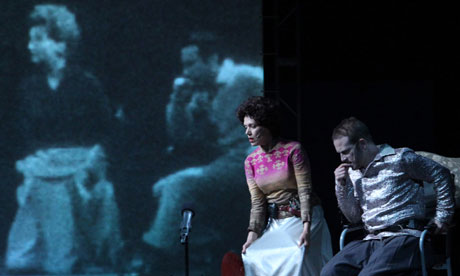
She remembered seeing the Burton production, which was directed by John Gielgud – himself a famous Hamlet – and thinking of it as experimental purely because the actor playing Gertrude wore not a bodiced dress and ruff, but a mink coat. “That’s what experimental was then!” she laughs. More exciting though was Burton’s futuristically named “Electronovision”, an innovation that used 17 cameras to film and broadcast the performance for two days in 1,000 cinemas across the US . In the Wooster production, that grainy 1964 film is projected above the set, forming a ghostly backdrop of a past Hamlet. The New York Times described the Woosters’ show as “an aching tribute to the ephemerality of greatness in theatre”.

Kate Valk and Ari Fliakos in Hamlet

Kate Valk and Ari Fliakos in Hamlet

“The whole metaphor to using the film is the ghost,” Kate Valk enthuses. “The ghost of all those performances!”

Scott Shepherd is a performer who invariably attracts adjectives like “indefatigable” and “tireless”; those seem entirely deserved when it emerges that he edited the entire Burton film into Shakespearean meter, in other words, painstakingly cutting the performers’ pauses so that the iambic pentameter is duly honoured with beats and stresses in the right places.

“This was an arduous task, yeah,” he admits. “To go in and cut pauses if they came in the middle of a verse line and then move them to the end of the verse line.”

It’s Shepherd-as-Hamlet’s imagination, so the premise goes, that creates the onstage action, in which live performers mirror the movements and speech of the actors in the 1964 projection. For all the visual innovations though, LeCompte insists that the text itself remains sacrosanct, and, “on a par with the visual”.

She says: “What I was doing, I realised, was trying to take this shard of what I could get from the past, from that production, and to reinterpolate it into something that made sense to me, in the future.” A brief pause, then: “But I just wanted to delight myself, frankly!”

Despite three decades of making work this is the first Shakespeare the company has ever done. (They’ve since added Troilus and Cressida, a collaboration with the RSC, to their repertoire.)

“I was not hip to the Shakespeare idea at all,” says Ari Fliakos, who plays Claudius and Marcellus, among other roles. Why? “I don’t know,” he says, “maybe it comes out of my allergy to theatre.”

Professing not to be a “theatre person” seems to be a common Wooster trait. Even Valk, who’s been described as “the Meryl Streep of downtown”, has claimed that acting is not among her skills.

1hamlet_wooster_group_czernia

When I mention this tendency to LeCompte she laughs. “I like theatre people!” she protests. “But the process of making theatre in the commercial world I don’t like because it’s too formulaic. I really like to ramble for quite a while,” – and then she corrects herself: “I don’t like to, I have to. I wish I was faster, frankly – we’d be making a little more money.”

Like most members, LeCompte included, Fliakos came to the group through a side door, after hanging around there in 1996, answering phones and fetching coffee. “Everything was stimulating, everything resonated,” he recalls. “It seemed like experimenting with drugs all over again, it was a whole new experience I wouldn’t have expected in any kind of live performance.” He sighs: “The minute you try to describe it, not unlike a trip, it begins to dissipate.”

Every member I talk to about the Wooster Group speaks with this kind of ecstatic devotion. Nonetheless, the creative world of 2013 is a very different one to 1974 – financially and ideologically. LeCompte admits that, “in order to be able to keep the company together I have to be more aware of money, ways of living and ideas. It’s the terrible thing that it’s not hip anymore to not have money, or to be on the outside. It’s much harder for people to give up things that have money and status.”

***4V8G1667©Mihaela Marin

But there are gains, Shepherd explains: “Most people who are in acting are going from one job to the next, and it’s quite hard to develop a sense of continuity, that you’re engaged in building a body of work. And here that’s all you do. One piece bleeds into the other so you’re creating sort of an oeuvre and making something larger than a particular production, you know? This is about developing a philosophy of working, a way of working with a group of people.”

“It feels,” he says finally, “substantial.”

Again the reviews will be out soon for both shows so it will be interesting to see what the critics make of these two very different, culturally and artistically diverse reworkings of Shakespeare. However, according to one critic who Tweeted a few hours ago, the opening night of Hamlet didn’t go well:

domIt happens to the best of us, it seems.

Out Of This World

I am going to out myself today! I am geek – a science fiction geek. I have always loved it and when I saw this Tweet recently my interest was immediately grabbed:

tweet_FotorI thought that I had never seen any science fiction on stage but when I looked at the ‘call for papers’ for the Stage The Future conference I realised I had. Samuel Beckett’s Endgame is of course set in a post-apocalyptic future,  Caryl Churchill’s A Number is about human cloning in a near future world and Howard Brenton’s Greenland is set in a future utopia 700 years from now. Hollywood has always had the grip on science fiction, simply because of the special effects and CGI that it could offer.  But of course the kind of technology that is now available in theatre is starting to change all that.

Leaving Planet Earth traces the story of humanity's first migration into space.A new piece of theatre called Leaving Planet Earth is just about to open at the Edinburgh Festival which sounds like it is really breaking new ground. It has been created by a company called Grid Iron and, to quote the publicity material it fuses live interactive performance with innovative digital and new media technologies. It is an immersive, site-responsive, promenade piece. An article written by Charlotte Higgins in the Guardian talks about how the show was created:

Sci-fi theatre sends audience out of this world

Leaving Planet Earth, one of Edinburgh international festival’s most ambitious productions, to take off in disused quarry

Science fiction is usually the preserve of film, with the endless possibilities of special effects; or fiction, with the endless possibilities of the reader’s imagination.

But now a new production – one of the most ambitious of the Edinburgh international festival, which opens this weekend – is putting sci-fi into the theatre. Or rather, instead of into a traditional theatre, into the distinctly intergalactic setting of the Edinburgh international climbing arena. The biggest of its kind in Europe, it is based in a vast disused quarry on the fringes of the city.

The show, Leaving Planet Earth, is the creation of a pair of Glasgow-based artists, Catrin Evans and Lewis Hetherington. Evans, a sci-fi fan, had been impressed by the way TV series such as Battlestar Galactica had used the genre to provide acute political commentary (it was one of the few mainstream American TV shows to offer a critique on the occupation of Iraq, for example).

Working with the Scottish theatre company Grid Iron, which specialises in site-specific, immersive theatre, Evans and Hetherington came up with a storyline in which the audience has become the last group of people to leave Earth for a new planetary home and are being taken on an “induction” into the new planet.

LPE-Final-Dec-12.--By-Douglas-Chalmers

The story begins even before audiences arrive – they will have received an email message that asks them to watch a motivational video about their new home and invites them to upload an image of an object for a museum devoted to Earth.

When they arrive they will be led through the arena buildings, where high-tech glassy surfaces come up against rugged rock faces, and views give out on to the huge sheer faces of the old quarry.

“We wanted to be somewhere really expansive,” said Evans. “It’s sci-fi – so the themes are really expansive.”

The two artists began to think about a situation in which humans were “involved in a migration into space”. What if a sci-fi story could be used as the carrier for thinking about some big questions about, according to Hetherington, “our relationship to the planet and human responsibility” and “the nature of progress, betterment, advancement and growth”?

But at bottom, they say, it is a human story: about the characters’ own attachment to the past, memories and hopes for the future.

The promotional video mentioned in the article is here:

.

There is even a website that forms part of the piece, here. I look forward to reading the reviews when they come out.

Out of curiosity, I did a little further research and came across the Science Fiction Theatre Company who are based in Boston. Perhaps Sci-Fi theatre really will be the next big thing. For those of you reading this who are IB Theatre Arts students, maybe the IBO will have to add a new theatre tradition to their list very soon.