Violence By Design

One of the smash hits on the London stage at the moment is  Coriolanus. It is one of Shakespeare’s more violent plays with big, bloody battle scenes, riots on the streets of Rome and battles on the Senate floor. This current production, starring Tom Hiddleston  has been roundly applauded.

Untitled

Obviously one of the things that this production does well is violence and death, most spectacularly, it would appear, Coriolanus’ own death. Given my comments recently in my post, Dying On StageI was intrigued to read an interview with Richard Ryan, the fight director on the show, who was talking to Frances Wasem in The Telegraph. In it, Ryan talks about how he approached the job:

How to choreograph a theatrical fight scene

’ve worked for 20 years in theatre and film as a fight instructor and stunt coordinator, but I trained as an actor, so in many way, working in theatre always feels like coming home. My part in the production is to create an exciting fight, which has energy and pace, develops the characters and the plot – and to do it all safely.

The fight director is involved from the very beginning of a production. Wherever possible I like to sit in on rehearsals to get a better sense of the world the director is trying to create. For Coriolanus, Josie (Rourke, the director) outlined the contemporary feel of the play and talked about the Roman look. We had to merge those two elements in the fight scenes. The director will tell me if they envisage a more visceral, hard-hitting or a swashbuckling-style fight. We’ll also discuss any specific plot elements that they wish to include. In Coriolanus it was important to establish Coriolanus as a warrior and Tullus Aufidius as a worthy adversary.

Richard Ryan, Tom Hiddleston and Hadley Fraser rehearse a fight scene for Coriolanus Photo: Rich Hardcastle

Richard Ryan, Tom Hiddleston and Hadley Fraser rehearse a fight scene for Coriolanus Photo: Rich Hardcastle

Research is part of how a fight is put together. I might visit museums to look at how a warrior, at that time, would have fought and moved. For Coriolanus, I looked over illustrations of Roman tactics and battles and discussed with Lucy (Osborne, the costume designer) a need for a range of movements (so that skin doesn’t chafe). We make sure the metal of the stage armour is lighter than real armour and the sword blades are made of aluminum, not steel. They would still cause damage if they came into contact with the body, though. We were lucky that Lucy got us the boots early on in rehearsals, as their weight and grip changed the type of choreography.

I also talk to the set designer and lighting technician. Principally, I need to ensure that the actors can move around the stage, can see each other’s movements, and that they won’t slip or fall. The actors need to be able see the swords as they fight. Losing sight of the blade in a beautiful sidelight is dangerous. I’ll ask for areas of the stage, which see heavy fighting, to be reinforced. The safety of the actors is crucial, everything from the type of floor to the consistency of stage blood is thought about (in case the actors slip). If a piece of furniture is going to be slammed into, then you reinforce that particular bit of the set, so no one is hurt.

One can talk a good fight, but it’s in the doing that all the work happens. After discussion with Josie and armed with an idea of costumes and weapons, the next step is to start choreographing – and to put the fight on its feet.

I sketch out on paper what I think the floor pattern of the fight will look like, but that’s just for myself. The fight is crafted in the rehearsal room, with and on the actors. The actors might be left or right-handed or have an old injury that makes them hesitant. I base the fight on the story and what the actors can do. Their involvement is key. I need to create a fight scene that is exciting, but that’s also sustainable for the actors to perform eight times a week.

In rehearsals, safety is very important. I’m a fencing coach and black belt martial artist so I’m aware of potential injury. There are crash pads at the back of the room, for when an actor is thrown. I also have back pads, knee and elbow pads. In one fight, both Hadley Fraser and Tom Hiddleston are thrown as they grapple and the crash mat was used as they learned and became familiar with the mechanics of the throw.

So that swords don’t actually hit the actors we use a technique called “off-line”. The sword basically makes contact with the area that an actor was previously in. The actors continually watch for spaces to move into. There’s a structure to a fight, which is like a dance; the moves are done over and over until they are second nature. In early rehearsals you see an actor counting out the moves (one, two, three…), but by the time the show opens, they’re invisible.

Photo: Rich Hardcastle

Photo: Rich Hardcastle

Ensuring that the actor is able to convey their character in a fight scene is fundamental to my brief. In Coriolanus I need to establish Coriolanus as a warrior and Tullus Aufidius as a worthy adversary. We also need to confirm Tom as a leader, which is achieved through a combination of what he does, the way others respond to him and using stagecraft to ensure he is in strongest position on stage.

In the action, similar principles apply. Tom (Coriolanus) has minimal, but definite movements, whereas junior warriors would quite simply move more. We’d contrast a confident stillness for Tom, with a more edgy, nervous physicality of a less experienced soldier. Tom and I tried to develop an icon fight style, reflective of his vision for Coriolanus. We settled on a signature low stance, from which he launches into explosive attacks.

The energy of a fight scene should build. You do this by creating the illusion that the fight is picking up pace. You start the fight with the actors doing bigger moves – and reduce them in size as the fight gets more intense. You also reduce the number of pauses in the action, as anger builds. It gives the illusion that the moves are faster and more violent, that tempers have frayed. But it’s an illusion; the reality is it’s very controlled.

I had the good fortune to teach Tom swordplay at RADA. Then, as now, he was diligent, enthusiastic and physically fit. He also contributed ideas – and did so on Coriolanus too. Tom and I had been debating whether to “play” an injury, after he was thrown. I wasn’t convinced it would work. So, in a run through of the fight – with the rest of the cast present, who hadn’t been privy to our conversation – Tom landed from the throw and faked the injury. It worked wonderfully and the rest of the cast liked it, so I conceded that Tom was right. Tom had a broad grin for the rest of the day.

Not surprisingly this set me off on a research trail and I was quite astonished by what I found – mountains of information, societies, guilds, guides, schools and even lesson plans about stage combat. One article from Armour Archive deals specifically with sword fighting, Stage Combat 101.  Meron Langsner, himself a fight director offers loads of links to all things violent on stage. Brigham Young University Theatre Education Database offers four lessons and associated resources, including a great little Terms and Definitions document.

Then there are instructional videos like this one from Armstrong Atlantic State University Drama Professor, Pam Sears, revealing the tricks to the illusions of combat in theatre.

.

I also came across the interview from Stage Source in which four practitioners, Angie Jepson, Robert Najarian, Ted Hewlettstage and Meron Langsner talk about stage combat, fight choreography, and something called Violence Design which seems to be a relatively new term that covers everything violent on stage. It is 45 minutes long, but very interesting – click the icon below to listen

There are professional bodies, such as the Society of American Fight Directors and The British Academy of Dramatic Combat who train actors and certificate teachers. There are people who blog about stage combat, my favourite being I’m So Not Going To Hit YouThere are even Facebook groups, such as Girls Fight, which is set up to promote women in stage combat, of which there are few. It seems to be a male dominated profession. Having said that, there is a great little interview here with Alison de Burgh, who was the first ever professional female fight director in the UK.

1267614-kuhn-7-_wide-9391ed2429d5835b9a0681b2c8cf9d8908ce0e10-s40-c85What I started to glean on my quick tour around stage combat was that much of the training has its basis, not surprisingly, in the kind of discipline that comes with martial arts. This article and programme recording from NPR, In Japan, ‘Sliced Up Actors’ Are A Dying Breed, is about a Japanese actor, Seizo Fukumoto, who has been killed more than 50,000 in his career. Although largely on film, Fukumoto, is known as a Kirareyaku, which roughly translates as ‘chopped up actors’. His art is known in Japanese as tate, a stylized sort of stage combat that combines elements of martial arts, dance and kabuki theatre. You can listen to the programme by clicking this icon:

What is clear, and I always knew this of course, is that stage combat is highly skilled and potentially very dangerous if you are not trained properly. There is a scary list of when things have gone wrong here. So as we say in an increasingly litigious world, Don’t try this at home, kids!

stab

Something to Stream About

Over the course of the last few months I have been carefully watching the growing debate surrounding the showing of live broadcasts or recordings of theatre in cinemas and live streaming to anywhere you want to watch.

Theatre has generally resisted these modes of reaching a wider audience, although opera, particularly the Metropolitan Opera in New York and the Royal Opera House in the UK have been pioneering it for a number of years. It comes as no real surprise that live streaming has started to take hold and is expanding rapidly. Cinema-based and arts venue showings are on the increase as well as specific services, like Digital Theatre which allow for anytime, anywhere access to a growing range of live filmed, but post-produced, edited performances.

maxresdefault

It would appear that the UK is leading the charge, followed closely by certain North American companies. National Theatre Live started the ball rolling in the UK in 2009 showing live performances in cinema’s across the country:

National Theatre Live is the National Theatre’s groundbreaking project to broadcast the best of British theatre live from the London stage to cinemas across the UK and around the world.

Though each live broadcast is filmed in front of a live audience in the theatre, cameras are carefully positioned throughout the auditorium to ensure that cinema audiences get the ‘best seat in the house’ view of each production. Where these cameras are placed is different for each broadcast, to make sure that cinema audiences enjoy the best possible experience every time.

Satellites allow the productions to be broadcast live, without delay, to cinemas throughout the UK as well as many European venues. Other venues view the broadcasts ‘as live’ according to their time zone, or at a later date.

They have rapidly expanded the programme and now broadcast co-productions, as well as their own work, from across London. The statistics are impressive – seen by 1.5 million people in 500 venues around the world, half of which are outside the UK.

.

The article that really got me thinking about the implications of it all, from early 2013, was written for Exeunt by A.E Dobson, Live to Your Local Cinema – Michael Barker. In it, Dobson notes that this nascent form

……has attracted little critical or academic interest despite its profile. Whilst the current paucity of literature can be attributed to sheer novelty, its cause is certainly hindered by its lack of a name. Those working within the film industry have found it useful to use the term “alternative content”; those without hanker after a moniker more focussed on what the format does rather than what it doesn’t.

He goes on to say, and this is probably at the core of any subsequent debate and discussion, that

While some aspects of Livecasting may allow a greater number to claim ownership of the ritual, film is at the same time a fundamentally distancing medium; it positions the cinemagoers – structurally – as outsiders, a problem that the architects of the experience spend a good deal of time repressing.

The debate in the UK was really ignited by the decision of the Royal Shakespeare Company to start broadcasting to cinemas too,  alongside the National Theatre broadcasting it’s anniversary performances on BBC Television. First to write about this was Dominic Cavendish in The Telegraph with a piece simply entitled, Should live theatre be shown in cinemas?

At around the same time Pilot Theatre live-streamed, for free, its production of Blood and Chocolate, an immersive, promenade piece which is still available to watch on Youtube. It is here that differences start to occur.  The National Theatre and The RSC are only making their broadcasts available at a specific time, in a specific venue while Pilot are making theirs available at anytime as long as you have access to a computer. More about Pilot later.

Almost simultaneously came the news in an article in the Canadian Globe and Mail, entitled Stratford Festival to film productions for worldwide theatre distributionthat the Southern Ontario Festival was planning to do something similar with a view to international viewing. 

At this point the debate got interesting. The Guardian in the UK, in its editorial pages, wrote that:

In praise of … streaming live theatre

Nothing beats being there, as any sports fan knows, but there are consolations when barriers to theatre access are removed

On Wednesday night the Royal Shakespeare Company joined the growing band of arts organisations that are breaking down the biggest single barrier to access – the need to be there – by transmitting live their top-rated Richard II to cinemas around the UK. Audiences from Aberdeen to Ambleside, Taunton, Tamworth and Thurso – and many more in Ireland, Sweden, Canada and Malta – were simultaneously connected to Stratford for a three-hour rollercoaster ride through medieval England. Thousands of enthusiasts who could never otherwise have got a ticket were able to see the first of director Gregory Doran’s new cycle of Shakespeare’s history plays. Nothing quite beats being there, as any sports fan knows. Yet sometimes it felt almost better: the camera could close in on Richard’s ravaged face, and it could reveal the austere splendour of the gothic set: a seat in the gods and the front row. Being there can’t do that.

This perspective really struck a chord with me. I’ve been to see too many plays where I know I missed the subtleties of the performance because I simply been too far away from the stage – particularly a problem in more modern, larger venues. However, and not surprisingly, there have been those people who simply can’t see the value of live-streaming, even fearing that it will reduce theatre-going audiences rather than increase them. In The Stage last week (the newspaper for theatre professionals in the UK), an executive from a regional theatre labelled the NT Live screenings as ‘Weird’

Stephen Wood ……. warned that the National Theatre’s NT Live initiative must never become a “substitute” for actual theatregoing.

Wood, who worked as head of press at the National in the 80s, has labelled the screenings “weird”, adding: “They are neither theatre nor film, but something in between. That’s not to say they are not valid, it’s just that they are a very odd thing.”

The article, NT Live must not become a “substitute” for theatregoing, goes on in the same vein. However, the accompanying survey and comments would seem to disagree with Wood. Not surprisingly his comments garnered some criticism. My favourite is from the ever pragmatic Lyn Gardner in her Guardian Theatre Blog. This was written only a few days after Wood’s comments, and another live streaming event by an independent theatre, this time of Howard Brenton’s latest play, Drawing The Line, which explores the moment when the line between India and Pakistan was made and British rule in India ended.

Why digital theatre poses no threat to live performance

The early 20th-century conductor Sir Thomas Beecham was not a big fan of the radio. He thought that if people could listen to concerts relayed in their own home, they would be reluctant to visit concert halls. He chided the “wireless authorities” for doing “devilish work”.

I thought about Sir Thomas – who no doubt would be delighted to learn that the devilish Radio 3 hasn’t killed off the live concert – last week when Stephen Wood, executive director of the Stephen Joseph theatre in Scarborough, was reported in the Stage as taking issue with NT Live, which screens productions live to venues across the country and the world.

Upcoming productions include the Donmar’s sellout Coriolanus with Tom Hiddleston. In a single evening, Coriolanus could stream to more people than it will play during its entire run in the 250-seater venue. Wood is concerned that these kind of broadcasts will become a substitute for actual theatregoing, saying: “We must be careful that we don’t arrive at a situation where this type of thing is what people’s only experience of live theatre really is.”

Wood’s comments echo those of Michael Kaiser of the Kennedy Centre in Washington, who in a blog last year raised the spectre that digital downloads and screenings are threatening American regional theatre. He asked whether the baby-boom generation could be “the last to routinely attend live, fully professional performances” and suggested that the allure of being able to broadcast to huge numbers could make organisations who are using digital technology risk-adverse and lead to the collapse of regional theatre. Why will people go out to the theatre, particularly at a time of rising costs, he asks, when they can stay home and download or go to a local cinema? Probably for exactly the same reasons why live gigs are flourishing. Downloading your favourite band’s tracks is not the same as seeing them live.

In both cases, Wood and Kaiser appear a little like King Canutes trying to fruitlessly hold back the waves. In both cases they appear to see digital as a threat to live theatregoing. Perhaps assuming that the 60,000 people who attended live screenings of David Tennant’s Richard II in cinemas are incapable of understanding that it’s not the same as actually seeing a live performance at the RST or the Barbican. I know perfectly well that fresh salmon and smoked salmon don’t taste the same but that doesn’t stop me from wanting to sample both.

Not everyone has a theatre on their doorstep or indeed access to it. Many of the thousands of British schoolchildren who last November enjoyed a classroom streaming of Richard II and a live discussion with Tennant and Greg Doran would not otherwise have had the opportunity to see the show at all.

But that doesn’t mean that their appetite won’t be whetted to go to their local theatre and see a different show as a result. Early research about NT Live found that it was more likely, not less likely to make people go to the theatre, and people who go to the theatre are more likely to go and see more theatre.

More forward-thinking theatres understand this. They are not in competition with each other for audiences, and anything we can do to encourage theatregoing and make it a habit can only be good in what ever form it is distributed. Surely we should be celebrating the fact that the NT reached two million more people through screenings, not getting anxious about it? If anything it should be a spur to make theatres and companies all over the country wonder how might they might use of digital in interesting ways. Many already are. Some are looking at different ways of storytelling in projects such as Unlimited’s new initiative, Uneditions. I don’t think this is an issue that necessarily pits big against small, or London against the regions. It is more about open-mindedness and a willingness to be bold.

It’s certainly not about ditching the way that theatre has been toured and delivered over hundreds of years, but rather about seeing the artistic possibilities of digital platforms and extending reach, capacity and audiences. There are plenty, from Pilot to National Theatre Wales and Hampstead, who are already doing just that. If they can do it then so can the Stephen Joseph, and others too.

Michael Kaiser’s blog for The Huffington Post, that Gardner references, makes interesting reading, but is very doom laden. He suggests that the broadcasting by national companies will inevitably bring about the demise of smaller regional companies. However, he makes assumptions and asks questions with very little insight of the UK experience  where it is regional and smaller companies who are embracing live-streaming to widen their audience base and bring in more people to their building-based work. I agree with the veritable Lyn Gardner completely. The mother of a friend of mine who is a regular theatre-goer, but doesn’t live in London, now watches the NT Live productions at her local cinema, but still goes to London to watch other productions, by other companies.

3134-fitandcrop-560x350

I’m not going reiterate all the positive and supportive arguments made here in the articles and links, but to be able to increase the reach of a piece of work, both nationally and internationally, can only be a good thing. For example, the global live streaming of another of Howard Brenton’s plays last year, The Arrest of Ai Weiwei, has value beyond that of being an artistic and creative sharing. In the UK it means that people living outside London have access to some of the best theatre in the world and those regional companies with smaller budgets, doing exciting things, can have a reach way beyond their original remit, community and intent. The same will be reflected in any country where national theatrical institutions are based in a capital city, but are geographically and/or financially out of the reach of most of its citizens.

With that in mind, Marus Romer, artistic director of Pilot Theatre, announced the launch of a new a project, via his blog, that aims to create a country-wide live streaming service, LiveTheatreStream.TV. Pilot have been pioneering live-streaming of their work and creative conferences for a while now and have a dedicated digital production team. I have posted this before, but here again is their live stream of Blood and Chocolate.

.

Clearly, having said all of this, what we see now is a variety of broadcasting/streaming options emerging:

  • Some are streamed live, are free and can be watched again later via a hosting site/computer
  • Some are streamed live, are free and can be watched for a limited time only, again via computer.
  • Some are recorded, then edited and then made available for streaming, but at a charge via a subscription service
  • Some are broadcast live (via satellite) to specific venues, mostly cinemas, and are charged for but are not accessible in any other form
  • Some are recorded live, then broadcast later to specific venues, mostly cinemas, and are charged for but are not accessible in any other form.

I find it all fantastic and exciting for so many reasons. As a theatre teacher,  for so long I have had to make do with filmed versions of plays or one camera set-up recordings of live productions – neither of which are anywhere near satisfactory. As an English speaking theatre practitioner and theatre-goer living internationally, I am, of course, delighted by these developments. Having said that I am, so far, always disappointed when I go to the NT Live website and it tells me that I am 7,500km from my nearest cinema – the distance between Hong Kong and Melbourne, Australia. Mind you, this morning as I was writing, I have been back to the site and it is telling me that the broadcast venues are getting closer – I can apparently now watch Frankenstein and Coriolanus in Japan, the Philippines and South Korea – so now only 1,100km away. One can but hope.

My original intent was to finish the post at this point, but as I said at the beginning and have hopefully alluded to throughout, the whole ‘genre’ is continually evolving, as are the discussions around it. However, a Tweet from yesterday led to another avenue of discussion, which very meaningfully adds to the debate about how we adapt the cultural landscape to take advantage of and make the most of live streaming. Elizabeth Freestone, artistic director of a well regarded small scale British touring company, Pentabus,  wrote a blog yesterday, What live theatre screenings mean for small companies which, while supportive of what is happening, raises some very relevant, pertinent questions about the future. Whilst Freestone’s comments are about the UK, they could easily have a relevancy elsewhere as things develop.

I run Pentabus, a small-scale touring company. We tour rural area – village halls, fields, colleges and pubs – taking our work into the heart of a community. We do this because people living in geographically isolated places struggle to have the same access to live arts their urban counterparts enjoy. Transport, pricing, time – all conspire to deny opportunity. So I’m thrilled live screenings give our audiences more opportunities to experience theatre near them. And I’m delighted the income venues get from live screenings (including bar sales) helps them afford to programme more live theatre in turn. But some of the infrastructure surrounding screenings can’t help but pitch one against the other. And if put into competition with each other, venues will always choose live screenings because they are much cheaper to buy than live theatre. The good news is, the problems are solvable.

No doubt the debate will continue. Your thoughts?

Dying On Stage

There a few things I have always had to begrudgingly admit that cinema does better than theatre, and one of them is death. A death – be it by murder, accident or natural causes – on stage is alway difficult. We suspend our disbelief, but when I see someone chopped down in the prime of life in front of me – I’m thinking Hamlet, Romeo and Juliet – it always leaves me (rather than the supposed corpse) a little cold.

the-barricade1

So it was with some interest that I read Jane Howard’s article in The Guardian that mused on this most difficult of theatrical acts:

Can theatre ever pull off a convincing stage death?

Playwrights love a dramatic death scene – but stage trickery is rarely good enough for the audience to suspend disbelief

If you’ve been to the theatre even a handful of times, it’s likely you’ve seen a stage death. Our fascination with death seems endless, and proves fruitful picking for playwrights. For the writer, there’s power in making an audience empathise with a character and then ripping that character away, and there’s also power in the vindictive killing of the disliked.

Oedipus Schmoedipus, playing in the Sydney festival, is a documentation and reenactment of the deaths in the western theatrical canon by performance company Post. The billing lists the work as “after Aeschylus, Anon, Barrie, Behn, Boucicault, Büchner, Chekhov, Euripides, Gogol, Goldsmith, Gorky, Hugo, Ibsen, Jonson, Marlowe, Mayakovsky, Molière, Pirandello, Plautus, Racine, Seneca, Shakespeare, Sophocles, Strindberg, Voltaire, Wedekind, Wilde et al”. And these men didn’t stop at one death apiece.

Post’s Mish Grigor describes the work as exploring the “tension between the fact that death is an actual universal, and the western theatrical canon is often spoken about as having universal themes or, these plays speak to all of us. We’re interpreting an actual universal through something that we don’t think is really universal, but pretends to be.”

Is death, then, perhaps an easy way of trying to create a connection with the audience? It is something that everyone watching will have a relationship with, even when other themes a play explores may be foreign?

oedipus-schmoedipus-belvoir-2014-production-shot-4-by-ellis-parrinder

And yet, we are readily judgemental of watching someone pretend to die. When we’re watching theatre we suspend disbelief in so many ways, buying into the construct of the world and using our imagination to fill in the gaps. But there is something about death that is particularly sticking when it comes to witnessing it on stage.

“I find it quite absurd when an actor dies on stage,” says Grigor, “because we know that it’s a game of pretend: they’re still breathing. You can still see them breathing a lot of the time, and the stage trickery that is employed is usually not that good.”

When you start talking about the practice of death and dying on stage, the same concerns repeatedly come up. Tim Roseman, artistic director of Playwriting Australia, says: “The trouble is, it’s an inherently over-the-top theatrical thing that theatre does, because at the very least you’re left with: what do you do with the body? And so the artifice is always problematic.

“Because I know you’ve got to do it 34 more times before you finish the season and, literally, do you just get up and walk off? Do we get someone in black to come and steal the body in the end? It’s a really problematic thing. And, you know, fake blood. So I think it’s the thing we buy the least.”

It seems that while we’re prepared to ignore the wires helping someone fly, there is something about death that makes us watch for the rise and fall of an actor’s chest or shadowed movements in the blackout.

Maybe that’s why, when I look back at the deaths on stage that have truly impacted and stayed with me, I keep returning to puppetry. The death of the title character of the Adventures of Alvin Sputnik: Deep Sea Explorer, a puppet made from little more than a white-gloved hand and a foam ball, left me holding my breath to not audibly sob. The deaths of hundreds of silent puppets at the hands of Nazi soldiers in Hotel Modern’s Kamp left my heart in my throat and my brain overwhelmed.

I mentioned these deaths to Nescha Jelk, artistic associate at the State Theatre Company of South Australia. “It’s because the puppeteer animates it, gives it that life and gives it that real presence,” she says. “We really invest [emotionally] with the puppets, but it’s so easy to de-animate them and to take that away.”

Grigor agrees: “There’s always life in the person, isn’t there? You always know. For me, I find it very hard to escape that knowledge: that a person is just a person.”

Michael-Feast-plays-Thoma-007

Not surprisingly this led me to see what other people had to say on the topic. A blog post Alexis Soloski, also in The Guardian, from a year or so ago – What makes a good stage death? Forget all that tediously realistic convulsing and juddering – a really convincing theatrical death is better left unseen – is great and her list at the end, about what should be remembered when ‘acting’ death, just made me smile:

1. Don’t. Keep the death off-stage.

2. Perform the death on stage but avoid showing it directly, as in the famed stoning scene in Edward Bond’s Saved.

3. Keep convulsions to a minimum.

4. Better blood. (The Royal Shakespeare Company keeps correctly coloured fluid in three different viscosities.)

5. Try to die on your stomach or with your back to the audience so they don’t see you continuing to breathe.

6. Actually die. There are – a very small number of – actors who have perished while treading the boards. (This method is not recommended. Not only is it tremendously sad and frightening, but it’s terribly inconvenient for the next day’s matinee.)

There is also a great article from TimeOut Sydney, Death Scenes,  which talks to six performers about how they ‘do’ death on stage. One of the actors interviewed, when asked if their mind wonders once they have been killed, said:

Sometimes you lie there thinking about what you’re going to have for dinner if it’s a matinee

A rather more serious article from theatrebayarea.org, I’m dying out here has in interview with actor James Carpenter who has ‘died’ many, many times on stage and is an interesting read on the subject.

I’ll finish with an extract from a post by Alfred Hickiling, Death by overacting, The Greeks did it tactfully, Bottom did it endlessly

There is a lot of death in the theatre: sometimes good, but frequently so bad as to make you wonder why anyone ever decided to mess with the formula established by the Greeks. You can’t help but feel that the fathers of western drama had it right when they opted to keep all the gory business off stage – why spoil the performance with a series of unnecessary convulsions when you can send a messenger to report that you expired heroically, with all your tragic dignity intact? Ibsen, Chekhov and Miller got the message: a solemn exit followed by a solitary gunshot, a profound silence and no mess.

Saved, Edward Bond

Saved, Edward Bond

It is the Jacobeans we have to thank for plays that conclude knee-deep in guts, thanks to their macabre fascination for golden daggers, poisoned Bibles, severed limbs and so forth – which all the followers of Sarah Kane and the Blasted school have enthusiastically revived today. But if one were to identify the absolute nadir of unconvincing expirations, it is as well to start at the Bottom:

Thus die I: thus, thus, thus.

Now I am dead,
Now I am fled,
My soul is in the sky.
Tongue lose thy light,
Moon take thy flight,
Now die, die, die, die, die.

I have seen actors spin Bottom’s soliloquy out for several minutes, at which point the joke no longer seems to be on Shakespeare’s weaver, so much as on themselves. But if the death of Pyramus is daft, Shakespeare also crafted some of the most exquisitely moving death scenes of all time, such as Cleopatra with the asp (“Dost thou not see the baby at my breast that sucks the nurse asleep?”), as well as one of the most defiantly underplayed (Mercutio’s “’tis but a scratch”).

No Longer A Refugee

The article I want to share in today’s post really touched a nerve when I read it last week. It was published in the Financial Times, written by Charlotte Eagar, and is about her project to stage the antiwar Greek tragedy, The Trojan Women with a cast of Syrian women who have fled their homeland’s vicious civil war for neighbouring Jordan.

a8ebe18e-7410-11e3-beeb-00144feabdc0

If you don’t know the play, The Trojan Women is about refugees, set at the fall of Troy. All the men are dead and the former Queen Hecuba of Troy, her daughter Cassandra and the rest of the women are waiting in a refugee camp to hear their fate. Euripides wrote the play in 415BC as an anti-war protest against the Athenians’ brutal capture of the neutral island of Melos; they slaughtered all the men and sold the women and children into slavery. You can download the text of the play as an e-book here, or read it online here.

4c06569e-5e6e-4213-b3a3-59af6ceffd39

Eagar’s piece is definitely worth reading. It charts the whole project from beginning to end. It is both immensely inspirational and gut-wrechingly sad. Click the link below for the full article.

Syrian refugees stage Euripides’ ‘The Trojan Women’

You get a real sense of the power of the performance in the interview, below, with one of the actor refugees, known simply as Fatima.

.

5857925

.
.

The Third Collaborator

Theatre Room has been on an extended Christmas vacation, but I am back now and have lots to share over the next few days.

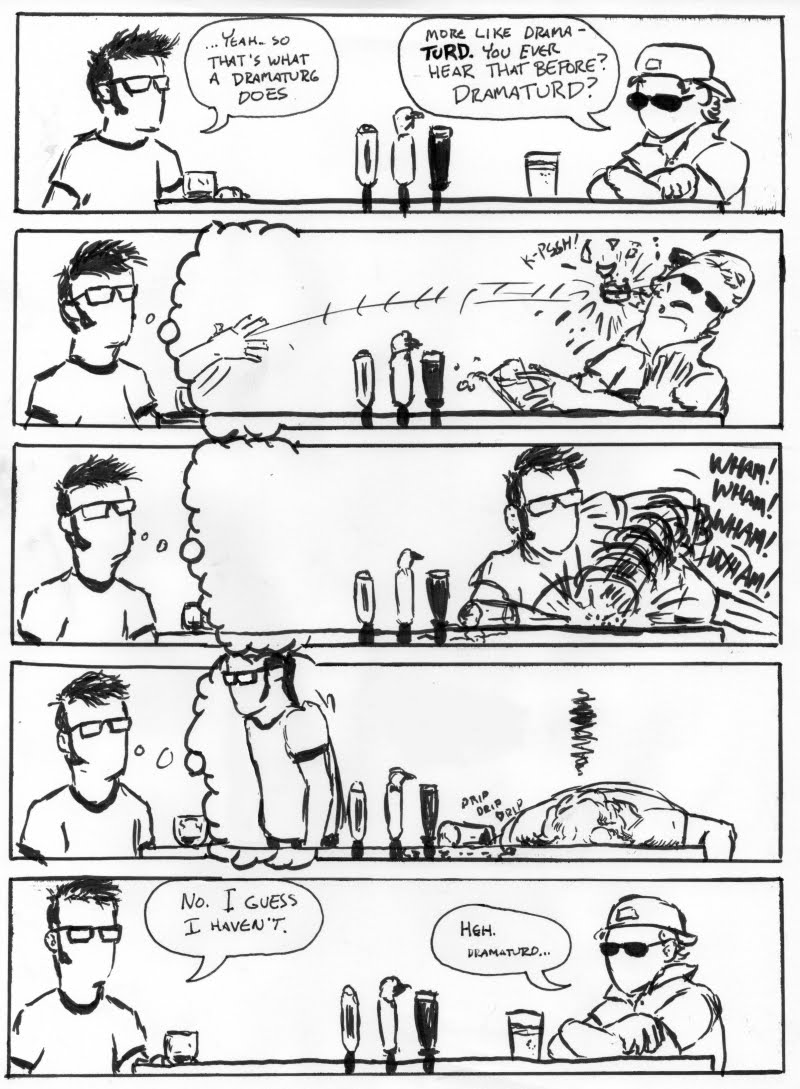
I want to start with an article from the Boston Globe from last week. Written by Joel Brown and entitled Offstage, dramaturgs are playing a prominent role it explores the burgeoning role of dramaturgy in American theatre. As I have written here before, dramaturgy often defies definition and this great article tries to put that right.

Offstage, dramaturgs are playing a prominent role

The posters and programs for Company One’s “Splendor” last fall offered three credits where there are usually two:

“A WORLD PREMIERE by Kirsten Greenidge

Directed by Shawn LaCount

Dramaturgy by Ilana M. Brownstein”

Playwrights and directors always get prominent credits, but a dramaturg almost never does. The billing for Brownstein was one outward sign of a backstage shift in Boston theater. In today’s theater, dramaturgs do anything from mundane script management to researching a play’s historical background, from suggesting changes in a play’s structure to arranging post-show discussions with the audience.

“The role of the dramaturg was, really, we saw it as a third collaborator,” said LaCount, Company One’s artistic director.

But it’s a job that’s at best dimly familiar to the audience. Partly that’s because the role of the dramaturg changes from show to show and company to company. Dictionaries broadly define dramaturgy as the art of dramatic representation. Even dramaturgs say the job is not easy to explain. In today’s theater, they do anything from mundane script management to researching a play’s historical background, from suggesting changes in a play’s structure to arranging post-show discussions with the audience.

“You ask 10 dramaturgs what they do, and you’ll get 17 answers,” said Brownstein, whose title at Company One is director of new work.

From left: director Shawn LaCount, dramaturg Jessie Baxter, and actor Peter Andersen discussing an upcoming production of “The Flick.’’

From left: director Shawn LaCount, dramaturg Jessie Baxter, and actor Peter Andersen discussing an upcoming production of “The Flick.’’

From a small-company production like “Splendor” to the Broadway-bound “The Gershwins’ Porgy and Bess,” dramaturgs have been shaping much of what Boston theater audiences see. LaCount and others say that a dramaturg is especially valuable to a new play, and that’s why dramaturgs have a higher profile here lately. “I think Boston is becoming a player in new work in the American theater, (and) it’s been a while,” said LaCount. “I think the role of the dramaturg is a lot more noticeable and valuable.”

The Literary Managers and Dramaturgs of the Americas will hold their annual conference here in June. “The theme of the conference is looking to the future to see where we are going,” says conference chairwoman Magda Romanska, an associate professor at Emerson College and editor of an upcoming dramaturgy textbook. “I think it’s a really good moment for the field.”

Playwrights are artists and rightly protective of their creations. But Greenidge said she was happy to have Brownstein’s input during the development of “Splendor,” which is built around a Thanksgiving weekend and centers on ties of family and community.

Freelance010 - edit

“One thing Ilana brought up was, ‘Nobody ever has Thanksgiving dinner in your play — what does that mean?” Greenidge said. By the time of the premiere, the playwright added a brief, dreamlike scene in which all the characters come to the table to get a piece of pie before dispersing again.

Dramaturgy (it rhymes with clergy, though “dramaturg” is pronounced with a hard G) dates to Europe in the 1700s, when the first dramaturgs were sort of in-house critics. Formal dramatic structure was long their main concern. Now institutional dramaturgs may be involved in selecting plays for a company to produce; they often carry the job title of literary manager. Production dramaturgs work on a specific show. Some dramaturgs are freelance, some on staff. Duties and titles overlap.

In the modern era, dramaturgs are known mainly for researching the context of a play to ensure an accurate production, and to provide background information to cast and designers. They have long been considered “the in-house bookworm,” as one joked.

But even that role is not necessarily dull. “Today I’m reading all about S&M for ‘Venus in Fur,’ ” said Charles Haugland, dramaturg at the Huntington Theatre Company.

Dramaturgs enter the field in various ways, but few have had as consistent a path as Ryan McKittrick, director of artistic programs/dramaturg at the American Repertory Theater in Cambridge. “I sort of grew up in this theater,” he said.

McKittrick was an undergraduate at Harvard when he fell in love with ART’s work, studied dramaturgy at the ART Institute, and has worked with the company since he graduated in 2000. He works on projects developed sometimes over years at the theater, including 2011’s “The Gershwins’ Porgy and Bess” under artistic director Diane Paulus that made it to Broadway.

“When I was an undergraduate, I didn’t really know what dramaturgy was,” McKittrick said. “It provides an opportunity for someone who loves academic research but also loves the theater and wants to pursue a life in professional theater. And within the theater you get to do many, many different things.”

keep_calm_and_trust_the_dramaturg_ceramic_tile-r32585b26ebd944a391f65451dfcf19ae_agtk1_8byvr_512_Fotor

Most dramaturgs write program notes and organize post-show discussions. Their quest: “How do we deepen an audience’s connection to the material?” said A. Nora Long, a dramaturg whose job title is associate artistic director at the Lyric Stage Company of Boston.

On productions, a dramaturg may also be responsible for “moment-to-moment rehearsal stuff” that requires a deep knowledge of the script, Brownstein said. “Splendor” follows numerous characters in a fictional Boston suburb over decades, jumping back and forth in time. The cast rehearsed the scenes in the order in which they appear in the play, not in the order in which they happen. So the scene they were working on at any given time might hinge on developments not shown until later.

“So it was one of my jobs for every scene to be the person who was like, ‘Context! Here’s what you need to know,’ ” Brownstein said.

Playwright Walt McGough says he’s always happy to have a dramaturg on one of his productions because they can solve thorny problems. When his “Priscilla Dreams the Answer” was in rehearsal with Fresh Ink Theatre a couple of years ago, he and director Melanie Garber got along great except for “one moment where we just kept talking past each other,” McGough said via e-mail.

The issue on which they deadlocked: when to start playing a Belle and Sebastian song in the play’s final moments. Garber wanted to start at the beginning of the last scene, while McGough wanted to wait until the blackout, he explained.

“We were wasting time trying to explain to each other why one choice was right and the other was wrong,” McGough said. “The dramaturg, Jessie Baxter, was sitting and patiently watching us run around in circles. She spoke up and recommended splitting the difference, and beginning the cue about halfway through the scene, so that it underscored the final moments but didn’t kick in fully until the play had ended.”

That solved the problem perfectly, he said, and exemplified the value of having a dramaturg who “observes the entirety of a play and its production, instead of just one aspect, and makes sure that everything that happens is being done in service to the same viewpoint.”

Baxter also “dramaturgs” for Company One and is working on its production of Annie Baker’s “The Flick,” opening at the Modern Theater in February.

The job all depends on the play, the circumstances and who’s involved. Dramaturgs can be less needed on a well-known work, especially with an experienced director. “If we’re doing ‘Private Lives’ with [director] Maria Aitken, she’s done 12 Noel Coward plays, she doesn’t need me,” said the Huntington’s Haugland.

And there are some playwrights and directors who aren’t so enthused about what dramaturgs have to say. Playwright Richard Nelson gave a speech in New York in 2007 in which he deplored a “culture of ‘development’ ” in which playwrights are thought to need help to do their work.

lmda_FotorBoston dramaturgs say it’s often the older generation that has an issue with their growing role.

“I have some people in my family who are theater practitioners,” said Long, “and when I told my uncle I was studying dramaturgy, he was like, ‘As a director, what would I possibly need a dramaturg for? I can do research.’

“But the thing you cannot do is be another pair of eyes,” Long said. “I think the best dramaturgical relationships are about finding a collaborator who knows as much about what you are attempting to do onstage as you do, but who is going to look at it from a different perspective.”

As devised theater and new technologies become more common, younger playwrights grow more comfortable with new kinds of collaboration, said Romanska, who had just returned from a theater festival in Krakow filled with experimental work. “The rigid division of roles, director/dramaturg/playwright, becomes more and more blurred as people move across boundaries,” she said.

There is also an excellent article here, written by Robert Loerzel for Playbill that also tackles the question.

The Literary Managers and Dramaturgs of the Americas, mentioned in Brown’s article, is an excellent source of information. It has a resources page, which contains a Dramaturgy Handbook written by Dr Magda Romanska who is the Assistant Professor and Head of Theatre Studies at Emerson College. This is a real find and a must read. Simply click the link above to download a copy.

Grand Designs #2

When I started Reading Room it was based solely here, on WordPress. Slowly it spread to have a presence on Facebook and Twitter, which became a source of material. Recently I added Tumblr in an attempt to reach my students in another way, but unwittingly I tapped into another fascinating source.  There are some great Tumblrs that curate theatre designs by the hundreds and I’m going to share a few today – for inspiration more than anything else.

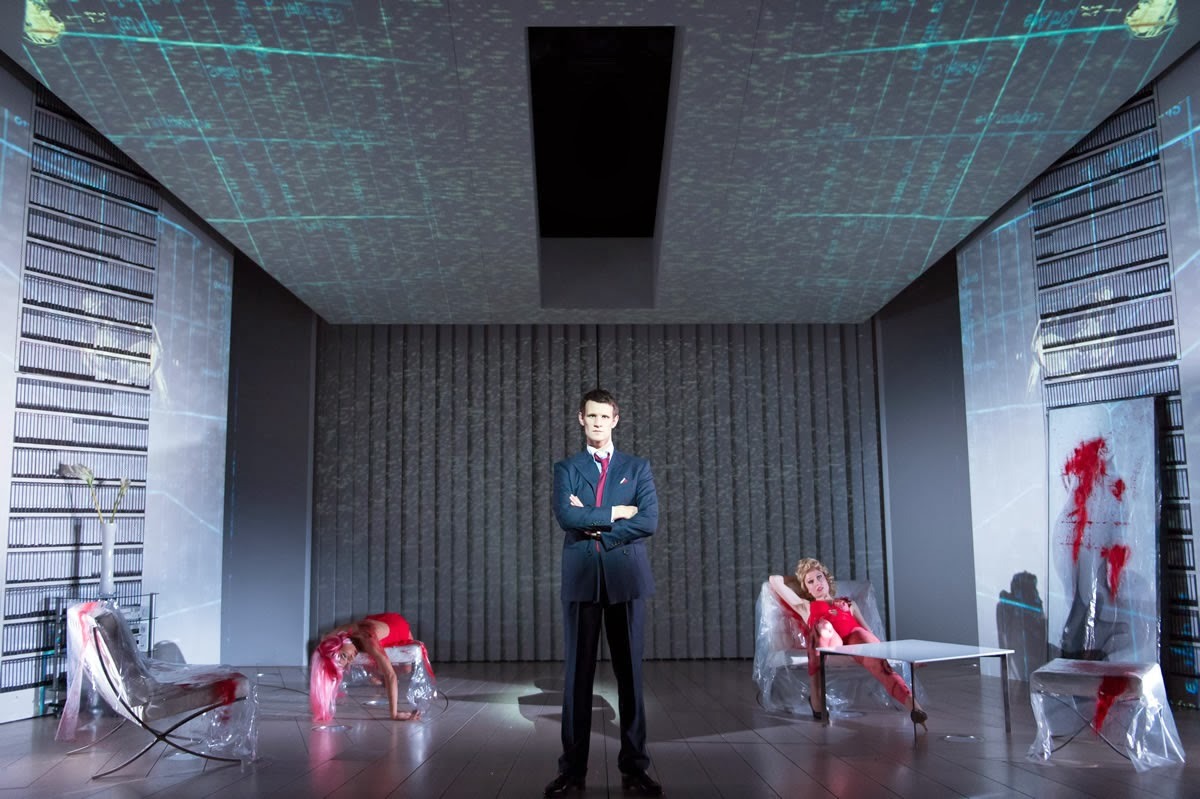
OLYMPUS DIGITAL CAMERAOne Tumblr I follow is yeahtheatresetsandprops who posts regularly and has a great and varied selection of set designs from Europe and the US. The above design is by Troy Hourie for The Classical Theatre of Harlem’s production of Peter Weiss’ play, Marat/Sade. The one below is from the brand new American PsychoThe Musical which has just opened at The Donmar in London, starring Matt Smith – he of Dr Who fame (with rave reviews, I should add). The design is by Es Devlin and has garnered equally great plaudits as Smith has for his performance in the show.

tumblr_mxrld3nrC81qlpqbyo3_1280Another I follow is Everything Scenic who posts some lovely designs and videos too. One beautiful design that struck me is this one, for Sunday in the Park with George, by David Farley.

.

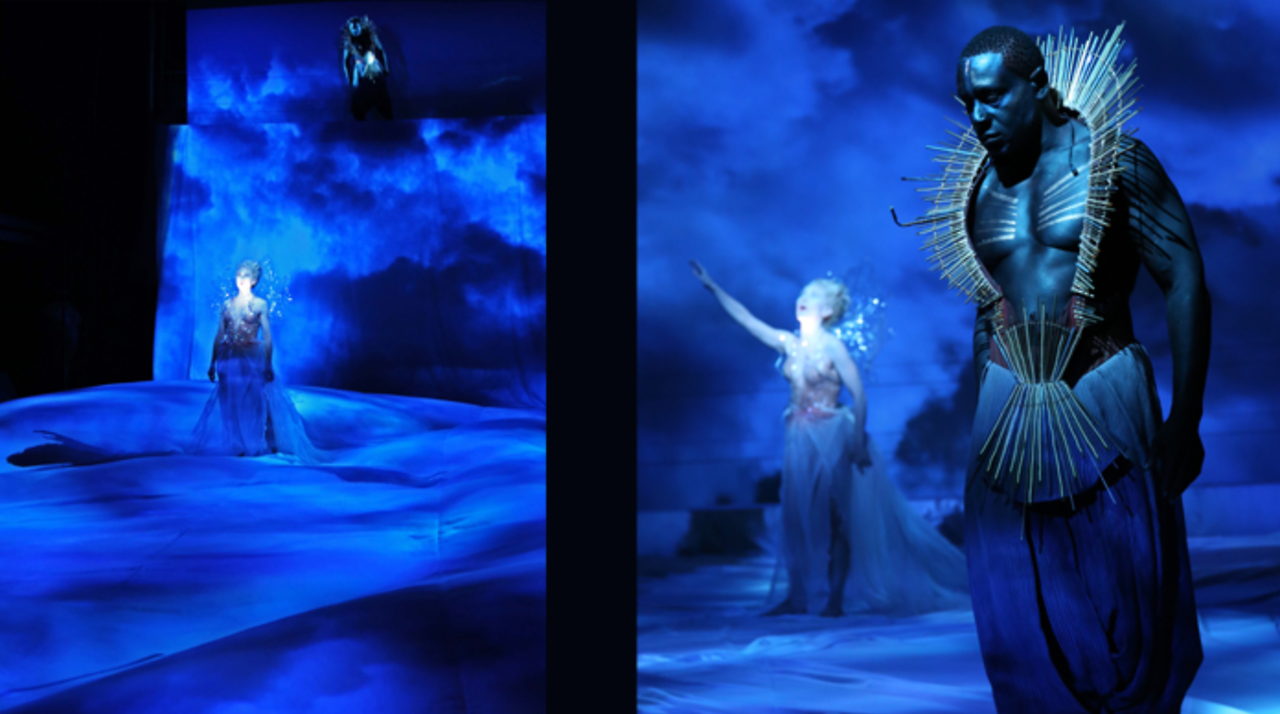
Another is for a rather wet version of Metamorphosis (Ovid, rather than Kafka), designed by Daniel Ostling at the Arena Stage in Washington DC.

.

Everything Scenic also posts some unedited video, straight from the stage manager, like this one that shows the stage machinery used in Billy Elliot, the musical. 


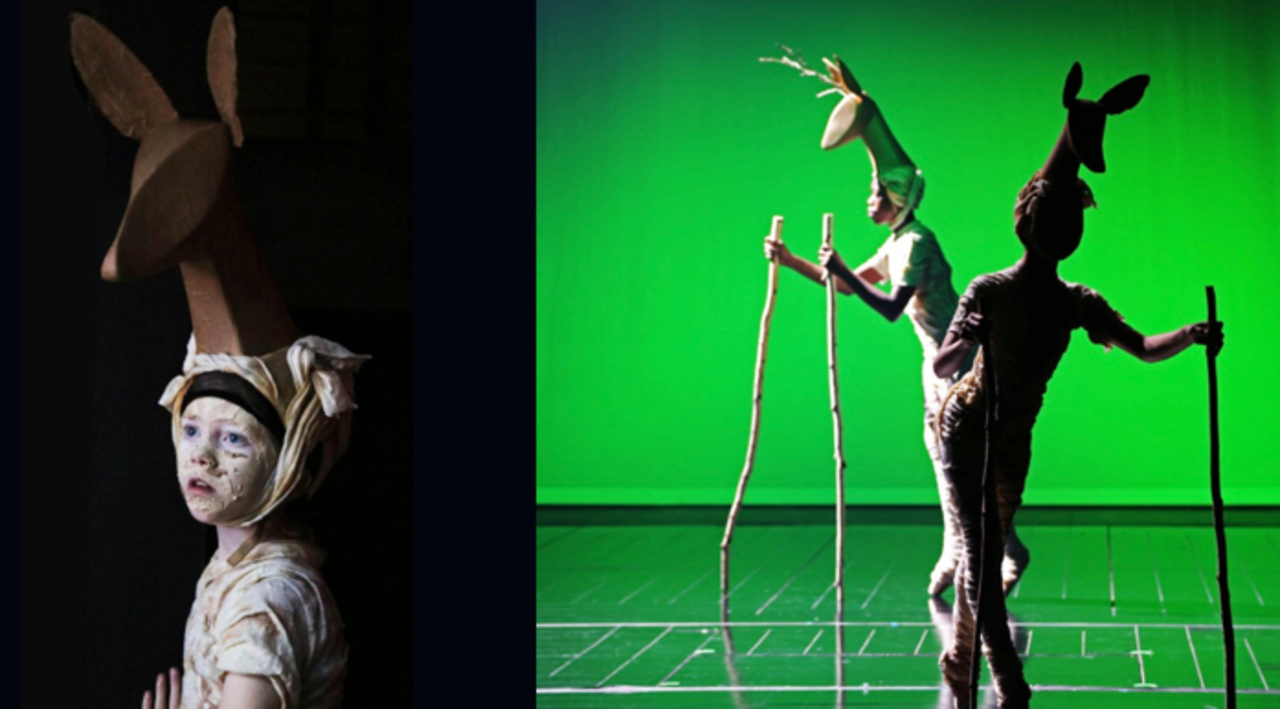
Another Tumblr I follow is the bizarrely named Glut and Decadencewho also posts some great photo sets of scenic design. These are for a production of  A Midsummer Night’s Dream, for Theatre For A New Audience (New York) directed by Julie Taymor (of Lion King fame) and designed by Es Devlin:

tumblr_mwdopiKaDu1s2pri8o1_1280

tumblr_mwdopiKaDu1s2pri8o4_1280

tumblr_mwdopiKaDu1s2pri8o6_1280

Uncut Debate

The Scotsman newspaper published an interesting article this week, Debating Political Theatre, written by Tiffany Jenkins, a cultural commentator. In it she suggests that even in an age of austerity and economic woe across much of the world, theatre has yet to respond in a robust and meaningful way. I don’t necessarily agree with her take, but it certainly gives pause for thought. 

Modern social drama has plenty of targets but is awash with complacency at a time when we badly need riotous debate, writes Tiffany Jenkins

POLITICAL theatre has a long and honourable tradition, reaching back to Ancient Greece when playwrights satirised the existing system to powerful effect. More recently, in the 1970s and 80s, political theatre was alive with attacks on……capitalism. At its best, it was vibrant and uncompromising. Most importantly, it had bite.

Today, over three years into the age of austerity, and political theatre appears to be in rude health. Its boom is suggested by the success of Theatre Uncut, formed in 2010 in response to public spending cuts and with the intention of encouraging debate and action. Leading playwrights have responded to this contemporary vehicle for short work made available for free for anyone to perform for a limited period. And they have done so in their thousands – so far, more than 3,000 people have staged these plays in more than 17 countries across four continents. This Saturday, there is a Mass Action Day where people will simultaneously stage seven new works written in response to the provocation: “Do we all get more right wing in hard times?”

There is a lot on show. Appearances, however, can be deceptive, because despite all this activity – the multiple productions, prizes, plaudits and the applause – there are limitations to political theatre today. These are in part due to certain inherent difficulties with it – it can easily veer into didactic agitprop, which is boring – but there are also more profound problems with the politics at the heart of the works, and the state of affairs that they inadvertently reveal. Taking a closer look at political theatre today – what is on offer, who it is for and what it says – and you find a complacent body of writing that flatters the audience and is devoid of critical thinking.

DSC_0388_web

Theatre Uncut aims to create a conversation about important everyday issues, a laudable purpose, but the work staged is very much a singular view of the world, and notably black and white. The objects of criticism and those who are to blame are cynical politicians, greedy capitalists and racists. One such play is Church Forced To Put Up Gates After Font Is Used As Wash Basin By Migrants, written by the comedian Mark Thomas. It’s about a right-wing newspaper owner who used to publish porn, who is obsessed with depicting immigrants as “shit”, the EU as “shit”, and the BBC as “shit”, and who thinks everyone who works for him is “f****** useless”. He is taken hostage by women in balaclavas who threaten to kill him unless he prints a pro-migration editorial.

If this work contributes anything to political debate, it’s cliché. Because we have heard this before – there is nothing surprising, complex, or nuanced in this play or the others it accompanies. Most of them are cartoon depictions of nasty right wing people and lovely lefties who think the right kind of thoughts. Frankly, most of the plays are just long rants. It is clearly assumed that audiences know better, and are thus reassured about their views and can go home contented having been congratulated. It’s all very safe.

The problem with the pantomime visions of what is effectively the opposition is that they just don’t ring true. I say this not as a right-wing newspaper owner or as a capitalist, but as someone who is interested in working out what is wrong today, and it’s really not as simple as how things are depicted in works such as Church Forced To Put Up Gates After Font Is Used As Wash Basin By Migrants – in which there is a lot of profanity but little insight.

Take another of the plays being performed this week, The Wing by Clara Brennan. One of Brennan’s main characters is Mick, a white working class bloke who reads The Sun (there is a repetitive theme in the plays which depicts tabloids as disgusting and their readers as scum), wraps himself in a “light blood-spattered St George’s flag” and who dislikes immigrants. His daughter, Kerry, is a right-on thinking woman who had had her picture taken for Page 3 in order to later reveal that at the very same time as she was getting her bits out, she was by then already pregnant by a “brown person”.

In The Wing, there is no attempt to persuade those that may not think or feel the same, and no attempt to understand people who do not agree. It also feels out of date, just repeating the politics of the 1980s and 1990s, refusing to address the present. And this is why is has no bite, no power: it doesn’t aim to win hearts or minds, and it doesn’t address the present with any urgency.

The political theatre of the past tried to influence, the political theatre of the present assumes things will never change. What The Wing also and unintentionally shows is the contempt some of these playwrights have for the white working class, the social group habitually blamed for everything, but who were once an important social force in politics.

Theatre-Uncut-007

There is nothing wrong with going to see a dramatisation of opinions with which you agree, but for the work to be effective, to have an impact, it needs to challenge those who come from shared outlooks and try to understand those that don’t. Indeed, some of the best work has done just this – John McGrath, founder of the Scottish popular 7:84 theatre company, is a case in point. McGrath always said that political theatre should avoid agitprop and confront the audience, make them feel uncomfortable and question their own positions.

Political theatre today should be a place of riotous debate. Even if the playwrights and producers are singing from the same hymn sheet – and they usually are – there is plenty to discuss and argue about. I am not advocating that people tear each other apart, but suggest that constructive questioning is needed in the cause of clarification.

If we do not take ourselves and audiences out of our comfort zones, and try and persuade others, political theatre will continue as a dampener to debate, a sedative rather than a spur to action. It is time to stop applauding and cheering. This sort of political theatre doesn’t deserve an encore.

TUheader

Now it is clear that Jenkins is taking particular aim at a movement called Theatre Uncut which was created in 2010

to encourage debate and galvanise action around political issues that affect all of our lives.

According to Lyn GardnerTheatre Uncut isn’t just a performance, it’s an idea: that theatre can be immediately responsive to world events, engender discussion and effect change. Founded in response to public service cuts (in the UK), it suggests that theatre has a part to play in the protest movements that are gathering pace across the world in response to economic downturn and events in Syria. The lead time between a play being written and actually being staged is often more than a year; Theatre Uncut, by contrast, is theatre’s rapid response unit. The plays are written speedily and given just one day of rehearsal: actors often have scripts in hand.

.

So far Theatre Uncut plays have been performed by over 3,000 people in 17 countries across 4 continents. Performances have happened everywhere from theatres in New York, community centres in Scotland, schools across England, universites in South Africa, on the streets in Spain, on public buses in Mexico, to village church halls in Wales.

Untitled 2_FotorPlaywrights have come from many countries – Syria, Spain, Argentina, Iceland, Greece, UK, USA, Egypt and so on. You can even obtain the plays free of charge for performance, as long as any profits are donated to charity. You can read a review of the latest Theatre Uncut performance, by Susannah Clapp here.

.

To me, this is how theatre of protest should be happening, and I think Jenkins’ is misguided in her notion that theatre is not causing riotous debate. Maybe it’s because it is just not happening in the way she would like. Mind you, the final paragraph of Clapp’s review above does say the following:

This is an evening of intermittent sizzle. It intrigues rather than ignites. The idea of the project itself is more political than any particular argument. There is no real answer to the question about getting more rightwing: how could there be without statistical evidence? There is no real anti-left persuasion. Neither are there any rallying cries: Gillian Slovo suggested in one post-show discussion that people no longer feel there is a political alternative. Yet the actors bring the flying-by-the-seat-of-their-pants concentration that the visionary enterprise needs.

.

I’d suggest you watch the three plays embedded here and make your own mind up.

.

The Business

Untitled_FotorI have just stumbled across the content for today’s post courtesy of a tweet from Lyn Gardner. It would seem there is an annual careers conference held in the UK, specifically for students who want a career in theatre, theatrecraft. It looks fantastic and really does cover all aspects of theatre making. Whilst it obviously focuses on working in the UK, the video page has a huge list of categories and links to videos that would be useful to anyone, anywhere, thinking of making their career a theatrical one. Take a look below, and click the title links for the relevant videos:

DIRECTING

Explore the role of a Director and what it takes to survive in the industry. Hear from professional Director Adam Spreadbury-Maher

MAKE-UP

See the character emerge — a demonstration of Stage Make up from experienced theatre make up artist Melanie Winning.

PRODUCING

Take a look at what is involved in producing a show and find out how to pursue a career as a producer from industry experts.

.

THEATRE DESIGN

With professional stage desinger Matt Edwards.

PROPS

An introduction to working in a props department for a major company

DESIGN AND MODEL BOXES

A chance to see how shows are developed from a design concept to a full size on stage production, with advice to those interested in pursuing a career in theatre design.

.

WRITING

Be introduced to the craft of playwriting and find out how to survive as a working playwright.

DIRECTING

What exactly do directors do? An introduction with professional Director Emma Rivlin.

MAKING MONEY…

A unique opportunity to hear how your technical skills can be utilised in the commercial sector.

DIRECTING COMEDY

A look at verbal and visual comedy, focusing on how understanding timing and where to direct the audience’s attention can benefit your ability to direct in every other genre.

BACKSTAGE TOURS

Take a peek behind the scenes at two major London theatres.

DIRECTING AND PRODUCING

We talk to some some top directors and producers about why they love their jobs and how they got there.

SPOTLIGHT ON TECHNICAL THEATRE

Exactly what goes on behind the scenes to make your favourite shows happen…

PLAYWRIGHTS

Leading writers talk about how they got to where they are and what it takes to write a play.

.

THEATRE MANAGEMENT

How to keep a major London theatre running smoothly and not go mad in the process.

MARKETING

The ins and outs of making sure people know about shows and want to see them.

TOP TIPS

A great collection of hints and tips from those in the know (or so they say…).

VIDEO DESIGN

An insight into the work of video designers and how their work contributes to live performance.

SOUND AND SET DESIGN

A fascinating look at the sound designer and set designer and how the two work together to create incredible atmospheres.

SET CONSTRUCTION

See some of the work that goes into building a major set – before it even gets to the theatre.

.

PRODUCTION MANAGEMENT

Amazing buhend the scenes access as we follow the production manager during a get-in at the London Coliseum.

STAGE DESIGN

An informative one-to-one explaining the role of the Stage Designer.

RUNNING A VENUE

Get the low down on running one of the biggest and busiest venues at the Edinburgh Fringe Festival.

COSTUME

A profile of Faye Fullerton – a leading costume designer.

ALTERNATIVES TO TRAINING

Theatre professionals talk about how they took different routes into the undustry.

ROUTES INTO THE INDUSTRY

Insights right from the top of the Theatre World – Nicholas Hytner spills the beans.

DON’T GO TO UNI!

The artistic director of the National Theatre puts forward a controversial point of view.

WORKING IN TECHNICAL THEATRE

Learn about how to “upskill” for this exciting but demanding profession.

.

SKILL UP!

What skills do you need for your chosen profession and where do you get them from?

UNIVERSITY

Do you need to go to University to get ahead in the theatre?

HOW DID I GET HERE?

Various theatre professionals explain the decisions, training and lucky coincidences that led them to their jobs.

APPRENTICESHIPS

A popular way to take your first steps in the industry

SPOTLIGHT ON WIGS AND PROPS

A brief introduction to the goings on in the wigs and props department of major theatres.

..

Playing With Words

This week I have been to see (with lots of students) A Clockwork Orange, an adaptation of the Anthony Burgess novella, staged by UK-based company, Action To The Word. Nothing unusual in that, of course, but it did raise a number of questions for me and my students. But before I go any further have a look as these two videos to put the post in context:

.

.

Firstly I should say that I did enjoy it. It was a great attempt to put something on stage that would otherwise be difficult to do, simply because the sheer level of ultra-violence and sexual violence in the narrative. Secondly, I have to say this as it has a bearing on what I am about to write, I was sitting in the gods (gallery) and had forgotten my glasses, so may have missed a few subtleties.

Clockwork Orange - Action to the Word

This production is an all male one. Single gender companies and casts are very much in vogue at the moment, allowing directors to explore narrative themes that are perhaps not foremost in an original work. In essence I have no problem with this – this is theatre at its most dynamic – theatre as a vehicle to reflect what is interesting to the director and company, and even as a mirror to contemporary societal shifts and passions. However, I was left wondering whether, when you stray away too far from a writer’s original intent, are you indeed putting on, in this case, A Clockwork Orange or a different play altogether.

In her programme/play bill notes, Alexandra Spencer-Jones, the plays director says

My company was rehearsing Romeo and Juliet [when] I decided to bring A Clockwork Orange to the stage……People think of R & J as a beautiful and tragic love story….for me it is much more than that….my main interest came into the role of Romeo ‘as a man’ upholding male responsibility when his friend Mercutio is killed and becoming (sadly) what he hates – a Montague fighter. With this in mind I spent much time concentrating on the fights and the role of testosterone in Shakespeare. Romeo – an angel with rage just under the skin. In the same actor who was in the role at the time, I found this storage balance – can the audience love someone they are scared of, sympathise with a villain – cry for him when he suffers. I was desperate to find out and A Clockwork Orange provided such a character and such a story to experiment.

Clockwork Orange - Action to the Word

It was from this concept, and the fact that I primarily direct men in the Shakespeare company, that I decided to workshop the piece as all male. Suddenly it was to a piece about women being objectified and raped, it was a piece about power and manipulation of all people, dictatorship and youth.

And I suppose this is what I saw this week. The narrative is indeed transformed, but into one that has blunt homoerotic overtones that don’t exist in Burgess’ original and therefore I have to question whether what we watched should still be ‘sold’ as A Clockwork Orange.

Clockwork Orange - Action to the WordAs I said earlier, I appreciated the piece and there were some excellent moments. But should a director be able to take way a central theme, such as the objectification of women, and claim they are staging the same play? I have subsequently had this conversation with some friends and students and we came to no real conclusion….seemingly just left with a nagging doubt that we had seen something other than that which we were expecting.

This also led to some self-examination on my part. As a theatre maker I like taking an original work and exploring certain themes in more depth while relegating others in terms of importance. A few years ago I staged a version of Lord of the Flies which did just this. I have never really thought about the proprietary nature of doing this as part of the creative process, but having experienced what I have this week, it has made question myself a little.

Another question that this particular production raised for me was whether, when one sees a physical theatre re-interpretation or re-imagining of a novel, is there a need to have read the original to make sense of the new work? Do you need to hold on to the depths and nuances of the novel in order to give depth and nuance to the new work? In this case, the reaction of my students would seem to indicate yes. Of course any adaptation from one form to another takes on this conundrum, whether it is from book to stage or screen, but it is a question worth considering I feel.

"A Clockwork Orange"

The other major question that was raised for me was one of venue choice. Here in Hong Kong, the piece was staged in the Lyric Theatre, a 1200 seater, traditional space. Thankfully we have a handful of new production companies in the city who are increasingly bringing in significant and worthy pieces. However, I was left feeling that the decision to put this particular production onto one of the two main stages we have in the city was a mistake. This was confirmed when I started to read the reviews of the original stagings in the UK. The venues there were small and intimate – 150 seaters or so.  This made sense of the reviews for me – you can read a couple here and here – where the critic had clearly had a very experience to my own. The intent behind the direction was clearly to create a piece of theatre that was visceral and arresting, but when you are sat a long way from the stage, this is lost – as it was for us. A shame, as I think, especially given that the audience in the stalls was sparse and the four international schools in attendance seemed to be crammed in to the gallery and balcony. This fact could of course lead to a whole new post about theatre pricing and the real value given by production companies to fostering the next generation of theatre goers…..but that one is for another day.

You Spin Me Right, Right Round

Before you read what I’m writing about today, take a minute to watch this video:

.

I often write about theatre and technology, but this is something else.  This amazing piece of mechanics creates illusion in a very different way. The following article, written by Nina Caplin in The Telegraph explains it all.

Inside the Olivier’s drum revolve

It’s the mechanical beast that allows the Olivier’s actors to be spun round invisibly – and to rise miraculously from the depths. But what’s it like being in the drum revolve’s jaws?

After World War II, when a National Theatre finally became more than an excellent idea that nobody wanted to pay for, the architect Denys Lasdun was appointed to design the new theatre on the South Bank. The company, under Laurence Olivier, was up and running by 1963 but their purpose-built home took rather longer, and the most revolutionary (in every sense) part of it took longer still. The Olivier Theatre’s drum revolve is an extraordinary, five-storey, computer-operated double lift contraption that enables the stage to be lowered through the floor and spun around.

The drum revolve in action, rising up with a cork screw action

The drum revolve in action, rising up with a cork screw action

And, because it’s split into two, operators can swap one half for the other without, in theory, the audience suspecting a thing. It is complicated, expensive and mechanically flawed, but it speaks of the kind of dramatic ambition a national theatre should have – and when it is cleverly used, the results can be amazing. The clever usage took a while, though. The entire building is wrapped around the drum’s contraption, or as Di Willmott, production manager on 2011’s Emperor & Galilean, puts it, “the whole mechanism is inside a big baked bean tin”. The two semicircular elevators, known as Red and Blue, weigh 25 tonnes each, plus 25 tonnes of counterweight. It must have been a brave actor prepared to rise up from the basement to the Olivier stage on a 100-foot lift operated by a 1970s computer.

The control panel and operator of the National Theatre's drum revolve

The control panel and operator of the National Theatre’s drum revolve

And in fact, even though the National Theatre building opened in 1976, it was 1988, and Dion Boucicault’s The Shaughraun, directed by Howard Davies with a set by William Dudley, that – in the words of then-Director of the NT Richard Eyre – made sense of the Olivier revolve for the first time. Shortly after it opened, Eyre met with Lasdun and told him that despite admiring the NT building and getting a thrill out its public spaces, he found the Olivier a difficult theatre to present plays in, “Which,” said Eyre, “I suppose is a bit like saying that you have a watering can that doesn’t hold water.” Lasdun called him a barbarian. Willmott took me backstage, during Emperor & Galilean, to see the beast in its lair. We descended seemingly endless steps, in the dark (well, Willmott had a torch), to find a lone man – show operator Simon Nott – shifting a series of levers in front of a screen. The raising and lowering and rotating is his job; everything must be in just the right place, so that doors line up for actors to enter and leave and scenery to be wheeled in or out. Everything should happen quietly, although until recently that wasn’t the case: ‘When it starts going around,’ said Nott, ‘you can’t hear yourself think.’ The metal tracks of the revolve weren’t quite perfectly round, and loud music was required to drown out the noise of its motion. But that, Sacha Milroy tells me now, has been fixed. Milroy was Production Manager on His Dark Materials, the vastly ambitious adaptation of Philip Pullman’s vastly ambitious trilogy; she is now, perhaps not coincidentally, PM of the entire theatre.

The National Theatre's drum revolve stage in action

The National Theatre’s drum revolve stage in action

Backstage, I stood at the base of the incredible golden gates from the Emperor and Galilean set and craned up. It’s all right this way, Willmott said, but the other way round is harder: ‘The first time you look down and see the floor 100ft away it’s very frightening. But now I’ve done it hundreds of times.’ Ben Wright, an actor in His Dark Materials, described feeling daunted by its size, but added: ‘It’s a great feeling when it’s moving, you’re going up 20ft into air then back down again.’ His co-star, Inika Leigh-Wright, was less robust: ‘You can hear everything going on above you and it sounds 20 times louder than it actually is and it’s quite scary.’

The view from inside the National Theatre's drum revolve

The view from inside the National Theatre’s drum revolve

As the actors floated up and down during that show, more prosaic work went on below: Milroy describes the 6-metre space that they lowered, re-dressed, exchanging furniture and snapping panels on and off, then raised as an entirely different room; critics talked of witches and bears on the stage’s upper regions and Oxford colleges rising from its lower depths. Even those who didn’t love the show marvelled at the design. As well they might: with the exception of Vienna’s Burgtheater, there is nothing like the drum revolve in Europe. So, why isn’t it used – and talked about – more? Partly, because it’s so expensive: ‘It eats money,’ says Milroy, ‘and it’s hard to get your head around – it’s quite cumbersome, so you need to understand the nuances and use it in a subtle way.’ Not easy with a contraption that weighs 100 tonnes. ‘An awful lot of designers are quite terrified of the logistics and the complications,’ says Milroy – and in fact Giles Cadle, who designed His Dark Materials, worked on the show for two years.

The drum revolve in action during 'War Horse'

The drum revolve in action during ‘War Horse’