The Dark Side

I have just been reading about a puppetry festival, taking place in England’s south-west. What took my interest, however, was that half the programming was specifically puppetry for an adult audience. The Bristol Festival of Puppetry – Exploring Different Worlds, has companies and performances from four continents and its programme for adults has a particularly dark feel about it – take a look here. One of the companies, Duda Paiva, looks fantastic. Brazilian born, Dutch resident Duda Paiva describes his work as a

lively cross-over of dance and objects in an exciting and original form of contemporary visual theatre.

Sounds fascinating, doesn’t it? Well, take a look at extracts from two of their pieces. The first is called Bastard!

.

And the second, Malediction

.

In connection with the festival, Rachel McNally, the organiser has given an interview to Regina Papachlimitzou from Exeunt, in which she talks about why puppetry has an enduring appeal, and why audiences have such a visceral response to puppetry: 

This is not a full answer, but it’s a partial answer: when you watch an actor perform, even though the performance can be brilliant, and they completely inhabit that character, you still are aware that there is a person behind that character, who is an actor, because you see their face and it’s so familiar. So, for example, if you see Tom Cruise in one movie and then you see him in another, you know it’s Tom Cruise performing and acting. Whereas a puppet is only that character. So you have to believe the puppet, that’s the only existence that puppet has, is to be that character and so if you’re prepared to believe in that puppet, in that character of the puppet, then you believe whole-heartedly in the story.

That’s a very transformative experience for an audience, because you allow yourself to buy in completely, and to be transported. There is an innocence to that which can take you to absolutely delightful places, but on the other hand you can go to some very dark places [as well]. Because you have to go with the puppet. There is obviously the performance that’s coming from the puppet but it’s then also what [you are] putting onto the puppet [yourself], because a puppet does not have facial muscles, so you read them slightly differently.

The other side of it is to do with the relationship between the puppeteer and the puppet. Increasingly in performances, you don’t see the puppeteer blacked out. You see the facial expressions of the puppeteer. Most puppeteers try to keep themselves relatively neutral, because they want the focus to be the puppet. There’s something joyful about seeing someone give that much attention and detail to create a life. Because the puppeteer is investing their own huge level of focus in a puppet, that gives you another reason to go along with the puppet.

.

The Wright Way

bruntwood_head_mid_res.jpg300x424.028268551Over the last year I have watched three plays emerge from the creative minds of two (now ex) students, on to the page and then on to the stage (or a toilet in one case). I was humbled by and astonished at their skill.  I’m a deviser of theatre by nature, a practical playwright if you wish. So to see them hone their skills through trial and error, draft and redraft was as much as a learning experience for me as it was for them.

There is lots of advice out there of course – a simple Google search tells you that – but I wonder where the line is drawn between a taught/learned skill and an innate talent. So I was delighted when I stumbled across this recording on The Open University by playwright Mark Ravenhill, talking about his craft and his approach to writing:

You can read the transcript of the recording by clicking here and then clicking the text tab.

Drama Online

And finally for this week a potentially groundbreaking new resource for theatre students and teachers called Drama Online. It says about itself:

Capture

Drama Online introduces new writers alongside the most iconic names in playwriting history, providing contextual and critical background through scholarly works and practical guides.

Currently it is in BETA development but there is already so much on there. To get to the plays, you will have to have a subscription, but a lot of the areas, such as the Playwrights & Practitioners and Genres pages are accessible to all users. If this continues to grow it will become a key resource for theatre students everywhere.

You Do What?

Can you describe what a dramaturge does? What is their role in the theatrical process? Well, it has been defined in a number of (sometimes conflicting) ways but it perhaps easiest to think about it as someone who deals with the research and development of plays, working alongside the director. But, there is no officially defined description and a the role of a dramaturge in one theatre company might differ quite significantly to one in another company.  One (Wikipeadia) definition says:

Dramaturgy is a comprehensive exploration of the context in which the play resides. The dramaturg is the resident expert on the physical, social, political, and economic milieus in which the action takes place, the psychological underpinnings of the characters, the various metaphorical expressions in the play of thematic concerns; as well as on the technical consideration of the play as a piece of writing: structure, rhythm, flow, even individual word choices

All clear now? No? Well have a read of this article written by Zoë Svendsen for T.H.E. Svendsen is a dramaturge and director, based in the UK, and here she explains how she understands the role by explaining work on a production of Christopher Marlowe’s Edward II, a play that is notoriously difficult to stage.

Zoë Svendsen on the dramaturge’s role at the heart of the action

The ‘creative consultant’ at work in the National Theatre’s new production of Christopher Marlowe’s Edward II

Zoë Svendsen

Zoë Svendsen

There is a huge crossover between academia and the theatre now,” says Zoë Svendsen. “When I left university, they felt like much more separate worlds…There is a very close relationship between my practice, my research and my teaching.”

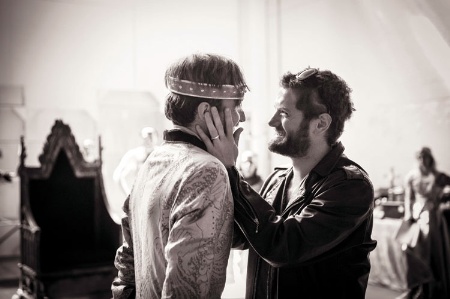
His grace and favourite: the National Theatre’s new Edward II presents a world in which the unthinkable becomes thinkable, says dramaturge Zoë Svendsen

His grace and favourite: the National Theatre’s new Edward II presents a world in which the unthinkable becomes thinkable, says dramaturge Zoë Svendsen

For some years a practice-based research fellow in drama and performance at the University of Cambridge, Svendsen next month takes on a new position at Cambridge as a lecturer in drama. She is director of a company called Metis Arts, which specialises in immersive and sometimes interactive performance projects addressing political themes. And she has worked as dramaturge on Joe Hill-Gibbins’ acclaimed 2012 Young Vic production of Thomas Middleton and William Rowley’s Jacobean tragedy,The Changeling, and now on his National Theatre production of Christopher Marlowe’s Edward II, which previews from this week. (A similar gig, in which Svendsen will work with the Royal Shakespeare Company on another Elizabethan drama, Arden of Faversham, follows next year.)

The role of dramaturge is far more established in continental Europe than in the UK, but Svendsen explains that it is essentially about “how the play functions in time and space – the production as a whole from a structural perspective, how the audience’s attention is held”.

While it remains the director’s job to steer the actors, she sits in on rehearsals and sees herself as a “sounding board, a creative consultant. We push ideas back and forth, trying to find out what the heart of the play is. I don’t like the term ‘outside eye’ – I’m absolutely embedded – but I can keep an eye on how one scene fits with other scenes, what the overall ambitions are.”

When it comes to her own projects and research, Svendsen has “long been interested in works which don’t conform to a kind of British empiricism in the staging, with a single time and a single location”. Her PhD looked at the Gate Theatre in Notting Hill and the production of plays from other cultures in London. And living and working in Berlin gave her a further “sense of the plethora of forms in which plays can be written”.

As a striking example of Svendsen’s own work, we might cite Metis Arts’ interactive multimedia production 3rd Ring Out, which Svendsen sees as having been “absolutely research-driven” and arising out of “a set of questions”. An earlier project about disused air-raid shelters and a decommissioned nuclear bunker in Cambridge led her and her collaborators to reflect on “Cold War exercises and the scenarios for many people across the country to play”.

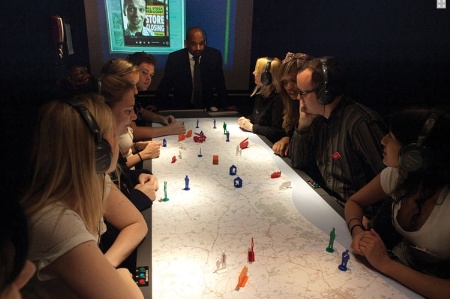
Doomsday scenarios: participants in Metis Arts’ interactive production 3rd Ring Out consider their options

Doomsday scenarios: participants in Metis Arts’ interactive production 3rd Ring Out consider their options

This led to the more general question of “What does it mean to practise for disaster?” and, since they “didn’t want to do re-enactment”, the search for a contemporary theme. When a visit to the Camp for Climate Action at Kingsnorth in Kent brought new urgency to Svendsen’s own concerns about the issue, it became the focus.

But this presented a dilemma, she recalls: “How do you make an effective performance about climate change? When you have theatre, which is about individual relationships, the short term and dramatic events, how do you avoid the trap of a kind of disaster porn, taking pleasure in the horror?”

To solve this problem, Svendsen and her co-director Simon Daw took two shipping containers around the country in 2010 and 2011. Inside, they constructed “an emergency planning cell” in which audiences of 12 sat at a table with headphones and a voting console. Amid an audiovisual simulation of a disaster scenario unfolding in their locality in 2033, they were invited to vote on the practical and ethical issues raised by heatwaves, food shortages and civil unrest. The question of whether to accept climate change refugees into the area proved particularly contentious.

But what had the creation of this powerful piece to do with productions of classic Elizabethan and Jacobean plays?

Svendsen believes that both draw on her central concern with how you hold audiences’ attention, and that her “sensibility for different kinds of formal structures” helped to forge “a distinctive way of looking at Renaissance dramas”. The key is “a deep commitment to the original text – which means expressing it as fully as possible in theatrical terms”.

When she and Hill-Gibbins began working on The Changeling, they were struck by its differences from most recent theatre: “A character says ‘We need to talk to so and so’ and there they are on stage – and there are no questions about how they got there. In Middleton, it’s all about what happens next, there’s very little back story. How characters interact with each other is absolutely about what they want at that immediate moment. There’s no continuous psychological through line. And that’s very different from what you find in ‘the grandfathers of modern drama’ such as Ibsen and Chekhov.”

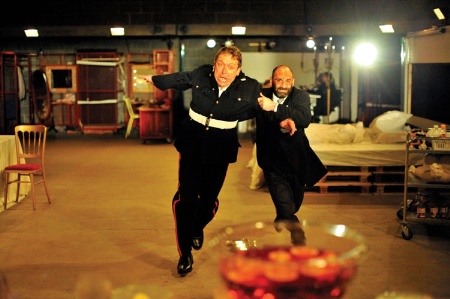
In tackling this challenge, they started off by cutting lines, reordering and amalgamating scenes – only to find themselves slowly working their way back to something close to the original text, albeit with greatly deepened understanding. The production, which featured a wedding scene staged with throbbing music by Beyoncé and a banquet where the actors get covered in food, was acclaimed by critics for its “lewdness and lunacy” and for “mak[ing] pervs of us all”.

Breaking with tradition: Joe Hill-Gibbins’ ‘iconoclastic’ production of The Changeling

Breaking with tradition: Joe Hill-Gibbins’ ‘iconoclastic’ production of The Changeling

“Reviewers talked about it as contemporary, Tarantino-esque and iconoclastic,” reflects Svendsen. “Actually all of that is in the play, but not necessarily brought out in today’s productions”, in which the British tradition of staging classics often puts the central stress on the text rather than the underlying structure.

Edward II may be best known for two key challenges it presents to directors: how openly erotic to make the relationship between the king and his “favourite”, Piers Gaveston; and how to stage Edward’s horrifying demise, impaled with a red-hot poker. (It also includes a great speech where the medieval equivalent of an academic is given trenchant advice on how he should “cast the scholar off”, give up his “velvet-caped cloak” and “learn to court it like a gentleman”: “You must be proud, bold, pleasant, resolute,/And now and then, stab, as occasion serves.”)

Without giving away any major secrets about a production still in rehearsal, Svendsen again flags up how different Edward II is from a contemporary play in its “accumulations and repetitions and things that seem to be a bit short-circuited” – and how exploring its structure had revealed its hidden depths.

“You need to allow the repetitions to become cumulative,” she suggests, “because repetition is what tells the story and allows Marlowe to comment on history. The characters don’t really change, but the situation changes, because what they conceive of as possible changes.

“Once the barons start threatening civil war and Gaveston’s exile, the rhetoric of threat becomes a capacity to act and those things become possible. The idea of deposing the king is unthinkable at the start of the play, but it’s interesting how quickly it becomes thinkable.”

In this, the play echoes Svendsen’s experience of working on 3rd Ring Out, where she and Daw considered the possible scenario of “putting the military on the streets” and then decided “no one would believe it was within the bounds of plausibility”.

“That was in 2010, but the next year the riots had erupted and the media were full of questions about whether the military should go on to the streets,” says Svendsen. “It had become thinkable as part of the national conversation. Pretty much everything we had imagined for 2033 did happen during the times we were performing.”

If you would like to hear more from Svendsen talking about dramaturgy, you can by clicking the link below, which will take you to an audio recording on Theatre Voicesof her talking about work on another classic play, The Changeling by Thomas Middleton and William Rowley.

Zoe Svendsen discusses The Changeling.

.

Words Are Louder Than Actions

All aspects of culture have their trends – art, music, architecture and so on – and theatre is no different. Current trends in theatre seem to be that of the immersive performance but also that of verbatim theatre (VT), which appears to be very popular at the moment across the globe. Essentially VT is a form of documentary theatre in which plays are created/written from the precise words spoken by people interviewed about a particular event or topic.

Perhaps one of the most famous pieces of VT is The Laramie Project which is a play by the Tectonic Theater Project about the reaction to the 1998 murder of a gay student in Laramie, Wyoming, in the US. The murder was denounced as a hate crime and brought attention to the lack of hate crimes laws in various US states. The play draws on hundreds of interviews conducted by the theatre company with inhabitants of the town, company members’ own journal entries, and published news reports. Arguably it is one of the most performed plays in The States. The company have just followed up the original with a new work called The Laramie Project: Ten Years Later which returns to Laramie to see how attitudes have changed in the intervening years.

.

There is a sense that VT is something new, but this is in fact mistaken. This kind of theatre has been around since the early 20th Century, one of the pioneers being Erwin Piscator and his living newspapers. In Drama Online Dr Tom Cantrell, Lecturer in Drama, University of York, gives a great outline and history of VT

Verbatim theatre is a form of documentary theatre which is based on the spoken words of real people. In its strictest form, verbatim theatre-makers use real people’s words exclusively, and take this testimony from recorded interviews. However, the form is more malleable than this, and writers have frequently combined interview material with invented scenes, or used reported and remembered speech rather than recorded testimony. There is an overlap between verbatim theatre and documentary theatre, and other kinds of fact-based drama, such as testimonial theatre (in which an individual works with a writer to tell their own story) and tribunal theatre (edited from court transcripts). In the United Kingdom, the term ‘verbatim’ specifically relates to the use of spoken testimony, whereas ‘documentary’ encompasses other found sources, such as newspaper articles, diaries and letters. However, in America ‘verbatim’ is not used, with ‘documentary’ being the preferred term. When looking for verbatim playtexts, the reader will often find them conflated with other documentary forms.

words

Documentary theatre has a rich heritage in comparison to the relative infancy of verbatim theatre. Erwin Piscator’s Trotz alledem! (In Spite of Everything! Berlin, 1925) is widely acknowledged as the first stage documentary. The play was a revue about the Communist Party and Piscator utilised new technologies which included creating montages using projected newsreel footage. Trotz alledem!also featured recorded speeches, news-extracts, photographs and film sequences from the First World War. Piscator went on to direct some of the most respected German documentary plays such as Rolf Hochhuth’s Der Stellvertreter (The Representative, known in America as The Deputy), which premiered in West Berlin in 1963, Heinar Kipphardt’s In the Matter of J. Robert Oppenheimer (1964), and Peter Weiss’s The Investigation (1965). These German documentary productions had a great influence on British documentary theatre, particularly the work of Joan Littlewood. Her production, Oh What a Lovely War! chronicled the First World War through songs and documents of the period. Its importance was immediately recognised, with the production hailed by the Observer as ‘The most important theatrical event of the decade’.

The development of verbatim theatre, rather like Piscator’s use of new film projection technologies, is closely linked to a simple technological development – the invention of the portable cassette recorder. This enabled the voices of individuals to be recorded in their own environment. Mobile interviews could take place which extended the dramatic possibilities of verbatim theatre. The first verbatim productions were directed by Peter Cheeseman who was artistic director of the Victoria Theatre, Stoke-on-Trent from 1962 – 1984. Cheeseman’s verbatim work at Stoke was not only influenced by the left-wing documentary theatre of Joan Littlewood, but also by the radio documentary tradition, particularly the radio ballads of Charles Parker. Central to Parker’s work was the prominence of working class voices in the broadcasts. One of Cheeseman’s most notable productions, which can be regarded the first verbatim play, was Fight for Shelton Bar (1974), which was part of a campaign fighting against the closure of a major steelworks in the heart of Stoke, and was performed in the city to an audience of many of the ex-workers.

Over the past two decades verbatim theatre has come to occupy a central place on the British stage, and is seen as one of the most incisive forms of political theatre. It has moved from the fringes to the mainstream, with some of the highest profile theatres staging verbatim plays. Particularly noteworthy exponents of the form include David Hare, whose verbatim (or at least part-verbatim) plays The Permanent Way (2003), Stuff Happens (2004) andThe Power of Yes (2009) were all performed at the National Theatre; director Max Stafford-Clark and writer Robin Soans, who have collaborated on A State Affair (2000), Talking to Terrorists (2005) andMixed Up North (2009); and in particular the campaigning work of director Nicholas Kent and theGuardian journalist Richard Norton Taylor at the Tricycle Theatre in Kilburn, North London. Kent and Norton-Taylor’s work has included a series of tribunal plays, including Nuremberg (1996), Bloody Sunday (2005), and perhaps their most successful production: The Colour of Justice: The Stephen Lawrence Enquiry (1999). All these were edited scenes from court cases. Kent has also collaborated with Gillian Slovo on Guantanamo: ‘Honour Bound to Defend Freedom’ (with Victoria Brittain, 2004) and most recently on The Riots (2011), which was the first theatrical response to the riots in the summer of 2011.

Verbatim theatre has arisen as the medium chosen to depict major societal issues. For example, army deaths in Philip Ralph’s Deep Cut (2008) and Fiona Evans’s Geoff Dead: Disco for Sale (2008); prostitution in Esther Wilson’s Unprotected (2006), Alecky Blythe’s The Girlfriend Experience (2008); murder in Tanika Gupta’s Gladiator Games (2005) and London Road (2012) and perhaps most predominantly, a surge of work on the continuing issue of the war in Iraq: Norton-Taylor’s Justifying War (2003), Called to Account (2007) and Tactical Questioning (2011), Gregory Burke’s Black Watch(2007) and Steve Gilroy’s The Motherland (2008).

Verbatim theatre has also proliferated internationally. Interested readers should explore American plays such as Moises Kaufman’s Gross Indecency: The Three Trials of Oscar Wilde (1997) and in particularThe Laramie Project (2000) and The Laramie Project Ten Years Later (2009). Anna Deavere Smith is also one of the most high profile documentary makers. Her work includes Building Bridges, Not Walls(1985) and Fires in the Mirror (1992). Similarly important is Jessica Blank and Erik Jensen’s celebrated play The Exonerated (2002), composed of interviews with individuals who have been released from death row. Australia has also experienced a boom in verbatim productions. The first verbatim production was Paul Brown’sAftershocks (1993), featuring interviews in the aftermath of the devastating Newcastle earthquake. Works by Alana Valentine including Run Rabbit Run(2004) and Parramatta Girls (2007) have also raised the profile of Australian verbatim theatre.

VT should be powerful and is obviously all about theatre that provokes, informs and seeks social and cultural change. Michael Billington wrote an article for The Guardian that also talks about its current popularity and you can read that here.

In an article for ideastap, playwright Alecky Blythe outlines her process:

I start with either an interesting event, or interesting character. That might be a story that I read in the paper or it might be an ongoing story, like women bishops. Then I’ll take myself off to interview people in a very journalistic way.

You have to be quite upfront from the beginning. Even if you don’t know where your project will end up – if it’ll even get used – you need to let people know that you’re going to record them and that an actor might portray them on stage. And you have to get their permission to do that.

Some people have said ‘no’. You have to judge if that really is a ‘no’ or if you just haven’t explained yourself properly. If it’s a matter of them being identifiable, I will go into how I can make them anonymous….

anonymous icon

Some people have both [of the] things you’re looking for: interesting characters and the potential to be developed narratively. Some people are brilliant, likeable and accessible straight away, but they might not have much forward story; all their best stories have already happened to them. The best verbatim theatre is as much present tense as possible – it’s about capturing things as they happen.

Of course you’re looking for emotional effect, but at other points in the story you’ll be looking for plot and facts, which means asking slightly dry questions – where they are, what they’re doing, who they’re waiting for etc. Those things are key to the highs and lows of the story.

Legally I don’t know whether it’s different to journalism. If someone says something that is highly contentious, as I am finalising the edit I’ll also go over exactly what they said with them. I want to check they remember, in case it could lead to any kind of back lash for them, and that they are ok with that. Some people say things in the heat of the moment that they might forget; sometimes the show is produced at least a year after they said it.

I don’t transcribe anything. I make a first edit, and of that edit I’ll log the timecode and who said what. That means that further down the line I can pick up specific moments – someone talking about sunglasses, for instance – by reading back through my notes rather than listening to 15 hours of recording.

I don’t write any lines; I give the actors the audio recordings. Although on the first day of rehearsal they get a running order; the names of the characters, titles of the tracks and who’s playing what part…..

…One of the strengths of verbatim is the sort of rich text you just couldn’t make up. So if you’re doing a verbatim play, put some of those quotes on the flyer or poster. It can just be a tiny soundbite.

I’ve always gone out and followed stories before anybody’s put any money on the table. That’s still the case. Even if a company says they want to work with you, by the time the paperwork’s gone through and the contract is signed, you might have missed a month’s worth of collecting material. Sometimes you are living on a breadline and taking gambles. But luckily my process isn’t too expensive – apart from the initial cost of a dictaphone, it’s just batteries and travel.

The popularity of VT is wide and I share two examples here that give you an idea about its power – Home, about life in a hostel for young homeless people in London and My Name is Rachel Corrie a play based on the diaries and emails of Rachel Corrie, an American student who was killed while protesting against the destruction of a house by the Israeli Defence Force in the Gaza Strip in 2003.

.

I should say (and proudly) that Shannon Murphy is an ex student of mine.

And finally a great article from Australian Writers Guild Magazine, by playwright Alana Valentine titled The tune of the spoken voice.

Riding High

Today’s post is born out of one those moments of revelation when you think ‘how did I miss that? How can I not have heard of that’.  I am writing about the Bamana giant body puppets of Mali. If you have never heard of this tradition it is well worth looking at, because when I say big, I mean BIG!

screen-shot-2013-03-13-at-12-47-05-pm

I need to point out at this stage that in the Bambara language the same word is used for both ‘mask’ and ‘puppet’, since both serve the same function: to enable mythical and supernatural beings to be brought to life by hidden performers. I got a little confused at first, but I like the idea that there is no distinction between the two .

.

Below is a brief background, courtesy of Museum of African Art in New York, but first I suggest you watch this.  The narration is in French (Mali was a French colony until 1960) and very accessible even with my poor school-boy ear.

.

At Arm’s Length: The Art of African Puppetry

The art of Malian puppet theatre, the Sogo bo (the animals come forth), practiced by the Bamana of Mali and originated by the fishing community of Bozo, dates back to pre-colonial Mali. Sogo bo, a performance of puppet and mask dances, tells stories of Malian tradition, imparting valuable lessons in morality while entertaining the audience.

Within the Sogo bo performance animals of the bush are paramount.The Bamana describe themselves as cultivators and hunting people, and it is therefore animals from the bush that predominate. The animal characters represent far more than their counterparts in the bush. They are the symbols, the tangible manifestation of the essential force of the animal. They are the imperial majesty of the buffalo or the conniving duplicity of the hare. The qualities are implied through the costume and the dance of the masker. The buffalo masker regally marches about, and the youthful spark of the hare can be seen in its quick, vigorous movements. The antelope can be seen striding grace-fully, and the baboon jumps about with vigor.

warel508370_540h450w

The Sogo bo masquerades are organized by the village youth associations, the kamalen- ton, and the subject matter most commonly dealt with is hunting and heroic behavior. The youth associations, in essence, own the masquerades. They organize the activities of the night, and it is their stories that the masquerades tell. Weeks prior to the fete, the youth organizations meet frequently, planning and choreographing the events of the masquer- ades. The youths of the kamalen-ton choose the cast of characters, the costumes, the stories, and the masks that will be used. They may choose to bring out and refurbish used masks or create new ones. Their mothers, wives, and sisters provide the textiles neces- sary for the costumes. Once the major planning is completed, the youth organizations split into smaller groups and work on the particular renovation or construction projects assigned to them. Throughout this process, the older men act as consultants, offering advice on the construction of the more intricate puppets.

The puppet masks of the Sogo bo are generally worn over the bodies of the performers (usually two men). The performer(s), surrounded by the wooden frame of their puppet masks, are hidden from view by straw and cloth which cover the frame.The head of the puppet is manipulatable , and from within, the performers move the puppet about in dance.

3947215898_e7764f17d6_o

The Sogo bo performance takes place at night, and can carry on well into the early morning hours, consisting of more than twenty sets of dances. Called to the dance by the beat of the drums, the maskers, either individually or in small groups, dance in character. The large and powerful beasts lumber about slowly, majestically (the more powerful ones come out towards the end of the night), while the energy and spark of youth can be seen in the dance of the smaller animals. Each dance set lasts only five to ten minutes, and in between, the women’s chorus provide song (praise songs for the animals). The chorus, however, does not perform during the dance sets, the sets are without voice. It is the masks, the movement of the maskers, and the beat of the drums that tell the story.Untitled_Fotor

Malian puppetry features maaniw, “little people” or puppets in human form. They range in size, from small hand-held rod puppets to almost 6-foot tall figures. Maaniw play an important role in initiation ceremonies and often appear at nighttime on the backs of kalaka (small stages in the form of a body). They often speak of the individual’s place in society and teach morals.

Though there are certain tenets that are retained in the storytelling, it is by no means a static tradition. Puppet plays that were once held only on specified days are now held on weekends, to accommodate the schedule of those who have left the village to make a living in bigger cities. Modern issues are dealt with, and the plays continue to reflect the lives and times of the Bamana.

.

1244916533630_FotorThen I read about Yaya Coulibaly, 7th generation descendant of Mamari Biton Coulibaly (King of Segou region of Mali) who is the director of the Sogolon Puppet Troupe. After training at the National Institute of Arts in Bamako, Mali,  and l’Institute International de la Marionette in France he mastered the traditional Malian arts of puppetry.  It would seem he doesn’t rest with tradition either. Malian puppet performances are traditionally voiceless, but Yaya has chosen to integrate voice and performance. I realised I had heard of him before and then I remembered he had worked with Handspring Puppet Company, the people who created the horse puppets for War HorseThey collaborated on a piece call Tall Horse which blended two puppetry traditions: the Handspring work which is based in lifelike realism and the stylised, ritual rtallhorsebased puppetry of West Africa. The play’s narrative is of  a giraffe and its handler, Atir, sent as a gift from the Egyptian Pasha to the French King Charles X in 1827. Its journey took it via Alexandria and Marseilles, creating a sensation en route. Tall Horse premiered in Cape Town and then went on to tour the world. This blending of styles really appeals to me. I would have loved to have seen the play.

Many of you reading this will know of ISTA – the International Schools Theatre Association and they published a great article a few years ago by Laurie-Carroll Bérubé about her staging of Tall Horse which you can read here, Malian puppetry traditions.

Changing tack slight, as part of my research I came across this fascinating recording of Basil Jones and Adrian Kohler (Handspring’s founders) and others, talking about puppetry as a contemporary medium of communication and influence. Puppets and politics – fantastic! You will need a couple of hours, but it is really, really interesting and worthwhile.

.

I’ll finish with a few useful facts about Malian puppetry, taken from Bérubé’s article:

Boliw is the raw spiritual energy/ power contained within performance objects such as masks and puppets. It is believed that women possess boliw – because of their ability to give birth.

Castalet: the large body-puppet, which represents a gentle mythical beast. The body of the animal is a cloth and raffia-covered frame which conceals the puppeteer inside who dances, making the raffia skirt sway.

Merens habitables are the long- necked female characters of traditional Malian performance. Merens habitables are manipulated only by men and post-menopausal women because only they are able to control the boliw contained within the puppet.

Sogo Baw or Sogow (Big Beasts): these are large body-puppets (roughly 2 m long, 1.5 m high), generally representing bush, savannah or domesticated animals. Sogo baw can resemble mobile puppet theatres with small puppets on the larger animal’s back, manipulated from within.

Sogo Bo: the annual masquerade (the Animals come forth) held in June, just before the rains come to Mali’s Segou region

Critics In & Jury Out

So the previews are over and the critics have been in to see Punchdrunk’s The Drowned Man: A Hollywood Fable. Now the fact that I am 9,500km away negates me seeing it so I have been avidly immersing myself (pun entirely intended) in the press and blogosphere.

It would seem the jury is out.  The theatrical event of the summer or the most over-hyped show of the year (lets not forget that promotional interviews and teasers were out in March)?

I will share one thing with you and give you the links to the rest. Make your own mind up. Here is a conversation between Natasha Tripney, William Drew, Stewart Pringle and Lauren Mooney that was published in Exeunt yesterday.

The Drowned Man: Playing the Game

Natasha Tripney: There were several moments during The Drowned Man where I felt as if I was in my own private movie. The soundtrack helped I think, – the Shangri-Las’ ‘Remember’ plays in my head often enough anyway – those finger clicks kicking in as I opened a door. The lighting, crepuscular, twilit, also played a part as I picked my way through an indoor glade, the ground underfoot loamy, or found myself in a diner, all Formica and bourbon and bubble gum, James Ellroy, Carson McCullers and Edward Hopper. I loved that. I could have played there all day.

Compared to their last major London show – The Masque of the Red Death at BAC, which is the only other Punchdrunk piece I’ve experienced (I missed Faust, sadly) – I got a lot out ofThe Drowned Man. I saw more action, so to speak, followed a couple of characters around (though didn’t find their arcs compelling enough to stick with them for too long), had my hand-held and my face stroked by a sequin-bedecked woman in a Red Room. Beautiful as the design was, I found Masque a hugely frustrating experience. I spent so much of my time in there, standing in glorious but empty spaces, arriving at scenes just as they’d finished and the one time I was in the ‘right’ place at the ‘right’ time I clearly stood in the wrong ‘place’ and got (quite roughly) elbowed out of the way by one of the performers. This didn’t really endear me towards them as a company.

Punchdrunk-Photo-Pari-600x287

So despite the oven-like temperatures, I enjoyed a lot about the experience. Some of the design was truly spectacular – I particularly liked the shrines and the scarecrows – the level of detail was delicious and for the first time I can grasp why people might become frequent fliers, returning multiple times. I think it was Ian Shuttleworth who said, when discussingMasque, that in order to get the most out of it you have to be good at following cues, chasing voices. I struggled with that in Masque, but I guess here I played the game better. It’s just a shame it took one deeply frustrating experience for me to figure out how to do that. Had I paid the best part of £50 in order to learn those lessons, I’m pretty sure I wouldn’t feel quite so warmly towards it.

Stewart Pringle: Though I have some severe reservations on it as a piece of theatre, I had a pretty awesome time wandering around Temple Studios. I found the attention to detail just as arresting as I had in Masque, and the scale and scope even more breathtaking. I’ve read a few of the early blog reviews and I find it genuinely surprised that experiences like walking through a forest filled with camper-vans, sifting through the detritus of failed relationships in seedy hotel rooms and wandering through the back-lot Beamish of the street scene have been written off as if the show was just a few hours plodding around a dingy warehouse.

I saw far more action and far more actors than I did in Masque, but in a way I think that took me out of the experience rather than enhanced my immersion. Because the actors interact with the audience so rarely, and because I find the dancey stylings of Maxine Doyle so insufficient and unengaging, I had far more fun when I was exploring on my own. There was a bunch of letters in the sort of broken down house area that I read through in their entirety, tracing a relationship from first wobble to total collapse, and I found the experience far more moving than any amount of repetitive interpretive dance.

I’m with Tash on the soundtrack, too. In the main I found it really enhanced the atmosphere, even if its repetitions eventually began to blur everything into a single tone. Because it essentially cycled around, or seemed to, it added to the creeping sense of dramatic stasis that built towards the final hour. Its lack of syncronicity with the action of individual scenes also created the occasional daft moment, such as finding I myself watching a man putting his trousers on in the back-room of a seamstresses to soaring, cinematic strings. They were very nice trousers, I suppose.
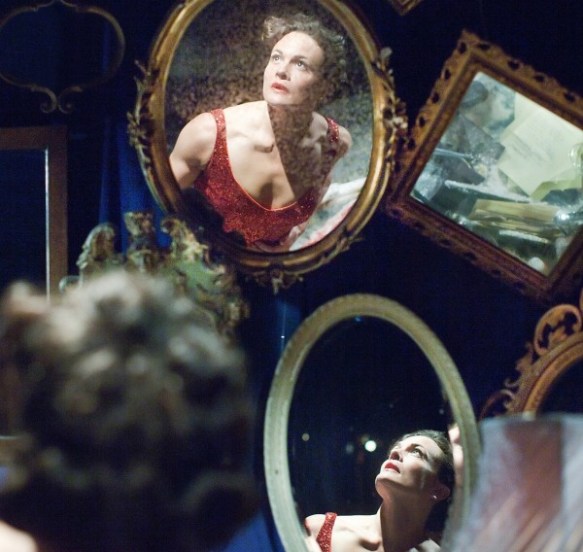
Punchdrunk-3-Photo-Pari-600x568

William Drew: So I find the idea of “playing the game” of a Punchdrunk show really interesting. My interpretation of this, which may not be what you meant, Tasha, is how an audience member makes sense of all the stimuli they fill their shows with, so they weave together a narrative for themselves. Bearing in mind, the world does not react to you, in the sense of your actions affecting outcomes, I can see two ways you can do this. The first is to explore the environment, looking for letters, imagining what was there before, finding the space in the absences for your own imagination; the other is to look for performers, to watch them and to follow them through a space. Let’s call the first exploration and the second active spectatorship (while recognising the extent to which it is “active” might be problematic but that’ll do for now). From what I understand, Stewart preferred the exploration so actually found the number of opportunities for active spectatorship unhelpful, at best, and an irritant, at worst. Tasha, on the other hand, you seem to have attempting to engage with bothMasque and Drowned Man as an active spectator and this is something that you feel you “failed” at with Masque but did more successfully in Drowned Man.

It seemed to me that Drowned Man was heavily weighted towards active spectatorship. Perhaps there were more actors or maybe it was simply the case that people know to “play the game” of a Punchdrunk show better by now so you get what amounts to a fairly respectable fringe audience in dogged pursuit of almost every performer. Like Stewart, my favourite moments were the ones where I could be alone exploring the world that the company have created. There were still treasures to be found in doing that. My favourite moment of theDrowned Man was where I sat on the one free chair in an audience of scarecrows. The impression that I was on a film set meant that I was able to suspend my disbelief for long enough to feel as if the “man” in front of me might turn around any second. That was thrilling. Generally though, I didn’t find there were as many pay-offs from exploring as there were in Faust and this leads me back to the possibility that the weighting is built into this show by the company in response to how most audiences want to behave within the environment. They are “failing” fewer people who want to play in that way by making it easier to “play the game” successfully but, in doing so, are they losing a little of the openness that was part of the appeal of their earlier work?

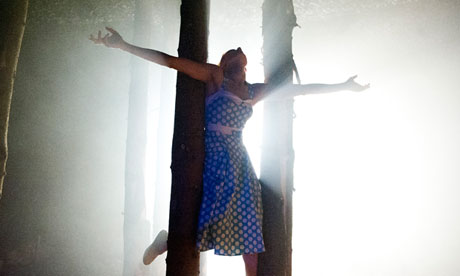
Punchdrunk: Sophie Bortolussi in The Drowned Man

Natasha Tripney: That’s really interesting. I hadn’t thought of it in quite those terms. Looking back on it now, my favourite moments of Drowned Man were actually ones of exploration – finding intricate origami flowers in a series of filing drawer or discovering a hidden shrine made of delicate curls of cassette tape. Even my lovely Shangri-Las moment was one in which I was alone in a space. I found Doyle’s choreographic style – all that sweaty sexual intensity – very samey after a while and not particular engaging and, as you said, Stew, far too reliant on archetype. I felt no need to pursue any one performer for long, though I gather this is an approach which lots of people favour. I think what worked for me here was the ratio between the exploratory/active elements and maybe the fact that I didn’t put pressure on myself to chase the action or attempt to piece a plot together as I did inMasque and therefore was far better able to enjoy what I was experiencing rather than fret about what I wasn’t. I think that’s what I meant by playing the game.

Lauren Mooney: This was my first Punchdrunk, Tasha, and I found all the things you said about the unsatisfactory nature of your Masque experience really familiar. Basically, it does seem like there are two ways to approach a show like this – following the actors or exploring the world. Not having done anything like this before, I found myself a little paralysed by indecision, and so didn’t have a fully satisfactory experience of either.

As I think most of us have said, I was completely blown away by the level of detail and the sheer SIZE of the thing; I’d spoken to a couple of people about what to expect, but nothing, really, could have prepared me for it. There was a kind of dream logic to the whole place that I found genuinely disturbing – I can’t put my finger on it, it was just an atmosphere, something perhaps to do with not being able to hear the actors when they spoke and being able to, to some extent, do what you wanted (go through people’s papers, letters, diaries) in a way that would be impossible or sociopathic in real life.

That and the music creeped me out all the way from the top of my spine to the bottom, and made my wandering experiences less adventurous than they should have been. When I was alone in the basement and found a cell full of small blocks, I had a powerful sense that the door was going to shut behind me, and wanted to be back in the safety of a crowd; when I was in a crowd, I wanted to be back on my own again, experiencing that waking-dream sensation.

Punchdrunk-2-Photo-by-Pari-600x389

My instinct to follow the actors and scenes was almost entirely, I think, for me, the wrong one – but it took me a long time to realise that most of the scenes were similar, repetitive, plot-light… Too long really, as by the time I’d given up on them and dug into some proper exploring, it was time for the finale. I basically expected there to be more plot than there was? So I was constantly chasing other scenes, thinking I was missing something, that some important brilliant theatre was happening in another room just outside my reach – when of course it wasn’t.

This is why I agree with Stew’s comment that it isn’t maybe good theatre so much as an amazing experience. The things I liked about it, and I liked lots in spite of a few reservations, weren’t things I can recognise as being connected in any way to theatre, the way a beautiful script or a brilliant performance can move you – it was a different sensation being evoked completely differently. It was the mood in the place that I found most effective, partly thanks to the music and partly, I must say, the masks. I know they’re controversial and uncomfortable, and I wear glasses so I had them squished onto my face a bit, but bloody hell, for me they were so effective. It made the audience look like part of the set design, for one thing, when seeing someone pulling a face at an inopportune moment might really take you out of it. (I have a lot of thoughts on this but actually, as I’m the only person new to Punchdrunk, I imagine everyone else is so Over the masks…)

So having said all this, I completely buy into the idea of revisits – I enjoyed my experience but it was quite unsatisfactory, and only gets more so the more I talk to other people – which brings me to pricing, something Stew talks about in more depth in his review. Isn’t there a way they could, for instance, charge far less for a return visit? If I’d paid £40 for that I would’ve been so cross, because I felt like I did it all wrong; I think the ticket costs are extortionate in general but doubly so because, as has been said, a single visit can be so frustrating. If they MUST charge such a lot, can’t they at least have an option of, you know, paying £10, £15 for a return visit…? I don’t know.

Having said all that, a friend of mine who also went to The Drowned Man is a gamer and his experience of things was very different to mine…

William Drew: There are some connections with videogames, yes, but there are also very significant differences in that the piece is no way interactive. It is a cliché of lazy videogame narratives to use letters lying around to fill in backstory for those of us for whom that matters. Going back to my previous categorisations of the way to experience a Punchdrunk show, I am drawing partly on Bartle’s gamer psychology. One of the categories of gamer types is the Explorer. These kinds of things are littered throughout videogame worlds to appeal to Explorer types. Other types, such as the Killer, will ignore them because they, you know, want to kill people (frowned upon in a Punchdrunk show, I understand, almost as much as talking).

Similarly, you might see a couple of NPCs (Non-Player Characters) arguing about something in a videogame. That argument is likely to be significant, possibly not to the main narrative, but could generate a quest you might want to embark on or the information contained within it might be relevant to another quest. I’m talking principally about the RPG genre because they tend to be more open world. In an adventure game, things are more linear and that makes it easy for everything to be relevant. What the environment tends to provide in both of these genres of games though is exposition and this is essentially all that Punchdrunk are giving us here. I don’t necessarily mean this as a criticism but I think it’s important to point out the ways in which The Drowned Man is as unlike a game as it is a piece of traditional theatre. I think a serious gamer who went there expecting a game would be as disappointed/confused as a hardcore theatregoer who went expecting some theatre.

Punchdrunk woman

Lauren Mooney: William – I very much agree, though the thing I meant about the difference in our experiences was actually less of a comment on the action than on our reactions to it. Oddly, I bought into the reality of the world almost too much – I rarely read the letters or looked through the drawers, so convinced was I in the bloody silly fibre of my being that this was wrong – or if not wrong, certainly something I risked being caught in the middle of and shouted at for!

Whereas my friend, Liam, who creates and designs games, had no such qualms and riffled away to his heart’s content. He even told me he regretted not trying on the clothes in the costume rooms – trying them on, which would NEVER have occurred to me in a MILLION YEARS.

I do think being predisposed to it by gaming might make you better at ‘playing’ a Punchdrunk show, but no, it certainly is nothing like actual gaming. Several people I’ve spoken to, in fact, said they would have liked to be given some kind of task, a thing to achieve or attain – whereas the show as it stands is essentially the opposite of this, telling people to ‘just go and mill about’. Visitors risk being paralysed by choice and ending up like me, waddling about lost and peering in through windows, looking for the party…

I think you’re right when you say that as either a gaming or a purely theatrical experience,The Drowned Man absolutely disappoints. Though I was hugely excited about the whole thing for a few hours after I left, just because it was so mad and huge and beautiful to look at, that sensation seems to fade hugely the further I get from it. It really does seem to me that most of the things I enjoyed most were general Punchdrunk things, not specific to this show, that I loved because they were new to me – and so ultimately, it does kind of seem like Punchdrunk have a set bag of tricks they wheel out every time, that only really impress the first time you see them. Apart from this, the quality of your experience is characterised by how well you play the game and…luck.

And the critics said:

Paul Taylor in The Independent:  For all its logistical flair the show is lacking in heart

Charles Spencer in The Telegraph: The masters of immersive theatre have returned with a show that will surely become a cult hit

Michael Billington in The Guardian: The choice of location is inspired

Sam Marlow, The Arts Desk: In their new show set in a seedy Hollywood outpost, Punchdrunk’s theatrical magic loses some of its allure

And in her blog for the Guardian, Lyn Gardner asks Does Punchdrunk’s The Drowned Man live up to the hype?

.

The Show Must Go On

We’ve all been there – props not in place, mics failing, even scenery falling over. I remember being a lighting operator on a show set in a women’s toilet, where half the cubicles collapsed mid-performance! Things do go wrong in theatre all the time.

_51633161_51633147

In this episode from the BBC’s Essay series, artistic director Josie Rourke talks about why working in theatre isn’t always plain sailing; what happens when disaster strikes and things go wrong. She explores mistakes of many kinds, not just the obvious ones that make an audience laugh, but the deeper rooted ones that start in the rehearsal room. Real food for thought!

Essay: On Directing – Josie Rourke

On a more frivolous note, recently in a newly opened production of Charlie and the Chocolate Factory the glass elevator got stuck just before the finale, leaving actors stuck in mid-air. The show was halted for 6 minutes while the problem was solved and apparently the apologetic stage manager received a round of applause from the audience. This prompted Lyn Gardner to write in her Guardian blog a piece entitled

Prop flops: why I love it when things go wrong on stage

Charlie and the Chocolate Factory’s great glass elevator may be unreliable – but misfiring props and mistimed cues can enhance rather than wreck a performance

The great glass elevator in Charlie and the Chocolate Factory at the Theatre Royal Drury Lane malfunctioned last week, leaving Douglas Hodge’s Willy Wonka and the child actor playing Charlie stranded – and the performance halted – while they were rescued. They were lucky: when a flying carpet misbehaved during a Californian production of Aladdin, it tipped off the actors and left them hanging by their safety harnesses.

6a00d8341c630a53ef015435b5f972970c-600wi

Provided nobody gets hurt or is humiliated (I once saw a poor Juliet lose her knickers when the elastic snapped), I must confess to having a sneaking enjoyment for moments that go wrong in the theatre. Doors that refuse to open, sets that wobble and revolves that malfunction may be a producer’s nightmare, but they demand spontaneity of a kind too much theatre spends its time trying, and failing, to emulate.

When things don’t go according to plan, it reminds us that what we are seeing is live and the actors are human. I once saw a rather dull revival of Oscar Wilde’s The Importance of being Earnest during which the teapot handle came off as one of the actors was trying to pour the tea. The moment was galvanising for both actors and audience, and we all laughed a great deal more for the rest of the show. It made everyone relax.

Sound effects are particularly prone to mistiming: I’ve heard telephones ring long after they have been answered and heard gunshots after the actor has fallen to the ground in apparent agony.

images1None, though, has been as spectacular as the misfiring special effects during a performance of Shakespeare’s Henry VIII at the Globe in 1613, when a cannon was fired and a spark lodged in the thatch, causing the theatre to burn down.
The reality is that something often goes wrong during theatre shows, but it’s rare that the audience notices. It’s only when something goes badly awry with a big illusion such as the glass elevator in Charlie that we notice, or when the show doesn’t go on at all or has to be abandoned because of computer malfunction. Cancellation of a performance because of technical hitches can be really annoying for audiences (who can’t always return on another evening), but I reckon audiences are hugely sympathetic when a production has to be halted for a few minutes. Rather than detracting from their theatre experience, it often enhances it. Those who were at Charlie last Friday will be talking about it for years.

Gardner’s post in turn prompted the RSC (Royal Shakespeare Company) to confess a few of its own mishaps:

We do our best to make sure all our performances run smoothly, but live theatre does go wrong from time to time. Here are some examples…

RSC-logoOne night our current production of Titus Andronicus came to a temporary halt when Saturnius (John Hopkins) remained naked in the bath which became stuck half way through the trap.

The Merry Wives of Windsor has a chequered history. Both our recent production and Merry Wives the Musical(2006), were each stopped three times, through difficulties with the set or audience illness. Stage Manager Robbie Cullen said: ‘On two preview performances, I had to pause Dame Judi Dench mid scene. The second time she said to me (and the audience) “Oh not you again!”’

The hydraulic leaning book cases on David Farr’s The Winter’s Tale (2009) decided to lean (and start tipping the odd book) a scene early on a New Year’s Day matinee at the Roundhouse.

During one performance of Twelfth Night last year the on-stage lift cut out as it was coming down, leaving Andrew Aguecheek, played by Bruce Mackinnon stuck in the open cage lift. He and fellow actors improvised (not in iambic pentameter) before stage managers had to temporarily stop the show, to much audience laughter, until the lift was fixed. Later in the same performance Aguecheeck seemed to forget where the front of the stage was and fell off it – he was startled but unhurt.

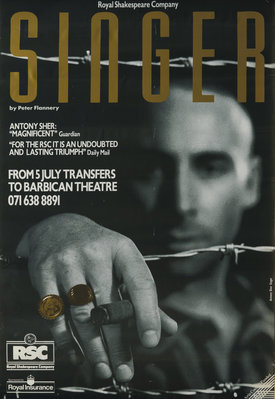
job_0344Unfortunately when shows are stopped, it is not always for mundane reasons. I remember going to see a production at the RSC of a play called Singer, by Peter Flannery, starring Antony Sher which was stopped after about 20 minutes because of a bomb scare and we were evacuated from the theatre. The similar thing happened to me when I happened to be in London two days after the 7/7 bombings in 2005 and two performances I was about to see were cancelled because members of the respective casts were stuck on the Underground following subsequent terrorist alerts.

It has to be said though that sometimes mistakes are tragic. In 1673, Molière, the French actor and playwright, died after being seized by a violent coughing fit while playing the title role in his own play, The Hypochondriac. In 2008 a german actor slit his throat on stage in Vienna when the prop knife for his suicide scene turned out to be a real one. Thankfully he survived. However, sadly only a few weeks ago a performer with Cirque Du Soleil in Las Vegas was killed during a performance of Ka.

..

Heads Above Water

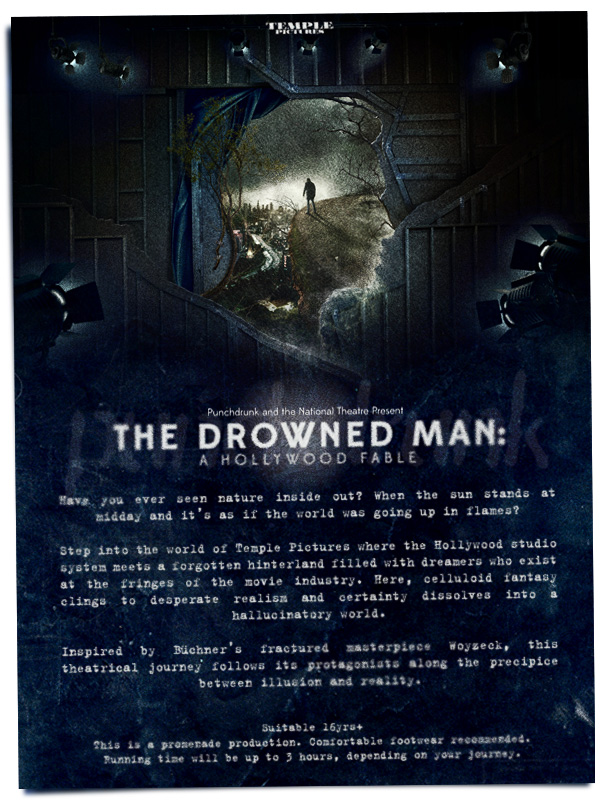
I make no apologies for a very ‘British’ post today. One of my favourite theatre companies, Punchdrunk (I’ve mentioned them here a few times before) are about to open a new show, The Drowned Man: A Hollywood Fable.

.

My friend and colleague Sara saw their production of Faust and still rates it as one of the best pieces of theatre she has ever seen. In The Observer today Liz Hoggart writes a profile of Felix Barrett, Punchdrunk’s founder and artistic director.

Felix Barrett: the visionary who reinvented theatre

The founder of the Punchdrunk company has no time for stages or even seats. Their ‘immersive’ style has had huge influence in theatre and beyond. And their new show is their most ambitious yet

‘We’re trying to build a parallel universe,” explains Felix Barrett, founder and artistic director of Punchdrunk. “For a few hours inside the walls, you forget that it’s London 2013 and slip into this other place.”

Felix Barrett Punchdrunk

An elfin 35-year-old, with long, straggly hair and beard, Barrett is the man who changed British theatre, when he set up Punchdrunk in 2000, pioneering a form of “immersive” or “promenade” theatre. Their latest show, The Drowned Man: A Hollywood Fable, a walk-through tour of a seedy 1960s film studio, opens to the critics this month.

The three-hour performance will play out over four floors of a former sorting office next to Paddington station, west London. Co-directed by Barrett and long-time associate Maxine Doyle, and inspired by Georg Büchner’s anti-war fable, Woyzeck, it’s their first major London show for six years, and biggest to date. It has, Barrett admits, the budget of a small film.

Punchdrunk want to take immersive theatre to a whole new level. A night in their company doesn’t involve a stage, a programme, an ice cream at the interval – or even a seat. They find empty buildings, fill them with richly detailed sets and performers and then set the audience loose – wearing masks. The thrill comes from not knowing what’s round the corner or how you’ll react when you find it. “In the theatre, you sit there closeted and you switch off part of your brain because you’re comfortable,” says Barrett. “If you’re uncomfortable, then suddenly you’re eager to receive.”

Even if you’ve never seen one of their wildly inventive shows, you will have felt their influence through advertising, music videos and festivals. Everyone these days wants to copy the Punchdrunk magic. The Drowned Man has already sold 50,000 tickets. For the next five months, a cast of 34 dancers and actors will lead 600 people a night around 200,000 sq ft of warehouse.

punchdrunk-the-drowned-man

Arguably Punchdrunk attract people who would normally run a mile from high-concept theatre. Their influences come from B movies, computer gaming and gothic novels. “It’s theatre for people who like theatre but don’t particularly like theatres,” says Colin Robertson, TV editor of theSun, an early fan. “Punchdrunk is theatre for the warehouse party generation. It has that DIY, chaotic feel about it that is so far removed from traditional stuffy theatre.”

Punchdrunk’s promenade productions have included Faust (where audiences explored an east London tobacco warehouse filled with scenes from Goethe’s play), The Masque of the Red Death (based on the stories of Edgar Allen Poe, staged in Battersea Arts Centre), andThe Duchess of Malfi (a collaboration with English National Opera in old pharmaceutical premises in Docklands). But it was their off-Broadway hitSleep No More – a spin on Macbeth that’s still packing audiences into a former warehouse in New York – that brought them celebrity attention.

The New York Times called it “a voyeur’s delight. Messes with your head as thoroughly as any artificial stimulant. Spectacular!” About 200,000 people have attended, including Justin Timberlake and Matt Damon. In many ways, Punchdrunk became the Banksy of the theatre world.

They’ve spawned countless imitators – from Secret Cinema and Gideon Reeling (Punchdrunk’s sister company) to You Me Bum Bum Train. Also, Rupert Goold’s Headlong company (EnronThe Effect) emerged at the same time.

Barrett founded Punchdrunk after studying drama at Exeter University. Dissatisfied with conventional venues, he fell in love with site-specific theatre. He staged an immersive take on the proto-expressionist masterpiece Woyzeck in an old Territorial Army barracks in Exeter as part of his theatre degree finals. The police turned up – “with dogs and everything,” he recalls fondly.

Paul Zivkovich and Kate Jackson in The Drowned Man A Hollywood Fable.

Paul Zivkovich and Kate Jackson in The Drowned Man A Hollywood Fable.

Along with Shunt, Punchdrunk led the charge for a wave of immersive, experiential theatre that aims to erase the fourth wall as much as possible. From the start, Barrett and his team knew how to create interventions on an outrageously grand scale with minimal resources, recalls David Benedict, London theatre critic for Variety. “Fringey sounds like they were a bit silly and small and fiddled around on the fringes. From the start, they were a bunch of people with quite a big idea and they pursued it with a) great imagination and b) rigour. They weren’t the first people to do site-specific, far from it, but they were the first to be bold enough to think big. The fact that they didn’t have any money released them in a weird way.”

The National’s director, Nicholas Hytner, was an early supporter. In 2005, he attended The Firebird Ball, inspired by Romeo and Juliet and Stravinsky’s The Firebird, in a disused south London factory. “I was suspicious when I was made to put on my white mask,” he says. “Maybe I was right to be. It turned out to represent the polar opposite of everything I’ve ever been able to do in the theatre and I was totally exhilarated – high on every moment of it.”

Hytner’s decision to have the National endorse the company led to their breakthrough show, 2006’s Faust, occupying five floors of a Wapping warehouse, and, a year later, The Masque of the Red Death.

It was this talent for getting into bed with very smart co-producers that set Punchdrunk apart, says Benedict. “It gave them the clout and the heft and the publicity. They never did upstairs rooms. When they did The Masque of The Red Death in 2007, they had the whole of the Battersea Arts Centre. And that was a very fashionable producing house because they’d already created mega-hit Jerry Springer: The Opera.”

In 2009, the Old Vic and Punchdrunk collaborated on a show in Tunnel 228 with contemporary artists underneath Waterloo station. It became more than a hit show, it became one of the “must-see” experiences in the capital.

Punchdrunk’s rise has coincided with audiences becoming much more adventurous over the past decade. It’s tricky to define cause and effect. Punchdrunk have driven the wish for something bold, but they also emerged at a time when audiences were tiring of sitting down in front of a proscenium arch before slipping out for the interval drink. And Punchdrunk became a byword for all that was different from that tradition.

Barrett gives little away about his personal life. We know he’s married to Kate, a media producer at the Tate, with a child. Although, touchingly, he reveals his company organised his “prenuptial bachelor party” (also known as a stag do) as a theatrical event, a journey that started with a key in the post and ended with 30 men in masks kidnapping him and forcing him to unlock a trunk full of his most embarrassing possessions. “It was the best show I’ve seen in the last 10 years,” says Barrett.

The darlings of British theatre have their critics, of course. TheGuardian‘s Michael Billington queried the “fairground shock tactics” of It Felt Like a Kiss (2009), their collaboration with documentary film-maker Adam Curtis, and musician Damon Albarn for the Manchester international festival, calling it “a real dog’s dinner of a show”. And theDaily Telegraph said of their 2010 foray into experimental opera, The Duchess of Malfi, that “the bag of tricks [was] looking increasingly jejune”.

Faust Punchdrunk 2006

Faust Punchdrunk 2006

“The trouble with a lot of site-specific theatre is it’s posh haunted house, with people rushing at you in corridors,” says Benedict. “When it works, you forget that, but it needs to be done with theatrical rigour.”

There have also been accusations of selling out. They have done corporate pieces for Stella Artois and W Hotels, while, at Sleep No More,tickets sell for $100, with programmes at $20. In London, with the National Theatre as co-producer, tickets for The Drowned Man are £39.50 to £47.50. Barrett claims sponsorship funds the experimentation, stressing that, as a charity, the company ploughs the money back. But they have, he concedes, paid attention to the bad press.

There is a sense that The Drowned Man needs to be a critical hit to restore some flagging confidence. Says Benedict: “The first time you go to a Punchdrunk show, it blows your head off, but the trouble is it’s a bit of a cliche if you’re relying on no one having seen it before. ”

In wider terms, perhaps we may see a return to straight theatre after a decade of playful deconstruction. Even if this happens, Punchdrunk will have made a fundamental mark – shaking up theatre and routine practice like none of their peers.

In another interview last week in The Independent entitled All the disused building’s a stage: Punchdrunk’s The Drowned Man is their most ambitious show yet,  Barrett talks to Alice Jones about why they keep pushing the boundaries.

The show is currently in preview so there are no official reviews. However here is one unofficial written by a member of a preview audience. The twittersphere  likes it too!

.

THE PUNCHDRUNK FILE (Courtesy of Liz Hoggart and The Observer)

Born Founded in 2000 by Felix Barrett. His regular collaborator is choreographer Maxine Doyle. They have come to be seen as the leading lights of a form of “immersive theatre”, where the audience is not seated but is freer to roam the performance site.

Best of times Their Hitchockian take on MacbethSleep No More, staged off-Broadway in 2011, seduced Matt Damon, Natalie Portman and Justin Timberlake to join the masked revels.

Worst of times Punchdrunk’s involvement in the launch of a new lager and a Louis Vuitton shop in central London raised eyebrows. Directing the Colombian pop diva Shakira’s world tour was, Barrett admits, “a tough experience”.

What they say “We aim to provide the quality of the West End while avoiding packing the audiences in like sardines.”

What others say “Punchdrunk have provided some of my most exciting dramatic experiences over the past decade. We are delighted to be working with them again in London after a six-year gap while they wowed New York; I can’t wait to see their new theatrical adventure.” Nick Hytner

.

In The Dock

Following from my last post, the first thing I want to share today is another BBC Essay: On Directing, this time with director, Barlett Sher:

Essay: On Directing – Bartlett Sher

bartlettsher200Sher is cut from a different cloth to Emma Rice. He is what I would call a ‘traditional’ director and plays a different role in the theatre world. He has some interesting things to say about the importance of getting transitions and transformation right in theatre as well as talking about the importance of rhythm in theatre making. However, there was a moment that surprised me. He talks about his role in theatre as an ‘interpretive’ art, unlike a visual artist because they start with a blank canvas. He seems to ignore all the new work being created by directors that don’t start with a script or a libretto. In a sense it links to my previous post McTheatre.  I’m not saying for one moment that Sher is one of the Mega-musical mob, but he would have appeared to have missed what is going on around him – not everyone is re-staging South Pacific or Romeo and Juliet or classic American drama. Contemporary theatre directors are creating new work, challenging work, work that is alive. I think it is about taking risks and scaring yourself.

As a perfect example of what I mean is the Royal Court Theatre in the UK. They are renown for doing fantastic, unusual and innovative work. Their current season is called Open Court a six week festival of plays, ideas and events chosen and suggested by a group of over 140 writers.

.

Two of the things they are doing  as part of Open Court particularly caught my attention. Firstly, their Surprise Theatre where every Monday and Tuesday nights there is a different surprise performance from a wide-ranging field of writers and theatre-makers; each creating a unique one-off performance, which remains a mystery to its audience right up until the lights go down. How’s that for risk taking by both the performers and the audience?! The performances are also being live-streamed!

.

Then there is  PIIGS – New Short Plays. PIIGS stands for Portugal, Ireland, Italy, Greece and Spain – all the European countries that have been hardest hit by the economic down-turn. The idea is that international writers join up with their British counterparts to create plays that explore what life is really like for those living in austerity. What a great idea!

.

This is what theatre should be about.

.