Worlds Apart

Over the course of the summer I have written about Shakespeare a couple of times. Today I am going to share two articles about two plays currently in production from opposite sides of the world. Firstly, Coriolanus directed by Lin Zhaohua for the People’s Art Theatre in Beijing in Mandarin and Hamlet, by The Wooster Group in New York. Both are currently on at The Edinburgh Festival.

The first is by Andrew Dixon for the Guardian, entitled

Guitar hero: Coriolanus goes rock

China’s most controversial director is bringing Shakespeare’s Coriolanus to Edinburgh – with two heavy-metal bands in tow

It’s 45 minutes to showtime at the People’s Art Theatre in Beijing. Backstage, actors in civvies are padding around, studiously avoiding the clock. Behind a dressing-room door, someone is making heavy weather of their warmup. Suddenly, the strangulated squeal of an electric guitar shakes the building, like a crack of thunder. No one bats an eyelid.

21253_653587371334804_1261359802_n

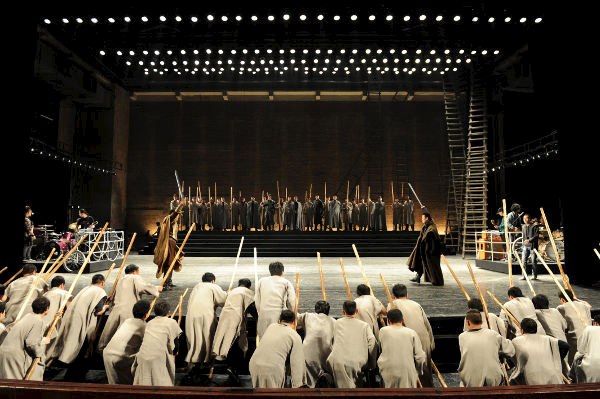
The closest most British stagings of Shakespeare get to guitars is the occasional lute. But in China, it seems, they prefer their Bard a little gnarlier. This is The Tragedy of Coriolanus by Lin Zhaohua, routinely described as China’s most controversial theatre director. First performed in 2007, it is big in every sense: there’s a cast of more than 100, and the action takes place on a near-empty stage against a vast, blood-red brick wall.

But the real surprise is the soundtrack: two live heavy-metal bands, going under the colourful names of Miserable Faith and Suffocated, who slide in periodically from the wings and punctuate the action with frenzied surges of nu-metal. This might be the only version of Shakespeare’s tragedy – the story of a hot-headed general who goes to war against his own people – that turns it into a battle of the bands.

182698_653587424668132_155504144_n

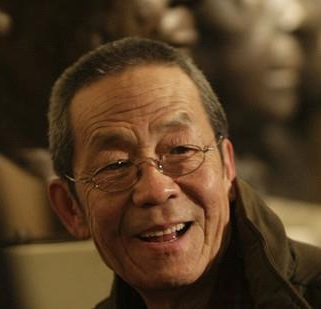
The director is hiding in a cloud of cigarette smoke in the theatre cafe. Were it not for the translator hovering at his elbow, you’d mistake Lin for an elderly caretaker: a slight, somewhat caved-in figure, his jacket hanging absent-mindedly off one shoulder. But, behind neat spectacles, his dark eyes are pin-sharp. He claps me on the shoulder as I sit down; I sense I’m being sized up.

First things first: why the heavy metal? “I wanted to use rock music to display the fierceness of the war, and the rioting of the citizens,” he says. “At first I wanted bands from Germany … I listened to a lot of them, but I didn’t like their electronic sounds. So Yi Liming, my designer, showed me around different parts of Beijing. I chose two of the bands I saw.”

The music certainly adds a volcanic energy. The text has been translated into contemporary Mandarin, and here in Beijing (unlike at the Edinburgh international festival, where the show will open later this month) there are no surtitles. The scalding force of Shakespeare’s verse, though, is echoed in the roaring guitars and pulsing bass. It’s a high-voltage experience, particularly when the Roman mob, dressed in semi-druidic robes, rush onstage brandishing wooden staffs – like a cross between a scene from Star Wars and Reading festival. In the interval, the musicians entertain the crowd, a flock of teenagers pressing close, clicking away with their cameraphones.

Lin smiles. “Some dramatists and critics don’t like the idea of using rock music, and they criticise my way of doing productions.” How does he feel about that? A shrug. “I don’t care.”

Combing the city’s nightspots for musical accompaniment sounds energetic for a director now in his late 70s. But Lin has never done things by the book. After graduating from the Beijing Central Academy of Drama in 1961, he joined the People’s Art Theatre (BPAT) – China’s equivalent of the RSC – as an actor, only to find his career stymied by the Cultural Revolution. Afterwards, he joined forces with the dissident writer Gao Xingjian, who would later win the Nobel prize. A trio of plays, beginning with 1982’s Absolute Signal, all but launched experimental theatre in China, with a confrontational, often absurdist style that unnerved the communist authorities.

316185_653587391334802_432981805_n

In the decades since, Lin has been prolific, flitting between new drama, stylised Peking Opera and ambitious reworkings of western classics. According to Li Ruru, an academic who has written extensively on Chinese theatre, Lin is “a major voice. He’s been doing experimental theatre for more than 30 years, at the absolute vanguard of Chinese spoken drama.” But his approach hasn’t always done him favours: one critic described him and Gao as “harbingers of strangeness” for their efforts to release drama from the straitjacket of Soviet-era social realism. The director refuses even this pigeonholing: “I have no style,” he has repeatedly told interviewers.

Anyone expecting peony-strewn chinoiserie – like that offered by the National Ballet of China two festivals ago – will be in for a shock. This is a Coriolanus of muscular clashes and brutal comedowns; of a leader always itching to administer the hair-dryer treatment, and who does nothing to disguise his detestation of the masses.

In the lead role is one of China’s most famous stage actors, Pu Cunxin: a disconcertingly polite figure who apologies for his sore throat – the consequence of competing with two metal groups. “It is an unusual way of performing,” he admits. “We don’t normally have this kind of collaboration in China. The noise is just so powerful on stage, but we need the rock music to express these emotions. It parallels Shakespeare’s ideas.”

941130_653587461334795_535090116_n

I’m struck by one moment in particular, where Coriolanus’s arch-rival Aufidius grabs a microphone during a battle scene, looking half like a wannabe rock god, half like a politician channelling the energy of the crowd. Politics are everywhere in Coriolanus: the play has been claimed both by leftwing critics as a primer on the dangers of demagoguery, and by the right as a lesson in the fickleness of the masses (the Roman citizens at first swoon over their apparently invincible general, then later turn on him). Given these paradoxes, it feels an oddly appropriate play for present-day China, a country nominally communist, but with an economy many capitalists would trade their copies of Milton Friedman for. On the short walk from my hotel to the theatre, two blocks from the Forbidden City, I drift through a shopping district crammed with western luxury brands; one window of a photography shop is jewelled with glittering Japanese cameras, the other with portraits of Mao and Deng Xiaoping. It would be harder to find a clearer image of Deng’s infamous”socialism with Chinese characteristics”.

What does Lin see in Shakespeare’s text? “The relations between the hero and the common citizens,” he replies. “In ancient Rome, people admired heroes. From my point of view, Coriolanus is a hero.” Is there a resonance with contemporary China? “It’s a good phenomenon if the play refers to current events. Those in power like to control citizens, and some common citizens are foolish.”

I want to find out about a previous Shakespeare production, Lin’s Beckettian staging of Hamlet, first seen in 1989. Performed in a rehearsal room at BPAT, the only prop a barber’s chair, it had three actors (one of them Pu) sharing the roles of Hamlet, Claudius and Polonius. Depending on your perspective, it captured either capitalist alienation, or the disillusion that followed the collapse of the student protests at Tiananmen Square. The parallels were cloudy – theatrical censorship is vigorously alive in the People’s Republic – but there to be seen.

Lin freely admits the show was unusual: in contrast to the traditional Chinese way of presenting Shakespeare, with wigs and western-style makeup (sometimes even prosthetic noses), his actors wore their own clothes, in a conscious decision to show the student prince as just another guy. But he is reluctant to open up on the wider issues. “I hate politics,” he says stoutly. “Hamlet has nothing to do with politics. It’s just about a person’s situation.” I can’t tell whether he’s genuinely uninterested, or unwilling to be frank with a British journalist. “I never discuss politics. I don’t think you can direct a production just from politics.” He isn’t even convinced, he says, he’s avant-garde. “I don’t have that concept. I just direct the production from my interests and from the needs of the play.”

941279_653587384668136_1016224444_n

Our time is nearly up; his lighter is snapping impatiently. Last question: does he like being called a rebel? “I don’t have preconceptions about what I’m going to create,” he stonewalls. “I just follow my instincts.”

I realise as I’m rushed out that I’ve forgotten to ask one thing – why direct Shakespeare in the first place? Why stage reach for a playwright four centuries old? When I email, the answer comes back quicker than I expect. It reads: “It gives me the freedom to say what I want.”
537273_582437285116480_15271441_nInterestingly, the Lin Zhaohua Theatre Studio has it’s own Facebook page which is where all the above images came from.

There is a fantastic outline of him and his work here where he is described as a very controversial drama director in China…one of the most significant figures in Chinese drama history you can’t ignore – whether you love him or not.

.

The second article today is also from the Guardian, by Hermione Hoby, exploring with the Wooster Group why, after all these years of experimental theatre, they decided to ‘do’ Shakespeare.

Wooster Group take on Shakespeare with Hamlet remix

Before Punchdrunk, or Complicite, or Forced Entertainment, or any other experimental theatre company you can name, there was New York’s Wooster Group, an avant-garde ensemble legendary not just for the work it has made since the 1970s, but also for the love affairs and betrayals that have coloured its history. As former member Willem Dafoe has put it: “You become accomplices in life. There’s a terrific power in that. The other side is, there’s no place to run.”

Since 1974 the company has worked out of the Performing Garage in Soho – a Manhattan neighbourhood once characterised by derelict lofts and heroin dealers and now given over to Prada boutiques and cupcake-centric cafes. This year they’re bringing one of their most successful shows ever – a remixed Hamlet devised from a filmed 1964 production starring Richard Burton – to the Edinburgh international festival.

I meet company members Scott Shepherd and Kate Valk in the big empty black box of their theatre and, seated on the steps of the auditorium, Shepherd explains that he directed the play years ago as a student at Brown University. Ever since, he says, he’s had it stuck in his head. That’s not, it turns out, a figure of speech. “He has a photographic memory,” Valk explains, mock-wearily. “It’s kind of obnoxious at times.”

Ham600

The skill is what enabled him, for example, to memorise all 49,000 words of The Great Gatsby for Elevator Repair Service’s acclaimed stage adaptation, Gatz. Hamlet though, was rooted even deeper. Eventually, with speeches still running through his head, it began to feel “like something that needed to be exorcised”.

And so he persuaded Valk, who claims to have suffered from what she calls “Shakespeare deficit disorder”, to join him in after-hours work on the text. From that moment in 2006, very slowly, their production began to take shape.

It began with the two of them, but the woman who continues to hold the company together – the matriarch, you might say – is the quietly formidable 69-year-old Elizabeth LeCompte. The Wooster Group emerged amid the creative ferment of 70s downtown New York, but it was her relationship with Spalding Gray, the late actor and writer, that dynamised the company. After graduating from Skidmore College she got together with Gray – as well as Valk, Jim Clayburgh, Ron Vawter, Peyton Smith and Dafoe – with whom she went on to have a son and a 27-year relationship. Dafoe ended it abruptly in 2004, the same year Gray took his own life by throwing himself from the Staten Island ferry. Miraculously, she weathered it with the company intact.

Before she met Gray in the mid 60s, LeCompte had little interest in theatre and had studied art, thinking she might become an architect like her father. “I think maybe,” she says, “it was just a mistake – I got together with Spalding not because I thought I was going to get involved with theatre but when Richard Schechner [the group’s original artistic director] hired me, I realised that it was really a good place.”

By 1975 she was staging Gray’s famous Rhode Island Trilogy, an autobiographical work that details his childhood and the suicide of his mother through monologue as well as personal materials such as letters and photographs. In 1980, Schechner left, LeCompte became artistic director and they changed their name from the Performing Group to the Wooster Group. What drove them then, I ask. She inhales. “It’s hard to know … I don’t know whether it was just youth, because it wasn’t exactly idealism. We weren’t afraid of anybody. We had a certain kind of feeling of the world was ours, so we could do what we wanted.”

67e72df164dbb6752b0f3871276b9f81

The company seems to retain that sense of boundlessness, I suggest.

“You really don’t really know where you’re going to end up when you start,” she agrees. “And there’s something very exhilarating about that, but it’s also very difficult. In most theatres the director has to know what’s there so the other people involved can rely on her. I don’t afford anyone that comfort. I’m as confused as everybody else a lot of the time.”

When LeCompte began working on Hamlet, “I didn’t really think I was working on Shakespeare, I thought I was working out on figuring outabout Shakespeare. I kind of came in a side door.” That’s often the best way. “Well,” she says drily, “it’s the only way I can do most things.”

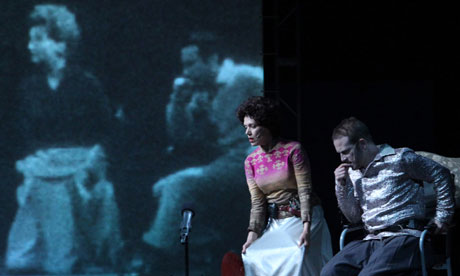
She remembered seeing the Burton production, which was directed by John Gielgud – himself a famous Hamlet – and thinking of it as experimental purely because the actor playing Gertrude wore not a bodiced dress and ruff, but a mink coat. “That’s what experimental was then!” she laughs. More exciting though was Burton’s futuristically named “Electronovision”, an innovation that used 17 cameras to film and broadcast the performance for two days in 1,000 cinemas across the US . In the Wooster production, that grainy 1964 film is projected above the set, forming a ghostly backdrop of a past Hamlet. The New York Times described the Woosters’ show as “an aching tribute to the ephemerality of greatness in theatre”.

Kate Valk and Ari Fliakos in Hamlet

Kate Valk and Ari Fliakos in Hamlet

“The whole metaphor to using the film is the ghost,” Kate Valk enthuses. “The ghost of all those performances!”

Scott Shepherd is a performer who invariably attracts adjectives like “indefatigable” and “tireless”; those seem entirely deserved when it emerges that he edited the entire Burton film into Shakespearean meter, in other words, painstakingly cutting the performers’ pauses so that the iambic pentameter is duly honoured with beats and stresses in the right places.

“This was an arduous task, yeah,” he admits. “To go in and cut pauses if they came in the middle of a verse line and then move them to the end of the verse line.”

It’s Shepherd-as-Hamlet’s imagination, so the premise goes, that creates the onstage action, in which live performers mirror the movements and speech of the actors in the 1964 projection. For all the visual innovations though, LeCompte insists that the text itself remains sacrosanct, and, “on a par with the visual”.

She says: “What I was doing, I realised, was trying to take this shard of what I could get from the past, from that production, and to reinterpolate it into something that made sense to me, in the future.” A brief pause, then: “But I just wanted to delight myself, frankly!”

Despite three decades of making work this is the first Shakespeare the company has ever done. (They’ve since added Troilus and Cressida, a collaboration with the RSC, to their repertoire.)

“I was not hip to the Shakespeare idea at all,” says Ari Fliakos, who plays Claudius and Marcellus, among other roles. Why? “I don’t know,” he says, “maybe it comes out of my allergy to theatre.”

Professing not to be a “theatre person” seems to be a common Wooster trait. Even Valk, who’s been described as “the Meryl Streep of downtown”, has claimed that acting is not among her skills.

1hamlet_wooster_group_czernia

When I mention this tendency to LeCompte she laughs. “I like theatre people!” she protests. “But the process of making theatre in the commercial world I don’t like because it’s too formulaic. I really like to ramble for quite a while,” – and then she corrects herself: “I don’t like to, I have to. I wish I was faster, frankly – we’d be making a little more money.”

Like most members, LeCompte included, Fliakos came to the group through a side door, after hanging around there in 1996, answering phones and fetching coffee. “Everything was stimulating, everything resonated,” he recalls. “It seemed like experimenting with drugs all over again, it was a whole new experience I wouldn’t have expected in any kind of live performance.” He sighs: “The minute you try to describe it, not unlike a trip, it begins to dissipate.”

Every member I talk to about the Wooster Group speaks with this kind of ecstatic devotion. Nonetheless, the creative world of 2013 is a very different one to 1974 – financially and ideologically. LeCompte admits that, “in order to be able to keep the company together I have to be more aware of money, ways of living and ideas. It’s the terrible thing that it’s not hip anymore to not have money, or to be on the outside. It’s much harder for people to give up things that have money and status.”

***4V8G1667©Mihaela Marin

But there are gains, Shepherd explains: “Most people who are in acting are going from one job to the next, and it’s quite hard to develop a sense of continuity, that you’re engaged in building a body of work. And here that’s all you do. One piece bleeds into the other so you’re creating sort of an oeuvre and making something larger than a particular production, you know? This is about developing a philosophy of working, a way of working with a group of people.”

“It feels,” he says finally, “substantial.”

Again the reviews will be out soon for both shows so it will be interesting to see what the critics make of these two very different, culturally and artistically diverse reworkings of Shakespeare. However, according to one critic who Tweeted a few hours ago, the opening night of Hamlet didn’t go well:

domIt happens to the best of us, it seems.

Digital Dreaming

I am always fascinated about how we can use technology to create and enhance performance and it is something that is clearly being embraced by theatres, directors and performers around the world. For example, live, streaming performance is starting to become the norm, rather than the exception. The National Theatre, through their NTLive programme, now regularly broadcasts it’s work to cinemas around the world.

However, it’s where technology allows a performance to become something that otherwise wouldn’t be possible is what really excites me. Therefore I was happy to come across this article in Wired by Liz Stinson about a performance called Mr and Mrs Dream. The creators, Le Théâtre du Corps, worked with a software company, Dassault Systèmes, to make something rather special indeed.

A Virtual Stage That Bends Reality and Pushes Theater’s Boundaries

There’s a scene in the contemporary ballet Mr. & Mrs. Dream where the walls of the set appear to burst apart, transporting one of the principal dancers from an apartment living room to a sea of meteorites in outer space. The dancer, Julien Derouault from Paris’ Théâtre du Corps, begins to hop from meteorite to meteorite, and with each step, the space rocks appear to dip from the heft of the human body. Of course, Derouault isn’t actually bouncing on meteorites; in reality, he’s simply leaping on the floor of an almost empty stage. The scene is mesmerizing, and from the vantage point of the audience, it really does look like the dancer is jumping through outer space. But it’s all an illusion, created by an elaborately engineered virtual reality system that could begin to replace traditional sets with projectors, screens and computers.

Though the show was conceived and choreographed by Derouault and his partner Marie-Claude Pietragalla, the brains behind Mr. and Mrs. Dream’s high-tech set is Dassault Systèmes. The French software engineering company typically uses its virtual reality technology to test, model and simulate products for companies like Boeing, so it’s natural to think that this collaboration is a bit of an odd pairing. But, says Mehdi Tayoubi, vice president in charge of experiential strategy at Dassault, interdisciplinary collaboration is becoming more common and more imperative for high-tech companies.

.

“It’s very important when you claim to be an innovative company, to be able to go outside the laboratory and your comfort zone,” says Tayoubi, who heads up Dassault’s Passion for Innovation program, an initiative whose goal is to apply the company’s industrial research and technology skills to the worlds of culture and education. Since 2005, Dassault has worked with architect Jean-Pierre Houdin to simulate the construction of Cheops pyramid, partnered with director Luc Besson to bring 3-D interactivity to movie theaters, and helped cartoon artists turn their cartoons into virtual reality (and these are just a few of their projects). Mr. and Mrs. Dream is Dassault’s first crack at live dance, and not surprisingly, there were some challenges and miscommunications along the way. “At the beginning it was a little bit difficult,” says Tayoubi. ”But we learned to share the same language.”

One of Dassault’s main challenges was creating a virtual reality system that was technical enough to accomplish the complex visual effects that the dance company envisioned while still being simple to use. “We needed to design a system that we can give to people who are not engineers and they could set up everything in a few hours,” explains Benoît Marini, Dassault’s virtual reality expert. The system also had to be mobile since the company would eventually be touring with it around the world.

.

Marini’s solution was a mobile “magic box,” which is basically a disassemble-able series of four gray screens and six projectors that would be the canvas for the immersive world of Mr. & Mrs. Dream. The box is similar to the virtual reality rooms traditionally used by industrial companies, only instead of testing emergency scenarios and modeling new airplane features, this box is used to motion-track dancers and project computer-generated images. For scenes like the one mentioned above, Marini positioned three Kinect sensors above the stage to track the dancers’ movements. So when the dancers jump, the meteorites bounce, or when the dancers kick, a flurry of leaves float through the air. Most of the other projected dance numbers were motion-captured in the studio and are played back in sync with the music. The audience doesn’t have to wear 3-D glasses; instead the team uses perception tricks like digitally created trompe l’oeil to convey depth and dimension.

dance888888

Fittingly, Mr. & Mrs. Dream is based on the work of Eugène Ionesco, the famed playwright whose work was a hallmark of the Theatre of the Absurd. “We always say to our customers like Boeing: ‘There is no limit, dream big, we can do everything,’” says Tayoubi. “So we saw a lot of similarity between Eugène Ionesco and what we are doing everyday.” Tayoubi believes that working on inter-disciplinary projects like this is the key to innovation, citing the magic box as a technology that Dassault will use again at automobile shows to give 3-D representations of new cars. Working with artists forces the scientifically minded to push boundaries and create solutions to problems that they’ve never encountered before. “Artists have a lot of imagination,” says Marini. ”Sometimes they want effects that aren’t possible.” So what happens when the dancers ask for something they can’t create, like holograms that can interact with the audience? “You say, ‘wow,’” Tayoubi laughs, “Then you begin to find a solution.”

You can read a review of the show here.

.

Critics In & Jury Out

So the previews are over and the critics have been in to see Punchdrunk’s The Drowned Man: A Hollywood Fable. Now the fact that I am 9,500km away negates me seeing it so I have been avidly immersing myself (pun entirely intended) in the press and blogosphere.

It would seem the jury is out.  The theatrical event of the summer or the most over-hyped show of the year (lets not forget that promotional interviews and teasers were out in March)?

I will share one thing with you and give you the links to the rest. Make your own mind up. Here is a conversation between Natasha Tripney, William Drew, Stewart Pringle and Lauren Mooney that was published in Exeunt yesterday.

The Drowned Man: Playing the Game

Natasha Tripney: There were several moments during The Drowned Man where I felt as if I was in my own private movie. The soundtrack helped I think, – the Shangri-Las’ ‘Remember’ plays in my head often enough anyway – those finger clicks kicking in as I opened a door. The lighting, crepuscular, twilit, also played a part as I picked my way through an indoor glade, the ground underfoot loamy, or found myself in a diner, all Formica and bourbon and bubble gum, James Ellroy, Carson McCullers and Edward Hopper. I loved that. I could have played there all day.

Compared to their last major London show – The Masque of the Red Death at BAC, which is the only other Punchdrunk piece I’ve experienced (I missed Faust, sadly) – I got a lot out ofThe Drowned Man. I saw more action, so to speak, followed a couple of characters around (though didn’t find their arcs compelling enough to stick with them for too long), had my hand-held and my face stroked by a sequin-bedecked woman in a Red Room. Beautiful as the design was, I found Masque a hugely frustrating experience. I spent so much of my time in there, standing in glorious but empty spaces, arriving at scenes just as they’d finished and the one time I was in the ‘right’ place at the ‘right’ time I clearly stood in the wrong ‘place’ and got (quite roughly) elbowed out of the way by one of the performers. This didn’t really endear me towards them as a company.

Punchdrunk-Photo-Pari-600x287

So despite the oven-like temperatures, I enjoyed a lot about the experience. Some of the design was truly spectacular – I particularly liked the shrines and the scarecrows – the level of detail was delicious and for the first time I can grasp why people might become frequent fliers, returning multiple times. I think it was Ian Shuttleworth who said, when discussingMasque, that in order to get the most out of it you have to be good at following cues, chasing voices. I struggled with that in Masque, but I guess here I played the game better. It’s just a shame it took one deeply frustrating experience for me to figure out how to do that. Had I paid the best part of £50 in order to learn those lessons, I’m pretty sure I wouldn’t feel quite so warmly towards it.

Stewart Pringle: Though I have some severe reservations on it as a piece of theatre, I had a pretty awesome time wandering around Temple Studios. I found the attention to detail just as arresting as I had in Masque, and the scale and scope even more breathtaking. I’ve read a few of the early blog reviews and I find it genuinely surprised that experiences like walking through a forest filled with camper-vans, sifting through the detritus of failed relationships in seedy hotel rooms and wandering through the back-lot Beamish of the street scene have been written off as if the show was just a few hours plodding around a dingy warehouse.

I saw far more action and far more actors than I did in Masque, but in a way I think that took me out of the experience rather than enhanced my immersion. Because the actors interact with the audience so rarely, and because I find the dancey stylings of Maxine Doyle so insufficient and unengaging, I had far more fun when I was exploring on my own. There was a bunch of letters in the sort of broken down house area that I read through in their entirety, tracing a relationship from first wobble to total collapse, and I found the experience far more moving than any amount of repetitive interpretive dance.

I’m with Tash on the soundtrack, too. In the main I found it really enhanced the atmosphere, even if its repetitions eventually began to blur everything into a single tone. Because it essentially cycled around, or seemed to, it added to the creeping sense of dramatic stasis that built towards the final hour. Its lack of syncronicity with the action of individual scenes also created the occasional daft moment, such as finding I myself watching a man putting his trousers on in the back-room of a seamstresses to soaring, cinematic strings. They were very nice trousers, I suppose.

Punchdrunk-3-Photo-Pari-600x568

William Drew: So I find the idea of “playing the game” of a Punchdrunk show really interesting. My interpretation of this, which may not be what you meant, Tasha, is how an audience member makes sense of all the stimuli they fill their shows with, so they weave together a narrative for themselves. Bearing in mind, the world does not react to you, in the sense of your actions affecting outcomes, I can see two ways you can do this. The first is to explore the environment, looking for letters, imagining what was there before, finding the space in the absences for your own imagination; the other is to look for performers, to watch them and to follow them through a space. Let’s call the first exploration and the second active spectatorship (while recognising the extent to which it is “active” might be problematic but that’ll do for now). From what I understand, Stewart preferred the exploration so actually found the number of opportunities for active spectatorship unhelpful, at best, and an irritant, at worst. Tasha, on the other hand, you seem to have attempting to engage with bothMasque and Drowned Man as an active spectator and this is something that you feel you “failed” at with Masque but did more successfully in Drowned Man.

It seemed to me that Drowned Man was heavily weighted towards active spectatorship. Perhaps there were more actors or maybe it was simply the case that people know to “play the game” of a Punchdrunk show better by now so you get what amounts to a fairly respectable fringe audience in dogged pursuit of almost every performer. Like Stewart, my favourite moments were the ones where I could be alone exploring the world that the company have created. There were still treasures to be found in doing that. My favourite moment of theDrowned Man was where I sat on the one free chair in an audience of scarecrows. The impression that I was on a film set meant that I was able to suspend my disbelief for long enough to feel as if the “man” in front of me might turn around any second. That was thrilling. Generally though, I didn’t find there were as many pay-offs from exploring as there were in Faust and this leads me back to the possibility that the weighting is built into this show by the company in response to how most audiences want to behave within the environment. They are “failing” fewer people who want to play in that way by making it easier to “play the game” successfully but, in doing so, are they losing a little of the openness that was part of the appeal of their earlier work?

Punchdrunk: Sophie Bortolussi in The Drowned Man

Natasha Tripney: That’s really interesting. I hadn’t thought of it in quite those terms. Looking back on it now, my favourite moments of Drowned Man were actually ones of exploration – finding intricate origami flowers in a series of filing drawer or discovering a hidden shrine made of delicate curls of cassette tape. Even my lovely Shangri-Las moment was one in which I was alone in a space. I found Doyle’s choreographic style – all that sweaty sexual intensity – very samey after a while and not particular engaging and, as you said, Stew, far too reliant on archetype. I felt no need to pursue any one performer for long, though I gather this is an approach which lots of people favour. I think what worked for me here was the ratio between the exploratory/active elements and maybe the fact that I didn’t put pressure on myself to chase the action or attempt to piece a plot together as I did inMasque and therefore was far better able to enjoy what I was experiencing rather than fret about what I wasn’t. I think that’s what I meant by playing the game.

Lauren Mooney: This was my first Punchdrunk, Tasha, and I found all the things you said about the unsatisfactory nature of your Masque experience really familiar. Basically, it does seem like there are two ways to approach a show like this – following the actors or exploring the world. Not having done anything like this before, I found myself a little paralysed by indecision, and so didn’t have a fully satisfactory experience of either.

As I think most of us have said, I was completely blown away by the level of detail and the sheer SIZE of the thing; I’d spoken to a couple of people about what to expect, but nothing, really, could have prepared me for it. There was a kind of dream logic to the whole place that I found genuinely disturbing – I can’t put my finger on it, it was just an atmosphere, something perhaps to do with not being able to hear the actors when they spoke and being able to, to some extent, do what you wanted (go through people’s papers, letters, diaries) in a way that would be impossible or sociopathic in real life.

That and the music creeped me out all the way from the top of my spine to the bottom, and made my wandering experiences less adventurous than they should have been. When I was alone in the basement and found a cell full of small blocks, I had a powerful sense that the door was going to shut behind me, and wanted to be back in the safety of a crowd; when I was in a crowd, I wanted to be back on my own again, experiencing that waking-dream sensation.

Punchdrunk-2-Photo-by-Pari-600x389

My instinct to follow the actors and scenes was almost entirely, I think, for me, the wrong one – but it took me a long time to realise that most of the scenes were similar, repetitive, plot-light… Too long really, as by the time I’d given up on them and dug into some proper exploring, it was time for the finale. I basically expected there to be more plot than there was? So I was constantly chasing other scenes, thinking I was missing something, that some important brilliant theatre was happening in another room just outside my reach – when of course it wasn’t.

This is why I agree with Stew’s comment that it isn’t maybe good theatre so much as an amazing experience. The things I liked about it, and I liked lots in spite of a few reservations, weren’t things I can recognise as being connected in any way to theatre, the way a beautiful script or a brilliant performance can move you – it was a different sensation being evoked completely differently. It was the mood in the place that I found most effective, partly thanks to the music and partly, I must say, the masks. I know they’re controversial and uncomfortable, and I wear glasses so I had them squished onto my face a bit, but bloody hell, for me they were so effective. It made the audience look like part of the set design, for one thing, when seeing someone pulling a face at an inopportune moment might really take you out of it. (I have a lot of thoughts on this but actually, as I’m the only person new to Punchdrunk, I imagine everyone else is so Over the masks…)

So having said all this, I completely buy into the idea of revisits – I enjoyed my experience but it was quite unsatisfactory, and only gets more so the more I talk to other people – which brings me to pricing, something Stew talks about in more depth in his review. Isn’t there a way they could, for instance, charge far less for a return visit? If I’d paid £40 for that I would’ve been so cross, because I felt like I did it all wrong; I think the ticket costs are extortionate in general but doubly so because, as has been said, a single visit can be so frustrating. If they MUST charge such a lot, can’t they at least have an option of, you know, paying £10, £15 for a return visit…? I don’t know.

Having said all that, a friend of mine who also went to The Drowned Man is a gamer and his experience of things was very different to mine…

William Drew: There are some connections with videogames, yes, but there are also very significant differences in that the piece is no way interactive. It is a cliché of lazy videogame narratives to use letters lying around to fill in backstory for those of us for whom that matters. Going back to my previous categorisations of the way to experience a Punchdrunk show, I am drawing partly on Bartle’s gamer psychology. One of the categories of gamer types is the Explorer. These kinds of things are littered throughout videogame worlds to appeal to Explorer types. Other types, such as the Killer, will ignore them because they, you know, want to kill people (frowned upon in a Punchdrunk show, I understand, almost as much as talking).

Similarly, you might see a couple of NPCs (Non-Player Characters) arguing about something in a videogame. That argument is likely to be significant, possibly not to the main narrative, but could generate a quest you might want to embark on or the information contained within it might be relevant to another quest. I’m talking principally about the RPG genre because they tend to be more open world. In an adventure game, things are more linear and that makes it easy for everything to be relevant. What the environment tends to provide in both of these genres of games though is exposition and this is essentially all that Punchdrunk are giving us here. I don’t necessarily mean this as a criticism but I think it’s important to point out the ways in which The Drowned Man is as unlike a game as it is a piece of traditional theatre. I think a serious gamer who went there expecting a game would be as disappointed/confused as a hardcore theatregoer who went expecting some theatre.

Punchdrunk woman

Lauren Mooney: William – I very much agree, though the thing I meant about the difference in our experiences was actually less of a comment on the action than on our reactions to it. Oddly, I bought into the reality of the world almost too much – I rarely read the letters or looked through the drawers, so convinced was I in the bloody silly fibre of my being that this was wrong – or if not wrong, certainly something I risked being caught in the middle of and shouted at for!

Whereas my friend, Liam, who creates and designs games, had no such qualms and riffled away to his heart’s content. He even told me he regretted not trying on the clothes in the costume rooms – trying them on, which would NEVER have occurred to me in a MILLION YEARS.

I do think being predisposed to it by gaming might make you better at ‘playing’ a Punchdrunk show, but no, it certainly is nothing like actual gaming. Several people I’ve spoken to, in fact, said they would have liked to be given some kind of task, a thing to achieve or attain – whereas the show as it stands is essentially the opposite of this, telling people to ‘just go and mill about’. Visitors risk being paralysed by choice and ending up like me, waddling about lost and peering in through windows, looking for the party…

I think you’re right when you say that as either a gaming or a purely theatrical experience,The Drowned Man absolutely disappoints. Though I was hugely excited about the whole thing for a few hours after I left, just because it was so mad and huge and beautiful to look at, that sensation seems to fade hugely the further I get from it. It really does seem to me that most of the things I enjoyed most were general Punchdrunk things, not specific to this show, that I loved because they were new to me – and so ultimately, it does kind of seem like Punchdrunk have a set bag of tricks they wheel out every time, that only really impress the first time you see them. Apart from this, the quality of your experience is characterised by how well you play the game and…luck.

And the critics said:

Paul Taylor in The Independent:  For all its logistical flair the show is lacking in heart

Charles Spencer in The Telegraph: The masters of immersive theatre have returned with a show that will surely become a cult hit

Michael Billington in The Guardian: The choice of location is inspired

Sam Marlow, The Arts Desk: In their new show set in a seedy Hollywood outpost, Punchdrunk’s theatrical magic loses some of its allure

And in her blog for the Guardian, Lyn Gardner asks Does Punchdrunk’s The Drowned Man live up to the hype?

.

Theatre Apps

Something a little different today.  I’ve been looking at what’s available in the iPad app store for theatre people (free and paid for), and there is a surprising mix so I thought I’d share a few of them with you.  First my favourite in terms of design:

Evernote Camera Roll 20130519 141459Played in Britain: Modern Theatre in 100 plays, 1945-2010

This is a beautiful interactive book that looks at plays that have been performed in the UK from 1945 to 2010. It isn’t just about British plays either – any thing that was performed during that period.  Reviews, interviews, production photographs and so on. Suffice to say I bought it.

.

Basically just an ebook, but beautifully illustrated, on the history of Chinese theatre.

Chinese Theater for iPad

Evernote Camera Roll 20130519 141443.

.

.

.

.

.

.

For you techies out there are a number of magazines you can get for free:

Lighting and Sound America

Evernote Camera Roll 20130519 141457.

.

.

.

.

.

.

Make-up Artist Magazine

Evernote Camera Roll 20130519 141446.

.

.

.

.

.

.

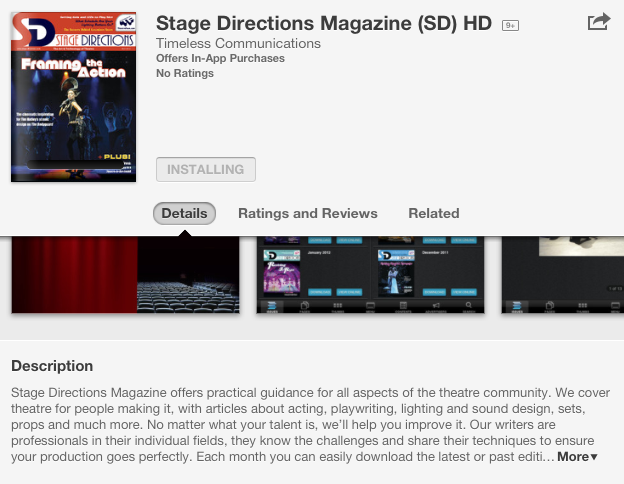
For all things techie Stage Directions Magazine

Evernote Camera Roll 20130519 141454.

.

.

.

.

.

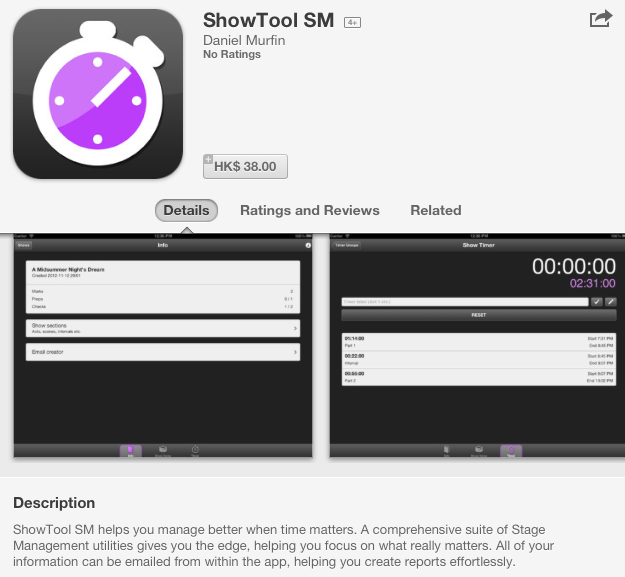
Now this is a super organisational app for stage managers, ShowTool SM

Evernote Camera Roll 20130519 141452.

.

.

.

.

.

.

An app to write plays with called, not surprisingly, Playwriter

Evernote Camera Roll 20130519 141440.

.

.

.

.

.

.

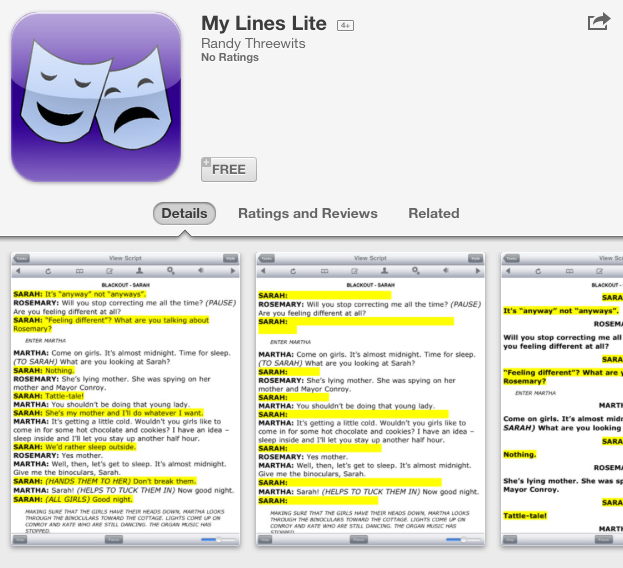
Now there are a few line-learning apps out there. This is one of the free ones, My Lines Lite

Evernote Camera Roll 20130519 141450.

.

.

.

.

.

.

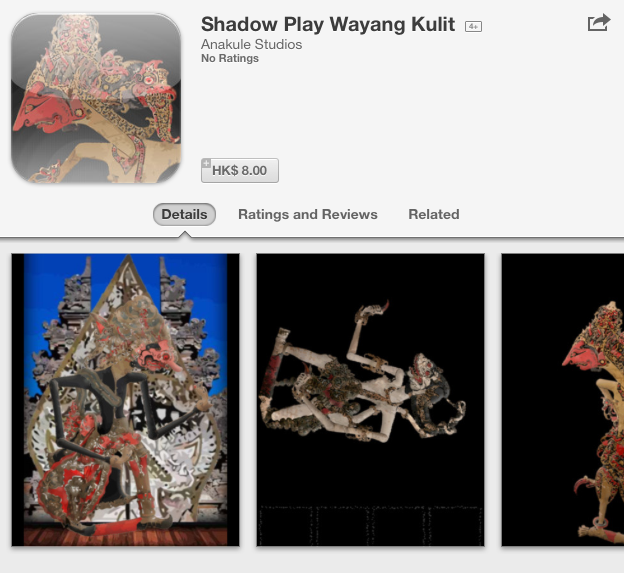
And finally a series of free little apps that bring various forms of Asian puppet theatre to the iPad, Shadow Play Wayang Kulit

Evernote Camera Roll 20130519 141445.

.

.

.

.

.

.

Notice that the stiffest tree is most easily cracked, while the bamboo survives by bending with the wind

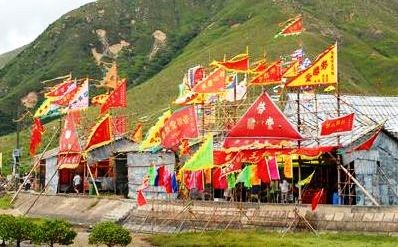
So said Bruce Lee, apparently. The reason for me quoting the Hong Kong legend is that it is bamboo theatre time in his home city. Throughout the year in town centres, village squares, on football pitches and car parks across Hong Kong these beautiful temporary bamboo structures spring up and disappear.

shek oThey house Cantonese opera performances at festival celebrations throughout the year. They are works of art in themselves. For those of you have not visited Hong Kong bamboo is the king of construction. We might have a harbour skyline from the future, but the scaffolding that allows the futuristic skyscrapers to be built is bamboo, not steel, even in 2013. There is good reason for this, it’s not just tradition. Hong Kong suffers from typhoons (or hurricanes if you are from the Americas) so if a big one comes in, a flying tower of bamboo does far less damage than one of steel.

So, our temporary theatres are built entirely by hand, using bamboo, usually by fewer than ten workers, and they are held together with nothing but plastic ties. The biggest theatres can hold up to 6,000 people. This also means they can be built in the most unlikely places. The one above is the car park of a seaside village, Shek O. The ones below are on a rocky sea outcrop on the Po Toi Island.

Picture1Sadly though, in the last couple of years, I’ve noticed that these beautiful buildings are being replaced by steel-frame stages, rather than bamboo, because, apparently, they are easier to assemble and require less-skilled workers. Such a shame! However, and even more sadly, the decline of the bamboo theatres matches the decline in the popularity Cantonese Opera itself. My students tell me that it is viewed as something for our grandparents.

There is a really interesting article here from the Urbanphoto blog with an interview with bamboo master Ying Che, who married into a family of bamboo masters going back three generations. I’ve Tweeted it too.

Hau wong - Tai OThere is a great irony in all of this though. In an attempt by the Hong Kong government to compete with Singapore as THE asian arts hub, we have under development a project known as the The West Kowloon Cultural District (WKCD). Located on waterfront reclaimed land, the district will feature a new museum of visual culture, numerous theatres, concert halls and other performance venues. It has been dogged by a series of problems, but is now finally making progress. I celebrate it – it’s a wonderful and expansive project. One of the first buildings to have its designs approved is the Xiqu Centre. According to the WKCD’s website;

The Xiqu Centre will symbolise the importance of Xiqu [Chinese/Cantonese Opera] and its rich heritage for our city. It was conceived to support and promote Xiqu as a contemporary art form making it accessible to new audiences, and keeping this remarkable piece of our heritage alive for future generations.

This is what it will look like:

west-kowloon-bamboo-theater-12So how did we celebrate the finalizing of the design for Xiqu Centre?

We built this:

west-kowloon-bamboo-theater-0In fact Ying Che and her family built it. If you click on the image below, you can see some images:

west-kowloon-bamboo-theater-2You can get a better flavour of the theatre in this video:

And why am writing about all this? Well I think Hong Kong seems to have managed to marry modernity and tradition in a way that other Chinese cities haven’t. I hope that by promoting Cantonese Opera and its heritage through the yet to be built Xiqu Centre will keep our bamboo theatres alive too. I’d hate to see them disappear and be replaced by their steel contemporaries. I hope the WKCD people see the beauty in building a bamboo theatre every now and again on their spanking new site. I think I might start a campaign……anyone join me?

Green Light

I have a backlog of interesting stuff to share today, so I’m going to give you an eclectic mix to be going on with.

Firstly this, which leads to a new ‘category’ on my blog (technical theatre), that caught my eye. I think it was because, for the first the time in my teaching career, one of my senior students, Alex, has gained a place on a very prestigious technical theatre course and we are delighted and excited for her.

LED-FresnelWe live in a Green world and I had never considered this. An article from The Stage, written by Matthew Hemley,  entitled Designers fight to save traditional theatre lightingI don’t know anyone who doesn’t at least attempt to live an environmentally sustainable lifestyle,  but this is an interesting one…….

Olivier award-winning lighting designers Paule Constable and Neil Austin are spearheading a global campaign aimed at protecting the future of the traditional tungsten light bulb in theatre productions.

The campaign is lobbying major manufacturers to continue production of tungsten lamps, following concerns that legislation banning retailers from selling incandescent light bulbs to domestic users has resulted in manufacturers producing fewer of them. The law was introduced in 2009, but has been phased in gradually over the last three years.

Lighting designers claim that traditional bulbs are vital for theatre productions because of the natural and warm light they provide, and the fact they can be faded up and down. They argue that they are needed alongside other light sources – such as LED lamps – to ensure lighting can be tailored according to a production’s needs.

The campaign’s Facebook page states that manufacturers are “starting to push towards other sources and are phasing out tungsten lamps by stealth”.

Austin, who won an Olivier award for The White Guard at the National Theatre, said he could understand that some manufacturers view theatre as a small part of their output, but added: “What we are trying to do is make sure they don’t stop manufacturing these types of lamps, which have a very specific usage for us. As lighting designers, we deal with manipulating people’s emotions to help tell a story. We want to make sure we are left with the tools we need to achieve that.”

stage

Lighting designer Michael Hulls, who initiated the campaign, said there was particular concern around some lamps that are considered domestic but which “are very widely used in live performances and theatrical luminaires”.

He said that legislation around these products was unclear.

“A special-purpose exemption applies to theatrical tungsten lamps but we have yet to ascertain exactly which are in and which are out, especially if they cross the line into domestic use,” said Hulls.

He added: “It’s not just about legislation. The campaign is focused on lamp manufacturers who may be considering, for commercial reasons, to de-invest in tungsten research and development, and attempt to lead us into an LED-dominated future where it becomes increasingly difficult to source theatrical tungsten lamps.”

Constable, whose credits include War Horse, stressed that the campaign is not anti-LED lighting.

“The campaign is not saying we should not be responsible users. But it says, ‘Please don’t assume we [will] continue to do what we do with resources being taken away from us,” she added.

prg-theatre-lighting-installation_gallery4_main

Green arts organisation Julie’s Bicycle is supporting the campaign. Founder and chief executive Alison Tickell described the increase in LED lighting as “a good thing”, but said: “Given the low number of hours they are actually on, tungsten stage lighting creates a comparatively small environmental impact, especially in comparison with front-of-house and auditorium lighting, which create between 9% and 15% of a theatre’s overall carbon emissions.”

Tickell added that until “an aesthetic equivalent to tungsten fixtures” exists, manufacturers should work with creative practitioners and designers “to make sure new products are fit for purpose”, and claimed that legislation should allow for a “phased transition”.

The campaigners have already had assurance from Osram, one of the biggest manufacturers of tungsten bulbs, that it will continue making the lamps.

“We appreciate the industry’s passion for this trusted lighting solution, and look forward to continuing to illuminate today and tomorrow’s entertainment stars on countless stages and studios with our Osram tungsten lamps,” it said.

Shame about the last paragraph, though!