Driving home from work recently I heard an interview with Chinese-American choreographer and director Shen Wei. Sometimes late to the party, I knew I had heard the name before and with my interest piqued by the interview, which ran as a strand on the BBC World Outlook series, I went digging. Shen came to international renown as lead choreographer at the Beijing Olympics in 2008. In itself this says something about the man and his international standing. To be invited to return to a country which would have once banned and perhaps renounced him for taking citizenship elsewhere, is powerful statement about his talent. It wasn’t this so much that attracted my attention, but his childhood in Hunan Province. Born during the cultural revolution, his father was a director of a Chinese Opera company and he literally grew up in the theatre. This is the BBC interview
Shen went onto study Chinese Opera at The Hunan Arts School and then to perform lead roles with the Hunan State Xian Opera Company. His journey from there to his own celebrated dance company in New York, Shen Wei Dance Arts is a fascinating one and detailed in these two interviews:
.
Clearly never a man to stand still, Shen is now gaining credence as a visual artist too and there is a clear link between the two art forms in much of his dance, easily illustrated by his piece for the Olympics:
.
You can watch the same video, with an english commentary here. In another piece, Second Visit of the Empress, he brings together Chinese opera and modern western dance in a wonderful fusion of the two forms:
.
Before leaving China Shen was one of the founder members of the Guangdong Modern Dance Company and was asked back in 2000 to create a piece called Foldingwhich particularly caught my attention with its stunning imagery. Shen not only choreographed Folding but also designed the costumes, set and make-up.
.
Like much contemporary dance, it is hard to draw a line between dance and theatre and the excerpts above make that evident in Shen’s work. For the boy who grew up back stage, the act of making theatre would appear never to be far from the surface.
Continuing from the previous post, I wanted to share the final article mentioned, written by Lyn Gardner in her Theatre Blogfor The Guardian, Is the playwright dead? Most of the theatre my students make is collaborative and new, applying and testing the creative skills and performance theory they have learned. However, they are also empowered by interpreting a written text and are challenged by that process in equal measure. As always, I find myself agreeing with Gardner. I have left her original links in the article as they lead to further interesting reading.
Is there an anti-writer trend in British theatre? Only if you insist on a very narrow definition of what constitutes new writing and fail to cherish playwriting in all its rich variety
“There has been a shift of opinion against playwriting, in favour of collective methods of theatre. The very activity of playwriting has been attacked as individualistic, undemocratic and even immoral,” declared playwright David Edgar when it was announced that he would be this year’s visiting professor in drama studies at Oxford and giving lectures and hosting discussions in February.
Blimey! Edgar talks of an “anti-writer trend”. That sounds serious and worrying. I’d like to think that he was being a little tongue in cheek because, after all, he also pointed out that “for the first time in at least 100 years, new work has overtaken the old work in the repertoire”, which can surely only be a good thing for writers of all kinds. Then there’s the roll call of people he’s invited to take part in discussions over the week, who include, among others, Bryony Lavery, David Greig and Chris Goode, who definitely all write plays but who often also create work in many different ways via collaboration, and for whom text plays distinct roles in different contexts.
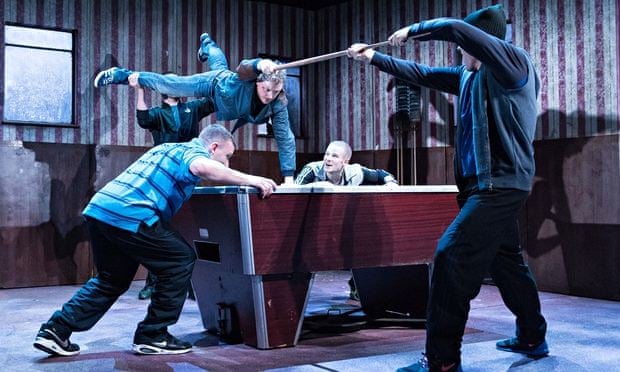
When I was talking to Scott Graham of Frantic Assembly recently, he talked eloquently about working with Bryony Lavery on Stockholm and how she expressed the wish to write silence, condensing a scene to the point where “words were redundant”. That’s still very much writing in my book, and I bet most other people’s, too.
Frantic Assembly
But even if what Edgar is saying is just a provocation, I’m really not sure that talking about an “anti-writer trend” is either true or helpful. After all, the adaptations of The Curious Incident of the Dog in the Night-Time or Let the Right One In are still distinctly scripted plays however many other tools have been utilised to make them. And why wouldn’t all theatre-makers – and that includes playwrights – use all the tools available to them that they find helpful for a particular piece of work? The danger is that Edgar’s statement sets up the idea that different kinds of theatre are in opposition to each other, and that the individual playwright must be at odds and in competition with those making work collectively or collaboratively or using other kinds of theatrical languages.
It’s not a case that one kind of theatre-making invalidates another or steals money and resources away from others. There is room for all comers and different ways of working because different is good and invigorating – and variety adds to the richness of our theatre culture. What suits some as a way of working will not necessarily suit others or perhaps only at particular points in their career for particular projects. Bryony Lavery can work fruitfully with Frantic Assembly and write plays entirely on her own, too. Doing one doesn’t mean you can’t do the other.
David Tennant, Hamlet
Does the fact that we have a variety of methods of working mean that the individual playwright with a singular vision is an endangered species? Of course not. You only have to look at the programmes of our new writing theatres to see that’s not the case. The fact that……. theatres across the country may also programme other kinds of work, some of it made collaboratively, simply reflects the fact that most of those now directly involved in new writing understand that what is needed is a far wider and looser definition around what we mean by new writing. That doesn’t threaten the playwright; it potentially liberates and provides more opportunities.
David Edgar’s week of lectures and discussions do sound fascinating – you can read the programme and participants here. They will all be published online so watch this space.
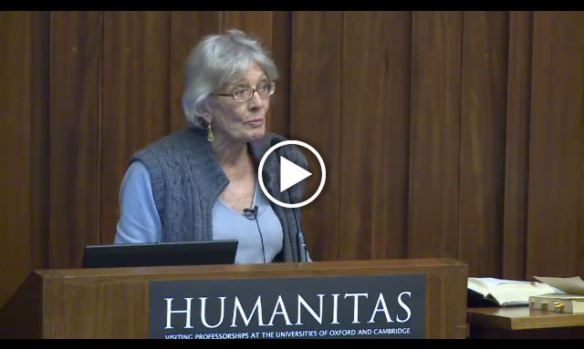
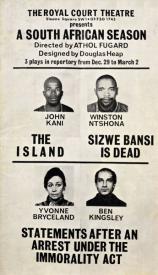
Today, I have stumbled across an astonishingly fascinating series of video recordings and I am compelled to share them straight away. They come from Humanitas, a series of Visiting Professorships at the Universities of Oxford and Cambridge which brings together leading practitioners and scholars to explore major themes in the arts, social sciences and humanities. In one of the strands, Drama Studies, the visiting professors so far have been actor Vanessa Redgrave, director Greg Doran, playwright Athol Fugard and will be joined this year by another playwright, David Edgar. All of them are giants in their respective fields. Fugard speaks in three videos; firstly about the defining moments in his life and work, then about staging his plays and finally about his playwrighting process. In his first video Doran gives a practical masterclass looking at what clues Shakespeare puts into the verse for the actor and in the second, another, masterclass, this time on how Shakespeare spins rhetoric for the actor. However, my favorite, are the series given by Redgrave, doyen of the theatre on both sides of the Atlantic as well as prominent social activist. Click on the image below to take you to the first of a series of four lectures and panel discussions, entitled, not surprisingly, Theatre and Politics.
The 2015 series, with David Edgar, promises to be equally interesting and provocative as he explores contemporary playwrighting from a number of perspectives. In an article in The Guardian born out of his appointment as Humanitas Visiting Professor, entitled Is the playwright dead?, he is quoted talking about the anti-writer trend that he considers to be prevalent in current collaborative theatre making. This notion will form the basis for his first lecture and the article itself, my next blog post.
So the first post of 2015 is a an easy one. A few weeks ago I shared a video about creating modern interpretations of Greek Chorus, made by the National Theatre in the UK (Group Chat). Since then they have released 3 more videos about various aspects of creating chorus as part of their Discover National Theatre strand:
.
Also part of Discover is the series of videos about Movement Direction, which are also a great little watch:
.
All short, but perfectly formed and super starting resources.
A fascinating project has recently wrapped up in London. A group of journalists from The Guardian newspaper, collaborated with theatre makers from the Royal Court Theatre to make a series of six ‘micro’ State of the Nation plays plays, running under the banner, Off The Page. There is a video introduction to the series here.
Each of the plays explores a different topic. Britain Isn’t Eating satirizes the UK government’s approach to food banks and the ‘feckless poor’. Devil in the Detail explores the emotional relationship that women have with clothes. PPE examines the power of politicians’ physical gestures – and the failure to engineer real change after the financial crisis.The Funereal Game explores racial tensions on and off the football pitch and the idea that sport embodies the country’s identity crisis. Finally, Groove is in the Heartexamines the changing relationship with music and technology. For each of the plays there is a making of article which you can click-through to via the links above. The videos of the plays are embedded there too. Whilst obviously written about UK orientated issues, the themes are definitely global and all the pieces are really interesting.
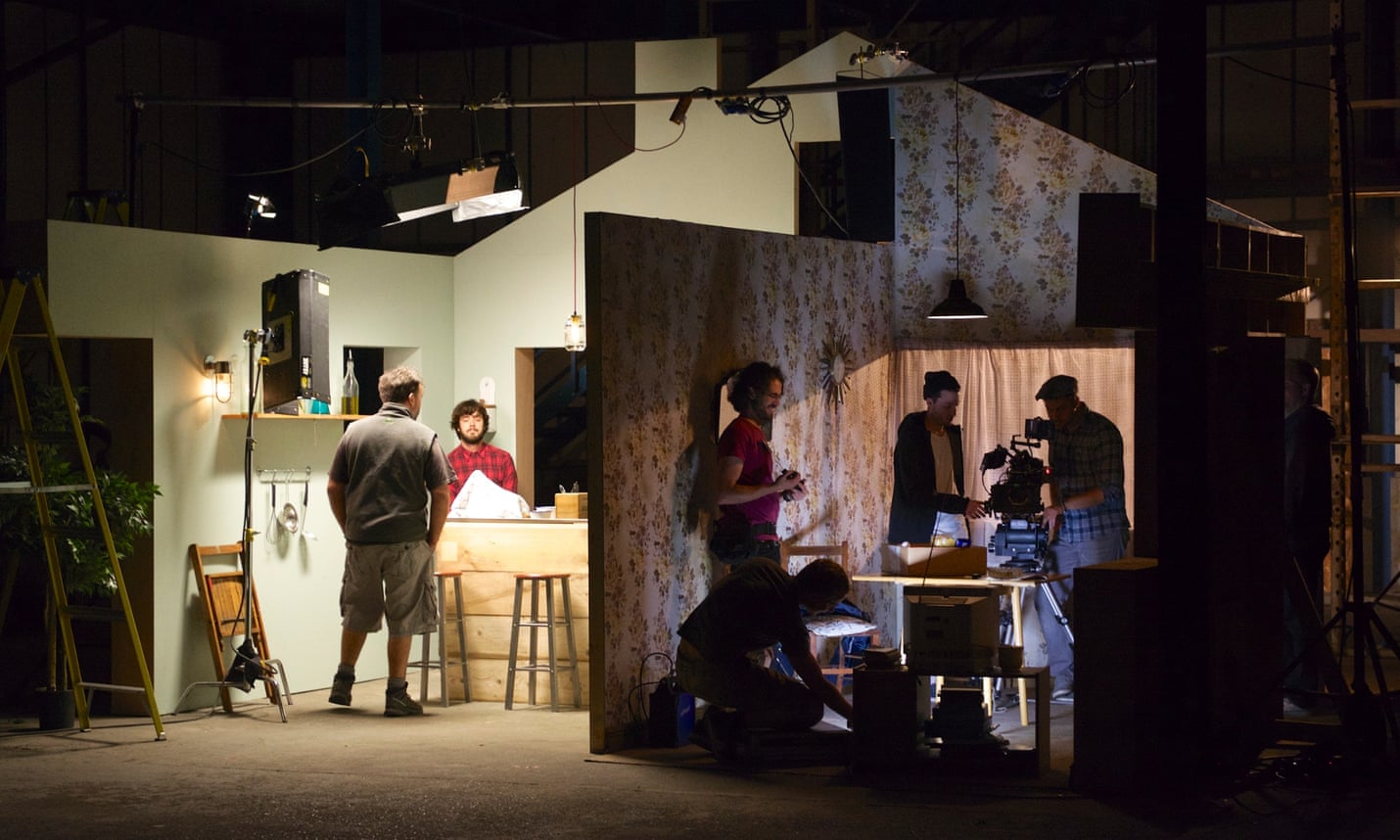
Each play used the same basic staging, but designed individually. A photo montage of the different designs makes interesting viewing here.
A quick share for today – a video from the National Theatre in the UK about playing Greek Chorus. Produced to tie in with their recent production of Medea starring Helen McCrory in the lead role, the video explores the portrayal and interpretation of the collective voice in modern productions – always a challenge for directors and actors.
.
Another interesting video, connected with the same production, is an interview with McCrory about her preparation for the role.
Two audio recording shares today. Firstly an interview, courtesy of Theatre Voice, by theatre critic Matt Trueman with verbatim playwright Alecky Blythe (and director Joe Hill-Gibbon) about her play Little Revolution. Performed earlier this year and receiving very polarised reviews, it explores the 2011 London riots. The interview gives a fascinating insight into the processes of writing and staging verbatim theatre. Blythe also writes about her approaches in The Telegraph, It looked a bit hairy. But I had to go.Interestingly, the same newspaper also gave Little Revolution one of it’s best reviews, calling it Absolutely Compelling.Truman’s own review of the play is a little more interrogating.
The second share, and not wholly unconnected, is an interview with writer and theatre maker Stella Duffy (and others) about the life of theatrical maverick Joan Littlewood, whose centenary has been marked this year by many events, not least the Fun Palace initiative, started by Duffy herself. Again a great listen about a woman who made theatre differently.
A super new resource, The Black Plays Archivehas just been launched in the UK. Curation started in 2009 and the aim is for it to be an online catalogue of the first professional production of every African, Caribbean and Black British play ever produced in Britain. It was born out of an idea by playwright Kwame Kwei-Armah and involves a considerable number of institutions from across the UK, with the National Theatre being the primary partner.
It contains Essays that can be read online or downloaded, Interviews (both video and audio) and recorded Play Extracts, either from their original staging or specifically recorded for the archive.
The plays are drawn from around the world by playwrights with an African or Caribbean heritage. Once complete the archive will be an incredible resource of black theatre writing. However, it is wider than that and includes interviews with directors, academics and practitioners that cover the whole spectrum of theatre making. For instance there is an essay from Dr Michael Pearce (academic, theatre director and native of Zimbabwe), Tracing Black America in black British theatre, which explores the rise of the Black Power movement in the US in 1970’s and how this was manifested in British theatre. This is a truly extraordinary and unique project and well worth an explore.
Three articles published over the course of the last week, by The Guardian UK, have caught my attention. The first, a review by veteran theatre critic Michael Billington, about a ‘play’ called 2071. I use the inverted commas advisedly at this point, as the piece has one actor, a scientist called Chris Rapley, who spends 70 minutes talking to the audience about climate change. Some might, and indeed have, called it a lecture, nothing more.
Some will argue this is not really theatre. But the idea that theatre should be exclusively reserved for fiction has been knocked on the head by a surge of documentary dramas and verbatim plays. And Katie Mitchell, who directed both this show and Ten Billion, realises that the eye needs to be satisfied as well as the ear. Rapley sits in a chair and, without notes, talks to the audience with an astonishing calm and command of facts for 75 minutes. Meanwhile Chloe Lamford’s design presents us with swirling video images behind him that illustrate Rapley’s arguments and have a strange beauty of their own.
The play is being staged at The Royal Court in London under the directorship of Katie Mitchell, who did a similar staging two years ago with a piece entitled Ten Billion where scientist Stephen Emmott (below) spoke about global over-population and its consequences. In fact Ten Billion was given the number 10 spot in the best plays of the year, according to one newspaper.
In this podcast from the Royal Court Duncan Macmillan (co-writer), Mitchell (director) and Rapley (speaking as scientist, co-writer and performer) talk to literary manager Christopher Campbell about the play.
.
I’ll leave it to you to ponder whether the classification as theatre is a correct one. Mitchell and Macmillan talk further, in the second of the articles I referred to earlier, about their reasons and the processes behind verbatim theatre of this kind. Climate change play 2071 aims to make data dramaticis written by Stephanie Merritt:
“As a dramatist, I’m interested in working with text in a different way,” Macmillan explains, when I meet them during a break in rehearsals at their south London studio. “There was the formal challenge of how to express Chris’s science, and what we could bring to him as theatre-makers – not just with a different audience for those issues, but in terms of technique and how to structure the material. For example, if Chris is writing a scientific paper or delivering an academic lecture, the convention is that you begin with your finding and go on to explain it. But that’s like Hamlet avenging his father’s death in the first five minutes. The simultaneous challenge we’ve had is how to take the anger and emotion out of the issue and at the same time make the data dramatically compelling to listen to.”
The subject matter is undoubtedly emotive, but more so political and therefore ripe for the theatre – even if it is a difficult subject to stage.
I am sure that it is no coincidence that on the same day Billington’s review for 2017 was published, he also wrote a rallying piece entitled Speaking truth to power: this is the rebirth of political theatre in which he talks about the resurgence of political theatre on the British stage at the moment, 2017 included. You can read the article yourself, but I’ll finish this post with his final paragraph which says much about the theatre I was brought up with, educated by and in which I believe passionately.
It is also something that seems part of our native bloodstream. Some years ago I was invited to take part in an international discussion of political theatre organised by the British Council in Santiago. After I had talked about the British theatre’s oppositional tradition, two French delegates treated my remarks with polite condescension. They observed that someone had recently staged a play in Paris about President Bush but that it had excited little interest. As we talked, I realised we were arguing from different premises. For my French colleagues, theatre was primarily an aesthetic discipline and something apart from life. From my entrenched Anglo-Saxon perspective, it was a vital part of life; and that inevitably embraces politics. I remain convinced to this day that among British theatre’s greatest strengths are its readiness to put our society under the microscope and its willingness to speak truth to power.
I wanted to share a short video today, an excerpt taken from a piece called Nowhere by Greek experimental theatre director, choreographer and visual artist Dimitris Papaioannou, (who incidentally was the creative director for the Athens Olympics in 2004). Nowhereis dedicated to Pina Bausch and was created to inaugurate the new main stage at the Greek National Theatre.
To quote the theatre’s website:
Nowhere is a work about the physical space of the theatrical stage. Constantly changing and defined by the men and women that inhabit it, it can be countless different places while designed to be nowhere at all.
The scene I’m sharing contains nudity, so be warned, but the reason it caught my attention will be obvious when you watch it. Simply stunning.
.
Known as the body mechanic system, it was used by Akram Khan in his piece Dust, part of a large work called Lest We Forget for the English National Ballet. Khan credited Papaioannou in the programme for the idea:
I have a feeling it might be making an appearance in some of my students’ work, minus the nudity I hope, given their reaction to it.

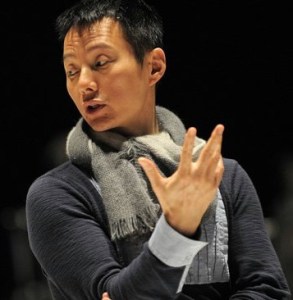 Driving home from work recently I heard an interview with Chinese-American choreographer and director Shen Wei. Sometimes late to the party, I knew I had heard the name before and with my interest piqued by the interview, which ran as a strand on the BBC World Outlook series, I went digging. Shen came to international renown as lead choreographer at the Beijing Olympics in 2008. In itself this says something about the man and his international standing. To be invited to return to a country which would have once banned and perhaps renounced him for taking citizenship elsewhere, is powerful statement about his talent. It wasn’t this so much that attracted my attention, but his childhood in Hunan Province. Born during the cultural revolution, his father was a director of a Chinese Opera company and he literally grew up in the theatre. This is the BBC interview








 Theatre Room Asia