Unknown's avatar

About Theatre Room Asia

IB Theatre Arts teacher

Stories that need to be told

I must be on holiday, as I have time post!

Today I want to share three videos that have at their heart the human want to tell stories, but primarily through theatre.

Firstly from David Binder an american theatre producer who is interested in taking performances off the stage. Here, at a TEDx conference he talks about how last summer he found himself in a small Australian neighbourhood, watching locals dance and perform on their lawns — and loving it. He shows us the new face of arts festivals, which break the boundary between audience and performer and help cities express themselves.

Then from Sam West, a hugely accomplished theatre director and actor. Whilst this is somewhat UK-centric he is essentially talking about how we, as theatre practitioners, should be telling everyone’s stories, whether funders and governments want us to.

And finally one from Shane Koyczan, poet and artist. His poem “To This Day” is a powerful story of bullying and survival, illustrated by animators from around the world.

Igniting Passions

For those of you that read my blog regularly, you know I have a fascination with site specific theatre. Today I’ve been reading about a extraordinary project by the National Theatre of Scotland, who are renown for works that push boundaries.  This new work, that is currently still ‘in progress’ struck a particular cord as it has the place of cars in our society at its heart. As someone who calls Hong Kong home, where the car is king, despite having one of the best (and growing) public transport systems in the world, I thought I would share it with you.

Evernote%20Camera%20Roll%2020130324%20161620

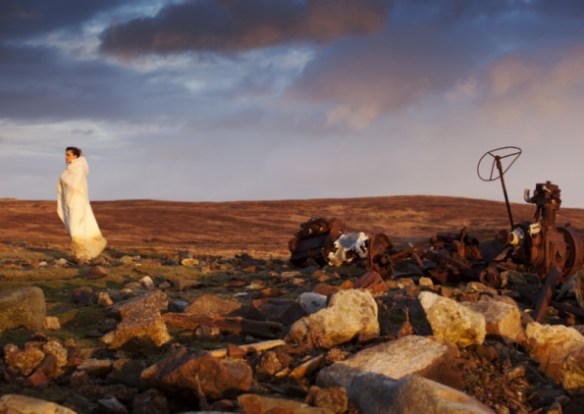
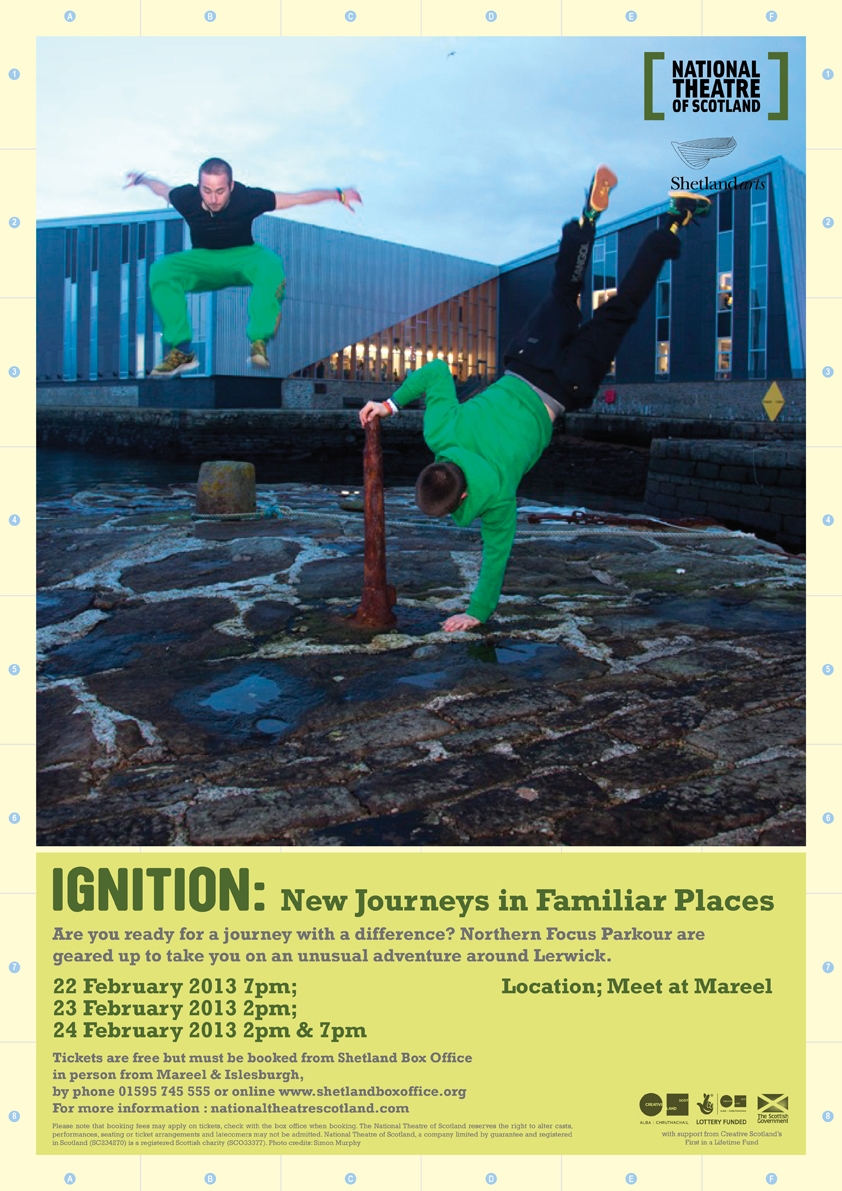
The piece is called Ignition and is set and takes place in the Shetland Islands in Scotland.The idea for Ignition grew from the death in a car crash of a young man called Stuart Henderson. It slowly developed into a project exploring the Shetlanders’ relationship with oil and the combustion engine. It has resulted in this joint creation, developed over the past over six months, by National Theatre of Scotland and Shetland Arts with members of the Shetland community. What makes it extraordinary is the way hundreds of individual stories (many gathered by Lowri Evans, dressed as the “White Wife” of folklore) meld into experience that everyone can recognise, identify with and participate in – rather in the way that you sometime see one big image made up of thousands of tiny photographs  (selection and combination by dramaturg Rob Evans). But, because you are part of the event, you are also making your own picture as you go along. The fire that lights Ignition is, it turns out, the seemingly simple blending of other people’s lives into our own and opening both into something universal.

ignition

By way of explanation, here is a quote from the NTS’s website:

Over the past six months, the National Theatre of Scotland has invited all of Shetland’s inhabitants to explore our bittersweet relationship with the automobile – how it shapes us, defines us, supports us, frees us, challenges our attitudes towards our dwindling resources and, sometimes, kills us. You have told us your stories and now we are ready to take you on the Ignition journey. Set in three locations across Shetland, the site-specific Ignition performances will carry you away on a shared car adventure. The stories will transport you to one indoor and two outdoor locations. At these locations you will see, hear and be a part of the stories that have been collected in the course of the Ignition project. Stories of Shetlanders who have given the White Wife a lift, knitted panels for the Car Yarns car, helped create the music written about the road from Sumburgh to Skaw, taken part in a Sunday Tea conversation, told us their secrets in the Car Confessional, or just taken time out to tell us their car stories. After ten thrilling days of immersive car-theatre between 20th and 29th March, Ignition culminates in a short, but unforgettable, one-off finale for all the Ignition audiences on 30th March in a stunning outdoor location in Brae. The stories will be experienced through exhilarating drive-in theatre, the movement discipline of parkour, music, hitchhikers, dance and text, and will take you on a journey that you will never forget.

If you click the image below, you can watch the BBC report on Ignition

Evernote%20Camera%20Roll%2020130324%20161631

NTS have also recorded a couple of videos about the project and you can watch them here:

and here:

Have a read of some of the reviews here – from The Scotsman, The Telegraph and The Guardian.

The National Theatre of Scotland’s own blog gives you a real feel of the whole creative process behind the project.

Evernote%20Camera%20Roll%2020130324%20161622

Challenge and Change

In a week where I have watched 13 fantastic, questioning and challenging pieces of devised GCSE Drama examination performances, I was appalled to read this article by Susan Elkin in The Independent.

I reproduce it here in full.  What do you think?

Two drama teachers were sacked for play where students acted out sexual abuse – but drama is meant to shock

Drama is meant to challenge actors and audiences – the teenagers were acting.

Indy

Two unnamed secondary school drama teachers have apparently been sacked by their school and are pursuing unfair dismissal claims.

Their offence? They taught GCSE drama to 15 and 16 year olds as it should be taught, in an uncompromising, rigorous, challenging way.

The students devised (that means worked out and wrote in drama jargon), produced, directed and acted in a short play – which is exactly what they’re supposed to be doing. I don’t know which GCSE drama syllabus they were using but devising your own work is in all of them.

The problem in this case was that the work – which was performed to friends and family – was about sexual abuse within the family and it depicted some pretty graphic activity, including a rape and oral sex.

It sounds – although I have only very samey newspaper reports to judge from – as if it was very powerful effective drama which really got to some of the people who saw it. One child wept and two more – including rather oddly – one of the actors, vomited. And a number of people reported afterwards, according to testimony produced at the tribunal, that they had found the experience a positive one.

My impression is that these teachers were actually doing a good job – making drama pose some very uncomfortable questions, which is exactly what drama is meant to do. It isn’t about putting on pretty bits of shallow, anodyne entertainment and does not begin and end with The Sound of Music or a pantomime version of Cinderella. Yes, it may have been unsuitable for a primary school group but these students were not children. They were young adults who – like it or not – will have experienced quite a bit of the world as it is, rather than as we might like it to be.

The mistake which these teachers made – and it’s hardly a sackable offence – was in failing to warn parents and friends that the play dealt with sensitive issues and was not suitable for younger children.

There is nothing remotely wrong with drama which upsets the audience and makes people think.  I find the blinding of Gloucester in King Lear intensely distressing. When I saw Starfish – a play presented by Y Touring which takes issues-based shows into school – I wept, at the end because it reminded me of the medical dilemmas faced by my father towards the end of his life. The last few moments of Katie Mitchell’s production of Ibsen’s Ghosts for the RSC with Simon Russell Beale and Jane Lapotaire still makes me shiver to think about it, nearly twenty years later.

But, when you see a drama, however much the ‘willing suspension of disbelief’ kicks in, you know, at some level, that these are actors pretending and that they will be in the pub half an hour after the show – or cursing the traffic as they drive home through it.

Teenagers in a school watching their friends know this as well as anyone. They understand how drama works. The issues are real but the action in front of them is not. Drama offers a way to tackle difficult issued impersonally. That is part of its job.

Pity then that this case should have been judged by people who really don’t seem to have a clue what drama is about or what it’s for. The tribunal judge, Lady Smith, has overturned the Employment Appeal Tribunal’s earlier decision in the teachers’ favour. This week she decreed that the case be reheard.

She was guided by the views of the local council’s ‘safeguarding manager for education’ – who is not, please note, a drama specialist. He watched a DVD of the performance and expressed shock that the pupils were ‘allowed to engage in such sexualised behaviour’. They weren’t. They were acting. And acting means that you pretend to be something that you’re not in a very controlled environment.  Actors – whether professional or amateur, young, middle aged or old – are NOT the roles they play or the actions they depict.

So, because a safeguarding manager (with a job title like that …) has experience in role play which is a therapeutic technique and not the same thing at all as drama, two teachers – who are apparently pretty good at what they do – have lost their jobs. Call that justice?

The Man’s ‘Method’

Today I am sharing a really interesting article by Simon Callow entitled Stanislavski was racked by self-doubt. It was published this week in The Guardian and I reproduce it here in full.

Konstantin Stanislavski as Don Juan.

.

.

.

.

.

.

This year marks the 150th anniversary of the birth of the Russian actor, director and theorist, Konstantin Stanislavski. If the anniversary is remembered at all, it will be with quiet respect. There was a time – not a time out of memory, though it seems distant now – when furious battles were waged in the theatre about acting: what it was and what it should be. In green rooms, in drama schools, and in the fiercely polemical pages of the theatre magazine Encore, the debate raged. It started around the time of the foundation of English Stage Company at the Royal Court theatre in the mid 1950s and continued until some point in the late 1970s, when all ideological and aesthetic discussions were abandoned in the face of economic trauma. The principal figures around whom the antagonists grouped were Stanislavski and the playwright and director Bertolt Brecht who, in the 1920s and 30s, articulated a theory of acting to rival, and indeed to oppose, the Russian’s. Broadly speaking, Brecht’s approach was political, Stanislavski’s psychological; Brecht’s epic, Stanislavski’s personal; Brecht’s narrative, Stanislavski’s discursive. Brecht’s actors demonstrated their characters, Stanislavski’s became them; Brecht’s audiences viewed the actions of the play critically, assessing the characters, Stanislavski’s audiences were moved by the characters, identifying with them; Brecht’s productions were informed by selective realism, Stanislavski’s aspired to poetic naturalism.

As Stanislavski had done with his Moscow Art theatre, Brecht created an acting group, the Berliner Ensemble, whose practice embodied and demonstrated his theories; the Ensemble’s visit to London in 1956, the year of Brecht’s death, had a seismic effect on British theatre, an effect that only started to fade in the last years of the 20th century. The Moscow Art theatre, meanwhile, had started to calcify; when Stanislavski’s original productions, still in the repertory, came to London they seemed preserved in aspic. Brecht and his theories made all the running, both aesthetically and politically, chiming with the British leftwing puritan tradition, resulting in productions that were bare, cool, politically explicit. The German’s influence, first felt in Joan Littlewood’s productions, was a formative factor in the unique populist style she forged for her Theatre Workshop; it informed a great deal of the Royal Court’s house style, in physical productions, in new plays, and in acting. It was also at the root of Peter Hall’s new Royal Shakespeare Company, and – sometimes a little incongruously – became part of the many-hued fabric of Laurence Olivier’s National Theatre Company, which produced a number of Brecht’s plays, performed new plays (by John Arden and Peter Shaffer, for example) heavily influenced by him, and applied his lessons to classics such as Farquhar’s The Recruiting Officer, starring Maggie Smith, who proved to be a brilliant, if somewhat unexpected, Brechtian.

But Stanislavski had been a force in the British theatre long before Brecht. His system had been taught in drama schools from the 1920s, and, slowly at first, but increasingly, leading British actors embraced his quest for psychological truthfulness over mere theatrical effectiveness. John Gielgud, Peggy Ashcroft, Michael Redgrave – but not, significantly, Olivier – endorsed his work; after the war Paul Scofield did the same. The huge popularity of 1950s film stars such as Montgomery Clift, Marlon Brando and John Garfield gave currency to the extremely limited version of Stanislavski’s system created by their teacher, Lee Strasberg, who coined the phrase The Method for his Stanislavski-lite version of it. Essentially, Strasberg elevated one aspect of Stanislavski’s work – emotional truthfulness – into the whole theory. Not only was this a crude reduction, it ignored the constant development and refinement of the theory, which preoccupied the Russian until the day he died, weighted down with international honours, in Moscow, in 1938. But by then the Soviet cultural nomenklatura had started the process of ossification that led to the lifeless productions London saw in the 1960s, a bitter paradox for a man whose entire life in art had been an unceasing quest for renewal, an unending struggle against the formulaic, the conventional, the self-referential.

In fact, Stanislavski’s life had been a series of paradoxes. Born Konstantin Sergeievich Alexeyev, the scion of a wealthy merchant family with interests in fabric, Stanislavski (he changed his name to avoid the obloquy that a career in the theatre might have brought on his family) was fascinated by acting from his earliest days, though he was always troubled by a certain self-consciousness, except, he noted, when imitating other actors, and then, he said, he was just plain bad. He acted enthusiastically with his fellow amateurs in the group known as the Alexeyev Circle, which he had founded when he was 14; he directed the plays and invariably took the leading role. Thanks to his insistence on the highest levels of presentation (bankrolled by his family), the group was a great success, and Alexeyev, as he still was, was prevailed on to become the head of one of the imperial dramatic schools. While there, he met Vladimir Nemirovich-Danchenko, who was running a school himself. The meeting at which they discussed the possibility of founding a theatre company lasted 18 hours, ending at Stanislavski’s house just outside Moscow the next day. Nemirovich-Danchenko, a highly cultured man, sophisticated and worldly wise, had written several successful plays; Stanislavski was something of a naif, with poor literary judgment and little social ease. Despite differences in background and temperament, they found themselves in such intense accord on every topic concerning the faults of the Russian theatre and the remedies for them, that the theatre they had convened was born there and then. The question of division of labour within what they decided to call the Moscow Art theatre was answered by the formula suggested by Stanislavski and was, subsequently, troublesome: he was to have responsibility for form, Nemirovich-Danchenko, content.
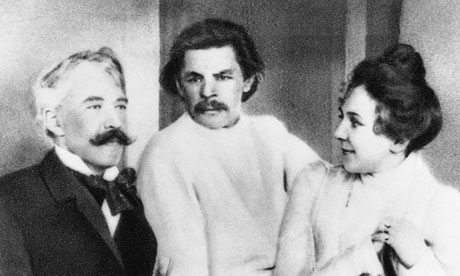
Maxim GorkyTheir first production, a historical epic by Alexei Tolstoy, was a success, largely due to the painstaking research undertaken for the costumes and set. Subsequent productions were less successful, including a Julius Caesar with Roman costumes and settings of impeccable archaeological credentials but that never came to terms with the play. Several productions were cancelled because of problems with the censor. The men quickly came to the point where they had to either have a huge success or sink forever: Nemirovich-Danchenko proposed that they perform a play that had flopped at its premiere, The Seagull, by short-story writer Anton Chekhov. Somewhat against his will – he neither liked nor understood the play – Stanislavski agreed. When the time came to stage it, he withdrew to his dacha, sending his elaborate mis-en-scene back to Moscow page by page, while Nemirovich-Danchenko rehearsed the actors – minus Stanislavski, who was playing the crucial part of the writer, Boris Trigorin.

Eventually he returned, the play opened and was a huge success. Stanislavski’s flair for creating atmosphere had resulted in an entirely new theatrical experience, in which the voices and characters were elements in an embroidery of sounds of nature and daily life, while the action was broken up to create the maximum poetic effect from the pauses and disjunctions of household routine; great ingenuity was exercised in filling these pauses with physical actions that would justify them. A hypnotic effect, a mirage of real life, was created: not strictly naturalism, but a poetry of the everyday.

The production’s success saved the theatre, which thereafter adopted the symbol of a seagull as its mascot. The author, however, though pleased his play had been liked (especially in comparison to its disastrous first production in St Petersburg) was far from happy with the staging, later ribbing Stanislavski by saying in his earshot that his next play would be set in a country where there were no crickets or mosquitoes to interrupt people trying to make conversation. Chekhov felt, too, that Stanislavski had misconceived the character of Trigorin. This was a recurring theme in Stanislavski’s career, both as director and actor: he had a habit of mentally substituting another play and another character, drawn from his own imagination, for the play and the character the writer had actually written. His literary sense was always poor; he was not an avid reader. Indeed, according to Nemirovich-Danchenko, he was technically dyslexic. He had great difficulty with words (learning them, even speaking them); off stage, too, he was famous for using the wrong word or for not being able to remember the one he needed. To what extent this influenced the development of his system, which often seems suspicious of language, is an interesting question.

Stanislavski was impelled to develop his system because of his dissatisfaction with the work he and his fellow actors were doing in the repertory that succeeded The Seagull: the three remaining plays of the Chekhov canon, Uncle Vanya, Three Sisters and The Cherry Orchard, and the first plays Maxim Gorky wrote for them. Stanislavski felt the company’s acting – his own as much that of his fellow players – remained painfully self-conscious and imitative; it lacked the pure “truth” he conceived of as the prime object of the actor’s art. From his earliest years, he had been plagued by the sense of self-consciousness: tall, handsome, graceful, intelligent, he was everything but spontaneous. Nemirovich-Danchenko describes what a favourable impression Stanislavski made on him at their first meeting: how serious, how thoughtful, how unlike an actor he seemed, neither loud nor vulgar nor self-promoting. The impression above all was of naturalness; the result, Nemirovich-Danchenko observes, of many hours practising in front of the mirror. By all accounts Stanislavski was richly endowed by nature to act. Throughout his autobiography, My Life in Art, however, he frets about not having been a great actor. It’s clear that if he had stopped thinking about it for a moment, he would have been. He saw this in himself, and attributed it to his fellow actors. The harder they worked, the worse they seemed to get. Exhausted – he had played the leading part in most of the productions, as well as devising the mis-en-scene for many and directing others – in 1910 he took a sabbatical year to try to solve the riddle.

He spent much of that time in Italy, closely observing great actors such as Tommaso Salvini and Eleanora Duse and trying to fathom what appeared to be their effortless inspiration. He came to the conclusion that they believed in what they were doing, and this belief gave them the capacity to be true to their inner emotion, despite the public nature of the stage; it created great relaxation, too: they seemed not to suffer from tension. At this point, Stanislavski turned his eyes on himself. Was he relaxed? Hardly ever. Did he believe in what he was doing? Almost never. But when had he been relaxed? When had he believed in what he was doing? When had he been good? He remembered certain passages of certain performances he had given. Why had they been remarkable? Generally, he discovered, because they were specific, rooted in either personal experience or memories of behaviour that had impressed him. This seemed to be the key. What if an entire role were to be constructed in this way? One would believe in every minute, and then relaxation would naturally follow: not an externally achieved relaxation, which he knew from trying made little or no difference to the performance, but a genuine, spontaneous freedom.

Something else that differentiated these great actors from – well, from him, for example – was that they knew why they did what they did. Their characters seemed to do everything for a reason: they always seemed to want something, and every action was for the achievement of this want. So there was another principle. Armed with his discoveries – the principles of belief based on the use of personal memories, relaxation and action – he triumphantly announced them to the convened actors of the Moscow Art theatre group. “I have discovered the principles of Art!” he cried. “Oh no, you haven’t,” they replied. “Acting’s not like that at all.”

From that point on, Stanislavski was something of a stranger in his own house. His relationship with Nemirovich-Danchenko, always fraught, became openly hostile, especially after the latter (by now a Communist Party member and head of all of Moscow’s dramatic theatres) publicly humiliated him by taking the leading part in The Village of Stepanchikovo away from him at the dress rehearsal, telling him he had failed to bring it to life. The company itself, during the turbulent years of the post-revolutionary period and the civil war, spent a great deal of time touring Europe and America. Abroad, the Moscow Art theatre was synonymous with Stanislavski, and his work (both as director and as actor) was universally acclaimed; his books, often clumsily translated and eccentrically published, became highly influential. Back in Moscow, he was increasingly marginalised. He eventually created the Studio theatre in which to test and establish his ideas, and then a Second Studio and finally a Third. Over the remaining 25 years of his life he taught more and more, modifying, adapting his principles, but never doubting the truth of those first discoveries. The founder members of the company never quite came round to them, and when they worked with him, he had to bargain with them, offering them large parts in his productions if they would agree to think in terms of the beats, actions, activities and affective memories. The younger actors embraced his ideas enthusiastically, but they then outstripped him in boldness and experiment; again he felt isolated within his own company, although, as he had always done in the past, he came to acknowledge their vitality and renewed himself by advancing into their territory with a radical and controversial production of The Government Inspector.

Meanwhile, he pushed his work further and further away from a simple-minded insistence on the primacy of emotion and psychology, exploring physical action and the crucial importance of rhythm in acting. These later developments have scarcely penetrated into western drama training, though they continue to be used and explored in the former eastern bloc, as has the work of Stanislavski’s pupils, and the results can be seen in the astonishing drama produced in that region, by theatres such as the Rustaveli theatre of Georgia, the Vilnius State Youth theatre, the Maly theatre in St Petersburg. It can also be seen in the impulse towards so-called physical theatre so typical of British theatre in the last couple of decades. In the west, Stanislavski’s work in its earlier phases is mostly deployed in drama schools. And it is here that it has been deeply influential. Because the majority of actors in the mainstream work within the bounds of psychological realism, particularly in TV and on film, Stanislavski’s formulation of the principles of acting is the foundation of most actors’ approach: connecting the emotional life of the character with one’s own; identifying their wants and actions; seeing how they fit into the play or script. Stanislavski was the first to identify these things, and to formulate a way in which actors could work on them, beyond imitation or intuition.

Brecht’s notions that acting is the servant of the story and that the audience needs to know no more of the character than is necessary for the comprehension of the narrative; that gesture is the actor’s key tool, and that the quest for the crystallising gesture is his or her main task; and that making the audience aware of the contradictions of the situation being represented is the purpose of the theatrical event seem not to have endured.

Stanislavski’s fascination with human character, its diversity and complexity, has endured, though there remains, embedded in his system, a deep suspicion of actors and their ingrained proclivity for self-consciousness, for superficiality, for the conventional and imitative – the things of which he so profoundly suspected himself. His star pupil, Michael Chekhov, though he subscribed to Stanislavski’s analysis of acting, had a different view of actors. He believed actors should preserve in themselves their first joyous impulses towards acting – at school, at home, in the street – their natural ease of assumption of character, their fantasy, their ready connection to their imaginations, and that out of that would come the sense of natural freedom that Stanislavski found so elusive. Playful Stanislavskian acting, fantastical Stanislavskian acting – now that’s something to consider. The part of him that knew spontaneity was at the heart of acting would surely have warmed to that.


Fo-Fighting

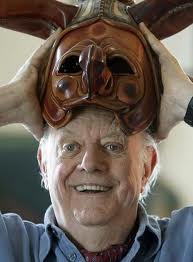
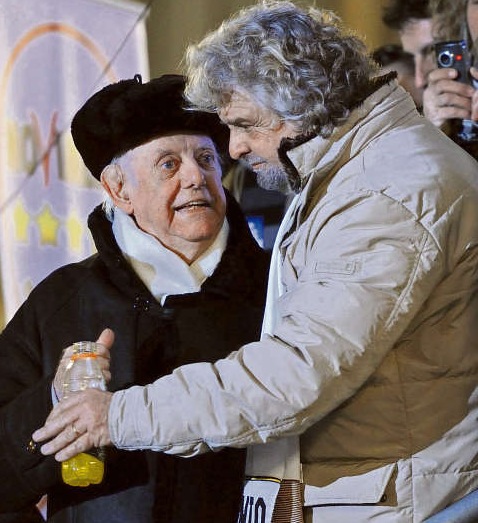
One of my favourite playwrights is Dario Fo and I was reminded of this today, reading an article about the elections in Italy. Fo, 86, is best known for his play Accidental Death of an Anarchist, inspired by the death of a man in police custody in 1969, and has long been a leftwing hero in Italy. He has spent a career writing about injustice and political corruption and together with his wife, Franca Rame, also a playwright, has been one of Europe’s most formidable social commentators. He was awarded the Nobel Prize for Literature in 1997 which places him amongst the true theatrical greats – Harold Pinter, Samuel Beckett, Wole Soyinka, Jean Paul Sartre, George Bernard Shaw even.

fo 2I’ve directed a couple of his plays – Accidental death of an Anarchist, Can’t Pay Won’t Pay – and been in a few too – Trumpets and Raspberries, Mistero Buffo. One of my favourites is The Virtuous Burglar.

He started writing in 1958 and is still pumping them out today and all the time has been a thorn in the side of the Italian government. Recently he ran for the Mayor of Milan and this week has been outspoken in his support of Beppe Grillo, a comedian turned politician who has just captured over a quarter of the Italian vote, throwing the country into political crisis and unsettling a Europe that is still teetering on the edge  of financial crisis. You can read what he has to say  in an article entitled We need a surreal fantasist like Beppe Grillo to rescue Italy, says Nobel-winning playwright Dario Fo.

fo.

.

.

.

.

.

.

.

.

.

.

.

A good potted biography of him can be found here and if you can speak Italian, have a look at his own website www.dariofo.it

In fact, if you are reading this in Hong Kong, you catch a performance of Accidental Death of an Anarchist at the Fringe Club Underground Theatre this week. I highly recommend it!

Digital Theatre

One of things that has frustrated theatre teachers and students for years is a problem of visual resources. Plays are are rarely recorded in their original form – i.e. using the stage and the set on which they were performed.  If they were, it was a single camera shot that meant most of the subtly of performance and dramatic tension was lost. The alternative was to film a version using the same actors but in a host of different locations, in essence turning from a piece of theatre into a movie – again not much use for students of live performance.

CaptureHowever, in the last couple of years this has begun to change, thankfully. Digital Theatre is a resource that is growing rapidly, capturing British theatre in its original form. This company are building their range of productions and they can be accessed in a variety of ways at quite low cost – sadly not much in life is free.

This is a trailer for their recording of Abi Morgan & Frantic Assembly’s Lovesong, and you get a real sense of the theatricality they have managed to capture.

They also have a daily blog, THE JOURNAL – A Global Culture Mix which whilst not always having a theatre focus, does share some interesting bits and pieces. This week they have started to use guest editors on the journal, and their first is Michael Attenborough, a very well respected director. Take a look!

If anyone of you know of any other similar online services, I would really like to know and share. Please leave a comment if you do.

The Artists Are Revolting

My post today is for arts students, teachers, educators and professionals everywhere. As the economic recession in the West sees funding for the arts slashed, as political dogmatism sees arts education removed from national curricula and as some societies continue to fail to understand the relevance of arts in their culture I was delighted to read this in the Huffington Post, written by Bruce E. Whitacre. A real call to arms!

I reproduce the article here in full.

Theater Education Programs Are in Demand for Workforce Creativity

Imagine a group comprised of accountants, tech executives, actors, corporate CEOs, playwrights and theater directors engaged in an urgent conversation. These rather divergent personalities are all discussing the state of theater education in America and its impact on our country’s economy, culture and future. They all agree that our nation’s future workforce can’t afford a curtain call on creativity.

Recently, IBM surveyed global CEOs and found that they view creativity as the most important leadership competency for the future. But what are we doing as a country to secure this vital resource? A significant number of young people today, when they enter the workforce, will never have been exposed to the valuable skills that come with arts education and specifically the theater experience — thinking on one’s feet; effectively communicating; practicing and rehearsing; writing; and collaborating as a team. This is a missed opportunity. According to the President’s Committee on the Arts & Humanities, in its groundbreaking report “Reinvesting in Arts Education,” arts education is a particularly powerful tool in reaching students who are otherwise turned off by standard school subjects.

??????????????????????Yet, some surveys on arts participation report that fewer than half of adults have participated in arts lessons or classes in schools – a decline from about 65 percent in the 1980s. In fact, government and arts education groups, as well as theaters themselves, have documented a nationwide decline in arts education of upwards of 40 percent. Most of the young people at risk of losing access to arts education come from disadvantaged communities.

The good news is that this meaningful conversation happening at the intersection of the corporate and arts community has yielded much more than just talk and good will. It has in fact led to a nationwide campaign called Impact Creativity, launched with a $250,000 grant from Ernst & Young and its CEO Jim Turley, to sustain and grow theater education programs serving more than half a million disadvantaged youth across the country. Ernst & Young employees have even recorded testimonials about theater education which can be viewed on the Impact Creativity website.

As a former accountant turned theater director and playwright turned non-profit executive, the synergy that feeds Impact Creativity and its otherwise disparate participants makes perfect sense to me. Over the course of the last 10 years, as executive director of the National Corporate Theatre Fund (NCTF), an association of 19 of the nation’s leading regional theaters, I have been engaging a broad cross-section of individuals across the country with a passion for theater education to explain the challenging circumstances around ensuring that all young people receive meaningful and beneficial arts education.

A perfect storm of state and local budget crises, the lingering recovery in philanthropy, and policy challenges in schools such as a hyper-focus on testing, as well as a resistance by local schools to spend precious resources on field trips to theaters, are keeping thousands of kids from seeing live theater even at greatly reduced prices, or even for free in many cases.

It is clear that challenging times are bringing out new solutions. Through the umbrella of the Impact Creativity campaign and the 19 NCTF theaters, we are able to hold a truly national conversation among the theaters themselves, prospective donors, and advocates about how to strengthen education offerings and challenge the status quo. We are working to address the issue of fragmentation in arts education which can make the entire sector increasingly vulnerable. Programs can benefit from a sharing of best practices across various theaters, assessments of nationwide education trends and using new technological tools.

In traveling around the country to visit with NCTF theaters, I have the amazing privilege of seeing inventive programs that take theater and young people to surprising places. The Illinois Institute of Technology, for example, uses the Goodman Theatre’s (Chicago) production of A Christmas Carol as part of its STEM curriculum to teach physics through stage mechanics and special effects in the show. In Rhode Island, Trinity Repertory Company has one of the country’s most dynamic and robust acting programs for children on the autism spectrum which uses theater based techniques to develop children’s voices and movements ultimately boosting their self-confidence, self-awareness and creativity. Hartford Stage, in partnership with Wells Fargo, has brought to life the bank’s financial literary curriculum through performance-based theater exercises and improvisational activities for middle school students. And at the Seattle Repertory Theatre, young women from diverse backgrounds are participating in the Y-We Speak program to create an original theater piece based on their life experiences empowering them with leadership skills.

These programs have shown me that enriching the nation’s youth through drama is inextricably linked to preparing a robust creative workforce of tomorrow. Strengthening this link, with partners in the arts and the corporate community, remains critical to the social, cultural and economic fabric of our communities. Impact Creativity will be at the nexus of these conversations in the year ahead. Join us.

And there is more. New findings from the Adobe State of Create Study suggest a global creativity gap in the world’s largest economies: US, UK, Germany, France and Japan. Click the graphic below to read the headlines of their report

adobe1.1-650x482

Even the BBC are running a series on the value of the arts to our economies and in our societies. Click the image below for their video report and article, Putting a price on the value of art:

Capture1

A World Feast

The phrase ‘global village’ sprung to mind when I read what I am going to share with you today – on a number of levels. The Young Vic and Royal Court theatres in London have collaborated to produce a new musical, Feast, that spans 300 years, takes in five countries – and needed 10 writers in an ambitious attempt to dramatise the culture and belief system of Yoruba.

Feast, at the Young Vic.

.

.

.

.

.

.

.

A piece truly worthy of the title of world theatre – not only in its content but how it was created and by whom. I reproduce here, in full, an article by Maddy Costa that appeared in The Guardian this week that tells the fascinating story of Feast‘s conception and development.

Feast: the Young Vic goes Yoruba

There’s a party going on. Damon Albarn is busy improvising on a thumb piano. Sola Akingbola, the drummer from Jamiroquai, is playing a shuffle on a shekere (a large maraca strung with beads). And Cuban dancer Yanet Fuentes is shivering her hips to the rhythm. In the middle of it all sits theatre director Rufus Norris – the man responsible for harnessing this hubbub and putting it on stage.

These are the rehearsals for Feast, a new play tracing the spread of the Yoruba belief system and culture from its home in Nigeria to Cuba, Brazil, the US and UK. Since he began directing in the late 1990s, Norris has sought out difficult projects – among them London Road, a jagged musical dealing with the aftermath of serial killings in Ipswich; and Dr Dee, Albarn’s first opera, about a 16th-century alchemist. (The two have remained friends, hence Albarn’s open ticket to this rehearsal room in a London warehouse, even though he’s not in this show.)

Feast is no exception. It has five writers, who live in four continents, and a cast of 13. The story covers 300 years of Yoruba experience, taking in slavery, liberation, family and social politics. But Feast isn’t a history lesson, says Norris, and if it’s going to feel authentic to the Yoruba belief system – in which everything from a table to a sheet of plastic has its own spirit – “you can’t just have a load of blah-blah on stage”. Which is one reason why, right now, he’s gently arguing with his choreographer, George Cespedes, about the actors’ intricate dance moves. Norris thinks they will liven up the staging; Cespedes, who is used to having more rehearsal before curtain-up, is getting worried about the time.

Feast

Feast was dreamed up by Elyse Dodgson, who runs the international department at London’s Royal Court, which is co-producing the show with the Young Vic. In the mid-2000s, Dodgson happened to be working simultaneously with playwrights in Nigeria and Latin America, and was struck by how the orishas, or spirits, of Yoruba belief had travelled across the Atlantic with the men and women who were transported as slaves, and fused with Catholicism to form the basis of local religions: santeria in Cuba, candomblé in Brazil. “It’s such an amazing story of survival,” says Dodgson – the trouble was how to tell it. It took two years of workshops, involving as many as 10 playwrights, to reach the form Feast is in now. Those workshops, writer Gbolahan Obisesan admits, were a tussle, as he and his fellow writers struggled to “agree on something that links all of us together”.

Norris insisted from the beginning that he didn’t want the show to feel like a string of vignettes, so Feast coalesced around four figures drawn from Yoruba cosmology: Yemoja, the mother goddess; Oshun, goddess of love; Oya, the spirit of change; and Eshu, the trickster, who causes chaos wherever he goes. These are reincarnated across the show, taking the form of sisters separated by slave traders, civil-rights protesters in 1960s America, and athletes in modern London vociferously debating whether black people should have white lovers or white bosses. Each of the five writers – American Tanya Barfield, Cuban Yunior García Aguilera, Nigerian Rotimi Babatunde, Brazilian Marcos Barbosa, and Obisesan, who moved to the UK from Nigeria in 1990, when he was nine – is responsible for the segments set in their own country.

Clearly this hasn’t been the simplest of ways to work (just trying to interview the five writers proves almost impossible). Why not settle on a single voice? Babatunde speaks for all of them when he says: “The dynamics of the story of Nigerian diaspora can only properly be reflected by the changing tones of each section.” Barfield adds that, given the hybrid nature of much Yoruba culture, there was no other way: “It’s rare to have the structure and the theme [of a play] work so much in tandem. The weaving of the stories mirrors the weaving of belief systems.”

Norris suggests a more down-to-earth reason: “There are details in the Cuba scene that nobody who wasn’t from there would come up with. Similarly, nobody can really write the Nigerian scene unless they have a deep understanding of the women there.”

Strikingly, the five writers met only once, in London last spring, but discovered links between them both expected and unforeseen. Babatunde knew the orishas had travelled to Latin America with slavery, but hadn’t realised how openly they are worshipped in Brazil and Cuba. For his part, Aguilera knew that orishas inform a lot of day-to-day Cuban rituals (such as the deliberate spilling of the first drop of rum from a bottle, to appease the spirits), yet it wasn’t until he was in London that he attended his first santeria ceremony.

The writers found connections in their different upbringings, too. “When you step out of the household [in Nigeria],” says Obisesan, “you’re not just a representation of yourself as a human being, you represent the whole family, the house you were brought up in. You represent your ancestors.” That’s something Barfield was surprised to recognise from her Oregon childhood: “Many black Americans have no knowledge of our ancestors whatsoever, yet the belief system of ancestral heritage is fundamental to the black community.” And although she was brought up Christian, the Yoruba belief in pervasive spirits did feel familiar: “The idea of God being everywhere is very much a part of African-American belief.”

This notion of pervasive spirits was key to Norris’s staging of the Wole Soyinka play Death and the King’s Horseman at the National Theatre in 2009: the audience could see that the props and furniture were “alive” because they were given life by puppeteers, but the white colonial characters couldn’t. Norris lived in Nigeria for the first three years of his life, while his father taught in a university there; to him, belief in spirits makes perfect sense. “It’s not romantic. There’s an energy to things, and the people there have a deep understanding of that.” He remembers reading an interview with a Yoruba priest who, at the suggestion that his beliefs were mere superstition, replied along the lines of: “If somebody is blind, you cannot talk to them about sight. You can’t see it; I can. I’ll just have to allow you to remain in ignorance.” Such resilience helps to explain the tenacity of Yoruba culture, he suggests: the way it survived slavery, its permeation into other lands.

For all his belief in Feast, Norris is anxious about putting it on stage. Not only do multi-authored plays tend not to go down well with critics, but this is the latest production from World Stages London, a collaboration between eight London theatres whose work last year – including outdoor community piece Babel, pan-European play Three Kingdoms and Bollywood musical Wah! Wah! Girls – received mixed reviews. “If I’m honest, I’m bracing myself,” says Norris. “But this is a celebration of an amazing culture – you can’t deliver that in a lecture form. And our theatre needs to open up.”

And with that, he goes back to the Latin dancers, the uplifting rhythms, the vibrant story of saints and survivors.

A ruling for common sense

I’ll start today’s post with an apology to my regular readers. My Christmas holiday from blogging somehow extended through January too. However, I now have a backlog of things to share so be prepared.

snake.

.

.

.

.

Regular readers will know I have been following the story of David Cecil, a British theatre producer, who had been jailed in Uganda for staging a play about homosexuality. The start of 2013 finally saw this injustice put right, when Cecil was released (on a legal technicality).

cecil

.

.

.

.

You can read the full story here.

It is somewhat of a pyrrhic victory, given why he was released, but at least David Cecil is now a free man.


Women in Theatre

Firstly, apologies for no posts recently, but a school production has swallowed me whole and just spat me out at the end of the run.  More about this later.

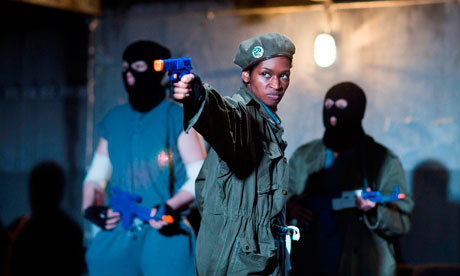
Today I want to return to a topic I’ve blogged about before, the roles for women in theatre, both on stage and off.  The all-female Julius Caeser I mentioned a few months ago has opened in London to rave reviews, one of which you can read here.

Julius Caesar at the Donmar Warehouse.

.

.

.

.

.

.

However, it has reignited the debate and I want to share some of articles that have been written in the last few days. Firstly, a piece called Women in theatre: why do so few make it to the top? written by Charlotte Higgins in which she asks leading figures why women are still underrepresented at every level of the business – and what needs to change. It is UK-centric, but the discussion and arguments are universal.

This article is supported by a piece of research, Women in theatre: how the ‘2:1 problem’ breaks down which presents some statistical research. Again UK based, but interesting reading none the less.

Finally, a great interactive graphic that explores women in Shakespeare, bringing us nicely back to the all-female Caesar. Click on the image below to take you there.

WIT