Unknown's avatar

About Theatre Room Asia

IB Theatre Arts teacher

Words Are Louder Than Actions

All aspects of culture have their trends – art, music, architecture and so on – and theatre is no different. Current trends in theatre seem to be that of the immersive performance but also that of verbatim theatre (VT), which appears to be very popular at the moment across the globe. Essentially VT is a form of documentary theatre in which plays are created/written from the precise words spoken by people interviewed about a particular event or topic.

Perhaps one of the most famous pieces of VT is The Laramie Project which is a play by the Tectonic Theater Project about the reaction to the 1998 murder of a gay student in Laramie, Wyoming, in the US. The murder was denounced as a hate crime and brought attention to the lack of hate crimes laws in various US states. The play draws on hundreds of interviews conducted by the theatre company with inhabitants of the town, company members’ own journal entries, and published news reports. Arguably it is one of the most performed plays in The States. The company have just followed up the original with a new work called The Laramie Project: Ten Years Later which returns to Laramie to see how attitudes have changed in the intervening years.

.

There is a sense that VT is something new, but this is in fact mistaken. This kind of theatre has been around since the early 20th Century, one of the pioneers being Erwin Piscator and his living newspapers. In Drama Online Dr Tom Cantrell, Lecturer in Drama, University of York, gives a great outline and history of VT

Verbatim theatre is a form of documentary theatre which is based on the spoken words of real people. In its strictest form, verbatim theatre-makers use real people’s words exclusively, and take this testimony from recorded interviews. However, the form is more malleable than this, and writers have frequently combined interview material with invented scenes, or used reported and remembered speech rather than recorded testimony. There is an overlap between verbatim theatre and documentary theatre, and other kinds of fact-based drama, such as testimonial theatre (in which an individual works with a writer to tell their own story) and tribunal theatre (edited from court transcripts). In the United Kingdom, the term ‘verbatim’ specifically relates to the use of spoken testimony, whereas ‘documentary’ encompasses other found sources, such as newspaper articles, diaries and letters. However, in America ‘verbatim’ is not used, with ‘documentary’ being the preferred term. When looking for verbatim playtexts, the reader will often find them conflated with other documentary forms.

words

Documentary theatre has a rich heritage in comparison to the relative infancy of verbatim theatre. Erwin Piscator’s Trotz alledem! (In Spite of Everything! Berlin, 1925) is widely acknowledged as the first stage documentary. The play was a revue about the Communist Party and Piscator utilised new technologies which included creating montages using projected newsreel footage. Trotz alledem!also featured recorded speeches, news-extracts, photographs and film sequences from the First World War. Piscator went on to direct some of the most respected German documentary plays such as Rolf Hochhuth’s Der Stellvertreter (The Representative, known in America as The Deputy), which premiered in West Berlin in 1963, Heinar Kipphardt’s In the Matter of J. Robert Oppenheimer (1964), and Peter Weiss’s The Investigation (1965). These German documentary productions had a great influence on British documentary theatre, particularly the work of Joan Littlewood. Her production, Oh What a Lovely War! chronicled the First World War through songs and documents of the period. Its importance was immediately recognised, with the production hailed by the Observer as ‘The most important theatrical event of the decade’.

The development of verbatim theatre, rather like Piscator’s use of new film projection technologies, is closely linked to a simple technological development – the invention of the portable cassette recorder. This enabled the voices of individuals to be recorded in their own environment. Mobile interviews could take place which extended the dramatic possibilities of verbatim theatre. The first verbatim productions were directed by Peter Cheeseman who was artistic director of the Victoria Theatre, Stoke-on-Trent from 1962 – 1984. Cheeseman’s verbatim work at Stoke was not only influenced by the left-wing documentary theatre of Joan Littlewood, but also by the radio documentary tradition, particularly the radio ballads of Charles Parker. Central to Parker’s work was the prominence of working class voices in the broadcasts. One of Cheeseman’s most notable productions, which can be regarded the first verbatim play, was Fight for Shelton Bar (1974), which was part of a campaign fighting against the closure of a major steelworks in the heart of Stoke, and was performed in the city to an audience of many of the ex-workers.

Over the past two decades verbatim theatre has come to occupy a central place on the British stage, and is seen as one of the most incisive forms of political theatre. It has moved from the fringes to the mainstream, with some of the highest profile theatres staging verbatim plays. Particularly noteworthy exponents of the form include David Hare, whose verbatim (or at least part-verbatim) plays The Permanent Way (2003), Stuff Happens (2004) andThe Power of Yes (2009) were all performed at the National Theatre; director Max Stafford-Clark and writer Robin Soans, who have collaborated on A State Affair (2000), Talking to Terrorists (2005) andMixed Up North (2009); and in particular the campaigning work of director Nicholas Kent and theGuardian journalist Richard Norton Taylor at the Tricycle Theatre in Kilburn, North London. Kent and Norton-Taylor’s work has included a series of tribunal plays, including Nuremberg (1996), Bloody Sunday (2005), and perhaps their most successful production: The Colour of Justice: The Stephen Lawrence Enquiry (1999). All these were edited scenes from court cases. Kent has also collaborated with Gillian Slovo on Guantanamo: ‘Honour Bound to Defend Freedom’ (with Victoria Brittain, 2004) and most recently on The Riots (2011), which was the first theatrical response to the riots in the summer of 2011.

Verbatim theatre has arisen as the medium chosen to depict major societal issues. For example, army deaths in Philip Ralph’s Deep Cut (2008) and Fiona Evans’s Geoff Dead: Disco for Sale (2008); prostitution in Esther Wilson’s Unprotected (2006), Alecky Blythe’s The Girlfriend Experience (2008); murder in Tanika Gupta’s Gladiator Games (2005) and London Road (2012) and perhaps most predominantly, a surge of work on the continuing issue of the war in Iraq: Norton-Taylor’s Justifying War (2003), Called to Account (2007) and Tactical Questioning (2011), Gregory Burke’s Black Watch(2007) and Steve Gilroy’s The Motherland (2008).

Verbatim theatre has also proliferated internationally. Interested readers should explore American plays such as Moises Kaufman’s Gross Indecency: The Three Trials of Oscar Wilde (1997) and in particularThe Laramie Project (2000) and The Laramie Project Ten Years Later (2009). Anna Deavere Smith is also one of the most high profile documentary makers. Her work includes Building Bridges, Not Walls(1985) and Fires in the Mirror (1992). Similarly important is Jessica Blank and Erik Jensen’s celebrated play The Exonerated (2002), composed of interviews with individuals who have been released from death row. Australia has also experienced a boom in verbatim productions. The first verbatim production was Paul Brown’sAftershocks (1993), featuring interviews in the aftermath of the devastating Newcastle earthquake. Works by Alana Valentine including Run Rabbit Run(2004) and Parramatta Girls (2007) have also raised the profile of Australian verbatim theatre.
VT should be powerful and is obviously all about theatre that provokes, informs and seeks social and cultural change. Michael Billington wrote an article for The Guardian that also talks about its current popularity and you can read that here.

In an article for ideastap, playwright Alecky Blythe outlines her process:

I start with either an interesting event, or interesting character. That might be a story that I read in the paper or it might be an ongoing story, like women bishops. Then I’ll take myself off to interview people in a very journalistic way.

You have to be quite upfront from the beginning. Even if you don’t know where your project will end up – if it’ll even get used – you need to let people know that you’re going to record them and that an actor might portray them on stage. And you have to get their permission to do that.

Some people have said ‘no’. You have to judge if that really is a ‘no’ or if you just haven’t explained yourself properly. If it’s a matter of them being identifiable, I will go into how I can make them anonymous….

anonymous icon

Some people have both [of the] things you’re looking for: interesting characters and the potential to be developed narratively. Some people are brilliant, likeable and accessible straight away, but they might not have much forward story; all their best stories have already happened to them. The best verbatim theatre is as much present tense as possible – it’s about capturing things as they happen.

Of course you’re looking for emotional effect, but at other points in the story you’ll be looking for plot and facts, which means asking slightly dry questions – where they are, what they’re doing, who they’re waiting for etc. Those things are key to the highs and lows of the story.

Legally I don’t know whether it’s different to journalism. If someone says something that is highly contentious, as I am finalising the edit I’ll also go over exactly what they said with them. I want to check they remember, in case it could lead to any kind of back lash for them, and that they are ok with that. Some people say things in the heat of the moment that they might forget; sometimes the show is produced at least a year after they said it.

I don’t transcribe anything. I make a first edit, and of that edit I’ll log the timecode and who said what. That means that further down the line I can pick up specific moments – someone talking about sunglasses, for instance – by reading back through my notes rather than listening to 15 hours of recording.

I don’t write any lines; I give the actors the audio recordings. Although on the first day of rehearsal they get a running order; the names of the characters, titles of the tracks and who’s playing what part…..

…One of the strengths of verbatim is the sort of rich text you just couldn’t make up. So if you’re doing a verbatim play, put some of those quotes on the flyer or poster. It can just be a tiny soundbite.

I’ve always gone out and followed stories before anybody’s put any money on the table. That’s still the case. Even if a company says they want to work with you, by the time the paperwork’s gone through and the contract is signed, you might have missed a month’s worth of collecting material. Sometimes you are living on a breadline and taking gambles. But luckily my process isn’t too expensive – apart from the initial cost of a dictaphone, it’s just batteries and travel.

The popularity of VT is wide and I share two examples here that give you an idea about its power – Home, about life in a hostel for young homeless people in London and My Name is Rachel Corrie a play based on the diaries and emails of Rachel Corrie, an American student who was killed while protesting against the destruction of a house by the Israeli Defence Force in the Gaza Strip in 2003.

.

I should say (and proudly) that Shannon Murphy is an ex student of mine.

And finally a great article from Australian Writers Guild Magazine, by playwright Alana Valentine titled The tune of the spoken voice.

Power To The People?

6a00d83451688869e20120a72085e1970b-800wiA quick post from me today, a longer one coming tomorrow. You need to read my previous post, Worlds Apart, to make sense of this one. It is fascinating to read Lyn Gardner’s take on The Tragedy of Coriolanus by Beijing People’s Art theatre given what Lin Zhaohua has to say about his direction and why he does Shakespeare in China. A real East versus West cultural conundrum, I think. The review was published in The Guardian this week.

Beijing People’s Art Theatre go for bombast, but slack pacing and an underused chorus leave it more mediocre than menacing

It sure is big, and – with no less than two Chinese rock bands on stage – it’s full of sound and fury, but while Beijing People’s Art Theatre pump up the volume on Shakespeare’s tragedy of power and violence, the result is oddly muted. With its themes of arrogance, leadership, a discontented mob and democracy, this should be a fascinating choice of play for a company hailing from a country where there is no political opposition, human rights are regularly abused and protest is frequently stamped out.

But this production remains mysteriously opaque, offering empty spectacle in the place of nuanced political comment and metaphor. Unlike the Shakespeare that came out of Romania and Poland during their communist eras, it seems determined to offer no comment upon the society that spawned it. Maybe it says something about the contempt in which the mass of the people are held by the country’s political leadership that the mob here have a desultory feel, wandering around looking vaguely hippyish, waving their arms unconvincingly and muttering the Chinese equivalent of “rhubarb, rhubarb”. They are so under-energised that they are never a real threat to anyone, except perhaps to their own health and safety in getting on and off the stage without tripping over each other.

The slackness of the crowd scenes is reflected in a production which was first performed in 2007 – and which often looks in need of a jolly good dust-down. Even the aesthetic is inconsistent, at times pared down and stripped back, and at others including cumbersome sofas and carts. Like a great deal in this production, the ladders at the back of the stage are there for effect only, and serve no purpose.

It’s not all mediocre flashiness. Pu Cunxin’s arrogant Coriolanus enters with a rock-star assurance and has a rumbling power, like a capped volcano. The scenes between him and his mother (Li Zhen) have genuine power and tension, particularly in their final encounter, which seals Coriolanus’s fate. But overall an evening which is epic, but not in a good way.


Other critics took different views and raised interesting questions.  You can read them here, here and here.


Critiquing The Critics

One of the things that confounds many theatre teachers is how to teach written theatre criticism. You can give your students all the tools to deconstruct what they see, but to then write it down in a way that communicates the truth of what has been seen without ladening it down with subjectivity is difficult.

theatre-criticsOf course theatre criticism is ultimately subjective – it is an individual’s viewpoint. But there is an art to it and in some instances the professional critic can make or break a show (New York theatre critics are particularly renowned for this as this  article shows). However, in the internet age, things have changed. Very often a blogger critic can get their reviews out to the world before traditional print critics can.

CriticThis is particularly so when shows are in preview and the bloggers get there first. This means that theatres are having to change the way they promote their work and social media is playing a greater and greater role in creating audiences for a show.  But I digress…..what I wanted to write about today was that notion of subjectivity. Sometimes plays are universally panned because they are simply bad. A show that opened in London this summer was utterly trashed by everyone that saw it, one critic going as far as saying:

It’s the kind of dreary experience……that makes you want to gnaw your fingers to the bone and ring the Samaritans.

Not good then, but the reverse can happen of course. However what intrigues me is what one critic praises another decries. Two of the plays I have written about recently, Hamlet, by The Wooster Group and Leaving Planet Earth by Grid Iron have both been reviewed The-Shepherds-Chamaleon1and were bound to divide the critics given their unconventional staging. Having had the luxury of time that my summer vacation affords me, I have been able to read all the mainstream reviews for both plays (as well as some of the more ‘unofficial’ ones) and it struck me just how subjective they are. There are of course similarities, both in terms of praise and criticism, but the overall ‘feel’ of the reviews is markedly different. So today I am going to offer you four reviews for each play, from the same sources, and see what you make of them.

Firstly, The Wooster Group and Hamlet:

The Guardian by Andrew Dickson, The ghosts of great Danes past haunt the Wooster Group’s intellectually satisfying but distant and forensic Hamlet 

The Telegraph by Dominic Cavendish , The Wooster Group’s production of Hamlet… in part a tribute to Richard Burton – doesn’t impress Dominic Cavendish 

The Independent by Anna Burnside, Hamlet – The Wooster Group’s efforts are like an elaborate parlour game 

The Stage by Natasha Tripney, The production can feel clinical in places, but there’s something mesmerising about it as a piece. It has a strange magic. (The Stage does not have a star rating system)

Secondly, Leaving Planet Earth, Grid Iron

The Guardian by Lyn Gardner. The show needs rather more of these small, intense and knotty human encounters, and rather less shuffling the audience around different spaces 

The Telegraph by Mark Brown, This thought-provoking science-fiction vision of a future Earth is all too believable 

The Independent by Anna Burnside, It looked good but added up to nothing much at all 

The Stage by Lauren Paxman, Have the site-specific experts….stretched themselves too far? (The Stage does not have a star rating system)

There’s much debate to be had here I think!

knifeback460

I will leave you with one further article, written by Lyn Gardner, theatre critic herself, discussing the role of the theatre critic. Sadly the article she is responding to is behind a pay-wall, but it doesn’t diminish what she has to say.

.

.

Worlds Apart

Over the course of the summer I have written about Shakespeare a couple of times. Today I am going to share two articles about two plays currently in production from opposite sides of the world. Firstly, Coriolanus directed by Lin Zhaohua for the People’s Art Theatre in Beijing in Mandarin and Hamlet, by The Wooster Group in New York. Both are currently on at The Edinburgh Festival.

The first is by Andrew Dixon for the Guardian, entitled

Guitar hero: Coriolanus goes rock

China’s most controversial director is bringing Shakespeare’s Coriolanus to Edinburgh – with two heavy-metal bands in tow

It’s 45 minutes to showtime at the People’s Art Theatre in Beijing. Backstage, actors in civvies are padding around, studiously avoiding the clock. Behind a dressing-room door, someone is making heavy weather of their warmup. Suddenly, the strangulated squeal of an electric guitar shakes the building, like a crack of thunder. No one bats an eyelid.

21253_653587371334804_1261359802_n

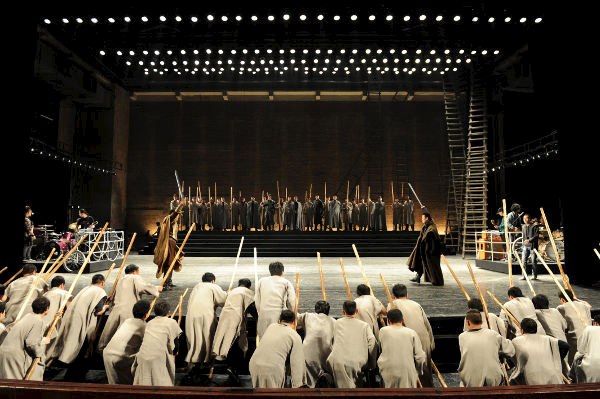
The closest most British stagings of Shakespeare get to guitars is the occasional lute. But in China, it seems, they prefer their Bard a little gnarlier. This is The Tragedy of Coriolanus by Lin Zhaohua, routinely described as China’s most controversial theatre director. First performed in 2007, it is big in every sense: there’s a cast of more than 100, and the action takes place on a near-empty stage against a vast, blood-red brick wall.

But the real surprise is the soundtrack: two live heavy-metal bands, going under the colourful names of Miserable Faith and Suffocated, who slide in periodically from the wings and punctuate the action with frenzied surges of nu-metal. This might be the only version of Shakespeare’s tragedy – the story of a hot-headed general who goes to war against his own people – that turns it into a battle of the bands.

182698_653587424668132_155504144_n

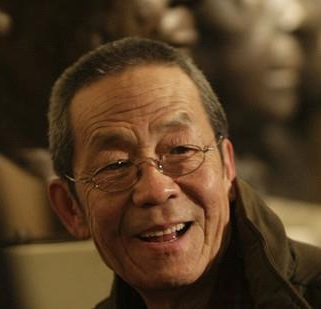
The director is hiding in a cloud of cigarette smoke in the theatre cafe. Were it not for the translator hovering at his elbow, you’d mistake Lin for an elderly caretaker: a slight, somewhat caved-in figure, his jacket hanging absent-mindedly off one shoulder. But, behind neat spectacles, his dark eyes are pin-sharp. He claps me on the shoulder as I sit down; I sense I’m being sized up.

First things first: why the heavy metal? “I wanted to use rock music to display the fierceness of the war, and the rioting of the citizens,” he says. “At first I wanted bands from Germany … I listened to a lot of them, but I didn’t like their electronic sounds. So Yi Liming, my designer, showed me around different parts of Beijing. I chose two of the bands I saw.”

The music certainly adds a volcanic energy. The text has been translated into contemporary Mandarin, and here in Beijing (unlike at the Edinburgh international festival, where the show will open later this month) there are no surtitles. The scalding force of Shakespeare’s verse, though, is echoed in the roaring guitars and pulsing bass. It’s a high-voltage experience, particularly when the Roman mob, dressed in semi-druidic robes, rush onstage brandishing wooden staffs – like a cross between a scene from Star Wars and Reading festival. In the interval, the musicians entertain the crowd, a flock of teenagers pressing close, clicking away with their cameraphones.

Lin smiles. “Some dramatists and critics don’t like the idea of using rock music, and they criticise my way of doing productions.” How does he feel about that? A shrug. “I don’t care.”

Combing the city’s nightspots for musical accompaniment sounds energetic for a director now in his late 70s. But Lin has never done things by the book. After graduating from the Beijing Central Academy of Drama in 1961, he joined the People’s Art Theatre (BPAT) – China’s equivalent of the RSC – as an actor, only to find his career stymied by the Cultural Revolution. Afterwards, he joined forces with the dissident writer Gao Xingjian, who would later win the Nobel prize. A trio of plays, beginning with 1982’s Absolute Signal, all but launched experimental theatre in China, with a confrontational, often absurdist style that unnerved the communist authorities.

316185_653587391334802_432981805_n

In the decades since, Lin has been prolific, flitting between new drama, stylised Peking Opera and ambitious reworkings of western classics. According to Li Ruru, an academic who has written extensively on Chinese theatre, Lin is “a major voice. He’s been doing experimental theatre for more than 30 years, at the absolute vanguard of Chinese spoken drama.” But his approach hasn’t always done him favours: one critic described him and Gao as “harbingers of strangeness” for their efforts to release drama from the straitjacket of Soviet-era social realism. The director refuses even this pigeonholing: “I have no style,” he has repeatedly told interviewers.

Anyone expecting peony-strewn chinoiserie – like that offered by the National Ballet of China two festivals ago – will be in for a shock. This is a Coriolanus of muscular clashes and brutal comedowns; of a leader always itching to administer the hair-dryer treatment, and who does nothing to disguise his detestation of the masses.

In the lead role is one of China’s most famous stage actors, Pu Cunxin: a disconcertingly polite figure who apologies for his sore throat – the consequence of competing with two metal groups. “It is an unusual way of performing,” he admits. “We don’t normally have this kind of collaboration in China. The noise is just so powerful on stage, but we need the rock music to express these emotions. It parallels Shakespeare’s ideas.”

941130_653587461334795_535090116_n

I’m struck by one moment in particular, where Coriolanus’s arch-rival Aufidius grabs a microphone during a battle scene, looking half like a wannabe rock god, half like a politician channelling the energy of the crowd. Politics are everywhere in Coriolanus: the play has been claimed both by leftwing critics as a primer on the dangers of demagoguery, and by the right as a lesson in the fickleness of the masses (the Roman citizens at first swoon over their apparently invincible general, then later turn on him). Given these paradoxes, it feels an oddly appropriate play for present-day China, a country nominally communist, but with an economy many capitalists would trade their copies of Milton Friedman for. On the short walk from my hotel to the theatre, two blocks from the Forbidden City, I drift through a shopping district crammed with western luxury brands; one window of a photography shop is jewelled with glittering Japanese cameras, the other with portraits of Mao and Deng Xiaoping. It would be harder to find a clearer image of Deng’s infamous”socialism with Chinese characteristics”.

What does Lin see in Shakespeare’s text? “The relations between the hero and the common citizens,” he replies. “In ancient Rome, people admired heroes. From my point of view, Coriolanus is a hero.” Is there a resonance with contemporary China? “It’s a good phenomenon if the play refers to current events. Those in power like to control citizens, and some common citizens are foolish.”

I want to find out about a previous Shakespeare production, Lin’s Beckettian staging of Hamlet, first seen in 1989. Performed in a rehearsal room at BPAT, the only prop a barber’s chair, it had three actors (one of them Pu) sharing the roles of Hamlet, Claudius and Polonius. Depending on your perspective, it captured either capitalist alienation, or the disillusion that followed the collapse of the student protests at Tiananmen Square. The parallels were cloudy – theatrical censorship is vigorously alive in the People’s Republic – but there to be seen.

Lin freely admits the show was unusual: in contrast to the traditional Chinese way of presenting Shakespeare, with wigs and western-style makeup (sometimes even prosthetic noses), his actors wore their own clothes, in a conscious decision to show the student prince as just another guy. But he is reluctant to open up on the wider issues. “I hate politics,” he says stoutly. “Hamlet has nothing to do with politics. It’s just about a person’s situation.” I can’t tell whether he’s genuinely uninterested, or unwilling to be frank with a British journalist. “I never discuss politics. I don’t think you can direct a production just from politics.” He isn’t even convinced, he says, he’s avant-garde. “I don’t have that concept. I just direct the production from my interests and from the needs of the play.”

941279_653587384668136_1016224444_n

Our time is nearly up; his lighter is snapping impatiently. Last question: does he like being called a rebel? “I don’t have preconceptions about what I’m going to create,” he stonewalls. “I just follow my instincts.”

I realise as I’m rushed out that I’ve forgotten to ask one thing – why direct Shakespeare in the first place? Why stage reach for a playwright four centuries old? When I email, the answer comes back quicker than I expect. It reads: “It gives me the freedom to say what I want.”

537273_582437285116480_15271441_nInterestingly, the Lin Zhaohua Theatre Studio has it’s own Facebook page which is where all the above images came from.

There is a fantastic outline of him and his work here where he is described as a very controversial drama director in China…one of the most significant figures in Chinese drama history you can’t ignore – whether you love him or not.

.

The second article today is also from the Guardian, by Hermione Hoby, exploring with the Wooster Group why, after all these years of experimental theatre, they decided to ‘do’ Shakespeare.

Wooster Group take on Shakespeare with Hamlet remix

Before Punchdrunk, or Complicite, or Forced Entertainment, or any other experimental theatre company you can name, there was New York’s Wooster Group, an avant-garde ensemble legendary not just for the work it has made since the 1970s, but also for the love affairs and betrayals that have coloured its history. As former member Willem Dafoe has put it: “You become accomplices in life. There’s a terrific power in that. The other side is, there’s no place to run.”

Since 1974 the company has worked out of the Performing Garage in Soho – a Manhattan neighbourhood once characterised by derelict lofts and heroin dealers and now given over to Prada boutiques and cupcake-centric cafes. This year they’re bringing one of their most successful shows ever – a remixed Hamlet devised from a filmed 1964 production starring Richard Burton – to the Edinburgh international festival.

I meet company members Scott Shepherd and Kate Valk in the big empty black box of their theatre and, seated on the steps of the auditorium, Shepherd explains that he directed the play years ago as a student at Brown University. Ever since, he says, he’s had it stuck in his head. That’s not, it turns out, a figure of speech. “He has a photographic memory,” Valk explains, mock-wearily. “It’s kind of obnoxious at times.”

Ham600

The skill is what enabled him, for example, to memorise all 49,000 words of The Great Gatsby for Elevator Repair Service’s acclaimed stage adaptation, Gatz. Hamlet though, was rooted even deeper. Eventually, with speeches still running through his head, it began to feel “like something that needed to be exorcised”.

And so he persuaded Valk, who claims to have suffered from what she calls “Shakespeare deficit disorder”, to join him in after-hours work on the text. From that moment in 2006, very slowly, their production began to take shape.

It began with the two of them, but the woman who continues to hold the company together – the matriarch, you might say – is the quietly formidable 69-year-old Elizabeth LeCompte. The Wooster Group emerged amid the creative ferment of 70s downtown New York, but it was her relationship with Spalding Gray, the late actor and writer, that dynamised the company. After graduating from Skidmore College she got together with Gray – as well as Valk, Jim Clayburgh, Ron Vawter, Peyton Smith and Dafoe – with whom she went on to have a son and a 27-year relationship. Dafoe ended it abruptly in 2004, the same year Gray took his own life by throwing himself from the Staten Island ferry. Miraculously, she weathered it with the company intact.

Before she met Gray in the mid 60s, LeCompte had little interest in theatre and had studied art, thinking she might become an architect like her father. “I think maybe,” she says, “it was just a mistake – I got together with Spalding not because I thought I was going to get involved with theatre but when Richard Schechner [the group’s original artistic director] hired me, I realised that it was really a good place.”

By 1975 she was staging Gray’s famous Rhode Island Trilogy, an autobiographical work that details his childhood and the suicide of his mother through monologue as well as personal materials such as letters and photographs. In 1980, Schechner left, LeCompte became artistic director and they changed their name from the Performing Group to the Wooster Group. What drove them then, I ask. She inhales. “It’s hard to know … I don’t know whether it was just youth, because it wasn’t exactly idealism. We weren’t afraid of anybody. We had a certain kind of feeling of the world was ours, so we could do what we wanted.”

67e72df164dbb6752b0f3871276b9f81

The company seems to retain that sense of boundlessness, I suggest.

“You really don’t really know where you’re going to end up when you start,” she agrees. “And there’s something very exhilarating about that, but it’s also very difficult. In most theatres the director has to know what’s there so the other people involved can rely on her. I don’t afford anyone that comfort. I’m as confused as everybody else a lot of the time.”

When LeCompte began working on Hamlet, “I didn’t really think I was working on Shakespeare, I thought I was working out on figuring outabout Shakespeare. I kind of came in a side door.” That’s often the best way. “Well,” she says drily, “it’s the only way I can do most things.”

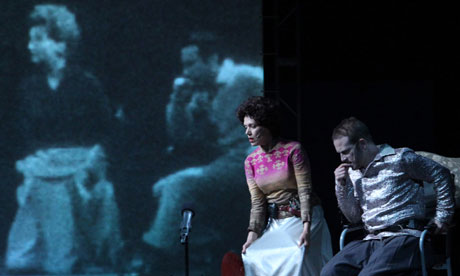
She remembered seeing the Burton production, which was directed by John Gielgud – himself a famous Hamlet – and thinking of it as experimental purely because the actor playing Gertrude wore not a bodiced dress and ruff, but a mink coat. “That’s what experimental was then!” she laughs. More exciting though was Burton’s futuristically named “Electronovision”, an innovation that used 17 cameras to film and broadcast the performance for two days in 1,000 cinemas across the US . In the Wooster production, that grainy 1964 film is projected above the set, forming a ghostly backdrop of a past Hamlet. The New York Times described the Woosters’ show as “an aching tribute to the ephemerality of greatness in theatre”.

Kate Valk and Ari Fliakos in Hamlet

Kate Valk and Ari Fliakos in Hamlet

“The whole metaphor to using the film is the ghost,” Kate Valk enthuses. “The ghost of all those performances!”

Scott Shepherd is a performer who invariably attracts adjectives like “indefatigable” and “tireless”; those seem entirely deserved when it emerges that he edited the entire Burton film into Shakespearean meter, in other words, painstakingly cutting the performers’ pauses so that the iambic pentameter is duly honoured with beats and stresses in the right places.

“This was an arduous task, yeah,” he admits. “To go in and cut pauses if they came in the middle of a verse line and then move them to the end of the verse line.”

It’s Shepherd-as-Hamlet’s imagination, so the premise goes, that creates the onstage action, in which live performers mirror the movements and speech of the actors in the 1964 projection. For all the visual innovations though, LeCompte insists that the text itself remains sacrosanct, and, “on a par with the visual”.

She says: “What I was doing, I realised, was trying to take this shard of what I could get from the past, from that production, and to reinterpolate it into something that made sense to me, in the future.” A brief pause, then: “But I just wanted to delight myself, frankly!”

Despite three decades of making work this is the first Shakespeare the company has ever done. (They’ve since added Troilus and Cressida, a collaboration with the RSC, to their repertoire.)

“I was not hip to the Shakespeare idea at all,” says Ari Fliakos, who plays Claudius and Marcellus, among other roles. Why? “I don’t know,” he says, “maybe it comes out of my allergy to theatre.”

Professing not to be a “theatre person” seems to be a common Wooster trait. Even Valk, who’s been described as “the Meryl Streep of downtown”, has claimed that acting is not among her skills.

1hamlet_wooster_group_czernia

When I mention this tendency to LeCompte she laughs. “I like theatre people!” she protests. “But the process of making theatre in the commercial world I don’t like because it’s too formulaic. I really like to ramble for quite a while,” – and then she corrects herself: “I don’t like to, I have to. I wish I was faster, frankly – we’d be making a little more money.”

Like most members, LeCompte included, Fliakos came to the group through a side door, after hanging around there in 1996, answering phones and fetching coffee. “Everything was stimulating, everything resonated,” he recalls. “It seemed like experimenting with drugs all over again, it was a whole new experience I wouldn’t have expected in any kind of live performance.” He sighs: “The minute you try to describe it, not unlike a trip, it begins to dissipate.”

Every member I talk to about the Wooster Group speaks with this kind of ecstatic devotion. Nonetheless, the creative world of 2013 is a very different one to 1974 – financially and ideologically. LeCompte admits that, “in order to be able to keep the company together I have to be more aware of money, ways of living and ideas. It’s the terrible thing that it’s not hip anymore to not have money, or to be on the outside. It’s much harder for people to give up things that have money and status.”

***4V8G1667©Mihaela Marin

But there are gains, Shepherd explains: “Most people who are in acting are going from one job to the next, and it’s quite hard to develop a sense of continuity, that you’re engaged in building a body of work. And here that’s all you do. One piece bleeds into the other so you’re creating sort of an oeuvre and making something larger than a particular production, you know? This is about developing a philosophy of working, a way of working with a group of people.”
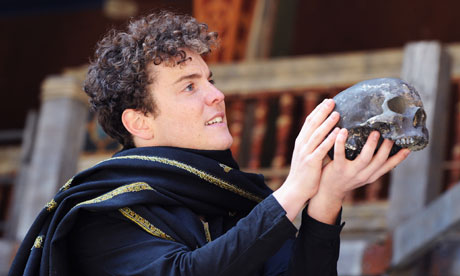
“It feels,” he says finally, “substantial.”

Again the reviews will be out soon for both shows so it will be interesting to see what the critics make of these two very different, culturally and artistically diverse reworkings of Shakespeare. However, according to one critic who Tweeted a few hours ago, the opening night of Hamlet didn’t go well:

domIt happens to the best of us, it seems.

Out Of This World

I am going to out myself today! I am geek – a science fiction geek. I have always loved it and when I saw this Tweet recently my interest was immediately grabbed:

tweet_FotorI thought that I had never seen any science fiction on stage but when I looked at the ‘call for papers’ for the Stage The Future conference I realised I had. Samuel Beckett’s Endgame is of course set in a post-apocalyptic future,  Caryl Churchill’s A Number is about human cloning in a near future world and Howard Brenton’s Greenland is set in a future utopia 700 years from now. Hollywood has always had the grip on science fiction, simply because of the special effects and CGI that it could offer.  But of course the kind of technology that is now available in theatre is starting to change all that.

Leaving Planet Earth traces the story of humanity's first migration into space.A new piece of theatre called Leaving Planet Earth is just about to open at the Edinburgh Festival which sounds like it is really breaking new ground. It has been created by a company called Grid Iron and, to quote the publicity material it fuses live interactive performance with innovative digital and new media technologies. It is an immersive, site-responsive, promenade piece. An article written by Charlotte Higgins in the Guardian talks about how the show was created:

Sci-fi theatre sends audience out of this world

Leaving Planet Earth, one of Edinburgh international festival’s most ambitious productions, to take off in disused quarry

Science fiction is usually the preserve of film, with the endless possibilities of special effects; or fiction, with the endless possibilities of the reader’s imagination.

But now a new production – one of the most ambitious of the Edinburgh international festival, which opens this weekend – is putting sci-fi into the theatre. Or rather, instead of into a traditional theatre, into the distinctly intergalactic setting of the Edinburgh international climbing arena. The biggest of its kind in Europe, it is based in a vast disused quarry on the fringes of the city.

The show, Leaving Planet Earth, is the creation of a pair of Glasgow-based artists, Catrin Evans and Lewis Hetherington. Evans, a sci-fi fan, had been impressed by the way TV series such as Battlestar Galactica had used the genre to provide acute political commentary (it was one of the few mainstream American TV shows to offer a critique on the occupation of Iraq, for example).

Working with the Scottish theatre company Grid Iron, which specialises in site-specific, immersive theatre, Evans and Hetherington came up with a storyline in which the audience has become the last group of people to leave Earth for a new planetary home and are being taken on an “induction” into the new planet.

LPE-Final-Dec-12.--By-Douglas-Chalmers

The story begins even before audiences arrive – they will have received an email message that asks them to watch a motivational video about their new home and invites them to upload an image of an object for a museum devoted to Earth.

When they arrive they will be led through the arena buildings, where high-tech glassy surfaces come up against rugged rock faces, and views give out on to the huge sheer faces of the old quarry.

“We wanted to be somewhere really expansive,” said Evans. “It’s sci-fi – so the themes are really expansive.”

The two artists began to think about a situation in which humans were “involved in a migration into space”. What if a sci-fi story could be used as the carrier for thinking about some big questions about, according to Hetherington, “our relationship to the planet and human responsibility” and “the nature of progress, betterment, advancement and growth”?

But at bottom, they say, it is a human story: about the characters’ own attachment to the past, memories and hopes for the future.

The promotional video mentioned in the article is here:

.

There is even a website that forms part of the piece, here. I look forward to reading the reviews when they come out.

Out of curiosity, I did a little further research and came across the Science Fiction Theatre Company who are based in Boston. Perhaps Sci-Fi theatre really will be the next big thing. For those of you reading this who are IB Theatre Arts students, maybe the IBO will have to add a new theatre tradition to their list very soon.

We Need Dreamers

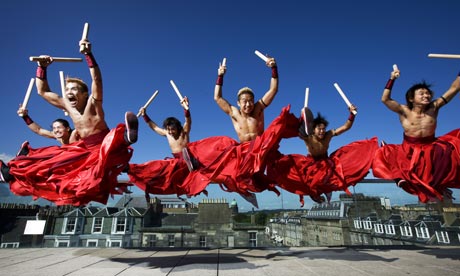
It doesn’t matter where I am in the world at this time of year, I quietly and occasionally wish I was somewhere else. This has nothing to do with the fact that school is about to restart (well, not much) but the fact that the largest arts festival in the world is taking place half a world away. August is the month of The Edinburgh International Festival and Fringe Tao-Samurai-Drummers-Edin-001Festival which draws artists and audiences from across the globe. It is truly an incredible event that lasts about 4 weeks and takes over the whole city. Virtually everyone I follow on Twitter, be they actors, directors, critics and so on – all seem to be there. The streets are full of street performers and any space that can possibly squeeze in an audience seems to do so. You want to see examples of world theatre – you can see it in Edinburgh. The performers range from seasoned and world-famous professionals to high school students. The statistics are almost unbelievable. In 2012 for the Fringe Festival alone:

  • 2695 shows were staged.
  • There were 42,096 performances in 279 venues, featuring 22,457 performers from 2,304 companies and 47 countries.
  • 1,418 performances were world premieres.

If you ever find yourself in the UK during August, you should go, but make sure you have somewhere to stay – hotels are booked up months in advance.

Now the reason for my post today is not about the festival itself, but rather about the opening address, which was this year made by the well know playwright, Mark Ravenhill and which has caused quite a stir in the theatre world. The thrust of his speech was about whether the arts could continue to thrive with reduced government funding in the current economic climate. He made some strong claims and I have to say I know what he means. It sent me off on a trail looking at to what extent the arts are supported by government money around the world and it has thrown up some interesting facts. Comparative statistics are hard to come by, but here are a few:

future_investment_value_2

  • In India, the government funds the arts heavily as there is little private support for
    performing arts
  • In Italy, it is the opposite with relatively little public funding.
  • In South Africa, the arts rely almost solely on private funding.
  • In China there is huge investment, but it is largely in centrepiece building projects, rather than supporting emerging artists.
  • In the Arab States, funding for the arts is increasing as it is seen as vital for creating ‘world class’ status.
  • Australia has a wide-ranging grant system for the arts.
  • One example from the UK stated that for every £1 invested by government subsidy £7 was returned to the state.

I am writing about this because I think it is something that is generally missing from theatre courses, unless they have a vocational element and I think it is important that theatre students understand the reality of making art in the outside world.

Ravenhill’s speech is below and really does cause pause for thought. Whilst his arguments tend to centre around the UK, there is a definite universality in what he is conjecturing.

Inaugural Opening Address of the Edinburgh Fringe Festival by Mark Ravenhill

mark_ravenhill_0

Yesterday I woke up, checked my Facebook feed first off as I always do and read this status update from a young playwright:

“Dreamt I was arriving at a dinner with a family where the husband had arranged to have the wife killed. She knew it and had chosen to accept it. I was the only other person at the table who knew. But if I let on, I’d die too. Plus, the man had an empire of van rentals and I’d been told I could have one for the Edinburgh Festival really cheap. I woke up before I’d decided what to do. But it wasn’t looking good for the wife. I feel so bad knowing that the offer of a cheap van could weaken me to that point”.

Welcome to the Edinburgh Fringe Festival. This is a unique performing arts festival. Nowhere in the world is there such an enormous range of work performed in one city in a few weeks. And nowhere is there such an open festival: if you can find a space, anyone can perform here at the Fringe. In this way, it’s a democratic festival. And yet like all democracies, it’s incredibly hard work – enormously costly to be here, to find a space to perform in and live in and to promote your performance.

And so I’m sure the young writer is not alone in dreaming about the dilemma of a choice between murder or a van. And in your waking hours I’m sure you’ve faced – not maybe not the possibility of murder – but some pretty sharp practice to make sure that the show goes on.

Because that’s the curious paradox about being an artist, particularly one who decides to do something as reckless and rewarding as bringing a show to the Fringe Festival. At the same time, to be a good artist you have to be the person who walks in to a space with integrity and tells the truth. That’s what marks you out from the audience and why they’re sitting over there and you’re standing up there: you are the most truthful person in that room.

And how do you get to be there? Chances are by being a liar, a vagabond and a thief. Now, maybe as you get to be a bigger name, you can subcontract out the shadier aspects of the job. Liar? That’s what my publicist does for me. Vagabond? That’s what my agent’s there for. Thief? What else does a producer do?

But certainly at the beginning of your career you’re going to have to be – to use a well worn but suitably Edinburgh based metaphor – DR Jekyll (I’m the one who tells the truth) and MR Hyde (yes, damn it, kill your wife if it means that I get that deal on the van).

It’s a schizophrenic existence. If you allow any of the hucksterism, fakery and swindling to seep in to what happens on the stage then your work as an artist is compromised and so then why frankly bother doing the thing at all? But if you allow any of the honesty and integrity from the stage to enter in to real life then chances are you’re not getting that van, that venue, that audience.

The performing artist, I’d like to suggest, has got to slice their personality as neatly as they can right down the middle, just like a Bertolt Becht heroine. In Brecht’s play Shen Te, The Good Person of Szechuan, was only able to do good in the world because she was also able to disguise herself as Shui Ta who collected the debts owed to her and saw off her rivals I business. And Anna 1 was only able to survive in the world (and send her family in Louisiana the money to build a new home) because her sister Anna 2 inverted the seven deadly sins and insisted that each of them were necessary virtues for survival in the modern world. Although Brecht didn’t set out to write a survival guide for performers at the Fringe Festival, I’d suggest that you could do a lot worse than read The Good Person of Szechuan and The Seven Deadly Sins and use them as your inspiration for how to conduct your affairs.

UAR_Good_Person

Because there’s little doubt that the Mr Hyde – the dark killer – aspect of our natures are going to have to be working even harder in the years to come if the shows are going to carry on going on.

Let’s say it again – because still it somehow doesn’t seem quite real in our bubble of existence – capitalism has experienced its biggest economic crisis since the 1930s depression, a depression which brought us genocidal dictatorships and world war. Our world, in ways that we can’t yet understand, is totally different from the one we were living in six or seven years ago. The paradigm has shifted and new ways of living and behaving are going to be needed if we’re going to make our way forward. There’s no possibility of pressing a restart button and going back to – when exactly? What about 2005? When it was all really lovely and that nice New Labour were in power and the economy seemed to doing splendidly and the arts were really, you know, valued. That’s a false memory of course and we’re not going back there. Any party that gets in to power in Westminster at the next election will be committed to the ideology (and plain wrong mathematics) of austerity. So we’re going to be making our art in increasingly tough times for at least a decade or more. We’re going to have to be complicit in more metaphorical wife murdering if we’re going to get the metaphorical van for our show.

But let’s look on this as a good thing. Didn’t the arts become safe and well behaved during the New Labour years? I think they did. I think they weren’t telling the truth – the dirty, dangerous, hilarious, upsetting, disruptive, noisy, beautiful truth – as often as often as they should have done. Why? Because most artists are decent, liberal, if only everyone were nicer to each other and let’s heal it with a hug sort of folk and so voted New Labour. And when New Labour came in to power there was much Gallagher brother greeting and talk of ‘creative industries’ and after a while for a few years a modest but real terms increase in government funding for the arts. And we artists were so grateful for that relatively modest bit of attention and money that we changed substantially what and who we were as artists.

Suddenly, we were talking about working in the creative industries, about the parts that the arts could play in urban renewal, about business plans and strategic thinking, about sponsorship relationships with the corporate sector that would allow us to fund educational work with our developing audiences, about the role that the arts could play in social inclusion.

What were you doing Mummy in the decade before the world hit the biggest economic crisis in almost a century?

Well, darling, I was learning not to talk and think like a grungy, angry artist but think and act more like New Labour cultural commissars and their friends in the banking sector.

Mummy, would they be the ones who got us in to the whole mess that I’m going to be dealing with for my whole life time?

Well, now you put it like that darling, yes I suppose they rather were.

And you spent a decade trying to be more like them, Mummy?

Well yes I rather did.

And wasn’t that a rather stupid thing to do?
Well, not at the time, darling, no; because you see I thought it would get me some funding and then I could build a career path for myself in the creative industries.

And did that work out for you Mummy?

Shut up and go a nick a can of beans for your tea.

In short, I think the arts sector as a whole went astray during the last couple of decades. Just as the Titanic was heading towards the iceberg, we were attending seminars and workshops, learning how to facilitate more effective refrigeration in our sector of the cultural industry when we could have been looking through the telescope and plotting an entirely different course. The bankers and the politicians weren’t looking ahead to spot the approaching iceberg. But neither were we: we were entertaining the same bankers and politicians at our latest gala, corporate sector friendly, socially inclusive performance evening.

As we were heading towards systemic collapse, the arts sector were teaching themselves to think and talk and act the language of the problem and not the solution.

Of course none of us were blessed with supernatural foresight – although there were plenty of signs that the economy that we were living in in the last decade of the old millennium and the first decade of the new was an unsustainable bubble. But let’s not regret what we did wrong then. But let’s look at where we are now. A moment in time when the political vocabulary is bereft of any other ideas than the barren path of austerity, with no major attempt to change the way the banking system or housing market or any other part of the system which proved itself to be so at fault. Politicians and a large part of the electorate are still playing that ‘bit of local difficulty, hang on for a couple more years then we can get back to 2005 again’ game.

Which is why the artists are needed more now than ever before. You’re the ones who have the freedom if you choose to use it to think of new possibilities, crazy ideas, bold, idealistic, irrational, counter-intuitive, disruptive, naughty, angry words and deeds. Because these are the only things that can adequately respond to such a huge meltdown in capitalism and the only way that we might find a way forward in to a different future.

Now is the time to ask the impossible questions and try out the wildest answers. What really is the value of love, of friendship, of work, of sex, of education, of gender, of ownership? Question them, destroy them, rebuild them. What is the value of money? And is capitalism as both practice and ideology the best way to live? The least worst way to live? The terrible but only thing we can come up with way to live? Something that we need to dismantle and start all over again to save ourselves and our planet?

Questions, questions. No easy answers. But we have to think that big if we’re going to catch up after the lost years of cosying up to bankers and politicians.

So thank god we’ve got a government in Westminster that we can properly hate and whole-heartedly attack. Because anger and hatred are some of the best fuel for the artist – strong enough fuel to maybe take us all the way in to imagining totally different ways of living our lives.

I said the freedom to think the impossible but of course the freedom to choose what to think is a difficult place to get to and often an economically costly one. The challenges before us all – particularly new, young artists from who we so desperately need our new ideas and new ways forward – are massive.

For a start there’s the real possibility that in the next decade we may see the end of all public investment in the arts – maybe not in Scotland if it goes its own way – but in the rest of the UK. I feel it’s worth saying this. There are lots of people I work with in the arts who won’t even think that thought ‘the possible end of all public investment in the arts’, as though if you don’t allow yourself to think it then that somehow makes it less likely to happen. But I feel we need to say it if we are going to come up with a full blooded concerted defense of public money for the arts.

But also I think we need to have a Plan B. What if the public funding of the arts, which has earned itself an unassailable position in some other countries, was a passing moment in British life? After all, it didn’t even begin until the 1940s, had its heyday in the 1960s and 1970s and has been eroded and shrinking since the 1980s. Historically, that’s a very short period of time. Business as usual would be the arts operating entirely within the marketplace with patrons and sponsors. Can you in any way see yourself making your work and speaking to an audience in that context? Or is that so abhorrent to you that you will enter in to a massive fight for public investment in the arts over the next few years? And if you are going to enter in to that fight – what are you really saying art is for to your community?

Because I think the message in the last couple of decades has been very mixed, in many ways downright confusing: we are a place that offers luxury, go on spoil yourself evenings where in new buildings paid for by a national lottery (a voluntary regressive tax) you can mingle with our wealthy donors and sponsors from the corporate sector and treat yourself to that extra glass of champagne but we are also a place that cares deeply about social justice and exclusion as the wonderful work of our outreach and education teams show. So we’re the best friends of the super-rich and the most disadvantaged at the same time? That’s a confusing message and the public has been smelling a rat. If the arts are for something, who are they for? And what are they doing for them? Does the Westminster government’s attack on the very poorest in our society amount to a class war? Might an artist have to choose what side she is on? In a society which has reached such a wipe gap between the rich and the poor as ours – as wide a gap as almost a century ago – then the artist can’t I suggest be for everyone and if we don’t do something pretty brave then we will be by default for the super-rich.

So it’s at least worth thinking: ‘no public money’. Would that mean all of the performing arts becoming safer and duller? Would I be able to choose to ask the impossible questions without public investment? Or maybe even would I be more able to ask the impossible questions without it? Maybe the artist free of any relationship with any public funding body is freest of all? If I didn’t have to fill in forms, tick boxes, prove how good, nice, worthy me and my project are to a well meaning gatekeeper maybe I’d make something better – more truthful, more radical? Anything and everything is worth thinking about and questioning.

But I would suggest that if anyone tells you to think and act more like the business sector, laugh at them and tell them that we tried that and it didn’t work and it meant us colluding with a system in collapse. And if you meet young artists here who use the words ‘this industry’ or ‘my career path’ or ‘ working on our policy document so that it fulfils all the criteria for the next funding round’ smile at them with sympathy for they are speaking a language that became redundant some five years ago.

Because the truth is that you are already fantastic entrepreneurs but you just find that word for what you is a bit naff and rightly so. Who wants to be like some wanker off Dragon’s Den? You’re much better than those tossers who line up and try to get themselves a mentor for their business plan. You have raised, begged, borrowed, stolen the money to get your work here, you are pounding the streets day and night with your flyers in your hand talking your audience one at a time to come and see your show, you are sharing overcrowded vans and flats and working out how to build the most incredible teams to get your shows on. And you do all this using your own ways of doing things, using your own vocabulary. You don’t need to be more like those in the corporate sector. They need to be more like you: your inventiveness, your imagination, your ability to co-operate, to promote yourselves, to genuinely engage with the people who come to see your show.

You are artists. You are making art. You have your own language. You have your own unique way of doing things. You are making your own rules. You don’t want to put yourself in front of a panel of people who’ve been successful in this ‘industry’, who will turn their chair around if they like the sound of your voice, who will mentor you to do things in the same way that they did them. Do you want to be like the X Factorrunner up who speaks in today’s Guardian about his delight at being invited to perform at the Walmart shareholder’s convention? Delighted to sing cover versions for a bunch of arseholes who profit from scandalously low paid workers on zero hours contracts? Do you want to be doing your stand up routine at next year’s Wonga.com debt collector of the year awards ceremony? Sure, it might pay a few bills but it will another step deeper in to the shit when you could be finding a way that all of us might get out of it.

Don’t look for mentors, I would suggest, who are decades older than you. People like me – ignore us. Don’t look for business models from last year. Make it up as you go along. Do everything as if for the first time. As one of the most beautiful men who Scotland ever produced once sang: ‘Rip it up and start again’.

Because the audience here isn’t going to pay money to see you seeking a consensus, avoiding conflict, making do with the way things are right now, being nice and obedient, ticking the boxes that someone else has defined for you. The audience are paying money to see you be new, a freak, challenging, disruptive, naughty, angry, irresponsibly playful – whatever form telling the truth takes in your act. But always telling the truth.

Act Now - Red Button

So in a dream you’re sitting there knowing a man will kill his wife but you don’t want to stop him because then he won’t cut you a deal on your van for the Fringe Festival. What are the possible solutions? Yes, collude in the wife’s murder is an option and get your van. Stop the murder and lose the van and so carry your set by foot all the way to Edinburgh is another. That’s surely the most morally correct thing to do and like most morally correct things it’s incredibly hard to do. But if year after year you stop the murders and carry your sets for hundreds of miles you will have a free conscience and maybe that will allow you to make the best art. Or maybe all those hundreds of miles of set carrying will knacker you so much that you’ll produce terrible art. Are there any other solutions? I suppose become rich enough yourself that you own the van company or socialize van ownership so that we all own the van and share its use equally. Or carry a gun at all times and shoot the man before he can murder his wife and then steal the van and ask the wife to join you for an adventurous few weeks in Edinburgh. Many possibilities, many choices. But you’re artists – and the wonderful thing about being an artist is that any of those choices and many many more are choices that you can make. You’re our dreamers, our explorers of new possibilities and we’ve never needed you more than we do today.

Have a great festival.

I’ll leave you make your own mind up.

That’s the way to do it

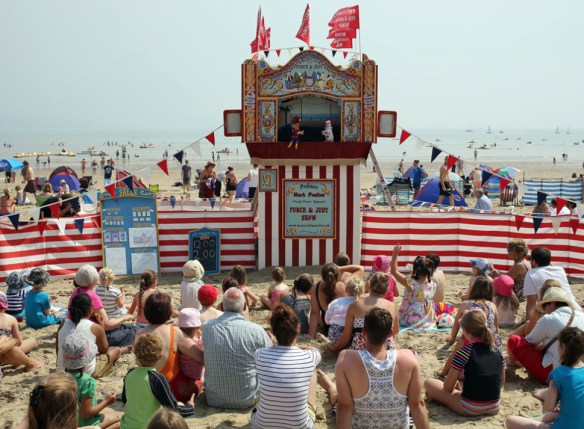
As a child I remember watching a puppet show with my grandfather. Nothing unusual in that, except it was on a beach. I can’t recall it very clearly except that I didn’t like the major character, who frightened me. As I have been exploring puppet theatre across the world I have steadfastly ignored this experience until a colleague pointed out that Punch and Judy was as much a legitimate world theatre form as Wayang Kulit. So I was prompted to dig deeper, and even more so when the image below, taken two weeks ago, appeared in the british press.
photo_Fotor

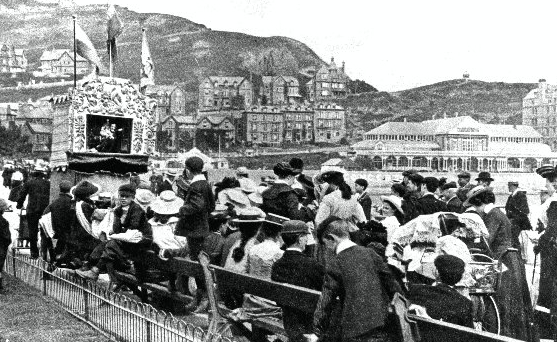
And the one below is from late nineteenth century.

llancod1_Fotor

I hadn’t realised quite how old the form was, or that it had its roots in Commedia dell’arte – although now that seems really obvious. Punch and Judy is one of the world’s most famous and long running puppet shows. It is essentially linked with England but Punch and Judy can be found just about wherever the colonial English decided to ‘set up home’ and english is spoken as a first language, America, Canada, Australia. Here is a great history of the form, written by Keith Preston, an Australian Punch and Judy man.

Punch and Judy has its origins in the commedia street theatre of medieval Italy and Punch arrived in England in 1663 from Italy as the marionette Pulchinello (noted by the famous London diarist Samuel Pepys). The character evolved into Punch over the next century and Punch appeared extensively both as a marionette and as a comic actor and slowly acquired a more English character that was a cross between the English Jester, Fool and the Shakespearean comic characters. In the late 1700’s the London puppet theatres closed and Punch and Judy as we know it appeared as a busking act on the streets of London as a portable hand-puppet show.

To entertain its new audience of street-wise townsfolk this new form of puppet theatre needed to be fast, loud, action-packed, comic and portable. Punch and Judy was all of these and more. The show started with the bottler (assistant who carried the bottle for the money donations) banging a drum and playing the pan pipes. The Punch-Man (later to be called a “Professor of Punch”) stayed inside the booth and operated all of the puppets and most notably the character of Punch whose shrill shrieking voice was created with a special reed inserted in the throat (known as the swazzle).

punch

The early puppeteers led a gypsy style existence moving through the streets of London and also taking the puppet show to fairs and events. When Londoners began to travel to the seaside towns by train in the 1840’s the Punch Professors followed and soon the Punch and Judy Show became a seaside institution. Some beaches and cities have had a Punch and Judy show every year for well over a hundred and thirty years. The Punch Professors guarded their shows fiercely and only passed on the secrets of puppetry to a son or nephew and kept the business ‘in the family’.

The show itself has changed enormously over the last two hundred years. The first written scripts appear around 1830 but illustrations of shows actually appear in the 1770’s. By the time the first scripts are found the Punch and Judy show has already been around for fifty years and has had a chance to develop into a fully fledged puppet show. While the story is new and reflects the life of the then modern Londoner, the script is also full of references to the early years of Punch, to the Medieval mystery plays and to the symbolic dramas, themes and characteristics of England.

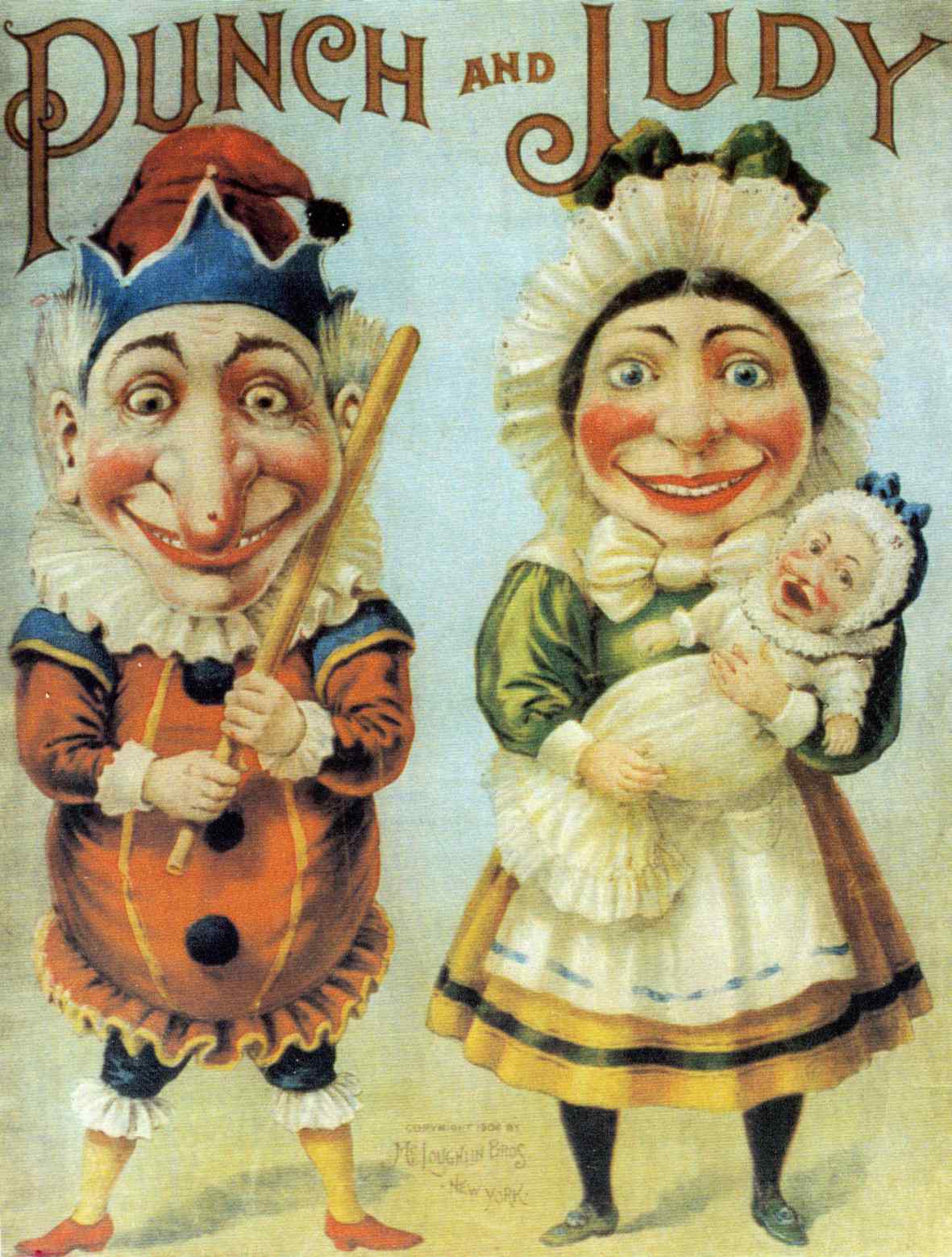
The early shows feature Mr Punch , a hook-nosed comic figure with a stick who is a cowardly braggart but strangely likeable. He hides, lies, cheats, steals, beats, boasts eats, drinks and loves his way through a difficult life. He is a rascal but is also an “Everyman” figure in that he represents the average person. In the old storyline he has an argument with other characters, fights them, sometimes he kills them, is chased by the law, taken to jail, but beats the hangman and the devil and ends as triumphant anti-hero. In between, the whole drama is treated as a total farcical comedy with lots of action, routines, jokes and slapstick moments. Other characters include Judy his wife and their Baby, Scaramouch the neighbour and his dog Toby (often played by a real dog) Joey the Clown, The Beadle or Policeman, The Quack Doctor, The Crocodile, Sweet Polly the Mistress, The Hangman, The Devil. In particular the characters of Hangman and Devil owe their origins to the medieval English dramas and early theatre of the Elizabethan period.

Punch-and-Judy

Obviously much of this is black-humour but with the comic drama, Punch and Judy acquired a symbolic status as a drama about life itself. Punch and Judy was a hugely popular entertainment for ordinary people on the street but also was often invited into private homes and mansions of the aristocrats.

It is interesting to note that a similar evolution of the commedia/marionettes also happened in other parts of Europe around the same time or slightly later and in Germany we have a similar hand-puppet show-Kaspar, in France – Guignol, Petrushka in Russia, Punchinello in Italy as well as links to the Greek shadow puppet theatre.

Punch and Judy emigrated with the English to America, Australia and other parts of the world in the Nineteenth Century but by the 1940’s was in decline with the advent of films and other aspects of popular entertainment. As with many other forms of traditional performance such as Vaudeville, Circus, Fairs and so on Punch and Judy was able to reinvent itself and had a revival in the 1960’s with the new emphasis on community arts, national pride, tourism and so on.

.

However over the years the Punch and Judy Show has also adapted and changed. In some cases it has become more of a children’s entertainment, far removed from its origins as a street-play. The rough and tumble violence has been changed and Punch is very much less of a sinister figure than he was in his early days. Some performers however do present shows that portray old-style performances still to this day.

To me it all seems terribly dated, but it clearly lives on. In an article in the Smithsonian Magazine by Linda Rodriguez McRobbie earlier this year the question is asked, Are Punch and Judy Shows Finally Outdated? It would seem not, although Rodriguez McRobbie does  talk about the violence (and murder!) in the shows:

The violence, of course, has remained—and for that reason, Mr. Punch’s influence on children has understandably long been a source of worry. A New York Times article from February 11, 1896, describes children enjoying a Punch show on West 135th Street in Manhattan—and one “grave gentleman,” who resembled Punch “as if they were brothers,” grumbling at the policeman-beating scene and declaring, “It is a shame to show such things to children! How can you expect them to have any respect for the law?”

In 1947, the Middlesex County Council in England banned Punch and Judy from schools, prompting wide outcry from Punch fans and his eventual reinstatement. More than 50 years later, in 1999 and 2000, other councils in Britain considered banning Punch and Judy shows on the claim that they were too violent for children; they didn’t, but it was close……Punch defenders claim that’s just modern oversensitivity. “Although adults get very upset about the violence, the bashing the baby, it’s no more real to a child than watching a cartoon, like ‘Tom and Jerry,’” says Cathy Haill, curator of popular entertainment for the Victoria & Albert Museum in London. “Ninety-nine percent of children will roar with laughter [at ‘Tom and Jerry’] and not think ‘Oh, I’ve got to write to the society for prevention of cruelty to cats’…Nowadays, people are far more— and I hate this term—politically correct and get ridiculously worried about things like this, in my view.”

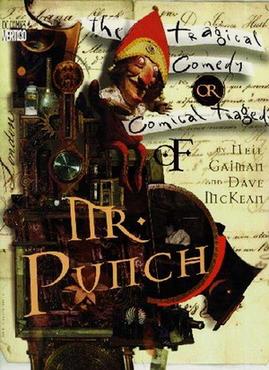
Mr_Punch_coverInterestingly though, Punch has been reinvented in a number of ways. In 1994 The Tragical Comedy or Comical Tragedy of Mr. Punch appeared as graphic novel by Neil Gaiman and Dave McKean. Last year Improbable Theatre created one of its most famous pieces, The Devil and Mr Punch:

DevilPunch.

..

.

.

.

.

There are two excellent pieces from Exuent that look at this particular show, The Immortal Mr Punch by Gareth Martin, and an interview with Julian Crouch (Designer and Director) by Tom Wicker.

.

And to finish, a delightful interview from 3 days ago, entitled Keeping Punch and Judy in the family, by Giulia Rhodes for the Guardian, where she talks to three generations of a Punch and Judy family.

.

Yes, But Is It Art?

My share today is one that resonated when I read it. I could have written it myself. In his article, Yes, but is it art? (written for BTG), Nathan Gabriel, Assistant Professor of Theatre at the University of Louisiana, speculates on a question that often occurs to teachers, students, audiences and reviewers. I shall say no more – have a read!

Yes, But is it Art

Is this play art? It’s a tricky question that I encounter a lot. It’s difficult partially because I’m never sure what, exactly, is meant by the word “art”. In a very literal sense, any theatrical production you see is art since theatre is one of The Arts. And while that broad definition is convenient and tidy, it feels dishonest. I know in my heart of hearts that not all theatre is created equal and that pure entertainments, like a juggling cabaret for example, don’t fall under the same umbrella as, say… Hamlet. They may both be theatre, but they are not both art.

ewan-39

Another problem with the “it’s all art” viewpoint is that it is also fairly useless. As a theatre practitioner and educator, I am regularly placed in situations where being able to determine whether or not a show is art can be an important distinction to make. Questions like what play should I choose to direct; how will I approach producing said play; what show will I ask my students to see/read; and what kind of review will I write are all affected by the answer to this very basic question.

So then how do we determine the difference between art and what I will call, for brevity and clarity’s sake, entertainment? When I pose this question with new theatre students everyone readily agrees that some performances are art and some are not. Often the students push shows with a focus on performance instead of theme (a show like Stomp, for example) out of the art category and into entertainment. Confusion arises, however, when they attempt to say why. Their attempts to discern art in the theatre usually touch on three categories.

20100126stomp

First they claim that a play is art if it moves them personally. This is problematic because it sets an individual up as The King Of Art, whose personal opinion speaks for all. So an amendment is usually made that every person should get to decide for themselves whether a play is art or not. This idea, while nice in its utopian nature, is in no way practical. Outside of academic conversations, theatre must deal in collaborative practicalities. Plays need to be selected for funding, sets need to be built, artistic teams need to work together to make productions happen, and objective, not subjective, guidelines have to be followed if these productions are to be successful.

The next proposal to determine a play’s artistic worthiness usually involves consulting experts like theatre critics, playwrights, and other artists who “know”. Unfortunately, these experts often disagree with one another, and even when they do agree can be proved wrong by a production that finds favour with history instead of its contemporary audiences.

Finally, some students argue for craft as being a determining factor. How well did the actors perform? Was the script well written? How impressive were the sets and special effects? This is a very convincing argument, which smartly takes into account the individual parts that make up the artistic whole. While I appreciate the effort to point to an objective set of criteria, in my experience a play can have a fantastic set, script, and cast of actors, but still not be art. So why not?

Duchamp-Fountain-1917

Let us look briefly outside of the theatre to see how this question was addressed in the visual arts. In 1917, artist Marcel Duchamp placed an ordinary urinal in an art gallery, turned it on its side, and called it art. Despite causing an uproar with gallery patrons and art critics at the time, this and other Duchamp “ready-mades” have been named by history as important works of art and are shown in museums around the world. Why?

It’s because Duchamp was criticizing the status quo. These pieces were a response to a gallery rule that any art could be shown as long as the artist paid a fee to exhibit. With his ready-made sculptures Duchamp challenged how people determine what they call art. In this example we find a definite clue about requirement for art status: intentional communication. Since Duchamp did not make the items he was displaying, he utilized not mastery of craft, but of idea. Thus, communicated ideas and intention take centre stage in the debate about whether or not something is art. From this perspective, the true litmus test for whether theatre is art is whether the production was intentionally designed to communicate with an audience.

However, not just any communication will do. I propose that the statement must be worth making. Every production, if one looks hard enough, probably attempts to communicate something. For example, in a Cirque Du Soleil show there is usually a loose plot upon which is hung many feats of physical prowess. We marvel at the skill of the performers but leave without a clear idea of what the point of it all was. Love is good? Keep on dreaming? Something about The Beatles? I am not saying that Cirque isn’t highly entertaining and impressive theatre (they don’t tour the world because they’re boring), but I am saying it’s not art. It’s not art because it doesn’t communicate anything that is authentic and/or necessary to hear about life.

Cirque_du_Soleil__T_160395a

This assertion raises the question, what exactly does a production need to communicate to be considered art? The answer to this should probably not be overly defined since art tends to defy being put into neat little boxes. However, I can offer you this—a professor of mine once said something that I refer to when I am faced with the art question: “If it says something that you know is true but would have trouble putting into words, it’s probably art.” Similarly, American playwriting legend Tennessee Williams once wrote in the New York Star, “[Art] is a benevolent anarchy: it must be that, and if it is true art, it is. It is benevolent in the sense of constructing something which is missing, and what it constructs may be merely criticism of things as they exist.”

Both of these definitions, as well as the example of Duchamp’s ready-mades, point towards art being a communication of the elusive truths of life that, for whatever reason, need to be heard by audiences in the particular time the show is produced. Not just a show of talent or a deeply emotional experience, art is more than just the well-made sum of its parts. It is holier than that. True art is the unspoken, said aloud.


Your thoughts? I would really like to know. Do leave a comment if you have time.
.

Going Global

I found myself recently in a conversation about what the term World Theatre means? I came to the conclusion that it depends on where in the world you are. For me, Cantonese Opera is not World Theatre because it exists on my doorstep, but for my students the work of Harold Pinter is, for example, as is the Broadway Musical.

But an announcement last week by a theatre company got me back on to this subject and it really got me thinking. The Globe Theatre in London, who I also wrote about recently, said they are sending a production of Hamlet on the first genuine world tour in theatre history. Starting on 23 April 2014, the 450th anniversary of Shakespeare’s birth, the company will spend two years travelling by planes, trains, boats and buses to visit every nation on Earth – 205 countries in all.  My immediate thoughts were, ‘is this inspired or is it arrogance  – only a British company would consider doing this?’. However, a quick Google search later disabused me of my cynicism. The proposed tour was reported in Canada, Australia and the US (not surprisingly, you might think), but also in India, China, Egypt, Turkey and many other places where English is not spoken as a first language. The saintly Peter Brook commented that it is:

a bold and dynamic project……the six simplest words in the English language are ‘to be or not to be’. There is hardly a corner of the planet where these words have not been translated. Even in English, those who can’t speak the language will at once recognise the sound and exclaim ‘Shakespeare!'”

Untitled_Fotor

According to The Globe’s artistic director, Dominic Dromgoole the idea came about because they wanted to build on the festival they hosted last year where all 37 Shakespeare plays were performed in 37 different languages, by actors from 37 countries. I wrote about it my post Globe to Globe. Further details were given in an interview with Maev Kennedy in the Guardian

Globe theatre plans 205-nation Hamlet world tour

Two-year tour will start next April on 450th anniversary of Shakespeare’s birth, and aims to visit every nation on Earth

“I think having a lunatic idea is a very good thing, it’s a great way to keep everybody focused and dazzled and delighted by the ambition and energy of the company,” said the artistic director, Dominic Dromgoole. “If we’re going to do every country in the world it has to be every country, we’re not going to leave anyone out. All the ‘Stans, South and North Korea – we’re very keen to get into North Korea. Antarctica? Fuck yes.”

He said it had to be Hamlet for the project. “It is an iconic play, instantly recognisable anywhere. It has that capacity to question, to challenge, to inspire in any country in the world,” he said.

The show will open at the Globe next April, and close there exactly two years later on 23 April 2016, which also happens to be Dromgoole’s last day as artistic director.

The 204th and 205th stops are already decided: the Rift Valley in Kenya – “where human life began on Earth”, Dromgoole said – and Elsinore in Denmark, the castle where Shakespeare set his tragedy. They will be performing in theatres, in town squares, on beaches and in jungle clearings. There are, however, many gaps and question marks in the plan.

The company will snake across Europe, at one point playing four countries in five days, into the Caribbean, America north and south, down the west coast of Africa, on into Australia and the Pacific islands (“logistically that could be quite hard work,” Dromgoole said, looking slightly anxious for the first time) on to Indonesia, Japan, China and Asia, back up the east coast of Africa, to Elsinore and then home. Easy.

Hamlet at the Globe

The experiment is unprecedented but builds on links forged through the Globe’s last spectacular attempt to link nations through the words of the glover’s son from Stratford-upon-Avon. Last summer as part of world Shakespeare season celebrating the Olympics, the Globe invited companies to come and perform every play the Bard wrote in 37 different languages – including Troilus and Cressida in Maori, Two Gentlemen of Verona in Shona (spoken in Zimbabwe and Zambia), and the Henry VI plays divided among the Balkans in Serbian, Albanian and Macedonian.

The season proved a wild success, seen by more than 100,000 people in six weeks, 80% of them first-time visitors to the Globe. “It was such a fantastic experience I thought we need to keep that energy going, we need another bananas idea,” Dromgoole explained.

The touring Hamlet will be the Globe’s scaled-down version, which has already been admired in UK tours, with a cast of eight – from a company of 12 to allow for illness and even the odd day off – playing more than two dozen roles between them, scampering through the text of Shakespeare’s longest play in just over two and a half hours.

6a0133ec96767e970b01538e667140970b

Although they hope to attract sponsorship, the unsubsidised main house on the South Bank has been making a handsome profit in recent years, and small-scale tours having been covering their costs or better.

Since Dromgoole launched Romeo and Juliet in a camper van six years ago – the modern version of the strolling players of Shakespeare’s day arriving in a wagon piled high with props and costumes, he said – he has been trying to reach the parts other tours don’t touch.

This summer he is sending a company out to play Shakespeare’s history plays on the actual battlefields that sparked regime change,  with Henry VI on the wide green fields in Yorkshire where in 1461 streams ran red with blood and ditches were choked with bodies at the battle of Towton.

“Touring is in our blood,” Dromgoole said. “It’s what Shakespeare’s company did, it’s what we do – and it’s great fun.”

Another interview here with The Globe’s executive producer, Tom Bird, gives you an even greater idea about the possibilities and logistics behind the tour.

I have to applaud Dromgoole for his vision. It is inspired. Perhaps Shakespeare is the true World Theatre? He is performed in the original and in translation all over the world. I was reading an interview with a Kuwaiti actor yesterday who said his greatest challenge and love was always Shakespeare (in Arabic). I’ve seen bilingual performances here in Hong Kong. Shakespeare is a favourite in Korea.

This tour will be an interesting one to follow once it gets underway. I am looking forward to how it is received. You can follow it on Twiiter @WorldHamlet.

Digital Dreaming

I am always fascinated about how we can use technology to create and enhance performance and it is something that is clearly being embraced by theatres, directors and performers around the world. For example, live, streaming performance is starting to become the norm, rather than the exception. The National Theatre, through their NTLive programme, now regularly broadcasts it’s work to cinemas around the world.

However, it’s where technology allows a performance to become something that otherwise wouldn’t be possible is what really excites me. Therefore I was happy to come across this article in Wired by Liz Stinson about a performance called Mr and Mrs Dream. The creators, Le Théâtre du Corps, worked with a software company, Dassault Systèmes, to make something rather special indeed.

A Virtual Stage That Bends Reality and Pushes Theater’s Boundaries

There’s a scene in the contemporary ballet Mr. & Mrs. Dream where the walls of the set appear to burst apart, transporting one of the principal dancers from an apartment living room to a sea of meteorites in outer space. The dancer, Julien Derouault from Paris’ Théâtre du Corps, begins to hop from meteorite to meteorite, and with each step, the space rocks appear to dip from the heft of the human body. Of course, Derouault isn’t actually bouncing on meteorites; in reality, he’s simply leaping on the floor of an almost empty stage. The scene is mesmerizing, and from the vantage point of the audience, it really does look like the dancer is jumping through outer space. But it’s all an illusion, created by an elaborately engineered virtual reality system that could begin to replace traditional sets with projectors, screens and computers.

Though the show was conceived and choreographed by Derouault and his partner Marie-Claude Pietragalla, the brains behind Mr. and Mrs. Dream’s high-tech set is Dassault Systèmes. The French software engineering company typically uses its virtual reality technology to test, model and simulate products for companies like Boeing, so it’s natural to think that this collaboration is a bit of an odd pairing. But, says Mehdi Tayoubi, vice president in charge of experiential strategy at Dassault, interdisciplinary collaboration is becoming more common and more imperative for high-tech companies.

.

“It’s very important when you claim to be an innovative company, to be able to go outside the laboratory and your comfort zone,” says Tayoubi, who heads up Dassault’s Passion for Innovation program, an initiative whose goal is to apply the company’s industrial research and technology skills to the worlds of culture and education. Since 2005, Dassault has worked with architect Jean-Pierre Houdin to simulate the construction of Cheops pyramid, partnered with director Luc Besson to bring 3-D interactivity to movie theaters, and helped cartoon artists turn their cartoons into virtual reality (and these are just a few of their projects). Mr. and Mrs. Dream is Dassault’s first crack at live dance, and not surprisingly, there were some challenges and miscommunications along the way. “At the beginning it was a little bit difficult,” says Tayoubi. ”But we learned to share the same language.”

One of Dassault’s main challenges was creating a virtual reality system that was technical enough to accomplish the complex visual effects that the dance company envisioned while still being simple to use. “We needed to design a system that we can give to people who are not engineers and they could set up everything in a few hours,” explains Benoît Marini, Dassault’s virtual reality expert. The system also had to be mobile since the company would eventually be touring with it around the world.

.

Marini’s solution was a mobile “magic box,” which is basically a disassemble-able series of four gray screens and six projectors that would be the canvas for the immersive world of Mr. & Mrs. Dream. The box is similar to the virtual reality rooms traditionally used by industrial companies, only instead of testing emergency scenarios and modeling new airplane features, this box is used to motion-track dancers and project computer-generated images. For scenes like the one mentioned above, Marini positioned three Kinect sensors above the stage to track the dancers’ movements. So when the dancers jump, the meteorites bounce, or when the dancers kick, a flurry of leaves float through the air. Most of the other projected dance numbers were motion-captured in the studio and are played back in sync with the music. The audience doesn’t have to wear 3-D glasses; instead the team uses perception tricks like digitally created trompe l’oeil to convey depth and dimension.

dance888888

Fittingly, Mr. & Mrs. Dream is based on the work of Eugène Ionesco, the famed playwright whose work was a hallmark of the Theatre of the Absurd. “We always say to our customers like Boeing: ‘There is no limit, dream big, we can do everything,’” says Tayoubi. “So we saw a lot of similarity between Eugène Ionesco and what we are doing everyday.” Tayoubi believes that working on inter-disciplinary projects like this is the key to innovation, citing the magic box as a technology that Dassault will use again at automobile shows to give 3-D representations of new cars. Working with artists forces the scientifically minded to push boundaries and create solutions to problems that they’ve never encountered before. “Artists have a lot of imagination,” says Marini. ”Sometimes they want effects that aren’t possible.” So what happens when the dancers ask for something they can’t create, like holograms that can interact with the audience? “You say, ‘wow,’” Tayoubi laughs, “Then you begin to find a solution.”

You can read a review of the show here.

.