Dying On Stage

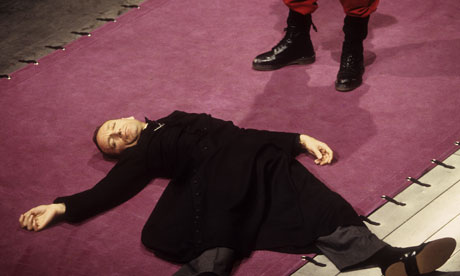
There a few things I have always had to begrudgingly admit that cinema does better than theatre, and one of them is death. A death – be it by murder, accident or natural causes – on stage is alway difficult. We suspend our disbelief, but when I see someone chopped down in the prime of life in front of me – I’m thinking Hamlet, Romeo and Juliet – it always leaves me (rather than the supposed corpse) a little cold.

the-barricade1

So it was with some interest that I read Jane Howard’s article in The Guardian that mused on this most difficult of theatrical acts:

Can theatre ever pull off a convincing stage death?

Playwrights love a dramatic death scene – but stage trickery is rarely good enough for the audience to suspend disbelief

If you’ve been to the theatre even a handful of times, it’s likely you’ve seen a stage death. Our fascination with death seems endless, and proves fruitful picking for playwrights. For the writer, there’s power in making an audience empathise with a character and then ripping that character away, and there’s also power in the vindictive killing of the disliked.

Oedipus Schmoedipus, playing in the Sydney festival, is a documentation and reenactment of the deaths in the western theatrical canon by performance company Post. The billing lists the work as “after Aeschylus, Anon, Barrie, Behn, Boucicault, Büchner, Chekhov, Euripides, Gogol, Goldsmith, Gorky, Hugo, Ibsen, Jonson, Marlowe, Mayakovsky, Molière, Pirandello, Plautus, Racine, Seneca, Shakespeare, Sophocles, Strindberg, Voltaire, Wedekind, Wilde et al”. And these men didn’t stop at one death apiece.

Post’s Mish Grigor describes the work as exploring the “tension between the fact that death is an actual universal, and the western theatrical canon is often spoken about as having universal themes or, these plays speak to all of us. We’re interpreting an actual universal through something that we don’t think is really universal, but pretends to be.”

Is death, then, perhaps an easy way of trying to create a connection with the audience? It is something that everyone watching will have a relationship with, even when other themes a play explores may be foreign?

oedipus-schmoedipus-belvoir-2014-production-shot-4-by-ellis-parrinder

And yet, we are readily judgemental of watching someone pretend to die. When we’re watching theatre we suspend disbelief in so many ways, buying into the construct of the world and using our imagination to fill in the gaps. But there is something about death that is particularly sticking when it comes to witnessing it on stage.

“I find it quite absurd when an actor dies on stage,” says Grigor, “because we know that it’s a game of pretend: they’re still breathing. You can still see them breathing a lot of the time, and the stage trickery that is employed is usually not that good.”

When you start talking about the practice of death and dying on stage, the same concerns repeatedly come up. Tim Roseman, artistic director of Playwriting Australia, says: “The trouble is, it’s an inherently over-the-top theatrical thing that theatre does, because at the very least you’re left with: what do you do with the body? And so the artifice is always problematic.

“Because I know you’ve got to do it 34 more times before you finish the season and, literally, do you just get up and walk off? Do we get someone in black to come and steal the body in the end? It’s a really problematic thing. And, you know, fake blood. So I think it’s the thing we buy the least.”

It seems that while we’re prepared to ignore the wires helping someone fly, there is something about death that makes us watch for the rise and fall of an actor’s chest or shadowed movements in the blackout.

Maybe that’s why, when I look back at the deaths on stage that have truly impacted and stayed with me, I keep returning to puppetry. The death of the title character of the Adventures of Alvin Sputnik: Deep Sea Explorer, a puppet made from little more than a white-gloved hand and a foam ball, left me holding my breath to not audibly sob. The deaths of hundreds of silent puppets at the hands of Nazi soldiers in Hotel Modern’s Kamp left my heart in my throat and my brain overwhelmed.

I mentioned these deaths to Nescha Jelk, artistic associate at the State Theatre Company of South Australia. “It’s because the puppeteer animates it, gives it that life and gives it that real presence,” she says. “We really invest [emotionally] with the puppets, but it’s so easy to de-animate them and to take that away.”

Grigor agrees: “There’s always life in the person, isn’t there? You always know. For me, I find it very hard to escape that knowledge: that a person is just a person.”

Michael-Feast-plays-Thoma-007

Not surprisingly this led me to see what other people had to say on the topic. A blog post Alexis Soloski, also in The Guardian, from a year or so ago – What makes a good stage death? Forget all that tediously realistic convulsing and juddering – a really convincing theatrical death is better left unseen – is great and her list at the end, about what should be remembered when ‘acting’ death, just made me smile:

1. Don’t. Keep the death off-stage.

2. Perform the death on stage but avoid showing it directly, as in the famed stoning scene in Edward Bond’s Saved.

3. Keep convulsions to a minimum.

4. Better blood. (The Royal Shakespeare Company keeps correctly coloured fluid in three different viscosities.)

5. Try to die on your stomach or with your back to the audience so they don’t see you continuing to breathe.

6. Actually die. There are – a very small number of – actors who have perished while treading the boards. (This method is not recommended. Not only is it tremendously sad and frightening, but it’s terribly inconvenient for the next day’s matinee.)

There is also a great article from TimeOut Sydney, Death Scenes,  which talks to six performers about how they ‘do’ death on stage. One of the actors interviewed, when asked if their mind wonders once they have been killed, said:

Sometimes you lie there thinking about what you’re going to have for dinner if it’s a matinee

A rather more serious article from theatrebayarea.org, I’m dying out here has in interview with actor James Carpenter who has ‘died’ many, many times on stage and is an interesting read on the subject.

I’ll finish with an extract from a post by Alfred Hickiling, Death by overacting, The Greeks did it tactfully, Bottom did it endlessly

There is a lot of death in the theatre: sometimes good, but frequently so bad as to make you wonder why anyone ever decided to mess with the formula established by the Greeks. You can’t help but feel that the fathers of western drama had it right when they opted to keep all the gory business off stage – why spoil the performance with a series of unnecessary convulsions when you can send a messenger to report that you expired heroically, with all your tragic dignity intact? Ibsen, Chekhov and Miller got the message: a solemn exit followed by a solitary gunshot, a profound silence and no mess.

Saved, Edward Bond

Saved, Edward Bond

It is the Jacobeans we have to thank for plays that conclude knee-deep in guts, thanks to their macabre fascination for golden daggers, poisoned Bibles, severed limbs and so forth – which all the followers of Sarah Kane and the Blasted school have enthusiastically revived today. But if one were to identify the absolute nadir of unconvincing expirations, it is as well to start at the Bottom:

Thus die I: thus, thus, thus.

Now I am dead,
Now I am fled,
My soul is in the sky.
Tongue lose thy light,
Moon take thy flight,
Now die, die, die, die, die.

I have seen actors spin Bottom’s soliloquy out for several minutes, at which point the joke no longer seems to be on Shakespeare’s weaver, so much as on themselves. But if the death of Pyramus is daft, Shakespeare also crafted some of the most exquisitely moving death scenes of all time, such as Cleopatra with the asp (“Dost thou not see the baby at my breast that sucks the nurse asleep?”), as well as one of the most defiantly underplayed (Mercutio’s “’tis but a scratch”).

No Longer A Refugee

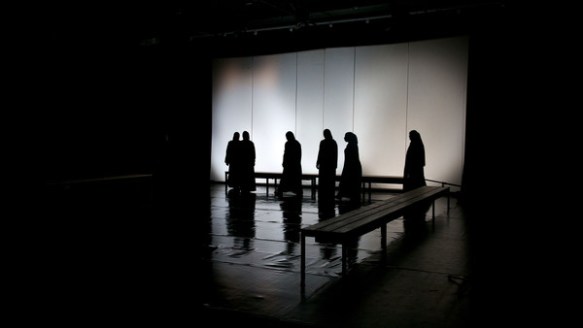
The article I want to share in today’s post really touched a nerve when I read it last week. It was published in the Financial Times, written by Charlotte Eagar, and is about her project to stage the antiwar Greek tragedy, The Trojan Women with a cast of Syrian women who have fled their homeland’s vicious civil war for neighbouring Jordan.

a8ebe18e-7410-11e3-beeb-00144feabdc0

If you don’t know the play, The Trojan Women is about refugees, set at the fall of Troy. All the men are dead and the former Queen Hecuba of Troy, her daughter Cassandra and the rest of the women are waiting in a refugee camp to hear their fate. Euripides wrote the play in 415BC as an anti-war protest against the Athenians’ brutal capture of the neutral island of Melos; they slaughtered all the men and sold the women and children into slavery. You can download the text of the play as an e-book here, or read it online here.

4c06569e-5e6e-4213-b3a3-59af6ceffd39

Eagar’s piece is definitely worth reading. It charts the whole project from beginning to end. It is both immensely inspirational and gut-wrechingly sad. Click the link below for the full article.

Syrian refugees stage Euripides’ ‘The Trojan Women’

You get a real sense of the power of the performance in the interview, below, with one of the actor refugees, known simply as Fatima.

.

5857925

.
.

Trafficking Words

My second post today is an article from The Guardian written by Haleh Anvari. It is about a rather special piece of immersive theatre that takes place in the back of a taxi, in the Iranian capital Tehran. Just fantastic!

Immersive drama set in a Tehran taxi

Iranian cabs afford passengers a degree of anonymity, paving the way for uninhibited conversations and a new play

That Tehran is beleaguered by appalling traffic and toxic air is no secret. The use of that traffic as backdrop to a play in a moving taxi, especially during some of the most polluted weeks of the year, is testament to the resilient creativity of the city’s young artistic community and their readiness to push boundaries not just in terms of art but physical wellbeing.

"Unpermitted Whispers", a play by Azadeh Ganjeh.

“Unpermitted Whispers”, a play by Azadeh Ganjeh.

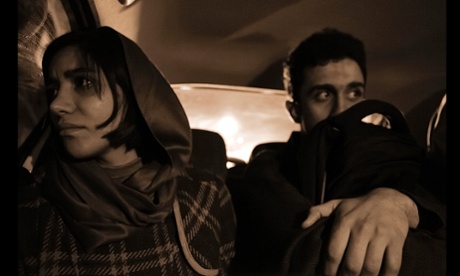
Unpermitted Whispers is a 35-minute play that takes place in one of Tehran’s “Rahi” taxis, which traverse the city along fixed, often straight-line, routes. Rahis pick up passengers at major intersections and drop them off anywhere along their set route, making for a convenient method of getting around town and one cheaper than the minicabs available in every neighbourhood of the capital.

In contrast to the minicabs, which provide door-to-door service, the Rahi system affords passengers much more anonymity, allowing for candid and uninhibited conversation. Tehranis frequently share stories that they have overheard in these communal cabs; for many, they serve as an extension of the private sphere in which Iranians feel safe to talk about issues of the day. Unpermitted Whispers takes advantage of this unlikely superimposition of public and private to tell the story of three passengers, all women, who are picked up by a male driver at different points along his route.

To see the play, we were instructed to assemble at a busy downtown coffee shop around the corner from the University of Tehran. The modern café, run by a troop of young, funky Tehranis, is an essential part of the production. It acts as the foyer to the moving theatre.

A short wait and a couple of lattes later, we were asked by a young woman to follow her outside to the nearest intersection. We waited on the street corner just as we normally would to catch a Rahi. A nondescript older model grey Peugot stopped at our feet and the usher beckoned us to get in. Before the taxi pulled away a young woman threw herself in beside us, and the play began.

There are four shows nightly, necessitating arduous organizational exertions. For one thing, the sessions can hardly be expected to start exactly on time, since the stage is at the mercy of Tehran’s nightmarish traffic. The taxi’s dramatic maneuvers are an additional cause for concern. Twice during the performance we attended, the driver swerved violently to the side of busy Taleghani Street to facilitate the unfolding drama.

As Tehranis we are very familiar with the communal cab, both its discomforts and its possibilities: the forced intimacy that results from sitting beside total strangers, the unwanted physical contact, the vexingly loud conversations on mobiles, as well as the impromptu debates and spontaneous venting about contentious social and political topics.

The play’s first scene was performed entirely on the telephone, as we eavesdropped on a conversation of a kind with which many Iranian women are familiar: a young bride wants to go to the theatre with her university friends but needs an alibi as her traditional family and jealous husband will not approve.

The second scene involved another young woman, who had lost her brother and fiancé after they were called up for national service. It was confusing and a tad overdramatic – especially when she leapt out of the car while it was still in motion.

The third featured a chador-clad woman from the shore of the Caspian Sea – her perfect Gilan dialect would have benefitted from subtitling – in search of her abusive husband, hospitalized somewhere in the city. We were taken to three hospitals and watched as she disappeared into each to “make enquiries.”

By this point, we had willingly suspended our disbelief and were interacting naturally with her plight, more like actual Rahi passengers than spectators. I and the other woman in our little group told her she should not endure being beaten, while the male passenger resorted to an Iranian adage:“You enter your husband’s household in a white dress and you leave only in another white garment – a shroud.” This provoked a heated conversation which was missed by the actress, then evidently hanging around the A&E room of the last hospital for the sake of verisimilitude.

The play was produced by Urban Arts House, an innovative new collective of young professional artists from different disciplines who are devoted to the urban culture of Tehran. They produce and encourage the making of experimental art in and about the capital, aiming to engage the public with the arts amid the city’s everyday spaces.

The show’s creator, Azadeh Ganjeh, is a scholar of Shakespeare who specializes in environmental art. Her three female characters were ostensibly inspired by major Shakespearean figures: Othello’s Desdemona, Hamlet’s Ophelia and The Taming of the Shrew’s Katharina. I felt that the play would have made better use of its setting had she introduced some male characters from Tehran’s own bustling streets and rounded out the stories with some of the more comical moments we encounter daily negotiating life in the city.

The Rahi drivers are as vociferous as the cabbies in any metropolis and often hold court, directing the conversations within their vehicles. In Unpermitted Whispers the only male character, the driver, was no more than that, a sidekick to the drama of the three women, each trying to overcome her difficult circumstances. At best he served as a symbol for the modern Iranian man, willing to help but unable to effect any real change.

It was a little disappointing, thus, to find that the stories addressed the strains and challenges of just one half of the population. The innovative use of the urban environment, on the other hand, was effective. Our voluntary participation in the drama within this one Rahi amplified the sense of Tehran as a living stage with ongoing dramas in every unseen corner.

We were dropped off some blocks away from the coffee shop where we had started our journey by the apologetic driver, who declared that he would continue to help the lady from out of town find her husband.

Trying to find the way back to our car, we asked directions from a young couple strolling down a quiet tree-lined street. As the man stopped to assist, his female companion ignored us and continued to walk on. There were tears quietly running down her face. Was this a real lover’s tiff or were they both part of the play? For a moment, it wasn’t easy to be sure.

The Third Collaborator

Theatre Room has been on an extended Christmas vacation, but I am back now and have lots to share over the next few days.

I want to start with an article from the Boston Globe from last week. Written by Joel Brown and entitled Offstage, dramaturgs are playing a prominent role it explores the burgeoning role of dramaturgy in American theatre. As I have written here before, dramaturgy often defies definition and this great article tries to put that right.

Offstage, dramaturgs are playing a prominent role

The posters and programs for Company One’s “Splendor” last fall offered three credits where there are usually two:

“A WORLD PREMIERE by Kirsten Greenidge

Directed by Shawn LaCount

Dramaturgy by Ilana M. Brownstein”

Playwrights and directors always get prominent credits, but a dramaturg almost never does. The billing for Brownstein was one outward sign of a backstage shift in Boston theater. In today’s theater, dramaturgs do anything from mundane script management to researching a play’s historical background, from suggesting changes in a play’s structure to arranging post-show discussions with the audience.

“The role of the dramaturg was, really, we saw it as a third collaborator,” said LaCount, Company One’s artistic director.

But it’s a job that’s at best dimly familiar to the audience. Partly that’s because the role of the dramaturg changes from show to show and company to company. Dictionaries broadly define dramaturgy as the art of dramatic representation. Even dramaturgs say the job is not easy to explain. In today’s theater, they do anything from mundane script management to researching a play’s historical background, from suggesting changes in a play’s structure to arranging post-show discussions with the audience.

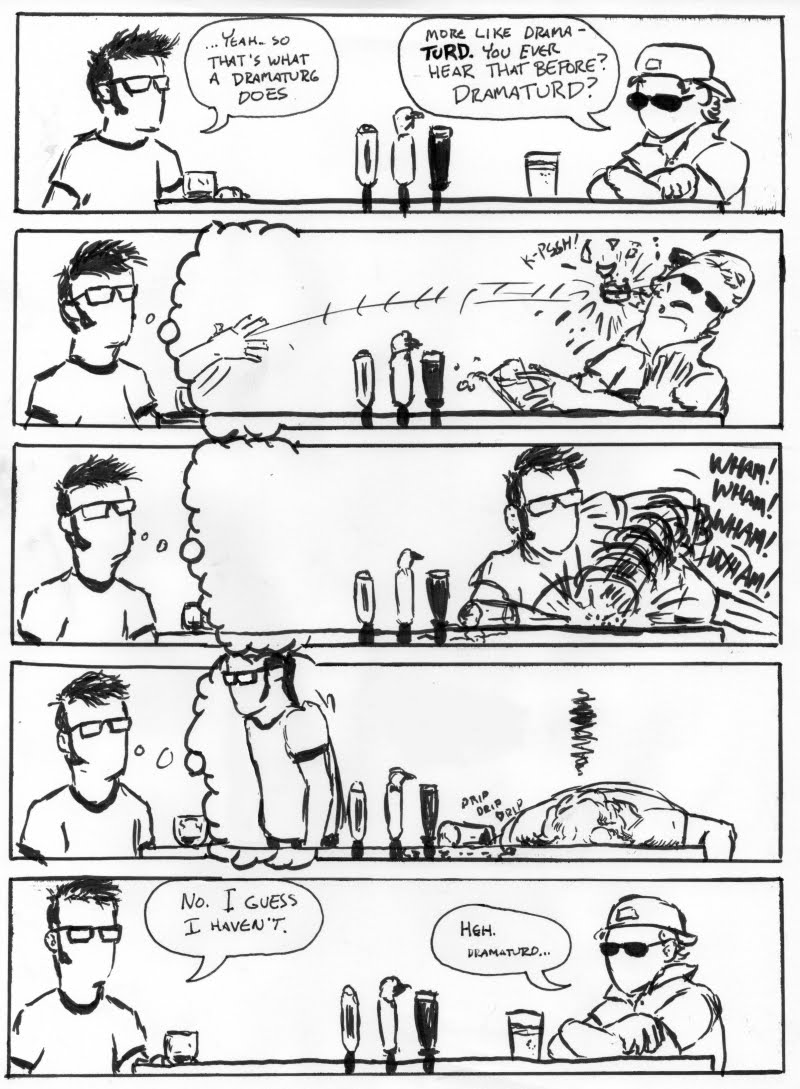
“You ask 10 dramaturgs what they do, and you’ll get 17 answers,” said Brownstein, whose title at Company One is director of new work.

From left: director Shawn LaCount, dramaturg Jessie Baxter, and actor Peter Andersen discussing an upcoming production of “The Flick.’’

From left: director Shawn LaCount, dramaturg Jessie Baxter, and actor Peter Andersen discussing an upcoming production of “The Flick.’’

From a small-company production like “Splendor” to the Broadway-bound “The Gershwins’ Porgy and Bess,” dramaturgs have been shaping much of what Boston theater audiences see. LaCount and others say that a dramaturg is especially valuable to a new play, and that’s why dramaturgs have a higher profile here lately. “I think Boston is becoming a player in new work in the American theater, (and) it’s been a while,” said LaCount. “I think the role of the dramaturg is a lot more noticeable and valuable.”

The Literary Managers and Dramaturgs of the Americas will hold their annual conference here in June. “The theme of the conference is looking to the future to see where we are going,” says conference chairwoman Magda Romanska, an associate professor at Emerson College and editor of an upcoming dramaturgy textbook. “I think it’s a really good moment for the field.”

Playwrights are artists and rightly protective of their creations. But Greenidge said she was happy to have Brownstein’s input during the development of “Splendor,” which is built around a Thanksgiving weekend and centers on ties of family and community.

Freelance010 - edit

“One thing Ilana brought up was, ‘Nobody ever has Thanksgiving dinner in your play — what does that mean?” Greenidge said. By the time of the premiere, the playwright added a brief, dreamlike scene in which all the characters come to the table to get a piece of pie before dispersing again.

Dramaturgy (it rhymes with clergy, though “dramaturg” is pronounced with a hard G) dates to Europe in the 1700s, when the first dramaturgs were sort of in-house critics. Formal dramatic structure was long their main concern. Now institutional dramaturgs may be involved in selecting plays for a company to produce; they often carry the job title of literary manager. Production dramaturgs work on a specific show. Some dramaturgs are freelance, some on staff. Duties and titles overlap.

In the modern era, dramaturgs are known mainly for researching the context of a play to ensure an accurate production, and to provide background information to cast and designers. They have long been considered “the in-house bookworm,” as one joked.

But even that role is not necessarily dull. “Today I’m reading all about S&M for ‘Venus in Fur,’ ” said Charles Haugland, dramaturg at the Huntington Theatre Company.

Dramaturgs enter the field in various ways, but few have had as consistent a path as Ryan McKittrick, director of artistic programs/dramaturg at the American Repertory Theater in Cambridge. “I sort of grew up in this theater,” he said.

McKittrick was an undergraduate at Harvard when he fell in love with ART’s work, studied dramaturgy at the ART Institute, and has worked with the company since he graduated in 2000. He works on projects developed sometimes over years at the theater, including 2011’s “The Gershwins’ Porgy and Bess” under artistic director Diane Paulus that made it to Broadway.

“When I was an undergraduate, I didn’t really know what dramaturgy was,” McKittrick said. “It provides an opportunity for someone who loves academic research but also loves the theater and wants to pursue a life in professional theater. And within the theater you get to do many, many different things.”

keep_calm_and_trust_the_dramaturg_ceramic_tile-r32585b26ebd944a391f65451dfcf19ae_agtk1_8byvr_512_Fotor

Most dramaturgs write program notes and organize post-show discussions. Their quest: “How do we deepen an audience’s connection to the material?” said A. Nora Long, a dramaturg whose job title is associate artistic director at the Lyric Stage Company of Boston.

On productions, a dramaturg may also be responsible for “moment-to-moment rehearsal stuff” that requires a deep knowledge of the script, Brownstein said. “Splendor” follows numerous characters in a fictional Boston suburb over decades, jumping back and forth in time. The cast rehearsed the scenes in the order in which they appear in the play, not in the order in which they happen. So the scene they were working on at any given time might hinge on developments not shown until later.

“So it was one of my jobs for every scene to be the person who was like, ‘Context! Here’s what you need to know,’ ” Brownstein said.

Playwright Walt McGough says he’s always happy to have a dramaturg on one of his productions because they can solve thorny problems. When his “Priscilla Dreams the Answer” was in rehearsal with Fresh Ink Theatre a couple of years ago, he and director Melanie Garber got along great except for “one moment where we just kept talking past each other,” McGough said via e-mail.

The issue on which they deadlocked: when to start playing a Belle and Sebastian song in the play’s final moments. Garber wanted to start at the beginning of the last scene, while McGough wanted to wait until the blackout, he explained.

“We were wasting time trying to explain to each other why one choice was right and the other was wrong,” McGough said. “The dramaturg, Jessie Baxter, was sitting and patiently watching us run around in circles. She spoke up and recommended splitting the difference, and beginning the cue about halfway through the scene, so that it underscored the final moments but didn’t kick in fully until the play had ended.”

That solved the problem perfectly, he said, and exemplified the value of having a dramaturg who “observes the entirety of a play and its production, instead of just one aspect, and makes sure that everything that happens is being done in service to the same viewpoint.”

Baxter also “dramaturgs” for Company One and is working on its production of Annie Baker’s “The Flick,” opening at the Modern Theater in February.

The job all depends on the play, the circumstances and who’s involved. Dramaturgs can be less needed on a well-known work, especially with an experienced director. “If we’re doing ‘Private Lives’ with [director] Maria Aitken, she’s done 12 Noel Coward plays, she doesn’t need me,” said the Huntington’s Haugland.

And there are some playwrights and directors who aren’t so enthused about what dramaturgs have to say. Playwright Richard Nelson gave a speech in New York in 2007 in which he deplored a “culture of ‘development’ ” in which playwrights are thought to need help to do their work.

lmda_FotorBoston dramaturgs say it’s often the older generation that has an issue with their growing role.

“I have some people in my family who are theater practitioners,” said Long, “and when I told my uncle I was studying dramaturgy, he was like, ‘As a director, what would I possibly need a dramaturg for? I can do research.’

“But the thing you cannot do is be another pair of eyes,” Long said. “I think the best dramaturgical relationships are about finding a collaborator who knows as much about what you are attempting to do onstage as you do, but who is going to look at it from a different perspective.”

As devised theater and new technologies become more common, younger playwrights grow more comfortable with new kinds of collaboration, said Romanska, who had just returned from a theater festival in Krakow filled with experimental work. “The rigid division of roles, director/dramaturg/playwright, becomes more and more blurred as people move across boundaries,” she said.

There is also an excellent article here, written by Robert Loerzel for Playbill that also tackles the question.

The Literary Managers and Dramaturgs of the Americas, mentioned in Brown’s article, is an excellent source of information. It has a resources page, which contains a Dramaturgy Handbook written by Dr Magda Romanska who is the Assistant Professor and Head of Theatre Studies at Emerson College. This is a real find and a must read. Simply click the link above to download a copy.