Taking To The Streets

P_E_2008030706450314Politics and theatre are, and have always been, inextricably linked. So following on from my previous post, this one explores real theatre on the streets, this time in Nepal.  I came across an article in the South Asia Monitor, written by Deepesh Paudal and originally published in The Kantipur DailyRoad ActSadak Natak or Street Theatre emerged in Nepal in the 1980s, during the height of monarchial rule, as a way of protesting against the excesses of the ruling royal family. Ashesh Malla, Artistic Director of Sarvanam, a Nepali theatre company, is credited for starting the movement and in a country where many live in rural poverty, street theatre has proved to be an effective way of raising awareness of a host of issues,  as well as entertaining people.

.

However, in his article, Paudal sounds a note of of caution about the continuing existence of Nepalese street theatre:

Fading interest The development of  street theatre in Nepal has seen its peaks and troughs. Periodically, some have been critical, raising questions on its objective. Some of them have tagged  street drama as a mere developmental play (bikase natak), ‘farming dollars’, while others have sternly criticised it for an absence of aesthetics. Non-governmental organisations’ and other social institutions’ direct or indirect involvement in  street theatre s has drawn both positive and negative remarks from stakeholders. The lack of transparency in fund allocation and management has frequently put theatre groups under scrutiny, often exposing their dependency on donors and foreign aids. Additionally, the progress of cyber entertainment and communication has widely overshadowed the essence of  street theatre . street Even the interest of the pioneers and of those who had been actively performing in  street drama s in the past has significantly dropped. Under these circumstances, the sustainability and even the survival of  street theatre are increasingly in a vulnerable state. All theatre aficionados need to quickly apprehend that appreciating the contributions of  street theatre just as well as that of the commercial theatre will help save this form of art from extinction.

Little is written (in english, anyway) about the history of theatre in Nepal. Even in Jukka O. Miettinen’s wonderful online book Asian Traditional Theatre and Dance, Nepal fails to get a mention. It does, however, get a few pages in The World Encyclopedia of Contemporary Theatre: Asia/Pacific as it does in Ashis Sengupt’s book Mapping South Asia Through Contemporary Theatre (both available through Google Books). You can also read a interesting overview of the history of Nepalese theatre here on HubPages.

Defiant Gestures

456423004I want to share an article today that was sent to me by an ex-student of mine, Clarissa Ko.  Clarissa is studying at the University of San Francisco and is taking a class called Embodied Activism. Given the current political unrest and student protests here in Hong Kong, the article struck a particular note with us both.  A number of gestures have been used by the Bypt2n1IMAE_MX-.jpg-largeprotesters that are now recognisable.  The crossed arms  has come to represent mistrust of the Central Government in Beijing. Hands held in the air was seen after tear gas was employed against them and borrowed from the non-violent protests held in Missouri, following the killing of Michael Brown. Adapted from it original “hands up, don’t shoot” meaning in Missouri, it was used here by the student protesters to indicate to the police that their intentions were entirely peaceful. Universal gesture at its most potent.  The Washington Post wrote about gesture used in mass protests around the world in the last few years, and produced this  info graphic:imrs

The article I referred to at the beginning, entitled Gesture, Choreography, and Protest in Ferguson, was written by Anusha Kedhar, Assistant Professor of Dance at Colorado College and makes fascinating reading. My colleague, Lou, has already used it as a way into the study of Peter Brook, the grand master of universal theatre . Published on The Feminist Wire, the piece is lengthy so I am only going to reproduce an extract here – you can read the rest at your leisure.

A Choreopolitics of FreedomAndré Lepecki recently wrote about “choreopolicing” and “choreopolitics.” He defines choreopolitics as the choreography of protest, or even simply the freedom to move freely, which he claims is the ultimate expression of the political. He defines choreopolicing as the way in which “the police determines the space of circulation for protesters and ensures that everyone is in their permissible place”—imposing blockades, dispersing crowds, dragging bodies. The purpose of choreopolicing, he argues, is “to de-mobilize political action by means of implementing a certain kind of movement that prevents any formation and expression of the political.” Lepecki then asks what are the relations between political demonstrations as expressions of freedom, and police counter-moves as implementations of obedience? How do the choreopolitics of protest and the choreopolicing of the state interact?

Powerful stuff, I’m sure you’d agree. Brecht would have loved it too!

Alternative Experiences

Today I would like to share two new excellent video documentaries from the American Theatre Wing. The first is about the creation of site-specific theatre. Since I Suppose is a site-specific theatrical experience based on Shakespeare’s Measure for Measure which allows the audience to travel on an immersive journey through downtown Chicago.

The video follows members of the Melbourne-based theatrical group, one step at a time like this and Chicago Shakespeare Theater who share a behind the scenes look at how the experience was created using digital technology and the architecture and culture of Chicago.

.

The second explores another visceral theatre experience but this time of the immersive kind. In the documentary Randy Weiner (Producer, Sleep No More), David Korins (Scenic Designer, Here Lies Love) and Zach Morris (Co-Artistic Director of Third Rail Projects) describe the ‘staging environment, the state of heightened theatricality, and the effect of the immersive movement on the audience and its influence on today’s theatre scene.’

.I

If you are a first year IB Theatre Arts student reading this, both of these videos would be superb for your Collaborative Project.

The Umbrella Revolution

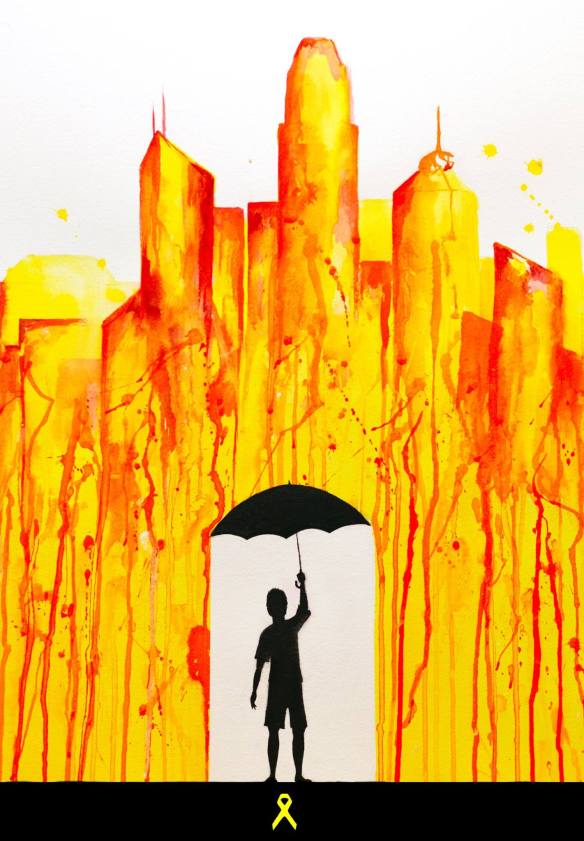
10636707_355054934652158_6232680504221465809_oBefore I begin posting today, I am compelled to write a few words about what is happening in Hong Kong where Theatre Room is based. It would be entirely wrong of me not to, as Theatre Room has an international readership. As I write this on National Day, it’s hard not to be in wonder at what is happening on the streets of our city. The last few days have had us all running the gamut of emotions. Little else is being discussed, dissected, prophesied and judged. The Umbrella Revolution, as it has been dubbed, is a truly profound experience. I’ve watched my social media feeds turning yellow and at every

new image, I well with tears of pride and astonishment. There is a determination amongst the student occupiers not to alienate fellow citizens. Rather then, to convince them that it matters and it is important. It’s working. People are coming out to support them because of how they are conducting themselves, which says so much.

How long it will continue and what the outcome will be is unknown and uncertain. However, the hope and the passionate belief that Hong Kong’s future will be a democratic one is palpable. We know the eyes of the world are on us, as does Beijing. Where ever we sit, be it on the street, at home, at work or at school, we are waiting for what comes next. From my window, across Stanley Bay, is a PLA barracks, hidden and, I can’t help feeling, brooding. The basic law allows for their deployment, should the authorities be unable to cope with a situation. We all hope that the change of tactics by the police and the withdrawal of the riot squads make this a diminishing prospect. National Day always has it’s tensions but this year they are immensely tangible and it is troubling when you hear the words ‘Tianamen’ and ‘Hong Kong’ uttered in the same breath.

All that said, at the moment it is peaceful and the pervading feelings are of pride and hope for a future where people have the right to determine their own lives. My hope, with every ounce of my being, is that it stays that way.

Keeping It Real

51kjIuRhjoLA week or so ago I had the pleasure of taking part in an acting workshop based on the teachings of Ute Hagen. Having had my own theatre education in Europe, Hagen’s work was largely unknown to me, despite the fact that her approach to naturalistic acting, along side that of Stanford Meisner and Lee Strasberg,  is widely taught and respected in North America. It has been something of a revelation and my ignorance of her work rather embarrassing. She died in 2004, but her influence continues to grow. Of her work she said, I teach acting as I approach it – from the human and technical problems I have experienced through living and practice.

I was particularly struck by exploring her ways into creating character. One of her obituaries commented that there was a balance in her approach, which was method acting, but not taken to the self-immolating extremes of some of its practitioners. Though she demanded respect, she eschewed pretension. These nine questions, in order, form the core of that character work:

1.  Who am I?  (All the details about your character including name, age, address, relatives, likes, dislikes, hobbies, career, description of physical traits, opinions, beliefs, religion, education, origins, enemies, loved ones, sociological influences, etc.)
2.  What time is it?  (Century, season, year, day, minute, significance of time)
3.  Where am I?  (Country, city, neighborhood, home, room, area of room)
4.  What surrounds me?  (Animate and inanimate objects-complete details of environment)
5.  What are the given circumstances?  (Past, present, future and all of the events)
6.  What is my relationship?  (Relation to total events, other characters, and to things)
7.  What do I want?  (Character’s needs.  The immediate and main objective)
8.  What is in my way?  (The obstacles which prevent character from getting his/her need)
9.  What do I do to get what I want?  (The action: physical and verbal, also-action verbs)

She wrote two books, Challenge for the Actor and Respect for Acting, both of which are still in print. There is also a fascinating recording of a series of master classes she gave, of which there is an excerpt here:

.

With her second husband, Herbert Berghof, who was a protégé of the German realist director Max Reinhardt, she co-founded the HB Studios in New York whose doors are still open today. I would suggest that if you don’t know the work of Ute Hagen or have struggled with Stanislavski or Strasberg, give her a go.

Incidentally, and not unconnected, the day after my workshop I read this article, published in the Slate and written by Marcus Geduld, in which he attempts to answer the question, How Do You Differentiate Good Acting From Bad Acting?

If anyone tells you there are objective standards, they’re full of crap. This is a matter of personal taste. There are trends. There are many people who loved Philip Seymour Hoffman’s acting. But if you don’t, you’re not wrong. At worst, you’re eccentric.

I’m a director who has been working with actors for almost 30 years, and I’m the son of a film historian. I’ll give you my definition of good acting. But I really want to stress that if I say, “Pacino is great,” and you disagree, my experience does not make me right and you wrong. It just means we have different tastes.

First, for me, an actor is good if he makes me believe he’s actually going through whatever his character is going through. I’m talking somewhat about physical stuff (“He really is getting shot!” “He really is jumping off a moving train!”) but mostly about psychological stuff (“He really is scared!” “He really is in love!”). If an actor seems to be faking it, he’s not doing his job.

You can read the rest of the article here, and I would recommend it.

Too Much Of A Good Thing?

Leaving Planet Earth 015If you read Theatre Room regularly, you will know that I have written on a number of occasions about the ever-growing popularity of Immersive theatre, especially in Europe. You also know that I am drawn to this form, especially as a way as bringing new audiences to the theatre and challenging theatre students take risks in their exploration of the possibilities in performance. All things ‘immersive’ are clearly drawing audiences and there is lots of ‘jumping on bandwagons’ at the moment.  It was with some interest then that I read Lyn Gardner’s Theatre Blog in The Guardian this week.  London-centric, by its nature, but certainly making a point that is worth considering wherever you are:

Immersive theatre: living up to its name, or just an overused gimmick?

Immersive theatre has become ubiquitous, but too often such billing is just a commercial come-on designed to sell tickets

My, there is an awful lot of immersive theatre around at the moment, particularly if you live within reach of London. You can watch Titus Andronicus performed in a car park in Peckham, visit Dorian Gray’s townhouse in Greenwich, pretend you are a spy in CoLab’s London-wide, digitally-augmented Fifth Column or – if you’ve £200 to spare – spend the night in a London hotel and watch the immersive play Backstage Tour.

Some of these shows deserve the tag. But I’m beginning to think that immersive has become one of the most overused terms in British theatre, in similar vein to that other much misused term, site-specific (or site-responsive), which is likewise often bandied about with little or no justification. Standing around watching a show in a room that appears to have been designed by an Oxford Street store window dresser doesn’t magically make the audience experience something immersive, no matter how many stuffed animals you incorporate into the set.

It you want an enjoyably sly swipe at the immersive phenomenon, take a look on the excellent Exeunt site, where Natasha Tripney has cleverly reframed her East Coast trains journey back from the fringe as immersive theatre.

The rise of immersive theatre undoubtedly reflects an interest from audiences – often audiences who may not think that traditional drama in traditional theatre playhouses is for them – in experiencing theatre in a different way, one that allows them to be part of the story and feel as if they have dropped down a rabbit hole into another world like Alice. In some instances where the audience can genuinely roam where they want, the experience is more akin to gaming than traditional theatre.

Some companies – ConeyLundahl and Seitl, Punchdrunk, Ontroerend Goed and Look Left Look Right among them – have perfected the art, finding ways that make sense of why the audience is present at all and allowing them to play their part. Such companies don’t mistake mere intimacy (lovely though it can be) for immersion, and in some instances give us genuine agency.

But I keep on seeing shows that claim to be immersive, and turn out to be anything but. Performing a show in a car park (Titus) while Southern trains constantly thunder by, so that Rome appears to be situated at a railway junction, or making audiences run away from zombies in an underground space in Edinburgh (Generation of Z on the Fringe), doesn’t make it immersive, it just makes it a show in an unusual – and not necessarily suitable – location. That’s fine. But short-changed audiences will quickly learn that immersive shows often don’t deliver on what they promise, and they will stay away.

Strong and portentous words from the venerable Gardner, and she is rarely wrong, in my opinion. Her reference to The East Coast Trains Show written by a fellow critic Natasha Tripney, and published in Exeunt is definitely worth a read (and a wry smile). Beautifully tongue-in-cheek, but harbouring similar grievances expressed by Gardner and a sense that she too has experienced one too many pieces of immersive theatre that simply are not.

Gangstas In Greece

Untitled_FotorI have a few posts to make today, so I am going to start with cheekiest one first.  My colleague Sean and me are currently delivering a course on Greek theatre with Oedipus Rex as the key text. Murder, incest and mutilation generally secures the rapt attention of 14 year olds! However, it is hard to find a filmed version of the play that isn’t very old, dated, badly filmed or just bad. For a number of years we have used a copy of Pier Paolo Pasolini’s 1967 filmed adaptation, Edipo Re to show excerpts from, and despite being in Italian, it served its purpose well.  However, our copy has gone astray, and while searching for alternatives, (Pasolini’s version is seemingly impossible to get hold of anymore) Sean introduced me to the Thug Notes Oedipus:

.

I have to say, despite it’s outrageousness, I thought what a superb idea! Greg Edwards’ Sparky Sweets, Ph.D is a great vehicle for delivering snap-shot summaries and analysis.  To quote the New York Times

Thug Notes is a deliciously executed example of a trend that has been around for years: the application of street sensibility to high-culture, high-concept areas and, more generally, any place where it’s not expected.

To date there are over 50 Thug Notes, but another of my favourites is most definitely his take on Hamlet

.

The Independent in the UK has a great interview with Sparky.

To date there are 300,000 subscribers to the the Thug Notes Youtube channel and 850,000 hits on his ‘drop’ on To Kill a Mockingbird alone. As of today, I’m a subscriber too.

Over Our Heads

salomeA blog post by theatre critic Lyn Gardner brought me to a realisation this week.  Virtually every theatre-going experience I have in Hong Kong is dominated, literally, by surtitles – either in English, Cantonese or sometimes both. I have often wondered how the complexity of a play in one language translates into another for a live audience. Are my Cantonese speaking compatriots having an easier time understanding the nuances of King Lear than I am? I know for sure that my students read the Cantonese surtitles when the spoken language of a play is impenetrable to them or the dialect or accent is too strong. In her post, Mind your language: the trouble with theatre subtitles, Gardner notes that great translations make foreign productions accessible, that poor ones are a distraction and asks whether surtitles always a necessity in communicating meaning to an audience:

One of the pleasures of London theatre-going over the past 20 years has been just how many foreign-language productions it has been possible to see. Shakespeare performed in another tongue has been a particular revelation as the Globe’s 2012 Globe to Globe season amply demonstrated, although what made that – and it’s ongoing spin-offs – so pleasurable was the chance to see Shakespeare amid an audience whose native tongue was the language in which the play was being performed. If you want evidence that London is truly an international city, this is it.

HEDDA GABLER, director Thomas Ostermeier

HEDDA GABLER, director Thomas Ostermeier

But there have been plenty of other opportunities to see oh-so-familiar classic plays in other languages, particularly at the Barbican, where Thomas Ostermeier has made us rethink Hedda and A Doll’s House and Hamlet, and will shortly be pitching up with An Enemy of the People. The London international festival of theatre has also done more than its bit to bring the world to London. In many of these cases it is the arrival of surtitles that have really made foreign-language productions accessible to those of us who do not speak or understand enough to get by. Without them I suspect many such shows wouldn’t get an English-speaking audience.

I remember a time when if you went to see a play in another language the best you could hope for was headphones and intrusive simultaneous translation or a free sheet detailing the action in each scene.

Good surtitles are a real art. One issue with surtitles is positioning. Poorly sited surtitles are like trying to hold a conversation in a room where a TV is on. However much you try not to look at them, your eye is constantly drawn towards them, even if you speak the language. You end up relying on the text rather than looking for other clues, which in a great production of a play in any language are demonstrated in a myriad of ways from the positioning and space between the characters to the timbre and tone of what is being said. It’s possible to understand a great deal about a production from its look and sound, even if you don’t speak a word of the language in which it’s being performed. Too much reliance on surtitles turns audiences into dummies, a bit like those tourists you see at Stratford who follow the entire production with their nose buried in the text on their lap as if it’s only the text that matters and looking at the stage is not necessary.

Rakata perform Punishment Without Revenge by Lope de Vega at Shakespeare's Globe

Rakata perform Punishment Without Revenge by Lope de Vega at Shakespeare’s Globe

Poor surtitles can be a hindrance rather than a help, as I found at the Globe last week with a Spanish-language production of Punishment Without Revenge. In this instance they were simply describing the action and not particularly well: it’s enormously frustrating and sometimes bewildering to be told that someone is speaking in metaphor or telling a joke and not to be told what the joke is. I reckon that in this instance no surtitles – and a simple synopsis sheet – would be far better than surtitles that distract the eye from what is happening on stage and are way too blunt to add any value to the viewer. What do you think? And if you’ve ever seen any real surtitle howlers do share.

I have considerable sympathy with Gardner.  I have, on occasion, found myself at the front of the stalls, unable to read the surtitles (which are almost directly above me) and watch the stage action without needing a visit to the physio the following morning.  In some of our smaller and older theatres the surtitles are shown to the side of the proscenium and you end up looking like a spectator at a tennis match. I’ve also experienced the earphone and recorded translation version elsewhere in Asia when watching theatre – once I had to leave a Bunraku performance in Osaka after about an hour because of my ever-growing irritation with the mono-tonal drawl of the voice in my (one) ear.

UntitledThe comments section that follows Gardner’s blog continues the debate as does this post from BTI Studios, which talks about the difficulties of ‘captioning’ in the theatre. One theatre in Germany, the Komische Oper in Berlin, has the surtitles shown on the back of seat in front of you, as does La Scala in Milan (both opera venues you’ll notice). This is clearly a move in the right direction in terms of being able to view surtitles clearly, but of course, does nothing to address the translation issues or how they are used by a venue (as in the example given by Gardener at The Globe Theatre). It seems that any large city with cultural aspirations now stages an international theatre festival, so watching performance in a language other than your own is no longer an unusual or unique experience. Given this, I think it’s about time venues in particular, but theatre makers more widely, become a little more adept at making captioning work for the audience, both technically and artistically.

By way of a post script, and not unconnected, the Royal Shakespeare Company in the UK have just announced that they are going to translate all of Shakespeare’s plays into Mandarin, as well as translating 14 seminal Chinese plays into English (although these have yet to be named). Quieting the cynic in me and over-looking the PR puffery about boosting business and cultural links between Britain and China, this could mean some exciting Chinese work being available in translation for the first time.

Old News

525531_511084732236163_1686059764_nA quick share today of something that recently caught my eye. British Pathé, to quote it’s own website…….was once a dominant feature of the British cinema experience, renowned for first-class reporting……Now considered to be the finest newsreel archive in the world, British Pathé is a treasure trove of 85,000 films unrivalled in historical and cultural significance. Spanning the years from 1896 to 1979, the collection includes footage from around the globe of major events, famous faces, fashion trends, travel, science and culture.

This archive has now been digitised and made available on Youtube. A real gift for theatre makers who want to include historical footage from around the globe in their work. The archive, which covers the most important and significant political, human, and cultural events of the 20th Century, even charts the development of mechanics in theatre. From 1945 and 1932 respectively:

Scenographers everywhere will be thrilled. The archive even has it’s own Facebook presence. Having done a bit of exploring, it seems its easier to search for the content of the footage you might need on the Pathé website itself, locate the title of the video/s that contain it, then search for those titles on the Pathé Youtube channel.

Cultural Refugees

Much of our news during the summer has been dominated by what is happening in the Middle East – Gaza, Iraq, the marauding of the Islamic State, not to mention the horrific execution of American journalist James Foley and countless Kurds. The latter act in particular, as these events are wont to do, connected the horrors in the region to the rest of the world.

SyriaTrojanWomen 029

It is with considerable sadness then, that I read in The Washing Post the article  I am about to share. Earlier this year I wrote about a production of Trojan Women performed by women refugees who had been forced to flee from Syria, No Longer A RefugeeThese dispossessed woman have been invited to perform their play in Washington D.C. in September, but have been denied visas because they are, of course, refugees. A wasted opportunity for so many reason, I feel. Written by Peter Marks, it makes infuriating reading.

Visa denials scuttle play with Syrian actresses at Georgetown

It had the potential to be one of the most galvanizing cultural events of the season: a dozen Syrian women, refugees from that besieged country, performing in Washington a version of a 2,500-year-old Greek tragedy revised to include their own harrowing stories.

But now the show can’t go on — simply because the women are, in fact, refugees. The State Department rejected the women’s applications for entertainers’ visas for the performances — scheduled for Sept. 18-20 at Georgetown University — because it is not convinced that the women would leave.

The decision has thrown into turmoil plans for the first staging outside the Middle East of “Syria: The Trojan Women,” a production organized by ­journalist-screenwriter Charlotte Eagar, her husband, filmmaker William Stirling, and Syrian stage director Omar Abu Saada. The Syrian women they recruited, living in exile in Jordan, are all amateur actors from varying strata of Syrian society and of diverse backgrounds. Some had never set foot in a theater before working on the play. But they wanted to come here, say Georgetown organizers of the event, to give their accounts of the toll the war has taken on them and their families.

80a013c2-740f-11e3-beeb-00144feabdc0

“This is the greatest tragedy, because in the United States we really don’t have access to the voices of the Syrian people. Who are we hearing from? ISIS,” said Cynthia Schneider, a former U.S. ambassador to the Netherlands who is co-chair of Georgetown’s Laboratory for Global Performance and Politics, which organized the event. “We are completely missing this absolutely vital human perspective of the war in Syria.”

“It’s really so sad,” added Abu Saada, interviewed via Skype from Cairo, “because me and all the team, everyone was very excited about this. Now it is so sad that they will not get the chance to do it.”

Georgetown officials were offering “Syria: The Trojan Women” as the launching point of a two-year festival, underwritten by the Doris Duke Charitable Foundation, aimed at reducing ethnic and religious misconceptions by examining the culture, history and politics of the Muslim world. Flummoxed by the State Department’s decision, they are scrambling to salvage the event by turning it into a conversation with the women by remote hookup from Amman.

The scuttling of “Syria: The Trojan Women” is the second major setback in efforts to bring groundbreaking theater to Washington this fall from hot spots around the globe.

Jonathan Ginsburg, an immigration lawyer based in Fairfax, Va., who was engaged by Georgetown to consult on the “Trojan Women” application, said the denial of the women’s visas reflects a broader problem: “What’s in play is the growing involvement of DHS [Department of Homeland Security] in visa affairs, in a post 9/11 environment,” he said. “And it is affecting the arts across the board. It is more difficult than it has been in years to get the underlying petitions approved” for visas for artists.

The play, first performed last fall in a community center in Amman, Jordan’s capital, splices into Euripides’s tragedy about the surviving women of a brutal war the tales of the Syrian refugee women, some of whom lost husbands and other relatives in Syria before fleeing to Jordan. As Eagar described it in an article she wrote for the Financial Times, the production makes the leap “from Greek spears and the Towers of Ilium to air raids, mortars, snipers and shattered homes in Homs.”

And the experience has proved a profound one for the women in the play — so much so, Abu Saada recounted, that one of the actresses decided a few days before the Amman performances that she would for the first time uncover her head in public.

Plans for the North American premiere in Georgetown’s Gonda Theatre were augmented by an invitation to the women from Columbia University to give an additional performance in New York. None of this was persuasive to the State Department. Although a visa for the event was granted to Abu Saada, who still maintains a residence in Damascus, the women’s applications were turned down this month by consular officials in Amman.

In a letter to Georgetown President John J. DeGioia, a State Department official, Michele T. Bond, said that the women “were refused under section 214(b) of the Immigration and Nationality Act.” That part of the code requires applicants to prove that they have a residence abroad and, according to the department, that they have “no intention of abandoning” it.

An additional wrinkle in this case, the department told the university in the Aug. 18 letter, was that there was no firm assurance from the Jordanians that the women would be allowed back into Jordan. “As you are aware,” wrote Bond, the acting assistant secretary for consular affairs, “a significant complicating factor in these cases is that the applicants have no assurance they will be permitted to return to Jordan following their trip to the United States.”

Derek Goldman, artistic director of Georgetown’s Davis Performing Arts Center and co-chair with Schneider of the laboratory, said that efforts to secure the visas involved contacting former and current Middle East diplomats, and even those with connections to King Abdullah II of Jordan. “We thought there was so much going on our side,” Goldman said, “and that basically it should be unimpeachable that these women should be able to get here, and that it would be so obvious that they would go back.”

Of the possibility that they would seek asylum, Schneider said: “I honestly thought the fact that these women had dependent small children and dependent parents [in Jordan] and none speaks English, and they don’t have any connection in the U.S., what would be the likelihood under those circumstances that that would happen?”

To add yet another twist, Abu Saada said that he learned Thursday that the Swiss government had approved visas for the women for a visit of the production to Switzerland in November. How or whether that might possibly alter the decision by the U.S. consular officer in Jordan remains unclear. As Ginsburg noted with chagrin, the decision of the officer in the country involved tends to hold a great deal of sway within the State Department.

Goldman and Schneider say they are determined to go ahead with a program involving the play. On Sept. 19, they have in mind an evening titled “Voices Unheard: The ‘Syria: Trojan Women Summit’ ” that will include excerpts from a documentary, “Queens of Syria,” about the play and a live feed from Amman, so the women can participate.

Abu Saada and two other members of his creative team who received visas are being encouraged by Goldman and Schneider to travel to Washington for the event. But as of Thursday, the director was on the fence. Without his Trojan women, he is not sure he has the heart for it.

“I’m still thinking what is the right decision,” he said.