 Since I became an international educator 16 years ago, I have always had questions about teaching Shakespeare, in English, to students for whom English is a second, third or even fourth language. It’s a varied, wide and noisy debate and one that I’m not going to have here today – perhaps another time.
As I was driving to work today, I heard a report about the arrest of a man after protesting at a performance of The Merchant of Venice at the Globe Theatre in London, UK. It got me thinking. The performance was by Habima, the Israeli national theatre company and it was in their native language, Hebrew. The protest was political, and if you want to know more you can check that out here http://www.guardian.co.uk/uk/2012/may/28/man-held-globe-threatre-protest
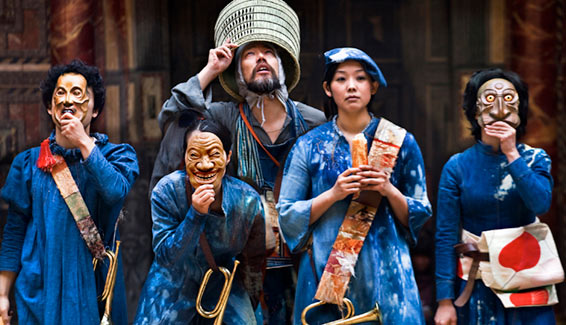
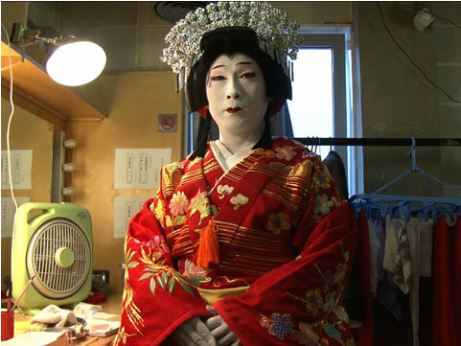
However, the point of my musing today is not about theatre and politics (again, for another time) but about the idea of Shakespeare being performed in languages other than English. As part of the World Shakespeare Festival and connected to the London Olympics, the revolutionary Globe Theatre is staging all 37 of the Bard’s plays in 37 different languages with theatre companies gathering for the event from right across the planet – The Taming of the Shrew in Urdu, Coriolanus in Japanese (above), The Merry Wives of Windsor in Swahili, Richard III in Mandarin and so on. The list is vast and quite incredible. What intrigues me more, is of course that all of these productions reflect the places, cultures, and societies that they were created in – given context by these places and the languages.
I am often told that Shakespeare’s plays are universal and they may be just that. But unless they are re-imagined and/or re-contextualized for their intended audience what can they really say to the people watching? I applaud and celebrate The Globe Theatre for what it is doing with this festival.
 Check out their website for yourself, but especially the Education page where there are some fantastic audio interviews (in a variety of languages, with translations) with the artists behind the project. This is what Shakespeare should be about and to me, gives it real value, making it contemporary and relevent to a 21st Century, global audience. Globe to Globe Festival
And if you really want to know what I am on about have a look at this A MIDSUMMER NIGHT’S DREAM. It is performed in Korean by the Yohangza Theatre Company at the Globe to Globe Festival. I saw this performance in Hong Kong a few years ago and it was fabulous. Drawing on Korean theatre traditions it truly transported me to a different world and a different culture. Enjoy!




 Theatre Room Asia