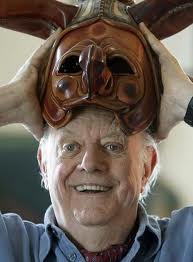
One of my favourite playwrights is Dario Fo and I was reminded of this today, reading an article about the elections in Italy. Fo, 86, is best known for his play Accidental Death of an Anarchist, inspired by the death of a man in police custody in 1969, and has long been a leftwing hero in Italy. He has spent a career writing about injustice and political corruption and together with his wife, Franca Rame, also a playwright, has been one of Europe’s most formidable social commentators. He was awarded the Nobel Prize for Literature in 1997 which places him amongst the true theatrical greats – Harold Pinter, Samuel Beckett, Wole Soyinka, Jean Paul Sartre, George Bernard Shaw even.
I’ve directed a couple of his plays – Accidental death of an Anarchist, Can’t Pay Won’t Pay – and been in a few too – Trumpets and Raspberries, Mistero Buffo. One of my favourites is The Virtuous Burglar.
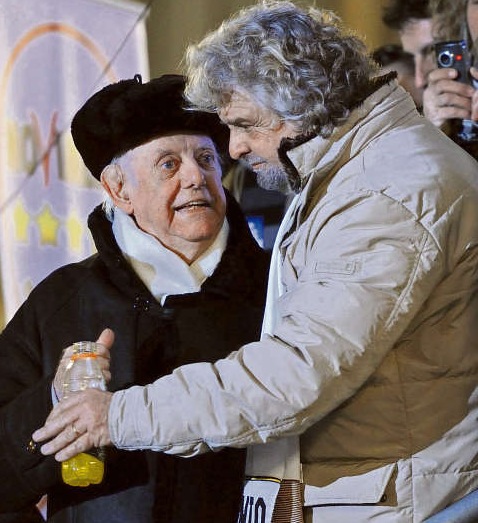
He started writing in 1958 and is still pumping them out today and all the time has been a thorn in the side of the Italian government. Recently he ran for the Mayor of Milan and this week has been outspoken in his support of Beppe Grillo, a comedian turned politician who has just captured over a quarter of the Italian vote, throwing the country into political crisis and unsettling a Europe that is still teetering on the edge of financial crisis. You can read what he has to say in an article entitled We need a surreal fantasist like Beppe Grillo to rescue Italy, says Nobel-winning playwright Dario Fo.
.
.
.
.
.
.
.
.
.
.
.
.
A good potted biography of him can be found here and if you can speak Italian, have a look at his own website www.dariofo.it
In fact, if you are reading this in Hong Kong, you catch a performance of Accidental Death of an Anarchist at the Fringe Club Underground Theatre this week. I highly recommend it!
The phrase ‘global village’ sprung to mind when I read what I am going to share with you today – on a number of levels. The Young Vic and Royal Court theatres in London have collaborated to produce a new musical, Feast, that spans 300 years, takes in five countries – and needed 10 writers in an ambitious attempt to dramatise the culture and belief system of Yoruba.
.
.
.
.
.
.
.
A piece truly worthy of the title of world theatre – not only in its content but how it was created and by whom. I reproduce here, in full, an article by Maddy Costa that appeared in The Guardian this week that tells the fascinating story of Feast‘s conception and development.
Feast: the Young Vic goes Yoruba
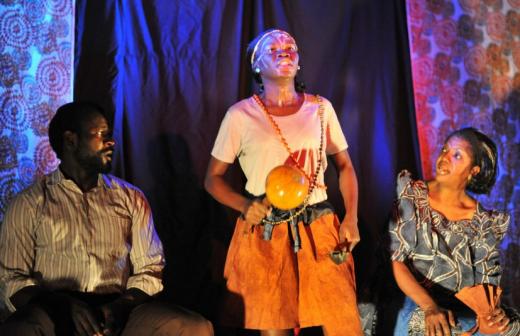
There’s a party going on. Damon Albarn is busy improvising on a thumb piano. Sola Akingbola, the drummer from Jamiroquai, is playing a shuffle on a shekere (a large maraca strung with beads). And Cuban dancer Yanet Fuentes is shivering her hips to the rhythm. In the middle of it all sits theatre director Rufus Norris – the man responsible for harnessing this hubbub and putting it on stage.
These are the rehearsals for Feast, a new play tracing the spread of the Yoruba belief system and culture from its home in Nigeria to Cuba, Brazil, the US and UK. Since he began directing in the late 1990s, Norris has sought out difficult projects – among them London Road, a jagged musical dealing with the aftermath of serial killings in Ipswich; and Dr Dee, Albarn’s first opera, about a 16th-century alchemist. (The two have remained friends, hence Albarn’s open ticket to this rehearsal room in a London warehouse, even though he’s not in this show.)
Feast is no exception. It has five writers, who live in four continents, and a cast of 13. The story covers 300 years of Yoruba experience, taking in slavery, liberation, family and social politics. But Feast isn’t a history lesson, says Norris, and if it’s going to feel authentic to the Yoruba belief system – in which everything from a table to a sheet of plastic has its own spirit – “you can’t just have a load of blah-blah on stage”. Which is one reason why, right now, he’s gently arguing with his choreographer, George Cespedes, about the actors’ intricate dance moves. Norris thinks they will liven up the staging; Cespedes, who is used to having more rehearsal before curtain-up, is getting worried about the time.
Feast was dreamed up by Elyse Dodgson, who runs the international department at London’s Royal Court, which is co-producing the show with the Young Vic. In the mid-2000s, Dodgson happened to be working simultaneously with playwrights in Nigeria and Latin America, and was struck by how the orishas, or spirits, of Yoruba belief had travelled across the Atlantic with the men and women who were transported as slaves, and fused with Catholicism to form the basis of local religions: santeria in Cuba, candomblé in Brazil. “It’s such an amazing story of survival,” says Dodgson – the trouble was how to tell it. It took two years of workshops, involving as many as 10 playwrights, to reach the form Feast is in now. Those workshops, writer Gbolahan Obisesan admits, were a tussle, as he and his fellow writers struggled to “agree on something that links all of us together”.
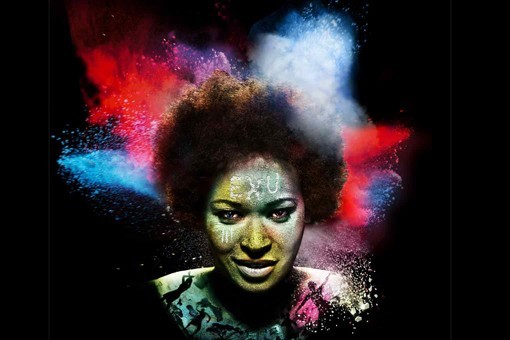
Norris insisted from the beginning that he didn’t want the show to feel like a string of vignettes, so Feast coalesced around four figures drawn from Yoruba cosmology: Yemoja, the mother goddess; Oshun, goddess of love; Oya, the spirit of change; and Eshu, the trickster, who causes chaos wherever he goes. These are reincarnated across the show, taking the form of sisters separated by slave traders, civil-rights protesters in 1960s America, and athletes in modern London vociferously debating whether black people should have white lovers or white bosses. Each of the five writers – American Tanya Barfield, Cuban Yunior García Aguilera, Nigerian Rotimi Babatunde, Brazilian Marcos Barbosa, and Obisesan, who moved to the UK from Nigeria in 1990, when he was nine – is responsible for the segments set in their own country.
Clearly this hasn’t been the simplest of ways to work (just trying to interview the five writers proves almost impossible). Why not settle on a single voice? Babatunde speaks for all of them when he says: “The dynamics of the story of Nigerian diaspora can only properly be reflected by the changing tones of each section.” Barfield adds that, given the hybrid nature of much Yoruba culture, there was no other way: “It’s rare to have the structure and the theme [of a play] work so much in tandem. The weaving of the stories mirrors the weaving of belief systems.”
Norris suggests a more down-to-earth reason: “There are details in the Cuba scene that nobody who wasn’t from there would come up with. Similarly, nobody can really write the Nigerian scene unless they have a deep understanding of the women there.”
Strikingly, the five writers met only once, in London last spring, but discovered links between them both expected and unforeseen. Babatunde knew the orishas had travelled to Latin America with slavery, but hadn’t realised how openly they are worshipped in Brazil and Cuba. For his part, Aguilera knew that orishas inform a lot of day-to-day Cuban rituals (such as the deliberate spilling of the first drop of rum from a bottle, to appease the spirits), yet it wasn’t until he was in London that he attended his first santeria ceremony.
The writers found connections in their different upbringings, too. “When you step out of the household [in Nigeria],” says Obisesan, “you’re not just a representation of yourself as a human being, you represent the whole family, the house you were brought up in. You represent your ancestors.” That’s something Barfield was surprised to recognise from her Oregon childhood: “Many black Americans have no knowledge of our ancestors whatsoever, yet the belief system of ancestral heritage is fundamental to the black community.” And although she was brought up Christian, the Yoruba belief in pervasive spirits did feel familiar: “The idea of God being everywhere is very much a part of African-American belief.”
This notion of pervasive spirits was key to Norris’s staging of the Wole Soyinka play Death and the King’s Horseman at the National Theatre in 2009: the audience could see that the props and furniture were “alive” because they were given life by puppeteers, but the white colonial characters couldn’t. Norris lived in Nigeria for the first three years of his life, while his father taught in a university there; to him, belief in spirits makes perfect sense. “It’s not romantic. There’s an energy to things, and the people there have a deep understanding of that.” He remembers reading an interview with a Yoruba priest who, at the suggestion that his beliefs were mere superstition, replied along the lines of: “If somebody is blind, you cannot talk to them about sight. You can’t see it; I can. I’ll just have to allow you to remain in ignorance.” Such resilience helps to explain the tenacity of Yoruba culture, he suggests: the way it survived slavery, its permeation into other lands.
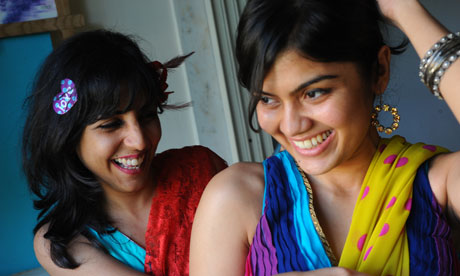
For all his belief in Feast, Norris is anxious about putting it on stage. Not only do multi-authored plays tend not to go down well with critics, but this is the latest production from World Stages London, a collaboration between eight London theatres whose work last year – including outdoor community piece Babel, pan-European play Three Kingdoms and Bollywood musical Wah! Wah! Girls – received mixed reviews. “If I’m honest, I’m bracing myself,” says Norris. “But this is a celebration of an amazing culture – you can’t deliver that in a lecture form. And our theatre needs to open up.”
And with that, he goes back to the Latin dancers, the uplifting rhythms, the vibrant story of saints and survivors.
Today I want to share an article that really is a true meeting of the East and West in theatrical terms. A project by British theatre The Royal Court is about to see the staging of 12 new plays by Indian playwrights in London. However it hasn’t just been a case of commissioning new work, it has been about development, mentoring and shaping work with the young writers. In the article by April de Angelis, which I reproduce here in full, you can see what an exciting programme this really is.
..
.
.
.
.
.
.
Royal Court’s New Plays from India: snapshots of the subcontinent
How do you capture one of the fastest changing places on Earth – and do so on stage? Playwright April de Angelis reports on 12 new plays that should change our image of India for ever
In October 2010, Elyse Dodgson, director of the Royal Court Theatre’s international department, playwright and dramaturg Carl Miller and I arrived at the Jindal guest house in Vasind, in India’s Maharashtra state. Staying with us were 12 Indian writers whose work we’d read but had not yet met. It was an exciting, curious, daunting moment: in three months we would be expecting them to deliver 12 new plays, and in some senses that depended as much on us as them.
One of the first discussions we had centred on the Royal Court’s artistic director Dominic Cooke’s dictum that there are two questions a playwright must address before they start to write: what is a play now (a question of form)? And who are we now (subject)? These questions resonated through the workshop. In an early session, the writers were asked to list the urgent subjects facing their society that they felt were important to address. The results were wide-ranging, surprising and gave an extraordinary picture of the diverse forces at work within contemporary India: Maoism and the red corridor; migration from villages to cities; the clash of modernity and mythology; the influence of western-style celebrity, especially an obsession with youth; “honour” killings; the emotional isolation of modern living; the homogenisation of culture; political corruption; religious identity; low value of life; loss of ethnic identity. Someone mentioned the Gulabi gang (a women-only vigilante group, who wear pink saris and smash up liquor shops because they don’t want their men drinking).
We then asked the playwrights to bring in newspaper cuttings with contemporary stories: these included reports on the plight of street children; the ongoing Bhopal compensation case; female infanticide; the case in which a male student killed himself after being secretly filmed having sex with another male student; the cheap-rates offered to westerners for Indian surrogate mothers. From these the playwrights began to identify subjects they felt drawn to and to investigate ways of telling their story.
There was much amicable debate. Were we trying to impose a template of a play on them? Could we honestly say that the concept of an “objective”, for example, is incontrovertible? No, we couldn’t, but on the other hand we found it to be a useful tool. The plays being written were for Royal Court audiences as well as for audiences in Mumbai, Bangalore, Pune, Chennai and Delhi, as well as, hopefully, elsewhere in India. Just as we had specified a contemporary Indian play – as opposed to, say, a historic, poetic drama – we were also proposing a vocabulary of playwriting. The playwrights were industrious and wanted to get on with the business of writing. By the end of the first workshop, each had created a proposal for a play and written a first scene. We met with each of them, gave dramaturgical advice, ironed out any potential problems, and said goodbye – for now.
Three months later, 12 plays arrived. Those written in Hindi and Marathi were translated. Stage two commenced. Rage Theatre Company, the creators of the Writers’ Bloc festival, our collaborators, arranged for a group of actors to be involved in another workshop. The plays were read aloud and each writer selected a scene they knew would be in the next draft, but which had problems to be solved. These were then worked on with actors who might improvise the more unclear or unconvincing moments. We all watched and discussed the scenes in their latest incarnation. It was very exciting to see the plays “living” for the first time and many memorable moments occurred: Shernaz Patel playing the ageing Bollywood actress in Siddarth Kumar’s Spunk desperate for the male lead’s, well … spunk, and its magical properties of endowing male children only; the startling image of two Kashmiri children stealing into a morgue to retrieve the football boots from their murdered friend, a victim of state repression in Abhishek Majumdar’s The Djinn’s of Eidgah; an older man risking his reputation as he and a younger man meet and become lovers on the Delhi metro in Still and Still Moving by Neel Chaudhuri.
The writers then embarked on their second drafts, which became the basis of productions in their own cities as well as being performed in January 2012 at the Writer’s Bloc festival hosted at the Prithvi theatre in Mumbai, a non-profit making theatre founded by the famous Bollywood Kapoor family and run, like all Indian theatre, on a non-subsidised basis. This, of course, makes life as a playwright extremely hard for Indian writers. In Britain, without subsided theatres such as the Royal Court, new writing would be a pipe dream. Five of these plays were then invited for the upcoming readings at the Court this month.
Purva Naresh trained in classical Indian dance and works as a film producer. Her play OK Tata Bye Bye is a provocative articulation of some of the central schisms in contemporary India: between rural and urban, traditional and modern, western and eastern ways of living, all pivoting on the contentious ground of gender politics. “OK tata bye bye” is the logo you see inscribed on the back of brightly decorated Indian trucks, and the play takes as its subject and setting caste-based prostitution that has sprung up along the side of an Indian highway. This teasing play takes as its premise the collision of two worlds, that of a young, independent-minded sex worker, Seema, who becomes the subject of a well-meaning documentary made by Pooja, an urban educated Indian woman fresh out of film school and her white American boyfriend, Mitch, whose earnest desire to engage with the subjects of this documentary teeters on the edge of voyeurism and exoticism. Pooja is torn so many ways, is she western or Indian? With whom does her allegiance lie? With a white western man, or a rural, lower-caste Indian woman? And underlying it all, the vibrant figure of Seema – refusing to be safely contained within a defining discourse – who worries away at Pooja like a brightly coloured shadow in danger of stealing the show. It is a brilliant and provocative look at sexual politics, identity and the perils of being a modern, urban Indian woman. And with show-stopping choreographic moments.
OK Tata Bye Byeregisters another conflict, that of technological power versus community; asking who is holding the camera? This theme also resonates in Mahua, a play about the enforced loss of tribal lands to a corporate mining company, by the young film-maker Akash Mohimen. As it opens, it has a timeless feel: Birsa, a tribal leader in waiting, in the village of Bihabend in the state of Orissa, commits a minor indiscretion and as a result must marry an “old” woman (she is 30!). This seems to be the set-up for a comedy, but slowly morphs into tragedy as he and his (now) beloved wife suffer the loss of their land and then of their livelihood and identities. The final act of Birsa is both tragic and merciful, underscoring the point that such powerlessness leads to impossible choices.
Back in bustling Mumbai, British-based actress and writer Ayeesha Menon is a contemporary, comic, female Indian voice. The sparkling Pereira’s Bakery at 76 Chapel Road brings the clash of traditional and modern right to the heart of a great city with a diverse cast of characters ranging from the doleful, old-man misanthropist always at hand philosophising home truths, to the young X Factor aspirant whose insistent warblings bring tensions to breaking point.
We see the forces of old and new contending with each other, culminating in the major crisis of the play, the threat to demolish the old quarter for the sake of progress, to steamroller the charm of an ancient district to make way for the sterile constructions of capital. The play captures both the centrality of family to Indian life and the frustrations of those who feel trapped by it and wish to escape the past and tradition – but, having done that, is it ever possible to recapture what has been lost?
Leftovers is set in Pune, written by Saga Deshmukh, a lawyer. It movingly details the difficulties of a family who are left behind in a city that is powering the economic engine of India. It centres on Baba, the patriarch, and his failure to fit into the new order. It is a delicately observed play about the unheard suffering of ordinary people.
Finally, The Djinns of Eidgah by Abhishek Majumdar, is set in the ongoing conflict in Kashmir and tells the story of two children. Ashrafi, a young girl, and her brother Bilal, orphaned by the conflict and struggling to grow up, find themselves in a world defined by violence. They are befriended by a doctor who seeks to steer a path between the warring sides, but the conflict proves too toxic. This play is partly magical in its incarnation of the djinns, ancient spirits which the young girl incants. Perhaps Majumdar’s riposte to our insistence on a contemporary Royal Court play, The Djinns of Eidgah merges old and new in a fusion of traditional Indian theatre forms and contemporary themes.
It is fascinating to look back at the whole process and see the way themes and ideas from the initial stages of the workshop have threaded through to the unique and original plays that exist now. Each play provides a prism through which it is possible to have a glimpse of India today. It’s clearly a great time to be an Indian playwright.
If you are interested in finding out more, you can here as well as watching interviews with the playwrights in their own languages, Hindi and Marathi.
My post yesterday about the casting controversy in the UK has elicited some interesting responses and became a focus for discussion for one of my TA classes this morning.
I have been digging deeper and have come across a comment piece by Anna Chen, a writer and performer who lives in the UK, entitled Memo to the RSC: east Asians can be more than just dogs and maids: The Royal Shakespeare Company’s casting for The Orphan of Zhao seems to hark back to an age of British imperialism.
I have reproduced an edited version here:
It’s no fun being bred out of the cultural gene pool. Watching TV, theatre or film, I’m on constant alert for a glimpse of someone who looks Chinese, for the slightest resemblance to an estimated 499,999 others like me living in the UK.
So it was with a sense of “here we go again” that we learned that the esteemed Royal Shakespeare Company (RSC) is mounting the classic play The Orphan of Zhao in the way prize trophies usually get mounted: gutted and stuffed. This 13th-century Yuan-dynasty masterpiece may be the first Chinese play, to make it to the hallowed RSC, but the only parts given to actors of east Asian heritage are two dogs. And a maid-servant. Who dies. Tragically.
Yes, out of 17 roles in the classic known to Eurocentrics as “the Chinese Hamlet”, a grand total of three have gone to Asians. Another dog is played by a black actor, making you wonder exactly what the RSC is trying to say.
All director Gregory Doran came up with is that the blizzard of complaints is a case of “sour grapes”, and that the critics should “get real”; not the most eloquent response you might expect from the intellectual heavyweight described as “one of the finest Shakespeareans of his generation”. Any finer, and he might appreciate why casting Asians as dogs and a maid – the latter dying in the most tiresome Madame Butterfly tradition – might elicit consternation. Quite rightly, “blackface” was long ago laughed out of court on the grounds that it not only challenges credulity but is also both ludicrous and demeaning to all parties concerned. Yellowface, however, apparently remains acceptable and credible. Why?
Had Doran remembered the lessons learned by director Peter Brook when he cast a range of ethnicities in his well-intentioned 1980s film and stage adaptations of the Indian epic Mahabharata and was forced to face his own ideological assumptions in the ensuing row, he might have trodden more sensitively instead of crashing in like a 19th-century colonialist after our tea and silks.
Only last year in the US, La Jolla Playhouse felt compelled to hold a public debate after it was caught having cast a mere two of the roles in the Chinese story, The Nightingale, as Asian, and one of them was a bird.
Cheekily, the RSC targets Chinese audiences (and their growing disposable wealth) in their marketing – with adverts in Chinese and a poster featuring a Chinese kid who looks nothing like the actors playing the main roles in the show – so we know it can make the effort when it wants to. Playwright David Henry Hwang of the Asian American Performers Action Coalition which fought in the Nightingale battle, says: “By producing The Orphan of Zhao, the RSC seeks to exploit the public’s growing interest in China; through its casting choices, the company reveals that its commitment to Asia is self-serving, and only skin-deep.”
Once again: why? The RSC casting is something of a litmus test, indicating how a failing superpower asserts its cultural dominance when its economic base is disintegrating. It may no longer operate under cold war rules to consciously exclude representations of the upstart Chinese, or feel pressured to depict us as Fu Manchu monstrosities . But, as George Orwell pointed out, you don’t need a whipped dog when a well-trained one will do.
Such minds are hard-wired to eliminate an entire group’s cultural representation, and they don’t even realise it. Amanda Rogers of Swansea University, says: “As a national company they have a responsibility to represent all sectors of British society. There is a real paucity of east Asian representation in this country, and when we do see it, it is usually confined to minor or stereotypical roles.”
One danger is that, the more a minority is presented as a blank canvas, the easier it is to project all sorts of rubbish on to it.
It’s a shame that James Fenton, with his progressive track record, allows his adaptation of The Orphan of Zhao to be cast along colonialist lines. As a component of the establishment’s entertainment wing shaping our perceptions and feelings, the RSC continues to airbrush us out of the picture, ready to be re-inserted into the frame only when villains are required. Whipped dog, well-trained one or puppet: you have to ask the old question: cui bonio?
The La Jolla Playhouse Chen refers too (and referred to in some of the links yesterday) is based in Los Angles and suffered the same fate earlier this year when it mounted a musical called ‘The Nightingale’ set in ancient China with a cast of 12, only 2 of whom were of east Asian decent. You can read more here in the LA Times. However, La Jolla’s reaction was more immediate than the RSC and they held an open, public discussion which was generally well received for opening up the debate about cultural casting. You can watch the opening 10 minutes of the debate (and then the rest of it) here:
Fascinating. Theatre and cultural politics – never too far apart!
For the last few weeks I’ve been following a really interesting debate that has been getting the theatre world chatting right across the globe. The Royal Shakespeare Company in the UK are about to stage a production of the the Chinese play The Orphan of Zhao. The play, from the 13th century, is often referred to as the ‘Chinese Hamlet’, and the RSC production is a new translation by James Fenton.
Fenton writes here giving a wonderful background to the play.
However, controversy has arisen because out of 17 actors cast in the piece, only 3 are of South East Asian origin and they play two puppeteers and and a maid. The debate and back lash has been harsh and forced the RSC on the offensive about their casting policies.
What I find even more interesting is that the ‘blogoshere’ has joined the debate in a very vociferous and intelligent way and I wanted to share some of that too: Madam Miaow, Dangerology and Theatrical Geographies all write passionately about the debate. The latter blog is particularly interesting and worth a read. Even Twitter and Facebook are not immune to the uproar.
I’ll let you read through and make your own mind up, but I have to say it is the first time I have come across the term yellowing-up and it is disturbing.
Finally, I want to include an interview with the director of the show that was made before the storm hit.
As my mind turns to flying to Vietnam tomorrow, with 50 students, on a CAS trip, I started to think about performance in that beautiful country. Many months ago I wrote about the traditional Water Puppet theatre for which Vietnam is very famous. I don’t imagine there is a visitor who has ever been to Hanoi who has not been to the Thang Long Water Puppet Theate to see a performance – I will be there again tomorrow night.
However, there is another theatre form that is very popular in Vietnam and that is Cai Luong, which roughly translated means renovated or reformed theatre. The Water Puppet theatre has its roots firmly in Vietnamese rice farming culture, but Cai Luong is an interesting mixture of East and West theatrical traditions, having being heavily influenced by the French during their rule in Vietnam. Essentially, Cai Luong is the convergence of southern Vietnamese folk songs, classical music, tuong (a Chinese-based classical theatre form) and modern spoken drama, all coming together to create folk opera.
There is a great little website, called, not suprisingly, Vietnam Opera, that has much more background and you can access that by clicking the image below:
Also on this site are pages about two other, more traditional, Vietnamese Opera forms, Tuong and Cheo that are more ‘Classical’ in their nature (and more serious in their themes and content). Cai Luong has a reputation for being lighter and more comic. Perhaps what is most astonishing of all is that unlike many traditional theatre forms across Asia, Cai Luong is thriving, growing in popularity and although some of this growth is driven by tourism, it has huge appeal to the Vietnamese too. There are even some instances of the traditional dress and costume being swapped for more contemporary clothing.
I leave you with a video of a full length performance of Cai Luong titled The Life of Buddah
This is an image taken on 16th September of British theatre producer, David Cecil. He was appearing in court in Kampala, Uganda, after having been arrested. What had Cecil done? Well, he dared to stage a play about homosexuality in a country that is currently debating a law that could possibly make being openly gay, punishable by death. Currently you can be imprisoned for life in Uganda for being gay. Cecil was, in fact, released on bail, pending another court appearance in mid-October that could see him put behind bars for 2 years.
His actual crime was to stage the play, The River and The Mountain, by playwright Beau Hopkins, without gaining authorisation from the Ugandan’s Media Council. The National Theatre of Uganda refused to stage play because some government officials objected to it. The play tells the story of a corporate businessman coming to terms with his sexual identity in a climate of oppressive homophobia. The protagonist, Samson, is a good man and a gay one. When his mother learns of his homosexuality, she tries to cure it by hiring a pastor, a private dancer and finally a witch doctor. The play ends with his murder at the hands of his co-workers.
.
.
.
.
.
.
.
.
If click the image above, which is taken from the play, you can read an interview with Okuyo Joel Atiku Prynce who played the lead role of Samson in The River and the Mountain.
Theatre has played a significant role in the last 50 years in bringing about the legalisation of homosexuality right across the world. Only yesterday in The Observer, British theatre critic Michael Billington wrote a lengthy piece about Tennessee Williams’ Cat on a Hot Tin Roof entitled Tennessee Williams’s southern discomfort. For those of you who don’t know the play, it deals in part with the suppressed homosexuality of one of the lead characters, Brick.
I have nothing but the utmost respect for people like David Cecil and the cast of The River and The Mountain who dare to challenge what they belive to be morally unacceptable. Only last year a gay rights activist in Uganda, David Kato, was brutally murdered after a tabloid news paper printed details about his private life.
Theatre has a long history of inciting fear in governments and other powerful people, that results in banning – look back as far as Molière and even farther. Molière, a French actor and playwright, wrote Tartuffe in 1664 and that was banned after being performed at Versailles for attacking and exposing the hypocrisy and deceit of the upper classes. People were afraid it would affect change, and wham, it was gone. And as you look through the history of theatre, you begin to realize that a playwright wasn’t tackling enough daring subject matter if they hadn’t been banned in some theatre somewhere. Theatre-goers have historically been a riotous bunch, so you can see where the fear would come from.
A modern audience member really recognizes the power of work on the stage to change the course of politics and daily life off the stage. Playwrights like Bertolt Brecht based their entire body of work off that power. Plays like The Laramie Project (about the murder of Matthew Shephard, a show that brought the discussion of hate crimes and trials to a nation) were written to directly engage with politics and to change the mindset of the culture around them, to explore territory that had not yet been explored.
The story of David Cecil and The River and The Mountain is not over yet.
Today I want to go back to a post I made in May about Juliano Mer-Khamis, a founder of the Freedom Theatre in the West Bank, Palestine, who was assassinated outside his own theatre. To put the post in context, both in terms of the Freedom and the regional politics the film below is excellent (and I warn you, at times, difficult to watch).
.
Now, the co-founder of the Freedom Theatre, Zakaria Zubeidi, and the artisitic director, Nabil al-Raee, are both in Israeli prisons and on hunger strike. No charge has been brought against Zubeidi and al-Raee has been charged with some very spurious offences.
This isn’t a political post, although you can probably guess what I think from the mere fact I’m blogging about the situation. It is about the power of theatre and the belief in this power to bring about social, cultural and political change.
In the course of the last year, at least six members of the Freedom’s board and staff have been arrested by the Palestinian Authority. What is it that a tiny little theatre like this can do that causes one of the most heavily armed nations in the world to persecute it in this way? No one has yet been charged for the killing of Mer-Khamis.
Below are a series of articles, the most recent coming first, that explore the last 18 months in the incredible story of the Freedom Theatre. I urge you read them all and make your own mind up.
By clicking the image on the left you can watch to Juliano Mer-Khamis talking about the importance of drama as a means of coping with Israeli occupation.
You can also listen to Mer Khamis talking in another interview from 2005 about a film he made, called Arna’s Children, which you can watch below.
Finally, I repost the video from May about the Freedom Theatre and the immensely important role it plays in helping the people of the West Bank live under Israeli occupation.
Today I am sharing an interview from the Huffington Post, between Katherine Brooks and Maria Tri Sulistyani, founder of Papermoon Puppet Theater, from Indonesia. Papermoon is not your traditional Wayang kulit theatre and the content of their work is even less traditional. The company uses puppetry to highlight social and political injustices in Indonesia’s turbulent past. What is also interesting is that the article talks about ‘cultural diplomacy’ – the idea that in order to truly understand someone from another culture, you also need to understand their traditions, history, language and general way of life.
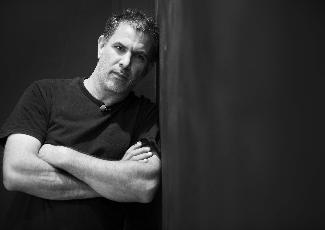
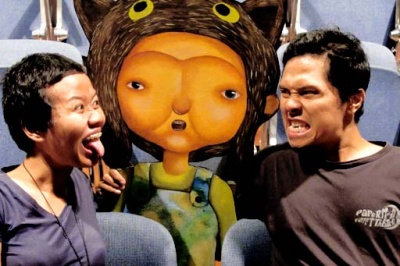
Indonesia’s Papermoon Puppet Theater is taking an art form we often associate with children’s stories and turning it into a vehicle for addressing the country’s dark history. The company, started by visual artists Maria Tri Sulistyani and her husband Iwan Effendi, (left) uses whimsical puppets and multimedia performances to recreate personal accounts of the mass jailings and executions that took place in Indonesia in 1965. They are harrowing stories, meant to shed light on the emotion and complexity of a time period often glossed over in contemporary history.
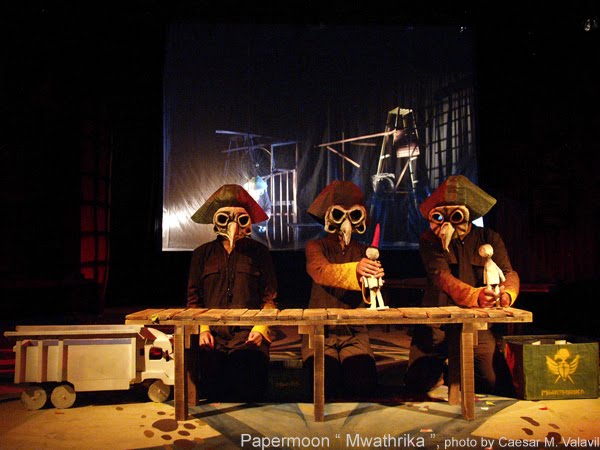
Papermoon’s performances reveal intimate moments of Indonesia’s past, but the company maintains that a discussion of politically driven atrocities is something accessible to international audiences. And the U.S. State Department agreed, recruiting Papermoon for its Center Stage program that will be touring throughout the country this year. Sulistyani and Effendi will be showcasing their work, “Mwathirika,” alongside ensembles from Haiti and Pakistan, sharing their brand of art as an initiative of cultural diplomacy.
We asked Maria Tri Sulistyani about her beginnings in the world of puppetry, the heavy themes she’s chosen to present and how she thinks art can interact with diplomacy in an email interview:
Can you tell us a little about traditional shadow puppetry in Indonesia? How does your style of puppetry compare?
Wayang kulit (Shadow Puppetry) has been an important art form – especially on Bali and Java – for almost 1,000 years. Its stories of good and evil, of love and death and transformation are most often taken from the Hindu epics Ramayana and Mahabharata. A single dhalang (master puppeteer) manipulates all of the many two dimensional leather puppets from behind a screen (to cast shadows). He also voices all of the characters. It is a virtuoso performance! While reaching back in history to tell his tales, the master puppeteer always makes reference to current happenings. Traditional puppet theater has played an important role in communicating values to communities.
There is also another kind of puppetry – Teater Boneka – that is generally just for children and it is a much less formal. Inspiration for the stories and the puppets come from lots of different influences – even Sesame Street.
The interesting part is that people in Indonesia had never connected these two types of puppetry before. Papermoon makes that link, and this is something new. Our pieces are performed on stages, like a theater play. Several puppeteers are on stage manipulating the puppets. Mwathirika, the piece we are presenting on tour, is really for adults, not kids and is a story told without words, without speaking. But we are telling stories about values, too — about moral choices and conflicts and relating to everyday life. Our stories are really personal and focus on individuals. From there we can see the bigger issues. Though Papermoon is not really creating a performance in the traditional form, we too want to share and talk about the values and ideals and choices of Indonesian people’s life.
Your earlier work, “Noda Lelaki di Dada Mona (A Stain on Mona’s Chest),” used puppets to convey a politically and sexually charged story. What was the reaction in Indonesia to such a performance?
It was very interesting because Papermoon had created performances for children since 2006, and “Noda Lelaki di Dada Mona” was the very first time we created a piece for an adult audience. That was also the first time we sold tickets to a performance, 300 seats, and it sold out!
People were shocked with what they saw. Not just only about the theme, but also by the kind of puppets we performed with, how realistic they were, and how we combined puppets with the actors who spoke as individuals, which had never been seen by people in Yogyakarta. Together with our audience, we started to realize that puppet theater could reach many people, including adults. Instead of having one puppeter verbalize all the voices, we decided each puppeter will speak for his own puppet. I would say that “Noda Lelaki di Dada Mona” was a kick start for Papermoon to do more performances, based on social themes, to communicate with many different types of audience.
In “Mwathirika” you have again focused on more serious accounts, this time of imprisonment and violence. Do you think the use of puppets makes it easier to express these heavy themes? Or easier to digest on the part of the audience?
Yes. For us, puppets are the perfect medium to bring an unexpected moments or difficult subjects to the audience. Puppets always have the image of cuteness, happiness, sometimes scary, but mostly FUN. So when people come to the theater, with a certain expectation of puppetry, they can be surprised, because what they see is totally different from what they thought.
Many people feel like the story of 1965 is already over, it’s expired, helpless, over-researched, or it’s never been heard. By seeing a poster of two little boys with a red balloon, people will think about something sweet. They don’t have fear to come, they feel relaxed, they are open. It’s perfect.
You spoke to a number of people – parents, grandparents, neighbors – who provided their stories for “Mwathirika.” Could you tell us about one story in particular that sheds light on the historical situation in Indonesia?
We asked them about what they felt at those moments in their lives. There was a lot of data, books about the 1965 tragedy, but very few could give insight into their feelings. And by interviewing those people, we could see their eyes, and what they really felt in their hearts – uncover their personal stories.
One of our company member’s uncle, told a story about how he, a 12 year old boy, had to take care of his little brothers and sisters, after their father was taken away by government officials, and didn’t come back for 13 years. He had to catch frogs in the rice fields, for his family to eat. And how the family grew in the middle of these chaotic moments, with children with no parents, and no one in the village dared to help, because if they helped they might be caught by the army too. In Mwathirika, we are not pointing fingers; we are not saying that one person is right and one person is wrong. But we tell a story about the impact of political turmoil on those who lived through those terrible times and the huge effect it has had on the next generation.
Your project has now become a tool for cultural diplomacy, helping to foster greater understanding in the US in particular. How do you view art in the greater scheme of international cooperation? Do you think that art has the potential to bring people together in a way that other diplomatic tools can not?
Yes. What people know about other countries or cultures, is mostly from the media. And it’s usually about all problems of economy, technology, war, conflict, and how to deal with that on a big scale. Of course people need to do big things, but sometimes people forgot how important it is to build a personal solution for the problems. And for us, Art is a personal thing. It’s about how we can reach out one person to another. When people meet, exchange their cultures, see another art from those who live in another country, then they see a different thing, they learn to respect each other. If people can share, talk more about their culture, the respect will go deeper, and hopefully an understanding of each other will be built there. Like we said, Art gets personal. This is where those big actions made by government might not reach.
Last question: Indonesia has become one of the region’s largest markets for contemporary art. How has the art scene changed in Indonesia since the 1960s?
When Indonesia became an independent country in 1945, art was seen as a big strength and unifying force for the country. The government put a lot of attention on the development of the arts. Sometimes, art was also used as a political tool.
In 1965, the art scene was changed by the political turmoil, lots of critical artists were jailed, silenced, disappeared in the violent political battles between the government and the Army. There were three years of chaos. When General Suharto took power in 1968, the government centralized the arts. Artists that had not been caught, and were still active, could develop their careers, but always had to support – promote –the government. And though things loosened up little by little over time, that was really the case up until the 1990s. The government was still very oppressive, and they didn’t want people to say bad things about them.
In 1998 when there were riots in the streets all over the country because of the falling economy, Suharto resigned and things began to change again – to open up and become less centralized. Since then, the art scene is changing (very quickly) again, because of the openness of information through internet, etc.
The video below is about their production Mwathirika.
The writing of this blog has taken me on a compelling and fascinating journey into the outer reaches of the internet. I am always amazed at what people are prepared to share and take the time to develop and post.
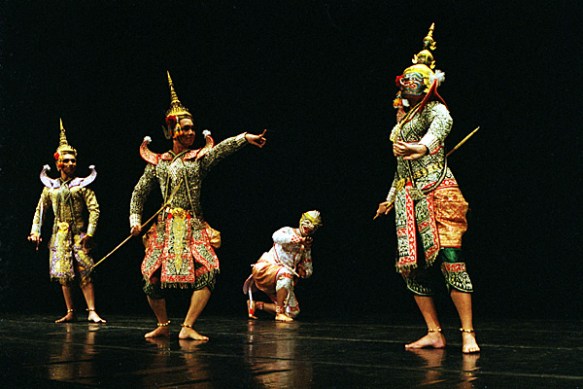
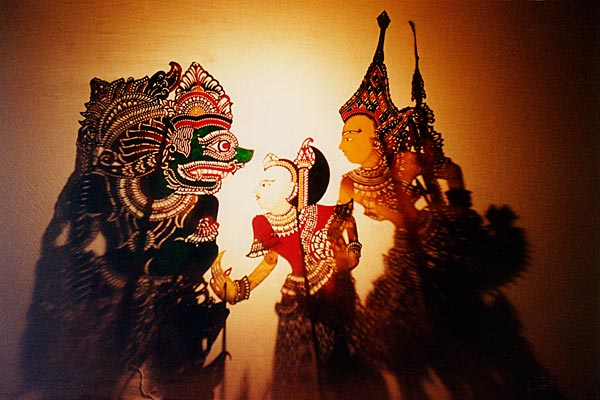
However, yesterday I struck gold for everyone who has interest in, or needs to have a working knowledge of, Asian performance traditions. It is a vastly illustrated web-based text book, an introduction to Asian theatre and dance traditions and so far covers India, Sri Lanka, Myanmar, Thailand, Laos, Cambodia, Vietnam, Malaysia, Indonesia, China, Korea, and Japan. Click the image below to enter this exceptional web-site.
A couple of quotes that stood out for me:
The interrelatedness of drama, dance and music
In Asia drama, dance and music are inseparable. In the European performing arts, on the other hand, they developed their own ways. Thus in the West we talk about text-dominated “spoken theatre”, music-dominated “opera”, and dance-dominated “ballet”.
Most of the traditional forms of Asian performing art combine drama, dance and music into a kind of whole in which it is difficult to draw a clear borderline between these art forms. Most of the Asian traditions employ either dance or dance-like, stylised movements, while movements are frequently interwoven with text. In addition to this, most of the traditions are characterised by their own specific musical styles or genres. The acting technique, which employs dance-like body language, is usually very intricate and it demands many years of arduous training, as western ballet technique, for example, does. Therefore in Asia it is simply not possible to classify stage arts as nonverbal “dance” or “spoken theatre”.
The Interaction between “Living Theatre” and Puppet Theatre
In Asia, puppet theatre and one of its variations, shadow theatre, are often regarded as valued “classical” traditions, whereas in the western tradition puppet theatre is, with only a few exceptions, regarded merely as children’s entertainment.
In Asia there are dozens of important forms of puppet theatre. One could generalise that shadow theatre usually represents the early strata of puppetry with a long history and religious or magical connotations. In shadow theatre the silhouette-like figures are often cut from leather or other transparent or semi-transparent materials and they are seen through a cloth screen while manipulated by one or more puppeteers.
The interaction of puppet theatre and “living theatre” is one of the characteristics of Asian theatrical traditions. There will be several clear examples in this book of how puppet theatre has influenced the structure, acting technique and other conventions of “living theatre” and vice versa.
The main person to thank for this incredible resource, who is the editor and main writer, is Dr. Jukka O. Miettinen, a lecturer at the Theatre Academy and Helsinki University in Finland and Mahidol University in Bangkok, Thailand.

 I’ve directed a couple of his plays – Accidental death of an Anarchist, Can’t Pay Won’t Pay – and been in a few too – Trumpets and Raspberries, Mistero Buffo. One of my favourites is The Virtuous Burglar.
 .
.




 Theatre Room Asia