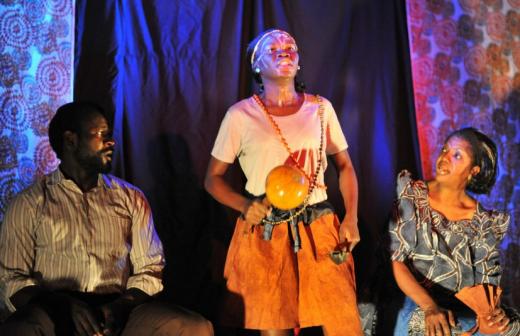
This is an image taken on 16th September of British theatre producer, David Cecil. He was appearing in court in Kampala, Uganda, after having been arrested. What had Cecil done? Well, he dared to stage a play about homosexuality in a country that is currently debating a law that could possibly make being openly gay, punishable by death. Currently you can be imprisoned for life in Uganda for being gay. Cecil was, in fact, released on bail, pending another court appearance in mid-October that could see him put behind bars for 2 years.
His actual crime was to stage the play, The River and The Mountain, by playwright Beau Hopkins, without gaining authorisation from the Ugandan’s Media Council. The National Theatre of Uganda refused to stage play because some government officials objected to it. The play tells the story of a corporate businessman coming to terms with his sexual identity in a climate of oppressive homophobia. The protagonist, Samson, is a good man and a gay one. When his mother learns of his homosexuality, she tries to cure it by hiring a pastor, a private dancer and finally a witch doctor. The play ends with his murder at the hands of his co-workers.
.
.
.
.
.
.
.
.
If click the image above, which is taken from the play, you can read an interview with Okuyo Joel Atiku Prynce who played the lead role of Samson in The River and the Mountain.
Theatre has played a significant role in the last 50 years in bringing about the legalisation of homosexuality right across the world. Only yesterday in The Observer, British theatre critic Michael Billington wrote a lengthy piece about Tennessee Williams’ Cat on a Hot Tin Roof entitled Tennessee Williams’s southern discomfort. For those of you who don’t know the play, it deals in part with the suppressed homosexuality of one of the lead characters, Brick.
I have nothing but the utmost respect for people like David Cecil and the cast of The River and The Mountain who dare to challenge what they belive to be morally unacceptable. Only last year a gay rights activist in Uganda, David Kato, was brutally murdered after a tabloid news paper printed details about his private life.
Theatre has a long history of inciting fear in governments and other powerful people, that results in banning – look back as far as Molière and even farther. Molière, a French actor and playwright, wrote Tartuffe in 1664 and that was banned after being performed at Versailles for attacking and exposing the hypocrisy and deceit of the upper classes. People were afraid it would affect change, and wham, it was gone. And as you look through the history of theatre, you begin to realize that a playwright wasn’t tackling enough daring subject matter if they hadn’t been banned in some theatre somewhere. Theatre-goers have historically been a riotous bunch, so you can see where the fear would come from.
A modern audience member really recognizes the power of work on the stage to change the course of politics and daily life off the stage. Playwrights like Bertolt Brecht based their entire body of work off that power. Plays like The Laramie Project (about the murder of Matthew Shephard, a show that brought the discussion of hate crimes and trials to a nation) were written to directly engage with politics and to change the mindset of the culture around them, to explore territory that had not yet been explored.
The story of David Cecil and The River and The Mountain is not over yet.
Today I am sharing an interview from the Huffington Post, between Katherine Brooks and Maria Tri Sulistyani, founder of Papermoon Puppet Theater, from Indonesia. Papermoon is not your traditional Wayang kulit theatre and the content of their work is even less traditional. The company uses puppetry to highlight social and political injustices in Indonesia’s turbulent past. What is also interesting is that the article talks about ‘cultural diplomacy’ – the idea that in order to truly understand someone from another culture, you also need to understand their traditions, history, language and general way of life.
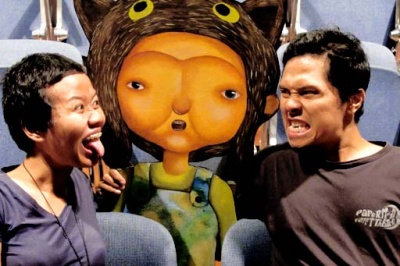
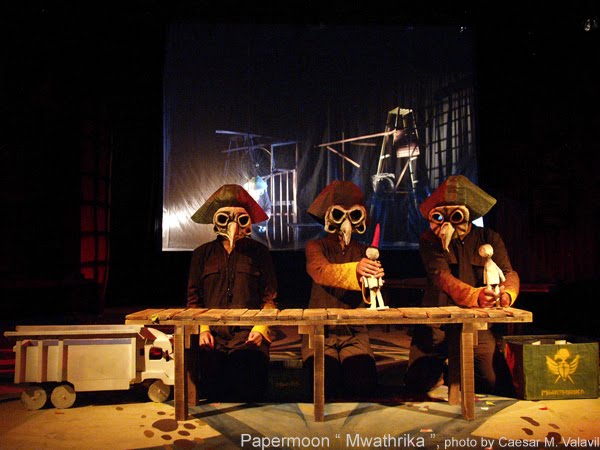
Indonesia’s Papermoon Puppet Theater is taking an art form we often associate with children’s stories and turning it into a vehicle for addressing the country’s dark history. The company, started by visual artists Maria Tri Sulistyani and her husband Iwan Effendi, (left) uses whimsical puppets and multimedia performances to recreate personal accounts of the mass jailings and executions that took place in Indonesia in 1965. They are harrowing stories, meant to shed light on the emotion and complexity of a time period often glossed over in contemporary history.
Papermoon’s performances reveal intimate moments of Indonesia’s past, but the company maintains that a discussion of politically driven atrocities is something accessible to international audiences. And the U.S. State Department agreed, recruiting Papermoon for its Center Stage program that will be touring throughout the country this year. Sulistyani and Effendi will be showcasing their work, “Mwathirika,” alongside ensembles from Haiti and Pakistan, sharing their brand of art as an initiative of cultural diplomacy.
We asked Maria Tri Sulistyani about her beginnings in the world of puppetry, the heavy themes she’s chosen to present and how she thinks art can interact with diplomacy in an email interview:
Can you tell us a little about traditional shadow puppetry in Indonesia? How does your style of puppetry compare?
Wayang kulit (Shadow Puppetry) has been an important art form – especially on Bali and Java – for almost 1,000 years. Its stories of good and evil, of love and death and transformation are most often taken from the Hindu epics Ramayana and Mahabharata. A single dhalang (master puppeteer) manipulates all of the many two dimensional leather puppets from behind a screen (to cast shadows). He also voices all of the characters. It is a virtuoso performance! While reaching back in history to tell his tales, the master puppeteer always makes reference to current happenings. Traditional puppet theater has played an important role in communicating values to communities.
There is also another kind of puppetry – Teater Boneka – that is generally just for children and it is a much less formal. Inspiration for the stories and the puppets come from lots of different influences – even Sesame Street.
The interesting part is that people in Indonesia had never connected these two types of puppetry before. Papermoon makes that link, and this is something new. Our pieces are performed on stages, like a theater play. Several puppeteers are on stage manipulating the puppets. Mwathirika, the piece we are presenting on tour, is really for adults, not kids and is a story told without words, without speaking. But we are telling stories about values, too — about moral choices and conflicts and relating to everyday life. Our stories are really personal and focus on individuals. From there we can see the bigger issues. Though Papermoon is not really creating a performance in the traditional form, we too want to share and talk about the values and ideals and choices of Indonesian people’s life.
Your earlier work, “Noda Lelaki di Dada Mona (A Stain on Mona’s Chest),” used puppets to convey a politically and sexually charged story. What was the reaction in Indonesia to such a performance?
It was very interesting because Papermoon had created performances for children since 2006, and “Noda Lelaki di Dada Mona” was the very first time we created a piece for an adult audience. That was also the first time we sold tickets to a performance, 300 seats, and it sold out!
People were shocked with what they saw. Not just only about the theme, but also by the kind of puppets we performed with, how realistic they were, and how we combined puppets with the actors who spoke as individuals, which had never been seen by people in Yogyakarta. Together with our audience, we started to realize that puppet theater could reach many people, including adults. Instead of having one puppeter verbalize all the voices, we decided each puppeter will speak for his own puppet. I would say that “Noda Lelaki di Dada Mona” was a kick start for Papermoon to do more performances, based on social themes, to communicate with many different types of audience.
In “Mwathirika” you have again focused on more serious accounts, this time of imprisonment and violence. Do you think the use of puppets makes it easier to express these heavy themes? Or easier to digest on the part of the audience?
Yes. For us, puppets are the perfect medium to bring an unexpected moments or difficult subjects to the audience. Puppets always have the image of cuteness, happiness, sometimes scary, but mostly FUN. So when people come to the theater, with a certain expectation of puppetry, they can be surprised, because what they see is totally different from what they thought.
Many people feel like the story of 1965 is already over, it’s expired, helpless, over-researched, or it’s never been heard. By seeing a poster of two little boys with a red balloon, people will think about something sweet. They don’t have fear to come, they feel relaxed, they are open. It’s perfect.
You spoke to a number of people – parents, grandparents, neighbors – who provided their stories for “Mwathirika.” Could you tell us about one story in particular that sheds light on the historical situation in Indonesia?
We asked them about what they felt at those moments in their lives. There was a lot of data, books about the 1965 tragedy, but very few could give insight into their feelings. And by interviewing those people, we could see their eyes, and what they really felt in their hearts – uncover their personal stories.
One of our company member’s uncle, told a story about how he, a 12 year old boy, had to take care of his little brothers and sisters, after their father was taken away by government officials, and didn’t come back for 13 years. He had to catch frogs in the rice fields, for his family to eat. And how the family grew in the middle of these chaotic moments, with children with no parents, and no one in the village dared to help, because if they helped they might be caught by the army too. In Mwathirika, we are not pointing fingers; we are not saying that one person is right and one person is wrong. But we tell a story about the impact of political turmoil on those who lived through those terrible times and the huge effect it has had on the next generation.
Your project has now become a tool for cultural diplomacy, helping to foster greater understanding in the US in particular. How do you view art in the greater scheme of international cooperation? Do you think that art has the potential to bring people together in a way that other diplomatic tools can not?
Yes. What people know about other countries or cultures, is mostly from the media. And it’s usually about all problems of economy, technology, war, conflict, and how to deal with that on a big scale. Of course people need to do big things, but sometimes people forgot how important it is to build a personal solution for the problems. And for us, Art is a personal thing. It’s about how we can reach out one person to another. When people meet, exchange their cultures, see another art from those who live in another country, then they see a different thing, they learn to respect each other. If people can share, talk more about their culture, the respect will go deeper, and hopefully an understanding of each other will be built there. Like we said, Art gets personal. This is where those big actions made by government might not reach.
Last question: Indonesia has become one of the region’s largest markets for contemporary art. How has the art scene changed in Indonesia since the 1960s?
When Indonesia became an independent country in 1945, art was seen as a big strength and unifying force for the country. The government put a lot of attention on the development of the arts. Sometimes, art was also used as a political tool.
In 1965, the art scene was changed by the political turmoil, lots of critical artists were jailed, silenced, disappeared in the violent political battles between the government and the Army. There were three years of chaos. When General Suharto took power in 1968, the government centralized the arts. Artists that had not been caught, and were still active, could develop their careers, but always had to support – promote –the government. And though things loosened up little by little over time, that was really the case up until the 1990s. The government was still very oppressive, and they didn’t want people to say bad things about them.
In 1998 when there were riots in the streets all over the country because of the falling economy, Suharto resigned and things began to change again – to open up and become less centralized. Since then, the art scene is changing (very quickly) again, because of the openness of information through internet, etc.
The video below is about their production Mwathirika.
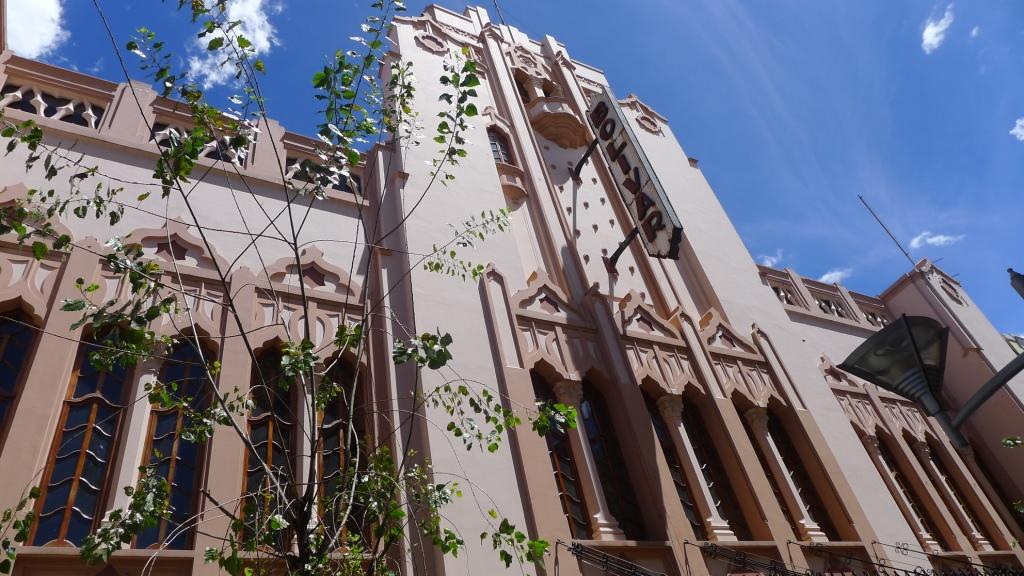
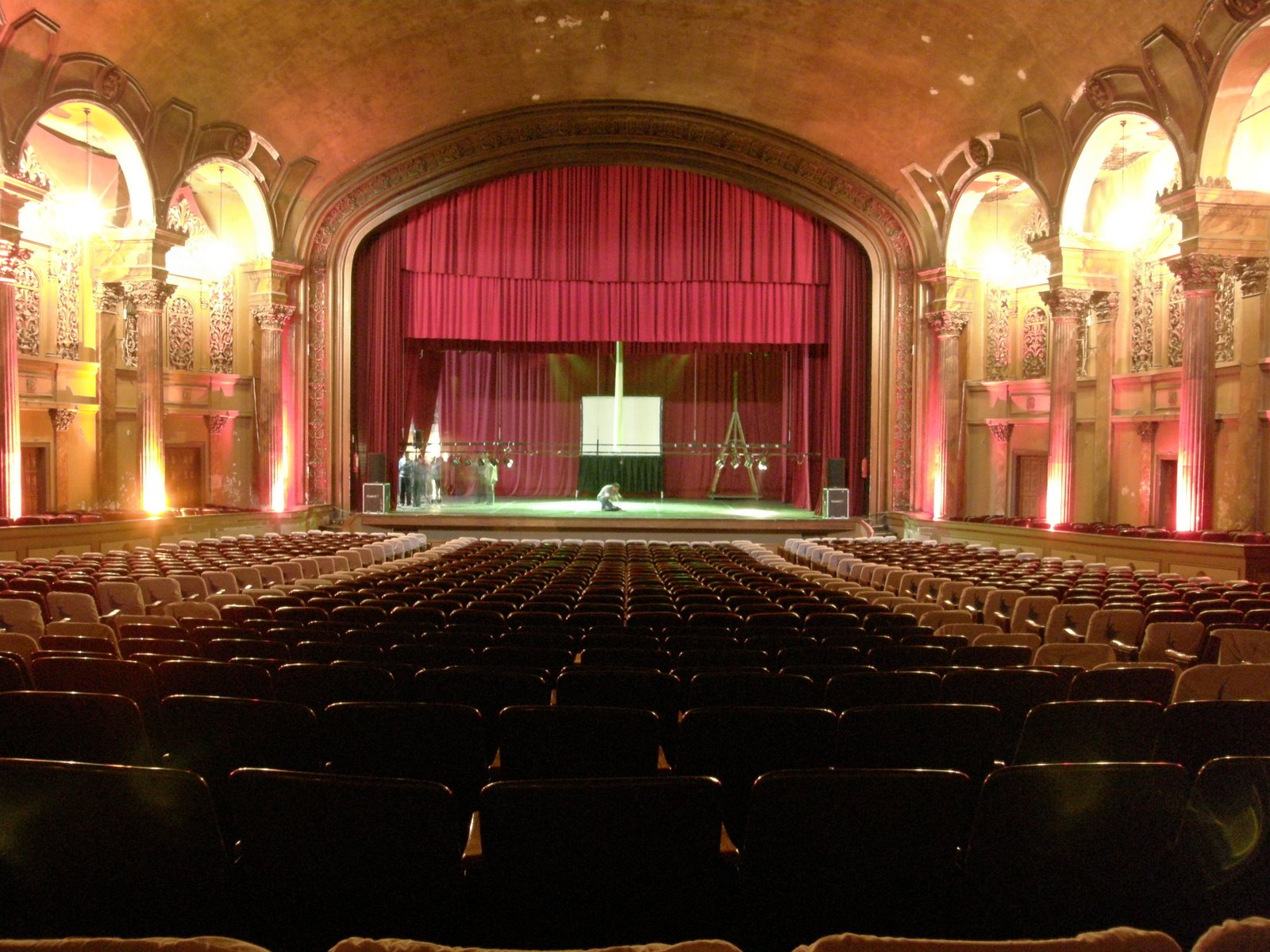
This is the beautiful deco Bolivar Theatre, in Quito, Ecuador, which opened in 1933 with an audience capacity of 2,400. Whenever I travel I try to visit these grand architectural icons as they often say much about a country’s society and culture, and I was stuck by the grandeur of this one.
Sadly, this is what it looks like on the inside now. In 1997, after a few years as a cinema, a lengthy restoration process took place, which succeeded in recapturing lost audiences. In 1998 the theatre dedicated itself to promoting culture in Quito, becoming The Theater of the City. 70 events, both national and international, were presented in 1998 and the first half of 1999, bringing more than 70,000 visitors. The future was bright. However, on Sunday, August 8, 1999, a gas leak caused a fire to erupt in the kitchen of the multinational chain Pizza Hut, which was occupying a business area on the ground floor of the theatre. The fire consumed over 70% of the building.
And why am writing about it? Well, as I travelled around Ecuador I was delighted by the lack of international franchises – not a Starbucks to be had, or the greasy stink of a MacDonalds to be sniffed. The Ecuadorian government clearly has a very tight rein on allowing these companies in.
However, there was a notice on the door of the Teatro Bolivar (to give it is proper title) that explained what had happened, but also went on to say that Pizza Hut refused both to accept responsibility for the fire or help fund or take part in any of the restoration. So much for corporate social responsibility!
The day following the fire, the Theater and Hotel Enterprise of Quito planned the Process of Restoration for the Bolivar Theater that would include a number of principal actions, including initiating legal and public actions to put pressure on Pizza Hut to recognize their responsibility for the fire and to continue to produce cultural events in the Bolivar in the process of rising out of the ashes. The restoration process is clearly a slow one, but the members of the Bolivar Theater Foundation and the Bolivar’s audiences are determined to return their beloved theatre to its original prominence, as one of the most important cultural venues in South America .
The places in which we make theatre can be as important as the performances themselves and represent the significance of creativity in and to a culture. So when one is destroyed by an international corporate giant that then refuses to accept its role in that destruction, it makes me especially angry.
So next time you pick up the phone to order your pizza, please think again and choose a company other than Pizza Hut.
I was chatting with my first year IB theatre students, Jeff, Tim and Clarissa, this week. I wanted to know what their university plans were. Not one of them knew – fair enough – but made me smile with the comment that ‘well we know it won’t be medicine because we are here talking to you’. So when my colleague John (thanks mate) posted this it struck me as being very prescient. It is 20 minutes long, but worth every minute and should inspire any student of the arts to take a leap of faith
I meet this amazing artist, Ghaffar Pourazar, last year. He is an Iranian born, British raised former computer animator turned master of Beijing Opera. He is the first and only ‘Westerner’ to train in the art and has subsequently created the first bilingual version of the opera, Monkey King, as well as adapting Shakespeare’s A Midsummer Night’s Dream for the Beijing opera stage. The links are various, but the first is to the International Centre for Beijing Opera which Ghaffar founded.
Using animation, projections and her own moving shadow, Miwa Matreyek performs a gorgeous, meditative piece about inner and outer discovery. Take a quiet 10 minutes and dive in. With music from Anna Oxygen, Mirah, Caroline Lufkin and Mileece.
Miwa Matreyek creates performances where real shapes and virtual images trade places, amid layers of animation, video and live bodies
“Puppets always have to try to be alive,” says Adrian Kohler of the Handspring Puppet Company, a gloriously ambitious troupe of human and wooden actors. Beginning with the tale of a hyena’s subtle paw, puppeteers Kohler and Basil Jones build to the story of their latest astonishment: the wonderfully life-like Joey, the War Horse, who trots (and gallops) convincingly onto the TED stage.
Basil Jones and Adrian Kohler, of Handspring Puppet Company, bring the emotional complexity of animals to the stage with their life-size puppets. Their latest triumph: “War Horse.”
I am a great fan of this actor. You may well recognise her.
Writer and actor Anna Deavere Smith gives life to author Studs Terkel, convict Paulette Jenkins, a Korean shopkeeper and a bull rider, excerpts from her solo show “On the Road: A Search for American Character.”
Anna Deavere Smith’s ground-breaking solo shows blur the lines between theatre and journalism, using text from real-life encounters to create gripping portraits.





 Theatre Room Asia