It’s a Mystery

As any good student of performance should know,  the history of theatre in almost all world cultures can trace its roots to religious ritual and celebration, be it the Ramayana in India, the Greek gods in Europe or shamanistic rites in ancient China.
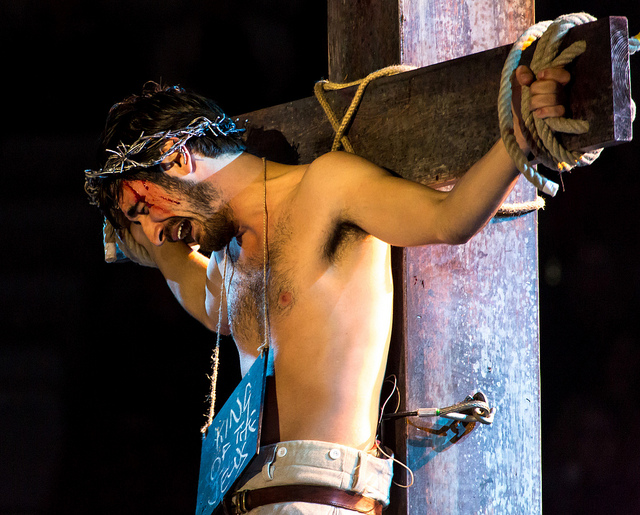
However in the West, the performance traditions of the Greek and Roman Empires were lost during the ‘Dark Ages’ leaving the continent with a gaping cultural hole. I’ve always been fascinated by what evolved next, The Mystery Plays, and the impact that they had on the theatrical heritage of almost a whole continent. If you don’t know about the Mysteries you can read a simple history here or a more in-depth one here.

What makes all this worthy of a post here, for me, is that they are still being performed 700 years later. One of the most famous performances takes place every year in the English city of York and this year’s re-interpretation has received some great reviews – have a look at this video, you will see why.

If you want to see more you can here which allows you see the performance from different viewing angles and cameras.

Even more fascinating is that the huge casts for these plays (with the exception of the lead roles) are largely drawn from local people, not professional actors, so it has remained what it began as – community theatre.

You can find Mystery or Passion Plays being performed all over Europe, but perhaps the most famous is in Oberammergau in Bavaria, Germany, where half the village take part – almost 3000 people.  They perform their Passion Play every 10 years and have done so since 1634. All the roles in Oberammergau are taken by locals. Have a look at this short documentary (apologies for the voice-over):


You don’t need to be a religious person (I’m not) to enjoy the spectacle of the modern Mystery Plays but you can appreciate a great story well told and a fantastic piece of theatre.

Burning down the House

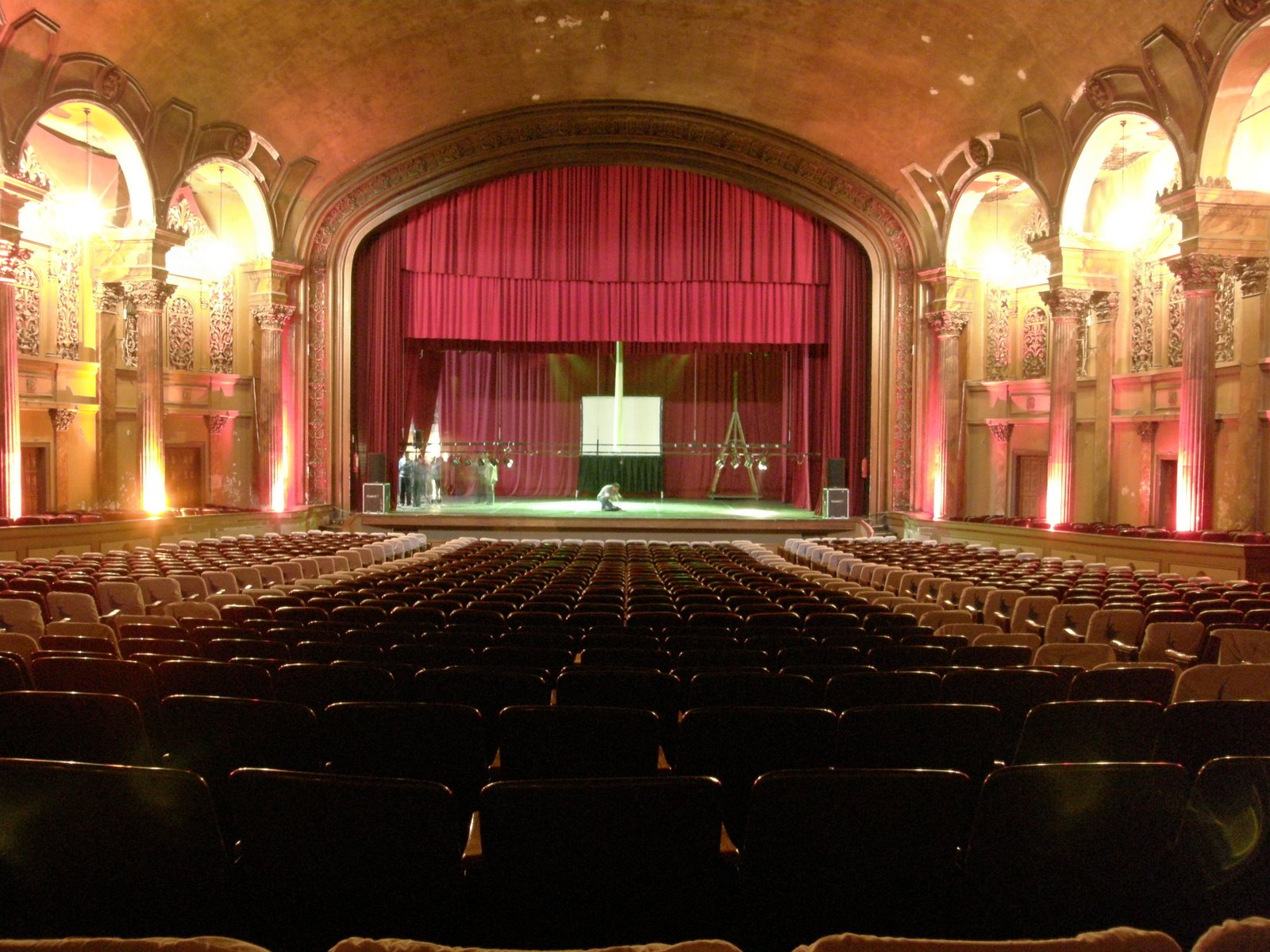
This is the beautiful deco Bolivar Theatre, in Quito, Ecuador, which opened in 1933 with an audience capacity of 2,400.  Whenever I travel I try to visit these grand architectural icons as they often say much about a country’s society and culture, and I was stuck by the grandeur of this one.

Sadly, this is what it looks like on the inside now.  In 1997, after a few years as a cinema, a lengthy restoration process took place, which succeeded in recapturing lost audiences. In 1998 the theatre dedicated itself to promoting culture in Quito, becoming The Theater of the City. 70 events, both national and international, were presented in 1998 and the first half of 1999, bringing more than 70,000 visitors. The future was bright. However, on Sunday, August 8, 1999, a gas leak caused a fire to erupt in the kitchen of the multinational chain Pizza Hut, which was occupying a business area on the ground floor of the theatre. The fire consumed over 70% of the building.

And why am writing about it? Well, as I travelled around Ecuador I was delighted by the lack of international franchises – not a Starbucks to be had, or the greasy stink of a MacDonalds to be sniffed.  The Ecuadorian government clearly has a very tight rein on allowing these companies in.

However, there was a notice on the door of the Teatro Bolivar (to give it is proper title) that explained what had happened, but also went on to say that Pizza Hut refused both to accept responsibility for the fire or help fund or take part in any of the restoration. So much for corporate social responsibility!

The day following the fire, the Theater and Hotel Enterprise of Quito planned the Process of Restoration for the Bolivar Theater that would include a number of principal actions, including initiating legal and public actions to put pressure on Pizza Hut to recognize their responsibility for the fire and to continue to produce cultural events in the Bolivar in the process of rising out of the ashes. The restoration process is clearly a slow one, but the members of the Bolivar Theater Foundation and the Bolivar’s audiences are determined to return their beloved theatre to its original prominence, as one of the most important cultural venues in South America .

The places in which we make theatre can be as important as the performances themselves and represent the significance of creativity in and to a culture. So when one is destroyed by an international corporate giant that then refuses to accept its role in that destruction, it makes me especially angry.

So next time you pick up the phone to order your pizza, please think again and choose a company other than Pizza Hut.

On Cloud Nine

I first encountered Caryl Churchill when I was doing my A Levels, many moons ago. It was her play, Cloud 9, that captured me and her writing has held me enthralled ever since.
It was the structure of the play, not just the content, that caught my attention, although it would be fair to say that the politics it spoke about shouted at me loudly. Act 1 is set in British colonial Africa in Victorian times, and Act 2 is set in a London park in 1979. However, between the acts only twenty-five years pass for the characters. Each actor plays one role in Act 1 and a different role in Act 2 – the characters who appear in both acts are played by different actors in the first and second. Act 1 parodies the conventional comedy genre and satirizes Victorian society and colonialism. Act 2 shows what could happen when the restrictions of both the genre of comedy and Victorian ideology are loosened in the more permissive 1970s. The play uses controversial portrayals of sexuality and obscene language and establishes a parallel between colonial and sexual oppression – and it made laugh!
Also it was developed inconjunction with Joint Stock Theatre Company who were taking the British theatre world by storm at the time with a new way of working, developing plays with well-known playwrights, in the rehearsal room.  The company is no more, but has given birth to Out of Joint, which was founded by Max Stafford-Clark, one of the original members of Joint Stock.
.
.
.
.
.
.
.
And why am I reminiscing about the play today?  Well, Churchill (pictured above) is about to open two new plays at London’s Royal Court Theatre.  Her writing career has spanned more than 50 years and her influence on Western theatre has been significant, and for me, satisfyingly controversial. You can read about her work and the two new plays in a fantastic article, Caryl Churchill: changing the language of theatre.
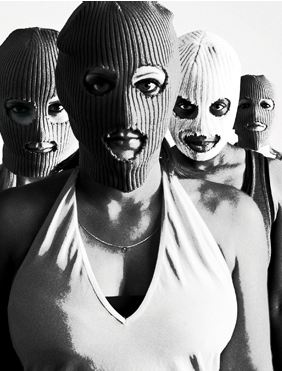
Therefore it also seems fitting that I should return to a post I made in June, “there aren’t bloody well enough parts for women” which bemoaned the lack of roles for women in theatre. Well, Churchill has gone a long way to address this in her career and it caught my notice that an all female version of Shakespeare’s Julius Caesar as about to open at the Donmar Warehouse in London. One writer commented that “The Donmar’s gender switch of Shakespeare’s play could turn a dusty GCSE set text into something much more Pussy Riot”.
 
An interesting thought!
 

Sound and Fury

Today I want to share an adaptation of a play, Kursk, to film. It is from a growing genre, that of Immersive Theatre, where the audience are required to experience more than something just created with words. The film version attempts to capture some the plays’ experiential  attributes.

In the year 2000, a Russian submarine, the Kursk, suffered a huge explosion that ripped the bow apart and sent the vessel to the seabed. Inspired by this tragic event, this production takes the audience on the imagined journey of a British Submarine sent to spy on the Kursk. The audience is subsumed in the submarine space with the performers, silent observers to the events as they unfold, complicit in their world of secrecy and codes, witnesses to the last minutes of the Kursk.

The piece puts the audience at the heart of the story using a novel and highly engaging staging that embraces both the epic and intensely personal. Using cutting edge sound design that creates the sonic equivalent of a virtual submarine, Kursk is an authentic and emotionally rich voyage into the icy depths of the Barents Sea and the dark recesses of the imagination.

Kursk received quite amazing reviews, two of which you can read here and here.

Thanks to a new initiative in the UK, The Space, the play has been reworked for film and you can watch the whole thing by clicking the image below

The producing company, Sound&Fury is a collaborative theatre company whose artistic interest is in developing the sound space of theatre and presenting the audience with new ways of experiencing performance and stories by heightening the aural sense.

Also on The Space is a fascinating documentary, Writing Kursk, about the making of the piece and is well worth a listen.

I am a real fan of this immerse theatre as I think it can challenge audiences in a very visceral way.  Mind you, not everyone agrees. In her blog, journalist Lynne Gardner explains why she has issues with it; Immersive theatre: take us to the edge, but don’t throw us in, she asserts, saying that it can replicate terrifying human experiences, but this type of theatre is best when it maintains some perspective.

“there aren’t bloody well enough parts for women”

In Hong Kong, school is most definitely out for Summer.  So me, my students, my colleagues and this blog will be taking a holiday and, even if I do say it myself, a well-earned and necessary break. Those of you in the Northern hemisphere, enjoy, and for those of you below the equator – you will get your turn!

For my last post for a while, I want share an article with you about the opportunities for women in theatre.  This week, the actors’ union Equity in the UK spoke out, highlighting the need for better employment opportunities for women. It was an act sparked by a well-known and respected theatre’s current season, which includes productions of Henry V and A Winter’s Tale from the all-male company Propeller – a choice of casting that, of course, reflects Shakespeare having written for a company of boys and men.

Propeller are a stunning company who create amazing and compelling work.  I know, I’ve seen them twice in HK and their interpretation of Taming of the Shrew (above) was possibly the best I’ve seen (for another time!). They are often cited in this debate, but I have to say, for me, they are a scapegoat. The situation goes much deeper (and back in time). For a world that is generally thought to be populated by liberal thinking people, I still find this very disheartening. Have a read……….

There aren’t bloody well enough parts for women

And when you have,  have a good think about where, across the globe, is indigenous theatre dominated by men?

Thank you.

See you in August.

Painted Faces

My intention for this blog was that it should be as wide as possible, covering all aspects of theatre and performance, including offering information about production roles and, when appropriate, the wide variety of careers in the creative industries.

So today I offer you an interview with Giuseppe Cannas who works as a make-up artist at the National Theatre in London. It is really interesting and gives you a very clear picture of his job.

A working life: the make-up artist

I’ve blogged elsewhere here about the role make-up plays in world theatre, but think about Chinese and Japanese traditional theatre forms.  Part of the actor training in those traditions is for the actor to be able to apply their own, highly detailed make-up

String Them Up

Puppets are one of the true world theatre traditions and no matter where you go in the world, you can usually find a native form of the art. In fact the UNIMA (Union Internationale de la Marionnette) Congress and World Puppetry Festival has just been held in China. UNIMA  is an international non-government organisation of UNESCO.

.

.

.

.

.

.

.

.

Today I bring you an interview with Mark Down, the co-founder of Blind Summit a British based puppet theatre.

Blind Summit’s Mark Down on puppetry and narrative.

Playing The Game

Now then, Gaming. Never something I’ve managed to get into, which is probably a good thing for me – Angry Birds is about my limit and even that frustrates the hell out of me. However, I do know that many of my friends are into gaming, online or off and that certainly many, many of my students are and this is where the research trail for this post began.  I have a student, Arisa, who is looking to explore the link between performance and gaming as a focus for her extended project.  Not wishing to sound like a complete idiot when advising her I decided I should do some research of my own and I was astounded at what I came across.

So I’ll start here with a review for The Crash of the Elysium (above) which is a new piece of children’s theatre, set in a multi-story car-park, by the internationally renowned Punchdrunk which is described as much of a game or adventure as it a performance. One critic commented

You certainly have to be on your toes, and…….is a one-off experience that children are likely to talk about for years. It’s also a reminder of what theatre can learn from other forms, particularly gaming. The excitement of the young audience comes…….from an active engagement in the unfolding scenario. Take nothing with you except a sense of adventure, wear flat shoes, be prepared to run…….

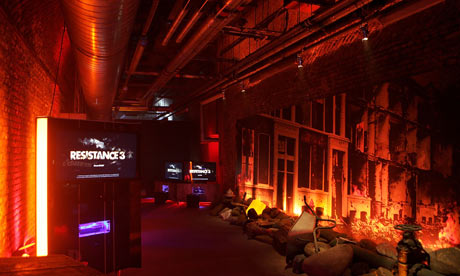
So this led me to Punchdrunk’s collaboration with PlayStation for the release of Resistance 3, Sony’s flagship sci-fi horror series. The company created a terrifying world beneath the railway arches at Waterloo station in London. The audience take the role of one of the few remaining survivors of an apocalyptic event and as one commentator noted:

From the moment the door closes behind you and you start to navigate the first dank corridor, torch in hand, you are as much part of the experience as witnessing it

.

.

.

..

.

.

.

And Darkness Descended as the piece is called was reviewed widely – both as a piece of performance and by technology writers and bloggers and the reaction from the two very different groups is fascinating. One blogger, Kevin Holmes who writes for a collective called The Creators Project (which is a global network dedicated to the celebration of creativity, culture and technology) entitled his piece Gaming And Theater Merge To Scare The Crap Out Of People – which I just love as a description.

.

.

.

.

.

.

.

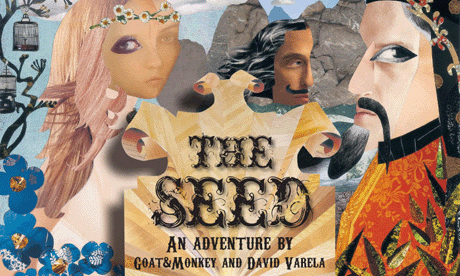
Then I found this article The Seed: where theatre, gaming and botany collide on a gaming  blog. The Seed is by the company called Goat and Monkey and is described as part immersive theatre and part on-line mystery.  This led me to another game blogger, Fin Kennedy, who asked the question Can video games help theatre reach the next level?

Another writer, Matt Trueman, asked the question The form is growing up. So what do we want from our games as theatre? Is it enough just to play or must we demand that games demand more?

I then came across another Punchdrunk production Sleep No More which is based vaguely around Macbeth, and was described by Salon website as

Shakespeare meets Internet games – Macbeth and alternate reality gaming collide in a show that could suggest the future of cutting-edge theater

.Click the image above for the New York Times review, or here for the Salon article.

This is a relatively new developing area of theatre. There is clearly much emerging all the time. There are even doctoral thesis’ being written on the subject. There is one here, by Katherine Whitlock, entitled THEATRE AND THE VIDEO GAME: BEAUTY AND THE BEAST.

It just all sounds so exciting. Maybe I’ll try Angry Birds again!

A Moment In Time

I was doing a bit of digging and came across these yesterday.  The New York Times has been publishing an occasional series of their original reviews of classic western plays. I am posting three here today. A real piece of theatre history. The links are for readable PDF versions of the images.

Firstly, Harold Pinter’s The Caretaker from 1961

Secondly, Tennessee Williams’ A Streetcar Named Desire from 1947

And finally, from 1905, George Bernard Shaw’s Man and Superman