Heads Above Water

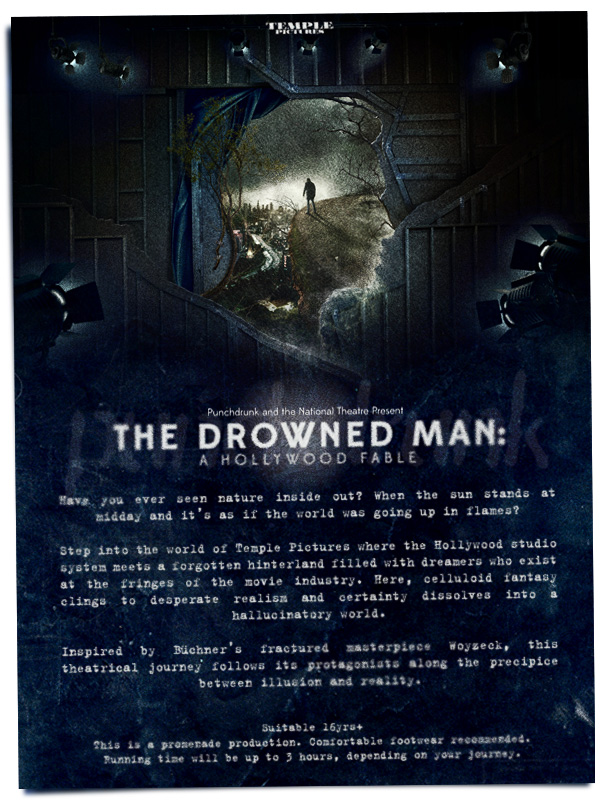
I make no apologies for a very ‘British’ post today. One of my favourite theatre companies, Punchdrunk (I’ve mentioned them here a few times before) are about to open a new show, The Drowned Man: A Hollywood Fable.

.

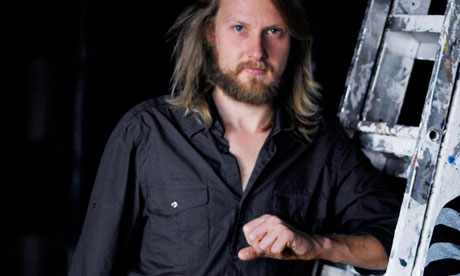
My friend and colleague Sara saw their production of Faust and still rates it as one of the best pieces of theatre she has ever seen. In The Observer today Liz Hoggart writes a profile of Felix Barrett, Punchdrunk’s founder and artistic director.

Felix Barrett: the visionary who reinvented theatre

The founder of the Punchdrunk company has no time for stages or even seats. Their ‘immersive’ style has had huge influence in theatre and beyond. And their new show is their most ambitious yet

‘We’re trying to build a parallel universe,” explains Felix Barrett, founder and artistic director of Punchdrunk. “For a few hours inside the walls, you forget that it’s London 2013 and slip into this other place.”

Felix Barrett Punchdrunk

An elfin 35-year-old, with long, straggly hair and beard, Barrett is the man who changed British theatre, when he set up Punchdrunk in 2000, pioneering a form of “immersive” or “promenade” theatre. Their latest show, The Drowned Man: A Hollywood Fable, a walk-through tour of a seedy 1960s film studio, opens to the critics this month.

The three-hour performance will play out over four floors of a former sorting office next to Paddington station, west London. Co-directed by Barrett and long-time associate Maxine Doyle, and inspired by Georg Büchner’s anti-war fable, Woyzeck, it’s their first major London show for six years, and biggest to date. It has, Barrett admits, the budget of a small film.

Punchdrunk want to take immersive theatre to a whole new level. A night in their company doesn’t involve a stage, a programme, an ice cream at the interval – or even a seat. They find empty buildings, fill them with richly detailed sets and performers and then set the audience loose – wearing masks. The thrill comes from not knowing what’s round the corner or how you’ll react when you find it. “In the theatre, you sit there closeted and you switch off part of your brain because you’re comfortable,” says Barrett. “If you’re uncomfortable, then suddenly you’re eager to receive.”

Even if you’ve never seen one of their wildly inventive shows, you will have felt their influence through advertising, music videos and festivals. Everyone these days wants to copy the Punchdrunk magic. The Drowned Man has already sold 50,000 tickets. For the next five months, a cast of 34 dancers and actors will lead 600 people a night around 200,000 sq ft of warehouse.

punchdrunk-the-drowned-man

Arguably Punchdrunk attract people who would normally run a mile from high-concept theatre. Their influences come from B movies, computer gaming and gothic novels. “It’s theatre for people who like theatre but don’t particularly like theatres,” says Colin Robertson, TV editor of theSun, an early fan. “Punchdrunk is theatre for the warehouse party generation. It has that DIY, chaotic feel about it that is so far removed from traditional stuffy theatre.”

Punchdrunk’s promenade productions have included Faust (where audiences explored an east London tobacco warehouse filled with scenes from Goethe’s play), The Masque of the Red Death (based on the stories of Edgar Allen Poe, staged in Battersea Arts Centre), andThe Duchess of Malfi (a collaboration with English National Opera in old pharmaceutical premises in Docklands). But it was their off-Broadway hitSleep No More – a spin on Macbeth that’s still packing audiences into a former warehouse in New York – that brought them celebrity attention.

The New York Times called it “a voyeur’s delight. Messes with your head as thoroughly as any artificial stimulant. Spectacular!” About 200,000 people have attended, including Justin Timberlake and Matt Damon. In many ways, Punchdrunk became the Banksy of the theatre world.

They’ve spawned countless imitators – from Secret Cinema and Gideon Reeling (Punchdrunk’s sister company) to You Me Bum Bum Train. Also, Rupert Goold’s Headlong company (EnronThe Effect) emerged at the same time.

Barrett founded Punchdrunk after studying drama at Exeter University. Dissatisfied with conventional venues, he fell in love with site-specific theatre. He staged an immersive take on the proto-expressionist masterpiece Woyzeck in an old Territorial Army barracks in Exeter as part of his theatre degree finals. The police turned up – “with dogs and everything,” he recalls fondly.

Paul Zivkovich and Kate Jackson in The Drowned Man A Hollywood Fable.

Paul Zivkovich and Kate Jackson in The Drowned Man A Hollywood Fable.

Along with Shunt, Punchdrunk led the charge for a wave of immersive, experiential theatre that aims to erase the fourth wall as much as possible. From the start, Barrett and his team knew how to create interventions on an outrageously grand scale with minimal resources, recalls David Benedict, London theatre critic for Variety. “Fringey sounds like they were a bit silly and small and fiddled around on the fringes. From the start, they were a bunch of people with quite a big idea and they pursued it with a) great imagination and b) rigour. They weren’t the first people to do site-specific, far from it, but they were the first to be bold enough to think big. The fact that they didn’t have any money released them in a weird way.”

The National’s director, Nicholas Hytner, was an early supporter. In 2005, he attended The Firebird Ball, inspired by Romeo and Juliet and Stravinsky’s The Firebird, in a disused south London factory. “I was suspicious when I was made to put on my white mask,” he says. “Maybe I was right to be. It turned out to represent the polar opposite of everything I’ve ever been able to do in the theatre and I was totally exhilarated – high on every moment of it.”

Hytner’s decision to have the National endorse the company led to their breakthrough show, 2006’s Faust, occupying five floors of a Wapping warehouse, and, a year later, The Masque of the Red Death.

It was this talent for getting into bed with very smart co-producers that set Punchdrunk apart, says Benedict. “It gave them the clout and the heft and the publicity. They never did upstairs rooms. When they did The Masque of The Red Death in 2007, they had the whole of the Battersea Arts Centre. And that was a very fashionable producing house because they’d already created mega-hit Jerry Springer: The Opera.”

In 2009, the Old Vic and Punchdrunk collaborated on a show in Tunnel 228 with contemporary artists underneath Waterloo station. It became more than a hit show, it became one of the “must-see” experiences in the capital.

Punchdrunk’s rise has coincided with audiences becoming much more adventurous over the past decade. It’s tricky to define cause and effect. Punchdrunk have driven the wish for something bold, but they also emerged at a time when audiences were tiring of sitting down in front of a proscenium arch before slipping out for the interval drink. And Punchdrunk became a byword for all that was different from that tradition.

Barrett gives little away about his personal life. We know he’s married to Kate, a media producer at the Tate, with a child. Although, touchingly, he reveals his company organised his “prenuptial bachelor party” (also known as a stag do) as a theatrical event, a journey that started with a key in the post and ended with 30 men in masks kidnapping him and forcing him to unlock a trunk full of his most embarrassing possessions. “It was the best show I’ve seen in the last 10 years,” says Barrett.

The darlings of British theatre have their critics, of course. TheGuardian‘s Michael Billington queried the “fairground shock tactics” of It Felt Like a Kiss (2009), their collaboration with documentary film-maker Adam Curtis, and musician Damon Albarn for the Manchester international festival, calling it “a real dog’s dinner of a show”. And theDaily Telegraph said of their 2010 foray into experimental opera, The Duchess of Malfi, that “the bag of tricks [was] looking increasingly jejune”.

Faust Punchdrunk 2006

Faust Punchdrunk 2006

“The trouble with a lot of site-specific theatre is it’s posh haunted house, with people rushing at you in corridors,” says Benedict. “When it works, you forget that, but it needs to be done with theatrical rigour.”

There have also been accusations of selling out. They have done corporate pieces for Stella Artois and W Hotels, while, at Sleep No More,tickets sell for $100, with programmes at $20. In London, with the National Theatre as co-producer, tickets for The Drowned Man are £39.50 to £47.50. Barrett claims sponsorship funds the experimentation, stressing that, as a charity, the company ploughs the money back. But they have, he concedes, paid attention to the bad press.

There is a sense that The Drowned Man needs to be a critical hit to restore some flagging confidence. Says Benedict: “The first time you go to a Punchdrunk show, it blows your head off, but the trouble is it’s a bit of a cliche if you’re relying on no one having seen it before. ”

In wider terms, perhaps we may see a return to straight theatre after a decade of playful deconstruction. Even if this happens, Punchdrunk will have made a fundamental mark – shaking up theatre and routine practice like none of their peers.
In another interview last week in The Independent entitled All the disused building’s a stage: Punchdrunk’s The Drowned Man is their most ambitious show yet,  Barrett talks to Alice Jones about why they keep pushing the boundaries.

The show is currently in preview so there are no official reviews. However here is one unofficial written by a member of a preview audience. The twittersphere  likes it too!

.

THE PUNCHDRUNK FILE (Courtesy of Liz Hoggart and The Observer)

Born Founded in 2000 by Felix Barrett. His regular collaborator is choreographer Maxine Doyle. They have come to be seen as the leading lights of a form of “immersive theatre”, where the audience is not seated but is freer to roam the performance site.

Best of times Their Hitchockian take on MacbethSleep No More, staged off-Broadway in 2011, seduced Matt Damon, Natalie Portman and Justin Timberlake to join the masked revels.

Worst of times Punchdrunk’s involvement in the launch of a new lager and a Louis Vuitton shop in central London raised eyebrows. Directing the Colombian pop diva Shakira’s world tour was, Barrett admits, “a tough experience”.

What they say “We aim to provide the quality of the West End while avoiding packing the audiences in like sardines.”

What others say “Punchdrunk have provided some of my most exciting dramatic experiences over the past decade. We are delighted to be working with them again in London after a six-year gap while they wowed New York; I can’t wait to see their new theatrical adventure.” Nick Hytner

.

In The Dock

Following from my last post, the first thing I want to share today is another BBC Essay: On Directing, this time with director, Barlett Sher:

Essay: On Directing – Bartlett Sher

bartlettsher200Sher is cut from a different cloth to Emma Rice. He is what I would call a ‘traditional’ director and plays a different role in the theatre world. He has some interesting things to say about the importance of getting transitions and transformation right in theatre as well as talking about the importance of rhythm in theatre making. However, there was a moment that surprised me. He talks about his role in theatre as an ‘interpretive’ art, unlike a visual artist because they start with a blank canvas. He seems to ignore all the new work being created by directors that don’t start with a script or a libretto. In a sense it links to my previous post McTheatre.  I’m not saying for one moment that Sher is one of the Mega-musical mob, but he would have appeared to have missed what is going on around him – not everyone is re-staging South Pacific or Romeo and Juliet or classic American drama. Contemporary theatre directors are creating new work, challenging work, work that is alive. I think it is about taking risks and scaring yourself.

As a perfect example of what I mean is the Royal Court Theatre in the UK. They are renown for doing fantastic, unusual and innovative work. Their current season is called Open Court a six week festival of plays, ideas and events chosen and suggested by a group of over 140 writers.

.

Two of the things they are doing  as part of Open Court particularly caught my attention. Firstly, their Surprise Theatre where every Monday and Tuesday nights there is a different surprise performance from a wide-ranging field of writers and theatre-makers; each creating a unique one-off performance, which remains a mystery to its audience right up until the lights go down. How’s that for risk taking by both the performers and the audience?! The performances are also being live-streamed!

.

Then there is  PIIGS – New Short Plays. PIIGS stands for Portugal, Ireland, Italy, Greece and Spain – all the European countries that have been hardest hit by the economic down-turn. The idea is that international writers join up with their British counterparts to create plays that explore what life is really like for those living in austerity. What a great idea!

.

This is what theatre should be about.

.

McTheatre

I’ve been trying to write this post for a few days, but kept getting lost in what I was trying to say. Now I think I have it – my thoughts are now in order.

There is one theatrical tradition that is sure to polarize theatre folk, The Musical, or to give it its proper title, Musical Theatre. People tend to either love it or hate it. It’s looked down on because its ‘populist’ or its celebrated because it is popular and draws a wide audience. I was reminded of this recently by playwright Howard Brenton when asked in an interview which art form he didn’t relate to, he said

Musical theatre. I love opera – I’ve written a libretto – but I can’t bear show music. Every song sounds the same.

I have always tended to agree with him, but while I was thinking about this I began to question why there are some musicals I do like – Les Miserables, Jesus Christ Superstar, Jerry Springer the Opera, The Threepenny Opera, The Lion King and on film, Moulin Rouge. Now this is an eclectic, if not quite odd, mix and I am aware of that, so what is it that they do that draws me too them? Why these, when I know that there are musicals that I simply don’t like and think are utter garbage (the likes of Starlight Express, for example)? Then I listened to this interview with Robert Gordon, who is Professor of Drama at Goldsmiths, University of London.

.

In it he reflects on the perception of musical theatre as pure entertainment and looks at key productions that have had significant political and social relevance across its history, from the 18th century production of John Gay’s The Beggar’s Opera to new musical Mission Drift. It is well worth a listen. (Incidentally, Brecht and Weill based Threepenny Opera on Gay’s Beggar’s Opera and Mission Drift is, and I quote, a pioneering journey west and east across the USA in search of the character of American capitalism).

.

So I went back to my list. Superstar was a first of its kind, one that embraced a popular musical idiom and appealed, therefore, to my generation. Jerry Springer is outrageous and challenged society’s religious norms (and I loved the howls of outrage it produced as well!). The Lion King is an easy one – the beautiful use of puppets was a first. The Threepenny Opera because again, it was the first of its kind, a socialist critique of a capitalist world and remains hauntingly relevant today. Moulin Rouge, ditto Superstar. That leaves me with Les Mis and I guess its appeal to me lies in its pure expansive theatricality – and I did see it in its original incarnation many years ago.

Be warned of the ‘interesting’ language in the video below!

.

All of this goes someway to help me understand my diffidence to musicals, but not all the way. Then it struck me that part of my issue is that they don’t tend into fit my modus operandi as a theatre teacher. You are all aware that I see theatre a tool of challenge, change and confrontation – it should make audiences think and reflect. Most musicals simply don’t do this, so in terms of my teaching life I have simply dismissed them. There is another point I’d like to make here, but it is irrelevant at the moment so I will leave for later.

.

But still I didn’t feel this gave me the full answer I was looking for. A little bit of research got me to look at the numbers of musicals on in London this summer (36) and New York (38). Astonishing! And this is just two cities. The spread of the ‘western’ musical across the globe seems relentless – I refer you back to an early post as a good example, The Gweilos Are Coming. If you compare the two listings you will the same shows again and again. I realised that this irritates me – where is the originality? On the other hand (with my global citizen hat on) why shouldn’t audiences in New York, London, Mumbai, Beijing, Shanghai and Sydney have access to these shows?

.

Then I read these two articles – Does the mega-musical boom mean theatre’s bust? and Some musical theatre is still on song – and it clicked! The final piece of the puzzle. The phrase McTheatre summed up what I don’t like about the modern mega-musical. It doesn’t matter where in the world you see one of the really big musicals it will look and sound exactly the same (unless you are seeing Cats in Beijing of course, where it will be sung in Chinese). Only the original staging is unique and truly creative – all the others are just a facsimile, a direct copy, that’s how it works! I am a believer in the global village, but this kind of globalisation which strips theatre of its creativity just seems wrong. As Robert Gordon says in his interview and Lyn Gardner in her articles, there are fantastic musical pieces of inspirational social commentary emerging, but they come from small, innovative companies, with small budgets, not the mega-theatrical corporations of Cameron Macintosh and Andrew Lloyd-Webber!

So there you have it. I have managed to explain to myself why I have problems with musicals and the answer is complex. You might not agree but let us beg to differ. However, if you really do like Starlight Express don’t ever speak to me again!

shop

By way of a post script to this post – I alluded to this earlier – I’d like to say something about the notion of the ‘school musical’. It doesn’t matter where in the world you are, there is an expectation that a school will ‘do’ a musical. However, let me be frank here, it is not because they extend or deepen learning, it’s because they are good publicity vehicles for an institution. I don’t really have a problem with this as such (actually that’s a lie, but it is my job). What I do have a problem with is that they are exclusive and limiting. The pool of students who have the skills to perform in a musical is small and excludes a much wider range of students who are excellent actors, but can’t sing. They reduce opportunities for participation. That’s not to say I don’t celebrate the students that can perform in them, because I do, and am humbled by their skills. Our last musical outing was Little Shop of Horrors (pictured above) and it was superb. But, I want public performances to impact in the classroom/drama studio and for me, musicals just don’t do that.

Paper Cuts

There is a history of shadow theatre right across the globe, stretching back centuries, as I have talked about here before. However, recently it has reached a mass audience in a new incarnation through the work of companies like Pilobolus – although I have to say, for me, once you get over the initial ‘wow’ factor it all becomes a little samey – having said that Pilobolus do some excellent other work too (see my previous post).

What I want to share today is the truely amazing work of Davy and Kirstin McGuire. Take a look:

.

Modern technology has just pushed the shadow play into a brand new era.

.

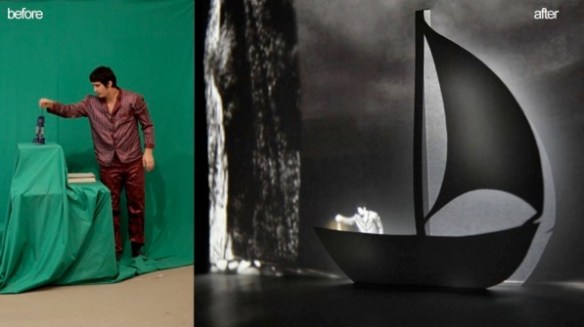
Icebook is their most famous piece to date and you can read about it’s making by clicking the image below:

boatbeforeafter-670x376They are about to open a new show called The Paper Architect which introduces live actors to the mix.  Here is an interesting article/interview written by Lyn Gardner in The Guardian this week:

Pulp fiction: bringing pop-up paper theatre to life

Magical and exquisitely crafted, Kristin and Davy McGuire’s miniature model universe is full of visual wonders

The 'Paper Architect' theatrical project by Davy and Kristin McGuire

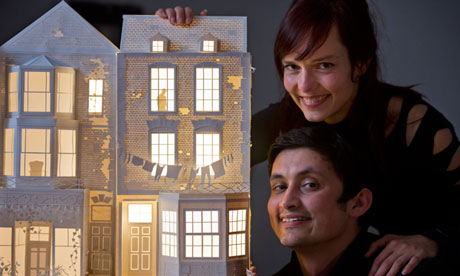
Davy McGuire grew up as an only child. He lived in his imagination, warding off loneliness by building tiny houses for tiny imaginary people. Several decades on, he is still at it – but now he makes them with his wife, Kristin. Together, the McGuires construct worlds made entirely out of paper, which are then given life with the aid of projections, optical illusions and the intervention of actors.

“We never set out to work with paper,” says Kristin. “It just grew out of curiosity. We weren’t model-makers. I didn’t even know how to cut paper. We’ve just had to acquire the skills as we’ve gone along.”

The McGuires…..are just two of a modest but intriguing wave of artists exploring the creative possibilities of paper. They include Paper Cinema, who create exquisite DIY films from cornflake-packet cutouts and an overhead projector, and the visual artist Yuken Teruya, whose take on paper carrier bags can currently be seen in an exhibition called – what else? – Paper at London’s Saatchi Gallery.

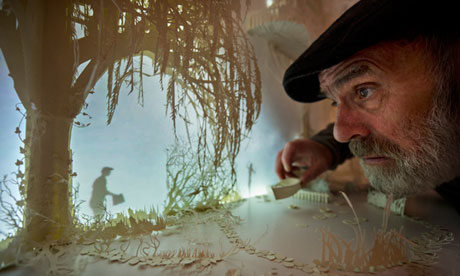
Actor John Cording of the 'Paper Architect' theatrical project by Davy and Kristin McGuire

Walk into the McGuires’ studio in Bristol, where they work in the company of their dog – called Cat, but of course – and you enter a world that feels like a last outpost of a 19th-century realm of illusion and magic. Illuminated paper butterflies dance in jam jars, a row of intricately detailed Edwardian houses complete with iron railings and washing lines recall a doll’s house, and a rural scene featuring pools and weeping trees sits waiting to come alive. All of it is made, by hand, entirely from paper. An exquisite birdcage smaller than my little finger represents hours of painstaking work for the couple, who met at college in the Netherlands, where Kristin, who trained as a dancer, cast Dartington College graduate Davy in one of her pieces.

“I kept asking her: now we have developed a professional relationship, can we have a private one too?” he smiles.

Both were interested in exploring the boundaries of performance (Kristin is a former national rhythmic gymnast), but neither imagined their lives would become so intricately bound up with wood pulp. One day in 2009, Kristin shone a light behind a pop-up book, and they began speculating whether it would be possible to turn a book into a theatre show. Even the Maguires aren’t entirely sure quite how they should describe what they do, which embraces installation, dioramas, music videos, animation and performance.

“Maybe you wouldn’t describe a lot of what we do as theatre, but it’s always got strong theatrical elements,” says Kristin. Their first pop-up theatre venture, The Icebook, was certainly different – a delicate fairytale that mixed paper and animation to such cunning effect that the experience was like falling headfirst into a pop-up story from childhood. The whole thing was so fragile, it felt like a dream.

The McGuires saw The Icebook as a miniature calling card, and were surprised when it became an international hit. “We thought of it as a try-out for a bigger show,” says Davy, “but people enjoyed its intimacy.” Kristin agrees: “When you start playing with scale, it makes people look in a new way. Their focus is different. They start seeing the detail and all the small moments in the story. In a digital world, there is something appealing about something which is hand-crafted. With CGI, you can just conjure up something so quickly and easily, but when it’s made by hand you can see beauty in the tiny imperfections.”

Davy nods. “People always ask how it’s done, but we don’t want to tell them. It’s not just for commercial reasons, but because we want to keep the element of magic and surprise.”

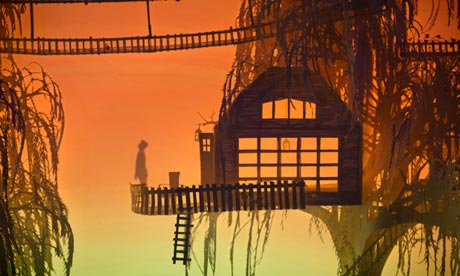
The 'Paper Architect' theatrical project by Davy and Kristin McGuire

Nonetheless, despite the success of The Icebook, last Christmas the McGuires expanded their scale to create a stage version of Diana Wynne Jones’s children’s novel Howl’s Moving Castle at Southwark Playhouse. Undaunted by the worldwide success of Hayao Miyazaki’s 2004 animated film version, the McGuires set out to create their own take on the story of a young milliner called Sophie who must try to escape the curse put on her by a witch.

“It was a good experience, but a stressful one,” recalls Kristin of the show, which combined pre-recorded narration by Stephen Fry, live actors and a pop-up castle upon which was projected hundreds of images. The castle was acclaimed as a thing of visual wonder, but juggling all the different aspects of the production was a steep learning curve, and one that the McGuires were not keen to repeat too quickly.

As a result, The Paper Architect, supported by £37,000 from the prestigious Oxford Samuel Beckett Theatre Trust award, which aims to support theatremakers working in unusual and innovative ways, combines live action with animation. Once again it employs a tiny scale, this time to tell the story of a lonely elderly man who is about to be evicted from his studio, and who is wondering how life might have turned out differently – a melancholic piece that, the McGuires hope, combines reality and imagination in powerful ways.

“Perhaps that man could have been me,” says Davy, “if the lonely child had grown into a lonely old man. I know that character.” For all sorts of reasons, we should be glad he didn’t.

Cultural Revolutions

One of things I enjoy most about writing this blog is that I am always learning. So today I’m going to share something totally new to me, Ache Lhamo, Tibetan Folk Opera.

529331_459683667440271_548838428_n_Fotor

Lhamo, meaning sister goddess, is a traditional Tibetan folk opera performed through a unique combination of dialogue, dance, chants, pantomime and songs. Based on Buddhist teachings and Tibetan historical figures, Ache Lhamo are traditionally stories of love, devotion, good and evil.

Lhamo has it’s roots in the masked dance-drama tradition of the Tibetan royal dynasty in the 6th to 9th centuries, but the development of Lhamo as it is known today is attributed to the 14th century teacher and self-made engineer, Thangtong Gyalpo. Thangtong Gyalpo developed a performance medium that told moral tales, based on Buddhist philosophy, in the words of the common people

.

Lhamo is a day long performance played outdoors traditionally under a large circular canvas tent. Music is simple, however the cymbals and drum create remarkable atmosphere. Costumes generally imitate those of the Tibetan aristocracy, and some characters wear masks, which portray their personality with bold symbols.

Lhamo Masks

However, and not surprisingly, Lhamo now has a more political context. The role of China in Tibet over the last 60 years remains one of the biggest human rights tragedies. The suppression or tight control of most of the cultural and religious practices of indigenous Tibetans is well-known. Lhamo only exists in traditional form outside of Tibet where it has been kept alive by exiles.  The most famous centre is in Dharamsala, India, and is known as the Tibetan Institute of Performing Arts (TIPA).  TIPA was established in August 1959, four months after the Dali Lama fled Tibet. You can watch one of their performances here:

.

There is a facsinating blog post, The Wandering Goddess, Sustaining the spirit of Ache Lhamo in the Exile Tibetan capital written by Jamyang Norbu, that tells story of the revival of Lhamo following the Chinese occupation. It is clear from all I have read that the practice of Lhamo by the Tibetan refugee community across the world evokes nostalgia for a lost existence and the struggle for a return to the Tibetan Buddhist homeland.

Meanwhile in Tibet itself it has been ‘redeveloped’ by China following the Cultural Revolution and used to support Chinese claims to Tibet. If you want to read more you can do here, in a rather scholarly paper entitled Tibetan Folk Opera: Lhamo in Contemporary Cultural Politics by Syed Jamil Ahmed.

I said earlier, the music that accompanies Lhamo is traditionally played on a drum and cymbols alone – take a look at this dude:

.

Norbu Tsering, was the TIPA opera master and drummer until he sadly passed away earlier this year. Another link with past traditions lost.

Burying Brecht?

I recently came across a great way of sharing audio streams,  soundcloud.com. A lot of theatres and practitioners are using it as a way of sharing panel discussions. I have set up a sister site to this one so I can add to the diversity of what I post here. I won’t always duplicate posts or what I subscribe to on soundcloud so check it out occasionally to see what I have re-posted. You can find Theatre Room Asia on soundcloud here.

I am going to share a great one today, which is a panel discussion of German and English theatre practitioners on the relevance of Bertolt Brecht and Brechtian theatre in the modern theatrical landscape.

brecht

To coincide with our production of A Life of Galileo, and in collaboration with the Goethe Institute in London, the Royal Shakespeare Company (RSC) hosted a ‘Brecht Meeting’ of British and German theatre makers in March 2013.
Chaired by Mark Ravenhill (RSC playwright in residence and writer of our new English version of A Life of Galileo), we explored the relevance (if any) that Brecht has for us as contemporary theatre makers.

Has Brecht now become a familiar ‘classic’, who can be produced in the same way that we might play Shakespeare or Schiller?

Does he still present challenges that allow us to ask important questions in the making of new theatre?

Should we bury his work and move on as though he never happened?

.

And if would like to, you hear an interview with the director of A Life of Galileo, Roxana Silbert, with journalist Paul Allen.

.

Global Reconstruction

Now for those of you have been reading my blog for a long time will know that I am no big fan of Shakespeare in the context of teaching in an international environment. I don’t see a lot of point trying to teach theatre practice through an arcane language that obfuscates its meaning at every turn – see what I mean?

However, I do like Shakespeare’s plays and have seen some incredibly powerful performances in my time. Also the history and myth behind the man is really interesting. One of the most enjoyable experiences I have had is being stood in the pit, in the open air, watching a production of Measure for Measure at The Globe Theatre in London a few years ago. If you don’t know anything about The Globe, it is a reconstruction of an Elizabethan playhouse on the south bank of the River Thames, London, that was originally built in 1599.

globe_theatre.

.

.

.

.

.

.

.

It is well worth a visit if you are ever in London. So why am I writing about it today? Well The  Globe is in the process of finishing the building of another theatre on its site, but this time a reconstruction of a Jacobean playhouse (which has a roof this time) and will be lit by candles. The new theatre opens next year and will be known as the Sam Wanamaker Playhouse, named after the american actor and director who is credited as the person most responsible for the modern recreation of The Globe.

This is a rendering of what it will look like when it is finished:

CGI+of+interior+of+the+Sam+Wanamaker+Playhouse+from+the+Upper+Gallery.+Design+by+Allies+++Morrison.I am fascinated by this theatrical archaeology. The Globe have produced a series of videos about the building of this new theatre and how you go about it. This is the first here:

There was a great article in The Independent last week, written by Holly Williams that traces this fantastic project

All the world’s a stage (or two): Shakespeare’s Globe to be joined by a candlelit indoor theatre

‘Oh, for a muse of fire that would ascend, the brightest heaven of invention…” So begins William Shakespeare’s Henry V; but it was a wish that would come back to haunt the playwright with unfortunate literalism a few years (and Henrys) down the line.

Four hundred years ago this week, on 29 June, during a performance of Henry VIII at the Globe theatre on Bankside, wadding from a stage canon did indeed ascend up through the theatre’s ‘wooden O’ – setting fire to that circular thatched roof. The Globe burnt to the ground; a contemporary account records that the blaze “burned so furiously, as it consumed the whole house, all in less than two hours, the people having enough to do to save themselves”. Not that the Jacobeans were too precious about it: the Globe was rapidly rebuilt – only this time, with a tiled roof. It lasted till 1644, when it was demolished after the Puritans closed England’s theatres.

Its 17th-century resurrection was certainly swifter than the modern project to rebuild Shakespeare’s Globe on the banks of the Thames. American actor Sam Wanamaker conceived of the idea way back in 1949, and founded the Shakespeare Globe Trust in 1970, but it didn’t actually open its doors to the public till 1997 – after Wanamaker’s death. Even then, it couldn’t be said to be wholly complete.

For Wanamaker’s vision was always that both of Shakespeare’s theatres should be brought back to life – an outdoor playhouse and an indoor theatre, too. It is, to some degree, a testament to the huge popular success of his plan that the public concept now of what Shakespeare’s theatre was like, is the Globe: almost circular, open-air, highly decorated, with a standing pit for rowdy groundlings.

But that’s only half the story. Each year from 1609 onwards, the company Shakespeare acted in, and wrote for, The King’s Men, played indoors at the Blackfriars theatre across the river during the winter. His plays, being year-round popular, would have to work indoors and outdoors, but it is thought The Winter’s Tale and The Tempest were written, initially and ideally, for an indoor venue.

Globe 2

So when Shakespeare’s Globe was being rebuilt in the Nineties, they also threw up a brick structure next door that could, at a later date, when more funds were raised (the Globe does not receive subsidy), be fitted with an indoor Jacobean theatre. This is currently, finally, being realised; christened the Sam Wanamaker Playhouse, its first season opens January 2014.

The structure is based on drawings which were found in the 1960s; falling out of a book in Worcester College Oxford, they showed detailed plans of a Jacobean theatre space. It felt like a gift – but has, in fact, complicated matters somewhat… The drawings were thought to hail from the early 17th century, but at an architectural symposium held at the Globe in 2005, an art historian who had studied the documents dropped a bombshell: drawn by John Webb, they dated from 1660, and were therefore certainly not ‘Shakespearean’ (he shuffled off this mortal coil in 1616).

These plans were radically different to Blackfriars anyway, which we know was itself a conversion of an old medieval hall. Should they try to recreate that instead? But the outdoor brick shell was already in place – it will provide modern entrances and access to a traditional timber-framed structure built actually inside it – and this existing footprint followed the size and spec of the Webb drawings.

So it was decided that they should stick with plan A: it would not be, like the Globe, an as-close-as-possible best guess at an actual named playhouse, but instead a “Jacobean archetype”, a theatre that Shakespeare and his contemporaries would, at least, have felt at home within. And it should recreate the conditions and atmosphere of playgoing in the early 17th century. The wooden space is intimate, will be rather magically lit by candles, and promises very different acoustics to the open-air Globe.

“We wouldn’t have done this if it wasn’t historically viable or feasible,” insists Dr Farah Karim-Cooper, head of the Globe’s Architecture Research Group. “We also did a lot of research into the acoustics and visual effects of Shakespeare’s Blackfriars playhouse – I keep describing it as haunting the project. So we’ve taken elements of that space, and we’ve used the [1660] drawings as a spatial map.”

globe 1

Which was handy for Peter McCurdy, the man who built the Globe and who is now the master craftsman for the Sam Wanamaker Playhouse (SWP). While the building may have been a dream for decades, once they got the green light, funding-wise, it’s all happened astonishingly quickly; McCurdy began building in his workshop last September, and moved on site in April. I was given an early look in at the start of this month, and while scaffolding was still being pivoted above our heads, you already get a good sense of the space – a 320-seater, with two levels of galleries curving round three sides of the stage and a small pit for seats in front.

It feels very intimate; the stage is about a quarter of the size of the Globe’s, and some seating is right up flush to it. In Shakespeare’s day, some of the Blackfriars audience even sat on stage, on stools – it was very much a ‘see and be seen’ place, with tickets much more expensive than the Globe’s. The Shakespeare author and professor at Columbia University, James Shapiro, quips “if you wanted to impress somebody, you’d take them to Blackfriars, like date night, throwing round the money; if you were looking to pick someone up, you’d go to the Globe…”. Even the cheapest tickets at the SWP will be twice the price of those at Shakespeare’s Globe (£10 instead of £5).

McCurdy, an expert in historical reconstruction and traditional building methods, oversees everything from what type of wood is used (oak for the main structure; Scots pine for the seating and stage) to researching the correct shapes for the pillars and the amount of decorative painting – which is still being debated.

“It’s a lot of detective work. You have to find historic precedent and models; without that you’re just inventing history,” says McCurdy, who spends much time researching still-standing Jacobean buildings, as well as drawings and contemporary accounts.

“It is almost experimental archeology: one is learning the process,” explains McCurdy. “One has got to be careful it doesn’t become a pastiche. It doesn’t want to look like you’ve cherry-picked [Jacobean features]; it’s trying to subtly bring them together so they have both harmony and integrity.” All of the wood is hand-finished to give as historically accurate a look and feel as possible, although modern-day power-tools are used in the construction process for speed and affordability. Even so, the project has cost £7.5m.

Globe 3

The question of historical authenticity is one that previously plagued the whole Globe project. In the Seventies, Wanamaker’s vision of rebuilding the first 1599 Globe was widely derided: “the concept of reconstructing the theatre seemed quite ridiculous to a lot of people in those days, and even in the 1990s there were a lot of naysayers, people who thought it was going to be destructive to Shakespeare and the history of theatre, rather than instructive – which is what it’s turned out to be,” says Karim-Cooper. The fear was of a “Disneyfication of Shakespeare, historicising him to such an extent that he no longer has that cultural relevance that we worship now”.

Some scholars and commentators sniffily pointed out it was impossible to recreate the experience of Elizabethan theatre – there were just too many practical unknowns, and we, as audiences, are different anyway – and that to try was to ensure modern productions became mere “museum theatre”. Heavens – the whole thing was even proposed by an American.

When Shakespeare’s Globe finally opened, under the artistic direction of Mark Rylance, it became not just a laboratory for investigating historical stage practices (Rylance has called it “the most experimental theatre space in England”), but a huge popular success. However, there were initially still many disgruntled voices: academics for whom it wasn’t accurate enough, and directors, designers and actors for whom it was too accurate. Many felt there was no room for their artistic vision in the elaborate design of the building, or felt exposed by the proximity of the standing audience, the daylight and the British weather.

Then there were critics who were snobbish about tourist audiences who laughed at the wrong places. Anyone who has seen a show at the Globe will recognise the effect the open-air space has, re-invigorating interaction between audience and actors. Rylance has suggested that unexpected comedy was “truly revealed in Shakespeare’s writing by the reconstruction”, but critics have not always agreed. Productions were accused of being pantomimic, or likened to football matches.

But today, the Globe is an established part of the theatrical landscape of Britain, and under the more recent directorship of Dominic Dromgoole, has also been home to new writing and international companies, as seen last year during the Cultural Olympiad. It’s still not to everyone’s tastes, but many scholars have found performance experiments there into Original Practices (all-male casts; traditional costume and music) illuminating, while many actors and audiences have found the immediacy of the space throws up new insights into Shakespeare (and other writers), be that unexpected laughter or moments of poignancy.

The cries of Disneyland and museum theatre have abated, then, and the new SWP has, so far, met with little resistance. “I haven’t received any hate mail yet!” jokes Karim-Cooper, before adding that they are still careful to keep “very clear of the word ‘authenticity’ – that word was applied to us, really. As an academic, authenticity is unachievable. [But] I think, overall, reception should be fairly calm, and positive.”

So what is so exciting about this new, old theatre – and will the SWP shed a different light on plays and the playgoing experience than the reconstructed Globe? McCurdy thinks so. “It’s a real contrast to the Globe, even without considering daylight versus candlelight. Although the structure has similarities at the moment, by the time we’ve got the finishes, the lime plaster, the panelling and carving, I think it will be very, very different.”

What effect it will have on performances remains to be seen; much as the construction is a process of discovery-through-doing, so practitioners, playing with plays in a new playhouse, may be surprised by what emerges. But there are a few features that are notable: the intimacy, the candlelight, the actors holding torches onstage, plus much more subtle acoustics, and therefore greater impact from music.

Would Shakespeare have written differently for these conditions? Shapiro thinks so. “Shakespeare had to write indoor-outdoor plays, playable in both. But [moving indoors] absolutely changed the kinds of plays he was writing; they had to take advantage of the music and atmospherics.” He adds that having this space today is “very important”, too, in helping us understand the Jacobean era. “When I started teaching I never really thought of the Blackfriars – now when I teach I’m hyper-conscious of playing space. And Jacobean is not Elizabethan; that’s the main thing for me about the indoor theatre, it’s going to remind us that it was quite a different set of concerns and cultural preoccupations in the early 17th century.”

Karim-Cooper agrees. “When you bed [texts] into the particular space they were written for, things are unlocked. If you take The Winter’s Tale, where Hermione’s statue comes to life; in candlelight, it can be quite a spectacle, the way Shakespeare draws attention in that scene to looking and seeing… it’s an incredibly intimate moment, and the indoor theatre brought you that much closer.”

Sadly, you won’t get to see that magical transformation in the SWP’s opening season in January. It’s ambitious in its programming: there’s a co-production with The Royal Opera of Cavalli’s L’Ormindo, and a new company of talented teenage actors – mimicking the Jacobean craze for ‘boy players’ performing satirical adult dramas – will stage John Marston’s The Malcontent. But there is, oddly, no Shakespeare; in a bizarre programming move, Dromgoole begins with John Webster’s Duchess of Malfi and shuns Will entirely. Very strange – although he’s promised that “in time we will perform the plays of Shakespeare in there”. Whether or not the company will transfer summer Globe hits into winter SWP shows, as The King’s Men would have seasonally re-housed their repertory, is not yet clear.

Either way, the company at the Globe, like Shakespeare’s own, now has two houses to play with. Asked what impact such reconstructed – or archetypal – theatres have, Shapiro is an enthusiastic advocate: “they do amazing things towards making you feel the immediacy and excitement of these plays when they were first staged. You learn that these plays have legs; even if you miss 10 or 20 per cent of the language, the plays carry the audience. It’s quite extraordinary that these difficult plays, written 400 years ago, still work – and Shakespeare’s best of all.”

Practical Explorations

Well, I’m now on vacation. I have spent the last week packing up my department. When we return in August we are moving into brand spanking new facilitates, state of the art teaching and performance studios, and we are all very excited. So many possibilities. Amongst all this I watched a truly inspired performance of Artaud’s Spurt of Blood by our Theatre Arts students, more of which I will share in another post. What a week!

But enough of all that.  What I want to share today is another blog Chasing The Trickster. It is written by Ashley Scott-Layton, who is an English writer-director and it charts his travels across Europe to discover more about European theatre practice (and how it differs to that of his homeland). In his own words, the blog will track my forays into the rehearsal rooms of Europe, where I hope to learn more about the exciting theatre cultures of each country.

basal

It is a fascinating read and you can drop in and out as you wish.

By the way, the name of his blog comes from European folklore where The Trickster is a shape shifting rogue known for disobeying normal rules and conventional behaviour.

Puppets For Peace

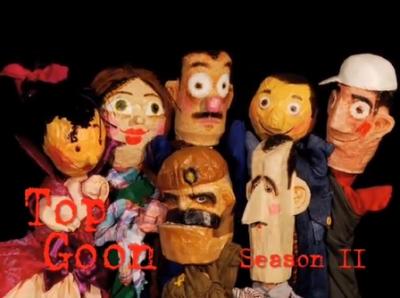
In another much more serious article, also from The Observer, David Betty writes about a group of puppeteers from Syria who are taking their work on tour in an attempt to bring about a peaceful end to the awful atrocities that are taking place there. If you click on the first image below, you can watch a short documentary made by Betty and Mona Mahmood, about the making of Top Goon: Diaries of a Little Dictator

Syrian satirists take puppet show into war-torn towns to mock Assad regime

Masasit Mati launched the online show Top Goon in 2011 to lampoon Assad. Now they’re taking it to the streets

For a group of anonymous Syrian artists who have mocked Bashar al-Assad and criticised the armed resistance, it is a bold move. Masasit Mati, creators of the YouTube finger-puppet show Top Goon: Diaries of a Little Dictator, have begun to perform the satirical series live inside the war-torn country in an attempt to bolster peaceful protest and spur the revolutionary art movement.

top_goon

The series, which will be shown in London next month as part of the Shubbak festival of Arab culture, caricatures Assad through the puppet Beeshu, the brutal, childish son of a dictator with a beaky nose and saucer-shaped ears. He is protected by his sinister and unquestioning henchman, The Goon, while ordinary Syrians are portrayed as brave and idealistic.

Speaking via Skype from Lebanon, the show’s director, Jameel, said they decided to use puppets to protect the identities of the 10 artists involved and because their small size “was a good way of lampooning the regime that presents itself as godlike”.

The episodes were filmed in Beirut, with the puppets and props smuggled out by the artists. “We disguised the puppets, especially the one of Beeshu,” said Jameel. “We gave him a moustache and extra hair. Otherwise, everyone would have recognised him.”

The first series, launched in autumn 2011, attracted more than 200,000 views on YouTube and was broadcast on the Dubai-based Syrian opposition channel Orient TV. But escalating violence and power blackouts shrank the domestic audience for the second and third series. So in January the group surreptitiously travelled into the rebel-held town of Manbij in the northern region of Aleppo to perform live in an arts festival organised by local activists. The town had enjoyed relative calm for a month, with no attacks or kidnappings, but on the day they arrived it was bombed by Assad’s forces, leaving 12 dead and dozens more wounded.

“We were very shocked and the organisers of the festival thought it should be delayed,” said Jameel. “We felt we couldn’t wait another week, but we didn’t want to gather people indoors in case there was another air strike. So we performed some of the episodes in the street during a protest [about the bombings].”

Syrian Art - VideoTop Goon draws on Assad’s speeches and biased state TV coverage of the uprising to highlight and subvert the regime’s propaganda.

In the episode Prostitute Media, a protester is forced to confess to being a violent criminal on an official news programme, saying: “I held an olive branch in my hand … I mean I was holding an RPG [rocket-propelled grenade], a nuclear bomb, pistols, rifles I got from al-Qaida.”

The series has also been critical of the armed resistance. In the episode Monster, Beeshu tortures a protester and taunts him to take his revenge. The prisoner attacks and strangles the dictator, who then gloats: “I told you, you’re a monster, just like me.”

.

Jameel said the live performance was “also about testing out the boundaries of the new regime in the liberated areas”. He added: “It’s one of the regions suffering now from the temptations of the Islamists and sectarianism. We were apprehensive about how they would react to one actress – hearing the voice of a lady who was making fun of a famous singer with this kind of sexy voice. But we felt very welcomed and respected.”

The group is preparing for live performances in Aleppo and the northern regions, which it hopes will support local artists. Arts committees and newspapers have been set up in rebel areas, but some have been shut down by hardline elements of the Free Syrian Army.

“There’s a whole civil society that’s being ignored by activists and the estern and Arab media, ” said Jameel. “We’re trying to come up with a concept of street theatre where we’ll go to an area, put on a show, then teach the people how to make puppets and put on shows. What keeps people alive is bringing them hope.”

If you want to read more you can here in The Washington Post, or here in Global Post and there is a fantastic documentary here: Little Dictator – Witness – Al Jazeera English.