Alternative Experiences

Today I would like to share two new excellent video documentaries from the American Theatre Wing. The first is about the creation of site-specific theatre. Since I Suppose is a site-specific theatrical experience based on Shakespeare’s Measure for Measure which allows the audience to travel on an immersive journey through downtown Chicago.

The video follows members of the Melbourne-based theatrical group, one step at a time like this and Chicago Shakespeare Theater who share a behind the scenes look at how the experience was created using digital technology and the architecture and culture of Chicago.

.

The second explores another visceral theatre experience but this time of the immersive kind. In the documentary Randy Weiner (Producer, Sleep No More), David Korins (Scenic Designer, Here Lies Love) and Zach Morris (Co-Artistic Director of Third Rail Projects) describe the ‘staging environment, the state of heightened theatricality, and the effect of the immersive movement on the audience and its influence on today’s theatre scene.’

.I

If you are a first year IB Theatre Arts student reading this, both of these videos would be superb for your Collaborative Project.

Too Much Of A Good Thing?

Leaving Planet Earth 015If you read Theatre Room regularly, you will know that I have written on a number of occasions about the ever-growing popularity of Immersive theatre, especially in Europe. You also know that I am drawn to this form, especially as a way as bringing new audiences to the theatre and challenging theatre students take risks in their exploration of the possibilities in performance. All things ‘immersive’ are clearly drawing audiences and there is lots of ‘jumping on bandwagons’ at the moment.  It was with some interest then that I read Lyn Gardner’s Theatre Blog in The Guardian this week.  London-centric, by its nature, but certainly making a point that is worth considering wherever you are:

Immersive theatre: living up to its name, or just an overused gimmick?

Immersive theatre has become ubiquitous, but too often such billing is just a commercial come-on designed to sell tickets

My, there is an awful lot of immersive theatre around at the moment, particularly if you live within reach of London. You can watch Titus Andronicus performed in a car park in Peckham, visit Dorian Gray’s townhouse in Greenwich, pretend you are a spy in CoLab’s London-wide, digitally-augmented Fifth Column or – if you’ve £200 to spare – spend the night in a London hotel and watch the immersive play Backstage Tour.

Some of these shows deserve the tag. But I’m beginning to think that immersive has become one of the most overused terms in British theatre, in similar vein to that other much misused term, site-specific (or site-responsive), which is likewise often bandied about with little or no justification. Standing around watching a show in a room that appears to have been designed by an Oxford Street store window dresser doesn’t magically make the audience experience something immersive, no matter how many stuffed animals you incorporate into the set.

It you want an enjoyably sly swipe at the immersive phenomenon, take a look on the excellent Exeunt site, where Natasha Tripney has cleverly reframed her East Coast trains journey back from the fringe as immersive theatre.

The rise of immersive theatre undoubtedly reflects an interest from audiences – often audiences who may not think that traditional drama in traditional theatre playhouses is for them – in experiencing theatre in a different way, one that allows them to be part of the story and feel as if they have dropped down a rabbit hole into another world like Alice. In some instances where the audience can genuinely roam where they want, the experience is more akin to gaming than traditional theatre.

Some companies – ConeyLundahl and Seitl, Punchdrunk, Ontroerend Goed and Look Left Look Right among them – have perfected the art, finding ways that make sense of why the audience is present at all and allowing them to play their part. Such companies don’t mistake mere intimacy (lovely though it can be) for immersion, and in some instances give us genuine agency.

But I keep on seeing shows that claim to be immersive, and turn out to be anything but. Performing a show in a car park (Titus) while Southern trains constantly thunder by, so that Rome appears to be situated at a railway junction, or making audiences run away from zombies in an underground space in Edinburgh (Generation of Z on the Fringe), doesn’t make it immersive, it just makes it a show in an unusual – and not necessarily suitable – location. That’s fine. But short-changed audiences will quickly learn that immersive shows often don’t deliver on what they promise, and they will stay away.

Strong and portentous words from the venerable Gardner, and she is rarely wrong, in my opinion. Her reference to The East Coast Trains Show written by a fellow critic Natasha Tripney, and published in Exeunt is definitely worth a read (and a wry smile). Beautifully tongue-in-cheek, but harbouring similar grievances expressed by Gardner and a sense that she too has experienced one too many pieces of immersive theatre that simply are not.

Over Our Heads

salomeA blog post by theatre critic Lyn Gardner brought me to a realisation this week.  Virtually every theatre-going experience I have in Hong Kong is dominated, literally, by surtitles – either in English, Cantonese or sometimes both. I have often wondered how the complexity of a play in one language translates into another for a live audience. Are my Cantonese speaking compatriots having an easier time understanding the nuances of King Lear than I am? I know for sure that my students read the Cantonese surtitles when the spoken language of a play is impenetrable to them or the dialect or accent is too strong. In her post, Mind your language: the trouble with theatre subtitles, Gardner notes that great translations make foreign productions accessible, that poor ones are a distraction and asks whether surtitles always a necessity in communicating meaning to an audience:

One of the pleasures of London theatre-going over the past 20 years has been just how many foreign-language productions it has been possible to see. Shakespeare performed in another tongue has been a particular revelation as the Globe’s 2012 Globe to Globe season amply demonstrated, although what made that – and it’s ongoing spin-offs – so pleasurable was the chance to see Shakespeare amid an audience whose native tongue was the language in which the play was being performed. If you want evidence that London is truly an international city, this is it.

HEDDA GABLER, director Thomas Ostermeier

HEDDA GABLER, director Thomas Ostermeier

But there have been plenty of other opportunities to see oh-so-familiar classic plays in other languages, particularly at the Barbican, where Thomas Ostermeier has made us rethink Hedda and A Doll’s House and Hamlet, and will shortly be pitching up with An Enemy of the People. The London international festival of theatre has also done more than its bit to bring the world to London. In many of these cases it is the arrival of surtitles that have really made foreign-language productions accessible to those of us who do not speak or understand enough to get by. Without them I suspect many such shows wouldn’t get an English-speaking audience.

I remember a time when if you went to see a play in another language the best you could hope for was headphones and intrusive simultaneous translation or a free sheet detailing the action in each scene.

Good surtitles are a real art. One issue with surtitles is positioning. Poorly sited surtitles are like trying to hold a conversation in a room where a TV is on. However much you try not to look at them, your eye is constantly drawn towards them, even if you speak the language. You end up relying on the text rather than looking for other clues, which in a great production of a play in any language are demonstrated in a myriad of ways from the positioning and space between the characters to the timbre and tone of what is being said. It’s possible to understand a great deal about a production from its look and sound, even if you don’t speak a word of the language in which it’s being performed. Too much reliance on surtitles turns audiences into dummies, a bit like those tourists you see at Stratford who follow the entire production with their nose buried in the text on their lap as if it’s only the text that matters and looking at the stage is not necessary.

Rakata perform Punishment Without Revenge by Lope de Vega at Shakespeare's Globe

Rakata perform Punishment Without Revenge by Lope de Vega at Shakespeare’s Globe

Poor surtitles can be a hindrance rather than a help, as I found at the Globe last week with a Spanish-language production of Punishment Without Revenge. In this instance they were simply describing the action and not particularly well: it’s enormously frustrating and sometimes bewildering to be told that someone is speaking in metaphor or telling a joke and not to be told what the joke is. I reckon that in this instance no surtitles – and a simple synopsis sheet – would be far better than surtitles that distract the eye from what is happening on stage and are way too blunt to add any value to the viewer. What do you think? And if you’ve ever seen any real surtitle howlers do share.

I have considerable sympathy with Gardner.  I have, on occasion, found myself at the front of the stalls, unable to read the surtitles (which are almost directly above me) and watch the stage action without needing a visit to the physio the following morning.  In some of our smaller and older theatres the surtitles are shown to the side of the proscenium and you end up looking like a spectator at a tennis match. I’ve also experienced the earphone and recorded translation version elsewhere in Asia when watching theatre – once I had to leave a Bunraku performance in Osaka after about an hour because of my ever-growing irritation with the mono-tonal drawl of the voice in my (one) ear.

UntitledThe comments section that follows Gardner’s blog continues the debate as does this post from BTI Studios, which talks about the difficulties of ‘captioning’ in the theatre. One theatre in Germany, the Komische Oper in Berlin, has the surtitles shown on the back of seat in front of you, as does La Scala in Milan (both opera venues you’ll notice). This is clearly a move in the right direction in terms of being able to view surtitles clearly, but of course, does nothing to address the translation issues or how they are used by a venue (as in the example given by Gardener at The Globe Theatre). It seems that any large city with cultural aspirations now stages an international theatre festival, so watching performance in a language other than your own is no longer an unusual or unique experience. Given this, I think it’s about time venues in particular, but theatre makers more widely, become a little more adept at making captioning work for the audience, both technically and artistically.

By way of a post script, and not unconnected, the Royal Shakespeare Company in the UK have just announced that they are going to translate all of Shakespeare’s plays into Mandarin, as well as translating 14 seminal Chinese plays into English (although these have yet to be named). Quieting the cynic in me and over-looking the PR puffery about boosting business and cultural links between Britain and China, this could mean some exciting Chinese work being available in translation for the first time.

A Devine Wright?

abridged-shakespeareAs much of the world begins a new academic year, so does Theatre Room. I am going to pick up where I left off in August with a further two articles that were published as a result of comments made by Ira Glass about Shakespeare and his relevance to a contemporary audience.

The first one that particularly caught my attention was written by Noah Berlatsky for The Atlantic. In it,  Berlatsky talks about Shakespeare’s political conservatism and how this shaped his writing.


Ira Glass recently admitted that he is not all that into Shakespeare, explaining that Shakespeare’s plays are “not relatable [and are] unemotional.” This caused a certain amount of incredulity and horror—but The Washington Post’s Alyssa Rosenberg took the opportunity to point out that Shakespeare reverence can be deadening. “It does greater honor to Shakespeare to recognize that he was a man rather than a god. We keep him [Shakespeare] alive best by debating his work and the work that others do with it rather than by locking him away to dusty, honored and ultimately doomed posterity,” she argued.

Rosenberg has a point. A Shakespeare who is never questioned is a Shakespeare who’s irrelevant. And there are a lot of things to question in Shakespeare for a modern audience. One of those things, often overlooked in popular discussions of his work, is his politics.

Shakespeare was a conservative, in the sense that he supported early modern England’s status quo and established hierarchy, which meant defending the Crown’s view of divine monarchical right and opposing the radicals, often Puritan, who questioned it.

For all the complexity and nuance of Shakespeare’s plays, his political allegiances were clear. James I was his patron, and Macbeth in particular is thought to be a tribute to the King. It even includes a reference to the Gunpowder Plot assassination attempt at James. That reference is made by Lady Macbeth as part of her effort to convince her husband to murder Duncan. The villainous traitors in the play are thus directly linked to traitors against James.

Macbeth isn’t a one-off to flatter the King, either: Rebels and usurpers in Shakespeare’s plays are always the bad guys. When Hamlet spits out the lines:

Oh fie, fie, ’tis an unweeded Garden
That grows to Seed: Things rank, and gross in Nature
Possess it merely.

The vision of sickening wrongness there is in part repulsion at his mother marrying his uncle, but it’s also a political disgust at the fact that the rightful ruler is gone, replaced by a usurpur. What’s “rank and gross” is not just sexual impropriety, but perversion of divine order. The Tempest is about restoring the rightful Duke to his place in spite of his usurping brother, while Othello shows that Shakespeare’s sympathies are not just with kings, but with any authority figure, as the sneaking underling Iago attempts to overthrow his noble Captain. It is significant here, too, that (as many critics have pointed out) Iago has no real motive for his animosity. He does not articulate a critique, or even a complaint, about the way Othello exercises power. Instead, he simply says:

I hate the Moor
And it is thought abroad, that ‘twixt my sheets
He has done my office: I know not if’t be true;
But I, for mere suspicion in that kind,
Will do as if for surety.

Rebellion against one’s superiors is presented as a matter of misguided jealousy and intrinsic spite. Similarly, the Puritan Malvolio in Twelfth Night, who aspires to the hand of a woman above him in social standing, is a hypocrite and a fool. The Puritan political resistance, or the Puritan ideological opposition to hierarchical norms, is never voiced, much less endorsed.

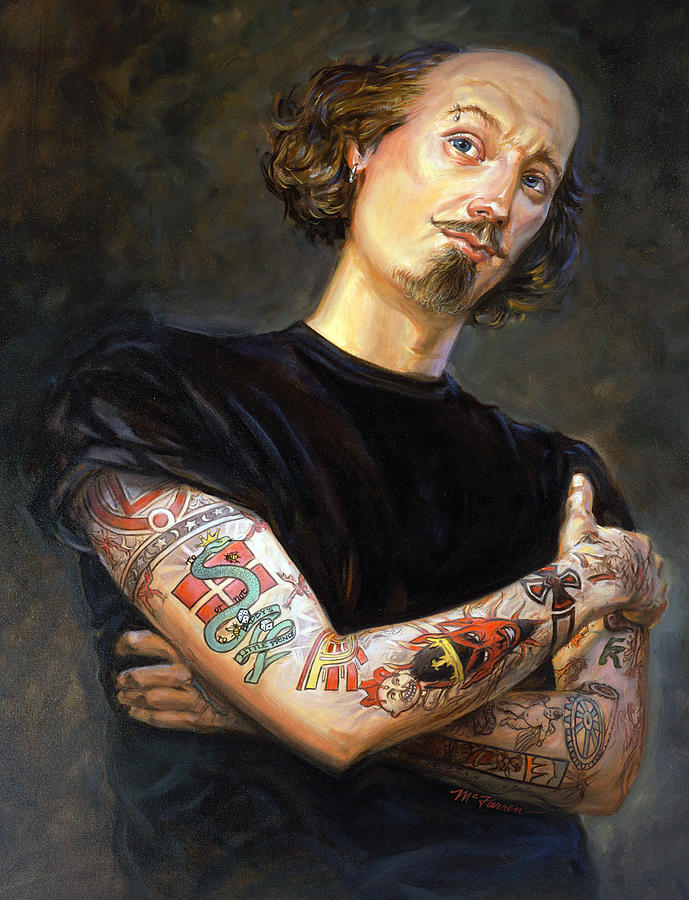
tattooed-shakespeare-mathew-mcfarren

In Shakespeare, those in authority rarely provoke resistance through injustice. In general, the one thing Shakespeare’s rulers can do wrong is to shirk their authority, trying to retire too early (King Lear) or consorting with those beneath them (Henry IV.) Often, their role is to come on at the end as a kind of hierarch ex machina, assuring all that “Some shall be pardon’d and some punished,” like the Prince at the end of Romeo and Juliet, or Prince Fortinbras at the end ofHamlet (“with sorrow I embrace my fortune”—yeah, we bet you’re sorry).

It’s sometimes said that Shakespeare always wrapped things up with a king on his throne and all right with the world as a reflection of a general belief among his contemporaries in the Great Chain of Being—a conception of the universe as divinely ordered hierarchy, each subordinate in his or her divinely ordered place. But there were many people in Shakespeare’s time who were mistrustful of kings and received authority—real-life versions of Malvolio, who Shakespeare pillories. Within his own context and within his own milieu, Shakespeare consistently championed the most powerful, and set himself against those who challenged their authority. He saw hierarchy as good and rebels as evil.

None of this is a good reason to dismiss Shakespeare. But it is a good basis for critical skepticism toward him. What would Twelfth Night look like from Malvolio’s perspective—or even from a perspective where it is not on its face ridiculous to imagine someone marrying across class? What real grievances might Iago or Macbeth have if it were possible for Shakespeare to show us an authority figure who isn’t a paragon? What happens to Julius Caesar if the rebels have some actual, genuine concerns about tyranny? As Rosenberg says, Shakespeare was a man, not a god—and as a man, he had a particular perspective, particular axes to grind, and particular blind spots. His plays aren’t entombed, authoritative holy writ; they’re living arguments, which means that, at least at times, they’re worth rebelling against.

The second comes from The Washington Post, written by Alyssa Rosenberg and explores the notion that the way a play is adapted/staged/interpreted will, of course, have a bearing on its relevancy to a modern audience: What we get wrong when we talk about Shakespeare.

Nothing To Be Sniffed At

aromaramaNow and again you come across something very different in the world of theatre and today I would like to share an article from the Clyde Fitch Report, by dramaturg and biological anthropologist Dillon Slagle.

In it,  Slagle interviews David Bernstein, who is a Scent Designer, an emerging field in theatre. Now this isn’t necessarily a new, 21st century thing. Indeed, American playwright and producer David Belasco toyed with the idea back in the early 1900s but it never really took hold.

Can You Smell That Smell? It’s Theatrical Scent Design

Theatre has begun to embrace a new type of designer. Their work is invisible, but, if done correctly, it can have a palpable impact on the performance. I interviewed David Bernstein about his work in the burgeoning field of scent design.

1_Fotor

Dillon Slagle: On a basic level, what is scent design?

David Bernstein: I split up scent design into two categories. One is an ambient smell or scent, which is scenting the theatre or the performance space as the audience is walking in. It’s part of the initial impression. It’s more like an installation, so it serves to transport the setting, or to make it “other.” The second is more like scent cues. Rather than scenting the space when you walk in, it’s the introduction of aromas to coincide with the action on stage.

You can read the rest of the Q & A here and another interview with Bernstein here. It’s an interesting concept, and I guess with immersive theatre all the rage at the moment, it will have a place. Me, I think I’ll just stick with smelling the grease paint.

Staging The Screen

An interesting little share today from Ideas Tap. As new technologies expand the possibilities of design in live theatre, whole new fields are opening up. In this interview by arts journalist Naima Khan with Kim Beveridge, digital artist, there is some interesting insight in to the role and the processes behind the art.

WALL OF DEATH: A WAY OF LIFE with National Theatre of Scotland

WALL OF DEATH: A WAY OF LIFE with National Theatre of Scotland

Kim Beveridge on video design

Kim Beveridge has created video for productions at the Royal Court and the National Theatre of Scotland. Kim talks to Naima Khan about avoiding clichés.

What challenges do video designers face when working on theatre shows?

One common problem you face is being asked to work on a production that doesn’t necessarily have the budget to realise what the director and the company want to do. Ambitious projects are more and more common now as you can easily run video off a laptop. There’s not a lot of troubleshooting you can do if, say, your video’s not bright enough. You can’t give it more lumens [measurement unit for light] and you’ll have to communicate that to people you’re working with.

Physical spacial challenges are also common when you put video into a space where actors need to be lit at the same time. You have to work closely with the lighting designer so you don’t bleach out what they’ve created. With the right budget you can get it right but it takes experience and experimentation.

Pests

Pests

Talk us through your working process for Pests

The work I make is very figurative so I like to start with something real and then manipulate it and edit it down to fit the show’s needs. One of the things I always ask is: what is the role that video is playing in this show? What is it here to do?

In Pests, it was clear video was there to illustrate one character’s psychotic hallucinations. The other thing we had to nail were the elements that the playwright Vivienne Franzmann had written about in her script. She’d included fire (that was really pared down by the final edit), blood, which she wanted coming through the walls, and also the presence of men. So I wanted to find images that were actually frightening not Hammer House of Horror-funny because when you start to work with blood it’s easy to go down that road.

We were keen that the images had a real textural quality because they were going to be projected onto mattresses. So I spent a lot of time filming ink and synthetic blood being bled onto fabrics like silk, and cotton. We put the camera underneath a stretched canvas of the material and just watched it move and bleed.

How can video designers and theatremakers use video or projections in a way that is relevant while steering clear of clichés?

When it comes to clichés, the fact that I’m working in collaboration means that it if I make a choice that’s obvious or boring, someone will tell me. But there’s nothing I wouldn’t try. It’s about experimenting. It’s about trying to make things lean, not having projection unnecessarily and only having it to support something that isn’t explicitly written in the text.

I’d also recommend trying to be involved in the collaboration from the earliest stage. Don’t be precious about rough edits, bring them into the space early on so you can show what you’re doing and see if it works before you spend hours on the animation. Be open about what you intend on doing, trust that the people you work with will have good imaginations and they’ll be able to use your rough sketch to come to an agreement about how to move forward.

How did you get your first job in theatre?

I studied Time Based Art at Duncan of Jordanstone College of Art so my background is doing video installation, sound and documentary. But I was always aware of spaces and I like projecting work in unconventional spaces. It was around 2005 that I left art school and the National Theatre of Scotland (NTS) started soon after. I was headhunted by them and hired to work on documenting the process in rehearsal rooms. What I learned was, if you do video and sound, your skills are really transferable and you don’t have to work in theatre design.

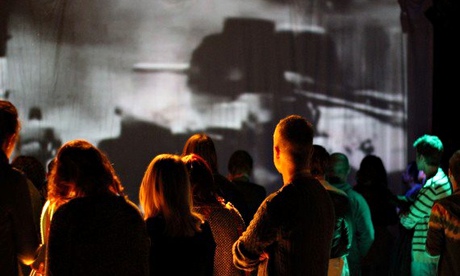
Pretty much immediately I started meeting loads of people who make shows and started working with them. It wasn’t long after that that Vicky Featherstone asked me to work on a large-scale production called Wall of Death, which was a documentary installation projected onto eight screens. Getting into theatre can happen quite quickly, it’s a lot about recommendations. I don’t have any business cards but if you get your name out there, things can start to happen.

Wall of Death

Wall of Death

How should video designers prepare themselves for work in the theatre industry?

There’s a book you should read called Staging the Screen: The Use of Film and Video in Theatre by Greg Giesekam. You’ll learn about the history of it and it’s surprising actually how long people have been doing this. If you really want to get into video design, just start experimenting. Find your strengths and see how they work with something live. Document people or performers interacting with your videos. Find a peer group that includes actors, maybe cabaret artists or even live musicians.

You could also go straight to people who are already working in theatre and ask them about work experience or courses. For example, there’s a great company called 59productions, which did some amazing stuff for the London Olympics, and one called Forkbeard Fantasy who do really cool experimental stuff, they also incorporate puppetry and animation. I don’t think you should worry about the industry too much. If you’ve got talent, and the guts to contact these people, they’ll help you through it. If they can, they probably will give you their time.

Still Streaming

89264It has been a few months since I have written about the discussions and debate surrounding the streaming of theatre, live and recorded, to cinemas, performance venues and across the web. In my last two posts on the matter, Something to Stream About and Something Else To Stream About I wrote about the experiences, arguments and concerns as they were being put forward. In the UK in the past few weeks the discussion has gathered pace again, with further written comment, the publication of a piece of research with regard to its impact on audience figures and continued experimentation with the form.

In a piece for The Guardian newspaper, Let’s stop pretending that theatre can’t be captured on screenthe highly regarded, veteran theatre critic Michael Billington wrote:

But while I remain an evangelist for live theatre, I think it’s time we stopped pretending that it offers an unreproducible event. A theatre performance can now be disseminated worldwide with astonishing fidelity. This represents…….a revolution which knocks on the head the old argument that theatre is an elitist medium aimed at the privileged few.

Following Billington’s piece, another theatre critic and editor, Andrew Haydon (who also runs the excellent blog Postcards From The Gods) wrote an article Coney’s no island: could streamed theatre let audiences call the shots? in which he talks generally about the continuing development of the form and in particular about a new show, Better Than Lifeby the company Coney, who describe themselves as:

Interactive theatre-makers….[who] weave together theatre and game design to create dynamic shows and experiences that can take place anywhere that people gather: in theatres, schools, museums, on the streets and online.

Haydon describes Better Than Life thus:

The live premise is simple: you arrive at the “secret location”, take part in a bit of audience participation and then meet Gavin, a man who has been granted the power to draw pictures of future events (a plot wittingly or unwittingly lifted from the wonky US science fiction TV show Heroes). The online premise is more complex: Coney’s stated aim is to experiment with how they might be able to let people interact with the performance even if they are not physically present. To this end, online viewers could choose which camera they watched from, interact in the site’s own chat facility and even control spotlights in the room itself.

BTL_webdesigns-17-1024x1024Now this is clearly a different beast to streaming theatre as it has been developing so far, but indicates the pace at which interactive technologies have the potential to shape the future development of theatre. Arts journalist Miriam Gillinson also wrote about her online experience watching Better Than Life, as opposed to Haydon’s ‘real-life’ viewing, in her blog post, ‘Better Than Life’ review or ‘Is there a triple click option?’. However, both seem to agree that whilst it was a form still very much in development, there was distinct and intriguing potential in the work and how it might point to the we ‘watch’ theatre in the future. To explore Coney’s work more, there is an excellent interview by Rohan Gunatillake with the company’s co-director, Annette Mees, for Native Magazine intriguingly titled Gorillas, beautiful tension & Better Than Life. In the interview, amongst other things, she explores the difference between their work and the more conventional broadcast streaming of theatre.

Coney's Early Days

Coney’s Early Days

As I said at the beginning of the post, one of the things that prompted me to revisit the streaming discussions was the publication of a survey in the UK that seems to show that the advent and growing audiences of streamed theatre is not, as some feared, having a negative effect on live audience attendance either in the capital or in the regions, as some feared. The survey was carried out by Nesta (a charity that funds innovation in the arts sciences and technology in the UK) and you can read their findings here. There is a condensed version of the findings here, courtesy of Whats On Stage

The National Theatre's Frankenstein, Jonny Lee Miller

The National Theatre’s Frankenstein, Jonny Lee Miller

Now obviously, these statistics are for the UK and they left me wondering how they would extrapolate out for international audiences of streamed and broadcast theatre. Since I last wrote about this subject and lamented the lack of broadcasts to Hong Kong, the National in the UK have at last found a cinema partner here.  Their initial foray – Frankenstein – was an immediate sellout (I was too slow) and since then, more and more broadcasts have been added with Coriolanus and The Audience begin shown multiple times in the next couple of months. They are immensely popular with Hong Kong audiences (I don’t mean just expats either) and I can see how they are creating an audience-in-waiting of theatre goers ready for their next trip to London. I could be cynical of course and comment that all of these productions have star actors with international reputations and are therefore an immediate box office draw. However, I won’t and I can’t – I am just delighted that I can now see what I consider to be some of best theatre in the world in the place I choose to call home.

I also want to a mention of another streamed event, that in a week that saw 500,000 people take to the streets of Hong Kong demanding universal suffrage, has significant resonance for me. On June 24th, The National Theatre of Scotland hosted The Great Yes, No, Don’t Know 5 Minute Theatre Show  which streamed for 24 hours, pieces of theatre lasting no longer than 5 minutes to and from around the globe.

greatyes_prod

Driven by the upcoming vote on Scottish independence from the UK, the idea was to create a democratic, dramatic response to the theme of ‘Independence’ – identity, borders, language, and national identity. You can watch some of the contributions again here. Quite rightly, many of them are from Scots making their own comment on what is to come on the 18th September, but there are also contributions from around the world. Theatre and democracy, hand in hand.

So as the experiments continue and the debates rumble on, I leave you with an article, Three Nationals, again from Native Magazine, this time by David Kettle, in which he talks to leaders in the three national theatres of the UK – The National, The National Theatre of Scotland and The National Theatre of Wales – about their digital visions. It leaves me in no doubt digital theatre broadcasting and streaming is hear to stay.

Truth and Lies

Today I want to share some thoughts about a new play in London that has been making headlines among the chattering TP3_Fotorclasses in the metropolis. Adler and Gibb is currently playing at The Royal Court Theatre. Written and directed by Tim Crouch, who is renowned for experimenting with and rejecting traditional theatrical conventions, it has created much debate, about both it’s form and meaning. As I have said before, I tend not to write here about specific plays in production, as there seems little value when most people who read Theatre Room are on the other side of the world.  However, Adler and Gibb has attracted so much attention I thought it merited some discussion. The first article I read about the show, Is this the real life? Is it just fantasy? by Holly Williams for The Independent is a good place to start to get a flavour of the piece. I followed this with an article by Crouch himself for The Guardian, The theatre of reality and avoiding the stage’s kiss of deathwhich begins with:

The old showbiz dictum of never working with children or animals is not because they’re uncontrollable. It’s because they’re too real. Not realistic, but real. And when you’re an actor giving your realistic all, there’s nothing more undermining than performing it next to something real. The set collapsing is real. Your fellow actor forgetting lines is real. I would suggest that full nudity tips the scale of real. Actual sex is right over there, as is actual violence. Even a kiss. In a production of King Lear I did for young audiences, when Edmund kissed Goneril the play momentarily came to a halt because the audience could only see the real.

And ends by noting:

In my play there are children as children and there are children as animals. There is an animal as an animal. There are objects pretending to be other objects, light pretending to be other light, a set pretending to be another set, an actor pretending to be another actor. And a kiss. A real kiss.

It was this argument that caught my attention.  Many times in my theatre journey I too have experienced the ‘real’ that Couch is talking about, which disconnects you from the ‘reality’ of the drama and connects you directly to the real world. I am convinced it is this that has shaped how I make theatre myself, trying to avoid the ‘theatrical reality’.  Crouch also notes that

There’s a danger when, as artists, we attempt to annex the real and put it in our work, thinking that by doing so, the experience we’ll give our audience will be more authentic, more honest, more deeply felt or perceived

231050_2_preview

In an interview given to Aesthetica, Crouch also says:

It is theatre’s loss not to think more rigorously about form. Visual art has moved beyond all recognition in the last 100 years. Theatre is still mired in notions of realism. There’s a great quote from the American scenic designer Robert Edmond Jones: “Realism is something we practice when we aren’t feeling very well. When we don’t feel up to making the extra effort.” The form of realism is about an attempt to capture reality – and it is this acquisitive aspect of realism that I am interested in exploring.

Not surprisingly, the critics have tended to fall into two camps – love and loath – with regard to Adler and Gibb. Matt Trueman, in his review, writes that

Crouch is, at some level, offering us an ode to theatre: it is dual status as fiction and reality, its honesty with semiology. At its baldest, art just gives us objects. Film, merely fiction. Theatre, the sweet spot in the middle, can hold both at once.

adler-and-gbb-playtextIn her blog, playwright Hannah Silva has written twice about the play, in attempt to answer questions she was left with – both in terms of form and message. Over all she says it is entertaining, strange, provocative, and a masterclass in theatre. She also shares a photo of a page in the programme/playbill (right) which indicates what will happen in the interval and that in itself gives you some idea of the unusual nature of the play. Below is a conversation with Crouch and one of his co-directors, Karl James, in which they talk about various aspects of the play. What has become clear to me as I have been trying to piece together a remote understanding of the play and why it has provoked the reaction that it clearly has, is that Adler and Gibb is one of those plays that keeps the watcher thinking and talking about it long after the viewing is over – a quick Google trawl through most reviews, both professional and personal, will attest to that.

.

Another writer and theatre-maker, Dan Hutton, writes:

What’s extraordinary here is the way in which Crouch allows the language and emotions of ‘truthful’ representation to take hold even as the play as a whole questions those things. You feel emotion even as you know you shouldn’t, and see truth even though you know it’s fiction. By drawing attention to all these things, however, Crouch demonstrates how the difference between all these things teeters on a knife-edge, with only the framework and context pushing it one way or the other.

Theatre is only a step away from film. Truth is only a step away from fiction. Art is only a step away from reality.

700x650.fit

Clearly the bigger questions are about form, One reviewer for PostScript Journal spoke about the fact that the constant reminders of ‘real’ reality meant  that he simply didn’t connect to the characters (although though it did make him think). On the other hand, Beccy Smith in her review for Total Theatre wrote:

Yet, as Brecht discovered, story’s seductive power has the ability to draw us in despite theatrical attempts to confound it. For all the clear and pleasing formal frames of the closing scenes (through cameras, screens, acting theories and film production), what lingers are the emotional realities portrayed.

And I suppose there you have it – or perhaps you don’t!

Setting Free

Valley_326First post of the day is an article published on Friday in The Financial Times.  Sarah Hemming interviews Peter Brook, now 89 and still going strong, about his latest work The Valley of Astonishmentwhich deals with the condition synaesthesia. It’s alway struck me that a theatrical exploration of the experience of a sufferer had potential and the great man himself has delivered the goods. As always he is working with an international cast, including American theatrical legend Kathryn Hunter (a big favourite amongst my colleagues) and avant-garde Japanese percussionist and long-time Brook collaborator Toshi Tsuchitori.

761fcdbc-cede-4460-9c5e-146e8022df94Interview: veteran theatre director Peter Brook

The once-maverick theatre director, now 89, still divides opinion. He talks about his latest creation and his desire to ‘savour life more fully’

Peter Brook picks up a tumbler of freshly squeezed orange juice from the table in front of him and revolves it in his hand. “I look at the glass of orange juice,” he says. “I listen very, very attentively . . . no sound emerges.”

Well, of course not, you might think. But while for most of us colours, sounds and sensations remain obstinately separate, for others the lines between them are porous. The great pioneering theatre director and I are discussing synaesthesia, the extraordinary neurological condition where the senses overlap: a sound, for example, might evoke a colour or taste. We agree that if you don’t have the condition, it is very hard to imagine. Which is precisely why Brook has made a theatre piece about it.

The Valley of Astonishment (which opens at London’s Young Vic next week) draws on the experiences of synaesthesia and attempts to communicate them using first-person testimony and stagecraft. Lighting, for instance, paints the stage in rapidly shifting colours to convey what one man hears when he listens to music. “We’re using the theatre to give life to a research that otherwise has no form or body,” Brook explains.

10390259_10152396206313346_31084398118402188_n

Not easy. But then all his life Brook has had an appetite for difficult theatrical terrain. Now 89, frail, but still cordial and spry in a black leather jacket and brightly coloured shirt, he meets me in an opulent Paris hotel. The place is full of handsomely furnished spaces but he chooses, characteristically, a quiet corridor where no one else is likely to settle.

Brook has always gone his own way. He blazed a trail through British theatre in the 1960s and 70s, experimenting with form and revolutionising theatre practice with his minimalist staging of Midsummer Night’s Dream (1970). His distillation of theatre to its basics in his 1968 book The Empty Space remains a guiding principle for many contemporary theatre makers. Its simple opening image of a person in an empty space has been the foundation of all Brook’s work in recent decades.

But he still felt constrained by the British theatre conventions of the time. In 1970 he left to travel the world, exploring theatre practices, and has never lived in Britain since. Settling in Paris, he created the International Centre for Theatre Research. He spent months, even years, developing pieces.

His eclectic methods and sage-like aura have produced intense reverence in some quarters and scepticism in others. They have also resulted in some outstanding pieces, one highlight being The Mahabharata (1985), an unforgettable nine-hour staging of the great Indian epic that sent fire licking across the sand and arrows raining over the stage to summon elemental battles. Typically, he responded to its success by changing tack and journeying inwards.

10320394_10152396206018346_2259612351189738091_n

“When The Mahabharata was over, I was swamped with invitations,” he says. “To do Beowulf, to do the Icelandic myths, to do the German myths – all that. Because I was now the Specialist on Old Myth,” he chuckles.

“I said, ‘But I’m not in the myth business.’ People always do that: if I’ve done a play by Chekhov somebody says, ‘Ah your next Chekhov . . .’ And I say, ‘But I’m not doing another Chekhov. This is something for now.’

“So my question to myself and my close collaborators was: what could be a similar research into what human life is about, but from a different perspective and from present-day conditions? . . . We started this research into what the brain is.”

The Valley of Astonishment is the third in a sequence of plays about the mind, initially inspired by the work of neurologist Oliver Sacks. The first was 1993’s The Man Who . . ., based on Sacks’ book The Man Who Mistook His Wife for a Hat. The new show is also typical of Brook’s recent work in being spare, delicate and distilled.

Before our meeting, I watch the show in Les Bouffes du Nord, the beautiful, dilapidated theatre behind Paris’s Gare du Nord that the director made his home for more than 30 years. The piece is simple in structure, delivered (in English) by three actors and two musicians on a near-empty stage. It’s humane, intensely focused, but also surprisingly light, playing little games with the audience.

A packed crowd listens intently and several linger in the bar afterwards to discuss the show with the cast. Brook says this is common: the piece has touched a nerve with many. One woman recalled that her mother had always had a different coloured toothbrush for each day of the week – a routine that suddenly made sense.

10404218_10152396206273346_7503657522193754296_n

“The people with this condition actually receive moments of their life more richly than we do,” Brook observes. “It’s a reminder to us all that whatever our experience at any moment, there is, in Shakespeare’s terms, ‘a world elsewhere’.”

He talks about one man who lost his proprioception – the inner sense of body position that enables us to co-ordinate movement – and yet learned, painstakingly, to control his limbs again by using his eyes.

“He came to see us when we were doing The Man Who . . . To everyone’s amazement, the door of the theatre opened and he strode in, sat down and crossed his legs. We thought someone would have to carry him in from the taxi. But he says he cannot for one second let go of this acute attentiveness with the eyes. Even today. If, for a moment, the lights go out, he has learnt how to let himself lean backwards against a wall because otherwise he would fall on the floor.

“And the thing that is so moving is that for him the great joy of Christmas day is that he is alone in his house and he sits on his chair and just lets himself go.” Brook demonstrates, letting himself go limp. “Because every moment for him is a marathon. Every moment.”

Brook stops, clearly moved. And this surely is the nub of the show: it is not designed to make audiences gawp at case histories, but to alert them to the out-of-the-ordinary capabilities of the mind. The piece encourages us to empathise with the characters but also to think about the perceptive tools we use to understand theatre. It’s about awareness in several senses: about what it means to be human.

There’s a click of heels on marble and we are joined by Marie-Hélène Estienne, Brook’s long-time French collaborator: a brisk though not unfriendly woman. She’s come to discuss her part in the play but also to keep Brook to his timetable (he is not a man for a short answer).

The two engage in a lively debate about the meaning of the word “compassion”. “I think you have to kill your judgment,” says Estienne. “Open yourself. When we worked on the play, the first thing that struck us was: ‘Who am I?’ Really.”

10270500_10152396205983346_8278687727159850143_n

That undimmed curiosity about what makes us tick seems to be what keeps Brook making theatre after 70 years in the business. The simplicity of his style, once revolutionary, is less surprising now – some have found recent works repetitive or underpowered – but the urge to comprehend remains fresh. His latest bookThe Quality of Mercy, a collection of essays about Shakespeare, finishes by examining Prospero’s final speech from The Tempest, with its plea to be forgiven and “set free”. Tolerance, clemency, mindfulness – late in life these qualities preoccupy Brook.

“What we need more and more is to savour more fully any moment of life,” he says. “And I think the theatre can do this. My only aim in the theatre is that people, after the experience of one or two hours together, in some way leave more confident with life than when they came in.”

An update. A week or so after I wrote this post, this interview was released by Theatre Voice in which Judi Herman talks to Kathryn Hunter and Marcello Magni about Brook and their work on Valley of Astonishment

Because there is not a set the audience have to contribute with their imagination, construct the landscape, and in that sense Peter is almost declaring from the first moment that we are telling a story inside another story inside another story, and I think for him theatre is telling stories.

.

A New Design

Having written last week about immersive theatre, I am going to continue today with a connected theme. Immersive theatre, as well as the experience, is largely what it is because the visual elements it contains, be they the building or place itself or what is placed there. In other words, it’s design. Now it strikes me that the term theatre design is a little redundant when describing the immersive space and indeed this seems to be bringing about a change in how we perceive either the role of a theatre designer or theatre design itself.

9783899861365Increasingly, theatre design is becoming scenography; the theatre designer,  the scenographer. I had been aware of term, although never entirely sure of its exact meaning, but as is often the case, it seems to have been popping up with more frequency in things I have been reading and conversations I have had. A colleague used it this week to describe one of his areas of specialism. So with my interest piqued, I got digging and have been quite fascinated by what I have found.

To begin with, scenography is defined thus:

Scenography is the art of creating performance environments; it can be composed of sound, light, clothing, performance, structure and space

Nothing particularly new there, one might think on first reading. However, it is the bringing together of all of these elements together that is different. Traditionally in theatre we separate out the design roles – stage, costume, light, sound and so on. Throw into this mix the varying role a director can play in the design process and maybe even the dramaturg, and we get quite a complicated web of people and roles making contributions to what we eventually end up looking at and experiencing on stage.

Scenography is becoming quite common in Europe and indeed, theatre designers are designating themselves as scenographers. However, it would seem that in the US the term has not been adopted with the same passion. On her website Stephanie A. Schoelzel, herself a scenographer, describes heated debates over the use of the term and the unique differences between US and European theatre in this regard. It is an interesting read on a number of fronts. Another description of Sceneography and its origins is from Imagined Spaces, the Canadian National Arts Centre in Ottawa is also informative.

Josef Svoboda

Josef Svoboda

Imagined Spaces is a superb resource site for anyone interested in scenic design, with hundreds of beautifully rendered stage designs. In his article on Imagined Spaces, What Is Scenography, Michael Eagan states that scenography emerged from the Prague Quadrennial and talks about Josef Svoboda, himself Czech, as the godfather of modern scenography.

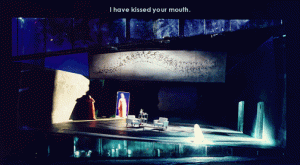
It was at this point in my research that I began to feel a little ignorant. Svoboda is clearly a giant amongst designers and scenographers, but I had never heard of him. When he died  2002, it was estimated that he had designed and/or directed over 700 theatrical and operatic performances.

When I sit alone in a theatre and gaze into the dark space of its empty stage, I’m frequently seized by fear that this time I won’t manage to penetrate it, and I always hope that this fear will never desert me. Without an unending search for the key to the secret of creativity, there is no creation. It’s necessary always to begin again. And that is beautiful.

Josef Svoboda.

You can get an idea of the scale of Svoboda’s work in the following two videos. If you speak Czech or French there are more in-depth videos on Youtube about the  man and his work.

It then struck me to whom I had heard the term scenographer ascribed before. Robert Lepage is one of the greatest living magicians of the performance space and I have had the delight, pleasure and awe of seeing a number of his works. An utter genius and worthy of a post all of his own, so I shall save further discussion of him until then. However equating Lepage and his work with the role of scenographer, I understood the difference between design and scenography.  It also allayed my feelings of ignorance somewhat. For many years scenography has been the preserve of the academics – a theory of, roughly speaking, the meeting of art, design, architecture and space, and how they interact with the spectator and the spectator with them.  Starting to feeI immersive here? I can now also see how two of the most influential theatre designers of the 20th Century, Adolphe Appia and Edward Gordon Craig, influenced the development of scenography. 

9789299006313_FotorThere are lots of resources out there for understanding scenography and putting it into practice, but one of the best I have come across is TAJ, Theatre Arts Journal. TAJ is an online journal devoted to the study of  scenography in performing arts. Also, the Prague Quadrennial site is a veritable treasure trove of scenographic wonders. There is even a board on Pinterest devoted to scenography, curated by architect Marios Angelopoulos.

To close, I should point out that scenography is not simply an act of theatre making. It is much wider than that, stretching to cover exhibition design, museum planning and interactive public spaces amongst other things – all things that need to engage an audience.