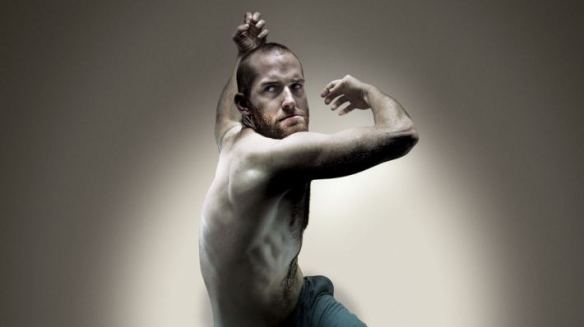
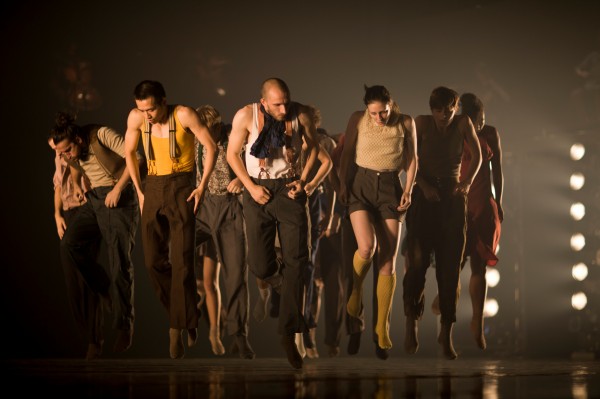
The latest piece from internationally renowned physical theatre company DV8 has just opened at the National Theatre in London, following a premier earlier in the year at the Vienna International Dance Festival. The company is almost 30 years old, yet the work they continue to produce is still be considered cutting edge. To define them precisely in terms of genre is a difficult – they work in a mixture of dance and physical theatre as well as verbatim theatre, and usually all done with a dark sense of humour. Of course over time their ‘style’ has evolved and of late has become much more speech driven. Lloyd Newson, the co-founder and leader of the company said in a recent interview:
I could never understand the discrepancy of dancers yakking away in the wings, then pretending to be mute the minute they stepped out on stage,” Newson says. “A friend and former colleague of mine, Nigel Charnock, once said: ‘Whenever I’m dancing, inside my head, I’m talking to myself the whole time’.”
The new work, eponymously entitled John, is again a verbatim piece, created using interviews conducted by Newson with more than 50 men asking them frank questions about love and sex. To quote their publicity:
One of those men was John. What emerged was a story that is both extraordinary and touching. Years of crime, drug use and struggling to survive lead John on a search where his life converges with others in an unexpected place, unknown by most. JOHN authentically depicts real-life stories, where movement and spoken word combine to create an intense, moving and poignant theatrical experience.
Newson has given two interviews to coincide with the opening of the show in London. Firstly to The Independent and Hugn Montgomery, DV8: Three decades of the provocative dance-theatre companywhere he speaks about the aesthetic of the company’s work in a typical refreshing forthright manner:
This is a man who has talked of dance as “the Prozac of the artforms”, for what he sees as its vacuous, anaesthetising beauty; he sums up his own approach as “if people don’t understand what’s being said physically, I’m not interested”
Yesterday, the BBC Front Row programme interviewed Newson about the creative process behind the work:
.
Too early for the english language reviews to be out, but Twitter has been alive with fulsome praise:
John is will be on a national tour when done in London, but is sure to be heading off across the globe soon. I do hope so, anyway.
Post Script:
Since writing this post, the reviews are in for John. Almost without exception, they are praiseworthy and talk fulsomely about Newson’s work. The London Evening Standard sums up the piece thus:
John is a powerful and absorbing piece full of innovative visual touches but there’s a question over the bisected nature of the narrative and the sudden switch of tone, the new cast of characters, the move into (scatological) comedy.
Yet it works because there are themes that thread all the way through: the search for something, be it escape, obliteration, sensation, intimacy or love — at whatever cost
Obviously confronting in many ways, John has clearly made an impact. There is one review however, that had me whooping with laughter. Written by Quentin Letts for The Daily Mail, a right-wing, ‘hang ’em high’ and ‘send the immigrants home’ rag published in the UK, screamed with the fabulous headline A National DISGRACE: Sleazy. Amoral. And paid for by you!I think Letts might be missing the point, don’t you?
As those of you who read Theatre Room regularly will know that I’m no great fan of musical theatre. There are however some exceptions, one being The Lion Kong. I first saw it in Los Angeles many years ago, and have been urging people to go and see it ever since. It first opened in Minneapolis in 1997, quickly transferring to Broadway. in 1999 it opened in London at the Lyceum Theatre, where it is till running 15 years later. In fact, it is currently playing in 10 cities world-wide. In its 17 years it has been seen by an estimated 75 million people and taken $6.2 billion, making it the highest grossing musical ever. Impressive figures indeed.
It’s easy to overlook, what with all the trumpeting of huge grosses and audience figures, what a radical piece of theatre The Lion King is, and always was.
Credit for this goes to the prime mover of this stage version, director Julie Taymor, who came from avant-garde, ritual and experimental theatre, and had already used masks and puppetry in other productions. Taymor also helped design the costumes for the Lion King, and even wrote the lyrics for one of its songs, Endless Night.
She has created a world that is fiercely non-literal, often to moving and wondrous effect. She makes no attempt to disguise the fact that these animals are moved and performed by humans. A drought on the African plain is conveyed by a circle of blue silk gradually vanishing by being pulled through a hole in the stage. When a lioness weeps, she pulls lengths of white ribbon from her eyes. Taymor evokes a waterfall using a huge sheet of billowing silk. A score of actors stride on stage, boxes on their head with long grass sprouting from them; this is Taymor’s way of representing the African savannah.
All of which seems a long way from the animated film and video of The Lion King, which proved immensely successful for Disney in the 1990s. They’re agreeable entertainments, based on a hero-myth story redolent of Hamlet. As a young lion cub, Simba is hoodwinked by his malevolent uncle Scar into believing he was responsible for his father the king Mufasa’s death. Simba flees before returning as an adult to reclaim his birthright from Scar, who has installed himself as king.
This is all fine as far as it goes, yet there’s a cosiness and reassurance about the film that Taymor withholds; in the stage version there is simply more at stake, along with a recognition that life is fragile. She also gave far greater emphasis to the film’s female characters. There’s a tough-mindedness about her method of story-telling; it’s surprising that Disney, to its great credit, approved such a radical reboot of the film.
Gritten’s article is well worth a read in its entirety here. Another one, this time by Adam Sherwin here in The Independent explores the money-making side of the The Lion King. Apparently Sirs Tim Rice and Elton John, the composers and librettists of the musical, have made a whopping US$120 million apiece from the show!
To finish with, it was recently announced that Disney have adapted the musical for schools which will be licensed for performance from January 2015. Disney, Rice and John will no doubt need to get deeper pockets.
By way of a post script, I should say that the show’s appeal for me is the ingenious way in which the animal characters have been brought to life with puppetry. The man behind most of the puppets is Michael Curry, and there are a couple of interesting interviews with him here and here about his work on the show .
A gnarly little piece today I came across in The Independent, Why are theatre directors messing with the classics?Written by journalist Adrain Hamilton, he bemoans (British) theatre directors who play with the text and/or original intent of the playwright. Has it ever been thus. Now far be it from me to suggest that Mr Hamilton (who is not a theatre critic or in any way connected professionally with the theatre) is simply whining because he may have witnessed a production of one of his favourite classic plays that he didn’t like (although I suspect there might be something in this). It’s not that I disagree with him totally. Indeed he makes some decent observations, but theatre is an interpretive art form, especially when dealing with the more classic/historical texts. There has to be a relevancy for a contemporary audience and it the director’s job to make that so. Of course it doesn’t always work, but that is theatre for you.
Why are theatre directors messing with the classics?
There are no more dreaded words in the English theatre today than “in a version by”. Whether it’s Ibsen’s Ghosts, Euripides’ Medea or Sophocles’ Electra, nothing will do but that the international giants of the stage be taken by an English writer and refashioned for the English audience in their own words.No one should doubt the theatricality of these “versions”. Greek tragedians, as indeed Ibsen, created great parts for female actors and this is what the British directors have seized on with such fervour today. Kristin Scott Thomas as Electra, Helen McCrory as Medea and Lesley Manville as Ibsen’s Mrs Alving have all been successively hailed as the new divas of drama for their anguished performances of tortured, wracked women.
Just as we perform Chekhov as the supreme English ironist, rather than the caustic writer of near farces, which is the way the Russians do, so our directors and dramatists rework the classics as studies in angst and high emotion, women on the edge not just of a nervous breakdown but of infanticidal self-destruction.
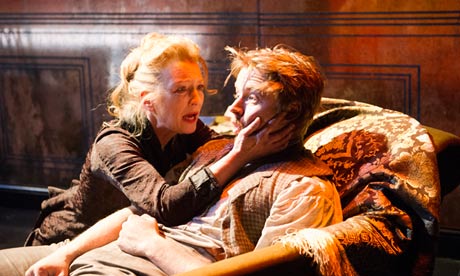
Lesley Manville in Richard Eyre’s production of Ghosts
Only that is not what these dramas are actually about, or not as their authors intended. The great classical dramatists didn’t set out to present psychiatric studies of individuals and their torments. They wrote about the human condition through the dilemmas and fates of individuals. The same goes for Henrik Ibsen. A would-be poet himself, he wanted to express what he saw as the societal truth of his times.
Sir Richard Eyre’s reworking of Ghosts, and his earlier Hedda Gabler, at the Almeida, are finely crafted works of domestic drama in which events speed their way to a horrifying conclusion, impelled by revelations which strip their heroines of all illusion. It’s Chekhov on speed, even to the point of climaxing the play with Mrs Alving administering the medicines with which to aid her son’s death.
But Ibsen didn’t write that. He left his heroine gripped by indecision whether to carry out her son’s desire to die or to refuse such an unnatural maternal act. Sir Richard’s version makes for a more melodramatic finish; Ibsen’s for a more troubling one. Which is how he saw his play, a very carefully modulated study through the dialogue of human evasion of how we are all made by our past and convention.
If you want to see the difference between the way that the British domesticate drama and other countries seize on the ideas behind a play, then the Barbican’s current series of international productions of Ibsen should be a revelation. The Berlin Schaubühne ensemble’s An Enemy of the People, the play he wrote in anger at the way Ghosts had been dismissed by the critics, is an interpretation full of the urgency that this angry assault on bourgeois conformity requires. Switching the time to now, it has all of Ibsen’s weight and weariness with the society about him but also his sense of the human part within it. If the production stuttered in London it was in trying, in the middle, to involve the audience in the debate. It apparently worked in performances elsewhere but not here. The English don’t go in for direct confrontation, let alone over ideas.
The Berlin Schaubühne ensemble’s An Enemy of the People
It gets worse with Greek tragedy. With a deeply affecting central performance, the National’s Medea wrung every emotion out of the story of an abandoned woman who wreaks revenge by killing her own children and dragging their bodies into exile in an end reminiscent of Bertolt Brecht. Only Euripides is not Brecht and he didn’t write Medea as a story of a wronged woman wrestling with her conflicting emotions. The Medea of Greek legend is a witch woman of terrifying force. The tragedy is one of anger and vengeance which cannot be constrained. At the end you feel not pity but horror and fear.
You don’t have to do Greek tragedy on a bare stage and skimped costumes. The poet Caroline Bird’s version of Euripides’ Trojan Women at the Gate Theatre in 2012 was one of the most intense theatrical experiences I’ve ever had. Moving the scene to a maternity hospital, it worked because it remained true to Euripides’ vision of captured women, turning in on themselves as they await their fate. But you can’t do what Frank McGuinness, whose adaptation of Electra is now playing at the Old Vic, did in the opera of the Theban Plays and mess around with the order at will. At least you can’t do it and still leave Sophocles on the credits.
Yukio Ninagawa, arguably the greatest theatre director of our times, who directed an electrifying Medea in Japanese, will only work with line-by-line translation. Presenting Shakespeare’s Cymbeline recently the Barbican (he’s back there with Hamlet next year), he apologised for changing a word in making a cedar into a pine for visual reasons. If only British directors would pay foreign dramatists the same respect when they turn them into English.
I went in search of the reviews of some of the plays that Hamilton vilifies as domestic. The same paper that carried his article, The Independent, gave the production of Euripides’ Medea he mentions 4 stars, calling it unforgettable and horribly gripping, as did The Telegraph who said it was thrilling and merciless. Richard Eyre’s production of Ibsen’s Ghosts, meanwhile was given 5 stars in The Independent – A spellbinding production – as it was in The Telegraph, with the final line of the review observing that Theatre seldom, if ever, comes greater than this. Finally, the production of Sophocles’ Electra was again given 5 stars by The Independent, calling it an evening of unalloyed magnificence; The Telegraph said it was Theatre at its best with The Guardian undermining Hamilton’s whole premise in the final paragraph of its 4 star review.
Theatre cannot be preserved in aspic, perhaps more so today than ever. I’m looking forward to reading how other less conservative commentators react to Hamilton’s views
Sometimes a trip to the theatre can be truly exhilarating, confronting and prescient. Last night I went with my friend Sara to see Political Motherby British based Israeli choreographer, Hofesh Shechter, and it was indeed all of those things – and a lot more besides. In essence, it is a piece that explores the relationship between society and state, duty and service and brutalisation by a repressive power. The staging is epic – and very loud (being issued with ear plugs by the theatre was a first for us, although they remained unused). Political Mother has had a few incarnations and we witnessed another one, with it being re-worked a little for the festival it was part of and the addition of young, local musicians, largely drummers, to an already significant cast of dancers and musicians.
.
It has toured significantly around the world and I am delighted to have had the opportunity to see something I had been reading about with envy – the reviews have been almost uniformly outstanding. You can see for yourself here and here.
However, it wasn’t simply the piece that was so enthralling, it was also the context in which it was being performed. The monolith of a building in which it was staged, the Hong Kong Cultural Centre, was commissioned and built under British colonial rule and is currently celebrating its 25th anniversary. Ten minutes walk away is the commercial district of Mong Kok, where protests for universal suffrage continue. Across Victoria Harbour from the theatre is the other site of protest, with roads closed and a growing tent city springing up. It was palpable that the irony of a governmental sponsored festival hosting Political Mother was not lost on the majority of the audience. We were left wondering what the performers thought about the timeliness of their work in Hong Kong.
Dance and politics have never been far apart. One of the founders of contemporary dance, Martha Graham was no stranger to this fact, as this short documentary shows:
Politics and theatre are, and have always been, inextricably linked. So following on from my previous post, this one explores real theatre on the streets, this time in Nepal. I came across an article in the South Asia Monitor, written by Deepesh Paudal and originally published in The Kantipur Daily, Road Act. Sadak Natak or Street Theatre emerged in Nepal in the 1980s, during the height of monarchial rule, as a way of protesting against the excesses of the ruling royal family. Ashesh Malla, Artistic Director of Sarvanam, a Nepali theatre company, is credited for starting the movement and in a country where many live in rural poverty, street theatre has proved to be an effective way of raising awareness of a host of issues, as well as entertaining people.
.
However, in his article, Paudal sounds a note of of caution about the continuing existence of Nepalese street theatre:
Fading interest The development of street theatre in Nepal has seen its peaks and troughs. Periodically, some have been critical, raising questions on its objective. Some of them have tagged street drama as a mere developmental play (bikase natak), ‘farming dollars’, while others have sternly criticised it for an absence of aesthetics. Non-governmental organisations’ and other social institutions’ direct or indirect involvement in street theatre s has drawn both positive and negative remarks from stakeholders. The lack of transparency in fund allocation and management has frequently put theatre groups under scrutiny, often exposing their dependency on donors and foreign aids. Additionally, the progress of cyber entertainment and communication has widely overshadowed the essence of street theatre . Even the interest of the pioneers and of those who had been actively performing in street drama s in the past has significantly dropped. Under these circumstances, the sustainability and even the survival of street theatre are increasingly in a vulnerable state. All theatre aficionados need to quickly apprehend that appreciating the contributions of street theatre just as well as that of the commercial theatre will help save this form of art from extinction.
Today I would like to share two new excellent video documentaries from the American Theatre Wing. The first is about the creation of site-specific theatre. Since I Suppose is a site-specific theatrical experience based on Shakespeare’s Measure for Measure which allows the audience to travel on an immersive journey through downtown Chicago.
The video follows members of the Melbourne-based theatrical group, one step at a time like this and Chicago Shakespeare Theater who share a behind the scenes look at how the experience was created using digital technology and the architecture and culture of Chicago.
.
The second explores another visceral theatre experience but this time of the immersive kind. In the documentary Randy Weiner (Producer, Sleep No More), David Korins (Scenic Designer,Here Lies Love) and Zach Morris (Co-Artistic Director of Third Rail Projects) describe the ‘staging environment, the state of heightened theatricality, and the effect of the immersive movement on the audience and its influence on today’s theatre scene.’
.I
If you are a first year IB Theatre Arts student reading this, both of these videos would be superb for your Collaborative Project.
A week or so ago I had the pleasure of taking part in an acting workshop based on the teachings of Ute Hagen. Having had my own theatre education in Europe, Hagen’s work was largely unknown to me, despite the fact that her approach to naturalistic acting, along side that of Stanford Meisner and Lee Strasberg, is widely taught and respected in North America. It has been something of a revelation and my ignorance of her work rather embarrassing. She died in 2004, but her influence continues to grow. Of her work she said, I teach acting as I approach it – from the human and technical problems I have experienced through living and practice.
I was particularly struck by exploring her ways into creating character. One of her obituaries commented that there was a balance in her approach, which was method acting, but not taken to the self-immolating extremes of some of its practitioners. Though she demanded respect, she eschewed pretension. These nine questions, in order, form the core of that character work:
1. Who am I? (All the details about your character including name, age, address, relatives, likes, dislikes, hobbies, career, description of physical traits, opinions, beliefs, religion, education, origins, enemies, loved ones, sociological influences, etc.) 2. What time is it? (Century, season, year, day, minute, significance of time) 3. Where am I? (Country, city, neighborhood, home, room, area of room) 4. What surrounds me? (Animate and inanimate objects-complete details of environment) 5. What are the given circumstances? (Past, present, future and all of the events) 6. What is my relationship? (Relation to total events, other characters, and to things) 7. What do I want? (Character’s needs. The immediate and main objective) 8. What is in my way? (The obstacles which prevent character from getting his/her need) 9. What do I do to get what I want? (The action: physical and verbal, also-action verbs)
She wrote two books, Challenge for the Actor andRespect for Acting, both of which are still in print. There is also a fascinating recording of a series of master classes she gave, of which there is an excerpt here:
.
With her second husband, Herbert Berghof, who was a protégé of the German realist director Max Reinhardt, she co-founded the HB Studios in New York whose doors are still open today. I would suggest that if you don’t know the work of Ute Hagen or have struggled with Stanislavski or Strasberg, give her a go.
Incidentally, and not unconnected, the day after my workshop I read this article, published in the Slate and written by Marcus Geduld, in which he attempts to answer the question, How Do You Differentiate Good Acting From Bad Acting?
If anyone tells you there are objective standards, they’re full of crap. This is a matter of personal taste. There are trends. There are many people who loved Philip Seymour Hoffman’s acting. But if you don’t, you’re not wrong. At worst, you’re eccentric.
I’m a director who has been working with actors for almost 30 years, and I’m the son of a film historian. I’ll give you my definition of good acting. But I really want to stress that if I say, “Pacino is great,” and you disagree, my experience does not make me right and you wrong. It just means we have different tastes.
First, for me, an actor is good if he makes me believe he’s actually going through whatever his character is going through. I’m talking somewhat about physical stuff (“He really is getting shot!” “He really is jumping off a moving train!”) but mostly about psychological stuff (“He really is scared!” “He really is in love!”). If an actor seems to be faking it, he’s not doing his job.
You can read the rest of the article here, and I would recommend it.
If you read Theatre Room regularly, you will know that I have written on a number of occasions about the ever-growing popularity of Immersive theatre, especially in Europe. You also know that I am drawn to this form, especially as a way as bringing new audiences to the theatre and challenging theatre students take risks in their exploration of the possibilities in performance. All things ‘immersive’ are clearly drawing audiences and there is lots of ‘jumping on bandwagons’ at the moment. It was with some interest then that I read Lyn Gardner’s Theatre Blog in The Guardian this week. London-centric, by its nature, but certainly making a point that is worth considering wherever you are:
Immersive theatre: living up to its name, or just an overused gimmick?
Immersive theatre has become ubiquitous, but too often such billing is just a commercial come-on designed to sell tickets
My, there is an awful lot of immersive theatre around at the moment, particularly if you live within reach of London. You can watch Titus Andronicus performed in a car park in Peckham, visit Dorian Gray’s townhouse in Greenwich, pretend you are a spy in CoLab’s London-wide, digitally-augmented Fifth Column or – if you’ve £200 to spare – spend the night in a London hotel and watch the immersive play Backstage Tour.
Some of these shows deserve the tag. But I’m beginning to think that immersive has become one of the most overused terms in British theatre, in similar vein to that other much misused term, site-specific (or site-responsive), which is likewise often bandied about with little or no justification. Standing around watching a show in a room that appears to have been designed by an Oxford Street store window dresser doesn’t magically make the audience experience something immersive, no matter how many stuffed animals you incorporate into the set.
It you want an enjoyably sly swipe at the immersive phenomenon, take a look on the excellent Exeunt site, where Natasha Tripney has cleverly reframed her East Coast trains journey back from the fringe as immersive theatre.
The rise of immersive theatre undoubtedly reflects an interest from audiences – often audiences who may not think that traditional drama in traditional theatre playhouses is for them – in experiencing theatre in a different way, one that allows them to be part of the story and feel as if they have dropped down a rabbit hole into another world like Alice. In some instances where the audience can genuinely roam where they want, the experience is more akin to gaming than traditional theatre.
Some companies – Coney, Lundahl and Seitl, Punchdrunk, Ontroerend Goed and Look Left Look Right among them – have perfected the art, finding ways that make sense of why the audience is present at all and allowing them to play their part. Such companies don’t mistake mere intimacy (lovely though it can be) for immersion, and in some instances give us genuine agency.
But I keep on seeing shows that claim to be immersive, and turn out to be anything but. Performing a show in a car park (Titus) while Southern trains constantly thunder by, so that Rome appears to be situated at a railway junction, or making audiences run away from zombies in an underground space in Edinburgh (Generation of Z on the Fringe), doesn’t make it immersive, it just makes it a show in an unusual – and not necessarily suitable – location. That’s fine. But short-changed audiences will quickly learn that immersive shows often don’t deliver on what they promise, and they will stay away.
Strong and portentous words from the venerable Gardner, and she is rarely wrong, in my opinion. Her reference to The East Coast Trains Show written by a fellow critic Natasha Tripney, and published in Exeunt is definitely worth a read (and a wry smile). Beautifully tongue-in-cheek, but harbouring similar grievances expressed by Gardner and a sense that she too has experienced one too many pieces of immersive theatre that simply are not.
A quick share today of something that recently caught my eye. British Pathé, to quote it’s own website…….was once a dominant feature of the British cinema experience, renowned for first-class reporting……Now considered to be the finest newsreel archive in the world, British Pathé is a treasure trove of 85,000 films unrivalled in historical and cultural significance. Spanning the years from 1896 to 1979, the collection includes footage from around the globe of major events, famous faces, fashion trends, travel, science and culture.
This archive has now been digitised and made available on Youtube. A real gift for theatre makers who want to include historical footage from around the globe in their work. The archive, which covers the most important and significant political, human, and cultural events of the 20th Century, even charts the development of mechanics in theatre. From 1945 and 1932 respectively:
Scenographers everywhere will be thrilled. The archive even has it’s own Facebook presence. Having done a bit of exploring, it seems its easier to search for the content of the footage you might need on the Pathé website itself, locate the title of the video/s that contain it, then search for those titles on the Pathé Youtube channel.
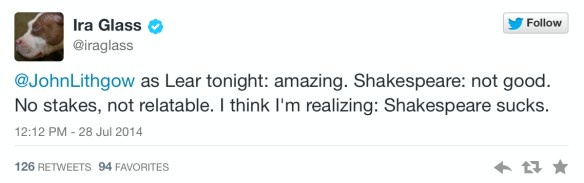
A beautiful spat has broken out amongst the literati Stateside this week, all sparked by a tweet from Ira Glass, presenter of This American Life:
He then followed it with this:
Social media went mad and it was picked up and discussed widely. The debate is fascinating and I thought I would share some of it with you. Firstly, and this is really worth listening to, a podcast from Born Ready. Director Steve Boyle and theatre producer Rob Ready discuss, to paraphrase Born Ready site, why Shakespeare has been elevated to something like a Prophet, and how his plays have become a point of shared experience and a cultural touchstone. I should warn you, however, that some rather choice language is used during the discussion.
.
Now, whilst Glass didn’t personally attack John Lithgow, to tie him in with a rant about the irrelevancy of Shakespeare was bound to cause an outcry. Firstly, Lithgow is akin to acting royalty in the US and secondly, North Americans really love their Shakespeare – you only have to look at the amount of Shakespeare festivals that take place across the continent every year and the fact that New York has been swamped with productions of late.
The reaction on social media was, it has to be said, highly entertaining as these pieces on CBC and The Wire highlight. If you click-through on the second tweet above, you can read it for yourself. Others have weighed into the debate, most, not surprisingly disagreeing with Glass – even Esquire, in a piece entitled SHAKESPEARE IS THE MOST UNIVERSAL WRITER EVER – Ira Glass doesn’t know what he’s talking about.
One of the best responses comes from the New Republic by Adam Kirsch, who calls Ira Glass a Philistine for saying Shakespeare sucks, while noting that he is not alone in this opinion:
Does Shakespeare suck? Ira Glass, the host of the popular upper-middlebrow radio show “This American Life,” apparently thinks so; he tweeted as much after suffering through a performance of King Lear in Central Park. The backlash has been swift and severe, thus answering the question of whether there remain any literary taboos in the twenty-first century. Apparently, calling the Bard “not relatable” is still enough to get someone branded as a philistine.
I come not to praise Glass, certainly—I think he is a philistine—but also not totally to bury him. For there is always something admirable in speaking with complete honesty about one’s aesthetic reactions, even when those reactions are plainly wrong. Those who automatically praise Shakespeare because they know it is the right thing to say, or because they fear Glass-like ostracism if they say otherwise, may also be philistines—The kind that Nietzsche, in his Untimely Meditations, called the “culture-philistine,” who “fancies that he is himself a son of the muses and a man of culture,” but is actually incapable of a genuine encounter with art. The first rule of any such encounter is honesty: If you fail to find what you are looking for in a work of art, even King Lear, you must be willing to admit it. Then you can move on to the question of whether it is you or King Lear that is deficient.
The truth is that Glass could have summoned some pretty impressive names to testify in his defense. George Bernard Shaw famously hated Shakespeare, complaining that “Shakespeare’s weakness lies in his complete deficiency in the highest spheres of thought,” and offhandedly claiming “I have actually written much better [plays] than As You Like It.” Tolstoy, too, had a low opinion of Shakespeare: “Open Shakespeare … wherever you like, or wherever it may chance, you will see that you will never find ten consecutive lines which are comprehensible, unartificial, natural to the character that says them, and which produce an artistic impression.” Shakespeare’s fame, Tolstoy concluded, was purely a matter of convention: “There is but one explanation of this wonderful fame: it is one of those epidemic ‘suggestions’ to which men have constantly been and are subject.”
But then, to be hated by Shaw and Tolstoy is itself a distinction. For these great writers, Shakespeare stood in their way as an indestructible obstacle, representing a way of writing that they opposed because they could not practice it. To Shaw, whose plays are political and polemical, Shakespeare was not political or polemical enough; to Tolstoy, who strove for organic naturalness, Shakespeare was neither organic nor natural. When T.S. Eliot declared that Hamlet was an artistic failure, he was not trying to make people stop seeing or reading Hamlet; rather, he was trying to get us to change the way we think about what makes a play successful.
Ira Glass, of course, was not engaged in this kind of literary maneuver. He was speaking as a playgoer who found, evidently to his surprise, that King Lear was not providing whatever it was he expected a play to provide—that is what “not relatable” really means. And even here, Glass is not alone or even a pioneer. Until the Shakespeare revival of the eighteenth century, King Lear was regularly performed in England in an edited version, in which Cordelia lived at the end. No less a Shakespearean than Doctor Johnson approved of this change, on the grounds that “the audience will … always rise better pleased from the final triumph of persecuted virtue.” In other words, Johnson was saying that the devastating conclusion of Lear was not relatable; it did not tell people what they expected a play to tell them. (Similarly, Johnson remarked on the “seeming improbability” of Lear’s conduct in impetuously disowning Cordelia, and explained it by the primitivism of the England of Lear’s time; after all, he wrote, such barbarism “would yet be credible if told of a petty prince of Guinea or Madagascar.”)
If audiences today would not stand for such a prettified Lear, that is because our sense of reality, of how the world really works and is supposed to work, has changed since the eighteenth century. Lear is generally considered the most powerful of Shakespeare’s plays precisely because, in its unsparing picture of a violent, unjust, continually brutal world, it conforms so well to what our history teaches us to expect. In other words, Lear is all too relatable, though what it relates is deeply disturbing (as it was for Johnson, who objected to the putting out of Gloucester’s eyes as an unstageable obscenity).
If, in the face of this overwhelming power, an audience member remains simply unmoved—if, like Ira Glass, he just thinks the play fails to work—then something has obviously gone wrong, not with the play, but with the spectator. Exactly what is wrong in this case is something only Glass can answer, but I have my suspicions. Not just Ira Glass, but all of us, are growing increasingly unused to the kind of abstraction that art requires. Lear’s plight is supposed to move us not because it is something that could really happen to us—already in the eighteenth century, Johnson found it incredible—but because it is what Eliot called an “objective correlative,” an artistic formula for producing a certain emotion. The horror of life that Lear communicates is something deeper and more constant than the particular actions of its dramatis personae. The same is true of Oedipus’s self-blinding, or for that matter Abraham’s near-sacrifice of Isaac: We can only appreciate these stories if we imagine our way into them, rather than demanding that they come obediently to us.
Perhaps that is the difference between art and entertainment. And in a culture with so many proliferating sources of entertainment, the work required to encounter art is becoming increasingly unfamiliar. When people stop going to see Shakespeare altogether, we’ll know that we’ve lost this particular part of our humanity—one which we have traditionally honored as among the noblest and most valuable.
It’s a healthy debate, whatever side you are on. It is also noteworthy that Glass is clearly having second thoughts having faced the vitriol – the original tweet has been deleated.

 The latest piece from internationally renowned physical theatre company DV8 has just opened at the National Theatre in London, following a premier earlier in the year at the Vienna International Dance Festival. The company is almost 30 years old, yet the work they continue to produce is still be considered cutting edge. To define them precisely in terms of genre is a difficult – they work in a mixture of dance and physical theatre as well as verbatim theatre, and usually all done with a dark sense of humour. Of course over time their ‘style’ has evolved and of late has become much more speech driven. Lloyd Newson, the co-founder and leader of the company said in a recent interview:










 Theatre Room Asia