Igniting Passions

For those of you that read my blog regularly, you know I have a fascination with site specific theatre. Today I’ve been reading about a extraordinary project by the National Theatre of Scotland, who are renown for works that push boundaries.  This new work, that is currently still ‘in progress’ struck a particular cord as it has the place of cars in our society at its heart. As someone who calls Hong Kong home, where the car is king, despite having one of the best (and growing) public transport systems in the world, I thought I would share it with you.

Evernote%20Camera%20Roll%2020130324%20161620

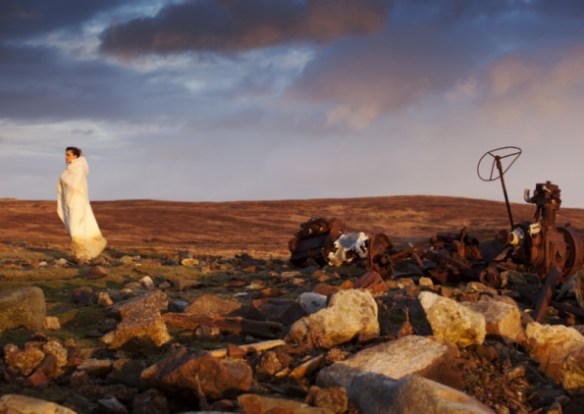
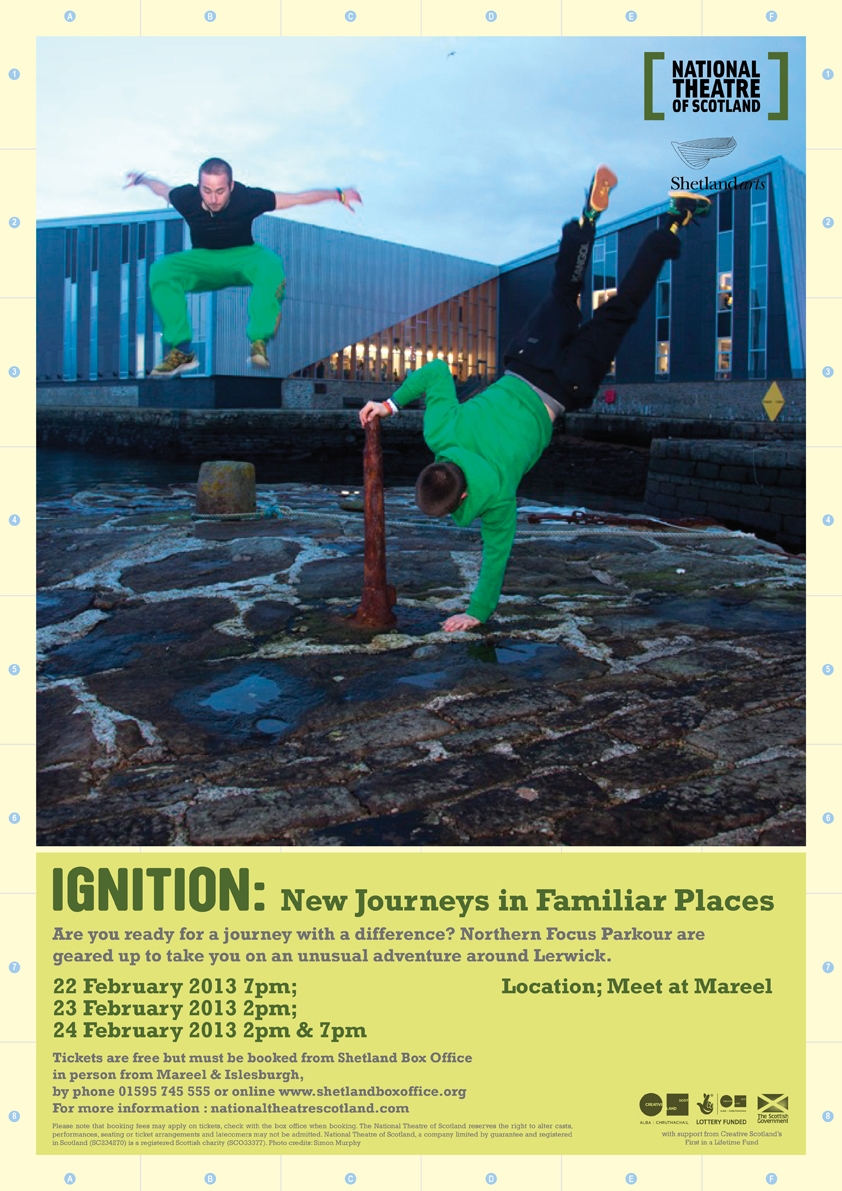
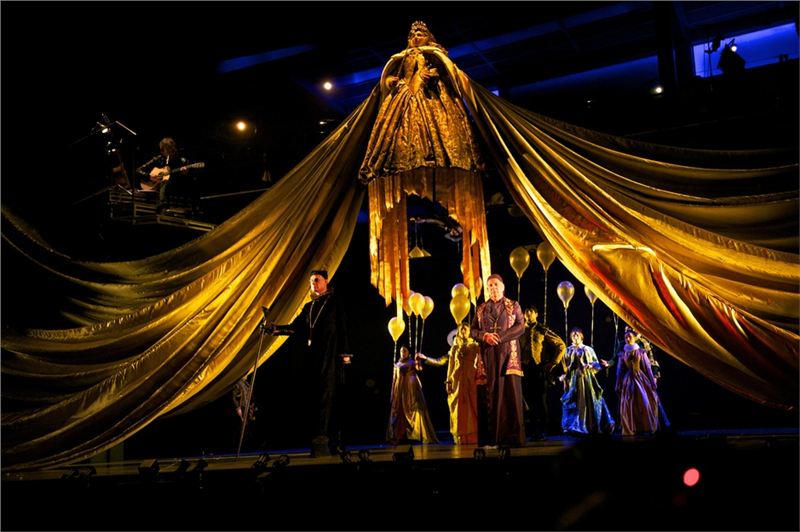
The piece is called Ignition and is set and takes place in the Shetland Islands in Scotland.The idea for Ignition grew from the death in a car crash of a young man called Stuart Henderson. It slowly developed into a project exploring the Shetlanders’ relationship with oil and the combustion engine. It has resulted in this joint creation, developed over the past over six months, by National Theatre of Scotland and Shetland Arts with members of the Shetland community. What makes it extraordinary is the way hundreds of individual stories (many gathered by Lowri Evans, dressed as the “White Wife” of folklore) meld into experience that everyone can recognise, identify with and participate in – rather in the way that you sometime see one big image made up of thousands of tiny photographs  (selection and combination by dramaturg Rob Evans). But, because you are part of the event, you are also making your own picture as you go along. The fire that lights Ignition is, it turns out, the seemingly simple blending of other people’s lives into our own and opening both into something universal.

ignition

By way of explanation, here is a quote from the NTS’s website:

Over the past six months, the National Theatre of Scotland has invited all of Shetland’s inhabitants to explore our bittersweet relationship with the automobile – how it shapes us, defines us, supports us, frees us, challenges our attitudes towards our dwindling resources and, sometimes, kills us. You have told us your stories and now we are ready to take you on the Ignition journey. Set in three locations across Shetland, the site-specific Ignition performances will carry you away on a shared car adventure. The stories will transport you to one indoor and two outdoor locations. At these locations you will see, hear and be a part of the stories that have been collected in the course of the Ignition project. Stories of Shetlanders who have given the White Wife a lift, knitted panels for the Car Yarns car, helped create the music written about the road from Sumburgh to Skaw, taken part in a Sunday Tea conversation, told us their secrets in the Car Confessional, or just taken time out to tell us their car stories. After ten thrilling days of immersive car-theatre between 20th and 29th March, Ignition culminates in a short, but unforgettable, one-off finale for all the Ignition audiences on 30th March in a stunning outdoor location in Brae. The stories will be experienced through exhilarating drive-in theatre, the movement discipline of parkour, music, hitchhikers, dance and text, and will take you on a journey that you will never forget.

If you click the image below, you can watch the BBC report on Ignition

Evernote%20Camera%20Roll%2020130324%20161631

NTS have also recorded a couple of videos about the project and you can watch them here:

and here:

Have a read of some of the reviews here – from The Scotsman, The Telegraph and The Guardian.

The National Theatre of Scotland’s own blog gives you a real feel of the whole creative process behind the project.

Evernote%20Camera%20Roll%2020130324%20161622

The Man’s ‘Method’

Today I am sharing a really interesting article by Simon Callow entitled Stanislavski was racked by self-doubt. It was published this week in The Guardian and I reproduce it here in full.

Konstantin Stanislavski as Don Juan.

.

.

.

.

.

.

This year marks the 150th anniversary of the birth of the Russian actor, director and theorist, Konstantin Stanislavski. If the anniversary is remembered at all, it will be with quiet respect. There was a time – not a time out of memory, though it seems distant now – when furious battles were waged in the theatre about acting: what it was and what it should be. In green rooms, in drama schools, and in the fiercely polemical pages of the theatre magazine Encore, the debate raged. It started around the time of the foundation of English Stage Company at the Royal Court theatre in the mid 1950s and continued until some point in the late 1970s, when all ideological and aesthetic discussions were abandoned in the face of economic trauma. The principal figures around whom the antagonists grouped were Stanislavski and the playwright and director Bertolt Brecht who, in the 1920s and 30s, articulated a theory of acting to rival, and indeed to oppose, the Russian’s. Broadly speaking, Brecht’s approach was political, Stanislavski’s psychological; Brecht’s epic, Stanislavski’s personal; Brecht’s narrative, Stanislavski’s discursive. Brecht’s actors demonstrated their characters, Stanislavski’s became them; Brecht’s audiences viewed the actions of the play critically, assessing the characters, Stanislavski’s audiences were moved by the characters, identifying with them; Brecht’s productions were informed by selective realism, Stanislavski’s aspired to poetic naturalism.

As Stanislavski had done with his Moscow Art theatre, Brecht created an acting group, the Berliner Ensemble, whose practice embodied and demonstrated his theories; the Ensemble’s visit to London in 1956, the year of Brecht’s death, had a seismic effect on British theatre, an effect that only started to fade in the last years of the 20th century. The Moscow Art theatre, meanwhile, had started to calcify; when Stanislavski’s original productions, still in the repertory, came to London they seemed preserved in aspic. Brecht and his theories made all the running, both aesthetically and politically, chiming with the British leftwing puritan tradition, resulting in productions that were bare, cool, politically explicit. The German’s influence, first felt in Joan Littlewood’s productions, was a formative factor in the unique populist style she forged for her Theatre Workshop; it informed a great deal of the Royal Court’s house style, in physical productions, in new plays, and in acting. It was also at the root of Peter Hall’s new Royal Shakespeare Company, and – sometimes a little incongruously – became part of the many-hued fabric of Laurence Olivier’s National Theatre Company, which produced a number of Brecht’s plays, performed new plays (by John Arden and Peter Shaffer, for example) heavily influenced by him, and applied his lessons to classics such as Farquhar’s The Recruiting Officer, starring Maggie Smith, who proved to be a brilliant, if somewhat unexpected, Brechtian.

But Stanislavski had been a force in the British theatre long before Brecht. His system had been taught in drama schools from the 1920s, and, slowly at first, but increasingly, leading British actors embraced his quest for psychological truthfulness over mere theatrical effectiveness. John Gielgud, Peggy Ashcroft, Michael Redgrave – but not, significantly, Olivier – endorsed his work; after the war Paul Scofield did the same. The huge popularity of 1950s film stars such as Montgomery Clift, Marlon Brando and John Garfield gave currency to the extremely limited version of Stanislavski’s system created by their teacher, Lee Strasberg, who coined the phrase The Method for his Stanislavski-lite version of it. Essentially, Strasberg elevated one aspect of Stanislavski’s work – emotional truthfulness – into the whole theory. Not only was this a crude reduction, it ignored the constant development and refinement of the theory, which preoccupied the Russian until the day he died, weighted down with international honours, in Moscow, in 1938. But by then the Soviet cultural nomenklatura had started the process of ossification that led to the lifeless productions London saw in the 1960s, a bitter paradox for a man whose entire life in art had been an unceasing quest for renewal, an unending struggle against the formulaic, the conventional, the self-referential.

In fact, Stanislavski’s life had been a series of paradoxes. Born Konstantin Sergeievich Alexeyev, the scion of a wealthy merchant family with interests in fabric, Stanislavski (he changed his name to avoid the obloquy that a career in the theatre might have brought on his family) was fascinated by acting from his earliest days, though he was always troubled by a certain self-consciousness, except, he noted, when imitating other actors, and then, he said, he was just plain bad. He acted enthusiastically with his fellow amateurs in the group known as the Alexeyev Circle, which he had founded when he was 14; he directed the plays and invariably took the leading role. Thanks to his insistence on the highest levels of presentation (bankrolled by his family), the group was a great success, and Alexeyev, as he still was, was prevailed on to become the head of one of the imperial dramatic schools. While there, he met Vladimir Nemirovich-Danchenko, who was running a school himself. The meeting at which they discussed the possibility of founding a theatre company lasted 18 hours, ending at Stanislavski’s house just outside Moscow the next day. Nemirovich-Danchenko, a highly cultured man, sophisticated and worldly wise, had written several successful plays; Stanislavski was something of a naif, with poor literary judgment and little social ease. Despite differences in background and temperament, they found themselves in such intense accord on every topic concerning the faults of the Russian theatre and the remedies for them, that the theatre they had convened was born there and then. The question of division of labour within what they decided to call the Moscow Art theatre was answered by the formula suggested by Stanislavski and was, subsequently, troublesome: he was to have responsibility for form, Nemirovich-Danchenko, content.
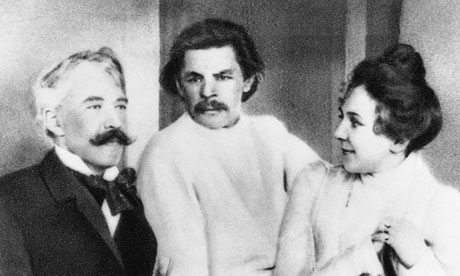
Maxim GorkyTheir first production, a historical epic by Alexei Tolstoy, was a success, largely due to the painstaking research undertaken for the costumes and set. Subsequent productions were less successful, including a Julius Caesar with Roman costumes and settings of impeccable archaeological credentials but that never came to terms with the play. Several productions were cancelled because of problems with the censor. The men quickly came to the point where they had to either have a huge success or sink forever: Nemirovich-Danchenko proposed that they perform a play that had flopped at its premiere, The Seagull, by short-story writer Anton Chekhov. Somewhat against his will – he neither liked nor understood the play – Stanislavski agreed. When the time came to stage it, he withdrew to his dacha, sending his elaborate mis-en-scene back to Moscow page by page, while Nemirovich-Danchenko rehearsed the actors – minus Stanislavski, who was playing the crucial part of the writer, Boris Trigorin.

Eventually he returned, the play opened and was a huge success. Stanislavski’s flair for creating atmosphere had resulted in an entirely new theatrical experience, in which the voices and characters were elements in an embroidery of sounds of nature and daily life, while the action was broken up to create the maximum poetic effect from the pauses and disjunctions of household routine; great ingenuity was exercised in filling these pauses with physical actions that would justify them. A hypnotic effect, a mirage of real life, was created: not strictly naturalism, but a poetry of the everyday.

The production’s success saved the theatre, which thereafter adopted the symbol of a seagull as its mascot. The author, however, though pleased his play had been liked (especially in comparison to its disastrous first production in St Petersburg) was far from happy with the staging, later ribbing Stanislavski by saying in his earshot that his next play would be set in a country where there were no crickets or mosquitoes to interrupt people trying to make conversation. Chekhov felt, too, that Stanislavski had misconceived the character of Trigorin. This was a recurring theme in Stanislavski’s career, both as director and actor: he had a habit of mentally substituting another play and another character, drawn from his own imagination, for the play and the character the writer had actually written. His literary sense was always poor; he was not an avid reader. Indeed, according to Nemirovich-Danchenko, he was technically dyslexic. He had great difficulty with words (learning them, even speaking them); off stage, too, he was famous for using the wrong word or for not being able to remember the one he needed. To what extent this influenced the development of his system, which often seems suspicious of language, is an interesting question.

Stanislavski was impelled to develop his system because of his dissatisfaction with the work he and his fellow actors were doing in the repertory that succeeded The Seagull: the three remaining plays of the Chekhov canon, Uncle Vanya, Three Sisters and The Cherry Orchard, and the first plays Maxim Gorky wrote for them. Stanislavski felt the company’s acting – his own as much that of his fellow players – remained painfully self-conscious and imitative; it lacked the pure “truth” he conceived of as the prime object of the actor’s art. From his earliest years, he had been plagued by the sense of self-consciousness: tall, handsome, graceful, intelligent, he was everything but spontaneous. Nemirovich-Danchenko describes what a favourable impression Stanislavski made on him at their first meeting: how serious, how thoughtful, how unlike an actor he seemed, neither loud nor vulgar nor self-promoting. The impression above all was of naturalness; the result, Nemirovich-Danchenko observes, of many hours practising in front of the mirror. By all accounts Stanislavski was richly endowed by nature to act. Throughout his autobiography, My Life in Art, however, he frets about not having been a great actor. It’s clear that if he had stopped thinking about it for a moment, he would have been. He saw this in himself, and attributed it to his fellow actors. The harder they worked, the worse they seemed to get. Exhausted – he had played the leading part in most of the productions, as well as devising the mis-en-scene for many and directing others – in 1910 he took a sabbatical year to try to solve the riddle.

He spent much of that time in Italy, closely observing great actors such as Tommaso Salvini and Eleanora Duse and trying to fathom what appeared to be their effortless inspiration. He came to the conclusion that they believed in what they were doing, and this belief gave them the capacity to be true to their inner emotion, despite the public nature of the stage; it created great relaxation, too: they seemed not to suffer from tension. At this point, Stanislavski turned his eyes on himself. Was he relaxed? Hardly ever. Did he believe in what he was doing? Almost never. But when had he been relaxed? When had he believed in what he was doing? When had he been good? He remembered certain passages of certain performances he had given. Why had they been remarkable? Generally, he discovered, because they were specific, rooted in either personal experience or memories of behaviour that had impressed him. This seemed to be the key. What if an entire role were to be constructed in this way? One would believe in every minute, and then relaxation would naturally follow: not an externally achieved relaxation, which he knew from trying made little or no difference to the performance, but a genuine, spontaneous freedom.

Something else that differentiated these great actors from – well, from him, for example – was that they knew why they did what they did. Their characters seemed to do everything for a reason: they always seemed to want something, and every action was for the achievement of this want. So there was another principle. Armed with his discoveries – the principles of belief based on the use of personal memories, relaxation and action – he triumphantly announced them to the convened actors of the Moscow Art theatre group. “I have discovered the principles of Art!” he cried. “Oh no, you haven’t,” they replied. “Acting’s not like that at all.”

From that point on, Stanislavski was something of a stranger in his own house. His relationship with Nemirovich-Danchenko, always fraught, became openly hostile, especially after the latter (by now a Communist Party member and head of all of Moscow’s dramatic theatres) publicly humiliated him by taking the leading part in The Village of Stepanchikovo away from him at the dress rehearsal, telling him he had failed to bring it to life. The company itself, during the turbulent years of the post-revolutionary period and the civil war, spent a great deal of time touring Europe and America. Abroad, the Moscow Art theatre was synonymous with Stanislavski, and his work (both as director and as actor) was universally acclaimed; his books, often clumsily translated and eccentrically published, became highly influential. Back in Moscow, he was increasingly marginalised. He eventually created the Studio theatre in which to test and establish his ideas, and then a Second Studio and finally a Third. Over the remaining 25 years of his life he taught more and more, modifying, adapting his principles, but never doubting the truth of those first discoveries. The founder members of the company never quite came round to them, and when they worked with him, he had to bargain with them, offering them large parts in his productions if they would agree to think in terms of the beats, actions, activities and affective memories. The younger actors embraced his ideas enthusiastically, but they then outstripped him in boldness and experiment; again he felt isolated within his own company, although, as he had always done in the past, he came to acknowledge their vitality and renewed himself by advancing into their territory with a radical and controversial production of The Government Inspector.

Meanwhile, he pushed his work further and further away from a simple-minded insistence on the primacy of emotion and psychology, exploring physical action and the crucial importance of rhythm in acting. These later developments have scarcely penetrated into western drama training, though they continue to be used and explored in the former eastern bloc, as has the work of Stanislavski’s pupils, and the results can be seen in the astonishing drama produced in that region, by theatres such as the Rustaveli theatre of Georgia, the Vilnius State Youth theatre, the Maly theatre in St Petersburg. It can also be seen in the impulse towards so-called physical theatre so typical of British theatre in the last couple of decades. In the west, Stanislavski’s work in its earlier phases is mostly deployed in drama schools. And it is here that it has been deeply influential. Because the majority of actors in the mainstream work within the bounds of psychological realism, particularly in TV and on film, Stanislavski’s formulation of the principles of acting is the foundation of most actors’ approach: connecting the emotional life of the character with one’s own; identifying their wants and actions; seeing how they fit into the play or script. Stanislavski was the first to identify these things, and to formulate a way in which actors could work on them, beyond imitation or intuition.

Brecht’s notions that acting is the servant of the story and that the audience needs to know no more of the character than is necessary for the comprehension of the narrative; that gesture is the actor’s key tool, and that the quest for the crystallising gesture is his or her main task; and that making the audience aware of the contradictions of the situation being represented is the purpose of the theatrical event seem not to have endured.

Stanislavski’s fascination with human character, its diversity and complexity, has endured, though there remains, embedded in his system, a deep suspicion of actors and their ingrained proclivity for self-consciousness, for superficiality, for the conventional and imitative – the things of which he so profoundly suspected himself. His star pupil, Michael Chekhov, though he subscribed to Stanislavski’s analysis of acting, had a different view of actors. He believed actors should preserve in themselves their first joyous impulses towards acting – at school, at home, in the street – their natural ease of assumption of character, their fantasy, their ready connection to their imaginations, and that out of that would come the sense of natural freedom that Stanislavski found so elusive. Playful Stanislavskian acting, fantastical Stanislavskian acting – now that’s something to consider. The part of him that knew spontaneity was at the heart of acting would surely have warmed to that.


A World Feast

The phrase ‘global village’ sprung to mind when I read what I am going to share with you today – on a number of levels. The Young Vic and Royal Court theatres in London have collaborated to produce a new musical, Feast, that spans 300 years, takes in five countries – and needed 10 writers in an ambitious attempt to dramatise the culture and belief system of Yoruba.

Feast, at the Young Vic.

.

.

.

.

.

.

.

A piece truly worthy of the title of world theatre – not only in its content but how it was created and by whom. I reproduce here, in full, an article by Maddy Costa that appeared in The Guardian this week that tells the fascinating story of Feast‘s conception and development.

Feast: the Young Vic goes Yoruba

There’s a party going on. Damon Albarn is busy improvising on a thumb piano. Sola Akingbola, the drummer from Jamiroquai, is playing a shuffle on a shekere (a large maraca strung with beads). And Cuban dancer Yanet Fuentes is shivering her hips to the rhythm. In the middle of it all sits theatre director Rufus Norris – the man responsible for harnessing this hubbub and putting it on stage.

These are the rehearsals for Feast, a new play tracing the spread of the Yoruba belief system and culture from its home in Nigeria to Cuba, Brazil, the US and UK. Since he began directing in the late 1990s, Norris has sought out difficult projects – among them London Road, a jagged musical dealing with the aftermath of serial killings in Ipswich; and Dr Dee, Albarn’s first opera, about a 16th-century alchemist. (The two have remained friends, hence Albarn’s open ticket to this rehearsal room in a London warehouse, even though he’s not in this show.)

Feast is no exception. It has five writers, who live in four continents, and a cast of 13. The story covers 300 years of Yoruba experience, taking in slavery, liberation, family and social politics. But Feast isn’t a history lesson, says Norris, and if it’s going to feel authentic to the Yoruba belief system – in which everything from a table to a sheet of plastic has its own spirit – “you can’t just have a load of blah-blah on stage”. Which is one reason why, right now, he’s gently arguing with his choreographer, George Cespedes, about the actors’ intricate dance moves. Norris thinks they will liven up the staging; Cespedes, who is used to having more rehearsal before curtain-up, is getting worried about the time.

Feast

Feast was dreamed up by Elyse Dodgson, who runs the international department at London’s Royal Court, which is co-producing the show with the Young Vic. In the mid-2000s, Dodgson happened to be working simultaneously with playwrights in Nigeria and Latin America, and was struck by how the orishas, or spirits, of Yoruba belief had travelled across the Atlantic with the men and women who were transported as slaves, and fused with Catholicism to form the basis of local religions: santeria in Cuba, candomblé in Brazil. “It’s such an amazing story of survival,” says Dodgson – the trouble was how to tell it. It took two years of workshops, involving as many as 10 playwrights, to reach the form Feast is in now. Those workshops, writer Gbolahan Obisesan admits, were a tussle, as he and his fellow writers struggled to “agree on something that links all of us together”.

Norris insisted from the beginning that he didn’t want the show to feel like a string of vignettes, so Feast coalesced around four figures drawn from Yoruba cosmology: Yemoja, the mother goddess; Oshun, goddess of love; Oya, the spirit of change; and Eshu, the trickster, who causes chaos wherever he goes. These are reincarnated across the show, taking the form of sisters separated by slave traders, civil-rights protesters in 1960s America, and athletes in modern London vociferously debating whether black people should have white lovers or white bosses. Each of the five writers – American Tanya Barfield, Cuban Yunior García Aguilera, Nigerian Rotimi Babatunde, Brazilian Marcos Barbosa, and Obisesan, who moved to the UK from Nigeria in 1990, when he was nine – is responsible for the segments set in their own country.

Clearly this hasn’t been the simplest of ways to work (just trying to interview the five writers proves almost impossible). Why not settle on a single voice? Babatunde speaks for all of them when he says: “The dynamics of the story of Nigerian diaspora can only properly be reflected by the changing tones of each section.” Barfield adds that, given the hybrid nature of much Yoruba culture, there was no other way: “It’s rare to have the structure and the theme [of a play] work so much in tandem. The weaving of the stories mirrors the weaving of belief systems.”

Norris suggests a more down-to-earth reason: “There are details in the Cuba scene that nobody who wasn’t from there would come up with. Similarly, nobody can really write the Nigerian scene unless they have a deep understanding of the women there.”

Strikingly, the five writers met only once, in London last spring, but discovered links between them both expected and unforeseen. Babatunde knew the orishas had travelled to Latin America with slavery, but hadn’t realised how openly they are worshipped in Brazil and Cuba. For his part, Aguilera knew that orishas inform a lot of day-to-day Cuban rituals (such as the deliberate spilling of the first drop of rum from a bottle, to appease the spirits), yet it wasn’t until he was in London that he attended his first santeria ceremony.

The writers found connections in their different upbringings, too. “When you step out of the household [in Nigeria],” says Obisesan, “you’re not just a representation of yourself as a human being, you represent the whole family, the house you were brought up in. You represent your ancestors.” That’s something Barfield was surprised to recognise from her Oregon childhood: “Many black Americans have no knowledge of our ancestors whatsoever, yet the belief system of ancestral heritage is fundamental to the black community.” And although she was brought up Christian, the Yoruba belief in pervasive spirits did feel familiar: “The idea of God being everywhere is very much a part of African-American belief.”

This notion of pervasive spirits was key to Norris’s staging of the Wole Soyinka play Death and the King’s Horseman at the National Theatre in 2009: the audience could see that the props and furniture were “alive” because they were given life by puppeteers, but the white colonial characters couldn’t. Norris lived in Nigeria for the first three years of his life, while his father taught in a university there; to him, belief in spirits makes perfect sense. “It’s not romantic. There’s an energy to things, and the people there have a deep understanding of that.” He remembers reading an interview with a Yoruba priest who, at the suggestion that his beliefs were mere superstition, replied along the lines of: “If somebody is blind, you cannot talk to them about sight. You can’t see it; I can. I’ll just have to allow you to remain in ignorance.” Such resilience helps to explain the tenacity of Yoruba culture, he suggests: the way it survived slavery, its permeation into other lands.

For all his belief in Feast, Norris is anxious about putting it on stage. Not only do multi-authored plays tend not to go down well with critics, but this is the latest production from World Stages London, a collaboration between eight London theatres whose work last year – including outdoor community piece Babel, pan-European play Three Kingdoms and Bollywood musical Wah! Wah! Girls – received mixed reviews. “If I’m honest, I’m bracing myself,” says Norris. “But this is a celebration of an amazing culture – you can’t deliver that in a lecture form. And our theatre needs to open up.”

And with that, he goes back to the Latin dancers, the uplifting rhythms, the vibrant story of saints and survivors.

Women in Theatre

Firstly, apologies for no posts recently, but a school production has swallowed me whole and just spat me out at the end of the run.  More about this later.

Today I want to return to a topic I’ve blogged about before, the roles for women in theatre, both on stage and off.  The all-female Julius Caeser I mentioned a few months ago has opened in London to rave reviews, one of which you can read here.

Julius Caesar at the Donmar Warehouse.

.

.

.

.

.

.

However, it has reignited the debate and I want to share some of articles that have been written in the last few days. Firstly, a piece called Women in theatre: why do so few make it to the top? written by Charlotte Higgins in which she asks leading figures why women are still underrepresented at every level of the business – and what needs to change. It is UK-centric, but the discussion and arguments are universal.

This article is supported by a piece of research, Women in theatre: how the ‘2:1 problem’ breaks down which presents some statistical research. Again UK based, but interesting reading none the less.

Finally, a great interactive graphic that explores women in Shakespeare, bringing us nicely back to the all-female Caesar. Click on the image below to take you there.

WIT

All the world really is a stage

Today I want to share an article that really is a true meeting of the East and West in theatrical terms.  A project by British theatre The Royal Court is about to see the staging of 12 new plays by Indian playwrights in London.  However it hasn’t just been a case  of commissioning new work, it has been about development, mentoring and shaping work with the young writers. In the article by April de Angelis, which I reproduce here in full, you can see what an exciting programme this really is.

..

.

.

.

.

.

.

Royal Court’s New Plays from India: snapshots of the subcontinent

How do you capture one of the fastest changing places on Earth – and do so on stage? Playwright April de Angelis reports on 12 new plays that should change our image of India for ever

In October 2010, Elyse Dodgson, director of the Royal Court Theatre’s international department, playwright and dramaturg Carl Miller and I arrived at the Jindal guest house in Vasind, in India’s Maharashtra state. Staying with us were 12 Indian writers whose work we’d read but had not yet met. It was an exciting, curious, daunting moment: in three months we would be expecting them to deliver 12 new plays, and in some senses that depended as much on us as them.

One of the first discussions we had centred on the Royal Court’s artistic director Dominic Cooke’s dictum that there are two questions a playwright must address before they start to write: what is a play now (a question of form)? And who are we now (subject)? These questions resonated through the workshop. In an early session, the writers were asked to list the urgent subjects facing their society that they felt were important to address. The results were wide-ranging, surprising and gave an extraordinary picture of the diverse forces at work within contemporary India: Maoism and the red corridor; migration from villages to cities; the clash of modernity and mythology; the influence of western-style celebrity, especially an obsession with youth; “honour” killings; the emotional isolation of modern living; the homogenisation of culture; political corruption; religious identity; low value of life; loss of ethnic identity. Someone mentioned the Gulabi gang (a women-only vigilante group, who wear pink saris and smash up liquor shops because they don’t want their men drinking).

We then asked the playwrights to bring in newspaper cuttings with contemporary stories: these included reports on the plight of street children; the ongoing Bhopal compensation case; female infanticide; the case in which a male student killed himself after being secretly filmed having sex with another male student; the cheap-rates offered to westerners for Indian surrogate mothers. From these the playwrights began to identify subjects they felt drawn to and to investigate ways of telling their story.

There was much amicable debate. Were we trying to impose a template of a play on them? Could we honestly say that the concept of an “objective”, for example, is incontrovertible? No, we couldn’t, but on the other hand we found it to be a useful tool. The plays being written were for Royal Court audiences as well as for audiences in Mumbai, Bangalore, Pune, Chennai and Delhi, as well as, hopefully, elsewhere in India. Just as we had specified a contemporary Indian play – as opposed to, say, a historic, poetic drama – we were also proposing a vocabulary of playwriting. The playwrights were industrious and wanted to get on with the business of writing. By the end of the first workshop, each had created a proposal for a play and written a first scene. We met with each of them, gave dramaturgical advice, ironed out any potential problems, and said goodbye – for now.

Three months later, 12 plays arrived. Those written in Hindi and Marathi were translated. Stage two commenced. Rage Theatre Company, the creators of the Writers’ Bloc festival, our collaborators, arranged for a group of actors to be involved in another workshop. The plays were read aloud and each writer selected a scene they knew would be in the next draft, but which had problems to be solved. These were then worked on with actors who might improvise the more unclear or unconvincing moments. We all watched and discussed the scenes in their latest incarnation. It was very exciting to see the plays “living” for the first time and many memorable moments occurred: Shernaz Patel playing the ageing Bollywood actress in Siddarth Kumar’s Spunk desperate for the male lead’s, well … spunk, and its magical properties of endowing male children only; the startling image of two Kashmiri children stealing into a morgue to retrieve the football boots from their murdered friend, a victim of state repression in Abhishek Majumdar’s The Djinn’s of Eidgah; an older man risking his reputation as he and a younger man meet and become lovers on the Delhi metro in Still and Still Moving by Neel Chaudhuri.

The writers then embarked on their second drafts, which became the basis of productions in their own cities as well as being performed in January 2012 at the Writer’s Bloc festival hosted at the Prithvi theatre in Mumbai, a non-profit making theatre founded by the famous Bollywood Kapoor family and run, like all Indian theatre, on a non-subsidised basis. This, of course, makes life as a playwright extremely hard for Indian writers. In Britain, without subsided theatres such as the Royal Court, new writing would be a pipe dream. Five of these plays were then invited for the upcoming readings at the Court this month.

Purva Naresh trained in classical Indian dance and works as a film producer. Her play OK Tata Bye Bye is a provocative articulation of some of the central schisms in contemporary India: between rural and urban, traditional and modern, western and eastern ways of living, all pivoting on the contentious ground of gender politics. “OK tata bye bye” is the logo you see inscribed on the back of brightly decorated Indian trucks, and the play takes as its subject and setting caste-based prostitution that has sprung up along the side of an Indian highway. This teasing play takes as its premise the collision of two worlds, that of a young, independent-minded sex worker, Seema, who becomes the subject of a well-meaning documentary made by Pooja, an urban educated Indian woman fresh out of film school and her white American boyfriend, Mitch, whose earnest desire to engage with the subjects of this documentary teeters on the edge of voyeurism and exoticism. Pooja is torn so many ways, is she western or Indian? With whom does her allegiance lie? With a white western man, or a rural, lower-caste Indian woman? And underlying it all, the vibrant figure of Seema – refusing to be safely contained within a defining discourse – who worries away at Pooja like a brightly coloured shadow in danger of stealing the show. It is a brilliant and provocative look at sexual politics, identity and the perils of being a modern, urban Indian woman. And with show-stopping choreographic moments.

OK Tata Bye Byeregisters another conflict, that of technological power versus community; asking who is holding the camera? This theme also resonates in Mahua, a play about the enforced loss of tribal lands to a corporate mining company, by the young film-maker Akash Mohimen. As it opens, it has a timeless feel: Birsa, a tribal leader in waiting, in the village of Bihabend in the state of Orissa, commits a minor indiscretion and as a result must marry an “old” woman (she is 30!). This seems to be the set-up for a comedy, but slowly morphs into tragedy as he and his (now) beloved wife suffer the loss of their land and then of their livelihood and identities. The final act of Birsa is both tragic and merciful, underscoring the point that such powerlessness leads to impossible choices.

Back in bustling Mumbai, British-based actress and writer Ayeesha Menon is a contemporary, comic, female Indian voice. The sparkling Pereira’s Bakery at 76 Chapel Road brings the clash of traditional and modern right to the heart of a great city with a diverse cast of characters ranging from the doleful, old-man misanthropist always at hand philosophising home truths, to the young X Factor aspirant whose insistent warblings bring tensions to breaking point.

We see the forces of old and new contending with each other, culminating in the major crisis of the play, the threat to demolish the old quarter for the sake of progress, to steamroller the charm of an ancient district to make way for the sterile constructions of capital. The play captures both the centrality of family to Indian life and the frustrations of those who feel trapped by it and wish to escape the past and tradition – but, having done that, is it ever possible to recapture what has been lost?

Leftovers is set in Pune, written by Saga Deshmukh, a lawyer. It movingly details the difficulties of a family who are left behind in a city that is powering the economic engine of India. It centres on Baba, the patriarch, and his failure to fit into the new order. It is a delicately observed play about the unheard suffering of ordinary people.

Finally, The Djinns of Eidgah by Abhishek Majumdar, is set in the ongoing conflict in Kashmir and tells the story of two children. Ashrafi, a young girl, and her brother Bilal, orphaned by the conflict and struggling to grow up, find themselves in a world defined by violence. They are befriended by a doctor who seeks to steer a path between the warring sides, but the conflict proves too toxic. This play is partly magical in its incarnation of the djinns, ancient spirits which the young girl incants. Perhaps Majumdar’s riposte to our insistence on a contemporary Royal Court play, The Djinns of Eidgah merges old and new in a fusion of traditional Indian theatre forms and contemporary themes.

It is fascinating to look back at the whole process and see the way themes and ideas from the initial stages of the workshop have threaded through to the unique and original plays that exist now. Each play provides a prism through which it is possible to have a glimpse of India today. It’s clearly a great time to be an Indian playwright.


If you are interested in finding out more, you can here as well as watching interviews with the playwrights in their own languages, Hindi and Marathi.


Crowd Sourcing Theatre

A national newspaper in the UK has just launched a project that really interests me – the idea of a crowd-sourced theatre project.  The Guardian is working with a regional theatre, The West Yorkshire Playhouse, on a production of Tennessee Williams’ Cat on a Hot Tin Roof. During the production they are running a series of articles that take you through the production process as well as exploring in more depth other aspects of staging the play. But more than this they asking their readers to review the show and share their reviews, as well as offering advice from professional theatre critics about how to write a good review.

The link that will take you to the ‘series’ page is here.

.

.

.

.

.

.

.

.

.

.

.

.

..

.

I have already posted the article written by Michael Billington about the history of the play itself, but if you click on the image below you can re-read it:

.

.

.

.

.

.

.

There is a collection of images from various productions of the play from 1958 onwards which you can view by clicking here and advice from Lynne Garnder, professional critic, about review writing here

You can even watch trumpet player Simon Beddoe and pianist Matthew Bourne talk about the challenge of providing ‘reactive and emotive’ improvised accompaniment to the play, working with the cast and the director to create a soundscape that reflects and comments on the world of the play by clicking here.

However, my favorite so far is an article by Alfred Hickling, which follow the fit-up week when the set is built and technical rehearsals take place. It’s that interesting I’m not going to link to it, but reproduce it in full.

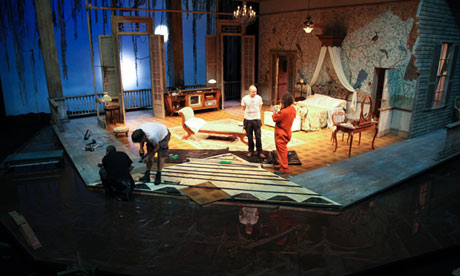
Behind the scenes: Cat on a Hot Tin Roof at West Yorkshire Playhouse

A society drowning in bourbon-coloured water, an opulent mansion and improvised jazz are not the easiest of illusions to create on stage, as Alfred Hickling discovers as part of our unique crowd-sourced theatre project

It’s the first day of the fit-up at the West Yorkshire Playhouse – the week in which the set is installed and technical rehearsals begin – and already production manager Eddie de Pledge has a sinking feeling. Not that there’s anything wrong (the build is progressing on schedule), but the design for Cat on a Hot Tin Roof requires approximately a third of the stage to be submerged in brown, bourbon-coloured water.

Before anything else can happen, several layers of industrial-grade pond-liner have to be deployed. “If a designer wants water as a scenic element, you have to add at least an extra day to the schedule,” De Pledge says. “Even 10 centimetres of liquid creates over three tonnes of additional weight. Then there’s issues of humidity in the atmosphere, especially where electrics are involved. And the water has to be changed regularly to prevent it becoming stagnant.”

De Pledge will be doing his utmost to avoid any aquatic disasters on the scale of the National theatre’s production of Alan Ayckbourn’s boating comedy Way Upstream, which notoriously flooded the Lyttelton auditorium in 1982. But there are valid artistic reasons for turning the Playhouse into a temporary swimming pool. Designer Francis O’Connor explains: “The Quarry theatre is one of the largest stages in the country – it demands that you make an epic, visual statement. At the same time, Tennessee Williams’ play is remarkably intimate – there are lots of sequences which are basically two people talking in a bedroom.” O’Connor’s solution has been to increase the rake of the stage, so that the the room itself plunges into a tide of muddy, brown water. “The play deals with death, alcoholism and a family in crisis,” O’Connor says. “The idea was to suggest a society sliding into the drink.”

Recreating the opulence of an antebellum mansion is an expensive business. There’s a budget of more than £1000 for balustrades alone (all the show’s carpentry is done in-house) and a parquet floor to be laid – albeit from painted MDF rather than solid wood. Even the chinoiserie of the decorative scheme is the outcome of a careful search to find period-correct silk wallpaper: “Though not in Mississippi,” O’Connor says. “Sadly, the research budget doesn’t stretch that far. But we found something very close at Nostell Priory, near Wakefield.”

.

.

.

.

.

.

.

The director, Sarah Esdaile, did visit the Mississippi Delta, however, while on honeymoon four years ago. The trip fired her ambition to direct what many consider to be Williams’s finest work. “What this play gives you is that otherworldly sense of southern Mississippi,” she says. “It’s like no place on Earth; the flatness, the humidity, the weird alien moss hanging in the swamps. And then there’s the music of course.”

Williams’s fictitious plantation is in the region of Clarksville, often referred to as the birthplace of the blues (Elia Kazan’s original Broadway production featured an appearance by the great country-blues duo Sonny Terry and Brownie McGhee. Esdaile’s production shifts the action slightly further south, to the swampland surrounding New Orleans, and takes inspiration from the sounds of that region. “We originally discussed commissioning a jazz-based score,” she says, “but then we realised that a jazz composition may be a contradiction in terms.”

Instead, the music in the production is the result of an unusual experiment in which a group of musicians from Leeds Improvised Music Association (LIMA) were invited to interact directly with the cast. As the actors rehearsed, the musicians improvised, and the results of these sessions have been edited into a montage by sound designer Mic Pool. “In an ideal world, we’d have live musicians improvising every night,” Esdaile explains. “Unfortunately we couldn’t afford that. But what we do have is a bespoke score that developed as the result of an improvised dialogue between actors and musicians.”

.

.

.

.

.

.

.

Esdaile has just one further day in the rehearsal room before a gruelling week of 13-hour days begins. “It’s the most exciting and the most nerve-racking part of the process,” she says. “You have four weeks to create a theatrical illusion in the rehearsal room; and then four days to recreate it all again with lights, sound and costumes. It’s the point where you most often find yourself switching into problem-solving mode, and it can sometimes seem as if the poor play is being ignored.”

The main contribution to a successful tech is anticipating problems in advance – nowhere more so than in the wardrobe department, for which a classic costume drama such as Cat on a Hot Tin Roof is a major operation. Deputy head of wardrobe, Victoria Marzetti, explains: “You read the script and note that it is set in 1950s Mississippi. That means lots of white linen. And lots of linen means lots of laundry.”

Her job is made more challenging by the fact that some of the actors will be required to wade ankle-deep through filthy brown water. This won’t present such a problem for cotton and light fabrics, but some of the more elaborate women’s costumes are dry-clean only. It’s not practical for theatres to work with cleaning chemicals, but Marzetti reveals that there is a secret, temporary fix for emergencies: “Vodka. A quick squirt with neat alcohol works wonders because it kills the bacteria.”

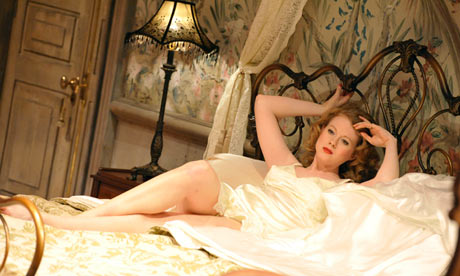
Marzetti pulls out the wardrobe department’s proudest creation for this show – the outfit worn by the matriarch Big Mama, whom Williams describes as being like “a Japanese wrestler wearing at least half a million in flashy gems”. Big Mama’s bling was made possible by the fortunate find of several metres of emerald, beaded fabric at a knock-down price. But an even greater bargain is the padded underwear – a Debenhams leotard stuffed with birdseed – to plump the actor, Amanda Boxer, to an appropriate size. “It will be very hot and very heavy” Marzetti says, “but Amanda wanted to feel the incapacitating effects of genuine weight.”

Movement director Etta Murfitt has been teaching Boxer how a much larger person gets in and out of a chair; and has spent time developing a suitably feline stance for Zoe Boyle, who plays Maggie the Cat. But there is little point in the actors looking right if they don’t sound right; and perhaps the most indispensable role has been that of voice specialist, Kara Tsiaperas, who has coached the cast in the nuances of deep south dialect.

“Williams was very specific about melodic speech patterns he wanted to hear,” Tsiaperas says. “There’s a stage direction which states that Maggie’s voice must have ‘range and music’.” Tsiaperas, a New Yorker herself, says there is nothing worse than actors falling into “generalised, American drawl. It’s a myth that everyone in the south talks slowly – it’s just that the stress falls on different vowels. But the hardest thing of all is not to sound condescending. Whenever I’m required to coach southern American accents I’m reminded of a line from the film Sweet Home Alabama: “Just because I talk slow doesn’t mean I’m stupid.”

Resourcing Asia

The writing of this blog has taken me on a compelling and fascinating journey into the outer reaches of the internet. I am always amazed at what people are prepared to share and take the time to develop and post.

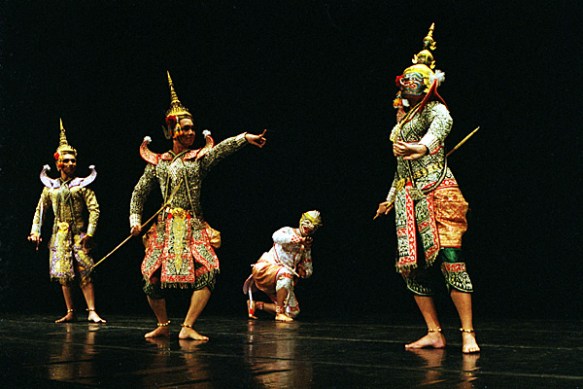
However, yesterday I struck gold for everyone who has interest in, or needs to have a working knowledge of, Asian performance traditions. It is a vastly illustrated web-based text book, an introduction to Asian theatre and dance traditions and so far covers India, Sri Lanka, Myanmar, Thailand, Laos, Cambodia, Vietnam, Malaysia, Indonesia, China, Korea, and Japan. Click the image below to enter this exceptional web-site.

A couple of quotes that stood out for me:

The interrelatedness of drama, dance and music

In Asia drama, dance and music are inseparable. In the European performing arts, on the other hand, they developed their own ways. Thus in the West we talk about text-dominated “spoken theatre”, music-dominated “opera”, and dance-dominated “ballet”.

Most of the traditional forms of Asian performing art combine drama, dance and music into a kind of whole in which it is difficult to draw a clear borderline between these art forms. Most of the Asian traditions employ either dance or dance-like, stylised movements, while movements are frequently interwoven with text. In addition to this, most of the traditions are characterised by their own specific musical styles or genres. The acting technique, which employs dance-like body language, is usually very intricate and it demands many years of arduous training, as western ballet technique, for example, does. Therefore in Asia it is simply not possible to classify stage arts as nonverbal “dance” or “spoken theatre”.

The Interaction between “Living Theatre” and Puppet Theatre

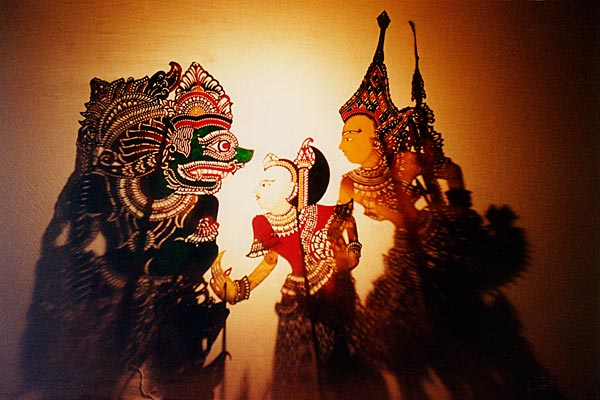
In Asia, puppet theatre and one of its variations, shadow theatre, are often regarded as valued “classical” traditions, whereas in the western tradition puppet theatre is, with only a few exceptions, regarded merely as children’s entertainment.

In Asia there are dozens of important forms of puppet theatre. One could generalise that shadow theatre usually represents the early strata of puppetry with a long history and religious or magical connotations. In shadow theatre the silhouette-like figures are often cut from leather or other transparent or semi-transparent materials and they are seen through a cloth screen while manipulated by one or more puppeteers.

The interaction of puppet theatre and “living theatre” is one of the characteristics of Asian theatrical traditions. There will be several clear examples in this book of how puppet theatre has influenced the structure, acting technique and other conventions of “living theatre” and vice versa.

The main person to thank for this incredible resource, who is the editor and main writer, is Dr. Jukka O. Miettinen, a lecturer at the Theatre Academy and Helsinki University in Finland and Mahidol University in Bangkok, Thailand.

On Cloud Nine

I first encountered Caryl Churchill when I was doing my A Levels, many moons ago. It was her play, Cloud 9, that captured me and her writing has held me enthralled ever since.
It was the structure of the play, not just the content, that caught my attention, although it would be fair to say that the politics it spoke about shouted at me loudly. Act 1 is set in British colonial Africa in Victorian times, and Act 2 is set in a London park in 1979. However, between the acts only twenty-five years pass for the characters. Each actor plays one role in Act 1 and a different role in Act 2 – the characters who appear in both acts are played by different actors in the first and second. Act 1 parodies the conventional comedy genre and satirizes Victorian society and colonialism. Act 2 shows what could happen when the restrictions of both the genre of comedy and Victorian ideology are loosened in the more permissive 1970s. The play uses controversial portrayals of sexuality and obscene language and establishes a parallel between colonial and sexual oppression – and it made laugh!
Also it was developed inconjunction with Joint Stock Theatre Company who were taking the British theatre world by storm at the time with a new way of working, developing plays with well-known playwrights, in the rehearsal room.  The company is no more, but has given birth to Out of Joint, which was founded by Max Stafford-Clark, one of the original members of Joint Stock.
.
.
.
.
.
.
.
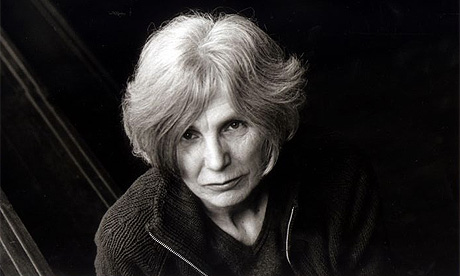
And why am I reminiscing about the play today?  Well, Churchill (pictured above) is about to open two new plays at London’s Royal Court Theatre.  Her writing career has spanned more than 50 years and her influence on Western theatre has been significant, and for me, satisfyingly controversial. You can read about her work and the two new plays in a fantastic article, Caryl Churchill: changing the language of theatre.
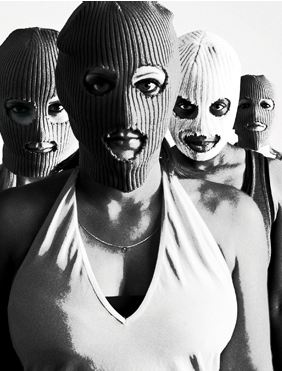
Therefore it also seems fitting that I should return to a post I made in June, “there aren’t bloody well enough parts for women” which bemoaned the lack of roles for women in theatre. Well, Churchill has gone a long way to address this in her career and it caught my notice that an all female version of Shakespeare’s Julius Caesar as about to open at the Donmar Warehouse in London. One writer commented that “The Donmar’s gender switch of Shakespeare’s play could turn a dusty GCSE set text into something much more Pussy Riot”.
 
An interesting thought!
 

Sound and Fury

Today I want to share an adaptation of a play, Kursk, to film. It is from a growing genre, that of Immersive Theatre, where the audience are required to experience more than something just created with words. The film version attempts to capture some the plays’ experiential  attributes.

In the year 2000, a Russian submarine, the Kursk, suffered a huge explosion that ripped the bow apart and sent the vessel to the seabed. Inspired by this tragic event, this production takes the audience on the imagined journey of a British Submarine sent to spy on the Kursk. The audience is subsumed in the submarine space with the performers, silent observers to the events as they unfold, complicit in their world of secrecy and codes, witnesses to the last minutes of the Kursk.

The piece puts the audience at the heart of the story using a novel and highly engaging staging that embraces both the epic and intensely personal. Using cutting edge sound design that creates the sonic equivalent of a virtual submarine, Kursk is an authentic and emotionally rich voyage into the icy depths of the Barents Sea and the dark recesses of the imagination.

Kursk received quite amazing reviews, two of which you can read here and here.

Thanks to a new initiative in the UK, The Space, the play has been reworked for film and you can watch the whole thing by clicking the image below

The producing company, Sound&Fury is a collaborative theatre company whose artistic interest is in developing the sound space of theatre and presenting the audience with new ways of experiencing performance and stories by heightening the aural sense.

Also on The Space is a fascinating documentary, Writing Kursk, about the making of the piece and is well worth a listen.

I am a real fan of this immerse theatre as I think it can challenge audiences in a very visceral way.  Mind you, not everyone agrees. In her blog, journalist Lynne Gardner explains why she has issues with it; Immersive theatre: take us to the edge, but don’t throw us in, she asserts, saying that it can replicate terrifying human experiences, but this type of theatre is best when it maintains some perspective.

Playing The Game

Now then, Gaming. Never something I’ve managed to get into, which is probably a good thing for me – Angry Birds is about my limit and even that frustrates the hell out of me. However, I do know that many of my friends are into gaming, online or off and that certainly many, many of my students are and this is where the research trail for this post began.  I have a student, Arisa, who is looking to explore the link between performance and gaming as a focus for her extended project.  Not wishing to sound like a complete idiot when advising her I decided I should do some research of my own and I was astounded at what I came across.

So I’ll start here with a review for The Crash of the Elysium (above) which is a new piece of children’s theatre, set in a multi-story car-park, by the internationally renowned Punchdrunk which is described as much of a game or adventure as it a performance. One critic commented

You certainly have to be on your toes, and…….is a one-off experience that children are likely to talk about for years. It’s also a reminder of what theatre can learn from other forms, particularly gaming. The excitement of the young audience comes…….from an active engagement in the unfolding scenario. Take nothing with you except a sense of adventure, wear flat shoes, be prepared to run…….

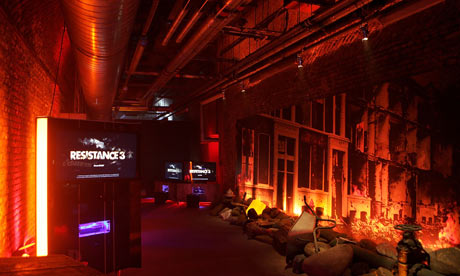
So this led me to Punchdrunk’s collaboration with PlayStation for the release of Resistance 3, Sony’s flagship sci-fi horror series. The company created a terrifying world beneath the railway arches at Waterloo station in London. The audience take the role of one of the few remaining survivors of an apocalyptic event and as one commentator noted:

From the moment the door closes behind you and you start to navigate the first dank corridor, torch in hand, you are as much part of the experience as witnessing it

.

.

.

..

.

.

.

And Darkness Descended as the piece is called was reviewed widely – both as a piece of performance and by technology writers and bloggers and the reaction from the two very different groups is fascinating. One blogger, Kevin Holmes who writes for a collective called The Creators Project (which is a global network dedicated to the celebration of creativity, culture and technology) entitled his piece Gaming And Theater Merge To Scare The Crap Out Of People – which I just love as a description.

.

.

.

.

.

.

.

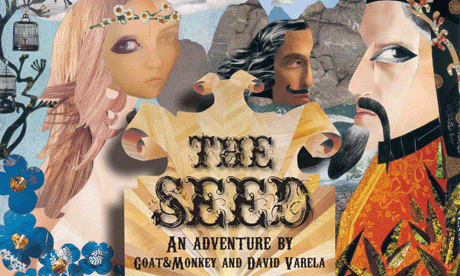
Then I found this article The Seed: where theatre, gaming and botany collide on a gaming  blog. The Seed is by the company called Goat and Monkey and is described as part immersive theatre and part on-line mystery.  This led me to another game blogger, Fin Kennedy, who asked the question Can video games help theatre reach the next level?

Another writer, Matt Trueman, asked the question The form is growing up. So what do we want from our games as theatre? Is it enough just to play or must we demand that games demand more?

I then came across another Punchdrunk production Sleep No More which is based vaguely around Macbeth, and was described by Salon website as

Shakespeare meets Internet games – Macbeth and alternate reality gaming collide in a show that could suggest the future of cutting-edge theater

.Click the image above for the New York Times review, or here for the Salon article.

This is a relatively new developing area of theatre. There is clearly much emerging all the time. There are even doctoral thesis’ being written on the subject. There is one here, by Katherine Whitlock, entitled THEATRE AND THE VIDEO GAME: BEAUTY AND THE BEAST.

It just all sounds so exciting. Maybe I’ll try Angry Birds again!