Shadows Of The Empire

I find myself in Sabah, Malaysian Borneo this week and as coincidences go this is a good one.  On the way here I came across an article in The Wall Street Journal about shadow puppet theatre – but with a difference. Entitled Star Wars as Shadow Play, the writer John Krich  talks about a new shadow play called Peperangan Bintang, which translates from the Malay into Star Wars. str2_cn_2710_cnbintang_A

In the article Krich outlines a three-year old project by Tintoy Chuo to find a new, younger audience for the ancient Malaysian art of Wayang Kulit:

George Lucas credits the success of his Hollywood blockbusters in part to traditional forms of mythmaking. Now, his storytelling is coming full circle. Those heroes and villains from “a galaxy, far, far away” have landed in Malaysia with the mission of reviving its traditional art of the “shadow play.”

“I’m trying to combine the traditional with the high-tech to find a unique way to preserve Malaysian culture,” says originator Tintoy Chuo. “I myself sometimes find shadow play too long and boring. But this is something cool that young people can relate to. Even my mom knows ‘Star Wars.'”

A 25-minute preview of “Peperangan Bintang” (Malay for “Star Wars”) premiered last October. Drawing on the first of the films to be released—whose full title is “Star Wars Episode IV: A New Hope”—it features Sangkala Vedeh (Powerful General Vedeh, or Darth Vader), Perantau Langit (He Who Walks in the Sky, or Luke Skywalker) and Puteri Leia (Princess Leia), plus the familiar squeaking robots, augmented by banging gongs and screeching horns, eerie graphics, dramatic recitations and sound effects of heavy breathing and robotic squeaks. Mr. Chuo is still working on turning it into a full-length shadow play, usually 1½ hours.

“I thought it was a brilliant idea from the start,” says the retiring president of the Star Wars Malaysia Fan Club, Adi Azhar Abdul Majid. The club of 200 paying members—”from architects to kids who flip burgers,” says Mr. Adi, a former lawyer and freelance professional emcee—stages movie marathons and garage sales of memorabilia to support local charities. With the fan club’s help, Mr. Chuo was able to contact Mr. Lucas’s Lucasfilm, which said through a spokeswoman that Mr. Chuo’s “art was beautiful” and “was impressed with his passion for ‘Star Wars.’ ” Lucasfilm said it has offered to put Mr. Chuo’s photos in its fan publication, Bantha Tracks.

It was three years back that Mr. Chuo, 42 years old and a father of three, first struck on the idea of redesigning Luke Skywalker and the gang in shadow-play style. He raised funds by selling T-shirts displaying his fantastical hybrid creations. He seems perfectly suited to the project: By profession he’s a “character creator,” designing creatures for use in games, advertisements and other applications. But in the end he decided he needed help from a shadow-play “jedi.”

10411228_735168279878618_802517924135396961_n

“At first, I made them in plastic with lasers,” Mr. Chuo says. “Soon, I realized I needed to find a real puppet master to help me stage a performance.” A long search across rural villages ended with a Facebook inquiry from Muhammad Dain bin Othman, 62, a shadow-play master known familiarly as “Pak,” or Uncle, Dain. “That Christmas,” Mr. Chuo recounts, “I saw my first shadow play and he watched his first DVD of ‘Star Wars.’ ”

Pak Dain’s conclusion: “It’s a simple story, not difficult.”

The master soon helped Mr. Chuo fashion 10 puppets the old-fashioned way, of cowhide, the holes made by nails. Pak Dain’s only hesitation was over his reputation for authenticity. He decided it was acceptable to adapt “Star Wars” because tradition allows “outside stories” to augment main mythic plot outlines. “Nobody has complained so far,” Pak Dain explains, because musical themes specific to the Hindu characters Rama and Sita were changed.

“I told him that if some found us inauthentic, I would take the blame as the Chinese guy,” Mr. Chuo says.

Hailing from the Tumpat district of Malaysia’s northern state of Kelantan, a shadow-play hotbed, Pak Dain was taught by three learned masters and began mounting performances in the 1980s. He retired in 2008, but kept a connection, pouring his money into training musicians to keep alive this art that was once a regular feature of weddings and village celebrations. Unable to perform, he opened a Kota Bharu gallery for the puppets. It is estimated there are only 10 surviving master puppeteers around Kelantan, where the form of theater was adapted from Indian sources. Compared with the better-known Indonesia version, Malaysian wayang kulit features rounder, more transparent figures—colors shine through the silhouettes. The characters have one movable arm, as compared with two in Indonesia.

10451678_735168206545292_7375208139219776895_n

The slow and relatively static performances have lost ground to movies, television and videogames. Today, the Malaysian shadow play is performed mainly for tourists in the Cultural Center of Kota Bharu, Kelantan’s state capital. One of the motives for basing a production on a Hollywood legend is, in Pak Dain’s words, to “change the mood” of authorities by “showing that shadow play doesn’t just belong to Rama.”

Though he’d like more funding to improve backdrop effects and perform overseas, Pak Dain says he will “continue to sacrifice a lot because we all love it and we want to promote it to the younger generation.”

This put a huge smile on my face for a number of  reasons. One, the attempt to keep, revive even, a traditional theatrical form like Wayang Kulit is admirable and innovative on Chuo’s part. Two, as contemporary theatre is using the big screen to widen its audience base, I am taken by the idea that the world of cinema is finding a place on the ‘theatrical screen’. Three, I have to admit I’m a Stars Wars fan – but of the original films, not the dross that Lucas produced later

.

Tintoy Chuo and his team have been working hard to publicise their work. Firstly an interview with Chuo, Take Huat, Pak Dain and Ahmad Azrai by Gloria Kurnik about the project, which you can watch here.  Secondly, Chuo and Huat took part in the TEDx event in Kula Lumpur, and spoke about their work:

.

There is also a Facebook Page which follows the development of the project, which is planned to be finished – a full length Wayang Kulit piece – by the end of the year. There is a little trailer here, which just made grin from ear to ear, especially the scene with R2-D2 and C-3PO

.

1479328_634266829961483_1618726353_nThe fact that traditional techniques of puppet making and puppeteering are the centre of this effort is heartening, as is the use of traditional Malay instruments to play the soundtrack. Also, there is an alignment of characters with those in the traditional Wayang Kulit stories, which will hopefully widen the appeal. On the flip side, when the New Straits Times wrote about the venture, they did so on their ‘Tech’ pages, because of the computer generated visual effects being used.

This truly is fusion in so many ways.
Specifically Epic

Last week I had a moment of enlightenment while doing some reading around site specific theatre. Actually it was more of Homer Simpson ‘duh’ moment. We tend to view site specific/responsive theatre as something new, simply because of its huge and growing popularity. This was my Homer moment, the realisation that of course it has been around in one form or another for hundreds of years, both in the East and the West.

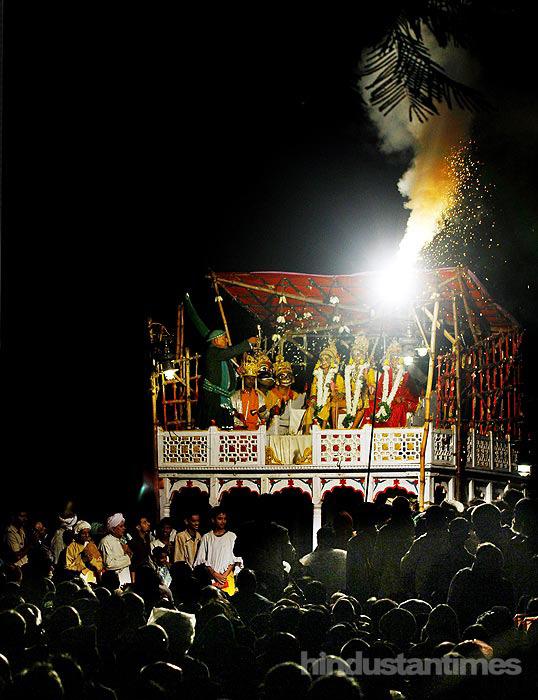
Ramnagar-AA-20-700One site specific performance that is almost 200 years old is the Ramlila of Ramnagar performed in Varanasi, India every year. It was started in 1830 by the Maharaja Udit Narayan Singh and is a theatrical portrayal of the Hindu epic, the Ramayana. Ramlila or Ram Leela (which means, literally, Rama’s story) take place all over India, but the one in Ramnagar is an epic in its own right. It lasts 31 days and takes place over an area of almost 8 square kilometres – basically the city is turned into an open-air set.  It is steeped in tradition – characters are played by local actors and major roles are often inherited by families, a good example being, the role of Ravana  which was held by same family from 1835 to 1990. It is reckoned that over 1 million people come to watch the spectacle every year. What interested and heartened me was that the ‘audience’ are indeed pilgrims. Very few foreign visitors are amongst the spectators as Ramnagar currently has no real tourist infrastructure. It wasn’t until 2013 that it was officially allowed to be documented on film.

13jun_Ramleela-Issaq01

There are many Ramlila that take place across India, particularly in the North, but they generally last 10 days. Like Kabuki in Japan, Khmer Shadow Theatre in Cambodia, Commedia dell’arte in Europe and many performance traditions across the world, Ramlila is recognised by UNESCO as a Masterpiece of the Oral and Intangible Heritage of Humanity:

.

There are two excellent articles which are worth reading if you’d like to know more. The first is by Richard Schechner, a professor of performance studies at New York University. Written for the The New York TimesA Maharajah´s Festival for Body and Soul is an Untitledexcellent insight to the Ramlila of Ramnagar and details the potential problems that face it in the 21st Century. The other, equally as informative, is by Saudamini Jain for the Hindustan Times, entitled A look at the grandest Ramlila in the world

Another interesting online source comes from ZeeNews and is about the Dussehra Festival during which the Ramlila takes place.

In his Introduction to Theatre in India, David Mason,  Associate Professor of Theatre, Rhodes College draws the parallels between the Ramlila and the liturgical dramas and passion plays of Medieval Europe.  This ties in with my opening paragraph to this post,  as one of the traditions I realised was effectively site-specific is the Oberammergau Passion Play which is performed every 10 years by the inhabitants of the village of Oberammergau, Germany and been done so since 1634.

One more excellent resource that I have come across is The Ram Lila by Norvin Hein. Very detailed and clearly part of a larger work, although I cannot attribute it beyond that.

So there you have it – my ‘duh’ moment has left me a wiser person.

The Faces Of A Master

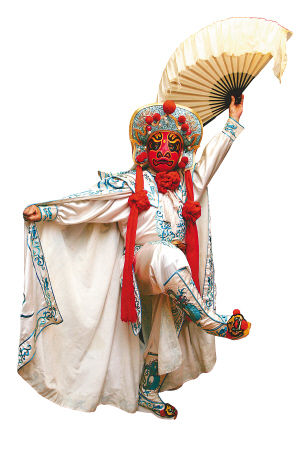
Bianlian_FotorIn my school we are in the process of writing a new curriculum for our younger students and one of my roles has been to gather together materials for an online course to compliment and enrich the taught classroom practice. This week I have been working on a Mask unit and it suddenly struck me that there was one particular practice involving mask that would be perfect for that course and one that I have not explored here on Theatre Room. 

Biàn Liǎn (变脸) or Face Changing has a long and traditional history in China, first appearing in Sichuan Opera during the Quing Dynasty, almost 300 years ago. Opera in China, it needs to be understood, takes many forms, depending on where it originated. Here in Hong Kong we have Cantonese Opera, as I have written about many times before. However, Sichuan Opera is a little different to most traditional forms. It tends to be more ‘play-like’ and less constrained, with more entertaining elements to enliven the performance. These included sword fighting, fire eating, beard-changing and Biàn Liǎn. Now if you live outside China it is unlikely that you will have ever seen Biàn Liǎn. It is a closely guarded art form and taught only be a few old masters, although it is seen more often today in other Asian countries. Before I go any further, have a look at this:

 .

It isn’t surprising that information about Biàn Liǎn in english is quite limited, but you can get a decent understanding its history and how it works here and here.

MTMyNTgyODAxODQzMjVfMQThere a number of rumours surrounding Biàn Liǎn which I quite like. Firstly that the secret of Bian Lian leaked out during a 1986 visit of a Sichuan Opera troupe to Japan. Indeed, the Japanese are big fans of the face changer (and see the video below). Secondly, that Biàn Liǎn is one of the traditional arts protected by Chinese secrecy laws although officials of the Ministry of Culture of in China have stated that this is not true. Thirdly, Hong Kong Canto pop star Andy Lau offered to pay Bian Lian master Peng Denghuai 3,000,000 yuan (which is about US$360,000) to learn the techniques. Although Lau did learn the from Peng, both deny any money changed hands. If it did, Lau wasted his cash as he seems not yet to have mastered the art. All three of these rumours are touched upon in a South China Morning Post article from 2010, which you can download here The Secret Art. The SCMP also have a video interview with another Biàn Liǎn master, Wai Shui-kan which is worth a watch:

One more video, from NTDTV is another interesting source:

.

Although I have not had the pleasure of seeing a full Sichuan Opera, I did see a Biàn Liǎn performance in Nanjing a couple of years ago and it was breath-taking. A captivating, magical theatrical feast.

Setting Free

Valley_326First post of the day is an article published on Friday in The Financial Times.  Sarah Hemming interviews Peter Brook, now 89 and still going strong, about his latest work The Valley of Astonishmentwhich deals with the condition synaesthesia. It’s alway struck me that a theatrical exploration of the experience of a sufferer had potential and the great man himself has delivered the goods. As always he is working with an international cast, including American theatrical legend Kathryn Hunter (a big favourite amongst my colleagues) and avant-garde Japanese percussionist and long-time Brook collaborator Toshi Tsuchitori.

761fcdbc-cede-4460-9c5e-146e8022df94Interview: veteran theatre director Peter Brook

The once-maverick theatre director, now 89, still divides opinion. He talks about his latest creation and his desire to ‘savour life more fully’

Peter Brook picks up a tumbler of freshly squeezed orange juice from the table in front of him and revolves it in his hand. “I look at the glass of orange juice,” he says. “I listen very, very attentively . . . no sound emerges.”

Well, of course not, you might think. But while for most of us colours, sounds and sensations remain obstinately separate, for others the lines between them are porous. The great pioneering theatre director and I are discussing synaesthesia, the extraordinary neurological condition where the senses overlap: a sound, for example, might evoke a colour or taste. We agree that if you don’t have the condition, it is very hard to imagine. Which is precisely why Brook has made a theatre piece about it.

The Valley of Astonishment (which opens at London’s Young Vic next week) draws on the experiences of synaesthesia and attempts to communicate them using first-person testimony and stagecraft. Lighting, for instance, paints the stage in rapidly shifting colours to convey what one man hears when he listens to music. “We’re using the theatre to give life to a research that otherwise has no form or body,” Brook explains.

10390259_10152396206313346_31084398118402188_n

Not easy. But then all his life Brook has had an appetite for difficult theatrical terrain. Now 89, frail, but still cordial and spry in a black leather jacket and brightly coloured shirt, he meets me in an opulent Paris hotel. The place is full of handsomely furnished spaces but he chooses, characteristically, a quiet corridor where no one else is likely to settle.

Brook has always gone his own way. He blazed a trail through British theatre in the 1960s and 70s, experimenting with form and revolutionising theatre practice with his minimalist staging of Midsummer Night’s Dream (1970). His distillation of theatre to its basics in his 1968 book The Empty Space remains a guiding principle for many contemporary theatre makers. Its simple opening image of a person in an empty space has been the foundation of all Brook’s work in recent decades.

But he still felt constrained by the British theatre conventions of the time. In 1970 he left to travel the world, exploring theatre practices, and has never lived in Britain since. Settling in Paris, he created the International Centre for Theatre Research. He spent months, even years, developing pieces.

His eclectic methods and sage-like aura have produced intense reverence in some quarters and scepticism in others. They have also resulted in some outstanding pieces, one highlight being The Mahabharata (1985), an unforgettable nine-hour staging of the great Indian epic that sent fire licking across the sand and arrows raining over the stage to summon elemental battles. Typically, he responded to its success by changing tack and journeying inwards.

10320394_10152396206018346_2259612351189738091_n

“When The Mahabharata was over, I was swamped with invitations,” he says. “To do Beowulf, to do the Icelandic myths, to do the German myths – all that. Because I was now the Specialist on Old Myth,” he chuckles.

“I said, ‘But I’m not in the myth business.’ People always do that: if I’ve done a play by Chekhov somebody says, ‘Ah your next Chekhov . . .’ And I say, ‘But I’m not doing another Chekhov. This is something for now.’

“So my question to myself and my close collaborators was: what could be a similar research into what human life is about, but from a different perspective and from present-day conditions? . . . We started this research into what the brain is.”

The Valley of Astonishment is the third in a sequence of plays about the mind, initially inspired by the work of neurologist Oliver Sacks. The first was 1993’s The Man Who . . ., based on Sacks’ book The Man Who Mistook His Wife for a Hat. The new show is also typical of Brook’s recent work in being spare, delicate and distilled.

Before our meeting, I watch the show in Les Bouffes du Nord, the beautiful, dilapidated theatre behind Paris’s Gare du Nord that the director made his home for more than 30 years. The piece is simple in structure, delivered (in English) by three actors and two musicians on a near-empty stage. It’s humane, intensely focused, but also surprisingly light, playing little games with the audience.

A packed crowd listens intently and several linger in the bar afterwards to discuss the show with the cast. Brook says this is common: the piece has touched a nerve with many. One woman recalled that her mother had always had a different coloured toothbrush for each day of the week – a routine that suddenly made sense.

10404218_10152396206273346_7503657522193754296_n

“The people with this condition actually receive moments of their life more richly than we do,” Brook observes. “It’s a reminder to us all that whatever our experience at any moment, there is, in Shakespeare’s terms, ‘a world elsewhere’.”

He talks about one man who lost his proprioception – the inner sense of body position that enables us to co-ordinate movement – and yet learned, painstakingly, to control his limbs again by using his eyes.

“He came to see us when we were doing The Man Who . . . To everyone’s amazement, the door of the theatre opened and he strode in, sat down and crossed his legs. We thought someone would have to carry him in from the taxi. But he says he cannot for one second let go of this acute attentiveness with the eyes. Even today. If, for a moment, the lights go out, he has learnt how to let himself lean backwards against a wall because otherwise he would fall on the floor.

“And the thing that is so moving is that for him the great joy of Christmas day is that he is alone in his house and he sits on his chair and just lets himself go.” Brook demonstrates, letting himself go limp. “Because every moment for him is a marathon. Every moment.”

Brook stops, clearly moved. And this surely is the nub of the show: it is not designed to make audiences gawp at case histories, but to alert them to the out-of-the-ordinary capabilities of the mind. The piece encourages us to empathise with the characters but also to think about the perceptive tools we use to understand theatre. It’s about awareness in several senses: about what it means to be human.

There’s a click of heels on marble and we are joined by Marie-Hélène Estienne, Brook’s long-time French collaborator: a brisk though not unfriendly woman. She’s come to discuss her part in the play but also to keep Brook to his timetable (he is not a man for a short answer).

The two engage in a lively debate about the meaning of the word “compassion”. “I think you have to kill your judgment,” says Estienne. “Open yourself. When we worked on the play, the first thing that struck us was: ‘Who am I?’ Really.”

10270500_10152396205983346_8278687727159850143_n

That undimmed curiosity about what makes us tick seems to be what keeps Brook making theatre after 70 years in the business. The simplicity of his style, once revolutionary, is less surprising now – some have found recent works repetitive or underpowered – but the urge to comprehend remains fresh. His latest bookThe Quality of Mercy, a collection of essays about Shakespeare, finishes by examining Prospero’s final speech from The Tempest, with its plea to be forgiven and “set free”. Tolerance, clemency, mindfulness – late in life these qualities preoccupy Brook.

“What we need more and more is to savour more fully any moment of life,” he says. “And I think the theatre can do this. My only aim in the theatre is that people, after the experience of one or two hours together, in some way leave more confident with life than when they came in.”

An update. A week or so after I wrote this post, this interview was released by Theatre Voice in which Judi Herman talks to Kathryn Hunter and Marcello Magni about Brook and their work on Valley of Astonishment

Because there is not a set the audience have to contribute with their imagination, construct the landscape, and in that sense Peter is almost declaring from the first moment that we are telling a story inside another story inside another story, and I think for him theatre is telling stories.

.

Kings and Their Fools

A bit of a post script today to last week’s A Shakespearian Smorgasbord. The National have posted a video this week that was made to accompany the cinema broadcast of Sam Mendes’ King Lear – short but really informative.

.

In the video Simon Russell Beale mentions having to shave off his hair in preparation for the role and he spoke about this in an interview in The Telegraph with Jasper Rees, which makes for a good read.

Why I shaved my head for Lear

When a classical actor plays Hamlet, a clock starts counting down to his Lear. There should, however, be a decent hiatus. Among those who have bagged both of Shakespeare’s twin peaks, there was a 36-year wait for Ian McKellen, 32 for Jonathan Pryce and 31 for Derek Jacobi.

For Simon Russell Beale, the gap between his “O what a rogue and peasant slave” and his “O reason not the need” amounts to a slender 14 years. And if director Sam Mendes had had his way, the interim would have been even smaller.

“Sam came to see Galileo,” says Beale. “We went and had a beer afterwards. Galileo ends with Galileo being quite old and Sam said, ‘I think we should do Lear before it’s too late.’ I said, ‘What the f— are you talking about? I’m 45!’ ”

Mendes persisted and the play was vaguely scheduled at the National Theatre, but the director’s commitment to Skyfall and Charlie and the Chocolate Factory has allowed Beale to edge up to 52.

This will be Beale’s seventh Shakespearean role with Mendes in a collaboration that began with Thersites in the RSC’s Troilus and Cressida in 1990. We meet in the National Theatre’s interview room, where the actor looks across at a picture of himself as Hamlet in 2000. Nowadays, with a full white beard and cropped silver hair, he looks comfortably grizzled enough to be handing over his kingdom to his progeny.

The crop was Mendes’s request. “The two nasty characters I’ve done with Sam – Richard III and Iago – for both of them I shaved my head. The first thing he said to me as Lear was, ‘Can you shave your head because it makes you feel more of a brute?’”

Lear_2774252b_Fotor

You can see why. After Cambridge Beale wavered between acting and singing. As he would have been a tenor, it seems pertinent to ask whether Shakespeare’s canon supplies roles which, if written for a singer, would be considered more of a stretch. After all, English theatre’s most recent Lear, whom I interviewed as he took on the role at Chichester, is the tall booming übermensch Frank Langella.

“Is there a Fach? I love that word. A Faaaaccchhh.” He stretches the vowel and dwells on the percussive consonant of the German word referring to a classical singer’s performing range. “Um, I don’t know. Of course my really weak suit is Frank Langella’s strongest, isn’t it? That sense of power in the first scene is quite difficult to find for me and that’s the bass baritone. But the last beats of the play, that’s tenor, isn’t it? I dunno. It’s a negotiation between a part and an actor. You have to play to your strengths or you slightly adapt them.”

Even Beale’s polite army of obsessive fans may not know that he first played Lear as a 17-year-old schoolboy at Clifton College. “I remember the smell because we had proper greasepaint and spirit gum. I can’t really remember anything about the performance beyond the fact that it was very exciting. And then when I picked it up to learn it for this, when I read the very first speech – ‘Mean time we shall express our darker purpose’ – it was all still there somewhere in the back of my brain. Whereas if you’d asked me to quote any of Timon, it’s gone.” (Timon in 2012 was his most recent Shakespearean role.)

216355_2_preview

As Beale returns to the role, it feels like the fulfilment of a prophecy embedded in the epithet “the greatest classical actor of his generation” which has followed him around for a couple of decades.

“It’s happening less now, though.” He unleashes a huge cannonade of laughter. “Obviously my ego is massaged when people say it. It’s flattering but embarrassing. And if you believed it, then you’d be in trouble. And I don’t. I seriously don’t. I think actually I’m a bit second-rate a lot of the time, and that’s not coy.”

He mentions actors of the same age for whom he thinks the tag is at least as apt – Mark Rylance, Stephen Dillane, Roger Allam. But none has privileged the stage over the screen with anything like the same devotion.

Does he ever wish he’d had a parallel life in Hollywood like other great titans of British theatre? “You’re talking about Sir Ian and Sir Michael and people like that. And yeah of course I’d love a career like that. Love it.” What’s to stop him taking some meetings in Los Angeles? “I suppose I could. I’ve got an American manager.”

You sense that it’ll never happen. Beale may have a vast army of nieces and nephews – he took all eight of them, aged 22 to two, Christmas shopping along the King’s Road the day before we meet, but his other family is here in this building to whose well-being, it is no exaggeration to say, he is as integral as any actor since Olivier. A tally of around 1,600 performances suggests as much. When the National was looking for a new artistic director, the chairman asked him to name his two preferred candidates (Nicholas Hytner’s nominated successor Rufus Norris was one of them). This, in short, is his home.

“I don’t think anything has ever made me as happy as working on a Shakespeare play in a rehearsal room here. It’s to do with a type of intellectual excitement. I’m sure you do get it in film and television, but it’s something absolutely viscerally pleasurable about coming here.”

So how does he feel about leaving the rehearsal room and doing it in what Katie Mitchell refers to as “the other room”? Would he be happy just rehearsing for its own sake? “No, of course not. You’re responsible for telling a story. It’s a bit like being a monk, praying for the world – sometimes you get into a state where you’re thinking that what I’m doing is valuable even if nobody else sees it. Which is, of course, bollocks.”

Perhaps there is no such thing with the capacious leading roles in Shakespeare, but once he does leave the rehearsal room does he feel he has ever strayed close to giving a definitive interpretation? “The simple answer is no,” he says. “But there were moments where you think, I can’t do it any better than that. Just sometimes it goes like a Rolls-Royce and then most of the time it doesn’t quite.”

He came closest to Bardic nirvana, he reckons, in Much Ado, delivering Benedick’s speech about falling in love with Beatrice from an ornamental pond in which he had plunged to hide during the gulling scene. “I always used to joke that the best performances are done in the bath and there I was literally floating in this warm water and talking to audience.”

That memory may be relegated in the coming months as he performs what rehearsals have reinforced for him is “quite simply the greatest play ever written”. Aside from researching dementia with the help of his mainly medical family, Beale has done his usual rummaging in the First Folio and Quarto and alighted on Lear’s obsession with tears.

1788030903

“When he comes on wearing his flowers in his hair and mad, his first line is ‘They cannot touch me for coining, I am the king himself.’ Which is a moderately interesting line if you’re interested in the Mint. But the other option is ‘They cannot touch me for crying… The next line is ‘Nature is above art in that respect,’ which seems to be about instinct being more powerful than contrivance. It doesn’t seem to apply to coining at all, but it does apply to crying. So I decided to do that version.” He is eager to make a documentary about Shakespeare textual scholarship. Well if anyone can…

The downside of doing Lear at 52 is that there aren’t many peaks beyond. He was once given a lift to Stratford by John Wood, who was playing Lear and Prospero in the same season. “I remember him saying, ‘I really don’t know where to go now.’ It’s weird but you do feel it’s the end of the road.”

He doesn’t feel “a particular lust to do Prospero”. How about Antony? “Oh nooo, he’s a foot taller. I’d like to do Falstaff on stage. [Beale played the fat knight in the BBC’s Hollow Crown season]. “And Jacques, yes. Actually I’d love to do Angelo. Shylock I’m wary of because I don’t know what I think of the play.”

How about running the show? “I think not any more. There was a time ten years ago that I wanted to be an artistic director but not now that I’ve seen it at close hand.”

There is one other role which remains on his to-do list, having by his own admission got it wrong the first time round. Where Hamlet’s fleet-footed intelligence was a bullseye for Beale, Macbeth was thought by many critics to be a stretch when he played the role for the same director, John Caird, at the Almeida.

“I think the critics were right. That was a lesson about not imposing something from outside. I had a very clear idea of what I wanted to do and it was a result of an essay I did at university. The play seemed to be about a suspension of time which meant that it was very static. And that’s very anti-theatrical. This sounds craven but it’s true: years after the event, most of the horrible things that were said were probably accurate. But I’m determined that Macbeth is in my Fach.”

Beale also talks in the video about research he did into something called Lewy Body dementia in order to create a convincing Lear and he goes into more detail about that in another article for The Telegraph, this time by Hannah Furness, which you can read here.

kinglear20jan2014nine_FotorDespite my dichotomous relationship with Shakespeare, King Lear is one of my favourites. One of the many things I find interesting is the fact The Fool disappears half way through the play without any explanation.  This is often seen as a flaw in the writing, and both directors and actors have to deal with this whenever the play is staged.  In Mendes’ version The Fool is bludgeoned to death in a bathtub by a deranged Lear. Academics have spent much time discussing this sudden departure but the explanation I like best is very prosaic. The Fool and Cordelia never appear on the stage together and it has been surmised that in its original production the roles were double cast, with the same actor playing both parts – so Shakespeare simply begin expedient, then. A question of economics rather that poor narrative construction.

In Mendes’ production The Fool is played by Adrian Scarborough and you can watch him discussing the role here or listen here:

.

The role of the fool, jester or clown is a familiar figure in most cultures, reaching back many centuries. In its The Why Factor strand, BBC World Service broadcast a fascinating pUntitled_Fotorrogramme this week, by Mike Williams, about the history of the fool (the podcast is embedded below). In China they had a whole range of jesters, one with the fabulous name of Moving Bucket In India, perhaps their most famous jester is Birbal from the 15th Century. Even today the clown is a familiar figure in Bollywood movies, one of the best known films being Mere Namm Joker about a clown called Raju, starring Raj Kapoor.

.

There is a nice, condensed history of the clown, written by Jonathan Baker on the website Silent Clown.

A Shakespearian Smorgasbord

Today’s post is a bit of a pick and mix of all things Shakespeare that have come my way recently. Firstly, a very recent interview with Sam Mendes, acclaimed director of both stage and screen.  His latest theatrical outing was directing Simon Russell Beale as King Lear at the National Theatre in London. Here he is in conversation with Mark Leipacher about that very production.

.

Along with Mendes, there are a series of video and audio recordings from the National that talk with the actors about their approach to creating all the major roles in Lear. You can listen to Talking Lear here or watch them here.  Another from the same series, which is really interesting, is a discussion hosted by theatre critic Michael Billington between psychoanalyst, Mike Brearley, and academic, Laurie Maguire, where they discuss Shakespeare’s understanding of the complexities of the human mind and how these would appear to be evident in King Lear.

F

Finally in connection with King Lear Simon Russell Beale wrote a piece for The Telegraph in April, Whys Shakespeare always says something newin which talks at length about playing the Bard, the dangers of editing the text and why he considers that Shakespeare still has something to say today.

King_Lear_Fotor

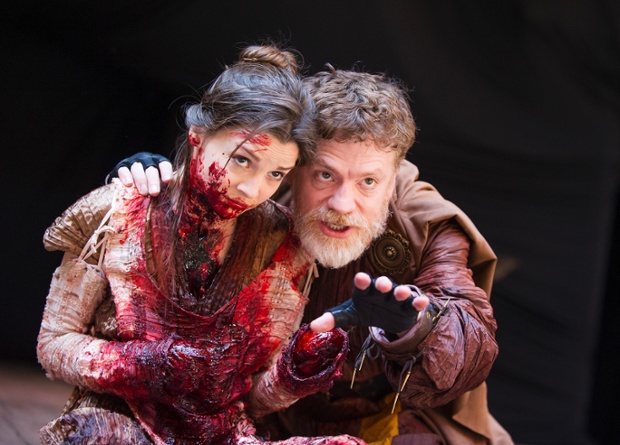
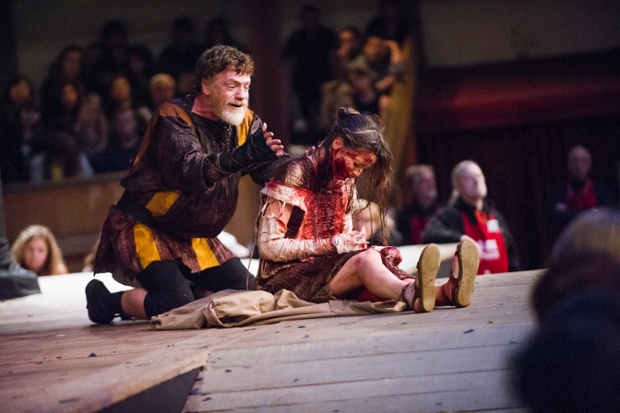
Another production that has been making headlines beyond its rave reviews is Titus Andronicus currently at The Globe Theatre, London. Titus is renowned for its violence – 14 deaths, a brutal rape and scenes of mutilation and cannibalism. Inevitably, stage blood is often used by the litre in productions of the play, and occasionally to great and gruesome effect.  This particular production has clearly pushed the boundaries, being described as full of violence and sick humour in Hannah Furness’ article for The Telegraph, Globe audience faints at ‘grotesquely violent’ Titus Andronicus. The fainting count at the time the article went to press was growing rapidly. If rumours are to be believed, the largest number to faint so far in one performance is 43.

06d90db4-6632-4b84-88ae-ced1441822bf-620x445

It is clear from the publicity photographs why the squeamish are not faring well at The Globe. Indeed those who faint have been dubbed ‘droppers’ by fellow theatre goers and Globe staff. Furness writes:

One theatre-goer, who watched the show’s opening night, said there had been “quite a few droppers” in the audience, who fainted upon seeing so much blood. Another reported he had “almost puked” by the interval, while a third warned: “You will definitely need a strong stomach”. Others praised the “Brilliantly staged and flawlessly acted” production, but warned of “blood and violence galore”

What is amazing that amongst all the gore, the director, Lucy Bailey has also been highly praised for bringing out the darkly comic elements of Titus and making sense of what is often seen as faltering marriage of knock-about humour and extreme suffering on Shakespeare’s part.

f7742971-e0c5-4a65-b0ea-475312981a98-620x413

I16iht-lon16-superJumbo_Fotorn her article for The Guardian, There’s method in theatre’s blood and goreMarina Warner talks about violence on stage through history, why tragedies such as Titus bring us face to face with intense violence and how they also carry a vital contemporary message. A great read.

There is some really good related reading on The Globe’s website. One is a great piece wittily entitled Food for Thought by Cedric Watts about the cannibal or anthropophagous banquet scene in the play.  Another is The Sound of Cracking Bone by Robert Shore which looks at the rehabilitation of Titus as a play of substance and how staging it in a theatre resembling its original setting allows it to breath again. It also reminded me of my favourite of Shakespeare’s stage directions, which comes from Titus, 

Enter a messenger with two heads and a hand

The maxim, there’s no such thing as bad publicity seems to have held true for The Globe and they have quietly taken advantage of the ‘droppers’ to garner extra publicity for the show. No one has actually said how much stage blood they are getting through, but it didn’t stop one intrepid journalist heading off to find where it was all made. There will be blood! written by Nick Clark for The Independent visits the suppliers of the fake blood for Titus who make up to 450 litres of the stuff every week and have doubled their production in the last year, largely due to bloody productions of Shakespeare’s plays.

Finally for today, a shout out for The Internet Archive which has recently posted the Orson Welles Shakespeare Collection, a selection of Shakespeare’s plays adapted for the radio by him in the 1930s and which were groundbreaking at the time. Welles is perhaps best known for the movie Citizen Kane, as well as one of the most famous broadcasts in the history of radio, his adaptation War of the Worlds which caused widespread panic when American listeners thought it was real and that an invasion by extraterrestrial beings was taking place

Orson Welles as Brutus in However, he was also a celebrated Shakespearian actor and during the late 1930s, Welles was the toast of Broadway, thanks to a string of audacious revivals of the Shakespeare’s work. The most famous of these was his 1937 adaptation of Julius Caesar. Welles costumed the piece in modern dress with soldiers wearing what looked like Nazi black shirts. The show was lit in such a way as to recall a Nuremberg rally. Obviously this was playing at a time when Hitler’s power was growing, and the production is said to have jolted American audiences and made Welles famous, with Time Magazine even putting him on its cover.

The recordings made available by The Internet Archive are obviously dated and sound quality is not always great, but they have a surprising intensity about them. You can access them here and I have embedded Julius Caesar to give a flavour of what the rest are like.

(.

Beyond The Icon

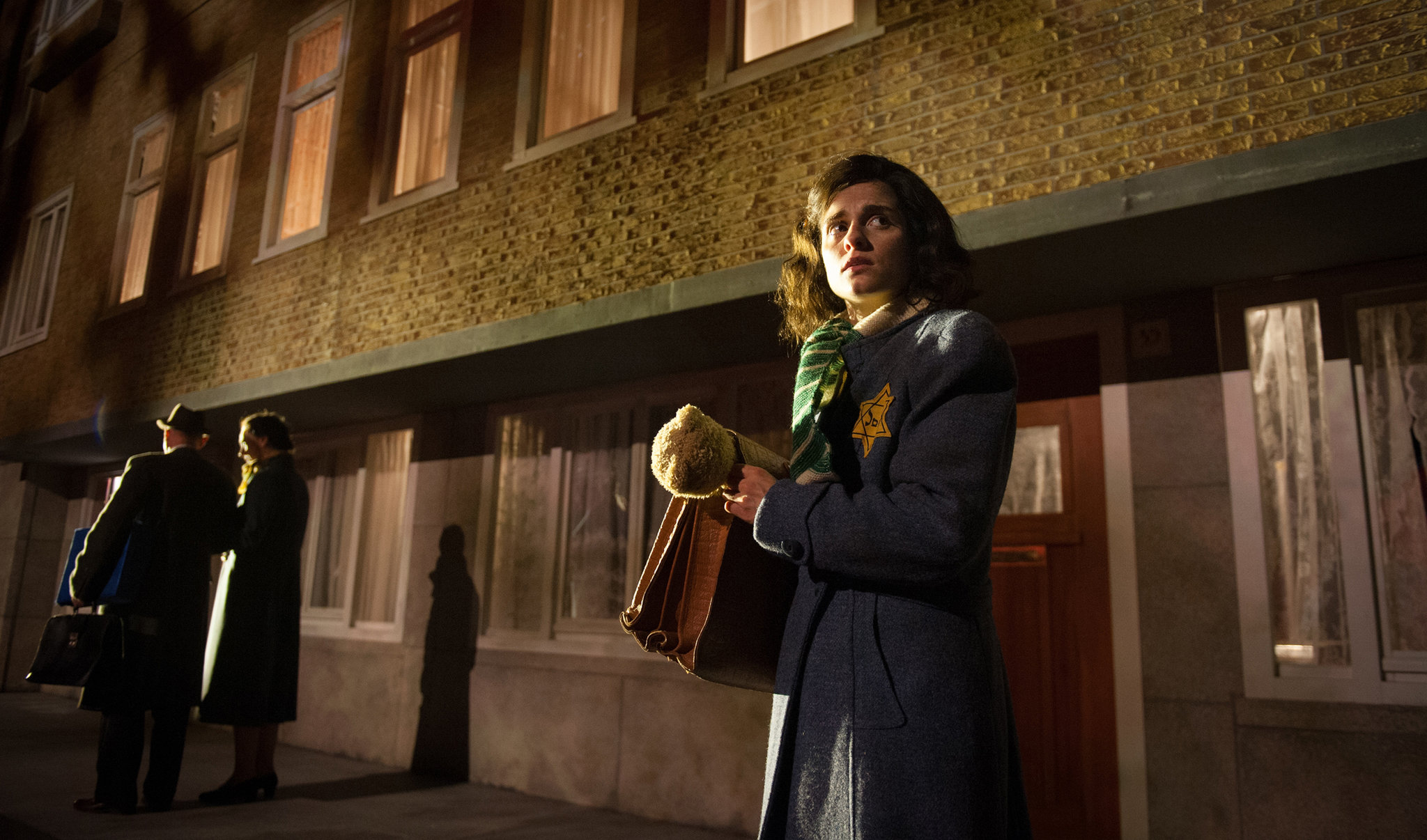
ANNE_hi_res_EnglishA new play has recently opened in Amsterdam eponymously called AnneI doubt there is a school child anywhere who has not heard the story of Anne Frank. She is perhaps one of the most well know victims of the Holocaust and the diaries of her wartime experiences in hiding have be translated and read around the world.

This new production has received much media coverage and is played out in a new theatre, built purposely to house the show, which is epic in its multi-media staging. However, the production has come with some controversy. It is the idea of Anne Frank Fonds (The Anne Frank Foundation) which was created in 1963 by Otto Frank, her father, to administer the funds raised by the publication of the diaries and use them for charitable projects around the world, usually related to young people.  However, the copyright on the diaries runs out in most countries in 2016 so the Anne Frank Fonds is looking at new ways of raising money, so it can continue its good works in Anne’s name. First published in 1947 the diaries have inspired numerous stage versions, although not one that has been particularly successful in great acclamation.  This new production looks like it might be the lasting legacy that the Fonds has been seeking, so where is the controversy? Well have a listen to this report by Anna Holligan for the BBC:

.

You can watch the report here too.

anne theu boermans


Jpfrank-superJumbo


annefrank-superJumbo

You can read more about the controversy in a report for The New York Times by Doreen Carvajal, Amid Tensions, a New Portrayal of Anne Frank. One of the first reviews in English by David Aaronovitch for The Times is here.

.

Redemption Song?

miss-saigon3_2900882kA revival of the musical Miss Saigon is shortly to come out of preview in London and there are already rumours of it then heading to North America (and no doubt then further afield). Once called one of the four great stage musicals of the 20th Century (one of the others being Les Miserables) it is estimated that 34 million people have been to see it across 29 countries, for which it has been translated into 15 different languages. Originally opening in 1989, I saw it here in Hong Kong in 2001 and I have to say I thought it was great, as far as a musical can be for me. I had been living in Asia for 5 years at that point and was beginning to understand the history and the culture of a region in a way you only can if you live there.

miss-saigon1_2900877k

I was a child as the Vietnam war came to a close in 1975 so hadn’t really engaged with atrocities of that particular conflict. History, in my education, was very much a British one, stretching as far as Europe to cover the likes of the Thirty Years War and The Reformation – nothing as even contemporary as World War II. Of course I knew the basic facts about what happened in Vietnam and the terrible consequences that were inflicted on a people in the name political ideology. By the time I saw the production in Hong Kong I had visited Vietnam, and as you do, had devoured as much information as you can to try to understand a new country – it’s history, society, culture and so on. I’d also seen and been affected by the iconic films about the war – The Deer Hunter and Apocalypse Now. Consequently, watching Miss Saigon I remember struggling somewhat with my conscience . The music did it’s job and you were sucked kicking and screaming into the simple narrative and the over-played emotional lives of the characters. Yet with well in excess of 1,000,000 Vietnamese having lost their lives quite so horrifically, was it right to sentimentalise the war and it’s legacy in such a way?

Indeed one critic at the time accused the show of hitching its portentous showbiz wagon to the solemn star of the Vietnamese tragedy A Filipino critic, Isagani R Cruz, observed in 1989 that

All the Vietnamese and Thai characters in the story, whether played by Filipino, Malaysian, Italian, French, Dutch, Japanese, American, or British performers, were the scum of the earth – pimps, prostitutes, bar habitues, sadistic and mindless soldiers, anti-nationalist visa-hunters at embassies. None of the Asian characters had any redeeming human qualities. Even The Engineer (played ingeniously by Pryce) helps Kim (played by Lea Salonga) only because her child is his “passport to America.”

No matter what we think of communism, we cannot deny that the Vietnamese fought a war to get rid of foreigners in their own land. Miss Saigon makes it appear that the Vietnamese fought the Americans simply because of Ho Chi Minh’s ego, symbolized by a gigantic statue hoisted up by mindless communist soldiers. We might as well say that the Americans fought the British because Thomas Jefferson and George Washington wanted memorials built in their honor, or that Filipinos fought both the Spaniards and the Americans because we wanted to have a Rizal Park.

Cruz wasn’t alone in these views. Other criticisms included the casting of a caucasian actor, Jonathan Pryce, as The Engineer, a Vietnamese brothel owner and central character in the musical – although to be fair this was subsequently righted in future castings. It is interesting that in the ‘trailer’ for the new production, Cameron Mackintosh goes to great lengths to point out the international casting of the new production.

.

When the tickets went on sale in September last year for this new production,  the box office took £4.4 million in the first 24 hours and advanced sales have so far taken £10.2 million. This is a show people want to see, so are the criticisms levelled at the original miss-saigon-1_2902467kproduction about distorting the truth of the war and stereotyping of its Asian characters fair? Or perhaps the real question is are they any longer fair? Are liberal sensibilities around

these questions just that, sensibilities. Generally musical theatre , contemporary or otherwise, is never going to be able to have the subtleties of a straight play, particularly in-depth of character and narrative. If they take as context something as difficult and potentially divisive as the Vietnam War there are bound to be critical voices of descent.  I suppose what I am asking myself is that as the events become part of history, is it permissible to ignore the superficial nature of their treatment and just enjoy the musical for what it is – a great entertaining night out at the theatre.  

My original prompt for writing this post was the opening of a new multi-media theatre piece in Amsterdam about the life of Anne Frank and the criticism directed at it for not treating the holocaust with the dignity and sensitivity deemed appropriate.  I will save that discussion for another post, but you can see the similarities

I am completely aware that you could name quite a few musicals where the context is a historical event in which many people lost their lives, Les Miserables being a great example. Perhaps musical theatre represents a facet of human nature – the want to look at something from the past, of which as a race we should be rightly shameful, and find the good, the happy, morally acceptable ending.  A way of absolving ourselves, maybe? Redemption? I don’t know. It will be interesting to see if the reviews of the new production of Miss Saigon raise the same objections, or whether the events it portrays are now far enough in the past to allow it to be a story well told, a night at the theatre and just that.

miss-saigon5_2900874kTo close, the excellent, in-depth and thoughtful article by Serena Davies, written for The Telegraph, about the new production, which I Tweeted last week.

Their Voices Are Far Too Few

Voting comes to a close tomorrow in the world largest democracy. The Indian general election has lasted 6 weeks, beginning on 7th April, with over 814.5 million people eligible to vote. Much has been published about the state of the nation and one article that particularly caught my attention was by Anupama Chandrasekhar and Akash Mohimen for The Guardian. Chandrasekhar and Mohimen are playwrights and in their piece The threats to political theatre in India: fundamentalism and escapism, they explore the integral role theatre has played in India’s freedom struggle in the past and question its purpose today, reflecting on censorship, audience expectations and the new voices seeking to be heard.

Anupama Chandrasekhar

Elections in India have always been high-decibel, high-emotion events, a period in which art and artists are most vulnerable to attack by fundamentalists. Twenty-five years ago, the street-theatre playwright and director Safdar Hashmi was killed in the middle of a performance during local municipal elections near Delhi. Last month, when the country was in the throes of electioneering, Evam, a Chennai theatre group, was pressurised by the police departments of three cities to cancel their shows of Ali J, a monologue on what it means to be a Muslim today.

Anupama Chandrasekhar

Anupama Chandrasekhar

The increasing number of fundamentalist groups targeting theatre companies across the country has become a cause for concern. A website of a fundamentalist group lists six plays they’ve had censored within the last three years, among other films, TV shows, commercials and books.. India was once far more tolerant of political theatre. While there was the odd case of a play being banned (the ban on Vijay Tendulkar’s Sakharam Binder was later revoked), explicitly political plays were allowed free reign in the 1970s (barring the Emergency years) and early 80s, particularly in my hometown, Chennai. As a child I watched in Tamil insightful political explorations in many guises: satires, spectacular mythologies, powerful social realism and laugh-a-minute drawing-room farces. Social realist Komal Swaminathan, satirist Cho Ramaswamy and mythologist Manohar were household names then.

The rise of fundamentalism has been an obvious deterrent to serious political theatre. But a bigger and more insidious threat has been what Brett Bailey would call the “sanitized demands of the market”. There’s a growing tendency to provide safe, escapist entertainment rather than dialogue with the world around us. While the older generation of theatre practitioners like Mahesh Dattani, Sunil Shanbag, Maya Rao, Na Muthuswamy, Gnani Sankaran and Mangai Arasu continue to ask urgent questions about who we are as a nation, many of my generation appear to have fallen prey to the exigencies of the market. Neil Simon and Yasmina Reza are Chennai’s two most popular and frequently staged playwrights of the English language. The pattern is eerily similar in other cities too.

Disconnect by Anupama Chandrasekhar at the Royal Court theatre

Disconnect by Anupama Chandrasekhar at the Royal Court theatre

In this din of safe comedies and news channel-induced hysteria, there are new voices seeking to be heard: Irawati Karnik, Abhishek Majumdar, Neel Chaudhuri, to name a few. The young Chennai director Aruna Ganesh Ram recently embarked on a pan-Indian verbatim project this election year to explore the concept of freedom. Director Quasar Padamsee’s project So Many Socks, based on Tenzin Tsundue’s collection of poems and stories, explores Tibet, nationhood and the individual. Swar Thounaojam, a Manipuri playwright and activist, wields the English language as a weapon and a tool to explore her subaltern identity.

But in a country with a population of over a billion, their voices are far too few.

Akash Mohimen

Traditionally, theatre has been an integral thread in the social fabric of India. It was used to spread news, socio-political awareness, propaganda and entertainment. Theatre played a vital role in India’s freedom struggle, bringing messages preached by the leaders to communities hundreds of miles away. It was one of the many sparks that gave rise to one of the world’s largest freedom movements.

In the 21st century, Indian theatre seems to have lost some of this spark. Political plays are few and far between.

Akash Mohimen

Akash Mohimen

Barring the continuous adaptations of Vijay Tendulkar and Badal Sircar’s texts from the 70s, there are only a handful of political plays doing the rounds.

There are plenty of contemporary writers trying to strike a balance between storytelling and shedding light upon important topics that have long been untouched. But audiences always prefer to keep such productions at arm’s length. They jump to conclusions that they are depressing and preachy; the message going around these days is “make them use their brains”.

I believe the reason for such a mind-set is lack of awareness. Audiences have little or no idea of what’s happening beyond their own city limits. When they hear about a play on the Kashmir issue, they immediately shun it, rather than become intrigued by the theme and witness a tale of friendship, lost innocence and survivor’s guilt.

The influence of the motion picture industry has affected theatre ticket sales. People would rather spend 400 rupees for a multiplex ticket on a Sunday, than 300 rupees for a play at Prithvi theatre. And their reason is mostly the same: escapism.

With such a thought process, it is fast becoming difficult to stay afloat by practising theatre alone. No matter how passionate one feels about this medium, one needs to branch out to films, commercials, event management and education to have some sort of financial support. There are few who can truly say that they earn their livelihood out of theatre.

Mahua by Akash Mohimen

Mahua by Akash Mohimen

Despite corporate funding over the last few years, most productions barely break even. In fact, some lose money each time the actors step on stage. But they keep coming back year after year, because of the sheer love for the stage.

Theatre in rural India remains the truest form of Indian theatre. There are parts of the country where, every festive season, a performance will be organised free of charge. A performance could be put together by a teacher, farmer, policeman and postman, where the whole village will participate. Irrespective of subject matter or story, they will lend their ears. The laughter and tears of the audience are a major adrenaline rush for the actors and musicians on stage. Everyone involved is as moved as the audience watching.

Anupama Chandrasekhar and Akash Mohimen are part of the Royal Court’s writing programme in India

Birthday Bardolatry

Wednesday marks the 450th anniversary of the birth of William Shakespeare. Now regular readers of Theatre Room will know that I have a certain ambivalence to the works of the bard and occasionally find myself in arguments with others who refuse to believe anything other that he was the greatest playwright to have ever lived.

MR at The GlobeIt was therefore with some great interest I listened to a programme presented by British playwright Mark Ravenhill (left), who has just finished a two-year stint as playwright in residence at the Royal Shakespeare Company. In Shakespeare: For and Against for the BBC, and to quote the promotional material for the programme

…..Ravenhill challenges our adulation of the Bard and asks: Is Shakespeare’s genius beyond question? Casting a sceptical eye over centuries of bardolatry, Ravenhill calls for a new approach to the plays.

Exploring the intellectual tradition that has seen important figures from Voltaire to Tolstoy to Wittgenstein challenge Shakespeare’s supremacy, Ravenhill searches for today’s dissenting voices.

Tracing the transformation of a working playwright into a national poet, global brand and secular god, Ravenhill asks if it’s still possible to enjoy Shakespeare without being overwhelmed by the cultural and commercial baggage of ‘brand Shakespeare’.

It is really fascinating and amongst other people he speaks to scholar Ania Loomba who describes India’s changing relationship with Shakespeare, and Professor Gary Taylor talks about the ambivalence of large parts of America toward the Bard. Have a listen below:

In the interest of balance I would also like to share a piece written for The Telegraph by the highly respected actor Simon Russell Beale (interviewed by Ravenhill in the above) whose latest Shakespearian outing has been playing King Lear at the National Theatre.

Why Shakespeare always says something new

As the 450th anniversary of Shakespeare’s birth approaches, the great Shakespearean actor Simon Russell Beale explains his secrets

At the very end of King Lear, a frail, old man appears carrying the corpse of his youngest and much-loved daughter. It’s an image, like that of Hamlet holding a skull or Juliet on her balcony, that has imprinted itself on the minds of readers and spectators over the last four hundred years. For some, it is unbearable, even morally irresponsible; for Lear’s lonely, individual grief seems to reinforce the possibility, iterated again and again in the play, that all human life is essentially meaningless.

Whether one accepts that bleak vision or not, here once again is that familiar magic – Shakespeare’s astonishing ability to open out his work, to manipulate a single storyline, so that it includes, implicates and challenges everyone.

PX694779_King-Lear_2872690b

The old king and his daughter do not enter alone, however. They are accompanied by at least one soldier, possibly more. This soldier, about whom we know almost nothing, has a single line later in the scene, but his entrance is not marked in either of the authoritative texts that have been handed down to us – the quarto and the Folio – and, consequently, presents the director of King Lear with a problem. When, precisely, should the soldier, or soldiers, enter? Every line spoken by Lear in this short, final scene is a wonder and I suspect that most directors instinctively feel that his words and the image should be left, as it were, to stand alone.

But, as so often, Shakespeare gives us a context for Lear’s pain, a counterpoint. The soldier is there to remind us, amongst other things, that the old king is not simply a grieving father but also a prisoner- of -war (a war for which he is ultimately responsible) and to confirm, with his single line, that Lear is still powerful and angry enough to have killed the man who was murdering his child.

This is a tiny example of another Shakespearean manoeuvre, one to set against his skill at articulating the big things like love and hate. It’s the type of thing that makes mounting Shakespeare’s work endlessly fascinating, demanding and frustrating. For whatever reason – the way the texts have been transmitted, carelessness on the part of the writer, a change of intention – the plays, in their lack of precision, often raise questions for which the playwright has provided no clear answer. Any actor or director in search of clarity could be forgiven for interpreting this as an opportunity or a challenge.

If this challenge seems, at times, difficult to meet then it’s comforting to know that we are not alone. Ben Jonson, Shakespeare’s younger contemporary and a writer whose narrative was always meticulously charted, found his older colleague’s work, for all its beauty, sloppy and often absurd. He probably found the paucity of information about Lady Macbeth’s child, for instance, infuriating. Unfair though it might be, however, Shakespeare’s capacity for absorbing endless reinterpretation, in contrast to the demands that Jonson makes, is maybe one reason why the latter’s work has never been as popular as his colleague’s. Perhaps we should be braver with Jonson, but the truth is that, over nearly thirty years of working on Shakespeare’s plays, there have been countless occasions when, in the rehearsal room, I have witnessed (and expended) a great deal of enjoyable effort in the attempt to sort out apparent inconsistencies and ambiguities. We could leave the plays alone, I suppose, but that seems the lazy and irresponsible option. Shakespeare demands a more considered response, I think.

This is a tricky business, however. One never wants to “tidy up” Shakespeare’s writing without considering as many options as possible and ambiguity is often a good thing. There are sometimes unexpected discoveries to be made by investing fully in something that is apparently confusing. The soldier in the final moments of King Lear is there precisely to complicate matters. In this case, the king may very well be embodying a profound and far-reaching pain that has universal relevance, but the playwright cannot resist providing a more mundane and savage context. Lear is not floating free of the real world; and this may remind us that it is in the oddities of Shakespeare’s writing, his exploration of the confusion and ugliness of any situation, his absolute refusal to sentimentalise, that a great deal of his power lies.

srb-as-lear_2878816c

The fact, too, that the plays are, from an interpretative point of view, open-ended leads satisfyingly to our questioning, not only the playwright, but also each other. We may not agree with a particular analysis or interpretation, but if it is neither wilful nor illogical, then it may well be, despite our preconceptions, valid. Shakespeare’s plays are very hospitable. As a fellow actor said to me recently, interpreting Shakespeare is “a game we can all play”.

The feeling that one is standing on shifting ground is there right at the start of any close reading of the text. The astonishing work of literary scholars over the last century has radically changed our view of the plays as comprising an unchanging and rigid canon. Not one of Shakespeare’s plays exists in a single, unchallenged version. There are, as I mentioned earlier, two authoritative texts for King Lear – with significant differences – and three for Hamlet. Plays like Measure for Measure are frankly a bit of a mess and Timon of Athens is clearly unfinished.

It seems that Shakespeare’s plays are, in some sense, there to be adapted. We have to tread carefully, of course, because we are dealing with a man who was unquestionably a genius;, but he was also a working man of the theatre and, it seems, was willing to adapt his work, responding to his own changing ideas and, presumably, to the demands of those he worked with. What this all boils down to is that you can’t perform a play by Shakespeare without first editing it. There is no set text.

The reason why this is a worry for some is that editing is necessarily an interpretative activity and our judgment of a play can therefore be manipulated. Choosing between options that the playwright himself offers is not, of course, objectionable, although many are surprised at how different these options sometimes are. For instance, one of Hamlet’s famous soliloquies, his last, “How all occasions do inform against me” is not in the Folio version of the play.

Difficulties arise when theatre practitioners change things that Shakespeare did not clearly authorise. In the production of King Lear that I am currently involved with, there is a glaring, perhaps even controversial, example of this. The Fool, one of Lear’s few friends, disappears halfway through the play and this is considered by commentators as either gratifyingly mysterious or simply unsatisfactory. We decided that the King, now mad and predictably violent for much of the time, should club the Fool to death.

Whatever arguments we can produce for such a decision – and I, of course, think they are watertight, despite the fact that much later in the story Lear mentions that the Fool has been hanged – there is no doubt that some find such a departure from the text distressing. Years ago, in a production of The Tempest (also directed, as it happens, by Sam Mendes), I played a rather haughty Ariel who, at the moment of being given his freedom by Prospero, spat in his master’s face. This seemed to me to be an absolutely understandable protest given Ariel’s long years of servitude, but many spectators, for understandable reasons, disliked it intensely.

THE-WINTER_S-TAL_2878808c

My defence is that the texts themselves are not stable and that, anyway, we are following Shakespeare’s footsteps. For instance, editing a play for performance often means cutting lines and we know that some of the plays exist in shorter versions, presumably intended for particular occasions and I’m sure he changed things for other reasons than that of length. Even if the principal aim of a group of practitioners is simply to reduce the playing time, rather than something more devious, distortion of some (largely mythical) ur-text is inevitable.

This process of editing may challenge our preconceptions about a play and those preconceptions, especially if they manifest themselves in a desire for something that we can easily define, are often very difficult to shift. I’m aware, when watching a production of a Shakespeare play I know well, that I have to work hard not to impose my rigid requirements on the performers in front of me. There is always a danger that, while working on a Shakespeare play over months or even years, one can persuade oneself that a certain interpretation is the only one possible. After all, it is part of an actor’s job to convince an audience that, within the context of the production, this is momentarily the case. But Macbeth need not be, as I saw him, a man whose poetic imagination is liberated by a murder that is a gift to his wife. Iago may not have a second-rate mind, as I would argue, but perhaps is really is some sort of Machiavellian superstar.

I know I have to fight against my own prejudices (and acknowledge that, in any case, my ideas can change). Equally well, I have been guilty in performance of smoothing over, rather than embracing, difficulties, in the vain hope that no one will notice. For instance I have always found it hard that Hamlet, a character that I love and admire, is guilty of a puerile misogyny and, perhaps, more worryingly, of the unnecessary deaths of his old friends from university, Rosencrantz and Guildenstern. When I played him, I could find reasons for the misogyny but half- ignored the murders. The conflict and, most importantly the play on our sympathies are there, however, and should not be ignored.

The question of sympathy is one that has been exercising me over the months that I’ve been working on King Lear in Sam Mendes’s production for the National Theatre. If the soldier in the final scene is a reminder that Lear is not just a poor old thing but an angry, indeed homicidal, man, operating, however feebly, in a harsh world, then the first scene of the play is a direct challenge to our natural desire to like the central character. Unlike Othello or even Macbeth, we never get a chance to see Lear at his best, to see the man that Cordelia loves and that Kent and Gloucester, his devoted allies, respect. There are ways of softening the scene up, of playing it in a more vulnerable way, although I feel that this dodges the issue. What the king does in dividing his kingdom and banishing his daughter is, in Kent’s word, “evil”. Consequently, it’s a long haul back to forgiveness both from the other characters and from the audience; to be honest, I’m not sure we ever really get there.

Forgiveness, and the difficulties of defining it, is something that Shakespeare seems always to have been interested in and this interest becomes especially intense in his later plays. In The Tempest we see Prospero offering forgiveness to his errant brother in a manner that looks suspiciously like another arbitrary display of power. The brother, perhaps significantly, does not answer. Leontes in The Winter’s Tale, wracked with a guilt that seems for a long time too deep-rooted to shift, faces a wronged wife who talks, not to him, but to their daughter. Not a word is spoken that promises unequivocally a settled and happy resolution.

Shakespeare recognised that the wish to be forgiven and the desire to forgive is the start of a process, that reconciliation or redemption take time, and time, of course, is the one thing that Lear and Cordelia do not have. That is what ultimately is so heartbreaking about King Lear. Not all mistakes can be fully rectified, all damage repaired and all love restored – at least, not here and now. The best we can do is accept the muddle of it all.

What Shakespeare always demands, though, is our sympathy, because, to put it simply, he writes about people like us. Offhand, I can think of only one character he wrote – Iago in Othello – that slips through the safety-net of his concern. Shakespeare might not agree with Lear’s sweeping and anarchic assertion that “none does offend”, but he sensed, I think, the danger of easy judgement. He recognises that self-worth and dignity are hard-won and that our lives cannot but be inconsistent, unpredictable, and confused. The only sane response for all of us, perhaps, is to emulate him – to look carefully, to withhold quick judgment and to try to understand.

It would suggest you read the comment’s that follow Beale’s piece – they make interesting reading. This one says it all for me:

Untitled_Fotor