Say It As It Is

little-revolution-posterTwo audio recording shares today. Firstly an interview, courtesy of Theatre Voice, by theatre critic Matt Trueman with verbatim playwright Alecky Blythe (and director Joe Hill-Gibbon) about her play Little Revolution. Performed earlier this year and receiving very polarised reviews, it explores the 2011 London riots. The interview gives a fascinating insight into the processes of writing and staging verbatim theatre. Blythe also writes about her approaches in The Telegraph, It looked a bit hairy. But I had to go. Interestingly, the same newspaper also gave Little Revolution one of it’s best reviews, calling it Absolutely Compelling. Truman’s own review of the play is a little more interrogating.

The second share, and not wholly unconnected,  is an interview with writer and theatre maker Stella Duffy (and others) about the life of theatrical maverick Joan Littlewood, whose centenary has been marked this year by many events, not least the Fun Palace initiative, started by Duffy herself. Again a great listen about a woman who made theatre differently.

.

Noh It All

izutsu_FotorA quick but superb share today, especially if you have an interest in world theatre forms. Discovered by a student of mine, Tsz Yu, while she was doing some research into movement and gesture of Japanese Noh actors. A new site, The Noh.com is a superb english language resource.  There are a few other online sources out there, but they tend to be quite brief in their content aimed  at a tourist market, rather than a resource for students. Noh.com is an evolving site with new material being added all the time. In the Trivia section you can ask, and expect an answer to any Noh related queries. The Play section is a real gift, as it contains a database of over 200 Noh plays, translated into english (shown alongside the Japanese text) which can de downloaded as PDF files.

Traditional print sources can be quite heavy going, so Noh.com is real find.  Having said that there is one book that is particularly good, MASK: A Release Of Acting Resources Volume II. The Training of The Noh Actor, which is also on Google Books.

One of the better other online sources is from the Japanese Arts Council which has revamped its website and it is now much more accessible to non-Japanese speakers, including the process of booking tickets, should you find yourself in the country. They have three introductory guides available on the site:

kabuki_Fotor

Untitled_Fotor

bunraku_Fotor.

These are great beginners guides if you are a novice in the main three traditional theatre forms. There is also a fantastic playlist on Youtube that has over 50 videos about these theatre forms, from documentaries to traditional music to recordings of performances. A veritable feast of all things Japanese Theatre.

Body Mechanics

I wanted to share a short video today, an excerpt taken from a piece called Nowhere  by Greek experimental theatre director, choreographer and visual artist Dimitris Papaioannou, (who incidentally was the creative director for the Athens Olympics in 2004). Nowhere is dedicated to Pina Bausch and was created to inaugurate the new main stage at the Greek National Theatre.

b_1012_pouthena3

To quote the theatre’s website:

Nowhere is a work about the physical space of the theatrical stage. Constantly changing and defined by the men and women that inhabit it, it can be countless different places while designed to be nowhere at all.

The scene I’m sharing contains nudity, so be warned, but the reason it caught my attention will be obvious when you watch it.  Simply stunning.

.

Known as the body mechanic system, it was used by Akram Khan in his piece Dust, part of a large work called Lest We Forget for the English National Ballet. Khan credited Papaioannou in the programme for the idea:

dm-dust-akram-khan-dancers-lines-arm-wave_1000

I have a feeling it might be making an appearance in some of my students’ work, minus the nudity I hope, given their reaction to it.

Set In Aspic

Helen McCrory as Medea, National Theatre

Helen McCrory as Medea, National Theatre

A gnarly little piece today I came across in The Independent, Why are theatre directors messing with the classics? Written by journalist Adrain Hamilton, he bemoans (British) theatre directors who play with the text and/or original intent of the playwright. Has it ever been thus. Now far be it from me to suggest that Mr Hamilton (who is not a theatre critic or in any way connected professionally with the theatre) is simply whining because he may have witnessed a production of one of his favourite classic plays that he didn’t like (although I suspect there might be something in this). It’s not that I disagree with him totally. Indeed he makes some decent observations, but theatre is an interpretive art form, especially when dealing with the more classic/historical texts. There has to be a relevancy for a contemporary audience and it the director’s job to make that so. Of course it doesn’t always work, but that is theatre for you.

Why are theatre directors messing with the classics?

There are no more dreaded words in the English theatre today than “in a version by”. Whether it’s Ibsen’s Ghosts, Euripides’ Medea or Sophocles’ Electra, nothing will do but that the international giants of the stage be taken by an English writer and refashioned for the English audience in their own words.No one should doubt the theatricality of these “versions”. Greek tragedians, as indeed Ibsen, created great parts for female actors and this is what the British directors have seized on with such fervour today. Kristin Scott Thomas as Electra, Helen McCrory as Medea and Lesley Manville as Ibsen’s Mrs Alving have all been successively hailed as the new divas of drama for their anguished performances of tortured, wracked women.

Just as we perform Chekhov as the supreme English ironist, rather than the caustic writer of near farces, which is the way the Russians do, so our directors and dramatists rework the classics as studies in angst and high emotion, women on the edge not just of a nervous breakdown but of infanticidal self-destruction.

Lesley Manville in Richard Eyre's production of Ghosts

Lesley Manville in Richard Eyre’s production of Ghosts

Only that is not what these dramas are actually about, or not as their authors intended. The great classical dramatists didn’t set out to present psychiatric studies of individuals and their torments. They wrote about the human condition through the dilemmas and fates of individuals. The same goes for Henrik Ibsen. A would-be poet himself, he wanted to express what he saw as the societal truth of his times.

Sir Richard Eyre’s reworking of Ghosts, and his earlier Hedda Gabler, at the Almeida, are finely crafted works of domestic drama in which events speed their way to a horrifying conclusion, impelled by revelations which strip their heroines of all illusion. It’s Chekhov on speed, even to the point of climaxing the play with Mrs Alving administering the medicines with which to aid her son’s death.

But Ibsen didn’t write that. He left his heroine gripped by indecision whether to carry out her son’s desire to die or to refuse such an unnatural maternal act. Sir Richard’s version makes for a more melodramatic finish; Ibsen’s for a more troubling one. Which is how he saw his play, a very carefully modulated study through the dialogue of human evasion of how we are all made by our past and convention.

If you want to see the difference between the way that the British domesticate drama and other countries seize on the ideas behind a play, then the Barbican’s current series of international productions of Ibsen should be a revelation. The Berlin Schaubühne ensemble’s An Enemy of the People, the play he wrote in anger at the way Ghosts had been dismissed by the critics, is an interpretation full of the urgency that this angry assault on bourgeois conformity requires. Switching the time to now, it has all of Ibsen’s weight and weariness with the society about him but also his sense of the human part within it. If the production stuttered in London it was in trying, in the middle, to involve the audience in the debate. It apparently worked in performances elsewhere but not here. The English don’t go in for direct confrontation, let alone over ideas.

The Berlin Schaubühne ensemble’s An Enemy of the People

The Berlin Schaubühne ensemble’s An Enemy of the People

It gets worse with Greek tragedy. With a deeply affecting central performance, the National’s Medea wrung every emotion out of the story of an abandoned woman who wreaks revenge by killing her own children and dragging their bodies into exile in an end reminiscent of Bertolt Brecht. Only Euripides is not Brecht and he didn’t write Medea as a story of a wronged woman wrestling with her conflicting emotions. The Medea of Greek legend is a witch woman of terrifying force. The tragedy is one of anger and vengeance which cannot be constrained. At the end you feel not pity but horror and fear.

You don’t have to do Greek tragedy on a bare stage and skimped costumes. The poet Caroline Bird’s version of Euripides’ Trojan Women at the Gate Theatre in 2012 was one of the most intense theatrical experiences I’ve ever had. Moving the scene to a maternity hospital, it worked because it remained true to Euripides’ vision of captured women, turning in on themselves as they await their fate. But you can’t do what Frank McGuinness, whose adaptation of Electra is now playing at the Old Vic, did in the opera of the Theban Plays and mess around with the order at will. At least you can’t do it and still leave Sophocles on the credits.

Yukio Ninagawa, arguably the greatest theatre director of our times, who directed an electrifying Medea in Japanese, will only work with line-by-line translation. Presenting Shakespeare’s Cymbeline recently the Barbican (he’s back there with Hamlet next year), he apologised for changing a word in making a cedar into a pine for visual reasons. If only British directors would pay foreign dramatists the same respect when they turn them into English.

I went in search of the reviews of some of the plays that Hamilton vilifies as domestic. The same paper that carried his article, The Independent, gave the production of Euripides’ Medea he mentions 4 stars, calling it unforgettable and horribly gripping, as did The Telegraph who said it was thrilling and merciless. Richard Eyre’s production of Ibsen’s Ghosts, meanwhile was given 5 stars in The Independent – A spellbinding production – as it was in The Telegraph, with the final line of the review observing that Theatre seldom, if ever, comes greater than thisFinally, the production of Sophocles’ Electra was again given 5 stars by The Independent, calling it an evening of unalloyed magnificenceThe Telegraph said it was Theatre at its best with The Guardian undermining Hamilton’s whole premise in the final paragraph of its 4 star review.

Theatre cannot be preserved in aspic, perhaps more so today than ever. I’m looking forward to reading how other less conservative commentators react to Hamilton’s views

Soviet By Design

c3ada36768c4bcfd35c1fc16ab83985bMy first share today was published this week in The Guardian. Written by Oliver Wainwright, it explores theatre design in the Soviet Union in the early 20th Century, which is currently the focus of an exhibition at the Victoria and Albert Museum in London.

A critical period in the development of stage design, Wainwright’s article, Russia’s stage revolution: when theatre was a hotbed for impossibly space-age design talks about how artists created radical sets and costumes for a futuristic new era of theatre that are said to have inspired Fritz Lang’s Metropolis.

.

A square-headed figure stands in a jagged harlequin costume, like a toddler’s drawing of a Christmas tree, beside a red-clothed character with black spines emerging from his limbs. There is a portly green-skinned man bursting out of a tight red vest, while another figure’s body swells from a triangular skirt in a big blue bulge.

Set against a mysterious monochrome backdrop of triangles and squares, these were the costume designs of then little-known Kazimir Malevich for the world’s first “futurist opera,” Victory Over the Sun, produced in St Petersburg in 1913. Complete with a libretto in the experimental “zaum” language – a kind of primeval Slavic mother-tongue, mixed with birdsong and cosmic utterances – it infuriated audiences, who reacted with violent outrage.

Malevich was not deterred. The stage sets formed the basis for his first Black Square painting, and the foundations for his fractured visual language of suprematism, one of the defining movements of the period. It was here in these gnomic theatre designs that he began his urgent pursuit of the “supremacy of pure artistic feeling”, of geometric splinters flying through limitless space, fuelled by the impending trauma of revolution.

These striking drawings form the opening to a new free exhibition in the V&A’s theatre and performance galleries, which traces the effect of war and revolution on Russian avant-garde theatre design, from 1913–33, a period that saw an earthquake of artistic transformation.

Comprising 160 works by 45 designers, much of what’s on show has been unearthed from the dusty depths of the Bakhrushin Theatre Museum archive in Moscow, some exhibited in public here in London for the first time – and it is a thrilling hoard.

Lyubov Popova’s fantastic mechanical set for The Magnanimous Cuckold, 1922.

Lyubov Popova’s fantastic mechanical set for The Magnanimous Cuckold, 1922.

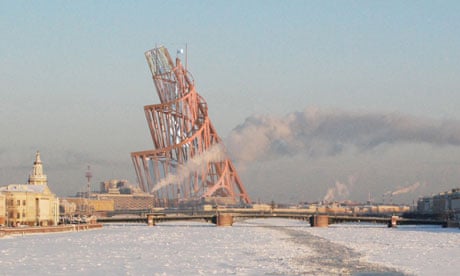
Facing off against Malevich are the early costume designs of Vladimir Tatlin, who would go on to dream up the spiralling skeleton of the Monument to the Third International, a plan for a gargantuan double-helix structure that would have loomed 400m above St Petersburg. While Malevich was brewing up a universe of dynamic shards, Tatlin’s designs – for operas with nostalgic titles such as Life for the Tsar and His Disobedient Son Adolf – reveal the beginnings of his constructivist style.

These counterpoints set the tone for a show that reveals the breadth of artistic styles spawned in these tumultuous years, with the theatre proving a hotbed of experimentation and a powerful vehicle of revolutionary propaganda.Women designers loom large, with the dazzling work of Alexandra Exterfeaturing extensively, from her bold reinventions of classics like Romeo and Juliet, to impossibly futuristic costumes for Aelita, one of the first ever sci-fi films, made in 1924. Based on a Tolstoy novel, it tells the story of an engineer who travels to Mars, falls in love with the Queen of the Martians, and organises a revolution. The space-queen was conceived as a Soviet Barbarella, clothed in a swirling dress of orbiting loops, topped with a many-pronged head-dress that gives her the look of a human TV aerial. It exudes the excitement of what the promised revolution would bring, the humble engineer discovering a brave new world through hard work. Utterly groundbreaking for its time, Exter’s alien set designs would go on to inform the dreamy aesthetic of Flash Gordon and Fritz Lang’s Metropolis.

Vladimir Tatlin, costume design for Life for the Tsar, 1913-15.

Vladimir Tatlin, costume design for Life for the Tsar, 1913-15.

“I want to burn with the spirit of the times,” declared Vsevolod Meyerhold, another influential figure of the period, and one of most enthusiastic activists of the new Soviet theatre. He joined the Bolshevik party in 1918 and became an official of the theatre division of the Commissariat of Education and Enlightenment, trying to radicalise Russian theatres under Bolshevik control. Developing what he called “biomechanics”, he championed a form of acting in which bodily expression was all, teaching his students gymnastics and circus skills, in a bid to transform the theatre from a place of naturalism and emotion to a full-blown fairground spectacle.

“Meyerhold laid the foundations for modern physical theatre, and groups like Complicite,” says curator Kate Bailey, “as well as a lot of the techniques of projection and moving sets that we take for granted as part of contemporary theatre design.”
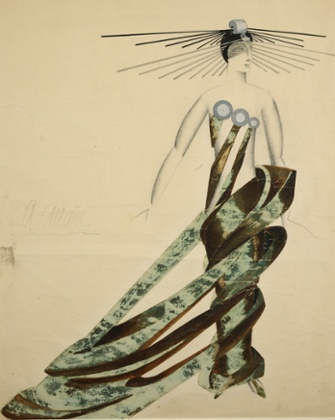
The Queen of the Martians, costume design by Alexandra Exter for the 1924 sci-fi film Aelita, based on a Tolstoy novel

The Queen of the Martians, costume design by Alexandra Exter for the 1924 sci-fi film Aelita, based on a Tolstoy novel

A key to realising his vision was Lyubov Popova, the daughter of a textile merchant who had been a member of Malevich’s Supremus art group from 1914-16. She produced a spectacular moving set for his production of The Magnanimous Cuckold in 1922, a model of which takes pride of place in the exhibition. The play follows the trials of a miller who suspects his wife of being unfaithful and pursues her lovers through the village, and Popova transforms the mill into an all-consuming acting machine, a thrilling landscape of rotating cogs and wheels.

Under the influence of Meyerhold, theatrical characters were reduced to types, emotion and psychological experience substituted for the gawp of physical and mechanical prowess. Similar narratives recur, in which “impure” characters of merchants and royalty, capitalists and priesthood, face off against “pure” peasants and sailors, the old order trounced by the newly awoken masses. Costumes of the old world are heavy and clumsy, set against the thrusting, cubo-futurist lines of the new Communist utopia.

It all comes to a satirical climax in Vladimir Mayakovsky’s comedy, The Bedbug, in which the brave Bolshevik protagonist, Prisypkin, is cryogenically frozen in an impossibly modern-looking spacesuit – to designs by Alexander Rodchenko – to be thawed when the ideal Communist world has been attained in 1979. Severely underwhelmed when he awakes, he finds a bedbug on his body, which becomes his only friend.

Alexander Rodchenko costume design for Bedbug, 1929, a comedy by Mayakovsky whose hero is frozen for 50 years to await a Communist paradise

Alexander Rodchenko costume design for Bedbug, 1929, a comedy by Mayakovsky whose hero is frozen for 50 years to await a Communist paradise

It is an appropriately gloomy end to the exhibition, which concludes with the rise of Stalin, who presided over a return to socialist realism, and the accompanying vicious backlash against the avant-garde. The final piece on show is a miraculous wooden and plaster model for Mayakovsky’s satirical play, Mystery-Bouffe, directed by Meyerhold, which depicts the North Pole, where the earth’s last survivors have voyaged, to be offered the choice between heaven and hell. They decline heaven, in favour of the promised land of the Communist paradise.

It was not to be so for the two leaders of the avant garde under Stalin: disillusioned and driven to despair, Mayakovsky shot himself, while Meyerhold was arrested, tortured and executed. “Theatre is not a mirror, but a magnifying glass,” Mayakovsky once said. And their powerful lens clearly looked a little too closely for the regime’s comfort.

The V and A exhibition, Russian Avant-Garde Theatre: War, Revolution and Design 1913-1933 has an associated Pintrest Board with some great images, as well as a blog.

Taking To The Streets

P_E_2008030706450314Politics and theatre are, and have always been, inextricably linked. So following on from my previous post, this one explores real theatre on the streets, this time in Nepal.  I came across an article in the South Asia Monitor, written by Deepesh Paudal and originally published in The Kantipur DailyRoad ActSadak Natak or Street Theatre emerged in Nepal in the 1980s, during the height of monarchial rule, as a way of protesting against the excesses of the ruling royal family. Ashesh Malla, Artistic Director of Sarvanam, a Nepali theatre company, is credited for starting the movement and in a country where many live in rural poverty, street theatre has proved to be an effective way of raising awareness of a host of issues,  as well as entertaining people.

.

However, in his article, Paudal sounds a note of of caution about the continuing existence of Nepalese street theatre:

Fading interest The development of  street theatre in Nepal has seen its peaks and troughs. Periodically, some have been critical, raising questions on its objective. Some of them have tagged  street drama as a mere developmental play (bikase natak), ‘farming dollars’, while others have sternly criticised it for an absence of aesthetics. Non-governmental organisations’ and other social institutions’ direct or indirect involvement in  street theatre s has drawn both positive and negative remarks from stakeholders. The lack of transparency in fund allocation and management has frequently put theatre groups under scrutiny, often exposing their dependency on donors and foreign aids. Additionally, the progress of cyber entertainment and communication has widely overshadowed the essence of  street theatre . street Even the interest of the pioneers and of those who had been actively performing in  street drama s in the past has significantly dropped. Under these circumstances, the sustainability and even the survival of  street theatre are increasingly in a vulnerable state. All theatre aficionados need to quickly apprehend that appreciating the contributions of  street theatre just as well as that of the commercial theatre will help save this form of art from extinction.

Little is written (in english, anyway) about the history of theatre in Nepal. Even in Jukka O. Miettinen’s wonderful online book Asian Traditional Theatre and Dance, Nepal fails to get a mention. It does, however, get a few pages in The World Encyclopedia of Contemporary Theatre: Asia/Pacific as it does in Ashis Sengupt’s book Mapping South Asia Through Contemporary Theatre (both available through Google Books). You can also read a interesting overview of the history of Nepalese theatre here on HubPages.

Gangstas In Greece

Untitled_FotorI have a few posts to make today, so I am going to start with cheekiest one first.  My colleague Sean and me are currently delivering a course on Greek theatre with Oedipus Rex as the key text. Murder, incest and mutilation generally secures the rapt attention of 14 year olds! However, it is hard to find a filmed version of the play that isn’t very old, dated, badly filmed or just bad. For a number of years we have used a copy of Pier Paolo Pasolini’s 1967 filmed adaptation, Edipo Re to show excerpts from, and despite being in Italian, it served its purpose well.  However, our copy has gone astray, and while searching for alternatives, (Pasolini’s version is seemingly impossible to get hold of anymore) Sean introduced me to the Thug Notes Oedipus:

.

I have to say, despite it’s outrageousness, I thought what a superb idea! Greg Edwards’ Sparky Sweets, Ph.D is a great vehicle for delivering snap-shot summaries and analysis.  To quote the New York Times

Thug Notes is a deliciously executed example of a trend that has been around for years: the application of street sensibility to high-culture, high-concept areas and, more generally, any place where it’s not expected.

To date there are over 50 Thug Notes, but another of my favourites is most definitely his take on Hamlet

.

The Independent in the UK has a great interview with Sparky.

To date there are 300,000 subscribers to the the Thug Notes Youtube channel and 850,000 hits on his ‘drop’ on To Kill a Mockingbird alone. As of today, I’m a subscriber too.

Old News

525531_511084732236163_1686059764_nA quick share today of something that recently caught my eye. British Pathé, to quote it’s own website…….was once a dominant feature of the British cinema experience, renowned for first-class reporting……Now considered to be the finest newsreel archive in the world, British Pathé is a treasure trove of 85,000 films unrivalled in historical and cultural significance. Spanning the years from 1896 to 1979, the collection includes footage from around the globe of major events, famous faces, fashion trends, travel, science and culture.

This archive has now been digitised and made available on Youtube. A real gift for theatre makers who want to include historical footage from around the globe in their work. The archive, which covers the most important and significant political, human, and cultural events of the 20th Century, even charts the development of mechanics in theatre. From 1945 and 1932 respectively:

Scenographers everywhere will be thrilled. The archive even has it’s own Facebook presence. Having done a bit of exploring, it seems its easier to search for the content of the footage you might need on the Pathé website itself, locate the title of the video/s that contain it, then search for those titles on the Pathé Youtube channel.

A Devine Wright?

abridged-shakespeareAs much of the world begins a new academic year, so does Theatre Room. I am going to pick up where I left off in August with a further two articles that were published as a result of comments made by Ira Glass about Shakespeare and his relevance to a contemporary audience.

The first one that particularly caught my attention was written by Noah Berlatsky for The Atlantic. In it,  Berlatsky talks about Shakespeare’s political conservatism and how this shaped his writing.


Ira Glass recently admitted that he is not all that into Shakespeare, explaining that Shakespeare’s plays are “not relatable [and are] unemotional.” This caused a certain amount of incredulity and horror—but The Washington Post’s Alyssa Rosenberg took the opportunity to point out that Shakespeare reverence can be deadening. “It does greater honor to Shakespeare to recognize that he was a man rather than a god. We keep him [Shakespeare] alive best by debating his work and the work that others do with it rather than by locking him away to dusty, honored and ultimately doomed posterity,” she argued.

Rosenberg has a point. A Shakespeare who is never questioned is a Shakespeare who’s irrelevant. And there are a lot of things to question in Shakespeare for a modern audience. One of those things, often overlooked in popular discussions of his work, is his politics.

Shakespeare was a conservative, in the sense that he supported early modern England’s status quo and established hierarchy, which meant defending the Crown’s view of divine monarchical right and opposing the radicals, often Puritan, who questioned it.

For all the complexity and nuance of Shakespeare’s plays, his political allegiances were clear. James I was his patron, and Macbeth in particular is thought to be a tribute to the King. It even includes a reference to the Gunpowder Plot assassination attempt at James. That reference is made by Lady Macbeth as part of her effort to convince her husband to murder Duncan. The villainous traitors in the play are thus directly linked to traitors against James.

Macbeth isn’t a one-off to flatter the King, either: Rebels and usurpers in Shakespeare’s plays are always the bad guys. When Hamlet spits out the lines:

Oh fie, fie, ’tis an unweeded Garden
That grows to Seed: Things rank, and gross in Nature
Possess it merely.

The vision of sickening wrongness there is in part repulsion at his mother marrying his uncle, but it’s also a political disgust at the fact that the rightful ruler is gone, replaced by a usurpur. What’s “rank and gross” is not just sexual impropriety, but perversion of divine order. The Tempest is about restoring the rightful Duke to his place in spite of his usurping brother, while Othello shows that Shakespeare’s sympathies are not just with kings, but with any authority figure, as the sneaking underling Iago attempts to overthrow his noble Captain. It is significant here, too, that (as many critics have pointed out) Iago has no real motive for his animosity. He does not articulate a critique, or even a complaint, about the way Othello exercises power. Instead, he simply says:

I hate the Moor
And it is thought abroad, that ‘twixt my sheets
He has done my office: I know not if’t be true;
But I, for mere suspicion in that kind,
Will do as if for surety.

Rebellion against one’s superiors is presented as a matter of misguided jealousy and intrinsic spite. Similarly, the Puritan Malvolio in Twelfth Night, who aspires to the hand of a woman above him in social standing, is a hypocrite and a fool. The Puritan political resistance, or the Puritan ideological opposition to hierarchical norms, is never voiced, much less endorsed.

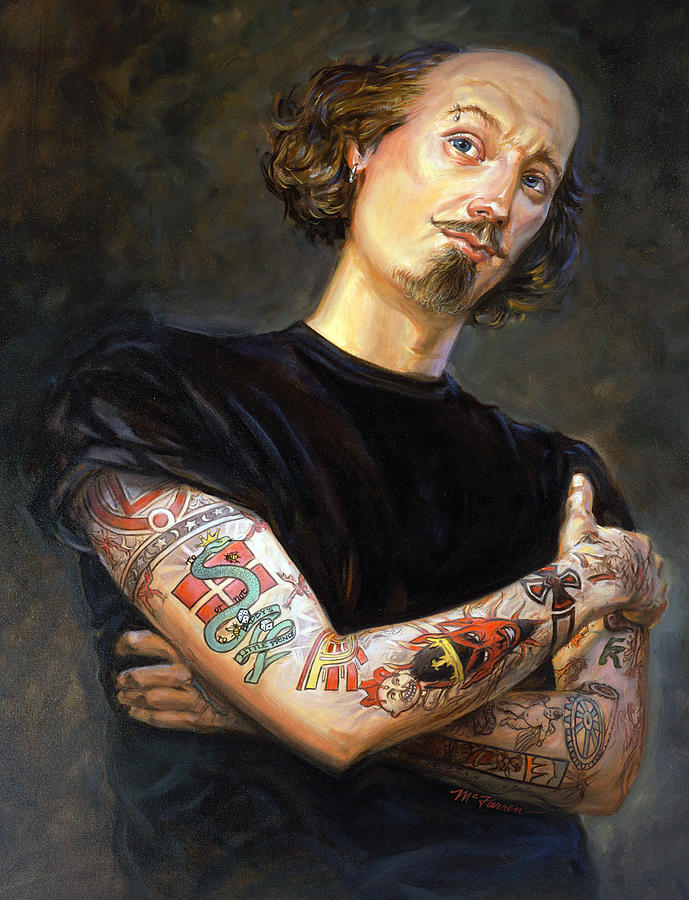
tattooed-shakespeare-mathew-mcfarren

In Shakespeare, those in authority rarely provoke resistance through injustice. In general, the one thing Shakespeare’s rulers can do wrong is to shirk their authority, trying to retire too early (King Lear) or consorting with those beneath them (Henry IV.) Often, their role is to come on at the end as a kind of hierarch ex machina, assuring all that “Some shall be pardon’d and some punished,” like the Prince at the end of Romeo and Juliet, or Prince Fortinbras at the end ofHamlet (“with sorrow I embrace my fortune”—yeah, we bet you’re sorry).

It’s sometimes said that Shakespeare always wrapped things up with a king on his throne and all right with the world as a reflection of a general belief among his contemporaries in the Great Chain of Being—a conception of the universe as divinely ordered hierarchy, each subordinate in his or her divinely ordered place. But there were many people in Shakespeare’s time who were mistrustful of kings and received authority—real-life versions of Malvolio, who Shakespeare pillories. Within his own context and within his own milieu, Shakespeare consistently championed the most powerful, and set himself against those who challenged their authority. He saw hierarchy as good and rebels as evil.

None of this is a good reason to dismiss Shakespeare. But it is a good basis for critical skepticism toward him. What would Twelfth Night look like from Malvolio’s perspective—or even from a perspective where it is not on its face ridiculous to imagine someone marrying across class? What real grievances might Iago or Macbeth have if it were possible for Shakespeare to show us an authority figure who isn’t a paragon? What happens to Julius Caesar if the rebels have some actual, genuine concerns about tyranny? As Rosenberg says, Shakespeare was a man, not a god—and as a man, he had a particular perspective, particular axes to grind, and particular blind spots. His plays aren’t entombed, authoritative holy writ; they’re living arguments, which means that, at least at times, they’re worth rebelling against.

The second comes from The Washington Post, written by Alyssa Rosenberg and explores the notion that the way a play is adapted/staged/interpreted will, of course, have a bearing on its relevancy to a modern audience: What we get wrong when we talk about Shakespeare.

Shakespeare Sucks

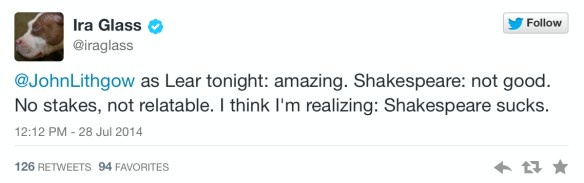
A beautiful spat has broken out amongst the literati Stateside this week, all sparked by a tweet from Ira Glass, presenter of This American Life:

Ira Glass 1_FotorHe then followed it with this:

Ira Glass 2_FotorSocial media went mad and it was picked up and discussed widely. The debate is fascinating and I thought I would share some of it with you. Firstly, and this is really worth listening to, a podcast from Born Ready. Director Steve Boyle and theatre producer Rob Ready discuss, to paraphrase Born Ready site, why Shakespeare has been elevated to something like a Prophet, and how his plays have become a point of shared experience and a cultural touchstone. I should warn you, however, that some rather choice language is used during the discussion.

.

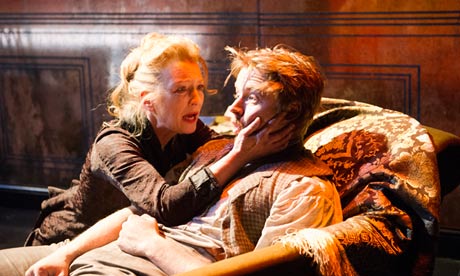
john

Now, whilst Glass didn’t personally attack John Lithgow, to tie him in with a rant about the irrelevancy of Shakespeare was bound to cause an outcry. Firstly, Lithgow is akin to acting royalty in the US and secondly, North Americans really love their Shakespeare – you only have to look at the amount of Shakespeare festivals that take place across the continent every year and the fact that New York has been swamped with productions of late.

The reaction on social media was, it has to be said, highly entertaining as these pieces on CBC and The Wire highlight. If you click-through on the second tweet above, you can read it for yourself. Others have weighed into the debate, most, not surprisingly disagreeing with Glass – even Esquire, in a piece entitled SHAKESPEARE IS THE MOST UNIVERSAL WRITER EVER – Ira Glass doesn’t know what he’s talking about.

One of the best responses comes from the New Republic by Adam Kirsch, who calls Ira Glass a Philistine for saying Shakespeare sucks, while noting that he is not alone in this opinion:

shakes_Fotor

 Does Shakespeare suck? Ira Glass, the host of the popular upper-middlebrow radio show “This American Life,” apparently thinks so; he tweeted as much after suffering through a performance of King Lear in Central Park. The backlash has been swift and severe, thus answering the question of whether there remain any literary taboos in the twenty-first century. Apparently, calling the Bard “not relatable” is still enough to get someone branded as a philistine.

I come not to praise Glass, certainlyI think he is a philistinebut also not totally to bury him. For there is always something admirable in speaking with complete honesty about one’s aesthetic reactions, even when those reactions are plainly wrong. Those who automatically praise Shakespeare because they know it is the right thing to say, or because they fear Glass-like ostracism if they say otherwise, may also be philistinesThe kind that Nietzsche, in his Untimely Meditations, called the “culture-philistine,” who “fancies that he is himself a son of the muses and a man of culture,” but is actually incapable of a genuine encounter with art. The first rule of any such encounter is honesty: If you fail to find what you are looking for in a work of art, even King Lear, you must be willing to admit it. Then you can move on to the question of whether it is you or King Lear that is deficient.

The truth is that Glass could have summoned some pretty impressive names to testify in his defense. George Bernard Shaw famously hated Shakespeare, complaining that “Shakespeare’s weakness lies in his complete deficiency in the highest spheres of thought,” and offhandedly claiming “I have actually written much better [plays] than As You Like It.” Tolstoy, too, had a low opinion of Shakespeare: “Open Shakespeare … wherever you like, or wherever it may chance, you will see that you will never find ten consecutive lines which are comprehensible, unartificial, natural to the character that says them, and which produce an artistic impression.” Shakespeare’s fame, Tolstoy concluded, was purely a matter of convention: “There is but one explanation of this wonderful fame: it is one of those epidemic ‘suggestions’ to which men have constantly been and are subject.”

But then, to be hated by Shaw and Tolstoy is itself a distinction. For these great writers, Shakespeare stood in their way as an indestructible obstacle, representing a way of writing that they opposed because they could not practice it. To Shaw, whose plays are political and polemical, Shakespeare was not political or polemical enough; to Tolstoy, who strove for organic naturalness, Shakespeare was neither organic nor natural. When T.S. Eliot declared that Hamlet was an artistic failure, he was not trying to make people stop seeing or reading Hamlet; rather, he was trying to get us to change the way we think about what makes a play successful.

Ira Glass, of course, was not engaged in this kind of literary maneuver. He was speaking as a playgoer who found, evidently to his surprise, that King Lear was not providing whatever it was he expected a play to providethat is what “not relatable” really means. And even here, Glass is not alone or even a pioneer. Until the Shakespeare revival of the eighteenth century, King Lear was regularly performed in England in an edited version, in which Cordelia lived at the end. No less a Shakespearean than Doctor Johnson approved of this change, on the grounds that “the audience will … always rise better pleased from the final triumph of persecuted virtue.” In other words, Johnson was saying that the devastating conclusion of Lear was not relatable; it did not tell people what they expected a play to tell them. (Similarly, Johnson remarked on the “seeming improbability” of Lear’s conduct in impetuously disowning Cordelia, and explained it by the primitivism of the England of Lear’s time; after all, he wrote, such barbarism “would yet be credible if told of a petty prince of Guinea or Madagascar.”)

If audiences today would not stand for such a prettified Lear, that is because our sense of reality, of how the world really works and is supposed to work, has changed since the eighteenth century. Lear is generally considered the most powerful of Shakespeare’s plays precisely because, in its unsparing picture of a violent, unjust, continually brutal world, it conforms so well to what our history teaches us to expect. In other words, Lear is all too relatable, though what it relates is deeply disturbing (as it was for Johnson, who objected to the putting out of Gloucester’s eyes as an unstageable obscenity).

If, in the face of this overwhelming power, an audience member remains simply unmovedif, like Ira Glass, he just thinks the play fails to workthen something has obviously gone wrong, not with the play, but with the spectator. Exactly what is wrong in this case is something only Glass can answer, but I have my suspicions. Not just Ira Glass, but all of us, are growing increasingly unused to the kind of abstraction that art requires. Lear’s plight is supposed to move us not because it is something that could really happen to usalready in the eighteenth century, Johnson found it incrediblebut because it is what Eliot called an “objective correlative,” an artistic formula for producing a certain emotion. The horror of life that Lear communicates is something deeper and more constant than the particular actions of its dramatis personae. The same is true of Oedipus’s self-blinding, or for that matter Abraham’s near-sacrifice of Isaac: We can only appreciate these stories if we imagine our way into them, rather than demanding that they come obediently to us.

Perhaps that is the difference between art and entertainment. And in a culture with so many proliferating sources of entertainment, the work required to encounter art is becoming increasingly unfamiliar. When people stop going to see Shakespeare altogether, we’ll know that we’ve lost this particular part of our humanityone which we have traditionally honored as among the noblest and most valuable.

William Shakespeare

The Guardian in the UK published a list of writers through history who have dared to rubbish Shakespeare, Shakespeare sucks: a potted history of Bard-bashing, while The New York Times ran an op-ed piece asking the question, Should Literature Be ‘Relatable’?

It’s a healthy debate, whatever side you are on. It is also noteworthy that Glass is clearly having second thoughts having faced the vitriol – the original tweet has been deleated.

I’ll leave you with BuzzFeed’s take on it all – Radio host Ira Glass didst belittle Shakespeare and the internet doth protest

.