Dying On Stage

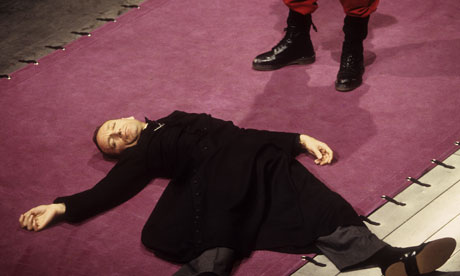
There a few things I have always had to begrudgingly admit that cinema does better than theatre, and one of them is death. A death – be it by murder, accident or natural causes – on stage is alway difficult. We suspend our disbelief, but when I see someone chopped down in the prime of life in front of me – I’m thinking Hamlet, Romeo and Juliet – it always leaves me (rather than the supposed corpse) a little cold.

the-barricade1

So it was with some interest that I read Jane Howard’s article in The Guardian that mused on this most difficult of theatrical acts:

Can theatre ever pull off a convincing stage death?

Playwrights love a dramatic death scene – but stage trickery is rarely good enough for the audience to suspend disbelief

If you’ve been to the theatre even a handful of times, it’s likely you’ve seen a stage death. Our fascination with death seems endless, and proves fruitful picking for playwrights. For the writer, there’s power in making an audience empathise with a character and then ripping that character away, and there’s also power in the vindictive killing of the disliked.

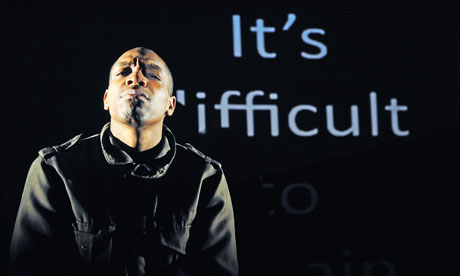
Oedipus Schmoedipus, playing in the Sydney festival, is a documentation and reenactment of the deaths in the western theatrical canon by performance company Post. The billing lists the work as “after Aeschylus, Anon, Barrie, Behn, Boucicault, Büchner, Chekhov, Euripides, Gogol, Goldsmith, Gorky, Hugo, Ibsen, Jonson, Marlowe, Mayakovsky, Molière, Pirandello, Plautus, Racine, Seneca, Shakespeare, Sophocles, Strindberg, Voltaire, Wedekind, Wilde et al”. And these men didn’t stop at one death apiece.

Post’s Mish Grigor describes the work as exploring the “tension between the fact that death is an actual universal, and the western theatrical canon is often spoken about as having universal themes or, these plays speak to all of us. We’re interpreting an actual universal through something that we don’t think is really universal, but pretends to be.”

Is death, then, perhaps an easy way of trying to create a connection with the audience? It is something that everyone watching will have a relationship with, even when other themes a play explores may be foreign?

oedipus-schmoedipus-belvoir-2014-production-shot-4-by-ellis-parrinder

And yet, we are readily judgemental of watching someone pretend to die. When we’re watching theatre we suspend disbelief in so many ways, buying into the construct of the world and using our imagination to fill in the gaps. But there is something about death that is particularly sticking when it comes to witnessing it on stage.

“I find it quite absurd when an actor dies on stage,” says Grigor, “because we know that it’s a game of pretend: they’re still breathing. You can still see them breathing a lot of the time, and the stage trickery that is employed is usually not that good.”

When you start talking about the practice of death and dying on stage, the same concerns repeatedly come up. Tim Roseman, artistic director of Playwriting Australia, says: “The trouble is, it’s an inherently over-the-top theatrical thing that theatre does, because at the very least you’re left with: what do you do with the body? And so the artifice is always problematic.

“Because I know you’ve got to do it 34 more times before you finish the season and, literally, do you just get up and walk off? Do we get someone in black to come and steal the body in the end? It’s a really problematic thing. And, you know, fake blood. So I think it’s the thing we buy the least.”

It seems that while we’re prepared to ignore the wires helping someone fly, there is something about death that makes us watch for the rise and fall of an actor’s chest or shadowed movements in the blackout.

Maybe that’s why, when I look back at the deaths on stage that have truly impacted and stayed with me, I keep returning to puppetry. The death of the title character of the Adventures of Alvin Sputnik: Deep Sea Explorer, a puppet made from little more than a white-gloved hand and a foam ball, left me holding my breath to not audibly sob. The deaths of hundreds of silent puppets at the hands of Nazi soldiers in Hotel Modern’s Kamp left my heart in my throat and my brain overwhelmed.

I mentioned these deaths to Nescha Jelk, artistic associate at the State Theatre Company of South Australia. “It’s because the puppeteer animates it, gives it that life and gives it that real presence,” she says. “We really invest [emotionally] with the puppets, but it’s so easy to de-animate them and to take that away.”

Grigor agrees: “There’s always life in the person, isn’t there? You always know. For me, I find it very hard to escape that knowledge: that a person is just a person.”

Michael-Feast-plays-Thoma-007

Not surprisingly this led me to see what other people had to say on the topic. A blog post Alexis Soloski, also in The Guardian, from a year or so ago – What makes a good stage death? Forget all that tediously realistic convulsing and juddering – a really convincing theatrical death is better left unseen – is great and her list at the end, about what should be remembered when ‘acting’ death, just made me smile:

1. Don’t. Keep the death off-stage.

2. Perform the death on stage but avoid showing it directly, as in the famed stoning scene in Edward Bond’s Saved.

3. Keep convulsions to a minimum.

4. Better blood. (The Royal Shakespeare Company keeps correctly coloured fluid in three different viscosities.)

5. Try to die on your stomach or with your back to the audience so they don’t see you continuing to breathe.

6. Actually die. There are – a very small number of – actors who have perished while treading the boards. (This method is not recommended. Not only is it tremendously sad and frightening, but it’s terribly inconvenient for the next day’s matinee.)

There is also a great article from TimeOut Sydney, Death Scenes,  which talks to six performers about how they ‘do’ death on stage. One of the actors interviewed, when asked if their mind wonders once they have been killed, said:

Sometimes you lie there thinking about what you’re going to have for dinner if it’s a matinee

A rather more serious article from theatrebayarea.org, I’m dying out here has in interview with actor James Carpenter who has ‘died’ many, many times on stage and is an interesting read on the subject.

I’ll finish with an extract from a post by Alfred Hickiling, Death by overacting, The Greeks did it tactfully, Bottom did it endlessly

There is a lot of death in the theatre: sometimes good, but frequently so bad as to make you wonder why anyone ever decided to mess with the formula established by the Greeks. You can’t help but feel that the fathers of western drama had it right when they opted to keep all the gory business off stage – why spoil the performance with a series of unnecessary convulsions when you can send a messenger to report that you expired heroically, with all your tragic dignity intact? Ibsen, Chekhov and Miller got the message: a solemn exit followed by a solitary gunshot, a profound silence and no mess.

Saved, Edward Bond

Saved, Edward Bond

It is the Jacobeans we have to thank for plays that conclude knee-deep in guts, thanks to their macabre fascination for golden daggers, poisoned Bibles, severed limbs and so forth – which all the followers of Sarah Kane and the Blasted school have enthusiastically revived today. But if one were to identify the absolute nadir of unconvincing expirations, it is as well to start at the Bottom:

Thus die I: thus, thus, thus.

Now I am dead,
Now I am fled,
My soul is in the sky.
Tongue lose thy light,
Moon take thy flight,
Now die, die, die, die, die.

I have seen actors spin Bottom’s soliloquy out for several minutes, at which point the joke no longer seems to be on Shakespeare’s weaver, so much as on themselves. But if the death of Pyramus is daft, Shakespeare also crafted some of the most exquisitely moving death scenes of all time, such as Cleopatra with the asp (“Dost thou not see the baby at my breast that sucks the nurse asleep?”), as well as one of the most defiantly underplayed (Mercutio’s “’tis but a scratch”).

Uncut Debate

The Scotsman newspaper published an interesting article this week, Debating Political Theatre, written by Tiffany Jenkins, a cultural commentator. In it she suggests that even in an age of austerity and economic woe across much of the world, theatre has yet to respond in a robust and meaningful way. I don’t necessarily agree with her take, but it certainly gives pause for thought. 

Modern social drama has plenty of targets but is awash with complacency at a time when we badly need riotous debate, writes Tiffany Jenkins

POLITICAL theatre has a long and honourable tradition, reaching back to Ancient Greece when playwrights satirised the existing system to powerful effect. More recently, in the 1970s and 80s, political theatre was alive with attacks on……capitalism. At its best, it was vibrant and uncompromising. Most importantly, it had bite.

Today, over three years into the age of austerity, and political theatre appears to be in rude health. Its boom is suggested by the success of Theatre Uncut, formed in 2010 in response to public spending cuts and with the intention of encouraging debate and action. Leading playwrights have responded to this contemporary vehicle for short work made available for free for anyone to perform for a limited period. And they have done so in their thousands – so far, more than 3,000 people have staged these plays in more than 17 countries across four continents. This Saturday, there is a Mass Action Day where people will simultaneously stage seven new works written in response to the provocation: “Do we all get more right wing in hard times?”

There is a lot on show. Appearances, however, can be deceptive, because despite all this activity – the multiple productions, prizes, plaudits and the applause – there are limitations to political theatre today. These are in part due to certain inherent difficulties with it – it can easily veer into didactic agitprop, which is boring – but there are also more profound problems with the politics at the heart of the works, and the state of affairs that they inadvertently reveal. Taking a closer look at political theatre today – what is on offer, who it is for and what it says – and you find a complacent body of writing that flatters the audience and is devoid of critical thinking.

DSC_0388_web

Theatre Uncut aims to create a conversation about important everyday issues, a laudable purpose, but the work staged is very much a singular view of the world, and notably black and white. The objects of criticism and those who are to blame are cynical politicians, greedy capitalists and racists. One such play is Church Forced To Put Up Gates After Font Is Used As Wash Basin By Migrants, written by the comedian Mark Thomas. It’s about a right-wing newspaper owner who used to publish porn, who is obsessed with depicting immigrants as “shit”, the EU as “shit”, and the BBC as “shit”, and who thinks everyone who works for him is “f****** useless”. He is taken hostage by women in balaclavas who threaten to kill him unless he prints a pro-migration editorial.

If this work contributes anything to political debate, it’s cliché. Because we have heard this before – there is nothing surprising, complex, or nuanced in this play or the others it accompanies. Most of them are cartoon depictions of nasty right wing people and lovely lefties who think the right kind of thoughts. Frankly, most of the plays are just long rants. It is clearly assumed that audiences know better, and are thus reassured about their views and can go home contented having been congratulated. It’s all very safe.

The problem with the pantomime visions of what is effectively the opposition is that they just don’t ring true. I say this not as a right-wing newspaper owner or as a capitalist, but as someone who is interested in working out what is wrong today, and it’s really not as simple as how things are depicted in works such as Church Forced To Put Up Gates After Font Is Used As Wash Basin By Migrants – in which there is a lot of profanity but little insight.

Take another of the plays being performed this week, The Wing by Clara Brennan. One of Brennan’s main characters is Mick, a white working class bloke who reads The Sun (there is a repetitive theme in the plays which depicts tabloids as disgusting and their readers as scum), wraps himself in a “light blood-spattered St George’s flag” and who dislikes immigrants. His daughter, Kerry, is a right-on thinking woman who had had her picture taken for Page 3 in order to later reveal that at the very same time as she was getting her bits out, she was by then already pregnant by a “brown person”.

In The Wing, there is no attempt to persuade those that may not think or feel the same, and no attempt to understand people who do not agree. It also feels out of date, just repeating the politics of the 1980s and 1990s, refusing to address the present. And this is why is has no bite, no power: it doesn’t aim to win hearts or minds, and it doesn’t address the present with any urgency.

The political theatre of the past tried to influence, the political theatre of the present assumes things will never change. What The Wing also and unintentionally shows is the contempt some of these playwrights have for the white working class, the social group habitually blamed for everything, but who were once an important social force in politics.

Theatre-Uncut-007

There is nothing wrong with going to see a dramatisation of opinions with which you agree, but for the work to be effective, to have an impact, it needs to challenge those who come from shared outlooks and try to understand those that don’t. Indeed, some of the best work has done just this – John McGrath, founder of the Scottish popular 7:84 theatre company, is a case in point. McGrath always said that political theatre should avoid agitprop and confront the audience, make them feel uncomfortable and question their own positions.

Political theatre today should be a place of riotous debate. Even if the playwrights and producers are singing from the same hymn sheet – and they usually are – there is plenty to discuss and argue about. I am not advocating that people tear each other apart, but suggest that constructive questioning is needed in the cause of clarification.

If we do not take ourselves and audiences out of our comfort zones, and try and persuade others, political theatre will continue as a dampener to debate, a sedative rather than a spur to action. It is time to stop applauding and cheering. This sort of political theatre doesn’t deserve an encore.

TUheader

Now it is clear that Jenkins is taking particular aim at a movement called Theatre Uncut which was created in 2010

to encourage debate and galvanise action around political issues that affect all of our lives.

According to Lyn GardnerTheatre Uncut isn’t just a performance, it’s an idea: that theatre can be immediately responsive to world events, engender discussion and effect change. Founded in response to public service cuts (in the UK), it suggests that theatre has a part to play in the protest movements that are gathering pace across the world in response to economic downturn and events in Syria. The lead time between a play being written and actually being staged is often more than a year; Theatre Uncut, by contrast, is theatre’s rapid response unit. The plays are written speedily and given just one day of rehearsal: actors often have scripts in hand.

.

So far Theatre Uncut plays have been performed by over 3,000 people in 17 countries across 4 continents. Performances have happened everywhere from theatres in New York, community centres in Scotland, schools across England, universites in South Africa, on the streets in Spain, on public buses in Mexico, to village church halls in Wales.

Untitled 2_FotorPlaywrights have come from many countries – Syria, Spain, Argentina, Iceland, Greece, UK, USA, Egypt and so on. You can even obtain the plays free of charge for performance, as long as any profits are donated to charity. You can read a review of the latest Theatre Uncut performance, by Susannah Clapp here.

.

To me, this is how theatre of protest should be happening, and I think Jenkins’ is misguided in her notion that theatre is not causing riotous debate. Maybe it’s because it is just not happening in the way she would like. Mind you, the final paragraph of Clapp’s review above does say the following:

This is an evening of intermittent sizzle. It intrigues rather than ignites. The idea of the project itself is more political than any particular argument. There is no real answer to the question about getting more rightwing: how could there be without statistical evidence? There is no real anti-left persuasion. Neither are there any rallying cries: Gillian Slovo suggested in one post-show discussion that people no longer feel there is a political alternative. Yet the actors bring the flying-by-the-seat-of-their-pants concentration that the visionary enterprise needs.

.

I’d suggest you watch the three plays embedded here and make your own mind up.

.

Post Apocalyptic Homer

My first post today is an article that appeared yesterday on Howlround, written by Jonathan Mandell. In it, Mandell posits that television is having an influence on theatre making. It makes an interesting read, and whilst I don’t necessarily agree with all his points, it certainly gives pause for thought. The play that appears to have prompted this, Mr Burns, A Post Electric Play, does sound fascinating and I will share some more about it at the end of the article.

8 Ways Television Is Influencing Theater

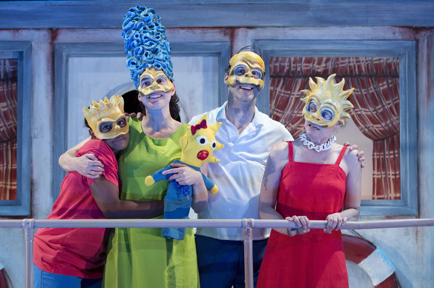
Anne Washburn started watching The Simpsons and writing plays at about the same time, and didn’t think they had anything to do with one another until she wrote Mr. Burns, A Post Electric Play, running at Playwrights Horizons until October 20.

Untitled1

Her play imagines how survivors of an apocalypse would remember episodes of The Simpsons immediately after the end of civilization, then seven years later and seventy-five years after that. It illustrates what might be the most obvious of the eight ways, I am suggesting, that television is influencing theater.

1. Shared Cultural Experience
“I envy the experience of the Greeks or the Elizabethans,” Washburn says. “That whole audience came in knowing the stories. They could focus on the characters.”

Television comes closest to providing a similar shared culture. “Movies do too,” Washburn says, “but movies are gone so quickly. Because TV shows are around so consistently for so long, they’re more finely woven into our lives.”

The Simpsons has always been a part of some people’s lives. Everybody knows who Homer and Marge are,” adds Washburn.

Avenue Q has had a long successful life by tapping into the affection for Sesame Street; imagining what Muppet-like characters (or, in truth, Muppet-watching children) would be like when they become adults.

“The characters on television shows are so much a part of the culture that people want to write about them,” says Washburn. Even plays or musicals that don’t revolve around a TV show can make allusions to them.

2. Direct Source Material
Sometimes a TV show is directly adapted for the stage. A recent example of this is The Addams Family. But while every movie studio has a department whose job it is to adapt its films for the stage, there is no such job in the TV networks.

Untitled2

“There’s a huge influx of movies being made into musicals, but not too many TV shows made into plays,” says Mark Subias, head of the theater department at United Talent Agency.

It is harder to get the rights to a television show, and easier to make money from one without adapting it for another medium. “Once it goes into syndication, there is so much money to be made, there’s not much motivation,” says Subias.

Still, it may be surprising to discover the television origins of some well-established works of theater. Rodgers and Hammerstein’s Cinderella, now on Broadway, debuted in 1958 as a musical written specifically for television. Horton Foote’s The Trip to Bountiful, currently in a revival on Broadway, began life on March 1, 1953 as an hour-long TV play starring Lillian Gish and Eva Marie Saint. Foote turned his teleplay into a stage play later that year, and it briefly ran on Broadway sixty years ago.

“Recently Gilligan’s IslandThe Brady Bunch, and Happy Days have been turned into musicals,” says Rebecca Pallor, a curator at the Paley Center for Media. “Although the producers of Happy Days (and no doubt the others) had aspirations of bringing the shows to Broadway, it has not yet happened. I seem to recall an attempt to turn I Dream of Jeannie into a musical as well.”

Even if few television shows currently serve as direct source material for stage shows, it seems clear that this is for reasons other than their popularity. There would surely be an audience for such adaptations, and a nation of TV-watchers can’t help but exert an influence on what does get presented on stage.

3. Forms And Approaches
“We live in a world now where you could argue that long, series television is the state of the art of storytelling,” director Sam Mendes said recently in explaining why he had turned Shakespeare’s history plays into a four-part TV series renamed The Hollow Crown, currently being shown on PBS.

“People have been doing interesting things with forms on television—The Wire, obviously,” says Washburn. “The way people are thinking about the arc of characters is really exciting.”

In my previous HowlRound article, Too Much Theater? The New Marathons, I said that the recent experiments in epic works of theater such as Mike Daisey’s All The Faces of the Moon—29 different monologues over 29 nights—could be influenced by television. As Daisey told me “the work is the size, in time, of a season or more of a TV show. Which allows new ways to listen.”

David Van Asselt, artistic director of Rattlestick Playwrights Theater, also used television as a reference point when talking to me about his brainchild, The Hill Town Plays—five of Lucy Thurber’s plays presented simultaneously in five different theaters in the Village. “With Lucy’s plays, you could see a play a week. We’re not asking any more of an audience than a TV show.”

These theater artists are far from the only ones who see television’s effect on the forms that theater (and not just “epic theater”) is using.

“It’s easy to see the influence television has had on me as a dramatist,” says Jay Stull, a director, literary manager, and the author of The Capables, a play recently produced Off-Broadway about a family of hoarders caught up in the world of reality television. But Stull doesn’t just mean using television as a subject.

“Television has conditioned me to prefer shorter scenes, quicker cuts, and fractured unities, but also to prefer longer stories generally.”

“I’m sure that watching TV changed how I think about dramatic rhythm,” says Washburn.

“I wonder whether characters like Walter White or Tony Soprano—the preponderance of anti-heroes on cable—make theater audiences more accepting of villains,” says playwright Sam Marks. “There are very few characters in my plays who are just ‘good.’”

Similarly, Matthew Maher, who plays Homer Simpson (among other characters) in Mr. Burns, sees a golden age of playwriting develop in just the past few years, because “the audiences of today have been trained to appreciate and develop an appetite for original thinking…and this training has come largely by way of the good shows on TV”—shows, not incidentally, by TV writers like Aaron Sorkin and Elizabeth Meriweather, the creator of the sitcom New Girl, who had their start as playwrights.

Itamar Moses has a mixed view. “I think it’s had some bad influence, in that you’ll see plays that are basically TV shows on stage, with tons of short, naturalistic scenes, in tons of locations for no particular reason.” On the other hand, Moses acknowledges that there are good shows on TV—and indeed, he is one of the growing number of playwrights who write for television.

4. Moonlighting
“If a playwright gets a bad review, he says: ‘I’ll go write for TV,’” says agent Mark Subias. “It’s sort of like a joke.”

In truth, having television as at least a theoretical alternative offers more than psychological support; there is also the money. “Some artists do make a living in the theater, but it’s rare,” says Subias, which is a reason why “I’m always very encouraging of my playwrights writing for television—if they have the temperament and skills (different from playwriting) and the desire.”

And if it doesn’t work out—that too can in a weird way offer support. “One of my writers was hired for a TV show that turned out to be a very stressful, toxic experience,” Subias says. “It made this person realize: ‘I’m a playwright. I need to write for the stage.’”

Itamar Moses, though primarily known as a playwright, has also written for television shows such as Boardwalk Empire. Asked whether his moonlighting has influenced his playwriting, he replies “It’s hard to have perspective on my own work, but I think the answer to this is yes, in two almost contradictory ways: On the one hand, being in a writers’ room makes it really clear how many ways there are to tell a particular story. The number of ideas—good ones—that get tossed around and then thrown out over the course of a day in a writers’ room, let alone a season, is staggering. So I think it probably made me less precious in my playwriting about staying married to my first idea, gave me faith that if I allowed the writers’ room inside my head to kick things around a little more, there might be a better idea on the horizon, and a better one after that.”

He adds,“On the other hand, because the money is so good in TV, with the trade-off being that you’re generally a cog in a larger machine, serving someone else’s vision, working with characters and a world someone else made up, it made me feel even more strongly that, in my playwriting, there was absolutely no reason to ever do anything other than exactly what I wanted to do. If I’m going to be paid almost nothing to make something that, relatively speaking, almost no one is going to see, I might as well execute my own vision.”

5. Departures (Disruptions)
The list is long of theater actors who have left a stage show for a role on TV or the movies. Some leave abruptly, disrupting the show they are in. Some never return to the theater; the stage was their stepping stone. (Pictured here is Sara Ramirez who made a splash in Spamalot on Broadway, winning a Tony for her role as The Lady of the Lake. She hasn’t been back since cast as Dr. Callie Torres in Grey’s Anatomy).

But even those performers who want to make a career in the theater also have to make a living. “It’s really difficult to cast a play in New York during pilot season, which I think is around February and March,” says Washburn. “All these actors go out to L.A. I hear ‘I’d love to audition for your play, but…’”

The effect is less obvious for playwrights than performers, but, says Washburn, “when you’re writing for television, you’re not writing a play. It remains to be seen whether some of the theater writers who left for TV will come back.”

6. Celebrity Casting
The term “stunt casting” was coined for cameos or “guest appearances”  by celebrities (usually movie stars) in television shows. It is a term almost always used pejoratively when describing the increasing practice of hiring celebrities (usually television or movie stars) to perform in a play or musical.

“If I could get a ‘star’ who’s a terrific actor, that’s a great thing,” says David Van Asselt of Rattlestick. “We’re trying to get audiences. I’m trying to find ways so attention can be brought to a play.”

The problem comes with an expanding definition of celebrity to embrace, that includes, for example, “stars” of reality television, who often have no experience on stage. Such casting is no longer restricted to bit roles; they are often asked to play the leads. Some shows have decided on a strategy to extend their runs by casting a succession of performers hired not for their talent, but because their names will attract publicity and lure in their fans.

“The great pleasure of theater for me is to see really good acting in action,” Washburn says. “Theater acting is a hard discipline; the more you do it, the better you are. People understand that stunt casting is an economic thing. But it does change the experience.”

7. Video Projections
Just this year, the Drama Desk Awards added a new category, Outstanding Projection Design, acknowledging the increasing use of videos on stage.

Untitled4

The winner was Peter Nigrini for Here Lies Love, the musical about Imelda Marcos by David Byrne and Fatboy Slim that was presented at the Public Theater in a theater set up to resemble a disco. But videos were used for more than just pulsating music video images. Videographers trailed the characters, projecting live close-ups on screens, as if they were news cameramen filming the characters making speeches or holding press conferences.

Wendall K. Harrington was given credit as “multi-image producer” for They’re Playing Our Song way back in 1979—the first of thirty six Broadway shows for which she has served as projection designer. Three years ago, she launched a new concentration in projection design at the Yale School of Drama.

“I explain to my classes that every playwright and director alive today grew up in the age of cinema and television,” Harrington says. “There is so much projection because they have been conditioned to think in these terms: Theater directors want scenes to ‘dissolve’ into each other; they’d like a ‘close up’—these are cinematic and TV terms. It would be hard now to write a play like Long Days Journey into Night—four hours in one room seems unthinkable.”

Videos on stage allow the kind of close-ups that were one of the advantages that television and movies had over the theater, and that audiences have come to expect, if not demand. But theater has taken the TV technology and turned it into something else. One example occurred in the Macbeth starring Alan Cumming, which included three video monitors with a live feed. To present the three witches, the three monitors showed Cumming from three different angles.

“The larger issue,” Harrington asks, “is whether the increasing use of video projections is affecting the quality of theater. Stay tuned for that.”

8. Theater As Anti-Television
A director once told Theresa Rebeck, playwright and television writer, “that since realism is done so well by television and feature films, the theater must explore something else.”

In her book Free Fire Zone, Rebeck makes it clear that she thinks the unnamed director is a fool (for one thing, she doesn’t think TV does realism well). Nonetheless, the director’s comment reflects what may be the greatest influence that television has had on theater—the push it has given theater artists to create something that will drag TV watchers out of their home and turn them into theatergoers.

“I can’t tell you how many theater mission statements I’ve read that say: We want to tell stories that can only be told through theater, that you can’t see on television,” Washburn says.

“How good TV has become at doing a certain kind of character-driven long-form storytelling really throws down a gauntlet for playwrights,” Itamar Moses says, “and challenges them to answer the question, with their work: What canonly theater do? What can’t we getanywhere else? And there’s no one answer to that, but it challenges every playwright to try to come up with theirs.”

Now for some more about Mr. Burns, A Post Electric PlayFirstly, the reviews are really good and it is clear that it is quite unique in a number of ways. Have a read here and here.

.

Playwrights Horizons has lots of other stuff worth having a read of, watch and listen to. Click the image below to get there:

burns3.jpg__960x480_q85_crop_upscale

burns5.jpg__960x480_q85_crop_upscale

You can hear more from Anne Washburn here on the origin of the play, its unique development process, and how “The Simpsons” came to represent the high culture of the future.

That Is The Question

An article in the New York Times caught my attention a couple of days ago, Maximum Shakespeare, To Renovate or Not to Renovate. Written by Charles Isherwood, a very well-known american theatre critic, it deals with the hoary old question about whether modern productions of Shakespearian plays should be contemporized. With a slew of The Bard’s plays to open on and off Broadway in the near future, Isherwood and other NYT writers will be

regularly posting commentaries on aspects of them, engaging larger questions about how today’s theater artists approach these canonical works, and inviting you to add your opinions about how vitally Shakespeare continues to speak to modern audiences. (Opera, ballet and movies will come up as well.)

If you read the article below and then follow the link above, you can see the discussion has already begun. I shall be following with interest.

Orlando Bloom in Romeo and Juliet on Broadway

Orlando Bloom in Romeo and Juliet on Broadway

Wherefore art thou riding a motorcycle, Romeo?

So might audiences muse at the start of the new Broadway staging of “Romeo and Juliet,” the first in the season’s plentiful Shakespeare productions, both on Broadway and off.

As the shows open in the coming months, fellow New York Times writers and I will be regularly posting commentaries on aspects of them, engaging larger questions about how today’s theater artists approach these canonical works, and inviting you to add your opinions about how vitally Shakespeare continues to speak to modern audiences. (Opera, ballet and movies will come up as well.)

David Leveaux’s “Romeo and Juliet,” which opened on Sept. 19 at the Richard Rodgers Theater, announces its point of view in the show’s opening moments, as Romeo removes his helmet (odd, that, for a swooning romantic; Mercutio, one suspects, wouldn’t bother) and reveals himself in the comely person of Orlando Bloom, clad in ripped jeans, T-shirt and hoodie, plus the kind of assorted man-jewelry you can scoop up by the handful at Urban Outfitters.

DISCUSS: Is Shakespeare better with contemporary imagery, or clad in classical garb?

The question I opened with — why make Romeo a facsimile of an urban hipster? — points directly toward an issue that I suspect will percolate throughout the season, namely whether in producing Shakespeare today the most effective approach revolves around cloaking the text in contemporary imagery, or hewing to a more “classical” line, dressing the actors in what passes for traditional Elizabethan costume.

With its set dominated by a giant Renaissance-style fresco scrawled with graffiti, the new Broadway production didn’t strike me as an ideal test case for the here-and-now approach. The costuming and visual effects meant to reorient this tragic love story as an urgent bulletin from today’s world felt pretty generic, as did his somewhat half-hearted gesture toward infusing the play with an element of racial tension. (The Capulets are all played by black actors, while the Montagues are white.)

But it is easy to understand the impulse, particularly with this play. “Romeo and Juliet” is the ur-drama of young love, and it is often the first Shakespeare play kids read in high school. Young audiences alienated, or at least challenged, by the arcane language of the play may be encouraged to stop texting and give it a more attentive hearing when the drama comes packaged in imagery to which they can relate.

Baz Luhrmann proved the efficacy of this approach in his fiercely imaginative movie version from 1996, with a pre-megastardom Leonardo DiCaprio and a pre-“Homeland” Claire Danes playing the doomed lovers in a Southern California riven by gun violence.

It was a palpable hit, so to speak, and deservedly so. And of course one of the most popular iterations of the story is the beloved musical “West Side Story,” which dispensed with Shakespeare’s language but kept the fundamental architecture of the plot.

Denzel Washington, far right, in the 2005 Broadway production of Julius Caesar.

Denzel Washington, far right, in the 2005 Broadway production of Julius Caesar.

But there are many grumblers out there, I suspect, who have had their fill of Shakespeare productions that try to shoehorn contemporary relevance into the plays by dressing the conspirators in “Julius Caesar,” say, in business suits, or “Macbeth” in 20th-century military attire.

In fact these days I’d argue that the default Shakespeare style — at least for the major tragedies, and many of the comedies and romances, too — is contemporary. (With the history plays that concentrate in detail on specific periods in the progression of the British royal line, there isn’t always as much innovation.)

What may get lost in the debate is the fact that dressing Shakespeare in off-the-rack duds is nothing new; in fact what’s comparatively newer is the tradition of presenting the plays in Elizabethan or Jacobean attire. As no less an acting authority than Alec Guinness once pointed out, in a 1953 program for the Stratford Shakespeare Festival, the plays were traditionally performed in attire drawn from the era in which they were produced until in the 19th century manager-actors such as Charles Kean and William Macready introduced a vogue for historical accuracy in Shakespeare.

Some scholars cite the innovative productions of Barry Jackson in the 1920s at the Birmingham Repertory Theater as marking a true inflection point in bringing modern dress into Shakespeare production. His 1923 production of “Cymbeline” was a game-changing landmark for British Shakespeare staging. Coincidentally — or perhaps not — the company was home to some of the greatest British actors of the 20th century, from Laurence Olivier and Ralph Richardson to Edith Evans and Peggy Ashcroft.

The great director Peter Brook was hired to stage three productions there at the age of 20. In America, meanwhile, Orson Welles is often lauded as the radical innovator who yanked Shakespeare out of the realm of fusty classicism, with his famous “voodoo” “Macbeth” and his Fascist-styled “Julius Caesar.”

Rory Kinnear and Adrian Lester in the National Theatre's production of Othello in London

Rory Kinnear and Adrian Lester in the National Theatre’s production of Othello in London

Many years of Shakespeare-watching have left me agnostic on the issue of “to update or not to update.” Nicholas Hytner’s riveting “Othello,” which I saw at the National Theater last summer (and which will be broadcast in movie theaters beginning Sept. 26), was a superb case in point. Without altering the text, in setting the play in a 21st-century war zone the production made cogent and disturbing points about the way, in a largely male-dominated military environment, women can become the object of repressed or warped violent impulses. (Emilia, here, was a soldier too.)

A scene from the 2006 production of King Lear at the Goodman Theater in Chicago.

A scene from the 2006 production of King Lear at the Goodman Theater in Chicago.

And perhaps the best overall production of “King Lear” I’ve seen was Robert Falls’s aggressively violent production for the Goodman Theater several years ago, in which Lear’s kingdom was represented as a failing, vaguely Balkan state, illuminating the way in which a power void automatically unleashes violence, which only begets more violence.

But I could just as easily cite any number of bland, unrewarding attempts to dress Shakespeare up in modern garb and gimmicky attempts at relevance, which I suspect some directors impose upon their productions because they (and their actors) are less at ease with the language than they ought to be. The hope is that novelty (although it rarely qualifies as novelty anymore) will prove a distraction from mediocrity.

Fundamentally, a great Shakespeare production will rise or fall not on what the actors are wearing, and whether they are barking into cell phones or slinging swords at each other, but on whether they can infuse these magnificent, challenging texts with the life blood of honest feeling and formal beauty

Are the most memorable Shakespeare productions you’ve seen modern or “classical”? Do you find it jarring when Hamlet picks up an iPad? What did you make of Mr. Leveaux’s “Romeo and Juliet”?

Everyone’s A Critic

A few weeks ago I wrote a post, Critiquing the Critics, in which I touched upon the notion that professional theatre critics are being threatened by the rise of the internet blogger/critic. Since then one of the major UK news papers sacked all its arts critics and another got rid of its chief theatre critic. The picture is the same right across the globe.  Arts criticism is clearly and sadly becoming a minority interest in the eyes of newspaper owners. All of this has not surprisingly stirred up quite a debate about the role of critics in relation to theatre and the purpose they really serve.  It has fascinated me and has raised a few questions about the synergy between theatre critic and theatre making.

In her article for Fourthwall magazine, The Future of Theatre CriticismEmily Hardy lays out the debate.

THE ESSAY: The Future of Theatre Criticism

In an information, saturated world, who do you trust? What is the future of traditional theatre criticism? Emily Hardy investigates.

theatre_seats_main

Tim Berners-Lee, creator of the internet, brought about a revolution that overwhelmed, consumed, and eventually defined contemporary society, facilitating freedom of speech in its rawest form.

A universally accessible resource of information, music, film and literature, the internet has reduced the value of the tangible book or CD for example, resulting in the inevitable and devastating decline of particular industries.

Theatre remains relatively safe, largely unperturbed by the culture of the ‘free download.’ A curated theatrical experience can be purchased in the form of aPhantom of the Opera concert DVD, but nothing available online yet threatens live, visceral, organic, fleshy theatre. However, traditional theatre criticism has fallen victim: In one respect, the immediate, wide-spread accessibility of a review has facilitated increased readership, but rapid turn-around and ‘free-for-all’ authorship means that the quality of criticism, at one time an art form in itself, is suffering. After all, “If everyone’s a critic, then no one’s a critic.” (L.Winer, Newsday)

Where once, books were ritually burnt because of the political threat posed by the persuasive written word, the internet, by putting power into the hands of the people, has actively encouraged the spread of opinion. Writer John Moore explains that, “When it comes to arts criticism, the internet was supposed to be the great equaliser,” but, what truth or meaning is there in anything online? The internet is everything and nothing because it has no centralised governance. What is fact without validation? Opportunistic bloggers, tweeters, and rapid-response reviewers, have filled the information vacuum created by the impartial internet, and whilst these unpaid, unqualified, unknowledgable writers slather the web with their opinions, informative, measured and witty criticism slips into the archives of yet another lost art form. Web reviewers, writing to varying degrees of purpose or proliferation have spawned a culture of speed rather than that of considered opinion, and this has resulted in wide-spread unemployment; John Moore, for example, was the last full-time, professional critic in Denver.

As experienced writers become surplus to requirement we need to ask, can theatre exist without criticism? The answer is dependent upon what you believe the purpose of criticism to be. What do you read and who do you trust? What do you hope to achieve by flicking to the arts pages of a paper? In any case, with the standard of criticism (online and in the papers) continuing to slip, the critic’s reputation worsens. What future is there?

Plato

Plato

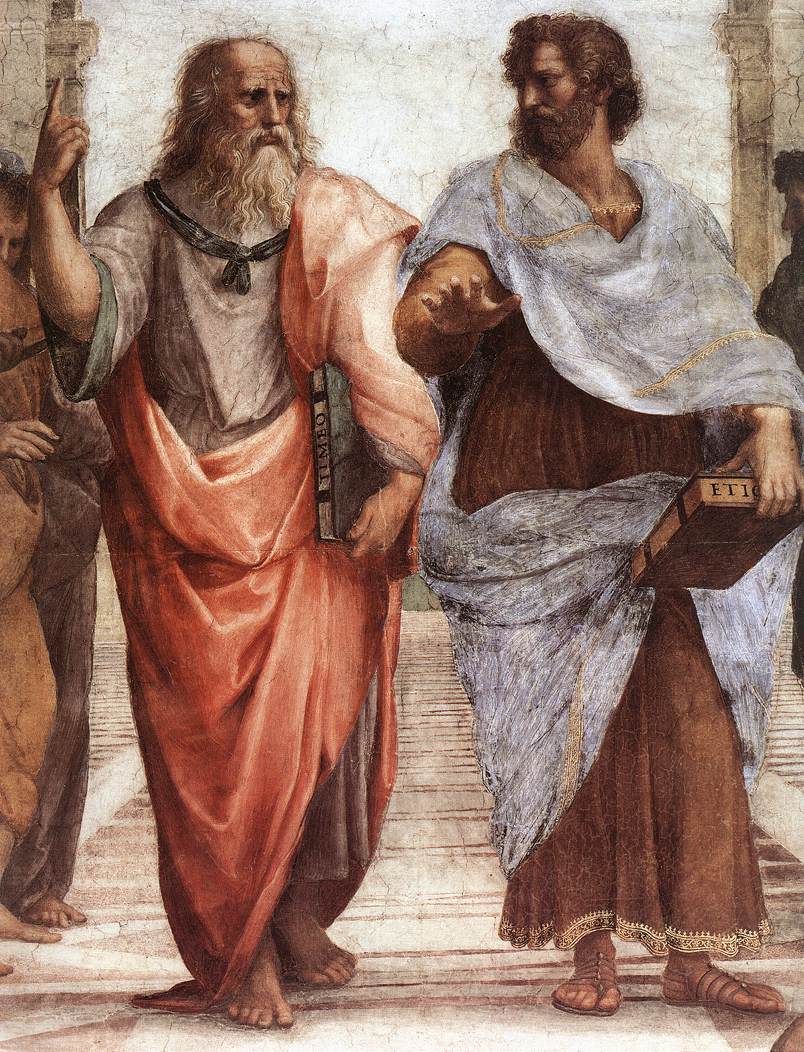
Before we confront the future, let us look firstly to the past. The earliest known reference to criticism dates back to C.380 B.C.E and Plato’s Republic. Laying a foundation for critical discourse in the classical world, Plato explains how it was fitting for a rhapsode, (poet) to respond verbally to theatrical entertainments: “For the poet is a light and winged and holy thing, and there is no invention in him until he has been inspired and is out of his senses, and the mind is no longer in him.” In the beginning then, there were high expectations. In the 1800’s, critics played an increasingly important role within the American press, and despite being accused of reducing feelings to a state of miserable refinement, they were valued, employed and at least possessed such skills. Meanwhile, as Irving Wardle outlines in his book Theatre Criticism, the Grub Street slums of Georgian London rapidly became a bohemian hive of artistic activity and were the probable origin of theatrical criticism in Britain. By the 1850’s, advancements in printing and the press fuelled an explosion in journalism, and in 1935, cementing that progress, establishment of The Drama Critic’s circle ensured that the critic’s influence continued to abound.

Conversely, 2007 saw the beginning of wide- spread layoffs at newspapers and magazines leaving dozens of veteran arts journalists professionally homeless, expunged by internet reviewers or cheaper freelancers. And the situation continues to worsen, evidence now suggesting that criticism has reached such a point of decline that it is no longer significant; it no longer has a part to play.

What could today’s critic offer in order to reinstate their own necessity and worth? What do we want? Reviewing, simply put, is the act of writing or speaking about the performing arts, so no one person can dictate what it should or shouldn’t be, and if critics disagree amongst themselves, that is nothing compared to the public disagreement over what their role should be. We all require something different, but one might hope to locate at least one, two or a combination of the qualities listed below:

A review should be…

Informative. The piece should contain basic, accurate information about the show/production in order to keep the reader in touch with the continuously evolving theatrical landscape – a landscape which, for some, sits at the epicentre of social functioning. The reviewer therefore, is required to attend, watch and inform.

Entertaining. Theatre is occasionally entertaining. Shouldn’t we be entertained when reading about it too? Be it witty or not, criticism should capture the style and essence of the show – reflecting, not just referencing it. It is good for the industry if people flick to the review pages; interesting articles will promote that intrigue.

Historical. Criticism is a way of documenting, remembering and celebrating past theatre, as well as present. Therefore a critic should have theatrical knowledge in order to root the production in question within theatrical history.

Constructive. Good, impartial criticism can provide the fresh eyes a creative team require. Reviewing is a fundamental and integral part of the development process – a way of improving theatre. “Only critical faculty enables any artistic creation at all.” (Wilde) What good does a sycophantic wash of praise do?

Opinionated: A review should assist the reader in making the all-important decision: to buy tickets or not to buy tickets? That’s a big responsibility, and if “everyone is a critic,” then who should we trust? Marketing might initially catch the attention of the consumer but a good review can cement the £60 per ticket spend. The public need an arbiter of taste.

The critics bible

The critics bible

And is this what we are getting? According to writer, John Russell Brown, criticism is an “unmapped quagmire,” – an art form that has remained, until recently, unexamined. But, in light of increased instability, it feels appropriate to turn the tables and examine what remains. Reviews that meet our expectations are increasingly difficult to find, but they do exist: Ben Brantley, for example, reviewed Menken and Fierstein’s Broadway musical, Newsies, for the New York Times. His piece, ‘Urchins with Punctuation,’ is lengthy and entertaining, reflecting the show’s energy and offering a measured and reasoned opinion from which the individual reader can decipher the production’s suitability. A literary achievement, he gives credit without verging into the bland territory of hyperbole: “Mr. Feldmen’s lyrics are spot on, while the melody reminds us just how charming a composer Mr.Menken […] can be.” Overblown praise only provokes cynicism, disappointment and a wilfulness to protest. He is refreshingly witty: “That doesn’t stop them from burning energy like toddlers on a sugar high at a birthday party,” and immediately captivates the reader, much in the same vein as a play might wish to do. Brantley also resists the trappings of writing a gratuitous plot synopsis, instead summarising the narrative in one Plato line: “The show’s title characters, feisty lads of the urban jungle […] make their living pushing the papes.”

In terms of language, Brantley uses the “read all about it,” exclamatory, punctuated energy of the show to drive his piece and employs the colloquial so as to serve the readership and the show’s potential audience. In addition, the grounded review acknowledges current social trends: “These days urchins have mostly been replaced in popular entertainment by troubled teenage vampires (‘Twilight’) and fresh-fleshed human killing machines (‘The Hunger Games’).” Perhaps you could criticise Brantley for failing to address the historical concerns of said urchins, but the all singing all dancing, lavish musical does not lend itself to a serious discussion of these themes. If the show fails to address it, then why should the reviewer? Instead, Brantley reviews Newsies for what it is. Finally and perhaps most importantly, is Brantley’s impressive honesty. He bravely asserts his opinion in the confident 1st person, and in a way that is simultaneously constructive and comical: “I commend the cast members for always appearing to be excited by what they are doing. Unfortunately, that is not the same as being exciting.”

Of course, Brantley is not the only capable writer in print, but with the situation as it is, and talented writers (young and old) being forced to write to unrealistic deadlines, often for no pay, is it any wonder that standards and expectations are not being met? Infuriatingly, criticism also continuously undermines itself in the following ways: Firstly, reviews have become monetized.

It is increasingly common for large production companies to pay papers (inevitably tantalised by the fee) for headline quotes. We are now bombarded with emphatic posters making incredible claims: “It’s the greatest show on Earth!” for example. But, if companies pay for quotes, how are we, the reader, able to distinguish between a review and a sales pitch? The differentiation no longer exists. Secondly, writers for particular sites receive a rate of pay dependant on the number of ‘hits’ a review receives. Obviously, a 5* piece, fizzing with praise, is shared and circulated by the company and consequently, only the sycophant can afford to eat. This severely limits the opinion of the honest reviewer, terrified of displeasing. That’s not theatre, nor is it criticism. That’s bribery and actually, all the reader gets is more marketing.

It is no coincidence that as we see more of the above, (not to mention dry, ignorant, distasteful writing) people lose faith in criticism, no longer functioning in the traditional capacity on which they relied. Simply put, the remaining work is not good enough to sustain the form’s validity. Let us remember for a moment Oscar Wilde’s expectation: “It is criticism rather than emotional sympathies, abstract ethics or commercial advantages that would make us cosmopolitan and serve as the basis of peace.” (Wilde) Gone, I fear, are the days of this long lost ideology.

oscar-wilde-1

Oscar Wilde

So what can be done? Due to the human need to impose form on chaos, art will always be accompanied by some sort of criticism; it cannot exist without it. However, in order to prevent being displaced entirely by the unmediated voice of the internet, critics need to act. Public reviews, such as those found on Amazon or Trip-Advisor, for example, tend to be either glowing or scathing. The internet rarely offers informed, impartial, measured opinion. For as long as this remains to be the case, the critic, as an arbiter of taste, stands a chance. Continuing to encourage a wealth of discussion and increasing public awareness will assist to stimulate change; only an amalgamation of minds can forge progress at this stage and suggestions are already being made.

No one can prescribe a format for ‘good’ criticism; pieces are as individual as plays or paintings, but perhaps, as was conceded at ‘The Art of Criticism’ conference in London, 2013, the future of criticism might hinge upon a willingness to adapt. For example, Brantley argues that reviews cannot be written well AND quickly. “I don’t think you should go with your very first instinct. I don’t think theatre is sports.” However, in order to adapt to 21st century demands, critics may no longer be allowed the luxury of “a chance to process what [they’ve] seen.” Mark Shenton, in his blog for The Stage, identifies how critics, such as Billington, Taylor and Letts, have been attending performances ahead of press night, in order to allow

for writing time. This is not an ideal solution – a preview should be a preview, but early viewing could potentially improve the standard of published work. Also in question is the star-rating system, which some papers have dismissed in order to encourage a thorough reading of the piece. It is too tempting to place great emphasis on the over-simplistic, reductionist, blurry distinction between 3 or 4 stars.

There are problems to be addressed and solutions to be trialled, but with persistence, adaptation and adjustment critics may well prevail. (Alternatively, we can hope that readers themselves might start to demand better!) However, if the horizon continues to darken, traditional theatre critics, artists as they are, may continue to suffer, reminiscent of where it all began – Grub Street and the impoverished, bohemian neighbourhood of hack writers.

It is clearly a debate that is going on in many places. For example, in his piece for the Australian newspaper The Age, theatre critic Cameron Woodhead talks about the rise (and dangers) of the internet blogger – Slagging off theatre, a case of foul play. You can read the blog Woodhead talks about, Shit on your play, here.

Meanwhile in London this week, The Critics Circle held its centenary conference and the link below is to a recording of a discussion, hosted by theatre critic Lyn Gardner, about the future of theatre criticism in a, twittering, blogging world.

The Critics’ Circle Centenary Conference: The Future of Criticism.

In the recording, I was particularly struck by the audience and panel talking about Harold Hobson and his championing of new writers that went on to become some of the most successful writers of the 20th century:

.

Irving Wardle also had a fascinating relationship with Harold Pinter, which he wrote about in Intelligent Life Magazine, The Unconditional Harold.

The Chair of the Drama section of the Critics’ Circle is Mark Shenton, theatre critic and avid tweeter. He also blogs for The Stage and two of his recent postings, Critics in intensive care – but can Twitter fill the space? and The critical and Shakespearean conundrum add to the debate.

It seems to me that there is a strong case in all of this for the professional theatre critic and we allow them to be drowned out by the likes of Shit on your play at our peril.