Their Voices Are Far Too Few

Voting comes to a close tomorrow in the world largest democracy. The Indian general election has lasted 6 weeks, beginning on 7th April, with over 814.5 million people eligible to vote. Much has been published about the state of the nation and one article that particularly caught my attention was by Anupama Chandrasekhar and Akash Mohimen for The Guardian. Chandrasekhar and Mohimen are playwrights and in their piece The threats to political theatre in India: fundamentalism and escapism, they explore the integral role theatre has played in India’s freedom struggle in the past and question its purpose today, reflecting on censorship, audience expectations and the new voices seeking to be heard.

Anupama Chandrasekhar

Elections in India have always been high-decibel, high-emotion events, a period in which art and artists are most vulnerable to attack by fundamentalists. Twenty-five years ago, the street-theatre playwright and director Safdar Hashmi was killed in the middle of a performance during local municipal elections near Delhi. Last month, when the country was in the throes of electioneering, Evam, a Chennai theatre group, was pressurised by the police departments of three cities to cancel their shows of Ali J, a monologue on what it means to be a Muslim today.

Anupama Chandrasekhar

Anupama Chandrasekhar

The increasing number of fundamentalist groups targeting theatre companies across the country has become a cause for concern. A website of a fundamentalist group lists six plays they’ve had censored within the last three years, among other films, TV shows, commercials and books.. India was once far more tolerant of political theatre. While there was the odd case of a play being banned (the ban on Vijay Tendulkar’s Sakharam Binder was later revoked), explicitly political plays were allowed free reign in the 1970s (barring the Emergency years) and early 80s, particularly in my hometown, Chennai. As a child I watched in Tamil insightful political explorations in many guises: satires, spectacular mythologies, powerful social realism and laugh-a-minute drawing-room farces. Social realist Komal Swaminathan, satirist Cho Ramaswamy and mythologist Manohar were household names then.

The rise of fundamentalism has been an obvious deterrent to serious political theatre. But a bigger and more insidious threat has been what Brett Bailey would call the “sanitized demands of the market”. There’s a growing tendency to provide safe, escapist entertainment rather than dialogue with the world around us. While the older generation of theatre practitioners like Mahesh Dattani, Sunil Shanbag, Maya Rao, Na Muthuswamy, Gnani Sankaran and Mangai Arasu continue to ask urgent questions about who we are as a nation, many of my generation appear to have fallen prey to the exigencies of the market. Neil Simon and Yasmina Reza are Chennai’s two most popular and frequently staged playwrights of the English language. The pattern is eerily similar in other cities too.

Disconnect by Anupama Chandrasekhar at the Royal Court theatre

Disconnect by Anupama Chandrasekhar at the Royal Court theatre

In this din of safe comedies and news channel-induced hysteria, there are new voices seeking to be heard: Irawati Karnik, Abhishek Majumdar, Neel Chaudhuri, to name a few. The young Chennai director Aruna Ganesh Ram recently embarked on a pan-Indian verbatim project this election year to explore the concept of freedom. Director Quasar Padamsee’s project So Many Socks, based on Tenzin Tsundue’s collection of poems and stories, explores Tibet, nationhood and the individual. Swar Thounaojam, a Manipuri playwright and activist, wields the English language as a weapon and a tool to explore her subaltern identity.

But in a country with a population of over a billion, their voices are far too few.

Akash Mohimen

Traditionally, theatre has been an integral thread in the social fabric of India. It was used to spread news, socio-political awareness, propaganda and entertainment. Theatre played a vital role in India’s freedom struggle, bringing messages preached by the leaders to communities hundreds of miles away. It was one of the many sparks that gave rise to one of the world’s largest freedom movements.

In the 21st century, Indian theatre seems to have lost some of this spark. Political plays are few and far between.

Akash Mohimen

Akash Mohimen

Barring the continuous adaptations of Vijay Tendulkar and Badal Sircar’s texts from the 70s, there are only a handful of political plays doing the rounds.

There are plenty of contemporary writers trying to strike a balance between storytelling and shedding light upon important topics that have long been untouched. But audiences always prefer to keep such productions at arm’s length. They jump to conclusions that they are depressing and preachy; the message going around these days is “make them use their brains”.

I believe the reason for such a mind-set is lack of awareness. Audiences have little or no idea of what’s happening beyond their own city limits. When they hear about a play on the Kashmir issue, they immediately shun it, rather than become intrigued by the theme and witness a tale of friendship, lost innocence and survivor’s guilt.

The influence of the motion picture industry has affected theatre ticket sales. People would rather spend 400 rupees for a multiplex ticket on a Sunday, than 300 rupees for a play at Prithvi theatre. And their reason is mostly the same: escapism.

With such a thought process, it is fast becoming difficult to stay afloat by practising theatre alone. No matter how passionate one feels about this medium, one needs to branch out to films, commercials, event management and education to have some sort of financial support. There are few who can truly say that they earn their livelihood out of theatre.

Mahua by Akash Mohimen

Mahua by Akash Mohimen

Despite corporate funding over the last few years, most productions barely break even. In fact, some lose money each time the actors step on stage. But they keep coming back year after year, because of the sheer love for the stage.

Theatre in rural India remains the truest form of Indian theatre. There are parts of the country where, every festive season, a performance will be organised free of charge. A performance could be put together by a teacher, farmer, policeman and postman, where the whole village will participate. Irrespective of subject matter or story, they will lend their ears. The laughter and tears of the audience are a major adrenaline rush for the actors and musicians on stage. Everyone involved is as moved as the audience watching.
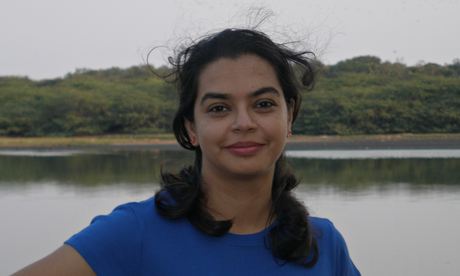
Anupama Chandrasekhar and Akash Mohimen are part of the Royal Court’s writing programme in India

A Stronghold In The Desert

Fifteen years ago I spent some time travelling through Syria and Jordan. It was my first trip to the Middle East and it was a defining moment for me. Both countries have had a lasting impact, not least because of the richness of their culture and history. In addition to Petra, two places remain very firmly planted in my memory. Firstly the Souk al-marina in Aleppo was a sensory delight,  an incredible bazaar built over 500 years ago under the Ottoman Empire and sat firmly on one of the World’s oldest trade routes. Secondly, Krak des Chevaliers, a crusader castle dating from 11th century, dripping in history.

SYR_1024_298371k

Souk al-marina before it was destroyed

krak_des_chevaliers_syria_photo

Krak des Chevaliiers before the civil war

Both have suffered badly during the Syrian civil war that has now been raging for 3 years. The Souk in Aleppo was destroyed by fire, and much of the city itself razed. Krak des Chevaliiers has been damaged by shelling and fire too.  It happens to be near Homs, another war-torn, ravaged Syrian city and has suffered accordingly. Both are (or in the former’s case, were) UNESCO World Heritage sites.

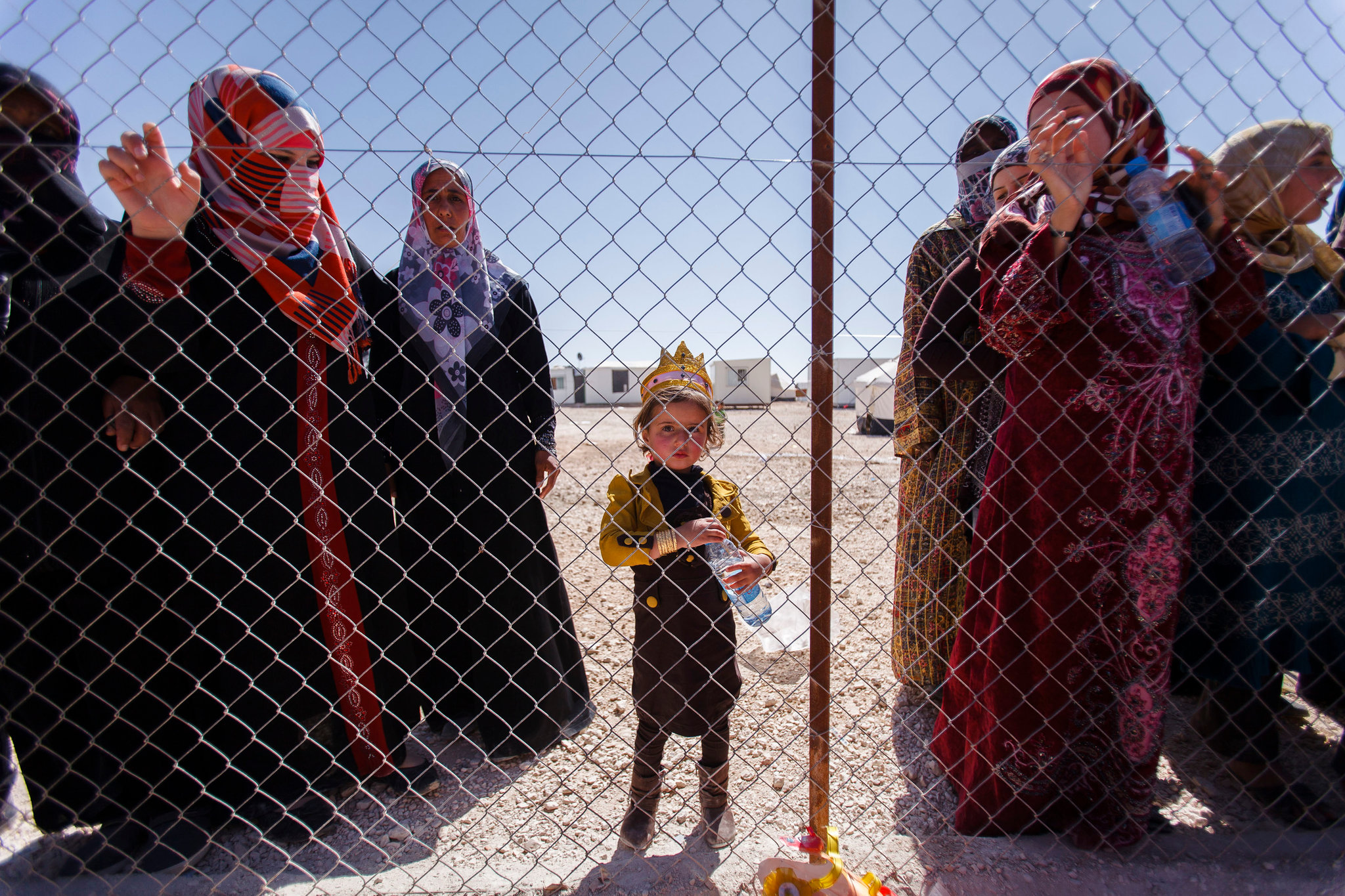
Where am I going with this? Well I was reminded of this visit again recently.  I have written twice here already (No Longer A Refugee and No Longer A Refugee #2about a group of women who have fled the fighting in Syria and have become performers in a production of The Trojan Women, a greek tragedy that reflects their own experiences. However, I have recently also become aware of another theatre project with Syrian refugees, but this time with children. Not surprisingly, many of the people fleeing the fighting in Syria have fled to neighbouring Lebanon and Jordan. One of the biggest refugee camps is the Zaatari Camp in Jordan which is currently housing about 150,000 people, an estimated 60,000 of whom are children with only a quarter of these receiving schooling.

1617466_875694579113737_164206393_o

In an attempt to help some of these children, Nawar Bulbul, a Syrian actor, has been working to stage a production of Shakespeare’s King Lear, with Lear recast as the Syrian president, Bashar al-Assad and Lear’s daughters as the different factions fighting in the civil war. I will let Ben Hubbard take up the story from here, in his excellent piece for The New York TimesBehind Barbed Wire. 

Behind Barbed Wire, Shakespeare Inspires a Cast of Young Syrians

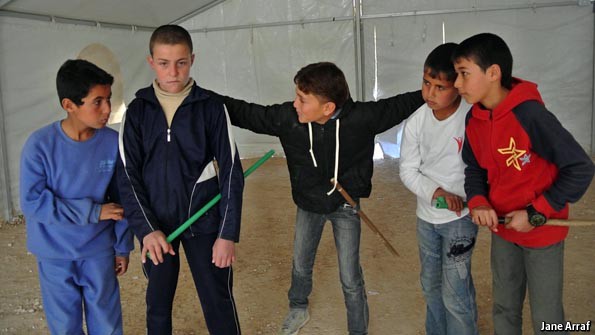
ZAATARI REFUGEE CAMP, Jordan — On a rocky patch of earth in this sprawling city of tents and prefab trailers, the king, dressed in dirty jeans and a homemade cape, raised his wooden scepter and announced his intention to divide his kingdom. His elder daughters, wearing paper crowns and plastic jewelry, showered him with false praise, while the youngest spoke truthfully and lost her inheritance.

So began a recent adaptation here of “King Lear.” For the 100 children in the cast, it was their first brush with Shakespeare, although they were already deeply acquainted with tragedy.

All were refugees who had fled the civil war in Syria. Some had seen their homes destroyed. Others had lost relatives to violence. Many still had trouble sleeping or jumped at loud noises. And now home was here, in this isolated, treeless camp, a place of poverty, uncertainty and boredom.

Reflecting the demographics of Syria’s wider refugee crisis, more than half of the 587,000 refugees registered in Jordan are younger than 18, according to the United Nations. Parents and aid workers fear that Syria’s war threatens to create a lost generation of children who are scarred by violence and miss vital years of education, and that those experiences and disadvantages will follow them into adulthood.

20140401_ZAATARI-slide-XUG9-superJumbo

The “King Lear” performance, the conclusion of a project than spanned months, was one attempt to fight that threat.

“The show is to bring back laughter, joy and humanity,” said its director, Nawar Bulbul, a 40-year-old Syrian actor known at home for his role in “Bab al-Hara,” an enormously popular historical drama that was broadcast throughout the Arab world.

The play owed its production largely to Mr. Bulbul. Smoking hand-rolled cigarettes and speaking with the animated face of a stage actor who never stops performing, Mr. Bulbul described his journey from television star to children’s director.

When the Syrian uprising broke out in 2011, he joined with gusto, appearing at antigovernment protests, leading chants and drawing the ire of the security services. A play he produced was banned, and a fellow actor who supported the government informed him that he could either appear on television to rectify his stance or expect to be arrested.

“I told him I would think about it, and a week later I was out of the country,” Mr. Bulbul said.

Bulbul watching rehearsals

Last year, he and his French wife moved to Jordan, where friends invited him to help distribute aid in Zaatari. The visit exposed him to what he called “the big lie” of international politics that had failed to stop the war.

“There are people who want to go home, and they are the victims while the great powers fight above them,” he said.

Children he met in the camp made him promise to return, and he did — with a plan to show the world that the least fortunate Syrian refugees could produce the loftiest theater.

The sun blazed on the day of the performance, staged on a rocky rectangle of land surrounded by a chain-link fence topped with barbed wire. The 12 main actors stood in the middle, while the rest of the cast stood behind them, a chorus that provided commentary and dramatic sound effects. The audience sat on the ground.

20140401_ZAATARI-slide-7SEC-superJumbo

When each of Lear’s first two daughters tricked him with false flattery in elegant, formal Arabic, the chorus members yelled “Liar! Hypocrite!” until the sisters told them to shut up.

And when the third sister refused to follow suit, the chorus members yelled “Truthful! Just!” until the king told them to shut up.

In later scenes, the king was heckled by the Fool, who wore a rainbow-colored wig, and eight boys performed a choreographed sword fight with lengths of plastic tubing. A few scenes from “Hamlet” were spliced in, making the story hard to follow. And at one point, a tanker truck carrying water roared by, drowning out the actors and coating the audience in a cloud of dust.

20140401_ZAATARI-slide-O1FD-superJumbo

But the mere fact that the play was performed was enough for the few hundred spectators. Families living in nearby tents brought their children, hoisting them on their shoulders so they could see.

After Lear’s descent into madness and death, the cast surrounded the audience, triumphantly chanting “To be or not to be!” in English and Arabic. The crowd burst into applause, and a number of the leading girls broke into tears. Mr. Bulbul said they were overwhelmed because it was the first time anyone had clapped for them.

After the show, as journalists interviewed the cast, the parents boasted of their children’s talent.

“I am the mother of King Lear,” declared Intisar al-Baradan when asked if she had seen the play. She had brought about 20 relatives to the performance, she said, adding that her son was also a great singer.

20140401_ZAATARI-slide-UA3C-superJumbo

Other parents described the project as a rare point of light in a bleak camp existence. Hatem Azzam, whose daughter Rowan, 12, played one of Lear’s daughters, said the family fled Damascus after government forces set his carpentry shop on fire. “We were a rebellious neighborhood, so they burned every shop on the street,” Mr. Azzam said. He arrived in Zaatari a year ago with five other family members, but one of his brothers got sick and died soon afterward, and his elderly mother never adjusted to the desert climate and died, too, he said. He hesitated to send his children to school, fearing that they would get sick in the crowded classrooms, and he kept them from roaming the camp because he did not want them to start smoking or pick up other bad habits. But the theater project was close to home, and his daughter was so excited about it that he let her go.

20140401_ZAATARI-slide-TSXA-superJumbo

“People get opportunities in life, and you have to take advantage of them,” Mr. Azzam said. “She got a chance to act when she was young, so that could make it easier for her in the future.”

The mother of Bushra al-Homeyid, 13, who played another of Lear’s daughters, said the family had fled Syria after government shelling killed her niece and nephew. “The camp is an incomplete life, a temporary life,” she said. “We hope that our time here will be limited.” But after a year here, she worried that her eldest daughter, who was in high school, would not be ready to go to college. Bushra, grinning widely and still wearing her yellow paper crown, said she had never acted before but wanted to continue.“I like that I can change my personality and be someone else,” she said.

(Illustrating photos by Warrick Page for The New York Times)

In his piece, City of The Lost for The New Yorker, David Remnick paints a desolate and harrowing picture of life in Zaatari – lengthy but worth a read.

Everything about this is a tragedy on a grand scale – a culture, lives and futures destroyed, but you cannot help but applaud Nawar Bulbul for what he is trying to do. He has set up a Facebook page and a YouTube channel, Shakespeare in Zaatari, which gives an even greater sense of what is being achieved out there in the desert. Having been forced to leave Syria himself, he continues to fight the Assad regime, even down to refusing to let what are considered to be pro-Assad media organisations film the project.

20140222_map503

Nouar Bolbol

Bulbul (left) is clearly a man of conviction and I for one celebrate what he is trying to achieve. Yes, it is only a small gesture when you consider that there are in excess of 60,000 children living in Zaatari. However he has chosen to harness the power of the thing he knows best – theatre – in an attempt to heal the brutal wounds of war, violence and dislocation. He doesn’t see theatre as a balm, a salve to make the horrors disappear. Some might say he is encouraging a very partisan view of the experience the children have been through. I would argue that it is simply a way of allowing an understanding of what brought about the situation they find themselves in and the truth about how one man and his regime can inflict incalculable suffering on others.

The Stage, Fighting

My first post today is a fascinating and troubling programme broadcast by the BBC last week. In it, the UK-based, Turkish theatre director, Mehmet Ergen travels back to Istanbul to explore the current state of the theatre in the country after the Arab Spring and Gezi Park protests.

Mehmet ErgenA background to Ergen and the programme, call A Tale of Two Theatres, is given here in the publicity from the BBC:

Acclaimed director Mehmet Ergen leads a double life, directing on stages 3000km apart. This programme follows him from London to Istanbul, to learn how much is now at stake for Turkish theatre.

Mehmet is best known to UK theatre audiences as Artistic Director of London’s Arcola Theatre. But his pioneering work in Hackney is only half the story as the programme discovers on a journey to his Turkish homeland, post Gezi Park and post Arab Spring, caught between the Syrian conflict and EU aspirations.

An Istanbul-born former DJ, Mehmet became the toast of London’s theatre scene by creating venues and careers from scratch. In 2000 he transformed a derelict clothing factory in Dalston into a destination venue, twice recognised by the Peter Brook Empty Space Award. Not content to run ‘a powerhouse of new work’ (in the words of theatre critic Susannah Clapp) in his adopted city, he later opened its opposite number back in his hometown.

istanbultheatre-protest

Tensions have been rising in Turkey between artists and politicians ever since the Prime Minister’s daughter was mocked on stage, allegedly for wearing a headscarf to the Ankara State Theatre in 2011. In 2012, a performance of Chilean play Secret Obscenities was censored by Istanbul’s Mayor Kadir Topbas.

Turkey Artistic FreedomsPrime Minister Erdogan then threatened to withdraw subsidies of up to 140 million
Turkish Lira from approximately 50 venues, employing roughly 1,500 actors, directors and technicians. Although wholesale privatisation has yet to be enacted, theatre companies openly opposed to government tactics during 2013’s Gezi Park protests promptly had their funding withdrawn.

Entrepreneurial ex-pat Mehmet acts as the listener’s guide to this politically charged arts scene, as he negotiates national and cultural borders to stage work that is as unpretentious as it is provocative.

A Tale of Two Theatres:

Somehow the situation in Turkey, which began in 2012, had passed me by and a little further digging only underscores what Ergen has to say. LABKULTUR ran a piece, Ethics of Art or Ethical Art, that is the question! that details the situation nicely, as did the Huffington Post.  You don’t need to speak Turkish to understand the following protest video. Entitled Şehir Tiyatroları Yok Edilemez, which roughly translates as our city theatres won’t be destroyed, is a powerful 24 seconds.

.

Let’s not forget that this is the same Prime Minister, Tayyip Erdoğan, who a couple of weeks ago attempted to block Twitter and Youtube to the whole country as both were hosting evidence of wide-ranging corruption in his government.

In 2012, Erdoğan accused theatre artists of being arrogant, saying They have started to humiliate and look down on us and all conservatives. Clearly theatre in Turkey is doing a great job if it manages to rattle the politicians in this way.

While researching this post I came across artsfreedom, an organisation which gathers international news and knowledge about artistic freedom of expression – or the lack of it. Click the image below to see what they do:

af_Fotorartsfreedom is an extension of Freemuse, a Danish-based organisation that advocates freedom of expression for musicians. Freemuse have started to gather annual statistics that cover artistic freedom of expression violations globally and the ones for 2013 make grim reading. A total number of 199 cases of attacks on artists and violations of their rights have been registered. The cases include 19 artists being killed, 27 newly imprisoned, 9 imprisoned in previous years but still serving time, 8 abducted, 3 attacked, 13 threatened or persecuted, 28 prosecuted, 19 detained, as well as 73 cases of censorship.

Visually it looks like this:

freemuse_FotorThe breakdown by country is here. The artsfreedom newsletter that reflects on these statistics is worth a (depressing) read here.
While artsfreedom works right across all arts, the pieces on their site that relate specifically to theatre are here.

Left Foot Forward

bec7cf1f76a3df6efdf60f12fcd545f2_FotorMy post last week about theatre and (geo)politics, A Rocky Road, has caused some interesting discussion in my department.  Today I would like to add another dimension to that debate by sharing an article by Holly Williams, for The independent. 2014 sees the commemoration of the beginning of the First World War, especially in Europe and Australasia. Over the course of the last year, there has been much polemic surrounding the nature of the commemorations, with many fearing, in the UK at least, that these commemorations could descend into jingoistic, flag waving events, rather than reflective experiences that explore the atrocity and human tragedy that was the First World War. Inevitably, the debate has largely split along the political divide, with even a government minister joining in, accusing British theatre of being left-wing in its portrayal of the events of the war – and this is where Holly Williams begins:

The First World War on stage: Lest we forget… the politics of war drama

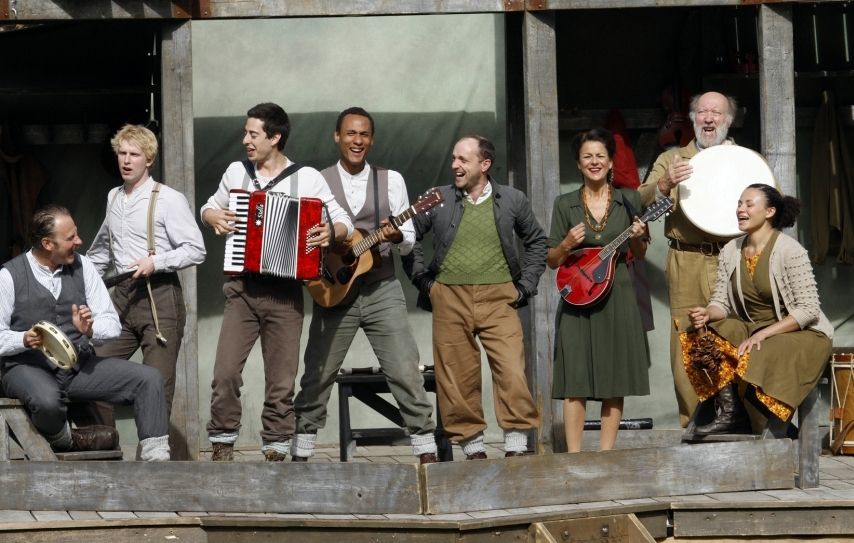
At the beginning of Theatre Royal Stratford East’s revival of Joan Littlewood’s 1963 musical Oh! What a Lovely War, a Pierrot clown describes a series of pre-war Bank holiday scenes, while a slide-show projects images of the seaside, bathers and a donkey. Except the “donkey” is the Education Secretary Michael Gove.

It’s apt that this landmark show about the First World War, which took swipes at the ruling classes who made a mess of it, should now laugh at today’s politicians too. And Gove is an easy, and justifiable, target: he made headlines recently by attacking Oh! What a Lovely War [as] perpetuating myths of the Great War as “a misbegotten shambles – a series of catastrophic mistakes perpetrated by an out-of-touch elite” and denigrating “patriotism, honour and courage”.

Birdsong

Birdsong

While it’s easy to smirk at the mental image of Gove stamping his foot, his reference to Oh! What a Lovely War reignited the debate about whether British theatre is inherently left wing: it’s hardly the first time it’s been accused of being the preserve of bleeding-heart, right-on liberals. But Gove had better stiffen that upper lip – 2014 sees First World War centenary events across all art forms, with theatre addressing the topic with particular vim.

The charge has already begun: Northern Broadsides are touring An August Bank Holiday Lark, about boys from a Lancashire village going to fight in the Gallipoli campaign, while the aforementioned  Oh! What a Lovely War is a huge sell-out at its original east London home. There are adaptations of books: a version of Sebastian Faulks’s Birdsong is on tour now, Pat Barker’s Regeneration arrives on stage at the Royal & Derngate in September, while a one-man play of Dalton Trumbo’s 1938 anti-war novel Johnny Got His Gun opens at the Southwark Playhouse in May. The National Theatre revives the rarely performed anti-war 1928 play The Silver Tassie in April, and there’s new writing too: Peter Gill’s Versailles is about to open at the Donmar, while in the autumn Shakespeare’s Globe stages Howard Brenton’s Doctor Scroggy’s War and the RSC has The Christmas Truce, a family play by Phil Porter.

These offer a vast array of different angles, from the impact of war on a rural community (An August Bank Holiday Lark) to the inner life of a man who had his limbs and face blown off (Johnny Got His Gun). Meanwhile, their protagonists range from officers in the trenches to civil servants in the corridors of power and the women who stayed behind. To assume that playwrights are wielding their pens like righteous political axes is simplistic, to say the least.

Rebecca Howell, Caroline Quentin, Alice Bailey Johnson and Zoe Rainey in Oh What A Lovely War

Oh What A Lovely War

And few within the industry have anything positive to say about Gove’s comments. “I thought it was unfortunate, unpatriotic, appealing to the worst side the country,” says the venerable Gill, who is also directing Versailles. “But mainly silly, and a bit embarrassing, frankly. Does he think we’re a fan of the Kaiser? It’s just childish!”

His play is set in the aftermath of war and centres on a young man sent among the British delegation to draw up the Treaty of Versailles; both in Paris, and at his family home in Kent, debate rages about the future of Europe.

And while Gill witheringly refutes the notion that British theatre is inherently left wing – “the National is hardly Trotskyite, is it?” – he does suggest that the stage is the ideal forum for ideological debate. “The Greeks showed us it is the perfect democratic instrument. It’s live and, unlike film, it’s not quite so able to manipulate. It’s the perfect dialectical [form] – I’m sounding like a communist now! – but it’s a perfect instrument for all kinds of things, and one of them is certainly airing [political debate].”

Versailles

Versailles

David Mercatali, directing the UK premiere of Johnny Got His Gun, suggests politics are a natural by-product of drama’s primary concern: the story. “There is nothing to say that politics needs to drive any medium, but I think that many people in theatre are looking to go beneath the presentation of history. If, in looking at those human stories, people feel a left-wing bias starts to come out, I don’t think there’s a lot we can do about that.”

He did, however, choose to stage Smith’s self-evidently anti-war monologue this year as a riposte to the misty-eyed patriotism that will also be sloshing about. “We have to be really careful about glorifying it. I actually think people try to protect the presentation of the First World War – it’s important that we expose the shortcomings behind it as well.”

An August Bank Holiday Lark

An August Bank Holiday Lark

Deborah McAndrew’s An August Bank Holiday Lark is winning rave reviews. But the playwright doesn’t see her role as political adjudicator. “Real historical analysis is probably not the job of a play, she says, “I’m a storyteller, I was looking for a story.”

However when she discusses Gallipoli, she can’t help but become angry. “If I was making any little political point it was that I felt young men’s lives were disregarded. And there was gross incompetence – Gallipoli was a disaster. There’s no way of spinning it. They were trying to invade Turkey, a whole country – the sheer numbers would tell you that was doomed to fail.” Which, really, is no “little” point.

Rachel Wagstaff, who adapted Birdsong for the West End in 2010 and rewrote it further for its current tour, echoes McAndrew: “I don’t think the job of a playwright is to teach history; it’s to tell stories.” But, she adds, writing is also an imaginative attempt to understand history and humanity. “How can we have allowed the situation to develop where, for example, in the first day of the Battle of the Somme, 20,000 [British troops] were killed? How can that ever be justified? As a playwright you’re trying to illuminate and question what it is to be human.”

Her show stages such battles – a logistical challenge that the production rises to with evocative use of lights, smoke and sound. And Wagstaff points out that theatre can be uniquely powerful in conveying the physical horror of war: “When it’s a real human being in front of you in that moment, I find that so much more affecting than on film or TV.”

Jonny Got His Gun

Johnny Got His Gun

Not that Birdsong isn’t also patriotic: Wagstaff says it also captures “the British spirit, that dark sense of humour” through its portrayal of the bravely upbeat Tommies in the trenches. “You have to show the events and honour them, and allow people to feel the horror,” says Wagstaff, “but on the other hand, you can’t have people sitting there for two hours just feeling sick, revolted, distressed and disturbed!”

Many of the plays being staged in 2014 do, then, question the decisions made before, during and after the war. Such harrowing source material naturally often lends itself to troubled – and sometimes explicitly anti-war – interpretations. But, despite what our Education Secretary might fear, they are also complex and humane in their interrogation, rather than limitedly “left wing”. “Isn’t it brilliant that people are having this debate?” says Wagstaff, injecting a note of positivity into the whole Govian furore, before concluding: “We must never allow such suffering to happen again, so it’s really important that we commemorate, and remember, and we tell our children. It’s more important than ever.”

I make no apologies for posting an article that is very UK-centric. I know similar debates are had right around the world about how politics and theatre collide, and that theatre makers are viewed as inherently left wing in their views. I think Williams’ word will have resonances everywhere. The politician Michael Gove is held in huge contempt for his ideology by the left leaning middle-class in the UK,  and for transparency’s sake I have to say I am in total agreement with them. I’d be interested to hear if a similar debate about theatre and the commemoration of the War is taking place elsewhere with such political overtones.

I want to finish with two other pieces of writing by theatre critic Michael Billington, both for The Guardian. Firstly, Oh What a Lovely War: the show that shook Britain which explores the impact of the original production in 1963 both on British understanding of the war and on theatre making more widely. Then, secondly, his review of the latest production of Oh What A Lovely War that has just been staged at the original venue of the ’63 production, Theatre Royal Stratford East. This latest staging formed part of the 50th anniversary of the play’s original staging as well as part of the centenary of the First World War.

A Rocky Road

normal-2Perhaps more that any other art form, theatre is a political beast. It has to be, it is about the human condition.  Whether it is the content that is political, or the mere act of staging something in a certain place, politics is never very far away. In democracies that have a left leaning government, theatre usually thrives and is supported by the state as a forum for discussion and debate. In those that lean to the right, theatre making shrinks as state funding is usually withdrawn or cut, being viewed as subversive and unnecessary. What the right have yet to work out is that their attempts at suppression only forces theatre makers to shout louder. More extreme governments hijack theatre as propaganda and/or ban work that doesn’t support ‘the cause’. Now of course these are generalisations, but without doubt there is some truth in them.

This week there have a few rumblings of discontent about the forth-coming world tour of Hamlet by the Globe Theatre, which I wrote about in July last year, Going Global. The theatre announced that in their attempt to visit every country in the world, North Korea was on the itinerary for September this year. This immediately drew criticism from Amnesty  and Human Rights Watch. Niall Couper from Amnesty said:

North Korea is a country where the horrors inflicted on people who fall out of favour are worse than any fiction….No tragic play can come close to the misery that 100,000 people trapped in the country’s prison camps endure, where torture, rape, starvation and execution are everyday occurrences.

normalTo be fair, Amnesty didn’t suggest that the theatre should boycott North Korea, but urged the company to read up on its human rights abuses first. Meanwhile Phil Robertson from Human Rights Watch (Asia) commented that exclusion would be the order of the day if the performance went ahead:

It’s going to be an extremely limited, elite audience that would see a production in any case. It would have to be in Pyongyang, which is a showcase city whose residents are selected to live there because they have shown their loyalty, so there’s a strict pre-selection process involved right from the off.

Many commentators have of course noted the sinister connection between Prince Hamlet’s murderous revenge on his uncle Claudius in the Shakespearean tragedy and recent events in North Korea. As a report from CNN said

The parallels of staging a drama about an epic family power struggle in Pyongyang, where the country’s young leader Kim Jong Un had his uncle, Jang Song Thaek executed has raised a few eyebrows…..Jang was considered instrumental in Kim’s rise to power, but Kim turned his back on his uncle in spectacular fashion late last year as Jang was branded “a traitor for all ages” and executed on charges that he had attempted to overthrow the government.

Phil Robertson drily noted that

When the North Korean leadership gets around to reading the plot of Hamlet, one imagines they might well insist on something else from the canon

hamlet_hedingham_Fotor

The story has made international news, from Bangkok and South Korea, to Germany and the US.  I suppose this says a lot about how well regarded the Globe is around the world. However, it is politicking that is driving the story. Not surprisingly, the Globe hit back issuing a statement that, amongst other things, said:

We have decided that every country means every country, since we believe that every country is better off for the presence of Hamlet. Shakespeare can entertain and speak to anyone, no matter where in the world they are. We have always believed that cultural communication, and different peoples talking to each other through art, is a force for good in the world. In every country, we are going for one single and simple purpose: to play Hamlet there.

We are very proud of our record of working with a selection of NGOs over the years – Amnesty themselves, PEN, Reprieve and Human Rights Watch. We have raised money for their operations, provided space for them, and felt their influence in many of our productions and the new plays we have performed. In that light, we were disappointed that Amnesty put out a quote about our touring without realizing that it was a world tour, but under the impression that it was going solely to one country.

I take their point, but I do wonder whether this is a wise move, as it could be seen as a potential endorsement of the brutal North Korean regime. There is something to be said for cultural diplomacy, but as the USA News points out, it can go too far. On the other hand, Mark Lawson writing in the Guardian, Is there something rotten in taking Hamlet to North Korea? argues that theatre does not always legitimise its hosts and can be a weapon against oppression. If the Globe were to avoid all repressive regimes, their World Tour simply wouldn’t be.

I’ll leave the final word to Couper and Amnesty who noted that

There’s a dark irony in the fact that Hamlet focuses on a prince wrestling with his conscience. Kim Jong-Un is no Hamlet. Sadly he shows no sign of wrestling with his conscience.


Provisional routing of the tour

Provisional routing of the tour

No Longer A Refugee #2

In January I wrote a post, No Longer A Refugee, about a group of women refugees who had fled the vicious civil war in their homeland Syria and were involved in the staging of a production of the Greek Tragedy, The Trojan Women. As I was driving to work today I listened to another thought-provoking programme about the project, which was broadcast by the BBC World Service, as part of their Outlook strand. If the January post struck a chord with you, I certainly recommend a listen to the Outlook podcast below:

604

Being Taken For A Ride

As trends in theatre go, the immersive genre just keeps expanding and redefining itself. This week, some of my own students staged a piece called The Ward which entailed masked audiences, elevators, stairs, four different spaces, touch, taste, smell, specially created video and a cast of 24. It was risky, edgy and played with the form very successfully. We were all delighted with piece and no more so than its creators, deservedly so.

Rift's Macbeth posterIt is seems hardly a week goes by now where I don’t read about a piece of immersive theatre playing somewhere in the world, and this week was no exception. The first I’d like to share is news of a UK company, Rift, who are planning to stage a version of Macbeth. The company have a reputation for staging immersive reinterpretations of classic pieces of theatre. Theatre Critic, Matt Trueman, wrote about this new work in progress in The Guardian.  What caught my eye, however, was that their version comes with a twist – it will take place overnight and the audience will be invited, encouraged even, to go to sleep during the performance. You don’t just by a ticket, you buy a bed and meal and there are 3 levels of ‘package‘ available, depending on the amount of comfort you want to enjoy during the ‘show’. The company says of its plans:

Face-to-face with witches in an underground car park. Feasting with the Macbeths. Bedding down for the night on the 27th floor as a siege rages around you. Characters sleepwalking through the walls: confiding plots, summoning apparitions and conspiring murder. In the morning waking to find the battle lost or won.

This is William Shakespeare’s Macbeth seen from the inside out. This production like a fever-dream leaves you questioning ideas of space and status; dystopia and utopia; waking and sleeping.

This production scatters the story of Macbeth over one night. From Dusk till Dawn

Felix Mortimer, artistic director of Rift talks in this documentary about how they work – in this case on a production of Kafka’s The Trial.

Meanwhile in Australia, the Perth Festival International Arts Festival is in full swing and immersive is clearly the order of the day with Punchdrunk, Look Left Look Right and Rimini Protokoll are all presenting wildly different immersive work. Punchdrunk’s The House Where Winter Lives is for 3 to 6 year olds,  Look Right Look Left are performing a reworking of their city-specific work, You Once Said Yes originally made for Edinburgh and Rimini Protokoll are staging Situation Rooms which requires its audience of 20 to wear headphones and carry iPads.

Australian writer and critic, Jane Howard, wrote about all three shows in her article for the Australia Culture Blog, The Guardian. In it she talks to the creatives behind the pieces.

Perth festival’s immersive theatre: ‘being confused is perfect’

While the headline shows of the Perth festival may be playing to hundreds at a time, in pockets all around the city this week performances are happening on a much smaller scale. These immersive theatre pieces are reliant on the actions of audience members to stage the work: from the solo audience of You Once Said Yes to the tightly choreographed interaction of audience members in Situation Rooms to the rambunctious collaboration of children in The House Where Winter Lives.

Kathryn McGarr, one of the performers with Punchdrunk’s The House Where Winter Lives, tells me that immersive theatre “inspires people a bit more”. And then there’s the practical consideration: even with the best will in the world, faced with a comfy chair in a warm, dark room it’s sometimes hard to stay awake. “People do fall asleep. Whereas there is no way you could fall asleep in a show like this.”

The House Where Winter Lives

The House Where Winter Lives

That much is certainly true. The adventure sees Mr and Mrs Winter take the audience of three to six-year-olds on a journey to discover the lost key to the larder. While Punchdrunk have created many immersive works for adults and even older children, this is the first time the company has pitched at such a young age group – and when you see their reactions it’s easy to think that this audience is perhaps the perfect age to be experiencing this work. Entirely without ideas of what “theatre” should be or how you should behave when watching it, they fully invest in the world.

Punchdrunk give the children a high degree of autonomy in their reactions. “We’ve got the script and we’ve got the structure and we’ve got certain things that we can do, and then we know when we can riff a bit and let them fill in the answers,” says performer and co-creator Matthew Blake.

Co-creator and performer Frances Moulds agrees. “There is a journey we need to go on,” she says, “but we can go with whatever they give us … That we’re open is actually a key thing: we’re open to anything they say and we want to hear what they’re saying.”

Allowing for audience response and choice is also central to You Once Said Yes, a show performed on the streets of Northbridge for an audience of one. That person has to be directed to a certain extent, concedes production manager Rosalyn Newbery, but “that has to be done sensitively and without dictating, because their responses and their reactions are very important, and they will change certain things”.

You Once Said Yes

You Once Said Yes

The title, she says, strongly suggests to the audience how to respond. Yet they can still say no, they can take an alternative route from that which is expected of them and the performers and production team must know how to be responsive to that.

James Rowland, one of the performers who travelled with the piece from the UK to join a local cast, says “no one show with one character will ever be the same, just because of the way people talk to them. The number of shows we’ve done is the number of shows there’s been.”

Many immersive theatre pieces rely on these interactions between the audience and performers and the self-direction and personality the audience invests into the work and the world. Rimini Protokoll’s Situation Rooms is the exception to this rule.

The documentary theatre piece invites the audience to step into the shoes of 10 people each as they talk about their relationship with the weapons industry. Following instructions on an iPad mini, with the world on the screen mirroring the environment built by the company, the audience move and silently interact in the exact place of the person whose story they’re hearing.

One of the creators, Helgard Haug, says the precision of the work is integral. “I think everybody understands that it’s perfect if it works, if you’re following it precisely. If you are in a space and you’re sitting at a table and you’re in the story of a person, and in the film you see a door opening and a person entering the space, and if that repeats in the real environment, in the real space where you are that’s the fun of it.”

While they walk through the space Haug wants the audience to question how these people fit into our society and why we each exist in the reality we exist in. After seeing the show, she says “to be confused is very productive. After half an hour leaving this building and being confused is perfect. Being exhausted is perfect. Needing a cup of coffee and a deep breath to then find your own skin again is just a very good thing to do with that content.”

Situation Rooms

Situation Rooms

While Situation Rooms aims to highlight the realities of a wider world, You Once Said Yes is about highlighting the realities and personality of the participant. Being involved in the presentation of such immersive work holds “massive privilege” for an actor, says Rowland.

“It’s pretty much the only arena in one-on-one performance where you really get that opportunity [to really meet the audience]: without lights, without a stage, in a situation where you just say, ‘No, go do whatever you want to do. Do your thing within the parameters of the show,’ which is lovely.”

That is one of reasons that people have responded so well to the show, he argues.

“By the end they feel they are, and they have been, valued, and it is about them as much as it is about the stories they’re unwrapping.”

A Cultural Democracy

For those of you who read Theatre Room regularly you will have noticed my preoccupation of late with the developments, and debate,  surrounding live streaming. Now of course this deals with how we consume theatre, not how we make it and this got me thinking about how this technology becomes part of the creative act itself. I know that there have been experiments in the field, and this piece by Jessica Holland, published in The National, an english language newspaper from Abu Dhabi, lays out some of the exciting possibilities:

Internet theatre – immersive, real-time shows with actors from all over the world

The answer is a brand-new art form that is being pioneered by performers in cities such as Tunis, Beirut and Dubai.

“It’s the future,” says the Lebanese writer, actor and director Lucien Bourjeily, who lives and works in Beirut. “At the moment it’s avant-garde, but it will become the norm.”

Lucien Bourjeily

Lucien Bourjeily

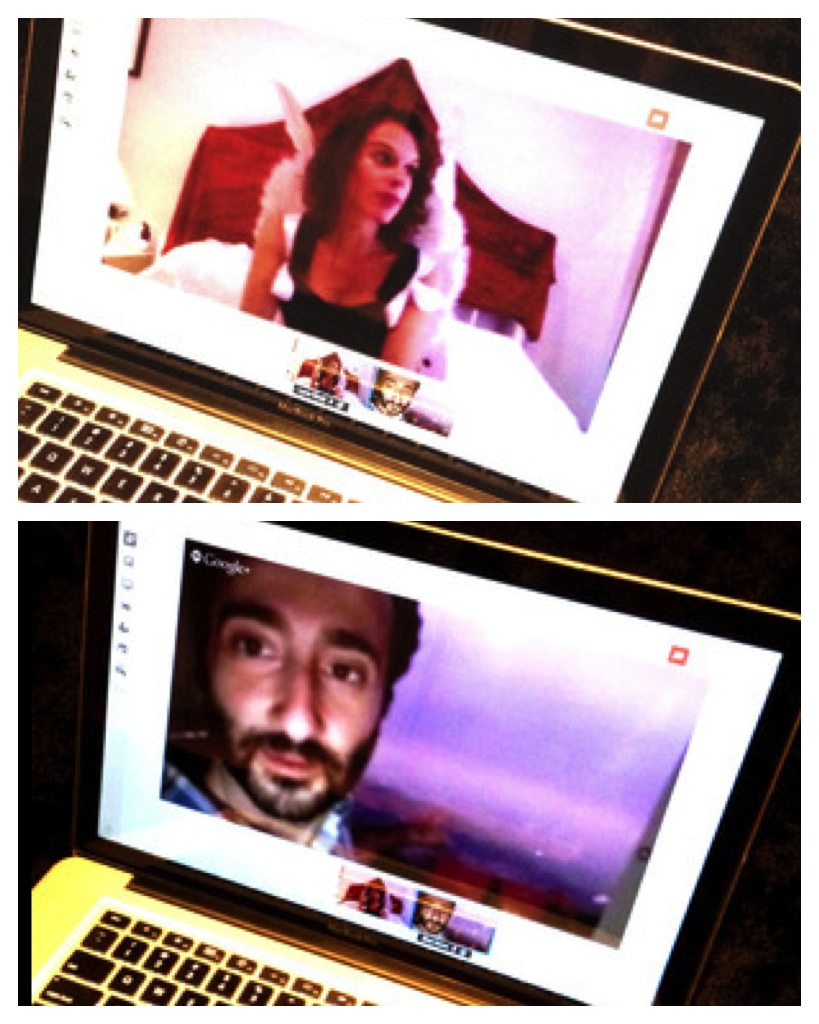
Last July, Bourjeily collaborated with Elastic Future, an experimental theatre company that started in San Francisco but is now based in London, on a play called Peek A Boo for the London International Festival of Theatre (LIFT). Five actors, playing spies, programmers and online peep-show entertainers, were divided between New York, London and Beirut, improvising dialogue as they interacted via streaming video. Audience members around the world watched in real-time by signing into Google Hangouts or watching the feed on Elastic Future’s web page. They also interacted with characters on Twitter and took part in a post-show Q&A.

Untitled“It was a breakthrough,” says Bourjeily of the performance, which followed just a week of online workshops and involved some quick thinking from the actors when there were glitches in the internet connection from New York. “It opened my eyes to so many possibilities for how to create a new type of immersive theatre.”

Erin Gilley, Elastic Future’s artistic director, says she learnt a lot from the experience and is eager to keep stretching the limits of the medium. She’s planning another work for this year’s Lift to be streamed online in July, with actors performing live via webcam from Ghana, Portugal and the United Kingdom.

“Theatre can’t exist without an audience and we’re trying to creatively explore what that means,” says Gilley of the work-in-progress. “The goal is for it to feel like you’re sitting in a theatre with other people, even though watching it will be a private experience.”

Gilley is avoiding screening the feed in an auditorium, in case the process prevents her from “discovering ways to create that feeling online”.

Much like Bourjeily, Gilley is evangelical about the benefits of this new, hybrid art form. For starters, it can bypass censors in countries such as Lebanon, where playwrights are required to submit their work to a bureau for approval. Performing online is cheaper than renting a space and flying in actors and it grants access to audiences from all over the world. It creates novel ways for artists scattered all over the globe to cooperate and to interact with viewers.

It can also turn practical constraints into aesthetic virtues….

As technology develops, the artistic possibilities multiply. “We have new ways of getting emotionally connected to our audience,” is how Bourjeily puts it. “The sky is the limit.”

Lucien Bourjeily is a fascinating man, as his website attests. So much so that Index On Censorship – a global NGO that fights for freedom of expression – has made him one of their four nominees for the Freedom of Expression awards for his play Would It Pass Or Not?, which is about censorship in Lebanon.The play was banned – by the censors, thus forcing them to justify their actions in public.

You can watch Peek-A -Boo here. It makes interesting viewing.

Elastic Future have been commissioned by LIFT to create a piece for this year’s festival, called Longitude, which will be streamed online on 9, 16, and 23 June. Indeed LIFT and it’s artistic director Mark Ball clearly see this kind of work as vital, linking the digital (stage) space with a wider cultural democracy – which is another blog post entirely.

David Cecil

David Cecil

As a post script, one of the other nominees for the Index Freedom Of Expression awards, which are in their 14th year and honour people around the world fighting for free expression, is David Cecil. Cecil is the British theatre producer who was jailed in Uganda for staging a play about homosexuality and whom I wrote about in the posts Stonewalled and A ruling for common sense over a year ago. Appallingly, a month ago the Ugandan parliament passed an anti-homosexuality law which, amongst other things, included punishments of up to life imprisonment. David Cecil is not gay. In fact when he was deported he was forced to leave behind his partner and their two young children. As I write, he has not been allowed to return.  The man deserves to be honoured.

What Are Words Worth?

A small, but perfectly formed little share today – a video from the National Theatre in the UK about verbatim theatre, from a range of people who make it. Well worth a view

.

I wrote at length about verbatim theatre last year in a post called Words Are Louder Than Actions which includes a great little how to guide by Alecky Blythe, who opens the video.

No Longer A Refugee

The article I want to share in today’s post really touched a nerve when I read it last week. It was published in the Financial Times, written by Charlotte Eagar, and is about her project to stage the antiwar Greek tragedy, The Trojan Women with a cast of Syrian women who have fled their homeland’s vicious civil war for neighbouring Jordan.

a8ebe18e-7410-11e3-beeb-00144feabdc0

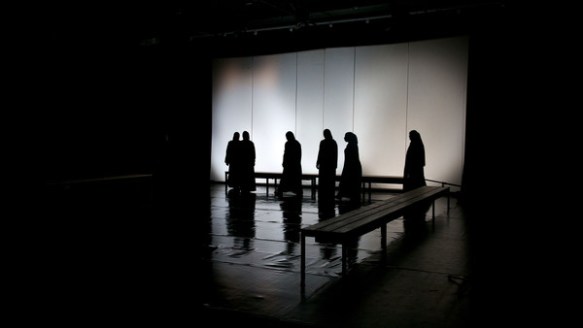
If you don’t know the play, The Trojan Women is about refugees, set at the fall of Troy. All the men are dead and the former Queen Hecuba of Troy, her daughter Cassandra and the rest of the women are waiting in a refugee camp to hear their fate. Euripides wrote the play in 415BC as an anti-war protest against the Athenians’ brutal capture of the neutral island of Melos; they slaughtered all the men and sold the women and children into slavery. You can download the text of the play as an e-book here, or read it online here.

4c06569e-5e6e-4213-b3a3-59af6ceffd39

Eagar’s piece is definitely worth reading. It charts the whole project from beginning to end. It is both immensely inspirational and gut-wrechingly sad. Click the link below for the full article.

Syrian refugees stage Euripides’ ‘The Trojan Women’

You get a real sense of the power of the performance in the interview, below, with one of the actor refugees, known simply as Fatima.

.

5857925

.
.