Moving On

NT DiscoverSo the first post of 2015 is a an easy one. A few weeks ago I shared a video about creating modern interpretations of Greek Chorus, made by the National Theatre in the UK (Group Chat). Since then they have released 3 more videos about various aspects of creating chorus as part of their Discover National Theatre strand:

.

Also part of Discover is the series of videos about Movement Direction, which are also a great little watch:

.

All short, but perfectly formed and super starting resources.

Little Voices

A fascinating project has recently wrapped up in London. A group of journalists from The Guardian newspaper, collaborated with theatre makers from the Royal Court Theatre to make a series of six ‘micro’ State of the Nation plays plays, running under the banner, Off The Page.  There is a video introduction to the series here.

ef05cbff-576b-449f-bb98-0a14f4a38ea4-620x372

Each of the plays explores a different topic. Britain Isn’t Eating satirizes the UK government’s approach to food banks and the ‘feckless poor’. Devil in the Detail explores the emotional relationship that women have with clothes. PPE examines the power of politicians’ physical gestures – and the failure to engineer real change after the financial crisis.The Funereal Game explores racial tensions on and off the football pitch and the idea that sport embodies the country’s identity crisis. Finally, Groove is in the Heart examines the changing relationship with music and technology. For each of the plays there is a making of article which you can click-through to via the links above. The videos of the plays are embedded there too. Whilst obviously written about UK orientated issues, the themes are definitely global and all the pieces are really interesting.

142fcb90-23a2-4118-9546-5eef9c3b23c8-2060x1236

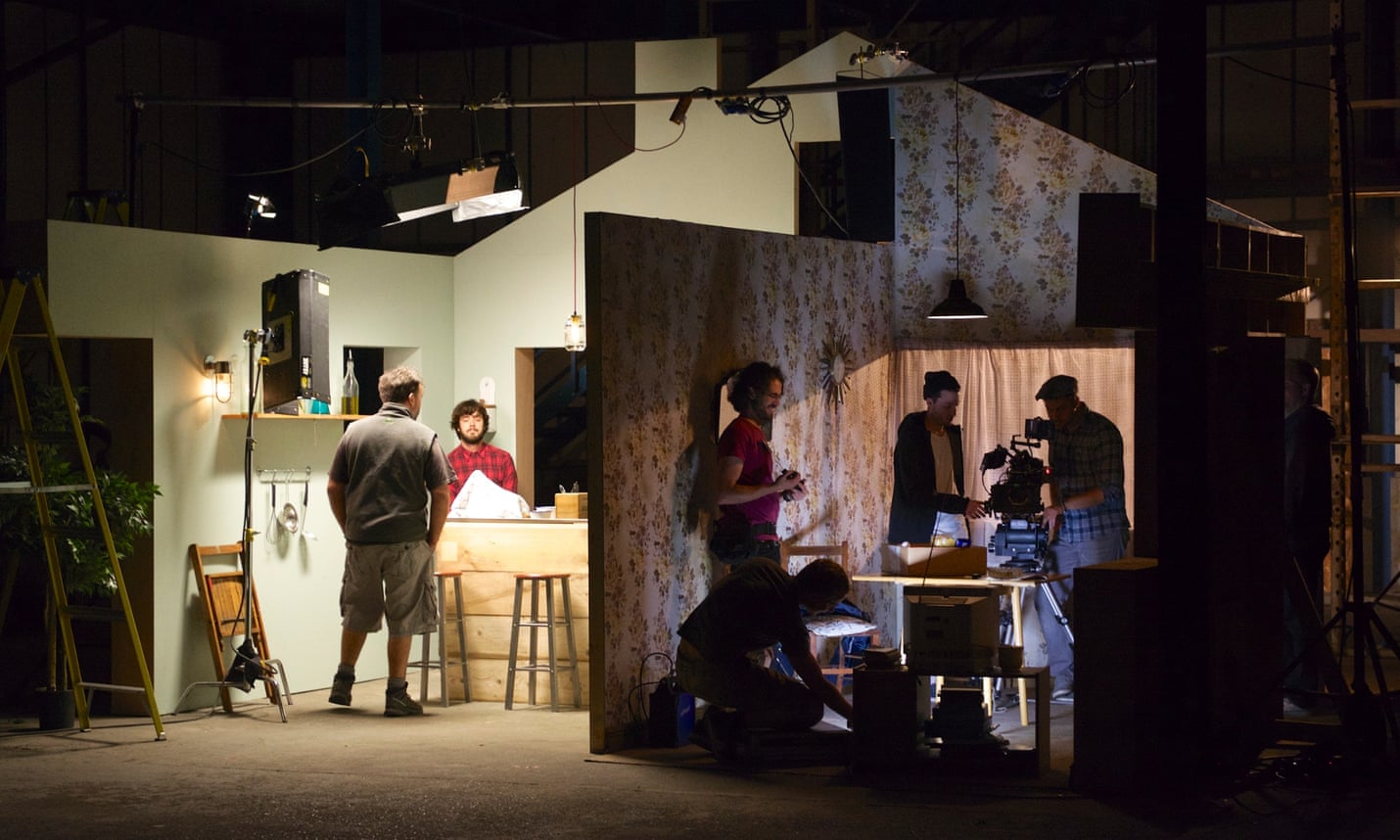
Each play used the same basic staging, but designed individually. A photo montage of the different designs makes interesting viewing here.

Group Chat

MedeaNEW_poster_notitle

A quick share for today – a video from the National Theatre in the UK about playing Greek Chorus.  Produced to tie in with their recent production of Medea starring Helen McCrory in the lead role, the video explores the portrayal and interpretation of the collective voice in modern productions – always a challenge for directors and actors.

.

Another interesting video, connected with the same production, is an interview with McCrory about her preparation for the role.

.

Say It As It Is

little-revolution-posterTwo audio recording shares today. Firstly an interview, courtesy of Theatre Voice, by theatre critic Matt Trueman with verbatim playwright Alecky Blythe (and director Joe Hill-Gibbon) about her play Little Revolution. Performed earlier this year and receiving very polarised reviews, it explores the 2011 London riots. The interview gives a fascinating insight into the processes of writing and staging verbatim theatre. Blythe also writes about her approaches in The Telegraph, It looked a bit hairy. But I had to go. Interestingly, the same newspaper also gave Little Revolution one of it’s best reviews, calling it Absolutely Compelling. Truman’s own review of the play is a little more interrogating.

The second share, and not wholly unconnected,  is an interview with writer and theatre maker Stella Duffy (and others) about the life of theatrical maverick Joan Littlewood, whose centenary has been marked this year by many events, not least the Fun Palace initiative, started by Duffy herself. Again a great listen about a woman who made theatre differently.

.

Curated By Kwei-Armah

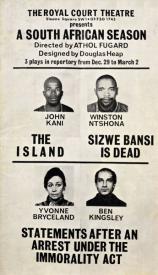
JLR_271_cA super new resource, The Black Plays Archive has just been launched in the UK. Curation started in 2009 and the aim is for it to be an online catalogue of the first professional production of every African, Caribbean and Black British play ever produced in Britain. It was born out of an idea by playwright Kwame Kwei-Armah and involves a considerable number of institutions from across the UK, with the National Theatre being the primary partner.

It contains Essays that can be read online or downloaded, Interviews (both video and audio) and recorded Play Extracts, either from their original staging or specifically recorded for the archive.

SB_22aThe plays are drawn from around the world by playwrights with an African or Caribbean heritage. Once complete the archive will be an incredible resource of black theatre writing. However, it is wider than that and includes interviews with directors, academics and practitioners that cover the whole spectrum of theatre making. For instance there is an essay from Dr Michael Pearce (academic, theatre director and native of Zimbabwe), Tracing Black America in black British theatre, which explores the rise of the Black Power movement in the US in 1970’s and how this was manifested in British theatre. This is a truly extraordinary and unique project and well worth an explore.

Willing To Speak Truth To Power

Three articles published over the course of the last week, by The Guardian UK, have caught my attention. The first, a review by veteran theatre critic Michael Billington, about a ‘play’ called 2071. I use the inverted commas advisedly at this point, as the piece has one actor, a scientist called Chris Rapley, who spends 70 minutes talking to the audience about climate change. Some might, and indeed have, called it a lecture, nothing more.

2071_3099361b

In his review, 2071 – urgent call for the greatest collective action in history, Billington argues otherwise:

Some will argue this is not really theatre. But the idea that theatre should be exclusively reserved for fiction has been knocked on the head by a surge of documentary dramas and verbatim plays. And Katie Mitchell, who directed both this show and Ten Billion, realises that the eye needs to be satisfied as well as the ear. Rapley sits in a chair and, without notes, talks to the audience with an astonishing calm and command of facts for 75 minutes. Meanwhile Chloe Lamford’s design presents us with swirling video images behind him that illustrate Rapley’s arguments and have a strange beauty of their own.

The play is being staged at The Royal Court in London under the directorship of Katie Mitchell, who did a similar staging two years ago with a piece entitled Ten Billion where scientist Stephen Emmott (below) spoke about global over-population and its consequences. In fact Ten Billion was given the number 10 spot in the best plays of the year, according to one newspaper.

10bill_2281662b

In this podcast from the Royal Court Duncan Macmillan (co-writer), Mitchell (director) and Rapley (speaking as scientist, co-writer and performer) talk to literary manager Christopher Campbell about the play.

.

I’ll leave it to you to ponder whether the classification as theatre is a correct one. Mitchell and Macmillan talk further, in the second of the articles I referred to earlier, about their reasons and the processes behind verbatim theatre of this kind. Climate change play 2071 aims to make data dramatic is written by Stephanie Merritt:

“As a dramatist, I’m interested in working with text in a different way,” Macmillan explains, when I meet them during a break in rehearsals at their south London studio. “There was the formal challenge of how to express Chris’s science, and what we could bring to him as theatre-makers – not just with a different audience for those issues, but in terms of technique and how to structure the material. For example, if Chris is writing a scientific paper or delivering an academic lecture, the convention is that you begin with your finding and go on to explain it. But that’s like Hamlet avenging his father’s death in the first five minutes. The simultaneous challenge we’ve had is how to take the anger and emotion out of the issue and at the same time make the data dramatically compelling to listen to.”

The subject matter is undoubtedly emotive, but more so political and therefore ripe for the theatre – even if it is a difficult subject to stage.

I am sure that it is no coincidence that on the same day Billington’s review for 2017 was published, he also wrote a rallying piece entitled Speaking truth to power: this is the rebirth of political theatre in which he talks about the resurgence of political theatre on the British stage at the moment, 2017 included.  You can read the article yourself, but I’ll finish this post with his final paragraph which says much about the theatre I was brought up with, educated by and in which I believe passionately.

It is also something that seems part of our native bloodstream. Some years ago I was invited to take part in an international discussion of political theatre organised by the British Council in Santiago. After I had talked about the British theatre’s oppositional tradition, two French delegates treated my remarks with polite condescension. They observed that someone had recently staged a play in Paris about President Bush but that it had excited little interest. As we talked, I realised we were arguing from different premises. For my French colleagues, theatre was primarily an aesthetic discipline and something apart from life. From my entrenched Anglo-Saxon perspective, it was a vital part of life; and that inevitably embraces politics. I remain convinced to this day that among British theatre’s greatest strengths are its readiness to put our society under the microscope and its willingness to speak truth to power.

Body Mechanics

I wanted to share a short video today, an excerpt taken from a piece called Nowhere  by Greek experimental theatre director, choreographer and visual artist Dimitris Papaioannou, (who incidentally was the creative director for the Athens Olympics in 2004). Nowhere is dedicated to Pina Bausch and was created to inaugurate the new main stage at the Greek National Theatre.

b_1012_pouthena3

To quote the theatre’s website:

Nowhere is a work about the physical space of the theatrical stage. Constantly changing and defined by the men and women that inhabit it, it can be countless different places while designed to be nowhere at all.

The scene I’m sharing contains nudity, so be warned, but the reason it caught my attention will be obvious when you watch it.  Simply stunning.

.

Known as the body mechanic system, it was used by Akram Khan in his piece Dust, part of a large work called Lest We Forget for the English National Ballet. Khan credited Papaioannou in the programme for the idea:

dm-dust-akram-khan-dancers-lines-arm-wave_1000

I have a feeling it might be making an appearance in some of my students’ work, minus the nudity I hope, given their reaction to it.

A Roaring Success

Lion King Las VegasAs those of you who read Theatre Room regularly will know that I’m no great fan of musical theatre.  There are however some exceptions, one being The Lion Kong. I first saw it in Los Angeles many years ago, and have been urging people to go and see it ever since. It first opened in Minneapolis in 1997, quickly transferring to Broadway. in 1999 it opened in London at the Lyceum Theatre, where it is till running 15 years later. In fact, it is currently playing in 10 cities world-wide. In its 17 years it has been seen by an estimated 75 million people and taken $6.2 billion, making it the highest grossing musical ever. Impressive figures indeed.

.

In a great article by David Gritten in The Telegraph, How The Lion King became the most successful stage show of all time he quite rightly points to the original director, Julie Taymor, as the creative genius behind the show.

It’s easy to overlook, what with all the trumpeting of huge grosses and audience figures, what a radical piece of theatre The Lion King is, and always was.

Credit for this goes to the prime mover of this stage version, director Julie Taymor, who came from avant-garde, ritual and experimental theatre, and had already used masks and puppetry in other productions. Taymor also helped design the costumes for the Lion King, and even wrote the lyrics for one of its songs, Endless Night.

lion-king

She has created a world that is fiercely non-literal, often to moving and wondrous effect. She makes no attempt to disguise the fact that these animals are moved and performed by humans. A drought on the African plain is conveyed by a circle of blue silk gradually vanishing by being pulled through a hole in the stage. When a lioness weeps, she pulls lengths of white ribbon from her eyes. Taymor evokes a waterfall using a huge sheet of billowing silk. A score of actors stride on stage, boxes on their head with long grass sprouting from them; this is Taymor’s way of representing the African savannah.

Simba - Nicholas Nkuna and the Original UK touring company.JPG

All of which seems a long way from the animated film and video of The Lion King, which proved immensely successful for Disney in the 1990s. They’re agreeable entertainments, based on a hero-myth story redolent of Hamlet. As a young lion cub, Simba is hoodwinked by his malevolent uncle Scar into believing he was responsible for his father the king Mufasa’s death. Simba flees before returning as an adult to reclaim his birthright from Scar, who has installed himself as king.

the-lion-king-musical

This is all fine as far as it goes, yet there’s a cosiness and reassurance about the film that Taymor withholds; in the stage version there is simply more at stake, along with a recognition that life is fragile. She also gave far greater emphasis to the film’s female characters. There’s a tough-mindedness about her method of story-telling; it’s surprising that Disney, to its great credit, approved such a radical reboot of the film.

Gritten’s article is well worth a read in its entirety here.  Another one, this time by Adam Sherwin here in The Independent explores the money-making side of the The Lion King. Apparently Sirs Tim Rice and Elton John, the composers and librettists of the musical, have made a whopping US$120 million apiece from the show!

To finish with,  it was recently announced that Disney have adapted the musical for schools which will be licensed for performance from January 2015. Disney, Rice and John will no doubt need to get deeper pockets.

By way of a post script, I should say that the show’s appeal for me is the ingenious way in which the animal characters have been brought to life with puppetry.  The man behind most of the puppets is Michael Curry, and there are a couple of interesting interviews with him here and here about his work on the show .

Set In Aspic

Helen McCrory as Medea, National Theatre

Helen McCrory as Medea, National Theatre

A gnarly little piece today I came across in The Independent, Why are theatre directors messing with the classics? Written by journalist Adrain Hamilton, he bemoans (British) theatre directors who play with the text and/or original intent of the playwright. Has it ever been thus. Now far be it from me to suggest that Mr Hamilton (who is not a theatre critic or in any way connected professionally with the theatre) is simply whining because he may have witnessed a production of one of his favourite classic plays that he didn’t like (although I suspect there might be something in this). It’s not that I disagree with him totally. Indeed he makes some decent observations, but theatre is an interpretive art form, especially when dealing with the more classic/historical texts. There has to be a relevancy for a contemporary audience and it the director’s job to make that so. Of course it doesn’t always work, but that is theatre for you.

Why are theatre directors messing with the classics?

There are no more dreaded words in the English theatre today than “in a version by”. Whether it’s Ibsen’s Ghosts, Euripides’ Medea or Sophocles’ Electra, nothing will do but that the international giants of the stage be taken by an English writer and refashioned for the English audience in their own words.No one should doubt the theatricality of these “versions”. Greek tragedians, as indeed Ibsen, created great parts for female actors and this is what the British directors have seized on with such fervour today. Kristin Scott Thomas as Electra, Helen McCrory as Medea and Lesley Manville as Ibsen’s Mrs Alving have all been successively hailed as the new divas of drama for their anguished performances of tortured, wracked women.

Just as we perform Chekhov as the supreme English ironist, rather than the caustic writer of near farces, which is the way the Russians do, so our directors and dramatists rework the classics as studies in angst and high emotion, women on the edge not just of a nervous breakdown but of infanticidal self-destruction.

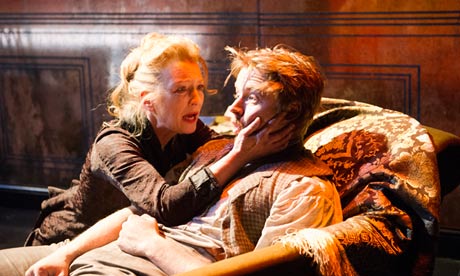
Lesley Manville in Richard Eyre's production of Ghosts

Lesley Manville in Richard Eyre’s production of Ghosts

Only that is not what these dramas are actually about, or not as their authors intended. The great classical dramatists didn’t set out to present psychiatric studies of individuals and their torments. They wrote about the human condition through the dilemmas and fates of individuals. The same goes for Henrik Ibsen. A would-be poet himself, he wanted to express what he saw as the societal truth of his times.

Sir Richard Eyre’s reworking of Ghosts, and his earlier Hedda Gabler, at the Almeida, are finely crafted works of domestic drama in which events speed their way to a horrifying conclusion, impelled by revelations which strip their heroines of all illusion. It’s Chekhov on speed, even to the point of climaxing the play with Mrs Alving administering the medicines with which to aid her son’s death.

But Ibsen didn’t write that. He left his heroine gripped by indecision whether to carry out her son’s desire to die or to refuse such an unnatural maternal act. Sir Richard’s version makes for a more melodramatic finish; Ibsen’s for a more troubling one. Which is how he saw his play, a very carefully modulated study through the dialogue of human evasion of how we are all made by our past and convention.

If you want to see the difference between the way that the British domesticate drama and other countries seize on the ideas behind a play, then the Barbican’s current series of international productions of Ibsen should be a revelation. The Berlin Schaubühne ensemble’s An Enemy of the People, the play he wrote in anger at the way Ghosts had been dismissed by the critics, is an interpretation full of the urgency that this angry assault on bourgeois conformity requires. Switching the time to now, it has all of Ibsen’s weight and weariness with the society about him but also his sense of the human part within it. If the production stuttered in London it was in trying, in the middle, to involve the audience in the debate. It apparently worked in performances elsewhere but not here. The English don’t go in for direct confrontation, let alone over ideas.

The Berlin Schaubühne ensemble’s An Enemy of the People

The Berlin Schaubühne ensemble’s An Enemy of the People

It gets worse with Greek tragedy. With a deeply affecting central performance, the National’s Medea wrung every emotion out of the story of an abandoned woman who wreaks revenge by killing her own children and dragging their bodies into exile in an end reminiscent of Bertolt Brecht. Only Euripides is not Brecht and he didn’t write Medea as a story of a wronged woman wrestling with her conflicting emotions. The Medea of Greek legend is a witch woman of terrifying force. The tragedy is one of anger and vengeance which cannot be constrained. At the end you feel not pity but horror and fear.

You don’t have to do Greek tragedy on a bare stage and skimped costumes. The poet Caroline Bird’s version of Euripides’ Trojan Women at the Gate Theatre in 2012 was one of the most intense theatrical experiences I’ve ever had. Moving the scene to a maternity hospital, it worked because it remained true to Euripides’ vision of captured women, turning in on themselves as they await their fate. But you can’t do what Frank McGuinness, whose adaptation of Electra is now playing at the Old Vic, did in the opera of the Theban Plays and mess around with the order at will. At least you can’t do it and still leave Sophocles on the credits.

Yukio Ninagawa, arguably the greatest theatre director of our times, who directed an electrifying Medea in Japanese, will only work with line-by-line translation. Presenting Shakespeare’s Cymbeline recently the Barbican (he’s back there with Hamlet next year), he apologised for changing a word in making a cedar into a pine for visual reasons. If only British directors would pay foreign dramatists the same respect when they turn them into English.

I went in search of the reviews of some of the plays that Hamilton vilifies as domestic. The same paper that carried his article, The Independent, gave the production of Euripides’ Medea he mentions 4 stars, calling it unforgettable and horribly gripping, as did The Telegraph who said it was thrilling and merciless. Richard Eyre’s production of Ibsen’s Ghosts, meanwhile was given 5 stars in The Independent – A spellbinding production – as it was in The Telegraph, with the final line of the review observing that Theatre seldom, if ever, comes greater than thisFinally, the production of Sophocles’ Electra was again given 5 stars by The Independent, calling it an evening of unalloyed magnificenceThe Telegraph said it was Theatre at its best with The Guardian undermining Hamilton’s whole premise in the final paragraph of its 4 star review.

Theatre cannot be preserved in aspic, perhaps more so today than ever. I’m looking forward to reading how other less conservative commentators react to Hamilton’s views