Unknown's avatar

About Theatre Room Asia

IB Theatre Arts teacher

Sound and Fury

Today I want to share an adaptation of a play, Kursk, to film. It is from a growing genre, that of Immersive Theatre, where the audience are required to experience more than something just created with words. The film version attempts to capture some the plays’ experiential  attributes.

In the year 2000, a Russian submarine, the Kursk, suffered a huge explosion that ripped the bow apart and sent the vessel to the seabed. Inspired by this tragic event, this production takes the audience on the imagined journey of a British Submarine sent to spy on the Kursk. The audience is subsumed in the submarine space with the performers, silent observers to the events as they unfold, complicit in their world of secrecy and codes, witnesses to the last minutes of the Kursk.

The piece puts the audience at the heart of the story using a novel and highly engaging staging that embraces both the epic and intensely personal. Using cutting edge sound design that creates the sonic equivalent of a virtual submarine, Kursk is an authentic and emotionally rich voyage into the icy depths of the Barents Sea and the dark recesses of the imagination.

Kursk received quite amazing reviews, two of which you can read here and here.

Thanks to a new initiative in the UK, The Space, the play has been reworked for film and you can watch the whole thing by clicking the image below

The producing company, Sound&Fury is a collaborative theatre company whose artistic interest is in developing the sound space of theatre and presenting the audience with new ways of experiencing performance and stories by heightening the aural sense.

Also on The Space is a fascinating documentary, Writing Kursk, about the making of the piece and is well worth a listen.

I am a real fan of this immerse theatre as I think it can challenge audiences in a very visceral way.  Mind you, not everyone agrees. In her blog, journalist Lynne Gardner explains why she has issues with it; Immersive theatre: take us to the edge, but don’t throw us in, she asserts, saying that it can replicate terrifying human experiences, but this type of theatre is best when it maintains some perspective.

Walking with Angels

Well the holiday is over so to back to blogging about what interests me (and my students hopefully) in the world of theatre and performance.

The first post of the year is about a piece of ‘theatre’ I have just come across. By American director Robert Wilson and set on the east coast of England, it is more installation than performance and it got me thinking (again) about what actually constitutes an act of theatre. What do you think?

Robert Wilson's Walking, in Norfolk

You can read an article about the work here and listen to The Strand programme here

“there aren’t bloody well enough parts for women”

In Hong Kong, school is most definitely out for Summer.  So me, my students, my colleagues and this blog will be taking a holiday and, even if I do say it myself, a well-earned and necessary break. Those of you in the Northern hemisphere, enjoy, and for those of you below the equator – you will get your turn!

For my last post for a while, I want share an article with you about the opportunities for women in theatre.  This week, the actors’ union Equity in the UK spoke out, highlighting the need for better employment opportunities for women. It was an act sparked by a well-known and respected theatre’s current season, which includes productions of Henry V and A Winter’s Tale from the all-male company Propeller – a choice of casting that, of course, reflects Shakespeare having written for a company of boys and men.

Propeller are a stunning company who create amazing and compelling work.  I know, I’ve seen them twice in HK and their interpretation of Taming of the Shrew (above) was possibly the best I’ve seen (for another time!). They are often cited in this debate, but I have to say, for me, they are a scapegoat. The situation goes much deeper (and back in time). For a world that is generally thought to be populated by liberal thinking people, I still find this very disheartening. Have a read……….

There aren’t bloody well enough parts for women

And when you have,  have a good think about where, across the globe, is indigenous theatre dominated by men?

Thank you.

See you in August.

Painted Faces

My intention for this blog was that it should be as wide as possible, covering all aspects of theatre and performance, including offering information about production roles and, when appropriate, the wide variety of careers in the creative industries.

So today I offer you an interview with Giuseppe Cannas who works as a make-up artist at the National Theatre in London. It is really interesting and gives you a very clear picture of his job.

A working life: the make-up artist

I’ve blogged elsewhere here about the role make-up plays in world theatre, but think about Chinese and Japanese traditional theatre forms.  Part of the actor training in those traditions is for the actor to be able to apply their own, highly detailed make-up

String Them Up

Puppets are one of the true world theatre traditions and no matter where you go in the world, you can usually find a native form of the art. In fact the UNIMA (Union Internationale de la Marionnette) Congress and World Puppetry Festival has just been held in China. UNIMA  is an international non-government organisation of UNESCO.

.

.

.

.

.

.

.

.

Today I bring you an interview with Mark Down, the co-founder of Blind Summit a British based puppet theatre.

Blind Summit’s Mark Down on puppetry and narrative.

Playing The Game

Now then, Gaming. Never something I’ve managed to get into, which is probably a good thing for me – Angry Birds is about my limit and even that frustrates the hell out of me. However, I do know that many of my friends are into gaming, online or off and that certainly many, many of my students are and this is where the research trail for this post began.  I have a student, Arisa, who is looking to explore the link between performance and gaming as a focus for her extended project.  Not wishing to sound like a complete idiot when advising her I decided I should do some research of my own and I was astounded at what I came across.

So I’ll start here with a review for The Crash of the Elysium (above) which is a new piece of children’s theatre, set in a multi-story car-park, by the internationally renowned Punchdrunk which is described as much of a game or adventure as it a performance. One critic commented

You certainly have to be on your toes, and…….is a one-off experience that children are likely to talk about for years. It’s also a reminder of what theatre can learn from other forms, particularly gaming. The excitement of the young audience comes…….from an active engagement in the unfolding scenario. Take nothing with you except a sense of adventure, wear flat shoes, be prepared to run…….

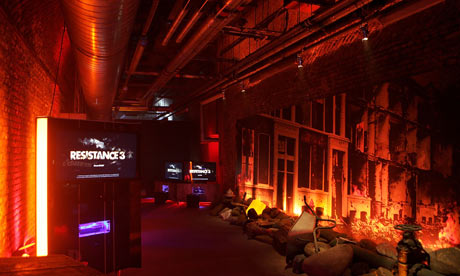
So this led me to Punchdrunk’s collaboration with PlayStation for the release of Resistance 3, Sony’s flagship sci-fi horror series. The company created a terrifying world beneath the railway arches at Waterloo station in London. The audience take the role of one of the few remaining survivors of an apocalyptic event and as one commentator noted:

From the moment the door closes behind you and you start to navigate the first dank corridor, torch in hand, you are as much part of the experience as witnessing it

.

.

.

..

.

.

.

And Darkness Descended as the piece is called was reviewed widely – both as a piece of performance and by technology writers and bloggers and the reaction from the two very different groups is fascinating. One blogger, Kevin Holmes who writes for a collective called The Creators Project (which is a global network dedicated to the celebration of creativity, culture and technology) entitled his piece Gaming And Theater Merge To Scare The Crap Out Of People – which I just love as a description.

.

.

.

.

.

.

.

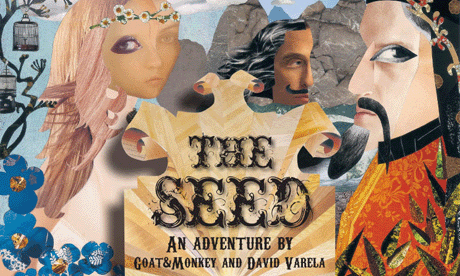
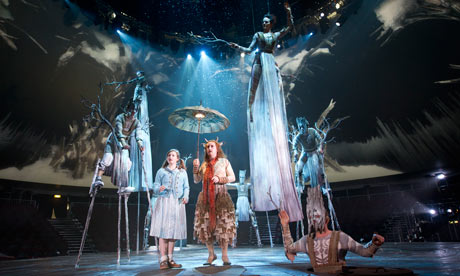
Then I found this article The Seed: where theatre, gaming and botany collide on a gaming  blog. The Seed is by the company called Goat and Monkey and is described as part immersive theatre and part on-line mystery.  This led me to another game blogger, Fin Kennedy, who asked the question Can video games help theatre reach the next level?

Another writer, Matt Trueman, asked the question The form is growing up. So what do we want from our games as theatre? Is it enough just to play or must we demand that games demand more?

I then came across another Punchdrunk production Sleep No More which is based vaguely around Macbeth, and was described by Salon website as

Shakespeare meets Internet games – Macbeth and alternate reality gaming collide in a show that could suggest the future of cutting-edge theater

.Click the image above for the New York Times review, or here for the Salon article.

This is a relatively new developing area of theatre. There is clearly much emerging all the time. There are even doctoral thesis’ being written on the subject. There is one here, by Katherine Whitlock, entitled THEATRE AND THE VIDEO GAME: BEAUTY AND THE BEAST.

It just all sounds so exciting. Maybe I’ll try Angry Birds again!

Hands Up!

A little added extra for today.  My mother sent me this link and it is quite astonishing.

.

The art form originated in ancient China and has now taken on a new lease of life thanks to modern imaging technology that allows multi-layering of images. The Indian artists behind this work are Amar Sen and Sabyasachi Sen. You can check them out through this link.

A Moment In Time

I was doing a bit of digging and came across these yesterday.  The New York Times has been publishing an occasional series of their original reviews of classic western plays. I am posting three here today. A real piece of theatre history. The links are for readable PDF versions of the images.

Firstly, Harold Pinter’s The Caretaker from 1961

Secondly, Tennessee Williams’ A Streetcar Named Desire from 1947

And finally, from 1905, George Bernard Shaw’s Man and Superman

Grand Designs

Today its design. I’ve often thought that in a different life I would liked to have been a theatre designer. Some of the best work I have ever seen has been enhanced or even made possible thanks to the designer.  That’s not say I don’t believe in the power of an empty stage, but when the design is right, it should speak to you in the same way the actors and the play do.

So I’m going to share a few things with you.  Firstly an interview with Tom Scutt, a 28-year-old stage designer who has been taking the theatre world by storm. The above image is from one of his latest creations for a stage version of The Lion, The Witch and The Wardrobe. Scutt gave his interview to ‘The Stage’

Secondly, an article in which theatre critics chose what they consider to be The 10 best theatre designs that have changed the face of modern theatre, from a 1912 Hamlet to Punchdrunk’s immersive Faust.

Thirdly a link to a web site by the stage designer J. William Davies that is full of delicious images and material. Click the image below, which is of his box set for a design for Six Characters In Search of An Author by Pirandello.

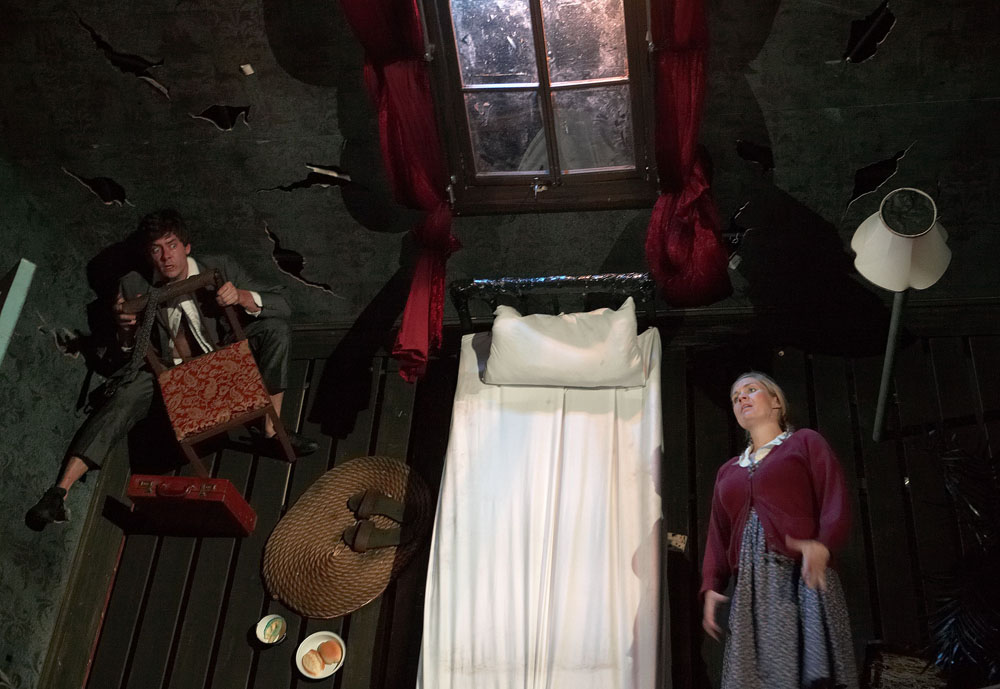
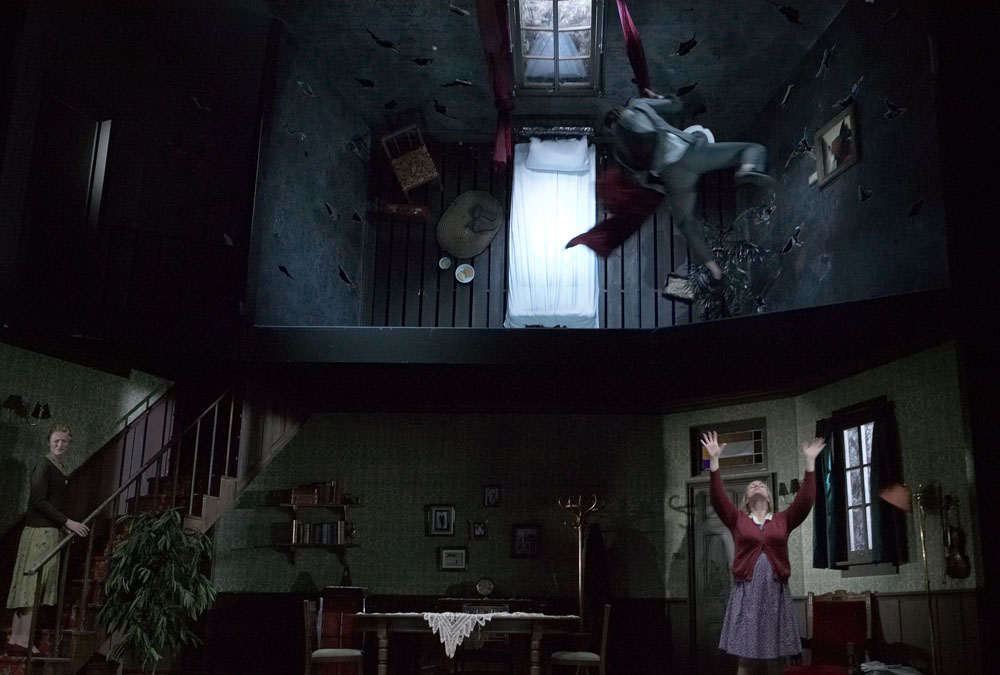
And finally my favourite two designs of the last couple of years. The first is by Börkur Jónsson, for VesturPort Theatre Company from Iceland, for their stunning production of Metamorphosis that played in Hong Kong a couple of years ago.  I was lucky enough to have front row seats and breath was taken away by every aspect of the production.

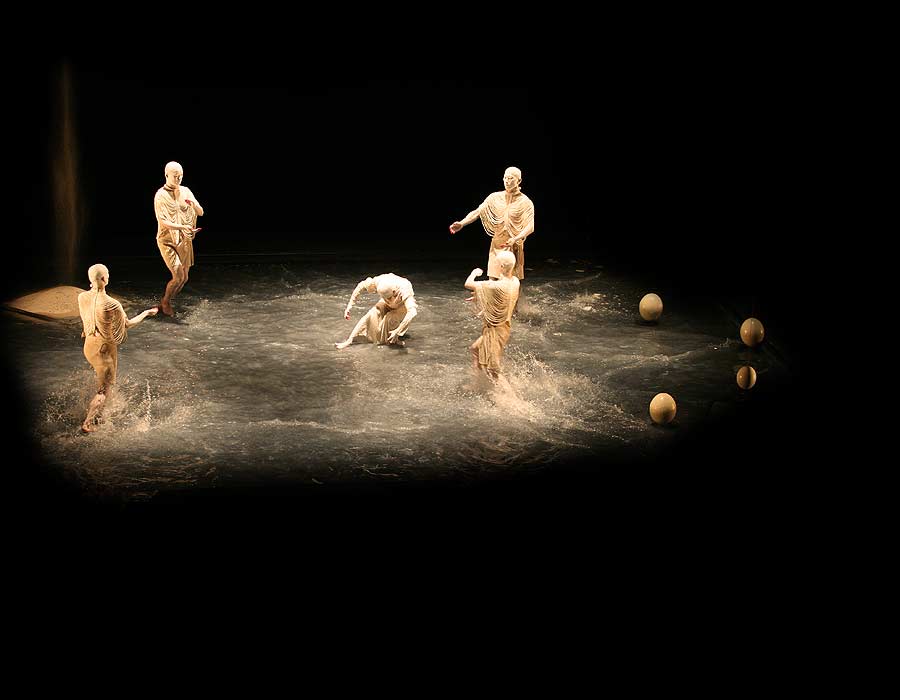
The second is by Ushio Amagatsu who directed, choreographed and designed the butoh piece Kagemi, by the Sankai Juko Company. I was privileged to see this one in Melbourne about 4 years ago. Wow.  The antithesis of my first choice, in its beautiful minimalism.

.