Dennis Kelly: “The Quest for Truth” 1

If you read Dennis Kelly’s speech that I posted yesterday, then this is by way of a response. Essentially I believe he right.The following extract says so much about the theatre we make and how we make it:

We don’t make our minds up using facts or arguments, we use facts and arguments to support what we have already decided is true.We bend and squeeze reality into a shape that supports what we feel. It is our feelings that rule us, not our minds. And this is where theatre has its impact. Theatre lies in emotion; it is an emotional medium, not really an intellectual one. But how does a playwright reconcile the quest for truth with an understanding that facts and arguments are essentially untrustworthy and that debate is something lawyers use to send people to jail regardless of whether they guilty or innocent? Well, perhaps they don’t. Perhaps they just say fuck it, this is what I feel, and they’re just honest about that. Theatre is essentially, at it’s best, a lone voice standing up in a darkened room and saying ‘I think this’. They’re not necessarily saying this is what’s right, or you should think this or this is what we should do, they’re saying ‘I think this. Does anyone else think the same?’

He goes on to talk about how theatre should come from a ‘desire to change things, from a belief in the power of theatre that is bigger than writers, directors, artistic directors and dramaturges, that it belongs to all of us and is never to be taken for granted‘ and I applaud him loudly for it. He isn’t really saying that political theatre is useless, just that we need to frame in such a way that we accept that ‘theatre lies in emotion; it is an emotional medium, not really an intellectual one‘ and that ‘theatre is essentially, at it’s best, a lone voice standing up in a darkened room and saying ‘I think this…….does anyone else feel the same?”.

Let me give you an example of what I (and I think, Kelly) sees as theatre with a voice, theatre that challenges, theatre that reflects the truth and in itself is a ‘quest for truth’, the latest offering by DV8 and Lloyd Newson, Can We Talk About This? The piece is a verbatim theatre work investigating the interrelated issues of freedom of speech, multiculturalism and Islam as manifest in Western democracies. It has received astounding reviews:

Every so often, a performance comes along that not only reconfigures the limits of the form, but also redefines and rearticulates how we see the world… Without a doubt, it is one of the most important works of our age. Go!

Time Out Sydney

Click the image above to watch excerpts.

ABC Radio Interview with Lloyd Newson, founder of DV8
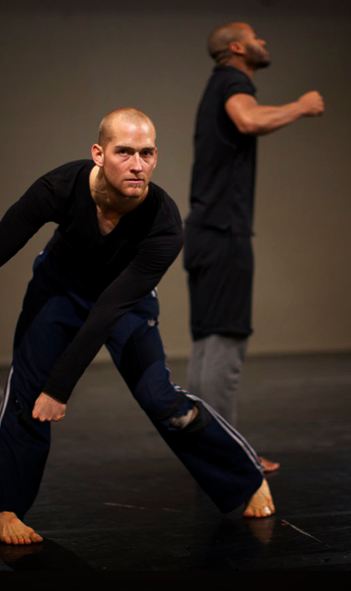
This is political theatre at it’s very best and most powerful. It is most definitely saying “I think this.….does anyone else feel the same?”. Can We Talk About This was in Hong Kong last year (and I missed it, unbelievably) but everyone I know who saw it, spoke about it in the most rapturous way. Even more so those who had never heard of DV8. It was clearly powerful and spoke with emotion to the audience. It comes as no surprise really. Newson insists in keeping his works at once informative and thought-provoking and this has been one of the defining traits of DV8. In fact, while he often displays a readiness to introduce a touch of hyperreality into his works, the eclectic stylist is nonetheless better known for his preference for content over ‘aesthetics and prettiness’. He clarifies:

I want to make theatre work because I don’t want to just make decorative dance pieces – they are like chocolate. They’re very nice at the time you eat it, but not very substantive in terms of [generating] brain power.

.

“Why political theatre is a complete waste of time”.

British playwright, Dennis Kelly, has recently sparked a fierce debate about the power of political theatre.  He gave the opening address at the Theatertreffen’s Stückemarkt in Berlin, Germany entitled Why political theatre is a complete fucking waste of time. Given that he is judged to be one of Europe’s leading political playwrights himself, you can see why Kelly’s words have caused a stir.

You can read the text of Kelly’s speech here Why political theatre is a complete fucking waste of time.

However, Matt Trueman, a theatre blogger questions Kelly’s view How polictical theatre changed it’s tune

The decision is yours. I know what I think……I’ll tell you later.

In The News

A few images from the news in the last week

Goma, Democrati Republic of Congo The Busara Contemporary Dance Company rehearse a production about child soldiers.

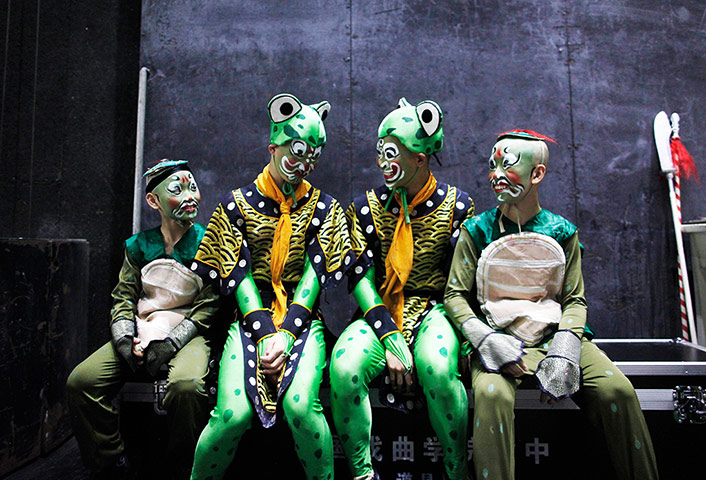
Beijing, China. Young students from the National Academy of Chinese Theatre Arts Middle School share a moment backstage before their Peking Opera performance, Nine-tailed Fox.

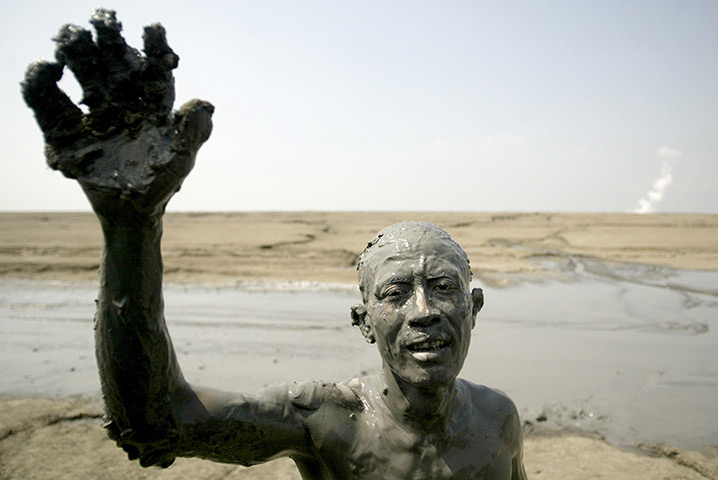
A victim of the Lapindo mud volcano takes part in a theatrical performance on a retaining dike in Sidoarjo, East Java.. Six years after it erupted from the well of a gas company linked to one of Indonesia’s richest men, the mud volcano known as “Lusi” is still spewing its toxic sludge over Java’s countryside. All attempts to plug the geyser have failed and new spouts are opening up, threatening to destroy more villages, homes and livelihoods in the East Java district of Sidoarjo.

And if you haven’t seen this yet – it’s been doing the rounds on social media – live your theatre journey by it

Art Should Comfort The Disturbed and Disturb The Comfortable

Ceser A Cruz

Site Very Specific. The Container

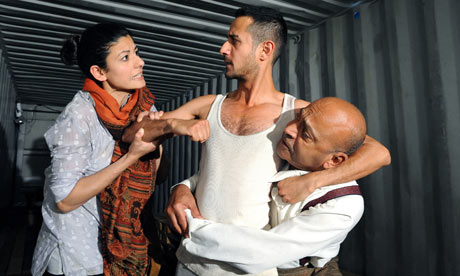
This is a still from a play called The Container, by Clare Bayley, that tells the story of five migrants – two Afghans, two Somalis and a Turkish Kurd – who are crossing Europe, accompanied by a Turkish trafficker and an unseen lorry driver. Their hoped-for destination is the UK, land of dreams. But they are experiencing only nightmares: the grim memories of what drove them from their homes, the stench of the container, and the fear of an unknown future.

The play literally takes place inside a shipping container, thousands of which I watch travel into and out of Hong Kong every day. When you talk about site-specific theatre you can’t get more specific than this. The audience sit in the container (maximum about 20) and are locked in there, with the 6 actors for the 65 minute duration of the play. The video is from a CNN piece, which gives a great visual flavour, but the third article below, Fancy seeing a play in here?, really gives you a sense of the powerful impact the experience had on the audience.

.

The Container: A Captive Audience

Photo montage from the production

Fancy seeing a play in here?

Mind you not everyone agreed that the authenticity of the experience achieved its intended impact: The play aims to depict human trafficking as realistically as possible, but in doing so loses impact

Chunky Move ‘Mortal Engine’

I was doing the second stage of a dramaturgical exercise with my TA students today and one of them, Tim, had conceived an inter-disciplinary, multi-media piece. It brought to mind this amazing piece by Chunky Move a physical theatre company from Melbourne, Australia.  They are award-winning practitioners who work with technology in amazing and ground-breaking ways. Much to my own annoyance, I missed Mortal Engine when it was in Hong Kong two years ago – mind you, I was climbing Kilimanjaro with a group of students at the time!

Mortal Engine is a dance-video-music-laser piece that utilises sophisticated interactive computer systems which, combined with the performers’ movements, trigger video projections, lights, sounds and laser images to portray an ever-shifting, shimmering world. It is performed on a tilted platform and the dancers appear to defy gravity.

My other favourite piece is Connected :

If you want to know more, you can watch this two-part documentary

.

An Instinct for Kindness

I have always understood the power of theatre to make people question their beliefs.  In 1994, as a young Drama teacher, a group of my Year 11 students created an examination piece exploring the murder of a 3 year old boy, Jamie Bulger.  He had been abducted, tortured and murdered by two 11 year old boys just over a year earlier in March 1993.  The case, not surprisingly, caused outrage across the UK. The boys, Robert Thompson and Jon Venables, who were found guilty of the murder, were roundly vilified, labelled as evil.

My students wanted to explore the case, but from the perspective of Venables and Thompson, as they wanted to understand what circumstances led them to commit such a horrific crime.  The performance was watched by the Chair of the School Governors, who was a magistrate.  He wrote to the students after the performance, saying that he had never considered what they had explored, having only felt revulsion for the murderers. The play made him question his own judgement so much that he didn’t sit in court for a number of weeks after watching the students’ performance.

I was made to think about this the other day when I listened to an interview with Chris Larner . In November 2010, he had accompanied his chronically ill ex-wife to Switzerland’s Dignitas clinic. He came home with an empty wheelchair and a story to tell. Consequently he wrote (and performed in) An Instinct for Kindness, a play that reflects on the circumstances, morality and humanity surrounding the journey,  exploring both the profound personal implications and the wider ethical considerations of the contentious issue of legal euthanasia.  The controversial play has put that debate firmly on the stage. Below is an interview with Larner and extracts from the play, as well as some reviews.  Food for thought indeed.

The Guardian Review

Catholic News Review

Exeunt Review

Quixotic Fusion: Performance ensemble

Quixotic Fusion is an ensemble of artists that brings together aerial acrobatics, dance, theater, film, music and visual effects. Quixotic, founded Anthony Magliano is an ensemble of artists from various disciplines including aerial acrobatics, dance, theatre, fashion, film, music and visual effects. This inventive group of artists goes beyond the limits of any specific art form, challenging traditional perceptions and creating a total sensory experience unlike any other for its audience while exploring infinite possibilities of movement, sound and multimdeia


I want Quixotic audiences to be challenged, to feel a little unsettled, to feel like it’s a little bit dangerous

Anthony Magliano

Kabuki theatre: a drag act with a difference

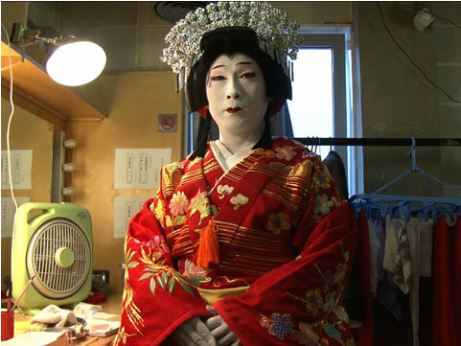
Japanese kabuki is one of the most impressive spectacles in world theatre: a spectacular, heavily costumed affair played by an exclusively male cast. This is one of Japan’s most famous ‘onnagata’ – cross-dressing – actors, Nakamura Shibajaku VII, who has portrayed princesses and courtesans at venues all over the world. Getting ready for work has never been this laborious …

Watch the video