A Devine Wright?

abridged-shakespeareAs much of the world begins a new academic year, so does Theatre Room. I am going to pick up where I left off in August with a further two articles that were published as a result of comments made by Ira Glass about Shakespeare and his relevance to a contemporary audience.

The first one that particularly caught my attention was written by Noah Berlatsky for The Atlantic. In it,  Berlatsky talks about Shakespeare’s political conservatism and how this shaped his writing.


Ira Glass recently admitted that he is not all that into Shakespeare, explaining that Shakespeare’s plays are “not relatable [and are] unemotional.” This caused a certain amount of incredulity and horror—but The Washington Post’s Alyssa Rosenberg took the opportunity to point out that Shakespeare reverence can be deadening. “It does greater honor to Shakespeare to recognize that he was a man rather than a god. We keep him [Shakespeare] alive best by debating his work and the work that others do with it rather than by locking him away to dusty, honored and ultimately doomed posterity,” she argued.

Rosenberg has a point. A Shakespeare who is never questioned is a Shakespeare who’s irrelevant. And there are a lot of things to question in Shakespeare for a modern audience. One of those things, often overlooked in popular discussions of his work, is his politics.

Shakespeare was a conservative, in the sense that he supported early modern England’s status quo and established hierarchy, which meant defending the Crown’s view of divine monarchical right and opposing the radicals, often Puritan, who questioned it.

For all the complexity and nuance of Shakespeare’s plays, his political allegiances were clear. James I was his patron, and Macbeth in particular is thought to be a tribute to the King. It even includes a reference to the Gunpowder Plot assassination attempt at James. That reference is made by Lady Macbeth as part of her effort to convince her husband to murder Duncan. The villainous traitors in the play are thus directly linked to traitors against James.

Macbeth isn’t a one-off to flatter the King, either: Rebels and usurpers in Shakespeare’s plays are always the bad guys. When Hamlet spits out the lines:

Oh fie, fie, ’tis an unweeded Garden
That grows to Seed: Things rank, and gross in Nature
Possess it merely.

The vision of sickening wrongness there is in part repulsion at his mother marrying his uncle, but it’s also a political disgust at the fact that the rightful ruler is gone, replaced by a usurpur. What’s “rank and gross” is not just sexual impropriety, but perversion of divine order. The Tempest is about restoring the rightful Duke to his place in spite of his usurping brother, while Othello shows that Shakespeare’s sympathies are not just with kings, but with any authority figure, as the sneaking underling Iago attempts to overthrow his noble Captain. It is significant here, too, that (as many critics have pointed out) Iago has no real motive for his animosity. He does not articulate a critique, or even a complaint, about the way Othello exercises power. Instead, he simply says:

I hate the Moor
And it is thought abroad, that ‘twixt my sheets
He has done my office: I know not if’t be true;
But I, for mere suspicion in that kind,
Will do as if for surety.

Rebellion against one’s superiors is presented as a matter of misguided jealousy and intrinsic spite. Similarly, the Puritan Malvolio in Twelfth Night, who aspires to the hand of a woman above him in social standing, is a hypocrite and a fool. The Puritan political resistance, or the Puritan ideological opposition to hierarchical norms, is never voiced, much less endorsed.

tattooed-shakespeare-mathew-mcfarren

In Shakespeare, those in authority rarely provoke resistance through injustice. In general, the one thing Shakespeare’s rulers can do wrong is to shirk their authority, trying to retire too early (King Lear) or consorting with those beneath them (Henry IV.) Often, their role is to come on at the end as a kind of hierarch ex machina, assuring all that “Some shall be pardon’d and some punished,” like the Prince at the end of Romeo and Juliet, or Prince Fortinbras at the end ofHamlet (“with sorrow I embrace my fortune”—yeah, we bet you’re sorry).

It’s sometimes said that Shakespeare always wrapped things up with a king on his throne and all right with the world as a reflection of a general belief among his contemporaries in the Great Chain of Being—a conception of the universe as divinely ordered hierarchy, each subordinate in his or her divinely ordered place. But there were many people in Shakespeare’s time who were mistrustful of kings and received authority—real-life versions of Malvolio, who Shakespeare pillories. Within his own context and within his own milieu, Shakespeare consistently championed the most powerful, and set himself against those who challenged their authority. He saw hierarchy as good and rebels as evil.

None of this is a good reason to dismiss Shakespeare. But it is a good basis for critical skepticism toward him. What would Twelfth Night look like from Malvolio’s perspective—or even from a perspective where it is not on its face ridiculous to imagine someone marrying across class? What real grievances might Iago or Macbeth have if it were possible for Shakespeare to show us an authority figure who isn’t a paragon? What happens to Julius Caesar if the rebels have some actual, genuine concerns about tyranny? As Rosenberg says, Shakespeare was a man, not a god—and as a man, he had a particular perspective, particular axes to grind, and particular blind spots. His plays aren’t entombed, authoritative holy writ; they’re living arguments, which means that, at least at times, they’re worth rebelling against.

The second comes from The Washington Post, written by Alyssa Rosenberg and explores the notion that the way a play is adapted/staged/interpreted will, of course, have a bearing on its relevancy to a modern audience: What we get wrong when we talk about Shakespeare.
Shakespeare Sucks

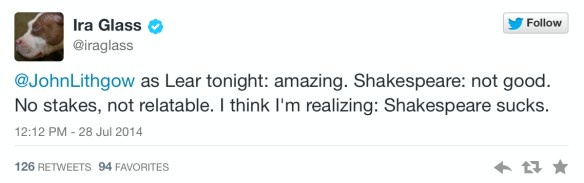
A beautiful spat has broken out amongst the literati Stateside this week, all sparked by a tweet from Ira Glass, presenter of This American Life:

Ira Glass 1_FotorHe then followed it with this:

Ira Glass 2_FotorSocial media went mad and it was picked up and discussed widely. The debate is fascinating and I thought I would share some of it with you. Firstly, and this is really worth listening to, a podcast from Born Ready. Director Steve Boyle and theatre producer Rob Ready discuss, to paraphrase Born Ready site, why Shakespeare has been elevated to something like a Prophet, and how his plays have become a point of shared experience and a cultural touchstone. I should warn you, however, that some rather choice language is used during the discussion.

.

john

Now, whilst Glass didn’t personally attack John Lithgow, to tie him in with a rant about the irrelevancy of Shakespeare was bound to cause an outcry. Firstly, Lithgow is akin to acting royalty in the US and secondly, North Americans really love their Shakespeare – you only have to look at the amount of Shakespeare festivals that take place across the continent every year and the fact that New York has been swamped with productions of late.

The reaction on social media was, it has to be said, highly entertaining as these pieces on CBC and The Wire highlight. If you click-through on the second tweet above, you can read it for yourself. Others have weighed into the debate, most, not surprisingly disagreeing with Glass – even Esquire, in a piece entitled SHAKESPEARE IS THE MOST UNIVERSAL WRITER EVER – Ira Glass doesn’t know what he’s talking about.

One of the best responses comes from the New Republic by Adam Kirsch, who calls Ira Glass a Philistine for saying Shakespeare sucks, while noting that he is not alone in this opinion:

shakes_Fotor

 Does Shakespeare suck? Ira Glass, the host of the popular upper-middlebrow radio show “This American Life,” apparently thinks so; he tweeted as much after suffering through a performance of King Lear in Central Park. The backlash has been swift and severe, thus answering the question of whether there remain any literary taboos in the twenty-first century. Apparently, calling the Bard “not relatable” is still enough to get someone branded as a philistine.

I come not to praise Glass, certainlyI think he is a philistinebut also not totally to bury him. For there is always something admirable in speaking with complete honesty about one’s aesthetic reactions, even when those reactions are plainly wrong. Those who automatically praise Shakespeare because they know it is the right thing to say, or because they fear Glass-like ostracism if they say otherwise, may also be philistinesThe kind that Nietzsche, in his Untimely Meditations, called the “culture-philistine,” who “fancies that he is himself a son of the muses and a man of culture,” but is actually incapable of a genuine encounter with art. The first rule of any such encounter is honesty: If you fail to find what you are looking for in a work of art, even King Lear, you must be willing to admit it. Then you can move on to the question of whether it is you or King Lear that is deficient.

The truth is that Glass could have summoned some pretty impressive names to testify in his defense. George Bernard Shaw famously hated Shakespeare, complaining that “Shakespeare’s weakness lies in his complete deficiency in the highest spheres of thought,” and offhandedly claiming “I have actually written much better [plays] than As You Like It.” Tolstoy, too, had a low opinion of Shakespeare: “Open Shakespeare … wherever you like, or wherever it may chance, you will see that you will never find ten consecutive lines which are comprehensible, unartificial, natural to the character that says them, and which produce an artistic impression.” Shakespeare’s fame, Tolstoy concluded, was purely a matter of convention: “There is but one explanation of this wonderful fame: it is one of those epidemic ‘suggestions’ to which men have constantly been and are subject.”

But then, to be hated by Shaw and Tolstoy is itself a distinction. For these great writers, Shakespeare stood in their way as an indestructible obstacle, representing a way of writing that they opposed because they could not practice it. To Shaw, whose plays are political and polemical, Shakespeare was not political or polemical enough; to Tolstoy, who strove for organic naturalness, Shakespeare was neither organic nor natural. When T.S. Eliot declared that Hamlet was an artistic failure, he was not trying to make people stop seeing or reading Hamlet; rather, he was trying to get us to change the way we think about what makes a play successful.

Ira Glass, of course, was not engaged in this kind of literary maneuver. He was speaking as a playgoer who found, evidently to his surprise, that King Lear was not providing whatever it was he expected a play to providethat is what “not relatable” really means. And even here, Glass is not alone or even a pioneer. Until the Shakespeare revival of the eighteenth century, King Lear was regularly performed in England in an edited version, in which Cordelia lived at the end. No less a Shakespearean than Doctor Johnson approved of this change, on the grounds that “the audience will … always rise better pleased from the final triumph of persecuted virtue.” In other words, Johnson was saying that the devastating conclusion of Lear was not relatable; it did not tell people what they expected a play to tell them. (Similarly, Johnson remarked on the “seeming improbability” of Lear’s conduct in impetuously disowning Cordelia, and explained it by the primitivism of the England of Lear’s time; after all, he wrote, such barbarism “would yet be credible if told of a petty prince of Guinea or Madagascar.”)

If audiences today would not stand for such a prettified Lear, that is because our sense of reality, of how the world really works and is supposed to work, has changed since the eighteenth century. Lear is generally considered the most powerful of Shakespeare’s plays precisely because, in its unsparing picture of a violent, unjust, continually brutal world, it conforms so well to what our history teaches us to expect. In other words, Lear is all too relatable, though what it relates is deeply disturbing (as it was for Johnson, who objected to the putting out of Gloucester’s eyes as an unstageable obscenity).

If, in the face of this overwhelming power, an audience member remains simply unmovedif, like Ira Glass, he just thinks the play fails to workthen something has obviously gone wrong, not with the play, but with the spectator. Exactly what is wrong in this case is something only Glass can answer, but I have my suspicions. Not just Ira Glass, but all of us, are growing increasingly unused to the kind of abstraction that art requires. Lear’s plight is supposed to move us not because it is something that could really happen to usalready in the eighteenth century, Johnson found it incrediblebut because it is what Eliot called an “objective correlative,” an artistic formula for producing a certain emotion. The horror of life that Lear communicates is something deeper and more constant than the particular actions of its dramatis personae. The same is true of Oedipus’s self-blinding, or for that matter Abraham’s near-sacrifice of Isaac: We can only appreciate these stories if we imagine our way into them, rather than demanding that they come obediently to us.

Perhaps that is the difference between art and entertainment. And in a culture with so many proliferating sources of entertainment, the work required to encounter art is becoming increasingly unfamiliar. When people stop going to see Shakespeare altogether, we’ll know that we’ve lost this particular part of our humanityone which we have traditionally honored as among the noblest and most valuable.

William Shakespeare

The Guardian in the UK published a list of writers through history who have dared to rubbish Shakespeare, Shakespeare sucks: a potted history of Bard-bashing, while The New York Times ran an op-ed piece asking the question, Should Literature Be ‘Relatable’?

It’s a healthy debate, whatever side you are on. It is also noteworthy that Glass is clearly having second thoughts having faced the vitriol – the original tweet has been deleated.

I’ll leave you with BuzzFeed’s take on it all – Radio host Ira Glass didst belittle Shakespeare and the internet doth protest

.

Nothing To Be Sniffed At

aromaramaNow and again you come across something very different in the world of theatre and today I would like to share an article from the Clyde Fitch Report, by dramaturg and biological anthropologist Dillon Slagle.

In it,  Slagle interviews David Bernstein, who is a Scent Designer, an emerging field in theatre. Now this isn’t necessarily a new, 21st century thing. Indeed, American playwright and producer David Belasco toyed with the idea back in the early 1900s but it never really took hold.

Can You Smell That Smell? It’s Theatrical Scent Design

Theatre has begun to embrace a new type of designer. Their work is invisible, but, if done correctly, it can have a palpable impact on the performance. I interviewed David Bernstein about his work in the burgeoning field of scent design.

1_Fotor

Dillon Slagle: On a basic level, what is scent design?

David Bernstein: I split up scent design into two categories. One is an ambient smell or scent, which is scenting the theatre or the performance space as the audience is walking in. It’s part of the initial impression. It’s more like an installation, so it serves to transport the setting, or to make it “other.” The second is more like scent cues. Rather than scenting the space when you walk in, it’s the introduction of aromas to coincide with the action on stage.

You can read the rest of the Q & A here and another interview with Bernstein here. It’s an interesting concept, and I guess with immersive theatre all the rage at the moment, it will have a place. Me, I think I’ll just stick with smelling the grease paint.

Walking In The Footsteps Of Giants

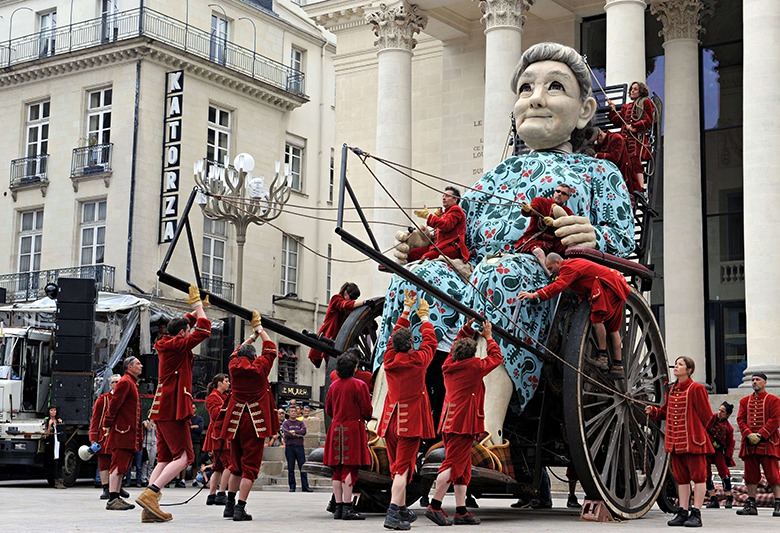
s_r18_71390039One of the most fascinating companies that has been gaining an international reputation in the last few years is Royal de Luxe. Founded in 1979 by writer and director Jean-Luc Courcoult, the company has played to 18 million spectators in more than 170 cities across the globe. In and of itself, this is impressive, but it is the nature of their work that makes them extraordinary. The company, based in Nantes, France, create giant, and I mean giant, puppets that appear in site-specific shows which take over whole cities, the narrative played out in front of thousands of people at a time. They have a reputation of being one of the best street theatre companies in the world and it isn’t hard to see why. Theatre critic Lynn Gardner, gave one of their shows, Sea Odessy, a five-star rating, and spoke about the audience reaction thus:

Look at the faces of the audience and you see wonder.

Yes, this is a spectacle, but one that in its simple storytelling, skilled manipulations of the lifelike puppets (the little girl seems steeped in watchful sadness; her dog gamboling through the streets, his tongue lolling) and playful changes of scale offers a theatrical experience that is both epic and intimate, joyful and sometimes sad. Follow it through, rather than just glimpsing it as a carnival-style parade, and you become as much invested in it as you do in King Lear, and as admiring of the craft and imagination employed to put it together.

s_r01_91339881

It’s certainly a marvel, but it is not just the extraordinary feats of engineering that hold the attention. These giants may dwarf us and even our great cities…….but it is human endeavour that animates them.

Tiny figures in wine-coloured coats crawl across the bodies of the little girl and diver like Lilliputians. Each step of the diver takes gargantuan human efforts. The result is inclusive theatre where young and old rub shoulders with the giants. We walk together in their footsteps, and we walk taller because they are with us.

If your French is any good, there is a fabulous documentary about the company and their work:

.

Another one, this time in English, from the BBC, covers a 2012 visit of the company to Liverpool, UK, as part of the 100 year commemorations of the sinking of The Titanic

.

What I love about their work is not just the sheer scale of it, but the way they bring theatre to a much wider audience.  Theatre critic Catherine Usher commented that:

The Sea Odyssey Giant Spectacular tapped into something very special in terms of public reception and makes extremely significant steps towards a successful future for large-scale street theatre…..

The reactions that both Usher and Gardner speak about are evident here in this video. Royal de Luxe are truly a global company having performed in a diversity of countries – from Vietnam to Chile, Iceland to Australia – the list is long and impressive. Not all their performances include The Giants, but never the less they certainly have a global reach, as this set of images from The Atlantic shows.

s_r21_RTR29PGP

The latest performance for The Giants is happening this weekend, again in the city of Liverpool in the UK, which seems to have taken the company and their puppets to it’s heart. This time, as part of the commemorations of World War I.

For BBC Arts, Actor Sue Johnston, from Liverpool herself,  has written about the emotional power of these now iconic giant marionettes:

Growing up in the 1960s and spending so many years in the world of entertainment, I have seen and been part of some incredible things……I have been lucky enough to have had some experiences that I will remember for ever.

But one of the things I will never forget came two years ago, when alongside tens of thousands of people from my hometown, I took to the streets to follow a 30ft wooden ‘giant’, her uncle and her dog around the streets of Liverpool.

The city truly fell in love with those characters, and the French artists – Royal De Luxe – who brought them to life.

On that occasion, the giants came to Liverpool to mark the centenary of the sinking of the Titanic – a seismic moment in history and certainly for the city, where so many of the crew from the ship were from. Some questioned if these giants were an appropriate way to commemorate such a disaster.

Royal de Luxe

They were proved spectacularly wrong.

This week, Royal De Luxe return to the city, and this time to mark something even bigger in our history – the centenary of WW1.Liverpool was the birthplace of the Pals regiments – groups of friends who, with the words of Lord Derby and Kitchener ringing in their ears, signed up together to go on an adventure abroad from which so few of them ever returned. Over the course of the coming years, there will be hundreds of commemorations around that terrible war – some big national moments and some small intimate affairs – but for me, it is this performance – titled Memories of 1914 – which I know will be as powerful as anything which will follow it.

Artistic endeavour such as this – big, bold and exciting – is a vital way for us to mark key historical events, no matter how sombre. They engage our senses and emotions in a way that other forms of commemoration would never be able to, and they break down barriers of age, class and race effortlessly. What is so compelling for me about Royal De Luxe is the way that they take the art to the people rather than wait for the people to come to them.

Between them, the three giants who will be in the city this week – the little girl and her dog again, but this time joined by a brand new grandmother giant – will travel a total of 30 miles around the city, going down the streets of forgotten terraces, past the two incredible cathedrals which hug the Merseyside skyline, and into parks quite a way off of the beaten track.

Vielle Geante (Old Giant), a puppet in the Royal de Luxe street theatre production Le Mur de Planck

This spectacle will engage and impact more people in this story, than any normal form of commemoration ever could, getting people to invest in something they didn’t even know they should care about.

Art can do this. It can touch us, thrill us, enrage us and engage us in things we might otherwise just let us pass by or choose to ignore. It makes us look and think differently about ourselves, where we live, our history and our future.

I have been lucky enough to be at the centre of some of those moments myself, but this week I am looking forward to experiencing it again, like everyone else. Being one of the million people who are due to come together to commemorate, pay our respects and reflect on the ultimate sacrifice, by being brought together by a giant girl, her grandmother and a dog.

Only art will ever be able to do that.

What Johnston doesn’t mention is that the puppets are so large that the company employ local volunteers wherever they perform to be assistant puppeteers, otherwise known as Lilliputians. One such volunteer is Colin Bordley, who talks about his experiences here.

I’ll leave the final words to their creator, Jean-Luc Courcoult, explaining how his characters come to life:

.

Staging The Screen

An interesting little share today from Ideas Tap. As new technologies expand the possibilities of design in live theatre, whole new fields are opening up. In this interview by arts journalist Naima Khan with Kim Beveridge, digital artist, there is some interesting insight in to the role and the processes behind the art.

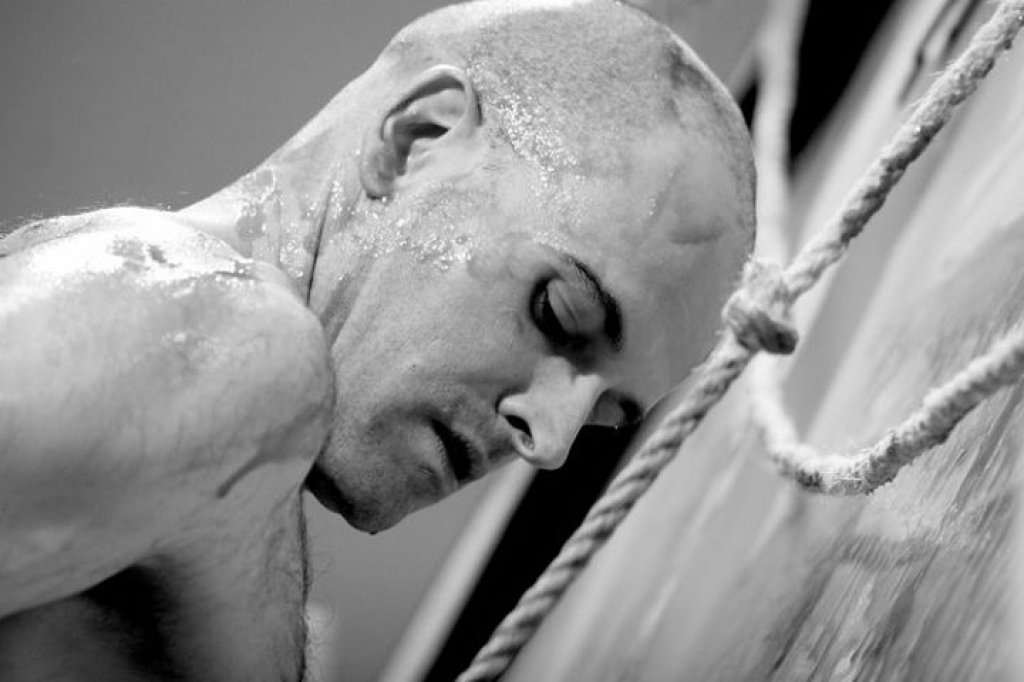
WALL OF DEATH: A WAY OF LIFE with National Theatre of Scotland

WALL OF DEATH: A WAY OF LIFE with National Theatre of Scotland

Kim Beveridge on video design

Kim Beveridge has created video for productions at the Royal Court and the National Theatre of Scotland. Kim talks to Naima Khan about avoiding clichés.

What challenges do video designers face when working on theatre shows?

One common problem you face is being asked to work on a production that doesn’t necessarily have the budget to realise what the director and the company want to do. Ambitious projects are more and more common now as you can easily run video off a laptop. There’s not a lot of troubleshooting you can do if, say, your video’s not bright enough. You can’t give it more lumens [measurement unit for light] and you’ll have to communicate that to people you’re working with.

Physical spacial challenges are also common when you put video into a space where actors need to be lit at the same time. You have to work closely with the lighting designer so you don’t bleach out what they’ve created. With the right budget you can get it right but it takes experience and experimentation.

Pests

Pests

Talk us through your working process for Pests

The work I make is very figurative so I like to start with something real and then manipulate it and edit it down to fit the show’s needs. One of the things I always ask is: what is the role that video is playing in this show? What is it here to do?

In Pests, it was clear video was there to illustrate one character’s psychotic hallucinations. The other thing we had to nail were the elements that the playwright Vivienne Franzmann had written about in her script. She’d included fire (that was really pared down by the final edit), blood, which she wanted coming through the walls, and also the presence of men. So I wanted to find images that were actually frightening not Hammer House of Horror-funny because when you start to work with blood it’s easy to go down that road.

We were keen that the images had a real textural quality because they were going to be projected onto mattresses. So I spent a lot of time filming ink and synthetic blood being bled onto fabrics like silk, and cotton. We put the camera underneath a stretched canvas of the material and just watched it move and bleed.

How can video designers and theatremakers use video or projections in a way that is relevant while steering clear of clichés?

When it comes to clichés, the fact that I’m working in collaboration means that it if I make a choice that’s obvious or boring, someone will tell me. But there’s nothing I wouldn’t try. It’s about experimenting. It’s about trying to make things lean, not having projection unnecessarily and only having it to support something that isn’t explicitly written in the text.

I’d also recommend trying to be involved in the collaboration from the earliest stage. Don’t be precious about rough edits, bring them into the space early on so you can show what you’re doing and see if it works before you spend hours on the animation. Be open about what you intend on doing, trust that the people you work with will have good imaginations and they’ll be able to use your rough sketch to come to an agreement about how to move forward.

How did you get your first job in theatre?

I studied Time Based Art at Duncan of Jordanstone College of Art so my background is doing video installation, sound and documentary. But I was always aware of spaces and I like projecting work in unconventional spaces. It was around 2005 that I left art school and the National Theatre of Scotland (NTS) started soon after. I was headhunted by them and hired to work on documenting the process in rehearsal rooms. What I learned was, if you do video and sound, your skills are really transferable and you don’t have to work in theatre design.

Pretty much immediately I started meeting loads of people who make shows and started working with them. It wasn’t long after that that Vicky Featherstone asked me to work on a large-scale production called Wall of Death, which was a documentary installation projected onto eight screens. Getting into theatre can happen quite quickly, it’s a lot about recommendations. I don’t have any business cards but if you get your name out there, things can start to happen.

Wall of Death

Wall of Death

How should video designers prepare themselves for work in the theatre industry?

There’s a book you should read called Staging the Screen: The Use of Film and Video in Theatre by Greg Giesekam. You’ll learn about the history of it and it’s surprising actually how long people have been doing this. If you really want to get into video design, just start experimenting. Find your strengths and see how they work with something live. Document people or performers interacting with your videos. Find a peer group that includes actors, maybe cabaret artists or even live musicians.

You could also go straight to people who are already working in theatre and ask them about work experience or courses. For example, there’s a great company called 59productions, which did some amazing stuff for the London Olympics, and one called Forkbeard Fantasy who do really cool experimental stuff, they also incorporate puppetry and animation. I don’t think you should worry about the industry too much. If you’ve got talent, and the guts to contact these people, they’ll help you through it. If they can, they probably will give you their time.

Shadows Of The Empire

I find myself in Sabah, Malaysian Borneo this week and as coincidences go this is a good one.  On the way here I came across an article in The Wall Street Journal about shadow puppet theatre – but with a difference. Entitled Star Wars as Shadow Play, the writer John Krich  talks about a new shadow play called Peperangan Bintang, which translates from the Malay into Star Wars. str2_cn_2710_cnbintang_A

In the article Krich outlines a three-year old project by Tintoy Chuo to find a new, younger audience for the ancient Malaysian art of Wayang Kulit:

George Lucas credits the success of his Hollywood blockbusters in part to traditional forms of mythmaking. Now, his storytelling is coming full circle. Those heroes and villains from “a galaxy, far, far away” have landed in Malaysia with the mission of reviving its traditional art of the “shadow play.”

“I’m trying to combine the traditional with the high-tech to find a unique way to preserve Malaysian culture,” says originator Tintoy Chuo. “I myself sometimes find shadow play too long and boring. But this is something cool that young people can relate to. Even my mom knows ‘Star Wars.'”

A 25-minute preview of “Peperangan Bintang” (Malay for “Star Wars”) premiered last October. Drawing on the first of the films to be released—whose full title is “Star Wars Episode IV: A New Hope”—it features Sangkala Vedeh (Powerful General Vedeh, or Darth Vader), Perantau Langit (He Who Walks in the Sky, or Luke Skywalker) and Puteri Leia (Princess Leia), plus the familiar squeaking robots, augmented by banging gongs and screeching horns, eerie graphics, dramatic recitations and sound effects of heavy breathing and robotic squeaks. Mr. Chuo is still working on turning it into a full-length shadow play, usually 1½ hours.

“I thought it was a brilliant idea from the start,” says the retiring president of the Star Wars Malaysia Fan Club, Adi Azhar Abdul Majid. The club of 200 paying members—”from architects to kids who flip burgers,” says Mr. Adi, a former lawyer and freelance professional emcee—stages movie marathons and garage sales of memorabilia to support local charities. With the fan club’s help, Mr. Chuo was able to contact Mr. Lucas’s Lucasfilm, which said through a spokeswoman that Mr. Chuo’s “art was beautiful” and “was impressed with his passion for ‘Star Wars.’ ” Lucasfilm said it has offered to put Mr. Chuo’s photos in its fan publication, Bantha Tracks.

It was three years back that Mr. Chuo, 42 years old and a father of three, first struck on the idea of redesigning Luke Skywalker and the gang in shadow-play style. He raised funds by selling T-shirts displaying his fantastical hybrid creations. He seems perfectly suited to the project: By profession he’s a “character creator,” designing creatures for use in games, advertisements and other applications. But in the end he decided he needed help from a shadow-play “jedi.”

10411228_735168279878618_802517924135396961_n

“At first, I made them in plastic with lasers,” Mr. Chuo says. “Soon, I realized I needed to find a real puppet master to help me stage a performance.” A long search across rural villages ended with a Facebook inquiry from Muhammad Dain bin Othman, 62, a shadow-play master known familiarly as “Pak,” or Uncle, Dain. “That Christmas,” Mr. Chuo recounts, “I saw my first shadow play and he watched his first DVD of ‘Star Wars.’ ”

Pak Dain’s conclusion: “It’s a simple story, not difficult.”

The master soon helped Mr. Chuo fashion 10 puppets the old-fashioned way, of cowhide, the holes made by nails. Pak Dain’s only hesitation was over his reputation for authenticity. He decided it was acceptable to adapt “Star Wars” because tradition allows “outside stories” to augment main mythic plot outlines. “Nobody has complained so far,” Pak Dain explains, because musical themes specific to the Hindu characters Rama and Sita were changed.

“I told him that if some found us inauthentic, I would take the blame as the Chinese guy,” Mr. Chuo says.

Hailing from the Tumpat district of Malaysia’s northern state of Kelantan, a shadow-play hotbed, Pak Dain was taught by three learned masters and began mounting performances in the 1980s. He retired in 2008, but kept a connection, pouring his money into training musicians to keep alive this art that was once a regular feature of weddings and village celebrations. Unable to perform, he opened a Kota Bharu gallery for the puppets. It is estimated there are only 10 surviving master puppeteers around Kelantan, where the form of theater was adapted from Indian sources. Compared with the better-known Indonesia version, Malaysian wayang kulit features rounder, more transparent figures—colors shine through the silhouettes. The characters have one movable arm, as compared with two in Indonesia.

10451678_735168206545292_7375208139219776895_n

The slow and relatively static performances have lost ground to movies, television and videogames. Today, the Malaysian shadow play is performed mainly for tourists in the Cultural Center of Kota Bharu, Kelantan’s state capital. One of the motives for basing a production on a Hollywood legend is, in Pak Dain’s words, to “change the mood” of authorities by “showing that shadow play doesn’t just belong to Rama.”

Though he’d like more funding to improve backdrop effects and perform overseas, Pak Dain says he will “continue to sacrifice a lot because we all love it and we want to promote it to the younger generation.”

This put a huge smile on my face for a number of  reasons. One, the attempt to keep, revive even, a traditional theatrical form like Wayang Kulit is admirable and innovative on Chuo’s part. Two, as contemporary theatre is using the big screen to widen its audience base, I am taken by the idea that the world of cinema is finding a place on the ‘theatrical screen’. Three, I have to admit I’m a Stars Wars fan – but of the original films, not the dross that Lucas produced later

.

Tintoy Chuo and his team have been working hard to publicise their work. Firstly an interview with Chuo, Take Huat, Pak Dain and Ahmad Azrai by Gloria Kurnik about the project, which you can watch here.  Secondly, Chuo and Huat took part in the TEDx event in Kula Lumpur, and spoke about their work:

.

There is also a Facebook Page which follows the development of the project, which is planned to be finished – a full length Wayang Kulit piece – by the end of the year. There is a little trailer here, which just made grin from ear to ear, especially the scene with R2-D2 and C-3PO

.

1479328_634266829961483_1618726353_nThe fact that traditional techniques of puppet making and puppeteering are the centre of this effort is heartening, as is the use of traditional Malay instruments to play the soundtrack. Also, there is an alignment of characters with those in the traditional Wayang Kulit stories, which will hopefully widen the appeal. On the flip side, when the New Straits Times wrote about the venture, they did so on their ‘Tech’ pages, because of the computer generated visual effects being used.

This truly is fusion in so many ways.

Still Streaming

89264It has been a few months since I have written about the discussions and debate surrounding the streaming of theatre, live and recorded, to cinemas, performance venues and across the web. In my last two posts on the matter, Something to Stream About and Something Else To Stream About I wrote about the experiences, arguments and concerns as they were being put forward. In the UK in the past few weeks the discussion has gathered pace again, with further written comment, the publication of a piece of research with regard to its impact on audience figures and continued experimentation with the form.

In a piece for The Guardian newspaper, Let’s stop pretending that theatre can’t be captured on screenthe highly regarded, veteran theatre critic Michael Billington wrote:

But while I remain an evangelist for live theatre, I think it’s time we stopped pretending that it offers an unreproducible event. A theatre performance can now be disseminated worldwide with astonishing fidelity. This represents…….a revolution which knocks on the head the old argument that theatre is an elitist medium aimed at the privileged few.

Following Billington’s piece, another theatre critic and editor, Andrew Haydon (who also runs the excellent blog Postcards From The Gods) wrote an article Coney’s no island: could streamed theatre let audiences call the shots? in which he talks generally about the continuing development of the form and in particular about a new show, Better Than Lifeby the company Coney, who describe themselves as:

Interactive theatre-makers….[who] weave together theatre and game design to create dynamic shows and experiences that can take place anywhere that people gather: in theatres, schools, museums, on the streets and online.

Haydon describes Better Than Life thus:

The live premise is simple: you arrive at the “secret location”, take part in a bit of audience participation and then meet Gavin, a man who has been granted the power to draw pictures of future events (a plot wittingly or unwittingly lifted from the wonky US science fiction TV show Heroes). The online premise is more complex: Coney’s stated aim is to experiment with how they might be able to let people interact with the performance even if they are not physically present. To this end, online viewers could choose which camera they watched from, interact in the site’s own chat facility and even control spotlights in the room itself.

BTL_webdesigns-17-1024x1024Now this is clearly a different beast to streaming theatre as it has been developing so far, but indicates the pace at which interactive technologies have the potential to shape the future development of theatre. Arts journalist Miriam Gillinson also wrote about her online experience watching Better Than Life, as opposed to Haydon’s ‘real-life’ viewing, in her blog post, ‘Better Than Life’ review or ‘Is there a triple click option?’. However, both seem to agree that whilst it was a form still very much in development, there was distinct and intriguing potential in the work and how it might point to the we ‘watch’ theatre in the future. To explore Coney’s work more, there is an excellent interview by Rohan Gunatillake with the company’s co-director, Annette Mees, for Native Magazine intriguingly titled Gorillas, beautiful tension & Better Than Life. In the interview, amongst other things, she explores the difference between their work and the more conventional broadcast streaming of theatre.

Coney's Early Days

Coney’s Early Days

As I said at the beginning of the post, one of the things that prompted me to revisit the streaming discussions was the publication of a survey in the UK that seems to show that the advent and growing audiences of streamed theatre is not, as some feared, having a negative effect on live audience attendance either in the capital or in the regions, as some feared. The survey was carried out by Nesta (a charity that funds innovation in the arts sciences and technology in the UK) and you can read their findings here. There is a condensed version of the findings here, courtesy of Whats On Stage

The National Theatre's Frankenstein, Jonny Lee Miller

The National Theatre’s Frankenstein, Jonny Lee Miller

Now obviously, these statistics are for the UK and they left me wondering how they would extrapolate out for international audiences of streamed and broadcast theatre. Since I last wrote about this subject and lamented the lack of broadcasts to Hong Kong, the National in the UK have at last found a cinema partner here.  Their initial foray – Frankenstein – was an immediate sellout (I was too slow) and since then, more and more broadcasts have been added with Coriolanus and The Audience begin shown multiple times in the next couple of months. They are immensely popular with Hong Kong audiences (I don’t mean just expats either) and I can see how they are creating an audience-in-waiting of theatre goers ready for their next trip to London. I could be cynical of course and comment that all of these productions have star actors with international reputations and are therefore an immediate box office draw. However, I won’t and I can’t – I am just delighted that I can now see what I consider to be some of best theatre in the world in the place I choose to call home.

I also want to a mention of another streamed event, that in a week that saw 500,000 people take to the streets of Hong Kong demanding universal suffrage, has significant resonance for me. On June 24th, The National Theatre of Scotland hosted The Great Yes, No, Don’t Know 5 Minute Theatre Show  which streamed for 24 hours, pieces of theatre lasting no longer than 5 minutes to and from around the globe.

greatyes_prod

Driven by the upcoming vote on Scottish independence from the UK, the idea was to create a democratic, dramatic response to the theme of ‘Independence’ – identity, borders, language, and national identity. You can watch some of the contributions again here. Quite rightly, many of them are from Scots making their own comment on what is to come on the 18th September, but there are also contributions from around the world. Theatre and democracy, hand in hand.

So as the experiments continue and the debates rumble on, I leave you with an article, Three Nationals, again from Native Magazine, this time by David Kettle, in which he talks to leaders in the three national theatres of the UK – The National, The National Theatre of Scotland and The National Theatre of Wales – about their digital visions. It leaves me in no doubt digital theatre broadcasting and streaming is hear to stay.

Specifically Epic

Last week I had a moment of enlightenment while doing some reading around site specific theatre. Actually it was more of Homer Simpson ‘duh’ moment. We tend to view site specific/responsive theatre as something new, simply because of its huge and growing popularity. This was my Homer moment, the realisation that of course it has been around in one form or another for hundreds of years, both in the East and the West.

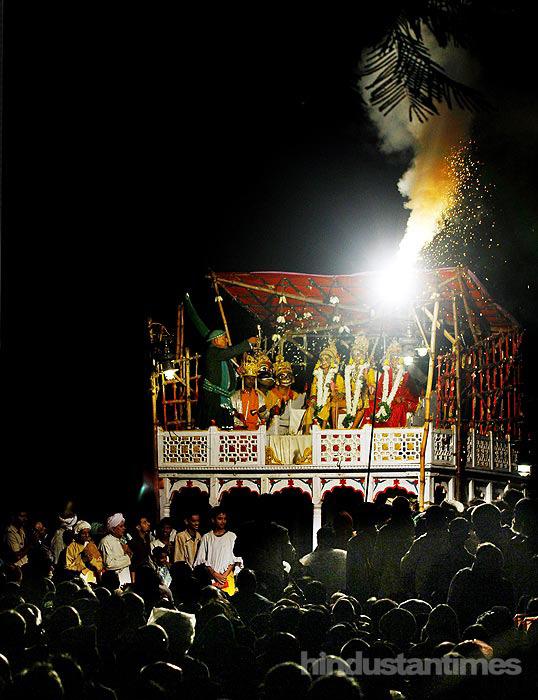
Ramnagar-AA-20-700One site specific performance that is almost 200 years old is the Ramlila of Ramnagar performed in Varanasi, India every year. It was started in 1830 by the Maharaja Udit Narayan Singh and is a theatrical portrayal of the Hindu epic, the Ramayana. Ramlila or Ram Leela (which means, literally, Rama’s story) take place all over India, but the one in Ramnagar is an epic in its own right. It lasts 31 days and takes place over an area of almost 8 square kilometres – basically the city is turned into an open-air set.  It is steeped in tradition – characters are played by local actors and major roles are often inherited by families, a good example being, the role of Ravana  which was held by same family from 1835 to 1990. It is reckoned that over 1 million people come to watch the spectacle every year. What interested and heartened me was that the ‘audience’ are indeed pilgrims. Very few foreign visitors are amongst the spectators as Ramnagar currently has no real tourist infrastructure. It wasn’t until 2013 that it was officially allowed to be documented on film.

13jun_Ramleela-Issaq01

There are many Ramlila that take place across India, particularly in the North, but they generally last 10 days. Like Kabuki in Japan, Khmer Shadow Theatre in Cambodia, Commedia dell’arte in Europe and many performance traditions across the world, Ramlila is recognised by UNESCO as a Masterpiece of the Oral and Intangible Heritage of Humanity:

.

There are two excellent articles which are worth reading if you’d like to know more. The first is by Richard Schechner, a professor of performance studies at New York University. Written for the The New York TimesA Maharajah´s Festival for Body and Soul is an Untitledexcellent insight to the Ramlila of Ramnagar and details the potential problems that face it in the 21st Century. The other, equally as informative, is by Saudamini Jain for the Hindustan Times, entitled A look at the grandest Ramlila in the world

Another interesting online source comes from ZeeNews and is about the Dussehra Festival during which the Ramlila takes place.

In his Introduction to Theatre in India, David Mason,  Associate Professor of Theatre, Rhodes College draws the parallels between the Ramlila and the liturgical dramas and passion plays of Medieval Europe.  This ties in with my opening paragraph to this post,  as one of the traditions I realised was effectively site-specific is the Oberammergau Passion Play which is performed every 10 years by the inhabitants of the village of Oberammergau, Germany and been done so since 1634.

One more excellent resource that I have come across is The Ram Lila by Norvin Hein. Very detailed and clearly part of a larger work, although I cannot attribute it beyond that.

So there you have it – my ‘duh’ moment has left me a wiser person.

Truth and Lies

Today I want to share some thoughts about a new play in London that has been making headlines among the chattering TP3_Fotorclasses in the metropolis. Adler and Gibb is currently playing at The Royal Court Theatre. Written and directed by Tim Crouch, who is renowned for experimenting with and rejecting traditional theatrical conventions, it has created much debate, about both it’s form and meaning. As I have said before, I tend not to write here about specific plays in production, as there seems little value when most people who read Theatre Room are on the other side of the world.  However, Adler and Gibb has attracted so much attention I thought it merited some discussion. The first article I read about the show, Is this the real life? Is it just fantasy? by Holly Williams for The Independent is a good place to start to get a flavour of the piece. I followed this with an article by Crouch himself for The Guardian, The theatre of reality and avoiding the stage’s kiss of deathwhich begins with:

The old showbiz dictum of never working with children or animals is not because they’re uncontrollable. It’s because they’re too real. Not realistic, but real. And when you’re an actor giving your realistic all, there’s nothing more undermining than performing it next to something real. The set collapsing is real. Your fellow actor forgetting lines is real. I would suggest that full nudity tips the scale of real. Actual sex is right over there, as is actual violence. Even a kiss. In a production of King Lear I did for young audiences, when Edmund kissed Goneril the play momentarily came to a halt because the audience could only see the real.

And ends by noting:

In my play there are children as children and there are children as animals. There is an animal as an animal. There are objects pretending to be other objects, light pretending to be other light, a set pretending to be another set, an actor pretending to be another actor. And a kiss. A real kiss.

It was this argument that caught my attention.  Many times in my theatre journey I too have experienced the ‘real’ that Couch is talking about, which disconnects you from the ‘reality’ of the drama and connects you directly to the real world. I am convinced it is this that has shaped how I make theatre myself, trying to avoid the ‘theatrical reality’.  Crouch also notes that

There’s a danger when, as artists, we attempt to annex the real and put it in our work, thinking that by doing so, the experience we’ll give our audience will be more authentic, more honest, more deeply felt or perceived

231050_2_preview

In an interview given to Aesthetica, Crouch also says:

It is theatre’s loss not to think more rigorously about form. Visual art has moved beyond all recognition in the last 100 years. Theatre is still mired in notions of realism. There’s a great quote from the American scenic designer Robert Edmond Jones: “Realism is something we practice when we aren’t feeling very well. When we don’t feel up to making the extra effort.” The form of realism is about an attempt to capture reality – and it is this acquisitive aspect of realism that I am interested in exploring.

Not surprisingly, the critics have tended to fall into two camps – love and loath – with regard to Adler and Gibb. Matt Trueman, in his review, writes that

Crouch is, at some level, offering us an ode to theatre: it is dual status as fiction and reality, its honesty with semiology. At its baldest, art just gives us objects. Film, merely fiction. Theatre, the sweet spot in the middle, can hold both at once.

adler-and-gbb-playtextIn her blog, playwright Hannah Silva has written twice about the play, in attempt to answer questions she was left with – both in terms of form and message. Over all she says it is entertaining, strange, provocative, and a masterclass in theatre. She also shares a photo of a page in the programme/playbill (right) which indicates what will happen in the interval and that in itself gives you some idea of the unusual nature of the play. Below is a conversation with Crouch and one of his co-directors, Karl James, in which they talk about various aspects of the play. What has become clear to me as I have been trying to piece together a remote understanding of the play and why it has provoked the reaction that it clearly has, is that Adler and Gibb is one of those plays that keeps the watcher thinking and talking about it long after the viewing is over – a quick Google trawl through most reviews, both professional and personal, will attest to that.

.

Another writer and theatre-maker, Dan Hutton, writes:

What’s extraordinary here is the way in which Crouch allows the language and emotions of ‘truthful’ representation to take hold even as the play as a whole questions those things. You feel emotion even as you know you shouldn’t, and see truth even though you know it’s fiction. By drawing attention to all these things, however, Crouch demonstrates how the difference between all these things teeters on a knife-edge, with only the framework and context pushing it one way or the other.

Theatre is only a step away from film. Truth is only a step away from fiction. Art is only a step away from reality.

700x650.fit

Clearly the bigger questions are about form, One reviewer for PostScript Journal spoke about the fact that the constant reminders of ‘real’ reality meant  that he simply didn’t connect to the characters (although though it did make him think). On the other hand, Beccy Smith in her review for Total Theatre wrote:

Yet, as Brecht discovered, story’s seductive power has the ability to draw us in despite theatrical attempts to confound it. For all the clear and pleasing formal frames of the closing scenes (through cameras, screens, acting theories and film production), what lingers are the emotional realities portrayed.

And I suppose there you have it – or perhaps you don’t!

The Faces Of A Master

Bianlian_FotorIn my school we are in the process of writing a new curriculum for our younger students and one of my roles has been to gather together materials for an online course to compliment and enrich the taught classroom practice. This week I have been working on a Mask unit and it suddenly struck me that there was one particular practice involving mask that would be perfect for that course and one that I have not explored here on Theatre Room. 

Biàn Liǎn (变脸) or Face Changing has a long and traditional history in China, first appearing in Sichuan Opera during the Quing Dynasty, almost 300 years ago. Opera in China, it needs to be understood, takes many forms, depending on where it originated. Here in Hong Kong we have Cantonese Opera, as I have written about many times before. However, Sichuan Opera is a little different to most traditional forms. It tends to be more ‘play-like’ and less constrained, with more entertaining elements to enliven the performance. These included sword fighting, fire eating, beard-changing and Biàn Liǎn. Now if you live outside China it is unlikely that you will have ever seen Biàn Liǎn. It is a closely guarded art form and taught only be a few old masters, although it is seen more often today in other Asian countries. Before I go any further, have a look at this:

 .

It isn’t surprising that information about Biàn Liǎn in english is quite limited, but you can get a decent understanding its history and how it works here and here.

MTMyNTgyODAxODQzMjVfMQThere a number of rumours surrounding Biàn Liǎn which I quite like. Firstly that the secret of Bian Lian leaked out during a 1986 visit of a Sichuan Opera troupe to Japan. Indeed, the Japanese are big fans of the face changer (and see the video below). Secondly, that Biàn Liǎn is one of the traditional arts protected by Chinese secrecy laws although officials of the Ministry of Culture of in China have stated that this is not true. Thirdly, Hong Kong Canto pop star Andy Lau offered to pay Bian Lian master Peng Denghuai 3,000,000 yuan (which is about US$360,000) to learn the techniques. Although Lau did learn the from Peng, both deny any money changed hands. If it did, Lau wasted his cash as he seems not yet to have mastered the art. All three of these rumours are touched upon in a South China Morning Post article from 2010, which you can download here The Secret Art. The SCMP also have a video interview with another Biàn Liǎn master, Wai Shui-kan which is worth a watch:

One more video, from NTDTV is another interesting source:

.

Although I have not had the pleasure of seeing a full Sichuan Opera, I did see a Biàn Liǎn performance in Nanjing a couple of years ago and it was breath-taking. A captivating, magical theatrical feast.