Brazilian Style

One of the problems of being a World theatre teacher who only speaks one language fluently (much to my shame) means there is a significant section I miss out on. So I was delighted to come across an article in The Stage by Ian Herbert about Brazilian theatre.

Stage-it-on-Rio-630x310My only real reference point in Brazilian Theatre prior to this was Augusto Boal and his Theatre of the oppressed.

.

Herbert’s article makes for interesting reading on a number of fronts, not least about how theatre is funded in Brazil, especially given the cuts in arts funding across the world in the light of failing economies. I reproduce an edited version here and have tweeted it in full.

Focus on Brazil

The first thing to note about Brazil is its sheer size. Its population, nearing 200 million now, occupies an area into which the European Union would fit comfortably. A closer look shows that the country’s huge population is concentrated in a few major cities – and its theatre activity can be narrowed down yet further.

Recent statistics suggest Brazil has more than 1,200 theatres, of which more than half are in the three big centres of its south-east region – Sao Paulo, Rio de Janeiro and Minas Gerais. Apart from a number of festivals in smaller cities ………. the main thrust of the country’s theatre activity is here. Rio’s 200 or so theatres benefit from the city being the centre of Brazilian TV, where the huge chain Globo produces telenovelas – local soaps that are now seen worldwide. But although Rio has the benefit of a large pool of film and TV actors available for its theatres, it is in Sao Paulo, with 300 theatres serving a population of 20 million, that the real action lies.

Theatre as we know it came relatively late to Brazil, although the 16th-century Jesuit Father Jose de Anchieta is credited with some religious entertainments. It took off with the arrival of the Portuguese royal family in 1808, and by the arrival of independence was already developing the bourgeois comedies that were the forbears of the tele-novela. Theatre was a focus for resistance to the dictatorships under which the country laboured for much of the 20th century.

Two Sao Paulo groups in particular, Teatro de Arena and Teatro Oficina, which were both banned in 1968, produced some of the leading figures in contemporary Brazilian theatre, including Antunes Filho, whose Macunaima stunned London in 1983 with its bare-breasted dancers. Antunes, at 80, is still working today, his latest production being a revival of a play by another great name in Brazilian theatre, Nelson Rodrigues.
The funding of theatre, like the other arts, is supported by the Rouanet Law, a peculiarly Brazilian institution that since 1991 has given companies tax breaks in return for cultural investment…….

On the face of it, the population gains enormously – Brazil has hosted a series of major art exhibitions, for instance, most of them free to the public. But the indiscriminate apportionment of private [money] means that the most popular events attract the most money. Recently, the Kings of Leon received £4 million towards a three-month season in one of Sao Paulo’s biggest theatres. This blurs the distinction between commercial and art theatre – shows like The Lion King….. playing now in Sao Paulo, are just as eligible for backing as The Wooster Group, which is also in town.

Many of the country’s theatres are in fact part of prestigious, well-appointed arts centres, which may be owned by big business. There are also private foundations – I visited one of them, the Instituto Cultural Capobianco. It is set in a rather seedy street, but the inside of the building is beautifully restored. I found a friendly basement bar and two well-equipped studio theatres, the smaller of which was occupied by a cast of 12 and three musicians performing to a full house of 50 people.

The Wooster Group was playing in one of the many venues operated all over the country by the independent centres of SESC, which translates as the Social Service of Commerce. SESC gets its huge income of £400 million from [the tax player], and uses it to provide social centres for workers that equate to rather opulent branches of the YMCA, with restaurants, pools, libraries and entertainment halls. As much as 20% of the SESC budget goes to culture. The body is far more important to the theatre community than Funarte, the country’s equivalent to the arts council, which operates a few theatres and tries to be an enlightened voice for cultural policy. Both are at present heavily involved in the preparation of a new cultural law, which may see more centralised distribution of funding through the capital, Brasilia.

Sao Paulo has another law peculiar to the city – the Lei de Fomento or Law of Encouragement, which gives smaller independent groups a chance to flourish alongside the commercial sphere. Up to around £250,000 each, spread over two years, can be given to some 30 local groups – not for individual productions but for more general ‘research’. The money is distributed regardless of which party is in power……….. Not surprisingly, the number of small groups in Sao Paulo theatre has mushroomed since the law was passed in 2002…………You’ll find two productions of Martin McDonagh’s The Pillowman, two of Strindberg’s Creditors, and a complete cycle of Aeschylus.

In spite of all this, it has to be admitted that theatre in Brazil is still very much a minority pursuit, not the popular platform envisaged by the great Augusto Boal, who is almost unknown to modern Brazilian audiences. Nonetheless, fine work is being done, notably by site-specific directors such as Antonio (‘To’) Araujo, whose latest work involves a helter-skelter journey through the streets and shopping malls of Bom Retiro, a Sao Paulo district…….[seen] as the city’s arrival point for immigrant minorities.

Brazil’s real popular theatre is, of course, carnival, which flourishes all over the country as never before.

Rio_Carnaval_2011_035_-758828

Interestingly, Herbert’s last point links nicely with my last post about what constitutes an act of theatre……….

‘An act of theatre…engaged’

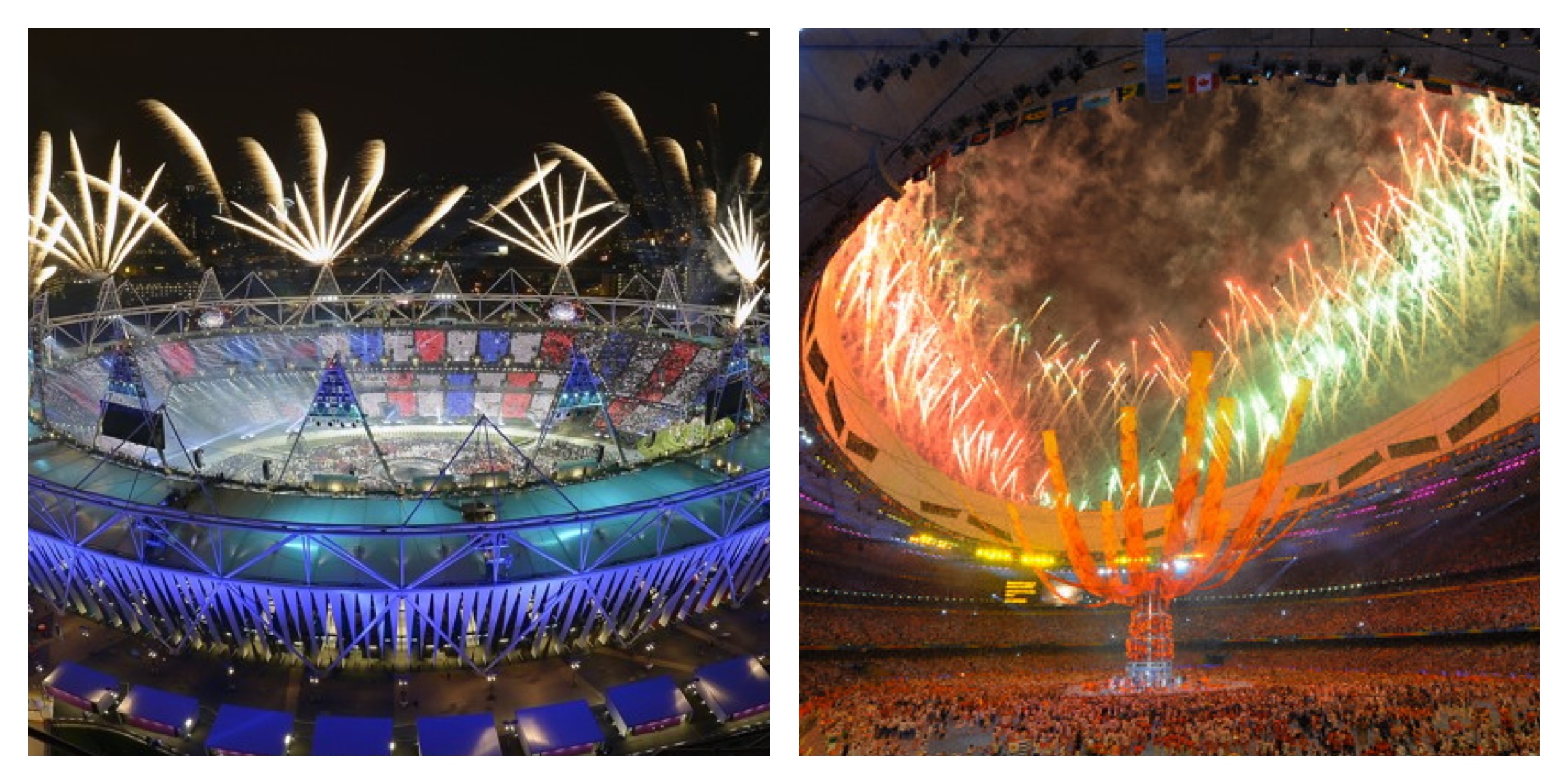
Something I have been thinking about recently is to what extent can a cultural spectacle be classed as theatre. Let me elaborate.  I have a student, Eliza, who has chosen to write a theatre extended essay and her focus is the opening ceremonies of the Beijing and London Olympics, and how – in terms of form – they represent their respective cultures.

Diptic

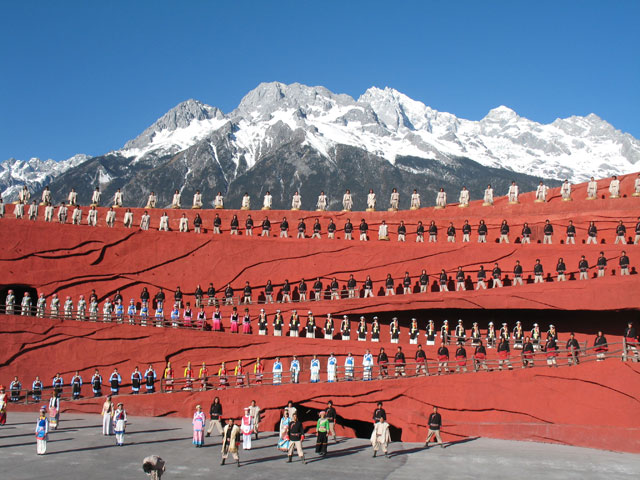
I then saw this image on a news website:

impression_lijiang_showThis is Impression Lijiang a cultural show demonstrating the traditions and lifestyles of the Naxi, Yi and Bai people of China’s Yunnan province. The show takes place inside Jade Dragon Snow Mountain Park at 3500m in an outdoor theatre specifically designed to showcase the mountain which is used as a backdrop. The production itself was designed by Zhang Yimou, famous Chinese film director and organizer of the opening ceremonies at the Beijing Olympics, with a cast of over 500 people, and a number of horses. Apparently, it is the highest altitude performance ever staged!

impression-lijiang21

However, the show does not have a plot. So is it theatre? The rave reviews on TripAdvisor would seem to say it is. A few years ago I saw The Edinburgh Military Tattoo – is that theatre? Is it World theatre, as it draws ‘performances’ from right across globe? What about Songkran in Thailand, Onam in Kerala, India or Thaipusam in Penang, Malaysia?

Of course Peter Brook famously says in The Empty Space:

I can take any empty space and call it a bare stage. A man walks across this empty space whilst someone else is watching him, and this is all that is needed for an act of theatre to be engaged

I don’t know the answer, but it has got me thinking. It’s also tied up with teaching Artaud and the Theatre of Cruelty and the place of ritual within that…….but that’s another post, for another day!

Just to add to the discussion I’ve tweeted an old blog post from Lyn Gardner on this debate…..great minds and all that!


‘We can solve our problems’

And thirdly, a blog post from Kevin EG Perry about villagers in Odisha state, India, who are writing and performing plays to explore problems ranging from hand-washing to local schools……

MDG India theatre.

.

.

.

.

.

.

The other side of theatre.

The play’s the thing for villages in India tackling real-life dramas

Sibaguda is a remote tribal village in southern Odisha state, in the east of India. There are just 49 households, and cows are frequently herded through the main square. The electricity supply has been disrupted by a broken transformer and the only road has fallen into disrepair. What Sibaguda does have, in common with many tribal villages, is a central meeting place where theatre is performed. Now, thanks to one particular performance, a school is being built here for the first time.

Amaresh Satapathy works for the Integrated Agency for Education, Environment and Technology (IAEET) in the nearby town of Koraput. Although his organisation works on everything from land rights to public health, Satapathy describes himself as a theatre activist. He first visited Sibaguda in 2007 as the leader of a Unicef-backed group performing street theatre to raise awareness of the importance of hand-washing.

They performed in tribal villages around the Koraput district, and locals said they had all learned important lessons from the plays. However, when they returned to the villages they found that the messages were quickly forgotten. “We asked people which part they remembered,” Satapathy says. “They talked about the entertainment, the tragedy and the comedy, but nobody remembered the message.”

Disillusioned, he began to reconsider the role that theatre could play. His group of actors from the main town moving from village to village may have brought entertainment, but they were doing little to empower villagers and were neglecting the area’s own rich tradition of folk theatre.

Satapathy decided to ask for Unicef’s support to initiate a participatory theatre programme, known as community-based theatre. “With CBT, we are doing something new with the community,” he says. “It is not just an ordinary development project.”

Rather than arriving with a paternalist message to preach, CBT invites villages to determine what their primary problem is, and then to write and perform a play that illustrates it. “The villagers are deciding what the problems are,” says Satapathy. “It is not about the problems of the NGOs. People are working for their own rights, in their own way.”

Satapathy no longer travels with a theatre group but arrives in the village with a small team who explain the concept and purpose of CBT over the course of a week. They encourage the villagers to draw on their own storytelling and theatrical traditions. “We don’t train them to act,” he says. “We ask them: ‘How do you sing, act or beat your drums?'” The team’s role is to spark the initial idea and then to help the villagers draw a powerful audience. The play can help villagers put their problems before local officials.

In Sibaguda, villagers decided their primary problem was education. Ramchandra Rana, 26, played a teacher in the performance. He says: “The children had trouble going to school. The nearest one is more than 2km from here, so we invited the block development officer and other local officials to our village to see the play. After the fifth or sixth time of asking, they came.”

Bali Dalpati, who gives his age as “more than 50”, played the father of the play’s central character, a young girl. He explains the plot they devised: “In our story, there was a family: a father, a mother and one daughter. Between the village and the next village there was a canal, and to get to school the children had to cross the canal. In the play, my daughter was going to school when a flood came and she had to be rescued. After that, we turned to the audience and the officials and asked, ‘Is this a good situation for our village?'”

Satapathy has found that inviting officials to villages has had far more success than traditional forms of petitioning local government. Of the 427 villages in IAEET’s catchment area, 50 have seen tangible results from CBT in terms of schools being built or better access to clean drinking water.

Dalpati is hugely positive about the impact. “We were so excited on the day of the performance,” he says. “The theatre has the power to change people’s minds. We always had theatre for entertainment, but now we see it as a road by which we can develop our village.” He gives a sobering account of a more typical interaction with local officials: “We used to have electricity here but the transformer broke down. When we asked the officials to fix it, they said, ‘Give us 5,000 rupees’. We said we would give them 5,000 rupees if they gave us a government receipt. They would not.”

There are drawbacks to letting the community define their development priorities. For example, the message about the importance of hand-washing is one that is unlikely to come from the villagers themselves. However, as a way of engaging and empowering communities, Satapathy believes there is much to be learned from his experience of placing power into the hands of the villagers.

“In our training process we are telling people two things,” he says. “The first thing we are saying is: you are a powerful person, you can change things. The second thing is: you are a skilled person at theatre. Community-based theatre gives people an opportunity to talk to each other and work together. It encourages the community that not only NGOs, the government or the literate, but we the people can solve our problems.”

Brooking The Trend

Secondly, an extract from Peter Brook’s new book, The Quality of Mercy: Reflections on Shakespeare, published in the The Guardian.

DEN INTERNATIONALE IBSEN-PRISENMore than any other ‘western’ theatre practitioner, Brook understands the connections between theatre traditions (ancient and modern) across the world – in all cultures – so I am intrigued that he has chosen to return to Shakespeare.

Mind you, at the age of 88, why shouldn’t he be reflecting on his achievements?

Peter Brook on A Midsummer Night’s Dream: a cook and a concept

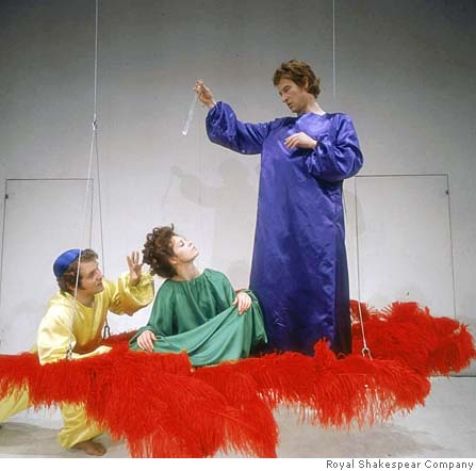
His 1970 RSC production of Shakespeare’s play featured circus trapezes, stilts and plate-spinning – and changed theatre history for good. In an extract from his new book, Peter Brook explains how this most seductive of Dreams came alive.

Once a computer was asked, “What is the truth?” It took a very long time before the reply came, “I will tell you a story …”

Today, this is the only way I can answer the question I’ve been asked so often: “Why don’t you write about A Midsummer Night’s Dream? You must have so much to say!”

So – I’ll tell you a story.

When I was 18 or 19, my one ambition was to make a film. By chance, I met the most eminent producer of the day, Sir Alexander Korda, a Hungarian of humble origins who had emigrated to make his fortune first in France, then in Britain, where he rose to power, was ennobled by the King and married a beautiful star, Merle Oberon, who for my father was “the perfect woman”.

I had just been on a trip to Seville during Holy Week, was thrilled by the multitude of mysterious impressions and imagined a story set in this extraordinary background.

“Sir Alexander,” I began, “I have an idea for a film – ”

He cut me off with an unforgettable phrase that contained in a few words the period in which it was uttered, the British class system and the snobbery of a newly enlisted member of the upper classes. With a light dismissal of the hand he said: “Even a cook can have an idea.”

This was virtually the end of the meeting. “Come back when you have developed your ‘idea’ enough to have a real story to offer me.”

Peter Brook's acrobatic 1970 production of A Midsummer Night's Dream.

It took many years to free his phrase from its period and context and to hear the deep truth it contained.

This brings me directly to A Midsummer Night’s Dream. It had never occurred to me to think of directing the Dream. I had seen many charming productions with pretty scenery and enthusiastic girls pretending to be fairies. Yet, when I was invited to do the play in Stratford, I discovered to my surprise that my answer was “Yes”. Somewhere in me there was an intuition that I had ignored.

Then, the first visit to Europe of the Peking Circus revealed that in the lightness and speed of anonymous bodies performing astonishing acrobatics without exhibitionism, it was pure spirit that appeared. This was a pointer to go beyond illustration to evocation, and I began to imagine a co-production with the Chinese. A year later, in New York, it was a ballet of Jerome Robbins that opened another door. A small group of dancers around a piano brought into fresh and magical life the same Chopin nocturnes that had always been inseparable from the trappings of tutus, painted trees and moonlight. In timeless clothes, they just danced. These pointers encouraged a burning hunch that, somewhere, an unexpected form was waiting to be discovered.

I talked this over with Trevor Nunn, director of the Royal Shakespeare Theatre, who said for this season he had created a young company who could in no time learn anything that was needed. It seemed too good to be true, especially as the Chinese Circus acrobats started their training at the age of five.

So we began with only the conviction that if we worked long, hard and joyfully on all the aspects of the play, a form would gradually appear. We started preparing the ground to give this form a chance. Within each day we improvised the characters and the story, practised acrobatics and then passing from the body to the mind, discussed and analysed the text line by line, with no idea of where this was leading us. There was no chaos, only a firm guide, the sense of an unknown form calling us to continue.

royal-shakespeare

Through freedom and joy, Alan Howard as Oberon not only found very quickly that he could master the art of spinning a plate on a pointed stick but that he could do so on a trapeze without losing any of the fine nuances of his exceptionally sensitive verse-speaking. His Puck, John Kane, did the same, while mastering walking on stilts. In another register, a very talented and tragically short-lived young actor, Glynne Edwards, discovered that all the accepted ideas of Thisbe’s lament over Pyramus’s death being a moment of pure farce were covering a true depth of feeling. This suddenly turned the usually preposterous attempts at acting of the “mechanicals” in the palace into something true and even moving. The situation was reversed and the smart and superior sniggering of the cultivated spectators well deserved the Duke’s rebuke:

For never anything can be amiss
When simpleness and duty tender it.

Then, for the first time, we used a practice that we can no longer do without. In the middle of rehearsals, we invited a group of kids into our rehearsal room; then later we asked an ad-hoc crowd in a Birmingham social club, so as to test what we were doing. Immediately, strengths and lamentable weakness were pitilessly exposed. We saw the trap of rehearsal jokes – everything that made the company fall about with laughter fell flat. It was clear that some embryonic forms could be developed and others discarded, although in the process nothing was lost. One thing can always lead to another. On French level crossings there is an apt warning: “One train can conceal another.” This can have a hopeful reading: “Behind a bad idea a good one can be waiting to appear.”

Gradually, the jigsaw began to fit, yet the very first preview was a disaster. My old friend Peter Hall took me by the arm and expressed his regret at the bad flop that was on its way. But at this point in the process a shock was needed. What to do? Peter Hall’s close collaborator John Barton said, “The problem is at the start. The way you begin doesn’t prepare us for the unexpected approach that follows. As it is now, we just can’t get into it.” Thanks to John, we found a way of starting the play literally with a bang. With an explosion of percussion from the composer Richard Peaslee, the whole cast literally burst onto the stage, climbed up the ladders and swarmed across the top level of the set with such joy and energy that they swept the audience along with them. After this, they could do no wrong. The presence of the audience in a week of previews and a high-pressured re-examination of every detail allowed at last the latent form to appear. Then, like the well-cooked meal, there was nothing to fiddle with, just to taste and enjoy. Often, after an opening, one has to go on working day after day, never satisfied, but this time we could recognise it. Miraculously it had fallen into place.
628x471

When the production had played across the world, there were many proposals to film it. I always refused because the essence of designer Sally Jacobs’s imagery was a white box. The invisible, the forest, even the darkness of night were evoked by the imagination in the nothingness that had no statement to make and needed no illustration. Unfortunately, the cinema of the day depended entirely on celluloid, and after the first screenings more and more scratches would appear. In any event, photography is essentially naturalistic and a film based only on whiteness, least of all a soiled and blotchy one, was unthinkable. Of course, a play can be filmed, but not literally. I’ve attempted this many times, and always a new form had to be found to correspond with a new medium. It can never be a literal recording of what the audience in the theatre once saw. Here I felt that nothing could reflect the zest and invention of the whole group. This truly was a live event.

Then the production was invited to Japan. Everyone was eager to go. As the costs were so high, could I agree to it being tele-recorded in performance so that it could be shown all over Japan and so contribute to their expenses? If we all agreed, they promised the recording would be destroyed in the presence of the British Consul. I discussed this with the cast, who had all been with me in refusing filming. This time it seemed impossible for us to say “No”.

A few weeks later, I received a bulky parcel from Japan. It contained a set of large discs. “This,” wrote one of the producers, “is a copy of the recording. We feel that you should have it.”

I found a player and discovered to my amazement that it looked very good. I sent a cable to Japan, telling them not to destroy the master. At once a telegram returned. “This morning, in the presence of the British Consul, as you requested, the recording and the negative have been burned.”

Only later did I realise that this was a valuable reminder to stay with my own convictions. The life of a play begins and ends in the moment of performance. This is where author, actors and directors express all they have to say. If the event has a future, this can only lie in the memories of those who were present and who retained a trace in their hearts. This is the only place for our Dream. No form nor interpretation is for ever. A form has to become fixed for a short time, then it has to go. As the world changes, there will and must be new and totally unpredictable Dreams.

Today, more than ever, I am left with a respect for the formless hunch which was our guide, and it has left me with a profound suspicion of the now much-used word “concept”. Of course, even a cook has a concept, but it becomes real during the cooking, and a meal is not made to last.

250px-BrookDreamUnfortunately, in the visual arts, “concept” now replaces all the qualities of hard-earned skills of execution and development. In their place, ideas are developed as ideas, as theoretical statements that lead to equally intellectual statements and discussions in their place. The loss is not in words but in the draining away of what only comes from direct experience, which can challenge the mind and feeling by the quality it brings.

A used carpet placed over a mass of old, used shoes won international prizes. It was considered enough to express the tragedy of emigrations, of displaced people and their long march. This made an admirable piece of political correctness, but its impact was negligible when compared with Goya, Picasso or many shockingly intense photographs. A single lightbulb going on and off won an important award because it expressed all of life and death. In fact, it only expressed the “idea” of life and death. These have been prize-winning concepts, but would not Alexander Korda rightly have said, “Come back when you have put your idea into a powerful form”?

job_0320

A form exists on every visible and invisible level. Through the quality of its development, then in the way its meaning is transformed. It is an understandable difficulty for actors, directors and designers facing a play of Shakespeare not to ask, “What should we do with it?” So much has been done already and so often filmed, recorded or described that it is hard not to begin by searching for something striking and new. A young director’s future may depend on the impact he or she makes. It is hard to have to play characters like Rosencrantz and Guildenstern without looking desperately for an idea. This is the trap opening under the feet of every director. Any scene in Shakespeare can be vulgarised almost out of recognition with the wish to have a modern concept. This easily leads to spicing the words by having a drunk say them into a mobile phone or else peppering the text with obscene expletives. This is no exaggeration. I saw the videotape of an actor trying vainly to find a new way of saying “To be or not to be”. As a last resort, one evening he set out to see whether alcohol might not be the answer. So he set up a camera, put a bottle of whisky on a table beside him, also a clock, and at planned intervals during the night recorded himself doing the soliloquy again and again as he gradually poured the contents of the bottle down his throat. The result needs no comment. Fortunately, there is another way. Always, an ever-finer form is waiting to be found through patient and sensitive trial and error. Directors are asked, “What is your concept?” The critics write about “a new concept” as though this label could cover the process. A concept is the result and comes at the end. Every form is possible if it is discovered by probing deeper and deeper into the story, into the words and into the human beings that we call the characters. If the concept is imposed in advance by a dominating mind, it closes all the doors.

We can all have an idea, but what can give the dish its substance and its taste?

No Strings Attached

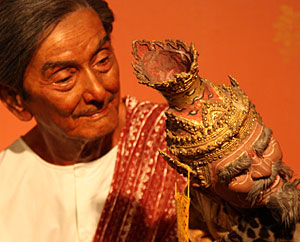
If you are looking to see a performance of traditional Thai puppetry then look no further than the ‘Joe Louis’ Puppet Theatre in Bangkok  It’s a remarkable story for an art form that had virtually died out in Thailand and is testimony to the efforts of the late Sakorn Yangkhieosod (nicknamed Joe Louis) who revived the ancient art and whose legacy can be seen at the Traditional Thai Puppet Theatre in Bangkok.

images

The theatre officially opened in 2002, but was renamed in 2004 by HM the King’s oldest sister, HRH Princess Galyani Vadhana. The new title was ‘Nattayasala Hun Lakorn Lek (Joe Louis)’ known in English as ‘The Traditional Thai Puppet Theatre’. Although the history of the theatre itself is recent, the roots of the story behind it go back to the early 1900s.

Traditional Thai Puppets

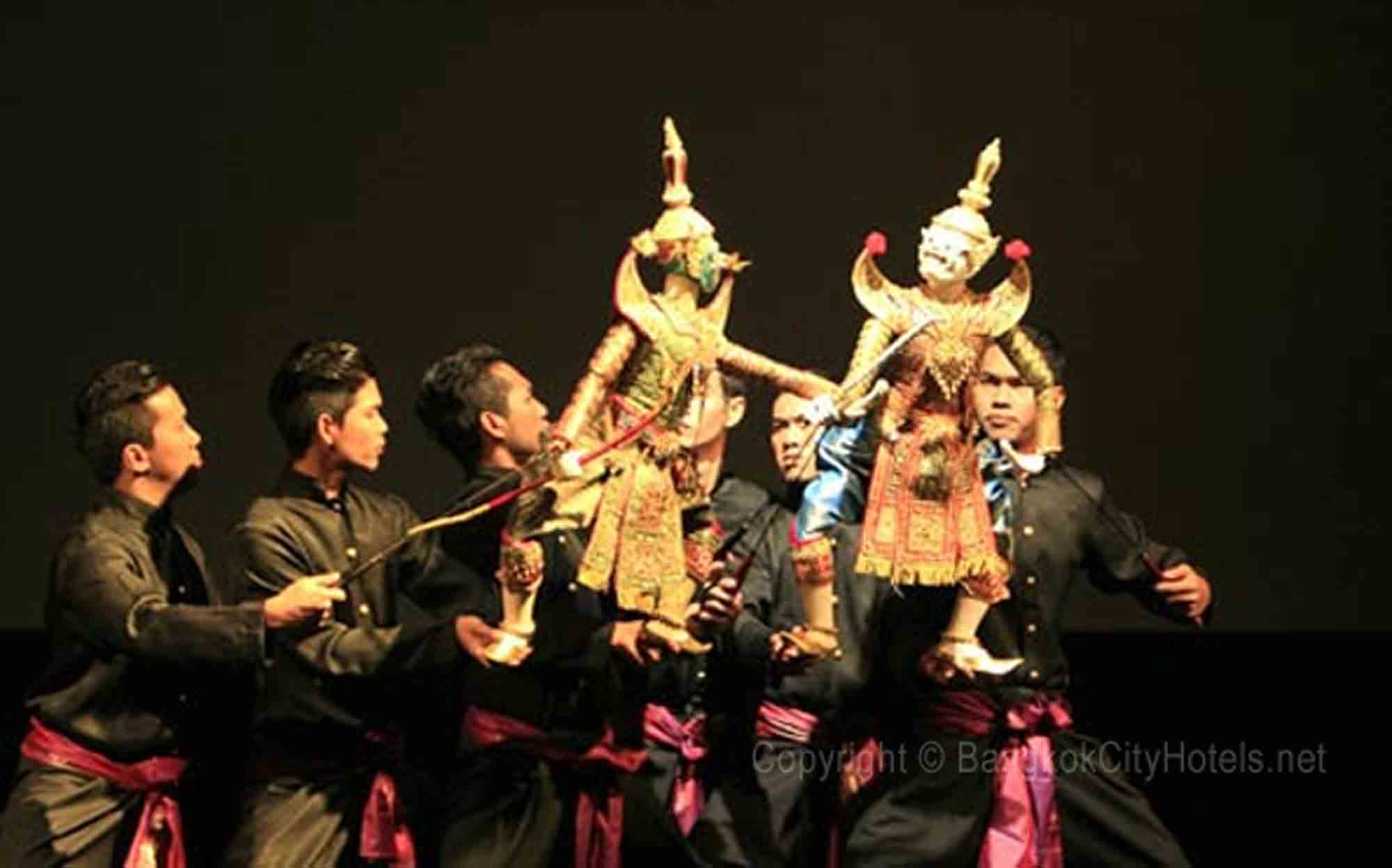
The puppets are up to 1.5 metres tall with numerous joints that enable them to be controlled by sticks. The skilled work of the puppeteer brings the characters to life. Sakorn (Joe Louis) himself once said, ‘Hun lakhon lek puppets are charming because they can act like humans. They can nod, wave their hands, and point their fingers. They dance like we can. It is the heart of the performance that the puppeteers bring life to the puppets.’

In Thai puppetry, each puppet requires the synchronised efforts of three puppeteers all of whom appear on stage with the puppet and all of whom are accomplished Thai classical dancers in their own right.

joe-louis

There are three main types of traditional Thai theatrical performances:

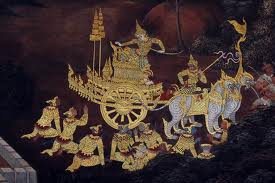
Khon is the most sophisticated of the performances with carefully choreographed movements and elaborate costumes. Khon usually features episodes from the Indian epic Ramayana (known in Thai as Ramakian) which details the story of a battle between vice and virtue and which features Hanuman, the great monkey warrior.

Lakhon is derived from khon but is used to recount a greater range of stories performing all the other classics of Thai drama.

Likay is also derived from khon, but compared to khon and lakhon, likay is the least sophisticated of the trio. The performances are based on common dramas and the action tends to be light-hearted with romance, comedy and singing all adding to the story.

Sakorn Yangkhieosod

puppet-3Born in 1922 to parents who were both puppeteers in a travelling troupe, Sakorn Yangkhieosod was a sickly child and spent part of his childhood in the care of monks where he was renamed ‘Lhiew’ meaning ‘Willow’. The later nickname of Joe Louis came about in the late 1930’s when the legendary boxer Joe Louis became heavyweight boxing champion of the world. Lhiew, who was already used to his name being pronounced ‘Lui’ suddenly found friends calling him ‘Joe Lui’ which in turn became ‘Joe Louis’.

The young Sakorn grew up to be a talented khon dancer and lakhon and likay performer. Being brought up in an environment where puppets were common, it was probably inevitable that he would also go on to become a master puppeteer. However, the Second World War and subsequent modernization were to have an impact on the traditional theatre in Thailand. The introduction of motion pictures and then television hastened the decline in traditional art forms which were viewed as old-fashioned. With the decline in public interest, the traditional Thai puppets were placed into storage and some were even destroyed. Sakorn made a living making khon masks although he found there was little demand for them too.

In the 1980’s it seemed that the old tradition would die out with Sakorn being the last known living exponent of traditional Thai puppetry. Apparently driven by nostalgia, Sakorn decided to make one more traditional puppet. When the puppet was finished, his 9 children were fascinated and became keen to learn how to make the puppets and how to manipulate them. Gradually, more puppets were made and in 1985, Sakorn and his family gave their first performance of ‘hun lakorn lek’ (traditional Thai small puppets). More performances were held over the years at local fairs and temples and the Joe Louis troupe became known throughout Thailand. In 1996, the King of Thailand granted Sakorn the title of National Artist in recognition of his work. The prestige of this honour enabled the necessary funding to establish the original puppet theatre near Sakorn’s home in Nonthaburi, but the theatre’s small size and quiet location meant that it did not attract many visitors.

photo

Sadly, a fire at Sakorn’s home in 1999 resulted in his house being destroyed along with all but one of his 50 puppets. It was a cruel blow for an old man who must have wondered whether it was worth carrying on with the traditional art form. With the help of family and friends and donations from the public, the Joe Louis troupe were able to re-establish themselves and in 2002 a new theatre was opened which proved to be hugely popular with local people and tourists and the Joe Louis troupe have regularly performed in front of Thai royalty.

Sakorn ‘Joe Louis’ Yangkhieosod died on May 21st 2007. His legacy is the Joe Louis Puppet Theatre now run by his family and which remains the sole guardian of traditional Thai puppetry. Take a look at the website – it is quite fascinating.

Hanging by a Thread

For my 100th post I want to return to the work and life of a company dear to me and who I have blogged about on a number of occasions. Here are extracts from  an article in the UK newspaper, The Guardian, written by Matt Trueman

Belarus Free Theatre will present a new piece – their first in English – that challenges the use of capital punishment around the world this summer. Trash Cuisine will argue that state-sanctioned capital punishment breeds a wider culture of violence. It will blend verbatim testimony with music, dance and sections from Shakespeare’s tragedies.

Capture

“We want to look at whether a state’s use of capital punishment sets an example to its citizens and legitimises other forms of violence,” the company’s co-artistic director Natalia Kaliada told the Guardian. “If we talk about capital punishment, is it only the state or can it involve one person or a group taking other people’s lives?”

Belarus is the last European country to employ the death penalty, and was urged last year to abandon the policy by the EU and Human Rights Watch in the wake of two high-profile executions. Vladislav Kovalyov and Dmitry Konovalov, both 26, were put to death last March after being convicted of a bomb attack that took place less than a year before. Kovalyov’s mother has since travelled around the world, maintaining her son’s innocence.

“In Belarus, when people are executed, their bodies are not given back to their families, so they never get the chance to bury their relatives,” Kaliada continued.

Trash Cuisine will also feature testimonials drawn from some of the other 94 countries worldwide where the death penalty remains in use, including Thailand and Malaysia. Interviewees include executioners, human rights lawyers, inmates and their families. “For us, it’s always important that we talk to people personally,” Kaliada explained.

Minsk, 2011: A Reply to Kathy Acker by Belarus Free Theatre

 .

.

.

.

.

.

.

She added: “When we were in Malaysia, some journalists asked: ‘Why are you here? Isn’t it enough for you to have your own troubles?’ We go to those places where others don’t get enough attention. We absolutely understand what it means not to be heard and we need to find those areas of the world that are hidden, where people’s stories do not get a chance to be heard.”

Belarus Free Theatre is banned from performing in its home country and, in the past three months, its underground performances in Minsk have been subject to five police raids.

Today, according to Kaliada, it operates as a “two-headed beast”, maintaining operations in Minsk while performing around the world.

In Too Deep?

In the interests of balance, I thought I would share an article today written by Alice Jones in The Independent in which she argues against the value and experience of immersive theatre. I don’t agree, however………..

Is theatre becoming too immersive?

Alice Jones has been put on the spot by actors time and again – and she’s sick of it


I had been in New York for less than 24 hours when my sister abandoned me in a warehouse. “I’ve got to find the naked rave,” she whispered, eyes crazed behind a white beaked mask. And off she went. I didn’t see her again for three hours.

It would be nice to say that this kind of thing doesn’t happen very often but it does. These days, if you’re a keen theatre-goer, it’s almost unavoidable. That’s why we were in the warehouse – we were at the theatre. At Sleep No More, to be precise, Punchdrunk’s trippy take on Macbeth, which unfolds over five floors and across 100 rooms of a former lock-up/ nightclub on West 27th Street. Audience members are handed a carnival mask (to remove inhibitions) and shoved into the labyrinth where they are expected to poke around graveyards, bedrooms and apothecary shops, follow characters into darkened corners and spy on them as they enact ghostly banquets and sinister masques. My sister had already seen the show once, a fortnight earlier, when her friend had emerged at the end enthusing about a naked rave in a secret room. This time she was determined to find it for herself. Once again, she didn’t. Neither of us did.

theatre

I wasn’t in the least surprised. The truth is, I am awful at site-specific theatre, promenade theatre, immersive theatre, any kind of theatre, really, which doesn’t involve sitting in a seat and watching without moving or talking. It’s not for want of trying. Since Punchdrunk kicked off the trend for “Choose Your Own Adventure”-style plays with their brilliant Masque of the Red Death at Battersea Arts Centre in 2007, I have been to shows in every imaginable location, from beach huts to nightclubs, playgrounds to camper vans, and been cast in any number of roles. I’ve posed as the new girl at school, a hotel guest and have sat through countless faux job interviews. I’ve been illegally trafficked in the back of lorry and trapped in a basement brothel. I’ve shivered around too many railway tunnels to mention imagining them to be a damp Denmark/Hitchcock movie/dystopia. I’ve even had a play about an Avon Lady staged in my own sitting room.

WOTW 1_905

And yet, I still lack flair. My latest flop came at dreamthinkspeak’s new show, In the Beginning Was the End, which takes place in the back corridors of Somerset House in London. Before the show, a solemn usher hands out a laminated sheet warning of low lighting, a lack of toilets, nudity and possible claustrophobia. They might have added SSA, or Site Specific Angst, that woozy, stomach-clenching feeling you get when you embark on a show and have no idea what is going on, what your part in it is supposed to be, where you should put your coat and when it will end.

In fact, In the Beginning is one of the more guided experiences. There is a fairly clear route to follow and no secret rave (I don’t think). There is still, though, a fair amount of aimless wandering, of staring into empty rooms and gingerly opening cupboard doors in the vague hope there might be a performance lurking within. There is still the very real risk of watching an usher for ages in case he turns out to be a Main Character (he didn’t). Pace is another potential pitfall. “The average journey time takes approximately 70 minutes, but you may go at your own pace,” states the laminated sheet. And if you get round in 55 minutes? Does that make you a bad audience member?

It’s difficult to give yourself over to theatre when your over-riding emotion is anxiety. Anxiety that you’re not seeing the crucial key that will unlock the piece; that you’re looking too hard at something that means nothing; that you might have to get involved at any moment; or that you’re missing out on something more exciting happening in another room. Too many times I have left shows only to discover that the best bit was a secret room I never found or a whispered encounter in a hidden phone box to which I was never privy. The feeling is disappointment mingled, it has to be said, with relief.

SAM_1972

Theatre that busts boundaries can be thrilling. Dreamthinkspeak’s Cherry Orchard, set in a derelict department store, was a spine-shiveringly beautiful update. Roadkill which took Traverse audiences on a journey to a tenement alongside a trafficked girl was harrowing and powerful. An evening being chased around The Pleasance by zombies in The Institute was one of the most frightening Halloweens I’ve ever had. In these cases, being immersed enhanced the show.

Too often, though, the experience is disorientating and audiences are expected to work harder than the cast in order to grasp the play. Some may enjoy the challenge: in New York, I saw people trying to talk to mute characters and elbowing their way into dance routines. That’s the problem – audiences are far harder to direct than actors. Amateurs are unpredictable; they might go wild with solipsistic glee, thrusting themselves centre stage, or they might shrivel up with shyness.

I’m not a natural performer; some might say that’s why I’m a critic. Certainly if I had to review my own performance in these shows, I’d be a two-star at best. So I’ll keep trying, but in the meantime I’d rather leave it to the professionals to take me on a journey, preferably without me having to leave my seat.


World Theatre Day 2013

Today (depending where you are reading this) is the 51st World Theatre Day and in celebration of the event I thought I would share some news of a theatre tradition that is refusing to die out – one in fact that continues to thrive. As many of Asia’s traditional theatre forms are in decline or find themselves sustained in a modified form for the tourist market, Japanese Kabuki lives on.

nn20130319i1b-870x489

The curtain is about to go up at a new theatre dedicated to Japan’s centuries-old kabuki-za performing art, sited in a high-tech venue in a 29-storey Tokyo office building. The theatre in the upscale Ginza shopping district, which will open to the public at the start of next month, will let audiences use portable monitors to read subtitles to explain the sometimes difficult to understand art form.

nn20130319fyd-870x489

The service will be available only in Japanese at first. But theatre managers hope to include foreign language services, starting with English, over the coming months, a spokesman told visiting journalists Monday. Another feature is the pit below the stage, which is now 16.45 metre (54 feet) deep — nearly four times what it was. The pit allows for props, actors and scenery to emerge from the bowels of the building.

nn20130319fyc-870x489

Despite the high-tech fixes, the theatre retains many elements of the original interior as well as the facade, which evokes medieval Japanese castles and temples with its curved roofs and red paper lanterns. In the 400-year-old stylised performing art, all-male casts perform in extravagant costumes and mask-like facial makeup.

nn20130319fyb-870x489

The new four-storey playhouse, with an 1,800-seat capacity, is the fifth version of the theatre, whose history dates back to 1889. The previous building, erected in 1951 to replace one heavily damaged in World War II, was demolished in 2010 due to worries over its ability to withstand earthquakes.The theatre is now housed in a 143-metre (470 feet) skyscraper, the tallest building in the area.

nn20130319fya-870x489Jun Hong, in The Japan Times, has written a great little question and answer article:

Ginza stage set for Kabuki-za’s fifth coming

The venerable Kabuki-za theater in Tokyo’s Ginza district reopens April 2 after three years of renovations and the addition of a 29-floor attached office tower.

A key venue for kabuki and other performances since 1889, the theater will retain its original ornate Japanese facade.

Following are questions and answers regarding the history of Kabuki-za and the reworked theater:

How significant is Kabuki-za?

Along with Shinbashi Enbujo, also in the Ginza district, and Kyoto’s Minami-za, the theater is one of the main venues for the traditional performing art, which dates back to the Edo Period in the 17th century.

Kabuki-za mainly devoted itself to staging kabuki in the early 1990s, but has put on shows by other artists, including singer Masako Mori and the late Hibari Misora.

In 2005, kabuki was added to UNESCO’s list of intangible cultural heritage.

“The kabuki stage is equipped with several gadgets, such as revolving stages and trapdoors through which the actors can appear and disappear. Another specialty of . . . the stage is the ‘hanamichi’ (footbridge) that extends into the audience (area),” UNESCO explains on its website.

When was the original Kabuki-za built?

According to Shochiku Co., which runs the theater, it first opened in 1889 under the initiative of playwright and journalist Genichiro Fukuichi.

The theater underwent renovations in 1911 but burned to the ground 10 years later because of an electrical fault.

The 1923 Great Kanto Earthquake slowed its reconstruction until the redesigned venue was able to reopen for a third time in 1924. Bombing raids later destroyed the theater again in May 1945.

How have kabuki and Kabuki-za fared since the war?

Faubion Bowers, an expert on Japanese theater who spent time in Japan before the war, played an important role in preserving the art form.

He served as Gen. Douglas MacArthur’s interpreter during the Allied Occupation. Bowers’ obituary in The New York Times in 1999 said that while the Allied forces “sought to ban (kabuki) as a relic of feudal society,” Bowers, known as the dean of Western knowledge of kabuki, prevented any alteration of the original content and defended the tradition.

Others, however, point out that kabuki’s preservation had more to do with members of the Allied forces quickly becoming infatuated with the art. Shochiku is also known to have fought hard to avoid having the performances censored.

What happened after the war?

It took six years, but Kabuki-za, in its third makeover, reopened in 1951 and operated until April 2010, when it closed for the latest renovations, including a modern-day high-rise.

The latest remake was delayed a month by the March 2011 Great East Japan Earthquake, but shows will start again on April 2.

What will the new Kabuki-za look like?

Kabuki-za will inherit the Wafu-Momoyama style and its signature extravagant facade.

But Shochiku said it will adjust to present-day needs as well, including barrier-free access and more lavatories. It will also provide direct access to subway stations.

The theater will consist of three floors and have 1,808 seats. It was built to high quake-resistance standards and can serve as a temporary shelter during emergencies in the capital.

In its first month of its grand reopening, three works from classical kabuki repertory will be presented, including “Kanjincho,” a story set in the 12th century about warriors of the Minamoto clan trying to get past a roadblock and escape north.

How does the high-rise fit in?

The 29-floor Kabuki-za Tower is a typical office building but will have galleries for displaying items from the theater and providing historical data to visitors.

“We believe that organizing a great kabuki play is the most important aspect of our job,” Shochiku President Junichi Sakomoto said last year. “But it is also an extremely important mission for us to expand the fan base of kabuki and classic art,” he added.

Who designed the new Kabuki-za?

Architect Kengo Kuma was charged with designing the new venue and said he would ensure it remains distinct from other theaters.

“It would be boring if Kabuki-za ended up the same as every other concert hall,” he told The Japan Times in an interview in September 2010.

One unique characteristic will be the relatively small space between seats, Kuma said, explaining that the sense of a packed house is essential for Kabuki-za. Kuma, whose works include Tokyo’s Suntory Museum of Art and the Nezu Museum, has also designed jewelry.

What will the theater’s latest reopening mean to the industry?

Kabuki was hit hard when two of its biggest stars passed away in a short span recently.

Iconic actor Ichikawa Danjuro died of pneumonia in February and Nakamura Kanzaburo, another celebrity, passed away due to respiratory failure in December. Danjuro was scheduled to perform over the first months of the reopening.

The next generation of kabuki actors, including Danjuro’s son, Ichikawa Ebizo, will have a tough time filling the shoes of their predecessors when they take the stage later this year.

Another Japanese english language newspaper THE ASAHI SHIMBUN has produced a photo set of the interior of the new theatre which you can see here. A parade and ceremony was held yesterday to commemorate the opening which was reported in the same newspaper, entitled Drum beats signal start of new Kabukiza history and you can read it here and watch it here – quite amazing.

About 120 people, including 63 Kabuki actors, walked along a 400-meter stretch as spectators crowded the sidewalks of Chuo-dori. It marked the first-ever parade of Kabuki actors in the Ginza, whose history of hosting the Kabukiza dates back to 1889.

Spectators called out the stage names of their favorite actors as they walked in the middle of the street. Jostling crowds were seen looking down from building windows facing the street and waving at the Kabuki stars.

The Kabuki actors in the “Ginza Hanamichi” commemorative parade included Nakamura Tokizo, Nakamura Fukusuke, Ichikawa Somegoro, Onoe Kikunosuke, Ichikawa Ebizo, Nakamura Kankuro and Nakamura Shichinosuke.

To finish, I came across this fantastic site about all the Kabuki theatres in Japan that has loads of information and history about the form (and how to book tickets should you find yourself there) – Kabuki Web

Immersive theatre – touchingly relevant

I’m in the UK this week and its bloody freezing – literally 0°C outside – hence my blogging frenzy!

It is that time of year in education – exam madness and the drawing to the end for my senior students – when they have to reflect on all they have learned. What has stuck me in the last few weeks is the impact that particular theatre forms have had upon them. Listening to TPPPs by Tim, Clarissa and Jeff there were some central themes, one of them being the Theatre of Cruelty. Another student, Katie, when asked in a university interview who her favourite theatre practitioner was, said Artaud. All this raised a wry smile from me, because the work of Artaud is notoriously difficulty to teach (and learn). We have so little in terms of definitive thinking from him, save a random collection of essays and playlets, so that much of what he wanted theatre to be is supposition on our part.

Picture1

What was made me clear to me, however, was that the students found the theatre form to be  liberating, something that allowed them to explore the notion of what it is to be human, to challenge the audience and immerse them in an alternative theatrical experience.

So it when I read a review of the Adelaide Arts Festival by Etan Smallman in the Huffington Post  entitled Lap Dances, Groping and Public Marriage Down Under: The One-on-One Theatre Where You’re The Star of the Show it not surprisingly caught my attention and I got reading. Here are some extracts:

………Earlier in the week, I made up an audience-of-one for the strangest show in town as I sat bound and blindfolded while being wheeled around a dark basement – with strangers caressing and feeding me before a woman pushed me on to a bed and stretched out on top of me.

The first of a trilogy of interactive performances by Belgian theatre group Ontoerend Goed, The Smile off Your Face had been the subject of hushed chats across the city.

Blindfolded and at the mercy of the cast’s young performers, you have a nose rubbed against your face, marzipan wafted under your own nose and a carrot – and a man’s bearded face – thrust into your bound hands. My fingers were then tightly wrapped around a woman’s neck in advance of us engaging in a bizarre dance.

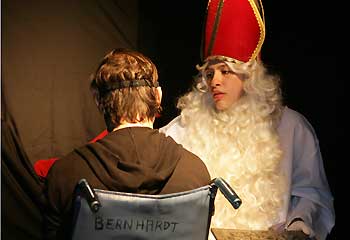
When the blindfold is eventually removed, you find yourself confronted with, depending on your judgment, a priest or Father Christmas – before meeting the man whose face you were forced to fondle.

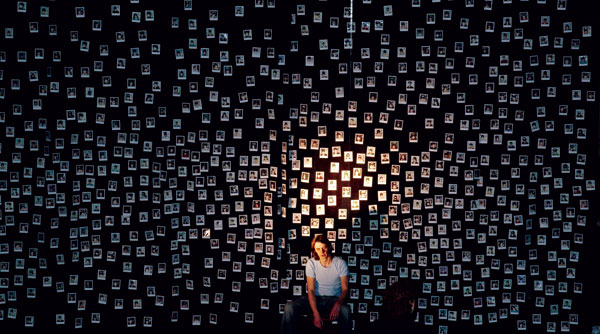
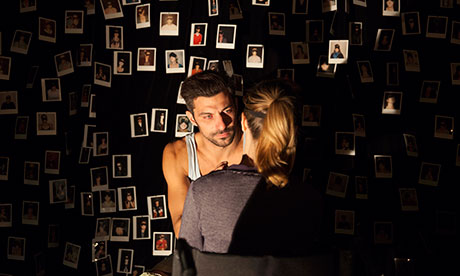
He then proceeds to show you a wall of Polaroid shots containing one of you grimacing. Finally, as you stare into each other’s eyes, tears begin spilling down his face while you’re slowly wheeled backwards out of the building.

The experience, which molested every one of my senses, left me buzzing and struggling to sleep. Meanwhile, it left author Kathy Lette – who was in front of me going into the show – worried she’d been “impregnated by a Belgian”.

What’s more, my experience lives on in the form of my Polaroid snap. Yes, the image of my strained face and bound hands will now be travelling across continents as this powerful performance art continues to tour the world.

Evernote Camera Roll 20130325 175058I knew I’d heard of Ontoerend Goed before so started digging and found what I was looking for, a rather dismissive review by Lynne Gardner:

The Smile Off Your Face is more therapy than theatre

I’ve always believed in the healing power of theatre – and this play, which won a Fringe First this morning, certainly feels like a one-to-one therapy session.

I’ve always believed in the power of theatre to heal. There have been times in my life when sitting in the dark, hearing stories being told, has been a life-saver. I’m often amazed at the way theatre provides just the right story that you need for succour at the exact moment you need it.

However, there is a difference between theatre and therapy. Really good theatre might indeed be therapy but it is first and foremost theatre. Theatre is often extremely good social work — and cheap at the price — but the social work is a by-product, or bonus if you like, of the art…..

…….The Smile Off Your Face is quite an experience. You are taken down a flight of stairs, put in a wheelchair, have your hands tied together and are blindfolded. In this helpless state, you are wheeled into a space where smells are wafted under your nose, lights shone in your eyes and your face tickled. Entirely in someone else’s power, you relinquish yourself to them – dancing when you are asked to dance, lying down on a bed when you are told to, and answering questions about yourself, some of them quite intimate. Somehow, it feels safe to speak. I was reminded of the confessional box of my Catholic childhood or how toddlers cover their faces and think nobody can see them.

Many people have come out crying, deeply affected. I’m not going to spoil the final revelation in case some of you get a chance to see it. But although it is a memorable 20 minutes, I’m not entirely convinced that it qualifies as theatre. Having seen King Lear once, you are unlikely to feel that you should never see King Lear again. Indeed, if you were a real glutton for punishment you could see King Lear 25 times and still get something different out of it every time. Likewise, a Complicite or Punchdrunk show. But once you’ve seen The Smile Off Your Face, there would be no point seeing it again because the element of surprise is destroyed. It’s like riding on the ghost train: the first time you’re spooked, but second time round you know to when to duck so that the dancing skeleton doesn’t whack you in the face.

Perhaps I’m being far too narrow in my definition of theatre, but what The Smile Off Your Face reminded me of most was a trip to the beauty salon for an aromatherapy session, where you are stroked and patted amid delicious smells, and lulled into a slightly hypnotic state where unexpected intimacies are exchanged. Its success is less to do with its power as a piece of theatre and more to do with the fact that the more ways we are offered to communicate in the modern world, the lonelier we feel. So perhaps the best way to look at The Smile Off Your Face is not as a 20-minute show but as 20 minutes of one-to-one therapy.

Evernote Camera Roll 20130325 175057

What I also remembered is that having had a few months to consider her experience at the hands of Ontoerend Goed, Gardner changed her mind and wrote:

Second thoughts about seeing shows twice

I imagined that The Smile Off Your Face was one of those experiences that would only work once, but it definitelystands up to a repeat viewing

Last year in Edinburgh I argued that the hit show The Smile Off Your Face wouldn’t bear a repeat viewing…….

I enjoyed the experience immensely in Edinburgh but wondered whether it was more akin to aromatherapy than theatre. I suggested that since the entire thing is predicated on a final unexpected revelation, it wouldn’t really stand up to a second viewing. Well, I was wrong. I saw the show again the other night……..and it very definitely does stand up. In fact because I knew what was happening, I was able to relax into it.

Detached woman of the world that I am, I’m not quite with those who come out crying or claiming that their lives have been changed forever by the experience. I find something ineffably sad about the way that it encourages intimacy and yet ultimately shows intimacy to be an illusion, but this is a genuinely beguiling piece of theatre and made me think how some of the techniques it utilises could be applied in other ways. It’s only on until tomorrow, but bag yourself a ticket. If you can’t get one, the look on people’s faces as they are wheeled out is a performance in itself.

Now for a woman with quite strident views on theatre in all its forms (and one who I generally respect) that was some turn-around. Take a look for yourself here in the video trailer for the show.

.

Now people have very polarized views on immersive theatre, theatre of cruelty – call it what you want – so it is up to you what you want to make of its relevance and value. I know what I think!

I’ll leave you here with an interview by Alex Needham with Ontoerend Goed’s co-founder Joeri Smet.

Ontroerend Goed: touch-sensitive theatre

The Belgian theatre company have been accused of betraying secrets, exploiting audiences – and not actually being theatre at all. Not guilty, says co-founder Joeri Smet

Belgian theatre company Ontroerend Goed (which roughly translates as “feel estate”) like to work a one-to-one basis. In The Smile off Your Face, actors wheel around a blindfolded audience member, then caress him or her on a bed. In Internal, a show which caused uproar in Edinburgh when it played there in 2009, an actor sits in a booth with a single theatregoer, seduces them into revealing their darkest secrets – then shockingly makes them public in a group session at the end.

In one of these booths, situated in a rehearsal room at Adelaide’s Dunstan Playhouse, sits Joeri Smet, one of Ontroerend Goed’s founders, just before Internal’s final performance at the Adelaide festival – after that, the company will embark on the third part of their immersive theatretrilogy, A Game Of You.

Having performed Internal in several countries, Smet believes British people take the transgression of public/private boundaries much more seriously than other nations. “I don’t want to make generalisations, but that causes a lot of unease for British people. It”s not like that on the continent and here in Australia people are OK with it much more – ‘Sure you can tell that about me’.”

Smet maintains that the company never explicitly divulge anything truly personal or painful, but couch it in general terms. “I will say that someone is making a very big step in their lives and it’s very frightening but also challenging – I wouldn’t reveal what the big step is.”

Joeri Smet in Trilogy: Internal

He denies that he is exploiting the audience’s vulnerabilities. “They always have the choice whether to engage or not.” No-one has ever walked out – “they stay to the end out of curiosity. It’s been said many times that you get as much out of the trilogy as you put in so I guess it’s a 50/50 thing.”

Ontroerend Goed’s exploration of how much audiences will take lead them into hot water at Edinburgh in 2011, when their show Audience – which isn’t showing in Adelaide – featured the one performer training a video camera onto a woman in the audience, and bullying her into opening her legs. Other audience members were furious – after that, they used a plant.

“I found it difficult that all the reviews focused so much on that one moment in the show because it’s about a lot more,” says Smet. “The ethical dimension of the show suddenly became the most important theme, which I found [to be] a reduction of the whole thing.” They toned it down “so people could actually see that the show isn’t about somebody being bullied in the audience.”

As for the woman they picked on, “we had contact with her and with the people surrounding her and in the end it was OK. From what I heard it was not herself who was really angry about it – it was more the people around her.”

Smet says that the controversy over his company’s shows is overblown. “There are some myths that surround the trilogy. People who have expectations of really extreme things happening might be disappointed. It’s all about getting in contact with each other in a respectful way. In The Smile off Your Face we’re exploring your physical trust, which is never damaged.”

The Guardian’s reviewer Claire Armitstead suggested that recent scandals about abuse and exploitation have made The Smile off Your Face seem much darker than when first performed in 2004. “I can see how people invest new meaning it but it’s not a deliberate thing,” says Smet. “The show is exactly the same as when it was developed.”

At its climax, the audience member’s blindfold is removed and an actor talks through their experience, finally bursting into tears. How many people have cried along with him?

“Many,” says Smet. “More women than men, but men also cry.”

Does that make him punch the air?

“I don’t go ‘Yes!’ – it’s great that people are so touched by it,” says Smet. “And I don’t always know why they cry. I can get that The Smile Off Your Face makes you cry – it probably would make me cry as well. It’s about being taken care of physically and being on that bed and having a very intimate conversation. I have to say that many people go and say ‘I haven’t been touched in this way physically, intimately, in so many years’ and sometimes I find it a bit sad to hear that. There are a lot of people who have a lack of intimacy in their lives.”

So is the trilogy theatre or therapy? “Maybe it’s not classical theatre but it is a theatrical performance with just a different approach to the audience – they’re in the show instead of watching it from outside,” says Smet. “It’s not therapy, but creative acts.”

The company’s next show will be called Fight Night, which Smet says will be more like Audience than the immersive trilogy. “It’s five actors and one presenter who try to stay on stage and people vote them off – but apart from that it’s also reflecting on democracy and the fairness of elections and the manipulations that go with that.”

Trilogy: The Smile Off Your Face

Meanwhile, A Game of You seems destined to keep Adelaide talking right until Sunday, the festival’s final day. Ontroerend Goed have been here before, but playing the fringe rather than the main festival. “I have the feeling that we have a lot more theatregoers her in the Festival Centre, says Smet. “I also feel that people are also a lot more understanding of the kind of show it is, the kind of performance it is. In the fringe it was like ‘this is a weird thing’ … in a positive way. Also we’re in a different building – with aircon. Last time it was pretty tough performing for 17 days in the heat.”

Hungry Hanuman

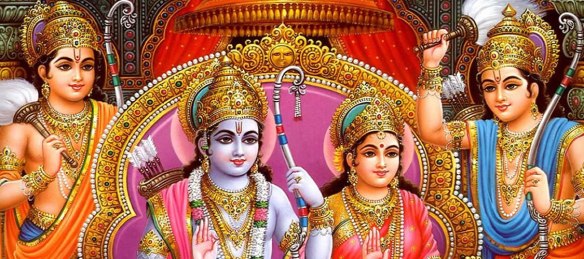
I have a number of students who have just begun their EE in Theatre Arts. One of them, Lois, wanted to write one that looked at Asian theatre styles. In the course of our discussions we alighted on the idea of how the same ancient stories and myths form the narratives of theatre from right across the continent, but are told in a variety of styles. As always, prompted by my students, this got me thinking about the value of these stories in a modern context.

Then I came across this article, a book review, in the Times of India about how artists are trying to make these ancient tales reflect and have meaning for the modern society in which they are now performed.

ramayana75

I reproduce it here for you in full.

New avatars of Ramayana reflect modern times

The Indian epic Ramayana is moving beyond convention to more profound retellings to reflect new realities.

Ruminate on this: Kumbhkaran, the giant sibling of the demon king Ravana in the epic had to grapple with excess sleep all his life. Sleep got into the way of his contribution to the battle between Lord Ram and Ravan, leading to his death.

Lakshman, the sibling of Lord Ram, battled sleeplessness – or rather the guilt attached to the act.

“My sleep, what does it mean.. That I sleep for 14 years or I get 14 years of sleep in one night? Is sleep the only way to find out,” muses an agonised Lakshman as he fends off sleep. Kumbhakaran, on the other hand, is bothered about his sleep cycle that he monitors on his wrist watch.

Lakshman and Kumbhakaran debate and spar over the implications of “this sleep” in a contemporary anecdotal re-telling of a slice from Ramayana in “Nidravatwam” – a 50-minute solo performance by playwright and director Nimmy Raphel.

Puducherry-based Raphel, who was in the capital recently for the Bharat Rang Mahotsav, the annual theatre festival of the National School of Drama, used a combination of traditional Indian Mohiniyattam, Kuchipudi, traditional martial dances and contemporary body dance to narrate her interpretation of Ramayana – a transposition of the ideas associated with sleep into the realm of contemporary absurd projected against the realities of fickle sleep cycles.

Lakshman becomes a symbol of modern-day sleep abuser- caught in the throes of time, multi-tasking and deadlines.

images

Sleep also becomes a device of self-introspection to search for deeper truths about existence.

Kumbhakaran is the sloth who struggles with his psyche to keep the killing inertia away, but succumbs to sleeping over.

Both are connected by boons that dramatically alter their cycles of sleep and wakefulness. While Lakshman bequeaths his 14-year sleep to his wife, Kumbhakarn is allowed six-hours sleep.

The act has conflicting redemption for both – while it kills Ravana’s brother, who begs Lakshman to take away some of his sleep, for the latter, the lack of it brings uncertainty.

Raphael, who has studied dance at Kalamandalam in Kerala, describes her act as a “dialogue between Kumbhakaran and Lakshma on the battlefield”.

The monkey god Hanuman had taken pride in the fact that he had a better version of Ramayana than Valmiki and had even asked the seer to take it, says playwright-dancer and director Suresh Kaliyath.

ramayana

A native of Kerala, Kaliyath, who is trained in the folk performing tradition of Ottanthullal, Kuchipudi and Parichamuttukali from Kerala Kalamandalam, has scripted a linear and impressionistic version of “Hanuman Ramayana” – the tale retold from Hanuman’s point of view.

The play opens with Hanuman’s hunger and his “fetish for food”.

“It is an attempt to expose the raw power of ritual and improvisation and link modern audiences with ideas in the centuries-old epic, Ramayana, where human complexities are involved in narration,” Kaliyath said.

“Human is worshipped as a symbol of strength, perseverance and devotion – and in my play he talks about the different hungers in life. I have tried to refer to the tradition of Muslim wedding feast in the northern Kerala and link it to Valmiki’s interpretation of the tale,” Kaliyath said.

Hanuman’s needs are different. “Hanuman has the freedom to speak of his carnal requirement of food,” he added.

A project, “A Modern Presentation of Ramayana: Dance in Three Parts and Comments” by Anita Ratnam, uses a short story by N.S. Madhavan, “Domestic Violence and Neurosurgeon”, to compare it with the Ahlaya episode where she turns into stone because of a curse and is redeemed by Ram.

“We are conducting a three-year Ramayana Project through which we are trying to open the epic to performers for interpretation,” Veenapani Chawla, director of the Puducherry-based Adishakti Laboratory for Theatre Arts Research, said.

ramayana_6_web

.

.

.

.

.

.

.

.

“We have used different experiences and performance genres to interpret the Ramayana. We had invited scholars like Ashish Nandy and Romila Thapar to speak at our seminars on Ramayana – and explore the various shades of perceptions,” Chawla added.

The Ramayana Project, supported by the Ford Foundation, is trying to rescue the epic from purism by giving it new voices – by members of different cultural groups including Dalits, tribals, Christians and even Muslims, who address social issues through the tome and try to draw parallels between modern society and that of the past, according to Chawla.

“The project was inspired by L. Rajappan, a Sangeet Natak Akademi award winning leather puppeteer who spent the last five years of his life at Adishakti,” Chawla said.

Every year since 2009, Adishakti has been hosting Ramayana festivals that present interpretations of the epic in a wide range of genres – using traditional and modern idioms from literature and folklore.

images (1)

The Ramayana has been interpreted in numerous ways over the years. In southern India there are at least seven versions in Sanskrit derived from the ancient scriptures, nearly 20 versions in regional languages and at least 10 Asian avatars.

The epics have been tweaked to cater to local sensitivities in many of the versions.

Paula Richman, in her book “Many Ramayanas: The Diversity of Narrative Traditions in South Asia”, explores the different retellings of Ramayana – the story of Lord Ram, his wife Sita and Ravan – from the different communal and socio-cultural perspectives of India.