Paper Mates

A while ago I wrote about the work of Davy and Kristin McGuire in a post called Paper Cuts. Their latest work The Paper Architect is a play combining paper-craft, animation, projection mapping and performance. It tells the story of an old model-maker who uses his paper creations as vessels for his imagination. It is just beautiful and so clever – take a look at the trailer:

.

One reviewer called it a piece that speaks to our imagination and challenges our notions what theatre can be. Indeed it does. But in and of itself, it is a simply (and I don’t mean that in a pejorative sense) a modern, technological shadow theatre which has of course been with us for hundreds, if not thousands, of years.

The McGuire’s work, not surprisingly, has a growing reputation internationally, as this rather amusing video shows

.

It’s All Greek

One of things that constantly fascinates when I am exploring the digital world for Theatre Room is the sheer variety of sources out there, and moreover, how they are being added to at an incredible rate.

The resource I’m sharing today is wonderful. A study of greek theatre in performance, hosted by Google on their Cultural Institute. It’s chock full of interviews, video, images and so on and is a delight to navigate your way through.

Untitled_FotormmmClick on the image above to take you to there. Hopefully there will be much more to come like this little gem.

Untitled_Fotorp

That Is The Question

An article in the New York Times caught my attention a couple of days ago, Maximum Shakespeare, To Renovate or Not to Renovate. Written by Charles Isherwood, a very well-known american theatre critic, it deals with the hoary old question about whether modern productions of Shakespearian plays should be contemporized. With a slew of The Bard’s plays to open on and off Broadway in the near future, Isherwood and other NYT writers will be

regularly posting commentaries on aspects of them, engaging larger questions about how today’s theater artists approach these canonical works, and inviting you to add your opinions about how vitally Shakespeare continues to speak to modern audiences. (Opera, ballet and movies will come up as well.)

If you read the article below and then follow the link above, you can see the discussion has already begun. I shall be following with interest.

Orlando Bloom in Romeo and Juliet on Broadway

Orlando Bloom in Romeo and Juliet on Broadway

Wherefore art thou riding a motorcycle, Romeo?

So might audiences muse at the start of the new Broadway staging of “Romeo and Juliet,” the first in the season’s plentiful Shakespeare productions, both on Broadway and off.

As the shows open in the coming months, fellow New York Times writers and I will be regularly posting commentaries on aspects of them, engaging larger questions about how today’s theater artists approach these canonical works, and inviting you to add your opinions about how vitally Shakespeare continues to speak to modern audiences. (Opera, ballet and movies will come up as well.)

David Leveaux’s “Romeo and Juliet,” which opened on Sept. 19 at the Richard Rodgers Theater, announces its point of view in the show’s opening moments, as Romeo removes his helmet (odd, that, for a swooning romantic; Mercutio, one suspects, wouldn’t bother) and reveals himself in the comely person of Orlando Bloom, clad in ripped jeans, T-shirt and hoodie, plus the kind of assorted man-jewelry you can scoop up by the handful at Urban Outfitters.

DISCUSS: Is Shakespeare better with contemporary imagery, or clad in classical garb?

The question I opened with — why make Romeo a facsimile of an urban hipster? — points directly toward an issue that I suspect will percolate throughout the season, namely whether in producing Shakespeare today the most effective approach revolves around cloaking the text in contemporary imagery, or hewing to a more “classical” line, dressing the actors in what passes for traditional Elizabethan costume.

With its set dominated by a giant Renaissance-style fresco scrawled with graffiti, the new Broadway production didn’t strike me as an ideal test case for the here-and-now approach. The costuming and visual effects meant to reorient this tragic love story as an urgent bulletin from today’s world felt pretty generic, as did his somewhat half-hearted gesture toward infusing the play with an element of racial tension. (The Capulets are all played by black actors, while the Montagues are white.)

But it is easy to understand the impulse, particularly with this play. “Romeo and Juliet” is the ur-drama of young love, and it is often the first Shakespeare play kids read in high school. Young audiences alienated, or at least challenged, by the arcane language of the play may be encouraged to stop texting and give it a more attentive hearing when the drama comes packaged in imagery to which they can relate.

Baz Luhrmann proved the efficacy of this approach in his fiercely imaginative movie version from 1996, with a pre-megastardom Leonardo DiCaprio and a pre-“Homeland” Claire Danes playing the doomed lovers in a Southern California riven by gun violence.

It was a palpable hit, so to speak, and deservedly so. And of course one of the most popular iterations of the story is the beloved musical “West Side Story,” which dispensed with Shakespeare’s language but kept the fundamental architecture of the plot.

Denzel Washington, far right, in the 2005 Broadway production of Julius Caesar.

Denzel Washington, far right, in the 2005 Broadway production of Julius Caesar.

But there are many grumblers out there, I suspect, who have had their fill of Shakespeare productions that try to shoehorn contemporary relevance into the plays by dressing the conspirators in “Julius Caesar,” say, in business suits, or “Macbeth” in 20th-century military attire.

In fact these days I’d argue that the default Shakespeare style — at least for the major tragedies, and many of the comedies and romances, too — is contemporary. (With the history plays that concentrate in detail on specific periods in the progression of the British royal line, there isn’t always as much innovation.)

What may get lost in the debate is the fact that dressing Shakespeare in off-the-rack duds is nothing new; in fact what’s comparatively newer is the tradition of presenting the plays in Elizabethan or Jacobean attire. As no less an acting authority than Alec Guinness once pointed out, in a 1953 program for the Stratford Shakespeare Festival, the plays were traditionally performed in attire drawn from the era in which they were produced until in the 19th century manager-actors such as Charles Kean and William Macready introduced a vogue for historical accuracy in Shakespeare.

Some scholars cite the innovative productions of Barry Jackson in the 1920s at the Birmingham Repertory Theater as marking a true inflection point in bringing modern dress into Shakespeare production. His 1923 production of “Cymbeline” was a game-changing landmark for British Shakespeare staging. Coincidentally — or perhaps not — the company was home to some of the greatest British actors of the 20th century, from Laurence Olivier and Ralph Richardson to Edith Evans and Peggy Ashcroft.

The great director Peter Brook was hired to stage three productions there at the age of 20. In America, meanwhile, Orson Welles is often lauded as the radical innovator who yanked Shakespeare out of the realm of fusty classicism, with his famous “voodoo” “Macbeth” and his Fascist-styled “Julius Caesar.”

Rory Kinnear and Adrian Lester in the National Theatre's production of Othello in London

Rory Kinnear and Adrian Lester in the National Theatre’s production of Othello in London

Many years of Shakespeare-watching have left me agnostic on the issue of “to update or not to update.” Nicholas Hytner’s riveting “Othello,” which I saw at the National Theater last summer (and which will be broadcast in movie theaters beginning Sept. 26), was a superb case in point. Without altering the text, in setting the play in a 21st-century war zone the production made cogent and disturbing points about the way, in a largely male-dominated military environment, women can become the object of repressed or warped violent impulses. (Emilia, here, was a soldier too.)

A scene from the 2006 production of King Lear at the Goodman Theater in Chicago.

A scene from the 2006 production of King Lear at the Goodman Theater in Chicago.

And perhaps the best overall production of “King Lear” I’ve seen was Robert Falls’s aggressively violent production for the Goodman Theater several years ago, in which Lear’s kingdom was represented as a failing, vaguely Balkan state, illuminating the way in which a power void automatically unleashes violence, which only begets more violence.

But I could just as easily cite any number of bland, unrewarding attempts to dress Shakespeare up in modern garb and gimmicky attempts at relevance, which I suspect some directors impose upon their productions because they (and their actors) are less at ease with the language than they ought to be. The hope is that novelty (although it rarely qualifies as novelty anymore) will prove a distraction from mediocrity.

Fundamentally, a great Shakespeare production will rise or fall not on what the actors are wearing, and whether they are barking into cell phones or slinging swords at each other, but on whether they can infuse these magnificent, challenging texts with the life blood of honest feeling and formal beauty

Are the most memorable Shakespeare productions you’ve seen modern or “classical”? Do you find it jarring when Hamlet picks up an iPad? What did you make of Mr. Leveaux’s “Romeo and Juliet”?

Complicité Genius

Published yesterday, today’s share is a joy. Perhaps one of the most famous theatre companies with a global reputation of the last 30 years is Complicité.

The Company’s inimitable style of visual and devised theatre [has] an emphasis on strong, corporeal, poetic and surrealist image supporting text

Stephen Knapper, Contemporary European Theatre Directors.

[The main principles of our work is ] seeing what is most alive, integrating text, music, image and action to create surprising, disruptive theatre

Complicité

Complicité at 30: Simon McBurney (founder and artistic director) and Judith Dimant (producer) in conversation

.

If you have never seen any of their work, here is a great taster

And a few more words of theatrical wisdom from McBurney

.

Theatre on a Tear Drop

I’m conscious that Reading Room hasn’t been living up to the Asia bit of its name of late , so I am putting that right today. Those of you that read me regularly will know that one country I hold dear for many reasons is India, and as a result I know quite a lot about its theatrical life. Not so for its south-eastern neighbour, Sri Lanka, though.  So I have been collecting a few bits and pieces that I want to share today.

09Apr07_125_FotorSri Lanka has been through years of bloodshed and struggle between the Tamil minority and the Sinhalese majority. It’s not surprising therefore that during this time the arts have struggled and many traditions have been hidden. One of the best sources of information I have found is the Active Theatre Movement which has as a goal, building a rich theatre culture for the nation development. The site isn’t very well maintained but there are some real gems on there. One that really interested me is Drama and Theatre Arts among the Tamils of Sri Lanka and is well worth a read, putting theatre in terms of the conflict and the traditions of the Tamil people. Also, much of the writing out there focuses on Sinhalese theatre traditions so this is a good, balancing source.

In common with a lot of asian theatre traditions, Sri Lanka’s is largely dance based underpinned by ancient ritual. Perhaps the one that is best known, is the Kandyan Dance – Uda Rata Natum – that originates from the ancient royal capital, Kandy. According to the legend, the origins of the dance lies in an exorcism ritual. However, today, the genre is considered the classical dance of Sri Lanka. You can read more here.

.

Another, less formal dance genre, again from an exorcism ritual, is the Salu Paliya or the Shawl Dance. This is a comic dance featuring the spirit Salu Paliya wearing a white shawl. Salu brings the blessings of the goddess Pattini to the patient. The appearance of this spirit in the healing ritual known as the Tovil has a specific significance – although demonic in appearance, Salu acts as a clown and uplifts the spirits of the patient and takes away his fear.

.

09Apr07_391_Fotor

The other notable feature of Sri Lankan theatre tradition is the use of mask, and again this goes back centuries and is rooted in folklore.

More about masks in the articles listed below, especially The Yakun Natima – devil dance ritual of Sri Lanka

..

On of the best sources I have found is the Sri Lanka Virtual Library.  I have taken a number of articles from there, in pdf form:

Ritual Dancing in rural Sri Lanka09Apr07_316_Fotor

Mystery of the masks

Dance and music of the Sinhalese

Dances of Sri Lanka

Drums of Sri Lanka

Kolam, Sakari and Nadagan Theater in Sri Lanka

The Yakun Natima – devil dance ritual of Sri Lanka

Classical Dances of Sri Lanka

Did Sinhala Drama Originate in Christmas

..

.

We Are Strong

I have written here, on a number of occasions, about Belarus Free Theatre, a company whose founders were forced to seek political asylum in the UK in 2011. This was after being targeted by the government in their home country, Belarus, for standing up against its repressive and dictatorial regime.

The audience inside the 'house-theatre' listening a reading from a student of Belarus Free Theatre, taken in 2009 by photographer Alessandro Vincenzi. The audience was contacted by the company in a private and secret way the day before or the same day of the performance in Minsk, Belarus.

The audience inside the ‘house-theatre’ listening to a reading from a student of BTF, taken in 2009 by photographer Alessandro Vincenzi. The audience was contacted by the company in a private and secret way the day before, or the same day of, the performances in Minsk, Belarus.

In fact, the very first two posts on Reading Room Asia were about the company (Belarus Free Theatre Part 1 and Part 2). To quote their own website, BFT is now a two-headed beast with a new part of the company in London, and a permanent ensemble left behind in Minsk who perform and tour around the world as Belarus Free Theatre.

Natalia Kaliada

Natalia Kaliada

Natalia Kaliada, one of the company’s co-founders, has become a significant voice, not only about the human rights violations that are taking place in her own country and around the globe, but about the power of theatre to challenge such atrocities.

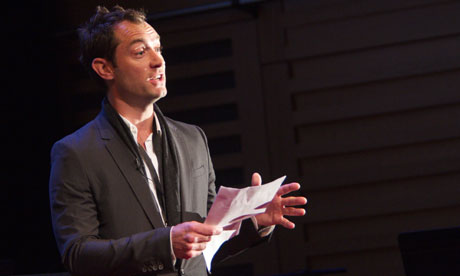
Jude Law

Jude Law

Since fleeing to London, she has used the new-found freedoms to rally support and has been joined by a whole host of influential people from both the theatre world and beyond. One of BFTs most high-profile supporters is the actor Jude Law, who has said when you talk about artistic freedom you are talking about freedom of speech and all our fundamental freedoms….it could not be more central to how we live. And these freedoms that we often take for granted are celebrated……by the struggle of the Free Theatre……These are freedoms which define us.

BFT now has a home in London with, and as an associate of, the Young Vic Theatre.  The company, together with the Young Vic have just released a short film, called Connection, with Law in the cast, which you can watch here.  It is a metaphor for BFTs own search to find a new home. Kaliada has written about this journey in an article for The Guardian:

Losing a home is always sudden, always a shock and always a tragedy.

An aircraft that can’t find an airport for landing, a doe searching in vain for a watering place in the desert or a man who has lost his memory in the middle of the metropolis – an endless stream of literary cliches could not reflect one hundredth of the horror and confusion that you feel after being left far from home without friends and family, without comfort and security.

We lost our home in Belarus involuntarily, without imagining that it could happen to us. The presidential elections in Belarus in 2010 resulted in thousands of arrests, long-term jail sentences, and hundreds of socially-active people fleeing persecution just for demanding one thing: respect for their rights. That is how the creators of Belarus Free Theatre ended up in exile.

Regaining a home doesn’t start with a space to live in, it begins with people. It begins with someone suddenly appearing next to you and asking one very simple but very important question: “How can I help?”

bft-logo

The film Connection……is a metaphor for our story. It is about how we as members of the troupe bridged the psychological gap between two societies; how we attempted to accept the fact that we were persecuted in one and celebrated in another. Jude Law, who co-stars in the film, supported us even before we escaped from Belarus. He performed in a Belarus Free Theatre production at the Young Vic a month before the ill-fated presidential elections of 2010. The theatre welcomed us with open arms, and Belarus Free Theatre soon began to show its performances there. It is no accident that the Young Vic became our London home: it’s an open, freedom-loving theatre, that listens keenly to others, with an acute sensitivity to theatrical innovation and freedom of creative expression. Belarus Free Theatre continues to show its performances underground in Minsk, but London is our second home, the place where our performances can be shown on some of the very best stages.

Jude was one of the first people to ask “How can I help?” and soon his voice was joined by Tom Stoppard, Irina Bogdanova, David Lan, Michael Attenborough, Kevin Spacey, Albina Kovaleva, Alison Stanley, Sigrid Rousing, James Bierman, Sam West, Laura Wade, Alexandra Wood, Joe Corré, Olga Proctor, Dominic Dromgoole, Joanna Lumley – first dozens then hundreds of people, famous and not so famous, influential and not so influential, wealthy and not so wealthy. Every single one of these people asked that crucial question and helped to create the foundation from which we began to build a new home.

Be assured, we are not complaining about our fate, nor are we looking for sympathy. We are strong. We want to work, to tell stories, to build and develop creative projects. Connection is not only a metaphor for regaining a new home, but a sign of communication between people coming together with the desire to create and collaborate; strengthening each other’s voice.

Incredible strength! If you want to get an idea of what it was like for BFT before being forced to flee, take a look at this work here by Alessandro Vincenzi, an italian photographer who charted their work and lives.

Now! Not Then

There are not many people who have had a greater global impact on theatre-making in the last 100 years, than Bertolt Brecht. I don’t imagine there is a theatre student anywhere who has at least not heard of him, studied him briefly. I am a great believer in his theatre practice. However, his plays tend to leave me, well, a tad bored. There are a couple I really like, The Resistible Rise of Arturo Ui and Fear and Misery of the Third Reich, for example, but the rest often feel a little dry.  Now of course this is often due to the way they are staged but I can never help feeling that his longer works would benefit from significant trimming   And this is the dichotomy with Brecht – Brecht, the theatre practitioner and Brecht, the playwright – in contemporary theatre. His practice continues to be fundamental to a whole host of theatre making, but his plays in performance, are far less common than they used to be.

.

This really comes as no surprise, when theatres are trying to find ways of competing with a fast-moving, attention-shrinking, digital world. So it was with some joy that I read Michael Billington’s article in The Guardian:

Bertolt Brecht: irresistible force or forgotten chapter in theatrical history?

Brecht’s belief that drama should present moral ideas through action is unfashionable, but as theatre becomes ever more narcissistic, audiences are seeking him out again

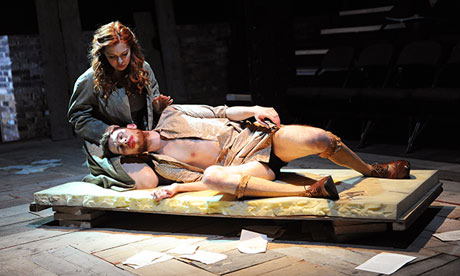
In the Jungle of Cities

In the Jungle of Cities

It’s that man again: Bertolt Brecht. His early play, In the Jungle of Cities,is being revived at London’s Arcola, and later this month he’s back in the West End, as Jonathan Church’s Chichester production of The Resistible Rise of Arturo Ui moves to the Duchess. It’s a production that won lots of praise when first seen last year, not least for the comic demonism of Henry Goodman’s performance as the eponymous Chicago racketeer who provides a metaphor for Adolf Hitler. But, for all its dazzling energy, I suspect the production will raise all the old arguments about Brecht’s standing today. Is he still an irresistible force or simply a chapter in theatrical history whose reputation has declined with the collapse of eastern European communism?

In weighing up the pros and cons, one has to start with a basic fact: as both a practising dramatist and visionary theorist, Brecht changed the face of modern theatre. Just to take Britain alone, I’d argue that the historic visit by Brecht’s Berliner Ensemble to London in 1956 [The link is to a review from the time] did more than any other single event – even than the premiere of Waiting for Godot a year earlier – to shake us out of our rooted complacency. The spare Brechtian aesthetic had a profound influence on the newly founded English Stage Company at the Royal Court, and the realisation of what a permanent company could achieve shaped the creation of the Royal Shakespeare Company in 1960 and the National theatre in 1963.

Directors, designers and dramatists were all influenced by Brecht’s idea of an epic theatre in which narrative replaces plot, the spectator is turned into an observer rather than someone implicated in the stage action, and each scene exists for itself alone. Above all, Brecht’s belief that drama should present moral and political ideas through action left its stamp on a huge range of plays, from Serjeant Musgrave’s Dance by John Arden, Luther by John Osborne and Saved by Edward Bond in the 1950s and 60s, through to Fanshen by David Hare and Destiny by David Edgar in the 1970s. As David Edgar once said: “Brecht is part of the air we breathe.”

Lest you think I exaggerate Brecht’s influence, I turned up a catalogue to an exhibition, Bertolt Brecht in Britain, mounted at the National Theatre in 1977. Among other things, it includes a checklist of annual productions. In 1972 you find 15 professional Brecht productions in the UK ranging from Arturo Ui in Belfast and Bradford to Mother Courage and Her Children in Watford and Canterbury, and a West End revival of The Threepenny Opera with a cast that included Vanessa Redgrave andBarbara Windsor. There were 77 amateur productions including a staggering 36 – many staged by students – of The Caucasian Chalk Circle. For good measure, BBC Television also presented Arturo Ui starring the formidable Nicol Williamson.

.

All this is unimaginable today. Few regional theatres have the financial resources, even if they had the will, to mount a Brecht play. The right-wing thought police would, I suspect, quickly be on the case if any school put on a Brecht show. And there is about as much likelihood of BBC doing a prestigious Brecht television production as there is of it presenting a play by Sophocles, Shaw, Ibsen, Chekhov or any of the great classic dramatists. Even in academia Brecht is much less central than he used to be: a friend told me that a supposedly comprehensive undergraduate theatre course devotes roughly two hours a year to him.

Yet, even if Brecht is out of fashion, his legacy is all around us. Stephen Unwin, in his excellent A Guide to the Plays of Bertolt Brecht, points to one key example in the growth of documentary drama. The kind of work staged at London’s Tricycle theatre under Nicolas Kent, starting with Half the Picture in 1993 and taking us up to Gillian Slovo’s examination of theLondon riots in 2011, fulfilled many of Brecht’s theatrical criteria. This was work that, in Brecht’s definition of epic theatre, offered the spectator a picture of the world, forced him or her to take decisions. It appealed to reason rather than feeling. Even the performance style made it clear that actors were representing, rather than identifying with, particular characters.

I also sense the Brechtian influence at work in some of the big plays on public themes that have emerged in recent years. They may eschew the Brechtian visual approach, but they engage with the issues of our times in ways he would have understood. In Enron (2009), Lucy Prebble traced the fall of the Texan energy giant to show how capitalism depends on con-tricks and illusions. In 13 (2011), which many critics myopically repudiated, Mike Bartlett argued that popular protest was now a bigger force for change than entrenched political parties. And in the 2013 play Chimerica, Lucy Kirkwood boldly invites us to compare and contrast China and America: it is a work that genuinely activates thought in that its apparent conclusion that America tolerates dissent while China punishes it is brought into question by the cases of Bradley Manning and Edward Snowden.

Brecht may be out of fashion in the self-regarding world of immersive and site-specific theatre, where everything depends on the minor shocks and sensations felt by the individual spectator: however good such shows may be, you generally come out of one by Punchdrunk or Shunt wanting to change your clothes instead of the world. But Brecth’s legacy is still too pervasive and potent for him ever to be entirely invisible.

We are also learning how to do him without the pedagogic reverence that for years put people off. Jonathan Church’s excellent Arturo Ui ushers us into a Chicago speakeasy where we listen to the seductive sounds of a jazz trio. And Roxana Silbert’s modern-dress Royal Shakespeare Company production of A Life of Galileo earlier this year used a text sensibly trimmed by Mark Ravenhill and seemed vitally connected to a world in which a liberally intentioned pope found himself trapped by institutional conservatism.

.

Brecht is too big a force to ignore…..But I’d like see our theatre go beyond revivals of Galileo, Mother Courage, The Caucasian Chalk Circle and The Good Person of Szechwan. I’d be fascinated to see St Joan of the Stockyards, with its Salvation Army heroine, Paul Dessau choruses and parodies of Goethe and Schiller. Brecht may not be as fashionable as he once was. But, in a theatre that tends towards narcissistic introspection, his ability to engage with the world and instruct delightfully seems to me more urgently important than ever.

It’s Not All Custard Pies

A bit of an unusual post from me today, courtesy of Smithsonian.com, written by Linda Rodriguez McRobbie. It deals with the history of the clown figure, from a range of cultures, which haunts many people’s nightmares and the psychology behind why – really good reading (if you aren’t scared by clowns!)

The History and Psychology of Clowns Being Scary

A terrifying clown walks in a Halloween parade in New York

A terrifying clown walks in a Halloween parade in New York

There’s a word— albeit one not recognized by the Oxford English Dictionary or any psychology manual— for the excessive fear of clowns: Coulrophobia.

Not a lot of people actually suffer from a debilitating phobia of clowns; a lot more people, however, just don’t like them. Do a Google search for “I hate clowns” and the first hit is ihateclowns.com, a forum for clown-haters that also offers vanity @ihateclowns.com emails. One “I Hate Clowns” Facebook page has just under 480,000 likes. Some circuses have held workshops to help visitors get over their fear of clowns by letting them watch performers transform into their clown persona. In Sarasota, Florida, in 2006, communal loathing for clowns took a criminal turn when dozens of fiberglass clown statues—part of a public art exhibition called “Clowning Around Town” and a nod to the city’s history as a winter haven for traveling circuses—were defaced, their limbs broken, heads lopped off, spray-painted; two were abducted and we can only guess at their sad fates.

Even the people who are supposed to like clowns—children—supposedly don’t. In 2008, a widely reported University of Sheffield, England, survey of 250 children between the ages of four and 16 found that most of the children disliked and even feared images of clowns. The BBC’s report on the study featured a child psychologist who broadly declared, “Very few children like clowns. They are unfamiliar and come from a different era. They don’t look funny, they just look odd.”

But most clowns aren’t trying to be odd. They’re trying to be silly and sweet, fun personified. So the question is, when did the clown, supposedly a jolly figure of innocuous, kid-friendly entertainment, become so weighed down by fear and sadness? When did clowns become so dark?

Maybe they always have been.

Clowns, as pranksters, jesters, jokers, harlequins, and mythologized tricksters have been around for ages. They appear in most cultures—Pygmy clowns made Egyptian pharaohs laugh in 2500 BCE; in ancient imperial China, a court clown called YuSze was, according to the lore, the only guy who could poke holes in Emperor Qin Shih Huang’s plan to paint the Great Wall of China; Hopi Native Americans had a tradition of clown-like characters who interrupted serious dance rituals with ludicrous antics. Ancient Rome’s clown was a stock fool called the stupidus; the court jesters of medieval Europe were a sanctioned way for people under the feudal thumb to laugh at the guys in charge; and well into the 18th and 19th century, the prevailing clown figure of Western Europe and Britain was the pantomime clown, who was a sort of bumbling buffoon.

But clowns have always had a dark side, says David Kiser, director of talent for Ringling Bros. and Barnum & Bailey Circus. After all, these were characters who reflected a funhouse mirror back on society; academics note that their comedy was often derived from their voracious appetites for food, sex, and drink, and their manic behavior. “So in one way, the clown has always been an impish spirit… as he’s kind of grown up, he’s always been about fun, but part of that fun has been a bit of mischief,” says Kiser.

“Mischief” is one thing; homicidal urges is certainly another. What’s changed about clowns is how that darkness is manifest, argued Andrew McConnell Stott, Dean of Undergraduate Education and an English professor at the University of Buffalo, SUNY.

Stott is the author of several articles on scary clowns and comedy, as well as The Pantomime Life of Joseph Grimaldi, a much-lauded 2009 biography of the famous comic pantomime player on the Regency London stage.

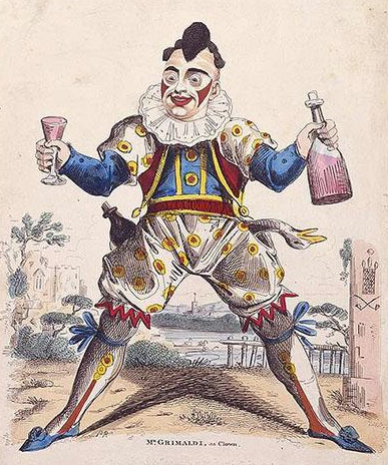
Grimaldi was the first recognizable ancestor of the modern clown, sort of the Homo erectus of clown evolution. He’s the reason why clowns are still sometimes called “Joeys”; though his clowning was of a theatrical and not circus tradition, Grimaldi is so identified with modern clowns that a church in east London has conducted a Sunday service in his honor every year since 1959, with congregants all dressed in full clown regalia.

In his day, he was hugely visible: It was claimed that a full eighth of London’s population had seen Grimaldi on stage. Grimaldi made the clown the leading character of the pantomime, changing the way he looked and acted. Before him, a clown may have worn make-up, but it was usually just a bit of rouge on the cheeks to heighten the sense of them being florid, funny drunks or rustic yokels. Grimaldi, however, suited up in bizarre, colorful costumes, stark white face paint punctuated by spots of bright red on his cheeks and topped with a blue mohawk. He was a master of physical comedy—he leapt in the air, stood on his head, fought himself in hilarious fisticuffs that had audiences rolling in the aisles—as well as of satire lampooning the absurd fashions of the day, comic impressions, and ribald songs.

A drawing of Joseph Grimaldi as his famous persona Clown Joey.

A drawing of Joseph Grimaldi as his famous persona Clown Joey.

But because Grimaldi was such a star, the character he’d invented became closely associated with him. And Grimaldi’s real life was anything but comedy—he’d grown up with a tyrant of a stage father; he was prone to bouts of depression; his first wife died during childbirth; his son was an alcoholic clown who’d drank himself to death by age 31; and Grimaldi’s physical gyrations, the leaps and tumbles and violent slapstick that had made him famous, left him in constant pain and prematurely disabled. As Grimaldi himself joked, “I am GRIM ALL DAY, but I make you laugh at night.” That Grimaldi could make a joke about it highlights how well known his tragic real life was to his audiences.

Enter the young Charles Dickens. After Grimaldi died penniless and an alcoholic in 1837 (the coroner’s verdict: “Died by the visitation of God”), Dickens was charged with editing Grimaldi’s memoirs. Dickens had already hit upon the dissipated, drunken clown theme in his 1836 The Pickwick Papers. In the serialized novel, he describes an off-duty clown—reportedly inspired by Grimaldi’s son—whose inebriation and ghastly, wasted body contrasted with his white face paint and clown costume. Unsurprisingly, Dickens’ version of Grimadli’s life was, well, Dickensian, and, Stott says, imposed a “strict economy”: For every laugh he wrought from his audiences, Grimaldi suffered commensurate pain.

Stott credits Dickens with watering the seeds in popular imagination of the scary clown—he’d even go so far as to say Dickens invented the scary clown—by creating a figure who is literally destroying himself to make his audiences laugh. What Dickens did was to make it difficult to look at a clown without wondering what was going on underneath the make-up: Says Stott, “It becomes impossible to disassociate the character from the actor.” That Dickens’s version of Grimaldi’s memoirs was massively popular meant that this perception, of something dark and troubled masked by humor, would stick.

Meanwhile, on the heels of Grimaldi’s fame in Britain, the major clown figure on the Continent was Jean-Gaspard Deburau’s Pierrot, a clown with white face paint punctuated by red lips and black eyebrows whose silent gesticulations delighted French audiences.

French artist Auguste Bouquet's rendition of Jean-Gaspard Deburau as Pierrot

French artist Auguste Bouquet’s rendition of Jean-Gaspard Deburau as Pierrot

Deburau was as well known on the streets of Paris as Grimaldi was in London, recognized even without his make-up. But where Grimaldi was tragic, Deburau was sinister: In 1836, Deburau killed a boy with a blow from his walking stick after the youth shouted insults at him on the street (he was ultimately acquitted of the murder). So the two biggest clowns of the early modern clowning era were troubled men underneath that face-paint.

After Grimaldi and Deburau’s heyday, pantomime and theatrical traditions changed; clowning largely left the theater for the relatively new arena of the circus. The circus got its start in the mid-1760s with British entrepreneur Philip Astley’s equestrian shows, exhibitions of “feats of horsemanship” in a circular arena. These trick riding shows soon began attracting other performers; along with the jugglers, trapeze artists, and acrobats, came clowns. By the mid-19th century, clowns had become a sort of “hybrid Grimaldian personality [that] fit in much more with the sort of general, overall less-nuanced style of clowning in the big top,” explains Stott.

Clowns were comic relief from the thrills and chills of the daring circus acts, an anarchic presence that complimented the precision of the acrobats or horse riders. At the same time, their humor necessarily became broader—the clowns had more space to fill, so their movements and actions needed to be more obvious. But clowning was still very much tinged with dark hilarity: French literary critic Edmond de Goncourt, writing in 1876, says, “[T]he clown’s art is now rather terrifying and full of anxiety and apprehension, their suicidal feats, their monstrous gesticulations and frenzied mimicry reminding one of the courtyard of a lunatic asylum.” Then there’s the 1892 Italian opera, Pagliacci (Clowns), in which the cuckolded main character, an actor of the Grimaldian clown mold, murders his cheating wife on stage during a performance. Clowns were unsettling—and a great source for drama.

England exported the circus and its clowns to America, where the genre blossomed; in late 19th century America, the circus went from a one-ring horse act to a three-ring extravaganza that travelled the country on the railways. Venues and humor changed, but images of troubled, sad, tragic clowns remained—Emmett Kelly, for example, was the most famous of the American “hobo” clowns, the sad-faced men with five o’clock shadows and tattered clothes who never smiled, but who were nonetheless hilarious.
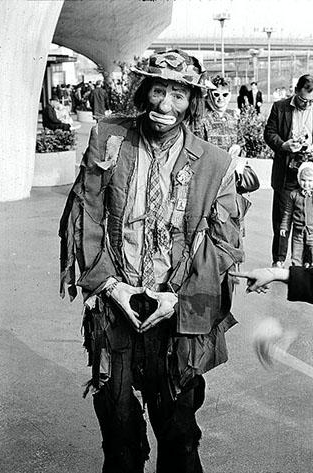
Emmett Kelly as "Weary Willy," the most famous example of the hobo-clown persona

Emmett Kelly as “Weary Willy,” the most famous example of the hobo-clown persona

Kelly’s “Weary Willie” was born of actual tragedy: The break-up of his marriage and America’s sinking financial situation in the 1930s.

Clowns had a sort of heyday in America with the television age and children’s entertainers like Clarabell the Clown, Howdy Doody’s silent partner, and Bozo the Clown. Bozo, by the mid-1960s, was the beloved host of a hugely popular, internationally syndicated children’s show – there was a 10-year wait for tickets to his show. In 1963, McDonald’s brought out Ronald McDonald, the Hamburger-Happy Clown, who’s been a brand ambassador ever since (although heavy is the head that wears the red wig – in 2011, health activists claimed that he, like Joe Camel did for smoking, was promoting an unhealthy lifestyle for children; McDonald’s didn’t ditch Ronald, but he has been seen playing a lot more soccer).

But this heyday also heralded a real change in what a clown was. Before the early 20th century, there was little expectation that clowns had to be an entirely unadulterated symbol of fun, frivolity, and happiness; pantomime clowns, for example, were characters who had more adult-oriented story lines. But clowns were now almost solely children’s entertainment. Once their made-up persona became more associated with children, and therefore an expectation of innocence, it made whatever the make-up might conceal all the more frightening—creating a tremendous mine for artists, filmmakers, writers and creators of popular culture to gleefully exploit to terrifying effect. Says Stott, “Where there is mystery, it’s supposed there must be evil, so we think, ‘What are you hiding?’”

Most clowns aren’t hiding anything, except maybe a bunch of fake flowers or a balloon animal. But again, just as in Grimaldi and Deburau’s day, it was what a real-life clown was concealing that tipped the public perception of clowns. Because this time, rather than a tragic or even troubled figure under the slap and motley, there was something much darker lurking.

Even as Bozo was cavorting on sets across America, a more sinister clown was plying his craft across the Midwest. John Wayne Gacy’s public face was a friendly, hard-working guy; he was also a registered clown who entertained at community events under the name Pogo. But between 1972 and 1978, he sexually assaulted and killed more than 35 young men in the Chicago area. “You know… clowns can get away with murder,” he told investigating officers, before his arrest.

Gacy didn’t get away with it—he was found guilty of 33 counts of murder and was executed in 1994. But he’d become identified as the “Killer Clown,” a handy sobriquet for newspaper reports that hinged on the unexpectedness of his killing. And bizarrely, Gacy seemed to revel in his clown persona: While in prison, he began painting; many of his paintings were of clowns, some self-portraits of him as Pogo. What was particularly terrifying was that Gacy, a man who’d already been convicted of a sexual assault on a teenage boy in 1968, was given access to children in his guise as an innocuous clown. This fueled America’s already growing fears of “stranger danger” and sexual predation on children, and made clowns a real object of suspicion.

After a real life killer clown shocked America, representations of clowns took a decidedly terrifying turn. Before, films like Cecil B. DeMille’s 1952 Oscar-winning The Greatest Show on Earth could toy with the notion of the clown with a tragic past—Jimmy Stewart played Buttons, a circus clown who never removed his make-up and who is later revealed to be a doctor on the lam after “mercy killing” his wife—but now, clowns were really scary.
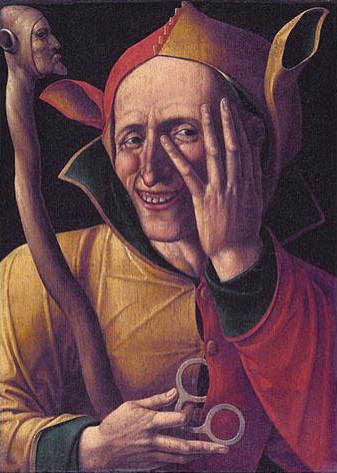
A predecessor of the modern clown, the medieval court jester exemplified the delicate blend of funny and horrifying

A predecessor of the modern clown, the medieval court jester exemplified the delicate blend of funny and horrifying

In 1982, Poltergeist relied on transforming familiar banality—the Californian suburb, a piece of fried chicken, the television—into real terror; but the big moment was when the little boy’s clown doll comes to life and tries to drag him under the bed. In 1986, Stephen King wrote It, in which a terrifying demon attacks children in the guise of Pennywise the Clown; in 1990, the book was made into a TV mini-series. In 1988, B-movie hit Killer Klowns from Outer Space featured alien clowns harboring sharp-toothed grins and murderous intentions. The next year saw Clownhouse, a cult horror film about escaped mental patients masquerading as circus clowns who terrorize a rural town. Between the late 1980s and now – when the Saw franchise’s mascot is a creepy clown-faced puppet — dozens of films featuring vicious clowns appeared in movie theatres (or, more often, went straight to video), making the clown as reliable a boogeyman as Freddy Kreuger.

Kiser, Ringling’s talent spotter and a former clown himself, acknowledged the damage that scary clown images have done to clowning, though he was inclined to downplay the effect. “It’s like, ‘Oh man, we’re going to have to work hard to overcome that one,’” he says.

But anecdotally at least, negative images of clowns are harming clowning as a profession. Though the Bureau of Labor Statistics doesn’t keep track of professional clowns specifically (they’re lumped in with comedians, magicians, and other miscellaneous performers), in the mid-2000s, articles began popping up in newspapers across the country lamenting the decline of attendees at clown conventions or at clowning workshop courses. Stott believes that the clown has been “evacuated as a figure of fun” (notably, Stott is personally uncomfortable with clowns and says he finds them “strange”); psychologists suggest that negative clown images are replacing positive clown images.

“You don’t really see clowns in those kinds of safe, fun contexts anymore. You see them in movies and they’re scary,” says Dr. Martin Antony, a professor of psychology at Ryerson University in Toronto and author of the Anti-Anxiety Work Book. “Kids are not exposed in that kind of safe fun context as much as they used to be and the images in the media, the negative images, are still there.”

That’s creating a vicious circle of clown fear: More scary images means diminished opportunities to create good associations with clowns, which creates more fear. More fear gives more credence to scary clown images, and more scary clown images end up in circulation. Of course, it’s difficult to say whether there has been a real rise in the number of people who have clown phobias since Gacy and It. A phobia is a fear or anxiety that inhibits a person’s life and clown fears rarely rate as phobias, psychologists say, because one simply isn’t confronted by clowns all that often. But clown fear is, Antony says, exacerbated by clowns’ representation in the media. “We also develop fears from what we read and see in the media… There’s certainly lots of examples of nasty clowns in movies that potentially puts feet on that kind of fear,” he says.

From a psychologist’s perspective, a fear of clowns often starts in childhood; there’s even an entry in the psychologists’ bible, the Diagnostic and Statistical Manual of Mental Disorders or DSM, for a fear of clowns, although it’s under the umbrella category of a pediatric phobia of costumed characters (sports mascots, Mickey Mouse). “It starts normally in children about the age of two, when they get anxiety about being around strangers, too. At that age, children’s minds are still developing, there’s a little bit of a blend and they’re not always able to separate fantasy from reality,” explains Dr. Brenda Wiederhold, a veteran psychologist who runs a phobia and anxiety treatment center in San Diego that uses virtual reality to treat clients.

Most people, she says, grow out of the fear, but not everyone—perhaps as much as 2 percent of the adult population will have a fear of clowns. Adult clown phobics are unsettled by the clown’s face-paint and the inability to read genuine emotion on a clown’s face, as well as the perception that clowns are able to engage in manic behavior, often without consequences.

But really, what a clown fear comes down to, what it’s always come down to, is the person under the make-up. Ringling’s Kiser agreed.

“I think we have all experienced wonderful clowns, but we’ve also all experienced clowns who in their youth or lack of training, they don’t realize it, but they go on the attack,” Kiser says, explaining that they can become too aggressive in trying to make someone laugh. “One of the things that we stress is that you have to know how to judge and respect people’s space.” Clowning, he says, is about communicating, not concealing; good clown make-up is reflective of the individual’s emotions, not a mask to hide behind—making them actually innocent and not scary.

Krusty_the_Clown_by_TheTitan99

But have bad, sad, troubled clowns done too much damage? There are two different, conflicting visions of the clown’s future.

Stott, for one, sees clowning continuing on its dark path. “I think we’ll find that the kind of dark carnival, scary clown will be the dominant mode, that that figure will continue to persist in many different ways,” he says, pointing to characters like Krusty the Clown on The Simpsons, who’s jaded but funny, or Heath Ledger’s version of The Joker in the Batman reboot, who is a terrifying force of unpredictable anarchy. “In many respects, it’s not an inversion of what we’re used to seeing, it’s just teasing out and amplifying those traits we’ve been seeing for a very long time.” Other writers have suggested that the scary clown as a dependable monster under the bed is almost “nostalgically fearful,” already bankrupted by overuse.

But there’s evidence that, despite the claims of the University of Sheffield study, kids actually do like clowns: Some studies have shown that real clowns have a beneficial affect on the health outcomes of sick children. The January 2013 issue of the Journal of Health Psychology published an Italian study that found that, in a randomized controlled trial, the presence of a therapy clown reduced pre-operative anxiety in children booked for minor surgery. Another Italian study, carried out in 2008 and published in the December 2011 issue of the Natural Medicine Journal found that children hospitalized for respiratory illnesses got better faster after playing with therapeutic clowns.

And Kiser, of course, doesn’t see clowning diminishing in the slightest. But good clowns are always in shortage, and it’s good clowns who keep the art alive. “If the clown is truly a warm and sympathetic and funny heart, inside of a person who is working hard to let that clown out… I think those battles [with clown fears] are so winnable,” he says. “It’s not about attacking, it’s about loving. It’s about approaching from a place of loving and joy and that when you really look at it, you see, that’s it really genuine, it’s not fake.”

.

Building the House

In another life I think I would have loved to have been a theatre designer. They are artists, architects, engineers and magicians all rolled into one. We sometimes forget they are there, that the set is another actor in the space. In the next few days the World Stage Design conference opens in Cardiff, Wales.

WSD_Fotor

WSD is described as a celebration of international performance design from the world of theatre, opera and dance as well as public performances and installations in non theatre spaces that takes place every 4 years. WSD started life in 2005 in Toronto, Canada. In 2009 it was held in Seoul, South Korea. While reading about it, I also learned about OISTAT, the International Organisation of Scenographers, Theatre Architects and Technicians a global network of theatre makers celebrating design and technology in live performance. The websites for both these organisations make interesting perusing.

I would really like to be at WSD, I think it would be a fascinating and exciting few days. However, I did raise a rye smile when I saw they were building a temporary, sustainable theatre for the conference, known as The Willow Theatre, lauding it as something new:

.

Now I know that I have seen them being built for many years and in an even more sustainable way:

.

The location for WSD2017 is yet to be decided, but perhaps they should start thinking about calling in the traditional bamboo theatre builders in instead? Mind you, one of the designers behind the The Willow is Chinese-american architect Tim Lai so perhaps it is just a modern take on a centuries old craft.

Power To The People?

6a00d83451688869e20120a72085e1970b-800wiA quick post from me today, a longer one coming tomorrow. You need to read my previous post, Worlds Apart, to make sense of this one. It is fascinating to read Lyn Gardner’s take on The Tragedy of Coriolanus by Beijing People’s Art theatre given what Lin Zhaohua has to say about his direction and why he does Shakespeare in China. A real East versus West cultural conundrum, I think. The review was published in The Guardian this week.

Beijing People’s Art Theatre go for bombast, but slack pacing and an underused chorus leave it more mediocre than menacing

It sure is big, and – with no less than two Chinese rock bands on stage – it’s full of sound and fury, but while Beijing People’s Art Theatre pump up the volume on Shakespeare’s tragedy of power and violence, the result is oddly muted. With its themes of arrogance, leadership, a discontented mob and democracy, this should be a fascinating choice of play for a company hailing from a country where there is no political opposition, human rights are regularly abused and protest is frequently stamped out.

But this production remains mysteriously opaque, offering empty spectacle in the place of nuanced political comment and metaphor. Unlike the Shakespeare that came out of Romania and Poland during their communist eras, it seems determined to offer no comment upon the society that spawned it. Maybe it says something about the contempt in which the mass of the people are held by the country’s political leadership that the mob here have a desultory feel, wandering around looking vaguely hippyish, waving their arms unconvincingly and muttering the Chinese equivalent of “rhubarb, rhubarb”. They are so under-energised that they are never a real threat to anyone, except perhaps to their own health and safety in getting on and off the stage without tripping over each other.

The slackness of the crowd scenes is reflected in a production which was first performed in 2007 – and which often looks in need of a jolly good dust-down. Even the aesthetic is inconsistent, at times pared down and stripped back, and at others including cumbersome sofas and carts. Like a great deal in this production, the ladders at the back of the stage are there for effect only, and serve no purpose.

It’s not all mediocre flashiness. Pu Cunxin’s arrogant Coriolanus enters with a rock-star assurance and has a rumbling power, like a capped volcano. The scenes between him and his mother (Li Zhen) have genuine power and tension, particularly in their final encounter, which seals Coriolanus’s fate. But overall an evening which is epic, but not in a good way.


Other critics took different views and raised interesting questions.  You can read them here, here and here.