The Faces Of A Master

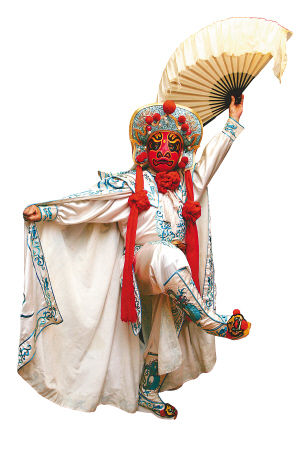
Bianlian_FotorIn my school we are in the process of writing a new curriculum for our younger students and one of my roles has been to gather together materials for an online course to compliment and enrich the taught classroom practice. This week I have been working on a Mask unit and it suddenly struck me that there was one particular practice involving mask that would be perfect for that course and one that I have not explored here on Theatre Room. 

Biàn Liǎn (变脸) or Face Changing has a long and traditional history in China, first appearing in Sichuan Opera during the Quing Dynasty, almost 300 years ago. Opera in China, it needs to be understood, takes many forms, depending on where it originated. Here in Hong Kong we have Cantonese Opera, as I have written about many times before. However, Sichuan Opera is a little different to most traditional forms. It tends to be more ‘play-like’ and less constrained, with more entertaining elements to enliven the performance. These included sword fighting, fire eating, beard-changing and Biàn Liǎn. Now if you live outside China it is unlikely that you will have ever seen Biàn Liǎn. It is a closely guarded art form and taught only be a few old masters, although it is seen more often today in other Asian countries. Before I go any further, have a look at this:

 .

It isn’t surprising that information about Biàn Liǎn in english is quite limited, but you can get a decent understanding its history and how it works here and here.

MTMyNTgyODAxODQzMjVfMQThere a number of rumours surrounding Biàn Liǎn which I quite like. Firstly that the secret of Bian Lian leaked out during a 1986 visit of a Sichuan Opera troupe to Japan. Indeed, the Japanese are big fans of the face changer (and see the video below). Secondly, that Biàn Liǎn is one of the traditional arts protected by Chinese secrecy laws although officials of the Ministry of Culture of in China have stated that this is not true. Thirdly, Hong Kong Canto pop star Andy Lau offered to pay Bian Lian master Peng Denghuai 3,000,000 yuan (which is about US$360,000) to learn the techniques. Although Lau did learn the from Peng, both deny any money changed hands. If it did, Lau wasted his cash as he seems not yet to have mastered the art. All three of these rumours are touched upon in a South China Morning Post article from 2010, which you can download here The Secret Art. The SCMP also have a video interview with another Biàn Liǎn master, Wai Shui-kan which is worth a watch:

One more video, from NTDTV is another interesting source:

.

Although I have not had the pleasure of seeing a full Sichuan Opera, I did see a Biàn Liǎn performance in Nanjing a couple of years ago and it was breath-taking. A captivating, magical theatrical feast.

Kings and Their Fools

A bit of a post script today to last week’s A Shakespearian Smorgasbord. The National have posted a video this week that was made to accompany the cinema broadcast of Sam Mendes’ King Lear – short but really informative.

.

In the video Simon Russell Beale mentions having to shave off his hair in preparation for the role and he spoke about this in an interview in The Telegraph with Jasper Rees, which makes for a good read.

Why I shaved my head for Lear

When a classical actor plays Hamlet, a clock starts counting down to his Lear. There should, however, be a decent hiatus. Among those who have bagged both of Shakespeare’s twin peaks, there was a 36-year wait for Ian McKellen, 32 for Jonathan Pryce and 31 for Derek Jacobi.

For Simon Russell Beale, the gap between his “O what a rogue and peasant slave” and his “O reason not the need” amounts to a slender 14 years. And if director Sam Mendes had had his way, the interim would have been even smaller.

“Sam came to see Galileo,” says Beale. “We went and had a beer afterwards. Galileo ends with Galileo being quite old and Sam said, ‘I think we should do Lear before it’s too late.’ I said, ‘What the f— are you talking about? I’m 45!’ ”

Mendes persisted and the play was vaguely scheduled at the National Theatre, but the director’s commitment to Skyfall and Charlie and the Chocolate Factory has allowed Beale to edge up to 52.

This will be Beale’s seventh Shakespearean role with Mendes in a collaboration that began with Thersites in the RSC’s Troilus and Cressida in 1990. We meet in the National Theatre’s interview room, where the actor looks across at a picture of himself as Hamlet in 2000. Nowadays, with a full white beard and cropped silver hair, he looks comfortably grizzled enough to be handing over his kingdom to his progeny.

The crop was Mendes’s request. “The two nasty characters I’ve done with Sam – Richard III and Iago – for both of them I shaved my head. The first thing he said to me as Lear was, ‘Can you shave your head because it makes you feel more of a brute?’”

Lear_2774252b_Fotor

You can see why. After Cambridge Beale wavered between acting and singing. As he would have been a tenor, it seems pertinent to ask whether Shakespeare’s canon supplies roles which, if written for a singer, would be considered more of a stretch. After all, English theatre’s most recent Lear, whom I interviewed as he took on the role at Chichester, is the tall booming übermensch Frank Langella.

“Is there a Fach? I love that word. A Faaaaccchhh.” He stretches the vowel and dwells on the percussive consonant of the German word referring to a classical singer’s performing range. “Um, I don’t know. Of course my really weak suit is Frank Langella’s strongest, isn’t it? That sense of power in the first scene is quite difficult to find for me and that’s the bass baritone. But the last beats of the play, that’s tenor, isn’t it? I dunno. It’s a negotiation between a part and an actor. You have to play to your strengths or you slightly adapt them.”

Even Beale’s polite army of obsessive fans may not know that he first played Lear as a 17-year-old schoolboy at Clifton College. “I remember the smell because we had proper greasepaint and spirit gum. I can’t really remember anything about the performance beyond the fact that it was very exciting. And then when I picked it up to learn it for this, when I read the very first speech – ‘Mean time we shall express our darker purpose’ – it was all still there somewhere in the back of my brain. Whereas if you’d asked me to quote any of Timon, it’s gone.” (Timon in 2012 was his most recent Shakespearean role.)

216355_2_preview

As Beale returns to the role, it feels like the fulfilment of a prophecy embedded in the epithet “the greatest classical actor of his generation” which has followed him around for a couple of decades.

“It’s happening less now, though.” He unleashes a huge cannonade of laughter. “Obviously my ego is massaged when people say it. It’s flattering but embarrassing. And if you believed it, then you’d be in trouble. And I don’t. I seriously don’t. I think actually I’m a bit second-rate a lot of the time, and that’s not coy.”

He mentions actors of the same age for whom he thinks the tag is at least as apt – Mark Rylance, Stephen Dillane, Roger Allam. But none has privileged the stage over the screen with anything like the same devotion.

Does he ever wish he’d had a parallel life in Hollywood like other great titans of British theatre? “You’re talking about Sir Ian and Sir Michael and people like that. And yeah of course I’d love a career like that. Love it.” What’s to stop him taking some meetings in Los Angeles? “I suppose I could. I’ve got an American manager.”

You sense that it’ll never happen. Beale may have a vast army of nieces and nephews – he took all eight of them, aged 22 to two, Christmas shopping along the King’s Road the day before we meet, but his other family is here in this building to whose well-being, it is no exaggeration to say, he is as integral as any actor since Olivier. A tally of around 1,600 performances suggests as much. When the National was looking for a new artistic director, the chairman asked him to name his two preferred candidates (Nicholas Hytner’s nominated successor Rufus Norris was one of them). This, in short, is his home.

“I don’t think anything has ever made me as happy as working on a Shakespeare play in a rehearsal room here. It’s to do with a type of intellectual excitement. I’m sure you do get it in film and television, but it’s something absolutely viscerally pleasurable about coming here.”

So how does he feel about leaving the rehearsal room and doing it in what Katie Mitchell refers to as “the other room”? Would he be happy just rehearsing for its own sake? “No, of course not. You’re responsible for telling a story. It’s a bit like being a monk, praying for the world – sometimes you get into a state where you’re thinking that what I’m doing is valuable even if nobody else sees it. Which is, of course, bollocks.”

Perhaps there is no such thing with the capacious leading roles in Shakespeare, but once he does leave the rehearsal room does he feel he has ever strayed close to giving a definitive interpretation? “The simple answer is no,” he says. “But there were moments where you think, I can’t do it any better than that. Just sometimes it goes like a Rolls-Royce and then most of the time it doesn’t quite.”

He came closest to Bardic nirvana, he reckons, in Much Ado, delivering Benedick’s speech about falling in love with Beatrice from an ornamental pond in which he had plunged to hide during the gulling scene. “I always used to joke that the best performances are done in the bath and there I was literally floating in this warm water and talking to audience.”

That memory may be relegated in the coming months as he performs what rehearsals have reinforced for him is “quite simply the greatest play ever written”. Aside from researching dementia with the help of his mainly medical family, Beale has done his usual rummaging in the First Folio and Quarto and alighted on Lear’s obsession with tears.

1788030903

“When he comes on wearing his flowers in his hair and mad, his first line is ‘They cannot touch me for coining, I am the king himself.’ Which is a moderately interesting line if you’re interested in the Mint. But the other option is ‘They cannot touch me for crying… The next line is ‘Nature is above art in that respect,’ which seems to be about instinct being more powerful than contrivance. It doesn’t seem to apply to coining at all, but it does apply to crying. So I decided to do that version.” He is eager to make a documentary about Shakespeare textual scholarship. Well if anyone can…

The downside of doing Lear at 52 is that there aren’t many peaks beyond. He was once given a lift to Stratford by John Wood, who was playing Lear and Prospero in the same season. “I remember him saying, ‘I really don’t know where to go now.’ It’s weird but you do feel it’s the end of the road.”

He doesn’t feel “a particular lust to do Prospero”. How about Antony? “Oh nooo, he’s a foot taller. I’d like to do Falstaff on stage. [Beale played the fat knight in the BBC’s Hollow Crown season]. “And Jacques, yes. Actually I’d love to do Angelo. Shylock I’m wary of because I don’t know what I think of the play.”

How about running the show? “I think not any more. There was a time ten years ago that I wanted to be an artistic director but not now that I’ve seen it at close hand.”

There is one other role which remains on his to-do list, having by his own admission got it wrong the first time round. Where Hamlet’s fleet-footed intelligence was a bullseye for Beale, Macbeth was thought by many critics to be a stretch when he played the role for the same director, John Caird, at the Almeida.

“I think the critics were right. That was a lesson about not imposing something from outside. I had a very clear idea of what I wanted to do and it was a result of an essay I did at university. The play seemed to be about a suspension of time which meant that it was very static. And that’s very anti-theatrical. This sounds craven but it’s true: years after the event, most of the horrible things that were said were probably accurate. But I’m determined that Macbeth is in my Fach.”

Beale also talks in the video about research he did into something called Lewy Body dementia in order to create a convincing Lear and he goes into more detail about that in another article for The Telegraph, this time by Hannah Furness, which you can read here.

kinglear20jan2014nine_FotorDespite my dichotomous relationship with Shakespeare, King Lear is one of my favourites. One of the many things I find interesting is the fact The Fool disappears half way through the play without any explanation.  This is often seen as a flaw in the writing, and both directors and actors have to deal with this whenever the play is staged.  In Mendes’ version The Fool is bludgeoned to death in a bathtub by a deranged Lear. Academics have spent much time discussing this sudden departure but the explanation I like best is very prosaic. The Fool and Cordelia never appear on the stage together and it has been surmised that in its original production the roles were double cast, with the same actor playing both parts – so Shakespeare simply begin expedient, then. A question of economics rather that poor narrative construction.

In Mendes’ production The Fool is played by Adrian Scarborough and you can watch him discussing the role here or listen here:

.

The role of the fool, jester or clown is a familiar figure in most cultures, reaching back many centuries. In its The Why Factor strand, BBC World Service broadcast a fascinating pUntitled_Fotorrogramme this week, by Mike Williams, about the history of the fool (the podcast is embedded below). In China they had a whole range of jesters, one with the fabulous name of Moving Bucket In India, perhaps their most famous jester is Birbal from the 15th Century. Even today the clown is a familiar figure in Bollywood movies, one of the best known films being Mere Namm Joker about a clown called Raju, starring Raj Kapoor.

.

There is a nice, condensed history of the clown, written by Jonathan Baker on the website Silent Clown.

Their Voices Are Far Too Few

Voting comes to a close tomorrow in the world largest democracy. The Indian general election has lasted 6 weeks, beginning on 7th April, with over 814.5 million people eligible to vote. Much has been published about the state of the nation and one article that particularly caught my attention was by Anupama Chandrasekhar and Akash Mohimen for The Guardian. Chandrasekhar and Mohimen are playwrights and in their piece The threats to political theatre in India: fundamentalism and escapism, they explore the integral role theatre has played in India’s freedom struggle in the past and question its purpose today, reflecting on censorship, audience expectations and the new voices seeking to be heard.

Anupama Chandrasekhar

Elections in India have always been high-decibel, high-emotion events, a period in which art and artists are most vulnerable to attack by fundamentalists. Twenty-five years ago, the street-theatre playwright and director Safdar Hashmi was killed in the middle of a performance during local municipal elections near Delhi. Last month, when the country was in the throes of electioneering, Evam, a Chennai theatre group, was pressurised by the police departments of three cities to cancel their shows of Ali J, a monologue on what it means to be a Muslim today.

Anupama Chandrasekhar

Anupama Chandrasekhar

The increasing number of fundamentalist groups targeting theatre companies across the country has become a cause for concern. A website of a fundamentalist group lists six plays they’ve had censored within the last three years, among other films, TV shows, commercials and books.. India was once far more tolerant of political theatre. While there was the odd case of a play being banned (the ban on Vijay Tendulkar’s Sakharam Binder was later revoked), explicitly political plays were allowed free reign in the 1970s (barring the Emergency years) and early 80s, particularly in my hometown, Chennai. As a child I watched in Tamil insightful political explorations in many guises: satires, spectacular mythologies, powerful social realism and laugh-a-minute drawing-room farces. Social realist Komal Swaminathan, satirist Cho Ramaswamy and mythologist Manohar were household names then.

The rise of fundamentalism has been an obvious deterrent to serious political theatre. But a bigger and more insidious threat has been what Brett Bailey would call the “sanitized demands of the market”. There’s a growing tendency to provide safe, escapist entertainment rather than dialogue with the world around us. While the older generation of theatre practitioners like Mahesh Dattani, Sunil Shanbag, Maya Rao, Na Muthuswamy, Gnani Sankaran and Mangai Arasu continue to ask urgent questions about who we are as a nation, many of my generation appear to have fallen prey to the exigencies of the market. Neil Simon and Yasmina Reza are Chennai’s two most popular and frequently staged playwrights of the English language. The pattern is eerily similar in other cities too.

Disconnect by Anupama Chandrasekhar at the Royal Court theatre

Disconnect by Anupama Chandrasekhar at the Royal Court theatre

In this din of safe comedies and news channel-induced hysteria, there are new voices seeking to be heard: Irawati Karnik, Abhishek Majumdar, Neel Chaudhuri, to name a few. The young Chennai director Aruna Ganesh Ram recently embarked on a pan-Indian verbatim project this election year to explore the concept of freedom. Director Quasar Padamsee’s project So Many Socks, based on Tenzin Tsundue’s collection of poems and stories, explores Tibet, nationhood and the individual. Swar Thounaojam, a Manipuri playwright and activist, wields the English language as a weapon and a tool to explore her subaltern identity.

But in a country with a population of over a billion, their voices are far too few.

Akash Mohimen

Traditionally, theatre has been an integral thread in the social fabric of India. It was used to spread news, socio-political awareness, propaganda and entertainment. Theatre played a vital role in India’s freedom struggle, bringing messages preached by the leaders to communities hundreds of miles away. It was one of the many sparks that gave rise to one of the world’s largest freedom movements.

In the 21st century, Indian theatre seems to have lost some of this spark. Political plays are few and far between.

Akash Mohimen

Akash Mohimen

Barring the continuous adaptations of Vijay Tendulkar and Badal Sircar’s texts from the 70s, there are only a handful of political plays doing the rounds.

There are plenty of contemporary writers trying to strike a balance between storytelling and shedding light upon important topics that have long been untouched. But audiences always prefer to keep such productions at arm’s length. They jump to conclusions that they are depressing and preachy; the message going around these days is “make them use their brains”.

I believe the reason for such a mind-set is lack of awareness. Audiences have little or no idea of what’s happening beyond their own city limits. When they hear about a play on the Kashmir issue, they immediately shun it, rather than become intrigued by the theme and witness a tale of friendship, lost innocence and survivor’s guilt.

The influence of the motion picture industry has affected theatre ticket sales. People would rather spend 400 rupees for a multiplex ticket on a Sunday, than 300 rupees for a play at Prithvi theatre. And their reason is mostly the same: escapism.

With such a thought process, it is fast becoming difficult to stay afloat by practising theatre alone. No matter how passionate one feels about this medium, one needs to branch out to films, commercials, event management and education to have some sort of financial support. There are few who can truly say that they earn their livelihood out of theatre.

Mahua by Akash Mohimen

Mahua by Akash Mohimen

Despite corporate funding over the last few years, most productions barely break even. In fact, some lose money each time the actors step on stage. But they keep coming back year after year, because of the sheer love for the stage.

Theatre in rural India remains the truest form of Indian theatre. There are parts of the country where, every festive season, a performance will be organised free of charge. A performance could be put together by a teacher, farmer, policeman and postman, where the whole village will participate. Irrespective of subject matter or story, they will lend their ears. The laughter and tears of the audience are a major adrenaline rush for the actors and musicians on stage. Everyone involved is as moved as the audience watching.

Anupama Chandrasekhar and Akash Mohimen are part of the Royal Court’s writing programme in India

Birthday Bardolatry

Wednesday marks the 450th anniversary of the birth of William Shakespeare. Now regular readers of Theatre Room will know that I have a certain ambivalence to the works of the bard and occasionally find myself in arguments with others who refuse to believe anything other that he was the greatest playwright to have ever lived.

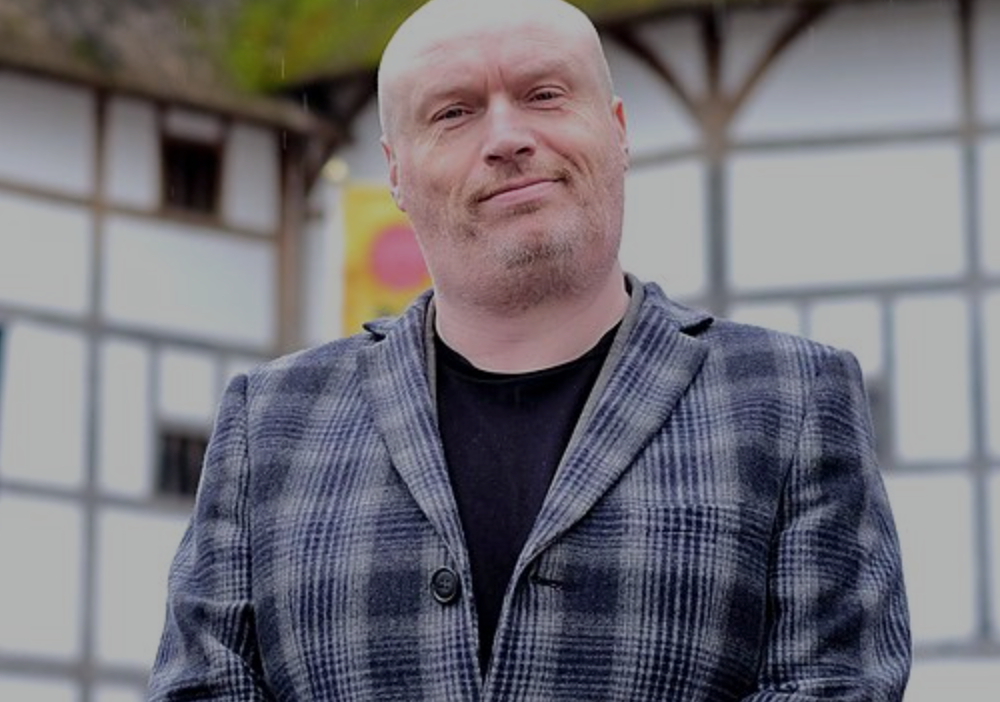
MR at The GlobeIt was therefore with some great interest I listened to a programme presented by British playwright Mark Ravenhill (left), who has just finished a two-year stint as playwright in residence at the Royal Shakespeare Company. In Shakespeare: For and Against for the BBC, and to quote the promotional material for the programme

…..Ravenhill challenges our adulation of the Bard and asks: Is Shakespeare’s genius beyond question? Casting a sceptical eye over centuries of bardolatry, Ravenhill calls for a new approach to the plays.

Exploring the intellectual tradition that has seen important figures from Voltaire to Tolstoy to Wittgenstein challenge Shakespeare’s supremacy, Ravenhill searches for today’s dissenting voices.

Tracing the transformation of a working playwright into a national poet, global brand and secular god, Ravenhill asks if it’s still possible to enjoy Shakespeare without being overwhelmed by the cultural and commercial baggage of ‘brand Shakespeare’.

It is really fascinating and amongst other people he speaks to scholar Ania Loomba who describes India’s changing relationship with Shakespeare, and Professor Gary Taylor talks about the ambivalence of large parts of America toward the Bard. Have a listen below:

In the interest of balance I would also like to share a piece written for The Telegraph by the highly respected actor Simon Russell Beale (interviewed by Ravenhill in the above) whose latest Shakespearian outing has been playing King Lear at the National Theatre.

Why Shakespeare always says something new

As the 450th anniversary of Shakespeare’s birth approaches, the great Shakespearean actor Simon Russell Beale explains his secrets

At the very end of King Lear, a frail, old man appears carrying the corpse of his youngest and much-loved daughter. It’s an image, like that of Hamlet holding a skull or Juliet on her balcony, that has imprinted itself on the minds of readers and spectators over the last four hundred years. For some, it is unbearable, even morally irresponsible; for Lear’s lonely, individual grief seems to reinforce the possibility, iterated again and again in the play, that all human life is essentially meaningless.

Whether one accepts that bleak vision or not, here once again is that familiar magic – Shakespeare’s astonishing ability to open out his work, to manipulate a single storyline, so that it includes, implicates and challenges everyone.

PX694779_King-Lear_2872690b

The old king and his daughter do not enter alone, however. They are accompanied by at least one soldier, possibly more. This soldier, about whom we know almost nothing, has a single line later in the scene, but his entrance is not marked in either of the authoritative texts that have been handed down to us – the quarto and the Folio – and, consequently, presents the director of King Lear with a problem. When, precisely, should the soldier, or soldiers, enter? Every line spoken by Lear in this short, final scene is a wonder and I suspect that most directors instinctively feel that his words and the image should be left, as it were, to stand alone.

But, as so often, Shakespeare gives us a context for Lear’s pain, a counterpoint. The soldier is there to remind us, amongst other things, that the old king is not simply a grieving father but also a prisoner- of -war (a war for which he is ultimately responsible) and to confirm, with his single line, that Lear is still powerful and angry enough to have killed the man who was murdering his child.

This is a tiny example of another Shakespearean manoeuvre, one to set against his skill at articulating the big things like love and hate. It’s the type of thing that makes mounting Shakespeare’s work endlessly fascinating, demanding and frustrating. For whatever reason – the way the texts have been transmitted, carelessness on the part of the writer, a change of intention – the plays, in their lack of precision, often raise questions for which the playwright has provided no clear answer. Any actor or director in search of clarity could be forgiven for interpreting this as an opportunity or a challenge.

If this challenge seems, at times, difficult to meet then it’s comforting to know that we are not alone. Ben Jonson, Shakespeare’s younger contemporary and a writer whose narrative was always meticulously charted, found his older colleague’s work, for all its beauty, sloppy and often absurd. He probably found the paucity of information about Lady Macbeth’s child, for instance, infuriating. Unfair though it might be, however, Shakespeare’s capacity for absorbing endless reinterpretation, in contrast to the demands that Jonson makes, is maybe one reason why the latter’s work has never been as popular as his colleague’s. Perhaps we should be braver with Jonson, but the truth is that, over nearly thirty years of working on Shakespeare’s plays, there have been countless occasions when, in the rehearsal room, I have witnessed (and expended) a great deal of enjoyable effort in the attempt to sort out apparent inconsistencies and ambiguities. We could leave the plays alone, I suppose, but that seems the lazy and irresponsible option. Shakespeare demands a more considered response, I think.

This is a tricky business, however. One never wants to “tidy up” Shakespeare’s writing without considering as many options as possible and ambiguity is often a good thing. There are sometimes unexpected discoveries to be made by investing fully in something that is apparently confusing. The soldier in the final moments of King Lear is there precisely to complicate matters. In this case, the king may very well be embodying a profound and far-reaching pain that has universal relevance, but the playwright cannot resist providing a more mundane and savage context. Lear is not floating free of the real world; and this may remind us that it is in the oddities of Shakespeare’s writing, his exploration of the confusion and ugliness of any situation, his absolute refusal to sentimentalise, that a great deal of his power lies.
srb-as-lear_2878816c

The fact, too, that the plays are, from an interpretative point of view, open-ended leads satisfyingly to our questioning, not only the playwright, but also each other. We may not agree with a particular analysis or interpretation, but if it is neither wilful nor illogical, then it may well be, despite our preconceptions, valid. Shakespeare’s plays are very hospitable. As a fellow actor said to me recently, interpreting Shakespeare is “a game we can all play”.

The feeling that one is standing on shifting ground is there right at the start of any close reading of the text. The astonishing work of literary scholars over the last century has radically changed our view of the plays as comprising an unchanging and rigid canon. Not one of Shakespeare’s plays exists in a single, unchallenged version. There are, as I mentioned earlier, two authoritative texts for King Lear – with significant differences – and three for Hamlet. Plays like Measure for Measure are frankly a bit of a mess and Timon of Athens is clearly unfinished.

It seems that Shakespeare’s plays are, in some sense, there to be adapted. We have to tread carefully, of course, because we are dealing with a man who was unquestionably a genius;, but he was also a working man of the theatre and, it seems, was willing to adapt his work, responding to his own changing ideas and, presumably, to the demands of those he worked with. What this all boils down to is that you can’t perform a play by Shakespeare without first editing it. There is no set text.

The reason why this is a worry for some is that editing is necessarily an interpretative activity and our judgment of a play can therefore be manipulated. Choosing between options that the playwright himself offers is not, of course, objectionable, although many are surprised at how different these options sometimes are. For instance, one of Hamlet’s famous soliloquies, his last, “How all occasions do inform against me” is not in the Folio version of the play.

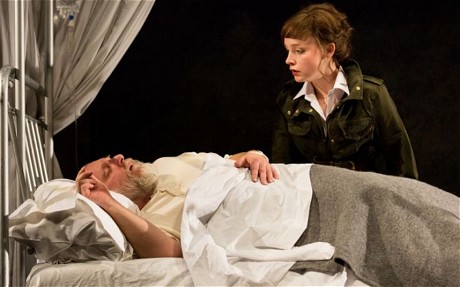
Difficulties arise when theatre practitioners change things that Shakespeare did not clearly authorise. In the production of King Lear that I am currently involved with, there is a glaring, perhaps even controversial, example of this. The Fool, one of Lear’s few friends, disappears halfway through the play and this is considered by commentators as either gratifyingly mysterious or simply unsatisfactory. We decided that the King, now mad and predictably violent for much of the time, should club the Fool to death.

Whatever arguments we can produce for such a decision – and I, of course, think they are watertight, despite the fact that much later in the story Lear mentions that the Fool has been hanged – there is no doubt that some find such a departure from the text distressing. Years ago, in a production of The Tempest (also directed, as it happens, by Sam Mendes), I played a rather haughty Ariel who, at the moment of being given his freedom by Prospero, spat in his master’s face. This seemed to me to be an absolutely understandable protest given Ariel’s long years of servitude, but many spectators, for understandable reasons, disliked it intensely.
THE-WINTER_S-TAL_2878808c

My defence is that the texts themselves are not stable and that, anyway, we are following Shakespeare’s footsteps. For instance, editing a play for performance often means cutting lines and we know that some of the plays exist in shorter versions, presumably intended for particular occasions and I’m sure he changed things for other reasons than that of length. Even if the principal aim of a group of practitioners is simply to reduce the playing time, rather than something more devious, distortion of some (largely mythical) ur-text is inevitable.

This process of editing may challenge our preconceptions about a play and those preconceptions, especially if they manifest themselves in a desire for something that we can easily define, are often very difficult to shift. I’m aware, when watching a production of a Shakespeare play I know well, that I have to work hard not to impose my rigid requirements on the performers in front of me. There is always a danger that, while working on a Shakespeare play over months or even years, one can persuade oneself that a certain interpretation is the only one possible. After all, it is part of an actor’s job to convince an audience that, within the context of the production, this is momentarily the case. But Macbeth need not be, as I saw him, a man whose poetic imagination is liberated by a murder that is a gift to his wife. Iago may not have a second-rate mind, as I would argue, but perhaps is really is some sort of Machiavellian superstar.

I know I have to fight against my own prejudices (and acknowledge that, in any case, my ideas can change). Equally well, I have been guilty in performance of smoothing over, rather than embracing, difficulties, in the vain hope that no one will notice. For instance I have always found it hard that Hamlet, a character that I love and admire, is guilty of a puerile misogyny and, perhaps, more worryingly, of the unnecessary deaths of his old friends from university, Rosencrantz and Guildenstern. When I played him, I could find reasons for the misogyny but half- ignored the murders. The conflict and, most importantly the play on our sympathies are there, however, and should not be ignored.

The question of sympathy is one that has been exercising me over the months that I’ve been working on King Lear in Sam Mendes’s production for the National Theatre. If the soldier in the final scene is a reminder that Lear is not just a poor old thing but an angry, indeed homicidal, man, operating, however feebly, in a harsh world, then the first scene of the play is a direct challenge to our natural desire to like the central character. Unlike Othello or even Macbeth, we never get a chance to see Lear at his best, to see the man that Cordelia loves and that Kent and Gloucester, his devoted allies, respect. There are ways of softening the scene up, of playing it in a more vulnerable way, although I feel that this dodges the issue. What the king does in dividing his kingdom and banishing his daughter is, in Kent’s word, “evil”. Consequently, it’s a long haul back to forgiveness both from the other characters and from the audience; to be honest, I’m not sure we ever really get there.

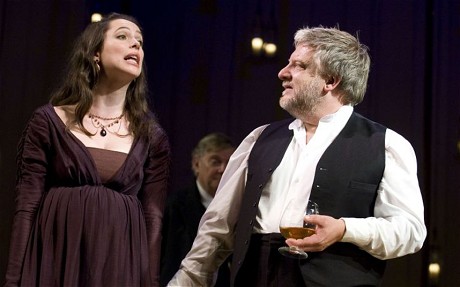
Forgiveness, and the difficulties of defining it, is something that Shakespeare seems always to have been interested in and this interest becomes especially intense in his later plays. In The Tempest we see Prospero offering forgiveness to his errant brother in a manner that looks suspiciously like another arbitrary display of power. The brother, perhaps significantly, does not answer. Leontes in The Winter’s Tale, wracked with a guilt that seems for a long time too deep-rooted to shift, faces a wronged wife who talks, not to him, but to their daughter. Not a word is spoken that promises unequivocally a settled and happy resolution.

Shakespeare recognised that the wish to be forgiven and the desire to forgive is the start of a process, that reconciliation or redemption take time, and time, of course, is the one thing that Lear and Cordelia do not have. That is what ultimately is so heartbreaking about King Lear. Not all mistakes can be fully rectified, all damage repaired and all love restored – at least, not here and now. The best we can do is accept the muddle of it all.

What Shakespeare always demands, though, is our sympathy, because, to put it simply, he writes about people like us. Offhand, I can think of only one character he wrote – Iago in Othello – that slips through the safety-net of his concern. Shakespeare might not agree with Lear’s sweeping and anarchic assertion that “none does offend”, but he sensed, I think, the danger of easy judgement. He recognises that self-worth and dignity are hard-won and that our lives cannot but be inconsistent, unpredictable, and confused. The only sane response for all of us, perhaps, is to emulate him – to look carefully, to withhold quick judgment and to try to understand.

It would suggest you read the comment’s that follow Beale’s piece – they make interesting reading. This one says it all for me:

Untitled_Fotor


A Stronghold In The Desert

Fifteen years ago I spent some time travelling through Syria and Jordan. It was my first trip to the Middle East and it was a defining moment for me. Both countries have had a lasting impact, not least because of the richness of their culture and history. In addition to Petra, two places remain very firmly planted in my memory. Firstly the Souk al-marina in Aleppo was a sensory delight,  an incredible bazaar built over 500 years ago under the Ottoman Empire and sat firmly on one of the World’s oldest trade routes. Secondly, Krak des Chevaliers, a crusader castle dating from 11th century, dripping in history.

SYR_1024_298371k

Souk al-marina before it was destroyed

krak_des_chevaliers_syria_photo

Krak des Chevaliiers before the civil war

Both have suffered badly during the Syrian civil war that has now been raging for 3 years. The Souk in Aleppo was destroyed by fire, and much of the city itself razed. Krak des Chevaliiers has been damaged by shelling and fire too.  It happens to be near Homs, another war-torn, ravaged Syrian city and has suffered accordingly. Both are (or in the former’s case, were) UNESCO World Heritage sites.

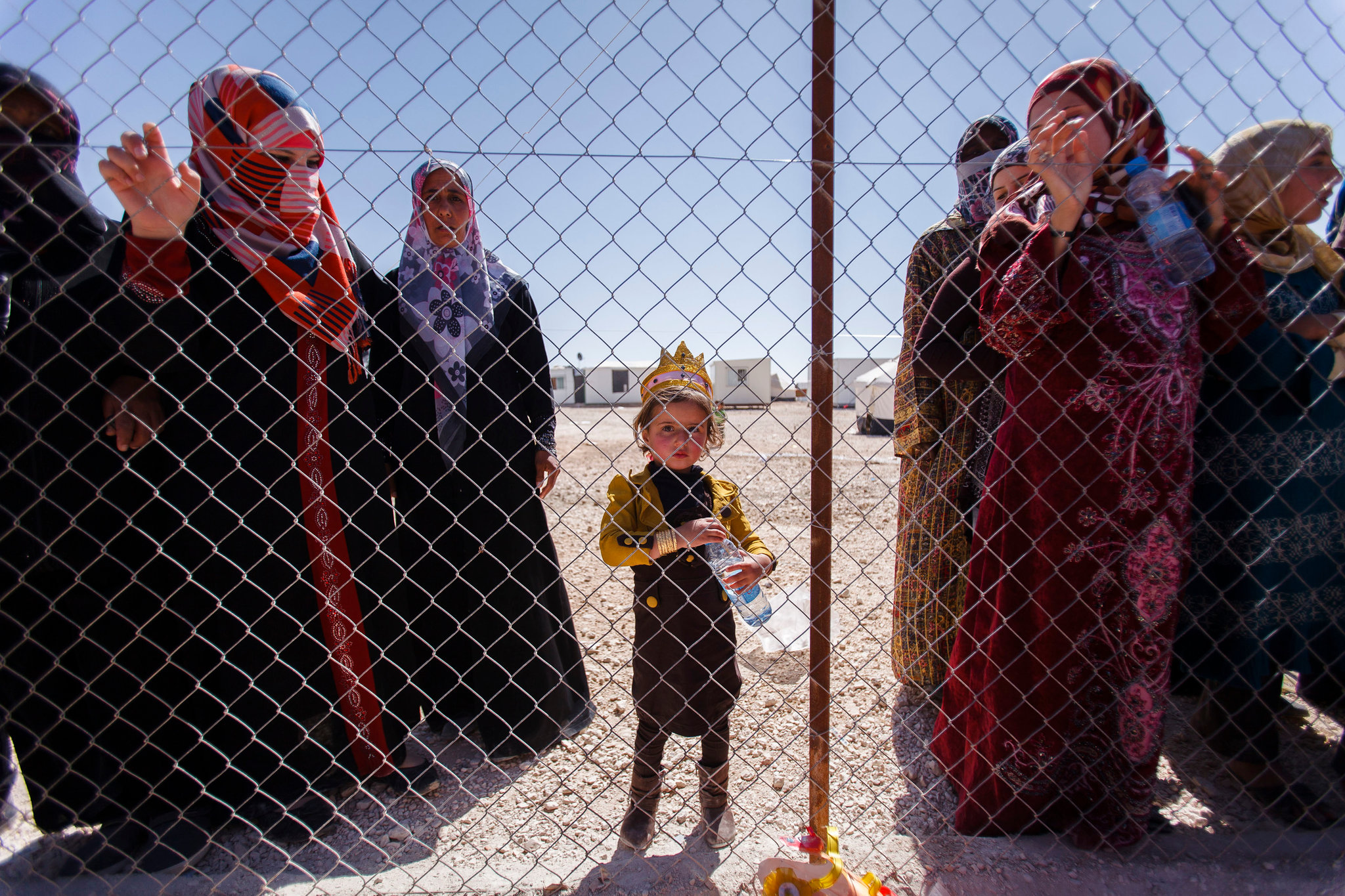
Where am I going with this? Well I was reminded of this visit again recently.  I have written twice here already (No Longer A Refugee and No Longer A Refugee #2about a group of women who have fled the fighting in Syria and have become performers in a production of The Trojan Women, a greek tragedy that reflects their own experiences. However, I have recently also become aware of another theatre project with Syrian refugees, but this time with children. Not surprisingly, many of the people fleeing the fighting in Syria have fled to neighbouring Lebanon and Jordan. One of the biggest refugee camps is the Zaatari Camp in Jordan which is currently housing about 150,000 people, an estimated 60,000 of whom are children with only a quarter of these receiving schooling.

1617466_875694579113737_164206393_o

In an attempt to help some of these children, Nawar Bulbul, a Syrian actor, has been working to stage a production of Shakespeare’s King Lear, with Lear recast as the Syrian president, Bashar al-Assad and Lear’s daughters as the different factions fighting in the civil war. I will let Ben Hubbard take up the story from here, in his excellent piece for The New York TimesBehind Barbed Wire. 

Behind Barbed Wire, Shakespeare Inspires a Cast of Young Syrians

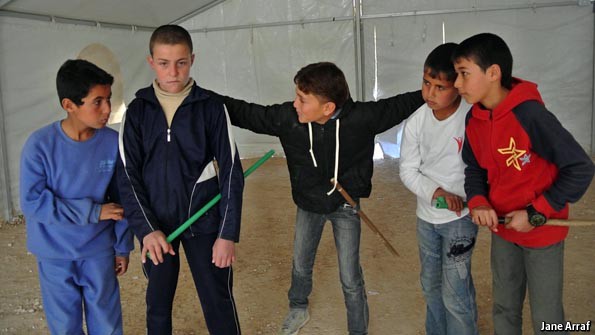
ZAATARI REFUGEE CAMP, Jordan — On a rocky patch of earth in this sprawling city of tents and prefab trailers, the king, dressed in dirty jeans and a homemade cape, raised his wooden scepter and announced his intention to divide his kingdom. His elder daughters, wearing paper crowns and plastic jewelry, showered him with false praise, while the youngest spoke truthfully and lost her inheritance.

So began a recent adaptation here of “King Lear.” For the 100 children in the cast, it was their first brush with Shakespeare, although they were already deeply acquainted with tragedy.

All were refugees who had fled the civil war in Syria. Some had seen their homes destroyed. Others had lost relatives to violence. Many still had trouble sleeping or jumped at loud noises. And now home was here, in this isolated, treeless camp, a place of poverty, uncertainty and boredom.

Reflecting the demographics of Syria’s wider refugee crisis, more than half of the 587,000 refugees registered in Jordan are younger than 18, according to the United Nations. Parents and aid workers fear that Syria’s war threatens to create a lost generation of children who are scarred by violence and miss vital years of education, and that those experiences and disadvantages will follow them into adulthood.

20140401_ZAATARI-slide-XUG9-superJumbo

The “King Lear” performance, the conclusion of a project than spanned months, was one attempt to fight that threat.

“The show is to bring back laughter, joy and humanity,” said its director, Nawar Bulbul, a 40-year-old Syrian actor known at home for his role in “Bab al-Hara,” an enormously popular historical drama that was broadcast throughout the Arab world.

The play owed its production largely to Mr. Bulbul. Smoking hand-rolled cigarettes and speaking with the animated face of a stage actor who never stops performing, Mr. Bulbul described his journey from television star to children’s director.

When the Syrian uprising broke out in 2011, he joined with gusto, appearing at antigovernment protests, leading chants and drawing the ire of the security services. A play he produced was banned, and a fellow actor who supported the government informed him that he could either appear on television to rectify his stance or expect to be arrested.

“I told him I would think about it, and a week later I was out of the country,” Mr. Bulbul said.

Bulbul watching rehearsals

Last year, he and his French wife moved to Jordan, where friends invited him to help distribute aid in Zaatari. The visit exposed him to what he called “the big lie” of international politics that had failed to stop the war.

“There are people who want to go home, and they are the victims while the great powers fight above them,” he said.

Children he met in the camp made him promise to return, and he did — with a plan to show the world that the least fortunate Syrian refugees could produce the loftiest theater.

The sun blazed on the day of the performance, staged on a rocky rectangle of land surrounded by a chain-link fence topped with barbed wire. The 12 main actors stood in the middle, while the rest of the cast stood behind them, a chorus that provided commentary and dramatic sound effects. The audience sat on the ground.

20140401_ZAATARI-slide-7SEC-superJumbo

When each of Lear’s first two daughters tricked him with false flattery in elegant, formal Arabic, the chorus members yelled “Liar! Hypocrite!” until the sisters told them to shut up.

And when the third sister refused to follow suit, the chorus members yelled “Truthful! Just!” until the king told them to shut up.

In later scenes, the king was heckled by the Fool, who wore a rainbow-colored wig, and eight boys performed a choreographed sword fight with lengths of plastic tubing. A few scenes from “Hamlet” were spliced in, making the story hard to follow. And at one point, a tanker truck carrying water roared by, drowning out the actors and coating the audience in a cloud of dust.

20140401_ZAATARI-slide-O1FD-superJumbo

But the mere fact that the play was performed was enough for the few hundred spectators. Families living in nearby tents brought their children, hoisting them on their shoulders so they could see.

After Lear’s descent into madness and death, the cast surrounded the audience, triumphantly chanting “To be or not to be!” in English and Arabic. The crowd burst into applause, and a number of the leading girls broke into tears. Mr. Bulbul said they were overwhelmed because it was the first time anyone had clapped for them.

After the show, as journalists interviewed the cast, the parents boasted of their children’s talent.

“I am the mother of King Lear,” declared Intisar al-Baradan when asked if she had seen the play. She had brought about 20 relatives to the performance, she said, adding that her son was also a great singer.

20140401_ZAATARI-slide-UA3C-superJumbo

Other parents described the project as a rare point of light in a bleak camp existence. Hatem Azzam, whose daughter Rowan, 12, played one of Lear’s daughters, said the family fled Damascus after government forces set his carpentry shop on fire. “We were a rebellious neighborhood, so they burned every shop on the street,” Mr. Azzam said. He arrived in Zaatari a year ago with five other family members, but one of his brothers got sick and died soon afterward, and his elderly mother never adjusted to the desert climate and died, too, he said. He hesitated to send his children to school, fearing that they would get sick in the crowded classrooms, and he kept them from roaming the camp because he did not want them to start smoking or pick up other bad habits. But the theater project was close to home, and his daughter was so excited about it that he let her go.

20140401_ZAATARI-slide-TSXA-superJumbo

“People get opportunities in life, and you have to take advantage of them,” Mr. Azzam said. “She got a chance to act when she was young, so that could make it easier for her in the future.”

The mother of Bushra al-Homeyid, 13, who played another of Lear’s daughters, said the family had fled Syria after government shelling killed her niece and nephew. “The camp is an incomplete life, a temporary life,” she said. “We hope that our time here will be limited.” But after a year here, she worried that her eldest daughter, who was in high school, would not be ready to go to college. Bushra, grinning widely and still wearing her yellow paper crown, said she had never acted before but wanted to continue.“I like that I can change my personality and be someone else,” she said.

(Illustrating photos by Warrick Page for The New York Times)

In his piece, City of The Lost for The New Yorker, David Remnick paints a desolate and harrowing picture of life in Zaatari – lengthy but worth a read.

Everything about this is a tragedy on a grand scale – a culture, lives and futures destroyed, but you cannot help but applaud Nawar Bulbul for what he is trying to do. He has set up a Facebook page and a YouTube channel, Shakespeare in Zaatari, which gives an even greater sense of what is being achieved out there in the desert. Having been forced to leave Syria himself, he continues to fight the Assad regime, even down to refusing to let what are considered to be pro-Assad media organisations film the project.

20140222_map503

Nouar Bolbol

Bulbul (left) is clearly a man of conviction and I for one celebrate what he is trying to achieve. Yes, it is only a small gesture when you consider that there are in excess of 60,000 children living in Zaatari. However he has chosen to harness the power of the thing he knows best – theatre – in an attempt to heal the brutal wounds of war, violence and dislocation. He doesn’t see theatre as a balm, a salve to make the horrors disappear. Some might say he is encouraging a very partisan view of the experience the children have been through. I would argue that it is simply a way of allowing an understanding of what brought about the situation they find themselves in and the truth about how one man and his regime can inflict incalculable suffering on others.

Lost in Translation?

I’m guessing that the name Anders Behring Breivik will strike a chord with anyone over the age of 16. If doesn’t, Breivik was the man who, almost 3 years ago, bombed government buildings in Oslo, Norway, killing eight people, before going on to kill 69 other people, mostly teenagers, in a mass shooting at a summer camp on the nearby island of Utøya.

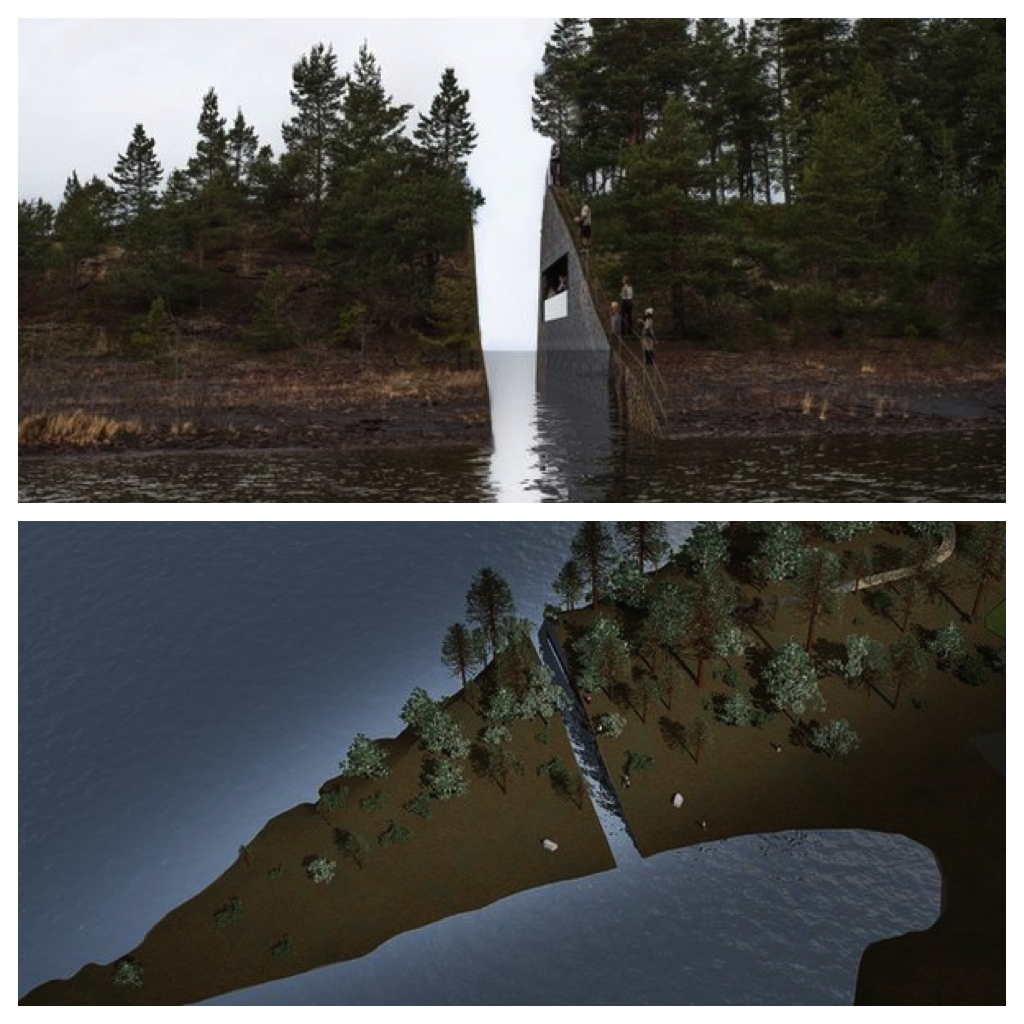
UtøyaNow this might sound like an odd introduction for a theatre blog, but bear with me. I was reminded of the atrocity this week on two fronts. Firstly, an attempt by the national government in Norway to create a memorial to the victims of Utøya shootings has been challenged by families of the victims and the locals who live near the proposed site.The memorial would see a channel cut across the tip of a peninsula which points out towards Utøya. one of the locals, Ole Morten Jensen said:

We will see this every day, a constant reminder of what we saw that day. All the blood, the noises, the shooting, the screaming. No, I don’t want to remember that. I think it is cruel for a government to expect us to be reminded of that.

I then read an article by Dominic Cavendish, for The Telegraph about David Grieg’s play, The Events, which was a response to the violence unleashed by Breivik back in July 2011, and asking how far human forgiveness will stretch in the face of atrocity. The Events doesn’t set itself in Norway, nor is there any direct reference to the Utøya massacre, but the parallels are obvious.  The play originally opened in the UK in summer 2013 and was a critical success, even winning best play of the year in one set of awards. It is still touring.

The Events, by David Greig Written by David Greig

Now, it has just had its Norwegian premiere and I wondered, given the opposition to the national memorial as one reminder too far, how The Events would be accepted by an audience who might want to put the horrors of Utøya behind them. Having said this, the play isn’t about that fateful day and its doesn’t recreate any particular event, but rather, as Lyn Gardner says, it is about grief, anger and revenge, but also about the things that bind us together as a community, the things that drive us apart, and what it is that makes us human. 

Now translated into Norwegian and titled Hendelsen the play opened in the town of Drammen, which is less than a 50 minute drive away from Utøya. Cavendish’s article below, deals in depth with the sensitivities surrounding the re-staging and whether it is something that Norwegian audiences will welcome:

David Greig: ‘I always knew I’d put The Events in front of a Norwegian audience’

The Events, David Greig’s acclaimed play about the aftermath of a massacre, has returned to its Norwegian source. But what did its first-night audience make of it?

David Greig in rehearsals for the Norwegian production of The Events

David Greig in rehearsals for the Norwegian production of The Events

A man stands on stage and points his fingers at a woman as though he were aiming a gun at her. “I have one bullet left,” he says. “Who is it for? Which one of you is it for?”

That’s what you’d hear if you translated his words into English. On this evening in late March, at Drammens Teater, a plush playhouse in a suburban town 30 minutes from Oslo, the man is speaking Norwegian. “Jeg har bare en kule,” he says. “Hvem er den til?” Even if you didn’t understand the words, you’d instantly grasp the seriousness of the threat.

I first saw Scottish playwright David Greig’s The Events at its opening performance in the Traverse theatre in Edinburgh, last August. At the time, I was gripped by this pivotal moment, in which the unnamed perpetrator of a mass shooting revels in his power of life or death over a young choir leader called Claire. This was only one of many elliptical and absorbing dramatic encounters.

Like Greig’s heroine Claire, a priest who almost loses her sanity in her quest to understand the loner who joins and then destroys her multicultural choir, the playwright had become obsessed with trying to fathom what made the Right-wing extremist tick – and flip. The resulting drama was as economical as it was experimental. Just two actors were needed, the male taking on multiple roles, not only of the killer but also those with insights into his actions and even Claire’s female partner. The added ingredient was a supporting choir of local singers drafted in from wherever the production might be playing. The show ingeniously explored the urge to understand mass murder and the limits of that understanding. While its conclusions seemed bleak, the choir’s vitality and solidarity felt wonderfully life-affirming.

But for all that potency and poignancy, the show in the UK allowed audiences to feel removed from its dark Scandinavian origins. Occasional references located the piece in Greig’s native Scotland. You might recall the Dunblane massacre of 1996, perhaps. You didn’t have to think of Utøya.

On its opening night in Norway, however, Hendelsen, as the play is titled here (and which translates as “event”), will strike home hard. Drammen is the capital town of Buskerud, the county that contains Utøya, which is a 50-minute drive away. A stone’s throw from the theatre, facing the river, stands a memorial to three local teenagers who died in the tragedy, the youngest aged 14.

I learn that during the afternoon’s dress rehearsal, members of the Drammen International Gospel Choir – an inclusive, multicultural project of precisely the kind Greig envisages – were left in tears after watching some of the scenes for the first time. “It took us back to the day it happened,” one of their number later confides. “We remembered the helicopters flying over this town that night, bringing people to the hospital.”

Apprehension and anticipation builds before the performers wander on to the stage to begin their choir practice, as though everyone was invited into their warm rehearsal space.

Heidi Gjermundsen Broch and The Drammen International Gospel Choir in rehearsal

Heidi Gjermundsen Broch and The Drammen International Gospel Choir in rehearsal

“I don’t think people will stand up and scream, ‘This is wrong, stop this!’ ” reflects Elsa Aanensen, the artistic director of Brageteatret, the company presenting this touring premiere in a co-production with ATC. But she can’t be certain. Last month, controversy engulfed plans for one of the permanent memorials chosen to honour the dead – Memory Wound by the Swedish artist Jonas Dahlberg – when the mother of the youngest victim complained about its location and a lack of consultation with the bereaved. Last year there was much heated discussion when a Danish theatre company called CaféTeatret brought over Manifesto 2083, based on the document Breivik distributed shortly before the attacks. And when Greig and Gray visited Norway in 2011 to talk to people and do research, the scepticism captured on the streets by a TV news crew almost set off a backlash against The Events before it had even been written.

“We still have a big wound in this country,” Aanensen explains. “I certainly think about those events and that day whenever I pass Utøya. I think that’s true for many people. It felt like our 9/11.” She consulted a number of survivors before proceeding, all of whom approved the idea, but admits she heard nothing after sending a letter outlining the project to the Workers Youth League. The choirs involved have needed reassurance too: “The worry was that there might be shooting and on-stage deaths.” She wants to set off a debate, not cause a disturbance.

“When I wrote The Events, I was always thinking about tonight,” Greig, 44, confesses over a cup of coffee after he arrives in Norway on a flying visit. “I knew there would come a point when I would have to place this play in front of a Norwegian audience. I had to feel I could hold my head up and say, ‘There’s nothing in this that is easy, sentimental or tawdry.’ ” Although as outwardly calm and articulate as ever, he has, he says, a gnawing feeling in the pit of his stomach.

When the hour finally arrives, two things are immediately obvious. First, that the theatre is not full, a possible indication that the company has been soft-peddling on marketing to avoid any sensationalising effect, or that the public is still wary. More importantly, it is suddenly clear how close to the bone the play is – and the performances take the work to a new pitch of intensity.

Local resonances are pronounced from the start. In the opening scene, the choir joins in rousing folksy rounds of Norwegian Coffee Song as Heidi Gjermundsen Broch’s radiant Claire vainly tries to welcome in Rolf Kristian Larsen’s silent, sinisterly impassive, “Boy” – here white and bearded, rather than an ethnic “outsider”, as he is in the UK production.

Larsen has drawn on mannerisms observed during Breivik’s trial – “I wanted the body language to be more relaxed than his to bring out the creepiness of that fixed smile,” he tells me. Partly as a result, Breivik-like assertions about “foreigners” and the urge to be famous, as well as allusions to the FAQ sections of his manifesto stand out more than ever. As do the risks inherent in Greig’s even-handedness; confronted in prison and asked to explain himself, the Boy is normal, pathetically inadequate. “I just got a bit obsessed with Aborigines,” he mutters.

There is no discernible weeping, wailing or complaining from the audience, yet the rapt attention is unmistakable and at the closing song – a haunting, specially composed ballad called We’re All Here (Vi Er Her Alle Sammen) – you can feel the room unifying in sorrow and defiance. Greig and Gray join the curtain call to loud applause, clutching roses – the flower adopted as the emblem of grief in 2011 – with the rest of the company.

David Greig (left) and director Ramin Gray standing beside a memorial to three teenage victims of the Anders Breivik massacre, with the Drammens Teater in the background

David Greig (left) and director Ramin Gray standing beside a memorial to three teenage victims of the Anders Breivik massacre, with the Drammens Teater in the background

It will take a while longer to get the measure of Norwegians’ reactions to the work – the tour eventually winds up in Oslo, with a choir drawn from the commune near Utøya. But the response so far has left Greig feeling quietly vindicated. He says: “I had a particularly touching moment where a lady came up to me who had a daughter on the island of Utøya and a son who was a security guard at a building that was bombed. Both survived but she had a very close relationship to what happened. She said that up until now she thought she was weird because she had all these arguments going on in her head – and Claire had articulated all those things.”

Gray, too, exudes relief afterwards: “This could have gone horribly wrong in so many ways – it was a real act of faith. I sat there thinking ‘Phew, this is OK and I’m proud of it.'” Ine Therese Berg, a young critic from the weekly newspaper Morgenbladet, strikes a more emphatically approving note. “I think Norwegians would find it interesting. It’s not just a gimmick, it has integrity, it’s touching. At the same time, I wonder if people want to deal with it. We all related to it at the time and we talk about it as a national trauma but I wonder who will come to see it.”

One voice urging her fellow countrymen to take a look –“It’s great, very serious. They are doing this in a good way” – is that of 26-year-old Tonje Kristensen, who survived Breivik’s killing spree by continually moving around Utøya, even though she badly damaged her back jumping from a second-floor window. It’s not a chapter she wishes to relive in detail again – she wells up when I ask her what it’s like to confront such painful memories – but the feeling of unreality described in the play as the shooting unfolds struck a powerful chord.

“I felt I was closer to death than I have ever been before,” she explains. “That’s a very special sensation that you don’t often get – it’s different from being scared. I think they really nailed that feeling – you’re not just scared, you’re terrified.”

Having made a concerted effort to move on, and not to dwell obsessively, as Claire does, on the whys and wherefores of the atrocity, she still understands why there would be such a compulsion to puzzle over it all. “I think everyone felt affected by it, not just the people who were at some of the places that he attacked. Maybe for some people it’s stronger even though they weren’t at Utøya.”

Can a play like this usefully add anything? She nods but it is perhaps Larsen – the man who plays, almost, not quite, the man who tried to kill her – who puts it best: “We don’t set out to answer all the questions. It’s as if we are in a massively large dark room and have lit a tiny match – and we have shed a little light in there, knowing that we are only going to find out so much before it burns out.”

I have to say I am left feeling slightly uncomfortable by this. I can’t help thinking that by taking the play to Norway it the becomes voyeuristic, particularly because it is written by an ‘outsider’. Perhaps, however, it could only be written by someone not connected with the events of July 2011. I don’t know.

The Stage, Fighting

My first post today is a fascinating and troubling programme broadcast by the BBC last week. In it, the UK-based, Turkish theatre director, Mehmet Ergen travels back to Istanbul to explore the current state of the theatre in the country after the Arab Spring and Gezi Park protests.

Mehmet ErgenA background to Ergen and the programme, call A Tale of Two Theatres, is given here in the publicity from the BBC:

Acclaimed director Mehmet Ergen leads a double life, directing on stages 3000km apart. This programme follows him from London to Istanbul, to learn how much is now at stake for Turkish theatre.

Mehmet is best known to UK theatre audiences as Artistic Director of London’s Arcola Theatre. But his pioneering work in Hackney is only half the story as the programme discovers on a journey to his Turkish homeland, post Gezi Park and post Arab Spring, caught between the Syrian conflict and EU aspirations.

An Istanbul-born former DJ, Mehmet became the toast of London’s theatre scene by creating venues and careers from scratch. In 2000 he transformed a derelict clothing factory in Dalston into a destination venue, twice recognised by the Peter Brook Empty Space Award. Not content to run ‘a powerhouse of new work’ (in the words of theatre critic Susannah Clapp) in his adopted city, he later opened its opposite number back in his hometown.

istanbultheatre-protest

Tensions have been rising in Turkey between artists and politicians ever since the Prime Minister’s daughter was mocked on stage, allegedly for wearing a headscarf to the Ankara State Theatre in 2011. In 2012, a performance of Chilean play Secret Obscenities was censored by Istanbul’s Mayor Kadir Topbas.

Turkey Artistic FreedomsPrime Minister Erdogan then threatened to withdraw subsidies of up to 140 million
Turkish Lira from approximately 50 venues, employing roughly 1,500 actors, directors and technicians. Although wholesale privatisation has yet to be enacted, theatre companies openly opposed to government tactics during 2013’s Gezi Park protests promptly had their funding withdrawn.

Entrepreneurial ex-pat Mehmet acts as the listener’s guide to this politically charged arts scene, as he negotiates national and cultural borders to stage work that is as unpretentious as it is provocative.

A Tale of Two Theatres:

Somehow the situation in Turkey, which began in 2012, had passed me by and a little further digging only underscores what Ergen has to say. LABKULTUR ran a piece, Ethics of Art or Ethical Art, that is the question! that details the situation nicely, as did the Huffington Post.  You don’t need to speak Turkish to understand the following protest video. Entitled Şehir Tiyatroları Yok Edilemez, which roughly translates as our city theatres won’t be destroyed, is a powerful 24 seconds.

.

Let’s not forget that this is the same Prime Minister, Tayyip Erdoğan, who a couple of weeks ago attempted to block Twitter and Youtube to the whole country as both were hosting evidence of wide-ranging corruption in his government.

In 2012, Erdoğan accused theatre artists of being arrogant, saying They have started to humiliate and look down on us and all conservatives. Clearly theatre in Turkey is doing a great job if it manages to rattle the politicians in this way.

While researching this post I came across artsfreedom, an organisation which gathers international news and knowledge about artistic freedom of expression – or the lack of it. Click the image below to see what they do:

af_Fotorartsfreedom is an extension of Freemuse, a Danish-based organisation that advocates freedom of expression for musicians. Freemuse have started to gather annual statistics that cover artistic freedom of expression violations globally and the ones for 2013 make grim reading. A total number of 199 cases of attacks on artists and violations of their rights have been registered. The cases include 19 artists being killed, 27 newly imprisoned, 9 imprisoned in previous years but still serving time, 8 abducted, 3 attacked, 13 threatened or persecuted, 28 prosecuted, 19 detained, as well as 73 cases of censorship.

Visually it looks like this:

freemuse_FotorThe breakdown by country is here. The artsfreedom newsletter that reflects on these statistics is worth a (depressing) read here.

While artsfreedom works right across all arts, the pieces on their site that relate specifically to theatre are here.

Invisible Light

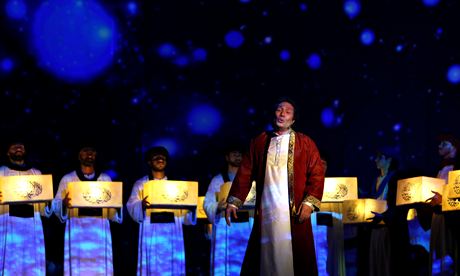
EP-140329286.jpg&MaxW=558&imageVersion=defaultA few days ago a show opened in Sharjah, a tiny emirate that forms part of the United Arab Emirates. Called Clusters of Light,  it tells the life story of the Prophet Mohammed and for anyone who knows about Islam, there is an obvious difficulty here – Islamic convention forbids the portrayal of the Prophet in human form. None the less what has been produced is a truly spectacular piece of theatre, drawing on the latest technology, expertise from around the world, a cast over over two hundred and performed in a brand new outdoor amphitheatre, the construction of which took only 3 months.

1715289621The whole event has been on an enormous scale. According to The Gulf News, The Al Majaz Amphitheatre, based on a traditional Roman design, cost US$32 million to build, can seat 4,500 people, has 400 animated lights, 120 sound speakers, and 21 projectors as well as a  hydraulic stage.

ali_03122014

The opening performance is no less impressive in its conception and the time scale in which it was created. Clusters of Light has been put together in less than 6 months, a time frame that would, I am sure, have any mainstream theatrical producer dancing with delight. The creative team behind the project are some of the most experienced in their field, with a history of staging, literally, some of the biggest shows on Earth. I will let writer Peter Walker and photojournalist Susan Schulman take up the story from here, in a piece published in The GuardianIslam the Opera.

It was quite a challenge, even for the crack team of theatrical experts summoned from around the world: less than six months to produce a hi-tech musical extravaganza about one of the most renowned figures in human history. Oh yes, and the title character can’t appear on stage.

But somehow it happened and on Sunday night a lavish production about the life and teachings of Muhammad, Islam’s main prophet, intended as a rejoinder to more militant interpretations of the faith, premiered at a specially built £20m mock-Roman amphitheatre in Sharjah, the small emirate adjoining Dubai.

The show had to be assembled in months by an international team that includes Piers Shepperd, technical director of the 2012 Olympic opening and closing ceremonies, and the man who made Danny Boyle’s creative ideas happen on stage. Now he has done the same for a show whose scope is roughly equivalent to Islam: the Opera. The 90-minute production, Clusters of Light, has the ambitious stated intent of rebranding the religion internationally.

The story is told with a cast of about 200, including some of the Arab world’s most celebrated singers, such as Mohammed Assaf, the Palestinian winner of Arab Idol, and the Tunisian tenor Lotfi Bouchnak, with spectacular animated scenes projected around them.

Clusters of Light

An inaugural run in Sharjah will be followed by mooted tours to Malaysia, Turkey and even Paris. There are tentative plans to translate the libretto, by a Saudi poet, into other languages with a view to attracting non-Muslim audiences.

From the beginning, the production faced one particular challenge: under Islamic convention Muhammad cannot be portrayed in human form.

The first step for the team, according to Richard Lindsay, the creative director, was to watch The Message, a 1977 film about Muhammad’s life that showed the story from his direct perspective, conveniently keeping him off-screen.

“As we weren’t making a film, we didn’t have that luxury,” said Lindsay. “There’s only once in the show we refer to the prophet, and then we represent him as a source of light, which is accepted. For the rest of the time we didn’t need him in the story, as it revolves around him. The show is about what he’s doing, but it doesn’t actually need to show him.”

EP-140339883.jpg&MaxW=460&imageVersion=default

The production is lavish to an almost Bollywood extent, with images projected to a huge screen behind the cast, forming the background scenes, sometimes animating to interact with the on-stage action or provide images such as a falcon seemingly soaring above the audience.

Gavin Robins, the director, with a background in the somewhat different world of the Eurovision song contest and stage productions such as How to Tame Your Dragon, describes it as the most technically advanced show he has worked on, and one of the most dramatic. “You could describe it as a romantic thriller,” he said. “When we first rehearsed the scene about the prophet’s death, the entire company was genuinely weeping. It’s a gift to be able to take that energy from a cast.”

Shepperd said his involvement changed his view about the religion’s take on several subjects, for example the position of women.

He said: “If you look at the popular misconceptions about Islam, that isn’t the case at all. It’s great to be working on a show that explores those kinds of things.”

AR-140329286.jpg&MaxW=558&imageVersion=default

Whatever the intended message, the broader cultural context is arguably slightly more complex. Sharjah is sufficiently traditional to possess a set of “public decency rules” that prohibit, among other things, men and women being alone together in public unless they are married or related. The author of the libretto, Abdulrahman al-Ashmawy, has reportedly written a poem criticising attempts by women in his native Saudi Arabia to be permitted to drive. However, the man ultimately overseeing Clusters of Light, Philippe Skaff, said he welcomed Sharjah’s ambitious scheme from the very personal perspective of a Lebanese Christian: “As a Christian Arab, if anyone feels threatened by extremism, it’s us. It’s very comforting to see a work like this commissioned.

“At the start of all this the sheikh told me, ‘If we don’t do this, if we don’t spread the real message of Islam, we’re letting the extremists take over. This is our way of responding to them.'”

In an article for The National, the Bahraini composer of Clusters of Light, Khalid Al Sheikh says it is a story for all nations and times. Interestingly, Al Sheikh worked with German composer Christian Steinhauser and the music was recorded by the German Film Orchestra Babelsberg. Another piece in The National, also by Afshan Ahmed, gives an idea of the complexity of, and technology behind, the staging.

During the rehearsal, a 12-tonne cube slowly appears from behind white scrim. A computer-generated grid pops up and in seconds is replaced by animated images of a marketplace.

“This is not a cinema screen where you have one big projector,” says Hai Tran, the head of technology at Multiple & Spinifex Group, a Sydney-based creative projects company that produced the show. “This involves projecting from all over the arena to get the whole environment looking right.

“The cube is very dynamic. We use it as a stage and it also turns into the Kaaba during the show.”

The commercial for the show (below) gives a very clear picture of the epic nature of what has been produced.

.

Now it has to be said something on this scale, and created in this timeframe, can only be achieved by a nation with a lot of money and the ability to hire the best the industry has to offer, but you can’t but applaud the vision. Also, as Peter Walker comments, the broader cultural context of the project might raise a few eyebrows elsewhere in the world, and perhaps this can’t be ignored. Having said this, I think if found myself in Sharjah tomorrow I would probably – no, almost certainly – find myself in the audience.

The Spirit Of Performance

Traditional chinese opera maskAlongside World Theatre Day, Theatre Room Asia is also celebrating. Today it has taken a new domain name, theatreroomasia.com  (although the old ibreadingroom address will continue to direct you here). Also today, Theatre Room is likely to pass it’s 10,000 view mark, which I find both thrilling and extraordinary. When I began, it was a meant to be a curated resource for my senior theatre students and indeed it still is. However it is now viewed across the world –  114 countries to date – and has a growing readership. It delights and encourages me that there is a need out there for something like Theatre Room and despite all the threats that theatre and performance face, be they economic, cultural, political or ideological, there is still a need to make theatre and reflect our humanity within that. South African playwright (and designer, director, installation maker and artistic director) Brett Bailey wrote the  Message of World Theatre Day 2014. His opening statement says it all, whilst his closing question is a challenge to every single student, teacher and practitioner of theatre across the globe.

Wherever there is human society, the irrepressible Spirit of Performance manifests.

Under trees in tiny villages, and on high-tech stages in global metropolis; in school halls and in fields and in temples; in slums, in urban plazas, community centres and inner-city basements, people are drawn together to commune in the ephemeral theatrical worlds that we create to express our human complexity, our diversity, our vulnerability, in living flesh, and breath, and voice.

We gather to weep and to remember; to laugh and to contemplate; to learn and to affirm and to imagine. To wonder at technical dexterity, and to incarnate gods. To catch our collective breath at our capacity for beauty and compassion and monstrosity. We come to be energized, and to be empowered. To celebrate the wealth of our various cultures, and to dissolve the boundaries that divide us.

Wherever there is human society, the irrepressible Spirit of Performance manifests. Born of community, it wears the masks and the costumes of our varied traditions. It harnesses our languages and rhythms and gestures, and clears a space in our midst.

Brett Bailey

Brett Bailey

And we, the artists that work with this ancient spirit, feel compelled to channel it through our hearts, our ideas and our bodies to reveal our realities in all their mundanity and glittering mystery.

But, in this era in which so many millions are struggling to survive, are suffering under oppressive regimes and predatory capitalism, are fleeing conflict and hardship; in which our privacy is invaded by secret services and our words are censored by intrusive governments; in which forests are being annihilated, species exterminated, and oceans poisoned: what do we feel compelled to reveal?

In this world of unequal power, in which various hegemonic orders try to convince us that one nation, one race, one gender, one sexual preference, one religion, one ideology, one cultural framework is superior to all others, is it really defensible to insist that the arts should be unshackled from social agendas?

Are we, the artists of arenas and stages, conforming to the sanitized demands of the market, or seizing the power that we have: to clear a space in the hearts and minds of society, to gather people around us, to inspire, enchant and inform, and to create a world of hope and open-hearted collaboration?

A Rocky Road

normal-2Perhaps more that any other art form, theatre is a political beast. It has to be, it is about the human condition.  Whether it is the content that is political, or the mere act of staging something in a certain place, politics is never very far away. In democracies that have a left leaning government, theatre usually thrives and is supported by the state as a forum for discussion and debate. In those that lean to the right, theatre making shrinks as state funding is usually withdrawn or cut, being viewed as subversive and unnecessary. What the right have yet to work out is that their attempts at suppression only forces theatre makers to shout louder. More extreme governments hijack theatre as propaganda and/or ban work that doesn’t support ‘the cause’. Now of course these are generalisations, but without doubt there is some truth in them.

This week there have a few rumblings of discontent about the forth-coming world tour of Hamlet by the Globe Theatre, which I wrote about in July last year, Going Global. The theatre announced that in their attempt to visit every country in the world, North Korea was on the itinerary for September this year. This immediately drew criticism from Amnesty  and Human Rights Watch. Niall Couper from Amnesty said:

North Korea is a country where the horrors inflicted on people who fall out of favour are worse than any fiction….No tragic play can come close to the misery that 100,000 people trapped in the country’s prison camps endure, where torture, rape, starvation and execution are everyday occurrences.

normalTo be fair, Amnesty didn’t suggest that the theatre should boycott North Korea, but urged the company to read up on its human rights abuses first. Meanwhile Phil Robertson from Human Rights Watch (Asia) commented that exclusion would be the order of the day if the performance went ahead:

It’s going to be an extremely limited, elite audience that would see a production in any case. It would have to be in Pyongyang, which is a showcase city whose residents are selected to live there because they have shown their loyalty, so there’s a strict pre-selection process involved right from the off.

Many commentators have of course noted the sinister connection between Prince Hamlet’s murderous revenge on his uncle Claudius in the Shakespearean tragedy and recent events in North Korea. As a report from CNN said

The parallels of staging a drama about an epic family power struggle in Pyongyang, where the country’s young leader Kim Jong Un had his uncle, Jang Song Thaek executed has raised a few eyebrows…..Jang was considered instrumental in Kim’s rise to power, but Kim turned his back on his uncle in spectacular fashion late last year as Jang was branded “a traitor for all ages” and executed on charges that he had attempted to overthrow the government.

Phil Robertson drily noted that

When the North Korean leadership gets around to reading the plot of Hamlet, one imagines they might well insist on something else from the canon

hamlet_hedingham_Fotor

The story has made international news, from Bangkok and South Korea, to Germany and the US.  I suppose this says a lot about how well regarded the Globe is around the world. However, it is politicking that is driving the story. Not surprisingly, the Globe hit back issuing a statement that, amongst other things, said:

We have decided that every country means every country, since we believe that every country is better off for the presence of Hamlet. Shakespeare can entertain and speak to anyone, no matter where in the world they are. We have always believed that cultural communication, and different peoples talking to each other through art, is a force for good in the world. In every country, we are going for one single and simple purpose: to play Hamlet there.

We are very proud of our record of working with a selection of NGOs over the years – Amnesty themselves, PEN, Reprieve and Human Rights Watch. We have raised money for their operations, provided space for them, and felt their influence in many of our productions and the new plays we have performed. In that light, we were disappointed that Amnesty put out a quote about our touring without realizing that it was a world tour, but under the impression that it was going solely to one country.

I take their point, but I do wonder whether this is a wise move, as it could be seen as a potential endorsement of the brutal North Korean regime. There is something to be said for cultural diplomacy, but as the USA News points out, it can go too far. On the other hand, Mark Lawson writing in the Guardian, Is there something rotten in taking Hamlet to North Korea? argues that theatre does not always legitimise its hosts and can be a weapon against oppression. If the Globe were to avoid all repressive regimes, their World Tour simply wouldn’t be.

I’ll leave the final word to Couper and Amnesty who noted that

There’s a dark irony in the fact that Hamlet focuses on a prince wrestling with his conscience. Kim Jong-Un is no Hamlet. Sadly he shows no sign of wrestling with his conscience.


Provisional routing of the tour

Provisional routing of the tour