As we head into a long weekend here in Hong Kong – Buddha’s Birthday – thank you Buddha – I thought I would share something simply beautiful – a montage from Pilobolus.
Enjoy.

As we head into a long weekend here in Hong Kong – Buddha’s Birthday – thank you Buddha – I thought I would share something simply beautiful – a montage from Pilobolus.
Enjoy.
Oh my goodness. Every now and again I stumble across an amazing web-based resource that makes me wonder how I had managed to miss it before. I’d like to introduce you to:
 It is what it says it is – an archive of recorded interviews with theatre practitioners of all kinds. It was started in 2003 and is now supported by various museums and drama colleges with a growing archive of material which will be preserved for posterity. All the recordings are tagged extensively, so it is easy to find things that are relevant to you. Click the banner above to access the homepage.
 I’m going to start off by sharing an interview with Yang Quin and Mary Anne O’Donnell who are the two founder members of Fat Bird Theatre Company. They talk to Mary Mazzilli about what it’s like to make theatre in Shenzhen-Guangdong, the oldest and fastest-growing Special Economic Zone in China. This is the only independent theatre company that promotes experimentation and internationalism; they focus on social changes and are dedicated to transforming Chinese theatre through experimental workshops, guerrilla performances and stage drama. You can access the recordings here.
My musings on what consitutes theatre continue and it would seem I am not the only one. My favourite theatre writer, Lyn Gardner, wrote this piece last week. While it is about the performance scene in the UK, she makes her point clearly.
Don’t box me in: why label art forms?
Is it theatre? Dance? An installation, or a pop gig? Artists are smashing boundaries – and audiences are keen to explore
Over the last couple of weeks, I’ve been to Wales to see Tir Sir Gar, which was as much tea party and installation as theatre, and Praxis Makes Perfect, as much immersive pop gig as immersive theatre. I saw Hofesh Shechter’s brilliant early works Uprising and the Art of Not Looking Back – quite clearly dance pieces. Or were they? Much of the choreographic language would be both familiar and thrilling to anyone interested in contemporary experimental theatre.
I also went on a self-guided walk (I self-guided into a bollard) around London’s Covent Garden, during one of Scary Little Girls’ and Naomi Paxton’s Living Literature Walks, which encompass live performance along the way. Was it a literary walk, or was it a theatre show that simply used the city and buildings as a vast stage-history soaked backdrop to explore the work of the Actresses Franchise League? Then there’s NoFitState’s circus show, Bianco which is currently touring across the country. Theatre, dance or neither? Oscar Mike’s the Situation Room. Game or theatre? Daniel Bye’s The Price of Everything.
Performance or economics lecture? Does it even matter?
Boundaries are being swept away and so are the expectations of audiences who are much more likely to be cultural nomads than they were just few years ago. The internet means that we are all much more likely to know what is happening across the arts and not just in our chosen art form. Even the old allegiances to venues are dying away, particularly when the most exciting events are as likely to take place in a warehouse or old building as they are in an opera house or purpose-built theatre.
Punchdrunk’s co-production of The Duchess of Malfi with ENO [English National Opera] may have been called an “opera”, but I bet that most of the audience didn’t much care. As far as they were concerned it was Punchdrunk, and it was this that drew them to Great Eastern Quay, just as The Drowned Man will draw thousands to the formerly secret location just next to London’s Paddington station.
Many of those may not even think that it’s theatre.
For other audiences, Neon Neon was the obvious draw for National Theatre of Wales’s Praxis Makes Perfect, which is touring later this month again, but for others it could be the involvement of director Wils Wilson or playwright Tim Price. It is the artists that increasingly engender loyalty, not the institution that produces them. And whether it’s called dance or theatre or opera doesn’t really concern the audience, and may even get in the way of them giving it a try.
But many newspapers and websites – including the Guardian – still classify and review by art form; Arts Council England still mostly funds on that basis; and many companies and buildings still define themselves by a predominant art form and pigeonhole events by art category. In the 21st century much of the most interesting work being made completely defies categorisation. That’s exactly what makes it so thrilling. So why continue to try and box it in?
It’s worth checking out the posts that followed her article for a few other perspectives
And by way of a neat segue from the last post, a new staging of Harold Pinter’s play The Hothouse has opened in London to rave reviews this week. The history of The Hothouse is that Pinter wrote it in 1958, put it to one side and only rescued it from oblivion in 1980. What is special about it? Well it is eerily prophetic in its vision of a world where psychiatric hospitals are used as a means of curing social dissidents. He said of it 1982
It was fantasy when I wrote it, but now it has become, I think, far more relevant. Reality has overtaken it.
 In a world where torture of ‘political’ prisoners still takes place – think Guantanamo Bay, think Belarus, think Iran…..the list is endless, The Hothouse has many resonances. You can read a couple of the reviews here and here.
However, what I really want to share with you is an edited version of an article commissioned for the play’s programme (or play-bill). It is written by Shami Chakrabarti who is director of The National Council of Civil Liberties (better known as Liberty) in the UK which is a leading voice in the world of human rights.
Pinter’s Hothouse will never cool down
How Harold Pinter’s play about the connection between mind-control and torture is more prescient now than ever

“It was fantasy when I wrote it, but now it has become, I think, far more relevant. Reality has overtaken it.” So said Harold Pinter of The Hothouse, his dark exploration of Kafkaesque incarceration and torture, during a 1982 interview. He was presumably referring to the renewed significance of the play – presciently written in 1958, but shelved until 1980 – given subsequent revelations regarding the political abuse of psychiatry to silence dissidents in the Soviet Union.
But more than three decades on, the work’s pertinence remains, and on a much wider footing than those original links with the Brezhnev period. The Hothouse is set in a mysteriously undefined institution, obscurely referred to as both “rest home” and “sanatorium”. The “residents” or “patients”, known only as numbers, are regularly electronically tortured. We never actually see their suffering, but we do witness that of a young member of staff.
When he has electrodes attached to his wrists and unbearable sounds blasted into his ears, we get the picture. This isn’t compassionate confinement. The control exercised; the “treatment” administered – it’s all so absolute and inhuman. What’s essentially satire is given a chilling new dimension.
Such subject matter should strike a chord with anyone engaged by the movement for fundamental rights and freedoms. Torture is more than the calculated infliction of pain: it also symbolises state power. Governments turn to brutality to reassert authority; to quell opposition and enforce policies. They use torture to convince victims of their strength and protect their supremacy. But in The Hothouse there’s more to it. While the nightmare seems superficially targeted towards humanitarian concerns, in reality this institution seeks to enter “troublesome” people’s minds and “improve” them; thereby creating a “better society”.
Quite how torture can ever lay the foundations for a society superior to one where it remains outlawed is anyone’s guess. We will likely always face evils, but we must not lose sight of what our actions say about us. Society has to be better than the individual, in both the goals it sets itself and how far it will go to achieve them. It’s by these efforts that society should be judged; not some mythical state of perfection. To shrug and offer that the end justifies the means when it comes to torture is unacceptable. Without its prohibition, how can any decent society prevail?
The use of inhuman treatment – whether to punish, gain intelligence or, as The Hothouse examines, exert control – has many consequences. The initial impact upon an individual is extreme; likely to result in various social issues. It also muddies the water as to when it’s legitimate to employ torture. For which causes should it be used? Who makes that call? Can cruelty be the solution to every crisis? If so, what does that mean for society?
When torture becomes normalised, other forms of social control, such as the rule of law, diminish. This is fatal for democracy and human rights, which depend not only on public engagement, but also the crucial constitutional principle that no one – including the state – is above the law. These notions might be idealistic, but they remain worth pursuing. As the late Lord Bingham articulated, in a world often divided by nationality, race and religion, respect for fundamental freedoms is the strongest unifying notion there is; the closest we are likely to get to a truly universal secular religion.
These are the values which separate democrat from dictator. They are the essence of the Britishness which unites people of all parties and faiths. And the antithesis of this human rights philosophy is surely the idea of pursuing causes by “whatever means necessary”. It is this sweeping licence for authoritarianism and brutality – two of the themes The Hothouse interrogates – that is the catalyst for tyranny. Pinter’s understanding of the risks of unchecked state power was obviously profound.
Cruelty is still used the world over. In many nations, torture and detention are routine, and there is no adequate judicial system to address violations. Over the last decade or so, democrats have shamefully resorted to kidnap and torture in freedom’s name. Guantánamo Bay, one of the most striking manifestations of post-9/11 policy, remains open, and reports of “systematic torture” are rife. Closer to home, the authorities have hidden behind the “War on Terror” to sidestep, ignore and undermine our legal and moral obligations to prevent torture. In the fight to defend our values and promote our way of life, we have compromised many of the traditions making it worthy of commendation at the outset.
Which brings us back to The Hothouse, where the institution’s staff are so consumed by their desire for control that they are now the “troublesome” party – apparent in their bizarre behaviour and obsession with hierarchy. Perhaps the workers truly think they are creating a “better” society, as democratic institutions undoubtedly believe they are protecting their populations. But so abhorrent are the staff’s methods that their objective is meaningless. Similarly, when governments turn to torture the “ends justifying means” contagion has infected the democratic patient. Previously uniting values are lost; ironically creating a corrosive landscape in which those most likely to thrive are “troublesome” tyrants and terrorists.
Perhaps on this Pinter and I might agree, for much of his later political work focused on abuses of power. And just like the proud human rights framework we now treasure, his fascination with totalitarianism was also inspired by the second world war. “I am aware of the sufferings and the horror of war, and by no means was I going to subscribe to keeping it going,” he once said. As sentiments go, that’s pretty difficult to argue with.
In addition there is a really interesting interview with the director and actors here which I have also tweeted.
Having posted about Not I yesterday, I went on a bit of a search to remind myself which other Beckett plays are out there and I am going to share my favourites today.

Top of the heap is Endgame which I think is my favourite of Beckett’s work. I last saw this at The Eleventh Hour’s beautiful little theatre in Fitzroy, Melbourne with a group of students and it was done so well. The characters are marvellous – Hamm (above left), Clov (above right), Nagg and Nell. Take the time to watch this great production starring Michael (Dumbledore) Gambon as Hamm
.
You can’t of course present a series of his plays without showing the most famous one, Waiting for Godot
.
.
Another of my favourites is Krapp’s last tape starring none other than Harold Pinter.
.
.
I really like Play too
.
.
And then there’s Breath
.
.
And finally, Come and Go, which varies between 121 and 127 words in length, depending on the translation – and where his ultra specific staging notes are significantly longer than the actual play!
.
A veritable Beckettian feast!
.A veritable
I want to share a great article written by actor Lisa Dawn for The Guardian, who is currently starring in the one person – well, one mouth – play, Not I, by Samuel Beckett.
 .
.
.
.
.
.
.
.
Beckett at his most absurd, this play stands on its own in theatre.
Beckett’s Not I: how I became the ultimate motormouth
Samuel Beckett left strict instructions for his ‘one-mouth’ play. Don’t act. And you can never go fast enough. Easier said than done.
Every pore of my face and neck is smothered with thick black grease and cloaked in charcoal. With surgical precision, I wet-wipe my lips and pull down the opaque tight shroud. Blinded now, I reach out for the hand that will guide me up the steep steps to the platform. “That’s the first strap, Lisa.”
The sound is muffled, but I can pick out some voices in the crowd below. My forehead is pushed forward, pressed between a thick blindfold and plank of wood. My arms are placed inside metal clasps, and my heartbeat reverberates against the blackened boards: don’t panic, don’t panic. I will never get used to this claustrophobic grip. Becky, my stage manager, pushes my neck forward through a gap large enough for only a third of my face and fastens the second strap of the head harness. Now my ears are closed off. Breathe. I breathe in dust from the curtain in front of me, into a mouth that hovers exactly eight feet above the stage.
I first heard about Not I in my teens, from the great Beckett actor Stephen Brennan. He told me about this short, intense play, where an actor is suspended in utter darkness except for her disembodied mouth spewing a torrent, a stream of consciousness. The mouth appears to float about the stage. I was transfixed by the image he painted.
In 1972, shortly after Beckett wrote Not I, the American actor Jessica Tandy played the role. Backstage, he told her she had destroyed his play. At 22 minutes, she had delivered it far too slowly. He then wrote to its director Alan Schnieder to say he would direct Billie Whitelaw in London himself, “to find out if this is theatre or not”.
In 2005, I was sent the script by the director Natalie Abrahami. In between the sheer poetry and the fractured narrative, I saw a transcript of how the mind works – not a linear stream of thought, but layers of interjections, interruptions, insurrections. In the scattering of Christian pieties and Irish colloquialisms, I also heard the sound of home.
From the moment I was cast, Abrahami banned Whitelaw’s name from the rehearsal room. But it looms large among Beckettians; her close affiliation to him provokes a natural call and response. The impact of her original 14-minute triumph at the Royal Court in London resonates 40 years on. And yet it was vital not to let that performance affect mine. If I was to pay homage to Beckett’s ultimate note – “Don’t act” – I’d have to find my own entry point. To this day, I have never seen any version of the piece performed in the theatre, but I have watched the film version of Billie’s, directed by Beckett in 1977 (the year I was born). When Beckett watched the rushes, he turned to his friend and biographer James Knowlson to say: “My god, it looks like a giant vulva!”
There is not a single aspect of Not I that isn’t difficult. As with all Beckett’s work, there are strict stage directions that must be adhered to. He was a holistic artist, and the visual, textual and sensory elements of the performance are of equal importance. Included in this, I might add, is the actor’s terror. Every performance is knife-edge stuff. Beckett wanted this piece to play on the nerves of the audience, not the intellect. And in writing a text so near to unlearnable as Not I, with its exhaustively tricksy repetition and countless interjections to be spoken at such speed, he gets it. It is so rarely performed that I cannot afford a mistake.
I have been fortunate in that everywhere I’ve lived has had stairs. In the run-up to a show – I’ve done it in 2005 and 2009 – I perform the piece at least three times a day, fastening myself into my makeshift harness between the bannisters. I record each performance, then carefully play it over with the text. If I go wrong even halfway through, back I go.
There is not a cell of my body that isn’t called to arms while performing, but most challenging of all is to silence one’s own internal Not I. There’s no room for reckless thoughts. They disturb the concentration. But like vultures, they hover above his lean lines. “Out into this world …” it begins. Did you turn off the gas? Your mobile? “This World …” This forever feral mind of mine.
When I met Billie in 2006, we bonded immediately, like two shell-shocked war veterans. About a year later, I received a call from her out of the blue. “I want to give you his notes, I need to give you his notes. Can you come round?” Soon she was conducting me over her kitchen table. “I can’t read or write music,” she said, “but if I were a musician, I’d have put a crotchet here instead of a quaver.” She recalled what Beckett had told her: “‘You can’t go fast enough for me.’ Also, ‘If the word has several syllables, use them. Ev-er-y-thing. No-thing.'”
When I was asked to perform the piece again at London’s Southbank Centre in 2009, Billie and I stepped up our sessions. In repeatedly instructing “No colour” or “Don’t act”, Beckett requires us to offer up our entire nervous systems – our “centre”, as Billie calls it. When I can simply let the words play their music out on my whole being, only then can I begin to approach the result I’m aiming for: pure Beckett.
I once asked Billie if she felt like a puppet. “No!” she exclaimed. “Because without me, he couldn’t do it.” And without Billie, neither could I. Only a few of us know what it is to hang in that darkness, terrified and alone till the curtain opens to let in the laser of light that fires the mouth and then to speak so fast you can’t think and think so fast you can’t speak … yet speak she must.
In this video, you can listen to Billie Whitelaw talking about her experience in the original production as well as watch her performance.
.
Interestingly, after writing my post yesterday, what should pop up in my twitter feed, but an article about the developing theatre culture in China – one that is driven as much by the growing popularity of western commercial theatre as the want to save the more traditional chinese forms.
…….the Chinese are particularly good at in the arts is that they get things done really quickly – they’re building concert halls, theatres and museums at a rate of knots…..

The image above is of National Centre for the Performing Arts in Beijing – beautiful – and the one below is the architect’s rendering of Shanghai Oriental Arts Centre

Mandarin versions of Mamma Mia! and Cats have staged almost 500 performances combined, playing across 19 cities and grossing millions of pounds at the box office, while negotiations continue for Chinese-language tours of The Phantom of the Opera and Les Miserables.
It will come as no surprise that I find this lamentable – is that all the West can export in terms of a theatrical tradition? I’m hoping that it is simply a way of getting a foot through the cultural door that will allow much more worthy work to follow.
I was slightly heartened by a quote from Nick Rongjun Yu, deputy general manager at the Shanghai Dramatic Arts Centre:
For young people, theatre has become part of their mainstream culture. Spoken theatre is gaining bigger audiences……. there is an increasingly diverse range of plays translated from English to Mandarin, including adaptations of Shakespeare….and The Woman in Black.
I’ll leave you to read the article in full here and make your own mind up!
One of the problems of being a World theatre teacher who only speaks one language fluently (much to my shame) means there is a significant section I miss out on. So I was delighted to come across an article in The Stage by Ian Herbert about Brazilian theatre.
 My only real reference point in Brazilian Theatre prior to this was Augusto Boal and his Theatre of the oppressed.
.
Herbert’s article makes for interesting reading on a number of fronts, not least about how theatre is funded in Brazil, especially given the cuts in arts funding across the world in the light of failing economies. I reproduce an edited version here and have tweeted it in full.
Focus on Brazil
The first thing to note about Brazil is its sheer size. Its population, nearing 200 million now, occupies an area into which the European Union would fit comfortably. A closer look shows that the country’s huge population is concentrated in a few major cities – and its theatre activity can be narrowed down yet further.
Recent statistics suggest Brazil has more than 1,200 theatres, of which more than half are in the three big centres of its south-east region – Sao Paulo, Rio de Janeiro and Minas Gerais. Apart from a number of festivals in smaller cities ………. the main thrust of the country’s theatre activity is here. Rio’s 200 or so theatres benefit from the city being the centre of Brazilian TV, where the huge chain Globo produces telenovelas – local soaps that are now seen worldwide. But although Rio has the benefit of a large pool of film and TV actors available for its theatres, it is in Sao Paulo, with 300 theatres serving a population of 20 million, that the real action lies.
Theatre as we know it came relatively late to Brazil, although the 16th-century Jesuit Father Jose de Anchieta is credited with some religious entertainments. It took off with the arrival of the Portuguese royal family in 1808, and by the arrival of independence was already developing the bourgeois comedies that were the forbears of the tele-novela. Theatre was a focus for resistance to the dictatorships under which the country laboured for much of the 20th century.
Two Sao Paulo groups in particular, Teatro de Arena and Teatro Oficina, which were both banned in 1968, produced some of the leading figures in contemporary Brazilian theatre, including Antunes Filho, whose Macunaima stunned London in 1983 with its bare-breasted dancers. Antunes, at 80, is still working today, his latest production being a revival of a play by another great name in Brazilian theatre, Nelson Rodrigues.
The funding of theatre, like the other arts, is supported by the Rouanet Law, a peculiarly Brazilian institution that since 1991 has given companies tax breaks in return for cultural investment…….On the face of it, the population gains enormously – Brazil has hosted a series of major art exhibitions, for instance, most of them free to the public. But the indiscriminate apportionment of private [money] means that the most popular events attract the most money. Recently, the Kings of Leon received £4 million towards a three-month season in one of Sao Paulo’s biggest theatres. This blurs the distinction between commercial and art theatre – shows like The Lion King….. playing now in Sao Paulo, are just as eligible for backing as The Wooster Group, which is also in town.
Many of the country’s theatres are in fact part of prestigious, well-appointed arts centres, which may be owned by big business. There are also private foundations – I visited one of them, the Instituto Cultural Capobianco. It is set in a rather seedy street, but the inside of the building is beautifully restored. I found a friendly basement bar and two well-equipped studio theatres, the smaller of which was occupied by a cast of 12 and three musicians performing to a full house of 50 people.
The Wooster Group was playing in one of the many venues operated all over the country by the independent centres of SESC, which translates as the Social Service of Commerce. SESC gets its huge income of £400 million from [the tax player], and uses it to provide social centres for workers that equate to rather opulent branches of the YMCA, with restaurants, pools, libraries and entertainment halls. As much as 20% of the SESC budget goes to culture. The body is far more important to the theatre community than Funarte, the country’s equivalent to the arts council, which operates a few theatres and tries to be an enlightened voice for cultural policy. Both are at present heavily involved in the preparation of a new cultural law, which may see more centralised distribution of funding through the capital, Brasilia.
Sao Paulo has another law peculiar to the city – the Lei de Fomento or Law of Encouragement, which gives smaller independent groups a chance to flourish alongside the commercial sphere. Up to around £250,000 each, spread over two years, can be given to some 30 local groups – not for individual productions but for more general ‘research’. The money is distributed regardless of which party is in power……….. Not surprisingly, the number of small groups in Sao Paulo theatre has mushroomed since the law was passed in 2002…………You’ll find two productions of Martin McDonagh’s The Pillowman, two of Strindberg’s Creditors, and a complete cycle of Aeschylus.
In spite of all this, it has to be admitted that theatre in Brazil is still very much a minority pursuit, not the popular platform envisaged by the great Augusto Boal, who is almost unknown to modern Brazilian audiences. Nonetheless, fine work is being done, notably by site-specific directors such as Antonio (‘To’) Araujo, whose latest work involves a helter-skelter journey through the streets and shopping malls of Bom Retiro, a Sao Paulo district…….[seen] as the city’s arrival point for immigrant minorities.
Brazil’s real popular theatre is, of course, carnival, which flourishes all over the country as never before.

Interestingly, Herbert’s last point links nicely with my last post about what constitutes an act of theatre……….
Something I have been thinking about recently is to what extent can a cultural spectacle be classed as theatre. Let me elaborate. I have a student, Eliza, who has chosen to write a theatre extended essay and her focus is the opening ceremonies of the Beijing and London Olympics, and how – in terms of form – they represent their respective cultures.
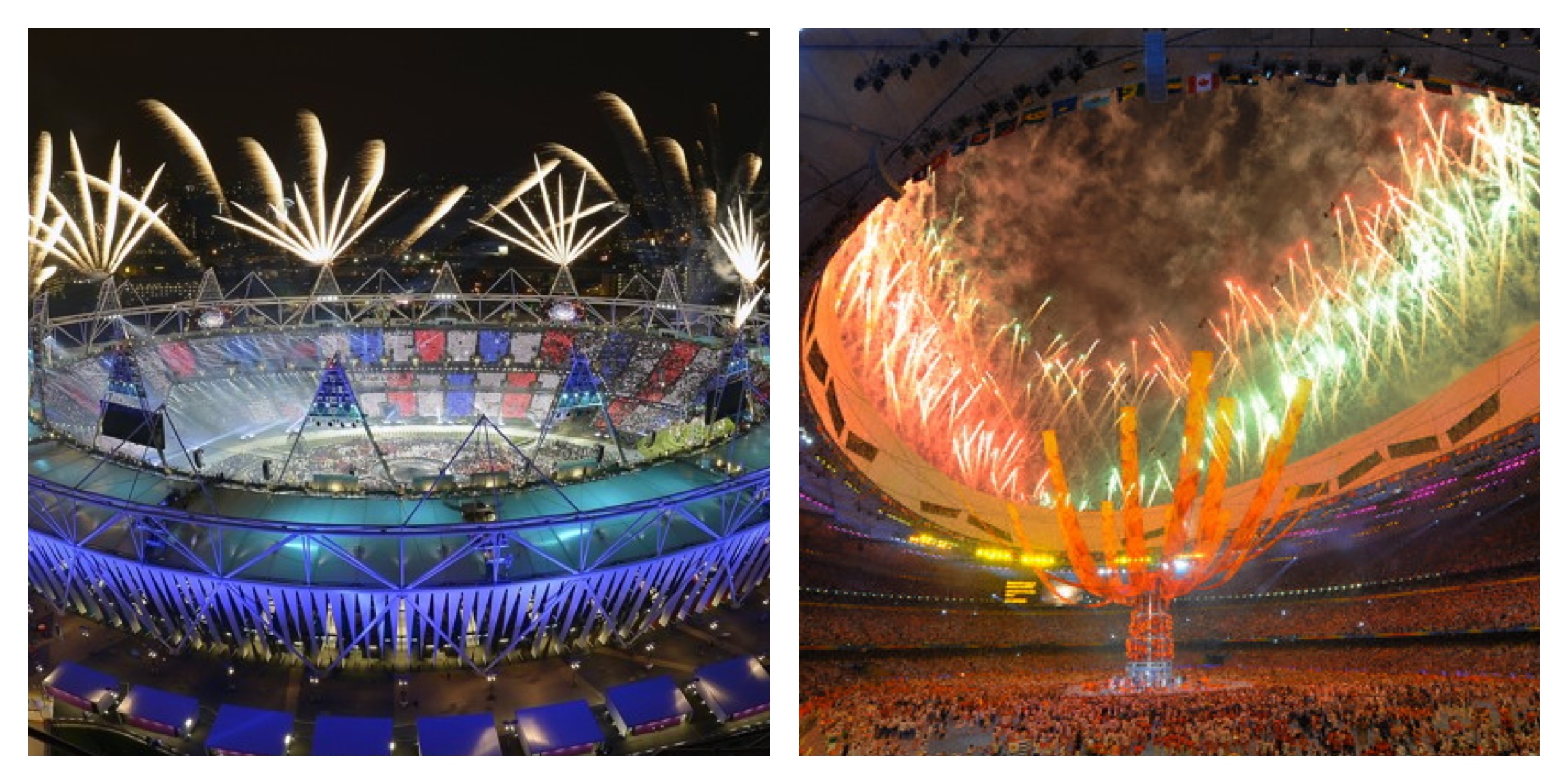
I then saw this image on a news website:
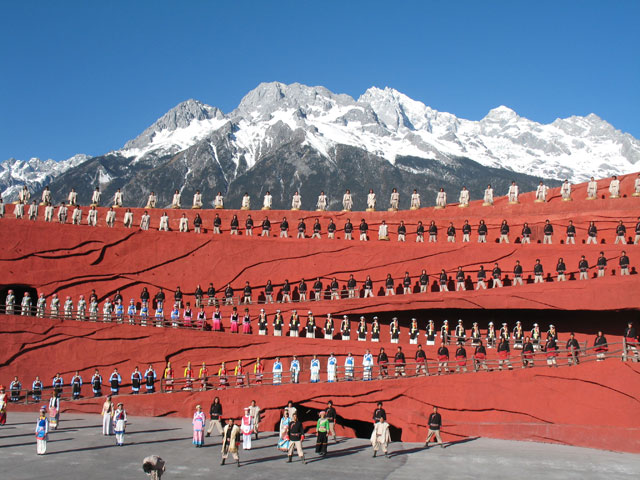 This is Impression Lijiang a cultural show demonstrating the traditions and lifestyles of the Naxi, Yi and Bai people of China’s Yunnan province. The show takes place inside Jade Dragon Snow Mountain Park at 3500m in an outdoor theatre specifically designed to showcase the mountain which is used as a backdrop. The production itself was designed by Zhang Yimou, famous Chinese film director and organizer of the opening ceremonies at the Beijing Olympics, with a cast of over 500 people, and a number of horses. Apparently, it is the highest altitude performance ever staged!

However, the show does not have a plot. So is it theatre? The rave reviews on TripAdvisor would seem to say it is. A few years ago I saw The Edinburgh Military Tattoo – is that theatre? Is it World theatre, as it draws ‘performances’ from right across globe? What about Songkran in Thailand, Onam in Kerala, India or Thaipusam in Penang, Malaysia?
Of course Peter Brook famously says in The Empty Space:
I can take any empty space and call it a bare stage. A man walks across this empty space whilst someone else is watching him, and this is all that is needed for an act of theatre to be engaged
I don’t know the answer, but it has got me thinking. It’s also tied up with teaching Artaud and the Theatre of Cruelty and the place of ritual within that…….but that’s another post, for another day!
Just to add to the discussion I’ve tweeted an old blog post from Lyn Gardner on this debate…..great minds and all that!
So wrote Lyn Gardner on her theatre blog today. Basically she was raising the question about just how much creative input an actor has today in the commercial theatre world. You can read the full article here and I’ve Tweeted it too.
I find the notion that actors are merely puppets of the ‘creatives’ utterly offensive (as does Gardner). Having said this, the whole argument does raise the question about whether acting is art or craft and this I do find worthy of thought and discussion. So I’d like to share a series of videos from a couple of years ago where Colin Firth, Morgan Freeman, Nicolas Cage, Christoph Waltz and others discus just that question.
.
I think Samuel Beckett put it best:
To find a form that accommodates the mess, that is the task of the artist




 Theatre Room Asia