Speak Up!

A couple of posts from me today. Firstly this article published in The Observer today. Written by Dayla Alberge, it is a bit of a tirade from two leading figures in the theatre world who consider that language is being mangled on stage in bid to imitate American film stars – and audiences are being let down.

mumbling

Imogen Stubbs hits out at mumbling actors

Too many actors mumble their way through their lines, neither enunciating nor projecting words clearly enough for audiences to understand them, according to leading figures in theatre.

Edward Kemp, artistic director of the Royal Academy of Dramatic Art (Rada) and actress Imogen Stubbs are infuriated by the mutterers, who they believe let down playwrights and audiences. Kemp said that some directors and producers encouraged mumbling, believing that “laidback mumbling is more truthful”.

Stubbs, who has appeared in scores of stage roles, including the part of Sally Bowles in Cabaret and Desdemona in Othello as well as film and television dramas, added that muttering – with its lack of variety and tonal interest – was perhaps a misguided attempt to imitate American film stars. “It was so drummed into us at drama school that ‘it’s unforgivable not to be clear and heard’,” she said.

The problem is so serious that Kemp fears “plays of language” – including works by Shakespeare, Wilde, Coward and Pinter – could eventually become so opaque that audiences will stay away. Already, he said, “we are on a knife-edge with Restoration comedy … It’s hard to find people who can teach and direct it”

Kemp and Stubbs regularly encounter stage mumblers. Kemp said: “There’s usually someone [about whom] you think, ‘sorry, what?'” Stubbs appeared in one production where she even found herself having to lip-read a mumbling co-star.

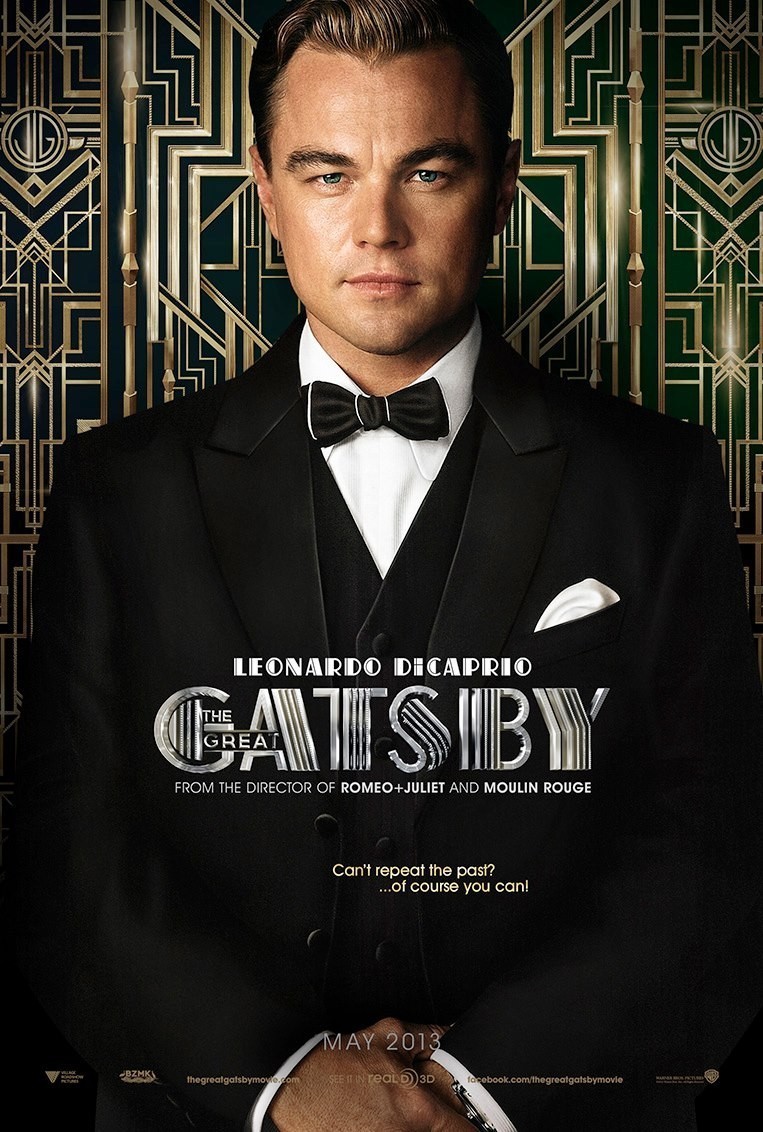
Although their criticisms focus on theatre, they are also irritated by mumbling in film and television, including Baz Luhrmann’s The Great Gatsby. Stubbs, a Rada council member, questioned whether Luhrmann had heard of commas or full stops.

2013-04-The-Great-Gatsby-Poster-7

“You’re just longing for it to stop and breathe. I thought the actors looked embarrassed. They were rather garbling their lines.”

Kemp, also a playwright, feels that part of the problem lies in actors being encouraged to improvise scripts, delivering “something like [what’s] on the page”, rather than the writer’s finely crafted original. “A lot of directors want you to jazz it up,” he said. The demise of repertory theatres has robbed young actors of opportunities to learn the craft of using the voice, while typecasting has also taken its toll, Stubbs suggested.

“The naturalistic, mumbling acting style tends to go with people who are playing something closer to their obvious self … People who are playing against their obvious self tend to embrace the acting a bit more,” added Stubbs.

While keen to acknowledge the excellence of some young actors, Stubbs senses that others are terrified of being caught sounding “like an old-fashioned actor”. But she added: “Acting is playing. You are pretending. Simon Russell Beale or Alex Jennings are theatrical actors who are naturalistic. You can hear them and people love them.”

Part of the problem also lies in the education system. Teenagers leave school unable to understand what they are asked to read, with no apparent relationship with language, let alone a sense of how to shape it, Kemp said. There is no longer a guarantee that even someone with an English degree from a leading university could handle this stuff, he added.

“We’ve had to change our training to adapt to teenagers [without] the faintest notion of basic grammar,” he said. He had a first-year student with English A-level reading a Shakespeare sonnet. “It made no sense to me whatsoever. I said, ‘can you just read out the nouns to me?’ He had no idea what a noun was.”

Rada has introduced grammar classes because of this problem. Kemp spoke of one student – an Austrian – with a finer appreciation of English grammar than a room which included at least one Oxford graduate.

Audiences are voicing frustration online. Stephen Dillane is among actors whose mumbling has irritated them.

the-tempest-006

“Dillane has been Mumbleman for years,” one wrote. “I caught Dillane’s Prospero at the Old Vic, like the rest of the audience couldn’t hear a word and was bitterly disappointed,” wrote another. “I still went along to see him at the Almeida in Masterbuilder but again, he was in a world of his own, totally pre-occupied with his own performance – absolutely no connection with the audience and worse, giving nothing to his fellow actors.”

Older actors draw on the subtleties of pitch, timbre and tempo – crucial for big spaces, yet they have “gone out of the culture”, Kemp said, with today’s actors relying on volume. “You can’t stress through volume, you have to stress through other things … I don’t always struggle to hear, but I do often struggle to understand. There’s the audibility thing and there’s the connection thing.”

Of course, every actor mutters sometimes, and Stubbs joked that her criticism could come back to haunt her.
Theatre Apps

Something a little different today.  I’ve been looking at what’s available in the iPad app store for theatre people (free and paid for), and there is a surprising mix so I thought I’d share a few of them with you.  First my favourite in terms of design:

Evernote Camera Roll 20130519 141459Played in Britain: Modern Theatre in 100 plays, 1945-2010

This is a beautiful interactive book that looks at plays that have been performed in the UK from 1945 to 2010. It isn’t just about British plays either – any thing that was performed during that period.  Reviews, interviews, production photographs and so on. Suffice to say I bought it.

.

Basically just an ebook, but beautifully illustrated, on the history of Chinese theatre.

Chinese Theater for iPad

Evernote Camera Roll 20130519 141443.

.

.

.

.

.

.

For you techies out there are a number of magazines you can get for free:

Lighting and Sound America

Evernote Camera Roll 20130519 141457.

.

.

.

.

.

.

Make-up Artist Magazine

Evernote Camera Roll 20130519 141446.

.

.

.

.

.

.

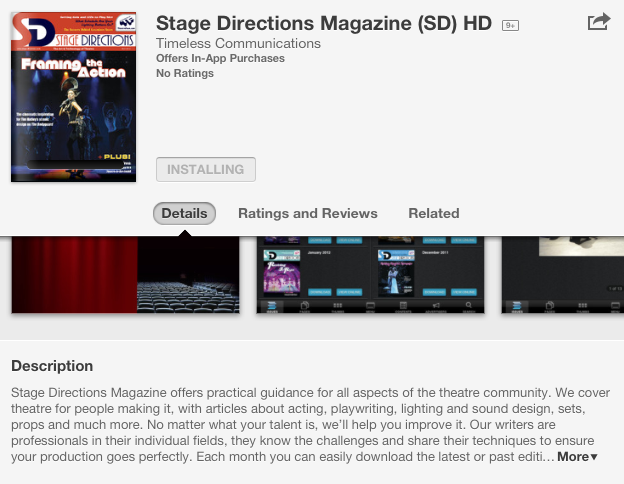
For all things techie Stage Directions Magazine

Evernote Camera Roll 20130519 141454.

.

.

.

.

.

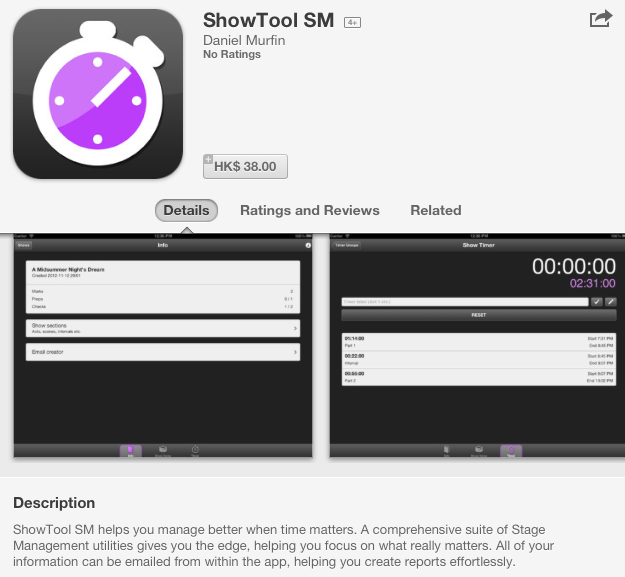
Now this is a super organisational app for stage managers, ShowTool SM

Evernote Camera Roll 20130519 141452.

.

.

.

.

.

.

An app to write plays with called, not surprisingly, Playwriter

Evernote Camera Roll 20130519 141440.

.

.

.

.

.

.

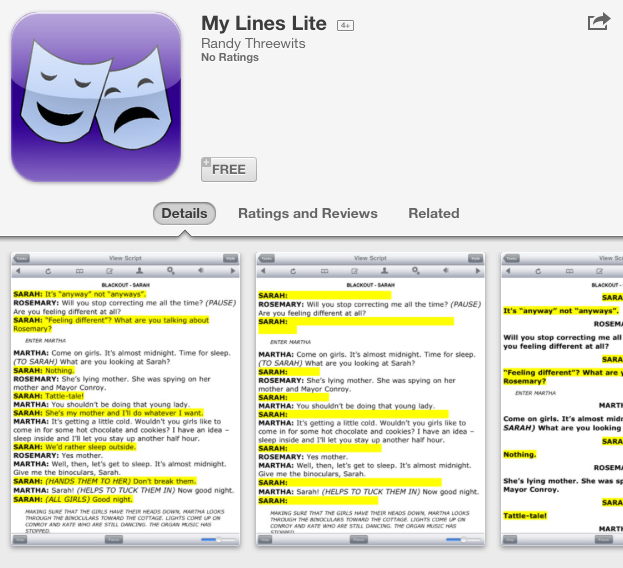
Now there are a few line-learning apps out there. This is one of the free ones, My Lines Lite

Evernote Camera Roll 20130519 141450.

.

.

.

.

.

.

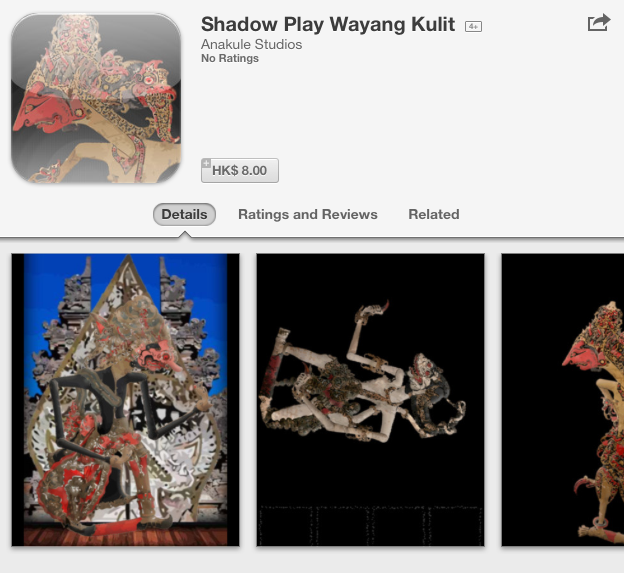
And finally a series of free little apps that bring various forms of Asian puppet theatre to the iPad, Shadow Play Wayang Kulit

Evernote Camera Roll 20130519 141445.

.

.

.

.

.

.

Voices from the Heavens

Oh my goodness.  Every now and again I stumble across an amazing web-based resource that makes me wonder how I had managed to miss it before. I’d like to introduce you to:

CaptureIt is what it says it is – an archive of recorded interviews with theatre practitioners of all kinds. It was started in 2003 and is now supported by various museums and drama colleges with a growing archive of material which will be preserved for posterity.  All the recordings are tagged extensively, so it is easy to find things that are relevant to you. Click the banner above to access the homepage.

150257108_bf938d9394_mI’m going to start off by sharing an interview with Yang Quin and Mary Anne O’Donnell who are the two founder members of Fat Bird Theatre Company. They talk to Mary Mazzilli about what it’s like to make theatre in Shenzhen-Guangdong, the oldest and fastest-growing Special Economic Zone in China. This is the only independent theatre company that promotes experimentation and internationalism; they focus on social changes and are dedicated to transforming Chinese theatre through experimental workshops, guerrilla performances and stage drama. You can access the recordings here.

Classified

My musings on what consitutes theatre continue and it would seem I am not the only one.  My favourite theatre writer, Lyn Gardner, wrote this piece last week.  While it is about the performance scene in the UK, she makes her point clearly.

Don’t box me in: why label art forms?

Is it theatre? Dance? An installation, or a pop gig? Artists are smashing boundaries – and audiences are keen to explore

Over the last couple of weeks, I’ve been to Wales to see Tir Sir Gar, which was as much tea party and installation as theatre, and Praxis Makes Perfect, as much immersive pop gig as immersive theatre. I saw Hofesh Shechter’s brilliant early works Uprising and the Art of Not Looking Back – quite clearly dance pieces. Or were they? Much of the choreographic language would be both familiar and thrilling to anyone interested in contemporary experimental theatre.

Capture1

I also went on a self-guided walk (I self-guided into a bollard) around London’s Covent Garden, during one of Scary Little Girls’ and Naomi Paxton’s Living Literature Walks, which encompass live performance along the way. Was it a literary walk, or was it a theatre show that simply used the city and buildings as a vast stage-history soaked backdrop to explore the work of the Actresses Franchise League? Then there’s NoFitState’s circus show, Bianco which is currently touring across the country. Theatre, dance or neither? Oscar Mike’s the Situation Room. Game or theatre? Daniel Bye’s The Price of Everything.

Capture3

Performance or economics lecture? Does it even matter?

Boundaries are being swept away and so are the expectations of audiences who are much more likely to be cultural nomads than they were just few years ago. The internet means that we are all much more likely to know what is happening across the arts and not just in our chosen art form. Even the old allegiances to venues are dying away, particularly when the most exciting events are as likely to take place in a warehouse or old building as they are in an opera house or purpose-built theatre.

Punchdrunk’s co-production of The Duchess of Malfi with ENO [English National Opera] may have been called an “opera”, but I bet that most of the audience didn’t much care. As far as they were concerned it was Punchdrunk, and it was this that drew them to Great Eastern Quay, just as The Drowned Man will draw thousands to the formerly secret location just next to London’s Paddington station.


Capture2Many of those may not even think that it’s theatre.

For other audiences, Neon Neon was the obvious draw for National Theatre of Wales’s Praxis Makes Perfect, which is touring later this month again, but for others it could be the involvement of director Wils Wilson or playwright Tim Price. It is the artists that increasingly engender loyalty, not the institution that produces them. And whether it’s called dance or theatre or opera doesn’t really concern the audience, and may even get in the way of them giving it a try.

But many newspapers and websites – including the Guardian – still classify and review by art form; Arts Council England still mostly funds on that basis; and many companies and buildings still define themselves by a predominant art form and pigeonhole events by art category. In the 21st century much of the most interesting work being made completely defies categorisation. That’s exactly what makes it so thrilling. So why continue to try and box it in?

It’s worth checking out the posts that followed her article for a few other perspectives


The gweilos are coming…

Interestingly, after writing my post yesterday, what should pop up in my twitter feed, but an article about the developing theatre culture in China – one that is driven as much by the growing popularity of western commercial theatre as the want to save the more traditional chinese forms.

…….the Chinese are particularly good at in the arts is that they get things done really quickly – they’re building concert halls, theatres and museums at a rate of knots…..

Beijing National Grand Theater, The Egg, Tiananmen, Beijing, China

The image above is of National Centre for the Performing Arts in Beijing – beautiful – and the one below is the architect’s rendering of Shanghai Oriental Arts Centre

oriental_art_centre

Mandarin versions of Mamma Mia! and Cats have staged almost 500 performances combined, playing across 19 cities and grossing millions of pounds at the box office, while negotiations continue for Chinese-language tours of The Phantom of the Opera and Les Miserables.

It will come as no surprise that I find this lamentable – is that all the West can export in terms of a theatrical tradition? I’m hoping that it is simply a way of getting a foot through the cultural door that will allow much more worthy work to follow.

I was slightly heartened by a quote from Nick Rongjun Yu, deputy general manager at the Shanghai Dramatic Arts Centre:

For young people, theatre has become part of their mainstream culture. Spoken theatre is gaining bigger audiences……. there is an increasingly diverse range of plays translated from English to Mandarin, including adaptations of Shakespeare….and The Woman in Black.

I’ll leave you to read the article in full here and make your own mind up!

Brazilian Style

One of the problems of being a World theatre teacher who only speaks one language fluently (much to my shame) means there is a significant section I miss out on. So I was delighted to come across an article in The Stage by Ian Herbert about Brazilian theatre.

Stage-it-on-Rio-630x310My only real reference point in Brazilian Theatre prior to this was Augusto Boal and his Theatre of the oppressed.

.

Herbert’s article makes for interesting reading on a number of fronts, not least about how theatre is funded in Brazil, especially given the cuts in arts funding across the world in the light of failing economies. I reproduce an edited version here and have tweeted it in full.

Focus on Brazil

The first thing to note about Brazil is its sheer size. Its population, nearing 200 million now, occupies an area into which the European Union would fit comfortably. A closer look shows that the country’s huge population is concentrated in a few major cities – and its theatre activity can be narrowed down yet further.

Recent statistics suggest Brazil has more than 1,200 theatres, of which more than half are in the three big centres of its south-east region – Sao Paulo, Rio de Janeiro and Minas Gerais. Apart from a number of festivals in smaller cities ………. the main thrust of the country’s theatre activity is here. Rio’s 200 or so theatres benefit from the city being the centre of Brazilian TV, where the huge chain Globo produces telenovelas – local soaps that are now seen worldwide. But although Rio has the benefit of a large pool of film and TV actors available for its theatres, it is in Sao Paulo, with 300 theatres serving a population of 20 million, that the real action lies.

Theatre as we know it came relatively late to Brazil, although the 16th-century Jesuit Father Jose de Anchieta is credited with some religious entertainments. It took off with the arrival of the Portuguese royal family in 1808, and by the arrival of independence was already developing the bourgeois comedies that were the forbears of the tele-novela. Theatre was a focus for resistance to the dictatorships under which the country laboured for much of the 20th century.

Two Sao Paulo groups in particular, Teatro de Arena and Teatro Oficina, which were both banned in 1968, produced some of the leading figures in contemporary Brazilian theatre, including Antunes Filho, whose Macunaima stunned London in 1983 with its bare-breasted dancers. Antunes, at 80, is still working today, his latest production being a revival of a play by another great name in Brazilian theatre, Nelson Rodrigues.
The funding of theatre, like the other arts, is supported by the Rouanet Law, a peculiarly Brazilian institution that since 1991 has given companies tax breaks in return for cultural investment…….

On the face of it, the population gains enormously – Brazil has hosted a series of major art exhibitions, for instance, most of them free to the public. But the indiscriminate apportionment of private [money] means that the most popular events attract the most money. Recently, the Kings of Leon received £4 million towards a three-month season in one of Sao Paulo’s biggest theatres. This blurs the distinction between commercial and art theatre – shows like The Lion King….. playing now in Sao Paulo, are just as eligible for backing as The Wooster Group, which is also in town.

Many of the country’s theatres are in fact part of prestigious, well-appointed arts centres, which may be owned by big business. There are also private foundations – I visited one of them, the Instituto Cultural Capobianco. It is set in a rather seedy street, but the inside of the building is beautifully restored. I found a friendly basement bar and two well-equipped studio theatres, the smaller of which was occupied by a cast of 12 and three musicians performing to a full house of 50 people.

The Wooster Group was playing in one of the many venues operated all over the country by the independent centres of SESC, which translates as the Social Service of Commerce. SESC gets its huge income of £400 million from [the tax player], and uses it to provide social centres for workers that equate to rather opulent branches of the YMCA, with restaurants, pools, libraries and entertainment halls. As much as 20% of the SESC budget goes to culture. The body is far more important to the theatre community than Funarte, the country’s equivalent to the arts council, which operates a few theatres and tries to be an enlightened voice for cultural policy. Both are at present heavily involved in the preparation of a new cultural law, which may see more centralised distribution of funding through the capital, Brasilia.

Sao Paulo has another law peculiar to the city – the Lei de Fomento or Law of Encouragement, which gives smaller independent groups a chance to flourish alongside the commercial sphere. Up to around £250,000 each, spread over two years, can be given to some 30 local groups – not for individual productions but for more general ‘research’. The money is distributed regardless of which party is in power……….. Not surprisingly, the number of small groups in Sao Paulo theatre has mushroomed since the law was passed in 2002…………You’ll find two productions of Martin McDonagh’s The Pillowman, two of Strindberg’s Creditors, and a complete cycle of Aeschylus.

In spite of all this, it has to be admitted that theatre in Brazil is still very much a minority pursuit, not the popular platform envisaged by the great Augusto Boal, who is almost unknown to modern Brazilian audiences. Nonetheless, fine work is being done, notably by site-specific directors such as Antonio (‘To’) Araujo, whose latest work involves a helter-skelter journey through the streets and shopping malls of Bom Retiro, a Sao Paulo district…….[seen] as the city’s arrival point for immigrant minorities.

Brazil’s real popular theatre is, of course, carnival, which flourishes all over the country as never before.

Rio_Carnaval_2011_035_-758828

Interestingly, Herbert’s last point links nicely with my last post about what constitutes an act of theatre……….

Are actors just puppets?

So wrote Lyn Gardner on her theatre blog today. Basically she was raising the question about just how much creative input an actor has today in the commercial theatre world. You can read the full article here and I’ve Tweeted it too.

I find the notion that actors are merely puppets of the ‘creatives’ utterly offensive (as does Gardner). Having said this, the whole argument does raise the question about whether acting is art or craft and this I do find worthy of thought and discussion. So I’d like to share a series of videos from a couple of years ago where Colin Firth, Morgan Freeman, Nicolas Cage, Christoph Waltz and others discus just that question.

.

I think Samuel Beckett put it best:

To find a form that accommodates the mess, that is the task of the artist

TDF Stages: A Theatre Magazine

I have just found a great little resource of a website called TDF Stages.  It is essentially New York based but has lots of interesting bits and pieces on it, such a Theatre 101, a video guide to everything theatre (check out the one on theatre etiquette) and categories such as set and costume design.

Click the image below and it will take you there:

Capture

In Too Deep?

In the interests of balance, I thought I would share an article today written by Alice Jones in The Independent in which she argues against the value and experience of immersive theatre. I don’t agree, however………..

Is theatre becoming too immersive?

Alice Jones has been put on the spot by actors time and again – and she’s sick of it


I had been in New York for less than 24 hours when my sister abandoned me in a warehouse. “I’ve got to find the naked rave,” she whispered, eyes crazed behind a white beaked mask. And off she went. I didn’t see her again for three hours.

It would be nice to say that this kind of thing doesn’t happen very often but it does. These days, if you’re a keen theatre-goer, it’s almost unavoidable. That’s why we were in the warehouse – we were at the theatre. At Sleep No More, to be precise, Punchdrunk’s trippy take on Macbeth, which unfolds over five floors and across 100 rooms of a former lock-up/ nightclub on West 27th Street. Audience members are handed a carnival mask (to remove inhibitions) and shoved into the labyrinth where they are expected to poke around graveyards, bedrooms and apothecary shops, follow characters into darkened corners and spy on them as they enact ghostly banquets and sinister masques. My sister had already seen the show once, a fortnight earlier, when her friend had emerged at the end enthusing about a naked rave in a secret room. This time she was determined to find it for herself. Once again, she didn’t. Neither of us did.

theatre

I wasn’t in the least surprised. The truth is, I am awful at site-specific theatre, promenade theatre, immersive theatre, any kind of theatre, really, which doesn’t involve sitting in a seat and watching without moving or talking. It’s not for want of trying. Since Punchdrunk kicked off the trend for “Choose Your Own Adventure”-style plays with their brilliant Masque of the Red Death at Battersea Arts Centre in 2007, I have been to shows in every imaginable location, from beach huts to nightclubs, playgrounds to camper vans, and been cast in any number of roles. I’ve posed as the new girl at school, a hotel guest and have sat through countless faux job interviews. I’ve been illegally trafficked in the back of lorry and trapped in a basement brothel. I’ve shivered around too many railway tunnels to mention imagining them to be a damp Denmark/Hitchcock movie/dystopia. I’ve even had a play about an Avon Lady staged in my own sitting room.

WOTW 1_905

And yet, I still lack flair. My latest flop came at dreamthinkspeak’s new show, In the Beginning Was the End, which takes place in the back corridors of Somerset House in London. Before the show, a solemn usher hands out a laminated sheet warning of low lighting, a lack of toilets, nudity and possible claustrophobia. They might have added SSA, or Site Specific Angst, that woozy, stomach-clenching feeling you get when you embark on a show and have no idea what is going on, what your part in it is supposed to be, where you should put your coat and when it will end.

In fact, In the Beginning is one of the more guided experiences. There is a fairly clear route to follow and no secret rave (I don’t think). There is still, though, a fair amount of aimless wandering, of staring into empty rooms and gingerly opening cupboard doors in the vague hope there might be a performance lurking within. There is still the very real risk of watching an usher for ages in case he turns out to be a Main Character (he didn’t). Pace is another potential pitfall. “The average journey time takes approximately 70 minutes, but you may go at your own pace,” states the laminated sheet. And if you get round in 55 minutes? Does that make you a bad audience member?

It’s difficult to give yourself over to theatre when your over-riding emotion is anxiety. Anxiety that you’re not seeing the crucial key that will unlock the piece; that you’re looking too hard at something that means nothing; that you might have to get involved at any moment; or that you’re missing out on something more exciting happening in another room. Too many times I have left shows only to discover that the best bit was a secret room I never found or a whispered encounter in a hidden phone box to which I was never privy. The feeling is disappointment mingled, it has to be said, with relief.

SAM_1972

Theatre that busts boundaries can be thrilling. Dreamthinkspeak’s Cherry Orchard, set in a derelict department store, was a spine-shiveringly beautiful update. Roadkill which took Traverse audiences on a journey to a tenement alongside a trafficked girl was harrowing and powerful. An evening being chased around The Pleasance by zombies in The Institute was one of the most frightening Halloweens I’ve ever had. In these cases, being immersed enhanced the show.

Too often, though, the experience is disorientating and audiences are expected to work harder than the cast in order to grasp the play. Some may enjoy the challenge: in New York, I saw people trying to talk to mute characters and elbowing their way into dance routines. That’s the problem – audiences are far harder to direct than actors. Amateurs are unpredictable; they might go wild with solipsistic glee, thrusting themselves centre stage, or they might shrivel up with shyness.

I’m not a natural performer; some might say that’s why I’m a critic. Certainly if I had to review my own performance in these shows, I’d be a two-star at best. So I’ll keep trying, but in the meantime I’d rather leave it to the professionals to take me on a journey, preferably without me having to leave my seat.


Igniting Passions

For those of you that read my blog regularly, you know I have a fascination with site specific theatre. Today I’ve been reading about a extraordinary project by the National Theatre of Scotland, who are renown for works that push boundaries.  This new work, that is currently still ‘in progress’ struck a particular cord as it has the place of cars in our society at its heart. As someone who calls Hong Kong home, where the car is king, despite having one of the best (and growing) public transport systems in the world, I thought I would share it with you.

Evernote%20Camera%20Roll%2020130324%20161620

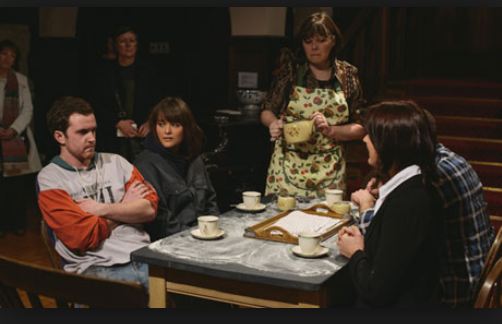
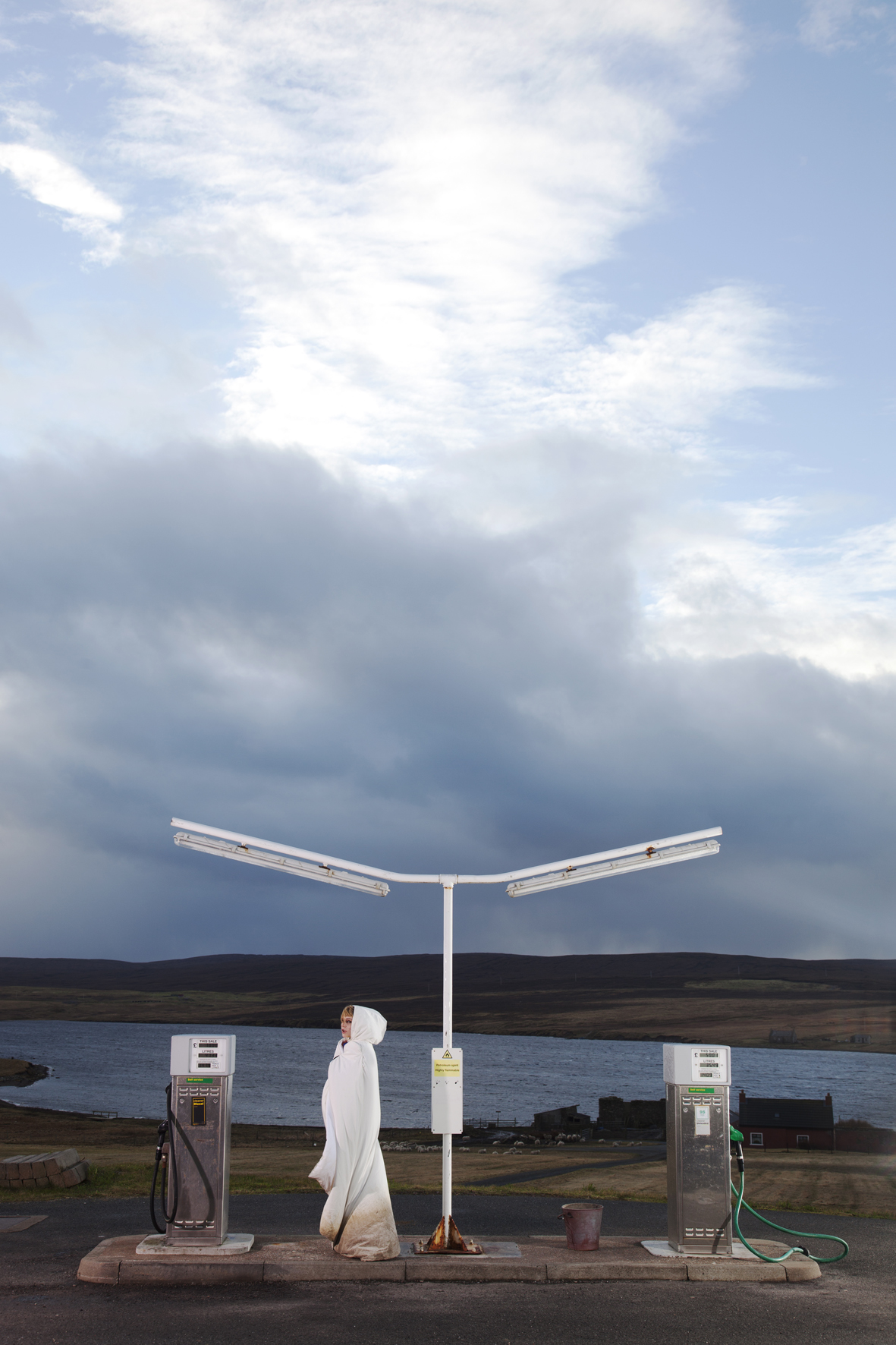
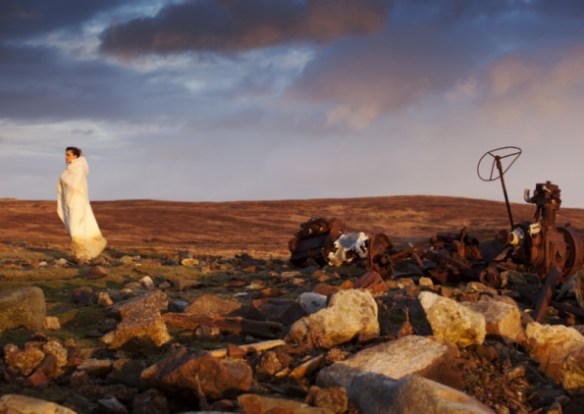
The piece is called Ignition and is set and takes place in the Shetland Islands in Scotland.The idea for Ignition grew from the death in a car crash of a young man called Stuart Henderson. It slowly developed into a project exploring the Shetlanders’ relationship with oil and the combustion engine. It has resulted in this joint creation, developed over the past over six months, by National Theatre of Scotland and Shetland Arts with members of the Shetland community. What makes it extraordinary is the way hundreds of individual stories (many gathered by Lowri Evans, dressed as the “White Wife” of folklore) meld into experience that everyone can recognise, identify with and participate in – rather in the way that you sometime see one big image made up of thousands of tiny photographs  (selection and combination by dramaturg Rob Evans). But, because you are part of the event, you are also making your own picture as you go along. The fire that lights Ignition is, it turns out, the seemingly simple blending of other people’s lives into our own and opening both into something universal.

ignition

By way of explanation, here is a quote from the NTS’s website:

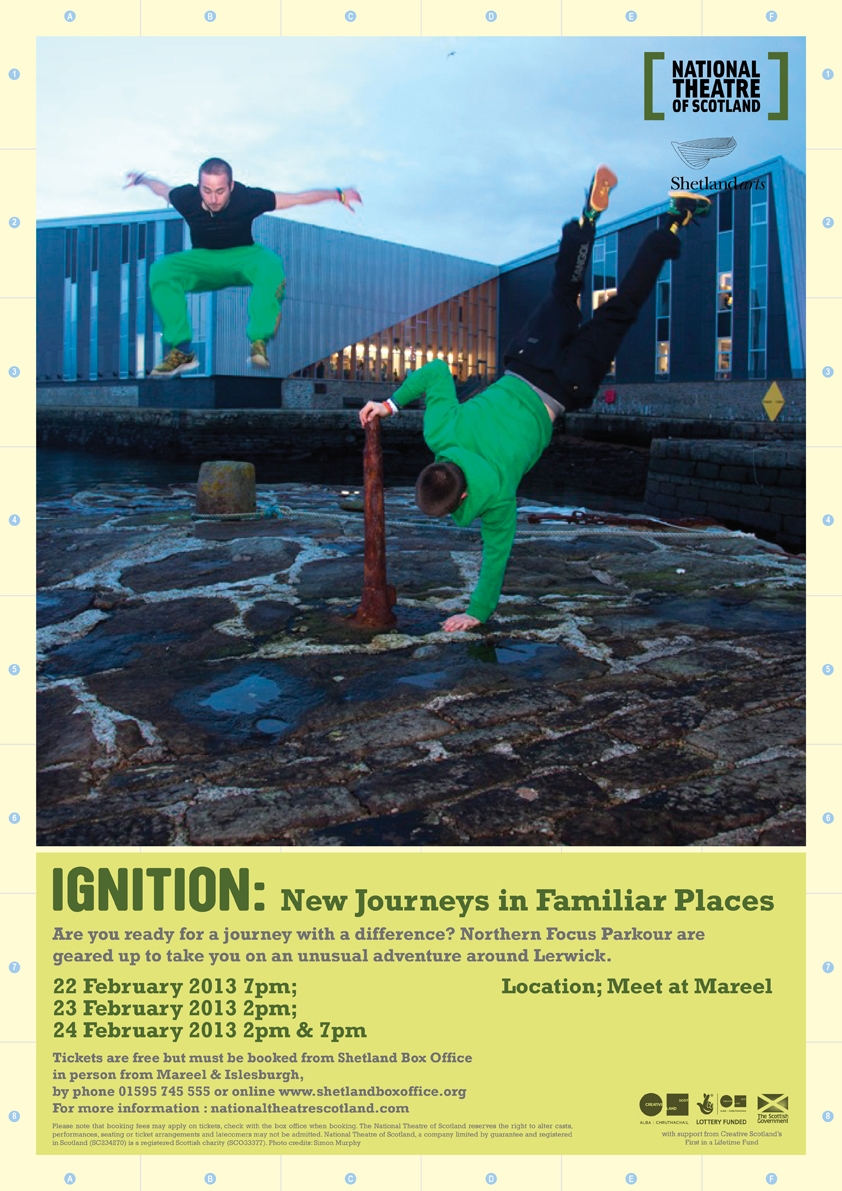
Over the past six months, the National Theatre of Scotland has invited all of Shetland’s inhabitants to explore our bittersweet relationship with the automobile – how it shapes us, defines us, supports us, frees us, challenges our attitudes towards our dwindling resources and, sometimes, kills us. You have told us your stories and now we are ready to take you on the Ignition journey. Set in three locations across Shetland, the site-specific Ignition performances will carry you away on a shared car adventure. The stories will transport you to one indoor and two outdoor locations. At these locations you will see, hear and be a part of the stories that have been collected in the course of the Ignition project. Stories of Shetlanders who have given the White Wife a lift, knitted panels for the Car Yarns car, helped create the music written about the road from Sumburgh to Skaw, taken part in a Sunday Tea conversation, told us their secrets in the Car Confessional, or just taken time out to tell us their car stories. After ten thrilling days of immersive car-theatre between 20th and 29th March, Ignition culminates in a short, but unforgettable, one-off finale for all the Ignition audiences on 30th March in a stunning outdoor location in Brae. The stories will be experienced through exhilarating drive-in theatre, the movement discipline of parkour, music, hitchhikers, dance and text, and will take you on a journey that you will never forget.

If you click the image below, you can watch the BBC report on Ignition

Evernote%20Camera%20Roll%2020130324%20161631

NTS have also recorded a couple of videos about the project and you can watch them here:

and here:

Have a read of some of the reviews here – from The Scotsman, The Telegraph and The Guardian.

The National Theatre of Scotland’s own blog gives you a real feel of the whole creative process behind the project.

Evernote%20Camera%20Roll%2020130324%20161622