The Churchillian Way

Today I am reproducing an article that appeared this week in the UK Guardian. In it, Mark Lawson speaks to people who have worked with playwright Caryl Churchill over the course of her prolific career.  At the beginning of September I wrote about Churchill in a post called On Cloud Nine which is essentially about her incredible  theatrical legacy. One of the things that makes Churchill even more fascinating is that she never speaks publically about her work, hence this article talking to those who have worked with her over the years.

Caryl Churchill, by the people who know her best

Her plays arrive fully formed – and she refuses to talk about what they mean. Mark Lawson talks to actors, directors and her publisher about what really makes Churchill tick

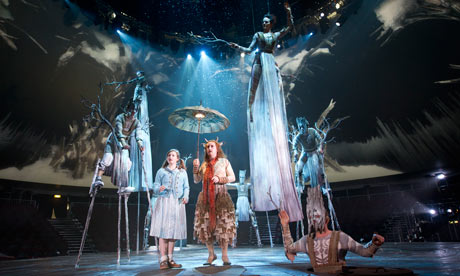
Since the death of JD Salinger, one of my biggest regrets as an interviewer is that Caryl Churchill declines to speak publicly about her work. It’s a resolution she has stuck to through the quarter century in which she has established herself as one of theatre’s most innovative and provocative dramatists. Tantalisingly, there have now been two new plays within a month that journalists can’t ask her about: today, the Royal Court in London premieres Ding Dong the Wicked, a half-hour drama that will run alongside Love and Information, the enthusiastically reviewed full-length play that opened there three weeks ago.

In the light of Churchill’s silence, I talked to a number of people who have worked with her instead. Flexibility, it rapidly emerges, is a key quality for her collaborators. The plays about which the writer won’t speak tend to emerge out of silence themselves. Nick Hern, who has published Churchill’s plays for 40 years, first at Methuen and now at his own company, NHB, says: “The plays just turn up, without warning. I think she’s one of those shamanistic writers, in the way Harold Pinter was. A play isn’t planned or premeditated; it’s scratching an itch. They come to me – originally in the post, now by email – and I sit down to read them, having absolutely no idea what the length or subject matter or form will be.”

John Tydeman, the former head of BBC radio drama, has directed half a dozen Churchill radio plays, starting with Lovesick in 1966; he also staged her play Objections to Sex and Violence, at the Royal Court in 1975. Even as a young writer, he remembers, Churchill was unusual in not seeking payment or contracts in advance. “We never commissioned her. Even with a work that had taken a great deal of historical research, such as one called Schreber’s Nervous Illness, the play would just turn up in the post.”

This is still the case, says Dominic Cooke, artistic director of the Royal Court. “The plays aren’t usually formally commissioned. So, in that sense, they just turn up on my desk. I have no idea what I’m getting.” The late addition to this autumn’s repertoire of Ding Dong the Wicked marks the second time the author has turned up at rehearsal with a second new play. The actor Allan Corduner was rehearsing Ice-Cream at the Royal Court in 1989 when, he says, “Caryl came in and said: ‘I’ve just written another new play. Are you up for it?” Called Hot Fudge, an allusion to the other play, Corduner recalls that this unexpected extra was “rehearsed and staged in record time”.

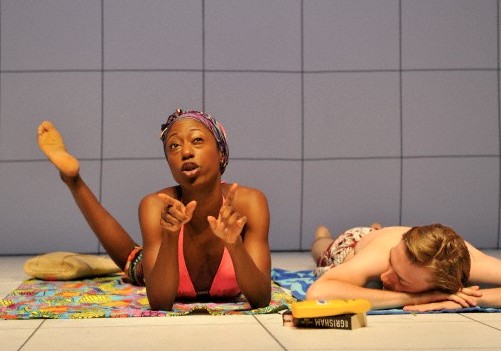
As well as challenging theatre schedules, Churchill’s plays have a long record of testing production possibilities. “The exciting thing about Caryl,” says Cooke, “is that she always tends to break new ground. The degree of innovation is extraordinary. Every play almost reinvents the form of theatre.” And not just theatre: among her radio plays with Tydeman was Identical Twins (1968), in which the title characters were men who, the writer specified, should be played by one actor, Kenneth Haigh, whose speeches would overlap. Decades before digital editing made such effects effortless, Tydeman needed to work with broadcasting’s best technicians. “Kenneth had to record the second speech while we played the first one back, and it turned out that it was almost impossible to do that (keeping pace with your own voice) for more than 30 or 40 seconds at a time. So we had to put the play together in very small takes.”

Churchill’s interest in vocal counterpoint has continued, and tested Hern at Methuen. “We were sitting one day and Caryl said: ‘I want to have overlapping dialogue.’ And I said: ‘Oh, my God, how are we going to do that?’ And we worked it out, using a forward slash, and even put a little example of how it would work at the front of the script. And now it’s an absolutely standard way of laying out a play.”

Even before that, the writer had asked for a specific and unusual layout of her scripts (character names set to the left, with a uniform gap before the dialogue began). Hern’s experience of her polite but precise insistence is echoed in stories from the rehearsal room. Cooke, who directs Ding Dong the Wicked, says: “She is a very strong presence in rehearsals. And there is a combination of being very open to suggestion – she enjoys the process of collaboration – but also of being very specific about what she wants in some cases.”

Tydeman agrees, finding the writer “diffident and quiet, willing to listen to advice but with firmly held views on certain aspects of the text or production”. It’s an experience shared by Michelene Wandor, a dramatist who worked with Churchill on the multi-author cabaret Floorshow (1977); she says that, “while friendly, Caryl kept herself very much to herself”. Perhaps because of her public invisibility, Churchill is often described as shy, but Corduner, who also appeared in the economic comedy Serious Money (1987), has a different reading: “She is so confident about her work that she can discuss it without defensiveness. She’s completely non-dogmatic. During rehearsal, she is absolutely clear-headed about what does and doesn’t work, which is quite rare in writers. She is entirely without ego.”

Tydeman hints at a private stability that underlies this quiet certainty. “One of the things that always strikes me about her is that I think she’s the only person in my address book who is still living at the same house she was living in in the early 1960s.” He has never met Churchill’s husband, David Harter, a campaigning solicitor, but she would often refer, during their working years, to her three sons and “writing the plays at the kitchen table”.

Churchill prefers to discuss form or effects in rehearsal, rather than meaning. “She talks more in general terms,” says Corduner. “She trusts actors and doesn’t want to tread on your territory.” When he was having trouble finding a character in Serious Money, she gently replied that she couldn’t help. But when the actor’s solution involved mimicking Churchill’s own speech – “She has a slight soft-r sound” – she agreed at once. Tydeman says: “We never talked about feminism, for example. It was just there. Caryl’s view was always that the plays would speak for themselves. Which, as you know, is also the attitude that she takes to interviews.”

Ah, the interviews. As I can’t put the question to Churchill herself, I asked her collaborators if they knew why she refused to talk about her work. “I’ve never discussed her refusal to do publicity,” insists Cooke. “We just accept that that will be the situation with each play.” Possibly because, as a publisher, he feels this refusal most keenly, Hern has had the conversation. “Oh, yes. Back at Methuen, I would come out of editorial meetings, having been asked if I could get Caryl to do this or that to promote the books. And I discussed it with her and she said: ‘I really don’t like talking about my work. It makes me self-conscious when I come to write the next thing.’ She said that, if she became analytical about the plays, she was worried that whatever it is that produces them will go away. It was always about creative self-consciousness. It wasn’t: ‘I vant to be alone.'”

Another thing Churchill’s people agree on is that critics focus too much on her structural jumps. “I’m most impressed by dialogue, rather than the form,” says Wandor, “which has, I think, always had uncertainties about it. The elliptical, quasi-poetic quality of the dialogue is the most interesting element.” Cooke concurs: “I don’t think she’s been given enough credit for the quality of her dialogue – the way she captures a situation or a character in just a few lines.”

In the unlikely event that Churchill ever agreed to an interview, one question that might come up would be the fact that – from Tydeman to Cooke, Stephen Daldry and James Macdonald at the Court – she has worked almost exclusively with male directors. “Mmm. Isn’t that interesting?” says Tydeman. “I think at the start it was happenstance rather than choice, because the men were rather in the majority. But it is interesting that it continued.” Wandor says: “I’ve never discussed it with her. But I think it is true that to have had major theatrical success, male directors still seem pretty pivotal, and the management/directing by Max Stafford-Clark [her longterm collaborator at the Royal Court] was crucial to the successes of the earlier work.”

Corduner admits the question has occurred to him. “I have been very conscious of that during rehearsals. But I’ve never discussed it with her. I think, although she’s clearly a feminist and stands for many things feminism admires, she doesn’t judge people by gender. I’ve never detected a yearning to have her work directed by women. Again, it’s that confidence.”

Has her diffidence when it comes to interviews had an effect on her reputation? The final word goes to Tydeman, who says, “I’m talking about working with [Caryl], but I was always struck by how little work was needed. Her plays – like those of Tom Stoppard, with whom I also worked – always arrived fully made. I’d put her up there with Stoppard, although her reputation may be lower than it should be – because she has chosen to stay in the background.”
Out of the Shadows

Today I am sharing an interview from the Huffington Post, between Katherine Brooks and Maria Tri Sulistyani,  founder of Papermoon Puppet Theater, from Indonesia. Papermoon is not your traditional Wayang kulit theatre and the content of their work is even less traditional.  The company uses puppetry to highlight social and political injustices in Indonesia’s turbulent past. What is also interesting is that the article talks about ‘cultural  diplomacy’ – the idea that in order to truly understand someone from another culture, you also need to understand their traditions, history, language and general way of life.

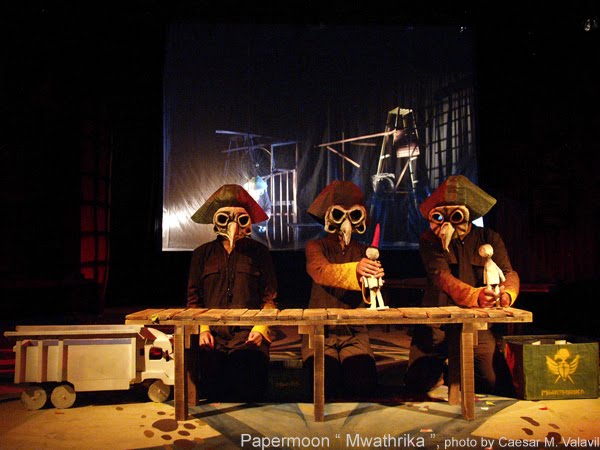
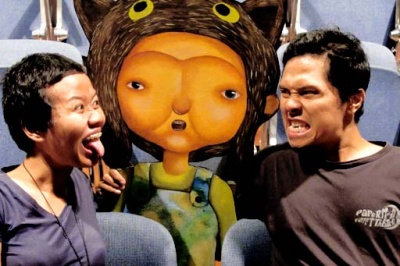
Indonesia’s Papermoon Puppet Theater is taking an art form we often associate with children’s stories and turning it into a vehicle for addressing the country’s dark history. The company, started by visual artists Maria Tri Sulistyani and her husband Iwan Effendi, (left) uses whimsical puppets and multimedia performances to recreate personal accounts of the mass jailings and executions that took place in Indonesia in 1965. They are harrowing stories, meant to shed light on the emotion and complexity of a time period often glossed over in contemporary history.

Papermoon’s performances reveal intimate moments of Indonesia’s past, but the company maintains that a discussion of politically driven atrocities is something accessible to international audiences. And the U.S. State Department agreed, recruiting Papermoon for its Center Stage program that will be touring throughout the country this year. Sulistyani and Effendi will be showcasing their work, “Mwathirika,” alongside ensembles from Haiti and Pakistan, sharing their brand of art as an initiative of cultural diplomacy.

We asked Maria Tri Sulistyani about her beginnings in the world of puppetry, the heavy themes she’s chosen to present and how she thinks art can interact with diplomacy in an email interview:

Can you tell us a little about traditional shadow puppetry in Indonesia? How does your style of puppetry compare?

Wayang kulit (Shadow Puppetry) has been an important art form – especially on Bali and Java – for almost 1,000 years. Its stories of good and evil, of love and death and transformation are most often taken from the Hindu epics Ramayana and Mahabharata. A single dhalang (master puppeteer) manipulates all of the many two dimensional leather puppets from behind a screen (to cast shadows). He also voices all of the characters. It is a virtuoso performance! While reaching back in history to tell his tales, the master puppeteer always makes reference to current happenings. Traditional puppet theater has played an important role in communicating values to communities.

There is also another kind of puppetry – Teater Boneka – that is generally just for children and it is a much less formal. Inspiration for the stories and the puppets come from lots of different influences – even Sesame Street.

The interesting part is that people in Indonesia had never connected these two types of puppetry before. Papermoon makes that link, and this is something new. Our pieces are performed on stages, like a theater play. Several puppeteers are on stage manipulating the puppets. Mwathirika, the piece we are presenting on tour, is really for adults, not kids and is a story told without words, without speaking. But we are telling stories about values, too — about moral choices and conflicts and relating to everyday life. Our stories are really personal and focus on individuals. From there we can see the bigger issues. Though Papermoon is not really creating a performance in the traditional form, we too want to share and talk about the values and ideals and choices of Indonesian people’s life.

Your earlier work, “Noda Lelaki di Dada Mona (A Stain on Mona’s Chest),” used puppets to convey a politically and sexually charged story. What was the reaction in Indonesia to such a performance?

It was very interesting because Papermoon had created performances for children since 2006, and “Noda Lelaki di Dada Mona” was the very first time we created a piece for an adult audience. That was also the first time we sold tickets to a performance, 300 seats, and it sold out!

People were shocked with what they saw. Not just only about the theme, but also by the kind of puppets we performed with, how realistic they were, and how we combined puppets with the actors who spoke as individuals, which had never been seen by people in Yogyakarta. Together with our audience, we started to realize that puppet theater could reach many people, including adults. Instead of having one puppeter verbalize all the voices, we decided each puppeter will speak for his own puppet. I would say that “Noda Lelaki di Dada Mona” was a kick start for Papermoon to do more performances, based on social themes, to communicate with many different types of audience.

In “Mwathirika” you have again focused on more serious accounts, this time of imprisonment and violence. Do you think the use of puppets makes it easier to express these heavy themes? Or easier to digest on the part of the audience?

Yes. For us, puppets are the perfect medium to bring an unexpected moments or difficult subjects to the audience. Puppets always have the image of cuteness, happiness, sometimes scary, but mostly FUN. So when people come to the theater, with a certain expectation of puppetry, they can be surprised, because what they see is totally different from what they thought.

Many people feel like the story of 1965 is already over, it’s expired, helpless, over-researched, or it’s never been heard. By seeing a poster of two little boys with a red balloon, people will think about something sweet. They don’t have fear to come, they feel relaxed, they are open. It’s perfect.

You spoke to a number of people – parents, grandparents, neighbors – who provided their stories for “Mwathirika.” Could you tell us about one story in particular that sheds light on the historical situation in Indonesia?

We asked them about what they felt at those moments in their lives. There was a lot of data, books about the 1965 tragedy, but very few could give insight into their feelings. And by interviewing those people, we could see their eyes, and what they really felt in their hearts – uncover their personal stories.

One of our company member’s uncle, told a story about how he, a 12 year old boy, had to take care of his little brothers and sisters, after their father was taken away by government officials, and didn’t come back for 13 years. He had to catch frogs in the rice fields, for his family to eat. And how the family grew in the middle of these chaotic moments, with children with no parents, and no one in the village dared to help, because if they helped they might be caught by the army too. In Mwathirika, we are not pointing fingers; we are not saying that one person is right and one person is wrong. But we tell a story about the impact of political turmoil on those who lived through those terrible times and the huge effect it has had on the next generation.

Your project has now become a tool for cultural diplomacy, helping to foster greater understanding in the US in particular. How do you view art in the greater scheme of international cooperation? Do you think that art has the potential to bring people together in a way that other diplomatic tools can not?

Yes. What people know about other countries or cultures, is mostly from the media. And it’s usually about all problems of economy, technology, war, conflict, and how to deal with that on a big scale. Of course people need to do big things, but sometimes people forgot how important it is to build a personal solution for the problems. And for us, Art is a personal thing. It’s about how we can reach out one person to another. When people meet, exchange their cultures, see another art from those who live in another country, then they see a different thing, they learn to respect each other. If people can share, talk more about their culture, the respect will go deeper, and hopefully an understanding of each other will be built there. Like we said, Art gets personal. This is where those big actions made by government might not reach.

Last question: Indonesia has become one of the region’s largest markets for contemporary art. How has the art scene changed in Indonesia since the 1960s?

When Indonesia became an independent country in 1945, art was seen as a big strength and unifying force for the country. The government put a lot of attention on the development of the arts. Sometimes, art was also used as a political tool.

In 1965, the art scene was changed by the political turmoil, lots of critical artists were jailed, silenced, disappeared in the violent political battles between the government and the Army. There were three years of chaos. When General Suharto took power in 1968, the government centralized the arts. Artists that had not been caught, and were still active, could develop their careers, but always had to support – promote –the government. And though things loosened up little by little over time, that was really the case up until the 1990s. The government was still very oppressive, and they didn’t want people to say bad things about them.

In 1998 when there were riots in the streets all over the country because of the falling economy, Suharto resigned and things began to change again – to open up and become less centralized. Since then, the art scene is changing (very quickly) again, because of the openness of information through internet, etc.

The video below is about their production Mwathirika.


Propping up the stage

If you are an IB Theatre Arts student reading this you know that we look at the world of theatre through 3 different lenses – Theatre in the World, Theatre in Performance and Theatre in the Making. When we think about the last one, our focus always tends towards the performance element and not everything else that we need to make theatre.

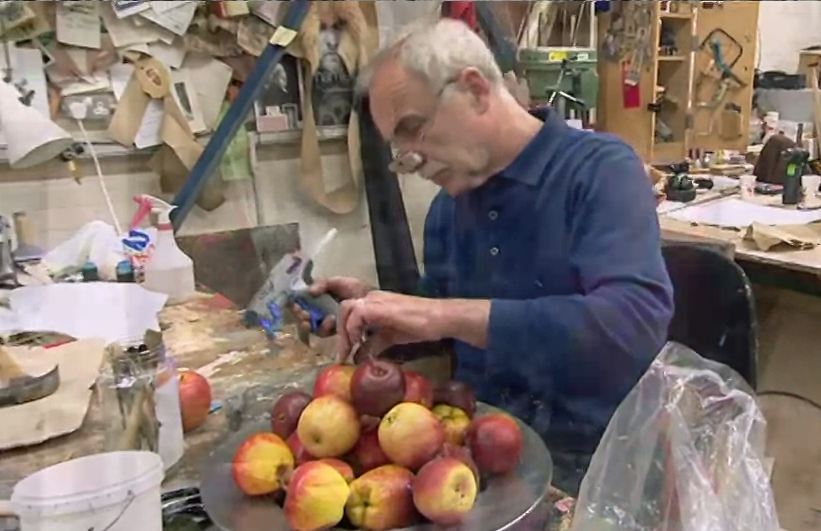
What got me thinking about this was article in The New York Times about a convention of props makers which makes great reading Blood to Rain, in a Bag of Tricks.

These people are real craftsmen and women.  If you ever get the chance to visit a props making workshop in a theatre, go! It is fascinating.in so many ways.

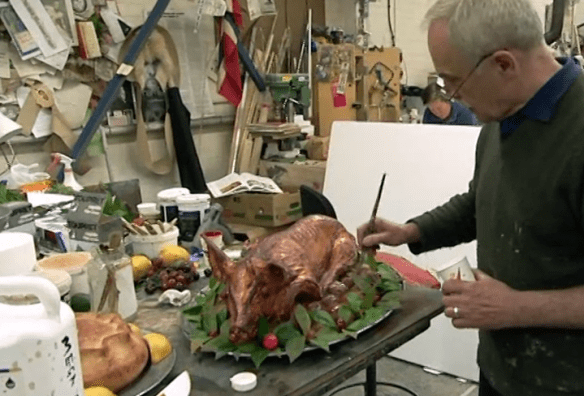
The National Theatre in the UK have a series of videos that are available in iTunesU or on YouTube that cover a whole range of prop making. One of my favourites is the one on food, which you can access by clicking the image below:

All the others in the series can be accessed by clicking the image on the left.  They are really varied and give you a great insight into this backstage world. If you want an even more in-depth view, take a look at this blog Prop Agenda by professional prop maker, Eric Hart. There is also an interview here with Antony Barnett who is Head of Props at the Royal Opera House in London.

“there aren’t bloody well enough parts for women”

In Hong Kong, school is most definitely out for Summer.  So me, my students, my colleagues and this blog will be taking a holiday and, even if I do say it myself, a well-earned and necessary break. Those of you in the Northern hemisphere, enjoy, and for those of you below the equator – you will get your turn!

For my last post for a while, I want share an article with you about the opportunities for women in theatre.  This week, the actors’ union Equity in the UK spoke out, highlighting the need for better employment opportunities for women. It was an act sparked by a well-known and respected theatre’s current season, which includes productions of Henry V and A Winter’s Tale from the all-male company Propeller – a choice of casting that, of course, reflects Shakespeare having written for a company of boys and men.

Propeller are a stunning company who create amazing and compelling work.  I know, I’ve seen them twice in HK and their interpretation of Taming of the Shrew (above) was possibly the best I’ve seen (for another time!). They are often cited in this debate, but I have to say, for me, they are a scapegoat. The situation goes much deeper (and back in time). For a world that is generally thought to be populated by liberal thinking people, I still find this very disheartening. Have a read……….

There aren’t bloody well enough parts for women

And when you have,  have a good think about where, across the globe, is indigenous theatre dominated by men?

Thank you.

See you in August.

Painted Faces

My intention for this blog was that it should be as wide as possible, covering all aspects of theatre and performance, including offering information about production roles and, when appropriate, the wide variety of careers in the creative industries.

So today I offer you an interview with Giuseppe Cannas who works as a make-up artist at the National Theatre in London. It is really interesting and gives you a very clear picture of his job.

A working life: the make-up artist

I’ve blogged elsewhere here about the role make-up plays in world theatre, but think about Chinese and Japanese traditional theatre forms.  Part of the actor training in those traditions is for the actor to be able to apply their own, highly detailed make-up

Grand Designs

Today its design. I’ve often thought that in a different life I would liked to have been a theatre designer. Some of the best work I have ever seen has been enhanced or even made possible thanks to the designer.  That’s not say I don’t believe in the power of an empty stage, but when the design is right, it should speak to you in the same way the actors and the play do.

So I’m going to share a few things with you.  Firstly an interview with Tom Scutt, a 28-year-old stage designer who has been taking the theatre world by storm. The above image is from one of his latest creations for a stage version of The Lion, The Witch and The Wardrobe. Scutt gave his interview to ‘The Stage’

Secondly, an article in which theatre critics chose what they consider to be The 10 best theatre designs that have changed the face of modern theatre, from a 1912 Hamlet to Punchdrunk’s immersive Faust.

Thirdly a link to a web site by the stage designer J. William Davies that is full of delicious images and material. Click the image below, which is of his box set for a design for Six Characters In Search of An Author by Pirandello.

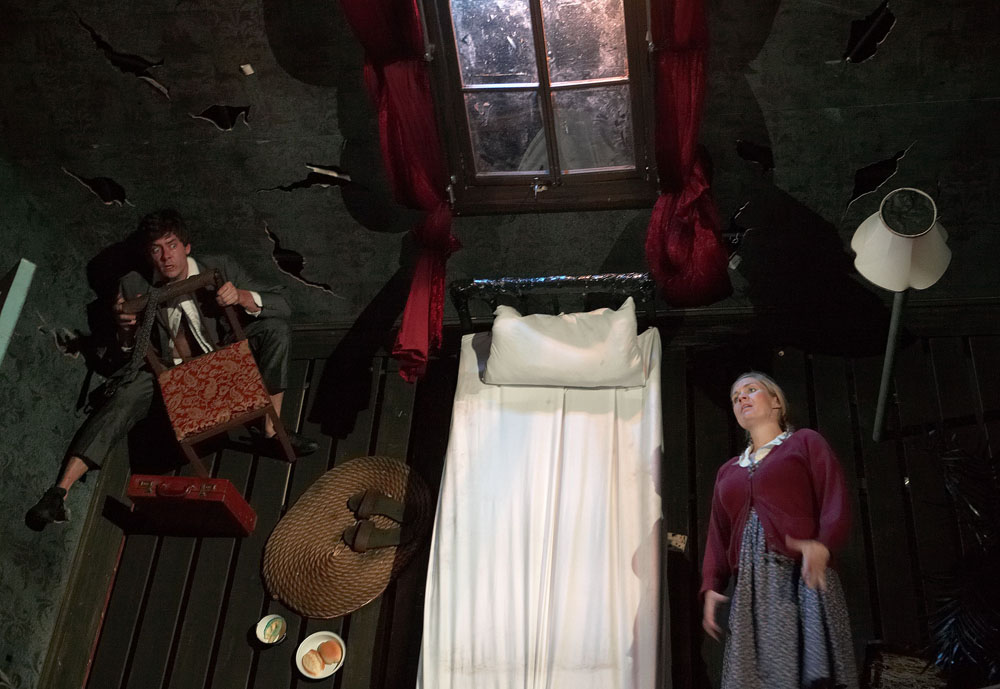
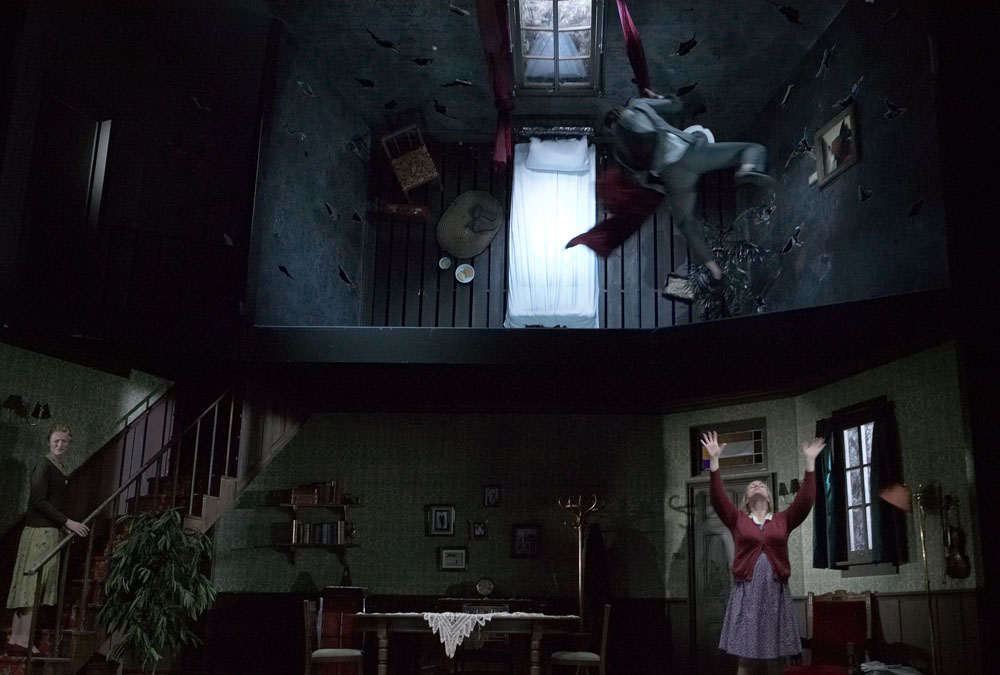
And finally my favourite two designs of the last couple of years. The first is by Börkur Jónsson, for VesturPort Theatre Company from Iceland, for their stunning production of Metamorphosis that played in Hong Kong a couple of years ago.  I was lucky enough to have front row seats and breath was taken away by every aspect of the production.

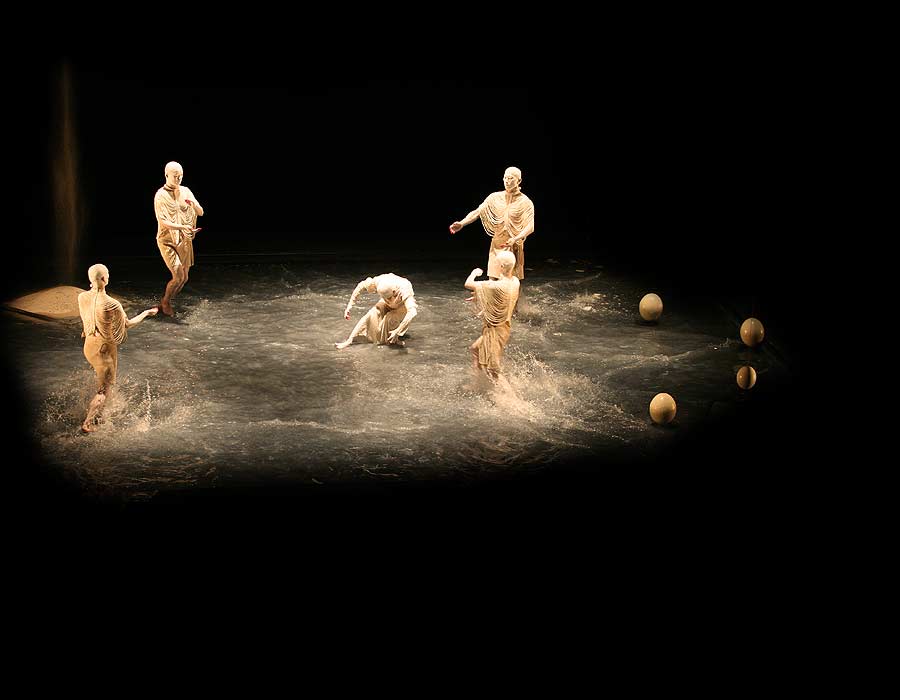
The second is by Ushio Amagatsu who directed, choreographed and designed the butoh piece Kagemi, by the Sankai Juko Company. I was privileged to see this one in Melbourne about 4 years ago. Wow.  The antithesis of my first choice, in its beautiful minimalism.

.

‘Now cross the Andes.’ In praise of the impossible stage direction

This is the article I was going to post yesterday, before I got carried away with Romans in Britain.

It’s all about stage directions and how different playwrights do or don’t use them, how they are interpreted by directors and how sometimes they are just plain ridiculous.

.My favorite is Exit, pursued by a bear

Anyway, read Mark Lawson’s article here


Dennis Kelly: “The Quest for Truth” 3

The political theatre debate continues. In an article in The Economist, Natalia Koliada is reported as saying

I am always against separating, saying there should be political theatre or social theatre or female theatre, or aboriginal theatre—it is about theatre. It is about going deep into one life, like a total immersion in personality, in a different circumstance.

Click the image above for the full article. What do you think?

Also in The Economist recently is Mohammed Al Attar,  an acclaimed young Syrian playwright who, given the appalling situation in his country, is talking about play-writing as a tool of protest:

I think theatre is political by default. But I do not directly write statements or propaganda

Again click the image above for a very different take on what is ‘political’ in theatre.

Site Very Specific. The Container

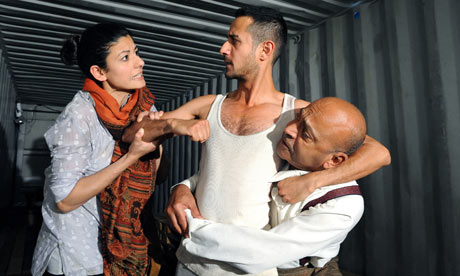
This is a still from a play called The Container, by Clare Bayley, that tells the story of five migrants – two Afghans, two Somalis and a Turkish Kurd – who are crossing Europe, accompanied by a Turkish trafficker and an unseen lorry driver. Their hoped-for destination is the UK, land of dreams. But they are experiencing only nightmares: the grim memories of what drove them from their homes, the stench of the container, and the fear of an unknown future.

The play literally takes place inside a shipping container, thousands of which I watch travel into and out of Hong Kong every day. When you talk about site-specific theatre you can’t get more specific than this. The audience sit in the container (maximum about 20) and are locked in there, with the 6 actors for the 65 minute duration of the play. The video is from a CNN piece, which gives a great visual flavour, but the third article below, Fancy seeing a play in here?, really gives you a sense of the powerful impact the experience had on the audience.

.

The Container: A Captive Audience

Photo montage from the production

Fancy seeing a play in here?

Mind you not everyone agreed that the authenticity of the experience achieved its intended impact: The play aims to depict human trafficking as realistically as possible, but in doing so loses impact