Site Very Specific. The Container

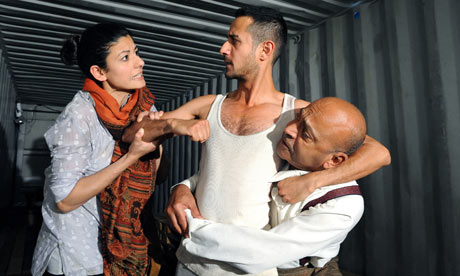
This is a still from a play called The Container, by Clare Bayley, that tells the story of five migrants – two Afghans, two Somalis and a Turkish Kurd – who are crossing Europe, accompanied by a Turkish trafficker and an unseen lorry driver. Their hoped-for destination is the UK, land of dreams. But they are experiencing only nightmares: the grim memories of what drove them from their homes, the stench of the container, and the fear of an unknown future.

The play literally takes place inside a shipping container, thousands of which I watch travel into and out of Hong Kong every day. When you talk about site-specific theatre you can’t get more specific than this. The audience sit in the container (maximum about 20) and are locked in there, with the 6 actors for the 65 minute duration of the play. The video is from a CNN piece, which gives a great visual flavour, but the third article below, Fancy seeing a play in here?, really gives you a sense of the powerful impact the experience had on the audience.

.

The Container: A Captive Audience

Photo montage from the production

Fancy seeing a play in here?

Mind you not everyone agreed that the authenticity of the experience achieved its intended impact: The play aims to depict human trafficking as realistically as possible, but in doing so loses impact

An Instinct for Kindness

I have always understood the power of theatre to make people question their beliefs.  In 1994, as a young Drama teacher, a group of my Year 11 students created an examination piece exploring the murder of a 3 year old boy, Jamie Bulger.  He had been abducted, tortured and murdered by two 11 year old boys just over a year earlier in March 1993.  The case, not surprisingly, caused outrage across the UK. The boys, Robert Thompson and Jon Venables, who were found guilty of the murder, were roundly vilified, labelled as evil.

My students wanted to explore the case, but from the perspective of Venables and Thompson, as they wanted to understand what circumstances led them to commit such a horrific crime.  The performance was watched by the Chair of the School Governors, who was a magistrate.  He wrote to the students after the performance, saying that he had never considered what they had explored, having only felt revulsion for the murderers. The play made him question his own judgement so much that he didn’t sit in court for a number of weeks after watching the students’ performance.

I was made to think about this the other day when I listened to an interview with Chris Larner . In November 2010, he had accompanied his chronically ill ex-wife to Switzerland’s Dignitas clinic. He came home with an empty wheelchair and a story to tell. Consequently he wrote (and performed in) An Instinct for Kindness, a play that reflects on the circumstances, morality and humanity surrounding the journey,  exploring both the profound personal implications and the wider ethical considerations of the contentious issue of legal euthanasia.  The controversial play has put that debate firmly on the stage. Below is an interview with Larner and extracts from the play, as well as some reviews.  Food for thought indeed.

The Guardian Review

Catholic News Review

Exeunt Review

Globe to Globe

Since I became an international educator 16 years ago, I have always had questions about teaching Shakespeare, in English, to students for whom English is a second, third or even fourth language. It’s a varied, wide and noisy debate and one that I’m not going to have here today – perhaps another time.

As I was driving to work today, I heard a report about the arrest of a man after protesting at a performance of The Merchant of Venice at the Globe Theatre in London, UK. It got me thinking. The performance was by Habima, the Israeli national theatre company and it was in their native language, Hebrew. The protest was political, and if you want to know more you can check that out here http://www.guardian.co.uk/uk/2012/may/28/man-held-globe-threatre-protest

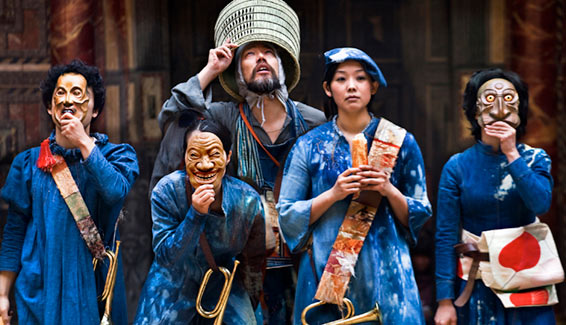
However, the point of my musing today is not about theatre and politics (again, for another time) but about the idea of Shakespeare being performed in languages other than English. As part of the World Shakespeare Festival and connected to the London Olympics, the revolutionary Globe Theatre is staging all 37 of the Bard’s plays in 37 different languages with theatre companies gathering for the event from right across the planet – The Taming of the Shrew in Urdu, Coriolanus in Japanese (above), The Merry Wives of Windsor in Swahili, Richard III in Mandarin and so on. The list is vast and quite incredible. What intrigues me more, is of course that all of these productions reflect the places, cultures, and societies that they were created in – given context by these places and the languages.

I am often told  that Shakespeare’s plays are universal and they may be just that. But unless they are re-imagined and/or re-contextualized for their intended audience what can they really say to the people watching? I applaud and celebrate The Globe Theatre for what it is doing with this festival.

Check out their website for yourself, but especially the Education page where there are some fantastic audio interviews (in a variety of languages, with translations) with the artists behind the project. This is what Shakespeare should be about and to me, gives it real value, making it contemporary and relevent to a 21st Century, global audience. Globe to Globe Festival

And if you really want to know what I am on about have a look at this A MIDSUMMER NIGHT’S DREAM. It is performed in Korean by the Yohangza Theatre Company at the Globe to Globe Festival.  I saw this performance in Hong Kong a few years ago and it was fabulous. Drawing on Korean theatre traditions it truly transported me to a different world and a different culture. Enjoy!

The Strand

The Strand is the home of arts on the BBC World Service. The Strand covers the most exciting and interesting music, books, films, architecture, dance, theatre and cultural events and big name interviews from all corners of the globe.

It’s on once a week and in various versions. They don’t always talk performance, but it is worth a listen, especially for nuggets about world theatre. You can checkout what they are covering every week by clicking on the image below.

You can get the download/podcast directly from the BBC at http://www.bbc.co.uk/podcasts/series/globalarts

Or through iTunes at http://itunes.apple.com/gb/podcast/the-strand-a-world-of-arts/id263570955

That Night Follows Day

About four years ago, me and my friend Sara were at the Melbourne International Arts Festival with a group of students. As always when we do these theatre trips, you try and cram in as many shows as possible. You pick your key shows and then build the rest of the performances around those.  That’s how we found ourselves watching That Night Follows Day by Tim Etchells. Since that day the play has been a permanent fixture in our classrooms and on our stage. It was funny and poignant and certainly left the adult audience rather stunned. That Night Follows Day explores the dynamics between grownups and kids, and was written for adult audiences—but it’s designed to be performed by children. You might say that it uses a group of young people as a giant mouthpiece that allows older people to reflect on their own behaviour and impact.

You feed us. You choose clothes for us. You lay down the law. You sing to us. You watch us sleep. You make us promises and sometimes hope we will not remember them. You tell us stories you hope will frighten us, but not too much. You try to tell us about the world. You explain to us the meaning of war. You whisper when you think we can’t hear. You explain to us that night follows day.

The video clip below is in Flemish, the language of the original production.  In fact the script for the play comes in 4 languages – Dutch, English, German and French. It doesn’t matter that the video isn’t in English, the power of the piece still shines through.


This blogger really gives a flavour of the peice: Letter from Belgium

Tim Etchells is an incredible and very talented contemporary theatre practitioner and is perhaps best known for his work with his company, Forced Entertainment. He writes an amazing blog which is always worth dipping in and out of:

http://www.timetchells.com/

Also if you want to know more about Forced Entertainment’s work you can visit their site here which has lots of video of their work

http://www.forcedentertainment.com/

That Night Follows Day is in fact a quietly revolutionary work which, with immaculate artfulness, strips theatre back to the barest essentials. Performance is the simplest utterance, and the text – a beautifully modulated series of variations on a theme – is a sequence of statements.

Alison Croggan

Peter Brook: ‘Simplicity is not a style’

All of my senior students have been Brooked at some point….and quite rightly so. When IB Theatre students ‘do’ their TPPP, the man never fails to make an appearance. This week, his latest play, based on a township short story by the South African dissident Can Themba, opens in London. In the video link below the legendary director discusses the links between the apartheid era and today’s political protests, looks back on a 70-year career – and explains why finding simplicity on stage is more complicated than you’d think.

Peter Brook Interview

Brook gave the interview to The Guardian newspaper, and in the same edition, their theatre blogger, Peter Lam talks about the influence Brook had on him:

Peter Brook’s writings made me want to do drama – and his restless exploration of the form, and the world, makes him one of its greatest living exponents

http://www.guardian.co.uk/stage/theatreblog/2012/may/25/the-suit-fits-peter-brook?intcmp=239

And finally, how could I blog about the great man without quoting his most famous utterance

I can take any empty space and call it a bare stage. A man walks across an empty space whilst someone else is watching him, and this is all that is needed for an act of theatre to be engaged

Wise words from Patsy Rodenburg

Patsy Rodenburg is a voice and acting coach who has worked with some of the world’s leading actors. She says the world needs actors more than ever. In these two talks, amongst other things, she tells the story of a profound encounter that reveals the deeper role theatre can play in people’s lives. She is an incredibly compelling speaker and what she says is really worth a listen by all theatre and performance students.